


Content Curator
Arithmetic-geometric sequence is a sequence of progression in which each term can be represented as a product of the term of an arithmetic progression and a geometric progression. It is generally abbreviated as AGP. Now, if a1,a2,a3,………..an be an arithmetic sequence and b1, b2, b3,…………bn be a geometric progression, then a1b1, a2b2,a3b3,……… anbn is called as an arithmetic-geometric sequence and it is of the form;
a,(a+d)r,(a+2d)r2,(a+3d)r3,…,[a+(n−1)d]rn−1
where, a is the first term of the sequence, d is the common difference and r is the common ratio. The sum of the number of the finite and infinite Arithmetic Geometric series can also be computed.
Read More: Math Formulas
| Table of Content |
Key Takeaways- Arithmetic Sequence, Geometric Sequence, Arithmetic Geometric Sequence, Common Difference, Common Ratio
What is Arithmetic Sequence?
[Click Here for Sample Questions]
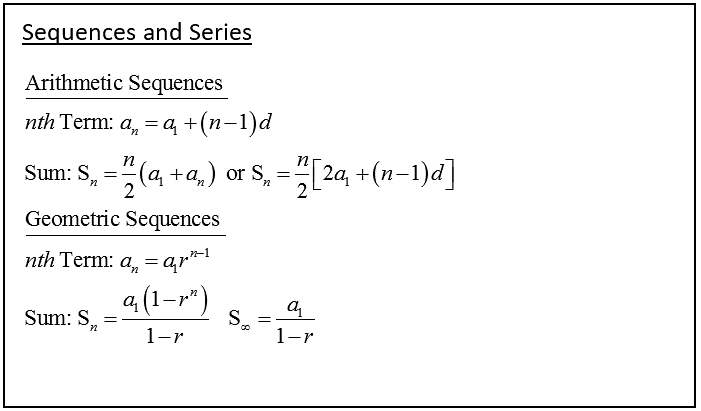
An arithmetic sequence can be regarded as an ordered set of numbers that have a common difference in terms of value between each consecutive term. Let us assume the sequence of 3,9,15,21,27… Here in this sequence, each number moves to the second number by adding or subtracting the value of 6. It is essential to mention here that the number that is added or subtracted at each level of the arithmetic sequence is called the difference and is usually represented by ‘d’.
Thus, an arithmetic sequence can be written in the following form:
a, a+d, a+2d,…………………….a +(n-2)d, a+(n-1)d
Here,
a is the first term of the sequence
d is the common difference
a + (n-1) d is the nth term of Arithmetic Sequence.
What is a Geometric Sequence?
[Click Here for Sample Questions]
Geometric sequence or progression refers to a sequence of non-zero numbers where each term after the first one is found by multiplying the previous one by an unchangeable non-zero number, called a common ratio. Thus, in the case of a geometric sequence, each number moves from one term to the next by always multiplying or dividing by the same common value or number. For instance, 2,4,8,16, 32, 64…. is a geometric sequence as each number has to be multiplied by 2 in order to get the next number in the series.
In mathematical terms, a geometric sequence can be written as;
a, ar, ar2………….arn-2, arn-1
Here,
a is the first term of the sequence.
r is the common ratio
arn-1 is the nth term of the geometric sequence.
Read Also: Latus Rectum of Ellipse
What is Arithmetic Geometric Sequence?
[Click Here for Sample Questions]
An Arithmetic-geometric sequence is a sequence or progression in which each term can be represented as a product of the term of an arithmetic progression and a geometric progression.
Now, let a1,a2,a3,………..an be an arithmetic sequence and b1, b2, b3,…………bn be a geometric progression, then a1b1, a2b2,a3b3,……… anbn is called as an arithmetic geometric sequence and it is of the form;
a, (a+d)r, (a+2d)r2, (a+3d)r3,…,[a+(n−1)d]rn−1
Here, a is the first term of the sequence, d is the common difference and r is the common ratio.
| Related Links | ||
|---|---|---|
| Arithmetic Sequence Recursive Formula | Arithmetic Sequence Explicit Formula | Einstein Field Equation |
| Arithmetic Sequence Formula | Infinite Series Formula | Relations and Functions |
Sum of Terms of Arithmetic Geometric Sequence
[Click Here for Sample Questions]
The sum of the first n terms of an arithmetic geometric sequence can be written in the following form-
Here, Sn is the sum of the terms of the sequence and An and Gn are the nth term of the arithmetic and the geometric sequence respectively.
Read Also: Permutations and Combinations
Proof
[Click Here for Sample Questions]
Multiplying the sequence
Sn= a+ | a+d |r + |a + 2d| r2 + …….+ [a +(n-1)d]rn-1
by ‘r’ we get,
Now, subtracting rSn from Sn we get,
rSn= ar + |a + 2d | r3 +…...+[a+(n-1)d]rn
Here, the last equality results from the expression of the sum of geometric progression. Dividing the expression by (1-r) gives the result.
Sum of AGP up to Infinite Terms
[Click Here for Sample Questions]
So far, we have found the sum of finitely many terms. Now let us consider an infinite many terms. As we cannot manually sum up an infinite number of terms, we will put a general approach here.
If -1 < r < 1, then the sum S of the arithmetic geometric series of infinitely many terms can be given by;
In other terms, the sum of an AGP is generally given by,
S(1 – r) = a – [a + (n – 1)d] rn + \(\frac{dr(1-r^{n-1})}{1-r}\)
S = \(\frac{a-[a+(n-1)d]r^n}{(1-r)}\) + \(\frac{dr(1-r^{n-1})}{(1-r)^2}\)
Now it has to be mentioned here that if r 1. Then the term a+n-1drn-1 gets very large and the sum does not converge. So here, we have to consider r < 1 and we will be using;
rn = 0
As we have already discussed earlier, the sum of the first n terms in an AGP can be represented by;
Sn = \(\frac{a-[a+(n-1)d]r^n}{(1-r)}\) + \(\frac{dr(1-r^{n-1})}{(1-r)^2}\)
Using it we get,
Sn = \(\frac{a}{1-r} + \frac{dr(1-0)}{(1-r)^2}\)
Sn = \(\frac{a}{1-r} + \frac{dr(1-0)}{(1-r)^2}\) (where, r < 1)
Read Also: Class 10 Mathematics Chapter 5 Arithmetic Progressions
Things to Remember
[Click Here for Sample Questions]
- An Arithmetic Sequence can be regarded as an ordered set of numbers that have a common difference in terms of value between each consecutive term.
- An arithmetic sequence can be written in the following form:
a, a+d, a+2d,…………………….a +(n-2)d, a+(n-1)d
- A Geometric Sequence refers to a sequence of non-zero numbers where each term after the first one is found by multiplying the previous one by an unchangeable non-zero number, called a common difference.
- Mathematically, a geometric sequence can be written as;
a, ar, ar2………….arn-2, arn-1
- An Arithmetic- geometric sequence is a sequence of progression in which each term can be represented as a product of the term of an arithmetic progression and a geometric progression.
- An Arithmetic- Geometric sequence can be written as;
a,(a+d)r,(a+2d)r2,(a+3d)r3,…,[a+(n−1)d]rn−1
| Chapter Related Links | ||
|---|---|---|
| Geometric Mean | Arithmetic Progression | Sequence and Series |
| Arithmetic Progressions Revision Notes | Arithmetic | Period of a Function |
Sample Questions
Ques. What is Arithmetic Progression? (2 Marks)
Ans. Arithmetic Sequence refers to an ordered set of numbers that have a common difference in terms of value between each consecutive term. The sequence of 3,9,15,21,27… is an arithmetic sequence. Here in this sequence, each number moves to the second number by adding or subtracting the value of 6.
Ques. What is a Geometric Sequence? (2 Marks)
Ans. A Geometric Sequence refers to a sequence of non-zero numbers where each term after the first one is found by multiplying the previous one by an unchangeable non-zero number, called a common difference. For example, 2,4,8,16, 32, 64…. is a geometric sequence as each number has to be multiplied by 2 in order to get the next number in the series.
Ques. What Arithmetic- Geometric Sequence? (2 Marks)
Ans. An Arithmetic-geometric sequence is a sequence or progression in which each term can be represented as a product of the term of an arithmetic progression and a geometric progression.
It is generally depicted as;
a,(a+d)r,(a+2d)r2,(a+3d)r3,…,[a+(n−1)d]rn−1
Ques. What are the similarities between arithmetic and geometric sequences? (2 Marks)
Ans. Arithmetic sequence follows terms by adding or subtracting. On the other hand, Geometric progression proceeds by multiplying the terms. The similarity between these two types of sequences is that they follow a particular pattern.
Ques. Give an example of daily life use of arithmetic progression? (1 Mark)
Ans. Using AP can be useful in predicting the next in the line in a sequence. It can be applied to someone waiting for a taxi. Assuming the traffic is moving at a constant speed one can predict when the next taxi will arrive.
Ques. Find out the sum of the following series:
1.2+2.22+ 3.23+………..+ 100.2100 (3 Marks)
Ans. Let’s denote the series by S.
Now, S= 1.2+2.22+ 3.23+………..+ 100.2100……….(i)
Or, 2S = 1.22+2.23+………..+ 99.2100+ 100.2100………(ii)
Or, -S = 1.2+ 1.22+ 1.23+…..1.2100 -100.2101
= 1.2 ( 299 -1/(2-1)- 100.2101
= -2100+ 2+ 100.2101
= 199.2100+ 2
Ques. What are the numbers to be inserted between 4 and 64 so that the resulting sequence forms a Geometric Progression? (3 Marks)
Ans. Let us assume that G1, G2, G3 are those three numbers that are to be inserted between 4 and 64.
Here, (b/a)1/n+1 = (64/4)1/3+1 = (16) ¼ = 2
G1= 4 X 2 = 8
G2 = 8 X 2 = 16
G3 = 16 X 2 = 32
Thus, the three numbers that are to be inserted are 8,16 and 32.
Ques. Arithmetic mean and geometric mean of two separate numbers are 5 and 4 respectively. Find those two numbers. (5 Marks)
Ans. Let us assume the numbers are a and b.
(a+b)/2 = 5, a+b = 5.2 = 10…………….(i)
\(\sqrt ab\)=4, ab = 16
Now, (a+b)2- (a-b)2 = 4ab
100- (a-b)2 = 4 X 16 = 64
(a-b)2 = 36
(a-b) = ±6………………….(ii)
By solving (i) and (ii) we get,
a = 8 and b = 2
Therefore, those two numbers are 8 and 2.
Do Check Out:





Comments