





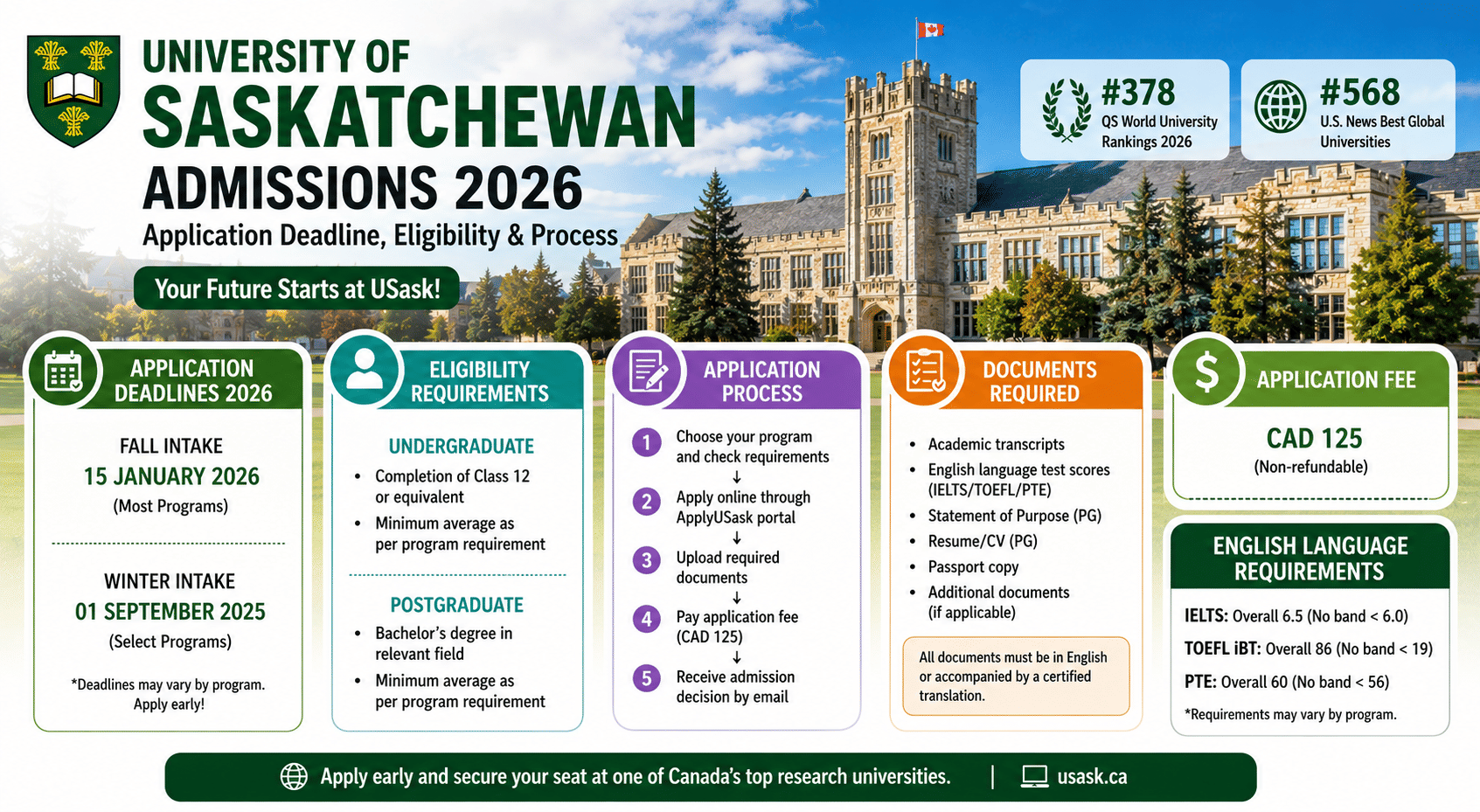
The University of Saskatchewan is home to several thousand international students, making it a diverse and globally represented campus. The university primarily offers admissions in the Fall (September) intake, while select programs also offer admissions in Winter, Spring, and Summer intakes, depending on course availability and program structure. However, most admissions are strongly dependent on seat availability and academic planning within each faculty.
- The University of Saskatchewan does not publish an official acceptance rate, but it is generally estimated to be around 70% - 75%.
- For undergraduate admission, students must have a Class 12 passing certificate with a minimum required academic percentage (varies by program).
- For postgraduate admission, students are typically required to have at least 70% in the last two years of study or equivalent academic performance, depending on the program.
- English language proficiency is mandatory and must be demonstrated through tests such as IELTS, TOEFL, PTE, or equivalent approved examinations.
- Students are also required to submit key documents such as academic transcripts, a passport copy, a statement of purpose (SOP), letters of recommendation (if required), and other program-specific documents.
The university recommends students apply as early as possible after receiving their offer of acceptance, especially when beginning the Canadian student visa process, as processing times may vary by country and intake. The overall estimated cost of a Canadian student visa, including application fee, biometrics, and associated charges, is approximately CAD 235 (INR 16,000), depending on individual circumstances and government updates.
Note: CAD 1 = INR 68.58 is the currency conversion used in the articles as of 8th June 2026.
For more information, check out the University of Saskatchewan
University of Saskatchewan Popular Courses and Fees
The University of Saskatchewan offers a wide range of undergraduate and postgraduate programs. The university follows a credit-based tuition system, in which tuition fees are calculated based on the number of credit units required for a course and the tuition rate per credit unit. As a result, the total tuition fee varies depending on the program and the courses a student enrolls in.
| Courses | Duration | Tuition Fee in CAD | Tuition Fee in INR |
|---|---|---|---|
| Master of Public Health | 2 Years | CAD 39,937 | INR 27.39 Lakhs |
| MS Computer Science | 20 Months | CAD 12,231 | INR 8.38 Lakhs |
| Master of Business Administration | 2 Years | CAD 73,558 | INR 50.44 Lakhs |
| Bachelor of Science in Computer Science | 4 Years | CAD 43,725 | INR 29.98 Lakhs |
| Bachelor of Science in Computer Engineering | 4 Years | CAD 62,214 | INR 42.67 Lakhs |
| Bachelor of Education | 4 Years | CAD 41,987 | INR 28.78 Lakhs |
Note: In addition to tuition fees, the University of Saskatchewan charges students for mandatory student fees, textbooks, and course supplies. These additional costs vary by program and course selection. Depending on the program, students can expect to pay approximately CAD 1,300 - 1,600 (INR 0.89 - 1.10 Lakhs) per year for student fees and study materials.
For more information, check out the University of Saskatchewan Courses and Fees
University of Saskatchewan Admission Requirements
The University of Saskatchewan does not publish a single set of admission requirements for all undergraduate programs. Admission requirements vary depending on the course and faculty chosen by the student. Therefore, applicants should carefully review the program-specific admission requirements before applying.
For graduate programs, the university publishes general admission requirements that apply to most master's and doctoral programs. These common graduate admission requirements are provided below.
| Requirement | Undergraduate (UG) | Postgraduate (PG) |
|---|---|---|
| Academic Qualification | Completion of Class 12 from a recognized board such as CBSE, CISCE, or a State Board. | Completion of a recognized bachelor's degree or equivalent from an accredited institution. |
| Minimum Academic Requirement | Must meet the program-specific admission average and prerequisite subject requirements. | Minimum 3 to 4 years' degree with 70% in the last 2 years of study. |
| English Language Proficiency | IELTS: Overall score of 6.5 with no score below 6.0 in each area TOEFL iBT: Overall score of 86 with minimum scores of 19 in each area Cambridge C1 Advanced: Overall score of 176 Duolingo English Test (DET): An overall score of 120, with a minimum score of 100 in each area, is required. |
|
| Document Requirements | Class 10 and Class 12 mark sheets/transcripts, proof of English proficiency (if required), and other program-specific documents. | Official academic transcripts, degree certificate, proof of English proficiency (if required), and additional documents such as references, CV, or statement of intent (if required by the program). |
| Tuition Deposit | CAD 1,000 tuition deposit after accepting the admission offer. | Varies by graduate program. |
| Application Fee | CAD 120 (INR 8,230) | CAD 120 (INR 8,230) |
University of Saskatchewan Admission Process
The admission process at the University of Saskatchewan is simple but structured, and it varies slightly for undergraduate and postgraduate applicants. International students are advised to apply early and ensure all required documents are ready before starting the application.
Step 1: Choose a Program: Students must first select their desired undergraduate or graduate program and review the specific admission requirements, including academic prerequisites and English language requirements.
Step 2: Check Eligibility Requirements: Applicants must meet the program-specific academic qualifications (Class 12 for UG or a bachelor’s degree for PG) along with required subject prerequisites and minimum grades.
Step 3: Prepare Required Documents: Students need to arrange academic transcripts, proof of English proficiency (IELTS/TOEFL/PTE), identification documents, and any additional program-specific documents.
Step 4: Submit Online Application: Applications are submitted through the official University of Saskatchewan application portal by filling in personal, academic, and program details and uploading documents.
Step 5: Pay Application Fee: Applicants are required to pay the non-refundable application fee while submitting their application.
Step 6: Receive Offer of Admission: If selected, students receive a conditional or final offer letter depending on whether all requirements have been met.
Step 7: Accept Offer & Pay Deposit: Students must accept the offer and pay the required tuition deposit to secure their seat.
Step 8: Apply for a Study Permit: After receiving the admission letter, international students must apply for a Canadian study permit to begin their studies.
Also check,
University of Saskatchewan Admission Decision
The University of Saskatchewan follows a holistic, program-specific admission process, where decisions are based on academic performance and subject prerequisites. Applicants must meet the minimum required grades in Class 12 (UG) or a recognized bachelor’s degree (PG), depending on the program applied for. Meeting minimum requirements does not guarantee admission, as competitive programs may require higher academic scores.
Admission decisions are typically based on overall academic consistency, required subject performance, and English language proficiency scores such as IELTS or TOEFL. Some programs may also evaluate additional documents like statements of intent, portfolios, or references.
The university reviews applications on a rolling basis, and students are encouraged to apply early, as some programs fill quickly. Final admission offers are issued once all required documents are submitted and evaluated by the faculty.
University of Saskatchewan Rankings
The University of Saskatchewan is recognized among Canada's leading research universities and has earned positions in several prominent global ranking systems. The table below highlights the university's recent rankings across major national and international ranking bodies.
| Ranking Body | 2026 Rank |
|---|---|
| QS World University Rankings 2026 | #378 |
| U.S. News Best Global Universities | #568 |
| THE World University Rankings 2026 | #351 - 400 |
| Collegedunia Study Abroad Rankings | #286 |
Note: University rankings may vary depending on the methodology, indicators, and evaluation criteria used by each ranking organization.
Canada Student Visa for Indian Students
For Indian students planning to study in Canada, a Study Permit (student visa) is required. It allows students to live and study in Canada for the duration of their academic program. Applicants must meet eligibility requirements and provide proof of acceptance from a recognized Canadian institution.
Key Rules & Requirements:
- Must have an offer letter (Letter of Acceptance) from a Designated Learning Institution (DLI)
- Proof of sufficient funds for tuition fees and living expenses
- Valid passport
- English language proficiency (IELTS/TOEFL/PTE if required by university)
- Medical examination and biometrics may be required
- No criminal record (police clearance certificate may be needed)
Visa Cost (Approx.):
- Study Permit Fee: CAD 150
- Biometrics Fee: CAD 85
- Total: CAD 235 (INR 16,000 (approx.))
Application Process:
Applicants must apply online through the IRCC portal, upload documents, pay fees, and complete biometrics. After approval, students receive a Port of Entry (POE) letter to enter Canada and obtain the study permit at the airport.
The processing time varies depending on application volume, so students are advised to apply well in advance of their course start date.
Also check,
- Canada Student Visa Guide for Indian Students
- Canada Student Visa
- Canada Student Visa Rejection Reasons
The University of Saskatchewan is a strong choice for international students seeking quality education in Canada, with a wide range of programs, global rankings, and research opportunities. With admissions based on program-specific requirements and a competitive but accessible process, students should carefully review eligibility criteria before applying. Since intake is limited and scholarships are competitive, early application is strongly recommended to improve admission and funding chances.
FAQs
Ques. What is the acceptance rate of the University of Saskatchewan?
Ans. The university does not publish an official acceptance rate. However, it is generally estimated to be around 70%–75%, depending on the program and applicant pool.
Ques. What are the undergraduate admission requirements?
Ans. Applicants must have completed Class 12 or equivalent from a recognized board and meet program-specific subject requirements such as Mathematics, Biology, Chemistry, or Physics, depending on the course.
Ques. What are the postgraduate (PG) admission requirements?
Ans. Applicants must hold a recognized bachelor’s degree (usually 4 years or equivalent) and meet program-specific academic requirements set by the department.
Ques. What documents are required for admission?
Ans. Students generally need academic transcripts, proof of English proficiency, a passport copy, and any additional program-specific documents such as SOP, CV, or reference letters.
College Student Profiles

University of Saskatchewan Program Fees & Deadlines
| Program | Important Dates | Fees | Application Fees | Eligibility | Financial Aid |
|---|---|---|---|---|---|
MEng Civil Engineering 2 years | USD 12,346 /Yr CAD 17,637 /Yr | 145 | IELTS:- 6.5, TOEFL:- 86, Duolingo:- 120, PTE:- 63 | ||
MPH 2 years | USD 13,313 /Yr CAD 19,018 /Yr | 145 | IELTS: 6.5, TOEFL: 4.5, PTE: 63, Duolingo: 120 | ||
| USD 8,887 /Yr CAD 12,696 /Yr | 145 | IELTS: 6.5, TOEFL: 4.5, PTE: 63, Duolingo: 120 | |||
MBA 12 months | USD 49,641 /Yr CAD 70,915 /Yr | 120 | GMAT: 500, IELTS: 6.5, TOEFL: 4.5, PTE: 63, Duolingo: 120 | ||
MEng Electrical Engineering 2 years | Application Deadline For Spring 2026 Intake (30th Nov 2026) | USD 12,346 /Yr CAD 17,637 /Yr | 145 | IELTS- 6.5, TOEFL- 86, Duolingo- 115, PTE- 63 | |
MS Agricultural Economics 2 years | USD 28,523 /Yr CAD 40,747 /Yr | 145 | IELTS:- 6.5, TOEFL:- 86, Duolingo:- 120, PTE:- 63 | ||
PharmD 4 years | USD 50,705 /Yr CAD 72,435 /Yr | 125 | IELTS:- 6.5, TOEFL:- 4.5, Duolingo:- 120, PTE:- 63 | - | |
MEng Mechanical Engineering 2 years | Application Deadline For Spring 2026 Intake (30th Nov 2026) | USD 12,346 /Yr CAD 17,637 /Yr | 145 | IELTS- 6.5, TOEFL- 86, Duolingo- 115, PTE- 63 | |
BS Computer Science 4 years | USD 29,763 /Yr CAD 42,519 /Yr | 125 | IELTS:- 6.5, TOEFL:- 86, Duolingo:- 120, PTE:- 63 | - | |
MS Pharmacy 2 years | USD 8,562 /Yr CAD 12,231 /Yr | 145 | IELTS: 6.5, TOEFL: 86, PTE: 63, Duolingo: 120 |
Do you think the Dates are wrong ? Report Here


Course Finder - Search from 50K+ courses
Popular Streams:
Reviews
Most Popular Tags
12 Reviews Found
Likes
- Very structured program
- Fast completion schedule for both MSc and PhD
- Very supportive faculty and staff
Dislikes
- Very high tuition
- Limited teaching options for students
- Hard to find jobs elsewhere as the program is intense
Scholarship
- Yes I was awarded with two fellowships. For the first 3 years it was a WCVM-CGPS scholarship and the rest was Graduate teaching fellowship.
- For both fellowship minimum GPA is 4-4.5 and good academic track records is a must.
- Most of them were supported by my PI’s grant and one of my lab mate also received Dean's scholarship from U of S.
- I don’t know how many students received fellowships as that information is confidential with the university.
- The scholarship that I received was only given to 4 people for the entire time period that I spent for my PhD period.
Overview
IELTS for language evaluation. My score - overall 8. For masters program good GPA (>3.9) and research interest. Yes, an interview with my supervisor where the goals of my research and my past experience were tested to check if it was worth to accepted me. My advise would be be yourself, dont overthink and answer in a professional but calm manner. My interest on Agricultural and Food Processing was well aligned with the University's major research. With extensive researches going on various biomass, I tried here. The college life is very diverse. People are very friendly and exciting to meet. Knowledge transfer is great with emphasis on maintaining good mental health. Promoting extracurricular activities and indulging is pretty good.
Scholarship
No Scholarships.
Overview
When i was in my 3rd year of Btech, one of my professors had done his Phd from University of Saskatchewan. So he has mentioned this professor. At that time, i did not pay much heed to that, because i was preparing for US. So when i started facing some financial problems, another professor of mine who i did my internship with, he also suggested me to try here. And i thought, why not. So, this is how I came across to this university.
Overview
I wanted to opt for a 1-year course since I am already a master's.
Scholarship
NO
Overview
There are a few factors that helped me choose University:-1. Fees structure:- It aligned with my budget and provides me an economically pressure-free environment to study.2. Supervisor:- My Supervisor is very helpful and understanding which helps me pursue my degree at a very good pace.3. Course and Research topic:- I got the research topic in the field I always wanted to go. My choices were Automobile, Design, Material Science, and Manufacturing.
Scholarship
Yes, I received the Graduate Research fellowship Award worth $16000/year. I was nominated by my Professor to the dept. of Mechanical Engineering for the Award based on current course percentage (which is 90.5%) and research work progress.
Overview
I live in Saskatoon so I decided this was the most convenient and affordable option for me. The nutrition program also had the practicum included in it, which other provinces don't have- you have to compete for it. The fact that I would not have to compete for this made the program much more appealing to me to apply for.
Overview
The way residence works to get into the medical school so it'd be easier for me to get a spot if I did my undergrad in the province and this is the better out of the two major schools in the province. In addition, it just seems like it has a vast selection of postgraduate options.
Overview
I opted for this college due to location and reputation. I am from a small town 3 hours away from it, therefore I only have a short drive in order to make it back home. This college also has almost the best reputation for its agriculture program in Canada, making me choose it.
Overview
I chose the university of Saskatchewan because they offered the nutrition program I was interested in and the program had a guaranteed internship. I am also from Saskatoon where the university of Saskatchewan is located.
Scholarship
During my time at the university of Saskatchewan, I did not receive any kind of scholarship or financial aid.
Overview
It was close to home. My family was in Saskatoon, I had friends from high school who also went to this university. The tuition is cheaper. I am familiar with the city, didn't have to move away, and I could live at home while going to school.
interested in this College ?
Follow & Share this college to get information about admission.



Comments