


Study Abroad Content Specialist | KdTvCV - Jun 1, 2026
Canada does not follow a single national grading system. Each province, and often each university, uses its own combination of letter grades, percentage scores and Grade Point Average (GPA) scales. Most Canadian universities use either a 4.0 GPA scale or a 9.0 GPA scale, with some institutions using a 4.33 scale.
For Indian students, understanding the Canadian grading system is essential before applying, since your Class 12 percentage or CGPA needs to be converted into a Canadian-equivalent GPA for admission purposes. A CGPA of 8.0 on a 10-point Indian scale converts to approximately 3.2 on a 4.0 Canadian GPA scale, which meets the minimum requirement for most postgraduate programs. Visit MS in Canada for score requirements and deadlines to apply.
This guide covers the full Canadian grading system — letter grades, GPA scales, province-wise breakdowns, university-specific scales from official sources, credit hours and how to convert your Indian CGPA to Canadian GPA.
Also read: Study in Canada for Indian Students 2026 — Complete Guide
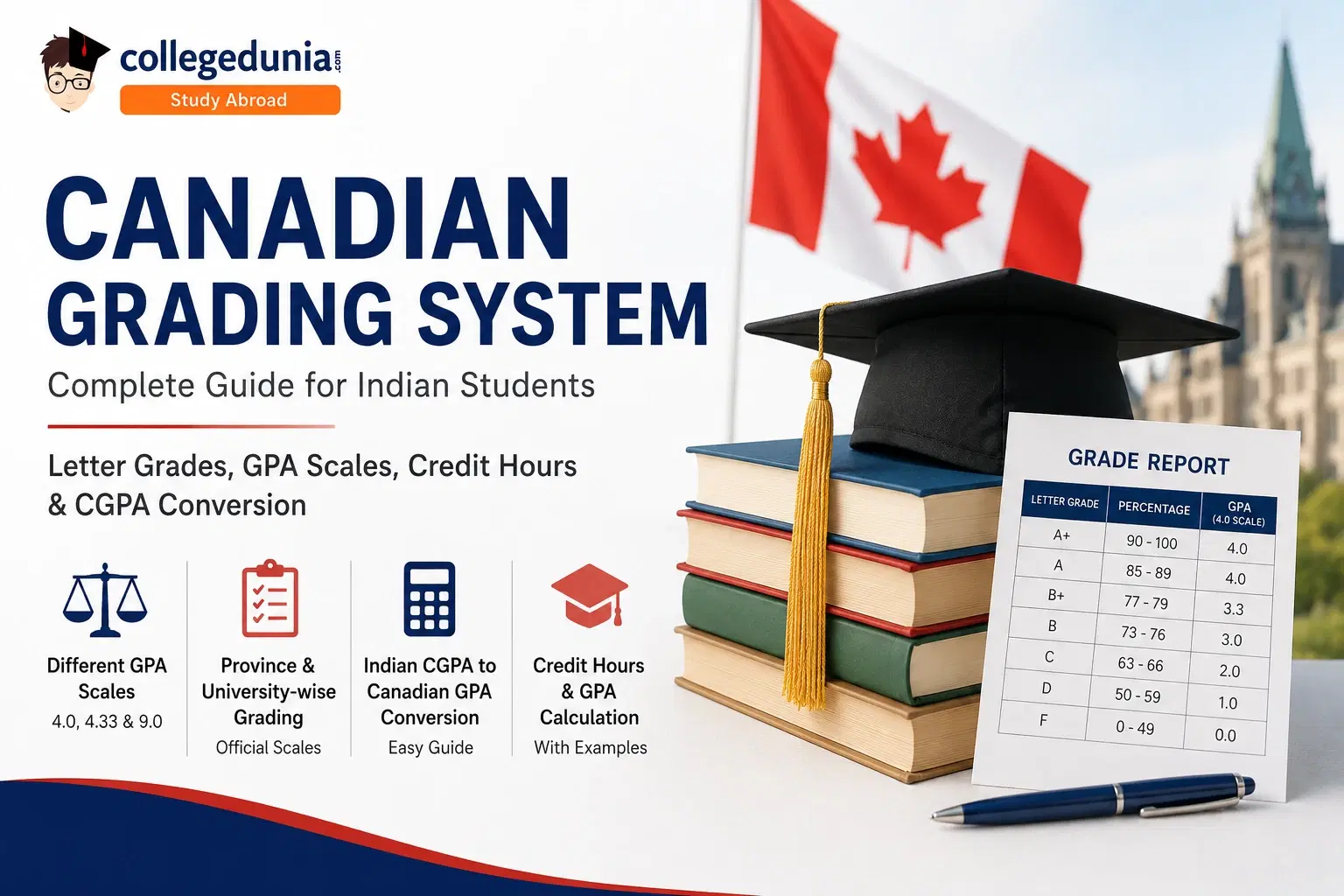
How the Canadian Grading System Works?
Canadian universities evaluate academic performance using three formats: letter grades, percentage scores, and GPA. These three formats are used together — a percentage score is converted to a letter grade, which is then assigned a GPA value.
- Students receive a percentage score (0-100%) based on exams, assignments and coursework
- The percentage is converted into a letter grade (A+, A, B+, B, C, D or F)
- Each letter grade is assigned a GPA value on a 4.0, 4.33 or 9.0 scale
- Every course carries a specific number of credit hours — courses with more credits have a greater impact on the final GPA
- The overall GPA is calculated as a weighted average across all completed courses
Important for Indian students: Canada does not have a centralised grading authority. The same letter grade can represent different percentage ranges at different universities. Always check the specific grading scale of the university you are applying to.
Read more: Top Universities in Canada for Indian Students 2026
Canadian Letter Grade to Percentage and GPA Conversion
Most Canadian universities follow one of two GPA scales: Scale I (4.0 or 4.33) or Scale II (9.0). The table below shows the standard conversion used across the majority of Canadian institutions.
Scale I: 4.0 and 4.33 GPA Scale
| Letter Grade | Percentage Range | GPA (4.0 Scale) | GPA (4.33 Scale) | Description |
|---|---|---|---|---|
| A+ | 90-100% | 4.0 | 4.33 | Excellent |
| A | 85-89% | 4.0 | 4.0 | Excellent |
| A- | 80-84% | 3.7 | 3.7 | Excellent |
| B+ | 77-79% | 3.3 | 3.3 | Good |
| B | 73-76% | 3.0 | 3.0 | Good |
| B- | 70-72% | 2.7 | 2.7 | Good |
| C+ | 67-69% | 2.3 | 2.3 | Adequate |
| C | 63-66% | 2.0 | 2.0 | Adequate |
| C- | 60-62% | 1.7 | 1.7 | Adequate |
| D+ | 57-59% | 1.3 | 1.3 | Marginal |
| D | 53-56% | 1.0 | 1.0 | Marginal |
| D- | 50-52% | 0.7 | 0.7 | Marginal |
| F | 0-49% | 0.0 | 0.0 | Fail |
Scale II: 9.0 GPA Scale
| Letter Grade | Percentage Range | GPA (9.0 Scale) | Description |
|---|---|---|---|
| A+ | 90-100% | 9 | Excellent |
| A | 80-89% | 8 | Excellent |
| B+ | 75-79% | 7 | Good |
| B | 70-74% | 6 | Good |
| B- | 65-69% | 5 | Good |
| C+ | 60-64% | 4 | Adequate |
| C | 55-59% | 3 | Adequate |
| C- | 50-54% | 2 | Adequate |
| D | 40-49% | 1 | Marginal |
| F | 0-39% | 0 | Fail |
Note: The 9.0 scale is used by universities, including the University of Manitoba and York University. The 4.0 and 4.33 scales are used by the majority of Canadian universities, including the University of Toronto, Queen's University, McGill University, and most Ontario institutions.
University-Specific Grading Scales in Canada
Grading scales vary between universities even within the same province. The tables below are sourced directly from official university registrar pages.
University of Toronto Grading Scale (Official)
Source: University of Toronto Registrar's Office (registrar.utoronto.ca)
| Grade Meaning | Letter Grade | Percentage | Grade Point Value |
|---|---|---|---|
| Excellent | A+ | 90-100% | 4.0 |
| Excellent | A | 85-89% | 4.0 |
| Excellent | A- | 80-84% | 3.7 |
| Good | B+ | 77-79% | 3.3 |
| Good | B | 73-76% | 3.0 |
| Good | B- | 70-72% | 2.7 |
| Adequate | C+ | 67-69% | 2.3 |
| Adequate | C | 63-66% | 2.0 |
| Adequate | C- | 60-62% | 1.7 |
| Marginal | D+ | 57-59% | 1.3 |
| Marginal | D | 53-56% | 1.0 |
| Marginal | D- | 50-52% | 0.7 |
| Inadequate | F | 0-49% | 0.0 |
Note for U of T Graduate students: The graduate grade scale at the University of Toronto uses a truncated scale. A grade of FZ (0-69%) is assigned for failure at the graduate level. The minimum passing grade in graduate studies is B- (70%).
Queen's University Grading Scale (Official)
Source: Queen's University Registrar (queensu.ca/registrar)
| Letter Grade | Grade Points | Percentage | Notes |
|---|---|---|---|
| A+ | 4.3 | 90-100% | Highest grade |
| A | 4.0 | 85-89.9% | - |
| A- | 3.7 | 80-84.9% | - |
| B+ | 3.3 | 77-79.9% | - |
| B | 3.0 | 73-76.9% | - |
| B- | 2.7 | 70-72.9% | Minimum passing grade in Graduate Studies |
| C+ | 2.3 | 67-69.9% | - |
| C | 2.0 | 63-66.9% | - |
| C- | 1.7 | 60-62.9% | Minimum passing grade in Medicine and Nursing |
| D+ | 1.3 | 57-59.9% | - |
| D | 1.0 | 53-56.9% | - |
| D- | 0.7 | 50-52.9% | - |
| F | 0.0 | 0-49.9% | Failure |
Note: Queen's University uses a 4.3 scale (not 4.0). The A+ grade carries 4.3 grade points at Queen's—higher than the standard 4.0 used at the University of Toronto. This is an important distinction when comparing GPAs across Canadian universities.
Grading System in Canada by Province
Canada has 10 provinces, and each follows a broadly similar structure but with variations in GPA scale, passing thresholds, and letter grade ranges. The table below summarizes the grading approach in the major provinces where most Indian students study.
| Province | GPA Scale Used | Top Grade | Passing Grade | Key Feature |
|---|---|---|---|---|
| Ontario | 4.0 or 4.33 | A+ (90-100%) | 50% (D-) | Most universities use the OUAC 9-scale conversion system for professional school applications |
| British Columbia | 4.33 | A (86-100%) | 50% (C-) | Teacher-centric system — instructors may decide their own grade-to-GPA conversion |
| Alberta | 4.0 or 4.3 | A+ (90-100%) | 50% (D) | Teacher-centric system; A+ = 4.3 at most Alberta institutions |
| Quebec | 4.0 (McGill); 4.0 (Laval) | A+ (90-100%) | 50-55% depending on institution | McGill uses a unique scale where A = 85-100% (no A+ distinction in some faculties) |
| Manitoba | 9.0 (University of Manitoba) | A+ (90-100%) = 9 | 50% (D = 1) | Uses the 9.0 scale — one of the few provinces where this is standard |
| Nova Scotia | 4.0 or 4.33 | A+ (90-100%) | 50% | Dalhousie University uses both Scale 3 and Scale 7 depending on faculty |
| Saskatchewan | Percentage-based (no GPA) | 90-100% = Excellent | 50% | Simpler percentage-based system; GPA not always calculated |
Province-Wise Grading: Alberta (4.3 Scale)
| Letter Grade | Percentage | GPA (4.3 Scale) |
|---|---|---|
| A+ | 90-100% | 4.3 |
| A | 85-89% | 4.0 |
| A- | 80-84% | 3.7 |
| B+ | 77-79% | 3.3 |
| B | 73-76% | 3.0 |
| B- | 70-72% | 2.7 |
| C+ | 67-69% | 2.3 |
| C | 63-66% | 2.0 |
| C- | 60-62% | 1.7 |
| D+ | 55-59% | 1.3 |
| D | 50-54% | 1.0 |
| F | 0-49% | 0.0 |
Province-Wise Grading: British Columbia
| Letter Grade | Percentage Range |
|---|---|
| A | 86-100% |
| B | 73-85% |
| C+ | 67-72% |
| C | 60-66% |
| C- | 50-59% |
| F | 0-49% |
Read more: Universities in British Columbia for Indian Students
Credit Hours in the Canadian Grading System
Every course at a Canadian university is assigned a specific number of credit hours, and these credits directly affect your GPA calculation. A course with more credit hours has a greater impact on your overall GPA than a course with fewer credits.
In Canada, 1 credit hour = 1 hour of classroom instruction per week during a semester. A standard 3-credit course meets for 3 hours per week. The number of credits per course is set by the faculty and listed in the course schedule.
| Degree Level | Total Credits Required | Typical Credits per Course | Full-Time Semester Load |
|---|---|---|---|
| Bachelor's Degree | ~120 credits | 3-4 credits | 15 credits per semester |
| Master's Degree | 30-60 credits | 3 credits | 9-12 credits per semester |
| PhD | Varies by program | 3 credits | Varies; research-based |
How to Calculate Weighted GPA in Canada?
Formula: GPA = [Total of (Course GPA x Credit Hours)] / Total Credit Hours
Worked example for an Indian student in their first semester at a Canadian university:
| Course | Grade | GPA Value | Credit Hours | GPA x Credits |
|---|---|---|---|---|
| Data Structures | A | 4.0 | 3 | 12.0 |
| Statistics | B+ | 3.3 | 3 | 9.9 |
| Technical Writing | A- | 3.7 | 2 | 7.4 |
| Database Systems | B | 3.0 | 3 | 9.0 |
| Research Methods | A+ | 4.0 | 3 | 12.0 |
| Total | 14 | 50.3 |
Semester GPA = 50.3 / 14 = 3.59 — this is considered a strong GPA at most Canadian universities.
What is a Good GPA in Canada?
A GPA of 3.0 or above on a 4.0 scale is generally considered the minimum for postgraduate admission at most Canadian universities. Competitive programs at top universities like the University of Toronto, McGill, and UBC typically require a 3.5 or higher.
| GPA Range (4.0 Scale) | Evaluation | What It Means for Indian Students |
|---|---|---|
| 3.7 - 4.0 | Excellent | Competitive for top programs at U of T, McGill, UBC and scholarships |
| 3.5 - 3.6 | Very Good | Strong profile; eligible for most graduate programs and merit awards |
| 3.0 - 3.4 | Good | Meets minimum requirement for most postgraduate programs in Canada |
| 2.5 - 2.9 | Average | May qualify for some programs; limits options at competitive universities |
| Below 2.5 | Below Average | Unlikely to meet minimum requirements at most Canadian universities |
Minimum GPA Requirements at Top Canadian Universities
| University | Minimum GPA for PG Admission | GPA Scale Used | Notes |
|---|---|---|---|
| University of Toronto | 3.0 (B) | 4.0 | Minimum B- (2.7) for Graduate Studies; competitive programs require 3.5+ |
| Queen's University | 2.7 (B-) | 4.3 | B- is minimum passing grade in Graduate Studies; most programs expect 3.0+ |
| McGill University | 3.0 | 4.0 | Competitive programs in Engineering and Medicine require 3.5+ |
| University of British Columbia | 3.0 | 4.33 | 76% average or higher for most graduate programs |
| University of Alberta | 3.0 | 4.0 | Equivalent to 73% or B grade |
| University of Waterloo | 3.0 | 4.0 | 70% minimum for most graduate programs |
How to Convert Indian CGPA and Percentage to Canadian GPA
Indian universities use a 10-point CGPA scale or a percentage system, while Canadian universities use a 4.0 GPA scale. Converting your Indian academic score to a Canadian GPA equivalent is a required step for most Canadian university applications.
Formula: Indian CGPA to Canadian GPA
Canadian GPA = (Your CGPA / Maximum CGPA) x 4
Example: If your CGPA is 8.5 out of 10 — Canadian GPA = (8.5 / 10) x 4 = 3.4
Indian CGPA to Canadian GPA Conversion Table
| Indian CGPA (out of 10) | Indian Percentage (approx.) | Canadian GPA (4.0 Scale) | Canadian Letter Grade | Evaluation |
|---|---|---|---|---|
| 9.5 - 10.0 | 95-100% | 3.8 - 4.0 | A / A+ | Excellent |
| 9.0 - 9.4 | 90-94% | 3.6 - 3.76 | A- | Excellent |
| 8.5 - 8.9 | 85-89% | 3.4 - 3.56 | A- / B+ | Very Good |
| 8.0 - 8.4 | 80-84% | 3.2 - 3.36 | B+ | Good |
| 7.5 - 7.9 | 75-79% | 3.0 - 3.16 | B | Good — meets most PG minimums |
| 7.0 - 7.4 | 70-74% | 2.8 - 2.96 | B- | Average — may limit options |
| 6.5 - 6.9 | 65-69% | 2.6 - 2.76 | C+ | Below average for most PG programs |
| 6.0 - 6.4 | 60-64% | 2.4 - 2.56 | C | Below minimum for most Canadian universities |
Important note for Indian students: This conversion is an approximation. Canadian universities may use WES (World Education Services) or other credential evaluation agencies to officially assess your Indian degree. Always check the specific conversion method required by your target university.
Read more: Cost of Studying in Canada for Indian Students 2026
Passing Grade Thresholds by Program Type in Canada
The minimum passing grade in Canada is not the same across all programs. Professional programs such as Medicine, Law, Nursing, and Graduate Studies have higher passing thresholds than standard undergraduate courses. Indian students applying to these programs must be aware of these differences.
| Program Type | Minimum Passing Grade | Percentage Equivalent | Notes |
|---|---|---|---|
| Standard Undergraduate | D- (50%) | 50-52% | Minimum to pass a course and earn credit |
| Graduate Studies (Master's / PhD) | B- (70%) | 70-72% | Confirmed at University of Toronto and Queen's University; below B- = fail at graduate level |
| Medicine and Nursing | C- (60%) | 60-62% | Confirmed at Queen's University; University of Toronto Dentistry and Medicine passing mark is 60% |
| Law (JD) | D (50-59%) | 50-59% | Queen's Law Faculty uses letter grades without percentage equivalents; D = Marginal pass |
| Pharmacy | Varies by institution | Typically 60%+ | Check individual university pharmacy faculty requirements |
Key takeaway for Indian students: If you are applying for a Master's or PhD program in Canada, you need a minimum of 70% (B- equivalent) in every course to pass. Scoring below 70% in a graduate course is treated as a failure at most Canadian universities—unlike in India, where 50-55% is often considered a pass at the postgraduate level.
Canadian Grading System vs Indian Grading System
The Canadian and Indian grading systems differ significantly in structure, scale, and passing thresholds. The table below gives Indian students a direct side-by-side comparison.
| Feature | Canada | India |
|---|---|---|
| Primary Scale | 4.0 GPA (most universities); 9.0 GPA (some universities) | 10-point CGPA (most universities); percentage (some universities) |
| Grading Format | Letter grades (A+ to F) + percentage + GPA | Percentage or CGPA; letter grades less common |
| Top Grade | A+ (90-100%) = 4.0 GPA | O or A+ (90-100%) = 10 CGPA |
| Passing Grade (UG) | D- = 50% | Typically 35-40% (varies by board and university) |
| Passing Grade (PG) | B- = 70% (at most universities) | Typically 50-55% |
| National Uniformity | No — varies by province and university | Partial — UGC guidelines exist but implementation varies |
| Credit System | Credit hours (1 credit = 1 hour/week); weighted GPA | Credit-based system under CBCS; weighted CGPA |
| Distinction / Honours | No formal distinction label; GPA 3.7+ considered excellent | Distinction typically 75%+; First Class 60%+ |
| Credential Evaluation for Abroad | WES Canada used for international degree assessment | WES India used for Canadian university applications |
Read more: Canada Student Visa for Indian Students 2026
Canada's grading system differs significantly from India's, with universities using GPA scales such as 4.0, 4.33, or 9.0 alongside letter grades and percentages. Since there is no national grading standard, admission requirements vary by institution, making it important for Indian students to understand university-specific GPA conversions and evaluation methods.
In general, a GPA of 3.0 (roughly equivalent to 75% or a CGPA of 7.5/10 in India) meets the minimum requirement for most postgraduate programs, while top universities often expect 3.5 or higher. Before applying, students should verify grading policies and credential evaluation requirements to accurately assess their eligibility and build a competitive application for Canadian universities.
FAQs
Ques. What grading system does Canada use?
Ans. Canada uses a combination of letter grades (A+ to F), percentage scores (0-100%) and Grade Point Average (GPA). Most universities calculate GPA on a 4.0 or 4.33 scale, while some universities such as the University of Manitoba and York University use a 9.0 scale. There is no single national grading system — each province and university follows its own variation. The grading scale at University of Toronto uses a 4.0 scale, Queen's University uses a 4.3 scale and the University of Manitoba uses a 9.0 scale.
Ques. What is a good GPA in Canada for Indian students?
Ans. A GPA of 3.0 or above on a 4.0 scale is considered the minimum for postgraduate admission at most Canadian universities. A GPA of 3.5 or higher is considered very good and makes you competitive for top programs at University of Toronto, McGill, UBC and University of Alberta. For scholarships and highly competitive programs, a GPA of 3.7 or above is typically required. For Indian students, a CGPA of 7.5 out of 10 converts to approximately 3.0 on the Canadian 4.0 scale.
Ques. How do I convert my Indian CGPA to Canadian GPA?
Ans. Use this formula: Canadian GPA = (Your CGPA / 10) x 4. For example, a CGPA of 8.0 out of 10 converts to (8.0 / 10) x 4 = 3.2 on the Canadian 4.0 scale. A CGPA of 9.0 converts to 3.6. This is an approximation — Canadian universities may use WES (World Education Services) for official credential evaluation. Always check the specific conversion method required by your target university before applying.
Ques. What is the passing grade in Canadian universities?
Ans. The passing grade varies by program type. For standard undergraduate courses, the minimum passing grade is typically D- (50%). For graduate programs (Master's and PhD), the minimum passing grade at most universities including University of Toronto and Queen's University is B- (70%) — scoring below 70% in a graduate course is treated as a failure. For Medicine and Nursing at Queen's University, the minimum passing grade is C- (60%).
Ques. Does every Canadian province use the same grading system?
Ans. No. Canada has no single national grading system. Ontario uses a 4.0 or 4.33 scale. Alberta uses a 4.0 or 4.3 scale with a teacher-centric approach where instructors may decide their own grade-to-GPA conversion. British Columbia uses a 4.33 scale. Manitoba uses a 9.0 scale at the University of Manitoba. Saskatchewan uses a simpler percentage-based system without a formal GPA calculation at some institutions. Always check the grading scale of the specific university you are applying to.
Ques. What are credit hours in the Canadian grading system?
Ans. In Canada, 1 credit hour = 1 hour of classroom instruction per week during a semester. A standard course carries 3 credit hours and meets for 3 hours per week. Credit hours are important because they determine your GPA calculation — courses with more credits have a greater impact on your overall GPA. A Bachelor's degree typically requires 120 credits to complete. A Master's degree requires 30-60 credits depending on the program and university.
Ques. How is GPA calculated in Canadian universities?
Ans. Canadian universities calculate GPA using a weighted average formula: GPA = [Total of (Course GPA x Credit Hours)] / Total Credit Hours. Each course grade is converted to a GPA value, multiplied by the number of credit hours for that course, and the results are added together and divided by the total credit hours. For example, if you score A (4.0) in a 3-credit course and B+ (3.3) in another 3-credit course, your GPA = (12.0 + 9.9) / 6 = 3.65.
Ques. What percentage is required for admission to Canadian universities for Indian students?
Ans. For undergraduate admission, most Canadian universities require a minimum of 70-75% in Class 12 (CBSE or equivalent). For postgraduate admission, a minimum of 55-60% in your bachelor's degree (equivalent to a Canadian GPA of 2.5-3.0) is typically required. Competitive programs at top universities such as University of Toronto, McGill and UBC may require 75-80% or above in your bachelor's degree. Always check the specific requirements of your target program as they vary significantly.
Ques. Is 75% in India equivalent to a good GPA in Canada?
Ans. A score of 75% in India is approximately equivalent to a Canadian GPA of 3.0 on a 4.0 scale (B grade). This meets the minimum requirement for most postgraduate programs in Canada. However, for competitive programs at top universities, 75% may be considered borderline. A score of 80% or above in India (approximately 3.2-3.5 Canadian GPA) gives you a stronger application profile for most Canadian universities.
Ques. Do Canadian universities accept Indian degrees without credential evaluation?
Ans. Most Canadian universities require Indian students to submit their transcripts through a recognised credential evaluation agency such as WES (World Education Services) for official GPA conversion. WES Canada evaluates your Indian degree and converts your grades to the Canadian equivalent. Some universities may accept self-reported grades at the application stage but will require official WES evaluation before final admission. Check the specific requirements of your target university before applying.





_(3)1716804776.png?tr=w-305,h-145,c-force?h=175&w=350&mode=stretch)






Comments