




Students appearing for the AHSEC HS Compartment 2026 Science examination can strengthen their preparation by focusing on the most important chapters in Physics, Chemistry and Mathematics along with regular practice of previous years' question papers.
- The AHSEC HS Compartment Examination gives Class 12 students another opportunity to clear one or two subjects without waiting for the next academic session.
- In Physics and Chemistry, the examination includes 70 marks for theory and 30 marks for practical while Mathematics is conducted as a 100 mark theory paper.
- The AHSEC HS Compartment 2026 examination is expected to be held in July 2026 giving students several weeks to complete revision after the declaration of the main examination results.
Related Links:
- AHSEC Class 12 Exam 2026: Result Out, Compartment Exam Dates, Toppers and Pass Percentage
- AHSEC HS Compartment Exam 2026: Routine Expected Soon, Eligibility, Dates and How to Apply
- AHSEC Class 12 Compartment 2026 Exam Day: Documents to Carry, Reporting Time and Centre Rules

Key Summary
- Students should understand the minimum qualifying marks for each subject and plan their preparation accordingly.
- Solving five or more previous years' AHSEC question papers for each subject can help students become familiar with the question pattern, marking scheme and time management.
- The AHSEC HS Compartment 2026 examination is expected to follow the same syllabus and exam pattern as the main board examination.
AHSEC Compartment 2026 Science Stream Overview
The AHSEC HS 2nd Year Compartment Examination gives Science stream students another opportunity to clear the subjects they could not pass in the main board examination.
- The AHSEC HS Compartment follows the same syllabus, paper pattern, and marking scheme as the regular HS 2nd Year examination, so students can continue their preparation using the same study material.
- After successfully clearing all the pending subjects through the compartment examination, the results are updated in the official academic record.
- Once students qualify in all subjects, AHSEC issues the final HS marksheet reflecting the completed examination record.
| Details | Information |
|---|---|
| Conducting Body | Assam Higher Secondary Education Council (AHSEC) |
| Exam Name | AHSEC HS 2nd Year Compartment Exam 2026 |
| Stream | Science — Physics, Chemistry, Mathematics |
| Theory Marks | Physics: 70 | Chemistry: 70 | Mathematics: 100 |
| Practical Marks | Physics: 30 | Chemistry: 30 | Mathematics: Nil |
| Passing Criteria |
30% in theory + 33% overall (theory + practical for Phy/Chem); 30% overall for Mathematics |
| Expected Exam Month |
July 2026 (most likely; check official site) |
| Official Website | ahsec.assam.gov.in |
Also Check: AHSEC Class 12 Compartment Result 2026: How to Check at ahsec.assam.gov.in
Ques. Will practical marks from the main AHSEC HS examination be carried forward in the Science compartment exam?
Ans. Yes. For Physics and Chemistry, the practical marks obtained in the main AHSEC HS examination are generally carried forward to the compartment examination. Students are usually required to reappear only for the theory paper in the failed subject, unless otherwise notified by AHSEC. They should check the official notification for any subject-specific instructions.
Physics Preparation Tips and Key Focus Areas
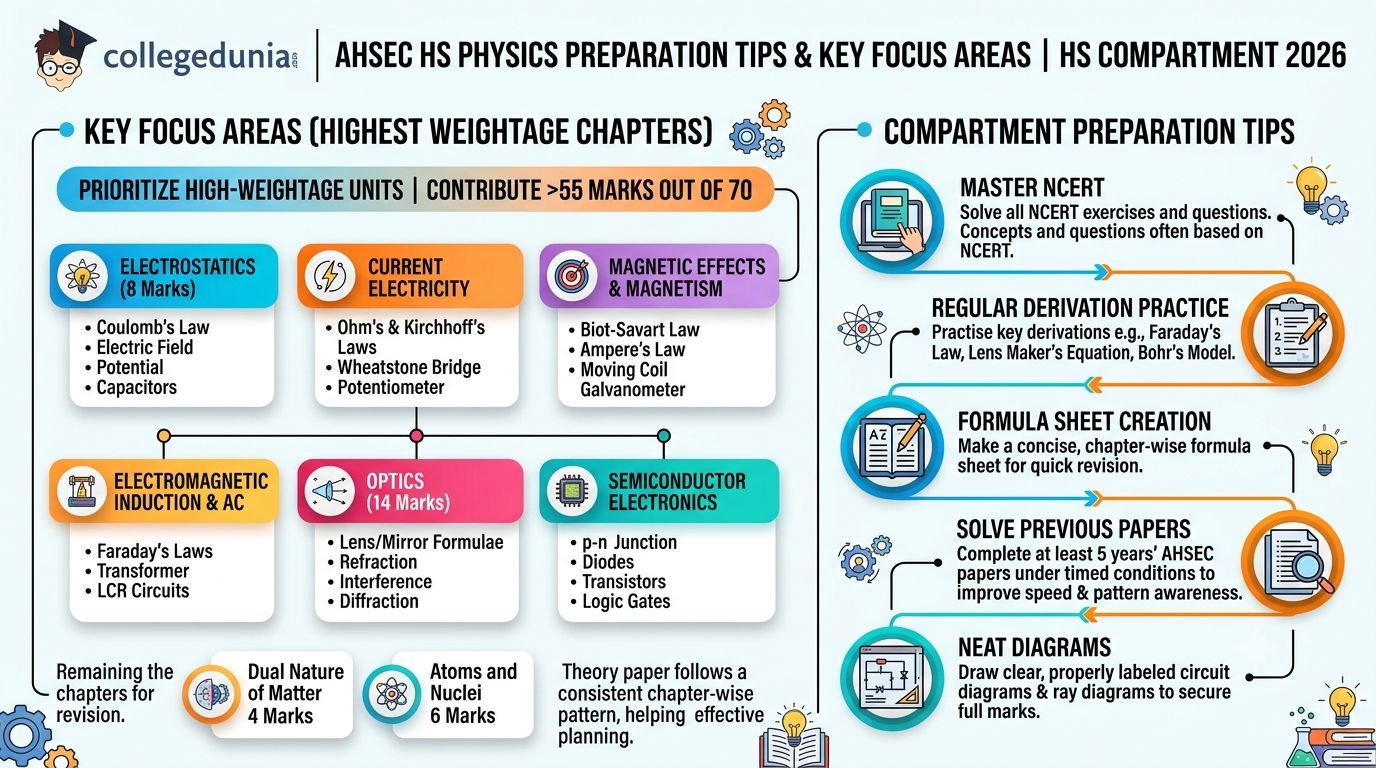
The AHSEC HS Physics paper may appear challenging at first, but the theory paper follows a consistent chapter-wise pattern, helping students plan their preparation more effectively.
- Students should give priority to Electrostatics, Current Electricity, Ray Optics and Optical Instruments, Moving Charges and Magnetism, Electromagnetic Induction and Alternating Current, and Semiconductor Electronics, as these chapters carry the highest weightage.
- Together, these units contribute more than 55 marks in the 70-mark theory paper, making them the most important topics for the AHSEC HS Compartment 2026 examination.
- After completing these high-weightage chapters, students should revise the remaining syllabus and solve previous years' question papers to strengthen their preparation.
| Chapter | Approx. Marks | Key Topics |
|---|---|---|
| Electrostatics | 8 marks |
Coulomb’s law, electric field, potential, capacitors |
| Current Electricity | 7 marks |
Ohm’s law, Kirchhoff’s laws, Wheatstone bridge, potentiometer |
| Magnetic Effects and Magnetism | 8 marks |
Biot-Savart law, Ampere’s law, moving coil galvanometer |
| Electromagnetic Induction and AC | 8 marks |
Faraday’s laws, transformer, LCR circuits |
| Optics | 14 marks |
Lens and mirror formulae, refraction, interference, diffraction |
| Dual Nature of Matter | 4 marks |
Photoelectric effect, de Broglie wavelength |
| Atoms and Nuclei | 6 marks |
Bohr’s model, radioactive decay, half-life, binding energy |
| Semiconductor Electronics | 7 marks |
p-n junction, diodes, transistors, logic gates |
Physics compartment preparation tips:
- Students should complete all NCERT exercise questions before moving on to previous years' question papers, as many Physics questions are based on NCERT concepts and exercises.
- Students should regularly practise important derivations such as Faraday's Law, the Lens Maker's Equation, and Bohr's Model, as these topics are frequently asked in the examination.
- Preparing a chapter-wise formula sheet can help students revise important formulas quickly during the final stage of preparation.
- Students should solve at least five previous years' AHSEC Physics question papers under timed conditions to improve speed and understand the question pattern.
- Students should practise drawing neat and properly labelled circuit diagrams and ray diagrams, as clear diagrams can help secure marks in diagram-based questions.
Also Check: AHSEC HS Compartment Exam 2026 Pass Marks: Minimum Marks in Theory and Practical Per Subject
Ques. Are derivations important for scoring well in the AHSEC HS Compartment 2026 Physics exam?
Ans. Yes. Derivations are an important part of the AHSEC HS Physics paper and are frequently asked from chapters such as Electrostatics, Electromagnetic Induction, Optics, and Atoms. Students should practise writing complete derivations with correct formulas, logical steps, and labelled diagrams to secure maximum marks in long-answer questions.
Ques. How can students improve diagram-based questions in AHSEC HS Compartment 2026 Physics?
Ans. Students should regularly practise drawing neat and properly labelled circuit diagrams, ray diagrams, and physics figures from the NCERT syllabus. Accurate diagrams not only improve answer presentation but can also help students earn partial or full marks in theory questions. Revising standard diagrams before the examination is an effective strategy for scoring better in Physics.
Chemistry Preparation Tips and Key Focus Areas
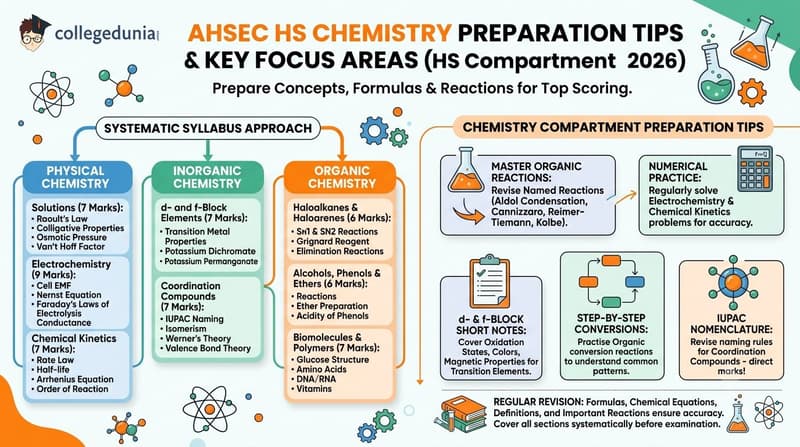
The AHSEC HS Chemistry paper offers good scoring opportunities for students who prepare concepts, formulas, and important reactions thoroughly.
- Students should plan their preparation by giving equal attention to Physical Chemistry, Inorganic Chemistry, and Organic Chemistry.
- Regular revision of formulas, chemical equations, definitions, and important reactions can help students answer questions with greater accuracy.
- Covering all three sections of the syllabus systematically can help students avoid leaving out important topics before the AHSEC HS Compartment 2026 examination.
| Chapter | Approx. Marks | Key Topics |
|---|---|---|
| Solutions |
7 marks |
Raoult’s law, colligative properties, osmotic pressure, van’t Hoff factor |
| Electrochemistry |
9 marks |
Cell EMF, Nernst equation, Faraday’s laws of electrolysis, conductance |
| Chemical Kinetics |
7 marks |
Rate law, half-life, Arrhenius equation, order of reaction |
| d- and f-Block Elements |
7 marks |
Transition metal properties, potassium dichromate, potassium permanganate |
| Coordination Compounds |
7 marks |
IUPAC naming, isomerism, Werner’s theory, valence bond theory |
| Haloalkanes and Haloarenes |
6 marks |
SN1 and SN2 reactions, Grignard reagent, elimination reactions |
| Alcohols, Phenols and Ethers |
6 marks |
Reactions of alcohols and phenols, ether preparation, acidity of phenols |
| Biomolecules and Polymers |
7 marks |
Glucose structure, amino acids, proteins, DNA and RNA, vitamins |
Chemistry compartment preparation tips:
- Students should revise important named reactions in Organic Chemistry, including Aldol Condensation, Cannizzaro Reaction, Reimer-Tiemann Reaction, and Kolbe's Reaction, as these topics are frequently asked in the examination.
- Students should practise numerical problems from Electrochemistry and Chemical Kinetics regularly to improve accuracy and speed in calculation-based questions.
- While revising d- and f-Block Elements, students should prepare short notes covering oxidation states, colours, and magnetic properties of transition elements for quick revision.
- Students should practise organic conversion reactions step by step, as these questions often follow familiar patterns and can help improve overall scores.
- Students should regularly revise the IUPAC nomenclature of Coordination Compounds, as this topic is straightforward and can contribute valuable marks in the examination.
Also Check: AHSEC Class 12 Compartment Exam 2026: Who Can Apply After Failing
Ques. Are Organic Chemistry named reactions important for the AHSEC HS Compartment 2026 exam?
Ans. Yes. Named reactions are among the most frequently tested topics in AHSEC HS Chemistry. Students should thoroughly revise reactions such as Aldol Condensation, Cannizzaro Reaction, Reimer-Tiemann Reaction, and Kolbe's Reaction along with their mechanisms and applications. Regular practice of organic conversion questions can help improve both accuracy and confidence in the examination.
Ques. How should students prepare numerical questions for AHSEC HS Compartment 2026 Chemistry?
Ans. Students should regularly practise numerical problems from Electrochemistry, Solutions, and Chemical Kinetics, as these chapters frequently include calculation-based questions. Revising formulas, understanding unit conversions, and solving previous years' numerical problems under timed conditions can improve calculation speed and reduce mistakes during the examination.
Mathematics Preparation Tips and Key Focus Areas
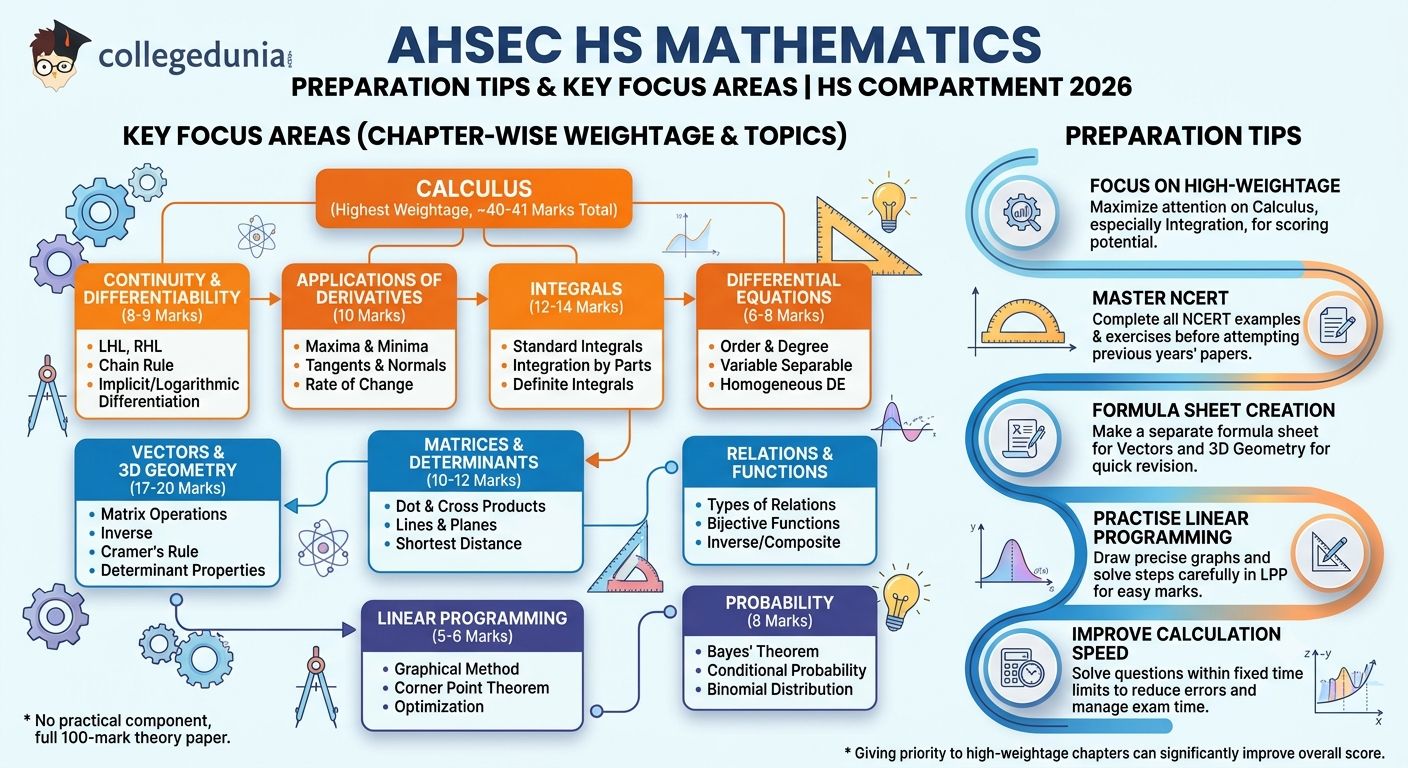
The AHSEC HS Mathematics paper is conducted as a 100-mark theory examination, with no practical component.
- Students should give maximum attention to Calculus, as it carries the highest weightage in the question paper.
- Vectors and Three-Dimensional Geometry together contribute a significant share of marks and should be included in the regular revision schedule.
- Matrices, Determinants, and Probability are also important scoring units, and students should prepare these topics thoroughly before the examination.
- Giving more revision time to these high-weightage chapters can help students improve their overall score in the AHSEC HS Compartment 2026 Mathematics examination.
| Chapter | Approx. Marks | Key Topics |
|---|---|---|
| Relations and Functions |
8 marks |
Types of relations, bijective functions, inverse and composite functions |
| Matrices and Determinants |
10–12 marks |
Matrix operations, adjoint, inverse, Cramer’s rule, determinant properties |
| Continuity and Differentiability |
8–9 marks |
LHL and RHL, chain rule, implicit and logarithmic differentiation |
| Applications of Derivatives |
10 marks |
Maxima and minima, tangents and normals, rate of change |
| Integrals |
12–14 marks |
Standard integrals, integration by parts, partial fractions, definite integrals |
| Differential Equations |
6–8 marks |
Order and degree, variable separable, linear and homogeneous DE |
| Vectors and 3D Geometry |
17–20 marks |
Dot and cross products, direction cosines, lines and planes, shortest distance |
| Linear Programming |
5–6 marks |
Graphical method, corner point theorem, feasible region, optimisation |
| Probability | 8 marks |
Bayes’ theorem, conditional probability, Bernoulli trials, binomial distribution |
Mathematics compartment preparation tips:
- Students should spend extra revision time on Integration, as it is one of the highest-weightage topics in the AHSEC HS Mathematics paper and requires regular practice.
- Before solving previous years' question papers, students should complete the NCERT examples and exercises for every chapter to strengthen their understanding of the concepts.
- Students should prepare a separate formula sheet for Vectors and Three-Dimensional Geometry and revise it regularly to avoid confusion during the examination.
- Students should practise Linear Programming questions by drawing proper graphs and solving each step carefully, as this topic can be scoring with sufficient practice.
- During revision, students should solve questions within a fixed time limit to improve calculation speed, reduce errors, and manage time effectively in the examination.
Also Check: AHSEC HS Compartment 2026 Admit Card: Correct Wrong Name or DOB
Ques. Is NCERT enough to prepare for the AHSEC HS Compartment 2026 Mathematics exam?
Ans. Yes. NCERT is the primary resource for AHSEC HS Compartment 2026 Mathematics preparation. Students should first complete all NCERT examples and exercises before moving on to previous years' question papers and sample papers. This approach helps build conceptual clarity, especially in Calculus, Matrices, Probability, and Vectors, which carry significant weightage in the examination.
Ques. Which chapters should students prioritise to score well in AHSEC HS Compartment 2026 Mathematics?
Ans. Students should focus on high-weightage chapters such as Integrals, Applications of Derivatives, Vectors and Three-Dimensional Geometry, Matrices and Determinants, and Probability. Regular practice of numerical problems, maintaining a separate formula notebook, and solving timed mock papers can significantly improve accuracy, calculation speed, and overall performance in the Mathematics examination.
30-Day Study Plan and General Tips
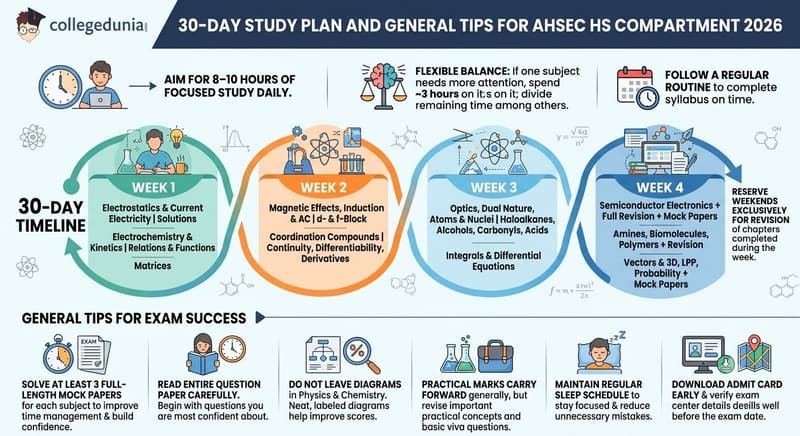
A 30-day study plan helps students cover all three subjects in a planned manner and reduces last-minute revision pressure before the examination.
- Students should aim for 8–10 hours of focused study every day, depending on their preparation level and the time available before the examination.
- If one subject needs more attention, students should spend around 3 hours on that subject and divide the remaining study time between the other two subjects.
- Students should reserve weekends exclusively for revision of the chapters completed during the week instead of starting new topics.
- Following the same study routine throughout the month can help students complete the syllabus on time and revise important topics before the AHSEC HS Compartment 2026 examination.
| Week | Physics | Chemistry | Mathematics |
|---|---|---|---|
| Week 1 |
Electrostatics and Current Electricity |
Solutions, Electrochemistry and Chemical Kinetics |
Relations and Functions, Matrices and Determinants |
| Week 2 |
Magnetic Effects of Current and Magnetism, Electromagnetic Induction and AC |
d- and f-Block Elements, Coordination Compounds |
Continuity and Differentiability, Applications of Derivatives |
| Week 3 |
Optics, Dual Nature of Matter, Atoms and Nuclei |
Haloalkanes and Haloarenes, Alcohols Phenols and Ethers, Aldehydes Ketones and Carboxylic Acids |
Integrals and Differential Equations |
| Week 4 |
Semiconductor Electronics + Full revision + Mock papers |
Amines, Biomolecules and Polymers + Revision |
Vectors and 3D Geometry, Linear Programming, Probability + Mock papers |
General tips for AHSEC compartment exam success:
- Students should solve at least three full-length mock papers for each subject during the last phase of preparation to improve time management and build confidence before the examination.
- Before writing the answers, students should read the entire question paper carefully and begin with the questions they can answer confidently.
- Students should not leave diagram-based questions in Physics and Chemistry, as neat and properly labelled diagrams can help improve overall scores.
- The practical marks awarded in the main examination are generally carried forward. Students should still revise important practical concepts and basic viva questions before the compartment examination.
- Maintaining a regular sleep schedule can help students stay focused and reduce unnecessary mistakes during the examination.
- Students should download the AHSEC HS Compartment 2026 Admit Card as soon as it is released and verify the examination centre details well before the exam date.
Also Check: How to Fix AHSEC Class 12 Compartment 2026 Admit Card Login Error
AHSEC Class 12 Compartment 2026: Reddit Discussion
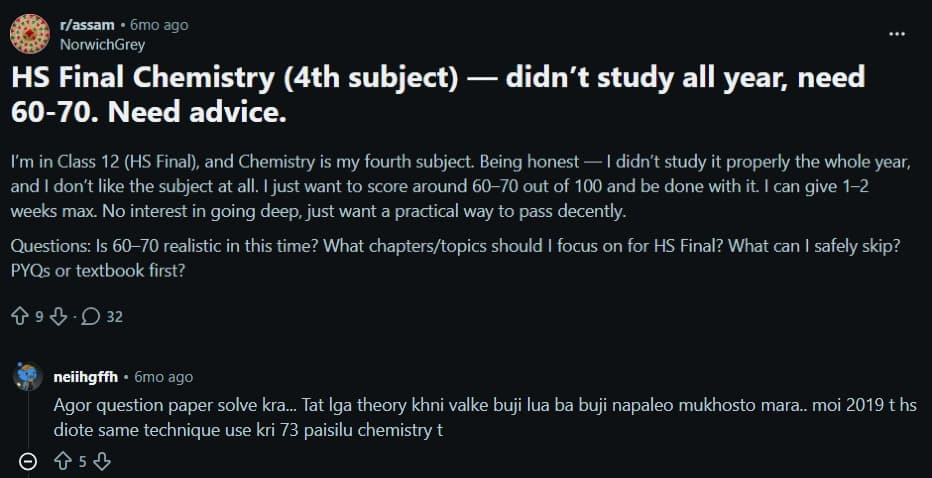
- The discussion focused on AHSEC HS Chemistry preparation for a fourth subject, with a candidate aiming to score 60–70 marks despite having only 1–2 weeks for preparation and seeking advice on important chapters, topics to prioritize, and whether to focus on PYQs or the textbook.
- Another Reddit user recommended solving previous years' question papers first and memorizing the theory and frequently asked answers, even if every concept is not fully understood. The user also shared that they followed a similar strategy during their 2019 HS examination and scored 73 marks in Chemistry.
AHSEC Class 12 Compartment 2026 FAQs
Ques. When is the AHSEC Class 12 Compartment Exam 2026 likely to be held?
Ans. Based on previous year trends and current notifications, the AHSEC HS 2nd Year compartment exam 2026 is expected in July 2026 (with some sources indicating possible extension into early August). It is usually held 6–8 weeks after the main result declaration. Students should regularly monitor the official website ahsec.assam.gov.in for the exact schedule and notification.
Ques. What is the minimum score needed to pass Physics in the AHSEC compartment exam?
Ans. Students must score at least 30% in the Physics theory paper (21 out of 70 marks) and 33% overall (when theory and practical marks are combined). Practical marks from the main exam are carried forward and do not need to be re-attempted in the compartment exam.
Ques. Is the syllabus for the AHSEC compartment exam the same as the main board exam?
Ans. Yes, the AHSEC compartment exam follows the complete syllabus of the main annual board examination with no reduction. Students must prepare all chapters as per the full AHSEC Class 12 Science stream syllabus for the subjects they are appearing in.
Ques. Which chapters are most important for the AHSEC Chemistry compartment exam?
Ans. Electrochemistry (9 marks), Chemical Kinetics, Coordination Compounds, Aldehydes Ketones and Carboxylic Acids, Haloalkanes and Haloarenes, and Biomolecules carry the highest weightage in Chemistry. Memorise all named reactions in Organic Chemistry and practise conversion reactions systematically for reliable marks.
Ques. How many hours should I study daily for the AHSEC compartment exam?
Ans. Aim for 8–10 hours of total daily study. Spend 3 hours on your weakest subject and divide the remaining time between the other two. In the last 10 days before the exam, shift entirely to full-length mock papers and quick revision of formulae and named reactions rather than covering new topics.
Ques. Where can I find previous year papers for the AHSEC Class 12 Science compartment exam?
Ans. Previous year question papers and model papers are available on the official AHSEC website at ahsec.assam.gov.in under the Question Papers section. Practising these papers is the most reliable strategy as they reflect the exact syllabus and pattern of the compartment exam.



Comments