




The Rajasthan Board 2026 Class 10 English Question Paper with Solution PDF is now available for download. The English exam was conducted in the Morning Session from 8:30 AM to 11:45 AM.
Based on the initial analysis of the board papers, the English exam was generally moderate in difficulty. Students who practice previous year question papers (PYQs) and focus on the Model Papers provided on the official RBSE website can easily achieve high scores. Aiming for 70+ marks out of the 80-mark written paper is considered an excellent achievement for Secondary students.
Rajasthan Board 2026 Class 10 English Question Paper with Solution PDF – Memory Based
| Rajasthan Board 2026 Class 10 English Question Paper with Solution PDF | Download | Check Solutions |

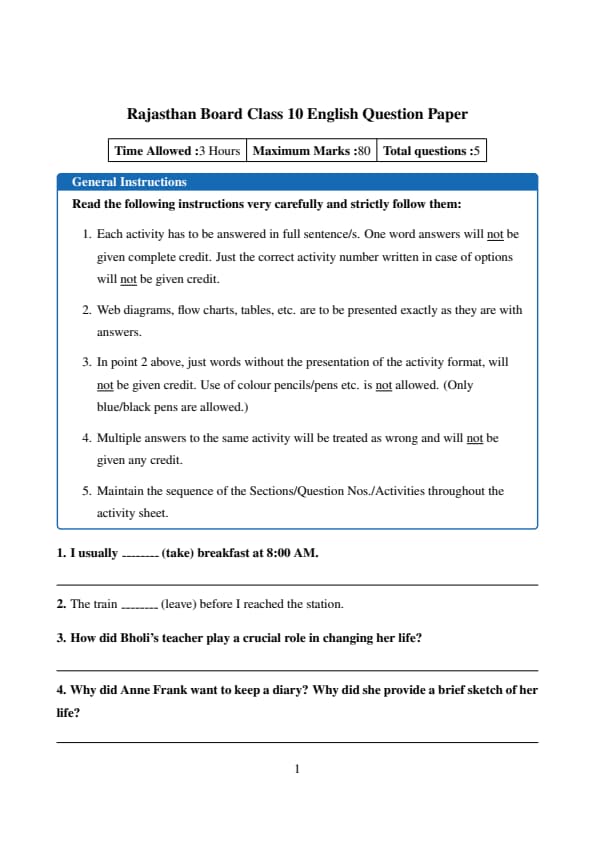
I usually ________ (take) breakfast at 8:00 AM.
View Solution
Concept:
This sentence describes a daily routine or habitual action.
In English grammar, actions that happen regularly (every day, always, usually, often, etc.) are expressed using the Simple Present Tense.
The word ``usually'' is an adverb of frequency, which indicates that the action happens regularly.
Such adverbs are commonly used with the Simple Present Tense.
Structure of Simple Present Tense (for habits): \[ Subject + Base Form of Verb + Object \]
Step 1: Identify the Subject —
The subject here is ``I''.
Step 2: Check the Time Expression —
The phrase ``usually'' and the fixed time ``at 8:00 AM'' show that this is a habitual action.
Step 3: Choose the Correct Verb Form —
With the subject I, we use the base form of the verb (no `-s' or `-es').
Hence: \[ take (correct) \quad not \quad takes \]
Step 4: Form the Correct Sentence — \[ I usually take breakfast at 8:00 AM. \]
Additional Examples of Similar Usage:
I wake up at 6:00 AM.
She goes to school every day.
We play in the evening.
They eat dinner at 9:00 PM.
These all describe routine actions, so they use the Simple Present Tense. Quick Tip: Whenever you see words like \textbf{always, usually, often, every day, daily, regularly}, use the \textbf{Simple Present Tense}. With \textbf{I/We/You/They} use the base verb (eat, play, take). With \textbf{He/She/It} add \textbf{-s / -es} (eats, plays, takes).
The train ________ (leave) before I reached the station.
View Solution
Concept:
The Past Perfect Tense is used to show that one action was completed before another action in the past.
Explanation:
In this sentence, two past actions are mentioned:
The train leaving
Reaching the station
The train left before the speaker reached the station, so the earlier action is expressed using the Past Perfect Tense.
Therefore, the correct verb form is had left. Quick Tip: When two actions happen in the past, use \textbf{Past Perfect} for the action that happened first and \textbf{Simple Past} for the later action.
How did Bholi’s teacher play a crucial role in changing her life?
View Solution
Concept:
In the story “Bholi”, the teacher represents the power of education, patience, and empathy in shaping a child’s personality. A supportive teacher can bring out confidence and self-respect in a student.
Step 1: Providing encouragement and care —
Unlike others, the teacher did not laugh at Bholi’s stammering.
She spoke gently and made Bholi feel safe and valued.
Step 2: Building confidence through education —
She taught Bholi patiently, helping her learn to speak without fear.
Through regular practice and appreciation, Bholi gained self-confidence.
Step 3: Changing Bholi’s self-image —
The teacher made her realize that she was capable and intelligent.
Education gave Bholi courage to stand up for her dignity and refuse an unjust marriage.
Step 4: Result —
With her teacher’s guidance, Bholi transformed from a timid, neglected girl into a confident and self-respecting individual. Quick Tip: While answering character-based questions, explain \textbf{what the character did, how it influenced others, and what change it brought.
Why did Anne Frank want to keep a diary? Why did she provide a brief sketch of her life?
View Solution
Concept:
“From the Diary of Anne Frank” highlights Anne’s loneliness and her need for a trusted companion. The diary becomes her confidant, allowing her to express her emotions freely.
Step 1: Reason for keeping a diary —
Anne felt that she lacked a close friend in whom she could confide.
Although she had family and acquaintances, she could not openly share her inner thoughts with them.
She decided to treat her diary as a true friend and named it ``Kitty.''
Step 2: Purpose of giving a brief sketch of her life —
Anne wanted readers to know about her family, school life, and early experiences.
This background information helps the reader understand her situation and feelings better.
It also explains the circumstances in which she started writing the diary.
Step 3: Conclusion —
Thus, Anne’s diary was not just a record of events but a source of emotional comfort, and the brief sketch of her life helped create a clear context for her writings. Quick Tip: When answering literature questions, always connect the \textbf{character’s feelings, reasons, and actions to the main theme of the lesson.
How did Valli plan her bus ride?
View Solution
Concept:
In the story “Madam Rides the Bus”, Valli’s bus journey reflects her curiosity, determination, and careful planning. She does not act impulsively but prepares herself thoughtfully.
Step 1: Collecting information —
Valli listened carefully to conversations of the villagers who travelled by bus.
From them, she learned about the route, distance, travel time, and the fare.
Step 2: Saving money —
She saved every coin she received, resisting the temptation to buy toys or snacks.
She calculated the exact fare needed for a to-and-fro journey.
Step 3: Choosing the right time —
Valli selected an afternoon bus when her mother would be resting.
This allowed her to travel alone without anyone stopping her.
Step 4: Result —
Through patience, observation, and determination, Valli successfully planned and completed her first bus ride. Quick Tip: For story-based answers, describe the character’s actions in sequence to show \textbf{planning, effort, and outcome.




Comments