




AP POLYCET 2021 Set B Question paper with answer key pdf conducted on September 1 is available for download. The exam was successfully organized by State Board of Technical Education & Training (SBTET), Andhra Pradesh. The question paper comprised a total of 120 questions.
AP POLYCET 2021 Set B Question Paper with Answer Key PDFs
| Question Paper PDF | Answer Key PDF | Solution PDF |
|---|---|---|
| Download PDF | Download PDF | Check Solutions |
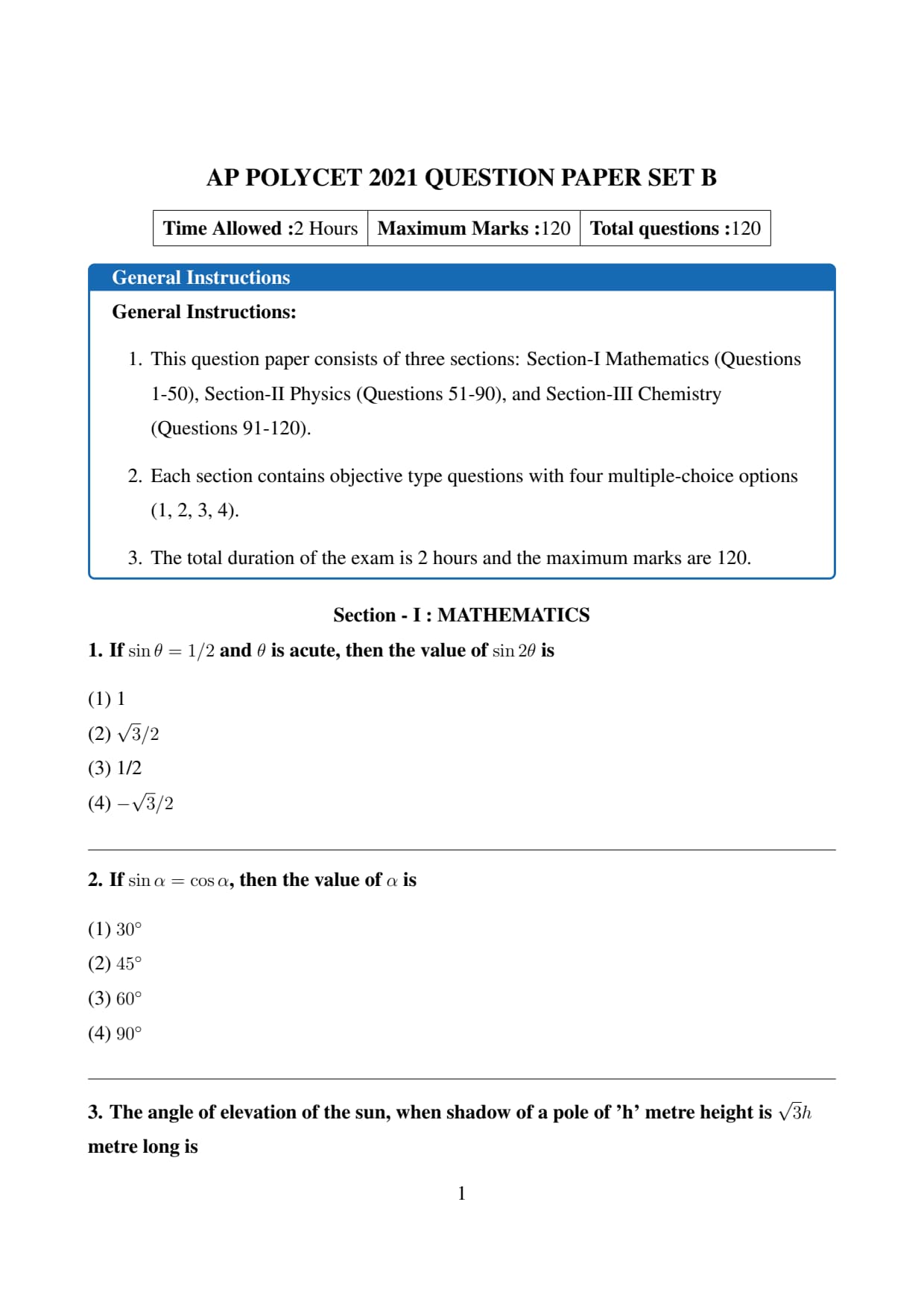
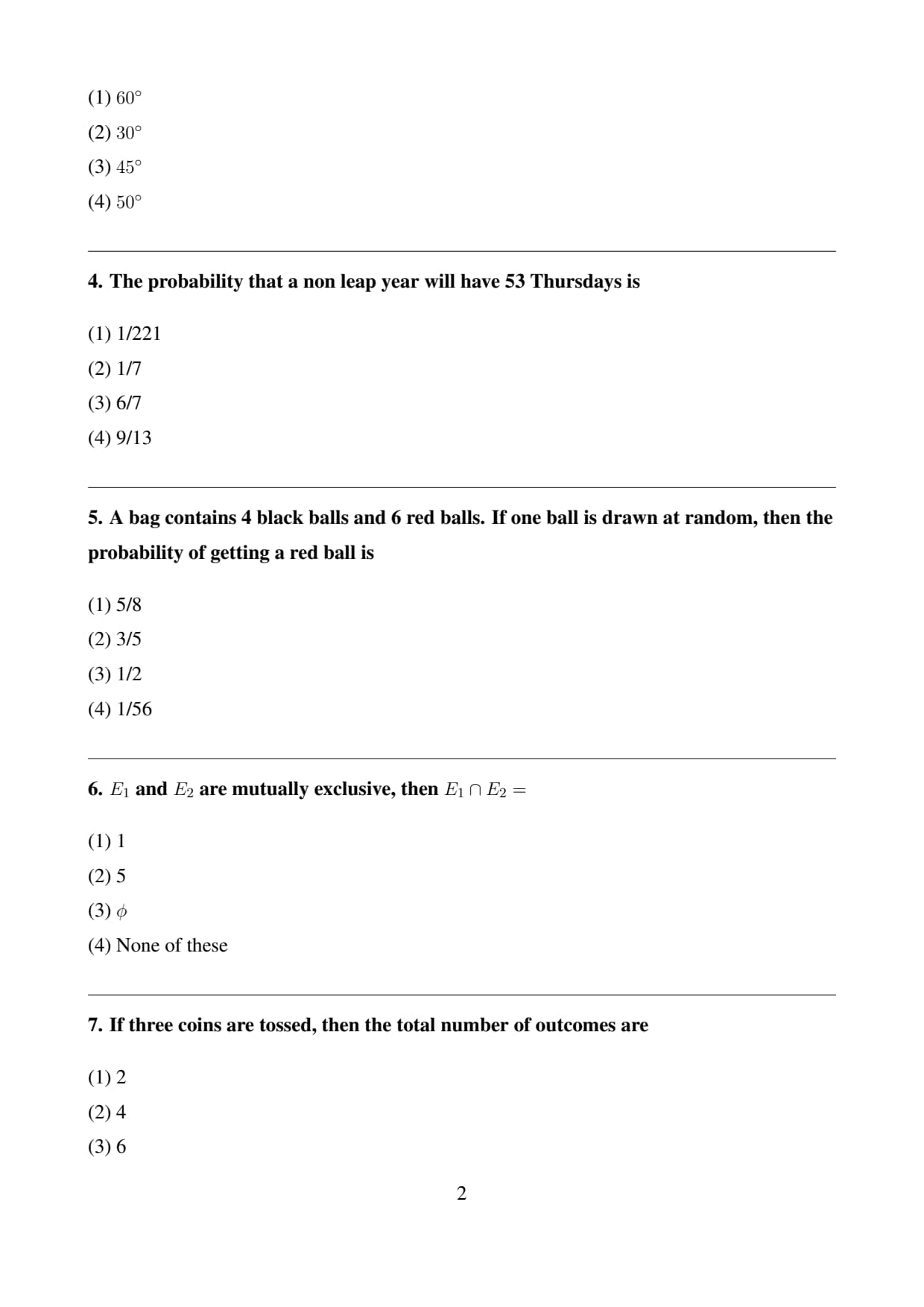
If \(\sin\theta = 1/2\) and \(\theta\) is acute, then the value of \(\sin 2\theta\) is
View Solution
Step 1: Concept
Determine \(\theta\) from the given sine value for an acute angle.
Step 2: Meaning
Since \(\sin\theta = 1/2\), then \(\theta = 30^\circ\).
Step 3: Analysis
Calculate \(\sin 2\theta = \sin(2 \times 30^\circ) = \sin 60^\circ\).
Step 4: Conclusion
The value of \(\sin 60^\circ\) is \(\sqrt{3}/2\).
Final Answer: (2) Quick Tip: \(\sin 2\theta = 2\sin\theta\cos\theta\). Since \(\sin\theta=1/2\), \(\cos\theta=\sqrt{3}/2\), so \(2(1/2)(\sqrt{3}/2) = \sqrt{3}/2\).
If \(\sin\alpha = \cos\alpha\), then the value of \(\alpha\) is
View Solution
Step 1: Concept
Trigonometric identity where sine and cosine values are equal.
Step 2: Meaning
Divide both sides by \(\cos\alpha\) to get \(\tan\alpha = 1\).
Step 3: Analysis
The angle \(\alpha\) for which \(\tan\alpha = 1\) in the first quadrant is \(45^\circ\).
Step 4: Conclusion
Hence, \(\alpha = 45^\circ\).
Final Answer: (2) Quick Tip: At \(45^\circ\), both \(\sin\) and \(\cos\) are \(1/\sqrt{2}\).
The angle of elevation of the sun, when shadow of a pole of 'h' metre height is \(\sqrt{3}h\) metre long is
View Solution
Step 1: Concept
Use the tangent ratio: \(\tan\theta = Opposite / Adjacent\).
Step 2: Meaning
\(\tan\theta = h / (\sqrt{3}h)\).
Step 3: Analysis
\(\tan\theta = 1/\sqrt{3}\).
Step 4: Conclusion
\(\theta = \arctan(1/\sqrt{3}) = 30^\circ\).
Final Answer: (2) Quick Tip: Shadow longer than height (\(\sqrt{3} \approx 1.732\)) means the angle is less than \(45^\circ\).
The probability that a non leap year will have 53 Thursdays is
View Solution
Step 1: Concept
A non-leap year has 365 days.
Step 2: Meaning
365 days = 52 weeks + 1 extra day.
Step 3: Analysis
To have 53 Thursdays, the one extra day must be a Thursday. Total possible days for the extra day are 7.
Step 4: Conclusion
Probability = \(1/7\).
Final Answer: (2) Quick Tip: Non-leap year extra days = 1 (Prob = 1/7); Leap year extra days = 2 (Prob = 2/7).
A bag contains 4 black balls and 6 red balls. If one ball is drawn at random, then the probability of getting a red ball is
View Solution
Step 1: Concept
Probability \(P(E) = Favorable outcomes / Total outcomes\).
Step 2: Meaning
Total balls = 4 (Black) + 6 (Red) = 10.
Step 3: Analysis
Favorable outcomes (Red balls) = 6. Probability = \(6/10\).
Step 4: Conclusion
Simplified fraction = \(3/5\).
Final Answer: (2) Quick Tip: Always simplify the fraction: \(6/10 = 3/5\).
\(E_1\) and \(E_2\) are mutually exclusive, then \(E_1 \cap E_2 =\)
View Solution
Step 1: Concept
Definition of mutually exclusive events.
Step 2: Meaning
Events that cannot happen at the same time.
Step 3: Analysis
If they cannot occur together, their intersection is the null set.
Step 4: Conclusion
\(E_1 \cap E_2 = \phi\).
Final Answer: (3) Quick Tip: Mutually exclusive \(\implies\) Intersection is empty (\(\phi\)).
If three coins are tossed, then the total number of outcomes are
View Solution
Step 1: Concept
Total outcomes for \(n\) coins is \(2^n\).
Step 2: Meaning
Here \(n = 3\).
Step 3: Analysis
\(2^3 = 2 \times 2 \times 2 = 8\).
Step 4: Conclusion
Total outcomes are 8.
Final Answer: (4) Quick Tip: Outcomes: HHH, HHT, HTH, HTT, THH, THT, TTH, TTT.
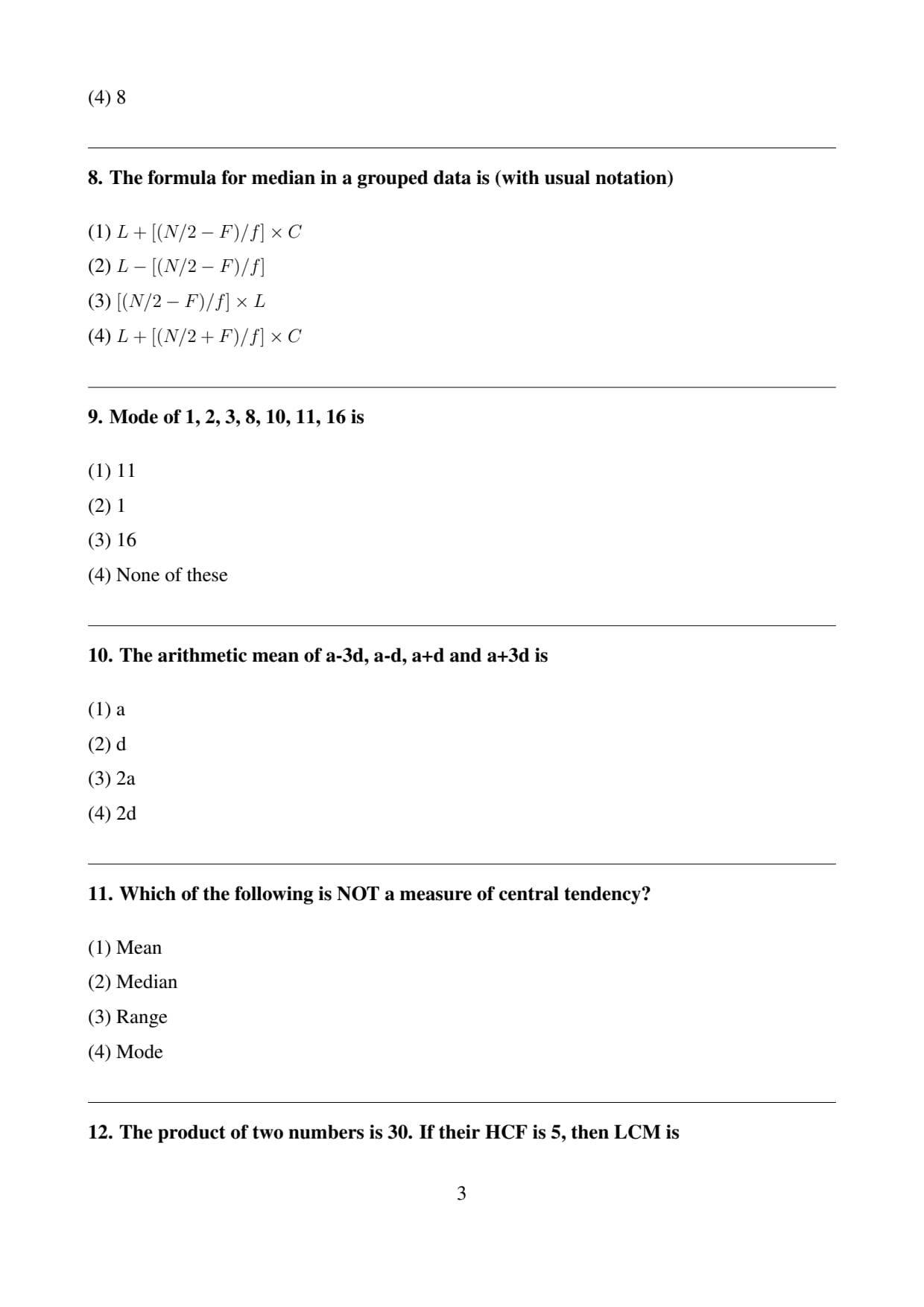
The formula for median in a grouped data is (with usual notation)
View Solution
Step 1: Concept
Standard formula for Median in statistics.
Step 2: Meaning
\(L\) = Lower limit, \(N\) = Total frequency, \(F\) = Cumulative frequency of preceding class, \(f\) = frequency, \(C\) = Class width.
Step 3: Analysis
Option 1 matches the standard mathematical definition.
Step 4: Conclusion
Correct formula is \(L + \left(\frac{\frac{N}{2}-F}{f}\right) \times C\).
Final Answer: (1) Quick Tip: The sign is always '+' and we subtract the cumulative frequency '\(F\)'.
Mode of 1, 2, 3, 8, 10, 11, 16 is
View Solution
Step 1: Concept
Mode is the value that appears most frequently in a data set.
Step 2: Meaning
Observe the frequency of each number.
Step 3: Analysis
Each number (1, 2, 3, 8, 10, 11, 16) appears exactly once.
Step 4: Conclusion
Since no number repeats, there is no mode.
Final Answer: (4) Quick Tip: If all values occur with the same frequency, the data is "amodal" (no mode).
The arithmetic mean of a-3d, a-d, a+d and a+3d is
View Solution
Step 1: Concept
Mean = Sum of terms / Number of terms.
Step 2: Meaning
Sum = \((a-3d) + (a-d) + (a+d) + (a+3d)\).
Step 3: Analysis
Sum = \(a + a + a + a - 3d - d + d + 3d = 4a\). Mean = \(4a / 4\).
Step 4: Conclusion
Arithmetic Mean = \(a\).
Final Answer: (1) Quick Tip: Symmetric terms around 'a' always result in a mean of 'a'.
Which of the following is NOT a measure of central tendency?
View Solution
Step 1: Concept
Measures of central tendency represent the center of a data set.
Step 2: Meaning
Mean, Median, and Mode are the three standard measures used to find the center.
Step 3: Analysis
Range is a measure of dispersion or spread, not central tendency.
Step 4: Conclusion
Hence, Range is the odd one out.
Final Answer: (3) Quick Tip: Central Tendency = Center; Dispersion (Range, SD) = Spread.
The product of two numbers is 30. If their HCF is 5, then LCM is
View Solution
Step 1: Concept
Formula: \(Product of two numbers = HCF \times LCM\).
Step 2: Meaning
\(30 = 5 \times LCM\).
Step 3: Analysis
\(LCM = 30 / 5\).
Step 4: Conclusion
\(LCM = 6\).
Final Answer: (2) Quick Tip: \(LCM = \frac{Product}{HCF}\).
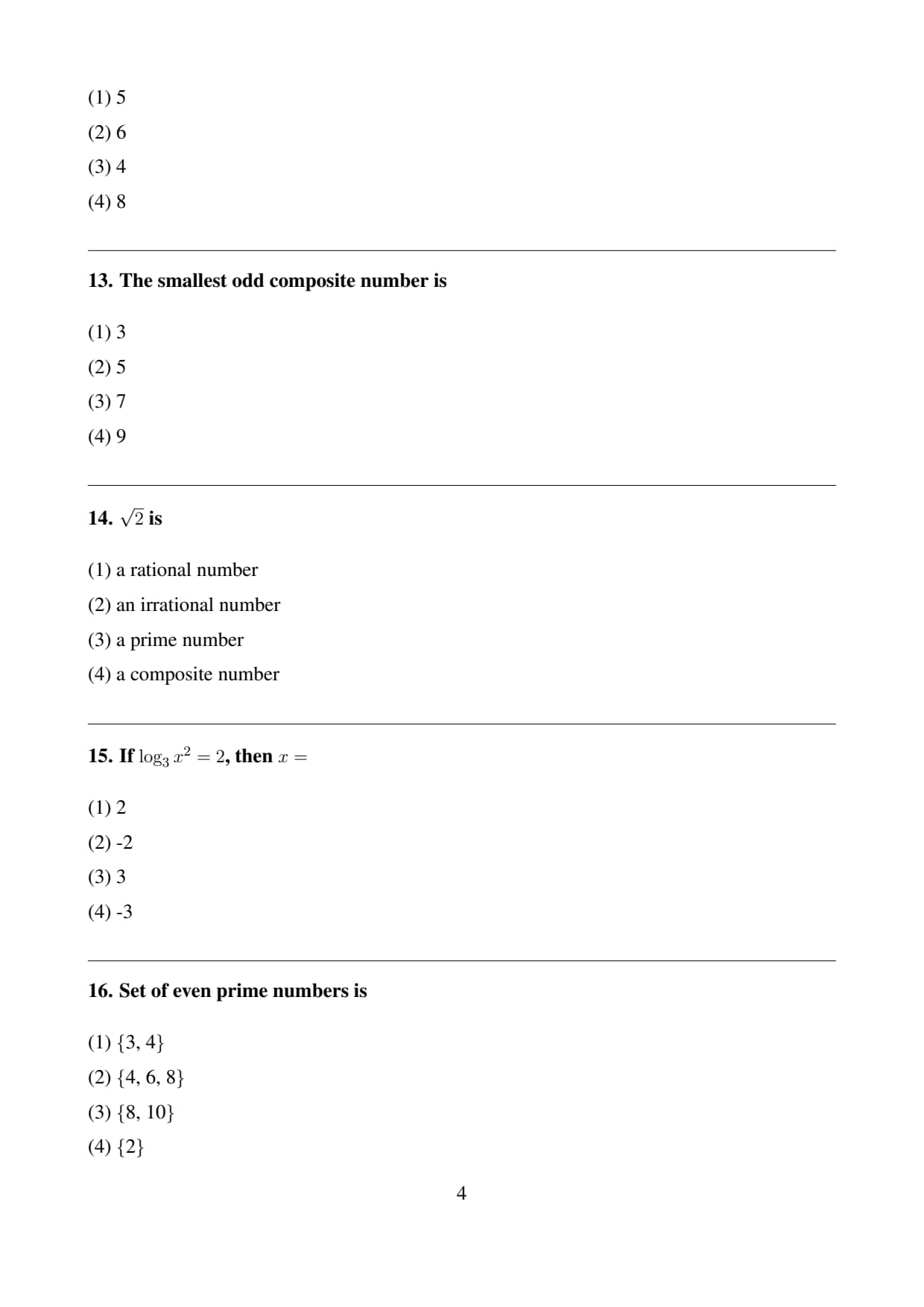
The smallest odd composite number is
View Solution
Step 1: Concept
Composite numbers have more than two factors.
Step 2: Meaning
Check odd numbers: 3 (Prime), 5 (Prime), 7 (Prime), 9 (Composite: 1, 3, 9).
Step 3: Analysis
9 is the first odd number that is not prime.
Step 4: Conclusion
The smallest odd composite number is 9.
Final Answer: (4) Quick Tip: 1 is neither prime nor composite. 2 is the only even prime.
\(\sqrt{2}\) is
View Solution
Step 1: Concept
Rational numbers can be written as \(p/q\).
Step 2: Meaning
\(\sqrt{2}\) cannot be expressed as a simple fraction and has a non-terminating, non-repeating decimal.
Step 3: Analysis
Any square root of a non-square natural number is irrational.
Step 4: Conclusion
\(\sqrt{2}\) is irrational.
Final Answer: (2) Quick Tip: \(\pi\) and \(\sqrt{non-square}\) are always irrational.
If \(\log_{3}x^{2} = 2\), then \(x =\)
View Solution
Step 1: Concept
Convert log to exponential form: \(\log_{a}b = c \implies a^{c} = b\).
Step 2: Meaning
\(3^{2} = x^{2}\).
Step 3: Analysis
\(9 = x^{2}\).
Step 4: Conclusion
\(x = \sqrt{9} = 3\) (Note: base/argument constraints usually imply positive \(x\)).
Final Answer: (3) Quick Tip: \(\log_b a^n = n \log_b a\). So \(2 \log_3 x = 2 \implies \log_3 x = 1 \implies x=3\).
Set of even prime numbers is
View Solution
Step 1: Concept
Prime numbers are greater than 1 with exactly two factors.
Step 2: Meaning
List primes: 2, 3, 5, 7, 11...
Step 3: Analysis
2 is the only number in the list that is even.
Step 4: Conclusion
The set is \{2\.
Final Answer: (4) Quick Tip: 2 is the unique even prime number.
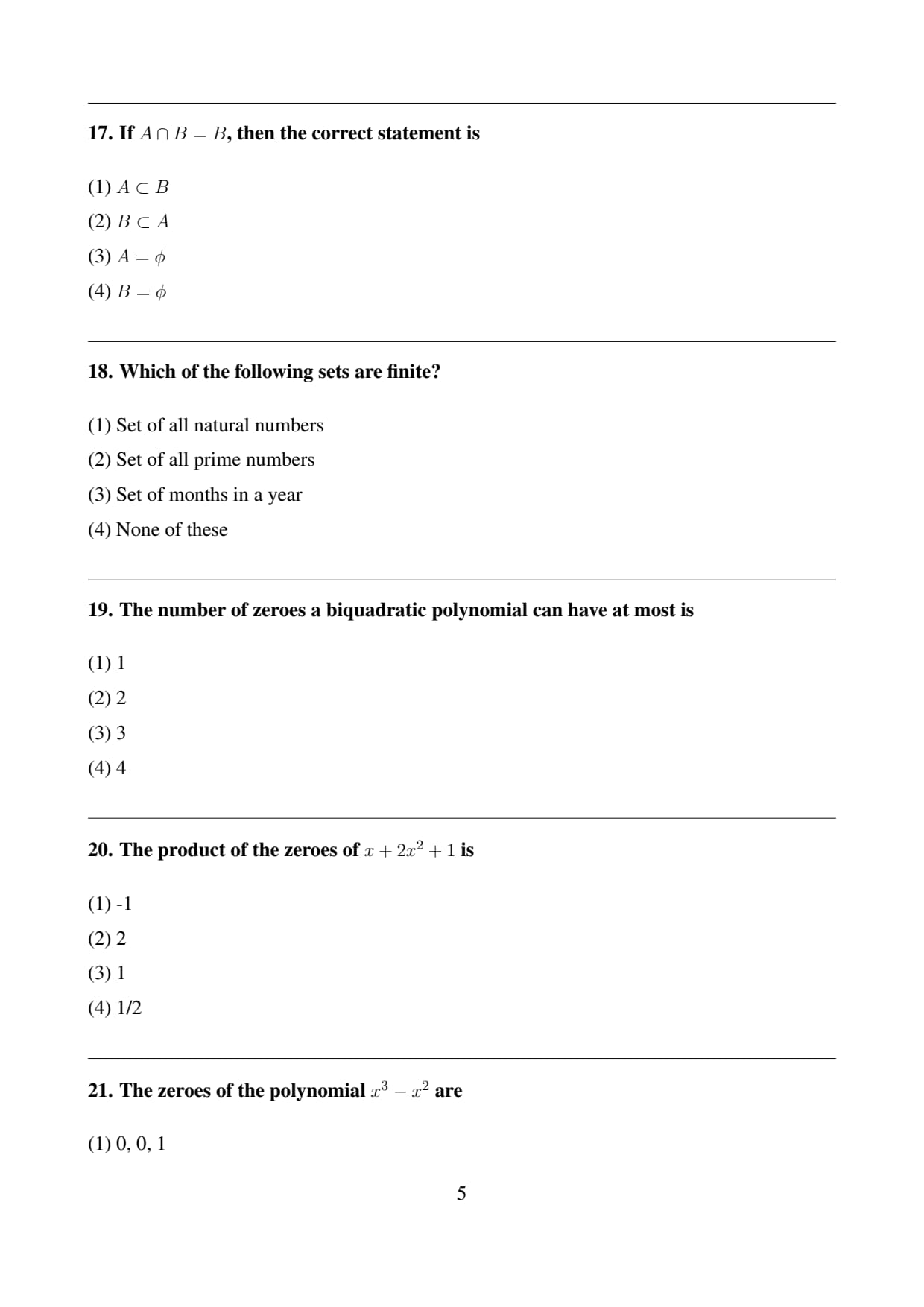
If \(A \cap B = B\), then the correct statement is
View Solution
Step 1: Concept
Intersection (\(\cap\)) gives the common elements.
Step 2: Meaning
If the intersection of \(A\) and \(B\) is exactly \(B\), it means all elements of \(B\) are inside \(A\).
Step 3: Analysis
By definition, if every element of \(B\) is in \(A\), then \(B\) is a subset of \(A\).
Step 4: Conclusion
\(B \subset A\).
Final Answer: (2) Quick Tip: \(A \cap B = Smaller set\); \(A \cup B = Larger set\).
Which of the following sets are finite?
View Solution
Step 1: Concept
A finite set has a countable/limited number of elements.
Step 2: Meaning
Natural numbers and prime numbers go on forever (infinite).
Step 3: Analysis
There are exactly 12 months in a year.
Step 4: Conclusion
Option 3 is finite.
Final Answer: (3) Quick Tip: If you can finish counting the elements, it's finite.
The number of zeroes a biquadratic polynomial can have at most is
View Solution
Step 1: Concept
A polynomial of degree \(n\) has at most \(n\) zeroes.
Step 2: Meaning
"Biquadratic" refers to a polynomial of degree 4.
Step 3: Analysis
Degree 4 \(\implies\) maximum 4 zeroes.
Step 4: Conclusion
Maximum zeroes = 4.
Final Answer: (4) Quick Tip: Linear (1), Quadratic (2), Cubic (3), Biquadratic (4).
The product of the zeroes of \(x + 2x^{2} + 1\) is
View Solution
Step 1: Concept
For \(ax^2 + bx + c\), product of zeroes = \(c/a\).
Step 2: Meaning
Rewrite the polynomial: \(2x^2 + 1x + 1\). Here \(a=2, b=1, c=1\).
Step 3: Analysis
Product = \(1/2\).
Step 4: Conclusion
The product is 1/2.
Final Answer: (4) Quick Tip: Always arrange in descending powers of \(x\) to identify '\(a\)' correctly.
The zeroes of the polynomial \(x^3 - x^2\) are
View Solution
Step 1: Concept
Find values of \(x\) that make the polynomial zero.
Step 2: Meaning
Set \(x^3 - x^2 = 0\).
Step 3: Analysis
Factorize: \(x^2(x - 1) = 0\). This gives \(x^2 = 0\) or \(x - 1 = 0\).
Step 4: Conclusion
\(x = 0, 0\) and \(x = 1\).
Final Answer: (1) Quick Tip: The degree is 3, so there must be 3 zeroes (including repetitions).
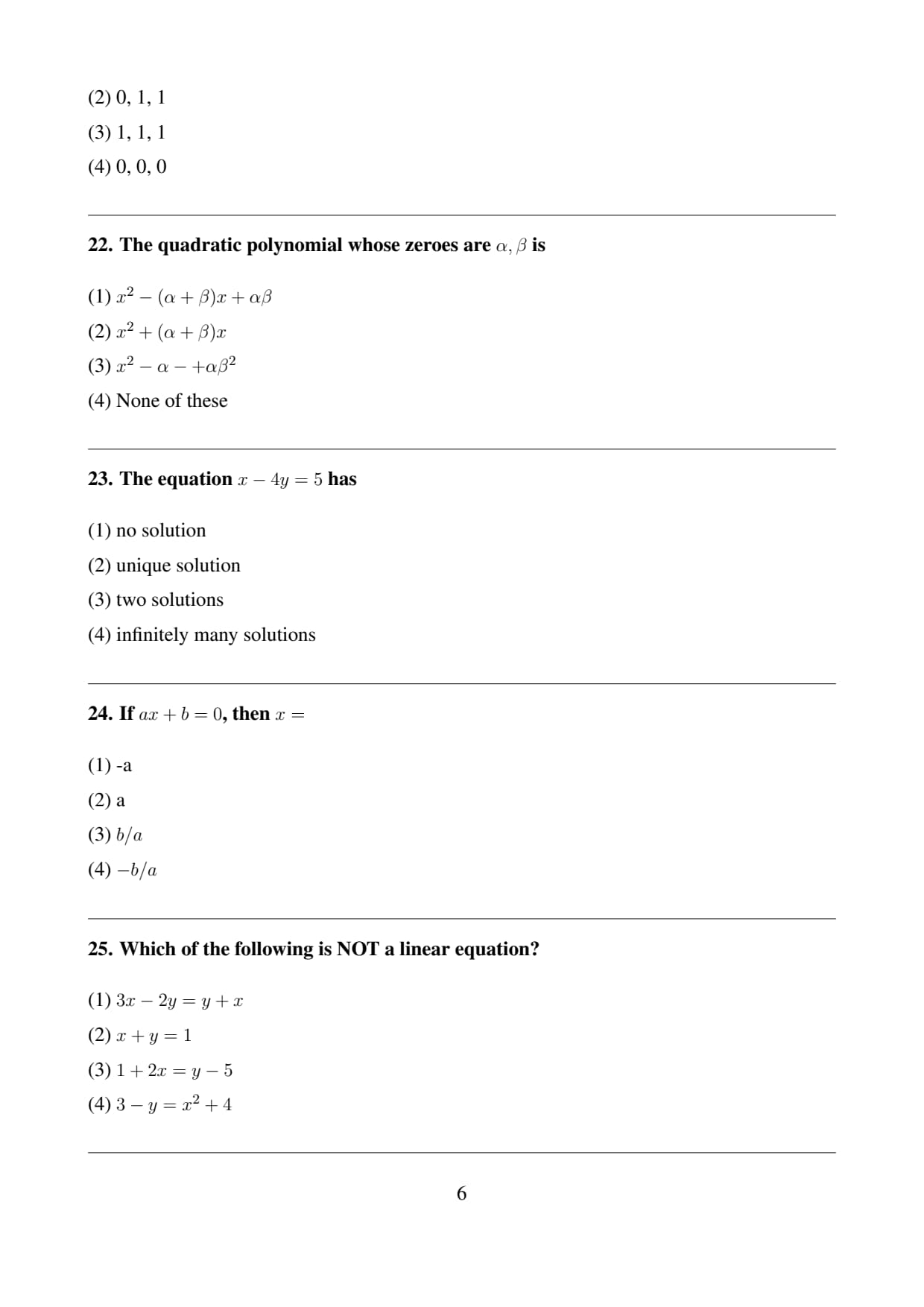
The quadratic polynomial whose zeroes are \(\alpha, \beta\) is
View Solution
Step 1: Concept
Standard form of a quadratic equation using its roots.
Step 2: Meaning
A polynomial is formed as \(k[x^2 - (sum of zeroes)x + (product of zeroes)]\).
Step 3: Analysis
Sum = \(\alpha + \beta\); Product = \(\alpha\beta\).
Step 4: Conclusion
The expression is \(x^2 - (\alpha + \beta)x + \alpha\beta\).
Final Answer: (1) Quick Tip: Remember the minus sign before the sum of zeroes.
The equation \(x - 4y = 5\) has
View Solution
Step 1: Concept
Nature of solutions for a linear equation in two variables.
Step 2: Meaning
The equation represents a straight line on a graph.
Step 3: Analysis
For every value of \(x\), there is a corresponding value of \(y\).
Step 4: Conclusion
Since a line consists of infinite points, there are infinitely many solutions.
Final Answer: (4) Quick Tip: A single linear equation with two variables always has infinite solutions.
If \(ax + b = 0\), then \(x =\)
View Solution
Step 1: Concept
Solving a linear equation in one variable.
Step 2: Meaning
Isolate the variable \(x\).
Step 3: Analysis
\(ax = -b\).
Step 4: Conclusion
\(x = -b/a\).
Final Answer: (4) Quick Tip: The zero of a linear polynomial \(ax+b\) is always \(-b/a\).
Which of the following is NOT a linear equation?
View Solution
Step 1: Concept
A linear equation has variables with a maximum power (degree) of 1.
Step 2: Meaning
Check the degree of each equation.
Step 3: Analysis
In option 4, the term \(x^2\) appears, making it a quadratic equation.
Step 4: Conclusion
Option 4 is not linear.
Final Answer: (4) Quick Tip: Linear = Degree 1. Quadratic = Degree 2.
Which of the following represents the situation where Siri bought 5 apples and 6 oranges and Laxmi bought 2 apples and 15 oranges for same amount of total money?
View Solution
Step 1: Concept
Translating a word problem into an algebraic equation.
Step 2: Meaning
Let price of an apple be \(x\) and price of an orange be \(y\).
Step 3: Analysis
Siri's cost: \(5x + 6y\). Laxmi's cost: \(2x + 15y\).
Step 4: Conclusion
Since the total money is the same: \(5x + 6y = 2x + 15y\).
Final Answer: (1) Quick Tip: "Same amount" indicates the use of the '=' sign between the two costs.
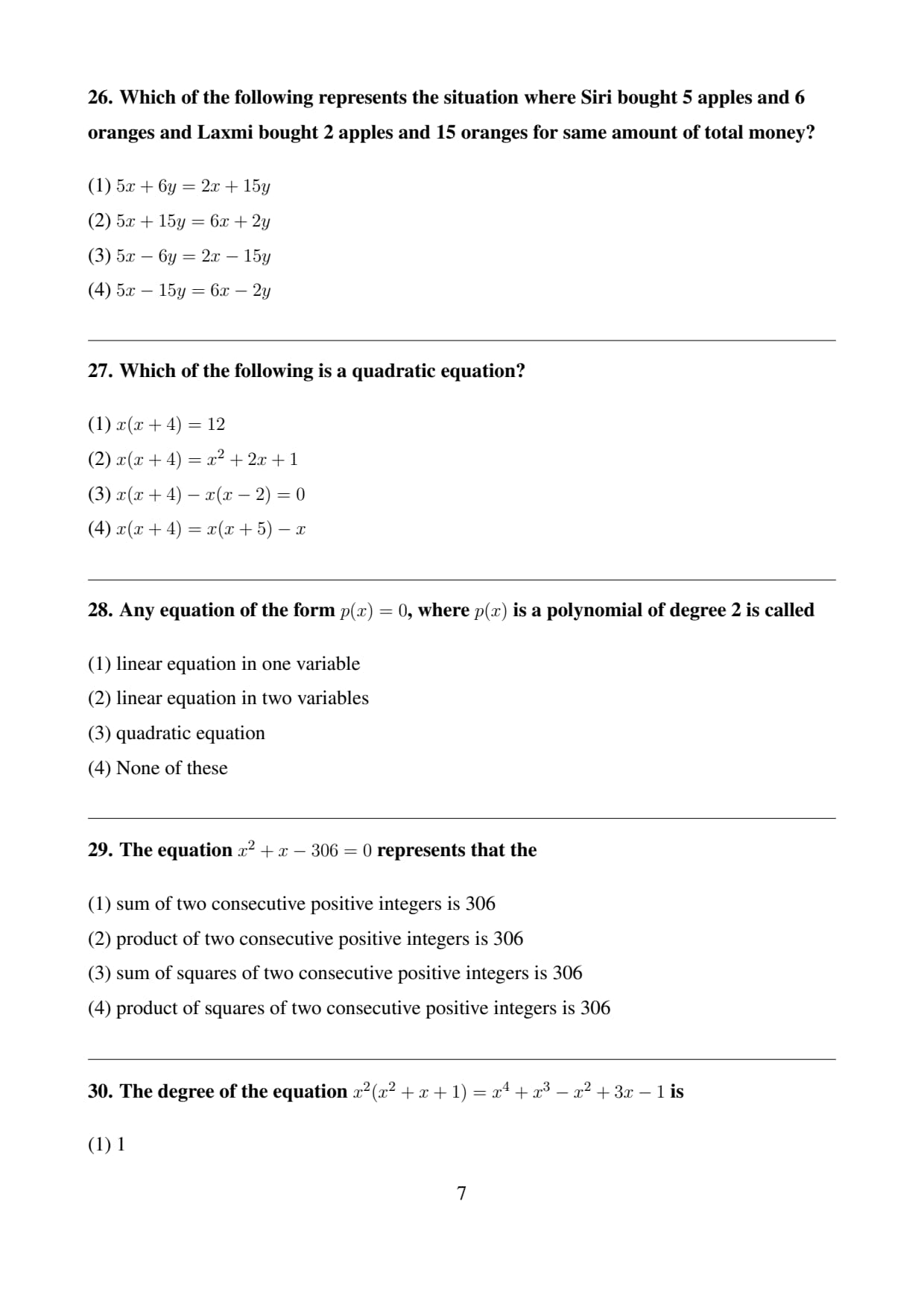
Which of the following is a quadratic equation?
View Solution
Step 1: Concept
A quadratic equation must have the form \(ax^2 + bx + c = 0\) (\(a \neq 0\)).
Step 2: Meaning
Simplify each option to see if the \(x^2\) term remains.
Step 3: Analysis
(1) \(x^2 + 4x - 12 = 0\) (Quadratic). (2) \(x^2 + 4x = x^2 + 2x + 1 \implies 2x - 1 = 0\) (Linear).
Step 4: Conclusion
Only option 1 remains a second-degree equation.
Final Answer: (1) Quick Tip: Check if the \(x^2\) terms cancel out on both sides before deciding.
Any equation of the form \(p(x) = 0\), where \(p(x)\) is a polynomial of degree 2 is called
View Solution
Step 1: Concept
Classification of equations based on degree.
Step 2: Meaning
A polynomial of degree 2 is known as a quadratic polynomial.
Step 3: Analysis
When set to zero, it forms a quadratic equation.
Step 4: Conclusion
The answer is quadratic equation.
Final Answer: (3) Quick Tip: Degree 1 = Linear; Degree 2 = Quadratic; Degree 3 = Cubic.
The equation \(x^2 + x - 306 = 0\) represents that the
View Solution
Step 1: Concept
Modeling integer relations.
Step 2: Meaning
Let \(x\) be the first integer. The consecutive integer is \(x + 1\).
Step 3: Analysis
Product = \(x(x + 1) = x^2 + x\). Setting product equal to 306 gives \(x^2 + x - 306 = 0\).
Step 4: Conclusion
This matches the provided equation.
Final Answer: (2) Quick Tip: \(x(x+1)\) expanded is \(x^2 + x\).
The degree of the equation \(x^2(x^2 + x + 1) = x^4 + x^3 - x^2 + 3x - 1\) is
View Solution
Step 1: Concept
The degree of an equation is the highest power of the variable after simplification.
Step 2: Meaning
Expand and simplify the equation.
Step 3: Analysis
LHS: \(x^4 + x^3 + x^2\). RHS: \(x^4 + x^3 - x^2 + 3x - 1\).
Subtracting \(x^4 + x^3\) from both sides: \(x^2 = -x^2 + 3x - 1 \implies 2x^2 - 3x + 1 = 0\).
Step 4: Conclusion
The highest power remaining is 2.
Final Answer: (2) Quick Tip: Don't assume the degree is the highest visible power; always simplify first!
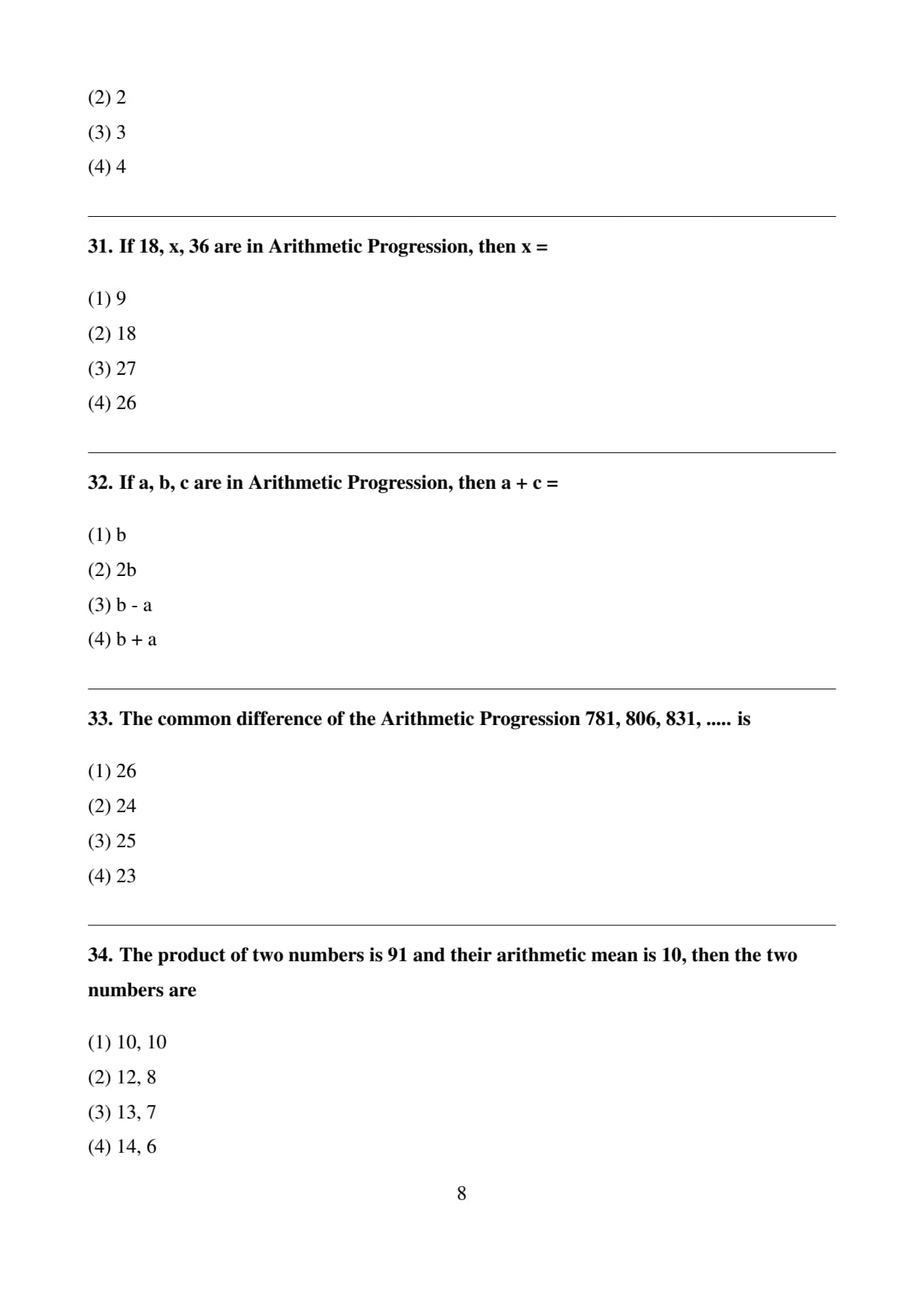
If 18, x, 36 are in Arithmetic Progression, then x =
View Solution
Step 1: Concept
In an Arithmetic Progression (AP), the middle term is the arithmetic mean of the surrounding terms.
Step 2: Meaning
For terms \(a, b, c\), the relation is \(b = (a + c) / 2\).
Step 3: Analysis
\(x = (18 + 36) / 2 = 54 / 2\).
Step 4: Conclusion
\(x = 27\).
Final Answer: (3) Quick Tip: Arithmetic Mean = Sum / 2.
If a, b, c are in Arithmetic Progression, then a + c =
View Solution
Step 1: Concept
Definition of common difference in AP.
Step 2: Meaning
\(b - a = c - b\).
Step 3: Analysis
Rearranging the terms: \(b + b = a + c\).
Step 4: Conclusion
\(2b = a + c\).
Final Answer: (2) Quick Tip: The sum of extremes equals twice the mean.
The common difference of the Arithmetic Progression 781, 806, 831, ..... is
View Solution
Step 1: Concept
Common difference \(d = a_2 - a_1\).
Step 2: Meaning
Subtract the first term from the second term.
Step 3: Analysis
\(d = 806 - 781\).
Step 4: Conclusion
\(d = 25\).
Final Answer: (3) Quick Tip: \(d\) is constant throughout the sequence.
The product of two numbers is 91 and their arithmetic mean is 10, then the two numbers are
View Solution
Step 1: Concept
Use the properties of mean and product.
Step 2: Meaning
Mean = 10 \(\implies\) Sum = 20. Product = 91.
Step 3: Analysis
We need two numbers that add to 20 and multiply to 91. \(13 + 7 = 20\) and \(13 \times 7 = 91\).
Step 4: Conclusion
The numbers are 13 and 7.
Final Answer: (3) Quick Tip: Check options: \(13 \times 7\) is the only one ending in 1.
The centroid divides each median in the ratio of
View Solution
Step 1: Concept
Properties of a triangle's centroid.
Step 2: Meaning
The centroid is the point of concurrency of medians.
Step 3: Analysis
The distance from the vertex to the centroid is twice the distance from the centroid to the midpoint.
Step 4: Conclusion
The ratio is 2 : 1.
Final Answer: (2) Quick Tip: Vertex to Centroid : Centroid to Side = 2 : 1.
If the centroid of the triangle formed with (a, b), (b, c) and (c, a) is O(0, 0), then \(a^3 + b^3 + c^3 =\)
View Solution
Step 1: Concept
Centroid formula: \(((x_1+x_2+x_3)/3, (y_1+y_2+y_3)/3)\).
Step 2: Meaning
\((a+b+c)/3 = 0 \implies a+b+c = 0\).
Step 3: Analysis
Algebraic identity: If \(a+b+c = 0\), then \(a^3 + b^3 + c^3 = 3abc\).
Step 4: Conclusion
The value is 3abc.
Final Answer: (4) Quick Tip: If sum of three numbers is zero, the sum of their cubes is \(3 \times\) their product.
The vertices of a parallelogram are (2, -3), (6, 5), (-2, 1), (-6, -7) in this order. The point of intersection of the diagonals is
View Solution
Step 1: Concept
Diagonals of a parallelogram bisect each other.
Step 2: Meaning
The intersection point is the midpoint of either diagonal.
Step 3: Analysis
Midpoint of diagonal joining (2, -3) and (-2, 1): \(((2-2)/2, (-3+1)/2) = (0, -1)\).
Step 4: Conclusion
The intersection point is (0, -1).
Final Answer: (1) Quick Tip: Intersection = Midpoint of \((x_1, y_1)\) and \((x_3, y_3)\).
Distance between the points (0, a) and (0, -a) is
View Solution
Step 1: Concept
Distance formula: \(\sqrt{(x_2-x_1)^2 + (y_2-y_1)^2}\).
Step 2: Meaning
Points are on the Y-axis.
Step 3: Analysis
Distance = \(|a - (-a)| = |2a|\).
Step 4: Conclusion
Distance is 2a.
Final Answer: (2) Quick Tip: Distance on an axis is the absolute difference of coordinates.
Two poles of height 6 m and 11 m stand on a plain ground and the distance between their feet is 12 m, then the distance between their tops is
View Solution
Step 1: Concept
Apply Pythagoras theorem.
Step 2: Meaning
Horizontal distance = 12 m. Vertical height difference = \(11 - 6 = 5\) m.
Step 3: Analysis
\(Distance^2 = 12^2 + 5^2 = 144 + 25 = 169\).
Step 4: Conclusion
\(\sqrt{169} = 13\) m.
Final Answer: (3) Quick Tip: (5, 12, 13) is a standard Pythagorean triplet.
\(\triangle ABC \sim \triangle PQR\), if \(\angle A = 50^\circ\), then \(\angle Q + \angle R =\)
View Solution
Step 1: Concept
Corresponding angles of similar triangles are equal.
Step 2: Meaning
\(\angle P = \angle A = 50^\circ\).
Step 3: Analysis
In \(\triangle PQR\), sum of angles = \(180^\circ\). \(\angle P + \angle Q + \angle R = 180^\circ\).
Step 4: Conclusion
\(\angle Q + \angle R = 180^\circ - 50^\circ = 130^\circ\).
Final Answer: (1) Quick Tip: Sum of remaining two angles = \(180^\circ - given angle\).
The point which is equidistant from the vertices of a triangle is called
View Solution
Step 1: Concept
Definition of points of concurrency in a triangle.
Step 2: Meaning
The circumcentre is the center of the circle that passes through all vertices.
Step 3: Analysis
Since it is the center of the circumcircle, the distance to each vertex is the radius (\(R\)).
Step 4: Conclusion
Thus, the circumcentre is equidistant from all vertices.
Final Answer: (4) Quick Tip: Circumcentre \(\to\) Vertices; Incentre \(\to\) Sides.
The number of tangents that can be drawn to a circle from a point lying on the circle is
View Solution
Step 1: Concept
Properties of tangents to a circle.
Step 2: Meaning
A tangent touches the circle at exactly one point.
Step 3: Analysis
At any specific point on the circumference, only one line can be perpendicular to the radius at that point.
Step 4: Conclusion
Exactly one tangent can be drawn.
Final Answer: (1) Quick Tip: Point ON circle = 1 tangent; Point OUTSIDE = 2 tangents; Point INSIDE = 0 tangents.
The total surface area of a cuboid of length 'l', breadth 'b' and height 'h' in square units is
View Solution
Step 1: Concept
Mensuration formula for surface area.
Step 2: Meaning
A cuboid has 6 rectangular faces (3 pairs of equal faces).
Step 3: Analysis
Area = \(2 \times (base area) + 2 \times (side area) + 2 \times (front area)\).
Step 4: Conclusion
\(TSA = 2(lb + bh + hl)\).
Final Answer: (3) Quick Tip: \(lbh\) is the Volume; \(2h(l+b)\) is the Lateral Surface Area.
With usual notation, if \(r = 7\) cm and \(h = 10\) cm in a cone, then its lateral height (approximately) \(l =\)
View Solution
Step 1: Concept
Relation between radius, height, and slant height: \(l = \sqrt{r^2 + h^2}\).
Step 2: Meaning
Substitute \(r = 7\) and \(h = 10\).
Step 3: Analysis
\(l = \sqrt{7^2 + 10^2} = \sqrt{49 + 100} = \sqrt{149}\).
Step 4: Conclusion
\(\sqrt{149} \approx 12.206\) cm.
Final Answer: (4) Quick Tip: Since \(12^2=144\) and \(13^2=169\), \(\sqrt{149}\) must be very close to 12.
If the diameter of a sphere is \(d\), then its volume is
View Solution
Step 1: Concept
Volume of sphere \(V = (4/3)\pi r^3\).
Step 2: Meaning
Diameter \(d = 2r\), so \(r = d/2\).
Step 3: Analysis
\(V = (4/3)\pi (d/2)^3 = (4/3)\pi (d^3/8)\).
Step 4: Conclusion
\(V = (4/24)\pi d^3 = (1/6)\pi d^3\).
Final Answer: (1) Quick Tip: Replace \(r\) with \(d/2\) in any volume/area formula to get it in terms of \(d\).
The sharpened edge of the pencil gives an idea about the
View Solution
Step 1: Concept
Identifying geometric shapes in real-life objects.
Step 2: Meaning
A sharpened pencil tapers from a circular base to a point.
Step 3: Analysis
This structure consists of a curved surface meeting at a vertex.
Step 4: Conclusion
It represents a cone.
Final Answer: (2) Quick Tip: An unsharpened pencil is a cylinder; the tip is a cone.
If \(\tan\theta + \cot\theta = 2\), then \(\tan^2\theta + \cot^2\theta =\)
View Solution
Step 1: Concept
Algebraic identity: \((a+b)^2 = a^2 + b^2 + 2ab\).
Step 2: Meaning
Square both sides: \((\tan\theta + \cot\theta)^2 = 2^2\).
Step 3: Analysis
\(\tan^2\theta + \cot^2\theta + 2\tan\theta\cot\theta = 4\). Since \(\tan\theta\cot\theta = 1\).
Step 4: Conclusion
\(\tan^2\theta + \cot^2\theta + 2(1) = 4 \implies \tan^2\theta + \cot^2\theta = 2\).
Final Answer: (2) Quick Tip: If \(x + 1/x = 2\), then \(x^n + 1/x^n\) is always 2.
If \(\tan\theta = 1/\sqrt{3}\), then the value of \(\cos\theta\) is
View Solution
Step 1: Concept
Identify the angle from the tangent value.
Step 2: Meaning
\(\tan\theta = 1/\sqrt{3} \implies \theta = 30^\circ\).
Step 3: Analysis
We need \(\cos 30^\circ\).
Step 4: Conclusion
\(\cos 30^\circ = \sqrt{3}/2\).
Final Answer: (2) Quick Tip: Standard values: \(\tan 30^\circ = 1/\sqrt{3}\), \(\cos 30^\circ = \sqrt{3}/2\).
If \(\sin\theta = 12/13\), then \(\tan\theta =\)
View Solution
Step 1: Concept
Use Pythagorean triplet: \(Opposite^2 + Adjacent^2 = Hypotenuse^2\).
Step 2: Meaning
\(Opp = 12\), \(Hyp = 13\). \(Adj = \sqrt{13^2 - 12^2} = \sqrt{169 - 144} = 5\).
Step 3: Analysis
\(\tan\theta = Opp / Adj\).
Step 4: Conclusion
\(\tan\theta = 12/5\).
Final Answer: (4) Quick Tip: (5, 12, 13) is a common triplet. \(\tan = 12/5\).
\(\sin 18^\circ / \cos 72^\circ =\)
View Solution
Step 1: Concept
Complementary angle formula: \(\sin\theta = \cos(90^\circ - \theta)\).
Step 2: Meaning
\(\sin 18^\circ = \cos(90^\circ - 18^\circ)\).
Step 3: Analysis
\(\sin 18^\circ = \cos 72^\circ\).
Step 4: Conclusion
\(\cos 72^\circ / \cos 72^\circ = 1\).
Final Answer: (1) Quick Tip: If \(\theta_1 + \theta_2 = 90^\circ\), then \(\sin\theta_1 / \cos\theta_2 = 1\).
Dioptre is the unit of
View Solution
Step 1: Concept
Identify the physical quantity measured in Dioptres.
Step 2: Meaning
Power of a lens (\(P\)) is the reciprocal of its focal length (\(f\)) in metres.
Step 3: Analysis
\(P = 1/f\). The SI unit for this reciprocal length is \(m^{-1}\).
Step 4: Conclusion
This unit is specifically named Dioptre (\(D\)).
Final Answer: (4) Quick Tip: \(P = 1/f(m)\). If \(f\) is in cm, \(P = 100/f\).
For the children below the age of 10 years, the value of least distance of distinct vision is about
View Solution
Step 1: Concept
Understand the variation of the least distance of distinct vision with age.
Step 2: Meaning
The least distance of distinct vision is the closest distance at which an eye can see clearly.
Step 3: Analysis
For a standard adult, this is 25 cm, but for young children, the eye lens is more flexible.
Step 4: Conclusion
In children below 10, this distance is significantly shorter, approximately 7-8 cm.
Final Answer: (1) Quick Tip: The value increases as you age because the ciliary muscles and lens lose flexibility.
Pick the false statement on the magnetic field lines.
View Solution
Step 1: Concept
Identify properties of magnetic field lines.
Step 2: Meaning
Field lines represent the direction and strength of a magnetic field in space.
Step 3: Analysis
Magnetic fields exist in all directions around a magnet, making the field structure 3D.
Step 4: Conclusion
Stating they are 2D is false.
Final Answer: (2) Quick Tip: Field lines are 3-dimensional imaginary curves forming continuous closed loops.
The SI units of magnetic flux and magnetic flux density respectively are
View Solution
Step 1: Concept
Recall SI units for magnetic quantities.
Step 2: Meaning
Magnetic flux (\(\Phi\)) measures total field lines; Flux density (\(B\)) measures lines per unit area.
Step 3: Analysis
\(\Phi\) unit is Weber (Wb). \(B\) unit is Weber/\(m^2\), also known as Tesla (T).
Step 4: Conclusion
The correct pair is Weber and Tesla.
Final Answer: (3) Quick Tip: \(1 Tesla = 1 Weber/meter^2\).
The development of electromagnetism lead to the invention of
View Solution
Step 1: Concept
Link electromagnetism to specific inventions.
Step 2: Meaning
Electromagnetism involves the production of magnetic fields from current or electricity from motion.
Step 3: Analysis
Bulbs and geysers use heating effects. Batteries use chemical effects.
Step 4: Conclusion
A dynamo uses electromagnetic induction to convert mechanical energy into electricity.
Final Answer: (4) Quick Tip: Dynamo = Electromagnetic Induction (Faraday's Law).
The magnetic flux passing through a unit area perpendicular to the field is called
View Solution
Step 1: Concept
Define magnetic field strength quantities.
Step 2: Meaning
Flux (\(\Phi\)) over Area (\(A\)) gives density.
Step 3: Analysis
Mathematically, \(B = \Phi / A\) (when perpendicular).
Step 4: Conclusion
This quantity is termed magnetic flux density.
Final Answer: (1) Quick Tip: Flux density is also known as Magnetic Induction.
When freely suspended, the compass needle comes to rest along the geographic
View Solution
Step 1: Concept
Understand the behavior of a magnet in Earth's magnetic field.
Step 2: Meaning
A compass needle is a small bar magnet.
Step 3: Analysis
Earth acts as a giant magnet, aligning external magnets with its field lines.
Step 4: Conclusion
It naturally aligns with the Earth's geographic North-South axis.
Final Answer: (4) Quick Tip: The North pole of the needle points toward the Geographic North.
If x and y are the temperatures of the hot and cold water samples respectively and z is the final temperature of their mixture, then
View Solution
Step 1: Concept
Apply the principle of calorimetry (heat exchange).
Step 2: Meaning
When hot and cold bodies mix, the final temperature reaches equilibrium.
Step 3: Analysis
The final temperature (\(z\)) must be lower than the hot sample (\(x\)) and higher than the cold sample (\(y\)).
Step 4: Conclusion
The relationship is \(x > z > y\).
Final Answer: (3) Quick Tip: Equilibrium temperature always lies between the initial temperatures of the components.
If i and r are the angle of incidence and angle of refraction, then the equation for Snell's law is
View Solution
Step 1: Concept
Recall the laws of refraction.
Step 2: Meaning
Snell's law defines the relationship between angles of incidence and refraction.
Step 3: Analysis
The ratio of the sine of the angle of incidence to the sine of the angle of refraction is constant for a given pair of media.
Step 4: Conclusion
Equation is \(\frac{\sin i}{\sin r} = n\) (Constant).
Final Answer: (4) Quick Tip: The constant is called the relative refractive index of the second medium with respect to the first.
A lens is made up of
View Solution
Step 1: Concept
Define the physical requirements for a lens.
Step 2: Meaning
A lens must allow light to pass through and undergo refraction.
Step 3: Analysis
Opaque materials block light, while transparent materials allow light transmission.
Step 4: Conclusion
Lenses are made of transparent materials like glass or plastic.
Final Answer: (1) Quick Tip: A lens must have at least one curved surface and be transparent.
The distance between the focal point and the optic centre gives the
View Solution
Step 1: Concept
Define basic terminologies associated with a lens.
Step 2: Meaning
The optic centre is the geometric centre of the lens, and the focal point is where light rays converge.
Step 3: Analysis
The linear distance between these two specific points on the principal axis is a fundamental property of the lens.
Step 4: Conclusion
This distance is defined as the focal length.
Final Answer: (2) Quick Tip: Focal length is usually denoted by '\(f\)' and is half the radius of curvature (\(R\)) for thin spherical mirrors.
The human eye functions on the principle of sensation of
View Solution
Step 1: Concept
Identify the sensory function of the human eye.
Step 2: Meaning
The eye is a biological organ that reacts to light and pressure.
Step 3: Analysis
While ears are for hearing and the tongue is for taste, the eyes process light to create images.
Step 4: Conclusion
The principle function is the sensation of vision.
Final Answer: (1) Quick Tip: The retina acts as a light-sensitive screen where the image is formed.
An amount of charge passing through any cross-section of the conductor in 1 second is called
View Solution
Step 1: Concept
Define the rate of flow of electric charge.
Step 2: Meaning
Charge (\(Q\)) passing through time (\(t\)) is represented as \(I = Q/t\).
Step 3: Analysis
When \(t = 1\) second, the current \(I\) equals the amount of charge \(Q\).
Step 4: Conclusion
This physical quantity is electric current.
Final Answer: (2) Quick Tip: SI unit of current is Ampere (A). \(1 A = 1 Coulomb / 1 Second\).
Which of the following materials obeys Ohm's law?
View Solution
Step 1: Concept
Distinguish between Ohmic and Non-Ohmic conductors.
Step 2: Meaning
Ohmic materials maintain a constant resistance regardless of voltage.
Step 3: Analysis
Silicon and Germanium are semiconductors (non-ohmic), and LEDs are diodes (non-ohmic).
Step 4: Conclusion
Aluminium, being a metal, acts as an Ohmic conductor under standard conditions.
Final Answer: (3) Quick Tip: Most metals are Ohmic conductors at constant temperature.
Pick the false statement on the metallic conductors.
View Solution
Step 1: Concept
Analyze properties of metallic conductors in relation to Ohm's law.
Step 2: Meaning
Metallic conductors are Ohmic, meaning \(V = IR\), where \(R\) is constant.
Step 3: Analysis
Since \(V \propto I\), the graph of \(V\) vs \(I\) must be a straight line passing through the origin (linear).
Step 4: Conclusion
The statement that the graph is "non-linear" is false.
Final Answer: (3) Quick Tip: A linear V-I graph indicates that resistance is independent of voltage.
The device used to measure the potential difference or electromotive force is
View Solution
Step 1: Concept
Identify instruments used to measure electrical quantities.
Step 2: Meaning
Potential difference (Voltage) is the work done per unit charge.
Step 3: Analysis
An ammeter measures current, a calorimeter measures heat, and a barometer measures pressure.
Step 4: Conclusion
The voltmeter is specifically designed to measure potential difference.
Final Answer: (2) Quick Tip: A voltmeter is always connected in parallel across the component to be measured.
The amount of heat required to raise the temperature of 1 gram of water by \(1^\circ\)C is called
View Solution
Step 1: Concept
Define units of heat energy.
Step 2: Meaning
Specific heat capacity is the basis for this unit definition.
Step 3: Analysis
Joule is the SI unit, but the specific definition involving 1g of water and \(1^\circ\)C describes the calorie.
Step 4: Conclusion
The quantity is 1 calorie.
Final Answer: (3) Quick Tip: \(1 calorie \approx 4.184 Joules\).
Two bodies A and B are at temperatures \(-100^\circ\)C and \(173\) K respectively. The body at higher temperature is
View Solution
Step 1: Concept
Convert temperatures to a common scale for comparison.
Step 2: Meaning
The relationship between Kelvin and Celsius is \(K = C + 273\).
Step 3: Analysis
Convert A to Kelvin: \(-100 + 273 = 173\) K. Body B is already \(173\) K.
Step 4: Conclusion
Since \(173 K = 173 K\), both are at the same temperature.
Final Answer: (3) Quick Tip: Absolute zero is \(0 K\) or \(-273.15^\circ C\).
Which of the following pairs of substances have the same values of specific heat?
View Solution
Step 1: Concept
Identify specific heat values for various substances.
Step 2: Meaning
Specific heat is the heat required to raise the temperature of unit mass by \(1^\circ\)C.
Step 3: Analysis
Specific heat of ice \(\approx 0.5 cal/g^\circC\) and kerosene is also \(\approx 0.5 cal/g^\circC\). Water is \(1.0\), much higher than ice.
Step 4: Conclusion
Ice and kerosene oil have approximately the same specific heat.
Final Answer: (4) Quick Tip: Water has the highest specific heat among common substances.
When touched, we feel that a metal piece is colder than a wooden piece. This is due to the transfer of heat from our fingers to
View Solution
Step 1: Concept
Understand thermal conductivity and perception of cold.
Step 2: Meaning
Metal is a better conductor of heat than wood.
Step 3: Analysis
When you touch metal, it quickly drains heat from your finger, making it "feel" colder even if both objects are at the same room temperature.
Step 4: Conclusion
The sensation of extreme cold is due to the rapid heat transfer specifically to the metal.
Final Answer: (1) Quick Tip: Cold is not something that "flows"; it is simply the absence or removal of heat.
A samosa appears to be cool outside but it is hot when we eat because the curry inside it has ingredients of
View Solution
Step 1: Concept
Specific heat determines how much heat an object can store per unit mass.
Step 2: Meaning
High specific heat means a substance takes a long time to heat up and a long time to cool down.
Step 3: Analysis
The outer crust of a samosa has low specific heat and cools quickly. The internal curry, often containing water and oils, has high specific heat.
Step 4: Conclusion
The high specific heat of the ingredients allows the inside to retain heat for much longer.
Final Answer: (2) Quick Tip: Water has a very high specific heat, which is why wet food stays hot longer than dry food.
Which of the following is NOT an example of refraction?
View Solution
Step 1: Concept
Distinguish between the phenomena of refraction and reflection.
Step 2: Meaning
Refraction is the bending of light as it passes between media. Reflection is light bouncing off a surface.
Step 3: Analysis
Options 1, 2, and 3 involve light traveling from water to air (refraction).
Step 4: Conclusion
An image in a plane mirror is formed strictly by the reflection of light.
Final Answer: (4) Quick Tip: Refraction = Bending through; Reflection = Bouncing back.
The speed of light in benzene is \(2 \times 10^8\) m/s. Its refractive index is (speed of light in vacuum = \(3 \times 10^8\) m/s)
View Solution
Step 1: Concept
Formula for refractive index: \(n = c/v\).
Step 2: Meaning
\(c\) = speed in vacuum (\(3 \times 10^8\) m/s); \(v\) = speed in medium (\(2 \times 10^8\) m/s).
Step 3: Analysis
\(n = (3 \times 10^8) / (2 \times 10^8) = 3/2\).
Step 4: Conclusion
The refractive index is 1.5.
Final Answer: (3) Quick Tip: Refractive index is always \(\ge 1\) because light is fastest in a vacuum.
A light ray travels from air to glass with an angle of incidence of \(45^\circ\). The possible angle of refraction is
View Solution
Step 1: Concept
Understand the behavior of light moving from a rarer to a denser medium.
Step 2: Meaning
Air is rarer; glass is denser.
Step 3: Analysis
When light enters a denser medium, it bends toward the normal, meaning the angle of refraction (\(r\)) is smaller than the angle of incidence (\(i\)).
Step 4: Conclusion
Since \(i = 45^\circ\), the only possible smaller angle in the options is \(30^\circ\).
Final Answer: (4) Quick Tip: Rarer to Denser \(\implies\) Angle decreases (\(i > r\)).
According to laws of refraction, which of the following lie in the same plane?
View Solution
Step 1: Concept
Recall the first law of refraction.
Step 2: Meaning
The law describes the geometric relationship of the rays at the point of incidence.
Step 3: Analysis
The incident ray, the refracted ray, and the normal at the point of incidence all lie in the same plane.
Step 4: Conclusion
Option 2 correctly lists all three components.
Final Answer: (2) Quick Tip: This is similar to the first law of reflection.
A focal plane is
View Solution
Step 1: Concept
Define the orientation of the focal plane in optics.
Step 2: Meaning
The focal plane is the plane where parallel rays (not parallel to the principal axis) converge.
Step 3: Analysis
This plane passes through the principal focus (\(F\)).
Step 4: Conclusion
By definition, this plane is perpendicular to the principal axis.
Final Answer: (2) Quick Tip: Every lens has two focal planes, one on each side.
Which of the following lens is used as magnifying lens?
View Solution
Step 1: Concept
Identify lenses based on their converging/diverging properties.
Step 2: Meaning
A magnifying glass requires a lens that can form an enlarged, virtual image.
Step 3: Analysis
Converging lenses (convex) are capable of magnification when the object is placed within the focal length.
Step 4: Conclusion
A double convex lens is the standard choice for magnification.
Final Answer: (1) Quick Tip: Magnifying Glass = Simple Microscope = Convex Lens.
A convex lens gives an image of the same size of the object when the object is placed
View Solution
Step 1: Concept
Recall image formation rules for a convex lens.
Step 2: Meaning
The size of the image changes based on the object's distance (\(u\)).
Step 3: Analysis
When an object is at \(2F_1\) (the centre of curvature), the image is formed at \(2F_2\) on the other side.
Step 4: Conclusion
In this specific position, the image is real, inverted, and exactly the same size as the object.
Final Answer: (4) Quick Tip: At \(C\) (\(2F\)), Magnification (\(m\)) = -1.
Pick the correct answer from the following two statements: (a) A lens has at least one curved surface. (b) A plano-concave lens has two curved surfaces.
View Solution
Step 1: Concept
Define the structural requirements of different lens types.
Step 2: Meaning
Statement (a): A lens is defined by having at least one curved boundary. Statement (b): "Plano" means flat.
Step 3: Analysis
A plano-concave lens has one flat (plane) surface and one inward-curved (concave) surface.
Step 4: Conclusion
(a) is correct; (b) is incorrect because it only has one curved surface.
Final Answer: (1) Quick Tip: Plano = 0 curvature (Flat); Concave/Convex = 1 curvature.
The material suitable for making heating element of electric iron is
View Solution
Step 1: Concept
Identify materials with high resistivity and high melting points.
Step 2: Meaning
Heating elements must convert electrical energy to heat without melting or oxidizing.
Step 3: Analysis
Copper and silver are excellent conductors (low resistance). Germanium is a semiconductor.
Step 4: Conclusion
Nichrome (an alloy of nickel and chromium) has high resistivity and does not oxidize easily at high temperatures.
Final Answer: (2) Quick Tip: Alloys are generally preferred over pure metals for heating elements.
Match the following: Physical quantity -- SI Unit: (i) Electric current, (ii) Electric charge, (iii) Electric potential; (a) Coulomb, (b) Volt, (c) Ampere.
View Solution
Step 1: Concept
Identify the standard SI units for the given electrical quantities.
Step 2: Meaning
Electric current is the flow of charge; Electric charge is a physical property of matter; Electric potential is the work done per unit charge.
Step 3: Analysis
- Current: Ampere (c)
- Charge: Coulomb (a)
- Potential: Volt (b)
Step 4: Conclusion
The matching sequence is (i)-(c), (ii)-(a), (iii)-(b).
Final Answer: (1) Quick Tip: Remember: \(I\) (Ampere), \(Q\) (Coulomb), \(V\) (Volt).
The materials which have resistivity in the order of \(10^{14}\) to \(10^{16}\) \(\Omega\)-m are
View Solution
Step 1: Concept
Categorize materials based on their electrical resistivity (\(\rho\)).
Step 2: Meaning
High resistivity means the material strongly opposes the flow of electric current.
Step 3: Analysis
Conductors have very low \(\rho\) (\(10^{-8}\) \(\Omega\)-m); Semiconductors are intermediate. Values like \(10^{14}\) are extremely high.
Step 4: Conclusion
These materials are classified as insulators.
Final Answer: (1) Quick Tip: Insulators = High Resistance; Conductors = Low Resistance.
The graph between potential difference (on X-axis) and current (on Y-axis) for a conductor gives a straight line
View Solution
Step 1: Concept
Understand the graphical representation of Ohm's Law.
Step 2: Meaning
\(V \propto I\) for an Ohmic conductor.
Step 3: Analysis
If \(V = 0\), then \(I = 0\). This relationship is linear and starts from \((0,0)\).
Step 4: Conclusion
The graph is a straight line passing through the origin.
Final Answer: (3) Quick Tip: The slope of a \(V-I\) graph represents Resistance (\(R\)).
1 joule / 1 coulomb =
View Solution
Step 1: Concept
Recall the definition of Electric Potential (\(V\)).
Step 2: Meaning
\(V = W / Q\), where \(W\) is work (Joules) and \(Q\) is charge (Coulombs).
Step 3: Analysis
\(1 Volt = 1 Joule / 1 Coulomb\).
Step 4: Conclusion
The result is 1 volt.
Final Answer: (1) Quick Tip: \(V = J/C\).
Pick the false statement from the following:
View Solution
Step 1: Concept
Distinguish between Resistance and Resistivity.
Step 2: Meaning
Resistance (\(R\)) depends on dimensions; Resistivity (\(\rho\)) is a material property.
Step 3: Analysis
Resistance unit is Ohm (\(\Omega\)); Resistivity unit is Ohm-metre (\(\Omega\)-m).
Step 4: Conclusion
Statement 3 is false because their units are different.
Final Answer: (3) Quick Tip: \(R = \rho(L/A) \implies \rho = R(A/L)\).
A current of 1.5 A passes through a conductor of resistance 20\(\Omega\). The potential difference across it is
View Solution
Step 1: Concept
Apply Ohm's Law: \(V = IR\).
Step 2: Meaning
\(I = 1.5 A\), \(R = 20 \Omega\).
Step 3: Analysis
\(V = 1.5 \times 20\).
Step 4: Conclusion
\(V = 30 V\).
Final Answer: (2) Quick Tip: \(1.5 \times 20\) is the same as \(15 \times 2\).
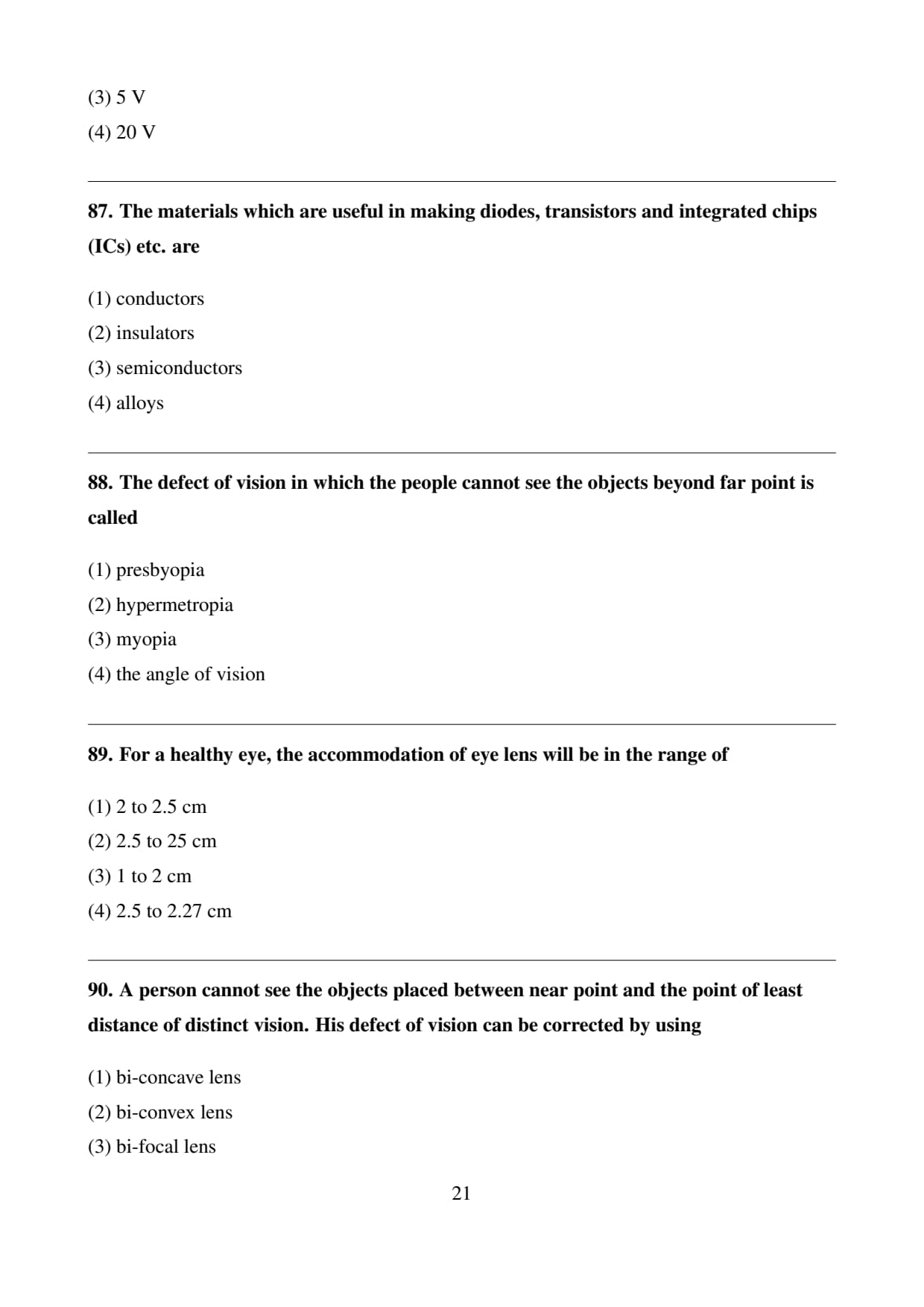
The materials which are useful in making diodes, transistors and integrated chips (ICs) etc. are
View Solution
Step 1: Concept
Identify the material class for electronic components.
Step 2: Meaning
Electronics require materials whose conductivity can be controlled.
Step 3: Analysis
Silicon and Germanium are the primary materials used for these devices.
Step 4: Conclusion
These are classified as semiconductors.
Final Answer: (3) Quick Tip: The "Silicon" in Silicon Valley refers to these semiconductors.
The defect of vision in which the people cannot see the objects beyond far point is called
View Solution
Step 1: Concept
Identify types of vision defects.
Step 2: Meaning
Myopia (nearsightedness) allows near vision but makes distant objects blurry.
Step 3: Analysis
In this condition, the far point is not at infinity but closer to the eye.
Step 4: Conclusion
The defect is myopia.
Final Answer: (3) Quick Tip: Myopia = Near sighted; Hypermetropia = Far sighted.
For a healthy eye, the accommodation of eye lens will be in the range of
View Solution
Step 1: Concept
Recall the focal length range of the human eye lens.
Step 2: Meaning
Accommodation is the eye's ability to change its focal length to see objects at various distances.
Step 3: Analysis
The distance between the lens and retina is fixed (\(\approx 2.5 cm\)). Focal length varies to keep images on the retina.
Step 4: Conclusion
The focal length typically ranges from \(2.5 cm\) (relaxed) to \(2.27 cm\) (strained).
Final Answer: (4) Quick Tip: The eye lens is thickest when viewing near objects (\(f = 2.27 cm\)).
A person cannot see the objects placed between near point and the point of least distance of distinct vision. His defect of vision can be corrected by using
View Solution
Step 1: Concept
Identify correction methods for Hypermetropia.
Step 2: Meaning
Hypermetropia (farsightedness) means the near point is further away than 25 cm.
Step 3: Analysis
The eye lens lacks sufficient converging power, causing the image to form behind the retina.
Step 4: Conclusion
A converging (convex) lens is required for correction.
Final Answer: (2) Quick Tip: Convex = Converging; Concave = Diverging.
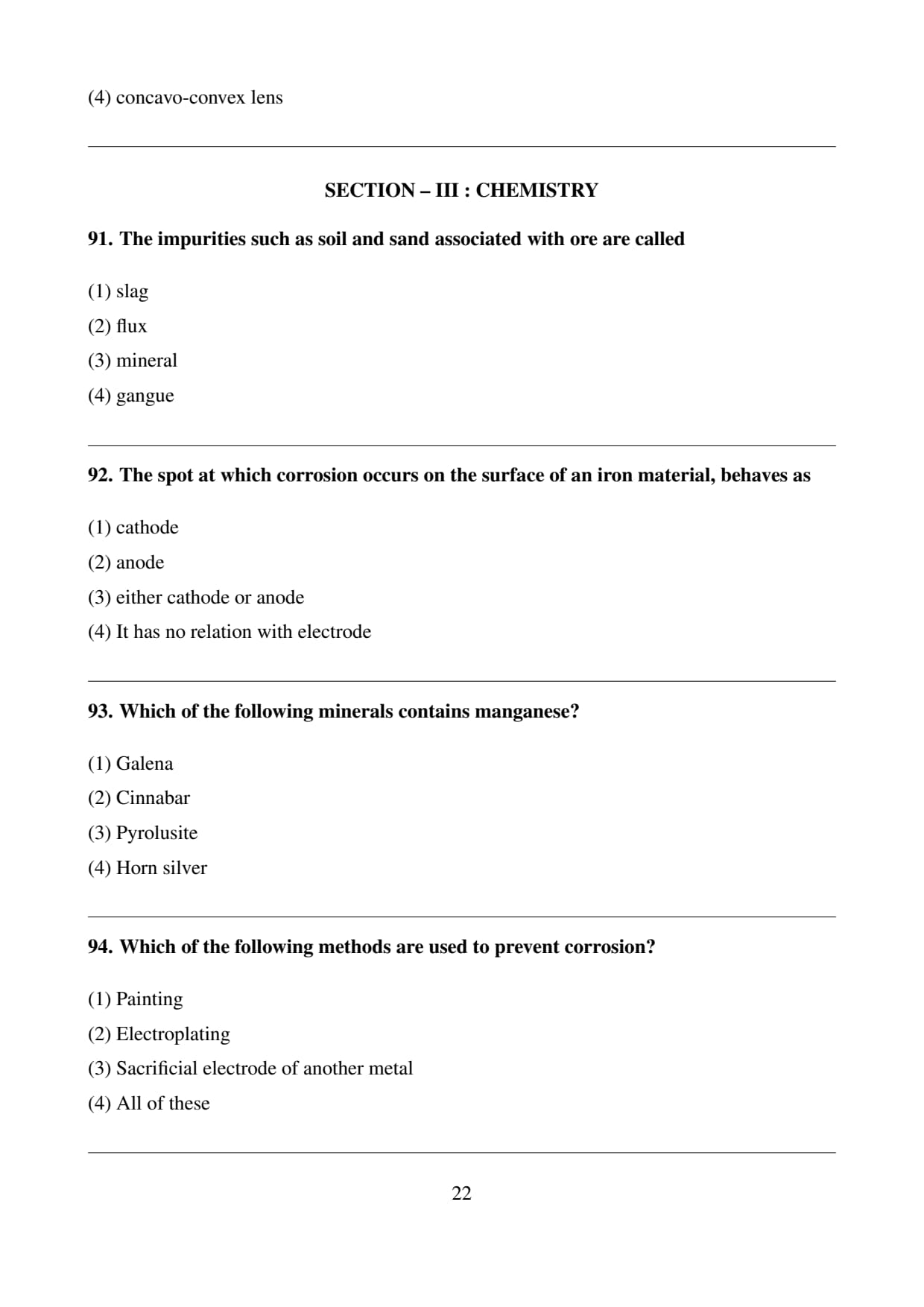
The impurities such as soil and sand associated with ore are called
View Solution
Step 1: Concept
Define terms used in metallurgy for non-metallic impurities.
Step 2: Meaning
Ores are extracted from the earth and are naturally contaminated.
Step 3: Analysis
Slag is a byproduct of smelting, flux is a substance added to remove impurities, and minerals are naturally occurring inorganic solids.
Step 4: Conclusion
The specific term for unwanted earthy impurities like sand and soil is gangue.
Final Answer: (4) Quick Tip: Ore - Gangue = Concentrated Ore.
The spot at which corrosion occurs on the surface of an iron material, behaves as
View Solution
Step 1: Concept
Understand the electrochemical theory of rusting (corrosion).
Step 2: Meaning
Corrosion is a redox reaction where metal is oxidized.
Step 3: Analysis
Oxidation (loss of electrons) always occurs at the anode. For iron: \(Fe \to Fe^{2+} + 2e^{-}\).
Step 4: Conclusion
The site of corrosion acts as the anode.
Final Answer: (2) Quick Tip: Anode = Oxidation (Loss of \(e^-\)); Cathode = Reduction (Gain of \(e^-\)).
Which of the following minerals contains manganese?
View Solution
Step 1: Concept
Identify ores/minerals and their chemical compositions.
Step 2: Meaning
Galena is Lead (Pb), Cinnabar is Mercury (Hg), and Horn Silver is Silver (Ag).
Step 3: Analysis
Pyrolusite is chemically Manganese Dioxide (\(MnO_2\)).
Step 4: Conclusion
Pyrolusite is the mineral containing manganese.
Final Answer: (3) Quick Tip: Pyrolusite (\(MnO_2\)) is the most important ore of Manganese.
Which of the following methods are used to prevent corrosion?
View Solution
Step 1: Concept
Identify various techniques used to protect metals from environmental oxidation.
Step 2: Meaning
Prevention involves creating a barrier or providing an alternative oxidation site.
Step 3: Analysis
Painting and electroplating create barriers. Sacrificial electrodes (like zinc) corrode instead of the main metal.
Step 4: Conclusion
All listed methods are valid prevention techniques.
Final Answer: (4) Quick Tip: Galvanization is a specific type of sacrificial protection using Zinc.
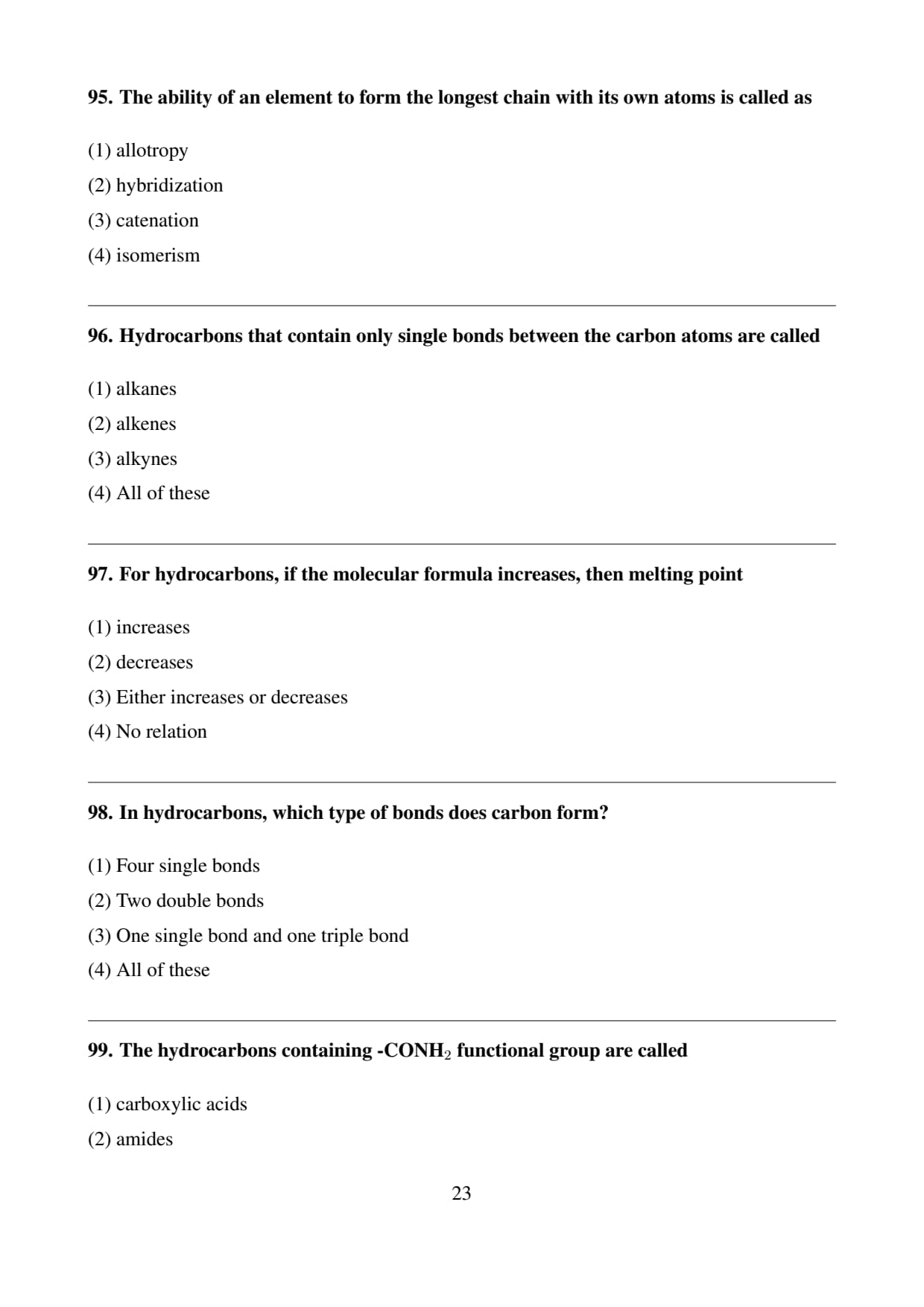
The ability of an element to form the longest chain with its own atoms is called as
View Solution
Step 1: Concept
Define properties of Carbon and similar elements in Organic Chemistry.
Step 2: Meaning
Self-linking is a unique property that allows for a vast variety of molecules.
Step 3: Analysis
Allotropy is different forms of an element; Hybridization is orbital mixing; Isomerism is same formula but different structure.
Step 4: Conclusion
The self-linking property is called catenation.
Final Answer: (3) Quick Tip: Carbon has the maximum power of catenation in the periodic table.
Hydrocarbons that contain only single bonds between the carbon atoms are called
View Solution
Step 1: Concept
Classify hydrocarbons based on the types of carbon-carbon bonds.
Step 2: Meaning
Saturated hydrocarbons have maximum hydrogen atoms and only single bonds.
Step 3: Analysis
Alkenes have double bonds, and Alkynes have triple bonds.
Step 4: Conclusion
Single-bonded hydrocarbons are known as alkanes.
Final Answer: (1) Quick Tip: Alkanes formula: \(C_nH_{2n+2}\).
For hydrocarbons, if the molecular formula increases, then melting point
View Solution
Step 1: Concept
Understand the relationship between molecular mass and physical properties.
Step 2: Meaning
Increasing molecular formula size means a larger molecule with more atoms.
Step 3: Analysis
Larger molecules have stronger Van der Waals forces between them, requiring more energy to separate.
Step 4: Conclusion
Therefore, the melting point increases as the molecular size increases.
Final Answer: (1) Quick Tip: Heavier hydrocarbons are solids, lighter ones are liquids or gases.
In hydrocarbons, which type of bonds does carbon form?
View Solution
Step 1: Concept
Understand the tetravalency of Carbon.
Step 2: Meaning
Carbon must always form a total of four covalent bonds to be stable.
Step 3: Analysis
Carbon can achieve this through various combinations: 4 singles (\(CH_4\)), 2 doubles (\(CO_2\)), or 1 single and 1 triple (\(HC \equiv CH\)).
Step 4: Conclusion
All the listed combinations are possible ways for carbon to bond.
Final Answer: (4) Quick Tip: Always count to four bonds for every Carbon atom!
The hydrocarbons containing -CONH\(_2\) functional group are called
View Solution
Step 1: Concept
Identify organic functional groups.
Step 2: Meaning
Acids contain -COOH, Amines contain -NH\(_2\), and Esters contain -COOR.
Step 3: Analysis
The -CONH\(_2\) group consists of a carbonyl group (\(C=O\)) directly attached to an amino group (\(NH_2\)).
Step 4: Conclusion
This functional group defines the Amide class.
Final Answer: (2) Quick Tip: Amine is just \(-NH_2\); Amide has the extra 'O' from the Carbonyl.
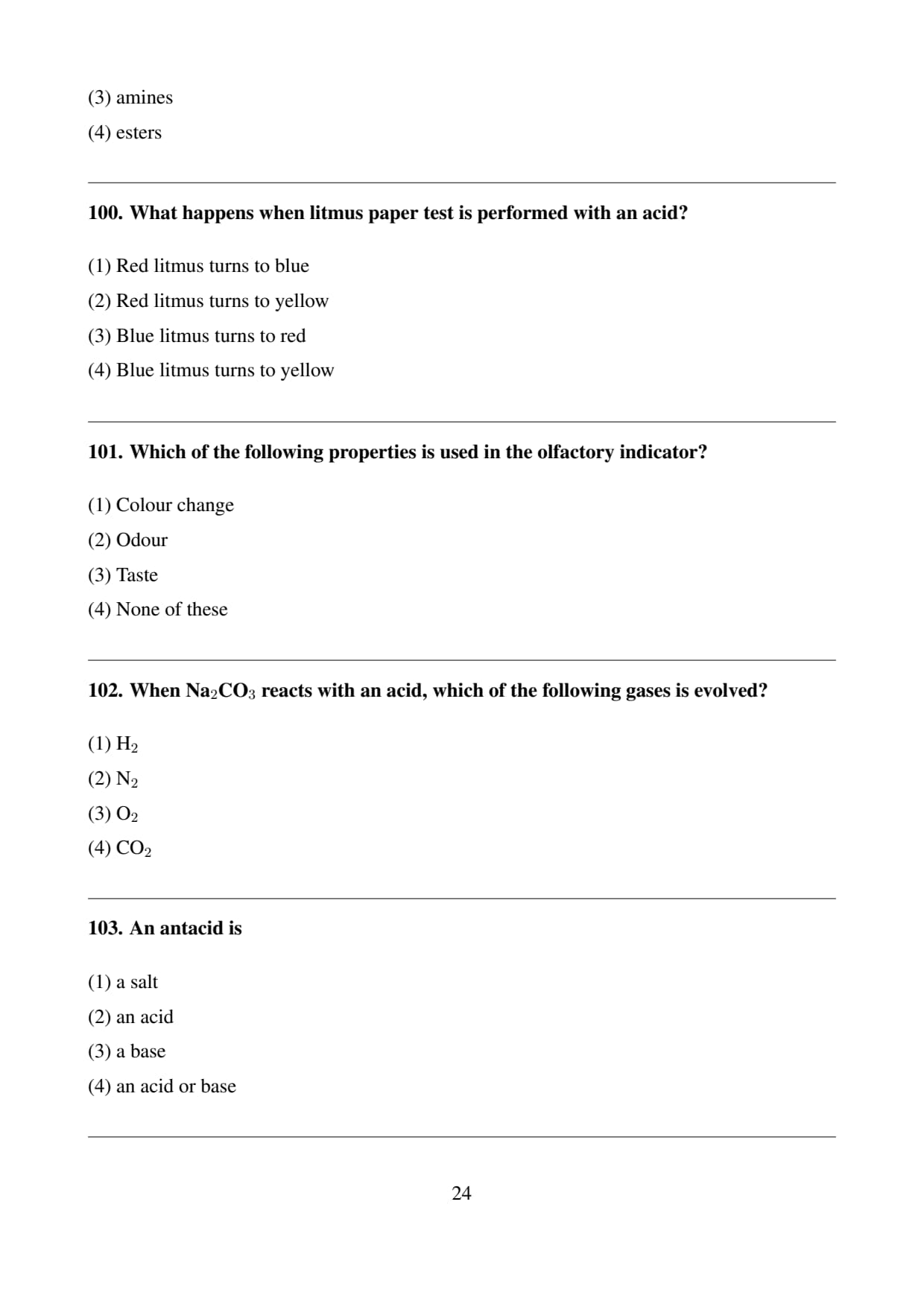
What happens when litmus paper test is performed with an acid?
View Solution
Step 1: Concept
Identify the standard behavior of pH indicators.
Step 2: Meaning
Litmus is a natural dye used to detect acidity or alkalinity.
Step 3: Analysis
Bases turn red litmus blue. Acids have the opposite effect on blue litmus.
Step 4: Conclusion
Acids turn blue litmus paper red.
Final Answer: (3) Quick Tip: ABR: Acid turns Blue to Red.
Which of the following properties is used in the olfactory indicator?
View Solution
Step 1: Concept
Identify the defining characteristic of olfactory indicators.
Step 2: Meaning
The term "olfactory" relates to the sense of smell.
Step 3: Analysis
Unlike visual indicators that change color, olfactory indicators change their smell in acidic or basic media.
Step 4: Conclusion
Odour is the property used.
Final Answer: (2) Quick Tip: Onion and vanilla essence are common olfactory indicators.
When Na\(_2\)CO\(_3\) reacts with an acid, which of the following gases is evolved?
View Solution
Step 1: Concept
Reaction of metal carbonates with acids.
Step 2: Meaning
Sodium carbonate (Na\(_2\)CO\(_3\)) is a metal carbonate.
Step 3: Analysis
\(Metal Carbonate + Acid \rightarrow Salt + Water + Carbon Dioxide\).
Step 4: Conclusion
The evolved gas is Carbon Dioxide (CO\(_2\)).
Final Answer: (4) Quick Tip: Carbonates always release \(CO_2\) when reacting with acids.
An antacid is
View Solution
Step 1: Concept
Understand the function of antacids in treating acidity.
Step 2: Meaning
Acidity is caused by excess HCl in the stomach.
Step 3: Analysis
To neutralize an acid, a mild base is required.
Step 4: Conclusion
Therefore, an antacid is a base.
Final Answer: (3) Quick Tip: Milk of Magnesia (Magnesium Hydroxide) is a common antacid base.
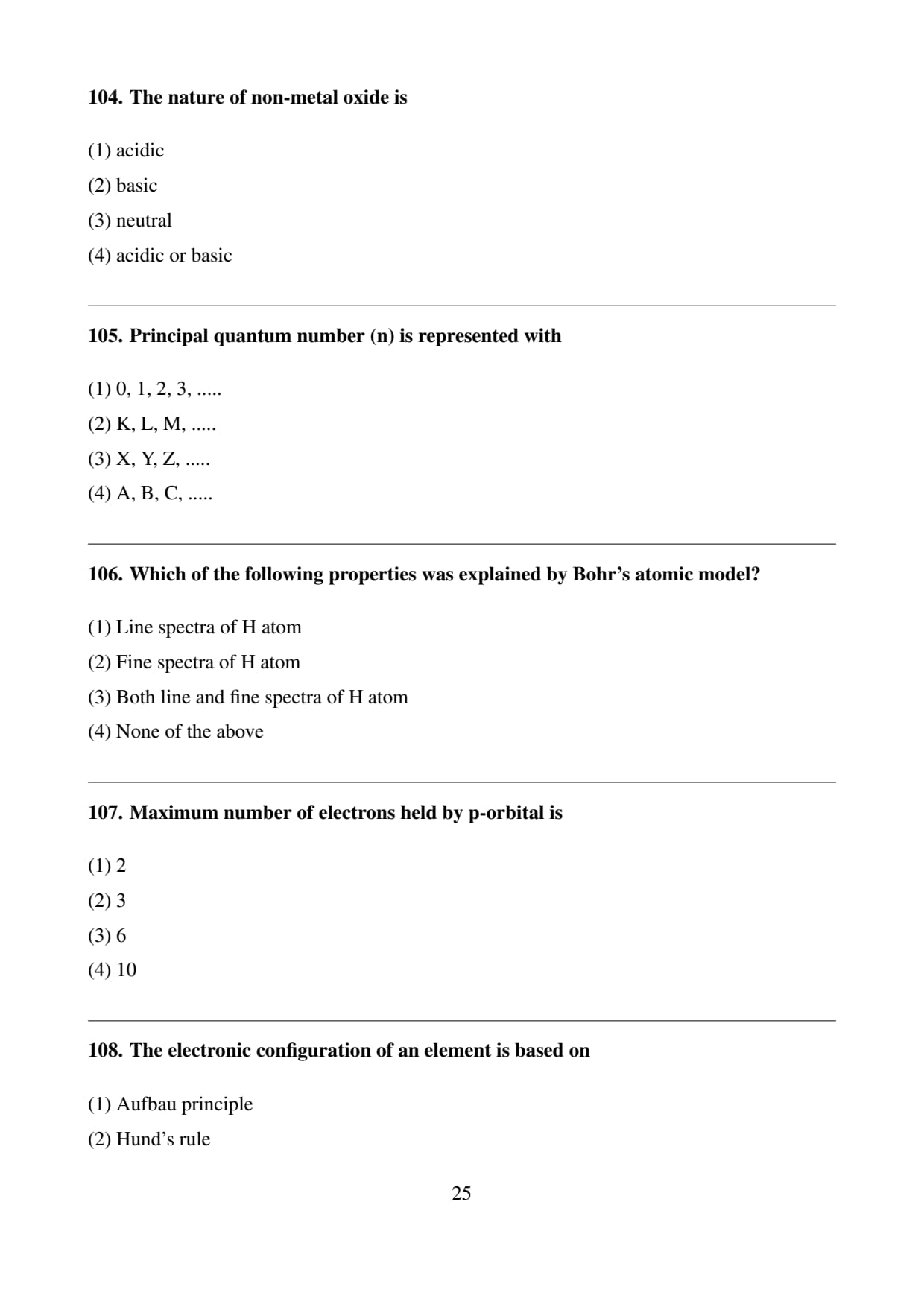
The nature of non-metal oxide is
View Solution
Step 1: Concept
Chemical nature of oxides.
Step 2: Meaning
Non-metals are elements like Carbon or Sulphur.
Step 3: Analysis
Non-metal oxides (like \(CO_2\) or \(SO_2\)) react with water to form acids.
Step 4: Conclusion
They are acidic in nature.
Final Answer: (1) Quick Tip: Metal oxides are Basic; Non-metal oxides are Acidic.
Principal quantum number (n) is represented with
View Solution
Step 1: Concept
Representation of electron shells.
Step 2: Meaning
The principal quantum number \(n\) denotes the main shell.
Step 3: Analysis
While \(n\) takes numerical values 1, 2, 3, these shells are lettered alphabetically starting from K.
Step 4: Conclusion
Represented by K, L, M, etc.
Final Answer: (2) Quick Tip: \(n=1\) is K, \(n=2\) is L, \(n=3\) is M, and so on.
Which of the following properties was explained by Bohr's atomic model?
View Solution
Step 1: Concept
Successes of the Bohr model.
Step 2: Meaning
Line spectra refer to discrete wavelengths emitted by hydrogen.
Step 3: Analysis
Bohr successfully explained the origin of hydrogen lines but failed to explain the "fine structure" (closely spaced lines).
Step 4: Conclusion
Only line spectra were explained.
Final Answer: (1) Quick Tip: Sommerfeld's model was later proposed to explain the fine spectra.
Maximum number of electrons held by p-orbital is
View Solution
Step 1: Concept
Electron capacity of subshells.
Step 2: Meaning
The p-subshell consists of three orbitals (\(p_x, p_y, p_z\)).
Step 3: Analysis
Each orbital can hold 2 electrons. \(3 \times 2 = 6\).
Step 4: Conclusion
Maximum capacity is 6.
Final Answer: (3) Quick Tip: s-shell (2), p-shell (6), d-shell (10), f-shell (14).
The electronic configuration of an element is based on
View Solution
Step 1: Concept
Rules for filling electrons in orbitals.
Step 2: Meaning
Aufbau (order), Hund (pairing), and Pauli (spin).
Step 3: Analysis
All three rules must be followed simultaneously to write a correct configuration.
Step 4: Conclusion
The answer is All of the above.
Final Answer: (4) Quick Tip: Aufbau means "building up" in German.
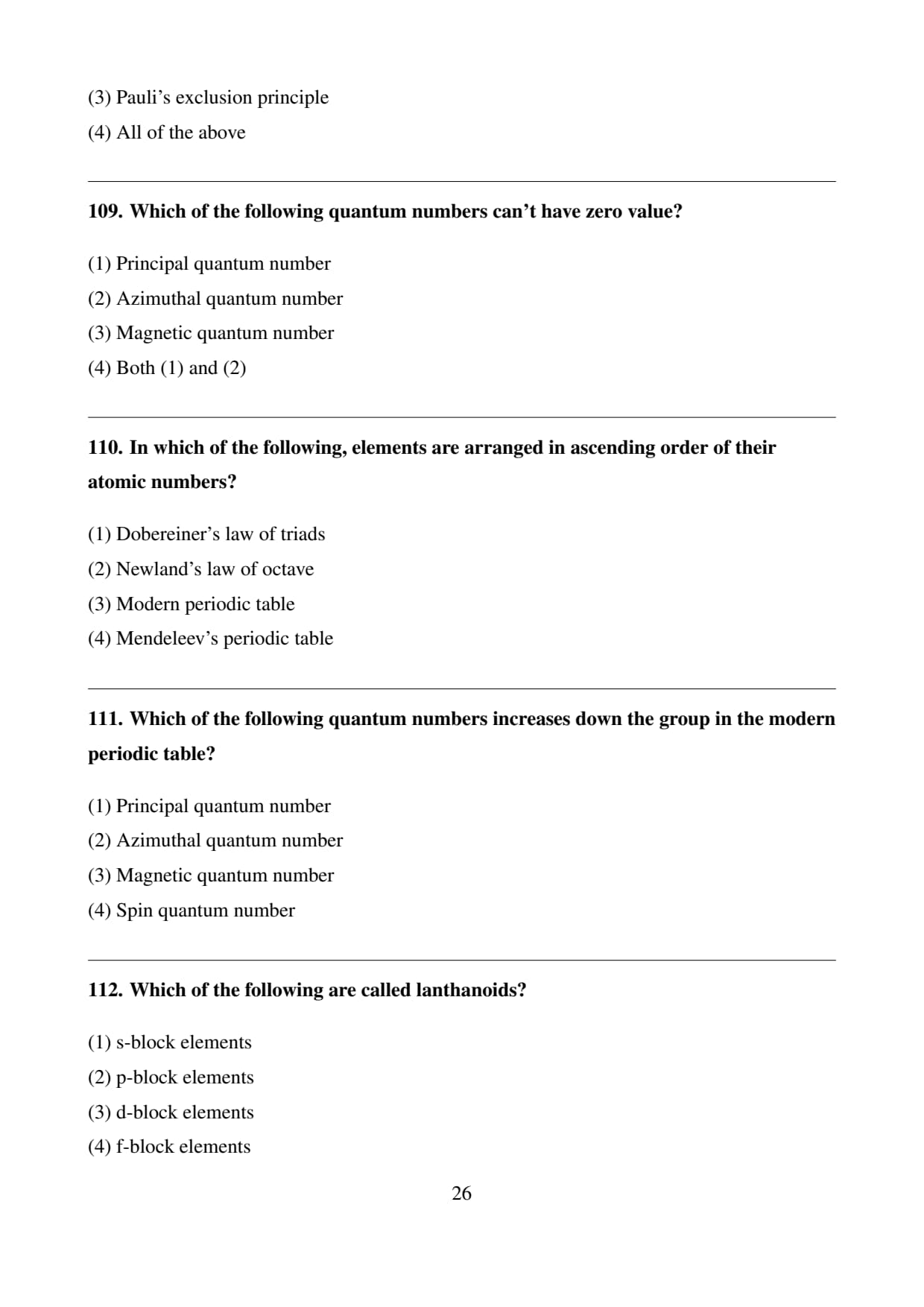
Which of the following quantum numbers can't have zero value?
View Solution
Step 1: Concept
Allowed values for quantum numbers.
Step 2: Meaning
\(n\) (Principal), \(l\) (Azimuthal), \(m\) (Magnetic).
Step 3: Analysis
\(l\) can be 0 (s-orbital), \(m\) can be 0. However, \(n\) must be a positive integer (\(1, 2, 3...\)).
Step 4: Conclusion
\(n\) cannot be zero.
Final Answer: (1) Quick Tip: \(n\) starts from 1; \(l\) starts from 0.
In which of the following, elements are arranged in ascending order of their atomic numbers?
View Solution
Step 1: Concept
Basis of classification in different periodic tables.
Step 2: Meaning
Early models used atomic mass.
Step 3: Analysis
Dobereiner, Newland, and Mendeleev all used atomic mass. Moseley's modern table used atomic number.
Step 4: Conclusion
Modern periodic table is the correct choice.
Final Answer: (3) Quick Tip: Henry Moseley showed that atomic number is the fundamental property.
Which of the following quantum numbers increases down the group in the modern periodic table?
View Solution
Step 1: Concept
Understand the relationship between periodic table position and quantum numbers.
Step 2: Meaning
Moving down a group means moving from one period to the next.
Step 3: Analysis
Each new period represents a new electron shell being added to the atom.
Step 4: Conclusion
The Principal quantum number (\(n\)), which denotes the shell, increases by 1 for each row down a group.
Final Answer: (1) Quick Tip: Period number = Principal quantum number of the valence shell.
Which of the following are called lanthanoids?
View Solution
Step 1: Concept
Identify the location of specific element series in the periodic table.
Step 2: Meaning
Lanthanoids are the series of 14 elements following Lanthanum.
Step 3: Analysis
These elements involve the filling of the \(4f\) subshell.
Step 4: Conclusion
Therefore, they are classified as f-block elements.
Final Answer: (4) Quick Tip: Lanthanoids and Actinoids together make up the f-block (inner transition elements).
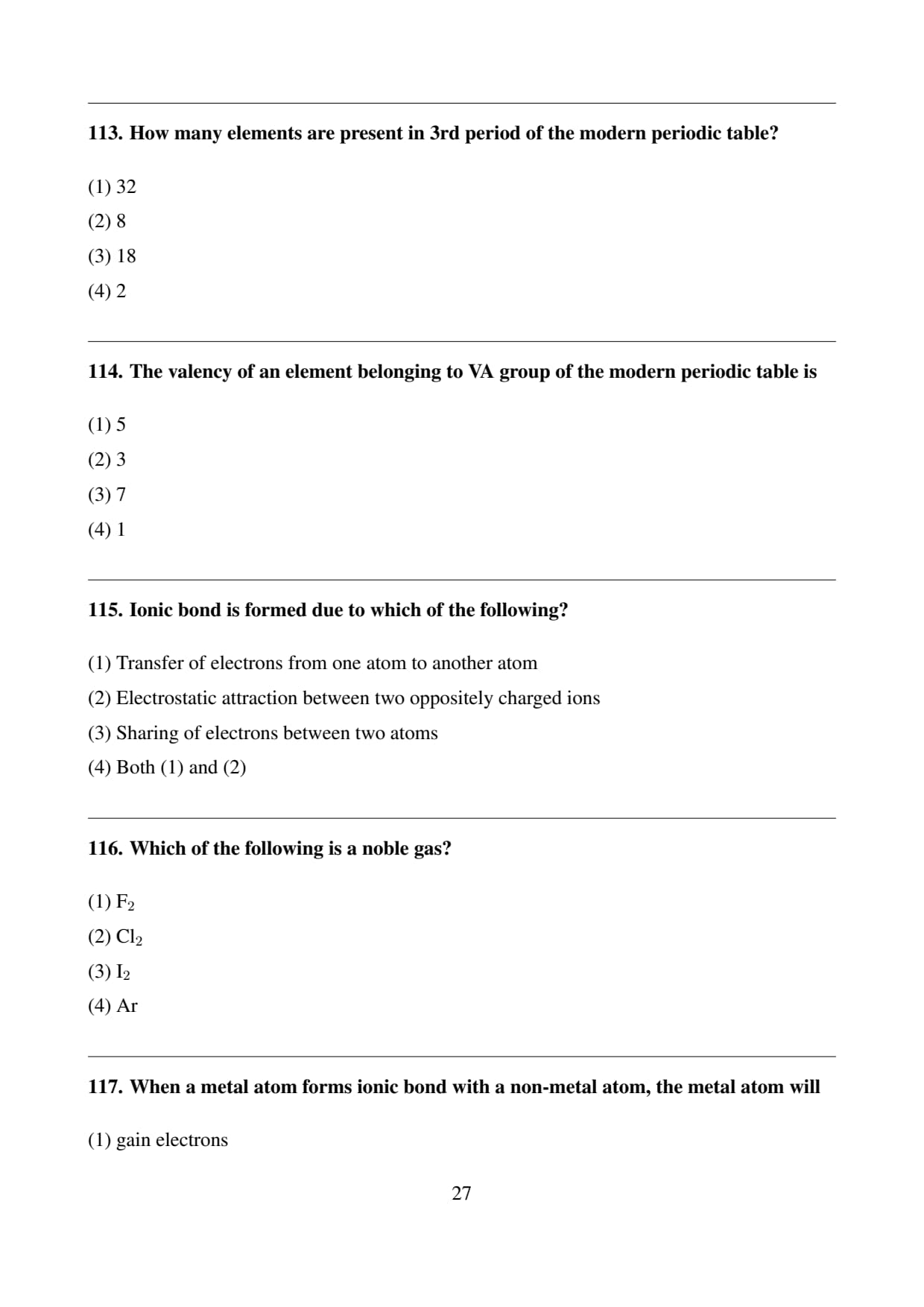
How many elements are present in 3rd period of the modern periodic table?
View Solution
Step 1: Concept
Recall the number of elements in each period of the modern periodic table.
Step 2: Meaning
The 3rd period starts with Sodium (Na) and ends with Argon (Ar).
Step 3: Analysis
It involves the filling of \(3s\) and \(3p\) orbitals. \(2 (s) + 6 (p) = 8\) electrons/elements.
Step 4: Conclusion
There are exactly 8 elements in the 3rd period.
Final Answer: (2) Quick Tip: Period 1 (2), Period 2 (8), Period 3 (8), Period 4 (18).
The valency of an element belonging to VA group of the modern periodic table is
View Solution
Step 1: Concept
Calculate valency based on group number.
Step 2: Meaning
Group VA (or Group 15) elements have 5 valence electrons.
Step 3: Analysis
To complete an octet, these atoms need to gain or share 3 more electrons.
Step 4: Conclusion
Valency = \(8 - 5 = 3\).
Final Answer: (2) Quick Tip: For groups 15-17, Valency = 8 - (number of valence electrons).
Ionic bond is formed due to which of the following?
View Solution
Step 1: Concept
Understand the mechanism of ionic bonding.
Step 2: Meaning
Ionic bonding occurs between metals and non-metals.
Step 3: Analysis
It begins with the transfer of electrons (1), which creates ions. These ions are then held together by electrostatic forces (2).
Step 4: Conclusion
Both statements describe parts of the ionic bond formation process.
Final Answer: (4) Quick Tip: Transfer of electrons \(\to\) Ions \(\to\) Attraction = Ionic Bond.
Which of the following is a noble gas?
View Solution
Step 1: Concept
Identify elements belonging to Group 18 (Noble Gases).
Step 2: Meaning
Noble gases are chemically inert and have complete valence shells.
Step 3: Analysis
Fluorine, Chlorine, and Iodine are Halogens (Group 17).
Step 4: Conclusion
Argon (Ar) is a noble gas.
Final Answer: (4) Quick Tip: He, Ne, Ar, Kr, Xe, Rn are the noble gases.
When a metal atom forms ionic bond with a non-metal atom, the metal atom will
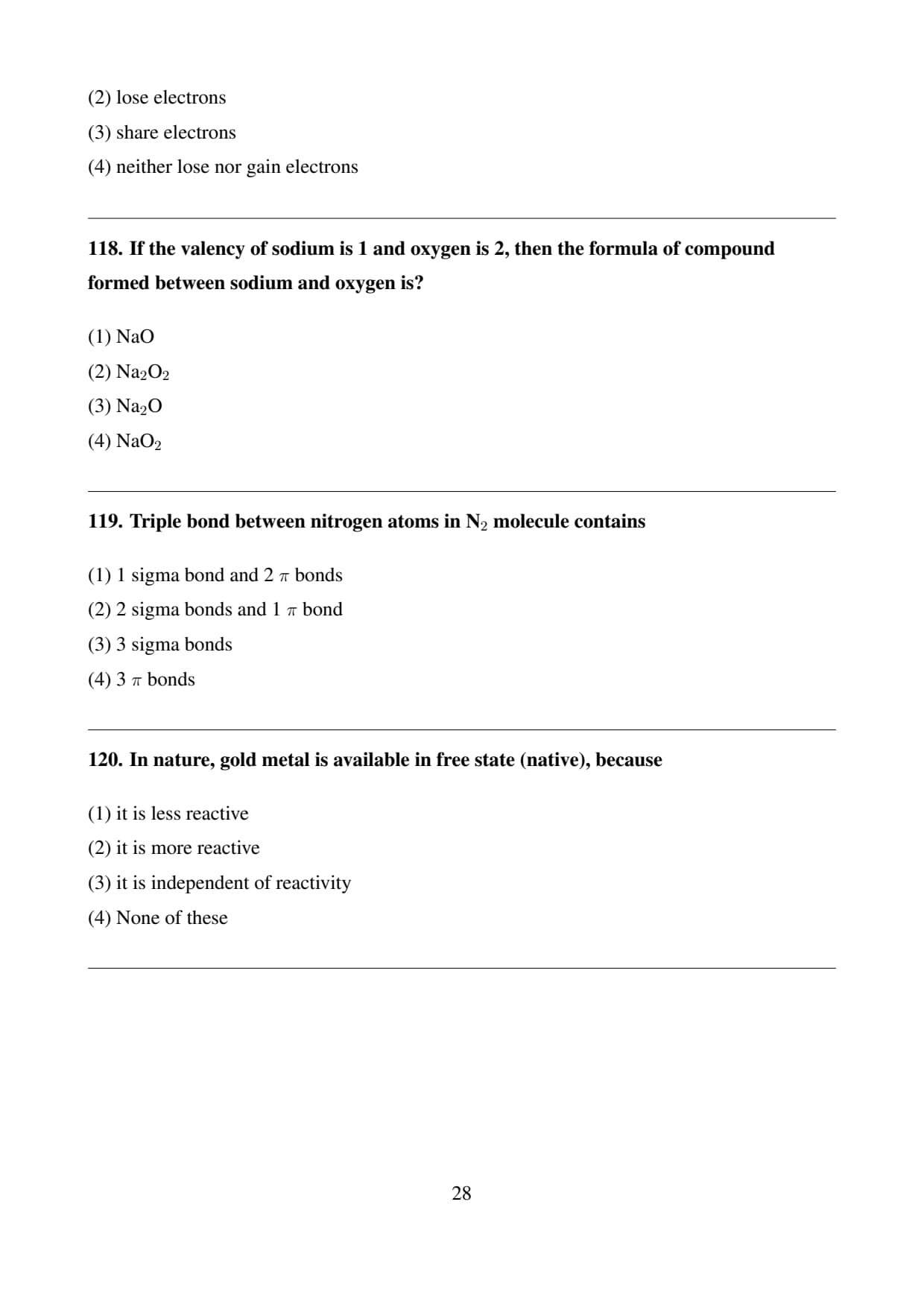
View Solution
Step 1: Concept
Understand electron movement during ionic bond formation.
Step 2: Meaning
Metals have low ionization energy and 1-3 valence electrons.
Step 3: Analysis
To achieve stability, metals give away their valence electrons to non-metals.
Step 4: Conclusion
The metal atom loses electrons to become a positively charged cation.
Final Answer: (2) Quick Tip: Metals = Electron Donors; Non-metals = Electron Acceptors.
If the valency of sodium is 1 and oxygen is 2, then the formula of compound formed between sodium and oxygen is?
View Solution
Step 1: Concept
Use the criss-cross method to determine chemical formulas.
Step 2: Meaning
Write symbols and their respective valencies: Na (1) and O (2).
Step 3: Analysis
Cross the valencies: The 2 from Oxygen goes to Sodium, and the 1 from Sodium goes to Oxygen.
Step 4: Conclusion
The resulting formula is Na\(_2\)O.
Final Answer: (3) Quick Tip: The total positive charge must equal the total negative charge (\(2 \times +1 = -2\)).
Triple bond between nitrogen atoms in N\(_2\) molecule contains
View Solution
Step 1: Concept
Composition of multiple covalent bonds.
Step 2: Meaning
A single bond is always a sigma (\(\sigma\)) bond. Additional bonds are pi (\(\pi\)) bonds.
Step 3: Analysis
In a triple bond (\(N \equiv N\)), the first bond formed is a \(\sigma\) bond, and the remaining two are \(\pi\) bonds.
Step 4: Conclusion
The triple bond contains 1 sigma and 2 pi bonds.
Final Answer: (1) Quick Tip: Single (1\(\sigma\)), Double (1\(\sigma\), 1\(\pi\)), Triple (1\(\sigma\), 2\(\pi\)).
In nature, gold metal is available in free state (native), because
View Solution
Step 1: Concept
Understand the relationship between metal reactivity and natural occurrence.
Step 2: Meaning
"Free state" means the metal is found as an element, not a compound.
Step 3: Analysis
Highly reactive metals react with oxygen or moisture to form compounds. Gold is at the bottom of the reactivity series.
Step 4: Conclusion
Due to its very low reactivity, gold does not easily form compounds and remains in its elemental form.
Final Answer: (1) Quick Tip: Noble metals like Gold and Platinum are found in the native state.



Comments