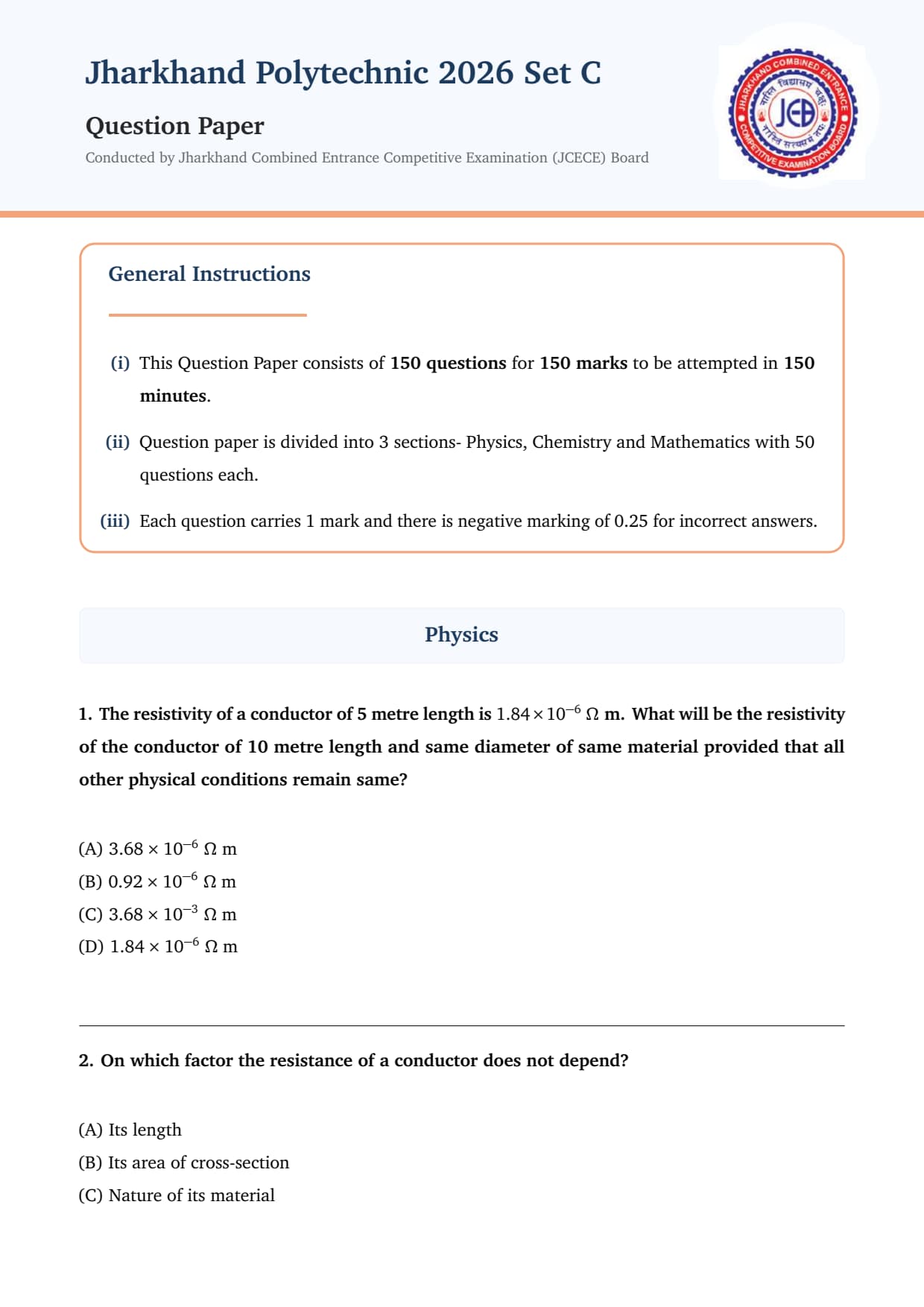
Jharkhand Polytechnic 2026 Question Paper is available for download here. JCECE Board has conducted Jharkhand Polytechnic 2026 exam on 12 July in single shift from 10.30 AM to 1.00 PM. Jharkhand Polytechnic 2026 Question Paper consists of 150 questions for 150 marks to be attempted in 150 minutes.

  • Jharkhand Polytechnic question paper is divided into 3 sections- Physics, Chemistry and Mathematics with 50 questions each.
  • According to Jharkhand Polytechnic exam pattern, each question carries 1 mark and there is negative marking of 0.25 for incorrect answers.

Candidates can download Jharkhand Polytechnic 2026 Question Paper with Answer Key and Solution PDF from the links provided below.

Jharkhand Polytechnic 2026 Question Paper with Solutions PDF

Jharkhand Polytechnic Question Paper 2026 Download PDF Check Solution

Question 1:

The resistivity of a conductor of 5 metre length is \(1.84 \times 10^{-6}\ \Omega m\). What will be the resistivity of the conductor of 10 metre length and same diameter of same material provided that all other physical conditions remain same?

  • (A) \(3.68 \times 10^{-6}\ \Omega m\)
  • (B) \(0.92 \times 10^{-6}\ \Omega m\)
  • (C) \(3.68 \times 10^{-3}\ \Omega m\)
  • (D) \(1.84 \times 10^{-6}\ \Omega m\)

Question 2:

On which factor the resistance of a conductor does not depend?

  • (A) Its length
  • (B) Its area of cross-section
  • (C) Nature of its material
  • (D) Its surface finish

Question 3:

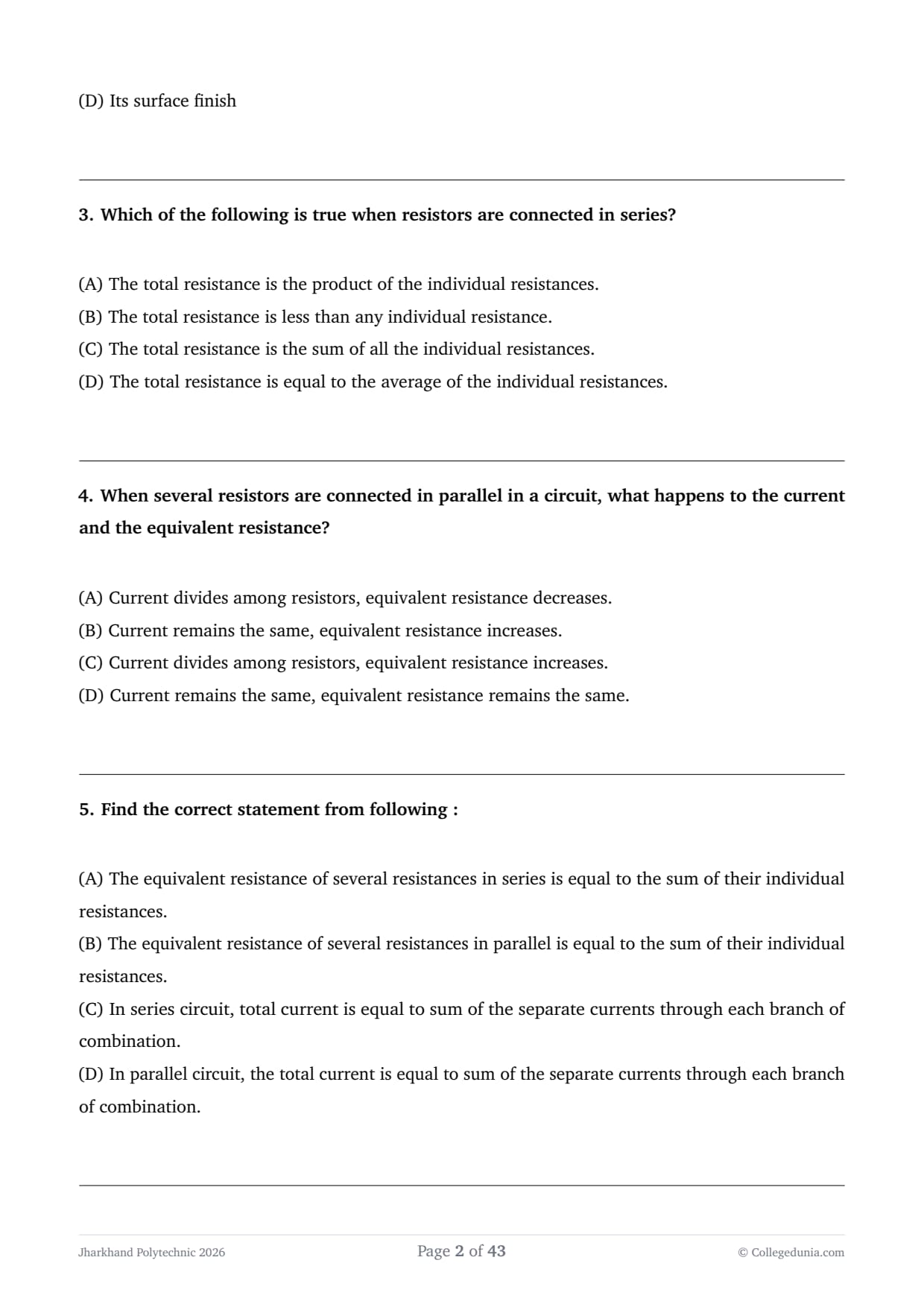
Which of the following is true when resistors are connected in series?

  • (A) The total resistance is the product of the individual resistances.
  • (B) The total resistance is less than any individual resistance.
  • (C) The total resistance is the sum of all the individual resistances.
  • (D) The total resistance is equal to the average of the individual resistances.

Question 4:

When several resistors are connected in parallel in a circuit, what happens to the current and the equivalent resistance?

  • (A) Current divides among resistors, equivalent resistance decreases.
  • (B) Current remains the same, equivalent resistance increases.
  • (C) Current divides among resistors, equivalent resistance increases.
  • (D) Current remains the same, equivalent resistance remains the same.

Question 5:

Find the correct statement from following :

  • (A) The equivalent resistance of several resistances in series is equal to the sum of their individual resistances.
  • (B) The equivalent resistance of several resistances in parallel is equal to the sum of their individual resistances.
  • (C) In series circuit, total current is equal to sum of the separate currents through each branch of combination.
  • (D) In parallel circuit, the total current is equal to sum of the separate currents through each branch of combination.

Question 6:

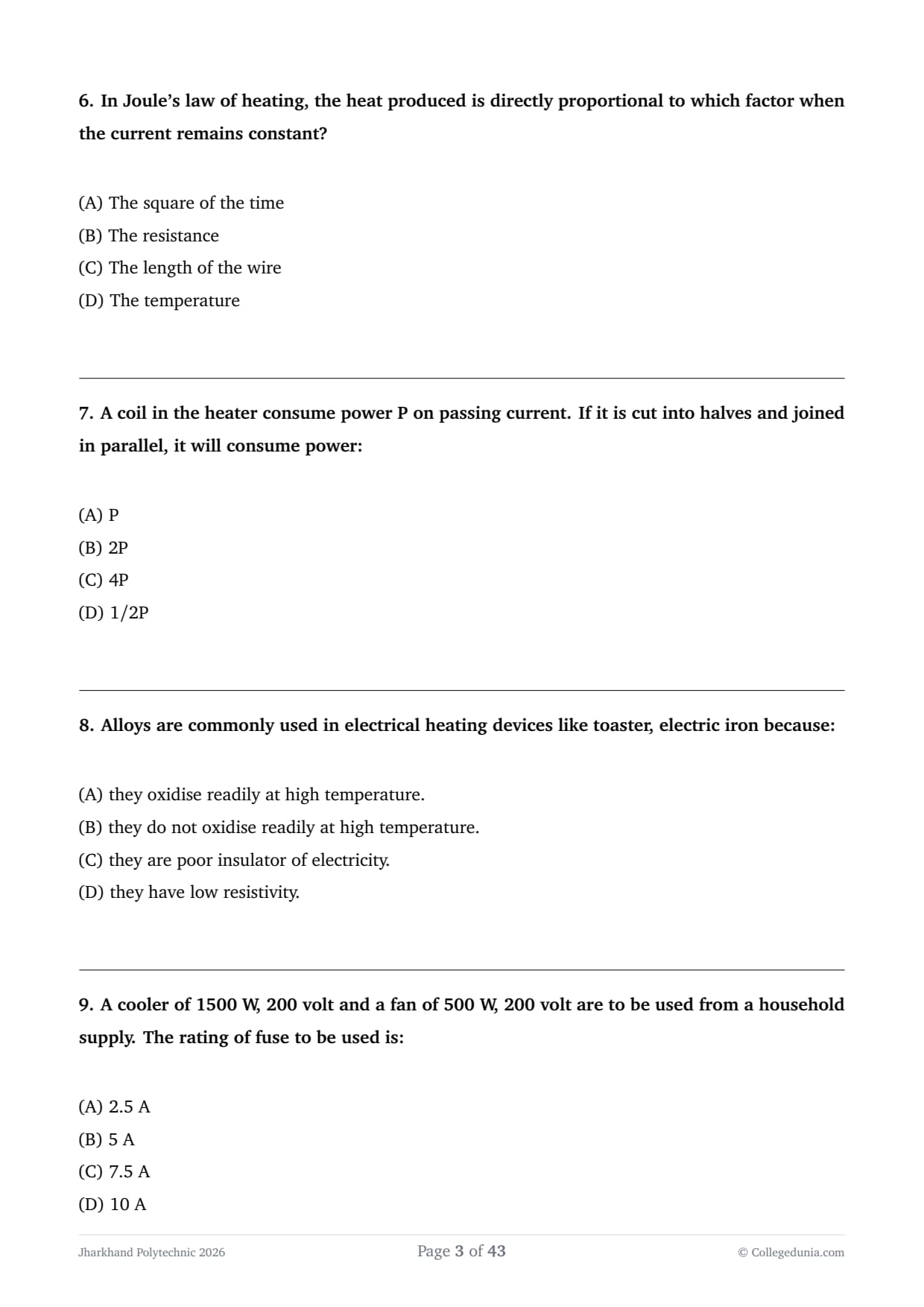
In Joule's law of heating, the heat produced is directly proportional to which factor when the current remains constant?

  • (A) The square of the time
  • (B) The resistance
  • (C) The length of the wire
  • (D) The temperature

Question 7:

A coil in the heater consume power P on passing current. If it is cut into halves and joined in parallel, it will consume power:

  • (A) P
  • (B) 2P
  • (C) 4P
  • (D) 1/2P

Question 8:

Alloys are commonly used in electrical heating devices like toaster, electric iron because:

  • (A) they oxidise readily at high temperature.
  • (B) they do not oxidise readily at high temperature.
  • (C) they are poor insulator of electricity.
  • (D) they have low resistivity.

Question 9:

A cooler of 1500 W, 200 volt and a fan of 500 W, 200 volt are to be used from a household supply. The rating of fuse to be used is:

  • (A) 2.5 A
  • (B) 5 A
  • (C) 7.5 A
  • (D) 10 A

Question 10:

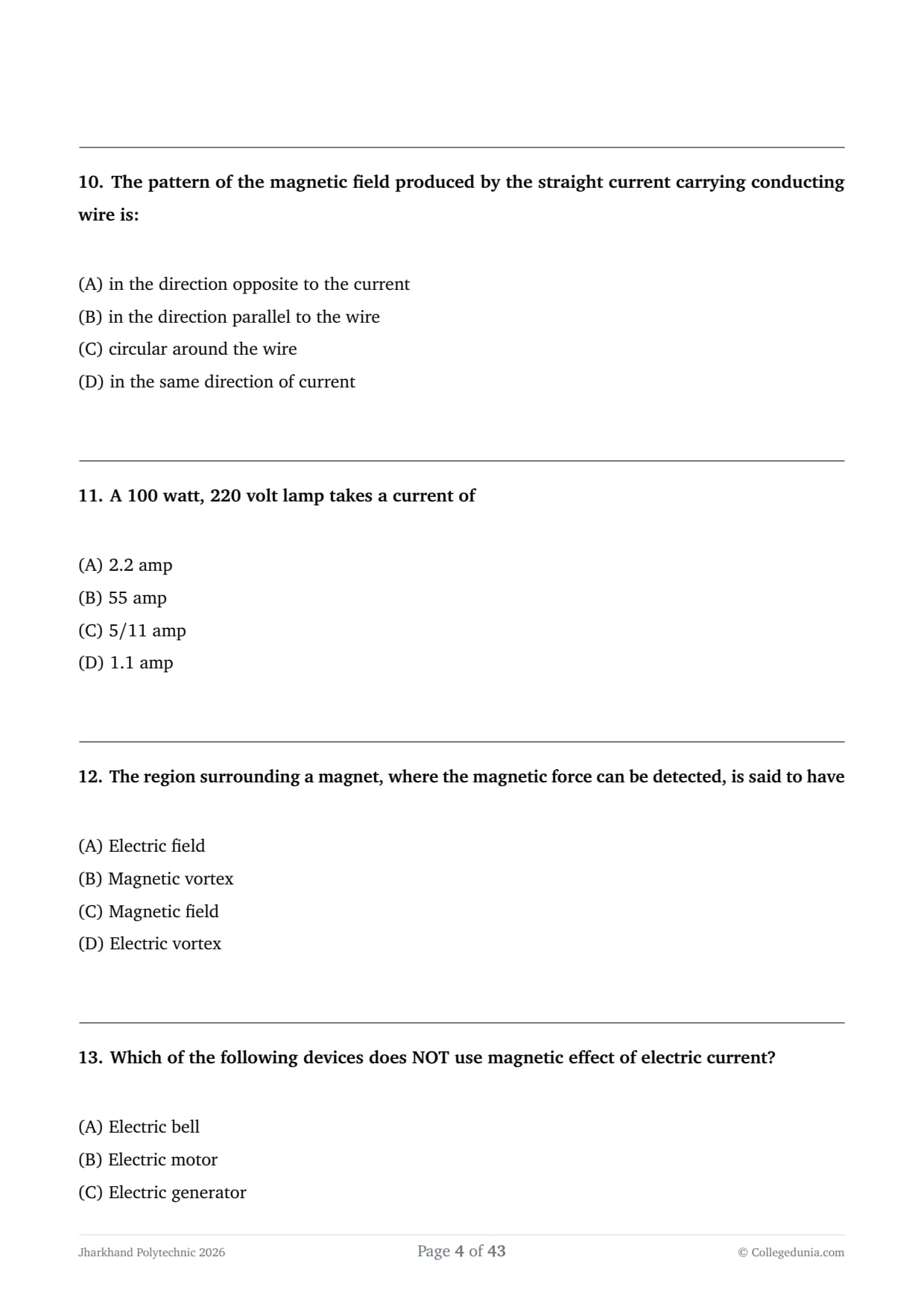
The pattern of the magnetic field produced by the straight current carrying conducting wire is:

  • (A) in the direction opposite to the current
  • (B) in the direction parallel to the wire
  • (C) circular around the wire
  • (D) in the same direction of current

Question 11:

A 100 watt, 220 volt lamp takes a current of

  • (A) 2.2 amp
  • (B) 55 amp
  • (C) 5/11 amp
  • (D) 1.1 amp

Question 12:

The region surrounding a magnet, where the magnetic force can be detected, is said to have

  • (A) Electric field
  • (B) Magnetic vortex
  • (C) Magnetic field
  • (D) Electric vortex

Question 13:

Which of the following devices does NOT use magnetic effect of electric current?

  • (A) Electric bell
  • (B) Electric motor
  • (C) Electric generator
  • (D) Electric heater

Question 14:

What happens to the deflection of the compass needle when it is moved away from a copper wire carrying a constant current?

  • (A) The deflection increases.
  • (B) The deflection remains the same.
  • (C) The deflection decreases.
  • (D) The needle becomes magnetic.

Question 15:

Magnetic field inside a current-carrying long solenoid

  • (A) is zero.
  • (B) decreases towards end.
  • (C) increases towards end.
  • (D) is same at all points.

Question 16:

Which of the following is NOT generally used for electrical transmission lines?

  • (A) Copper
  • (B) Aluminium
  • (C) Tungsten
  • (D) Both Copper and Aluminium

Question 17:

In domestic Indian house, the values of AC electrical power and frequency we receive are __________.

  • (A) 220 V and 50 Hz
  • (B) 240 V and 60 Hz
  • (C) 240 V and 50 Hz
  • (D) 220 V and 60 Hz

Question 18:

Consider the statements given below and choose the correct option :
Statement 1 : Angle of deviation produced by a prism depends on the angle of the prism.
Statement 2 : Dispersion takes place in a prism because the refractive index of the refracting medium is different for different wavelengths.

  • (A) Statements 1 & 2 both are correct.
  • (B) Statement 1 is correct, but Statement 2 is incorrect.
  • (C) Statements 1 & 2 both are incorrect.
  • (D) Statement 1 is incorrect, but Statement 2 is correct.

Question 19:

A light ray travels obliquely from a denser medium to a rarer medium. It will bend:

  • (A) Towards the normal
  • (B) Away from the normal
  • (C) Along the normal
  • (D) It will not bend

Question 20:

In case of a concave mirror, a ray parallel to the principal axis after reflection will

  • (A) Pass through the principal focus
  • (B) Diverge from the principal focus
  • (C) Reflect back to the object
  • (D) Pass through the centre of curvature

Question 21:

Which mirror is used by a dentist to examine a small cavity?

  • (A) Plane mirror
  • (B) Convex mirror
  • (C) Spherical mirror
  • (D) Concave mirror

Question 22:

A point on the principal axis of a spherical mirror where rays parallel to the principal axis after reflection meet or appear to meet is known as:

  • (A) centre of curvature
  • (B) principal focus
  • (C) pole
  • (D) aperture

Question 23:

The aperture of a spherical mirror refers to:

  • (A) The curvature of the mirror
  • (B) The focal length of the mirror
  • (C) The diameter of the reflecting surface
  • (D) The distance from the mirror to the object

Question 24:

Magnification produced by a rear view mirror fitted in vehicles:

  • (A) is less than one
  • (B) is more than one
  • (C) is equal to one
  • (D) can be more than or less than one depending upon the position of the object in front of it

Question 25:

The relationship between the radius of curvature R and focal length f of a spherical mirror of small aperture could be represented as:

  • (A) R = 1/f
  • (B) R = 2f
  • (C) R = 3f
  • (D) R = f

Question 26:

A child is standing in front of a magic mirror. She finds the image of her head bigger, the middle portion of her body of the same size and that of the legs smaller. The following is the order of combinations for the magic mirror from the top:

  • (A) Plane, convex and concave
  • (B) Convex, concave and plane
  • (C) Concave, plane and convex
  • (D) Convex, plane and concave

Question 27:

An object placed at a distance of +15 cm is slowly moved towards the pole of a convex mirror. The image will get

  • (A) shortened and real.
  • (B) enlarged and real.
  • (C) enlarged and virtual.
  • (D) diminished and virtual.

Question 28:

If a man's face is 25 cm in front of a concave shaving mirror producing erect image of 1.5 times the size of face, focal length of the mirror should be:

  • (A) 75 cm
  • (B) 25 cm
  • (C) -75 cm
  • (D) 60 cm

Question 29:

What is the size of the image formed when the object is at infinity in front of a concave mirror?

  • (A) Highly magnified
  • (B) Highly diminished, point-sized
  • (C) Same size as the object
  • (D) Inverted and large

Question 30:

An object is placed at 60.0 cm in front of a concave mirror of focal length 30 cm. At what distance from the mirror should a screen be placed to obtain a sharp image?

  • (A) 60.0 cm in front of the mirror
  • (B) 30.0 cm back of the mirror
  • (C) 90.0 cm in front of the mirror
  • (D) 90.0 cm back of the mirror

Question 31:

When electric current is passed, electrons move from:

  • (A) high potential to low potential
  • (B) low potential to high potential
  • (C) in the direction of the current
  • (D) in the direction opposite to the current

Question 32:

What does the magnification produced by a spherical mirror represent?

  • (A) The distance between the mirror and the object
  • (B) The ratio of the height of the object to the height of the image
  • (C) The ratio of the height of the image to the height of the object
  • (D) The size of the mirror

Question 33:

The Sun is visible to us about 2 minutes before the actual sunrise and about 2 minutes after the actual sunset because of

  • (A) atmospheric refraction
  • (B) atmospheric scattering
  • (C) dispersion of light
  • (D) motion of Earth

Question 34:

Large number of thin strips of black paper are made on the surface of a convex lens of focal length 20 cm to catch the image of a white horse. The image will be

  • (A) a zebra of black stripes
  • (B) a horse of black stripes
  • (C) a zebra of less brightness
  • (D) a horse of less brightness

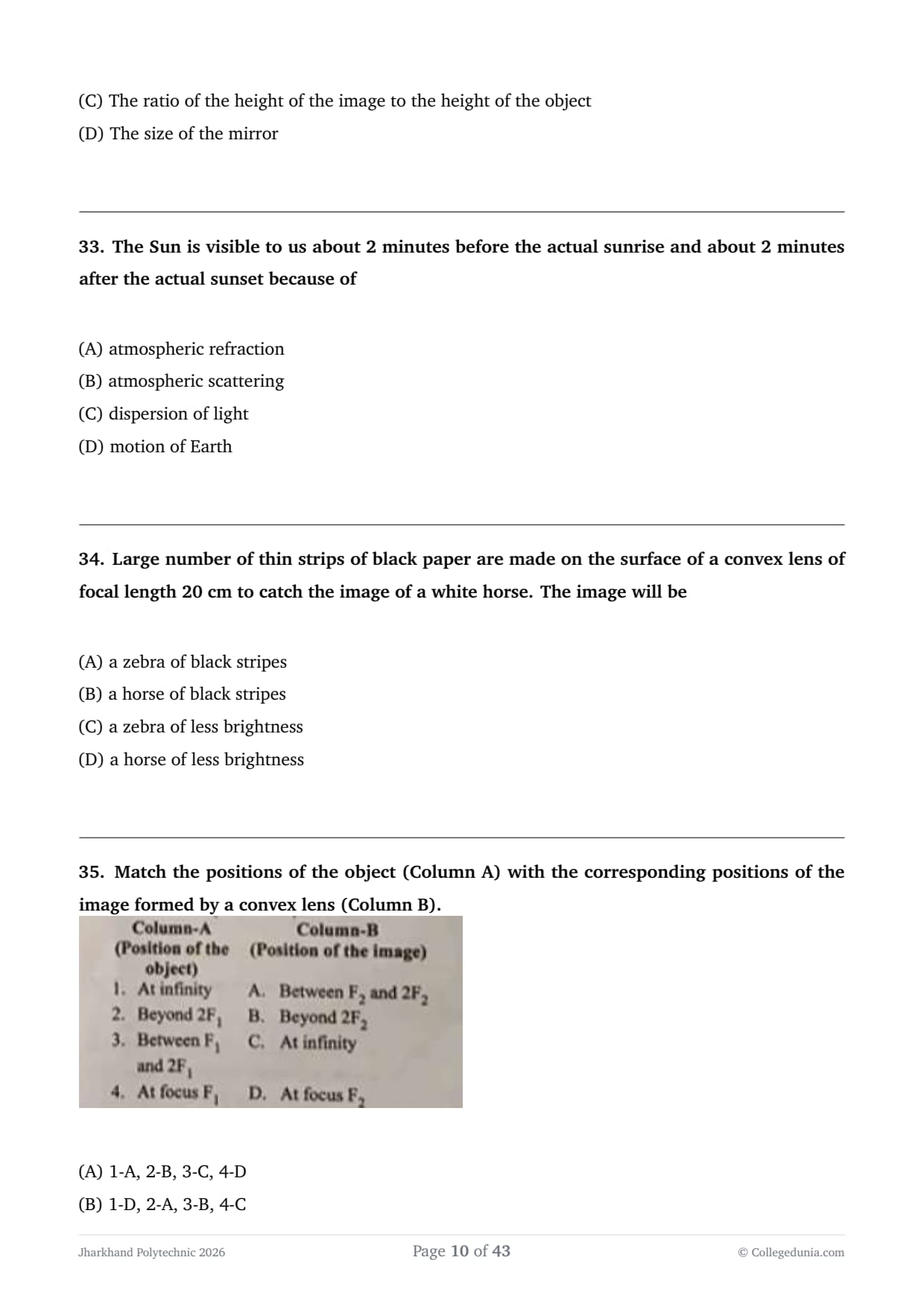
Question 35:

Match the positions of the object (Column A) with the corresponding positions of the image formed by a convex lens (Column B).

  • (A) 1-A, 2-B, 3-C, 4-D
  • (B) 1-D, 2-A, 3-B, 4-C
  • (C) 1-B, 2-A, 3-D, 4-C
  • (D) 1-C, 2-D, 3-A, 4-B

Question 36:

When object moves closer to convex lens, the image formed by it shifts :

  • (A) away from the lens.
  • (B) towards the lens.
  • (C) first towards and then away from the lens.
  • (D) first away and then towards the lens.

Question 37:

The lens formula is given by :
\[\frac{1}{f} = \frac{1}{v} - \frac{1}{u}\]
Which of the following correctly identifies each term in the formula?

  • (A) f = focal length, v = object distance, u = image distance
  • (B) f = focal length, v = image distance, u = object distance
  • (C) f = image distance, v = object distance, u = focal length
  • (D) f = object distance, v = focal length, u = image distance

Question 38:

Arrange the following parts of the human eye in the order that light passes through them :
1. Cornea
2. Retina
3. Pupil
4. Crystalline lens

  • (A) 1 \(\to\) 3 \(\to\) 4 \(\to\) 2
  • (B) 3 \(\to\) 1 \(\to\) 4 \(\to\) 2
  • (C) 1 \(\to\) 4 \(\to\) 3 \(\to\) 2
  • (D) 4 \(\to\) 3 \(\to\) 1 \(\to\) 2

Question 39:

When the object is placed very close to the lens, the image formed is virtual, erect and

  • (A) diminished
  • (B) smaller in size
  • (C) magnified
  • (D) bigger in size

Question 40:

A person uses a convex lens of focal length 20 cm in spectacles, the power of lens will be :

  • (A) -5 D
  • (B) +5 D
  • (C) +2 D
  • (D) -2 D

Question 41:

A few phenomena of light are given below :
(I) Advance sunrise and delayed sunset
(II) Twinkling of stars
(III) Wavering of objects seen through a turbulent stream of hot air
(IV) Blue colour of sky
Which of the above phenomena are due to atmospheric refraction?

  • (A) (I), (II) and (IV)
  • (B) (I), (II) and (III)
  • (C) (I), (III) and (IV)
  • (D) (I), (II), (III) and (IV)

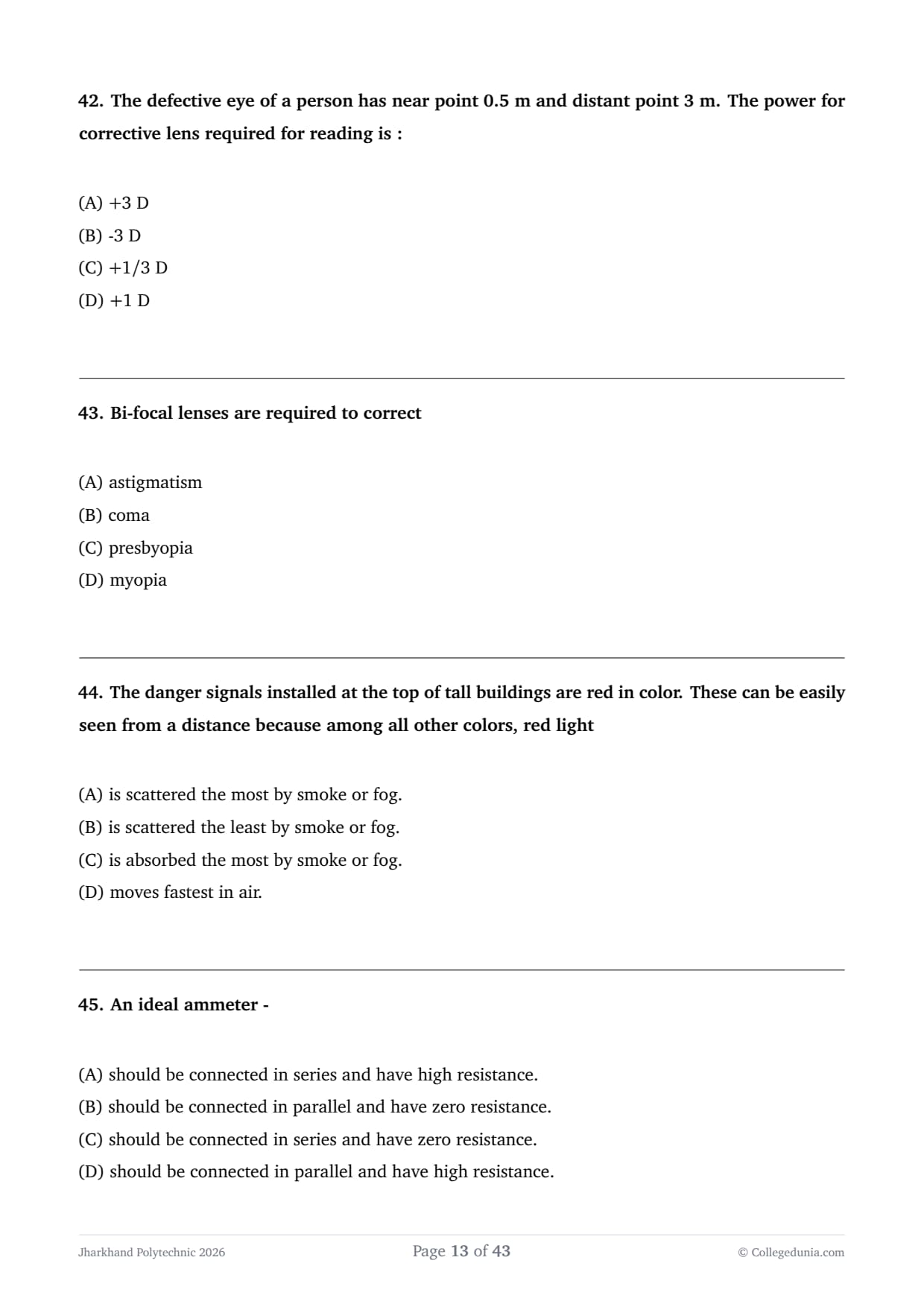
Question 42:

The defective eye of a person has near point 0.5 m and distant point 3 m. The power for corrective lens required for reading is :

  • (A) +3 D
  • (B) -3 D
  • (C) +1/3 D
  • (D) +1 D

Question 43:

Bi-focal lenses are required to correct

  • (A) astigmatism
  • (B) coma
  • (C) presbyopia
  • (D) myopia

Question 44:

The danger signals installed at the top of tall buildings are red in color. These can be easily seen from a distance because among all other colors, red light

  • (A) is scattered the most by smoke or fog.
  • (B) is scattered the least by smoke or fog.
  • (C) is absorbed the most by smoke or fog.
  • (D) moves fastest in air.

Question 45:

An ideal ammeter -

  • (A) should be connected in series and have high resistance.
  • (B) should be connected in parallel and have zero resistance.
  • (C) should be connected in series and have zero resistance.
  • (D) should be connected in parallel and have high resistance.

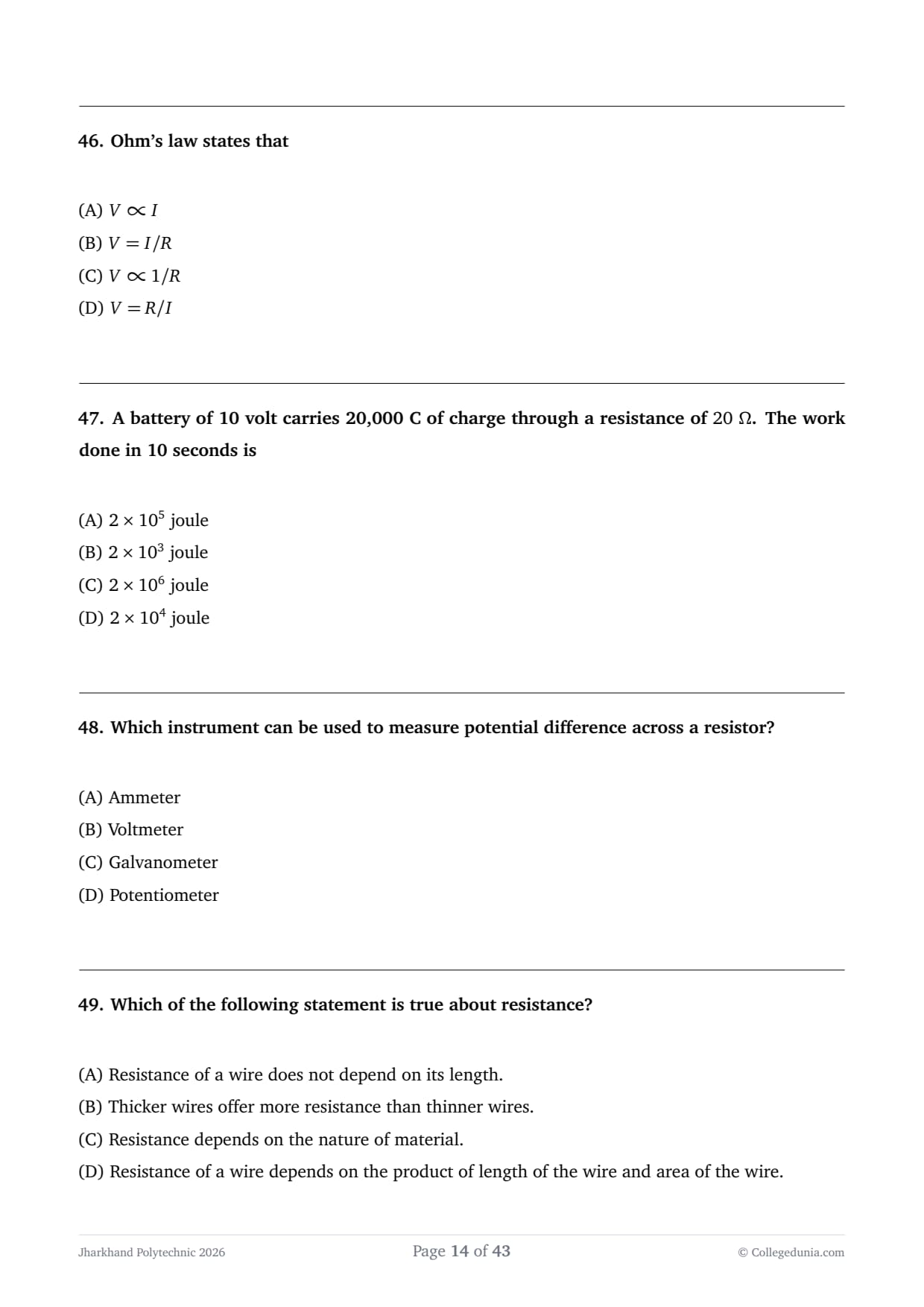
Question 46:

Ohm's law states that

  • (A) \( V \propto I \)
  • (B) \( V = I / R \)
  • (C) \( V \propto 1/R \)
  • (D) \( V = R / I \)

Question 47:

A battery of 10 volt carries 20,000 C of charge through a resistance of \(20\ \Omega\). The work done in 10 seconds is

  • (A) \(2 \times 10^5 joule\)
  • (B) \(2 \times 10^3 joule\)
  • (C) \(2 \times 10^6 joule\)
  • (D) \(2 \times 10^4 joule\)

Question 48:

Which instrument can be used to measure potential difference across a resistor?

  • (A) Ammeter
  • (B) Voltmeter
  • (C) Galvanometer
  • (D) Potentiometer

Question 49:

Which of the following statement is true about resistance?

  • (A) Resistance of a wire does not depend on its length.
  • (B) Thicker wires offer more resistance than thinner wires.
  • (C) Resistance depends on the nature of material.
  • (D) Resistance of a wire depends on the product of length of the wire and area of the wire.

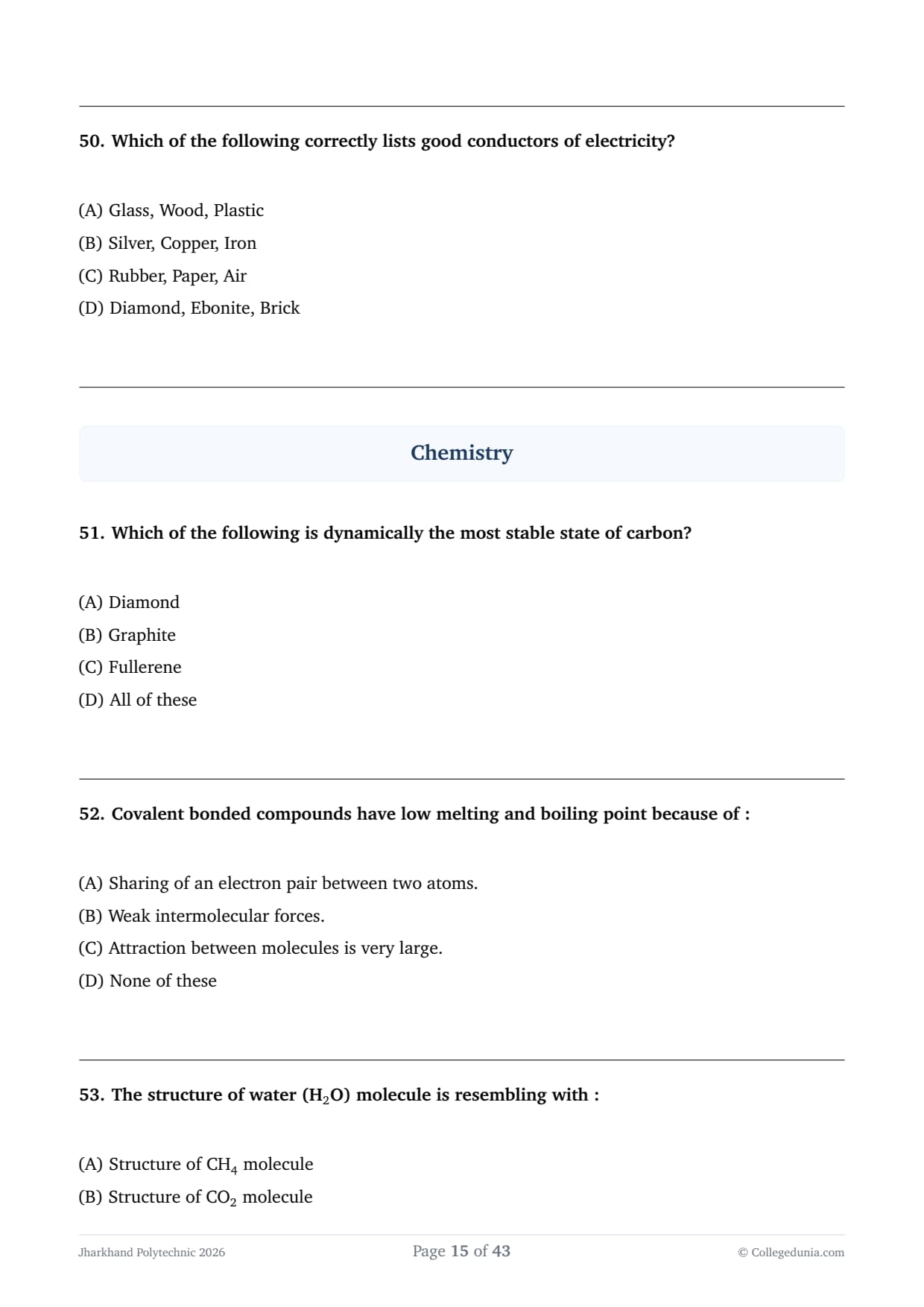
Question 50:

Which of the following correctly lists good conductors of electricity?

  • (A) Glass, Wood, Plastic
  • (B) Silver, Copper, Iron
  • (C) Rubber, Paper, Air
  • (D) Diamond, Ebonite, Brick

Question 51:

Which of the following is dynamically the most stable state of carbon?

  • (A) Diamond
  • (B) Graphite
  • (C) Fullerene
  • (D) All of these

Question 52:

Covalent bonded compounds have low melting and boiling point because of :

  • (A) Sharing of an electron pair between two atoms.
  • (B) Weak intermolecular forces.
  • (C) Attraction between molecules is very large.
  • (D) None of these

Question 53:

The structure of water (\(H_2O\)) molecule is resembling with :

  • (A) Structure of \(CH_4\) molecule
  • (B) Structure of \(CO_2\) molecule
  • (C) Structure of \(SO_2\) molecule
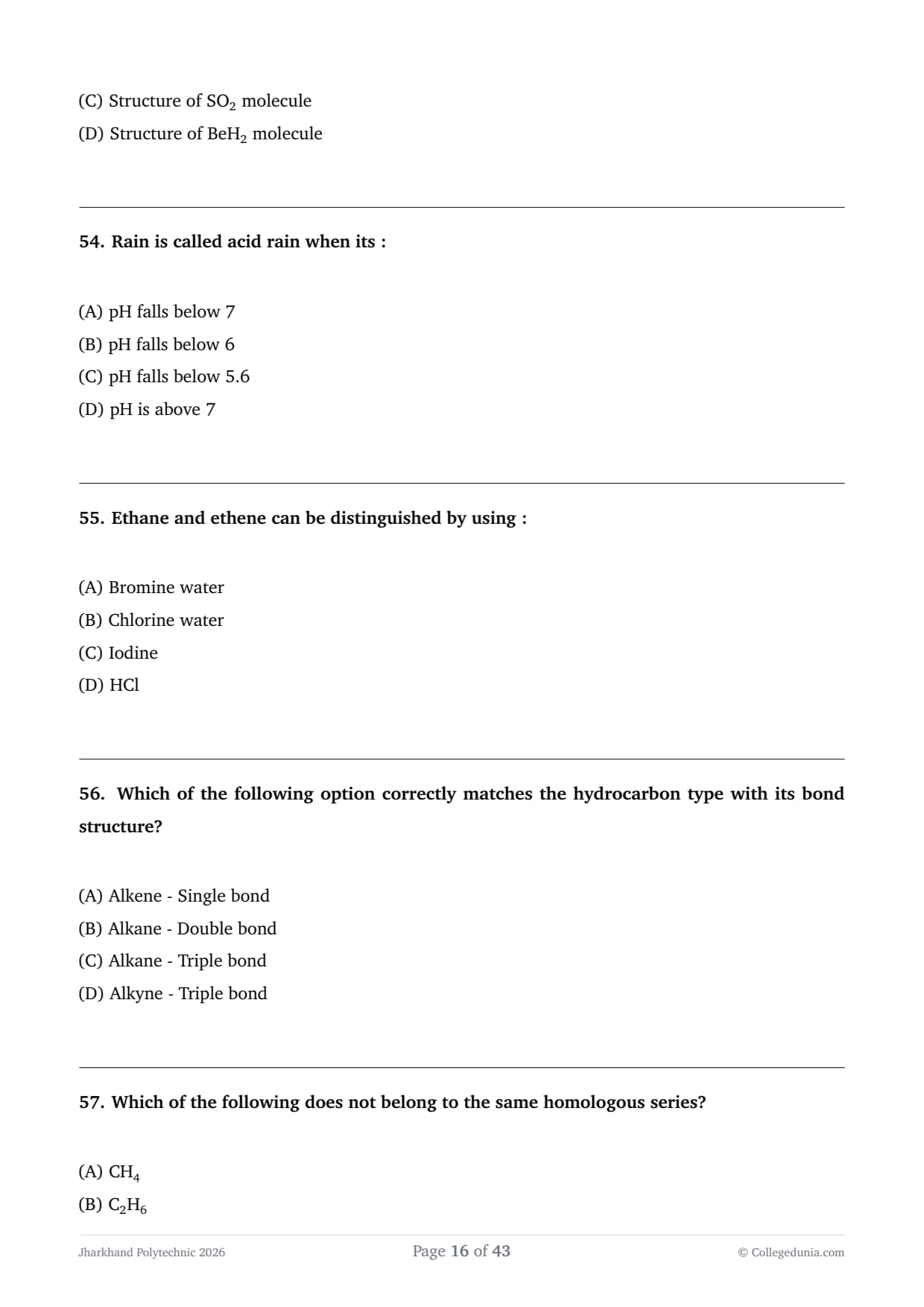
  • (D) Structure of \(BeH_2\) molecule

Question 54:

Rain is called acid rain when its :

  • (A) pH falls below 7
  • (B) pH falls below 6
  • (C) pH falls below 5.6
  • (D) pH is above 7

Question 55:

Ethane and ethene can be distinguished by using :

  • (A) Bromine water
  • (B) Chlorine water
  • (C) Iodine
  • (D) HCl

Question 56:

Which of the following option correctly matches the hydrocarbon type with its bond structure?

  • (A) Alkene - Single bond
  • (B) Alkane - Double bond
  • (C) Alkane - Triple bond
  • (D) Alkyne - Triple bond

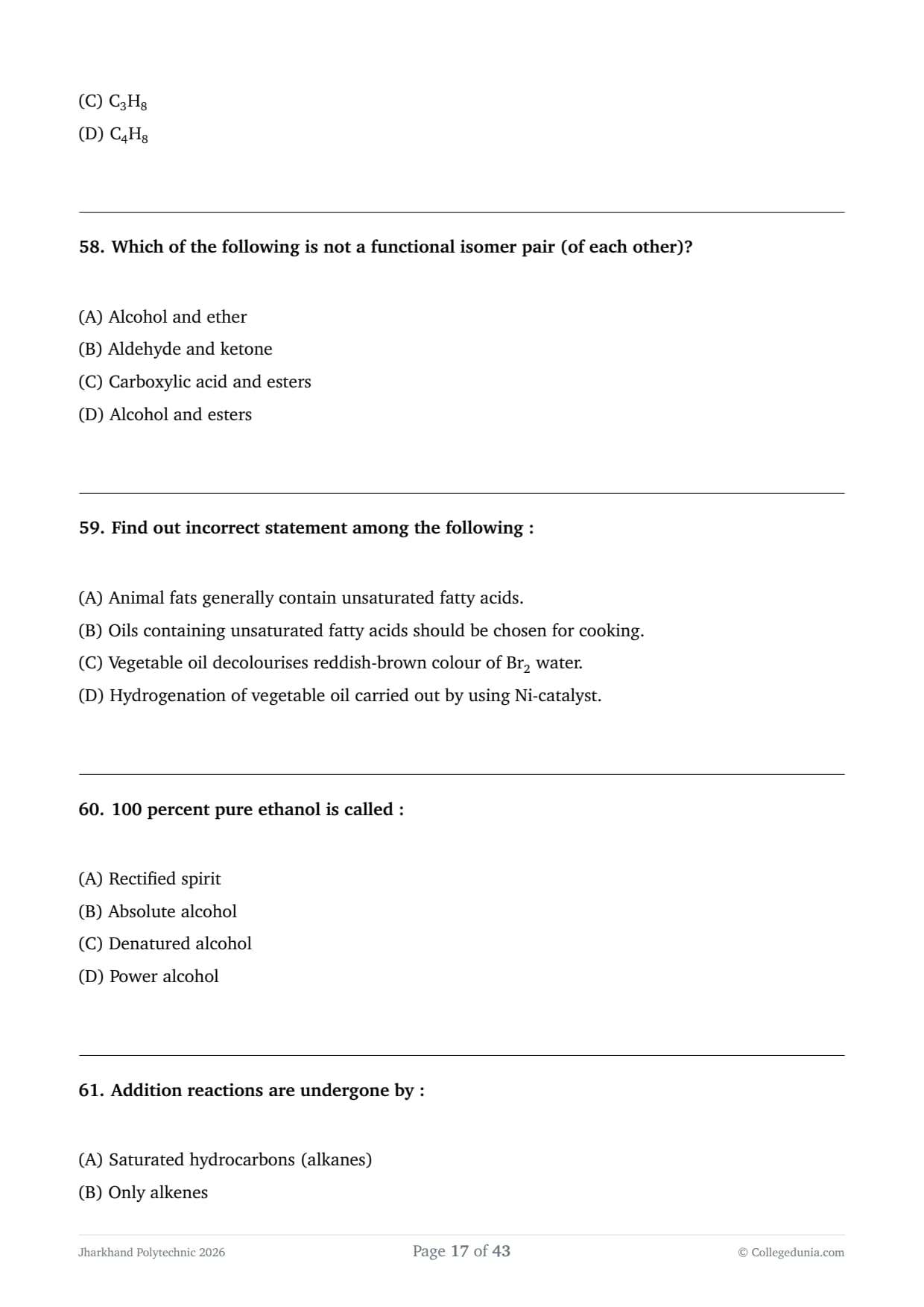
Question 57:

Which of the following does not belong to the same homologous series?

  • (A) \(CH_4\)
  • (B) \(C_2H_6\)
  • (C) \(C_3H_8\)
  • (D) \(C_4H_8\)

Question 58:

Which of the following is not a functional isomer pair (of each other)?

  • (A) Alcohol and ether
  • (B) Aldehyde and ketone
  • (C) Carboxylic acid and esters
  • (D) Alcohol and esters

Question 59:

Find out incorrect statement among the following :

  • (A) Animal fats generally contain unsaturated fatty acids.
  • (B) Oils containing unsaturated fatty acids should be chosen for cooking.
  • (C) Vegetable oil decolourises reddish-brown colour of \(Br_2\) water.
  • (D) Hydrogenation of vegetable oil carried out by using Ni-catalyst.

Question 60:

100 percent pure ethanol is called :

  • (A) Rectified spirit
  • (B) Absolute alcohol
  • (C) Denatured alcohol
  • (D) Power alcohol

Question 61:

Addition reactions are undergone by :

  • (A) Saturated hydrocarbons (alkanes)
  • (B) Only alkenes
  • (C) Only alkynes
  • (D) Both alkenes and alkynes

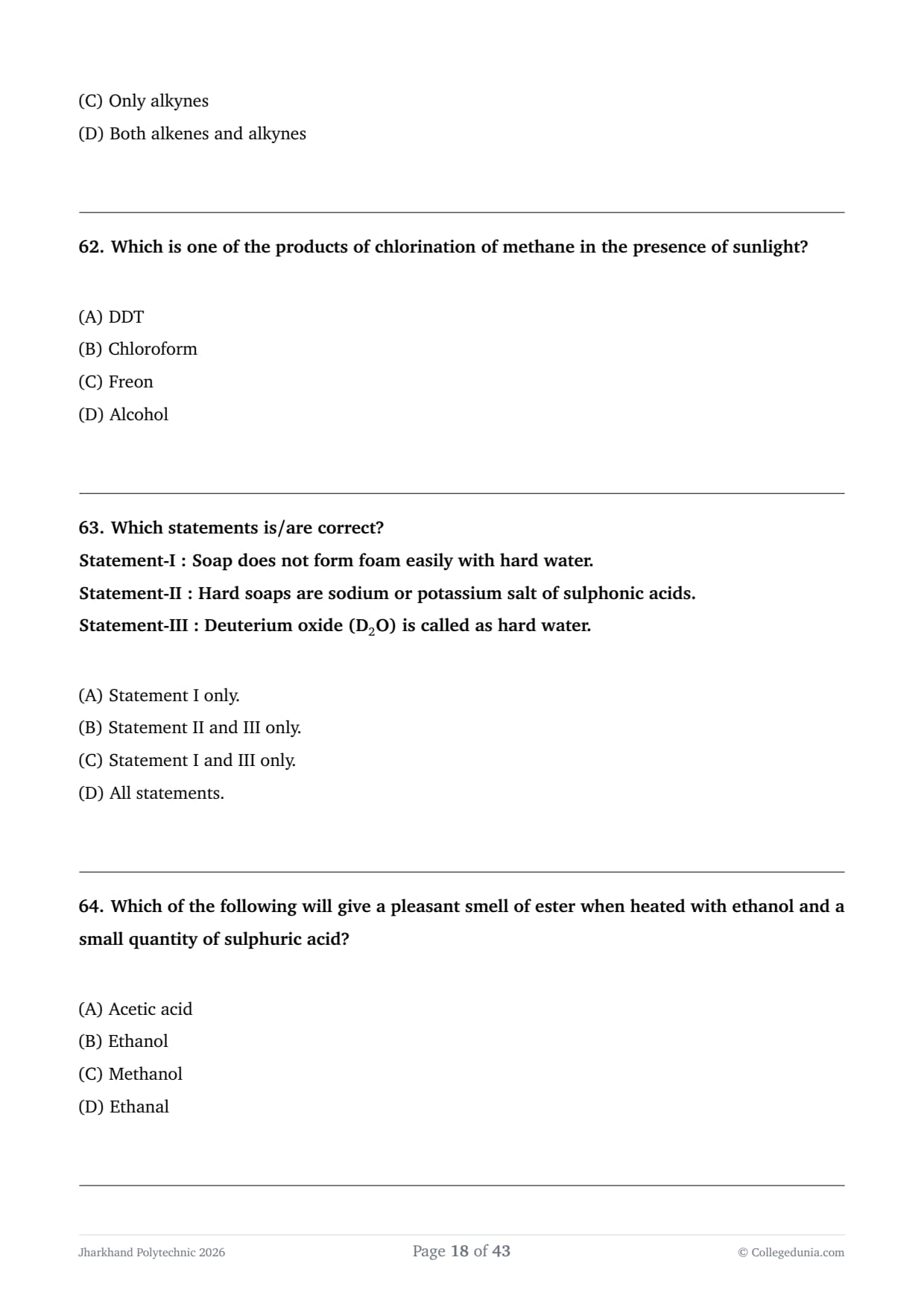
Question 62:

Which is one of the products of chlorination of methane in the presence of sunlight?

  • (A) DDT
  • (B) Chloroform
  • (C) Freon
  • (D) Alcohol

Question 63:

Which statements is/are correct?
Statement-I : Soap does not form foam easily with hard water.
Statement-II : Hard soaps are sodium or potassium salt of sulphonic acids.
Statement-III : Deuterium oxide (\(D_2O\)) is called as hard water.

  • (A) Statement I only.
  • (B) Statement II and III only.
  • (C) Statement I and III only.
  • (D) All statements.

Question 64:

Which of the following will give a pleasant smell of ester when heated with ethanol and a small quantity of sulphuric acid?

  • (A) Acetic acid
  • (B) Ethanol
  • (C) Methanol
  • (D) Ethanal

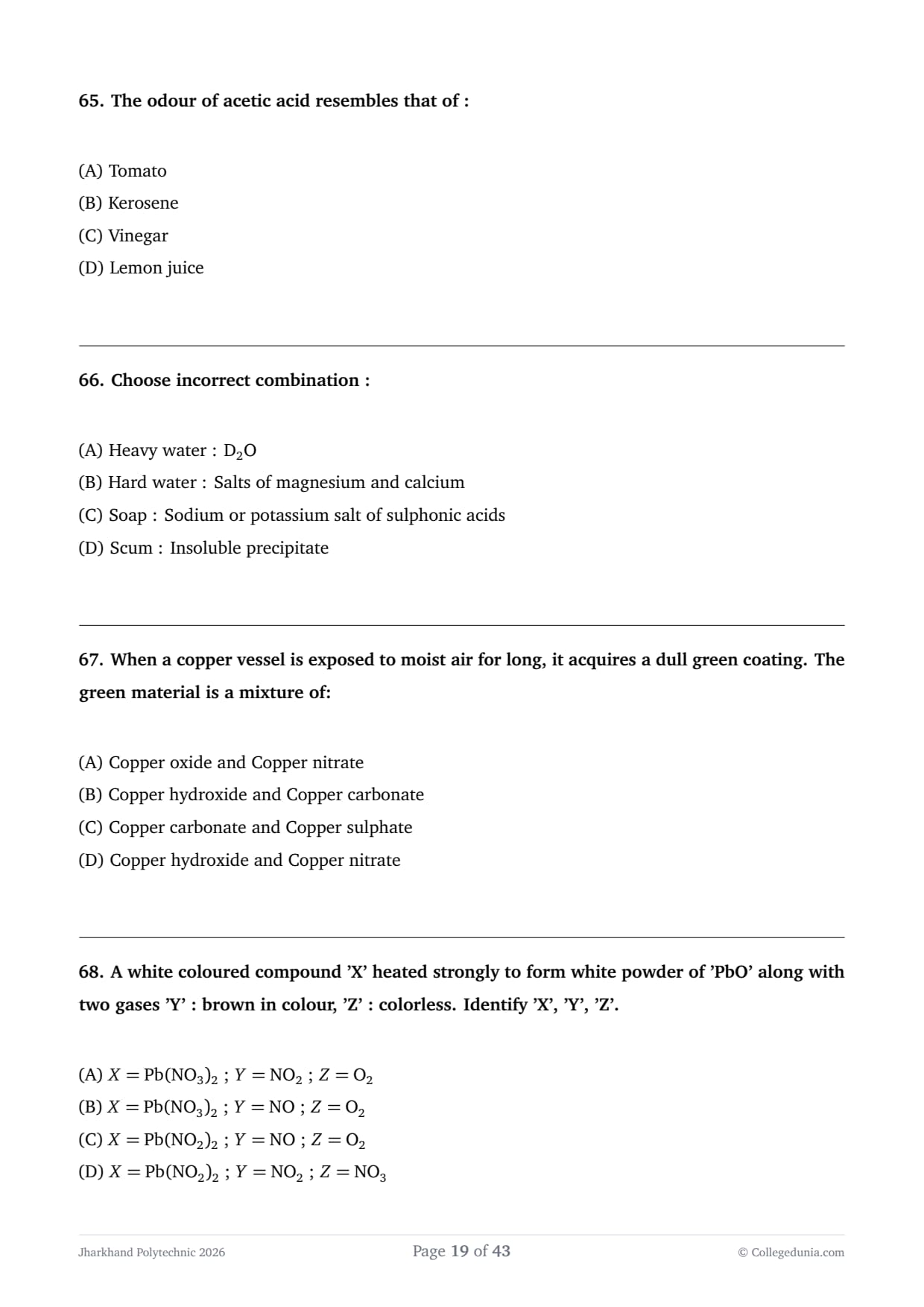
Question 65:

The odour of acetic acid resembles that of :

  • (A) Tomato
  • (B) Kerosene
  • (C) Vinegar
  • (D) Lemon juice

Question 66:

Choose incorrect combination :

  • (A) Heavy water : \(D_2O\)
  • (B) Hard water : Salts of magnesium and calcium
  • (C) Soap : Sodium or potassium salt of sulphonic acids
  • (D) Scum : Insoluble precipitate

Question 67:

When a copper vessel is exposed to moist air for long, it acquires a dull green coating. The green material is a mixture of:

  • (A) Copper oxide and Copper nitrate
  • (B) Copper hydroxide and Copper carbonate
  • (C) Copper carbonate and Copper sulphate
  • (D) Copper hydroxide and Copper nitrate

Question 68:

A white coloured compound 'X' heated strongly to form white powder of 'PbO' along with two gases 'Y' : brown in colour, 'Z' : colorless. Identify 'X', 'Y', 'Z'.

  • (A) \(X = Pb(NO_3)_2\) ; \(Y = NO_2\) ; \(Z = O_2\)
  • (B) \(X = Pb(NO_3)_2\) ; \(Y = NO\) ; \(Z = O_2\)
  • (C) \(X = Pb(NO_2)_2\) ; \(Y = NO\) ; \(Z = O_2\)
  • (D) \(X = Pb(NO_2)_2\) ; \(Y = NO_2\) ; \(Z = NO_3\)

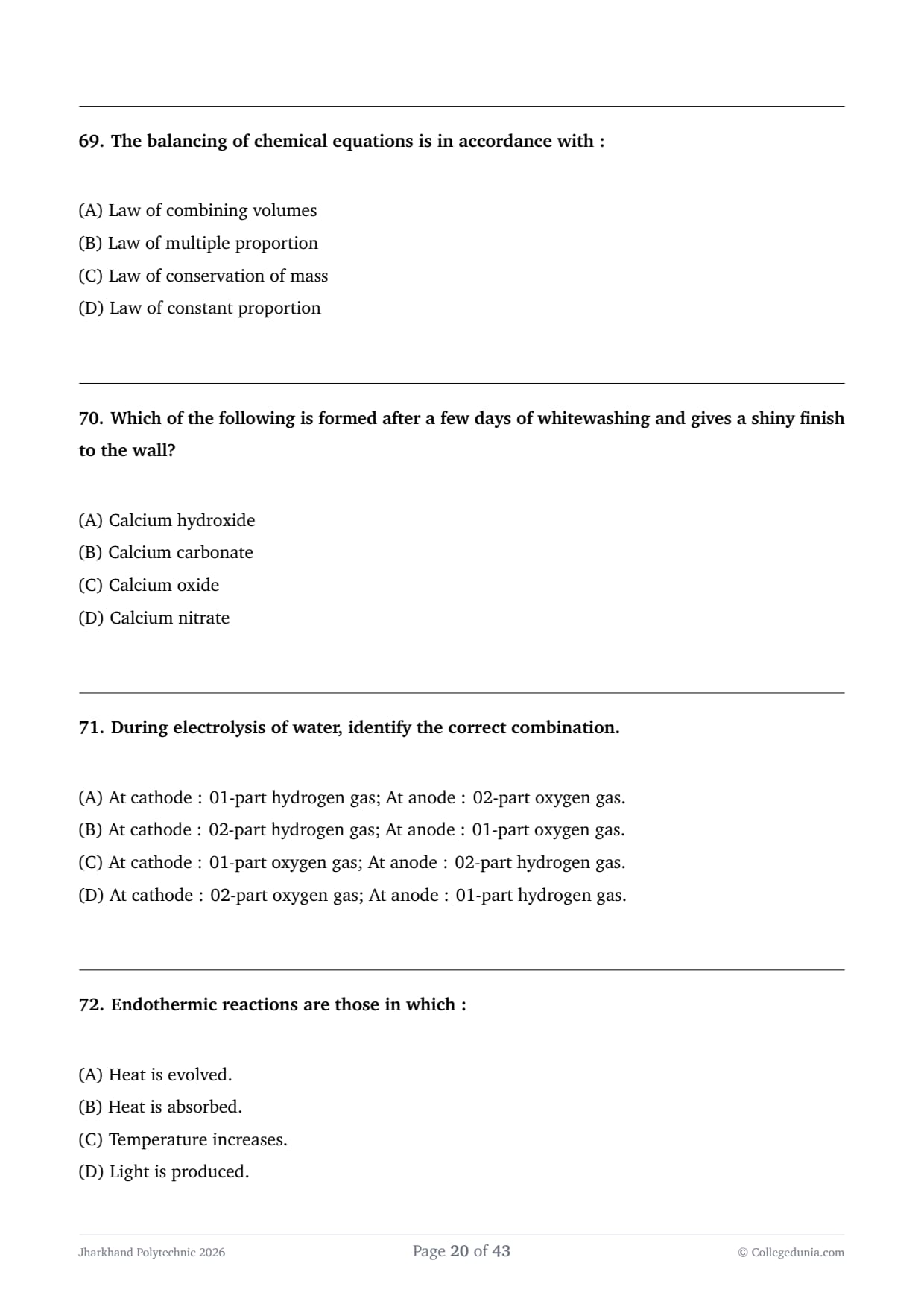
Question 69:

The balancing of chemical equations is in accordance with :

  • (A) Law of combining volumes
  • (B) Law of multiple proportion
  • (C) Law of conservation of mass
  • (D) Law of constant proportion

Question 70:

Which of the following is formed after a few days of whitewashing and gives a shiny finish to the wall?

  • (A) Calcium hydroxide
  • (B) Calcium carbonate
  • (C) Calcium oxide
  • (D) Calcium nitrate

Question 71:

During electrolysis of water, identify the correct combination.

  • (A) At cathode : 01-part hydrogen gas; At anode : 02-part oxygen gas.
  • (B) At cathode : 02-part hydrogen gas; At anode : 01-part oxygen gas.
  • (C) At cathode : 01-part oxygen gas; At anode : 02-part hydrogen gas.
  • (D) At cathode : 02-part oxygen gas; At anode : 01-part hydrogen gas.

Question 72:

Endothermic reactions are those in which :

  • (A) Heat is evolved.
  • (B) Heat is absorbed.
  • (C) Temperature increases.
  • (D) Light is produced.

Question 73:

You have been provided with three test tubes. One of them contains distilled water and the other two contain an acidic solution and a basic solution, respectively. Which of them will turn red litmus to blue?

  • (A) Acid
  • (B) Base
  • (C) Water
  • (D) All of these

Question 74:

What does calcium oxide produce when it reacts vigorously with water?

  • (A) Calcium carbonate
  • (B) Calcium hydroxide
  • (C) Calcium sulphate
  • (D) Calcium phosphate

Question 75:

All of the following acids dissociate completely in water, except :

  • (A) HCl
  • (B) \(H_2SO_4\)
  • (C) \(CH_3COOH\)
  • (D) \(HNO_3\)

Question 76:

Acetic acid was added to a solid X kept in a test tube. A colourless, odourless gas Y was evolved. The gas was passed through lime water, which turned milky. It was concluded that:

  • (A) Solid X is sodium hydroxide and the gas Y is \(CO_2\).
  • (B) Solid X is sodium bicarbonate and the gas Y is \(CO_2\).
  • (C) Solid X is sodium acetate and the gas Y is \(CO_2\).
  • (D) Solid X is sodium bicarbonate and the gas Y is \(SO_2\).

Question 77:

Sodium salt of acid present in vinegar is an example of :

  • (A) Salt of strong acid + strong base
  • (B) Salt of weak acid + strong base
  • (C) Salt of strong acid + weak base
  • (D) Salt of weak acid + weak base

Question 78:

What happens when a solution of an acid is mixed with a solution of a base in a test tube?
(i) The temperature of the solution increases.
(ii) The temperature of the solution decreases.
(iii) The temperature of the solution remains the same.
(iv) Salt formation takes place.

  • (A) (i) only
  • (B) (i) and (iii)
  • (C) (ii) and (iii)
  • (D) (i) and (iv)

Question 79:

Why a mild base like magnesium hydroxide is used during indigestion?

  • (A) To speed up production of hydrochloric acid to speed up digestion.
  • (B) It neutralizes excess acid in the stomach, relieving pain and irritation.
  • (C) It prevents the stomach from absorbing nutrients.
  • (D) It acts as an acid to digest food faster.

Question 80:

Brine is an :

  • (A) Aqueous solution of sodium hydroxide.
  • (B) Aqueous solution of sodium carbonate.
  • (C) Aqueous solution of sodium chloride.
  • (D) Aqueous solution of sodium bicarbonate.

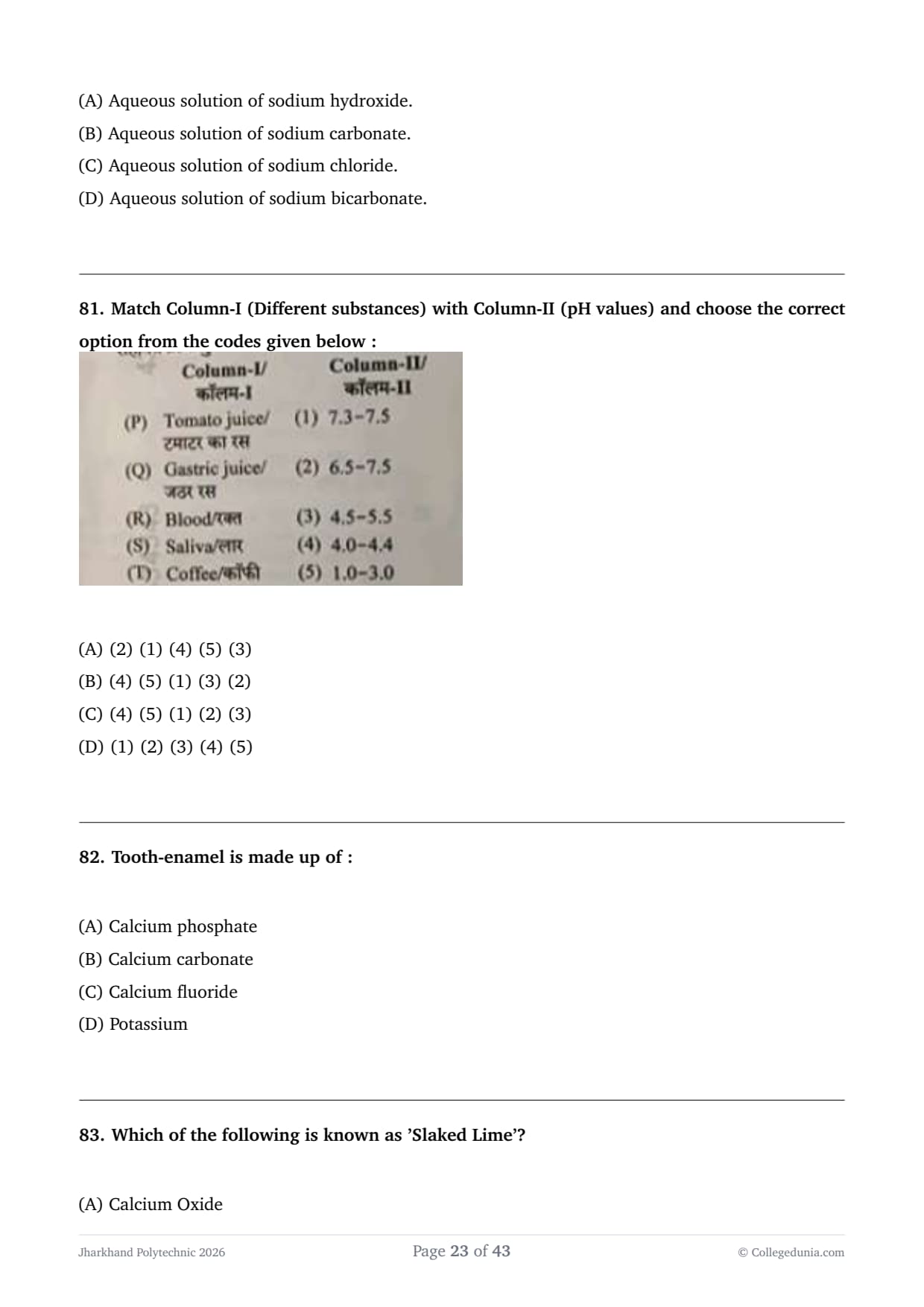
Question 81:

Match Column-I (Different substances) with Column-II (pH values) and choose the correct option from the codes given below :

  • (A) (2) (1) (4) (5) (3)
  • (B) (4) (5) (1) (3) (2)
  • (C) (4) (5) (1) (2) (3)
  • (D) (1) (2) (3) (4) (5)

Question 82:

Tooth-enamel is made up of :

  • (A) Calcium phosphate
  • (B) Calcium carbonate
  • (C) Calcium fluoride
  • (D) Potassium

Question 83:

Which of the following is known as 'Slaked Lime'?

  • (A) Calcium Oxide
  • (B) Calcium Carbonate
  • (C) Calcium Hydroxide
  • (D) Sodium Hydroxide

Question 84:

Which one of the following does not have water of crystallization?

  • (A) Blue vitriol
  • (B) Baking soda
  • (C) Washing soda
  • (D) Gypsum

Question 85:

When chlorine gas is passed in lime water, it forms chemical compound 'M' (main constituent of bleaching powder) and 'N' (used for bleaching in textile industry). Identify the correct option.

  • (A) 'X' = \(CO_2\); 'Y' = \(HCl\)
  • (B) 'X' = \(HCl\); 'Y' = \(Cl_2\)
  • (C) 'X' = \(Cl_2\); 'Y' = \(Ca(OH)_2\)
  • (D) 'X' = \(Cl_2\); 'Y' = \(CaCl_2\)

Question 86:

Gold is used in making ornaments because it is :

  • (A) Lustrous
  • (B) Unreactive
  • (C) Malleable
  • (D) All of these

Question 87:

An element X reacts with oxygen and forms oxide of X which turns red litmus to blue. The element X is a :

  • (A) Metal
  • (B) Non-metal
  • (C) Metalloid
  • (D) None of these

Question 88:

Phosphorus is stored in :

  • (A) Water
  • (B) Kept open air
  • (C) Alcohol
  • (D) Kerosene

Question 89:

The chemical formula of washing soda is :

  • (A) \(Na_2CO_3 \cdot 10H_2O\)
  • (B) \(NaHCO_3\)
  • (C) \(CH_3COONa\)
  • (D) \(Na_2CO_3\)

Question 90:

How many water molecules does hydrated calcium sulphate contain?

  • (A) 5
  • (B) 10
  • (C) 7
  • (D) 2

Question 91:

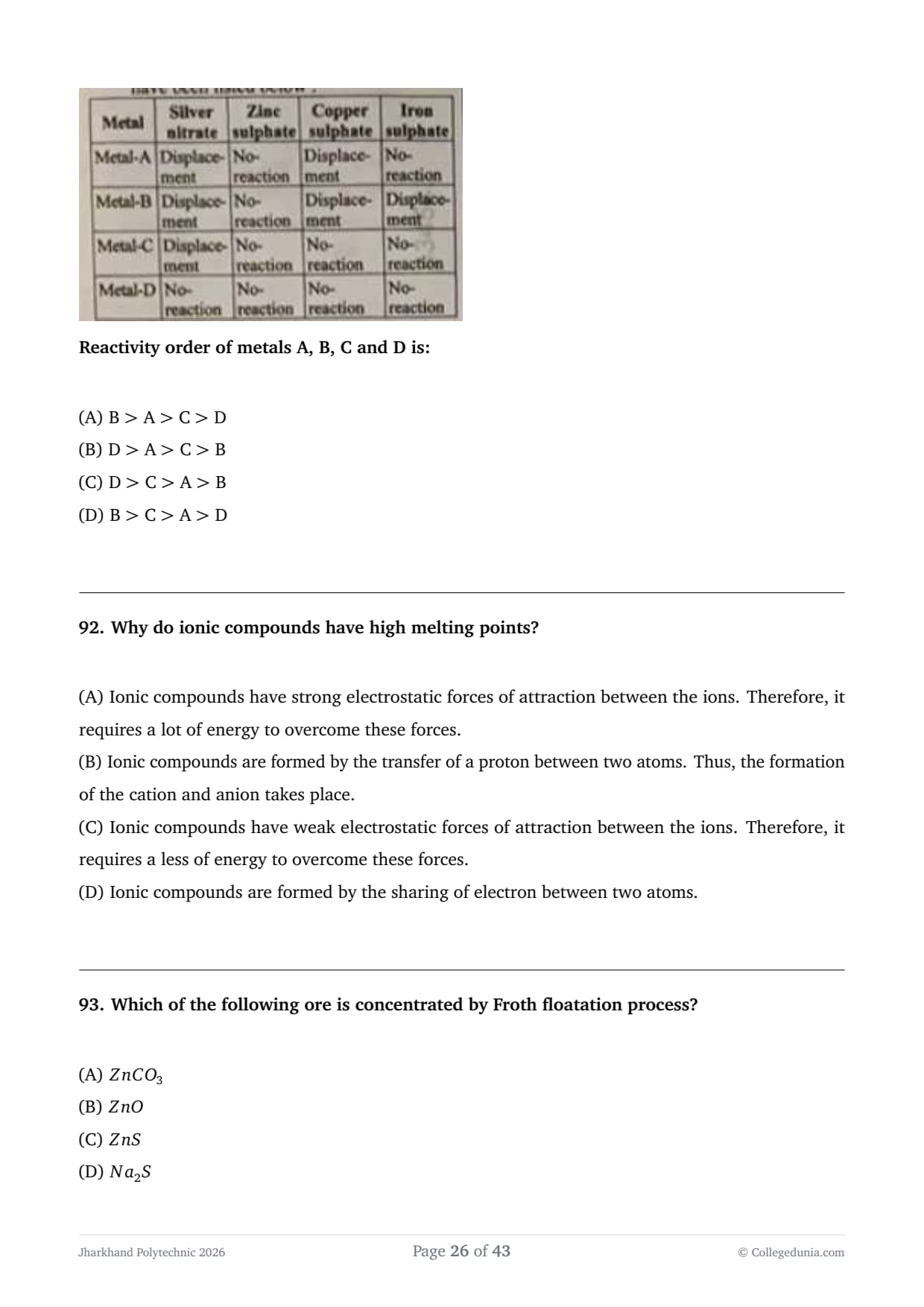
Four metals A, B, C and D were taken in five different solutions of silver nitrate, zinc sulphate, copper sulphate and iron sulphate and the observations have been listed below:


Reactivity order of metals A, B, C and D is:

  • (A) B \(>\) A \(>\) C \(>\) D
  • (B) D \(>\) A \(>\) C \(>\) B
  • (C) D \(>\) C \(>\) A \(>\) B
  • (D) B \(>\) C \(>\) A \(>\) D

Question 92:

Why do ionic compounds have high melting points?

  • (A) Ionic compounds have strong electrostatic forces of attraction between the ions. Therefore, it requires a lot of energy to overcome these forces.
  • (B) Ionic compounds are formed by the transfer of a proton between two atoms. Thus, the formation of the cation and anion takes place.
  • (C) Ionic compounds have weak electrostatic forces of attraction between the ions. Therefore, it requires a less of energy to overcome these forces.
  • (D) Ionic compounds are formed by the sharing of electron between two atoms.

Question 93:

Which of the following ore is concentrated by Froth floatation process?

  • (A) \(ZnCO_3\)
  • (B) \(ZnO\)
  • (C) \(ZnS\)
  • (D) \(Na_2S\)

Question 94:

Metal items are tarnished when kept open in air for some time. Silver utensils become blackish, copper utensils become greenish due to corrosion. The gases responsible for this corrosion respectively are:

  • (A) \(H_2S\) and \(CO_2\)
  • (B) \(SO_2\) and \(O_2\)
  • (C) Moist \(O_2\) air and \(CO_2\)
  • (D) \(NO_2\) and \(O_2\)

Question 95:

Some metal oxides react with acid as well as base to produce salt and water, these are known as amphoteric oxides. The examples of amphoteric oxides are:

  • (A) \(Al_2O_3\) and \(SiO\)
  • (B) \(Al_2O_3\) and \(ZnO\)
  • (C) \(CuO\) and \(ZnO\)
  • (D) \(CuO\) and \(SiO\)

Question 96:

Aqua regia is a mixture of concentrated HCl and concentrated \(HNO_3\) in the ratio of ____________ respectively.

  • (A) 1 : 2
  • (B) 2 : 1
  • (C) 1 : 3
  • (D) 3 : 1

Question 97:

During alloy formation if one of the metal is Hg (Mercury), then the alloy is called as:

  • (A) Galvanized alloy
  • (B) Amalgam
  • (C) Bronze
  • (D) Microlam

Question 98:

What type of bond is formed by the sharing of electrons between two atoms to achieve a completely filled outermost shell?

  • (A) Ionic bond
  • (B) Metallic bond
  • (C) Covalent bond
  • (D) Hydrogen bond

Question 99:

At what temperature is gypsum heated to form Plaster of Paris?

  • (A) 363 K
  • (B) 373 K
  • (C) 273 K
  • (D) 353 K

Question 100:

Protecting steel and iron from rusting by coating them with a thin layer of zinc is called:

  • (A) Tinning
  • (B) Galvanisation
  • (C) Electroplating
  • (D) Anodising

Question 101:

What will come in the place of question mark in the following question ?
\[ \sqrt{726} + \sqrt{294} + \sqrt{1176} + \sqrt{486} - \sqrt{600} = (?) \]

  • (A) \(31\sqrt{2}\)
  • (B) \(31\sqrt{6}\)
  • (C) \(34\sqrt{6}\)
  • (D) \(34\sqrt{2}\)

Question 102:

If semi-vertical angle of a cone of radius 7 cm is \(30^{\circ}\), then the curved surface area of the cone (in sq cm) is : (Take \(\pi = \frac{22}{7}\))

  • (A) 264
  • (B) 308
  • (C) 616
  • (D) 528

Question 103:

Which of the following is irrational number?

  • (A) 0.14
  • (B) \(0.14\overline{16}\)
  • (C) \(0.\overline{1416}\)
  • (D) \(0.4014001400014\dots\)

Question 104:

For what value(s) of c, the pair of equations \(x - 2y = 8; 5x - 10y = c\) have infinite solution ?

  • (A) 16
  • (B) All real values
  • (C) 40
  • (D) All non-negative real values of c

Question 105:

Select the mean of squares of first n natural numbers :

  • (A) \(n^2\)
  • (B) \(\frac{(n+1)(2n+1)}{6}\)
  • (C) \(\frac{n+1}{2}\)
  • (D) \(\frac{n(n+1)(2n+1)}{6}\)

Question 106:

Given \(\tan A = \frac{4}{3}\), then \(\cos A\) is :

  • (A) \(\frac{4}{5}\)
  • (B) \(\frac{3}{5}\)
  • (C) \(\frac{5}{3}\)
  • (D) \(\frac{5}{4}\)

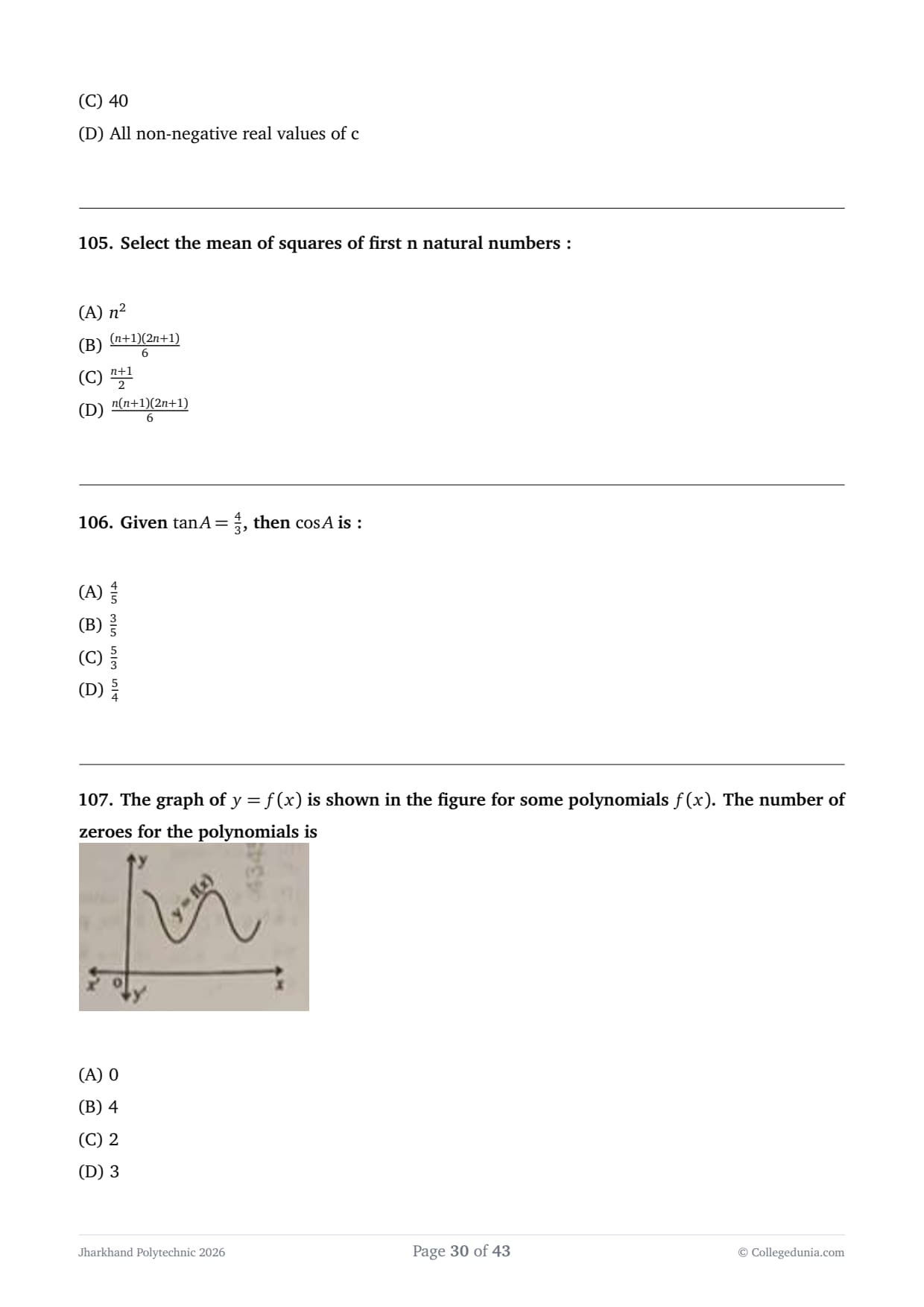
Question 107:

The graph of \(y = f(x)\) is shown in the figure for some polynomials \(f(x)\). The number of zeroes for the polynomials is

  • (A) 0
  • (B) 4
  • (C) 2
  • (D) 3

Question 108:

The graph of the linear equation \(2x + 3y = 6\) is a line which meets the y-axis at the point :

  • (A) (0, 2)
  • (B) (2, 0)
  • (C) (3, 0)
  • (D) (0, 3)

Question 109:

The area of the circle that can be inscribed in a square of 6 cm is

  • (A) \(36\pi cm^2\)
  • (B) \(15\pi cm^2\)
  • (C) \(12\pi cm^2\)
  • (D) \(9\pi cm^2\)

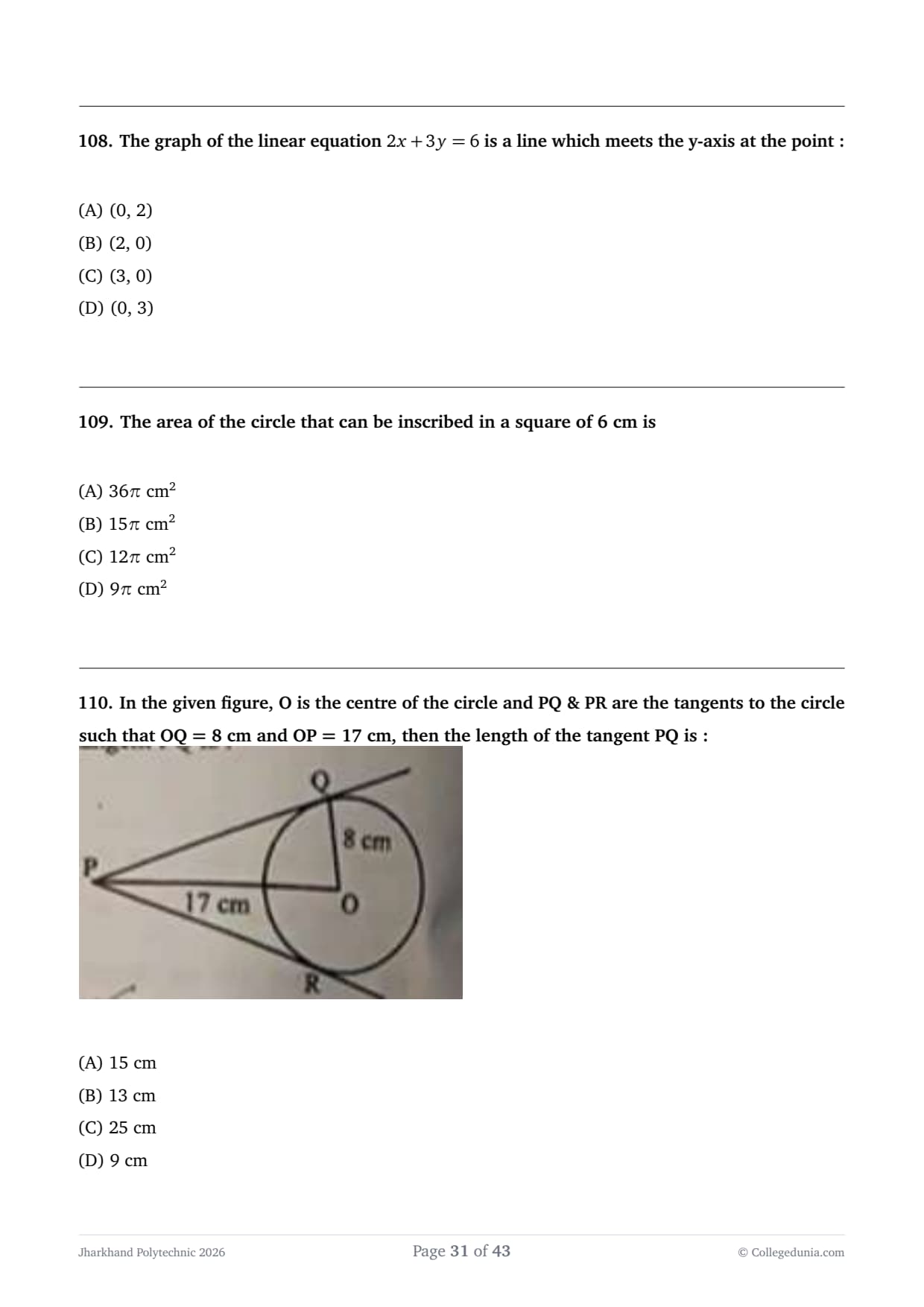
Question 110:

In the given figure, O is the centre of the circle and PQ & PR are the tangents to the circle such that OQ = 8 cm and OP = 17 cm, then the length of the tangent PQ is :

  • (A) 15 cm
  • (B) 13 cm
  • (C) 25 cm
  • (D) 9 cm

Question 111:

The ratio of income of two persons is 9 : 7 and the ratio of their expenditure is 4 : 3. If each of them saves Rs. 2,000 per month, find difference of their monthly income.

  • (A) Rs. 14,000
  • (B) Rs. 2,000
  • (C) Rs. 1,000
  • (D) Rs. 4,000

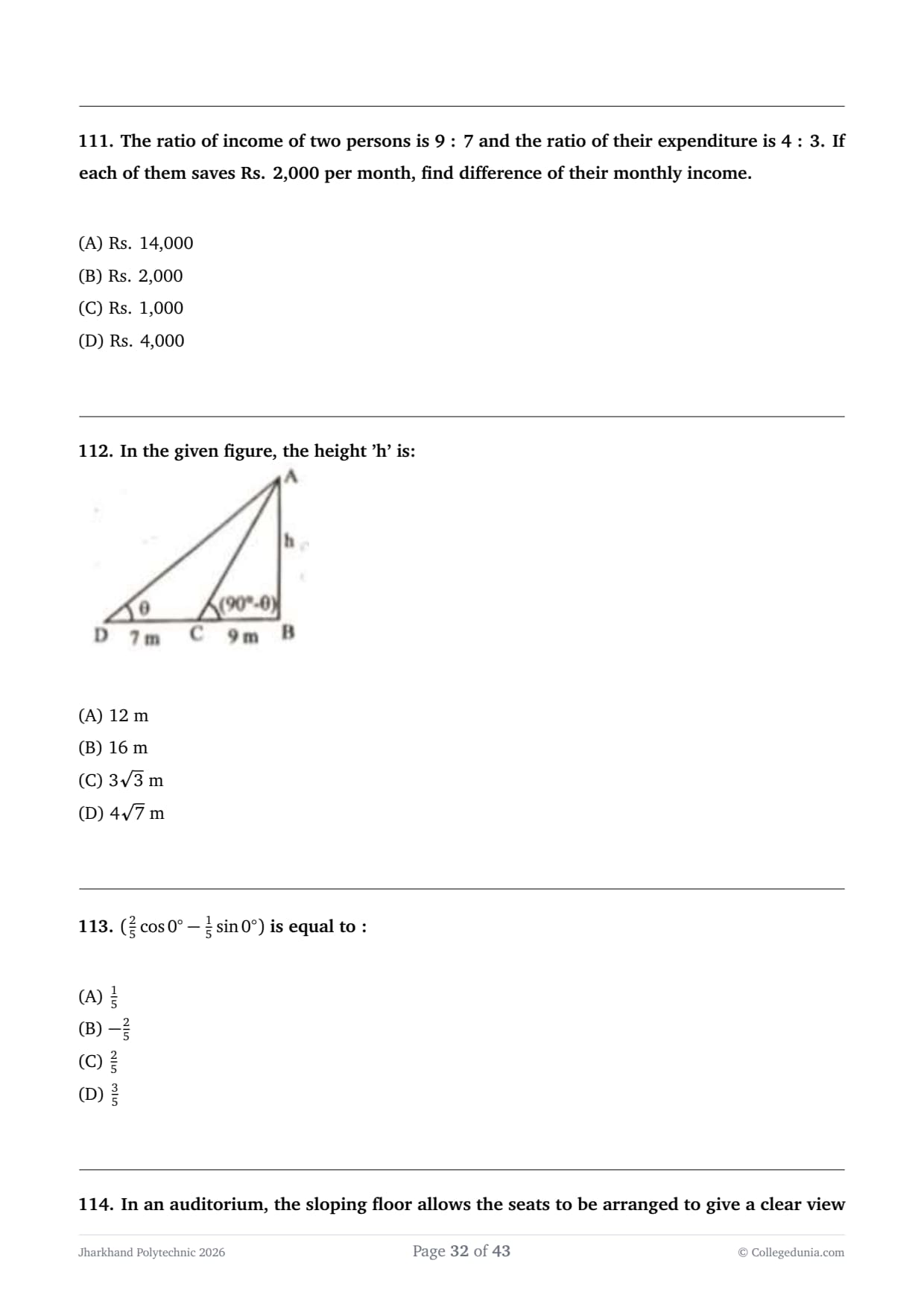
Question 112:

In the given figure, the height 'h' is:

  • (A) 12 m
  • (B) 16 m
  • (C) \(3\sqrt{3}\) m
  • (D) \(4\sqrt{7}\) m

Question 113:

\((\frac{2}{5}\cos 0^{\circ} - \frac{1}{5}\sin 0^{\circ})\) is equal to :

  • (A) \(\frac{1}{5}\)
  • (B) \(-\frac{2}{5}\)
  • (C) \(\frac{2}{5}\)
  • (D) \(\frac{3}{5}\)

Question 114:

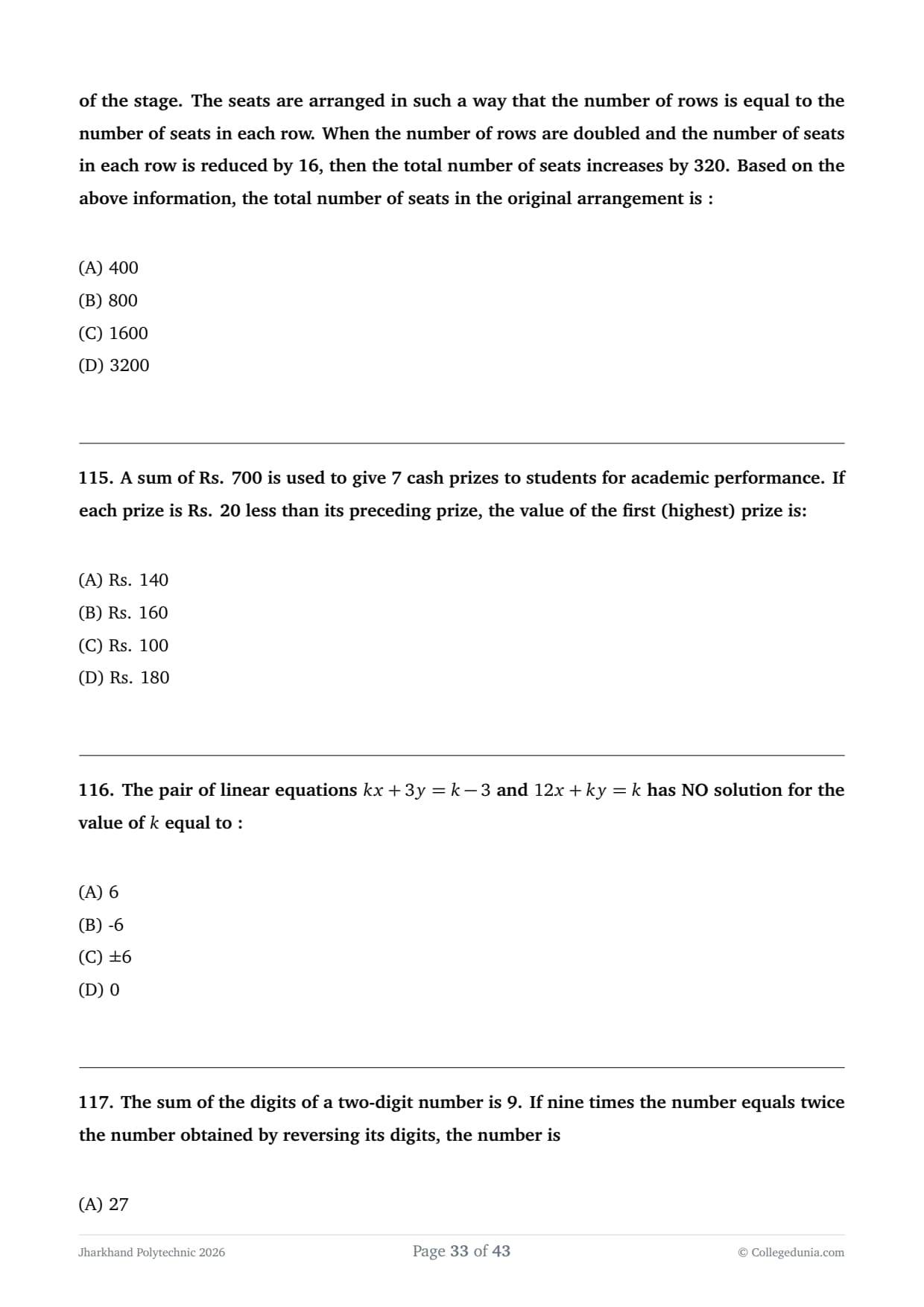
In an auditorium, the sloping floor allows the seats to be arranged to give a clear view of the stage. The seats are arranged in such a way that the number of rows is equal to the number of seats in each row. When the number of rows are doubled and the number of seats in each row is reduced by 16, then the total number of seats increases by 320. Based on the above information, the total number of seats in the original arrangement is :

  • (A) 400
  • (B) 800
  • (C) 1600
  • (D) 3200

Question 115:

A sum of Rs. 700 is used to give 7 cash prizes to students for academic performance. If each prize is Rs. 20 less than its preceding prize, the value of the first (highest) prize is:

  • (A) Rs. 140
  • (B) Rs. 160
  • (C) Rs. 100
  • (D) Rs. 180

Question 116:

The pair of linear equations \(kx + 3y = k - 3\) and \(12x + ky = k\) has NO solution for the value of \(k\) equal to :

  • (A) 6
  • (B) -6
  • (C) \(\pm 6\)
  • (D) 0

Question 117:

The sum of the digits of a two-digit number is 9. If nine times the number equals twice the number obtained by reversing its digits, the number is

  • (A) 27
  • (B) 36
  • (C) 18
  • (D) 81

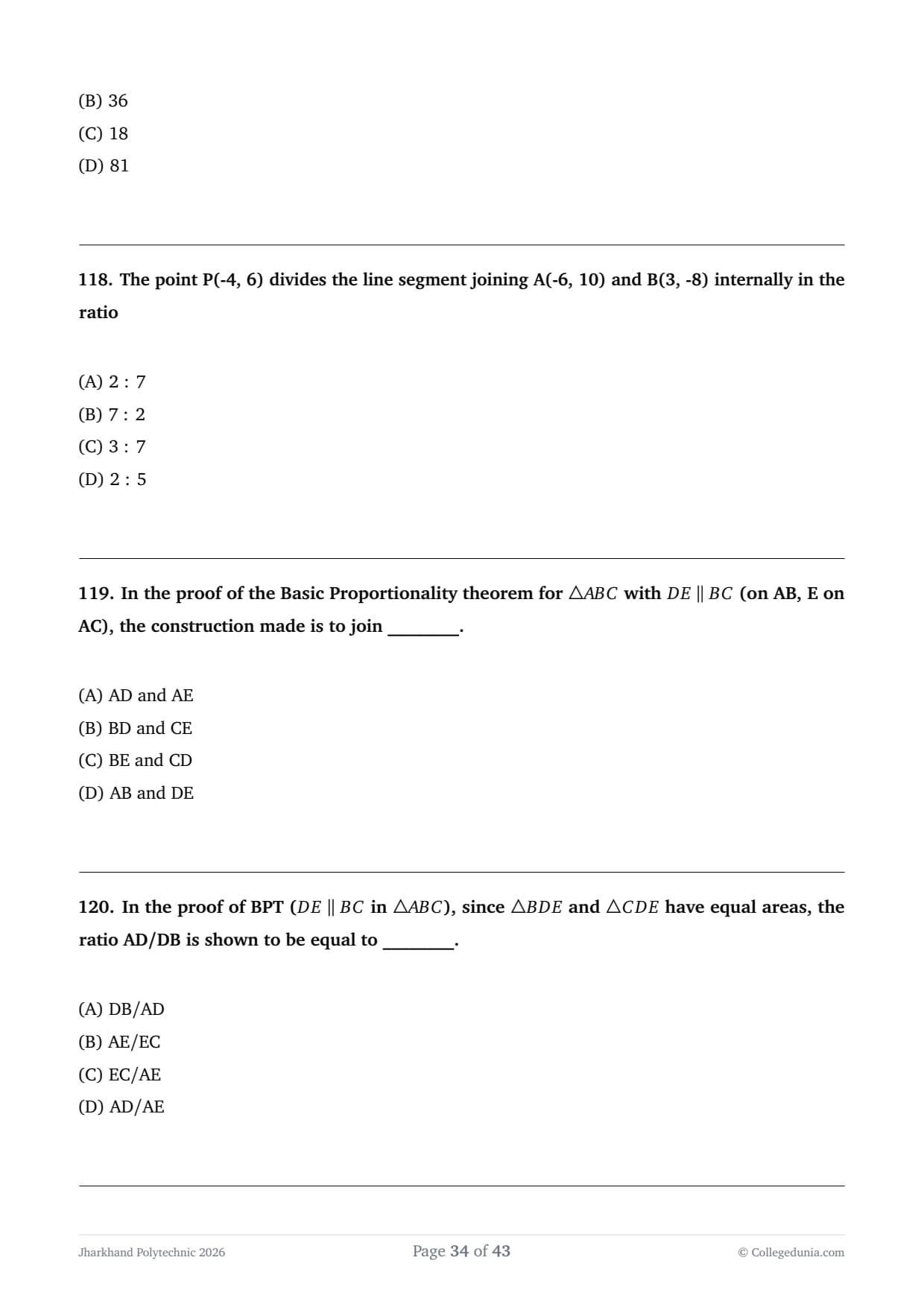
Question 118:

The point P(-4, 6) divides the line segment joining A(-6, 10) and B(3, -8) internally in the ratio

  • (A) 2 : 7
  • (B) 7 : 2
  • (C) 3 : 7
  • (D) 2 : 5

Question 119:

In the proof of the Basic Proportionality theorem for \(\triangle ABC\) with \(DE \parallel BC\) (on AB, E on AC), the construction made is to join ________.

  • (A) AD and AE
  • (B) BD and CE
  • (C) BE and CD
  • (D) AB and DE

Question 120:

In the proof of BPT (\(DE \parallel BC\) in \(\triangle ABC\)), since \(\triangle BDE\) and \(\triangle CDE\) have equal areas, the ratio AD/DB is shown to be equal to ________.

  • (A) DB/AD
  • (B) AE/EC
  • (C) EC/AE
  • (D) AD/AE

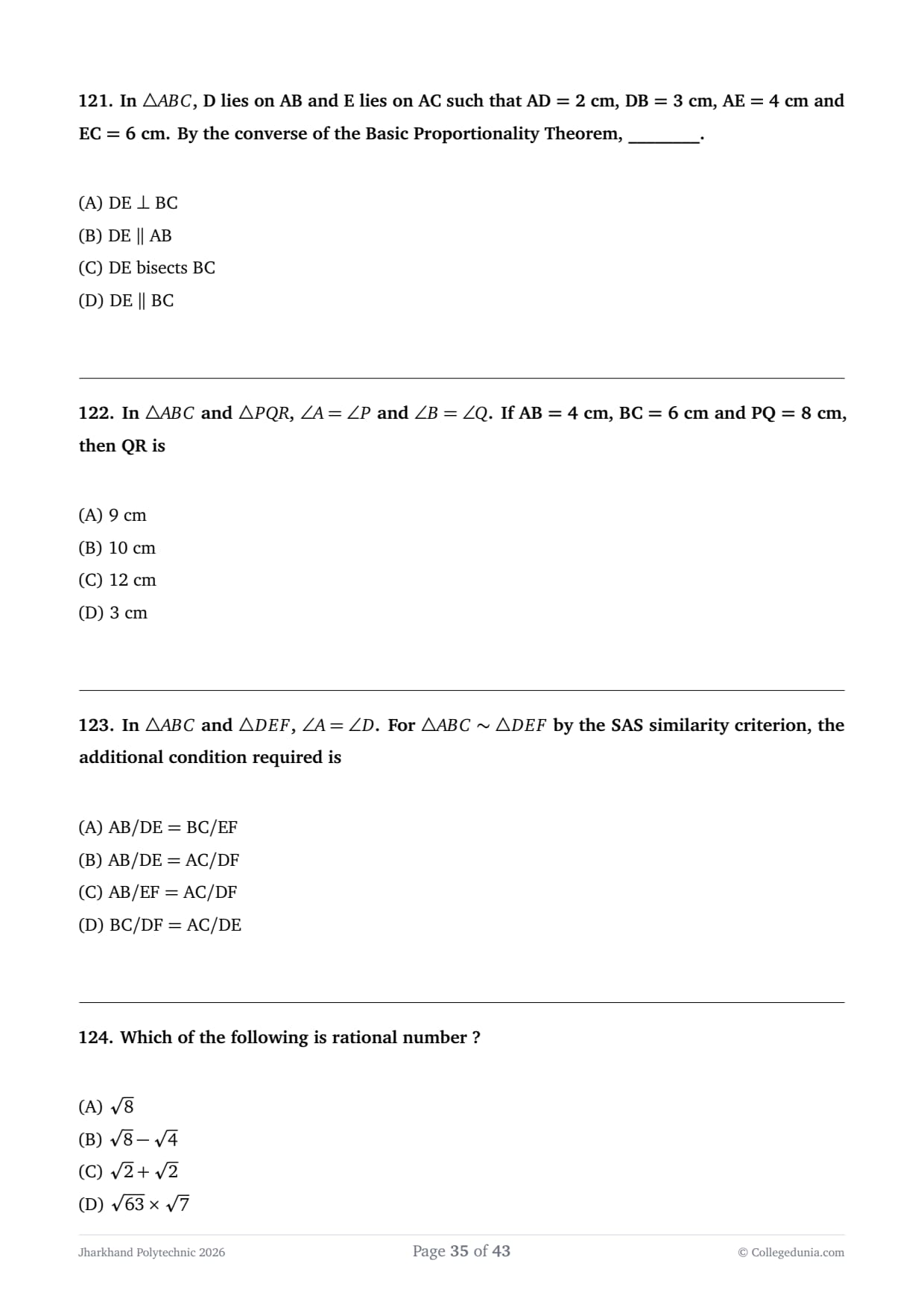
Question 121:

In \(\triangle ABC\), D lies on AB and E lies on AC such that AD = 2 cm, DB = 3 cm, AE = 4 cm and EC = 6 cm. By the converse of the Basic Proportionality Theorem, ________.

  • (A) DE \(\perp\) BC
  • (B) DE \(\parallel\) AB
  • (C) DE bisects BC
  • (D) DE \(\parallel\) BC

Question 122:

In \(\triangle ABC\) and \(\triangle PQR\), \(\angle A = \angle P\) and \(\angle B = \angle Q\). If AB = 4 cm, BC = 6 cm and PQ = 8 cm, then QR is

  • (A) 9 cm
  • (B) 10 cm
  • (C) 12 cm
  • (D) 3 cm

Question 123:

In \(\triangle ABC\) and \(\triangle DEF\), \(\angle A = \angle D\). For \(\triangle ABC \sim \triangle DEF\) by the SAS similarity criterion, the additional condition required is

  • (A) AB/DE = BC/EF
  • (B) AB/DE = AC/DF
  • (C) AB/EF = AC/DF
  • (D) BC/DF = AC/DE

Question 124:

Which of the following is rational number ?

  • (A) \(\sqrt{8}\)
  • (B) \(\sqrt{8} - \sqrt{4}\)
  • (C) \(\sqrt{2} + \sqrt{2}\)
  • (D) \(\sqrt{63} \times \sqrt{7}\)

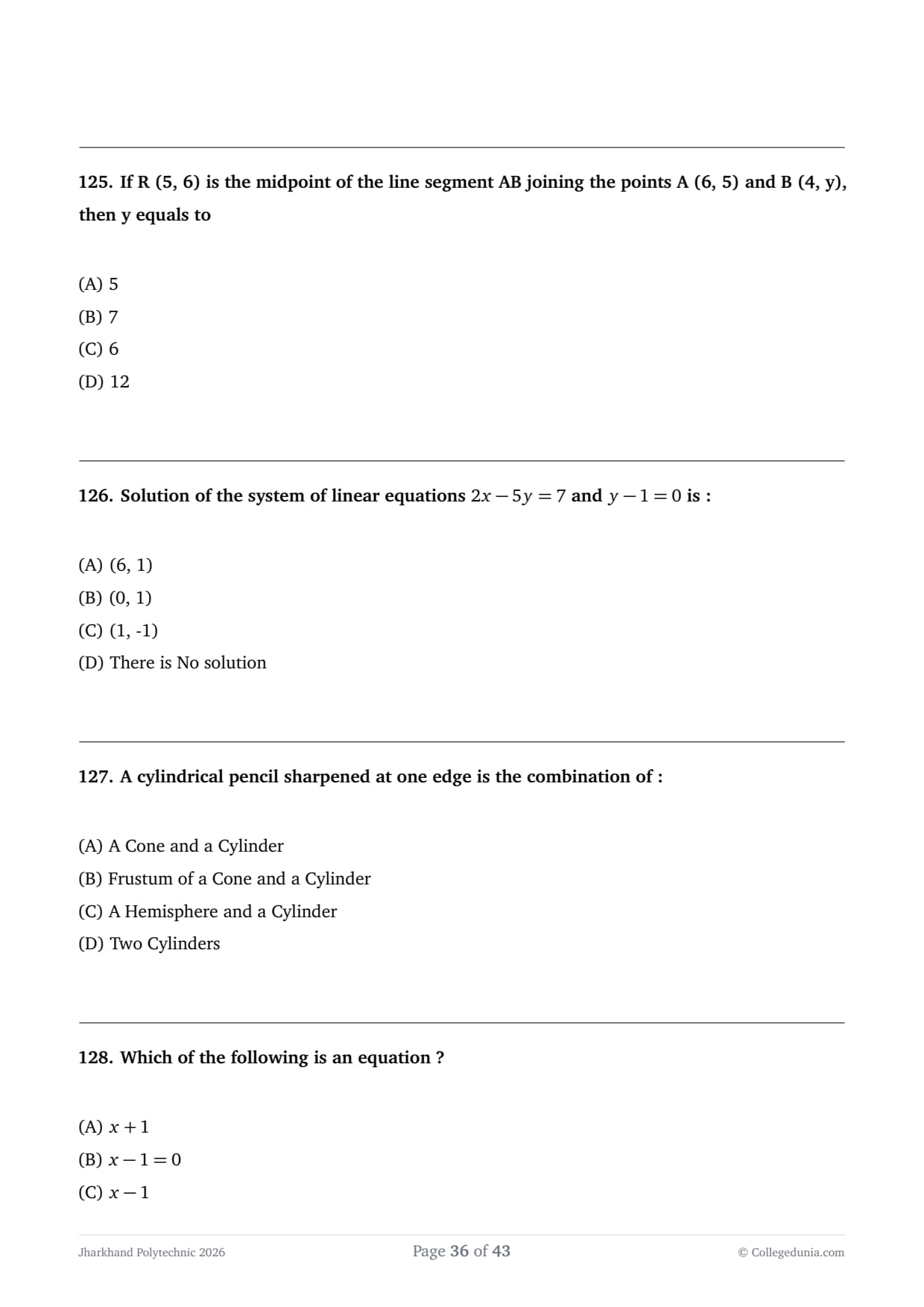
Question 125:

If R (5, 6) is the midpoint of the line segment AB joining the points A (6, 5) and B (4, y), then y equals to

  • (A) 5
  • (B) 7
  • (C) 6
  • (D) 12

Question 126:

Solution of the system of linear equations \(2x - 5y = 7\) and \(y - 1 = 0\) is :

  • (A) (6, 1)
  • (B) (0, 1)
  • (C) (1, -1)
  • (D) There is No solution

Question 127:

A cylindrical pencil sharpened at one edge is the combination of :

  • (A) A Cone and a Cylinder
  • (B) Frustum of a Cone and a Cylinder
  • (C) A Hemisphere and a Cylinder
  • (D) Two Cylinders

Question 128:

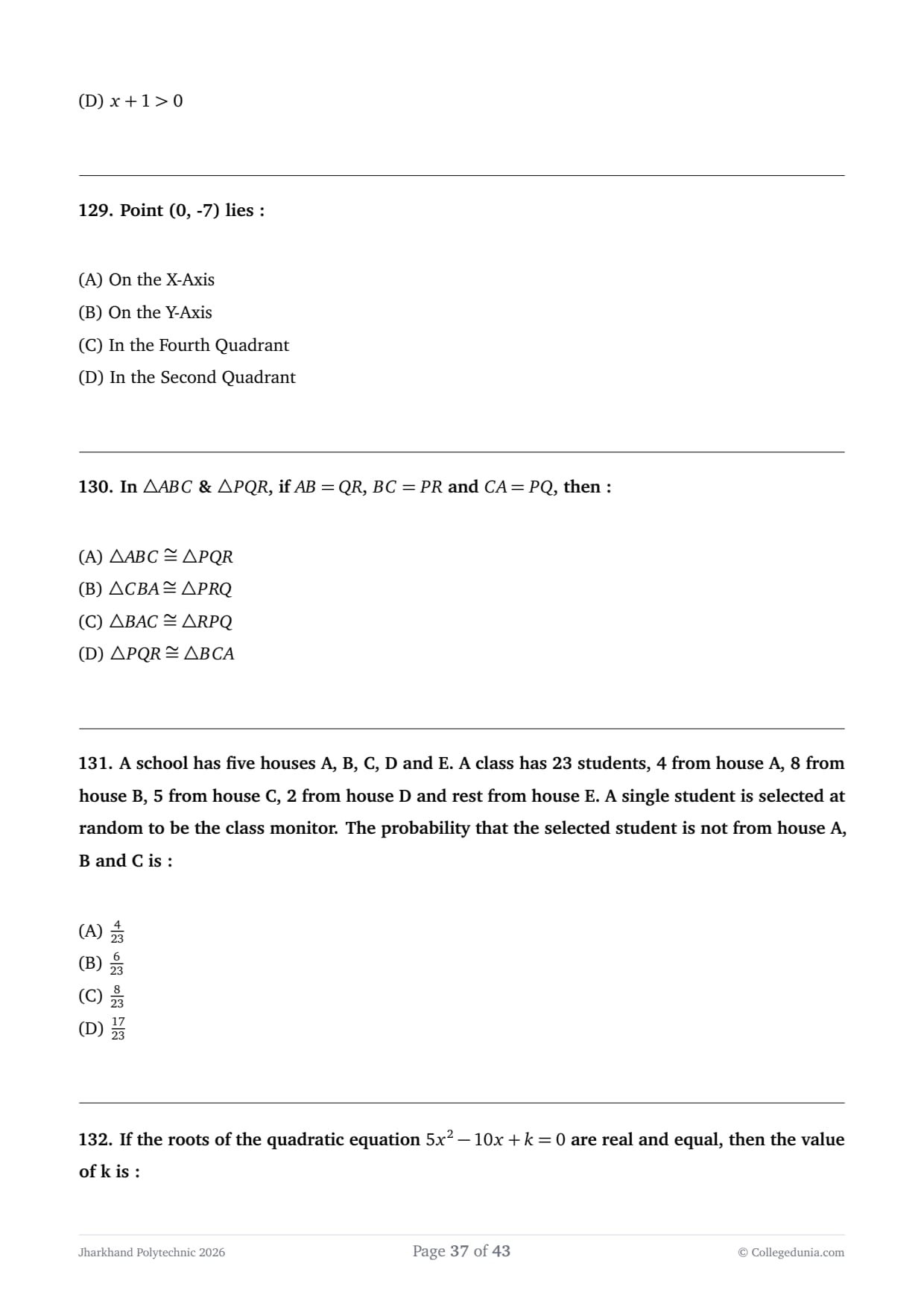
Which of the following is an equation ?

  • (A) \(x + 1\)
  • (B) \(x - 1 = 0\)
  • (C) \(x - 1\)
  • (D) \(x + 1 > 0\)

Question 129:

Point (0, -7) lies :

  • (A) On the X-Axis
  • (B) On the Y-Axis
  • (C) In the Fourth Quadrant
  • (D) In the Second Quadrant

Question 130:

In \(\triangle ABC\) & \(\triangle PQR\), if \(AB = QR\), \(BC = PR\) and \(CA = PQ\), then :

  • (A) \(\triangle ABC \cong \triangle PQR\)
  • (B) \(\triangle CBA \cong \triangle PRQ\)
  • (C) \(\triangle BAC \cong \triangle RPQ\)
  • (D) \(\triangle PQR \cong \triangle BCA\)

Question 131:

A school has five houses A, B, C, D and E. A class has 23 students, 4 from house A, 8 from house B, 5 from house C, 2 from house D and rest from house E. A single student is selected at random to be the class monitor. The probability that the selected student is not from house A, B and C is :

  • (A) \(\frac{4}{23}\)
  • (B) \(\frac{6}{23}\)
  • (C) \(\frac{8}{23}\)
  • (D) \(\frac{17}{23}\)

Question 132:

If the roots of the quadratic equation \(5x^2 - 10x + k = 0\) are real and equal, then the value of k is :

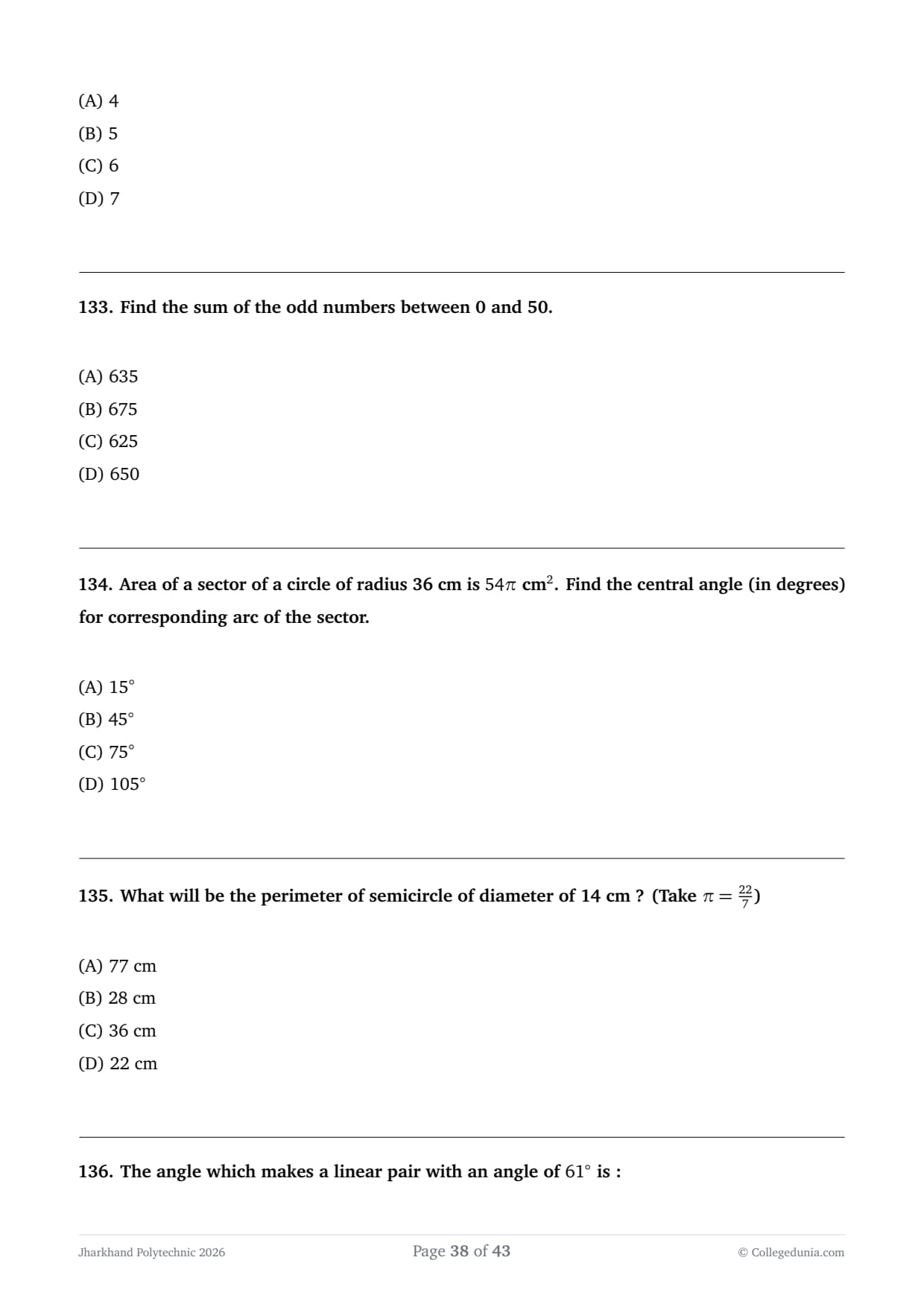
  • (A) 4
  • (B) 5
  • (C) 6
  • (D) 7

Question 133:

Find the sum of the odd numbers between 0 and 50.

  • (A) 635
  • (B) 675
  • (C) 625
  • (D) 650

Question 134:

Area of a sector of a circle of radius 36 cm is \(54\pi cm^2\). Find the central angle (in degrees) for corresponding arc of the sector.

  • (A) \(15^{\circ}\)
  • (B) \(45^{\circ}\)
  • (C) \(75^{\circ}\)
  • (D) \(105^{\circ}\)

Question 135:

What will be the perimeter of semicircle of diameter of 14 cm ? (Take \(\pi = \frac{22}{7}\))

  • (A) 77 cm
  • (B) 28 cm
  • (C) 36 cm
  • (D) 22 cm

Question 136:

The angle which makes a linear pair with an angle of \(61^{\circ}\) is :

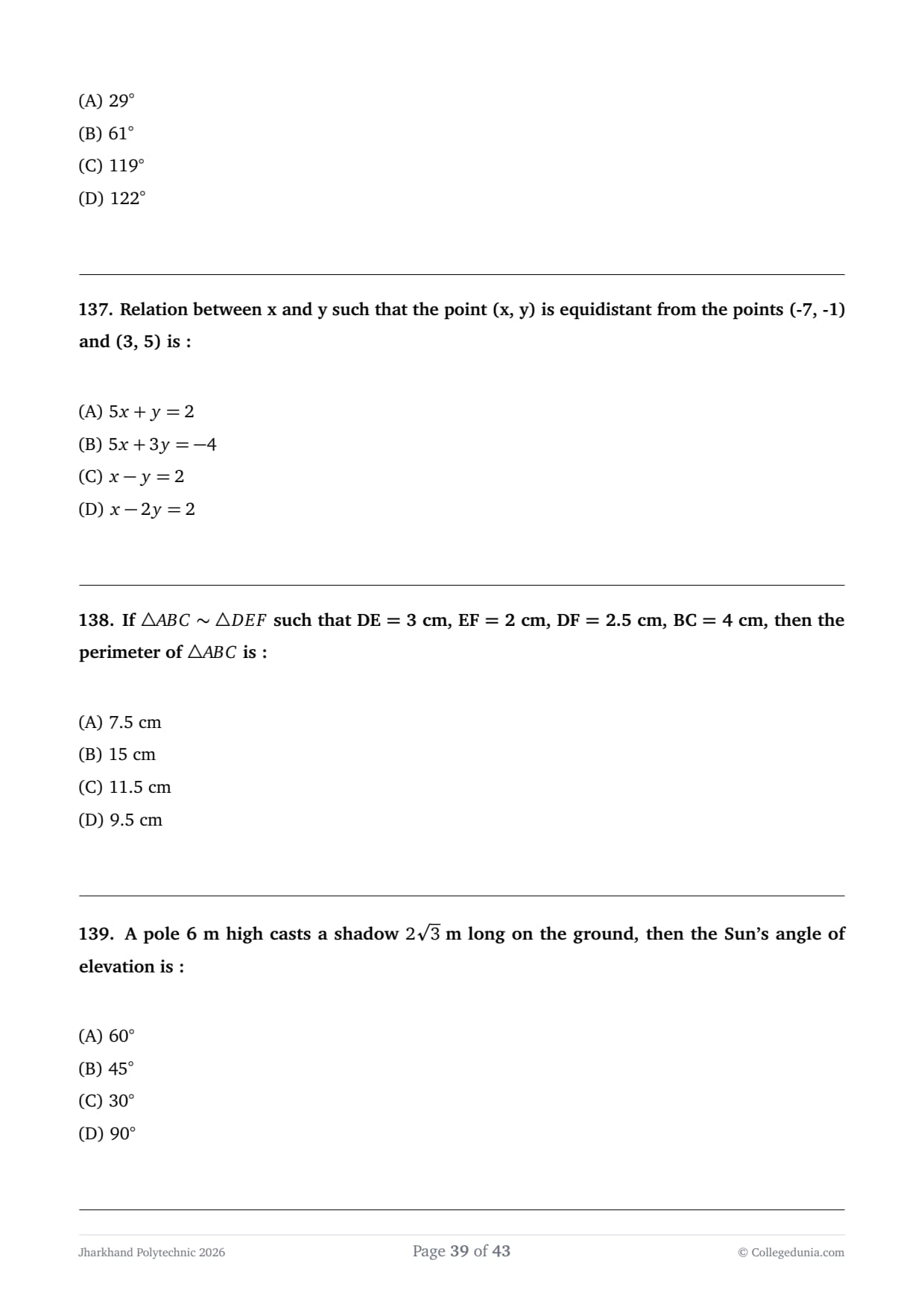
  • (A) \(29^{\circ}\)
  • (B) \(61^{\circ}\)
  • (C) \(119^{\circ}\)
  • (D) \(122^{\circ}\)

Question 137:

Relation between x and y such that the point (x, y) is equidistant from the points (-7, -1) and (3, 5) is :

  • (A) \(5x + y = 2\)
  • (B) \(5x + 3y = -4\)
  • (C) \(x - y = 2\)
  • (D) \(x - 2y = 2\)

Question 138:

If \(\triangle ABC \sim \triangle DEF\) such that DE = 3 cm, EF = 2 cm, DF = 2.5 cm, BC = 4 cm, then the perimeter of \(\triangle ABC\) is :

  • (A) 7.5 cm
  • (B) 15 cm
  • (C) 11.5 cm
  • (D) 9.5 cm

Question 139:

A pole 6 m high casts a shadow \(2\sqrt{3} m\) long on the ground, then the Sun's angle of elevation is :

  • (A) \(60^{\circ}\)
  • (B) \(45^{\circ}\)
  • (C) \(30^{\circ}\)
  • (D) \(90^{\circ}\)

Question 140:

The Prime factorization of the number 2304 is:

  • (A) \(3^2 \times 2^8\)
  • (B) \(3^1 \times 2^8\)
  • (C) \(3^2 \times 2^7\)
  • (D) \(3^1 \times 2^7\)

Question 141:

For which of the following figures, diagonals don't bisect each other?

  • (A) Trapezium
  • (B) Rhombus
  • (C) Parallelogram
  • (D) Rectangle

Question 142:

If the radius of a sphere is 2r, then its volume will be :

  • (A) \(\frac{4}{3}\pi r^3\)
  • (B) \(\frac{32\pi r^3}{3}\)
  • (C) \(\frac{2\pi r^3}{3}\)
  • (D) \(4\pi r^3\)

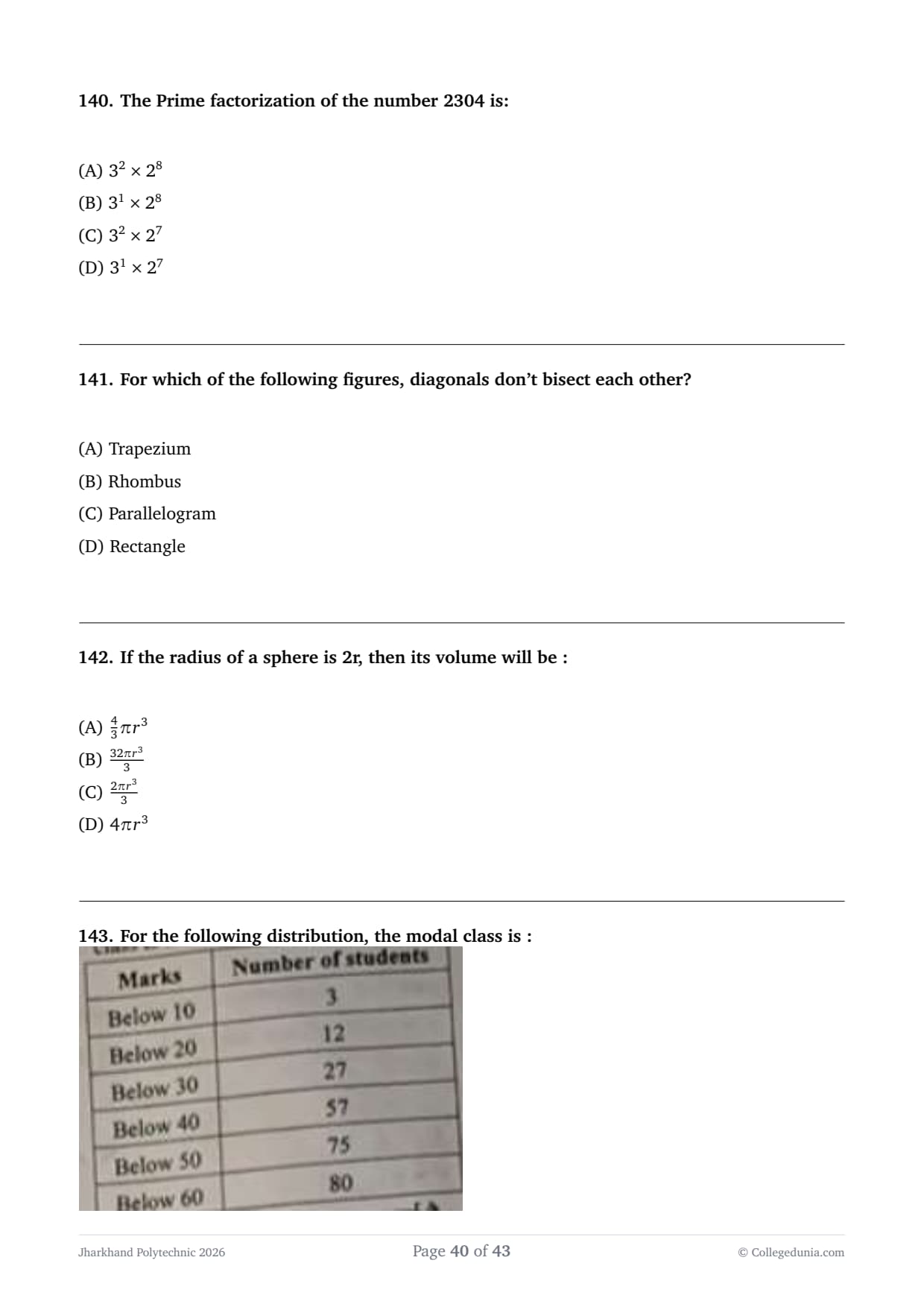
Question 143:

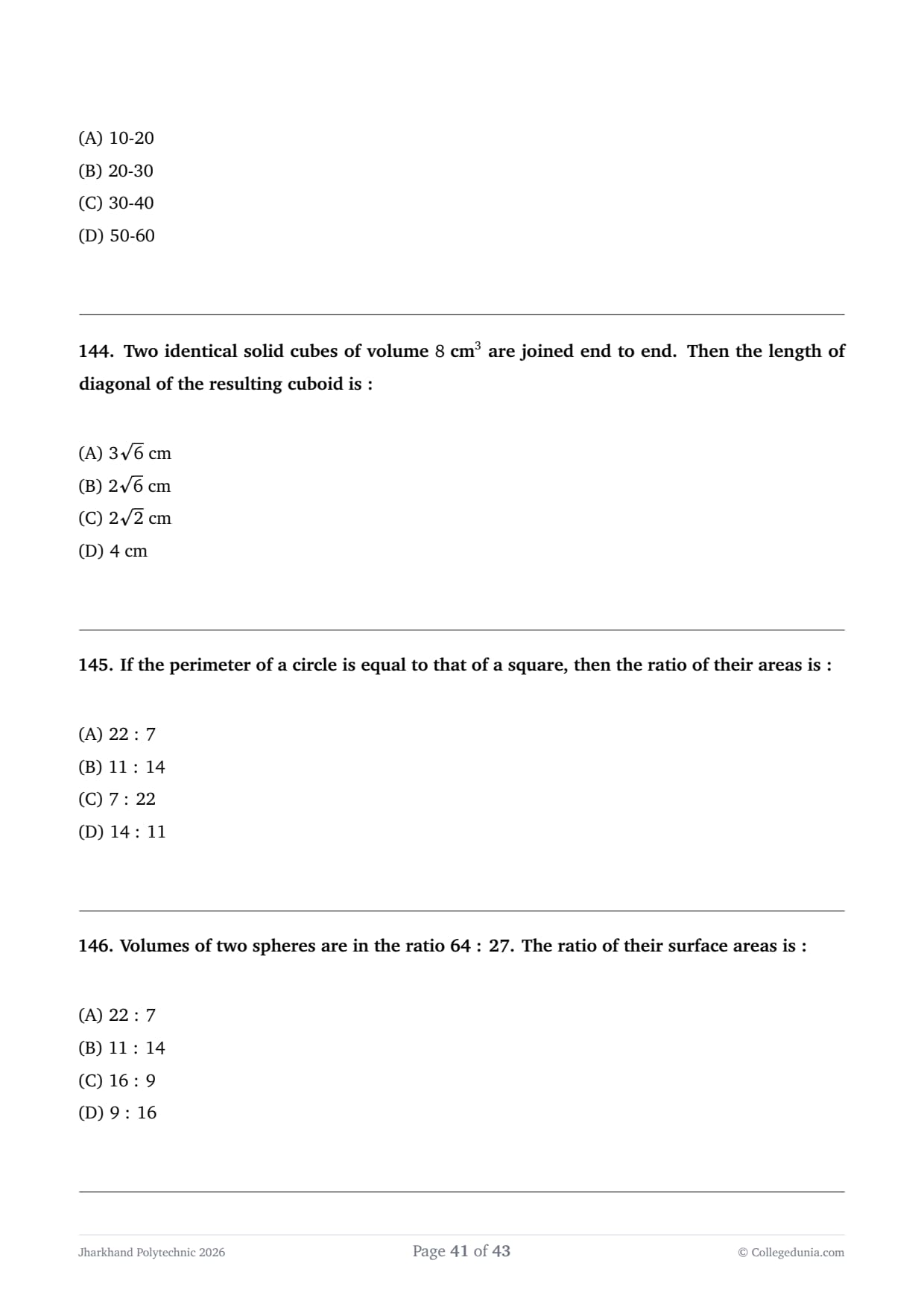
For the following distribution, the modal class is :

  • (A) 10-20
  • (B) 20-30
  • (C) 30-40
  • (D) 50-60

Question 144:

Two identical solid cubes of volume \(8 cm^3\) are joined end to end. Then the length of diagonal of the resulting cuboid is :

  • (A) \(3\sqrt{6} cm\)
  • (B) \(2\sqrt{6} cm\)
  • (C) \(2\sqrt{2} cm\)
  • (D) 4 cm

Question 145:

If the perimeter of a circle is equal to that of a square, then the ratio of their areas is :

  • (A) 22 : 7
  • (B) 11 : 14
  • (C) 7 : 22
  • (D) 14 : 11

Question 146:

Volumes of two spheres are in the ratio 64 : 27. The ratio of their surface areas is :

  • (A) 22 : 7
  • (B) 11 : 14
  • (C) 16 : 9
  • (D) 9 : 16

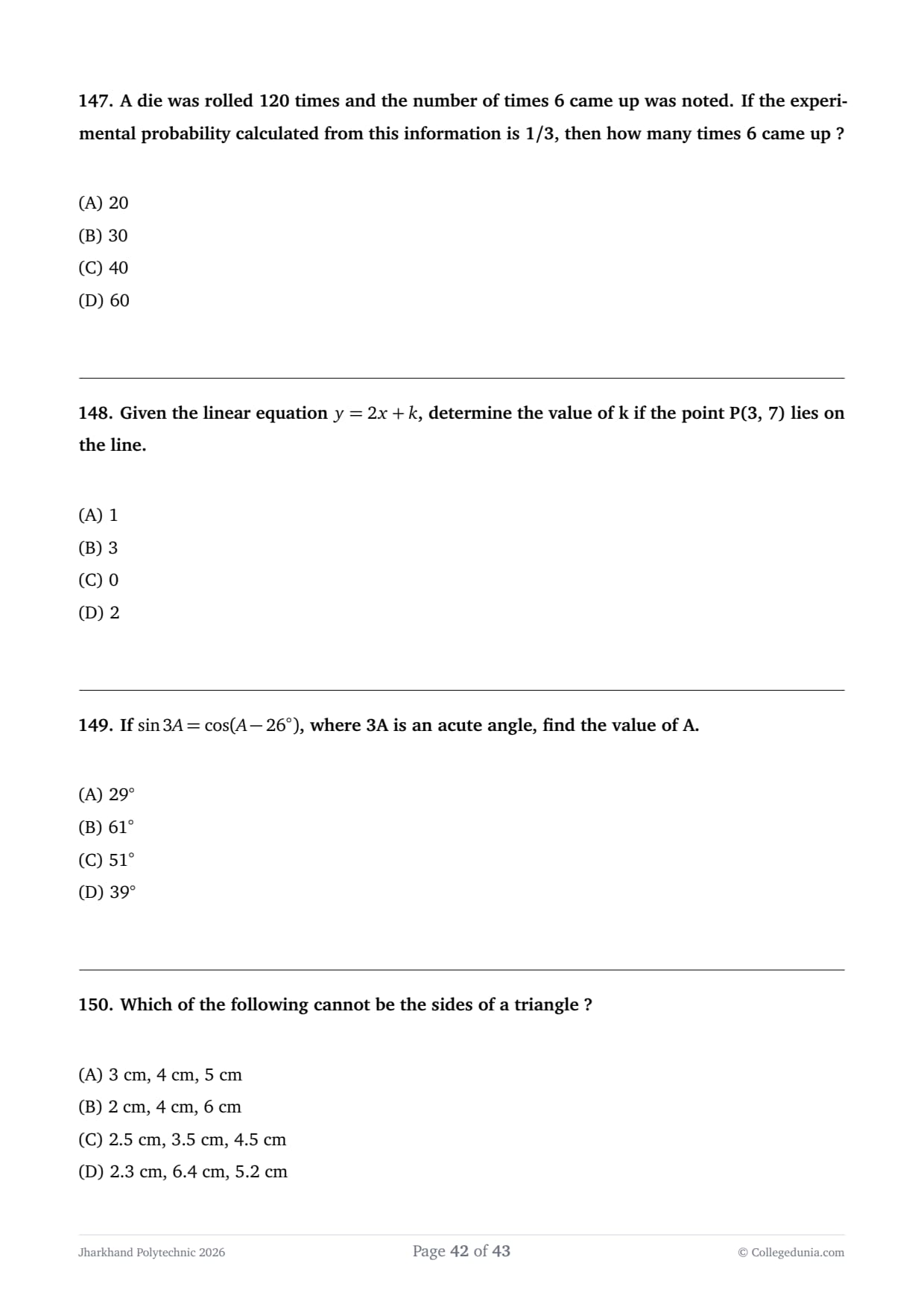
Question 147:

A die was rolled 120 times and the number of times 6 came up was noted. If the experimental probability calculated from this information is 1/3, then how many times 6 came up ?

  • (A) 20
  • (B) 30
  • (C) 40
  • (D) 60

Question 148:

Given the linear equation \(y = 2x + k\), determine the value of k if the point P(3, 7) lies on the line.

  • (A) 1
  • (B) 3
  • (C) 0
  • (D) 2

Question 149:

If \(\sin 3A = \cos (A - 26^{\circ})\), where 3A is an acute angle, find the value of A.

  • (A) \(29^{\circ}\)
  • (B) \(61^{\circ}\)
  • (C) \(51^{\circ}\)
  • (D) \(39^{\circ}\)

Question 150:

Which of the following cannot be the sides of a triangle ?

  • (A) 3 cm, 4 cm, 5 cm
  • (B) 2 cm, 4 cm, 6 cm
  • (C) 2.5 cm, 3.5 cm, 4.5 cm
  • (D) 2.3 cm, 6.4 cm, 5.2 cm

Jharkhand Polytechnic 2026 Exam Pattern

Particulars Details
Exam Name Polytechnic Entrance Competitive Examination (PECE)
Common Name Jharkhand Polytechnic 2026
Conducting Body Jharkhand Combined Entrance Competitive Examination Board (JCECEB)
Exam Level State Level
Mode of Exam Offline (OMR-based, pen and paper)
Exam Frequency Once a year
Exam Duration 2 hours 30 minutes
Total Questions 150 MCQs
Total Marks 150
Subjects Physics, Chemistry, Mathematics (Class 10 level)
Marking Scheme +1 for correct, -0.25 for incorrect

Jharkhand Polytechnic 2026 Exam Analysis & Expected Cutoff