KLEE 2026 LLB 3 Year Question Paper is available for download here. CEE Kerala conducted KLEE 2026 exam for 3 Year LLB on 28 June in single shift from 3 PM to 5 PM. KLEE 2026 LLB 3 Year Question Paper consists of 120 questions for 360 marks to be attempted in 2 hours.

  • KLEE 3 Year LLB Question Paper is divided into 4 sections- General English (36 questions), General Knowledge (27 questions), Arithmetic and Mental Ability (15 questions) and Aptitude for Legal Studies (42 questions).
  • Each question carries 3 marks and there is negative marking of 1 mark for incorrect answers.

Candidates can download KLEE 2026 LLB 3 Year Question Paper with Answer Key and Solution PDF from the links provided below.

KLEE 2026 LLB 3 Year Question Paper with Solution PDF

KLEE 3 Year LLB Question Paper 2026 Download PDF Check Solution

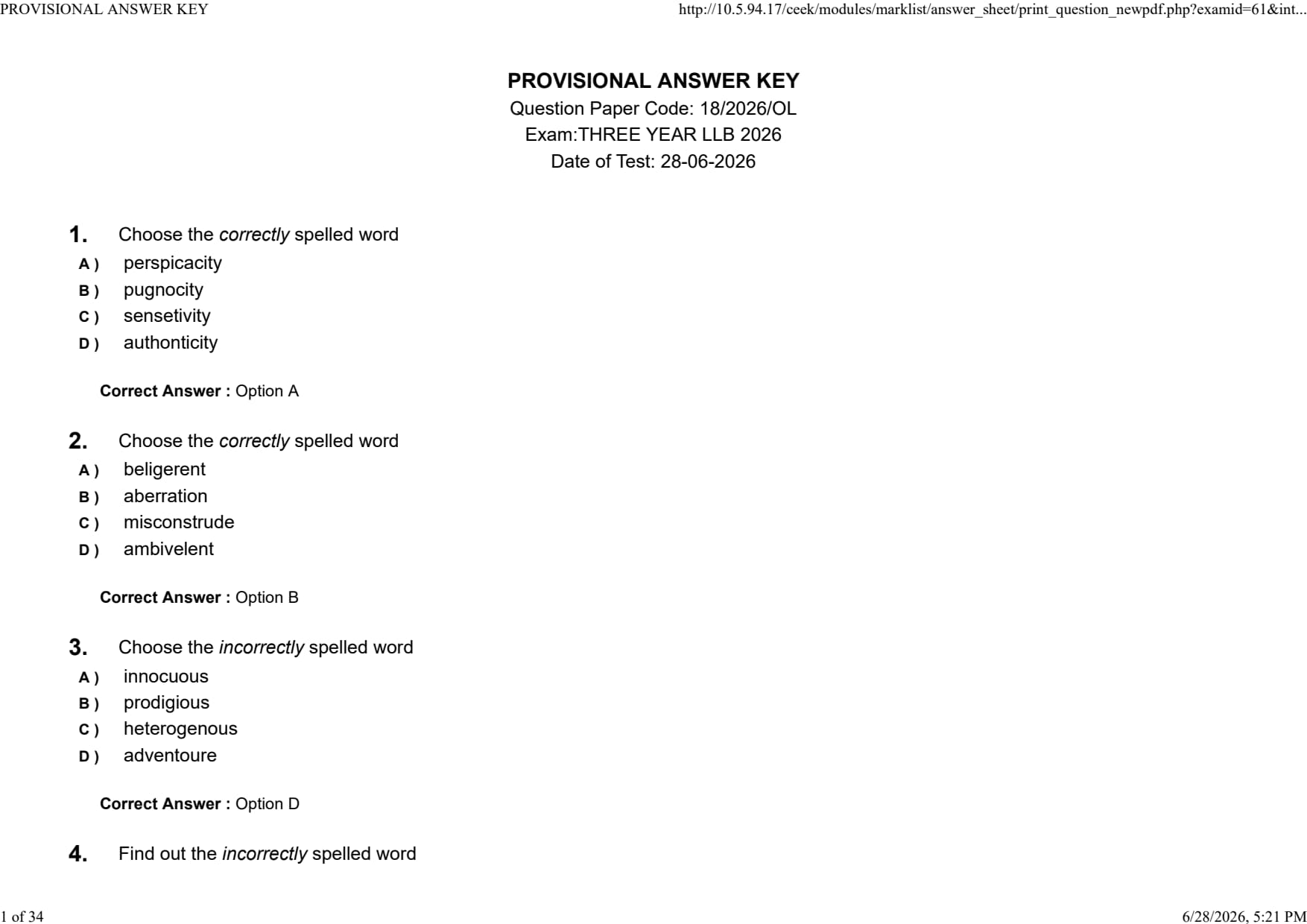
Question 1:

Choose the correctly spelled word

  • (A) perspicacity
  • (B) pugnocity
  • (C) sensetivity
  • (D) authonticity

Question 2:

Choose the correctly spelled word

  • (A) beligerent
  • (B) aberration
  • (C) misconstrude
  • (D) ambivelent

Question 3:

Choose the incorrectly spelled word

  • (A) innocuous
  • (B) prodigious
  • (C) heterogenous
  • (D) adventoure

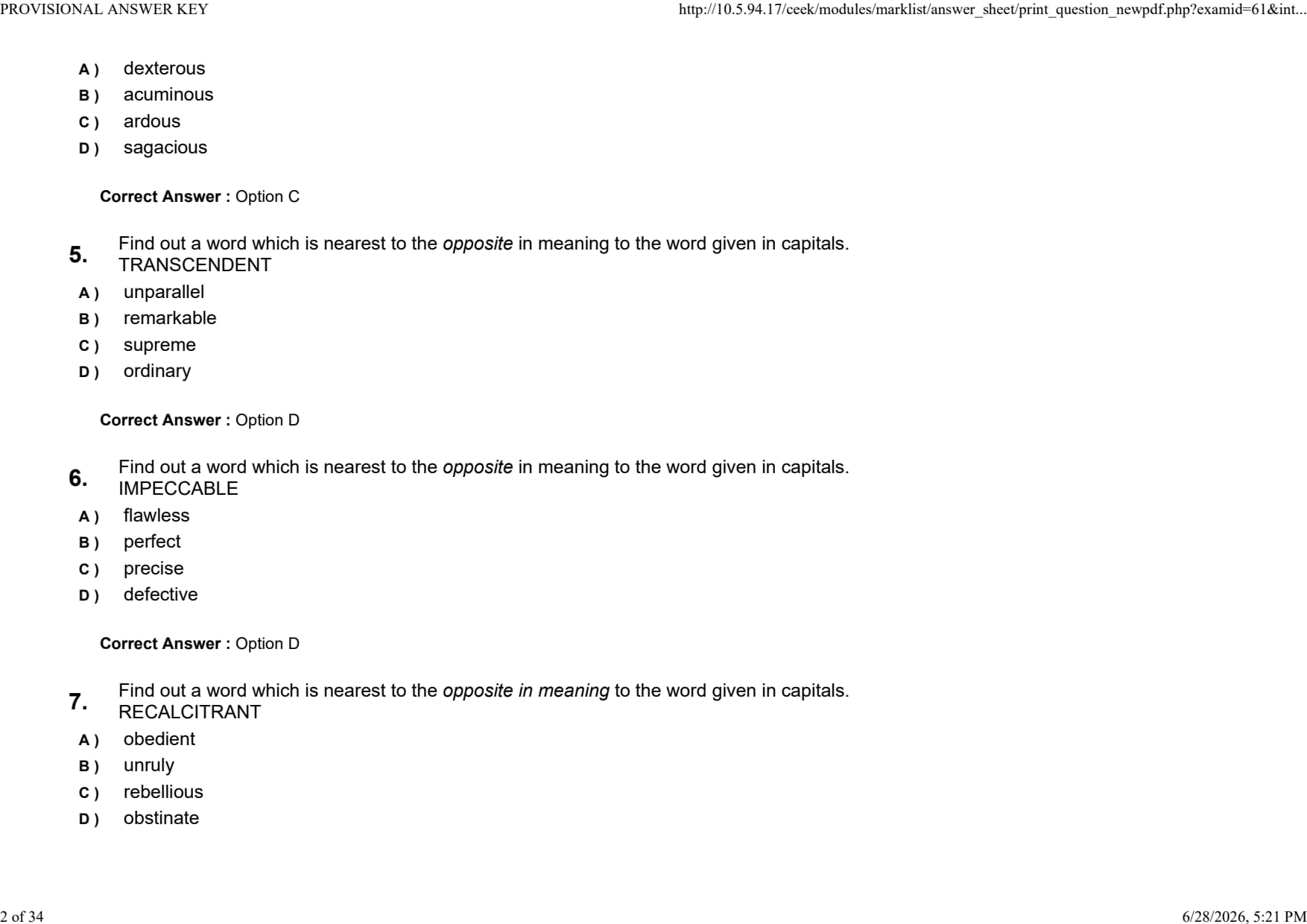
Question 4:

Find out the incorrectly spelled word

  • (A) dexterous
  • (B) acuminous
  • (C) ardous
  • (D) sagacious

Question 5:

Find out a word which is nearest to the opposite in meaning to the word given in capitals.
TRANSCENDENT

  • (A) unparallel
  • (B) remarkable
  • (C) supreme
  • (D) ordinary

Question 6:

Find out a word which is nearest to the opposite in meaning to the word given in capitals.
IMPECCABLE

  • (A) flawless
  • (B) perfect
  • (C) precise
  • (D) defective

Question 7:

Find out a word which is nearest to the opposite in meaning to the word given in capitals.
RECALCITRANT

  • (A) obedient
  • (B) unruly
  • (C) rebellious
  • (D) obstinate

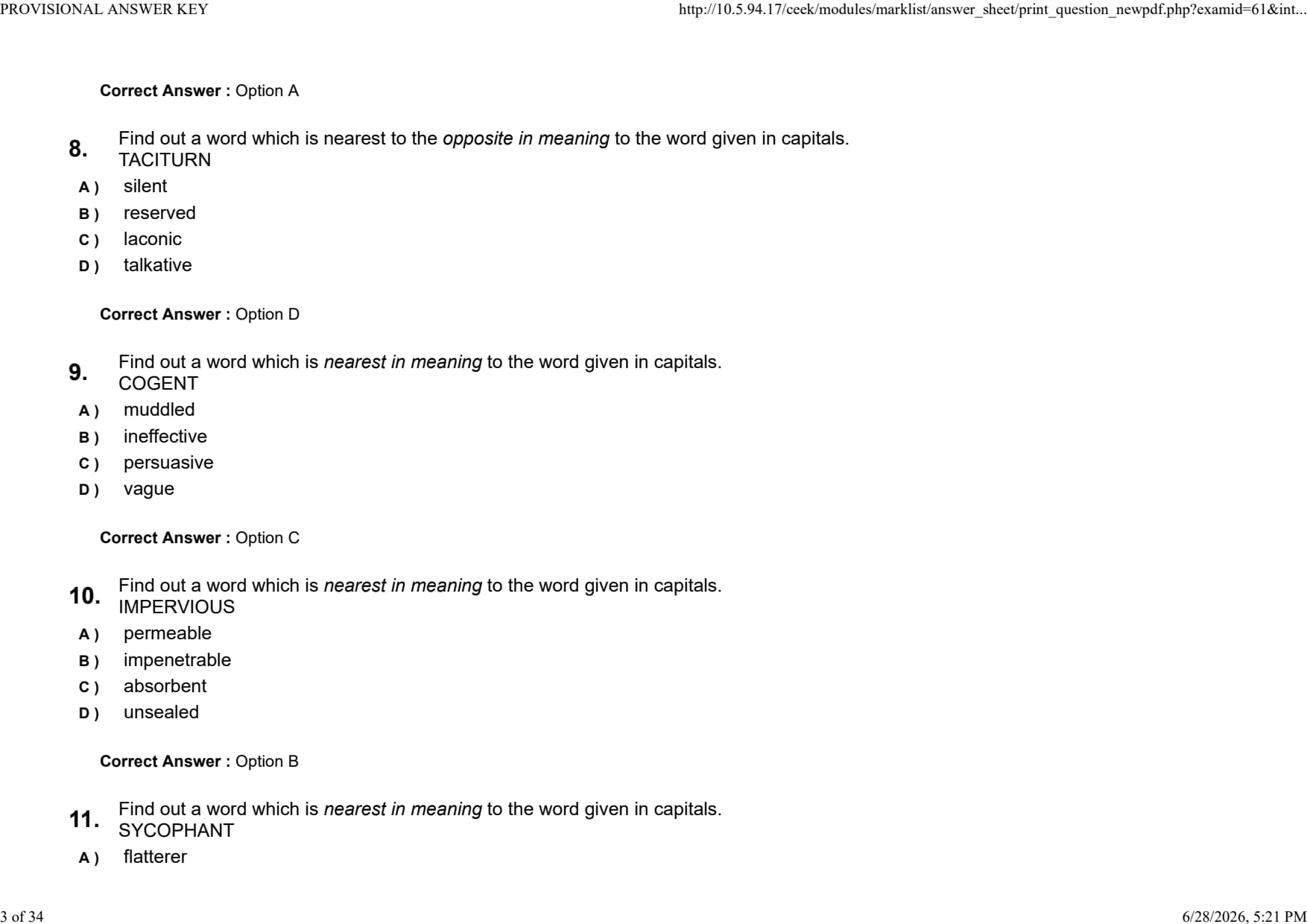
Question 8:

Find out a word which is nearest to the opposite in meaning to the word given in capitals.
TACITURN

  • (A) silent
  • (B) reserved
  • (C) laconic
  • (D) talkative

Question 9:

Find out a word which is nearest in meaning to the word given in capitals.
COGENT

  • (A) muddled
  • (B) ineffective
  • (C) persuasive
  • (D) vague

Question 10:

Find out a word which is nearest in meaning to the word given in capitals.
IMPERVIOUS

  • (A) permeable
  • (B) impenetrable
  • (C) absorbent
  • (D) unsealed

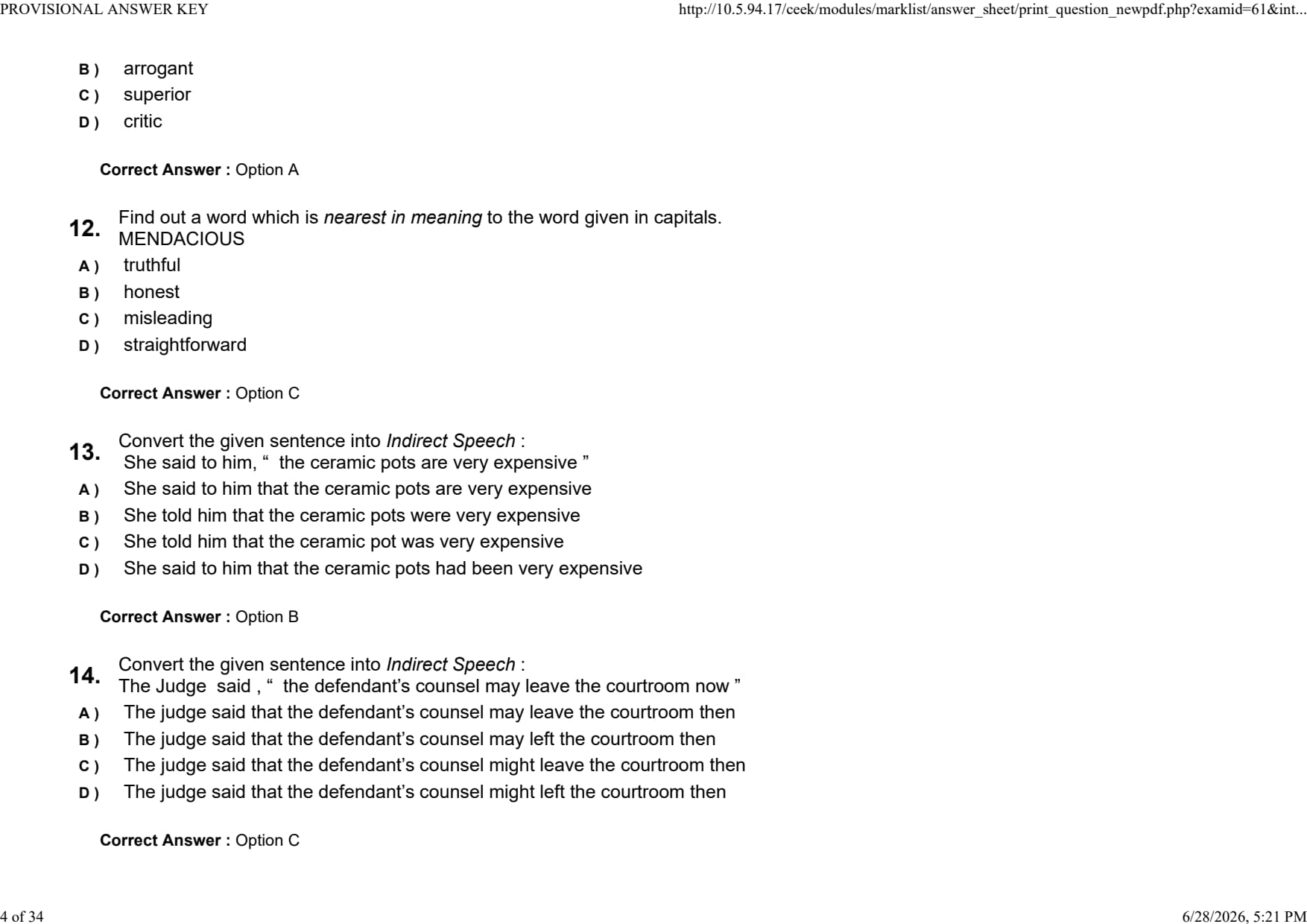
Question 11:

Find out a word which is nearest in meaning to the word given in capitals.
SYCOPHANT

  • (A) flatterer
  • (B) arrogant
  • (C) superior
  • (D) critic

Question 12:

Find out a word which is nearest in meaning to the word given in capitals.
MENDACIOUS

  • (A) truthful
  • (B) honest
  • (C) misleading
  • (D) straightforward

Question 13:

Convert the given sentence into Indirect Speech :
She said to him, “ the ceramic pots are very expensive ”

  • (A) She said to him that the ceramic pots are very expensive
  • (B) She told him that the ceramic pots were very expensive
  • (C) She told him that the ceramic pot was very expensive
  • (D) She said to him that the ceramic pots had been very expensive

Question 14:

Convert the given sentence into Indirect Speech :
The Judge said , “ the defendant’s counsel may leave the courtroom now ”

  • (A) The judge said that the defendant’s counsel may leave the courtroom then
  • (B) The judge said that the defendant’s counsel may left the courtroom then
  • (C) The judge said that the defendant’s counsel might leave the courtroom then
  • (D) The judge said that the defendant’s counsel might left the courtroom then

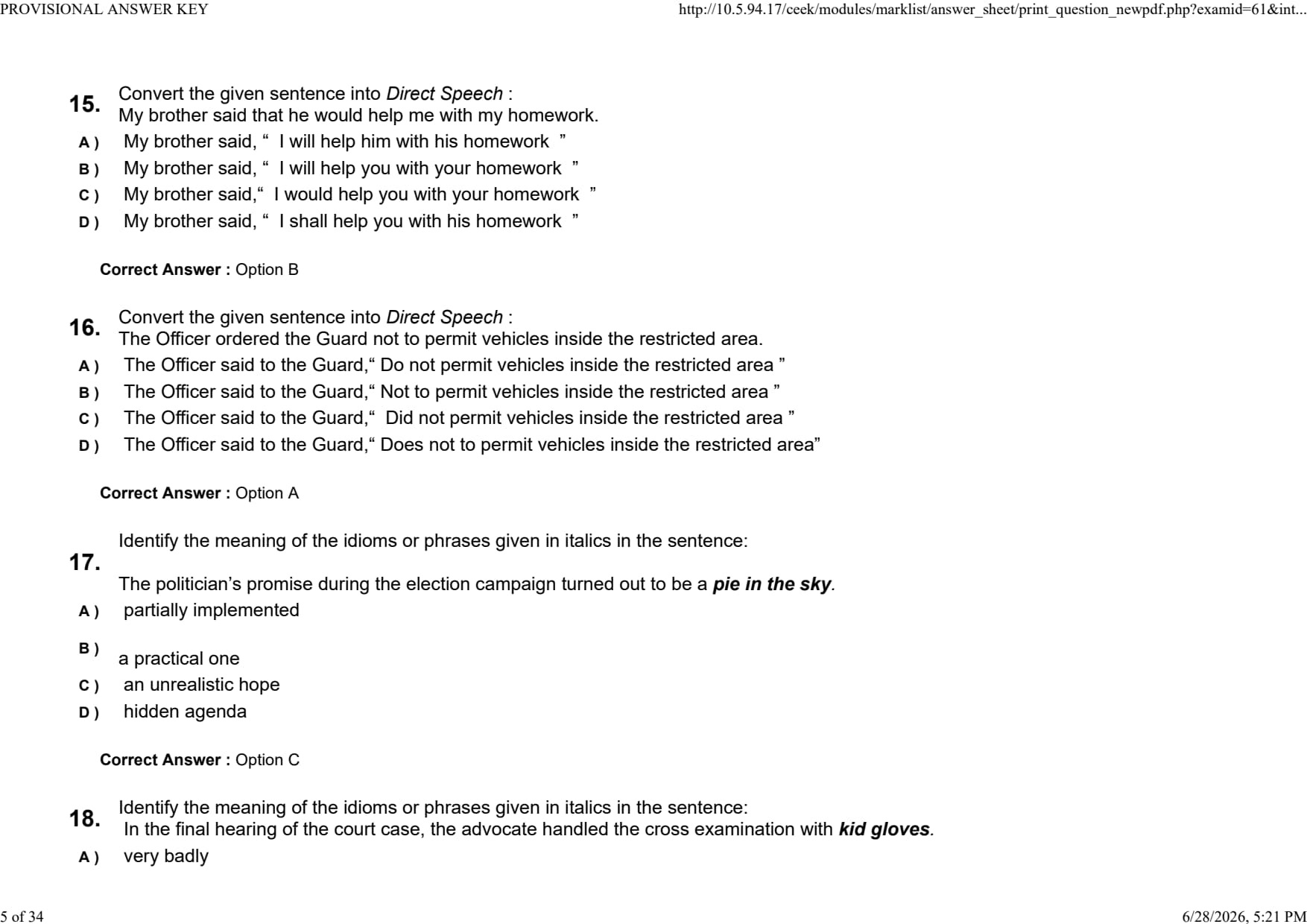
Question 15:

Convert the given sentence into Direct Speech :
My brother said that he would help me with my homework.

  • (A) My brother said, “ I will help him with his homework ”
  • (B) My brother said, “ I will help you with your homework ”
  • (C) My brother said,“ I would help you with your homework ”
  • (D) My brother said, “ I shall help you with his homework ”

Question 16:

Convert the given sentence into Direct Speech :
The Officer ordered the Guard not to permit vehicles inside the restricted area.

  • (A) The Officer said to the Guard,“ Do not permit vehicles inside the restricted area ”
  • (B) The Officer said to the Guard,“ Not to permit vehicles inside the restricted area ”
  • (C) The Officer said to the Guard,“ Did not permit vehicles inside the restricted area ”
  • (D) The Officer said to the Guard,“ Does not to permit vehicles inside the restricted area”

Question 17:

Identify the meaning of the idioms or phrases given in italics in the sentence:
The politician’s promise during the election campaign turned out to be a pie in the sky.

  • (A) partially implemented
  • (B) a practical one
  • (C) an unrealistic hope
  • (D) hidden agenda

Question 18:

Identify the meaning of the idioms or phrases given in italics in the sentence:
In the final hearing of the court case, the advocate handled the cross examination with kid gloves.

  • (A) very badly
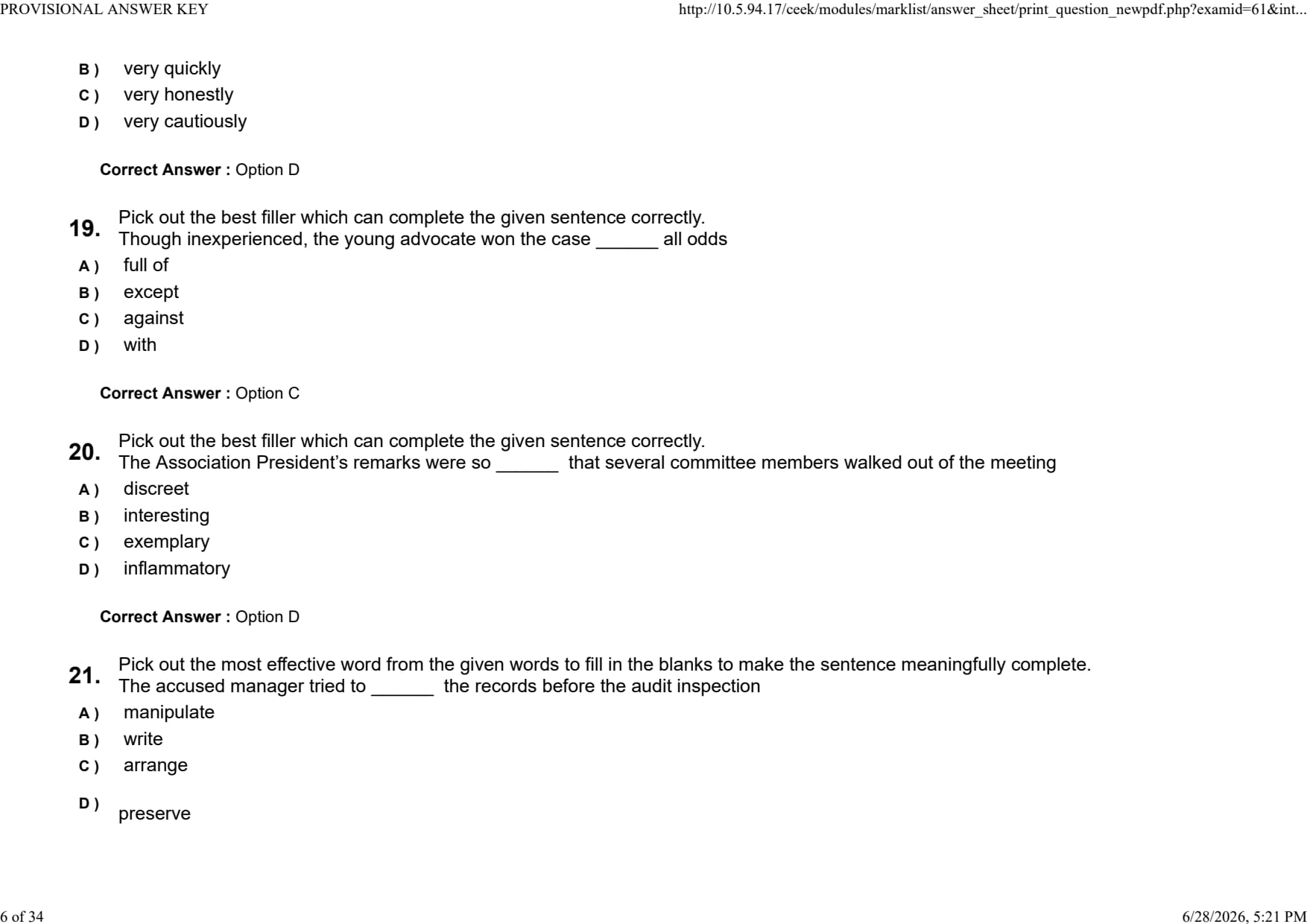
  • (B) very quickly
  • (C) very honestly
  • (D) very cautiously

Question 19:

Pick out the best filler which can complete the given sentence correctly.
Though inexperienced, the young advocate won the case ______ all odds

  • (A) full of
  • (B) except
  • (C) against
  • (D) with

Question 20:

The Association President’s remarks were so ______ that several committee members walked out of the meeting

  • (A) discreet
  • (B) interesting
  • (C) exemplary
  • (D) inflammatory

Question 21:

The accused manager tried to ______ the records before the audit inspection

  • (A) manipulate
  • (B) write
  • (C) arrange
  • (D) preserve

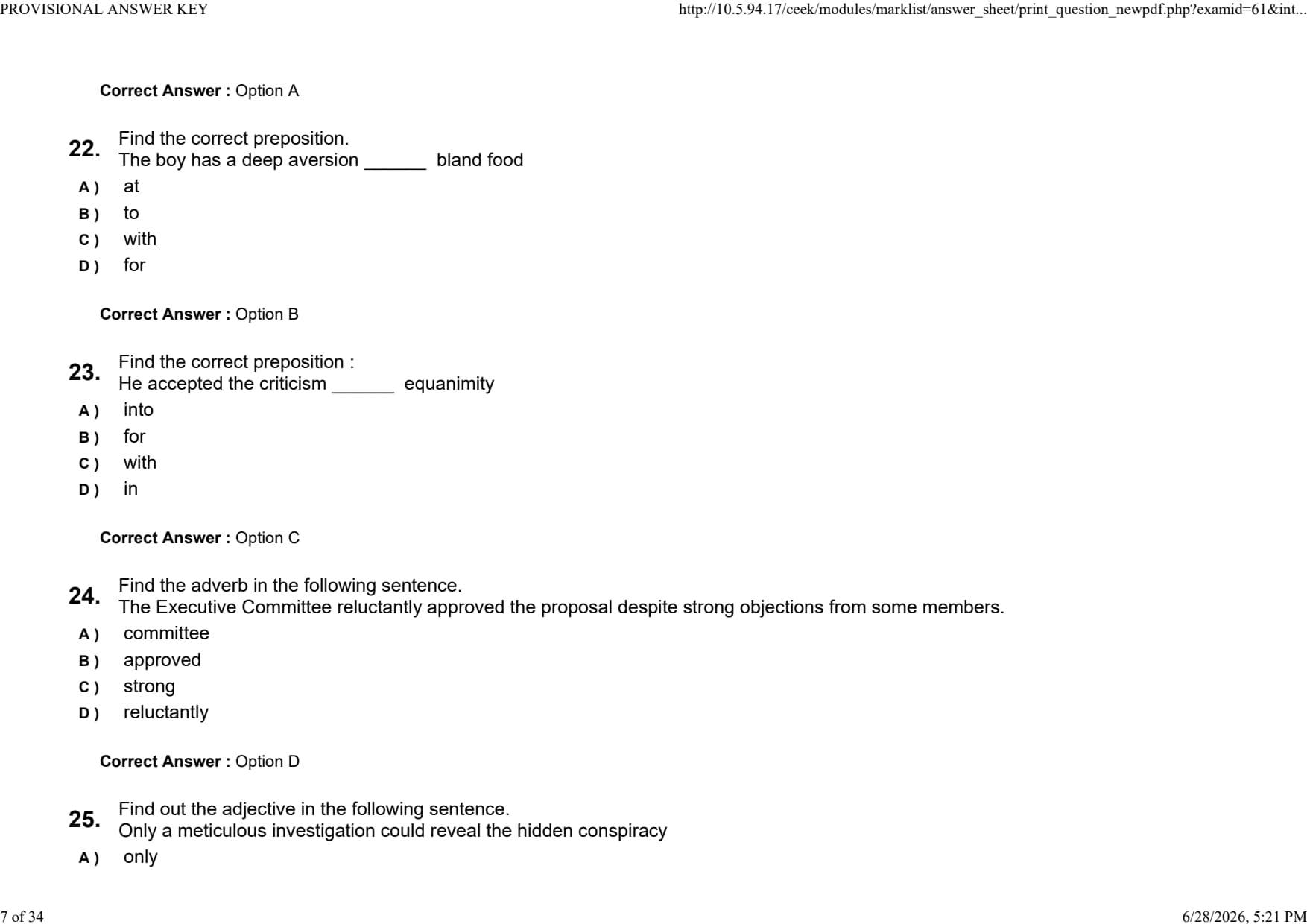
Question 22:

The boy has a deep aversion ______ bland food

  • (A) at
  • (B) to
  • (C) with
  • (D) for

Question 23:

He accepted the criticism ______ equanimity

  • (A) into
  • (B) for
  • (C) with
  • (D) in

Question 24:

Find the adverb in the following sentence.

The Executive Committee reluctantly approved the proposal despite strong objections from some members.

  • (A) committee
  • (B) approved
  • (C) strong
  • (D) reluctantly

Question 25:

Find out the adjective in the following sentence.

Only a meticulous investigation could reveal the hidden conspiracy

  • (A) only
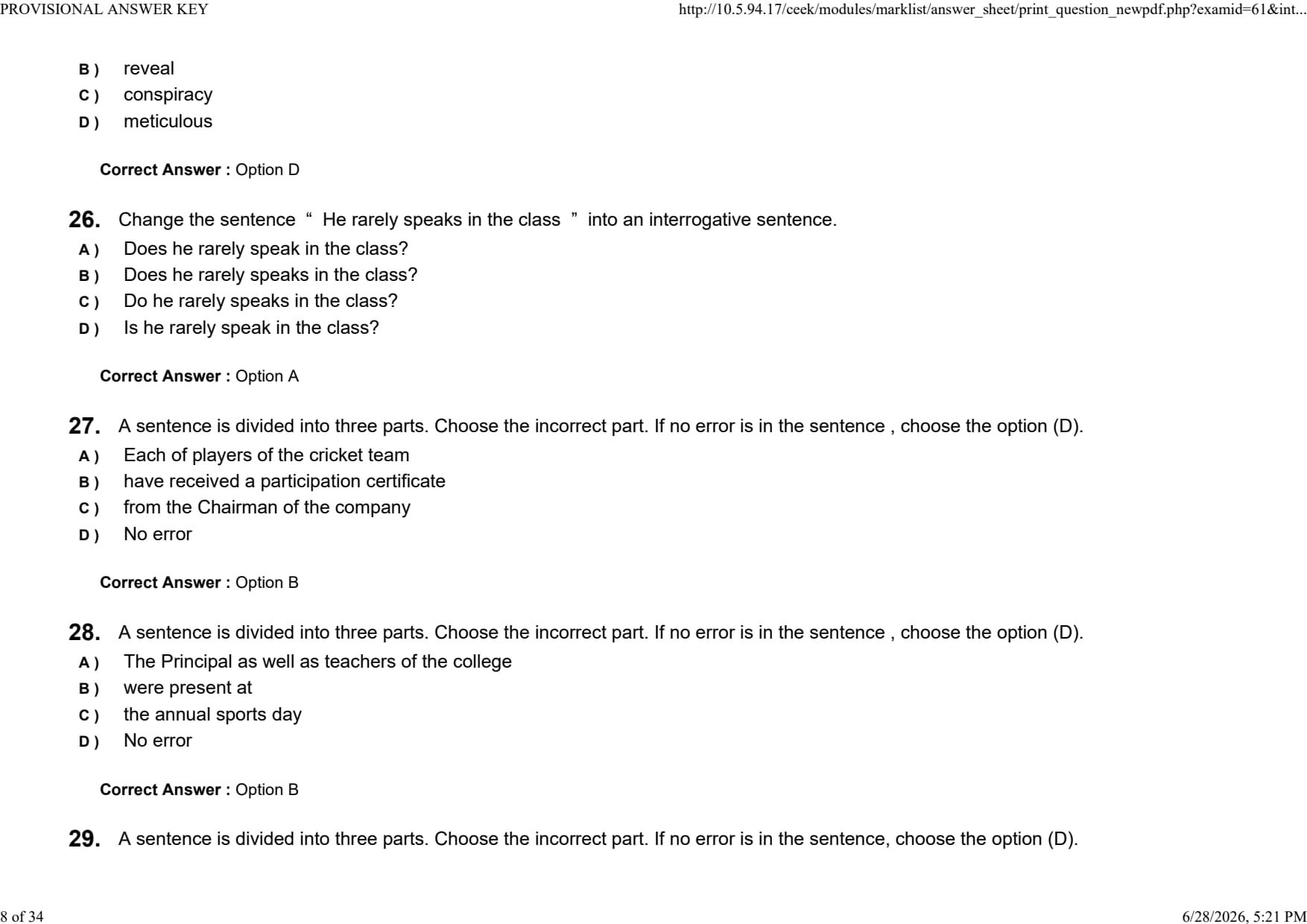
  • (B) reveal
  • (C) conspiracy
  • (D) meticulous

Question 26:

Change the sentence “ He rarely speaks in the class ” into an interrogative sentence.

  • (A) Does he rarely speak in the class?
  • (B) Does he rarely speaks in the class?
  • (C) Do he rarely speaks in the class?
  • (D) Is he rarely speak in the class?

Question 27:

A sentence is divided into three parts. Choose the incorrect part. If no error is in the sentence , choose the option (D).

(A) Each of players of the cricket team

(B) have received a participation certificate

(C) from the Chairman of the company

(D) No error

  • (A) Each of players of the cricket team
  • (B) have received a participation certificate
  • (C) from the Chairman of the company
  • (D) No error

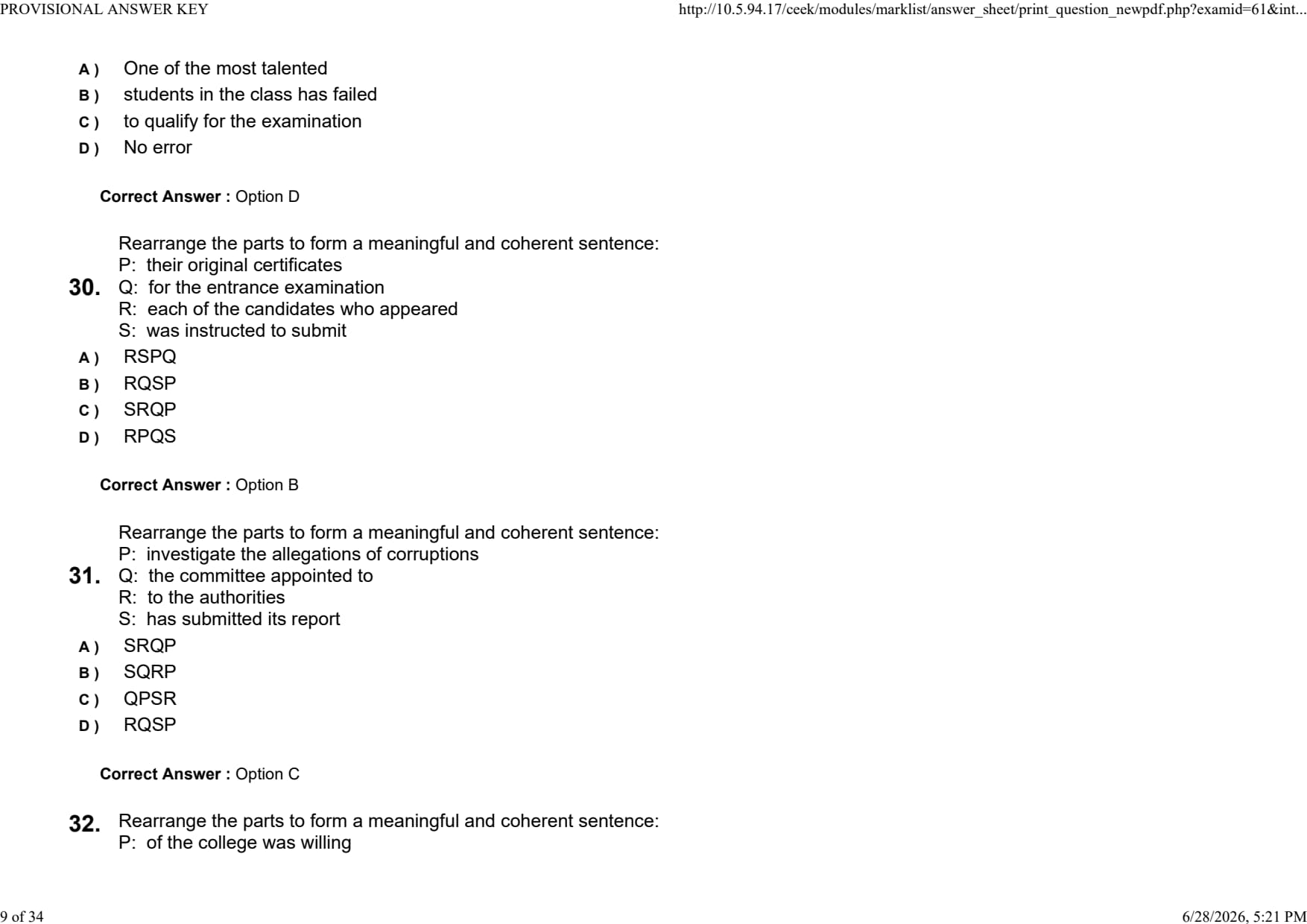
Question 28:

A sentence is divided into three parts. Choose the incorrect part. If no error is in the sentence , choose the option (D).

(A) The Principal as well as teachers of the college

(B) were present at

(C) the annual sports day

(D) No error

  • (A) The Principal as well as teachers of the college
  • (B) were present at
  • (C) the annual sports day
  • (D) No error

Question 29:

A sentence is divided into three parts. Choose the incorrect part. If no error is in the sentence, choose the option (D).

(A) One of the most talented

(B) students in the class has failed

(C) to qualify for the examination

(D) No error

  • (A) One of the most talented
  • (B) students in the class has failed
  • (C) to qualify for the examination
  • (D) No error

Question 30:

Rearrange the parts to form a meaningful and coherent sentence:

P: their original certificates

Q: for the entrance examination

R: each of the candidates who appeared

S: was instructed to submit

  • (A) RSPQ
  • (B) RQSP
  • (C) SRQP
  • (D) RPQS

Question 31:

Rearrange the parts to form a meaningful and coherent sentence:

P: investigate the allegations of corruptions

Q: the committee appointed to

R: to the authorities

S: has submitted its report

  • (A) SRQP
  • (B) SQRP
  • (C) QPSR
  • (D) RQSP

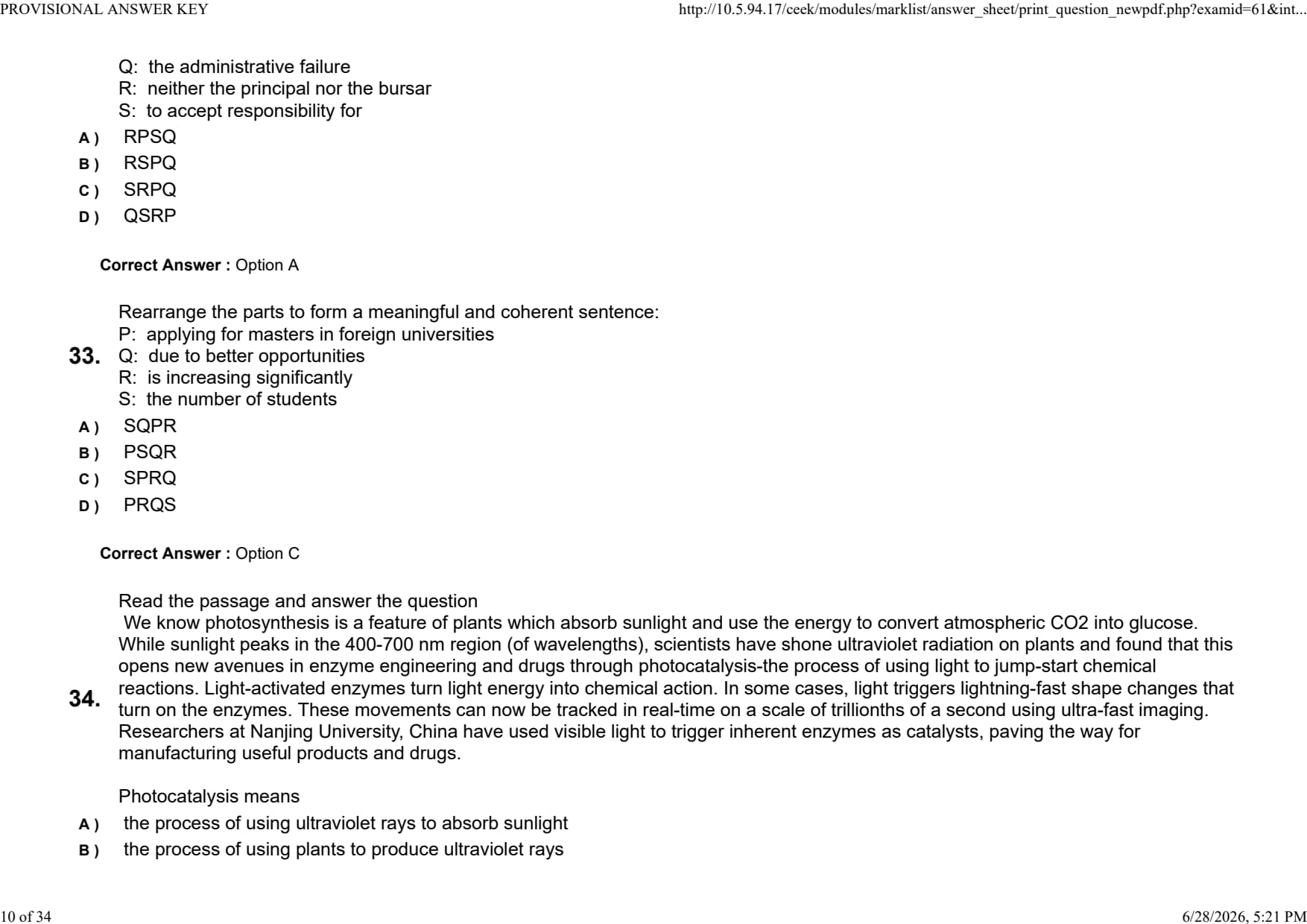
Question 32:

Rearrange the parts to form a meaningful and coherent sentence:

P: of the college was willing

Q: the administrative failure

R: neither the principal nor the bursar

S: to accept responsibility for

  • (A) RPSQ
  • (B) RSPQ
  • (C) SRPQ
  • (D) QSRP

Question 33:

Rearrange the parts to form a meaningful and coherent sentence:

P: applying for masters in foreign universities

Q: due to better opportunities

R: is increasing significantly

S: the number of students

  • (A) SQPR
  • (B) PSQR
  • (C) SPRQ
  • (D) PRQS

Question 34:

Read the passage and answer the question

We know photosynthesis is a feature of plants which absorb sunlight and use the energy to convert atmospheric CO2 into glucose. While sunlight peaks in the 400-700 nm region (of wavelengths), scientists have shone ultraviolet radiation on plants and found that this opens new avenues in enzyme engineering and drugs through photocatalysis-the process of using light to jump-start chemical reactions. Light-activated enzymes turn light energy into chemical action. In some cases, light triggers lightning-fast shape changes that turn on the enzymes. These movements can now be tracked in real-time on a scale of trillionths of a second using ultra-fast imaging. Researchers at Nanjing University, China have used visible light to trigger inherent enzymes as catalysts, paving the way for manufacturing useful products and drugs.


Photocatalysis means

  • (A) the process of using ultraviolet rays to absorb sunlight
  • (B) the process of using plants to produce ultraviolet rays
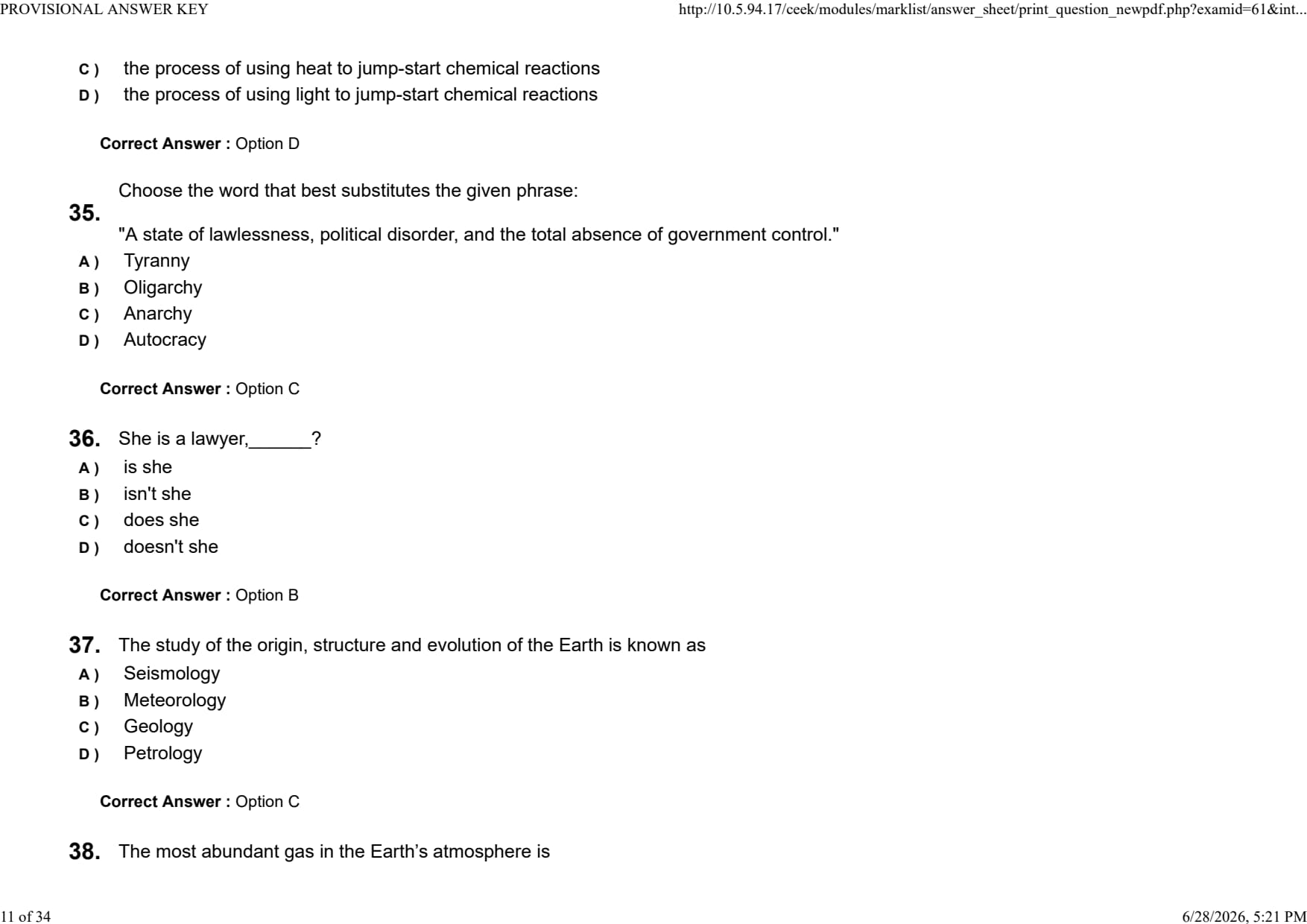
  • (C) the process of using heat to jump-start chemical reactions
  • (D) the process of using light to jump-start chemical reactions

Question 35:

Choose the word that best substitutes the given phrase:

"A state of lawlessness, political disorder, and the total absence of government control."

  • (A) Tyranny
  • (B) Oligarchy
  • (C) Anarchy
  • (D) Autocracy

Question 36:

She is a lawyer,______?

  • (A) is she
  • (B) isn't she
  • (C) does she
  • (D) doesn't she

Question 37:

The study of the origin, structure and evolution of the Earth is known as

  • (A) Seismology
  • (B) Meteorology
  • (C) Geology
  • (D) Petrology

Question 38:

The most abundant gas in the Earth’s atmosphere is

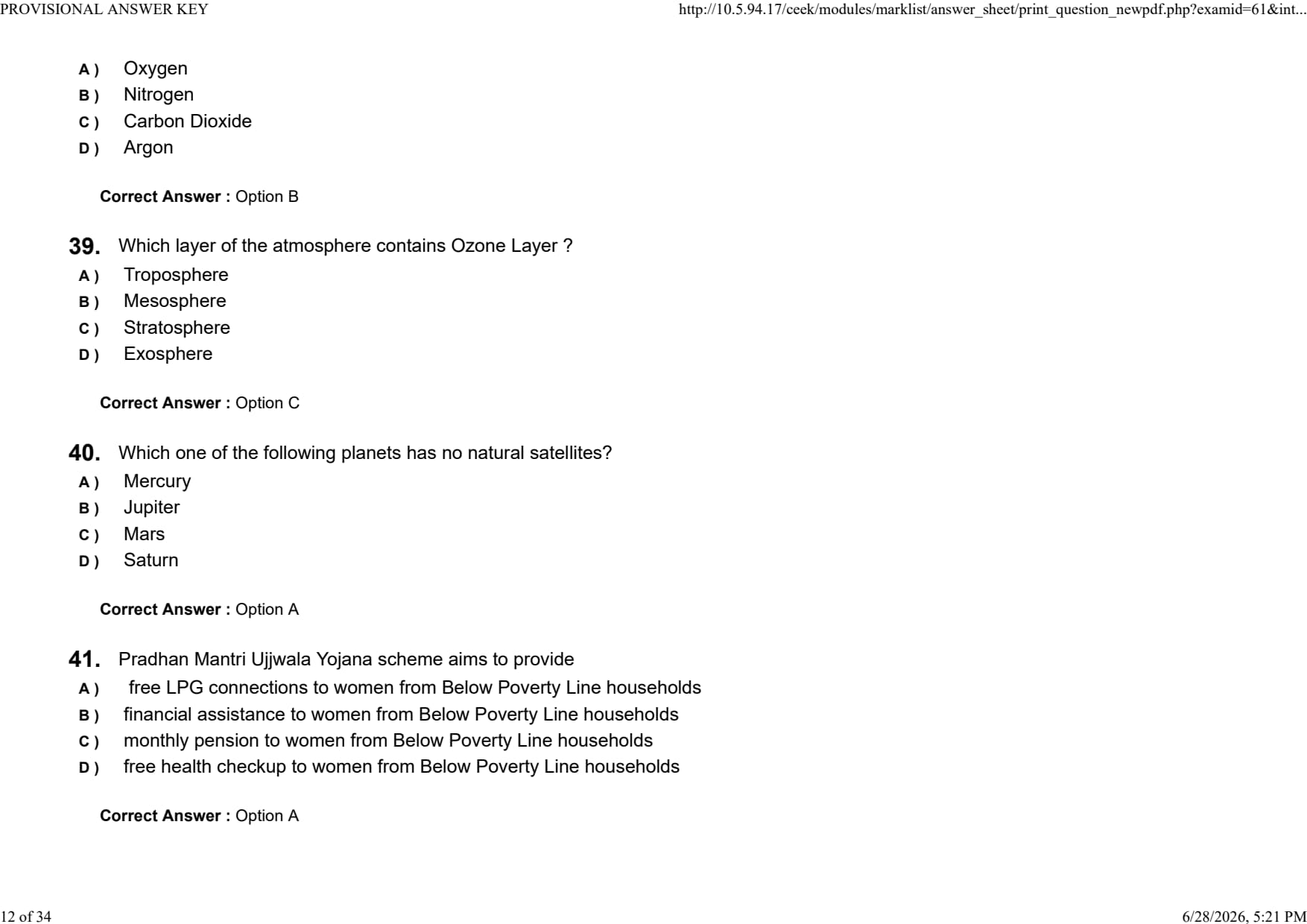
  • (A) Oxygen
  • (B) Nitrogen
  • (C) Carbon Dioxide
  • (D) Argon

Question 39:

Which layer of the atmosphere contains Ozone Layer ?

  • (A) Troposphere
  • (B) Mesosphere
  • (C) Stratosphere
  • (D) Exosphere

Question 40:

Which one of the following planets has no natural satellites?

  • (A) Mercury
  • (B) Jupiter
  • (C) Mars
  • (D) Saturn

Question 41:

Pradhan Mantri Ujjwala Yojana scheme aims to provide

  • (A) free LPG connections to women from Below Poverty Line households
  • (B) financial assistance to women from Below Poverty Line households
  • (C) monthly pension to women from Below Poverty Line households
  • (D) free health checkup to women from Below Poverty Line households

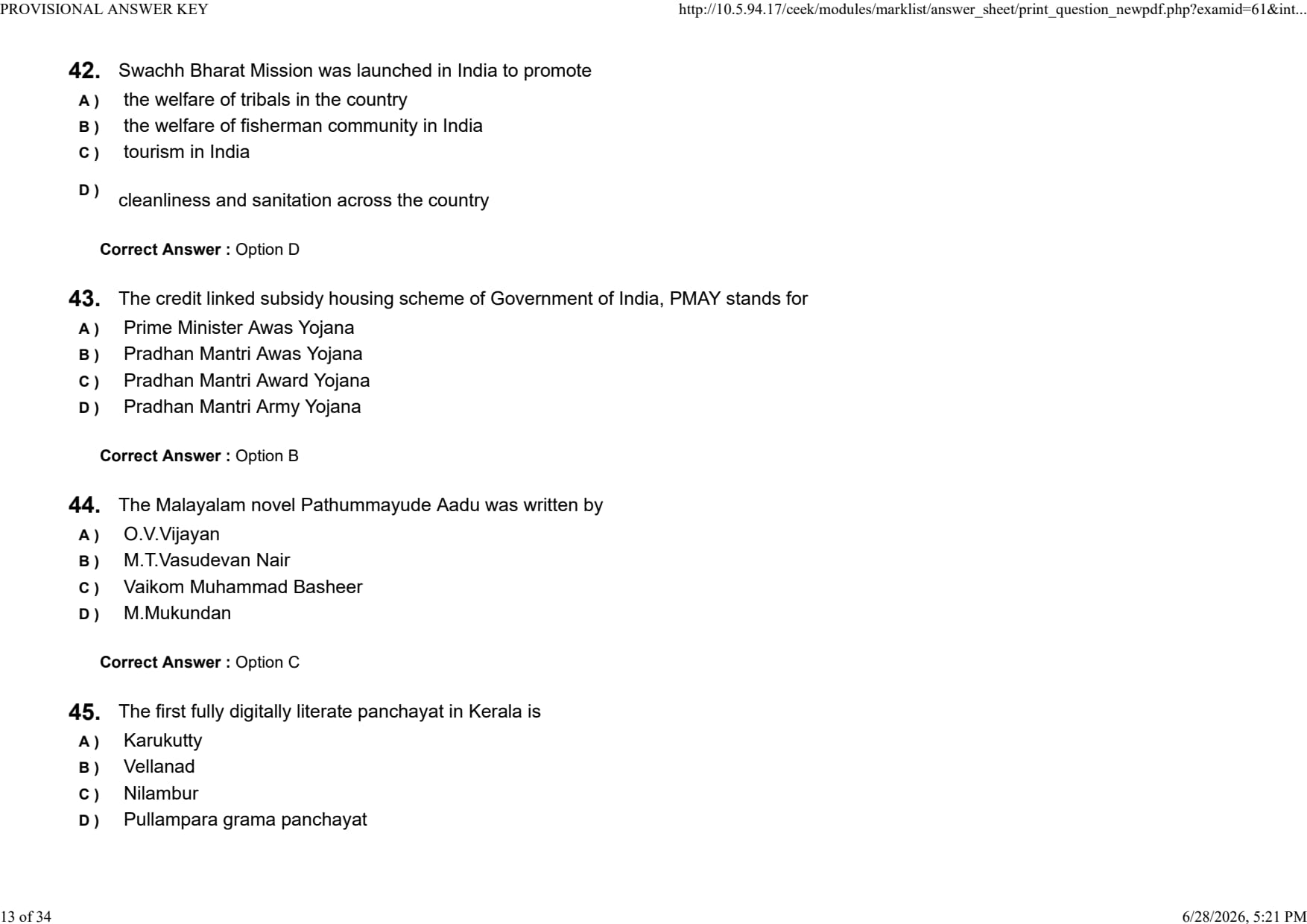
Question 42:

Swachh Bharat Mission was launched in India to promote

  • (A) the welfare of tribals in the country
  • (B) the welfare of fisherman community in India
  • (C) tourism in India
  • (D) cleanliness and sanitation across the country

Question 43:

The credit linked subsidy housing scheme of Government of India, PMAY stands for

  • (A) Prime Minister Awas Yojana
  • (B) Pradhan Mantri Awas Yojana
  • (C) Pradhan Mantri Award Yojana
  • (D) Pradhan Mantri Army Yojana

Question 44:

The Malayalam novel Pathummayude Aadu was written by

  • (A) O.V.Vijayan
  • (B) M.T.Vasudevan Nair
  • (C) Vaikom Muhammad Basheer
  • (D) M.Mukundan

Question 45:

The first fully digitally literate panchayat in Kerala is

  • (A) Karukutty
  • (B) Vellanad
  • (C) Nilambur
  • (D) Pullampara grama panchayat

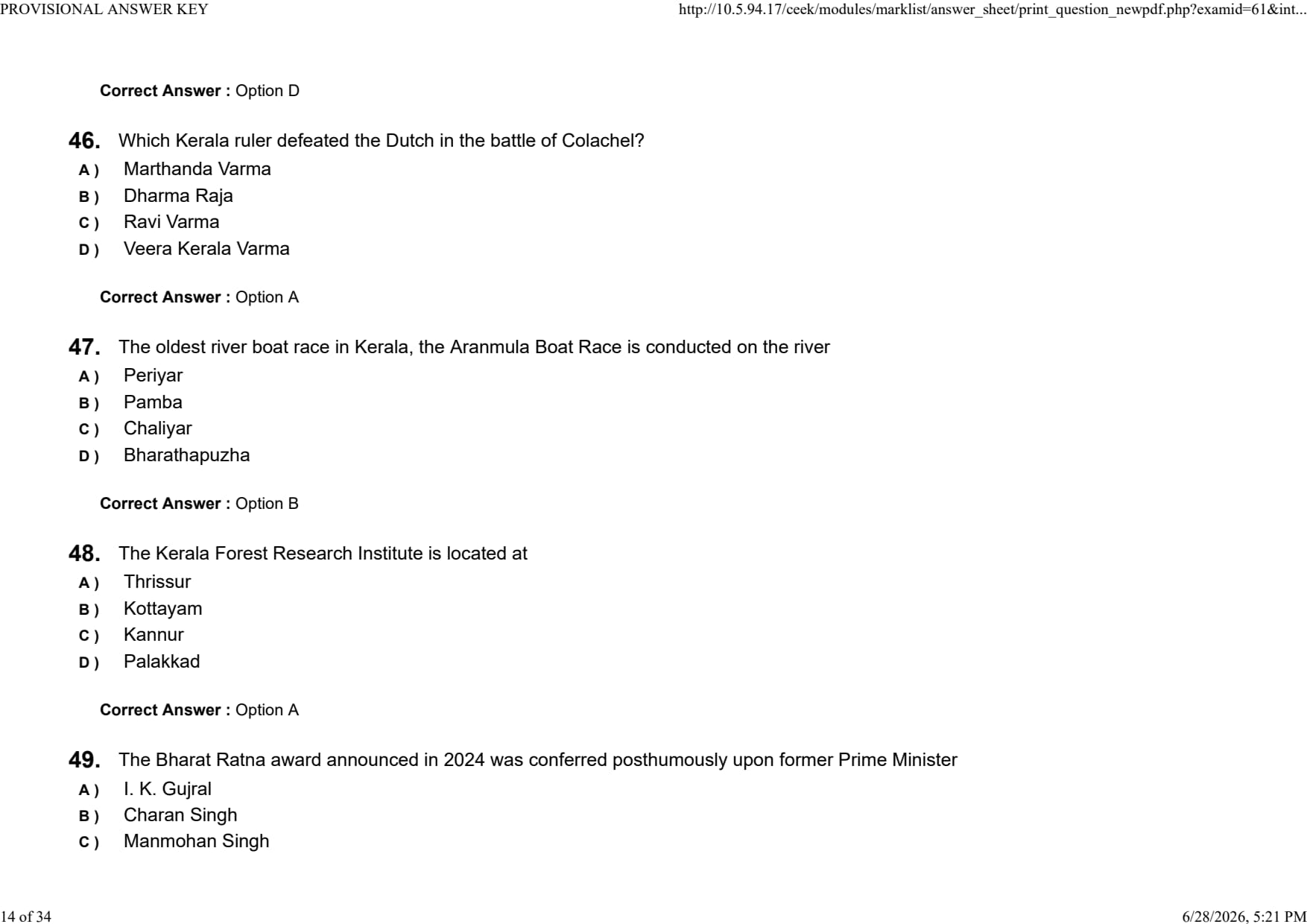
Question 46:

Which Kerala ruler defeated the Dutch in the battle of Colachel?

  • (A) Marthanda Varma
  • (B) Dharma Raja
  • (C) Ravi Varma
  • (D) Veera Kerala Varma

Question 47:

The oldest river boat race in Kerala, the Aranmula Boat Race is conducted on the river

  • (A) Periyar
  • (B) Pamba
  • (C) Chaliyar
  • (D) Bharathapuzha

Question 48:

The Kerala Forest Research Institute is located at

  • (A) Thrissur
  • (B) Kottayam
  • (C) Kannur
  • (D) Palakkad

Question 49:

The Bharat Ratna award announced in 2024 was conferred posthumously upon former Prime Minister

  • (A) I. K. Gujral
  • (B) Charan Singh
  • (C) Manmohan Singh
  • (D) Rajiv Gandhi

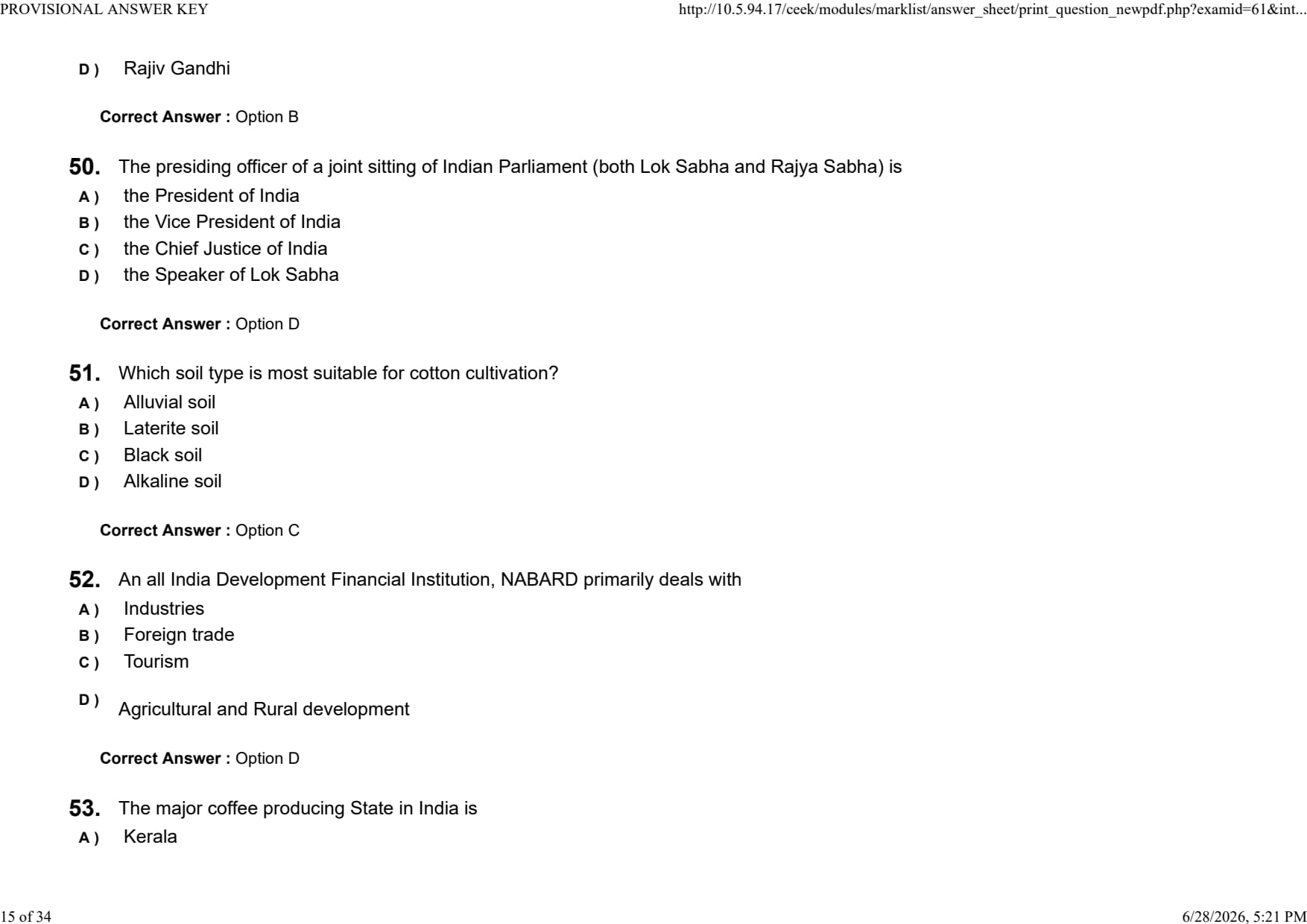
Question 50:

The presiding officer of a joint sitting of Indian Parliament (both Lok Sabha and Rajya Sabha) is

  • (A) the President of India
  • (B) the Vice President of India
  • (C) the Chief Justice of India
  • (D) the Speaker of Lok Sabha

Question 51:

Which soil type is most suitable for cotton cultivation?

  • (A) Alluvial soil
  • (B) Laterite soil
  • (C) Black soil
  • (D) Alkaline soil

Question 52:

An all India Development Financial Institution, NABARD primarily deals with

  • (A) Industries
  • (B) Foreign trade
  • (C) Tourism
  • (D) Agricultural and Rural development

Question 53:

The major coffee producing State in India is

  • (A) Kerala
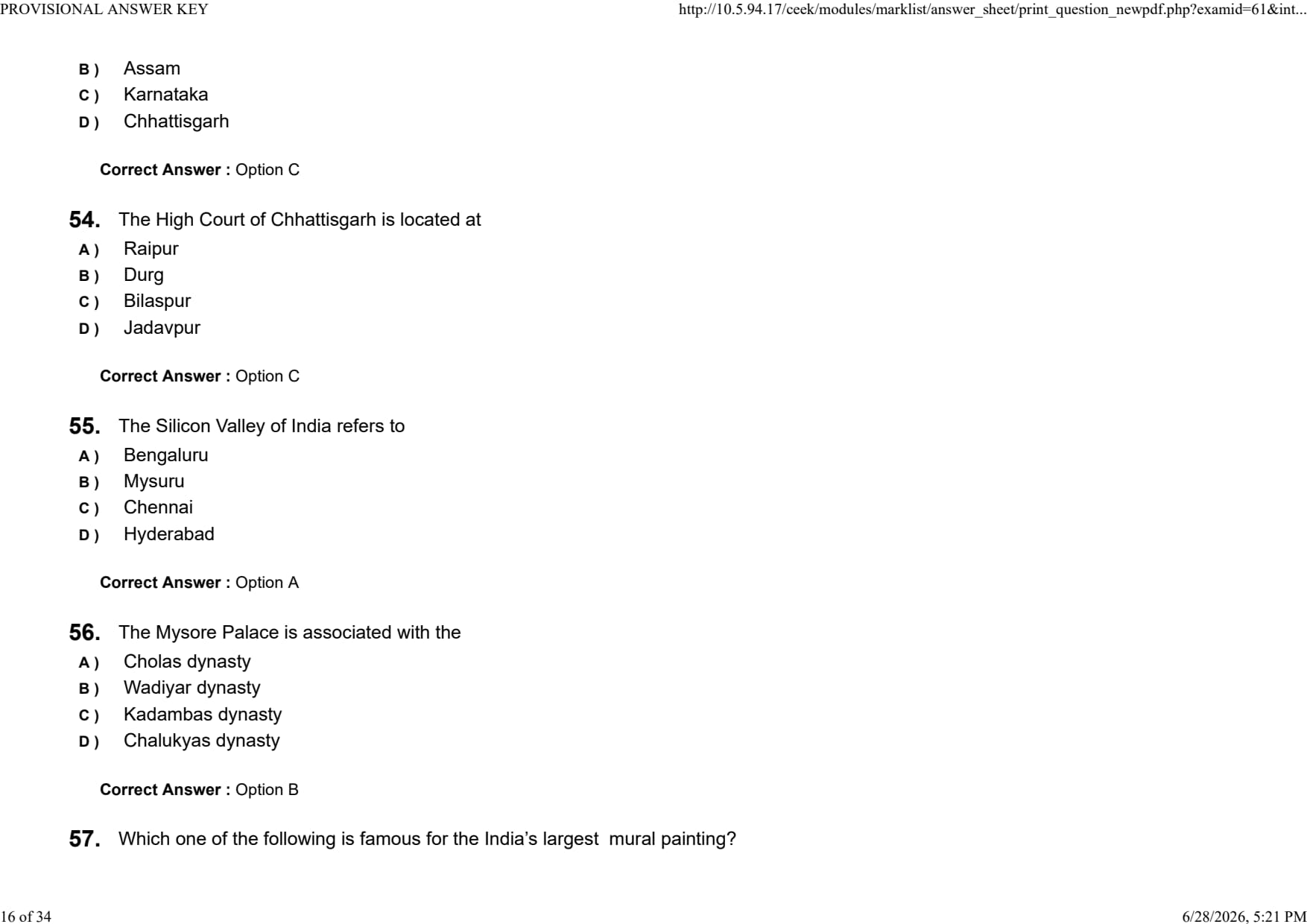
  • (B) Assam
  • (C) Karnataka
  • (D) Chhattisgarh

Question 54:

The High Court of Chhattisgarh is located at

  • (A) Raipur
  • (B) Durg
  • (C) Bilaspur
  • (D) Jadavpur

Question 55:

The Silicon Valley of India refers to

  • (A) Bengaluru
  • (B) Mysuru
  • (C) Chennai
  • (D) Hyderabad

Question 56:

The Mysore Palace is associated with the

  • (A) Cholas dynasty
  • (B) Wadiyar dynasty
  • (C) Kadambas dynasty
  • (D) Chalukyas dynasty

Question 57:

Which one of the following is famous for the India’s largest mural painting?

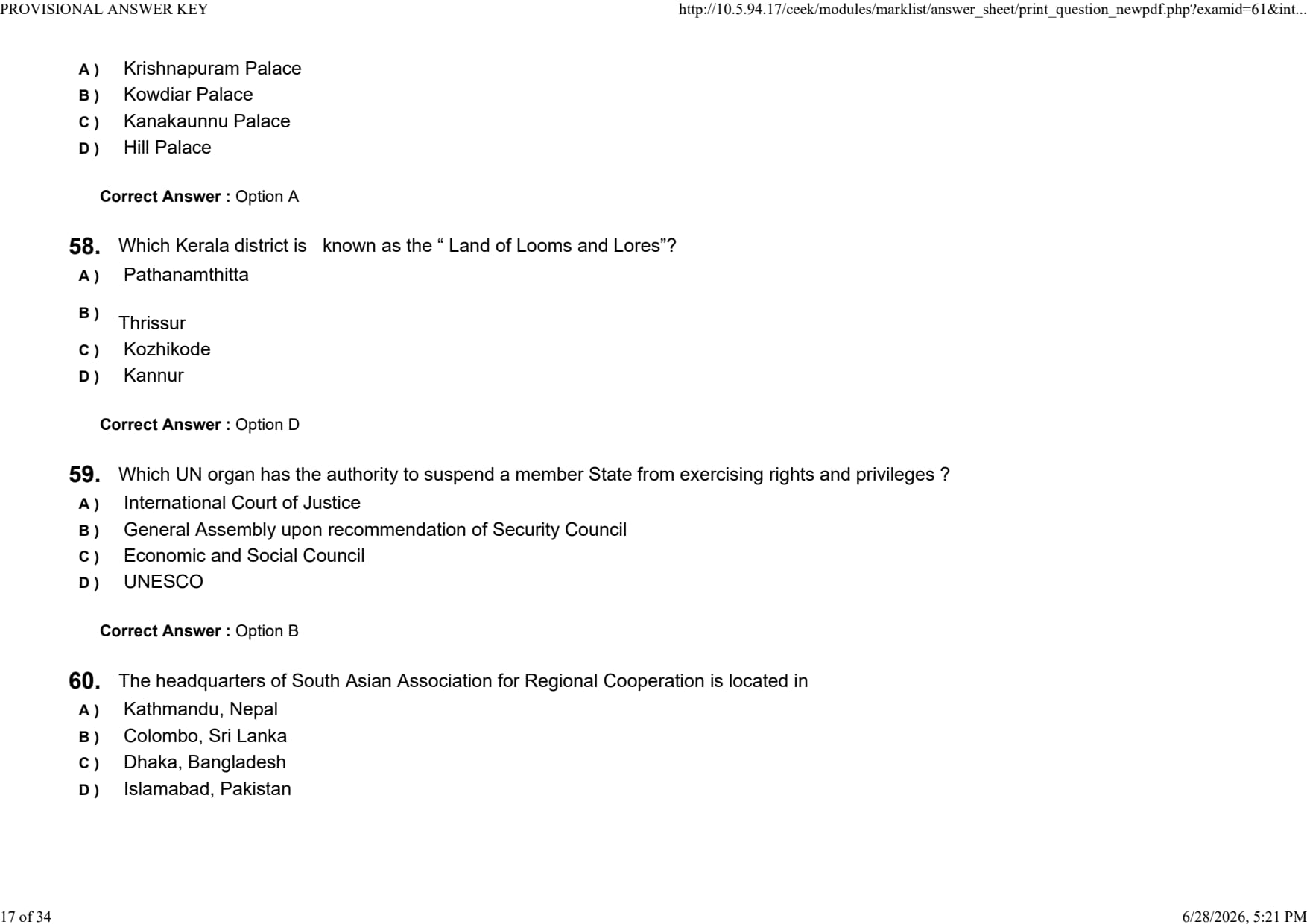
  • (A) Krishnapuram Palace
  • (B) Kowdiar Palace
  • (C) Kanakaunnu Palace
  • (D) Hill Palace

Question 58:

Which Kerala district is known as the “ Land of Looms and Lores”?

  • (A) Pathanamthitta
  • (B) Thrissur
  • (C) Kozhikode
  • (D) Kannur

Question 59:

Which UN organ has the authority to suspend a member State from exercising rights and privileges ?

  • (A) International Court of Justice
  • (B) General Assembly upon recommendation of Security Council
  • (C) Economic and Social Council
  • (D) UNESCO

Question 60:

The headquarters of South Asian Association for Regional Cooperation is located in

  • (A) Kathmandu, Nepal
  • (B) Colombo, Sri Lanka
  • (C) Dhaka, Bangladesh
  • (D) Islamabad, Pakistan

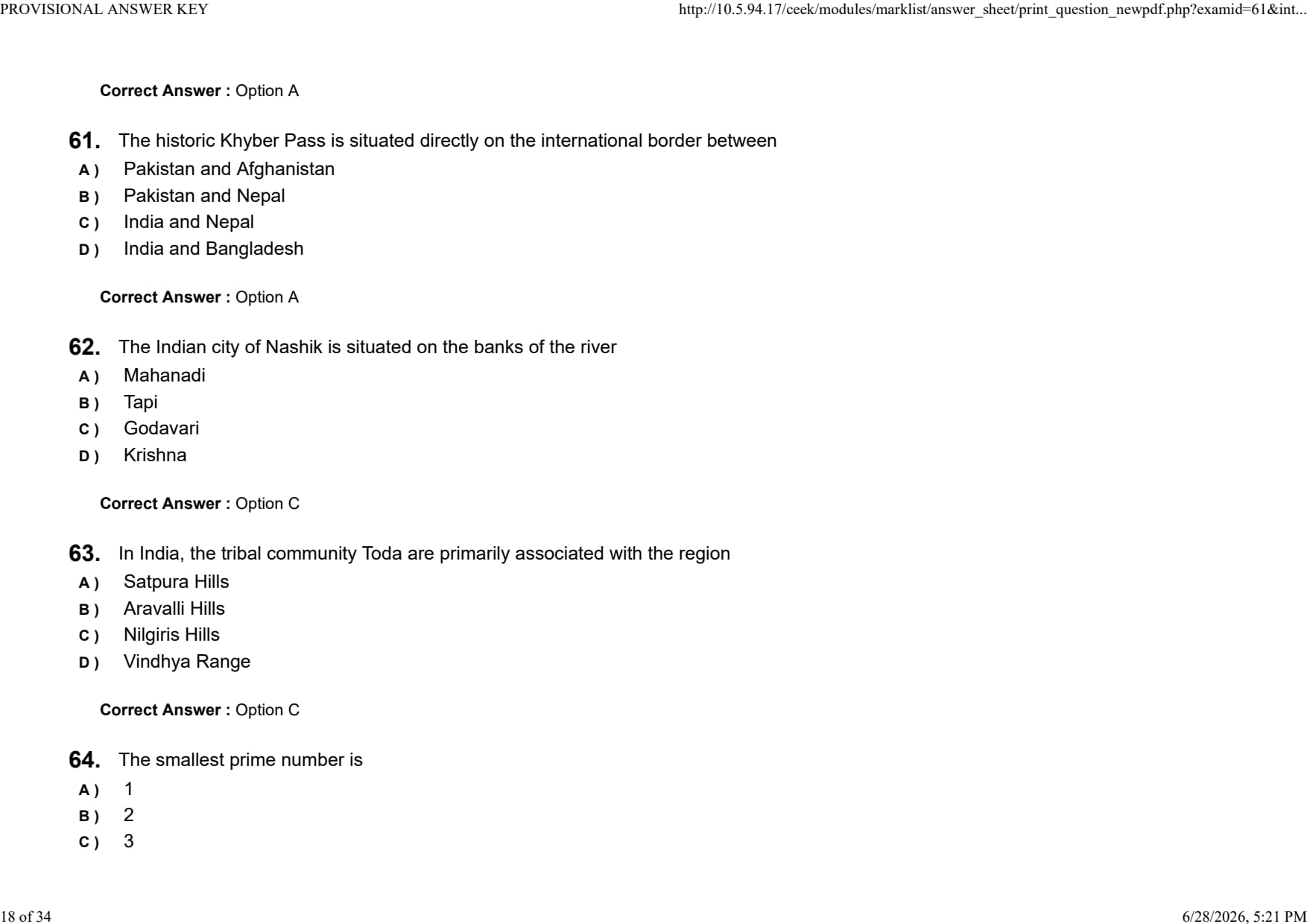
Question 61:

The historic Khyber Pass is situated directly on the international border between

  • (A) Pakistan and Afghanistan
  • (B) Pakistan and Nepal
  • (C) India and Nepal
  • (D) India and Bangladesh

Question 62:

The Indian city of Nashik is situated on the banks of the river

  • (A) Mahanadi
  • (B) Tapi
  • (C) Godavari
  • (D) Krishna

Question 63:

In India, the tribal community Toda are primarily associated with the region

  • (A) Satpura Hills
  • (B) Aravalli Hills
  • (C) Nilgiris Hills
  • (D) Vindhya Range

Question 64:

The smallest prime number is

  • (A) 1
  • (B) 2
  • (C) 3
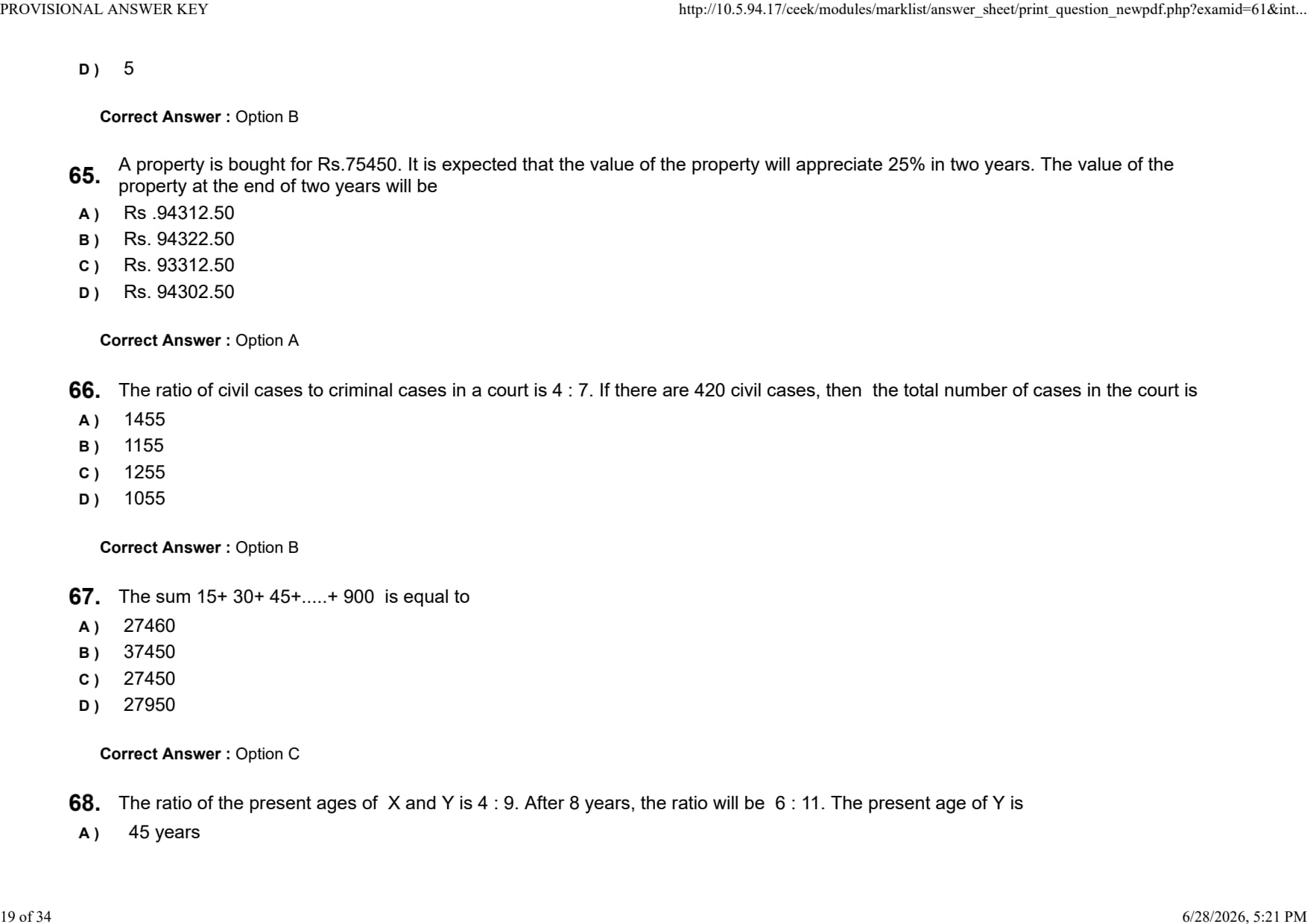
  • (D) 5

Question 65:

A property is bought for Rs.75450. It is expected that the value of the property will appreciate 25% in two years. The value of the property at the end of two years will be

  • (A) Rs .94312.50
  • (B) Rs. 94322.50
  • (C) Rs. 93312.50
  • (D) Rs. 94302.50

Question 66:

The ratio of civil cases to criminal cases in a court is 4 : 7. If there are 420 civil cases, then the total number of cases in the court is

  • (A) 1455
  • (B) 1155
  • (C) 1255
  • (D) 1055

Question 67:

The sum 15+ 30+ 45+.....+ 900 is equal to

  • (A) 27460
  • (B) 37450
  • (C) 27450
  • (D) 27950

Question 68:

The ratio of the present ages of X and Y is 4 : 9. After 8 years, the ratio will be 6 : 11. The present age of Y is

  • (A) 45 years
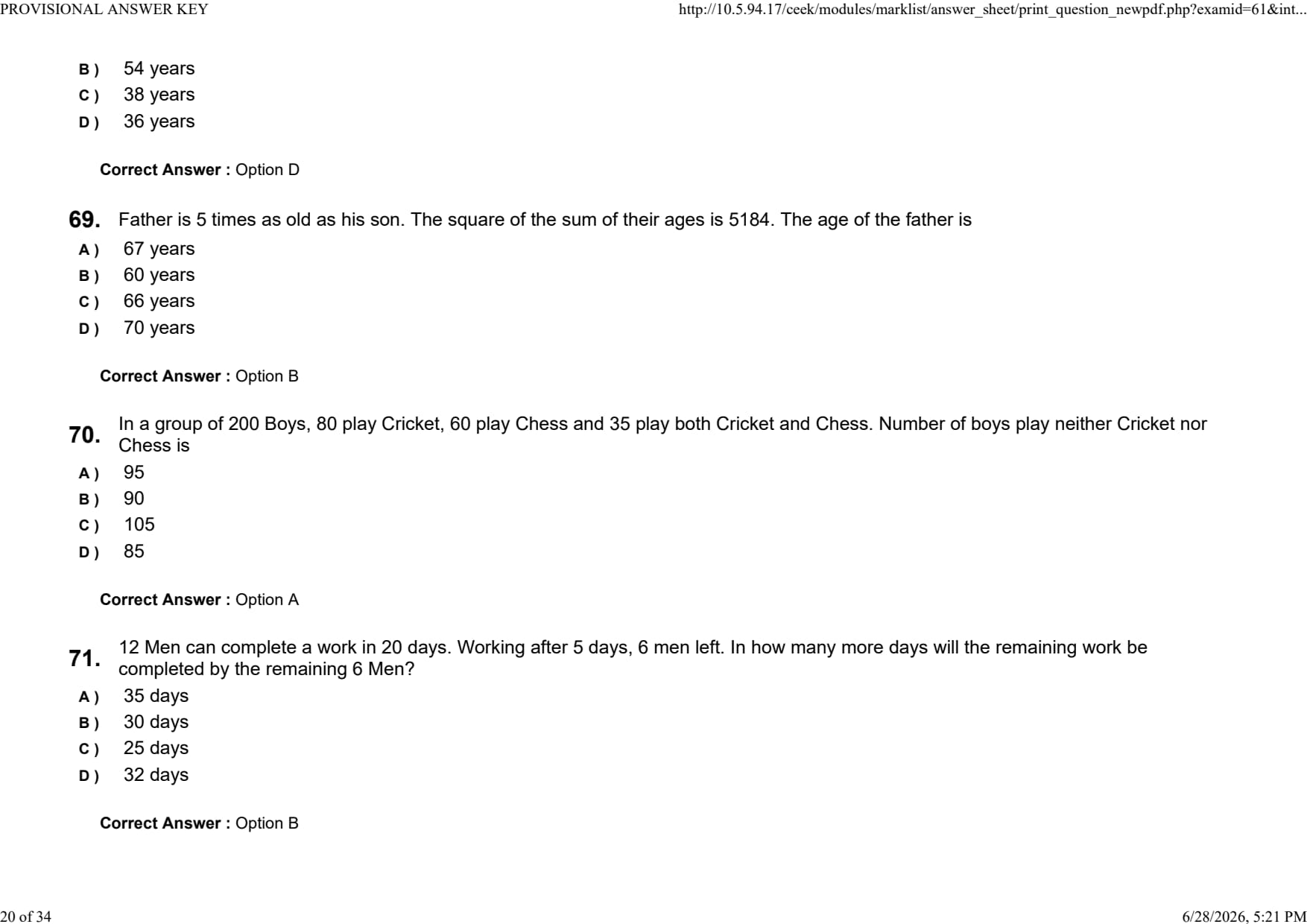
  • (B) 54 years
  • (C) 38 years
  • (D) 36 years

Question 69:

Father is 5 times as old as his son. The square of the sum of their ages is 5184. The age of the father is

  • (A) 67 years
  • (B) 60 years
  • (C) 66 years
  • (D) 70 years

Question 70:

In a group of 200 Boys, 80 play Cricket, 60 play Chess and 35 play both Cricket and Chess. Number of boys play neither Cricket nor Chess is

  • (A) 95
  • (B) 90
  • (C) 105
  • (D) 85

Question 71:

12 Men can complete a work in 20 days. Working after 5 days, 6 men left. In how many more days will the remaining work be completed by the remaining 6 Men?

  • (A) 35 days
  • (B) 30 days
  • (C) 25 days
  • (D) 32 days

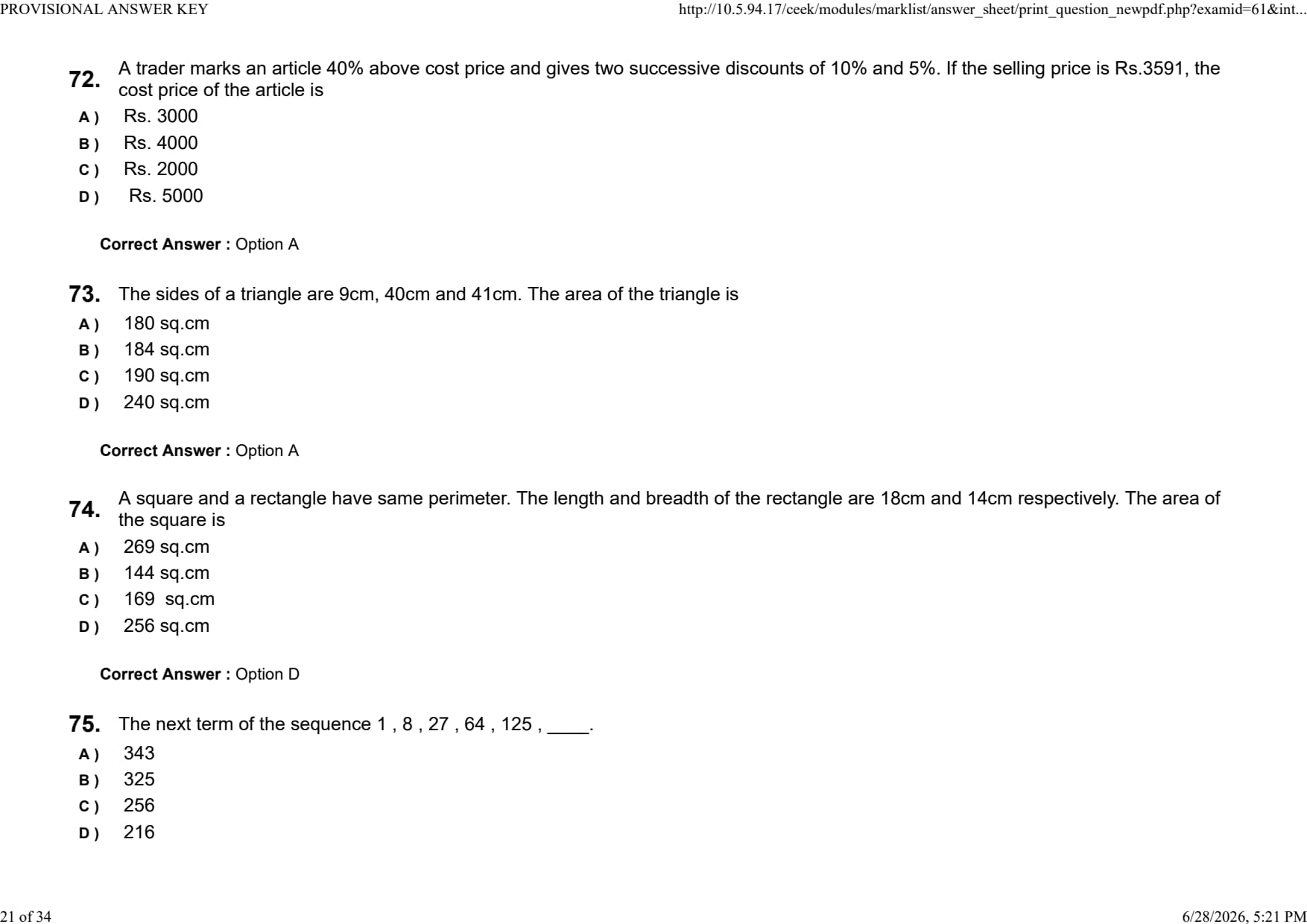
Question 72:

A trader marks an article 40% above cost price and gives two successive discounts of 10% and 5%. If the selling price is Rs.3591, the cost price of the article is

  • (A) Rs. 3000
  • (B) Rs. 4000
  • (C) Rs. 2000
  • (D) Rs. 5000

Question 73:

The sides of a triangle are 9cm, 40cm and 41cm. The area of the triangle is

  • (A) 180 sq.cm
  • (B) 184 sq.cm
  • (C) 190 sq.cm
  • (D) 240 sq.cm

Question 74:

A square and a rectangle have same perimeter. The length and breadth of the rectangle are 18cm and 14cm respectively. The area of the square is

  • (A) 269 sq.cm
  • (B) 144 sq.cm
  • (C) 169 sq.cm
  • (D) 256 sq.cm

Question 75:

The next term of the sequence 1 , 8 , 27 , 64 , 125 , ____.

  • (A) 343
  • (B) 325
  • (C) 256
  • (D) 216

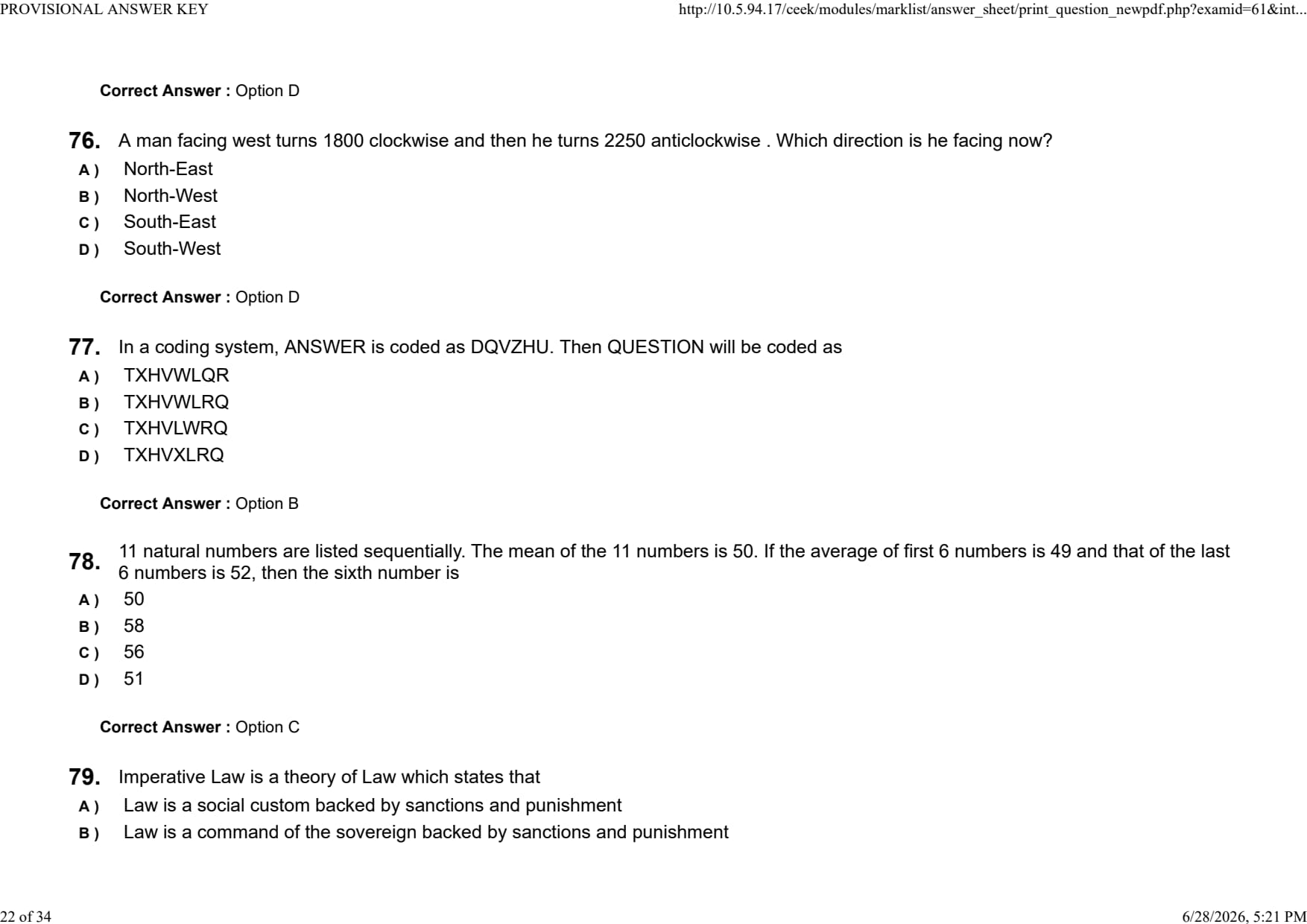
Question 76:

A man facing west turns 180 degrees clockwise and then he turns 225 degrees anticlockwise . Which direction is he facing now?

  • (A) North-East
  • (B) North-West
  • (C) South-East
  • (D) South-West

Question 77:

In a coding system, ANSWER is coded as DQVZHU. Then QUESTION will be coded as

  • (A) TXHVWLQR
  • (B) TXHVWLRQ
  • (C) TXHVLWRQ
  • (D) TXHVXLRQ

Question 78:

11 natural numbers are listed sequentially. The mean of the 11 numbers is 50. If the average of first 6 numbers is 49 and that of the last 6 numbers is 52, then the sixth number is

  • (A) 50
  • (B) 58
  • (C) 56
  • (D) 51

Question 79:

Imperative Law is a theory of Law which states that

  • (A) Law is a social custom backed by sanctions and punishment
  • (B) Law is a command of the sovereign backed by sanctions and punishment
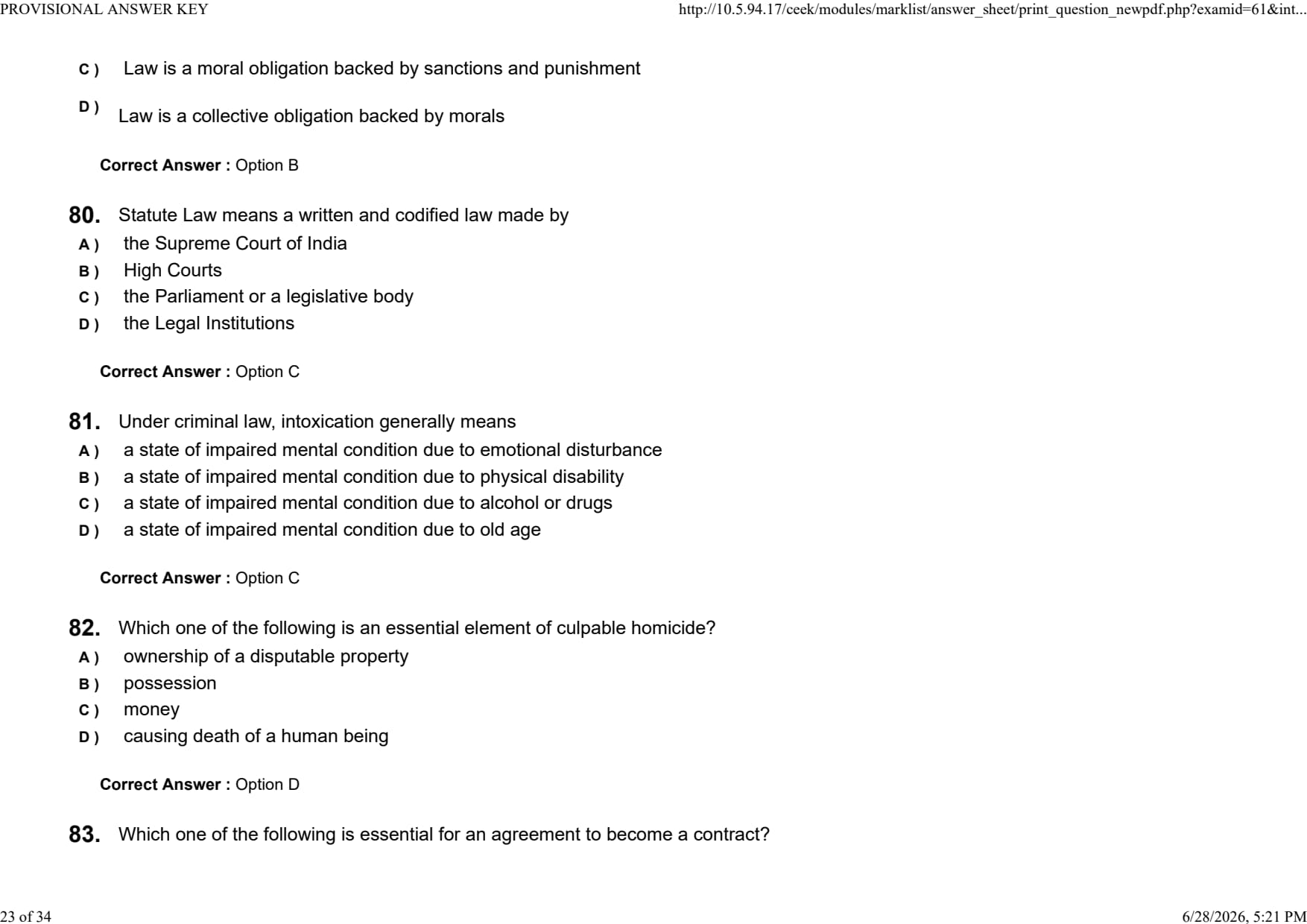
  • (C) Law is a moral obligation backed by sanctions and punishment
  • (D) Law is a collective obligation backed by morals

Question 80:

Statute Law means a written and codified law made by

  • (A) the Supreme Court of India
  • (B) High Courts
  • (C) the Parliament or a legislative body
  • (D) the Legal Institutions

Question 81:

Under criminal law, intoxication generally means

  • (A) a state of impaired mental condition due to emotional disturbance
  • (B) a state of impaired mental condition due to physical disability
  • (C) a state of impaired mental condition due to alcohol or drugs
  • (D) a state of impaired mental condition due to old age

Question 82:

Which one of the following is an essential element of culpable homicide?

  • (A) ownership of a disputable property
  • (B) possession
  • (C) money
  • (D) causing death of a human being

Question 83:

Which one of the following is essential for an agreement to become a contract?

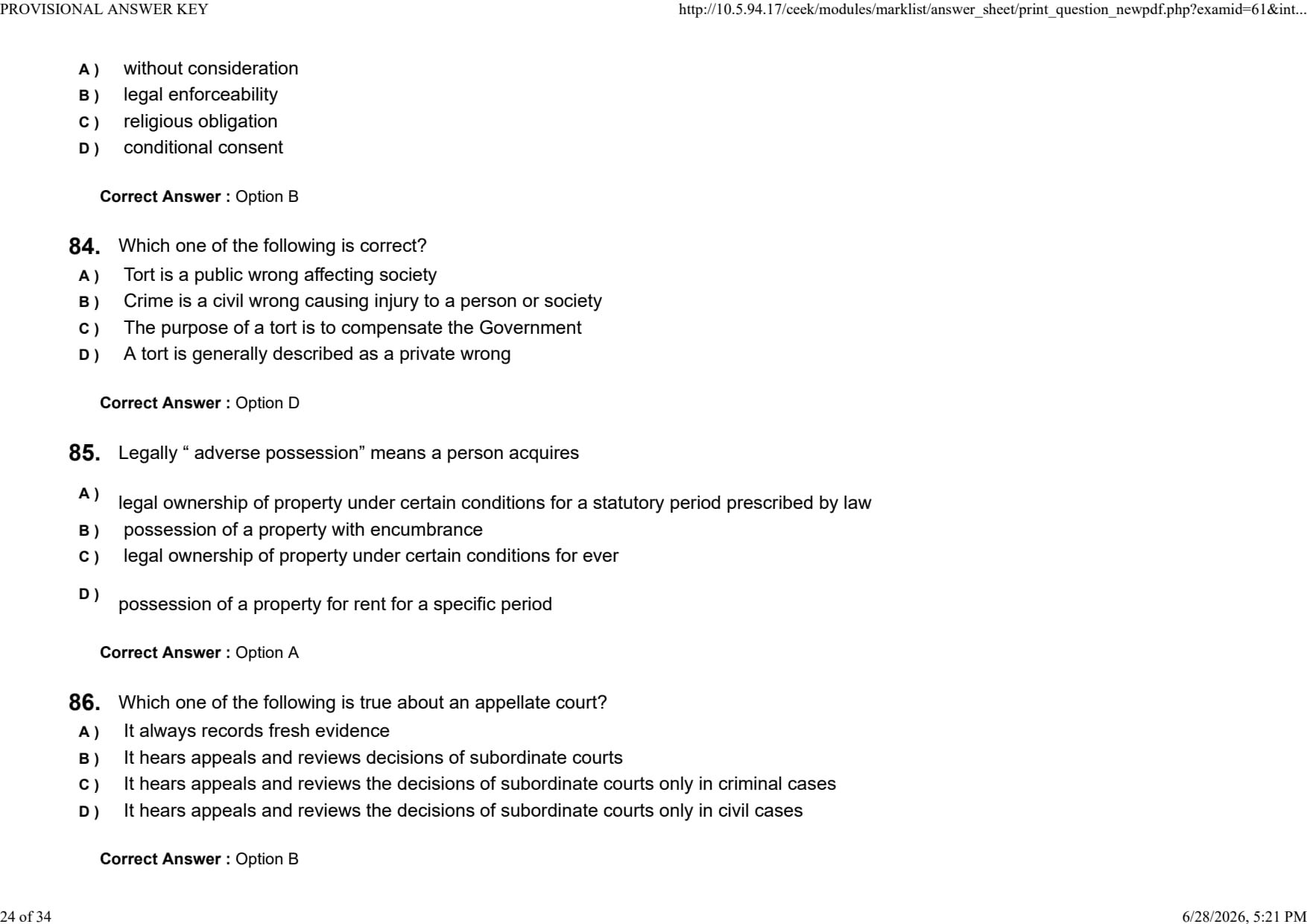
  • (A) without consideration
  • (B) legal enforceability
  • (C) religious obligation
  • (D) conditional consent

Question 84:

Which one of the following is correct?

  • (A) Tort is a public wrong affecting society
  • (B) Crime is a civil wrong causing injury to a person or society
  • (C) The purpose of a tort is to compensate the Government
  • (D) A tort is generally described as a private wrong

Question 85:

Legally ``adverse possession'' means a person acquires

  • (A) legal ownership of property under certain conditions for a statutory period prescribed by law
  • (B) possession of a property with encumbrance
  • (C) legal ownership of property under certain conditions for ever
  • (D) possession of a property for rent for a specific period

Question 86:

Which one of the following is true about an appellate court?

  • (A) It always records fresh evidence
  • (B) It hears appeals and reviews decisions of subordinate courts
  • (C) It hears appeals and reviews the decisions of subordinate courts only in criminal cases
  • (D) It hears appeals and reviews the decisions of subordinate courts only in civil cases

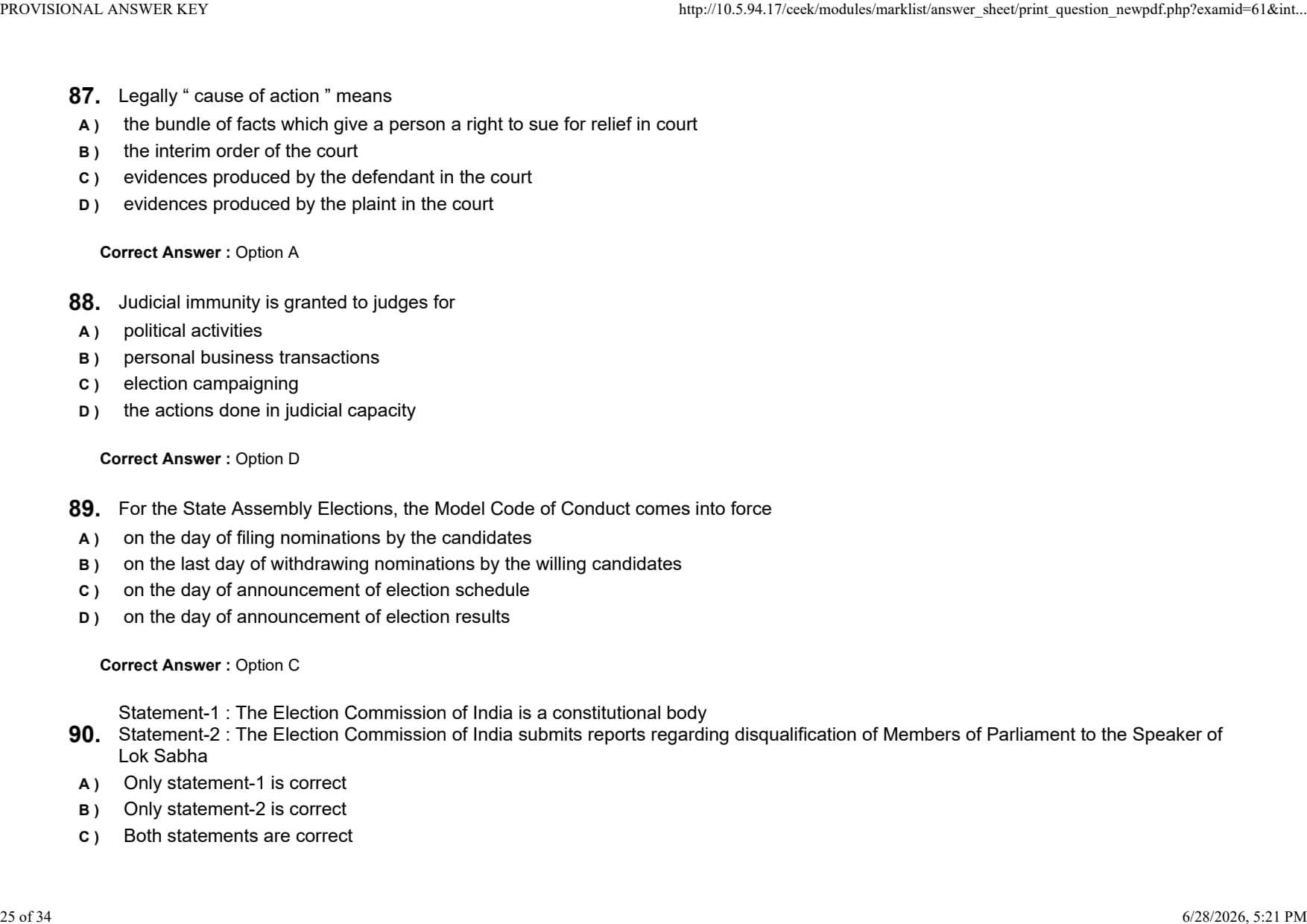
Question 87:

Legally ``cause of action'' means

  • (A) the bundle of facts which give a person a right to sue for relief in court
  • (B) the interim order of the court
  • (C) evidences produced by the defendant in the court
  • (D) evidences produced by the plaint in the court

Question 88:

Judicial immunity is granted to judges for

  • (A) political activities
  • (B) personal business transactions
  • (C) election campaigning
  • (D) the actions done in judicial capacity

Question 89:

For the State Assembly Elections, the Model Code of Conduct comes into force

  • (A) on the day of filing nominations by the candidates
  • (B) on the last day of withdrawing nominations by the willing candidates
  • (C) on the day of announcement of election schedule
  • (D) on the day of announcement of election results

Question 90:

Statement-1 : The Election Commission of India is a constitutional body

Statement-2 : The Election Commission of India submits reports regarding disqualification of Members of Parliament to the Speaker of Lok Sabha

  • (A) Only statement-1 is correct
  • (B) Only statement-2 is correct
  • (C) Both statements are correct
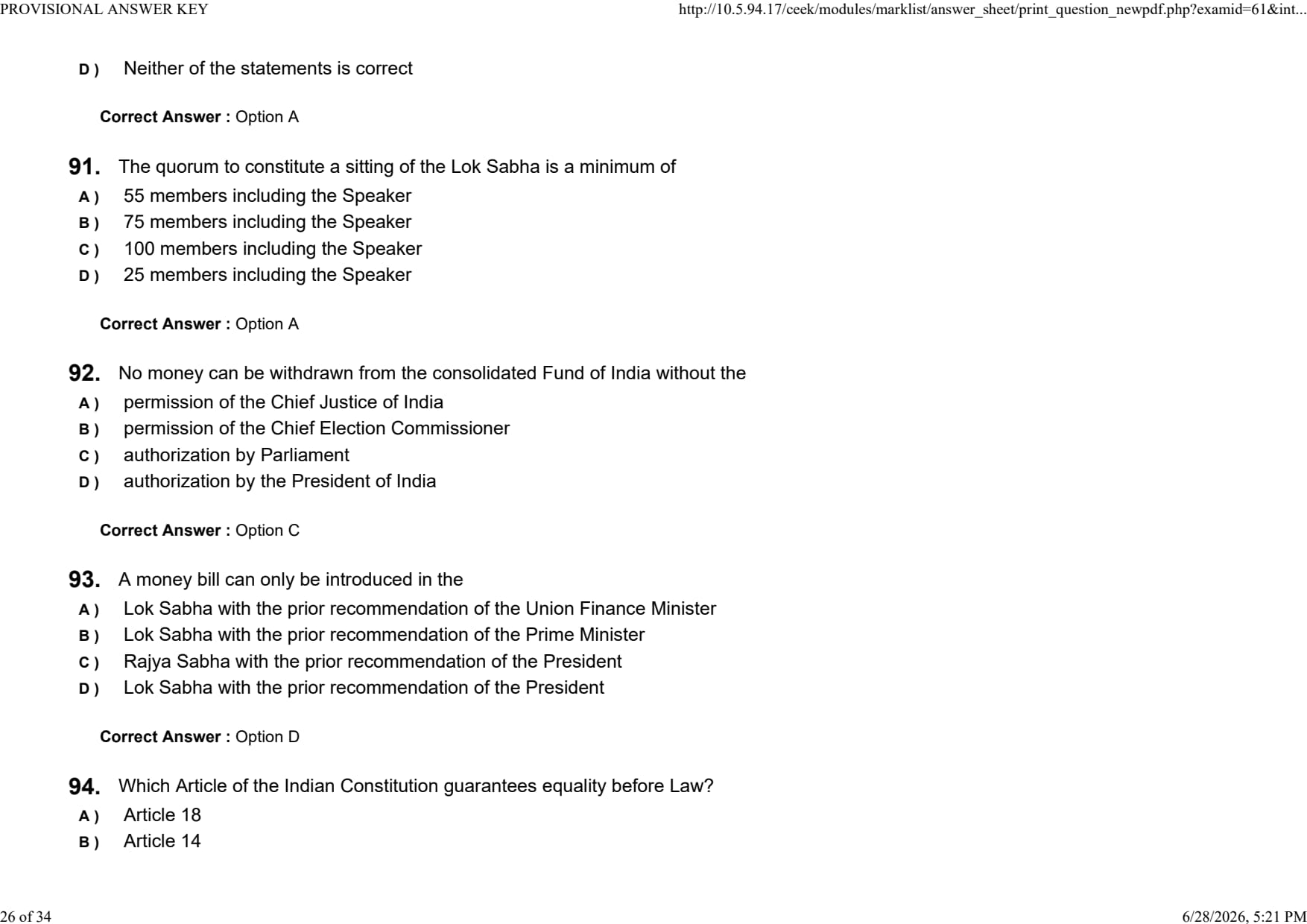
  • (D) Neither of the statements is correct

Question 91:

The quorum to constitute a sitting of the Lok Sabha is a minimum of

  • (A) 55 members including the Speaker
  • (B) 75 members including the Speaker
  • (C) 100 members including the Speaker
  • (D) 25 members including the Speaker

Question 92:

No money can be withdrawn from the consolidated Fund of India without the

  • (A) permission of the Chief Justice of India
  • (B) permission of the Chief Election Commissioner
  • (C) authorization by Parliament
  • (D) authorization by the President of India

Question 93:

A money bill can only be introduced in the

  • (A) Lok Sabha with the prior recommendation of the Union Finance Minister
  • (B) Lok Sabha with the prior recommendation of the Prime Minister
  • (C) Rajya Sabha with the prior recommendation of the President
  • (D) Lok Sabha with the prior recommendation of the President

Question 94:

Which Article of the Indian Constitution guarantees equality before Law?

  • (A) Article 18
  • (B) Article 14
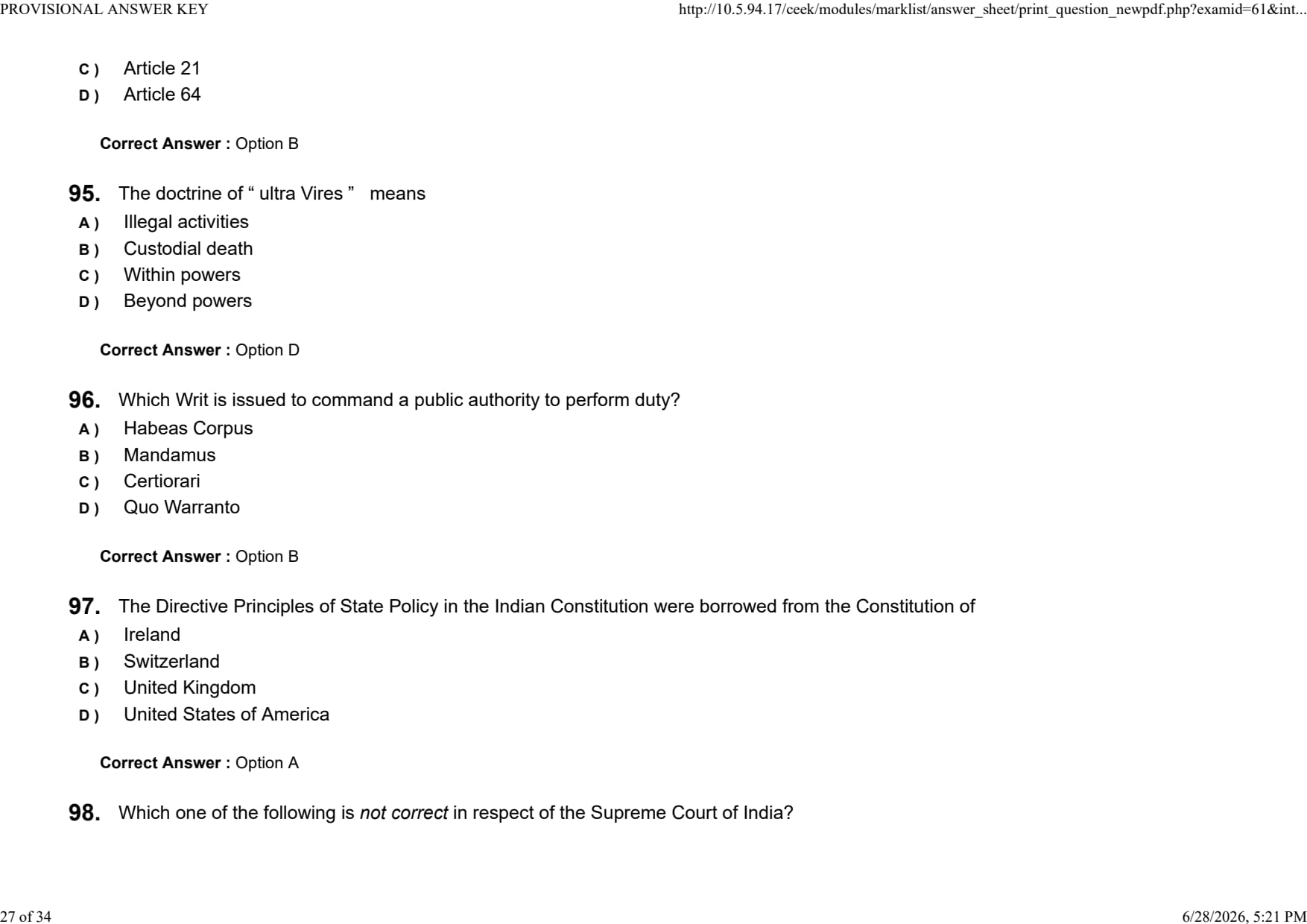
  • (C) Article 21
  • (D) Article 64

Question 95:

The doctrine of ``ultra Vires'' means

  • (A) Illegal activities
  • (B) Custodial death
  • (C) Within powers
  • (D) Beyond powers

Question 96:

Which Writ is issued to command a public authority to perform duty?

  • (A) Habeas Corpus
  • (B) Mandamus
  • (C) Certiorari
  • (D) Quo Warranto

Question 97:

The Directive Principles of State Policy in the Indian Constitution were borrowed from the Constitution of

  • (A) Ireland
  • (B) Switzerland
  • (C) United Kingdom
  • (D) United States of America

Question 98:

Which one of the following is not correct in respect of the Supreme Court of India?

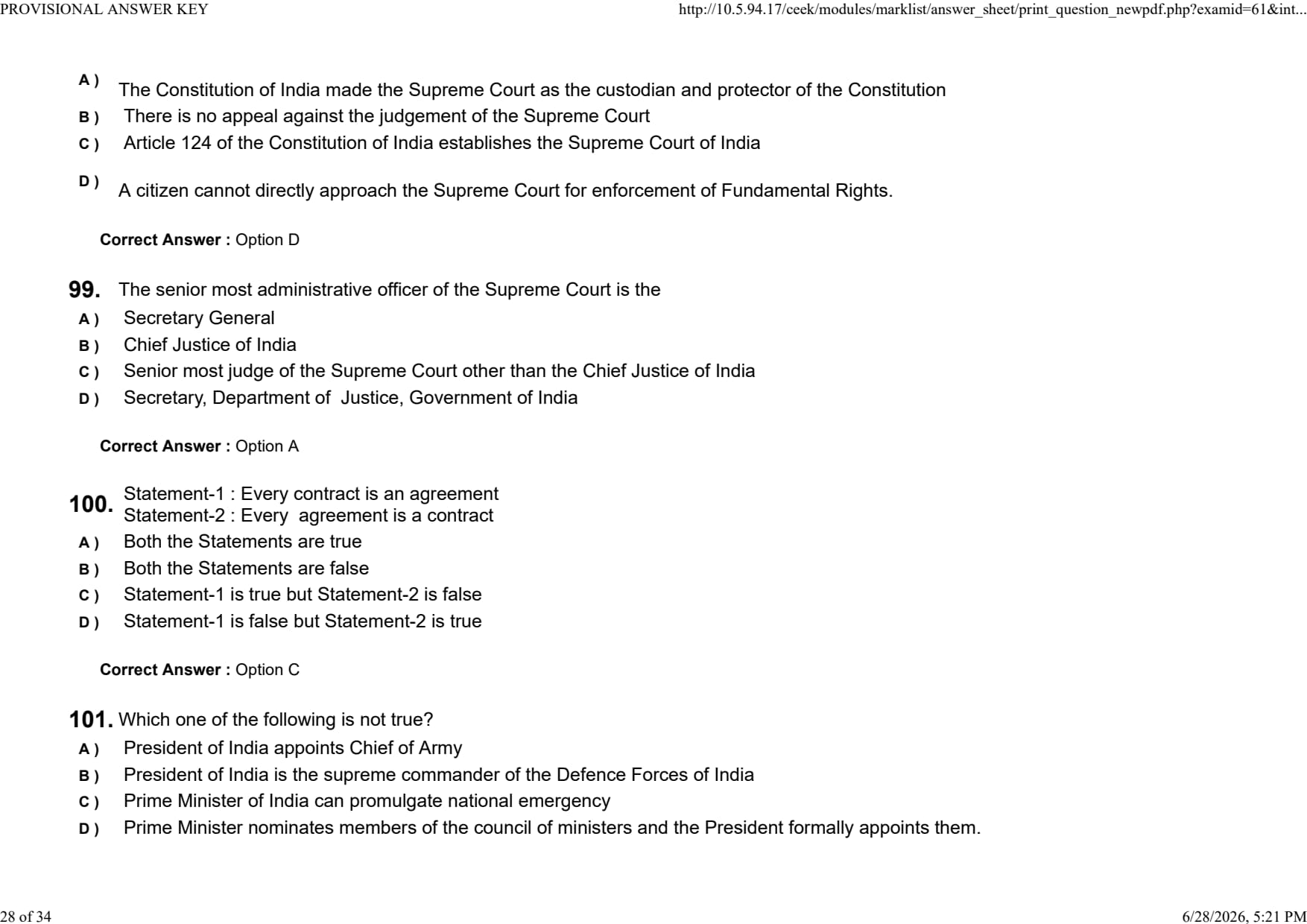
  • (A) The Constitution of India made the Supreme Court as the custodian and protector of the Constitution
  • (B) There is no appeal against the judgement of the Supreme Court
  • (C) Article 124 of the Constitution of India establishes the Supreme Court of India
  • (D) A citizen cannot directly approach the Supreme Court for enforcement of Fundamental Rights.

Question 99:

The senior most administrative officer of the Supreme Court is the

  • (A) Secretary General
  • (B) Chief Justice of India
  • (C) Senior most judge of the Supreme Court other than the Chief Justice of India
  • (D) Secretary, Department of Justice, Government of India

Question 100:

Statement-1 : Every contract is an agreement

Statement-2 : Every agreement is a contract

  • (A) Both the Statements are true
  • (B) Both the Statements are false
  • (C) Statement-1 is true but Statement-2 is false
  • (D) Statement-1 is false but Statement-2 is true

Question 101:

Which one of the following is not true?

  • (A) President of India appoints Chief of Army
  • (B) President of India is the supreme commander of the Defence Forces of India
  • (C) Prime Minister of India can promulgate national emergency
  • (D) Prime Minister nominates members of the council of ministers and the President formally appoints them.

Question 102:

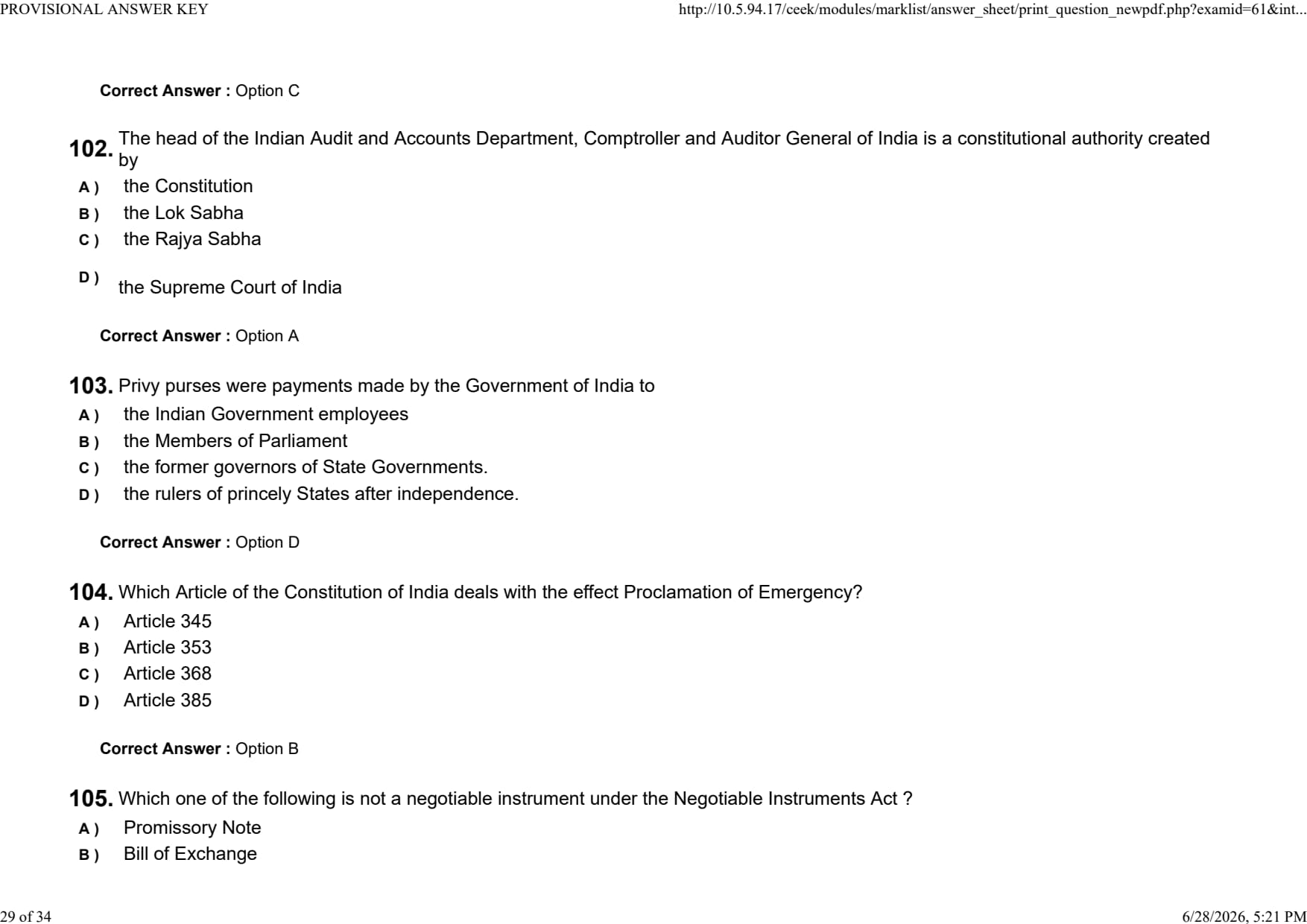
The head of the Indian Audit and Accounts Department, Comptroller and Auditor General of India is a constitutional authority created by

  • (A) the Constitution
  • (B) the Lok Sabha
  • (C) the Rajya Sabha
  • (D) the Supreme Court of India

Question 103:

Privy purses were payments made by the Government of India to

  • (A) the Indian Government employees
  • (B) the Members of Parliament
  • (C) the former governors of State Governments.
  • (D) the rulers of princely States after independence.

Question 104:

Which Article of the Constitution of India deals with the effect Proclamation of Emergency?

  • (A) Article 345
  • (B) Article 353
  • (C) Article 368
  • (D) Article 385

Question 105:

Which one of the following is not a negotiable instrument under the Negotiable Instruments Act?

  • (A) Promissory Note
  • (B) Bill of Exchange
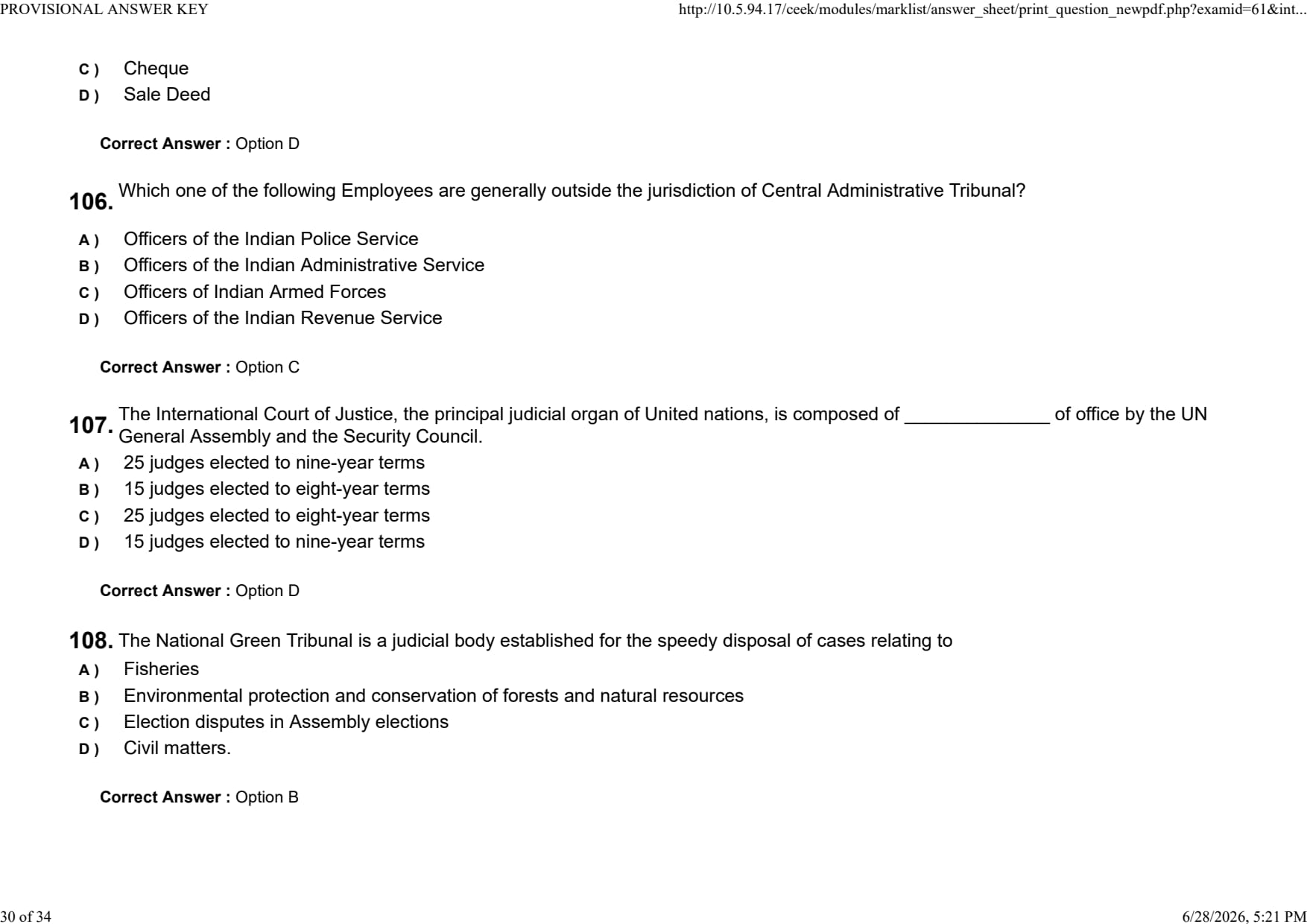
  • (C) Cheque
  • (D) Sale Deed

Question 106:

Which one of the following Employees are generally outside the jurisdiction of Central Administrative Tribunal?

  • (A) Officers of the Indian Police Service
  • (B) Officers of the Indian Administrative Service
  • (C) Officers of Indian Armed Forces
  • (D) Officers of the Indian Revenue Service

Question 107:

The International Court of Justice, the principal judicial organ of United nations, is composed of ___________ of office by the UN General Assembly and the Security Council.

  • (A) 25 judges elected to nine-year terms
  • (B) 15 judges elected to eight-year terms
  • (C) 25 judges elected to eight-year terms
  • (D) 15 judges elected to nine-year terms

Question 108:

The National Green Tribunal is a judicial body established for the speedy disposal of cases relating to

  • (A) Fisheries
  • (B) Environmental protection and conservation of forests and natural resources
  • (C) Election disputes in Assembly elections
  • (D) Civil matters.

Question 109:

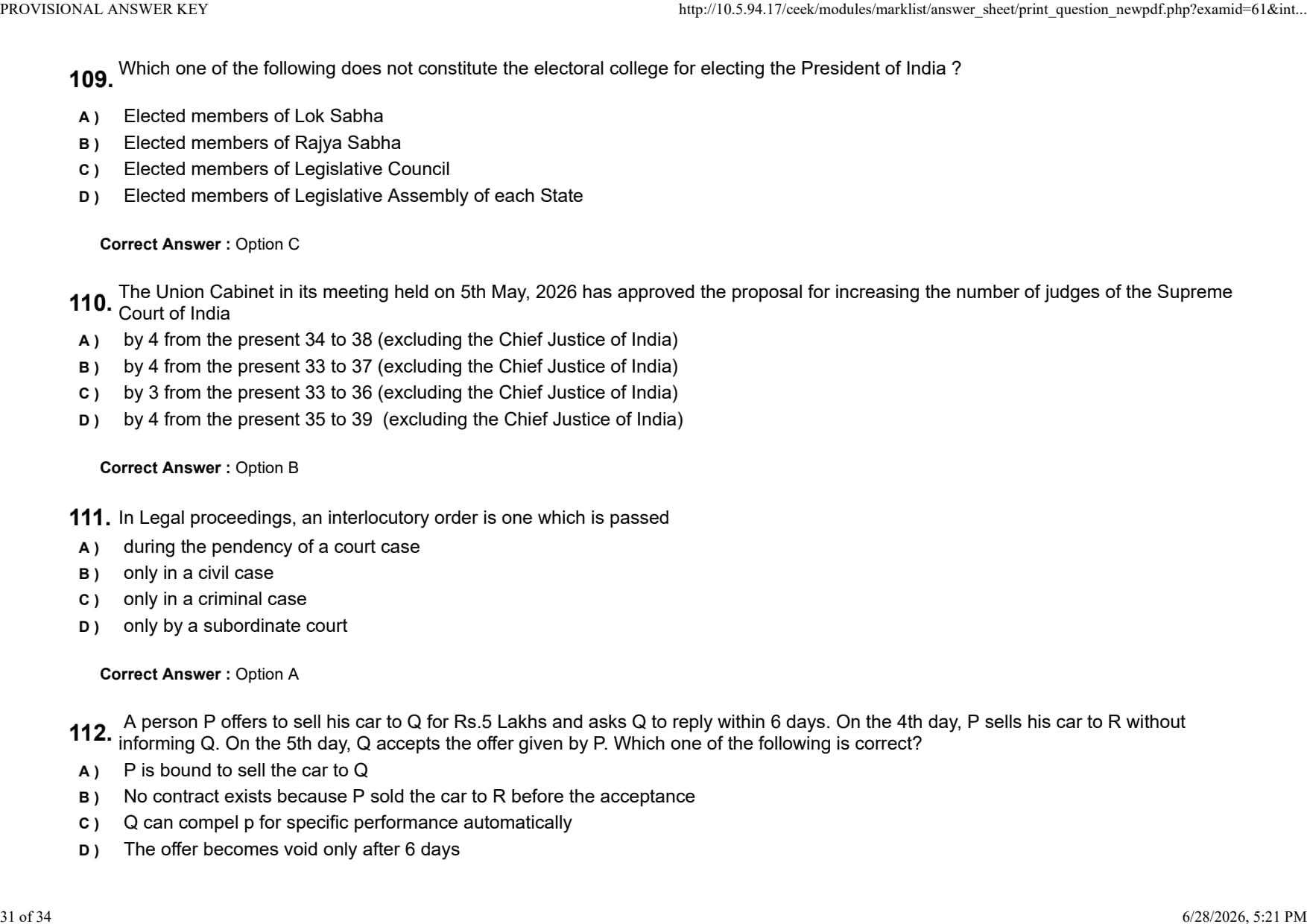
Which one of the following does not constitute the electoral college for electing the President of India ?

  • (A) Elected members of Lok Sabha
  • (B) Elected members of Rajya Sabha
  • (C) Elected members of Legislative Council
  • (D) Elected members of Legislative Assembly of each State

Question 110:

The Union Cabinet in its meeting held on 5th May, 2026 has approved the proposal for increasing the number of judges of the Supreme Court of India

  • (A) by 4 from the present 34 to 38 (excluding the Chief Justice of India)
  • (B) by 4 from the present 33 to 37 (excluding the Chief Justice of India)
  • (C) by 3 from the present 33 to 36 (excluding the Chief Justice of India)
  • (D) by 4 from the present 35 to 39 (excluding the Chief Justice of India)

Question 111:

In Legal proceedings, an interlocutory order is one which is passed

  • (A) during the pendency of a court case
  • (B) only in a civil case
  • (C) only in a criminal case
  • (D) only by a subordinate court

Question 112:

A person P offers to sell his car to Q for Rs.5 Lakhs and asks Q to reply within 6 days. On the 4th day, P sells his car to R without informing Q. On the 5th day, Q accepts the offer given by P. Which one of the following is correct?

  • (A) P is bound to sell the car to Q
  • (B) No contract exists because P sold the car to R before the acceptance
  • (C) Q can compel p for specific performance automatically
  • (D) The offer becomes void only after 6 days

Question 113:

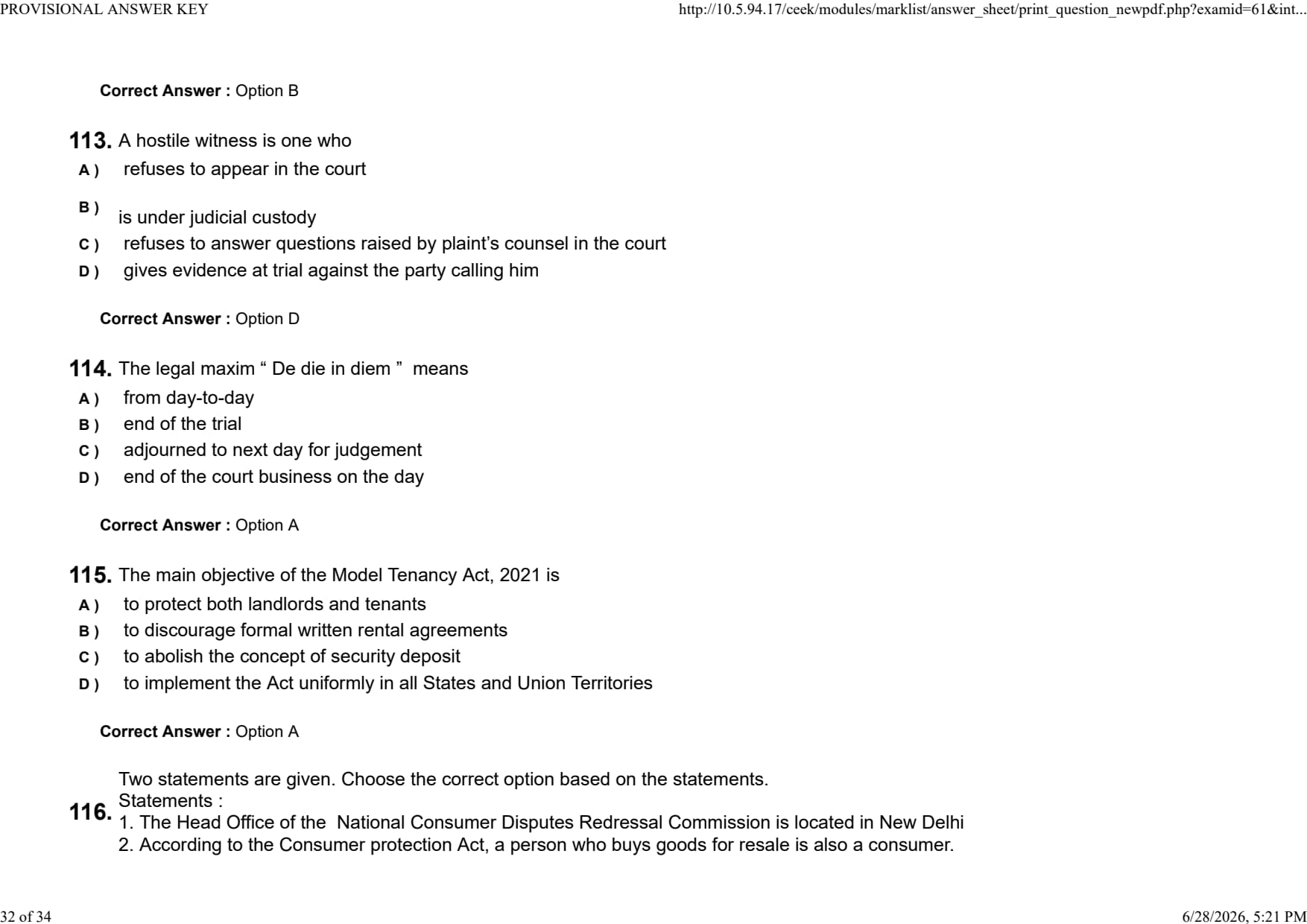
A hostile witness is one who

  • (A) refuses to appear in the court
  • (B) is under judicial custody
  • (C) refuses to answer questions raised by plaint’s counsel in the court
  • (D) gives evidence at trial against the party calling him

Question 114:

The legal maxim “ De die in diem ” means

  • (A) from day-to-day
  • (B) end of the trial
  • (C) adjourned to next day for judgement
  • (D) end of the court business on the day

Question 115:

The main objective of the Model Tenancy Act, 2021 is

  • (A) to protect both landlords and tenants
  • (B) to discourage formal written rental agreements
  • (C) to abolish the concept of security deposit
  • (D) to implement the Act uniformly in all States and Union Territories

Question 116:

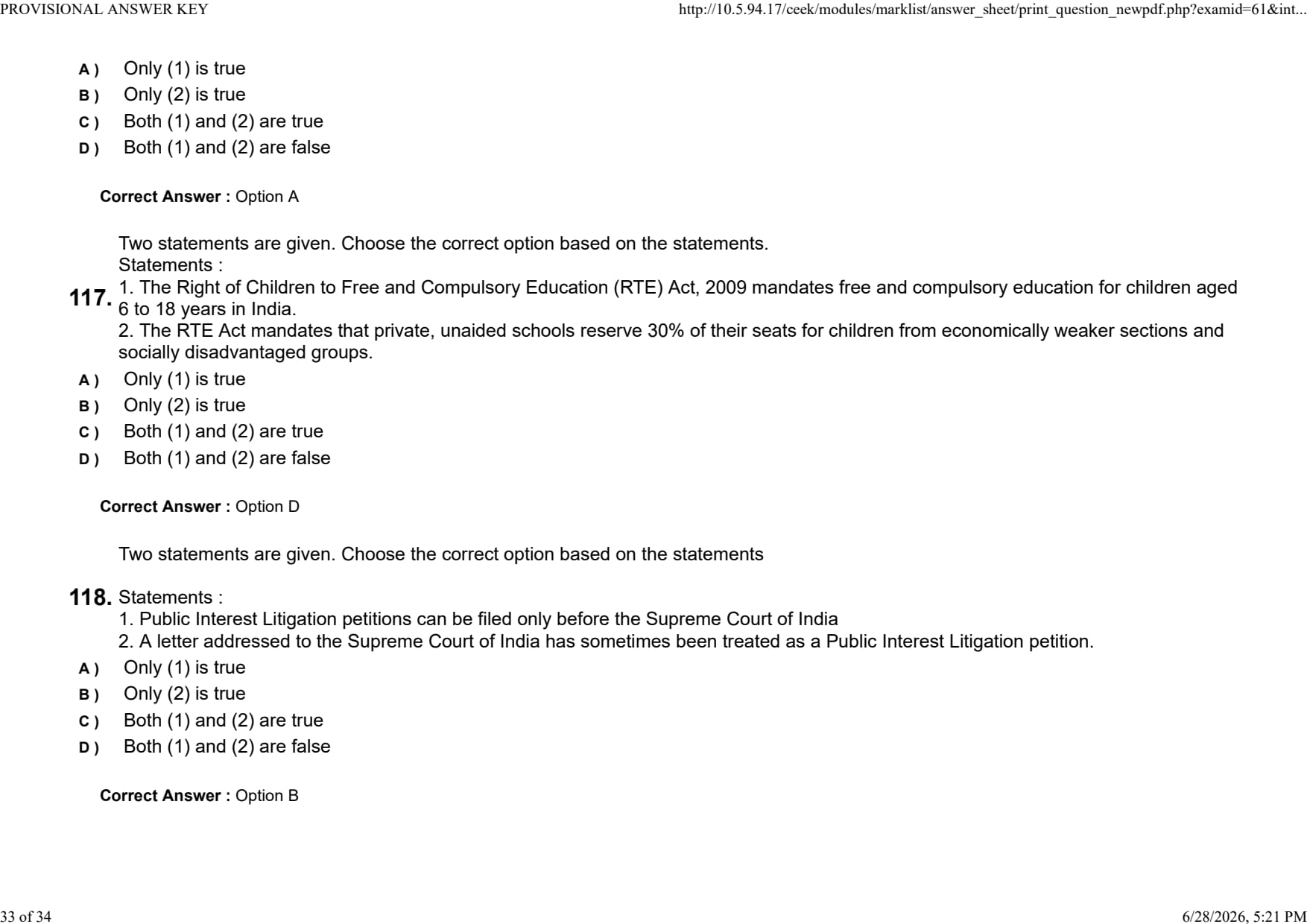
Two statements are given. Choose the correct option based on the statements.

Statements :

1. The Head Office of the National Consumer Disputes Redressal Commission is located in New Delhi

2. According to the Consumer protection Act, a person who buys goods for resale is also a consumer.

  • (A) Only (1) is true
  • (B) Only (2) is true
  • (C) Both (1) and (2) are true
  • (D) Both (1) and (2) are false

Question 117:

Two statements are given. Choose the correct option based on the statements.

Statements :

1. The Right of Children to Free and Compulsory Education (RTE) Act, 2009 mandates free and compulsory education for children aged 6 to 18 years in India.

2. The RTE Act mandates that private, unaided schools reserve 30% of their seats for children from economically weaker sections and socially disadvantaged groups.

  • (A) Only (1) is true
  • (B) Only (2) is true
  • (C) Both (1) and (2) are true
  • (D) Both (1) and (2) are false

Question 118:

Two statements are given. Choose the correct option based on the statements

Statements :

1. Public Interest Litigation petitions can be filed only before the Supreme Court of India

2. A letter addressed to the Supreme Court of India has sometimes been treated as a Public Interest Litigation petition.

  • (A) Only (1) is true
  • (B) Only (2) is true
  • (C) Both (1) and (2) are true
  • (D) Both (1) and (2) are false

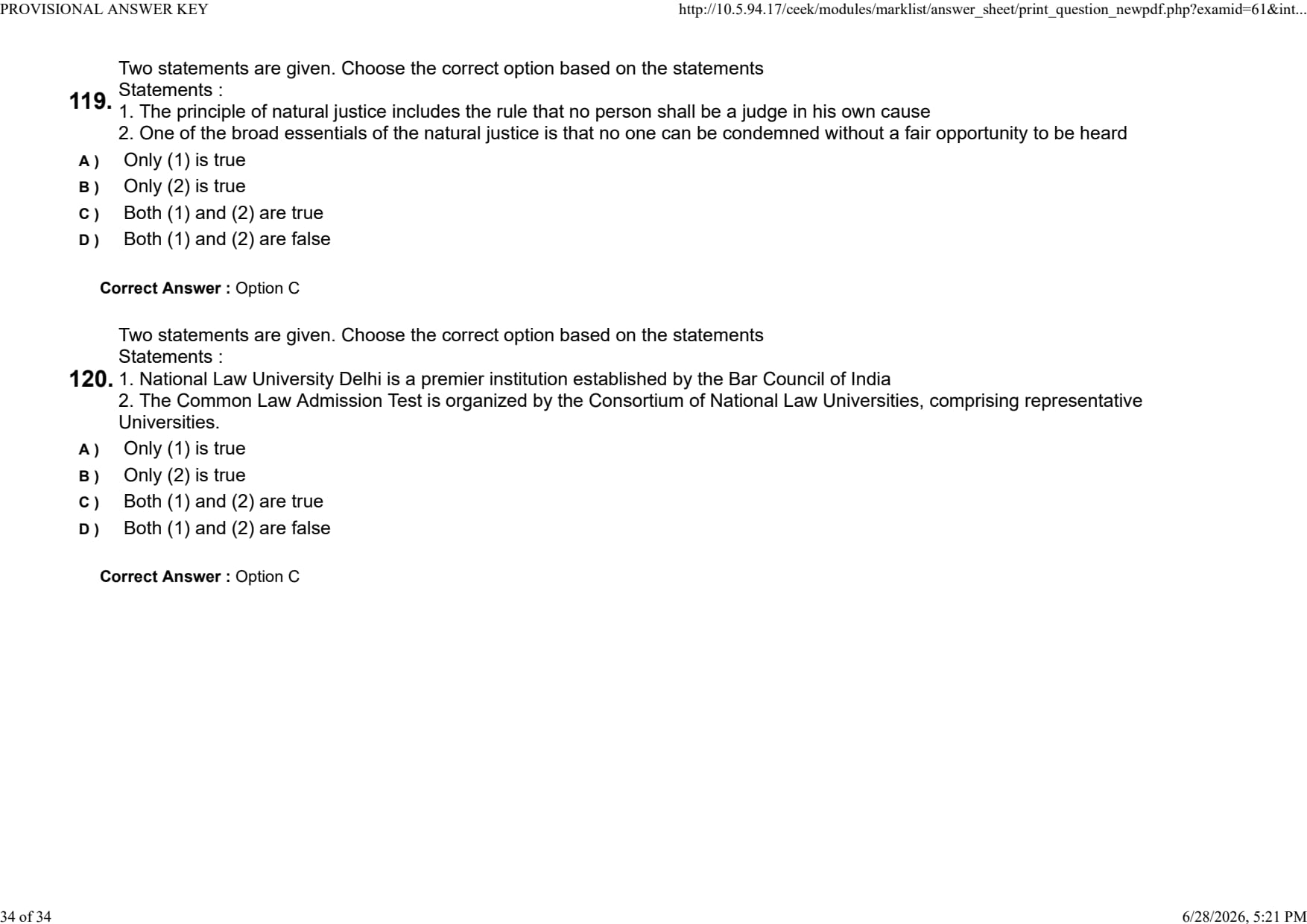
Question 119:

Two statements are given. Choose the correct option based on the statements

Statements :

1. The principle of natural justice includes the rule that no person shall be a judge in his own cause

2. One of the broad essentials of the natural justice is that no one can be condemned without a fair opportunity to be heard

  • (A) Only (1) is true
  • (B) Only (2) is true
  • (C) Both (1) and (2) are true
  • (D) Both (1) and (2) are false

Question 120:

Two statements are given. Choose the correct option based on the statements

Statements :

1. National Law University Delhi is a premier institution established by the Bar Council of India

2. The Common Law Admission Test is organized by the Consortium of National Law Universities, comprising representative Universities.

  • (A) Only (1) is true
  • (B) Only (2) is true
  • (C) Both (1) and (2) are true
  • (D) Both (1) and (2) are false

KLEE 2026 Exam Pattern

Particulars Details
Exam Name Kerala Law Entrance Examination (KLEE) 2026
Conducting Body Commissioner for Entrance Examinations (CEE), Kerala
Exam Mode Computer-Based Test (CBT)
Duration 120 minutes (2 hours)
Total Questions 120
Total Marks 360
Negative Marking Yes (−1 mark per wrong answer)
Medium of Exam English
Number of Sections 4

KLEE 2026 Revision