AP ECET 2026 Electrical and Electronics Engineering Question Paper is available for download here. JNTU Anantapur on behalf of APSCHE conducted AP ECET 2026 Electrical and Electronics Engineering exam on April 23 in Shift 1 from 9 AM to 12 PM. AP ECET is a state-level entrance exam conducted online for Diploma Holders and for B.Sc Holders and for admission into lateral entry for Engineering Courses.
- AP ECET Engineering Question Paper consists of 200 questions divided into 4 sections- Mathematics (50 questions), Physics (25 questions), Chemistry (25 questions) and Engineering Domain Specific (100 questions).
- Each correct answer answer carries 1 mark and there is no negative marking for incorrect answer.
Candidates can download AP ECET 2026 Electrical and Electronics Engineering Question Paper with Answer Key and Solution PDF from the links provided below.
AP ECET 2026 Electrical and Electronics Engineering Question Paper with Solutions
Question 1:
In the matrix \[ A=\begin{bmatrix} 1 & 2 & 3 \\
4 & 5 & 6 \\
7 & 4 & 9 \end{bmatrix}, \]
the minor \(M_{23}\) of the element \(a_{23}\) is:
- (A) \(10\)
- (B) \(-10\)
- (C) \(-6\)
- (D) \(6\)
Question 2:
If \[ \begin{vmatrix} 2x & 5 \\
8 & x \end{vmatrix} = \begin{vmatrix} 6 & -2 \\
7 & 3 \end{vmatrix}, \]
then the value of \(x\) is:
- (A) \(3\)
- (B) \(\pm 6\)
- (C) \(-3\)
- (D) \(\pm 2\)
Question 3:
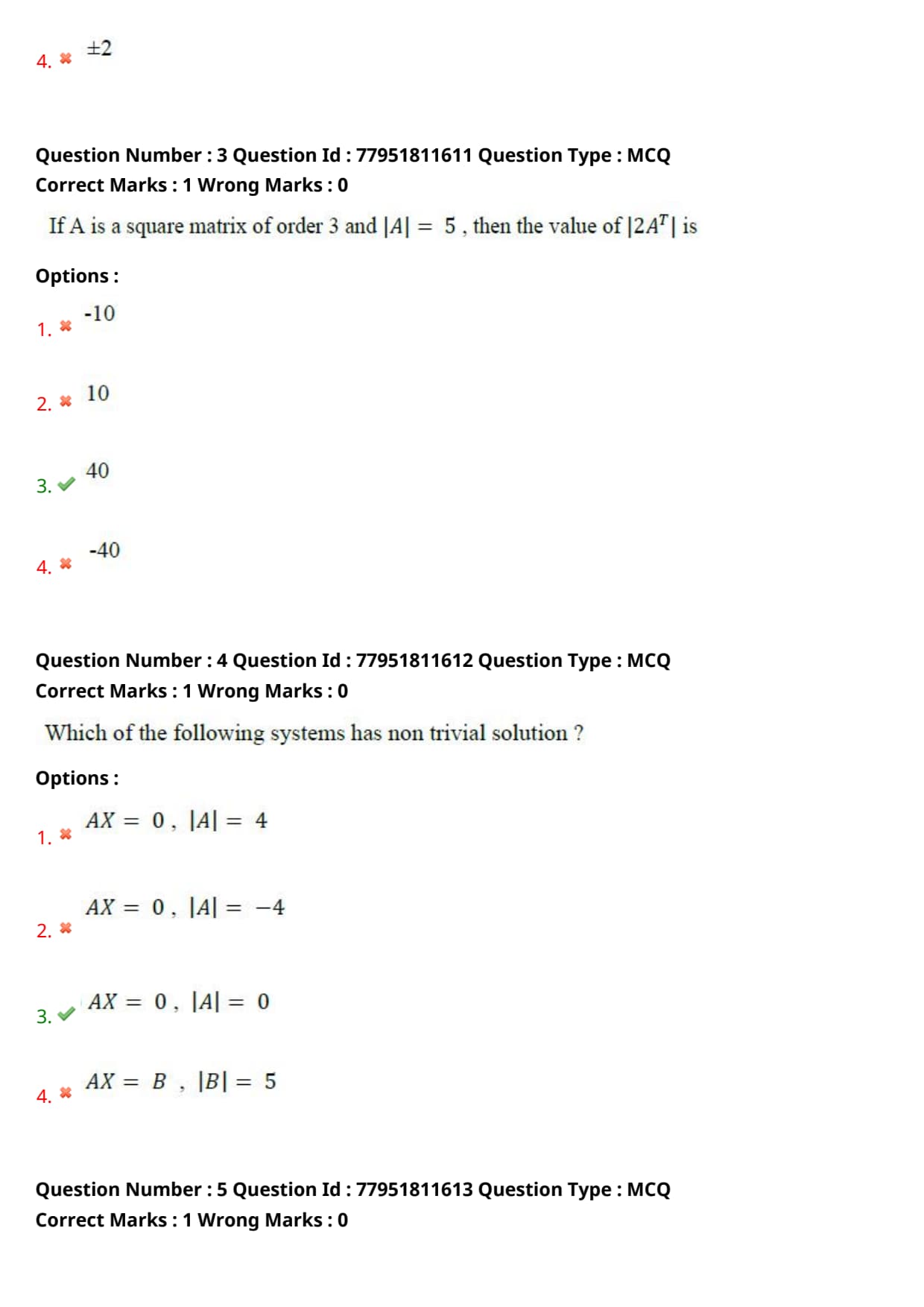
If \(A\) is a square matrix of order \(3\) and \(|A|=5\), then the value of \(\left|2A^T\right|\) is:
- (A) \(-10\)
- (B) \(10\)
- (C) \(40\)
- (D) \(-40\)
Question 4:
Which of the following systems has non-trivial solution?
- (A) \(AX=0,\ |A|=4\)
- (B) \(AX=0,\ |A|=-4\)
- (C) \(AX=0,\ |A|=0\)
- (D) \(AX=B,\ |B|=5\)
Question 5:
If \[ \begin{bmatrix} x+y & 2 \\
1 & x-y \end{bmatrix} = \begin{bmatrix} 4 & 2 \\
1 & 2 \end{bmatrix}, \]
then the values of \(x\) and \(y\) are:
- (A) \(x=3,\ y=1\)
- (B) \(x=1,\ y=3\)
- (C) \(x=2,\ y=3\)
- (D) \(x=1,\ y=1\)
Question 6:
If \[ \frac{x+4}{(x+2)^2(x+3)} = \frac{A}{(x+2)^2} + \frac{B}{x+2} + \frac{C}{x+3}, \]
then \(A+B+C=\)
- (A) \(2\)
- (B) \(1\)
- (C) \(-1\)
- (D) \(3\)
Question 7:
If \[ \frac{x}{(x-1)^2(x+2)} = \frac{A}{(x-1)^2} + \frac{2}{9(x-1)} + \frac{B}{x+2}, \]
then \(A+B=\)
- (A) \(\frac{1}{3}\)
- (B) \(\frac{1}{9}\)
- (C) \(-\frac{1}{3}\)
- (D) \(\frac{2}{3}\)
Question 8:
If \(\tan A=\frac{1}{2}\) and \(\tan B=\frac{1}{3}\), then \(A+B=\)
- (A) \(30^\circ\)
- (B) \(45^\circ\)
- (C) \(60^\circ\)
- (D) \(90^\circ\)
Question 9:
If \(2\sin^{-1}x=\sin^{-1}k\), then \(k=\)
- (A) \(2x\sqrt{1-x^2}\)
- (B) \(2x\)
- (C) \(x^2\)
- (D) \(1-2x^2\)
Question 10:
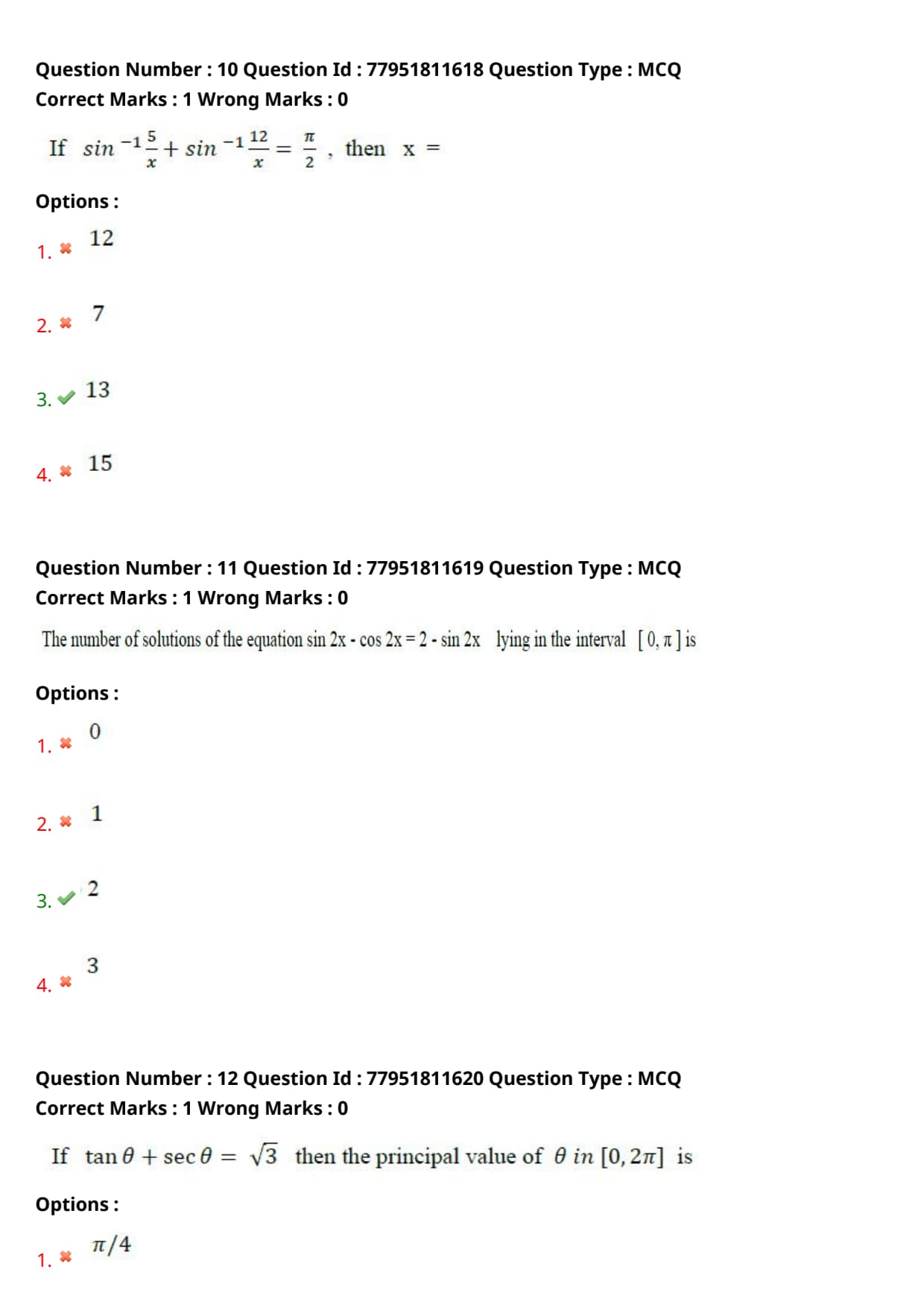
If \[ \sin^{-1}\frac{5}{x}+\sin^{-1}\frac{12}{x}=\frac{\pi}{2}, \]
then \(x=\)
- (A) \(12\)
- (B) \(7\)
- (C) \(13\)
- (D) \(15\)
Question 11:
The number of solutions of the equation \[ \sin 2x-\cos 2x=2-\sin 2x \]
lying in the interval \([0,\pi]\) is
- (A) \(0\)
- (B) \(1\)
- (C) \(2\)
- (D) \(3\)
Question 12:
If \[ \tan\theta+\sec\theta=\sqrt3, \]
then the principal value of \(\theta\) in \([0,2\pi]\) is
- (A) \(\frac{\pi}{4}\)
- (B) \(\frac{\pi}{6}\)
- (C) \(\frac{\pi}{2}\)
- (D) \(\frac{2\pi}{3}\)
Question 13:
\[ \frac{\tan x-1+\sec x}{\tan x-\sec x+1} = \]
- (A) \(\frac{1-\sin x}{\cos x}\)
- (B) \(\frac{1+\sin x}{\cos x}\)
- (C) \(\frac{1+\cos x}{\sin x}\)
- (D) \(\frac{1-\cos x}{\sin x}\)
Question 14:
\[ \tan 9^\circ-\tan 27^\circ-\tan 63^\circ+\tan 81^\circ= \]
- (A) \(2\)
- (B) \(1\)
- (C) \(4\)
- (D) \(3\)
Question 15:
If \[ \cos\theta=\frac{1}{2}\left(a+\frac{1}{a}\right), \]
then \[ 4\cos^3\theta-3\cos\theta= \]
- (A) \(a^3+\frac{1}{a^3}\)
- (B) \(\frac{1}{2}\left(a^3+\frac{1}{a^3}\right)\)
- (C) \(\frac{1}{4}\left(a^3+\frac{1}{a^3}\right)\)
- (D) \(\frac{1}{3}\left(a^3+\frac{1}{a^3}\right)\)
Question 16:
\[ \cos 6^\circ\sin 24^\circ\cos72^\circ= \]
- (A) \(\frac{1}{4}\)
- (B) \(-\frac{1}{8}\)
- (C) \(-\frac{1}{4}\)
- (D) \(\frac{1}{8}\)
Question 17:
\[ \tan^{-1}1+\tan^{-1}2+\tan^{-1}3= \]
- (A) \(\frac{3\pi}{4}\)
- (B) \(\frac{\pi}{2}\)
- (C) \(\pi\)
- (D) \(2\pi\)
Question 18:
If \[ z_1=4i^{40}-5i^{35}+6i^{17}+2,\qquad z_2=-1+i, \]
then \[ |z_1+z_2|= \]
- (A) \(13\)
- (B) \(5\)
- (C) \(15\)
- (D) \(12\)
Question 19:
The conjugate of \((1+i)^3\) is
- (A) \(1+2i\)
- (B) \(-2+2i\)
- (C) \(-2-2i\)
- (D) \(1-2i\)
Question 20:
The equation of a circle whose Centre is \((-3,2)\) and area is \(176\) units is
- (A) \(x^2+y^2+6x-4y-36=0\)
- (B) \(x^2+y^2+6x-4y-43=0\)
- (C) \(x^2+y^2-6x+4y-36=0\)
- (D) \(x^2+y^2-6x+4y-43=0\)
Question 21:
The equation of a circle whose Centre is \((2,-1)\) and which passes through the point \((3,6)\) is
- (A) \(x^2+y^2+4x+2y-45=0\)
- (B) \(x^2+y^2-2x+2y-50=0\)
- (C) \(x^2+y^2+2x+2y-50=0\)
- (D) \(x^2+y^2-4x+2y-45=0\)
Question 22:
If the parabola \(y^2=4ax\) passes through the point \((3,2)\), then the length of its latus rectum is:
- (A) \(\frac{4}{3}\)
- (B) \(4\)
- (C) \(\frac{2}{3}\)
- (D) \(\frac{1}{3}\)
Question 23:
The line \(y=mx+2\) is a tangent to the parabola \(y^2=8x\) if
- (A) \(m=1\)
- (B) \(m=2\)
- (C) \(m=3\)
- (D) \(m=4\)
Question 24:
The length of the latus rectum and eccentricity of the Hyperbola \[ 9x^2-16y^2=144 \]
are
- (A) \(\left(\frac{9}{4},\frac{5}{4}\right)\)
- (B) \(\left(\frac{9}{2},\frac{5}{4}\right)\)
- (C) \(\left(\frac{9}{2},\frac{5}{2}\right)\)
- (D) \(\left(9,\frac{5}{2}\right)\)
Question 25:
The equation of the ellipse with foci at \((\pm3,0)\) and the eccentricity as \(\frac{1}{3}\) is:
- (A) \(\frac{x^2}{81}+\frac{y^2}{72}=1\)
- (B) \(\frac{x^2}{9}+\frac{y^2}{8}=1\)
- (C) \(\frac{x^2}{8}+\frac{y^2}{9}=1\)
- (D) \(\frac{x^2}{3}+\frac{y^2}{2}=1\)
Question 26:
\[ \lim_{x\to\infty}\left(1+\frac{1}{x}\right)^x= \]
- (A) \(0\)
- (B) \(1\)
- (C) \(e\)
- (D) \(\infty\)
Question 27:
\[ \lim_{x\to 0}\frac{\sqrt{1+x}-1}{x}= \]
- (A) \(0\)
- (B) \(\frac{1}{2}\)
- (C) \(1\)
- (D) \(\infty\)
Question 28:
If \[ y=\frac{a\cos x+b\sin x+c}{\sin x}, \]
then \[ \frac{dy}{dx}= \]
- (A) \(-a cosec^2x-c cosec x\cot x\)
- (B) \(-a\)
- (C) \(-a cosec^2x+b\sec^2x+c cosec x\cot x\)
- (D) \(a cosec^2x-c cosec x\cot x\)
Question 29:
If \[ y=\sqrt{x+\sqrt{x+\sqrt{x+\cdots\infty}}}, \]
then \[ \frac{dy}{dx}= \]
- (A) \(\frac{1}{2y}\)
- (B) \(\frac{1}{1-2y}\)
- (C) \(\frac{1}{2(1-2y)}\)
- (D) \(\frac{-1}{1-2y}\)
Question 30:
Slope of the tangent to the curve \[ y=9x^2+7x^4+5 \]
at the point \(x=1\) is
- (A) \(28\)
- (B) \(16\)
- (C) \(46\)
- (D) \(\frac{1}{46}\)
Question 31:
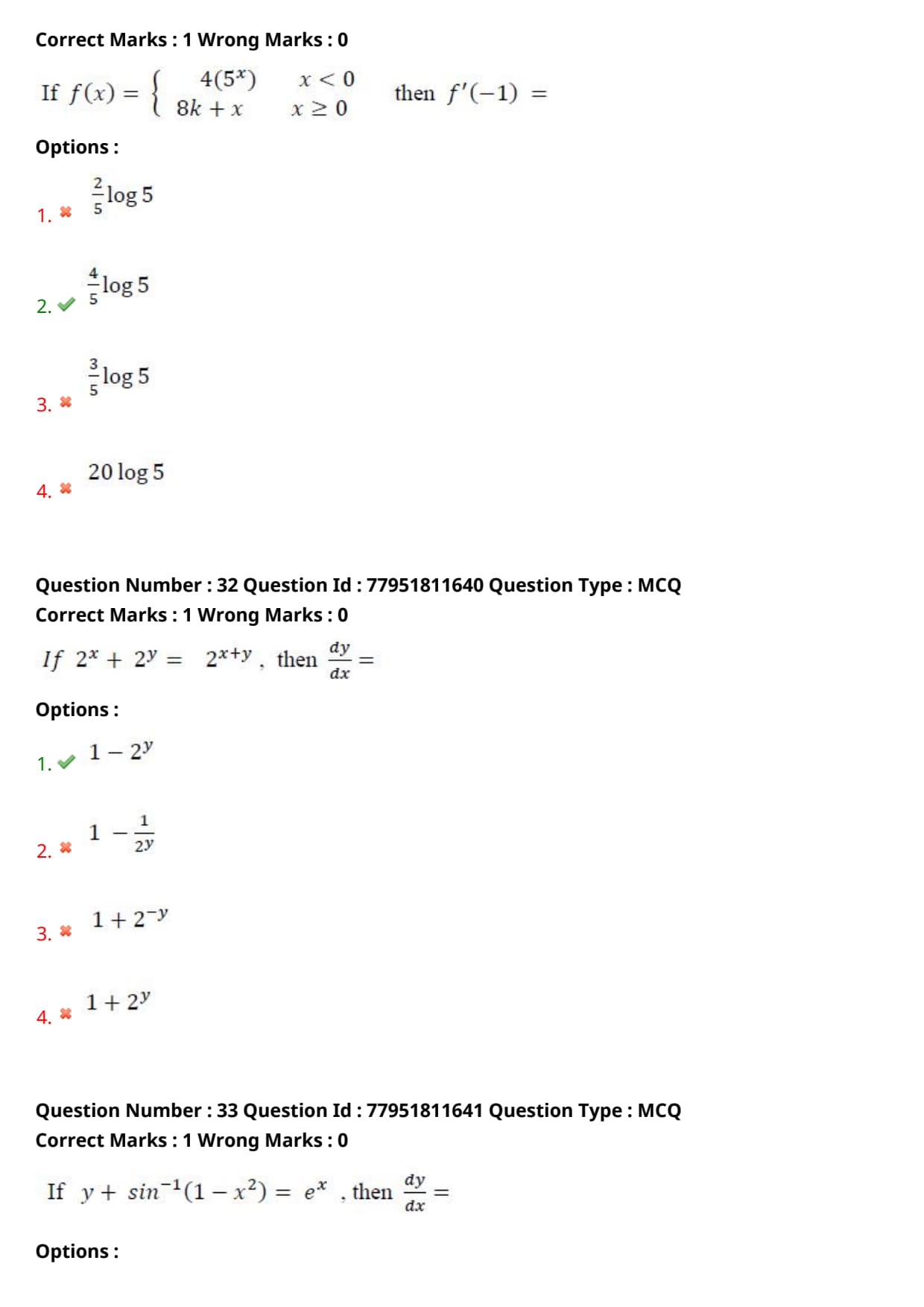
If \[ f(x)= \begin{cases} 4(5^x), & x<0
8k+x, & x\geq 0 \end{cases} \]
then \(f'(-1)=\)
- (A) \(\frac{2}{5}\log 5\)
- (B) \(\frac{4}{5}\log 5\)
- (C) \(\frac{3}{5}\log 5\)
- (D) \(20\log 5\)
Question 32:
If \[ 2^x+2^y=2^{x+y}, \]
then \[ \frac{dy}{dx}= \]
- (A) \(1-2^y\)
- (B) \(1-\frac{1}{2^y}\)
- (C) \(1+2^{-y}\)
- (D) \(1+2^y\)
Question 33:
If \[ y+\sin^{-1}(1-x^2)=e^x, \]
then \[ \frac{dy}{dx}= \]
- (A) \(e^x-\frac{2}{\sqrt{2-x^2}}\)
- (B) \(e^x-\frac{2}{\sqrt{2+x^2}}\)
- (C) \(e^x+\frac{2}{\sqrt{2-x^2}}\)
- (D) \(e^x+\frac{2}{\sqrt{2+x^2}}\)
Question 34:
If \(y(x)=x^x,\ x>0\), then \[ y''(2)-2y'(2)= \]
- (A) \(4\log_e2-2\)
- (B) \(4\log_e2+2\)
- (C) \(4(\log_e2)^2+2\)
- (D) \(4(\log_e2)^2-2\)
Question 35:
If \[ z=x^2y^3+e^y\sin x, \]
then \[ \frac{\partial^2 z}{\partial x\partial y}= \]
- (A) \(6xy^2+e^y\cos x\)
- (B) \(3x^2y^2+e^y\sin x\)
- (C) \(3x^2y^2+e^y\cos x\)
- (D) \(6xy^2+e^y\sin x\)
Question 36:
\[ \int \frac{dx}{\sin^2x\cos^2x}= \]
- (A) \(\tan x+\cot x+c\)
- (B) \(\tan x-\cot x+c\)
- (C) \(\tan x\cot x+c\)
- (D) \(\tan x+\sec x+c\)
Question 37:
\[ \int \frac{dx}{\sqrt{x+1}+\sqrt{x}}= \]
- (A) \(\frac{2}{3}\left[(x+1)^{\frac{3}{2}}-x^{\frac{3}{2}}\right]+c\)
- (B) \(\frac{2}{3}\left[(x+1)^{\frac{3}{2}}+x^{\frac{3}{2}}\right]+c\)
- (C) \(\frac{3}{2}\left[(x+1)^{\frac{3}{2}}-x^{\frac{3}{2}}\right]+c\)
- (D) \(\frac{3}{2}\left[(x+1)^{\frac{3}{2}}+x^{\frac{3}{2}}\right]+c\)
Question 38:
If \[ \int \frac{\sin^3x+\cos^3x}{\sin^2x\cos^2x}\,dx = A\sec x+B cosec x+c, \]
then \((A,B)\) are
- (A) \((1,1)\)
- (B) \((-1,-1)\)
- (C) \((1,-1)\)
- (D) \((-1,1)\)
Question 39:
The integral of \(f(x)=1+x^2+x^4\) with respect to \(x^2\) is
- (A) \(x+\frac{x^3}{3}+\frac{x^5}{5}+C\)
- (B) \(\frac{x^2}{3}+\frac{x^4}{5}+C\)
- (C) \(x^2+\frac{x^4}{4}+\frac{x^6}{6}+C\)
- (D) \(x^2+\frac{x^4}{2}+\frac{x^6}{3}+C\)
Question 40:
\[ \int_0^{\frac{\pi}{2}} \frac{\sin^{100}x}{\sin^{100}x+\cos^{100}x}\,dx = \]
- (A) \(\frac{\pi}{2}\)
- (B) \(\frac{\pi}{4}\)
- (C) \(100\)
- (D) \(50\)
Question 41:
\[ \int_0^1 x\sqrt{x^2+4}\,dx= \]
- (A) \(\frac{1}{3}[5\sqrt5-4]\)
- (B) \(\frac{1}{2}[5\sqrt5-8]\)
- (C) \(\frac{1}{3}[5\sqrt5-8]\)
- (D) \(\frac{1}{3}[5\sqrt5+4]\)
Question 42:
\[ \int_{-\frac{\pi}{6}}^{\frac{\pi}{6}} \frac{\sin^5x\cos^3x}{x^4}\,dx= \]
- (A) \(\frac{\pi}{2}\)
- (B) \(\frac{\pi}{4}\)
- (C) \(0\)
- (D) \(1\)
Question 43:
\[ \int \frac{dx}{\sqrt{16-25x^2}}= \]
- (A) \(\frac{1}{5}\sin^{-1}\left(\frac{5x}{4}\right)+c\)
- (B) \(\sin^{-1}\left(\frac{5x}{4}\right)+c\)
- (C) \(\frac{1}{5}\sin^{-1}\left(\frac{x}{4}\right)+c\)
- (D) \(\frac{1}{5}\sin^{-1}\left(\frac{4x}{5}\right)+c\)
Question 44:
The solution of the differential equation \[ x\frac{dy}{dx}+y=0 \]
passing through the point \((1,1)\) is \(y=\)
- (A) \(x^2\)
- (B) \(x^{-1}\)
- (C) \(x^{-2}\)
- (D) \(x\)
Question 45:
Degree of the differential equation \[ y=x\frac{dy}{dx}+a\sqrt{1+\left(\frac{dy}{dx}\right)^2} \]
is
- (A) \(4\)
- (B) \(3\)
- (C) \(2\)
- (D) \(1\)
Question 46:
The order of the differential equation of all circles passing through the origin and having their centres on the \(x\)-axis is
- (A) \(4\)
- (B) \(3\)
- (C) \(2\)
- (D) \(1\)
Question 47:
If \(a\) and \(b\) are arbitrary constants, then the differential equation representing the family of curves \[ y=a\sin(x+b) \]
is
- (A) \(\frac{d^2y}{dx^2}-y=0\)
- (B) \(\frac{d^2y}{dx^2}+y=0\)
- (C) \(\frac{d^2y}{dx^2}-y^2=0\)
- (D) \(\frac{dy}{dx}-y=0\)
Question 48:
The differential equation is \[ \frac{dy}{dx}+\frac{y}{x}=0 \]
and \(y(1)=2\). Then the value of \(y(3)\) is
- (A) \(2\)
- (B) \(3\)
- (C) \(\frac{2}{3}\)
- (D) \(1\)
Question 49:
The general solution of the differential equation \[ \frac{dy}{dx}=e^{x-y}+x^2e^{-y} \]
is
- (A) \(e^{-y}=e^x+\frac{x^3}{3}+c\)
- (B) \(e^y=e^x+\frac{x^3}{3}+c\)
- (C) \(e^y=e^x+x^3+c\)
- (D) \(e^y=e^x+c\)
Question 50:
The differential equation is \[ \frac{dy}{dx}+y\tan x=\sec x \]
and \(y(0)=1\). Then the value of \(y\left(\frac{\pi}{4}\right)\) is
- (A) \(0\)
- (B) \(\sqrt2\)
- (C) \(1\)
- (D) \(-1\)
Question 51:
If \(P=Fv\sin\beta t\), where \(F\) is force and \(v\) is velocity, then the dimensions of \(P\) and \(\beta\) are
- (A) \(ML^2T^{-3},\ T^{-1}\)
- (B) \(MLT^{-2},\ T^{-2}\)
- (C) \(ML^2T^{-1},\ T^{-1}\)
- (D) \(ML^2T^3,\ T^{-2}\)
Question 52:
If velocity \(V\), energy \(E\), and time \(T\) are chosen as fundamental quantities, then dimensional representation of surface tension in this system will be
- (A) \(E^1V^{-2}T^{-2}\)
- (B) \(E^1V^{-1}T^{-2}\)
- (C) \(E^{-2}V^{-1}T^{-3}\)
- (D) \(E^1V^{-2}T^{-1}\)
Question 53:
If \(|\vec A+\vec B|=|\vec A-\vec B|\), then the angle between the two vectors \(\vec A\) and \(\vec B\) is
- (A) \(0^\circ\)
- (B) \(180^\circ\)
- (C) \(120^\circ\)
- (D) \(90^\circ\)
Question 54:
An aeroplane is moving in a circular path with a speed of \(450\ kmph\). What is the change in velocity in half revolution?
- (A) \(0\ kmph\)
- (B) \(450\ kmph\)
- (C) \(250\ kmph\)
- (D) \(900\ kmph\)
Question 55:
The ratio between maximum and minimum values of two vectors \(\vec A\) and \(\vec B\), where \(A>B\), is \(4:1\). Then the ratio between the magnitudes of two vectors is
- (A) \(3:2\)
- (B) \(5:3\)
- (C) \(2:3\)
- (D) \(3:5\)
Question 56:
The magnitudes of three vectors \(\vec A,\vec B,\vec C\) are \(12,5\), and \(13\) units respectively and \(\vec A+\vec B=\vec C\). The angle between \(\vec A\) and \(\vec B\) is
- (A) \(0^\circ\)
- (B) \(120^\circ\)
- (C) \(90^\circ\)
- (D) \(45^\circ\)
Question 57:
A body falling from height \(H\) takes time \(T\) seconds to reach the ground. The time taken to cover the second half of height is
- (A) \(\frac{T}{\sqrt2}\)
- (B) \(\sqrt2T\)
- (C) \(\frac{\sqrt2-1}{\sqrt2}T\)
- (D) \(\frac{1}{\sqrt2-1}T\)
Question 58:
With what speed should a body be thrown upwards so that the distances covered in the \(5^{th}\) second and \(6^{th}\) second are equal?
- (A) \(75\ m/s\)
- (B) \(\sqrt{98}\ m/s\)
- (C) \(49\ m/s\)
- (D) \(19.8\ m/s\)
Question 59:
A body of mass \(1\ kg\) starts moving from rest under the action of a force which varies with displacement as \(F=2x+5\) in newtons. The work done by this force to displace the body from \(x=0\) to \(x=2\ m\) is
- (A) \(8\ J\)
- (B) \(10\ J\)
- (C) \(12\ J\)
- (D) \(14\ J\)
Question 60:
The potential energy of a particle is given by \(U(x)=20+(x-2)^2\), where \(U\) is in joules and \(x\) is in meters. The minimum potential energy and the position where it occurs are
- (A) \(20\ J at x=2\)
- (B) \(2\ J at x=20\ m\)
- (C) \(22\ J at x=2\ m\)
- (D) \(0\ J at x=2\ m\)
Question 61:
Power supplied to a particle of mass \(2\ kg\) varies with time as \[ P=\frac{3t^2}{2}\ watt, \]
where \(t\) is in seconds. If velocity at \(t=0\) is zero, the velocity at \(t=2\ s\) is
- (A) \(1\ m/s\)
- (B) \(2\ m/s\)
- (C) \(\sqrt2\ m/s\)
- (D) \(4\ m/s\)
Question 62:
A pump is used to deliver water at a certain rate from a given pipe. To obtain twice the volume of water from the same pipe in the same time, by what factor must the power of the motor pump be increased? Assume ideal conditions.
- (A) \(4\)
- (B) \(8\)
- (C) \(16\)
- (D) \(32\)
Question 63:
Two identical piano wires, when tuned to a fundamental frequency of \(400\ Hz\), produce no beats. One wire is then slightly tightened, and the beat frequency heard is \(2\ Hz\). What is the new fundamental frequency of the tightened wire?
- (A) \(398\ Hz\)
- (B) \(402\ Hz\)
- (C) \(404\ Hz\)
- (D) \(396\ Hz\)
Question 64:
A source of sound of frequency \(500\ Hz\) is moving towards an observer with velocity \(30\ m/s\). The speed of sound is \(330\ m/s\). The frequency heard by the observer will be
- (A) \(450\ Hz\)
- (B) \(550\ Hz\)
- (C) \(600\ Hz\)
- (D) \(500\ Hz\)
Question 65:
In acoustics, ``Noise'' is generally characterized by
- (A) Irregular and non-periodic vibrations
- (B) A constant pitch and frequency
- (C) Vibrations that follow a harmonic series
- (D) Regular and periodic vibrations
Question 66:
If the volume of a room is doubled and the total absorption is halved, the reverberation time will
- (A) Remain unchanged
- (B) Be doubled
- (C) Become four times
- (D) Be halved
Question 67:
In a closed hall of volume \(5000\ m^3\), the total absorption of the interior surfaces is \(200\) metric sabin. The reverberation time is
- (A) \(1\ s\)
- (B) \(2\ s\)
- (C) \(3\ s\)
- (D) \(4\ s\)
Question 68:
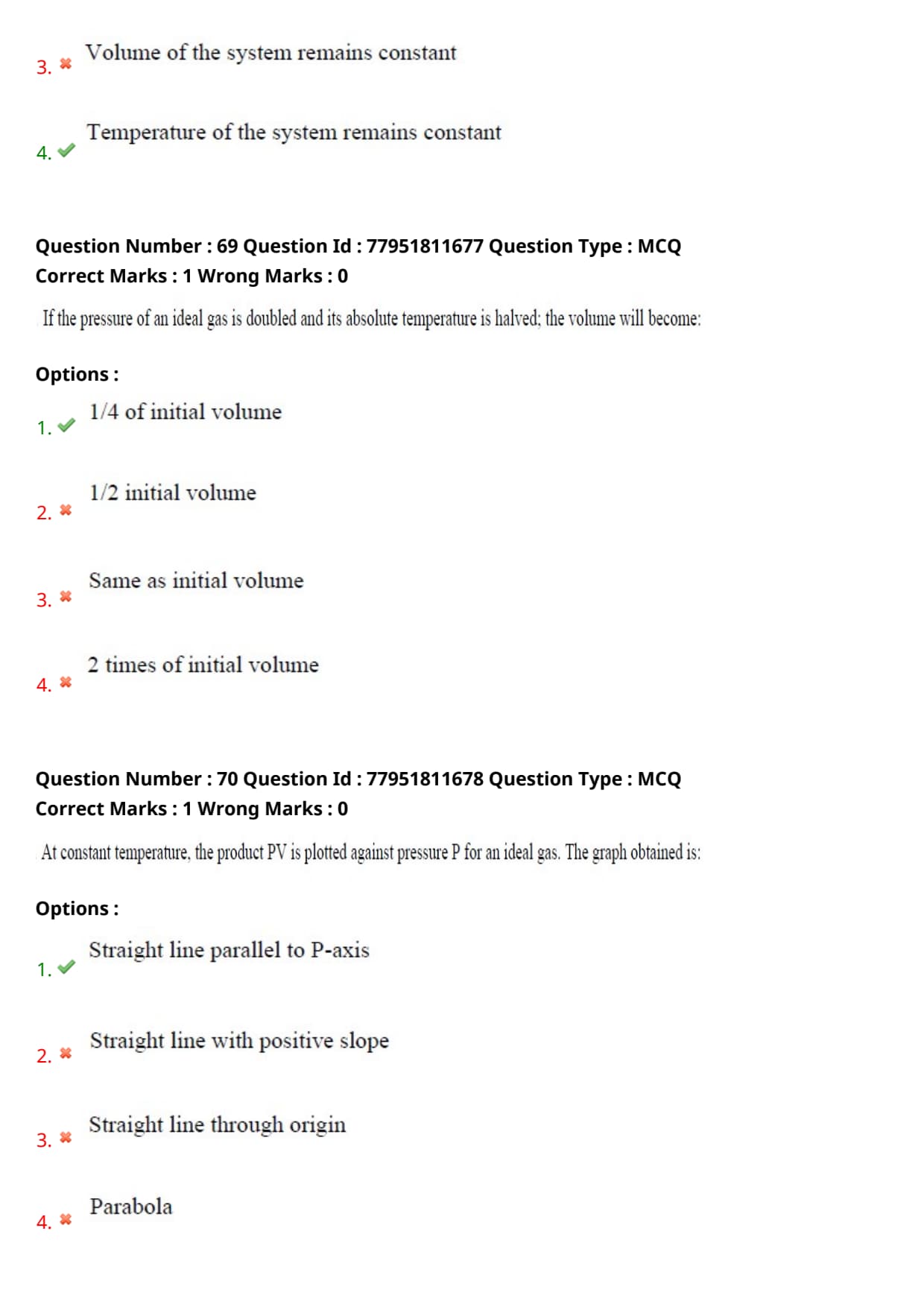
In an isothermal process
- (A) Internal energy of the system never remains constant
- (B) Total heat energy of the system remains constant
- (C) Volume of the system remains constant
- (D) Temperature of the system remains constant
Question 69:
If the pressure of an ideal gas is doubled and its absolute temperature is halved, the volume will become
- (A) \(\frac{1}{4}\) of initial volume
- (B) \(\frac{1}{2}\) initial volume
- (C) Same as initial volume
- (D) \(2\) times of initial volume
Question 70:
At constant temperature, the product \(PV\) is plotted against pressure \(P\) for an ideal gas. The graph obtained is
- (A) Straight line parallel to \(P\)-axis
- (B) Straight line with positive slope
- (C) Straight line through origin
- (D) Parabola
Question 71:
A bubble of an ideal gas rises from the bottom of a lake to the surface. At the bottom, the pressure is \(3\ atm\) and the temperature is \(7^\circ C\). At the surface, the pressure is \(1\ atm\) and the temperature is \(27^\circ C\). If the initial volume of the bubble was \(V_0\), what is its volume \(V\) at the surface?
- (A) \(3V_0\)
- (B) \(3.21V_0\)
- (C) \(0.9V_0\)
- (D) \(5.4V_0\)
Question 72:
The R.M.S. speed of oxygen molecules at \(27^\circ C\) is \(v\). At \(927^\circ C\), the rms speed will be:
- (A) \(v\)
- (B) \(\frac{v}{2}\)
- (C) \(2v\)
- (D) \(4v\)
Question 73:
In a photoelectric experiment, the stopping potential for incident light of wavelength \(4000\ Å\) is \(2\ V\). If the wavelength is changed to \(3000\ Å\), the new stopping potential will be approximately \[ (Use h=4.14\times10^{-15}\ eV s,\ c=3\times10^8\ m/s) \]
- (A) \(2\ V\)
- (B) \(3.03\ V\)
- (C) \(4.14\ V\)
- (D) \(1.5\ V\)
Question 74:
In Optical Fiber communication, the signal is transmitted in the form of:
- (A) Electrical pulses
- (B) Light pulses
- (C) Radio waves
- (D) Sound waves
Question 75:
In a superconducting ring, a persistent current has been flowing without decay for years. This is possible because:
- (A) Resistance is exactly zero and flux is quantized
- (B) Resistance is very small but finite
- (C) The ring is at absolute zero temperature
- (D) Magnetic field lines are expelled
Question 76:
The pair of orbitals with electron density maximum along the axes is
- (A) \(d_{xy}, d_{yz}\)
- (B) \(d_{z^2}, d_{x^2-y^2}\)
- (C) \(d_{xz}, d_{z^2}\)
- (D) \(d_{xz}, p_z\)
Question 77:
The angular momentum of an electron in an orbit \(X\) of hydrogen atom is \(\frac{2h}{\pi}\). Maximum number of orbitals possible in \(X\) is
- (A) \(4\)
- (B) \(9\)
- (C) \(16\)
- (D) \(25\)
Question 78:
The four quantum numbers for the electron in the outermost orbital of potassium \((Z=19)\) are
- (A) \(n=4,\ l=2,\ m=-1,\ s=+\frac{1}{2}\)
- (B) \(n=4,\ l=0,\ m=0,\ s=+\frac{1}{2}\)
- (C) \(n=3,\ l=0,\ m=1,\ s=+\frac{1}{2}\)
- (D) \(n=4,\ l=3,\ m=-2,\ s=-\frac{1}{2}\)
Question 79:
In which of the following, the number of bonding electrons and non-bonding electrons are in \(3:2\) ratio?
- (A) \(N_2\)
- (B) \(O_2\)
- (C) \(HCl\)
- (D) \(F_2\)
Question 80:
Which one of the following statements is not correct?
- (A) Ionic bond is non-directional bond
- (B) The maximum number of bond pairs between two atoms is \(3\)
- (C) Covalent compounds conduct electricity in fused state
- (D) Ionic compounds are generally soluble in water
Question 81:
\(12.6\ g\) of oxalic acid, \(H_2C_2O_4\cdot2H_2O\) \((M.wt. 126)\), is present in \(1500\ mL\) of solution. The normality of that solution is
- (A) \(0.266\ N\)
- (B) \(0.133\ N\)
- (C) \(0.399\ N\)
- (D) \(0.430\ N\)
Question 82:
Which of the following has highest equivalent weight? Given: At.wt. \(H=1,\ C=12,\ O=16,\ S=32,\ Na=23,\ Ca=40\)
- (A) Sulphuric acid
- (B) Sodium carbonate
- (C) Sodium sulphate
- (D) Calcium carbonate
Question 83:
Identify the pair of gases which have same number of molecules at S.T.P.?
- (A) \(11\ g of CO_2\) and \(14\ g of N_2\)
- (B) \(16\ g of O_3\) and \(16\ g of CH_4\)
- (C) \(5\ g of H_2\) and \(40\ g of CH_4\)
- (D) \(28\ g of N_2\) and \(22\ g of CO_2\)
Question 84:
\(100\ mL\) of \(0.1M\ HCl\) and \(100\ mL\) of \(0.05M\ H_2SO_4\) are mixed and the solution is diluted to \(2.0\ L\) by adding water. The pH of the resulting solution is
- (A) \(1\)
- (B) \(3\)
- (C) \(2\)
- (D) \(4\)
Question 85:
According to Arrhenius theory of acids and bases, which of the following is an example of Arrhenius base?
- (A) \(H_2SO_4\)
- (B) \(NH_3\)
- (C) \(NaOH\)
- (D) \(CaO\)
Question 86:
Electrolysis of an aqueous solution of \(Na_2SO_4\) between Pt electrodes liberates a gas \(X\) at anode and gas \(Y\) at cathode. \(X\) and \(Y\) respectively are
- (A) \(H_2,\ O_2\)
- (B) \(O_2,\ H_2\)
- (C) \(SO_2,\ H_2\)
- (D) \(H_2,\ SO_2\)
Question 87:
The wrong statement regarding Galvanic cell is
- (A) In this spontaneous redox reaction occurs
- (B) Salt bridge maintains electrical neutrality between the two solutions
- (C) Anode is represented by \((+)\) and cathode by \((-)\)
- (D) At anode oxidation occurs
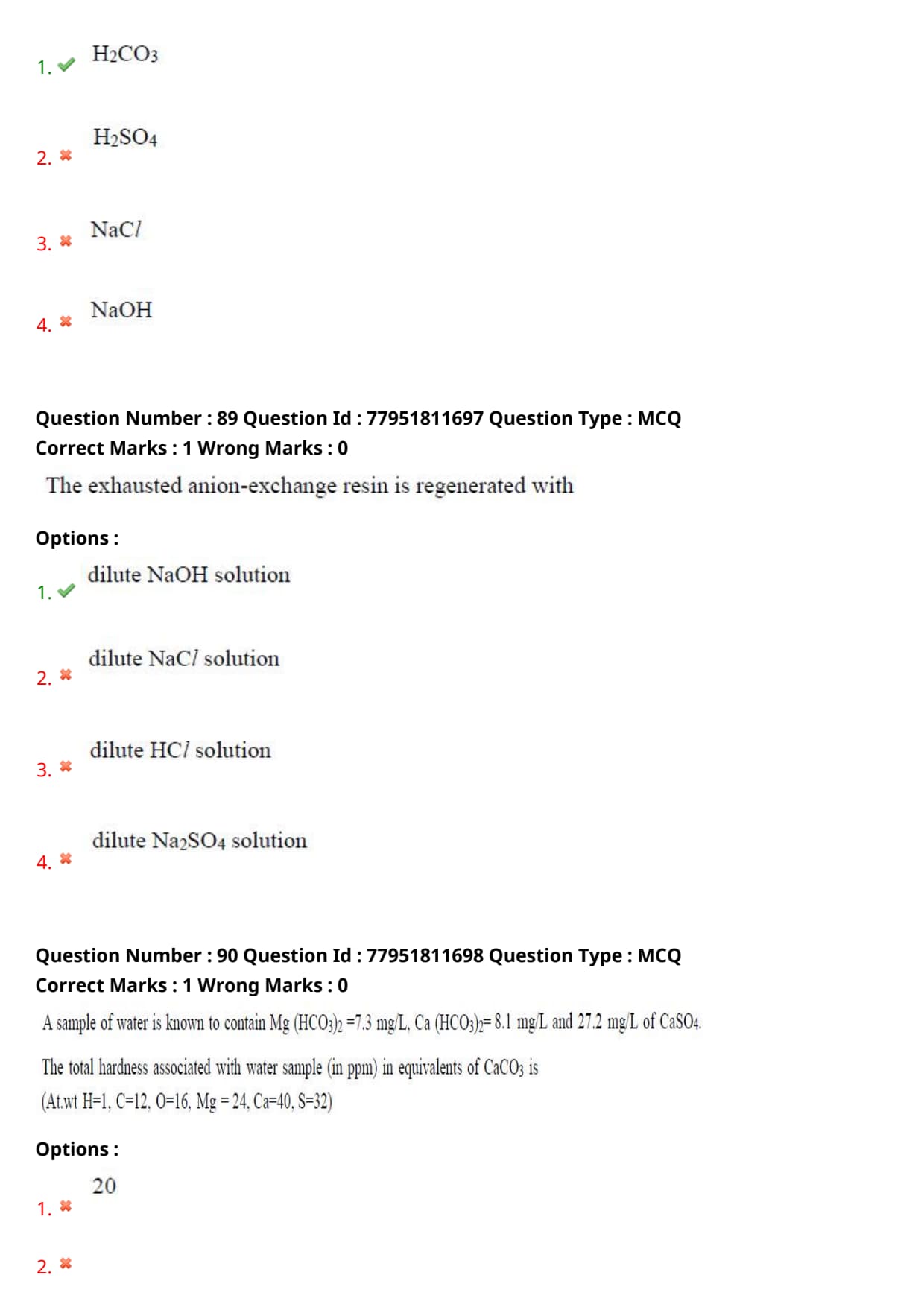
Question 88:
Which of the following is a weak electrolyte?
- (A) \(H_2CO_3\)
- (B) \(H_2SO_4\)
- (C) \(NaCl\)
- (D) \(NaOH\)
Question 89:
The exhausted anion-exchange resin is regenerated with
- (A) dilute \(NaOH\) solution
- (B) dilute \(NaCl\) solution
- (C) dilute \(HCl\) solution
- (D) dilute \(Na_2SO_4\) solution
Question 90:
A sample of water is known to contain \(Mg(HCO_3)_2=7.3\ mg/L\), \(Ca(HCO_3)_2=8.1\ mg/L\), and \(27.2\ mg/L\) of \(CaSO_4\). The total hardness associated with water sample in ppm in equivalents of \(CaCO_3\) is \[ (At.wt. H=1,\ C=12,\ O=16,\ Mg=24,\ Ca=40,\ S=32) \]
- (A) \(20\)
- (B) \(25\)
- (C) \(30\)
- (D) \(40\)
Question 91:
The type of functional group associated with cation exchange resin is
- (A) \(-OH\)
- (B) \(-SO_3H\)
- (C) \(-NH_2\)
- (D) \(-CHO\)
Question 92:
Identify the incorrect statement about the corrosion.
- (A) In the composition type of galvanic cell, metal with lower standard reduction potential undergoes corrosion
- (B) In stress cell type of galvanic cell, corrosion occurs at the stressed area of the metal
- (C) The rate of corrosion is more, when the area of cathode is smaller
- (D) In concentration cell type of galvanic cell, the metal below the water level undergoes corrosion readily
Question 93:
In galvanised iron
- (A) Zn acts as anode and Fe acts as cathode
- (B) Zn acts as cathode and Fe acts as anode
- (C) Sn acts as anode and Fe acts as cathode
- (D) Sn acts as cathode and Fe acts as anode
Question 94:
During vulcanization of raw rubber, the chemical added to it is
- (A) Sulphur
- (B) Phosphorus
- (C) Iodine
- (D) Sodium
Question 95:
Which of the following is a natural polymer?
- (A) Cellulose
- (B) Teflon
- (C) Polyvinylchloride
- (D) Neoprene rubber
Question 96:
The structure of Buna-S polymer is
- (A) \(\left[-CH_2-CH=CH-CH_2-CH(C_6H_5)-CH_2-\right]_n\)
- (B) \(\left[-CH_2-CH=CH-CH_2-CH(CN)-CH_2-\right]_n\)
- (C) \(\left[-CH_2-C(Cl)=CH-CH_2-\right]_n\)
- (D) \(\left[-NH-CO-NH-CH_2-\right]_n\)
Question 97:
The polymer used in making gaskets and non-stick coating utensils is
- (A) Polyvinyl chloride
- (B) Polystyrene
- (C) Polytetrafluoroethylene
- (D) Polythene
Question 98:
Which of the following is not to be considered as a primary fuel?
- (A) Wood
- (B) Petroleum
- (C) Coke
- (D) Coal
Question 99:
The oxide of nitrogen responsible for depletion of ozone layer is
- (A) \(N_2O\)
- (B) \(NO_2\)
- (C) \(NO\)
- (D) \(N_2O_3\)
Question 100:
The BOD of highly polluted water is
- (A) \(17\ ppm\)
- (B) \(10\ ppm\)
- (C) \(8\ ppm\)
- (D) \(12\ ppm\)
Question 101:
Ohm's law states that
- (A) Current is directly proportional to resistance
- (B) Current is directly proportional to voltage
- (C) Current is inversely proportional to voltage
- (D) Resistance is directly proportional to current
Question 102:
The unit of electrical resistance is
- (A) Ampere
- (B) Volt
- (C) Ohm
- (D) Watt
Question 103:
Kirchhoff's current law is based on the conservation of
- (A) Energy
- (B) Charge
- (C) Momentum
- (D) Power
Question 104:
Kirchhoff's voltage law is based on the conservation of
- (A) Charge
- (B) Energy
- (C) Current
- (D) Resistance
Question 105:
The material having nearly zero temperature coefficient of resistance is
- (A) Copper
- (B) Aluminium
- (C) Manganin
- (D) Carbon
Question 106:
The reciprocal of resistance is called
- (A) Conductance
- (B) Reactance
- (C) Impedance
- (D) Susceptance
Question 107:
The dielectric material between the plates of a capacitor is
- (A) Copper
- (B) Aluminium
- (C) Iron
- (D) Insulating material
Question 108:
In a capacitor, energy is stored in the form of
- (A) Magnetic field
- (B) Electric field
- (C) Heat energy
- (D) Mechanical energy
Question 109:
The equivalent capacitance of capacitors connected in parallel is
- (A) Less than the smallest capacitance
- (B) Equal to the reciprocal sum
- (C) Sum of individual capacitances
- (D) Zero
Question 110:
The equivalent capacitance of capacitors connected in series is
- (A) \(C_1+C_2+C_3\)
- (B) \(\frac{1}{C_1}+\frac{1}{C_2}+\frac{1}{C_3}\)
- (C) \(\frac{1}{C_{eq}}=\frac{1}{C_1}+\frac{1}{C_2}+\frac{1}{C_3}\)
- (D) Greater than the largest capacitance
Question 111:
The unit of inductance is
- (A) Henry
- (B) Farad
- (C) Ohm
- (D) Weber
Question 112:
Energy stored in an inductor is given by
- (A) \(\frac{1}{2}CV^2\)
- (B) \(\frac{1}{2}LI^2\)
- (C) \(VI\)
- (D) \(I^2R\)
Question 113:
The opposition offered by an inductor to alternating current is called
- (A) Resistance
- (B) Capacitive reactance
- (C) Inductive reactance
- (D) Conductance
Question 114:
The opposition offered by a capacitor to alternating current is called
- (A) Capacitive reactance
- (B) Inductive reactance
- (C) Resistance
- (D) Conductance
Question 115:
In a purely inductive circuit, current
- (A) Leads voltage by \(90^\circ\)
- (B) Lags voltage by \(90^\circ\)
- (C) Is in phase with voltage
- (D) Leads voltage by \(180^\circ\)
Question 116:
In a purely capacitive circuit, current
- (A) Lags voltage by \(90^\circ\)
- (B) Leads voltage by \(90^\circ\)
- (C) Is in phase with voltage
- (D) Is zero
Question 117:
The power factor of a purely resistive AC circuit is
- (A) Zero
- (B) Unity
- (C) Lagging
- (D) Leading
Question 118:
The power factor of a purely inductive circuit is
- (A) Unity
- (B) Zero lagging
- (C) Zero leading
- (D) One leading
Question 119:
The power factor of a purely capacitive circuit is
- (A) Unity
- (B) Zero lagging
- (C) Zero leading
- (D) One lagging
Question 120:
At resonance in a series RLC circuit, the impedance is
- (A) Maximum
- (B) Minimum
- (C) Infinite
- (D) Zero
Question 121:
At resonance in a series RLC circuit, current is
- (A) Minimum
- (B) Maximum
- (C) Zero
- (D) Infinite always
Question 122:
The resonant frequency of a series RLC circuit is
- (A) \(\frac{1}{2\pi LC}\)
- (B) \(\frac{1}{2\pi\sqrt{LC}}\)
- (C) \(2\pi\sqrt{LC}\)
- (D) \(\frac{L}{C}\)
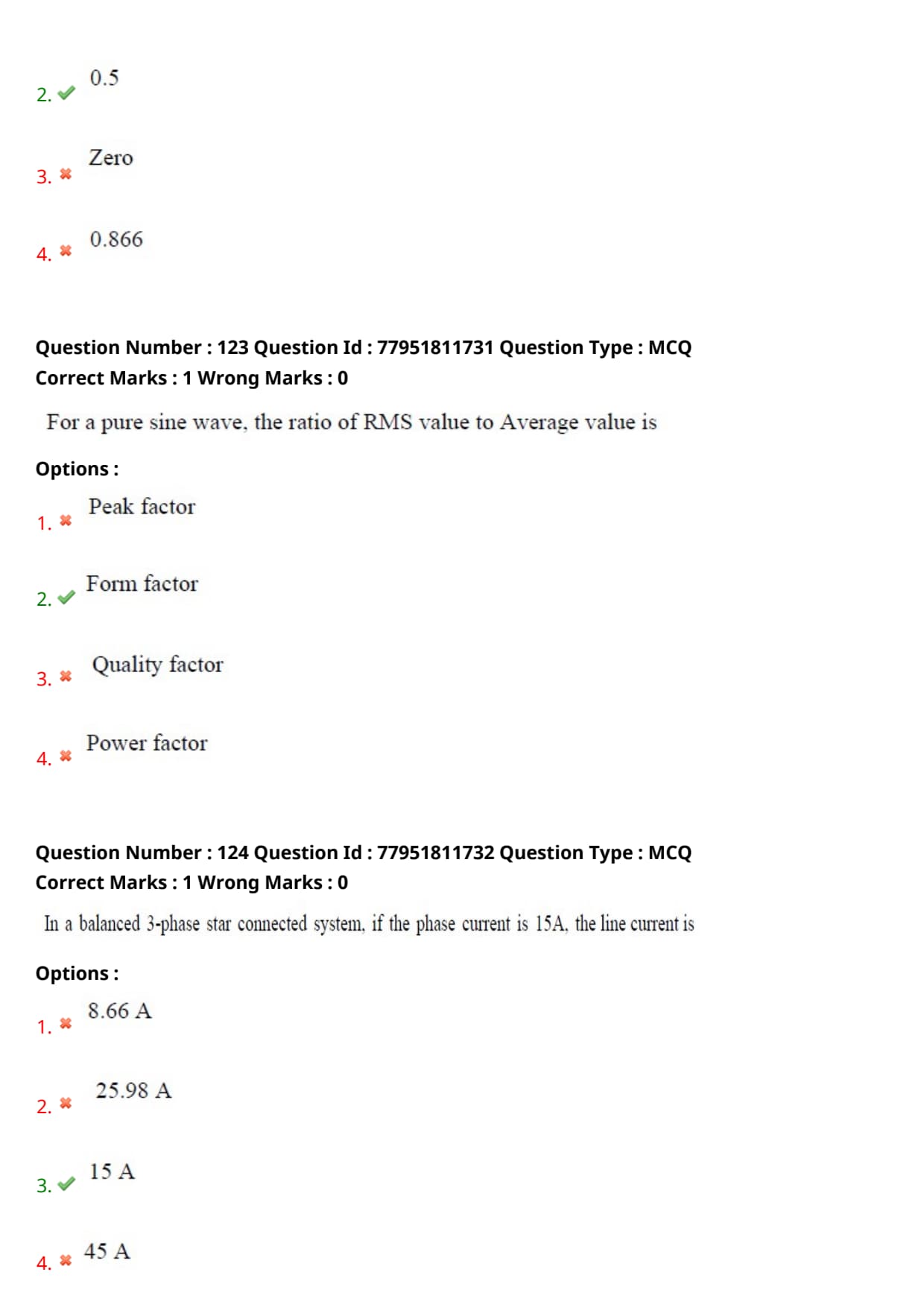
Question 123:
The form factor of a sinusoidal alternating current is
- (A) \(1.11\)
- (B) \(1.414\)
- (C) \(0.707\)
- (D) \(0.637\)
Question 124:
The peak factor of a sinusoidal alternating current is
- (A) \(1.11\)
- (B) \(1.414\)
- (C) \(0.707\)
- (D) \(0.637\)
Question 125:
The average value of a sinusoidal alternating current over one complete cycle is
- (A) Maximum value
- (B) RMS value
- (C) Zero
- (D) Half of maximum value
Question 126:
The RMS value of a sinusoidal alternating current is
- (A) \(0.637I_m\)
- (B) \(0.707I_m\)
- (C) \(1.414I_m\)
- (D) \(I_m\)
Question 127:
The average value of sinusoidal alternating current over half cycle is
- (A) \(0.637I_m\)
- (B) \(0.707I_m\)
- (C) \(1.414I_m\)
- (D) Zero
Question 128:
In a three-phase balanced system, the phase difference between any two phases is
- (A) \(60^\circ\)
- (B) \(90^\circ\)
- (C) \(120^\circ\)
- (D) \(180^\circ\)
Question 129:
In star connection, line voltage is related to phase voltage as
- (A) \(V_L=V_{ph}\)
- (B) \(V_L=\sqrt3V_{ph}\)
- (C) \(V_{ph}=\sqrt3V_L\)
- (D) \(V_L=3V_{ph}\)
Question 130:
In delta connection, line current is related to phase current as
- (A) \(I_L=I_{ph}\)
- (B) \(I_L=\sqrt3I_{ph}\)
- (C) \(I_{ph}=\sqrt3I_L\)
- (D) \(I_L=3I_{ph}\)
Question 131:
What is the major disadvantage of an auto transformer?
- (A) High cost
- (B) Low efficiency
- (C) Lack of electrical isolation between primary and secondary
- (D) Very heavy weight
Question 132:
If an alternator has a flux per pole of \(0.05\ Wb\), a frequency of \(50\ Hz\), and \(100\) turns per phase (assume pitch factor and distribution factor is \(1\)), the RMS phase emf is approximately
- (A) \(222\ V\)
- (B) \(1110\ V\)
- (C) \(555\ V\)
- (D) \(444\ V\)
Question 133:
Which method provides the most accurate results for the voltage regulation of a non-salient pole alternator?
- (A) EMF method
- (B) MMF method
- (C) Poitier Triangle method
- (D) Direct loading test
Question 134:
Two alternators A and B are in parallel. Alternator A is adjusted to have a leading power factor. This will cause Alternator B to
- (A) Also have a leading power factor
- (B) Have a lagging power factor
- (C) Stop rotating
- (D) Carry zero current
Question 135:
A Synchronous motor used specifically for power factor correction (running at no load and over excited) is called a
- (A) Synchronous generator
- (B) Synchronous condenser
- (C) Induction generator
- (D) Variable speed drive
Question 136:
In the V-curve of a Synchronous motor, the minimum point of the curve corresponds to
- (A) Lagging power factor
- (B) Unity power factor
- (C) Minimum speed
- (D) Leading power factor
Question 137:
What is a Pony motor in the context of starting a Synchronous motor?
- (A) A motor that runs on DC only
- (B) A small auxiliary motor used to bring the main motor up to speed
- (C) The main cooling fan
- (D) A motor used to reverse the direction
Question 138:
A motor has synchronous speed of \(1000\ rpm\) and runs at \(950\ rpm\). If the torque at this slip is \(10\ Nm\). What is the torque if the slip is doubled? (assume low slip region)
- (A) \(5\ Nm\)
- (B) \(10\ Nm\)
- (C) \(20\ Nm\)
- (D) \(40\ Nm\)
Question 139:
In an Induction motor, the rotor copper loss is equal to
- (A) Slip \(\times\) rotor input power
- (B) \((1-slip)\times\) rotor input power
- (C) Rotor input power/slip
- (D) Slip\(^2\times\) rotor input power
Question 140:
The pole changing method of speed control is only applicable to which type of motor?
- (A) Slip ring induction motor
- (B) Squirrel cage induction motor
- (C) Synchronous motor
- (D) DC shunt motor
Question 141:
Regenerative braking occurs only when the motor speed \(N\)
- (A) Is less than the synchronous speed
- (B) Is greater than the synchronous speed
- (C) Is exactly equal to synchronous speed
- (D) Is zero
Question 142:
A single phase induction motor is
- (A) Inherently self-starting
- (B) Not inherently self-starting
- (C) Self-starting only at high voltages
- (D) Always started by a DC motor
Question 143:
A universal motor is designed to operate on
- (A) DC supply only
- (B) AC supply only
- (C) Both AC and DC supply
- (D) 3-phase supply only
Question 144:
In a BLDC motor, the windings are placed on the
- (A) Rotor
- (B) Stator
- (C) Shaft
- (D) Commutator
Question 145:
The number of pulses applied to a Stepper motor determines the
- (A) Speed of rotation
- (B) Torque produced
- (C) Total angle or distance of rotation
- (D) Direction of rotation
Question 146:
Which type of generating station is best suited for peak load operation due to its quick starting ability?
- (A) Nuclear power plant
- (B) Gas turbine power plant
- (C) Thermal power plant
- (D) Solar power plant
Question 147:
Which of the following is a byproduct of coal combination that can be repurposed by the construction industry?
- (A) Flue gas
- (B) Fly ash
- (C) Nitrogen oxide
- (D) Sludge
Question 148:
If the area under a \(24\) hour daily load curve is \(480\ MWh\). The average load for that day is
- (A) \(10\ MW\)
- (B) \(20\ MW\)
- (C) \(40\ MW\)
- (D) \(480\ MW\)
Question 149:
Which tariff is most suitable for industrial consumers with a significant reactive power load?
- (A) Flat rate tariff
- (B) Block rate tariff
- (C) Maximum demand tariff
- (D) KVA maximum demand tariff
Question 150:
A factory has a load of \(400\ kW\) at a power factor of \(0.8\) lagging. If the power factor is to be improved to unity, the required KVAR of the capacitor bank is
- (A) \(400\ KVAR\)
- (B) \(300\ KVAR\)
- (C) \(500\ KVAR\)
- (D) \(100\ KVAR\)
Question 151:
Which circuit breaker is preferred for high voltage up to \(765\ kV\) and extra high voltage system?
- (A) Vacuum Circuit Breaker (VCB)
- (B) Air Circuit Breaker
- (C) \(SF_6\) Circuit Breaker
- (D) Miniature Circuit Breaker (MCB)
Question 152:
Why are current limiting reactors usually ``Air-cored'' rather than ``Iron-cored''?
- (A) To reduce weight
- (B) To improve cooling
- (C) To avoid magnetic saturation during heavy fault currents
- (D) To decrease the cost of iron
Question 153:
Which type of distance relay is inherently ``directional'' and does not require an additional directional unit?
- (A) Impedance relay
- (B) Reactance relay
- (C) MHO relay
- (D) Plain offset relay
Question 154:
Bus bar protection is usually not provided for which type of system?
- (A) Extra high voltage systems
- (B) Small distribution substation
- (C) Power house bus bars
- (D) \(132\ kV\) substations
Question 155:
Which type of lightning arrester is also known as a ``Surge Diverter''?
- (A) Rod gap
- (B) Horn gap
- (C) Expulsion type
- (D) Valve type
Question 156:
If the radius of a conductor in a transmission line is doubled while keeping spacing constant, the inductance of the line will
- (A) Increase
- (B) Decrease
- (C) Remain unchanged
- (D) Double
Question 157:
The sending end voltage of a line is \(33\ kV\) and the receiving end voltage is \(30\ kV\). The voltage regulation of the line is
- (A) \(3%\)
- (B) \(5%\)
- (C) \(10%\)
- (D) \(11%\)
Question 158:
A long transmission line is energized at the sending end but kept open circuited at the receiving end. If the sending end voltage is \(100\ kV\), the receiving end voltage is likely to be
- (A) \(90\ kV\)
- (B) \(100\ kV\)
- (C) \(105\ kV\)
- (D) \(0\ kV\)
Question 159:
What happens to the corona effect if the spacing between conductors is increased?
- (A) Corona increases
- (B) Corona decreases
- (C) Corona is absent
- (D) No effect
Question 160:
The converter used at the sending end of an HVDC system acts as a
- (A) Inverter
- (B) Rectifier
- (C) Cycloconverter
- (D) Chopper
Question 161:
If the length of the span between two level supports is increased by \(20%\), the sag will increase by approximately
- (A) \(20%\)
- (B) \(40%\)
- (C) \(44%\)
- (D) \(50%\)
Question 162:
A string of \(3\) discs can withstand a total voltage of \(25.76\ kV\). If each unit can individually withstand a maximum of \(11\ kV\), then the string efficiency is
- (A) \(68.75%\)
- (B) \(65%\)
- (C) \(78%\)
- (D) \(85%\)
Question 163:
A \(10\ km\) long cable has an insulation resistance of \(2\ M\Omega\). What will be the insulation resistance for a \(50\ km\) length of the same cable?
- (A) \(10\ M\Omega\)
- (B) \(0.4\ M\Omega\)
- (C) \(0.2\ M\Omega\)
- (D) \(1\ M\Omega\)
Question 164:
In a substation Single Line Diagram (SLD), which equipment is typically placed closest to the incoming line?
- (A) Circuit breaker
- (B) Current transformer
- (C) Surge arrester
- (D) Power transformer
Question 165:
A single phase AC distributor has a total resistance of \(0.2\ \Omega\) and a reactance of \(0.3\ \Omega\). If the load current is \(100\ A\) at \(0.8\) p.f. lagging, the approximate voltage drop is
- (A) \(16\ V\)
- (B) \(34\ V\)
- (C) \(50\ V\)
- (D) \(25\ V\)
Question 166:
Which of the following is the standard electrification system used by Indian railways for mainline trains?
- (A) \(1500\ V DC\)
- (B) \(33\ kV AC,\ 50\ Hz\)
- (C) \(25\ kV AC,\ 50\ Hz\)
- (D) \(11\ kV DC\)
Question 167:
The distance between two stops is \(5\ km\), the average speed is \(50\ km/h\), and the stop time is \(2\) minutes. Find the scheduled speed.
- (A) \(37.5\ km/h\)
- (B) \(42.5\ km/h\)
- (C) \(30\ km/h\)
- (D) \(50\ km/h\)
Question 168:
The unit of Specific Energy Consumption (SEC) is
- (A) Watt-hours
- (B) \(kWh/km\)
- (C) Watt hours/\((tonne-km)\)
- (D) Joules/Tonne
Question 169:
A compressor in an electric locomotive is driven by an auxiliary motor to provide air for
- (A) Air conditioning only
- (B) Air brakes, horns, and sanders
- (C) Turbine rotation
- (D) Pantograph lowering only
Question 170:
In which type of wiring system is highly skilled labor required?
- (A) Cleat wiring
- (B) Casing--Capping wiring
- (C) Conduit wiring
- (D) Batten wiring
Question 171:
A fuse in domestic wiring is always connected in the
- (A) Neutral wire
- (B) Earth wire
- (C) Live wire
- (D) Both neutral and earth wire
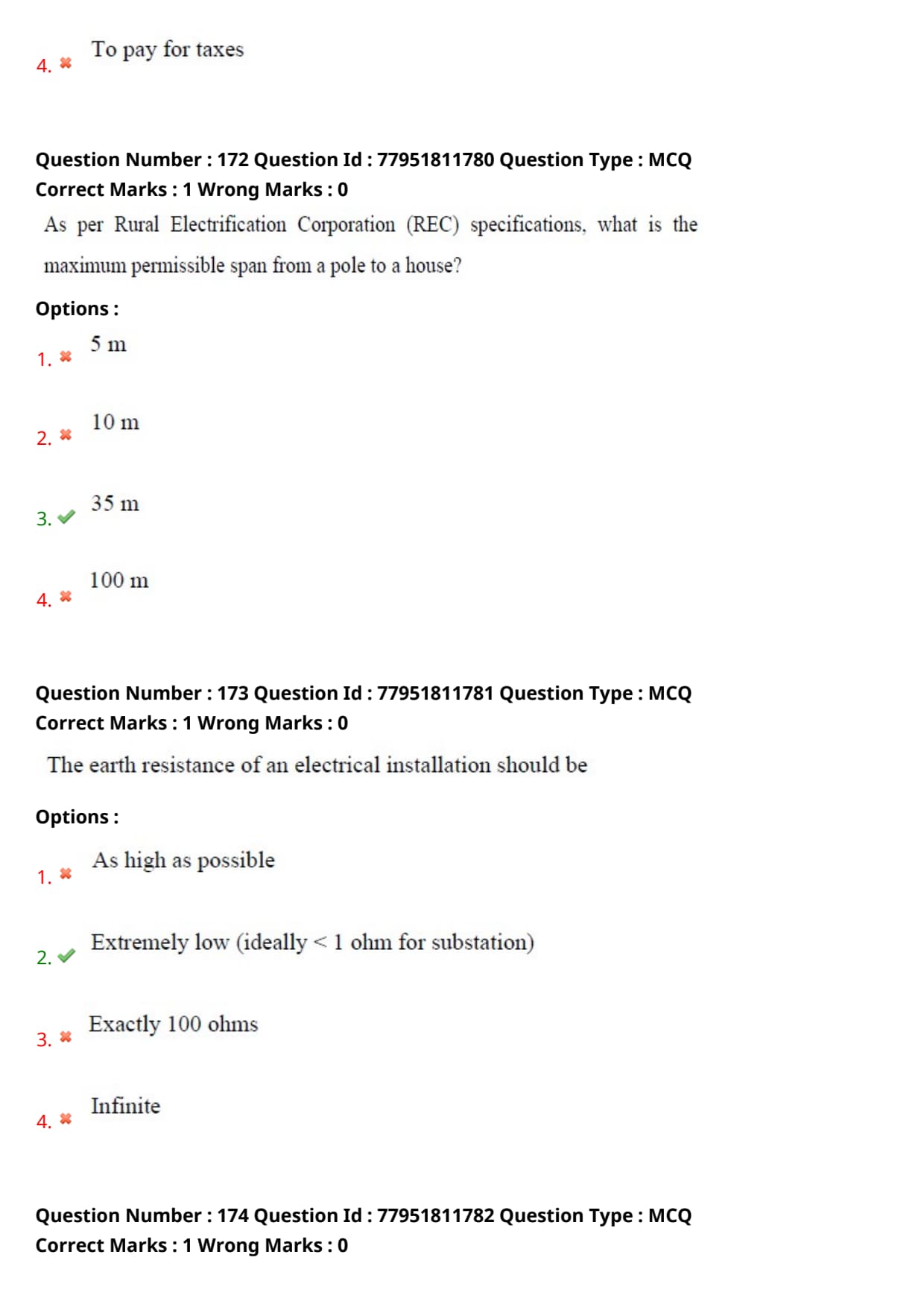
Question 172:
The main purpose of earthing in electrical installation is
- (A) To increase voltage
- (B) To reduce power consumption
- (C) To provide safety against electric shock
- (D) To increase current rating
Question 173:
Which type of earthing is commonly used in domestic installations?
- (A) Plate earthing
- (B) Pipe earthing
- (C) Rod earthing only
- (D) Strip earthing only
Question 174:
In an NPN transistor, the region which is heavily doped is
- (A) Collector
- (B) Base
- (C) Emitter
- (D) Substrate
Question 175:
In a common emitter transistor configuration, the current gain \(\beta\) is given by
- (A) \(\frac{I_B}{I_C}\)
- (B) \(\frac{I_C}{I_B}\)
- (C) \(\frac{I_E}{I_C}\)
- (D) \(\frac{I_C}{I_E}\)
Question 176:
Lissajous patterns on a CRO are used to measure
- (A) Voltage and current only
- (B) Frequency and phase difference
- (C) Resistance and inductance
- (D) Power factor only
Question 177:
In a CRO, focusing of the electron beam is done by
- (A) Deflection plates
- (B) Fluorescent screen
- (C) Focusing anode
- (D) Time base generator
Question 178:
The instrument used to measure power factor directly is
- (A) Wattmeter
- (B) Ammeter
- (C) Voltmeter
- (D) Power factor meter
Question 179:
The scale of a PMMC instrument is
- (A) Non-uniform
- (B) Uniform
- (C) Logarithmic
- (D) Exponential
Question 180:
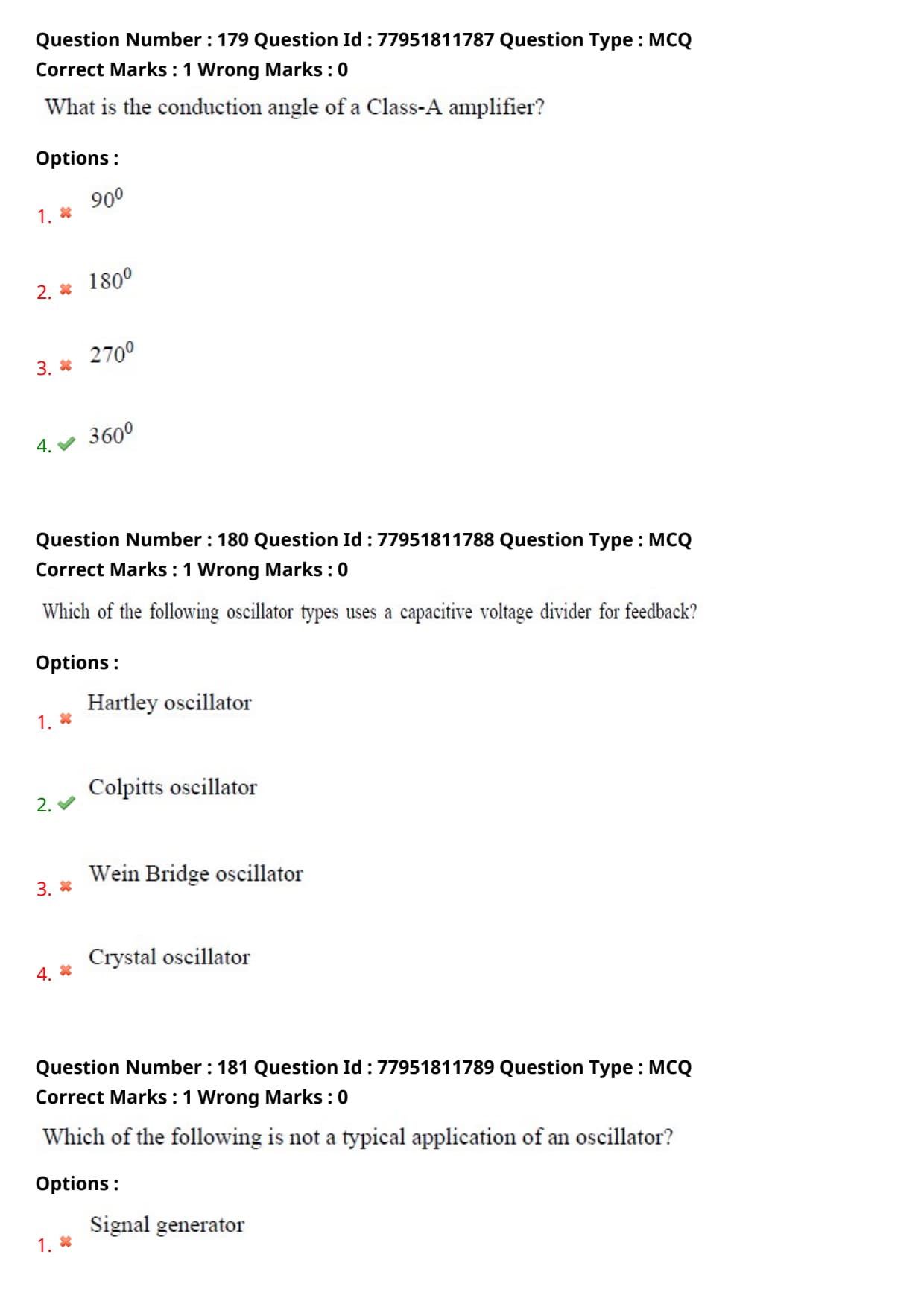
An oscillator circuit is used to
- (A) Convert AC into DC
- (B) Generate sustained AC signal
- (C) Measure resistance
- (D) Store charge
Question 181:
Which of the following is not a typical application of an oscillator?
- (A) Signal generator
- (B) Radio transmitter
- (C) Rectifier
- (D) Digital clock
Question 182:
The basic function of an oscillator is to
- (A) Amplify DC signal
- (B) Generate alternating waveform
- (C) Convert DC to fixed resistance
- (D) Measure voltage only
Question 183:
Which oscillator gives very high frequency stability?
- (A) RC phase shift oscillator
- (B) Hartley oscillator
- (C) Wien bridge oscillator
- (D) Crystal oscillator
Question 184:
In an RC phase shift oscillator, the feedback network provides a phase shift of
- (A) \(90^\circ\)
- (B) \(180^\circ\)
- (C) \(270^\circ\)
- (D) \(360^\circ\)
Question 185:
Wien bridge oscillator is commonly used for
- (A) RF signal generation
- (B) Audio frequency generation
- (C) Rectification
- (D) Voltage regulation
Question 186:
Crystal oscillator is preferred because it offers
- (A) Low efficiency
- (B) High frequency stability
- (C) High noise
- (D) Poor selectivity
Question 187:
In Boolean algebra, \(A+AB\) is equal to
- (A) \(A\)
- (B) \(B\)
- (C) \(AB\)
- (D) \(A+B\)
Question 188:
According to De Morgan's theorem, \(\overline{A+B}\) is equal to
- (A) \(\overline{A}+\overline{B}\)
- (B) \(\overline{A}\,\overline{B}\)
- (C) \(AB\)
- (D) \(A+B\)
Question 189:
For a half adder, the Sum and Carry outputs are respectively
- (A) \(A+B,\ AB\)
- (B) \(A\oplus B,\ AB\)
- (C) \(AB,\ A+B\)
- (D) \(A\oplus B,\ A+B\)
Question 190:
A flip-flop is used to store
- (A) One bit of data
- (B) One byte of data
- (C) One word of data
- (D) Analog signal only
Question 191:
The BCD representation of decimal number \(9\) is
- (A) \(1000\)
- (B) \(1001\)
- (C) \(1010\)
- (D) \(1111\)
Question 192:
The output of a NAND gate is zero when
- (A) All inputs are zero
- (B) Any one input is zero
- (C) All inputs are one
- (D) Inputs are unequal
Question 193:
A PN junction diode conducts current when it is
- (A) Reverse biased
- (B) Forward biased
- (C) Unbiased
- (D) Open circuited
Question 194:
A Zener diode is mainly used as a
- (A) Rectifier
- (B) Voltage regulator
- (C) Amplifier
- (D) Oscillator
Question 195:
A rectifier converts
- (A) DC into AC
- (B) AC into DC
- (C) AC into AC only
- (D) DC into DC only
Question 196:
A bridge rectifier uses how many diodes?
- (A) \(1\)
- (B) \(2\)
- (C) \(3\)
- (D) \(4\)
Question 197:
The ripple factor of a full-wave rectifier is approximately
- (A) \(1.21\)
- (B) \(0.482\)
- (C) \(0.707\)
- (D) \(1.11\)
Question 198:
When a transistor is used as a switch, it operates in
- (A) Active region only
- (B) Cut-off and saturation regions
- (C) Breakdown region only
- (D) Inverse active region only
Question 199:
The input impedance of an ideal operational amplifier is
- (A) Zero
- (B) Very low
- (C) Infinite
- (D) Equal to output impedance
Question 200:
The IC \(555\) is commonly used as a
- (A) Timer
- (B) Transformer
- (C) Rectifier diode
- (D) Inductor
AP ECET 2026 Exam Pattern
| Subjects |
Maximum Questions |
Maximum Marks |
| Physics |
25 |
25 |
| Chemistry |
25 |
25 |
| Mathematics |
50 |
50 |
| Engineering Branch |
100 |
100 |
| Total |
200 |
200 |
AP ECET 2026 Final Tips
























Comments