AP ECET 2026 Ceramic Technology Question Paper is available for download here. JNTU Anantapur on behalf of APSCHE conducted AP ECET 2026 Ceramic Technology exam on April 23 in Shift 1 from 9 AM to 12 PM. AP ECET is a state-level entrance exam conducted online for Diploma Holders and for B.Sc Holders and for admission into lateral entry for Engineering Courses.
- AP ECET Engineering Question Paper consists of 200 questions divided into 4 sections- Mathematics (50 questions), Physics (25 questions), Chemistry (25 questions) and Engineering Domain Specific (100 questions).
- Each correct answer answer carries 1 mark and there is no negative marking for incorrect answer.
Candidates can download AP ECET 2026 Ceramic Technology Question Paper with Answer Key and Solution PDF from the links provided below.
AP ECET 2026 Ceramic Technology Question Paper with Solutions
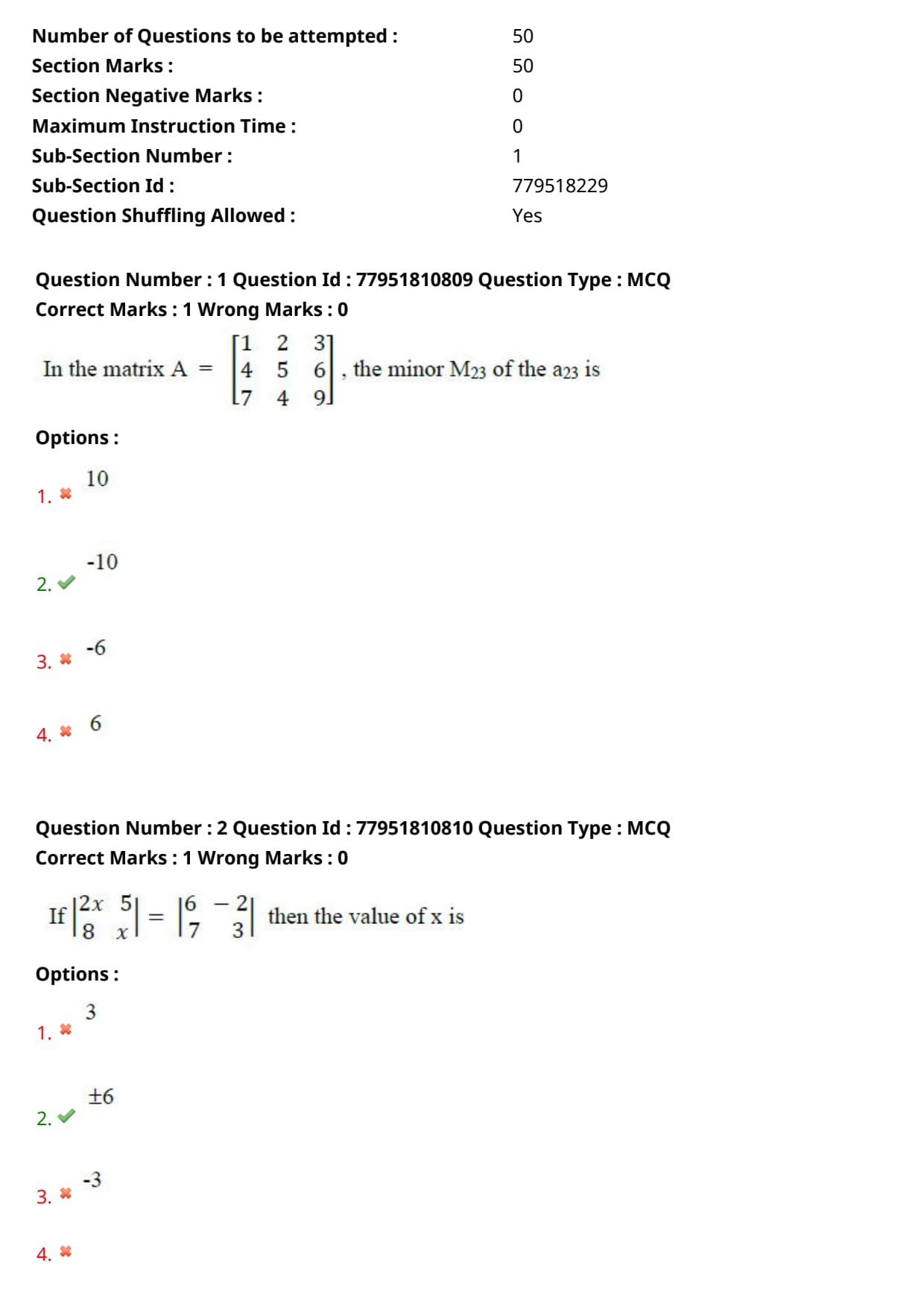
Question 1:
In the matrix \[ A=\begin{bmatrix} 1 & 2 & 3 \\
4 & 5 & 6 \\
7 & 4 & 9 \end{bmatrix}, \]
the minor \(M_{23}\) of the element \(a_{23}\) is:
- (A) \(10\)
- (B) \(-10\)
- (C) \(-6\)
- (D) \(6\)
Question 2:
If \[ \left|\begin{matrix} 2x & 5 \\
8 & x \end{matrix}\right| = \left|\begin{matrix} 6 & -2 \\
7 & 3 \end{matrix}\right|, \]
then the value of \(x\) is:
- (A) \(3\)
- (B) \(\pm 6\)
- (C) \(-3\)
- (D) \(\pm 2\)
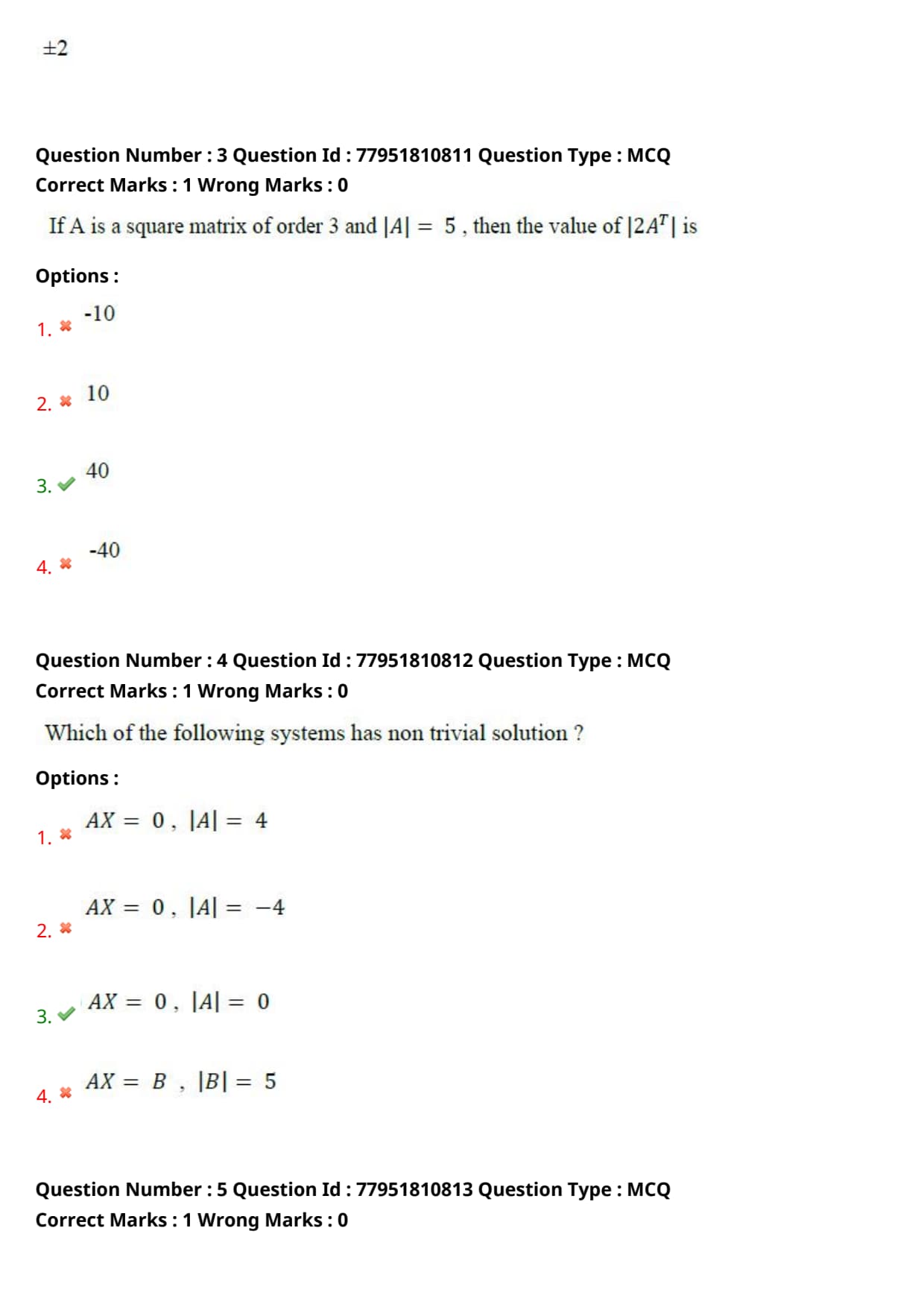
Question 3:
If \(A\) is a square matrix of order \(3\) and \(|A|=5\), then the value of \(\left|2A^T\right|\) is:
- (A) \(-10\)
- (B) \(10\)
- (C) \(40\)
- (D) \(-40\)
Question 4:
Which of the following systems has non-trivial solution?
- (A) \(AX=0,\ |A|=4\)
- (B) \(AX=0,\ |A|=-4\)
- (C) \(AX=0,\ |A|=0\)
- (D) \(AX=B,\ |B|=5\)
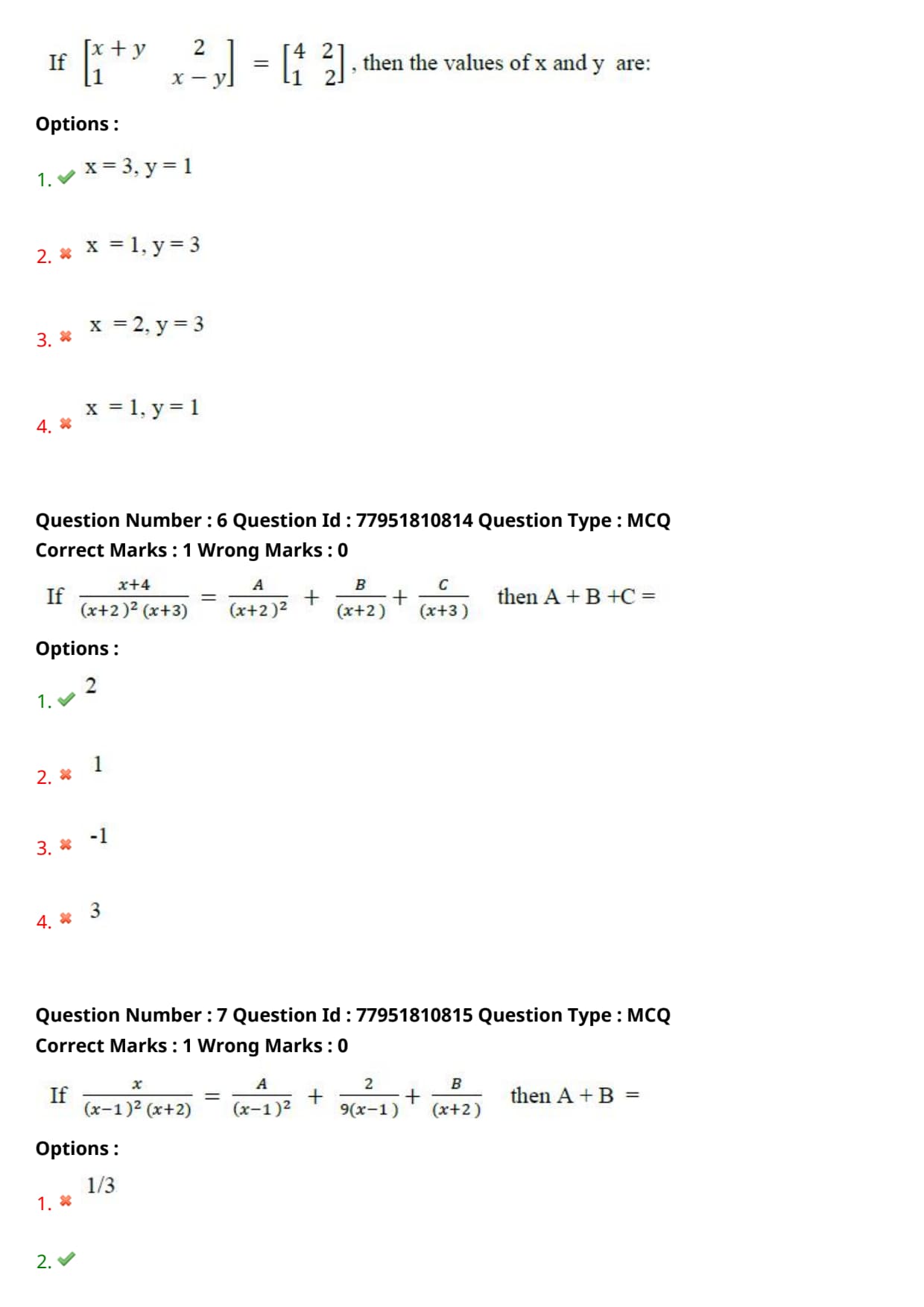
Question 5:
If \[ \begin{bmatrix} x+y & 2 \\
1 & x-y \end{bmatrix} = \begin{bmatrix} 4 & 2 \\
1 & 2 \end{bmatrix}, \]
then the values of \(x\) and \(y\) are:
- (A) \(x=3,\ y=1\)
- (B) \(x=1,\ y=3\)
- (C) \(x=2,\ y=3\)
- (D) \(x=1,\ y=1\)
Question 6:
If \[ \frac{x+4}{(x+2)^2(x+3)} = \frac{A}{(x+2)^2} + \frac{B}{x+2} + \frac{C}{x+3}, \]
then \(A+B+C=\)
- (A) \(2\)
- (B) \(1\)
- (C) \(-1\)
- (D) \(3\)
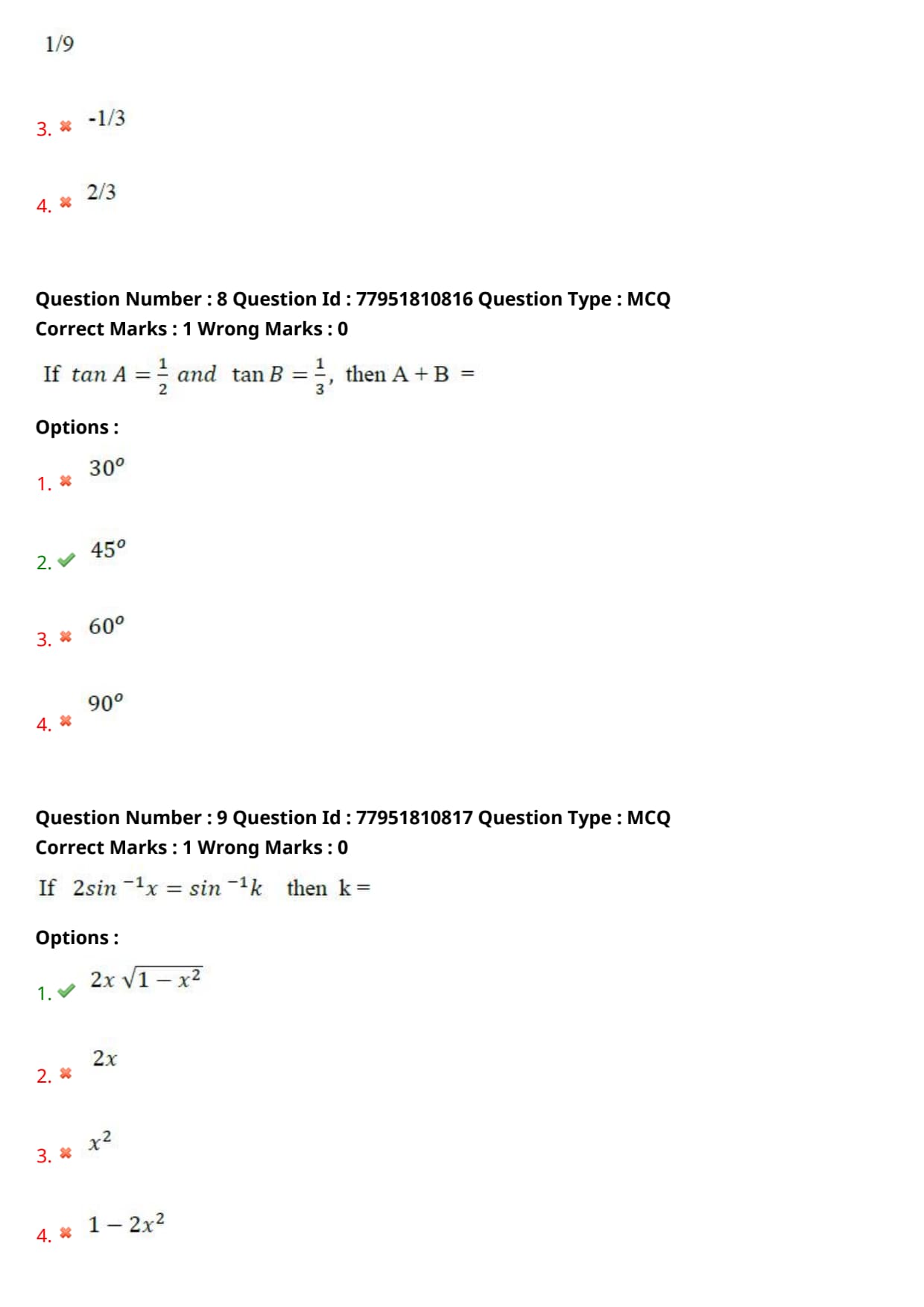
Question 7:
If \[ \frac{x}{(x-1)^2(x+2)} = \frac{A}{(x-1)^2} + \frac{2}{9(x-1)} + \frac{B}{x+2}, \]
then \(A+B=\)
- (A) \(\frac{1}{3}\)
- (B) \(\frac{1}{9}\)
- (C) \(-\frac{1}{3}\)
- (D) \(\frac{2}{3}\)
Question 8:
If \(\tan A=\frac{1}{2}\) and \(\tan B=\frac{1}{3}\), then \(A+B=\)
- (A) \(30°\)
- (B) \(45°\)
- (C) \(60°\)
- (D) \(90°\)
Question 9:
If \(2\sin^{-1}x=\sin^{-1}k\), then \(k=\)
- (A) \(2x\sqrt{1-x^2}\)
- (B) \(2x\)
- (C) \(x^2\)
- (D) \(1-2x^2\)
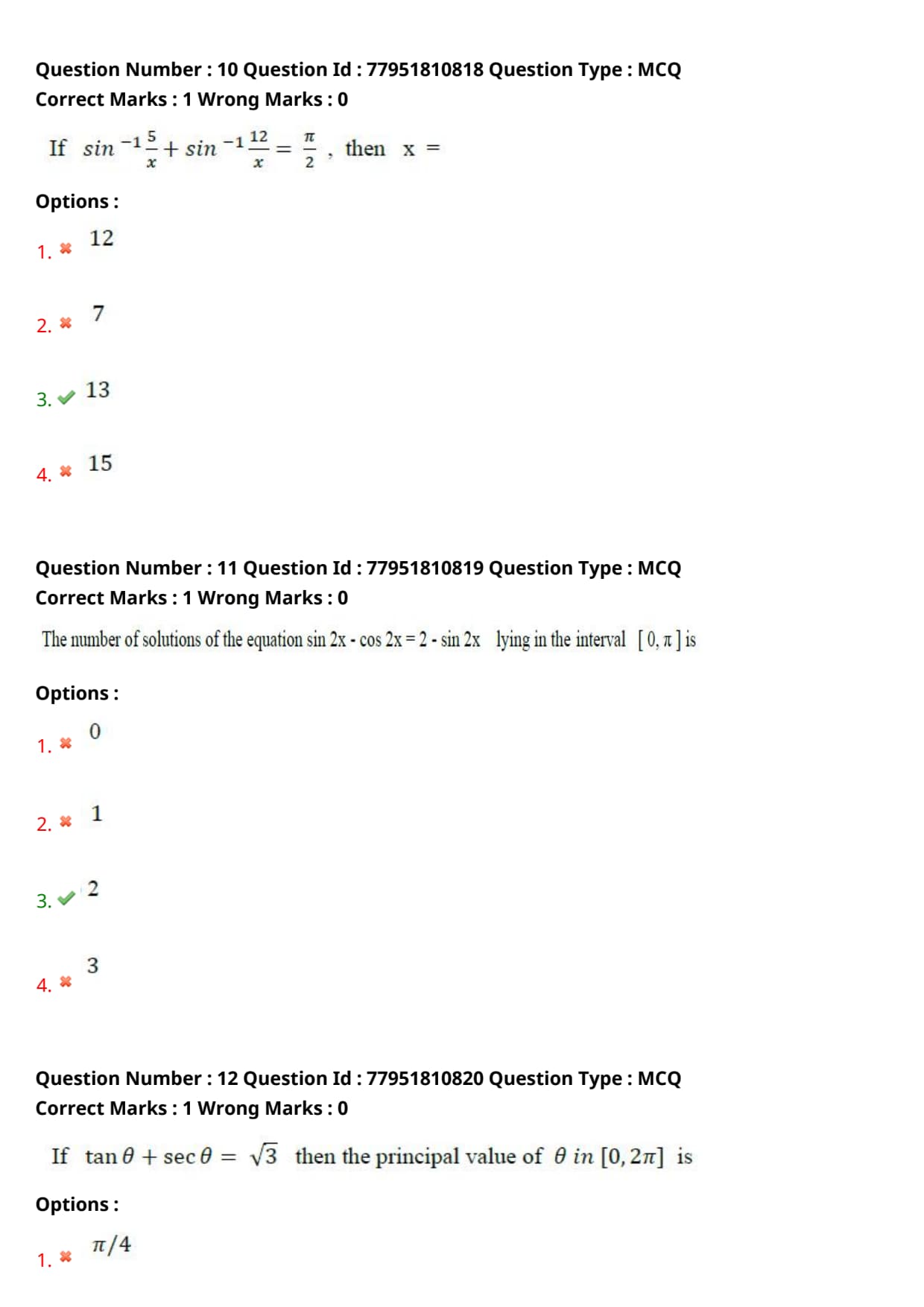
Question 10:
If \[ \sin^{-1}\frac{5}{x}+\sin^{-1}\frac{12}{x}=\frac{\pi}{2}, \]
then \(x=\)
- (A) \(12\)
- (B) \(7\)
- (C) \(13\)
- (D) \(15\)
Question 11:
The number of solutions of the equation \( \sin 2x-\cos 2x=2-\sin 2x \) lying in the interval \( [0,\pi] \) is
- (A) \(0\)
- (B) \(1\)
- (C) \(2\)
- (D) \(3\)
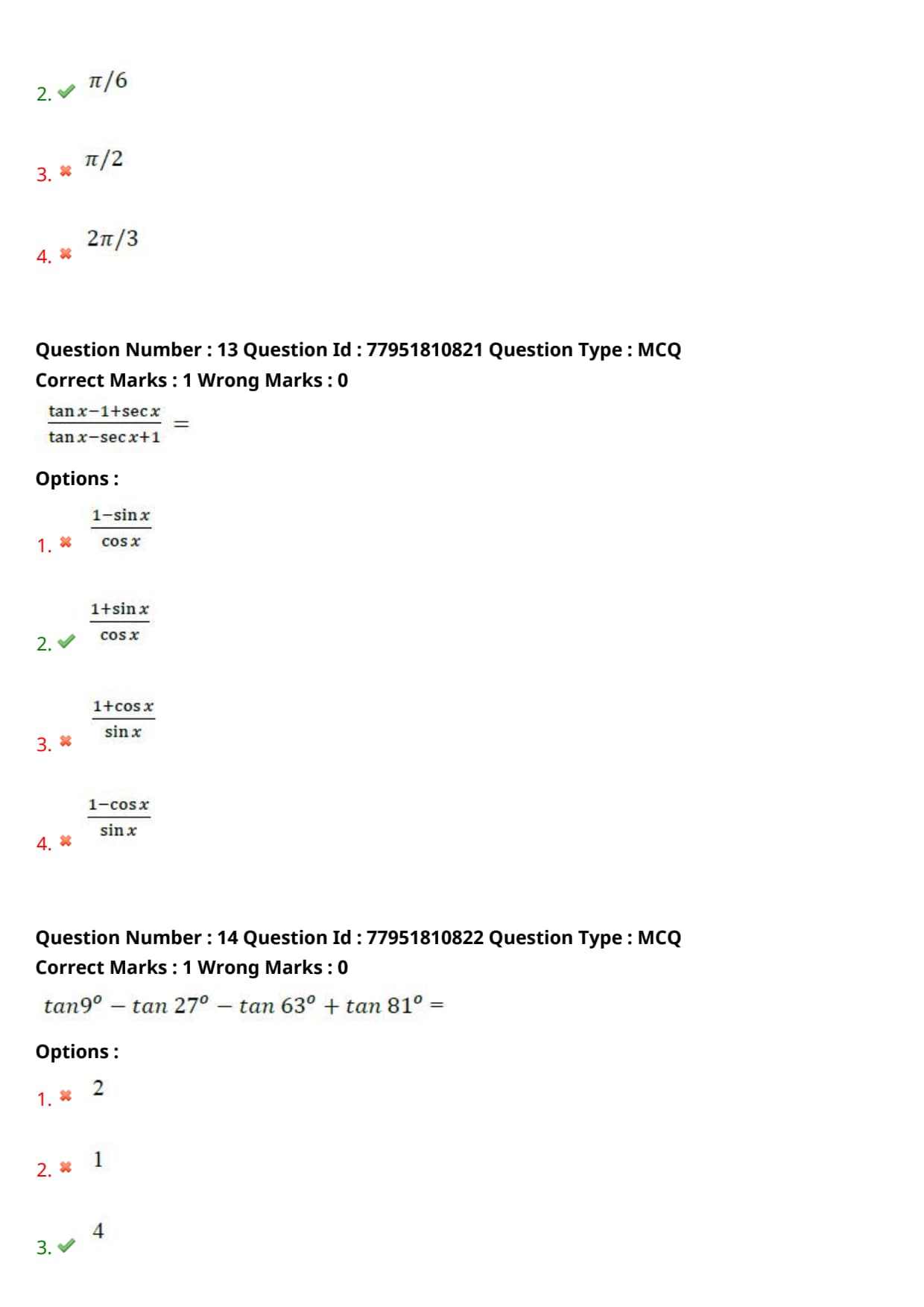
Question 12:
If \( \tan\theta+\sec\theta=\sqrt{3} \), then the principal value of \( \theta \) in \( [0,2\pi] \) is
- (A) \( \frac{\pi}{4} \)
- (B) \( \frac{\pi}{6} \)
- (C) \( \frac{\pi}{2} \)
- (D) \( \frac{2\pi}{3} \)
Question 13:
\[ \frac{\tan x-1+\sec x}{\tan x-\sec x+1} = \]
- (A) \( \frac{1-\sin x}{\cos x} \)
- (B) \( \frac{1+\sin x}{\cos x} \)
- (C) \( \frac{1+\cos x}{\sin x} \)
- (D) \( \frac{1-\cos x}{\sin x} \)
Question 14:
\[ \tan 9°-\tan 27°-\tan 63°+\tan 81°= \]
- (A) \(2\)
- (B) \(1\)
- (C) \(4\)
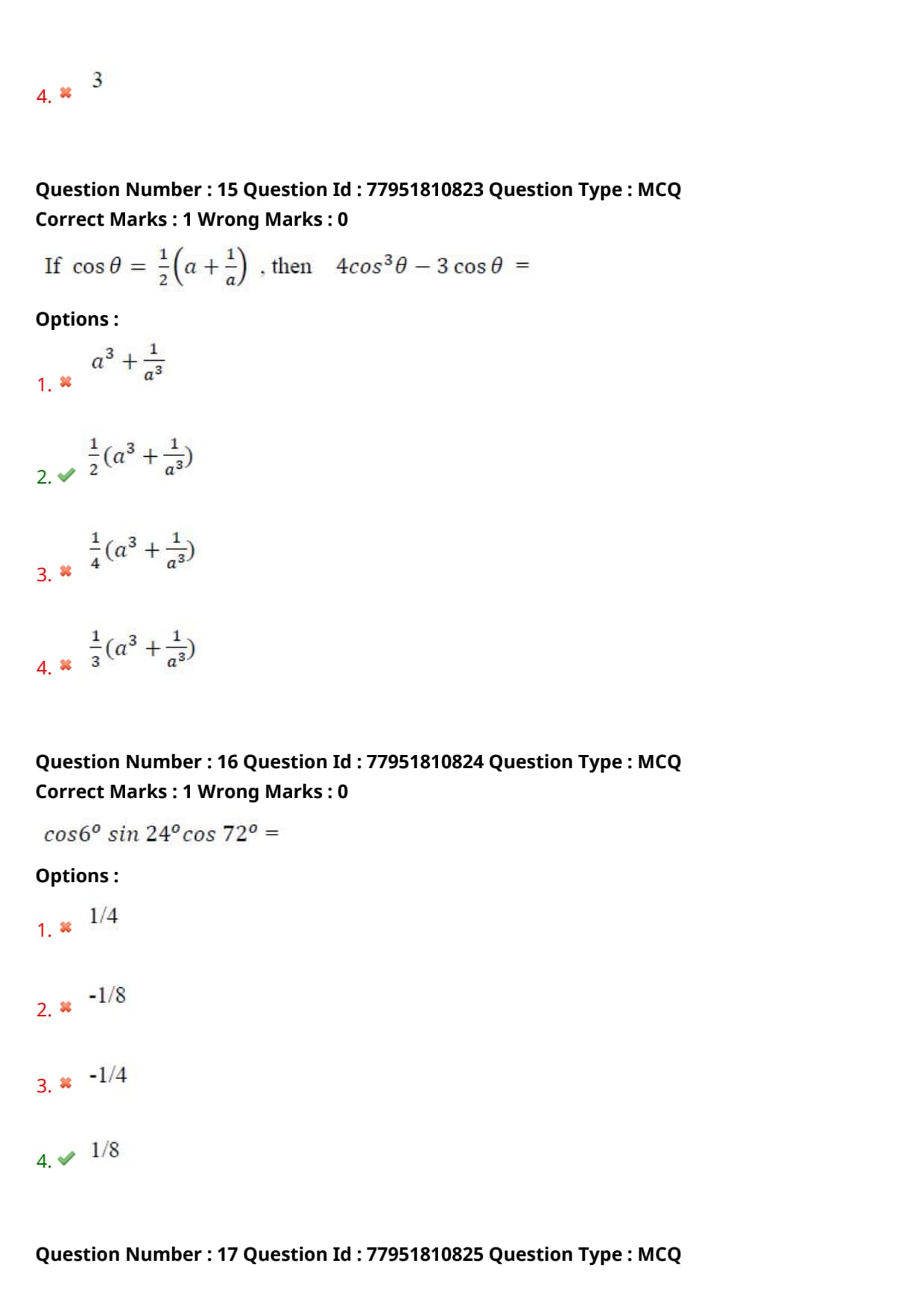
- (D) \(3\)
Question 15:
If \( \cos\theta=\frac{1}{2}\left(a+\frac{1}{a}\right) \), then \(4\cos^3\theta-3\cos\theta=\)
- (A) \(a^3+\frac{1}{a^3}\)
- (B) \(\frac{1}{2}\left(a^3+\frac{1}{a^3}\right)\)
- (C) \(\frac{1}{4}\left(a^3+\frac{1}{a^3}\right)\)
- (D) \(\frac{1}{3}\left(a^3+\frac{1}{a^3}\right)\)
Question 16:
\[ \cos 6° \sin 24° \cos 72°= \]
- (A) \(\frac{1}{4}\)
- (B) \(-\frac{1}{8}\)
- (C) \(-\frac{1}{4}\)
- (D) \(\frac{1}{8}\)
Question 17:
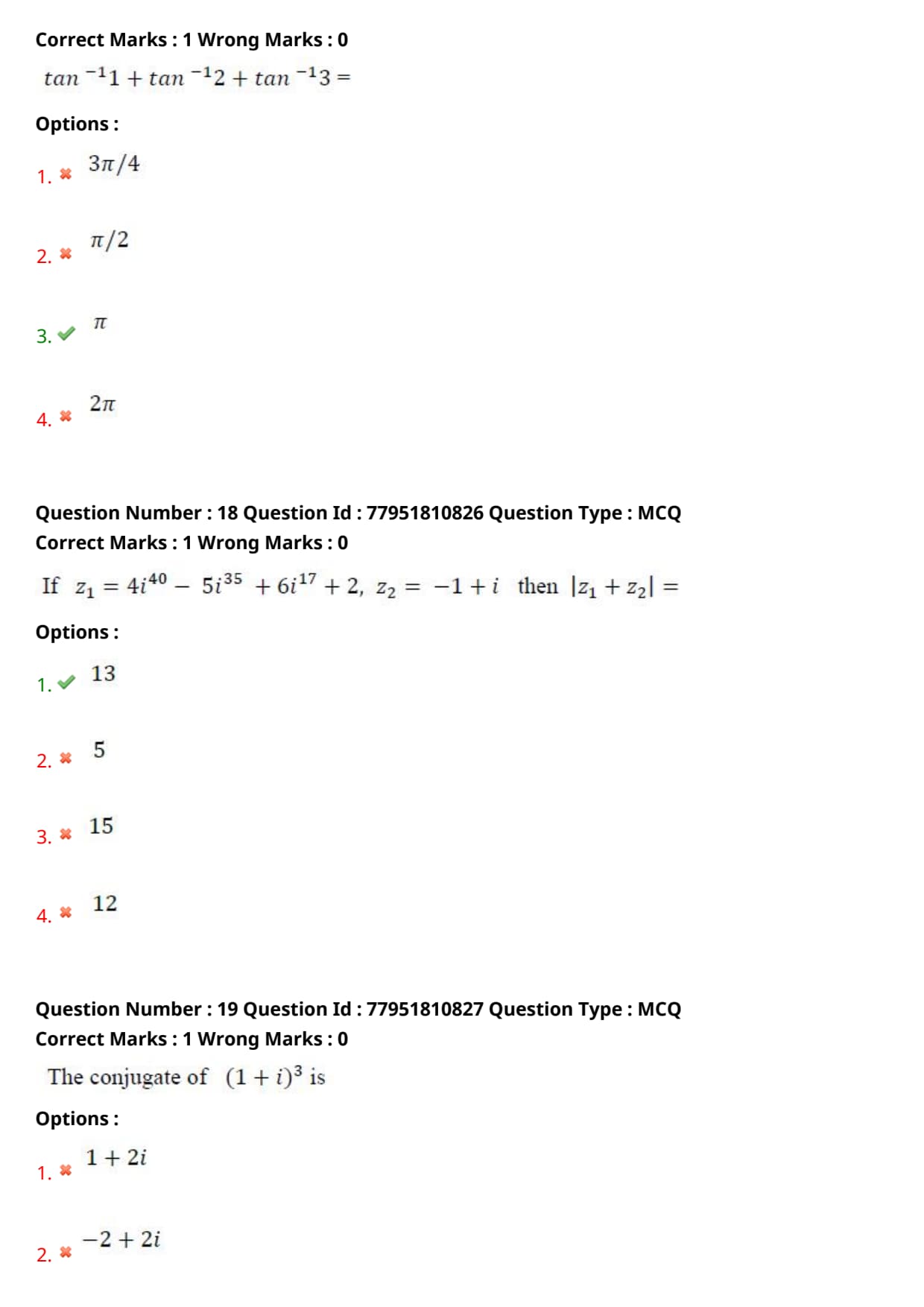
\[ \tan^{-1}1+\tan^{-1}2+\tan^{-1}3= \]
- (A) \(\frac{3\pi}{4}\)
- (B) \(\frac{\pi}{2}\)
- (C) \(\pi\)
- (D) \(2\pi\)
Question 18:
If \( z_1=4i^{40}-5i^{35}+6i^{17}+2,\ z_2=-1+i \), then \( |z_1+z_2|= \)
- (A) \(13\)
- (B) \(5\)
- (C) \(15\)
- (D) \(12\)
Question 19:
The conjugate of \( (1+i)^3 \) is
- (A) \(1+2i\)
- (B) \(-2+2i\)
- (C) \(-2-2i\)
- (D) \(1-2i\)
Question 20:
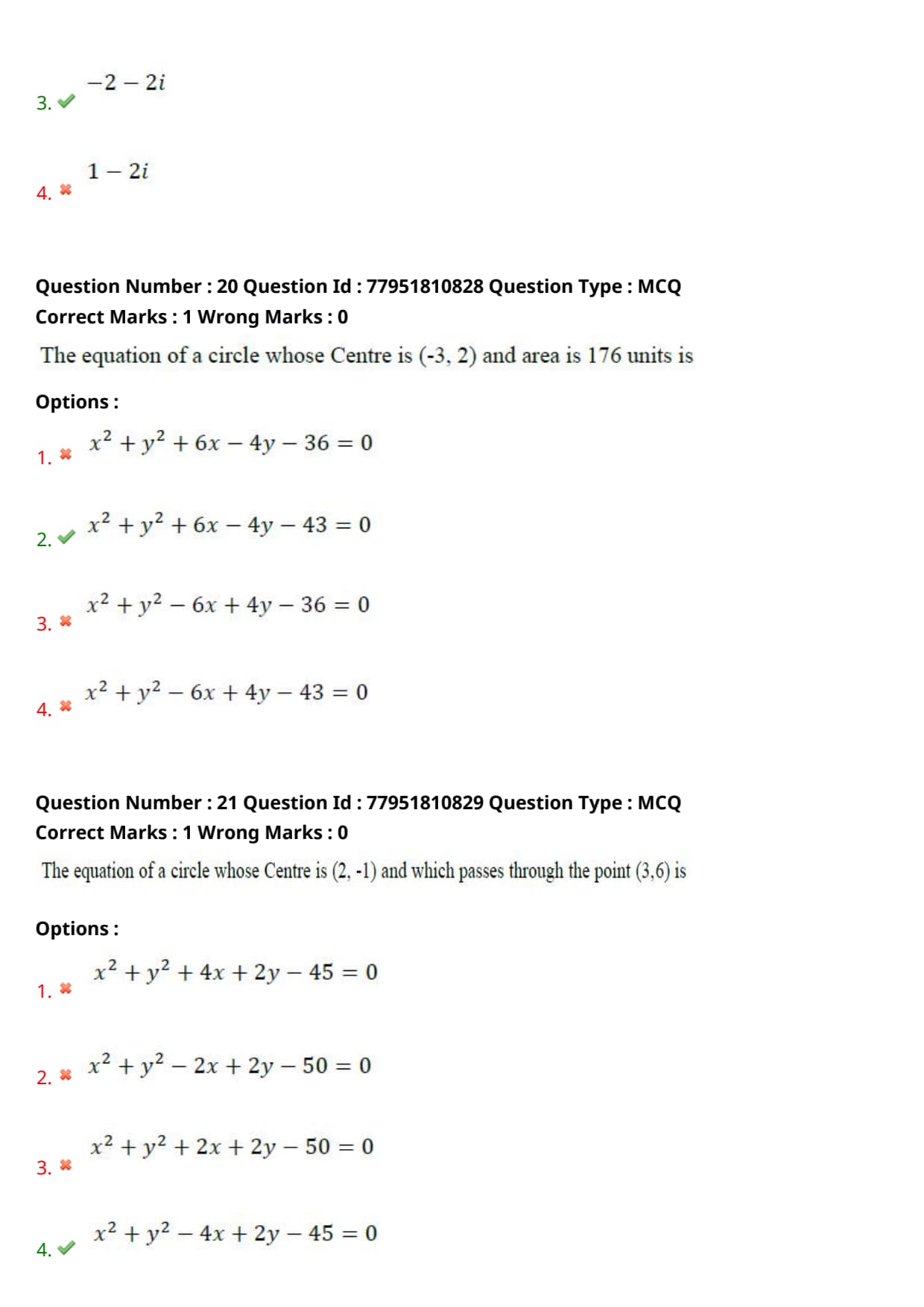
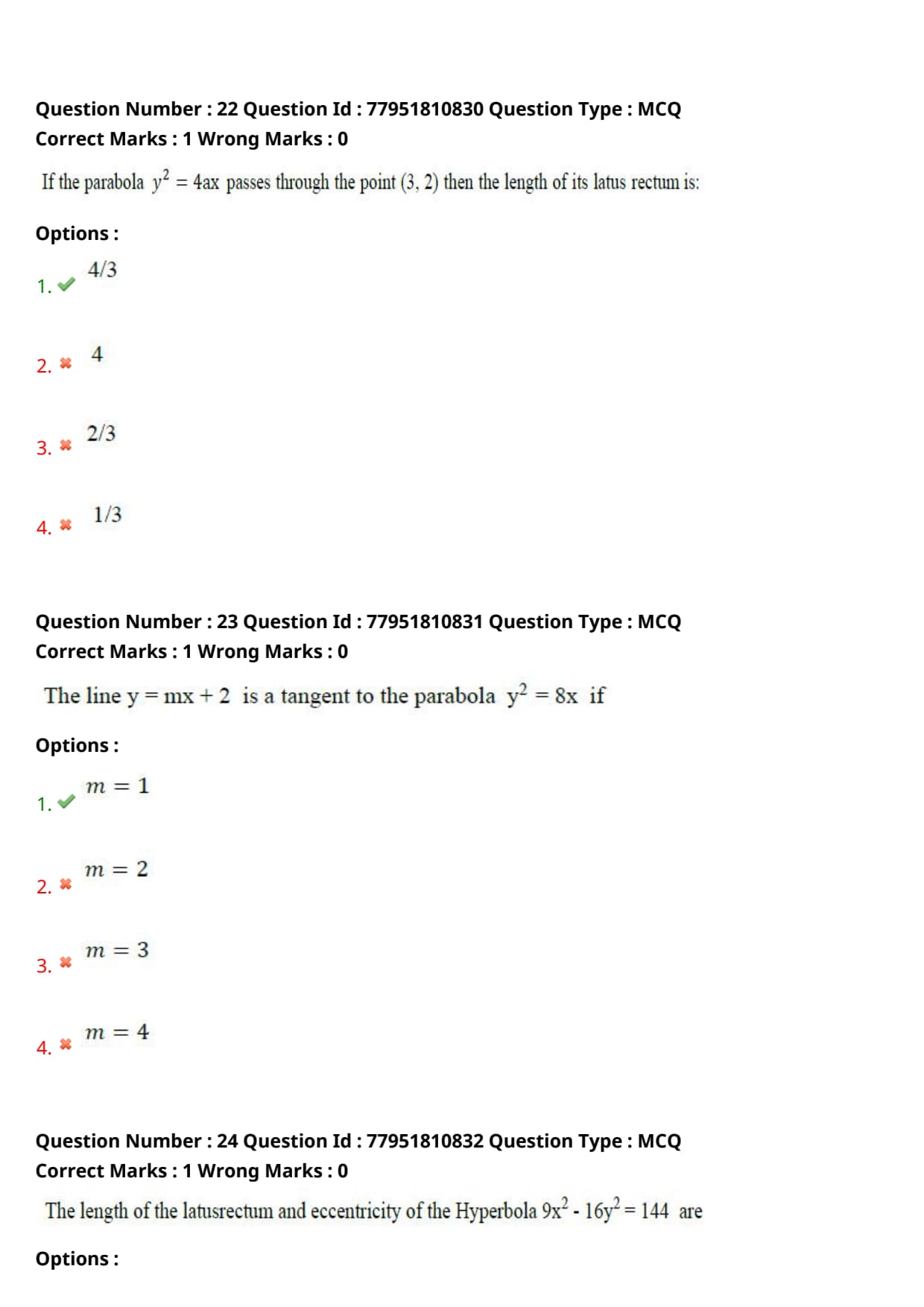
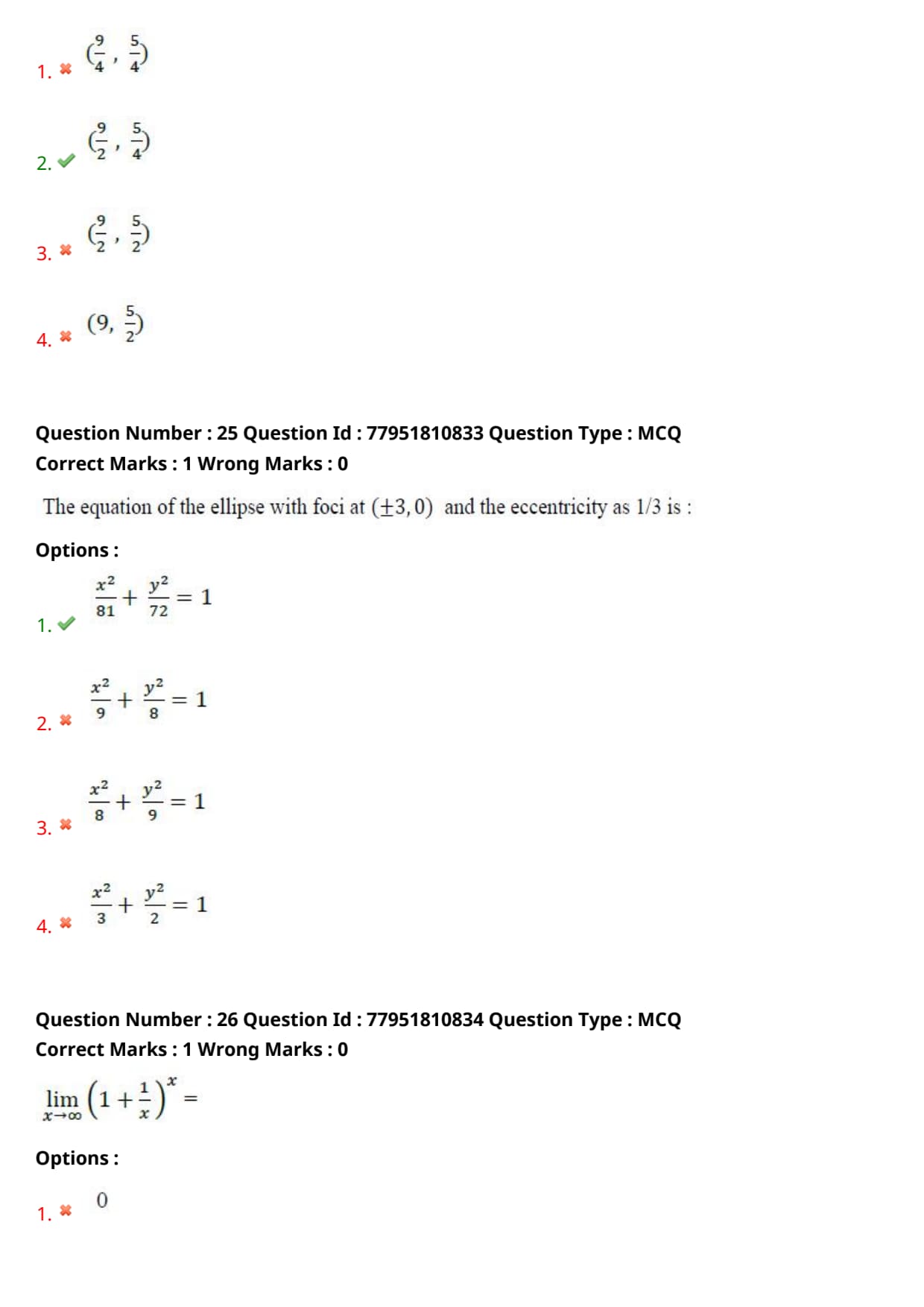
The equation of a circle whose Centre is \((-3,2)\) and area is \(176\) units is
- (A) \(x^2+y^2+6x-4y-36=0\)
- (B) \(x^2+y^2+6x-4y-43=0\)
- (C) \(x^2+y^2-6x+4y-36=0\)
- (D) \(x^2+y^2-6x+4y-43=0\)
Question 21:
The equation of a circle whose Centre is \((2,-1)\) and which passes through the point \((3,6)\) is
- (A) \(x^2+y^2+4x+2y-45=0\)
- (B) \(x^2+y^2-2x+2y-50=0\)
- (C) \(x^2+y^2+2x+2y-50=0\)
- (D) \(x^2+y^2-4x+2y-45=0\)
Question 22:
If the parabola \(y^2=4ax\) passes through the point \((3,2)\), then the length of its latus rectum is:
- (A) \(\frac{4}{3}\)
- (B) \(4\)
- (C) \(\frac{2}{3}\)
- (D) \(\frac{1}{3}\)
Question 23:
The line \(y=mx+2\) is a tangent to the parabola \(y^2=8x\) if
- (A) \(m=1\)
- (B) \(m=2\)
- (C) \(m=3\)
- (D) \(m=4\)
Question 24:
The length of the latus rectum and eccentricity of the Hyperbola \(9x^2-16y^2=144\) are
- (A) \(\left(\frac{9}{4},\frac{5}{4}\right)\)
- (B) \(\left(\frac{9}{2},\frac{5}{4}\right)\)
- (C) \(\left(\frac{9}{2},\frac{5}{2}\right)\)
- (D) \(\left(9,\frac{5}{2}\right)\)
Question 25:
The equation of the ellipse with foci at \((\pm 3,0)\) and the eccentricity as \(1/3\) is:
- (A) \(\frac{x^2}{81}+\frac{y^2}{72}=1\)
- (B) \(\frac{x^2}{9}+\frac{y^2}{8}=1\)
- (C) \(\frac{x^2}{8}+\frac{y^2}{9}=1\)
- (D) \(\frac{x^2}{3}+\frac{y^2}{2}=1\)
Question 26:
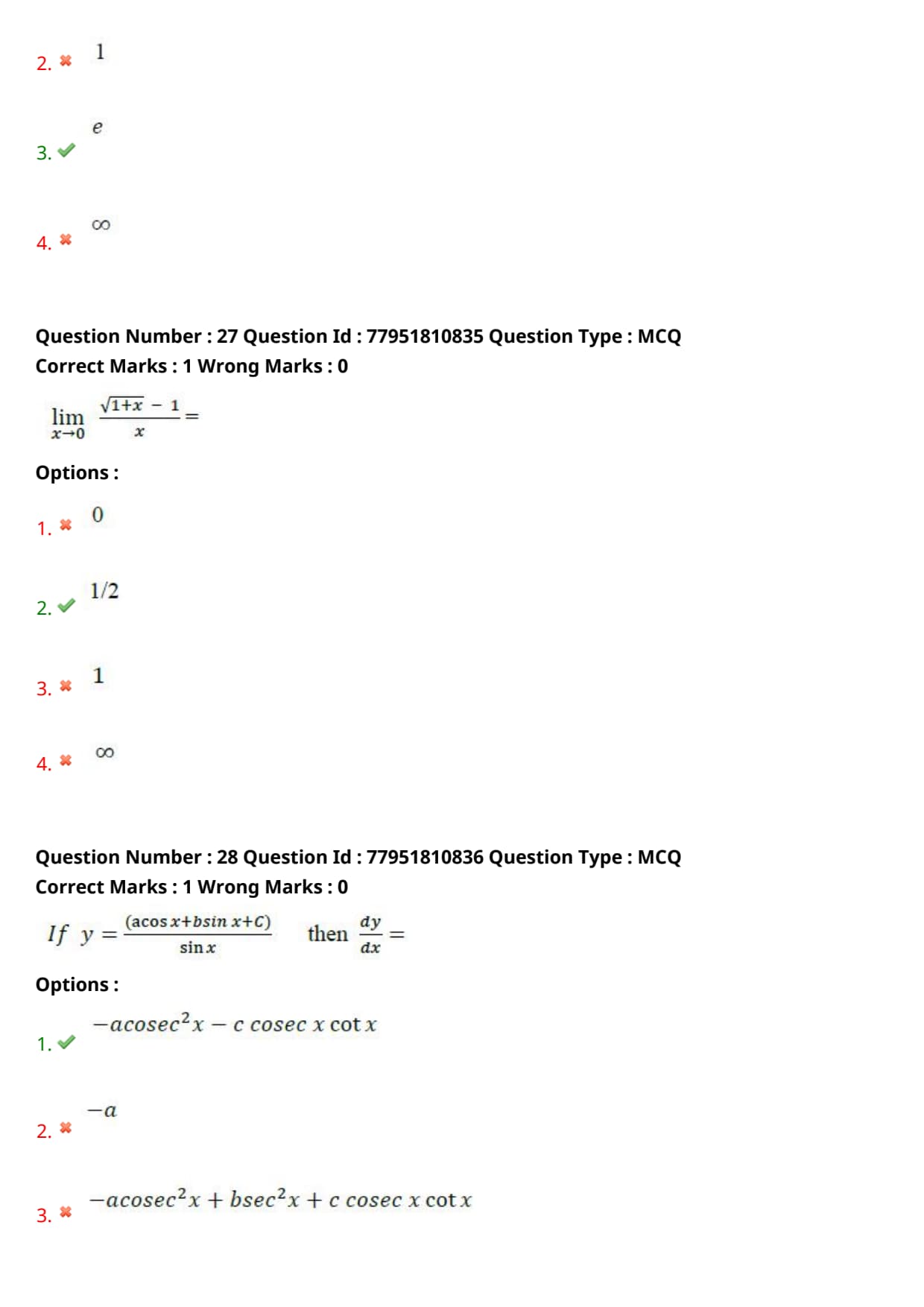
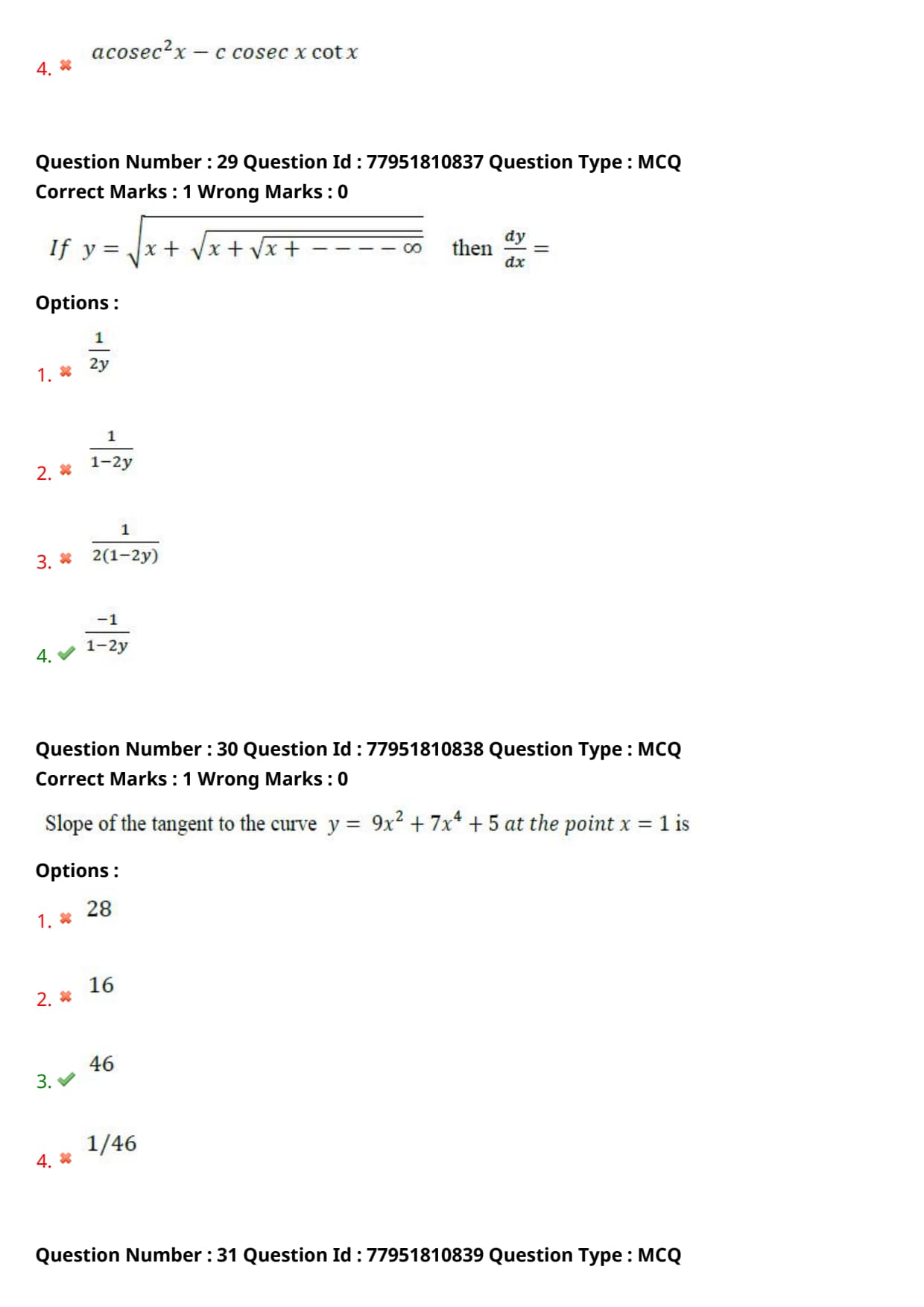
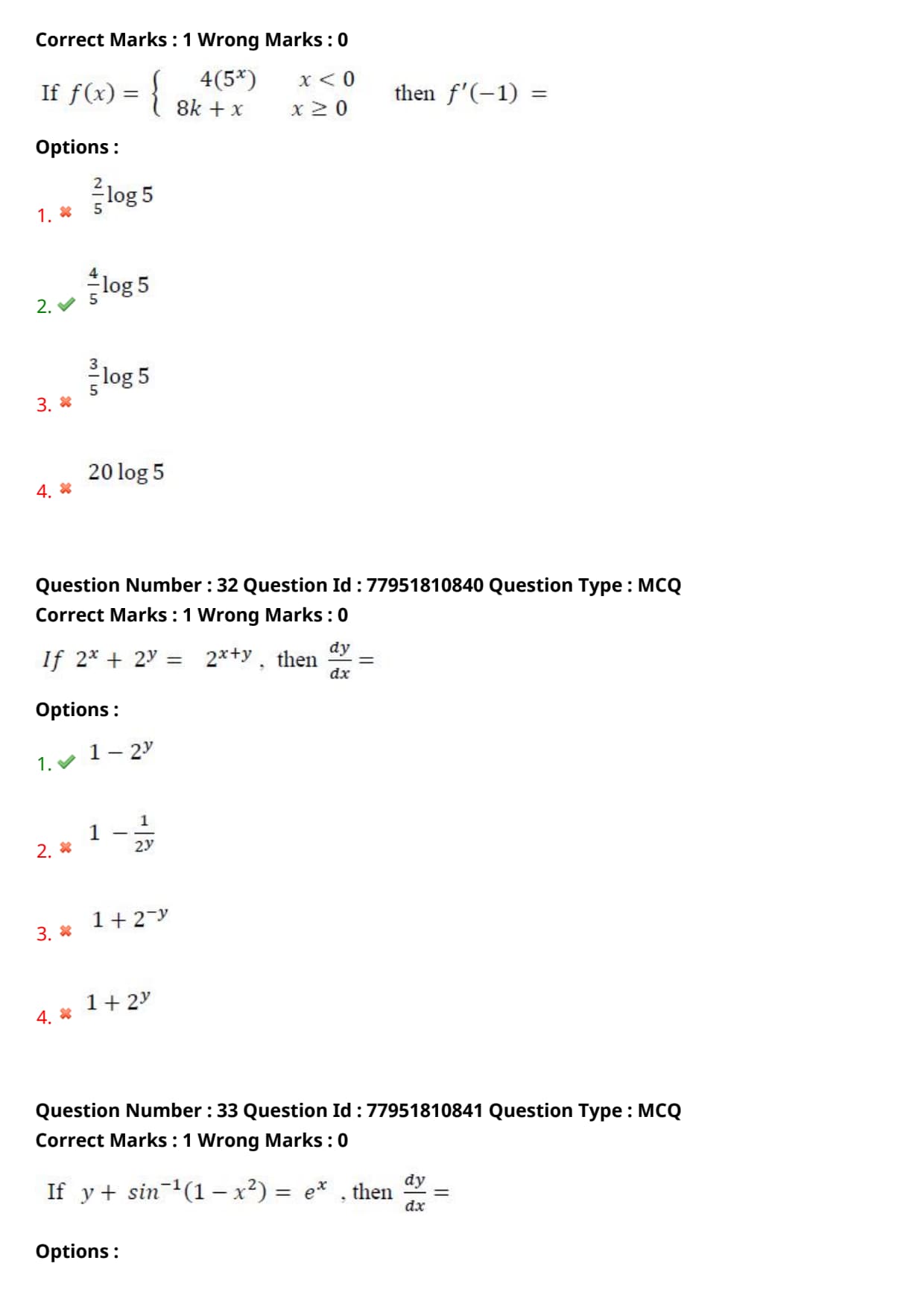
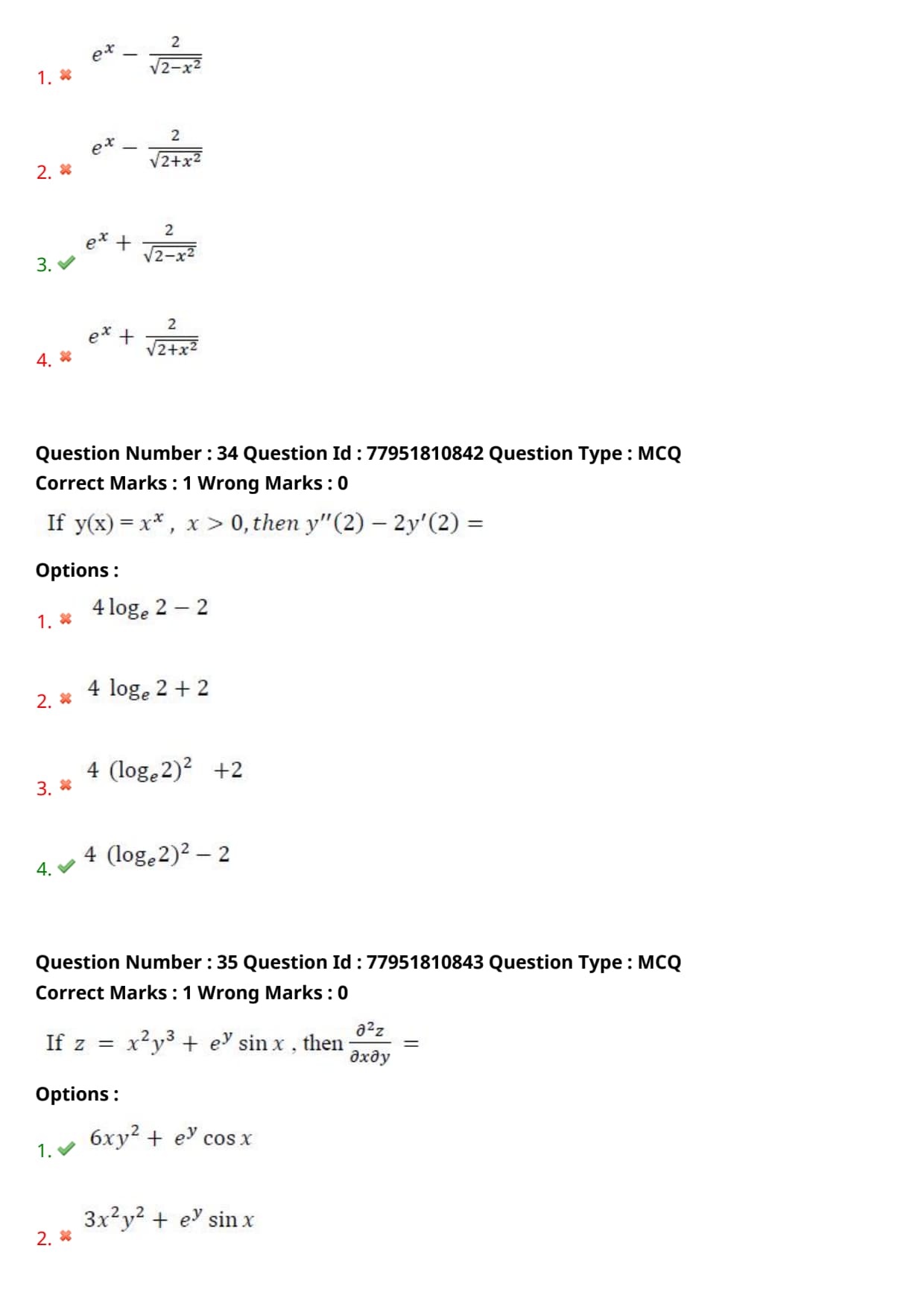
\[ \lim_{x\to\infty}\left(1+\frac{1}{x}\right)^x= \]
- (A) \(0\)
- (B) \(1\)
- (C) \(e\)
- (D) \(\infty\)
Question 27:
\[ \lim_{x\to 0}\frac{\sqrt{1+x}-1}{x}= \]
- (A) \(0\)
- (B) \(\frac{1}{2}\)
- (C) \(1\)
- (D) \(\infty\)
Question 28:
If \[ y=\frac{a\cos x+b\sin x+c}{\sin x}, \]
then \[ \frac{dy}{dx}= \]
- (A) \(-a cosec^2x-c cosec x\cot x\)
- (B) \(-a\)
- (C) \(-a cosec^2x+b\sec^2x+c cosec x\cot x\)
- (D) \(a cosec^2x-c cosec x\cot x\)
Question 29:
If \[ y=\sqrt{x+\sqrt{x+\sqrt{x+\cdots\infty}}}, \]
then \[ \frac{dy}{dx}= \]
- (A) \(\frac{1}{2y}\)
- (B) \(\frac{1}{1-2y}\)
- (C) \(\frac{1}{2(1-2y)}\)
- (D) \(\frac{-1}{1-2y}\)
Question 30:
Slope of the tangent to the curve \[ y=9x^2+7x^4+5 \]
at the point \(x=1\) is
- (A) \(28\)
- (B) \(16\)
- (C) \(46\)
- (D) \(\frac{1}{46}\)
Question 31:
If \[ f(x)= \begin{cases} 4(5^x), & x<0
8k+x, & x\geq 0 \end{cases} \]
then \(f'(-1)=\)
- (A) \(\frac{2}{5}\log 5\)
- (B) \(\frac{4}{5}\log 5\)
- (C) \(\frac{3}{5}\log 5\)
- (D) \(20\log 5\)
Question 32:
If \[ 2^x+2^y=2^{x+y}, \]
then \[ \frac{dy}{dx}= \]
- (A) \(1-2^y\)
- (B) \(1-\frac{1}{2^y}\)
- (C) \(1+2^{-y}\)
- (D) \(1+2^y\)
Question 33:
If \[ y+\sin^{-1}(1-x^2)=e^x, \]
then \[ \frac{dy}{dx}= \]
- (A) \(e^x-\frac{2}{\sqrt{2-x^2}}\)
- (B) \(e^x-\frac{2}{\sqrt{2+x^2}}\)
- (C) \(e^x+\frac{2}{\sqrt{2-x^2}}\)
- (D) \(e^x+\frac{2}{\sqrt{2+x^2}}\)
Question 34:
If \(y(x)=x^x,\ x>0\), then \[ y''(2)-2y'(2)= \]
- (A) \(4\log_e2-2\)
- (B) \(4\log_e2+2\)
- (C) \(4(\log_e2)^2+2\)
- (D) \(4(\log_e2)^2-2\)
Question 35:
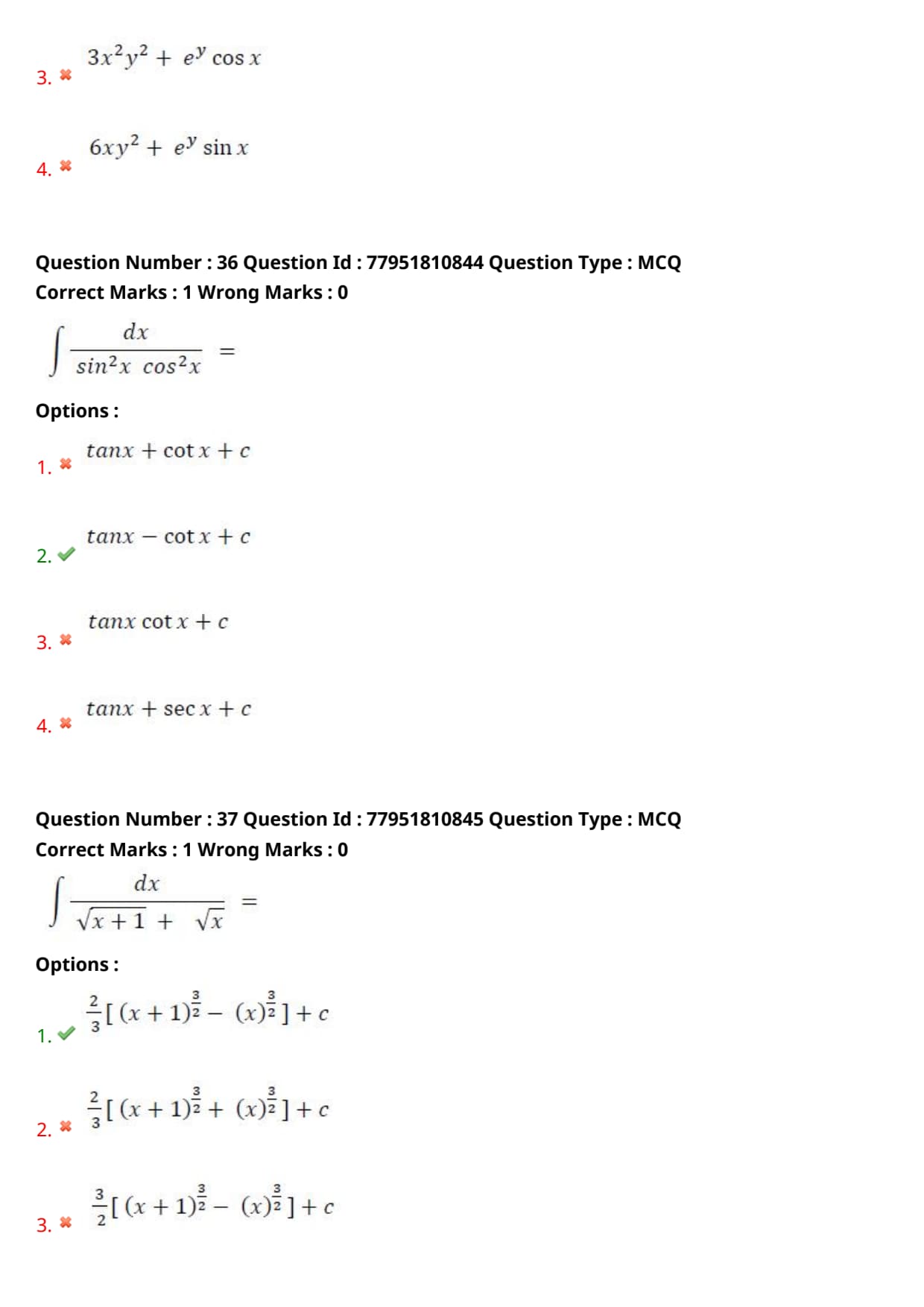
If \[ z=x^2y^3+e^y\sin x, \]
then \[ \frac{\partial^2 z}{\partial x\partial y}= \]
- (A) \(6xy^2+e^y\cos x\)
- (B) \(3x^2y^2+e^y\sin x\)
- (C) \(3x^2y^2+e^y\cos x\)
- (D) \(6xy^2+e^y\sin x\)
Question 36:
\[ \int \frac{dx}{\sin^2x\cos^2x}= \]
- (A) \(\tan x+\cot x+c\)
- (B) \(\tan x-\cot x+c\)
- (C) \(\tan x\cot x+c\)
- (D) \(\tan x+\sec x+c\)
Question 37:
\[ \int \frac{dx}{\sqrt{x+1}+\sqrt{x}}= \]
- (A) \(\frac{2}{3}\left[(x+1)^{\frac{3}{2}}-x^{\frac{3}{2}}\right]+c\)
- (B) \(\frac{2}{3}\left[(x+1)^{\frac{3}{2}}+x^{\frac{3}{2}}\right]+c\)
- (C) \(\frac{3}{2}\left[(x+1)^{\frac{3}{2}}-x^{\frac{3}{2}}\right]+c\)
- (D) \(\frac{3}{2}\left[(x+1)^{\frac{3}{2}}+x^{\frac{3}{2}}\right]+c\)
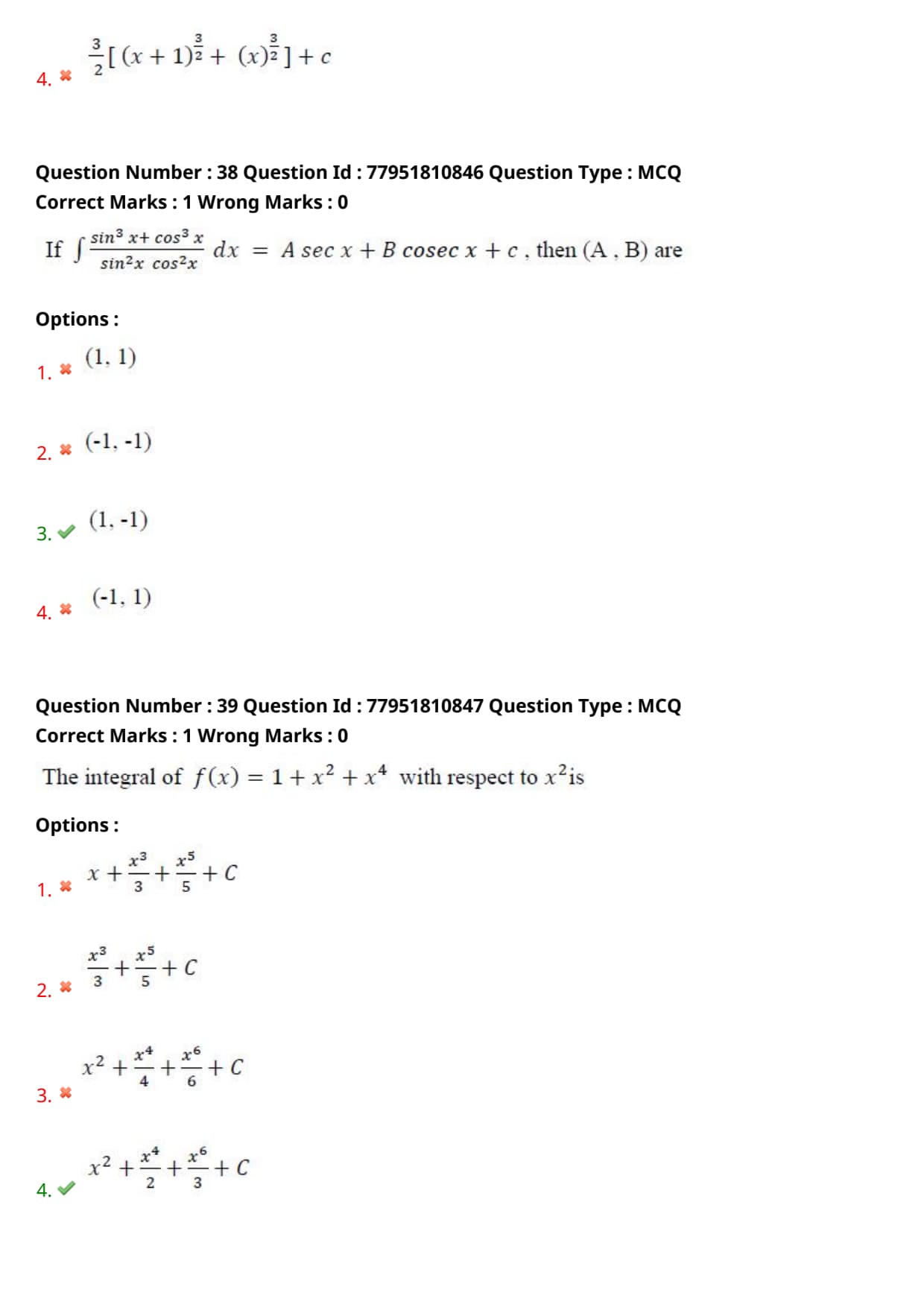
Question 38:
If \[ \int \frac{\sin^3x+\cos^3x}{\sin^2x\cos^2x}\,dx = A\sec x+B cosec x+c, \]
then \((A,B)\) are
- (A) \((1,1)\)
- (B) \((-1,-1)\)
- (C) \((1,-1)\)
- (D) \((-1,1)\)
Question 39:
The integral of \(f(x)=1+x^2+x^4\) with respect to \(x^2\) is
- (A) \(x+\frac{x^3}{3}+\frac{x^5}{5}+C\)
- (B) \(\frac{x^2}{3}+\frac{x^4}{5}+C\)
- (C) \(x^2+\frac{x^4}{4}+\frac{x^6}{6}+C\)
- (D) \(x^2+\frac{x^4}{2}+\frac{x^6}{3}+C\)
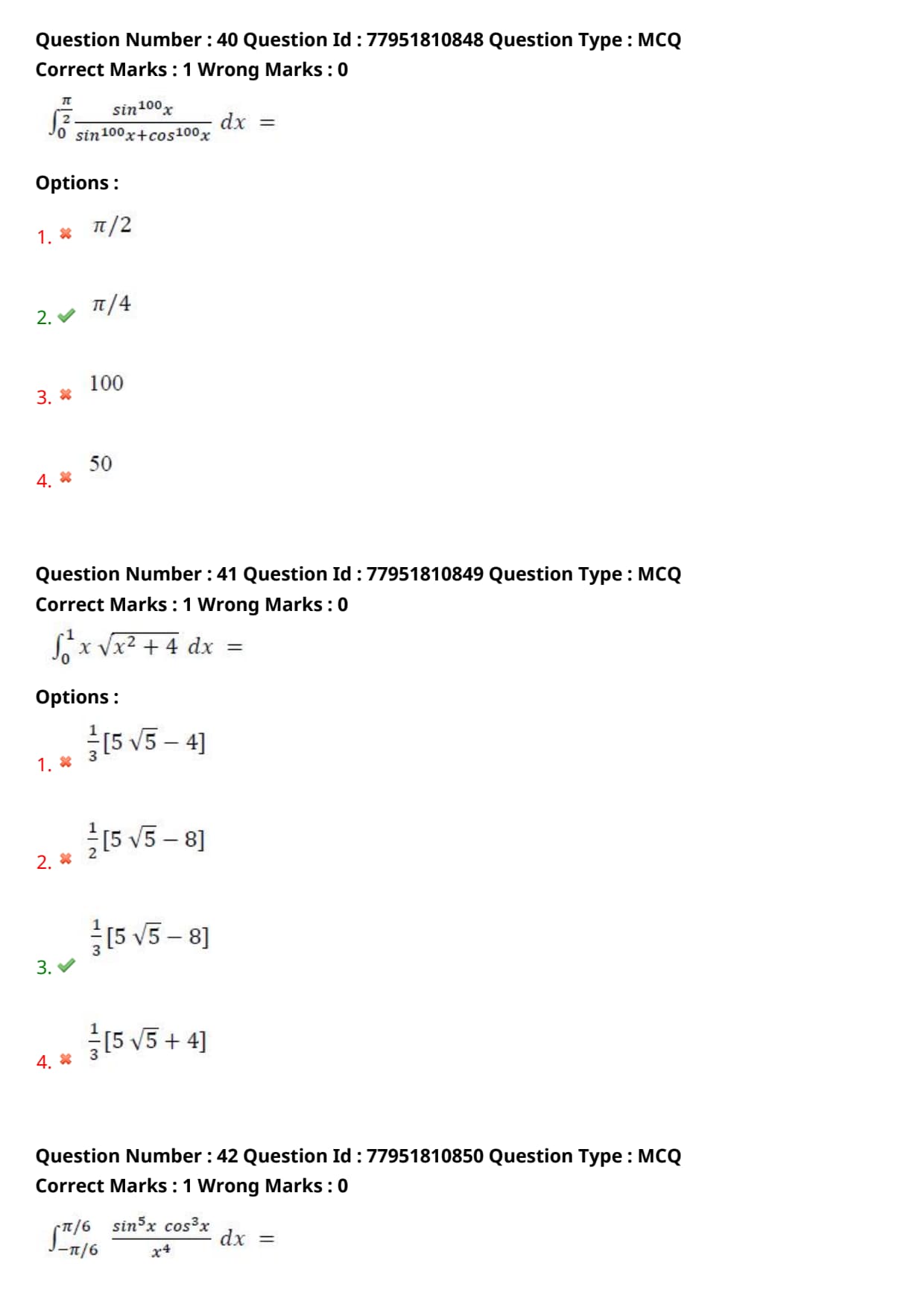
Question 40:
\[ \int_0^{\frac{\pi}{2}} \frac{\sin^{100}x}{\sin^{100}x+\cos^{100}x}\,dx = \]
- (A) \(\frac{\pi}{2}\)
- (B) \(\frac{\pi}{4}\)
- (C) \(100\)
- (D) \(50\)
Question 41:
\[ \int_0^1 x\sqrt{x^2+4}\,dx= \]
- (A) \(\frac{1}{3}[5\sqrt{5}-4]\)
- (B) \(\frac{1}{2}[5\sqrt{5}-8]\)
- (C) \(\frac{1}{3}[5\sqrt{5}-8]\)
- (D) \(\frac{1}{3}[5\sqrt{5}+4]\)
Question 42:
\[ \int_{-\frac{\pi}{6}}^{\frac{\pi}{6}} \frac{\sin^5x\cos^3x}{x^4}\,dx= \]
- (A) \(\frac{\pi}{2}\)
- (B) \(\frac{\pi}{4}\)
- (C) \(0\)
- (D) \(1\)
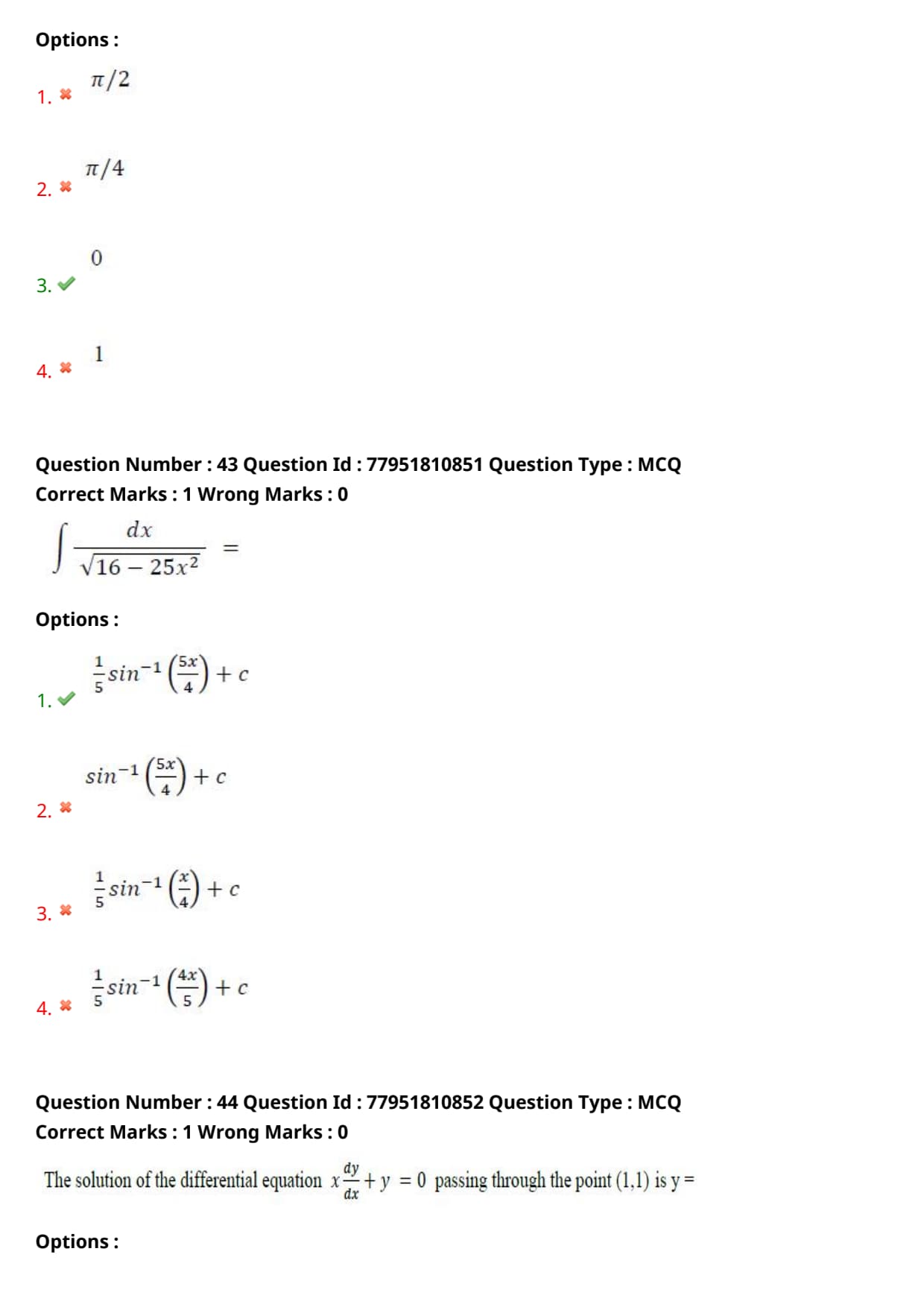
Question 43:
\[ \int \frac{dx}{\sqrt{16-25x^2}}= \]
- (A) \(\frac{1}{5}\sin^{-1}\left(\frac{5x}{4}\right)+c\)
- (B) \(\sin^{-1}\left(\frac{5x}{4}\right)+c\)
- (C) \(\frac{1}{5}\sin^{-1}\left(\frac{x}{4}\right)+c\)
- (D) \(\frac{1}{5}\sin^{-1}\left(\frac{4x}{5}\right)+c\)
Question 44:
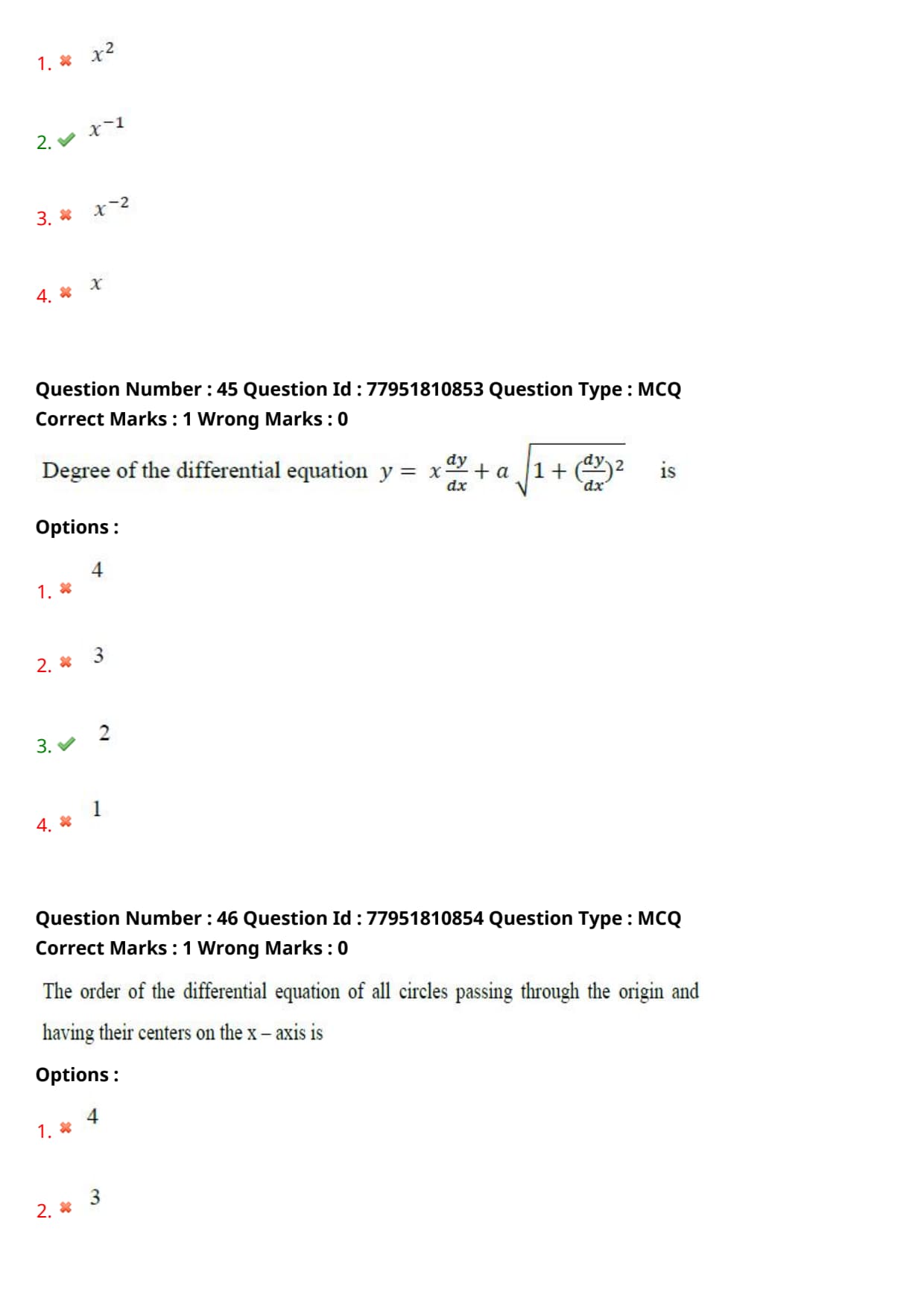
The solution of the differential equation \[ x\frac{dy}{dx}+y=0 \]
passing through the point \((1,1)\) is \(y=\)
- (A) \(x^2\)
- (B) \(x^{-1}\)
- (C) \(x^{-2}\)
- (D) \(x\)
Question 45:
Degree of the differential equation \[ y=x\frac{dy}{dx}+a\sqrt{1+\left(\frac{dy}{dx}\right)^2} \]
is
- (A) \(4\)
- (B) \(3\)
- (C) \(2\)
- (D) \(1\)
Question 46:
The order of the differential equation of all circles passing through the origin and having their centres on the \(x\)-axis is
- (A) \(4\)
- (B) \(3\)
- (C) \(2\)
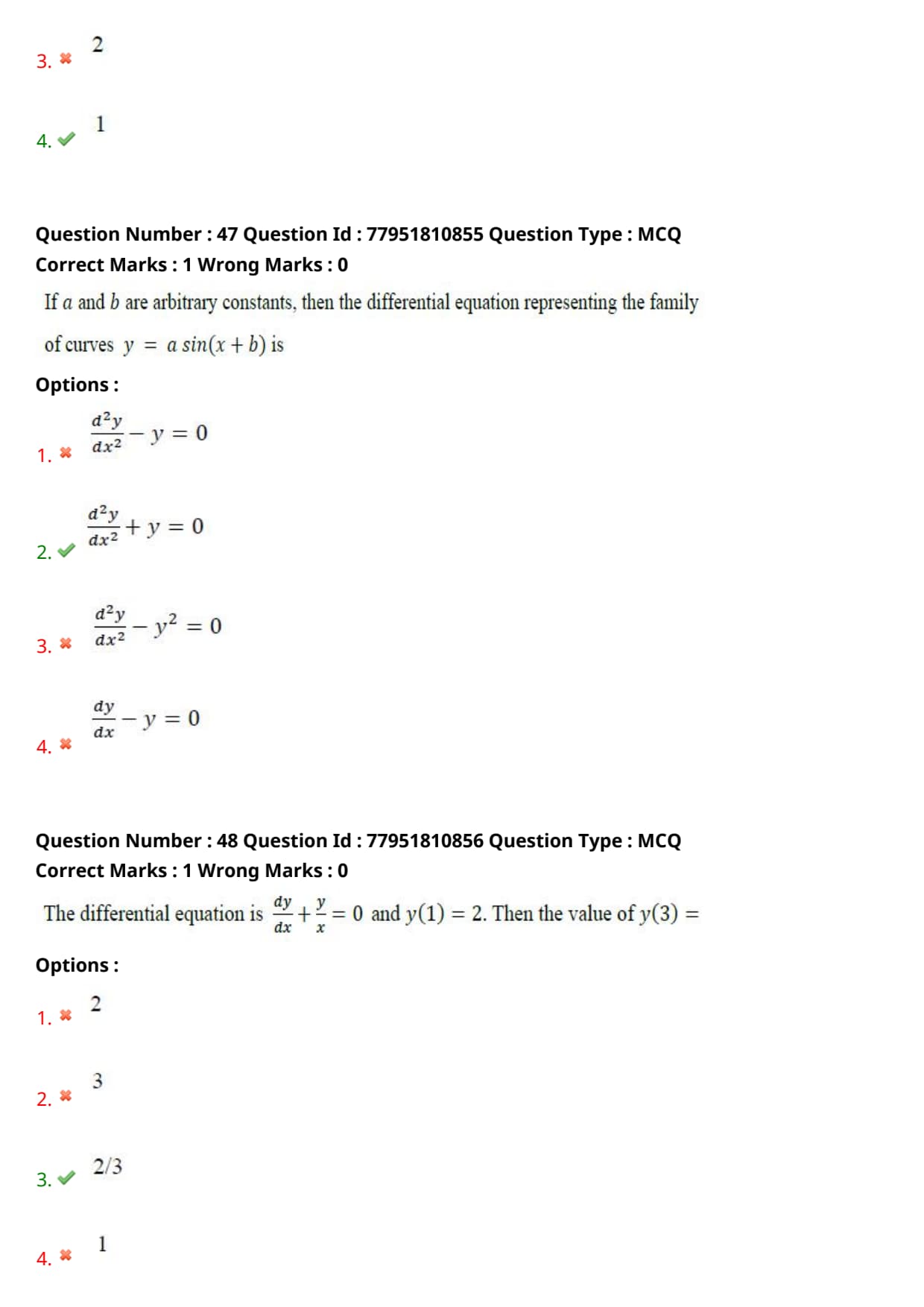
- (D) \(1\)
Question 47:
If \(a\) and \(b\) are arbitrary constants, then the differential equation representing the family of curves \[ y=a\sin(x+b) \]
is
- (A) \(\frac{d^2y}{dx^2}-y=0\)
- (B) \(\frac{d^2y}{dx^2}+y=0\)
- (C) \(\frac{d^2y}{dx^2}-y^2=0\)
- (D) \(\frac{dy}{dx}-y=0\)
Question 48:
The differential equation is \[ \frac{dy}{dx}+\frac{y}{x}=0 \]
and \(y(1)=2\). Then the value of \(y(3)\) is
- (A) \(2\)
- (B) \(3\)
- (C) \(\frac{2}{3}\)
- (D) \(1\)
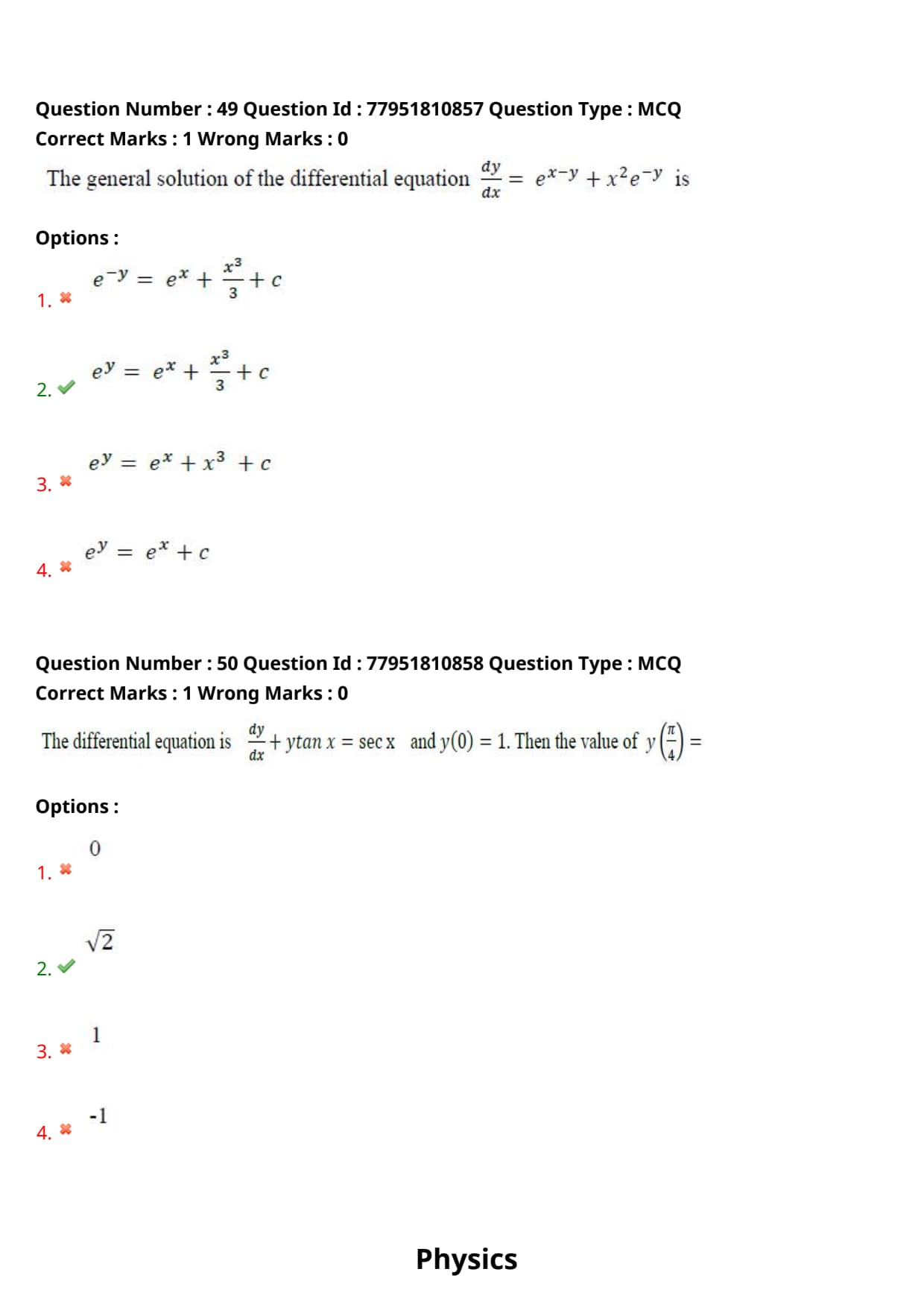
Question 49:
The general solution of the differential equation \[ \frac{dy}{dx}=e^{x-y}+x^2e^{-y} \]
is
- (A) \(e^{-y}=e^x+\frac{x^3}{3}+c\)
- (B) \(e^y=e^x+\frac{x^3}{3}+c\)
- (C) \(e^y=e^x+x^3+c\)
- (D) \(e^y=e^x+c\)
Question 50:
The differential equation is \[ \frac{dy}{dx}+y\tan x=\sec x \]
and \(y(0)=1\). Then the value of \(y\left(\frac{\pi}{4}\right)\) is
- (A) \(0\)
- (B) \(\sqrt{2}\)
- (C) \(1\)
- (D) \(-1\)
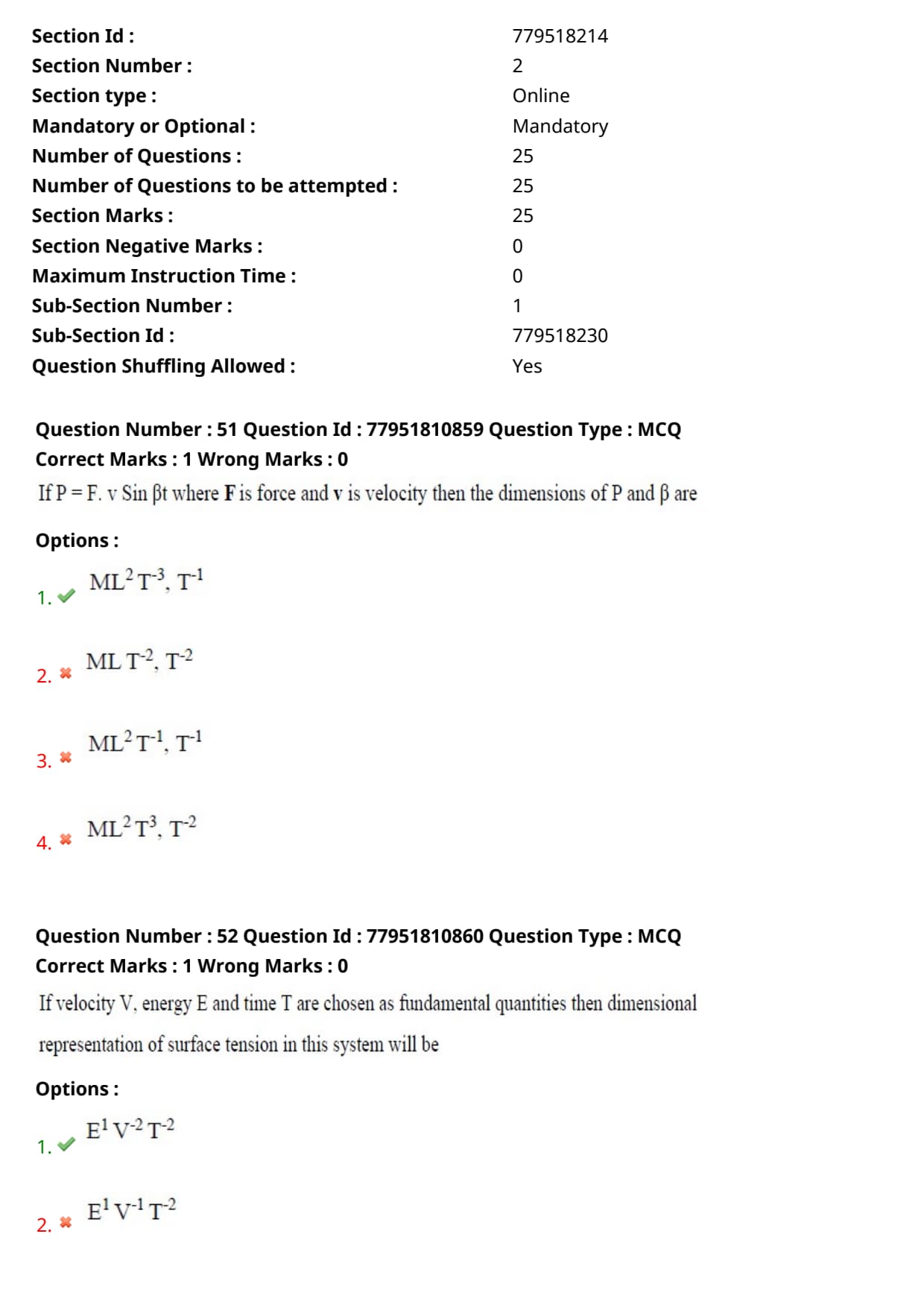
Question 51:
If \(P=Fv\sin\beta t\), where \(F\) is force and \(v\) is velocity, then the dimensions of \(P\) and \(\beta\) are
- (A) \(ML^2T^{-3},\ T^{-1}\)
- (B) \(MLT^{-2},\ T^{-2}\)
- (C) \(ML^2T^{-1},\ T^{-1}\)
- (D) \(ML^2T^3,\ T^{-2}\)
Question 52:
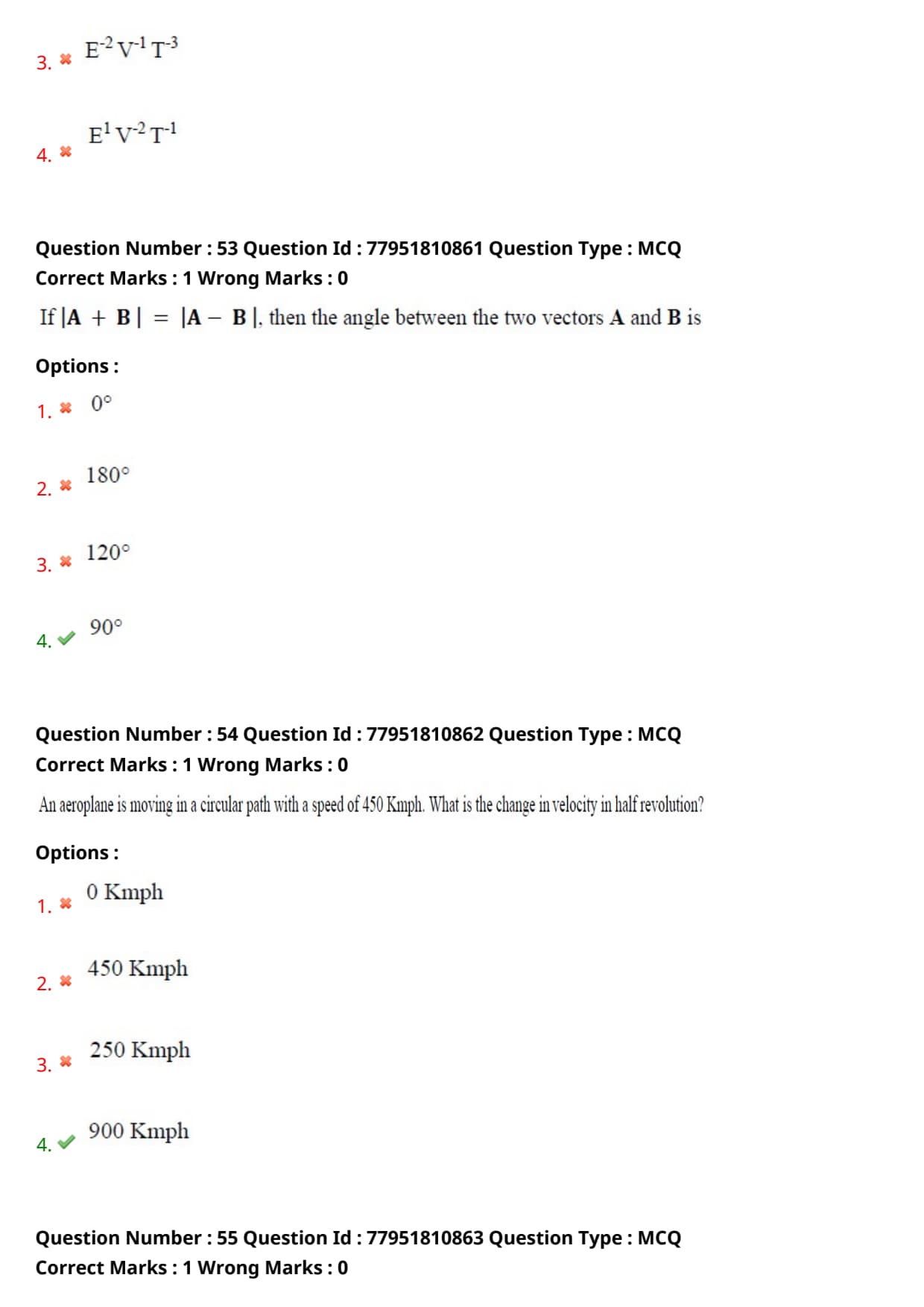
If velocity \(V\), energy \(E\), and time \(T\) are chosen as fundamental quantities, then dimensional representation of surface tension in this system will be
- (A) \(E^1V^{-2}T^{-2}\)
- (B) \(E^1V^{-1}T^{-2}\)
- (C) \(E^{-2}V^{-1}T^{-3}\)
- (D) \(E^1V^{-2}T^{-1}\)
Question 53:
If \(|\vec A+\vec B|=|\vec A-\vec B|\), then the angle between the two vectors \(\vec A\) and \(\vec B\) is
- (A) \(0°\)
- (B) \(180°\)
- (C) \(120°\)
- (D) \(90°c\)
Question 54:
An aeroplane is moving in a circular path with a speed of \(450\ kmph\). What is the change in velocity in half revolution?
- (A) \(0\ kmph\)
- (B) \(450\ kmph\)
- (C) \(250\ kmph\)
- (D) \(900\ kmph\)
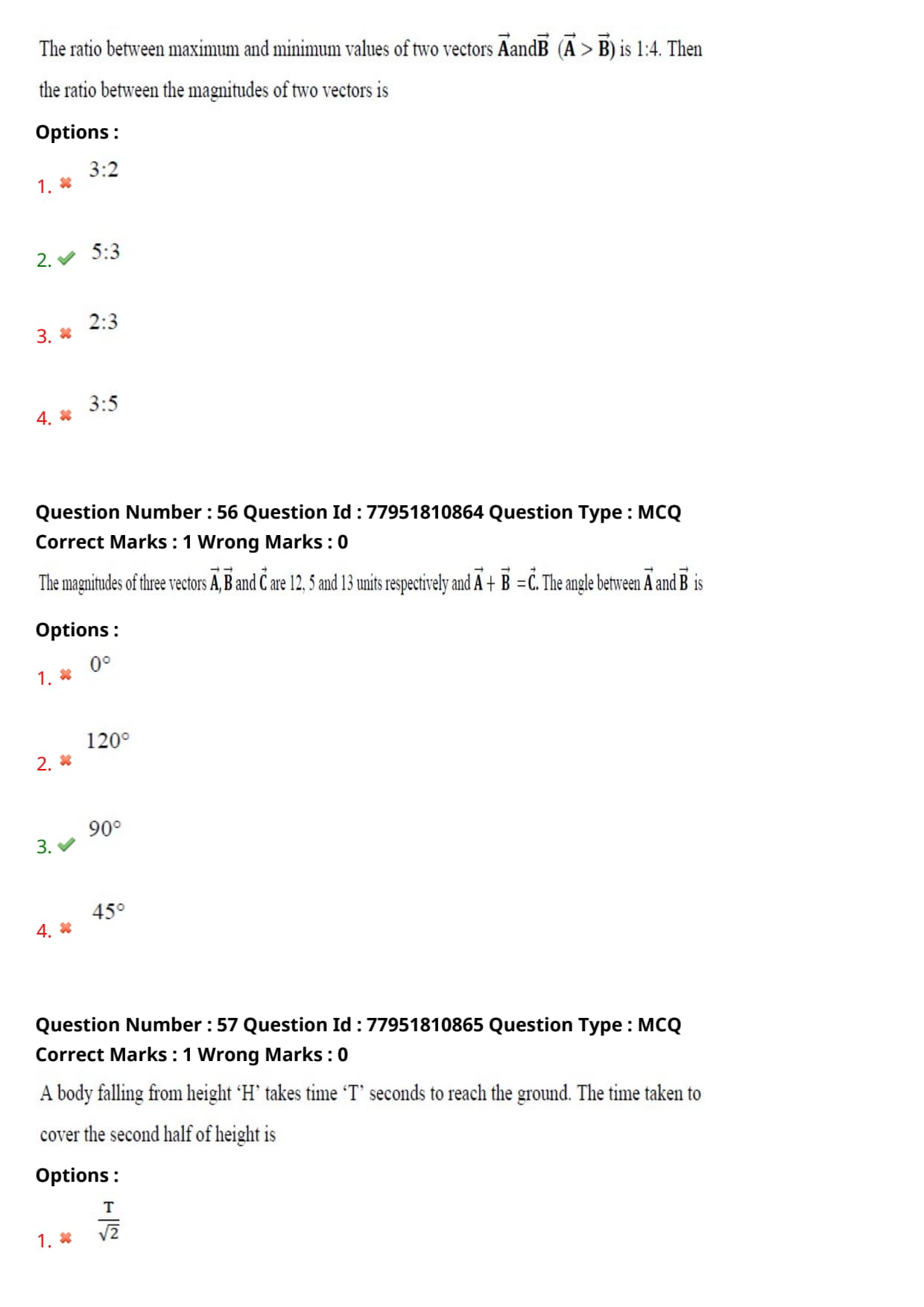
Question 55:
The ratio between maximum and minimum values of two vectors \(\vec A\) and \(\vec B\), where \(A>B\), is \(4:1\). Then the ratio between the magnitudes of two vectors is
- (A) \(3:2\)
- (B) \(5:3\)
- (C) \(2:3\)
- (D) \(3:5\)
Question 56:
The magnitudes of three vectors \(\vec A,\vec B,\vec C\) are \(12,5\), and \(13\) units respectively and \(\vec A+\vec B=\vec C\). The angle between \(\vec A\) and \(\vec B\) is
- (A) \(0°\)
- (B) \(120°\)
- (C) \(90°\)
- (D) \(45°\)
Question 57:
A body falling from height \(H\) takes time \(T\) seconds to reach the ground. The time taken to cover the second half of height is
- (A) \(\frac{T}{\sqrt{2}}\)
- (B) \(\sqrt{2}T\)
- (C) \(\frac{\sqrt{2}-1}{\sqrt{2}}T\)
- (D) \(\frac{1}{\sqrt{2}-1}T\)
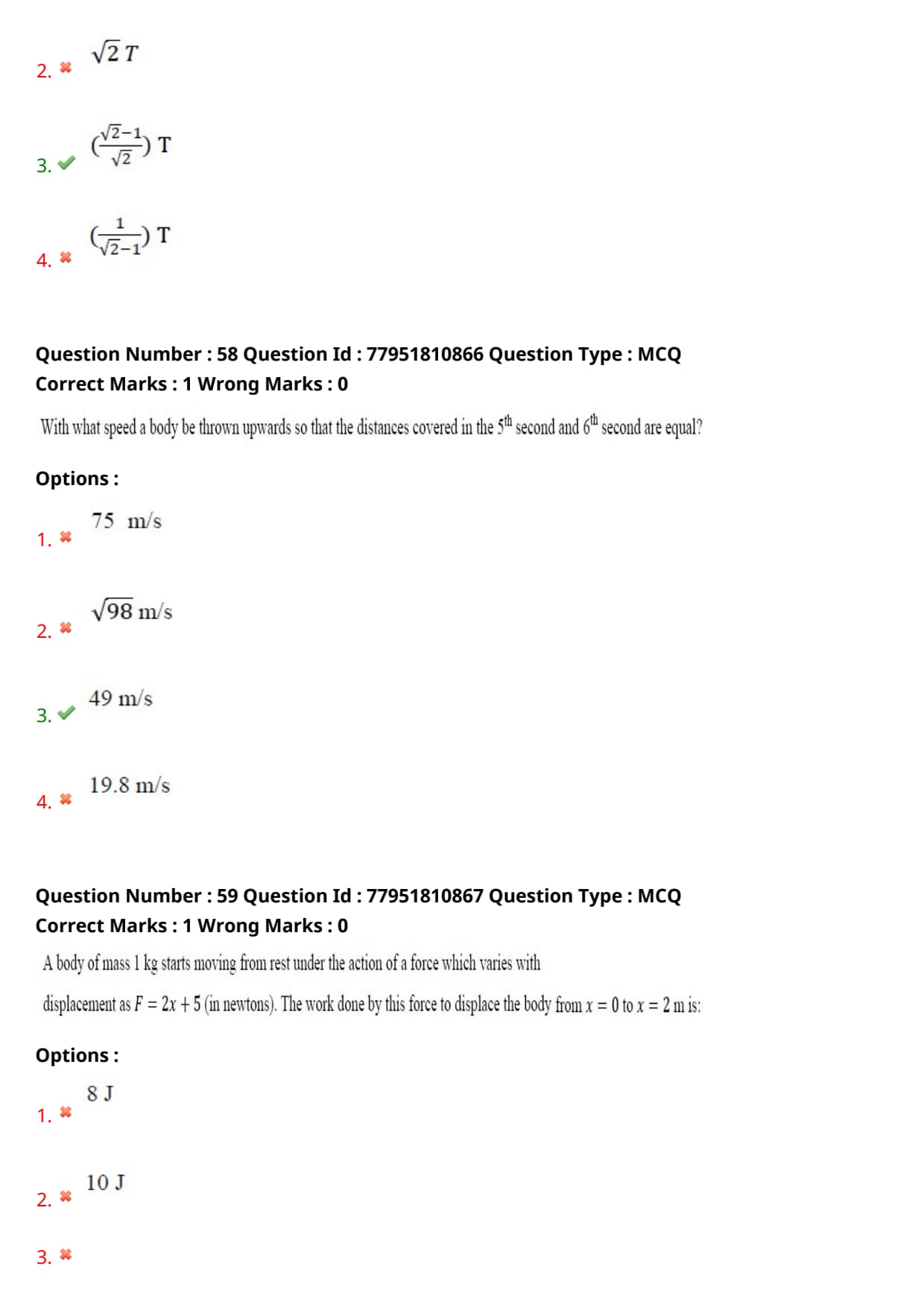
Question 58:
With what speed should a body be thrown upwards so that the distances covered in the \(5^{th}\) second and \(6^{th}\) second are equal?
- (A) \(75\ m/s\)
- (B) \(\sqrt{98}\ m/s\)
- (C) \(49\ m/s\)
- (D) \(19.8\ m/s\)
Question 59:
A body of mass \(1\ kg\) starts moving from rest under the action of a force which varies with displacement as \(F=2x+5\) in newtons. The work done by this force to displace the body from \(x=0\) to \(x=2\ m\) is
- (A) \(8\ J\)
- (B) \(10\ J\)
- (C) \(12\ J\)
- (D) \(14\ J\)
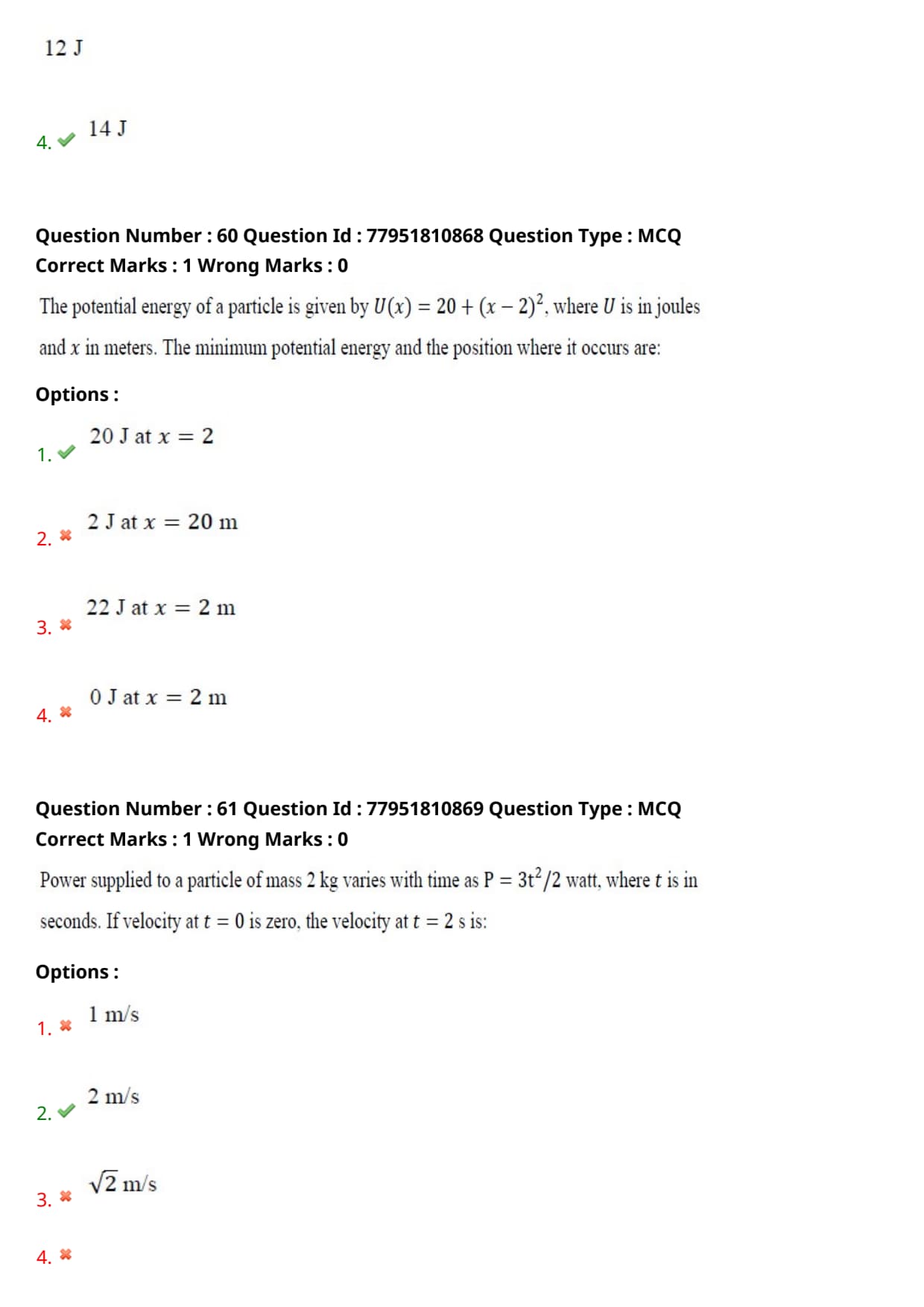
Question 60:
The potential energy of a particle is given by \(U(x)=20+(x-2)^2\), where \(U\) is in joules and \(x\) is in meters. The minimum potential energy and the position where it occurs are
- (A) \(20\ J at x=2\)
- (B) \(2\ J at x=20\ m\)
- (C) \(22\ J at x=2\ m\)
- (D) \(0\ J at x=2\ m\)
Question 61:
Power supplied to a particle of mass \(2\ kg\) varies with time as \[ P=\frac{3t^2}{2}\ watt, \]
where \(t\) is in seconds. If velocity at \(t=0\) is zero, the velocity at \(t=2\ s\) is
- (A) \(1\ m/s\)
- (B) \(2\ m/s\)
- (C) \(\sqrt{2}\ m/s\)
- (D) \(4\ m/s\)
Question 62:
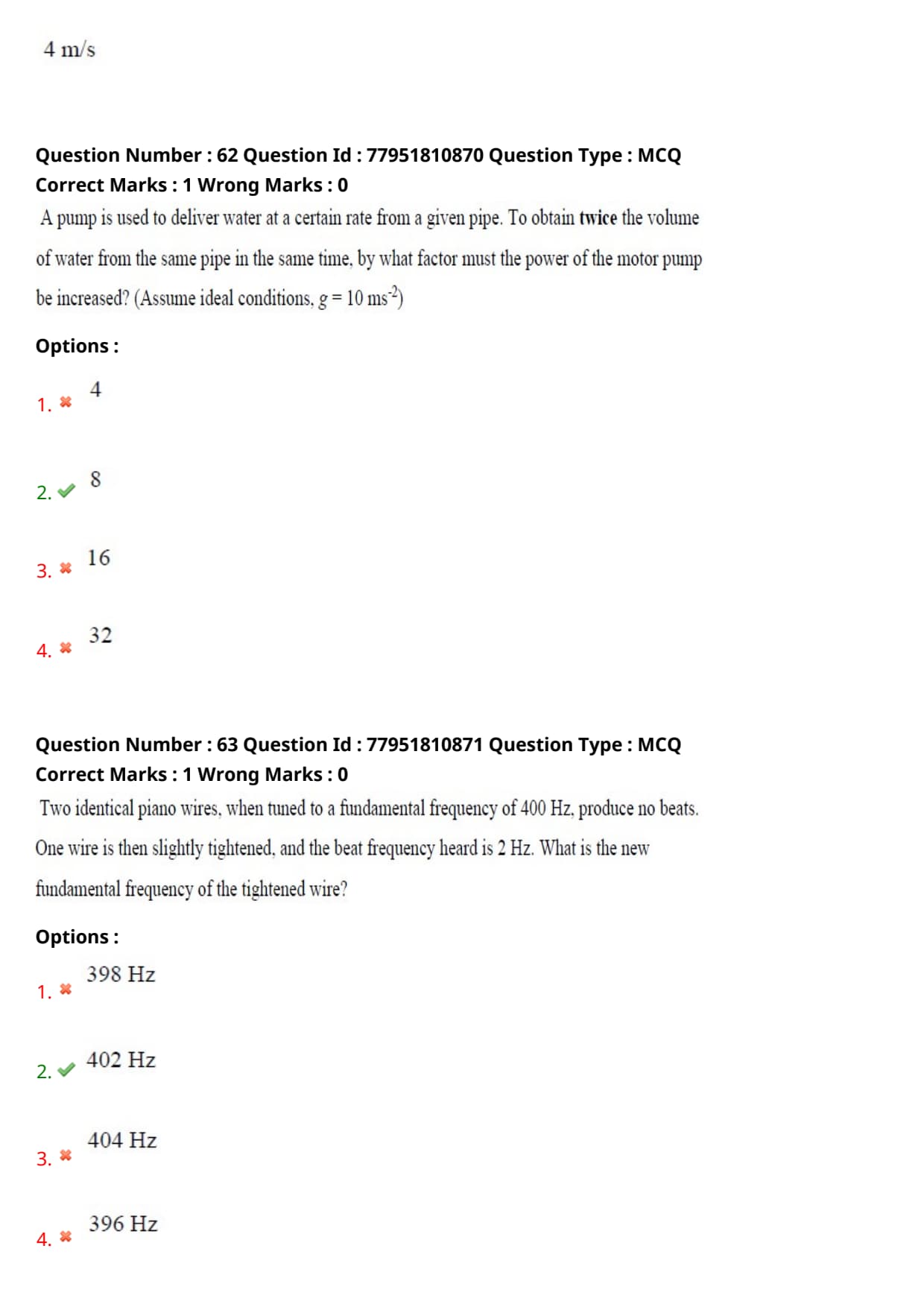
A pump is used to deliver water at a certain rate from a given pipe. To obtain twice the volume of water from the same pipe in the same time, by what factor must the power of the motor pump be increased? Assume ideal conditions.
- (A) \(4\)
- (B) \(8\)
- (C) \(16\)
- (D) \(32\)
Question 63:
Two identical piano wires, when tuned to a fundamental frequency of \(400\ Hz\), produce no beats. One wire is then slightly tightened, and the beat frequency heard is \(2\ Hz\). What is the new fundamental frequency of the tightened wire?
- (A) \(398\ Hz\)
- (B) \(402\ Hz\)
- (C) \(404\ Hz\)
- (D) \(396\ Hz\)
Question 64:
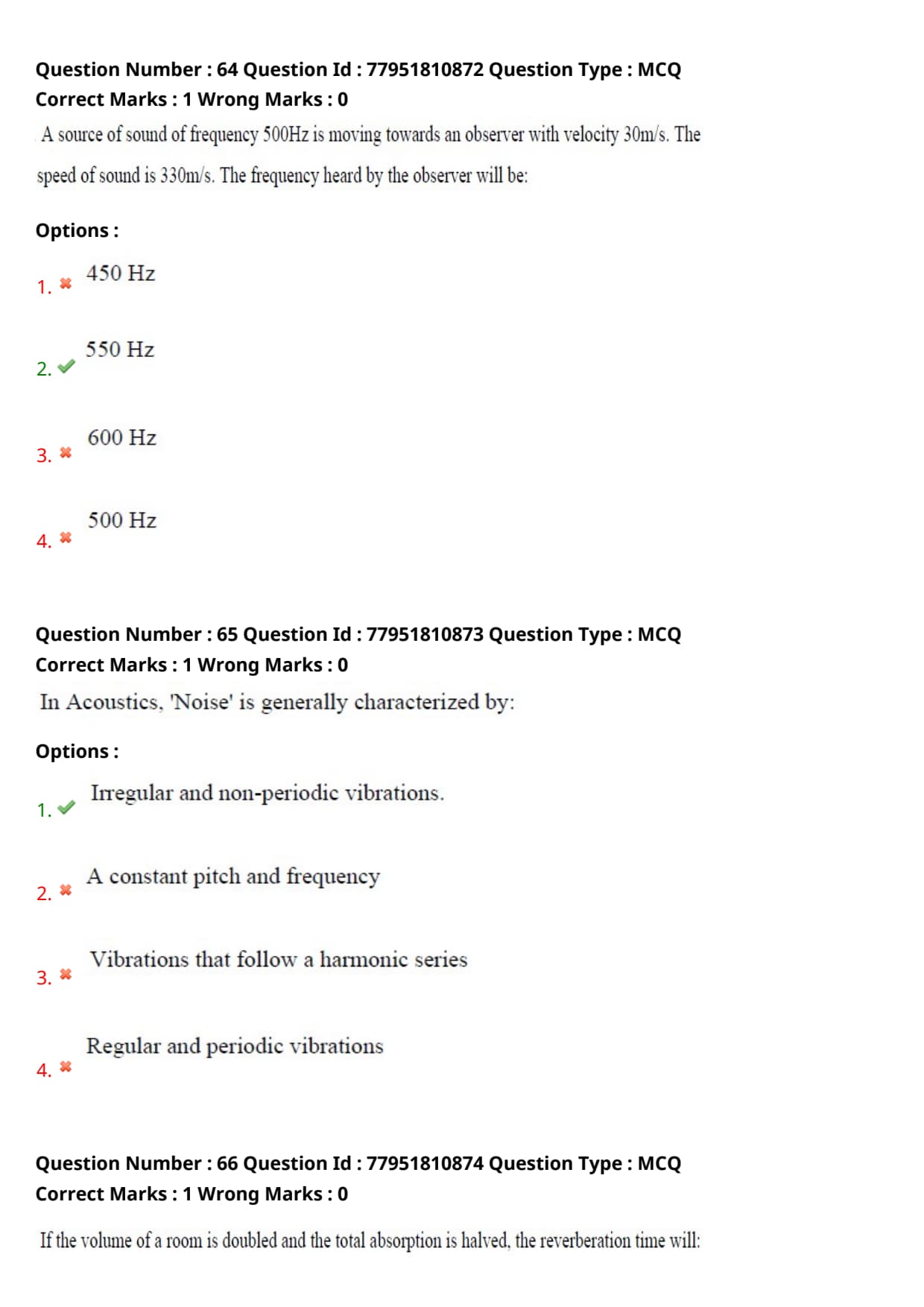
A source of sound of frequency \(500\ Hz\) is moving towards an observer with velocity \(30\ m/s\). The speed of sound is \(330\ m/s\). The frequency heard by the observer will be
- (A) \(450\ Hz\)
- (B) \(550\ Hz\)
- (C) \(600\ Hz\)
- (D) \(500\ Hz\)
Question 65:
In acoustics, ``Noise'' is generally characterized by
- (A) Irregular and non-periodic vibrations
- (B) A constant pitch and frequency
- (C) Vibrations that follow a harmonic series
- (D) Regular and periodic vibrations
Question 66:
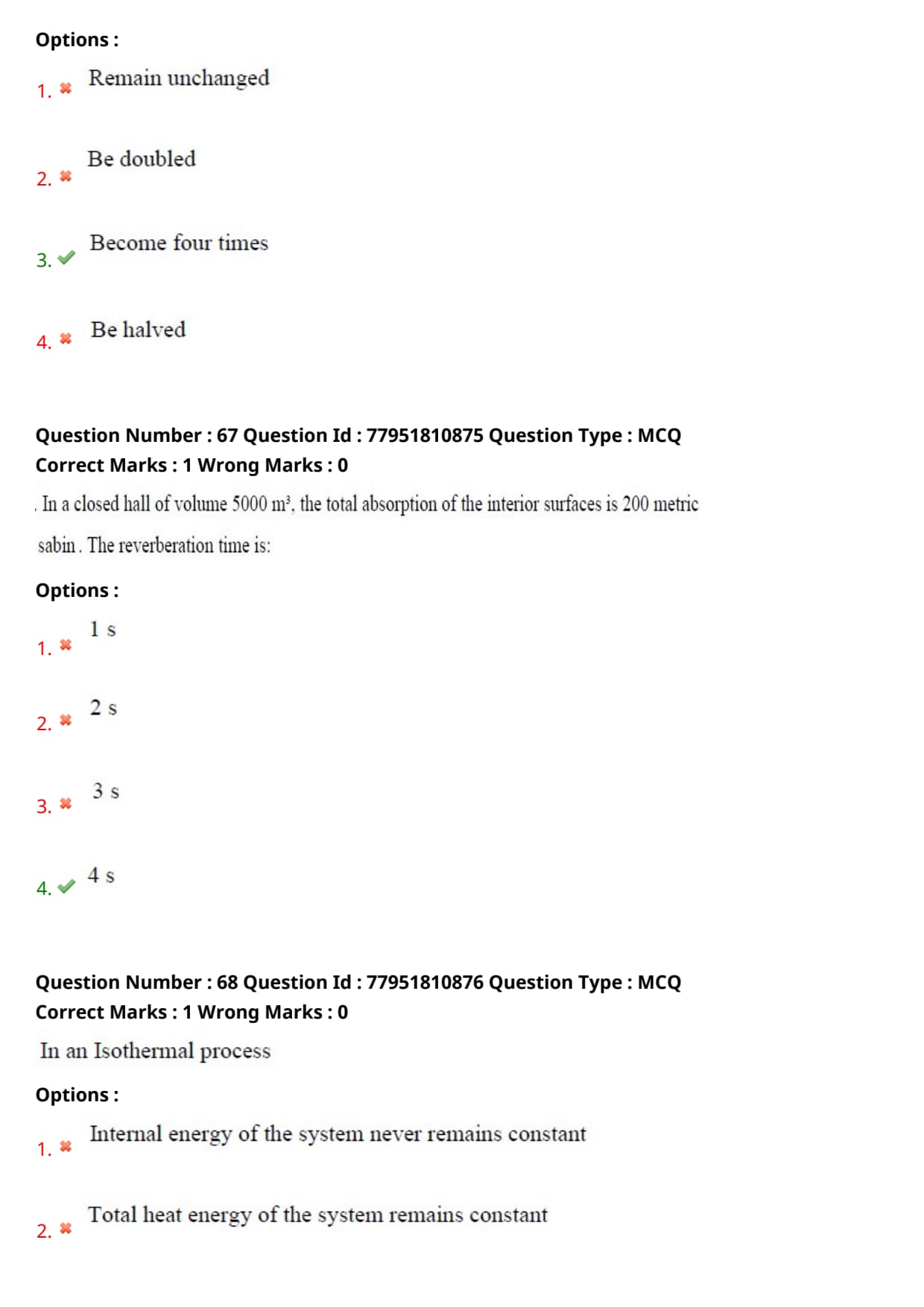
If the volume of a room is doubled and the total absorption is halved, the reverberation time will
- (A) Remain unchanged
- (B) Be doubled
- (C) Become four times
- (D) Be halved
Question 67:
In a closed hall of volume \(5000\ m^3\), the total absorption of the interior surfaces is \(200\) metric sabin. The reverberation time is
- (A) \(1\ s\)
- (B) \(2\ s\)
- (C) \(3\ s\)
- (D) \(4\ s\)
Question 68:
In an isothermal process
- (A) Internal energy of the system never remains constant
- (B) Total heat energy of the system remains constant
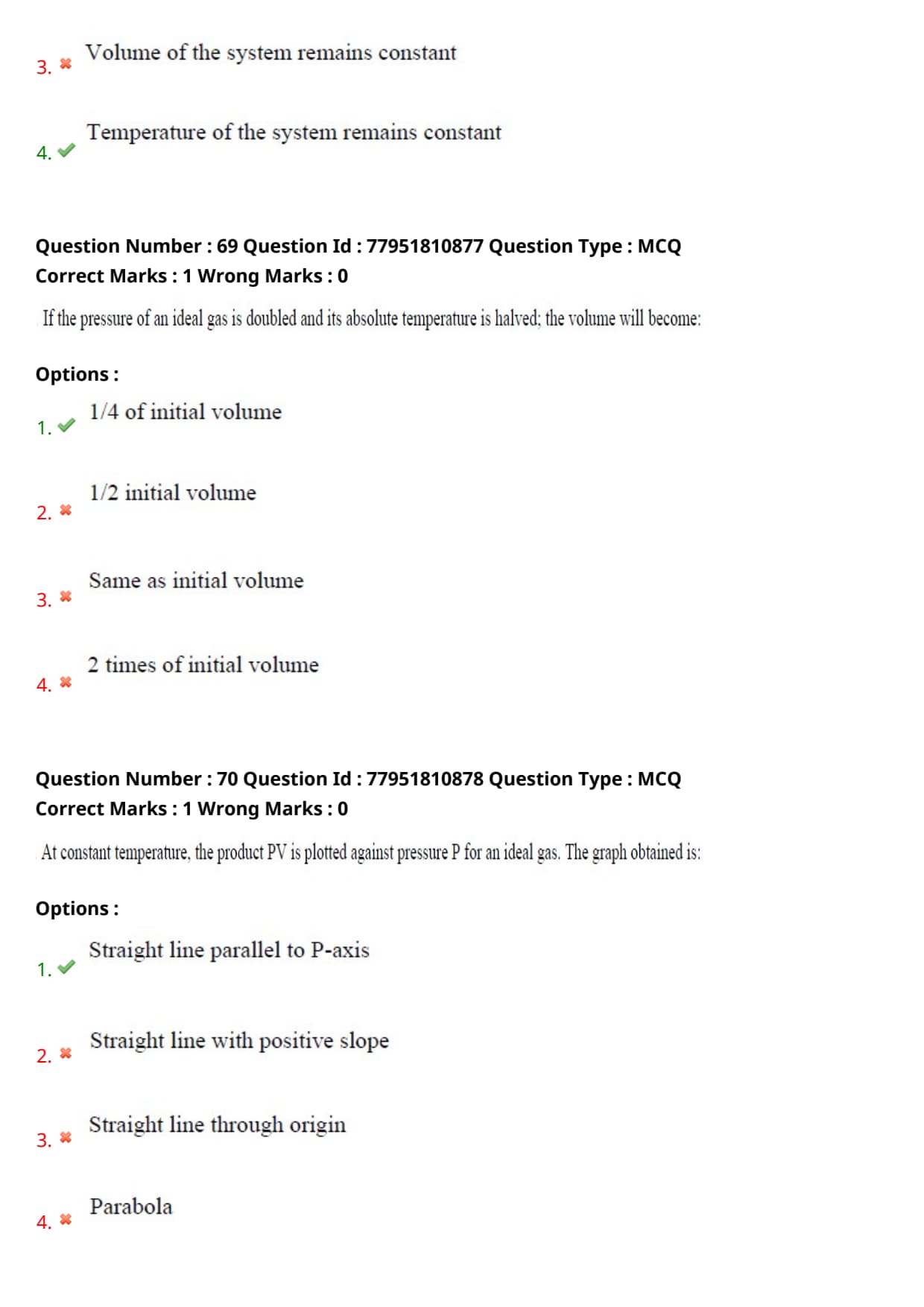
- (C) Volume of the system remains constant
- (D) Temperature of the system remains constant
Question 69:
If the pressure of an ideal gas is doubled and its absolute temperature is halved, the volume will become
- (A) \(\frac{1}{4}\) of initial volume
- (B) \(\frac{1}{2}\) initial volume
- (C) Same as initial volume
- (D) \(2\) times of initial volume
Question 70:
At constant temperature, the product \(PV\) is plotted against pressure \(P\) for an ideal gas. The graph obtained is
- (A) Straight line parallel to \(P\)-axis
- (B) Straight line with positive slope
- (C) Straight line through origin
- (D) Parabola
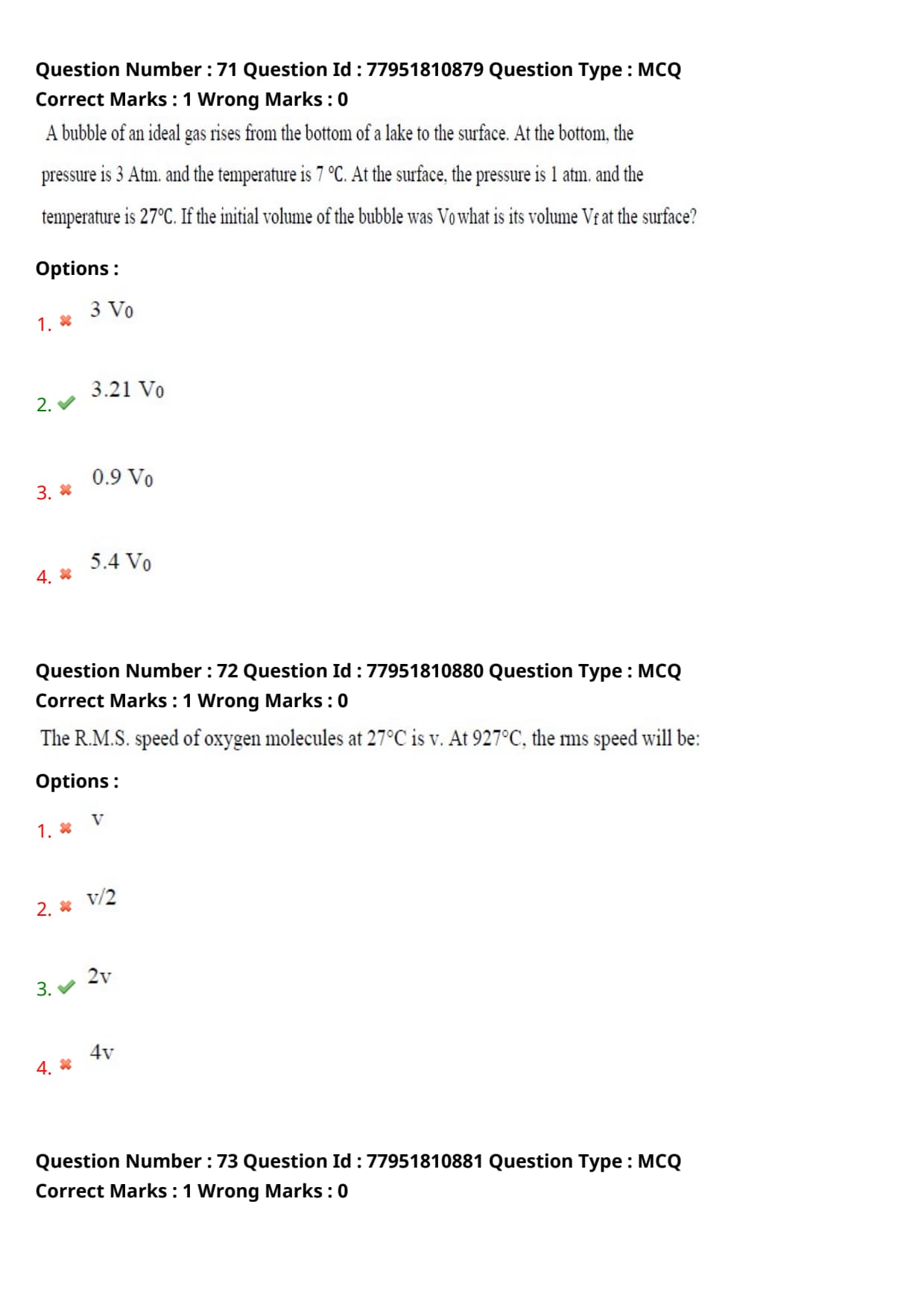
Question 71:
A bubble of an ideal gas rises from the bottom of a lake to the surface. At the bottom, the pressure is \(3\ atm\) and the temperature is \(7° C\). At the surface, the pressure is \(1\ atm\) and the temperature is \(27° C\). If the initial volume of the bubble was \(V_0\), what is its volume \(V\) at the surface?
- (A) \(3V_0\)
- (B) \(3.21V_0\)
- (C) \(0.9V_0\)
- (D) \(5.4V_0\)
Question 72:
The R.M.S. speed of oxygen molecules at \(27°C\) is \(v\). At \(927°C\), its R.M.S. speed will be
- (A) \(v\)
- (B) \(\frac{v}{2}\)
- (C) \(2v\)
- (D) \(4v\)
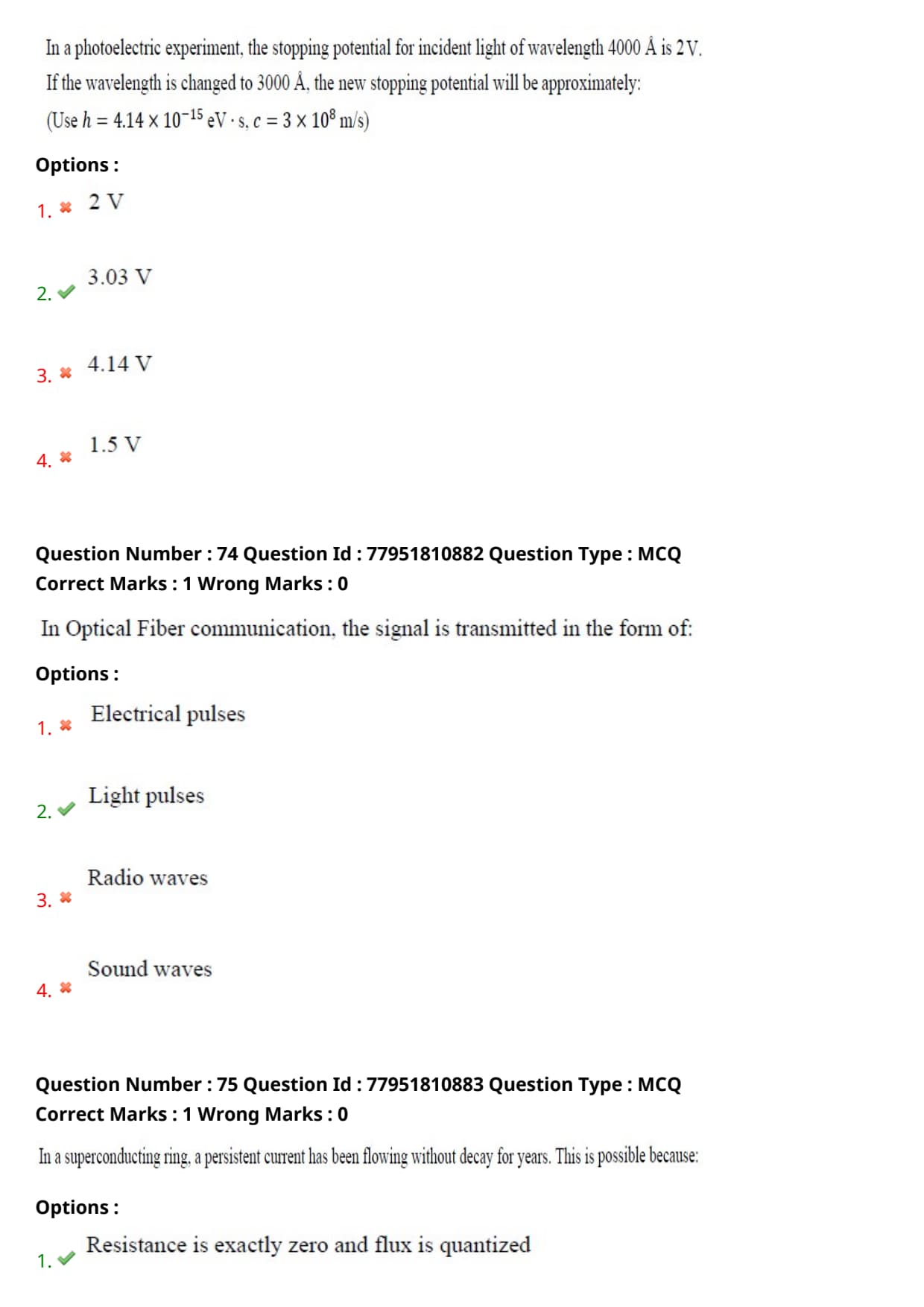
Question 73:
In a photoelectric experiment, the stopping potential for incident light of wavelength \(4000\ Å\) is \(2\ V\). If the wavelength is changed to \(3000\ Å\), the new stopping potential will be approximately \[ (Use h=4.14\times 10^{-15}\ eV s,\ c=3\times 10^8\ m/s) \]
- (A) \(2\ V\)
- (B) \(3.03\ V\)
- (C) \(4.14\ V\)
- (D) \(1.5\ V\)
Question 74:
In Optical Fiber communication, the signal is transmitted in the form of
- (A) Electrical pulses
- (B) Light pulses
- (C) Radio waves
- (D) Sound waves
Question 75:
In a superconducting ring, a persistent current has been flowing without decay for years. This is possible because
- (A) Resistance is exactly zero and flux is quantized
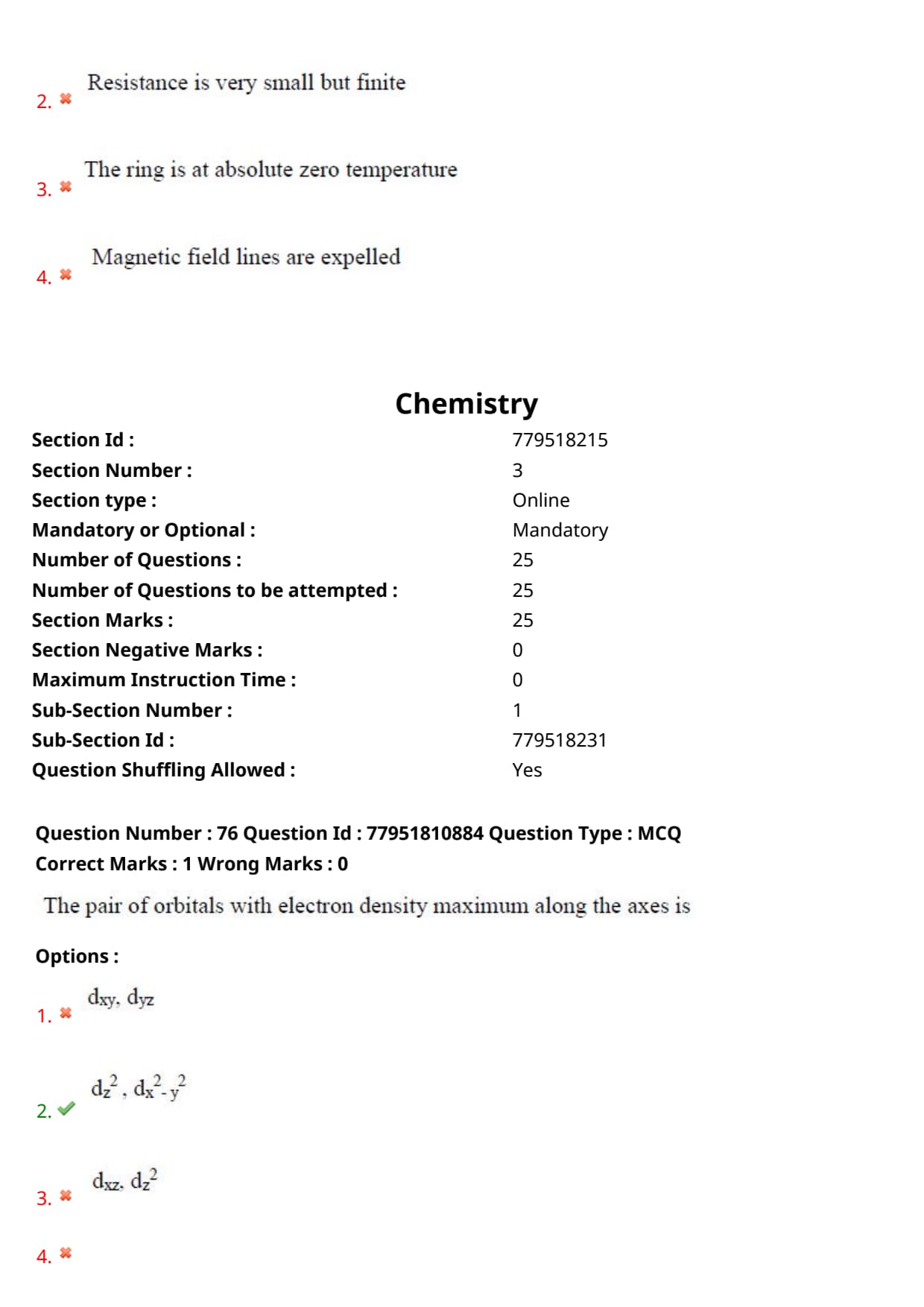
- (B) Resistance is very high and current is quantized
- (C) Magnetic field is zero and voltage is maximum
- (D) Temperature is very high and resistance is finite
Question 76:
The pair of orbitals with electron density maximum along the axes is
- (A) \(d_{xy}, d_{yz}\)
- (B) \(d_{z^2}, d_{x^2-y^2}\)
- (C) \(d_{xz}, d_{z^2}\)
- (D) \(d_{xz}, p_z\)
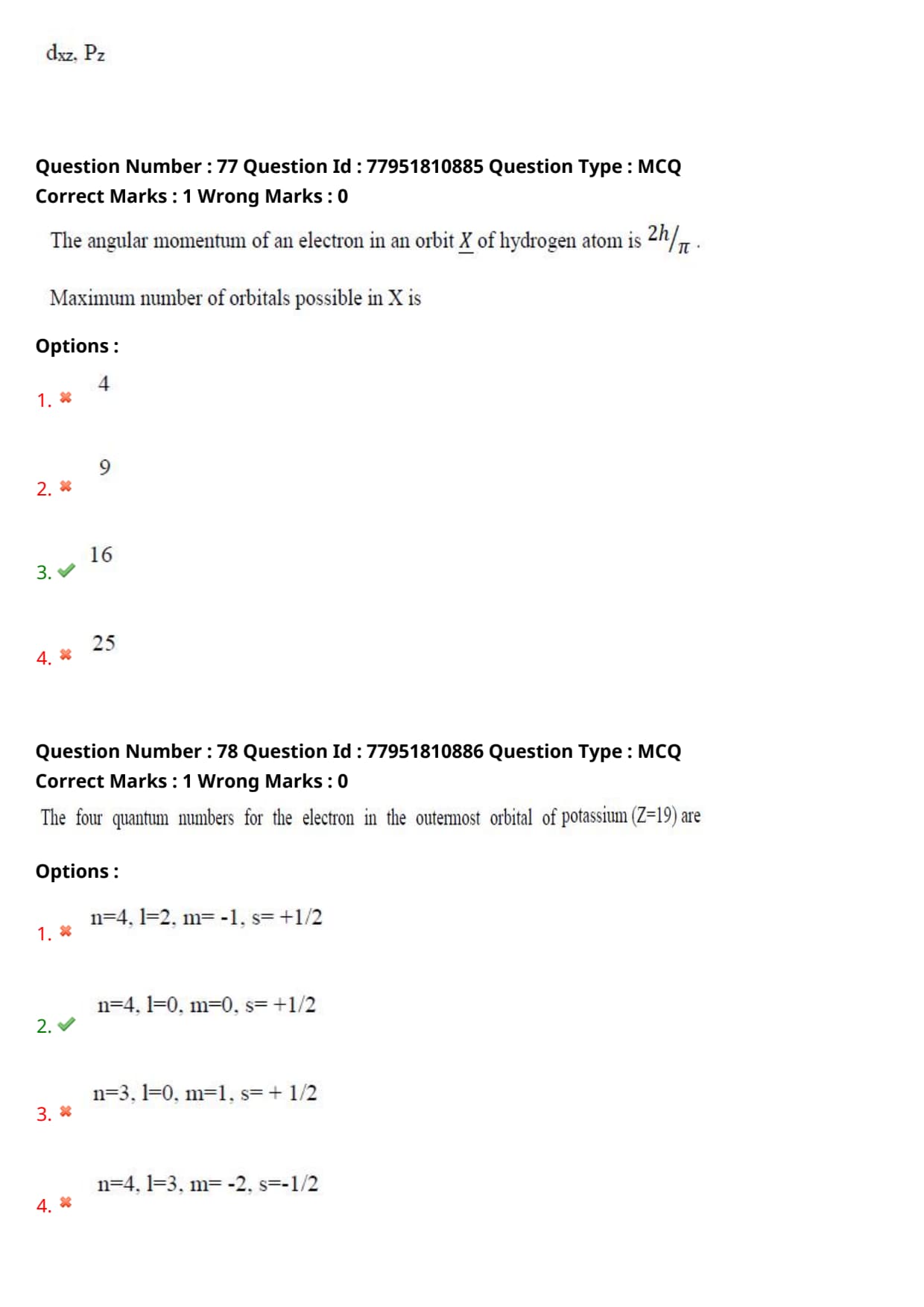
Question 77:
The angular momentum of an electron in an orbit \(X\) of hydrogen atom is \(\frac{2h}{\pi}\). Maximum number of orbitals possible in \(X\) is
- (A) \(4\)
- (B) \(9\)
- (C) \(16\)
- (D) \(25\)
Question 78:
The four quantum numbers for the electron in the outermost orbital of potassium \((Z=19)\) are
- (A) \(n=4,\ l=2,\ m=-1,\ s=+\frac{1}{2}\)
- (B) \(n=4,\ l=0,\ m=0,\ s=+\frac{1}{2}\)
- (C) \(n=3,\ l=0,\ m=1,\ s=+\frac{1}{2}\)
- (D) \(n=4,\ l=3,\ m=-2,\ s=-\frac{1}{2}\)
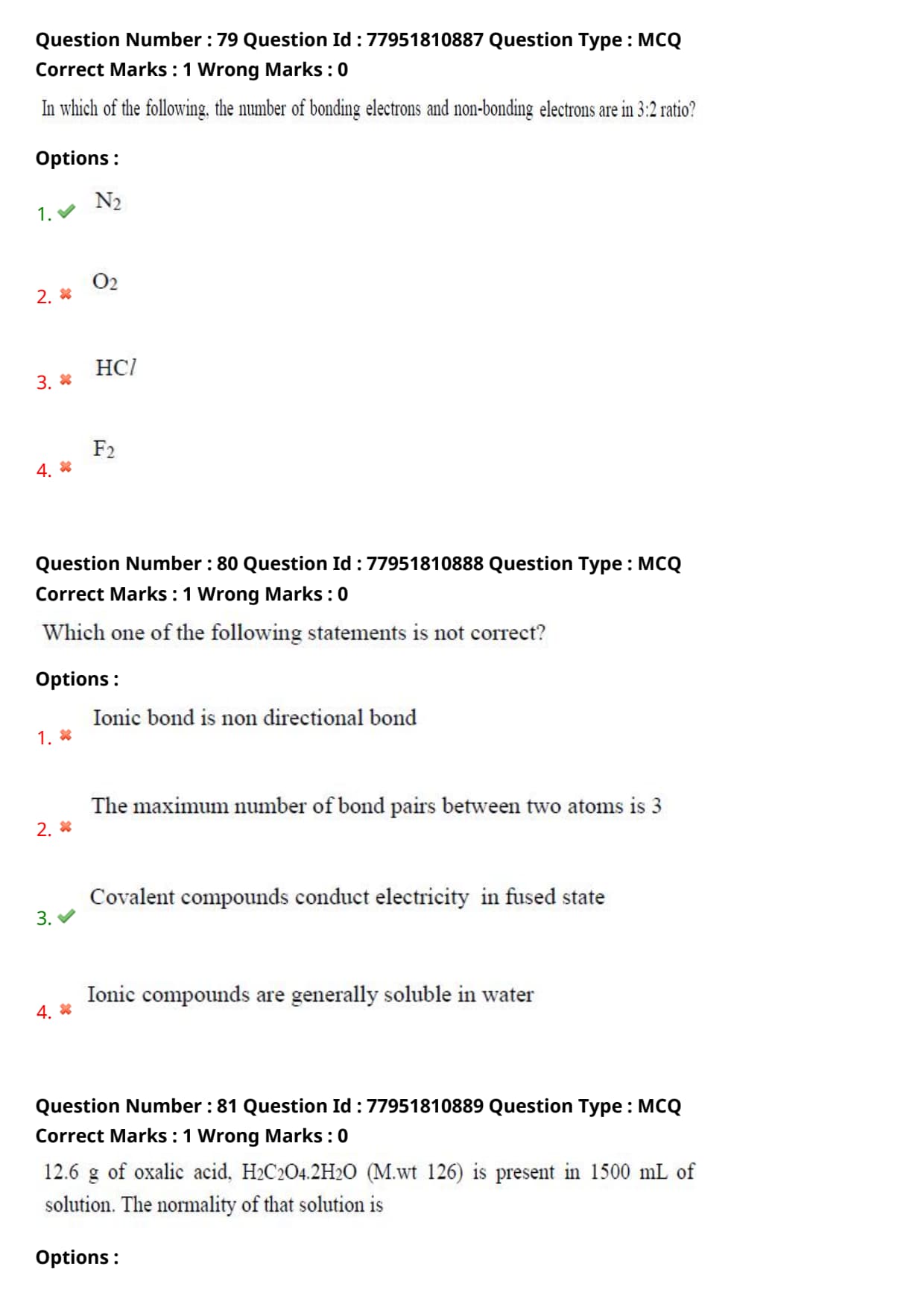
Question 79:
In which of the following, the number of bonding electrons and non-bonding electrons are in \(3:2\) ratio?
- (A) \(N_2\)
- (B) \(O_2\)
- (C) \(HCl\)
- (D) \(F_2\)
Question 80:
Which one of the following statements is not correct?
- (A) Ionic bond is non-directional bond
- (B) The maximum number of bond pairs between two atoms is \(3\)
- (C) Covalent compounds conduct electricity in fused state
- (D) Ionic compounds are generally soluble in water
Question 81:
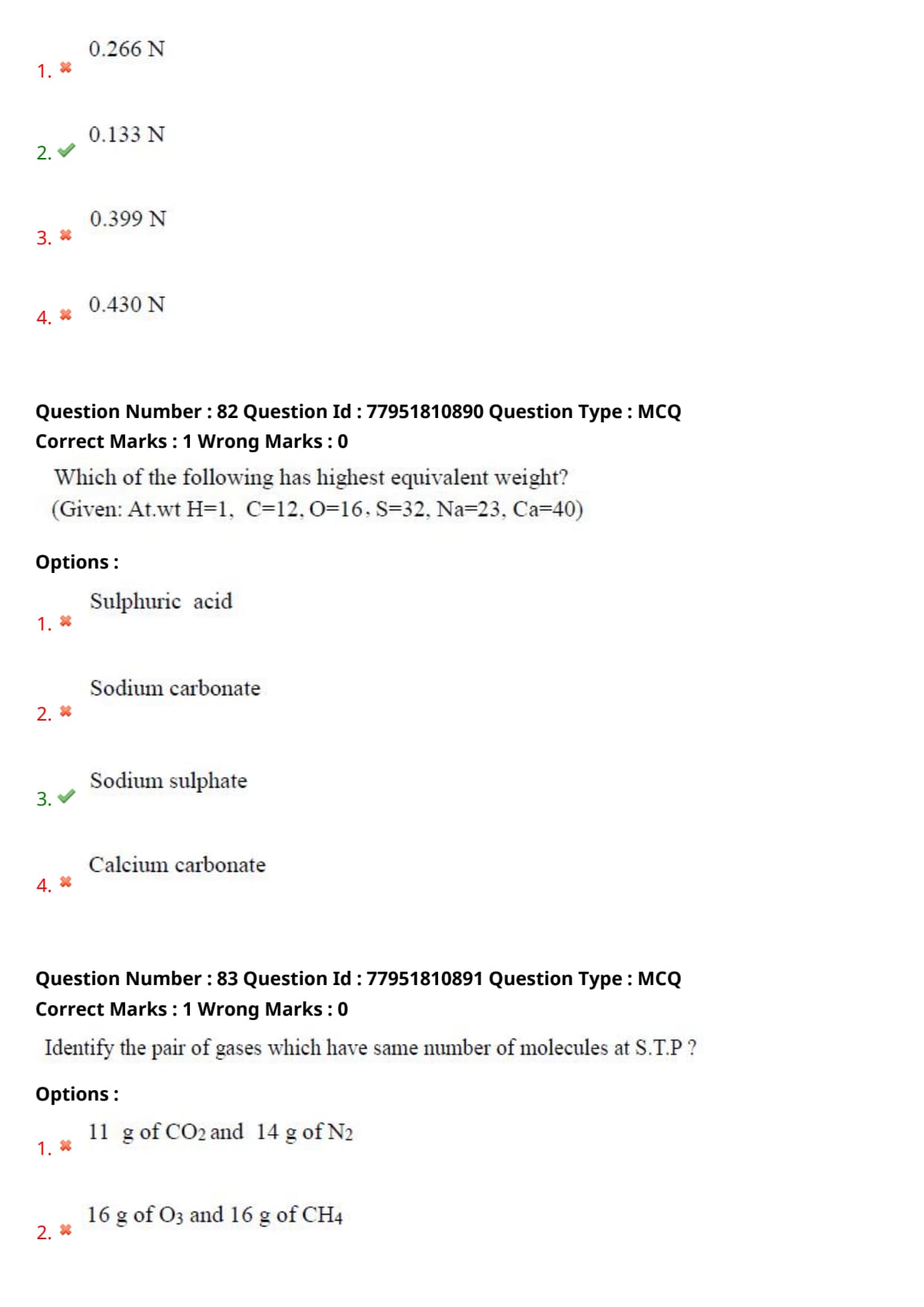
\(12.6\ g\) of oxalic acid, \(H_2C_2O_4\cdot 2H_2O\) \((M.wt. 126)\), is present in \(1500\ mL\) of solution. The normality of that solution is
- (A) \(0.266\ N\)
- (B) \(0.133\ N\)
- (C) \(0.399\ N\)
- (D) \(0.430\ N\)
Question 82:
Which of the following has highest equivalent weight? Given: At.wt \(H=1,\ C=12,\ O=16,\ S=32,\ Na=23,\ Ca=40\)
- (A) Sulphuric acid
- (B) Sodium carbonate
- (C) Sodium sulphate
- (D) Calcium carbonate
Question 83:
Identify the pair of gases which have same number of molecules at S.T.P.?
- (A) \(11\ g of CO_2\) and \(14\ g of N_2\)
- (B) \(16\ g of O_3\) and \(16\ g of CH_4\)
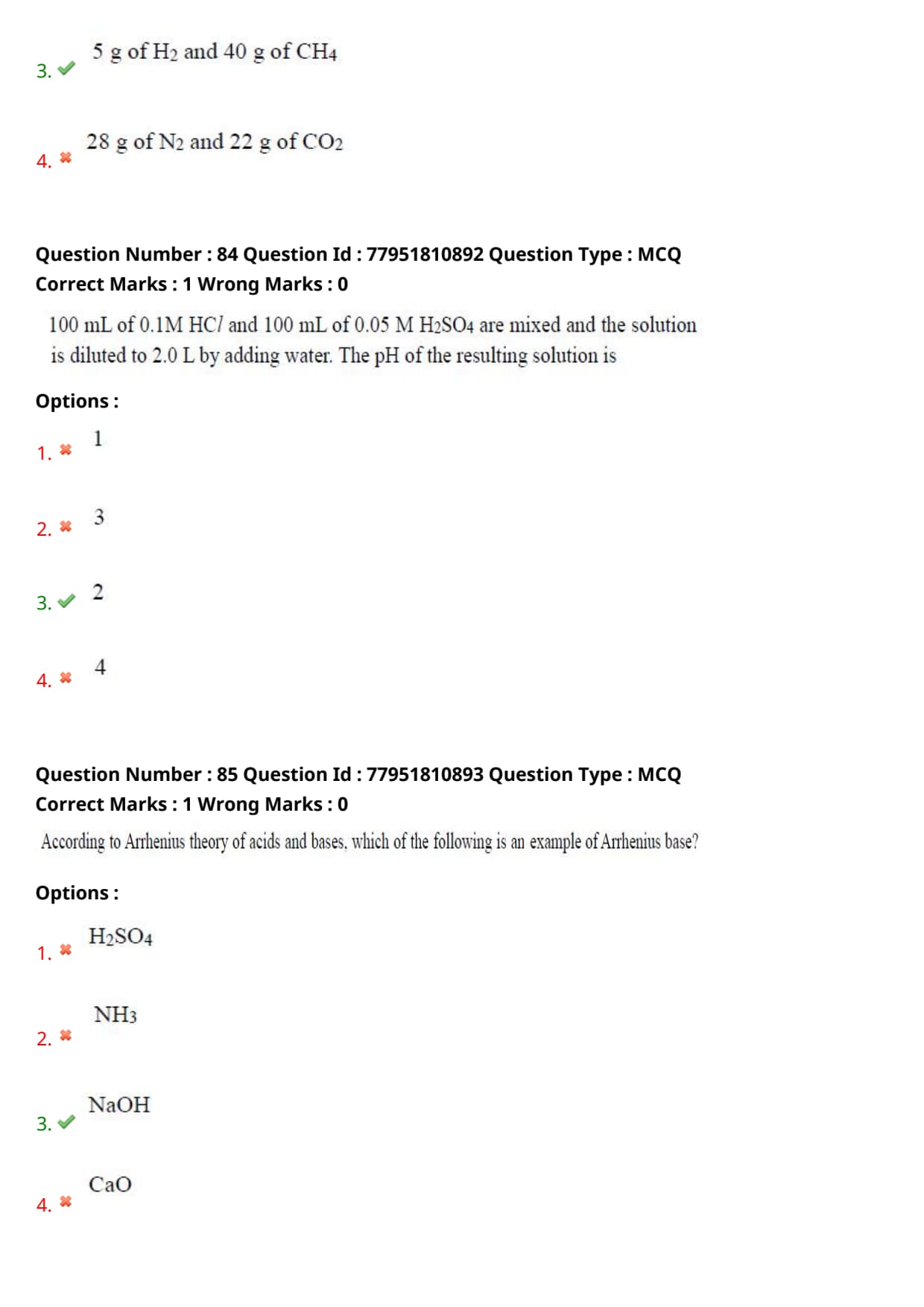
- (C) \(5\ g of H_2\) and \(40\ g of CH_4\)
- (D) \(28\ g of N_2\) and \(22\ g of CO_2\)
Question 84:
\(100\ mL\) of \(0.1M\ HCl\) and \(100\ mL\) of \(0.05M\ H_2SO_4\) are mixed and the solution is diluted to \(2.0\ L\) by adding water. The pH of the resulting solution is
- (A) \(1\)
- (B) \(3\)
- (C) \(2\)
- (D) \(4\)
Question 85:
According to Arrhenius theory of acids and bases, which of the following is an example of Arrhenius base?
- (A) \(H_2SO_4\)
- (B) \(NH_3\)
- (C) \(NaOH\)
- (D) \(CaO\)
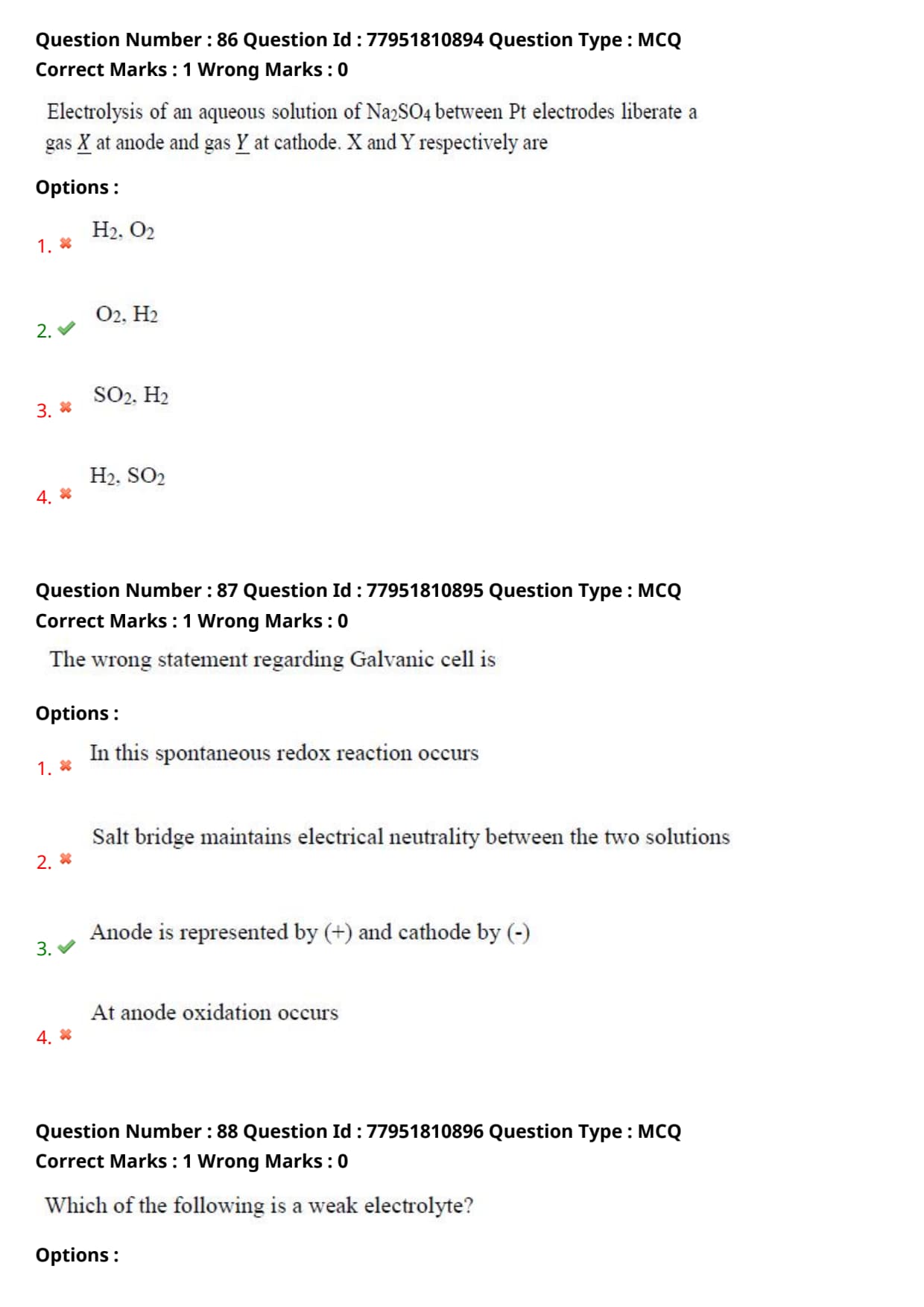
Question 86:
Electrolysis of an aqueous solution of \(Na_2SO_4\) between Pt electrodes liberates a gas \(X\) at anode and gas \(Y\) at cathode. \(X\) and \(Y\) respectively are
- (A) \(H_2,\ O_2\)
- (B) \(O_2,\ H_2\)
- (C) \(SO_2,\ H_2\)
- (D) \(H_2,\ SO_2\)
Question 87:
The wrong statement regarding Galvanic cell is
- (A) In this spontaneous redox reaction occurs
- (B) Salt bridge maintains electrical neutrality between the two solutions
- (C) Anode is represented by \((+)\) and cathode by \((-)\)
- (D) At anode oxidation occurs
Question 88:
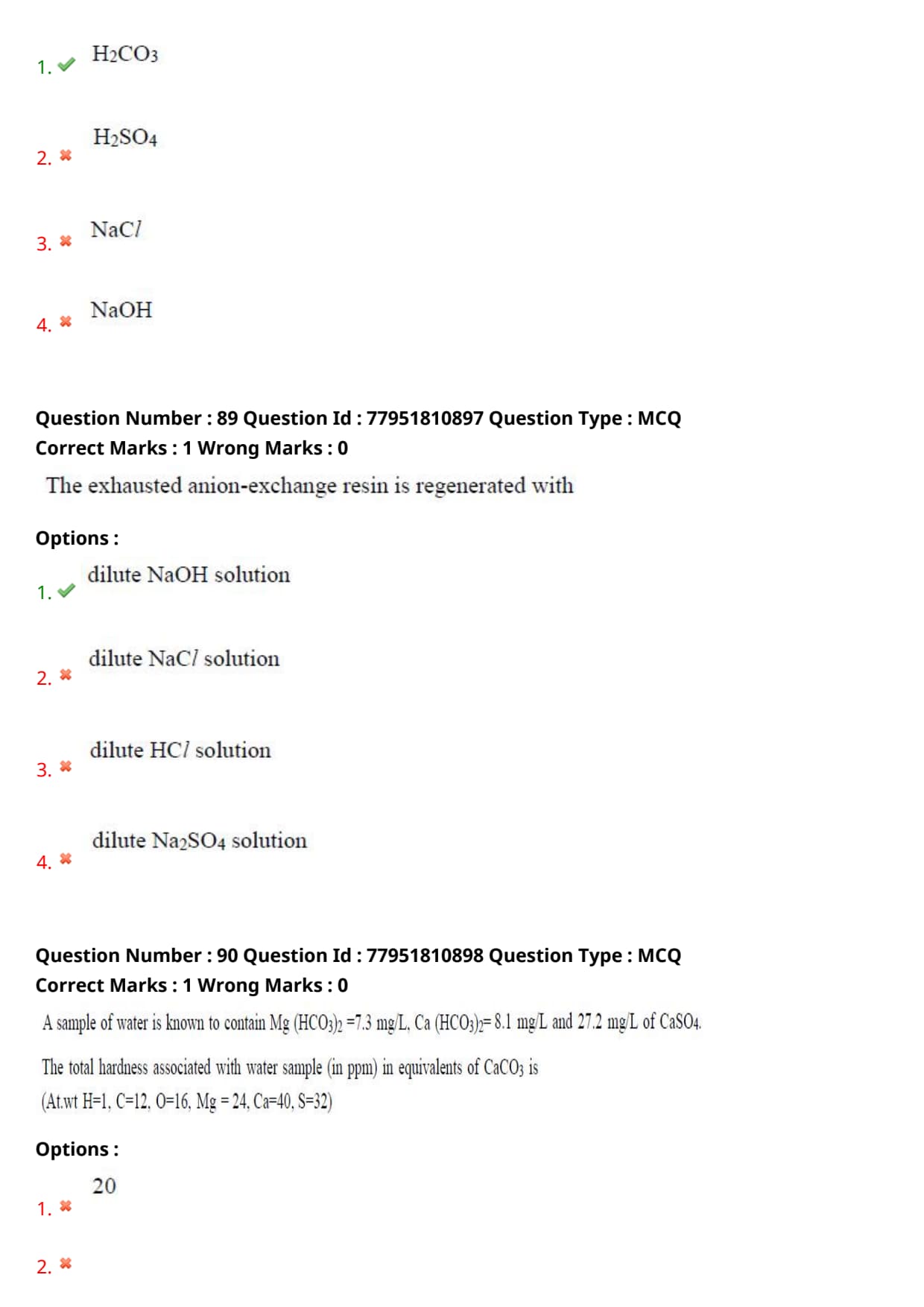
Which of the following is a weak electrolyte?
- (A) \(H_2CO_3\)
- (B) \(H_2SO_4\)
- (C) \(NaCl\)
- (D) \(NaOH\)
Question 89:
The exhausted anion-exchange resin is regenerated with
- (A) dilute \(NaOH\) solution
- (B) dilute \(NaCl\) solution
- (C) dilute \(HCl\) solution
- (D) dilute \(Na_2SO_4\) solution
Question 90:
A sample of water is known to contain \(Mg(HCO_3)_2=7.3\ mg/L\), \(Ca(HCO_3)_2=8.1\ mg/L\), and \(27.2\ mg/L\) of \(CaSO_4\). The total hardness associated with water sample in ppm in equivalents of \(CaCO_3\) is \[ (At.wt. H=1,\ C=12,\ O=16,\ Mg=24,\ Ca=40,\ S=32) \]
- (A) \(20\)
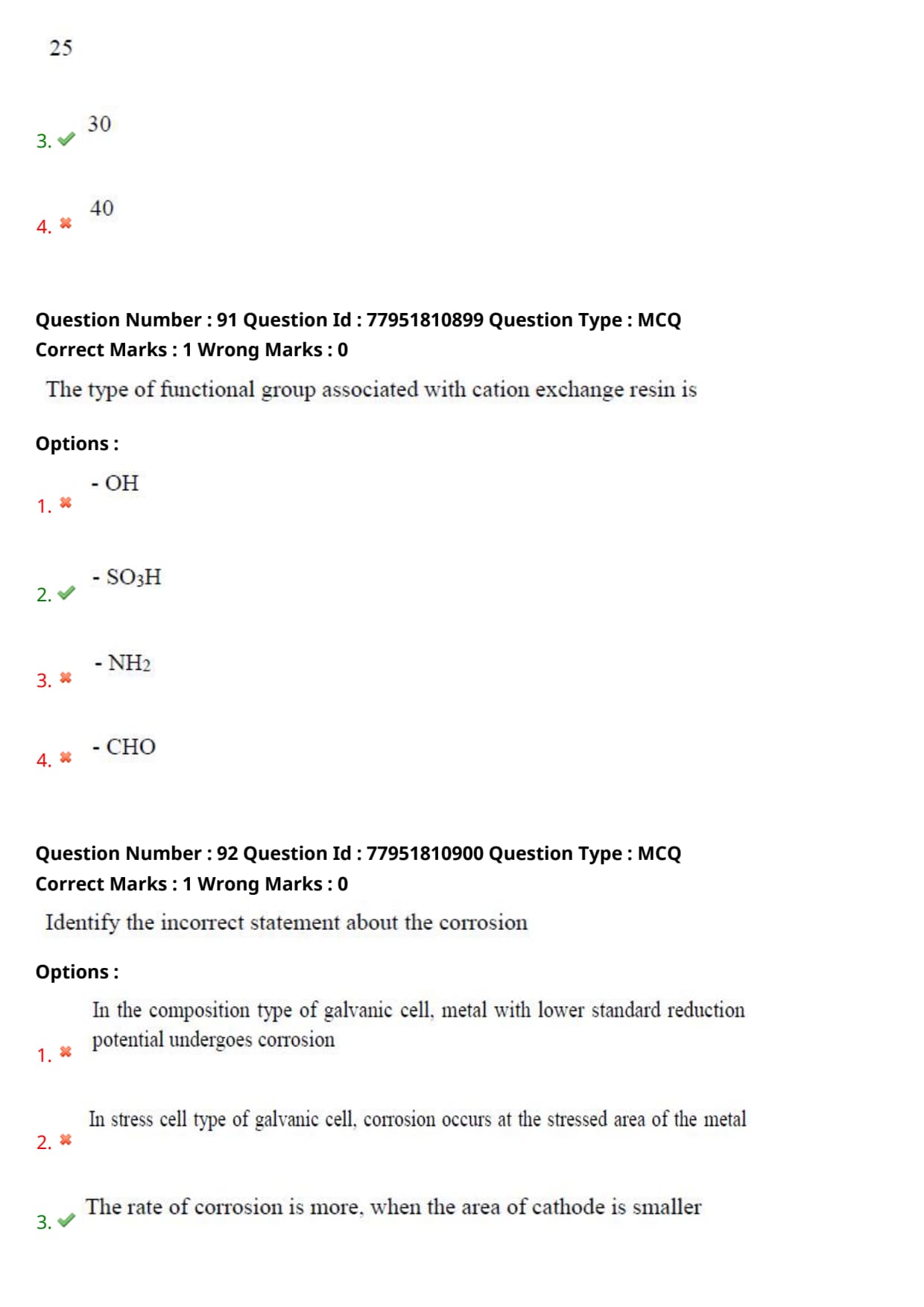
- (B) \(25\)
- (C) \(30\)
- (D) \(40\)
Question 91:
The type of functional group associated with cation exchange resin is
- (A) \(-OH\)
- (B) \(-SO_3H\)
- (C) \(-NH_2\)
- (D) \(-CHO\)
Question 92:
Identify the incorrect statement about the corrosion.
- (A) In the composition type of galvanic cell, metal with lower standard reduction potential undergoes corrosion
- (B) In stress cell type of galvanic cell, corrosion occurs at the stressed area of the metal
- (C) The rate of corrosion is more, when the area of cathode is smaller
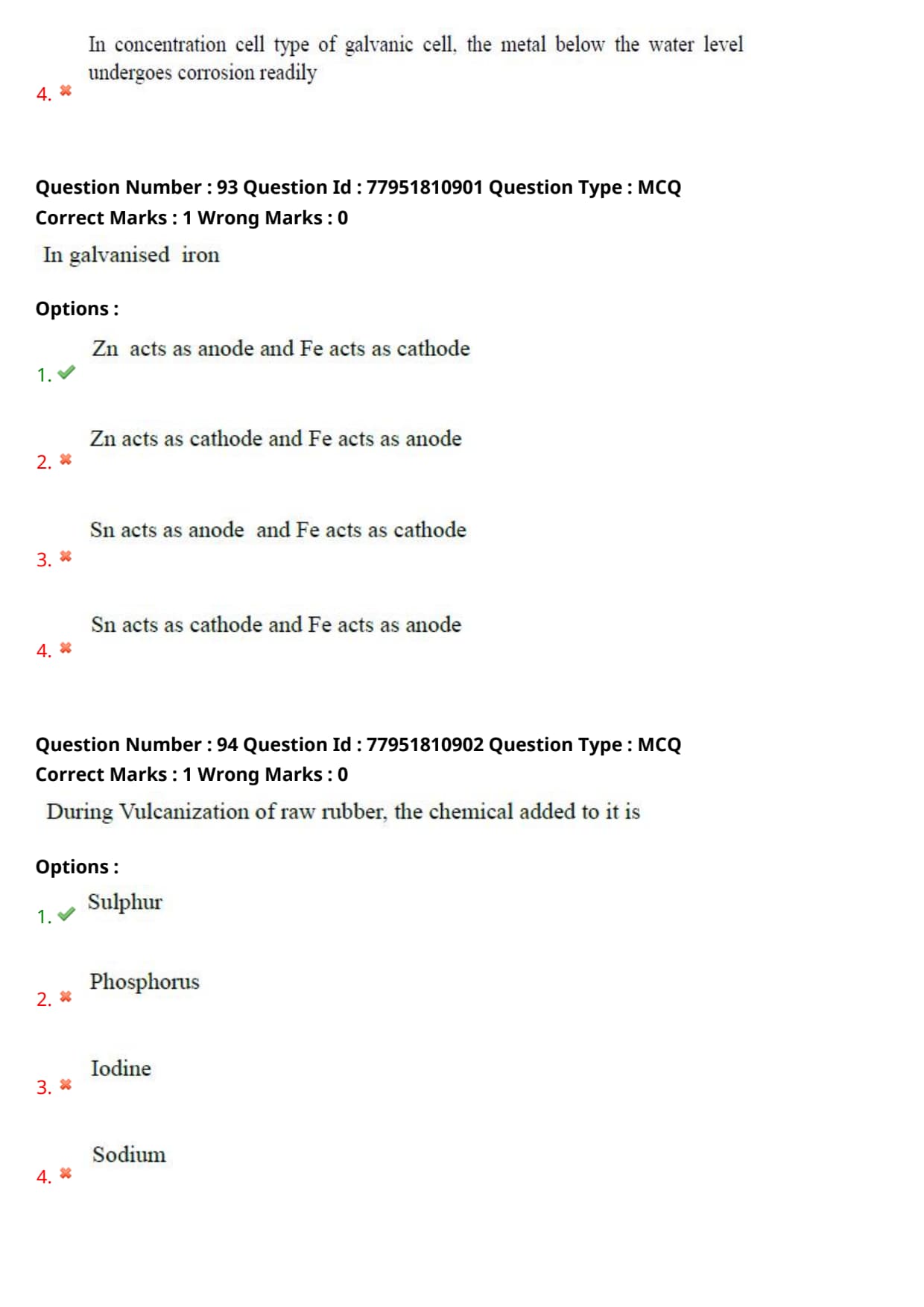
- (D) In concentration cell type of galvanic cell, the metal below the water level undergoes corrosion readily
Question 93:
In galvanised iron
- (A) Zn acts as anode and Fe acts as cathode
- (B) Zn acts as cathode and Fe acts as anode
- (C) Sn acts as anode and Fe acts as cathode
- (D) Sn acts as cathode and Fe acts as anode
Question 94:
During vulcanization of raw rubber, the chemical added to it is
- (A) Sulphur
- (B) Phosphorus
- (C) Iodine
- (D) Sodium
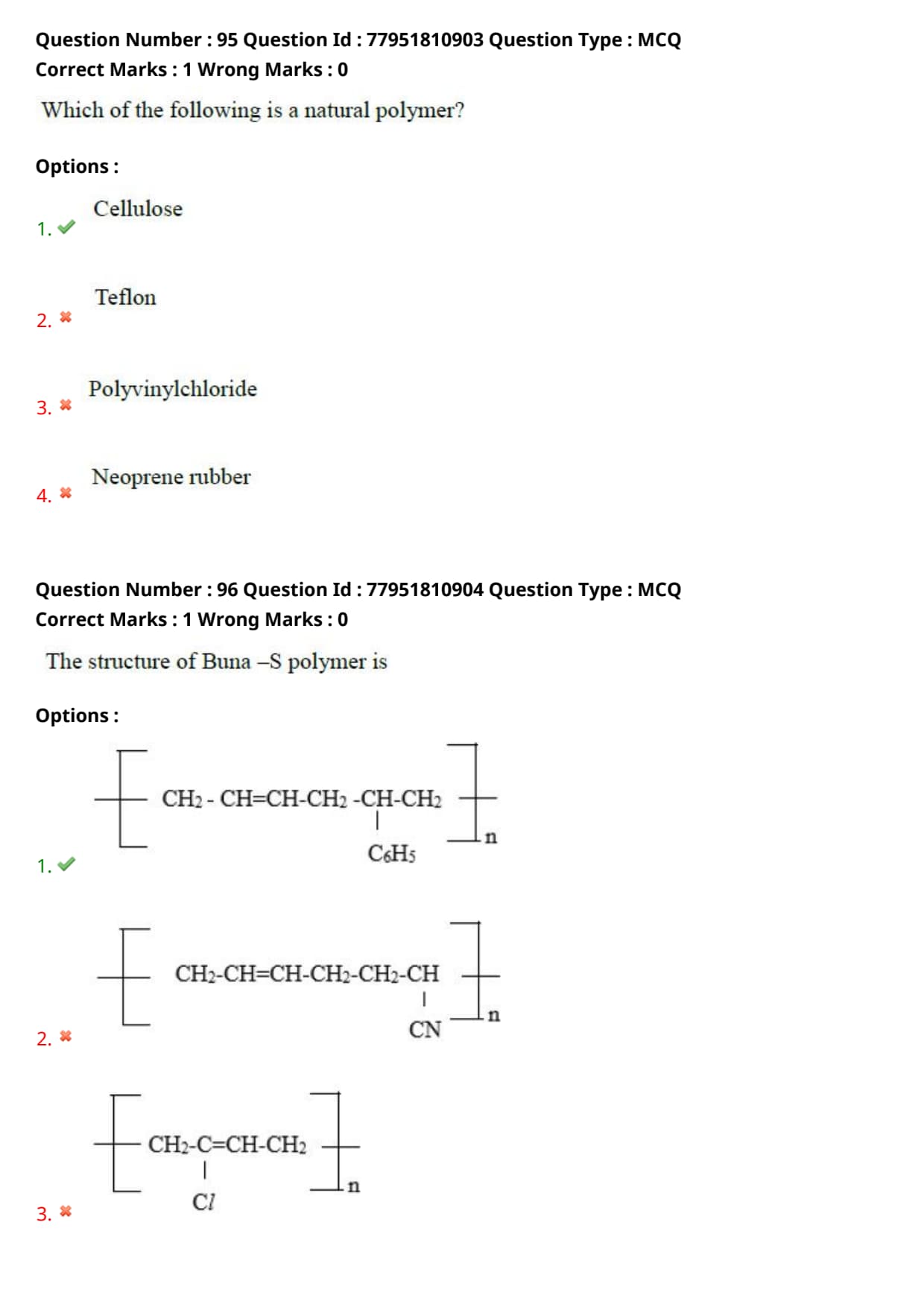
Question 95:
Which of the following is a natural polymer?
- (A) Cellulose
- (B) Teflon
- (C) Polyvinylchloride
- (D) Neoprene rubber
Question 96:
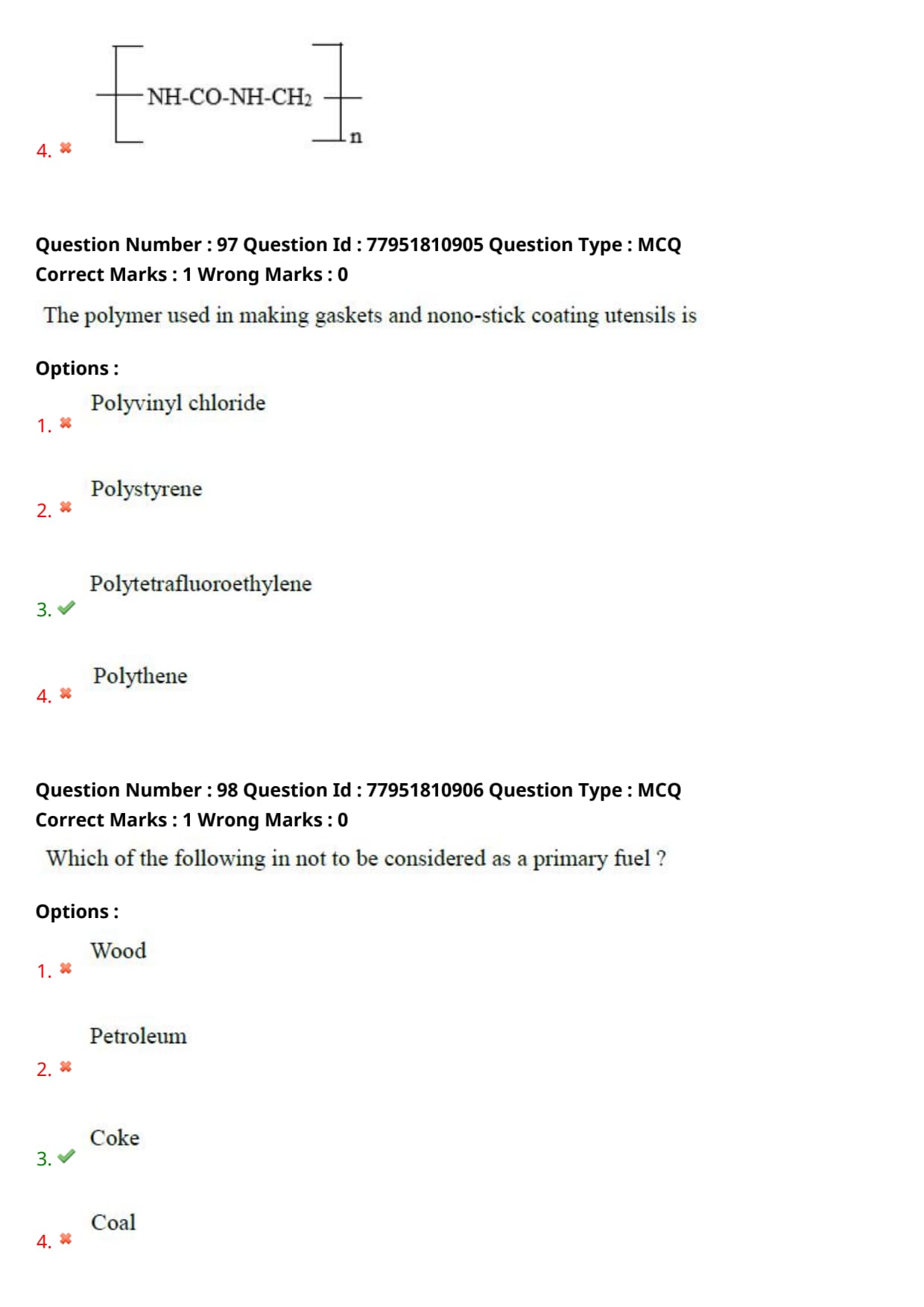
The structure of Buna-S polymer is
- (A) \(\left[-CH_2-CH=CH-CH_2-CH(C_6H_5)-CH_2-\right]_n\)
- (B) \(\left[-CH_2-CH=CH-CH_2-CH(CN)-CH_2-\right]_n\)
- (C) \(\left[-CH_2-C(Cl)=CH-CH_2-\right]_n\)
- (D) \(\left[-NH-CO-NH-CH_2-\right]_n\)
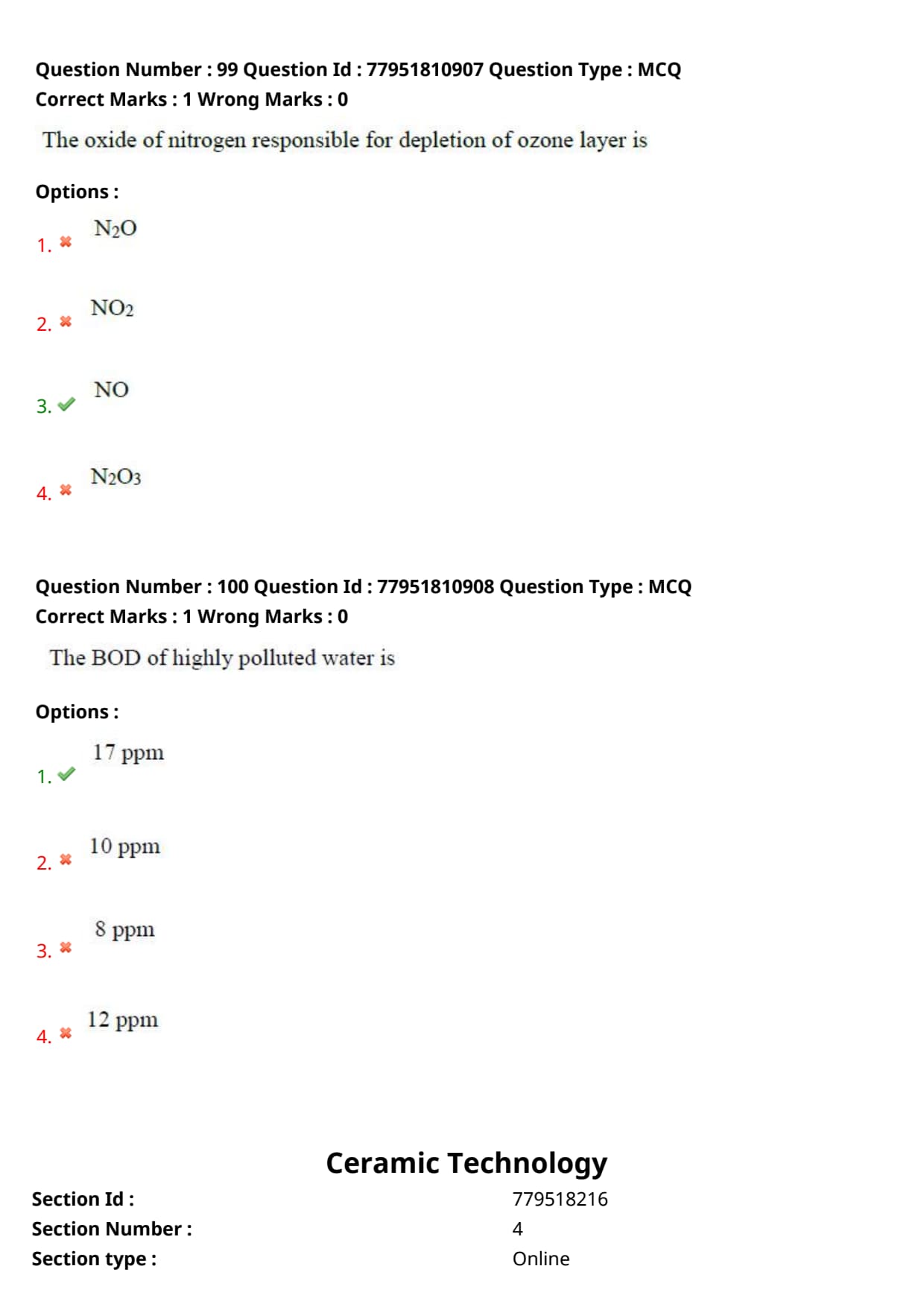
Question 97:
The polymer used in making gaskets and non-stick coating utensils is
- (A) Polyvinyl chloride
- (B) Polystyrene
- (C) Polytetrafluoroethylene
- (D) Polythene
Question 98:
Which of the following is not to be considered as a primary fuel?
- (A) Wood
- (B) Petroleum
- (C) Coke
- (D) Coal
Question 99:
The oxide of nitrogen responsible for depletion of ozone layer is
- (A) \(N_2O\)
- (B) \(NO_2\)
- (C) \(NO\)
- (D) \(N_2O_3\)
Question 100:
The BOD of highly polluted water is
- (A) \(17\ ppm\)
- (B) \(10\ ppm\)
- (C) \(8\ ppm\)
- (D) \(12\ ppm\)
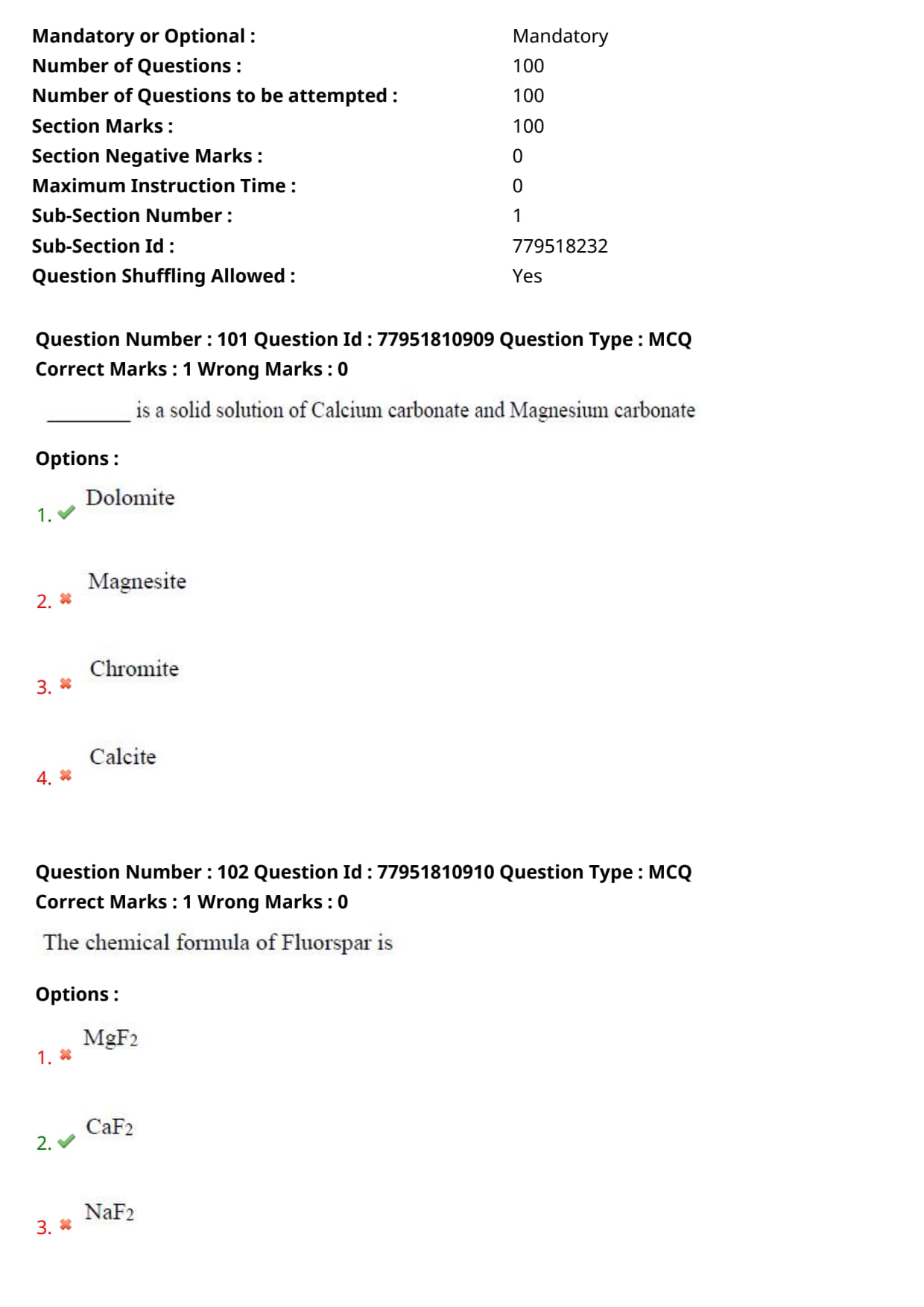
Question 101:
__________ is a solid solution of Calcium carbonate and Magnesium carbonate.
- (A) Dolomite
- (B) Magnesite
- (C) Chromite
- (D) Calcite
Question 102:
The chemical formula of Fluorspar is
- (A) \(MgF_2\)
- (B) \(CaF_2\)
- (C) \(NaF_2\)
- (D) \(NiF_2\)
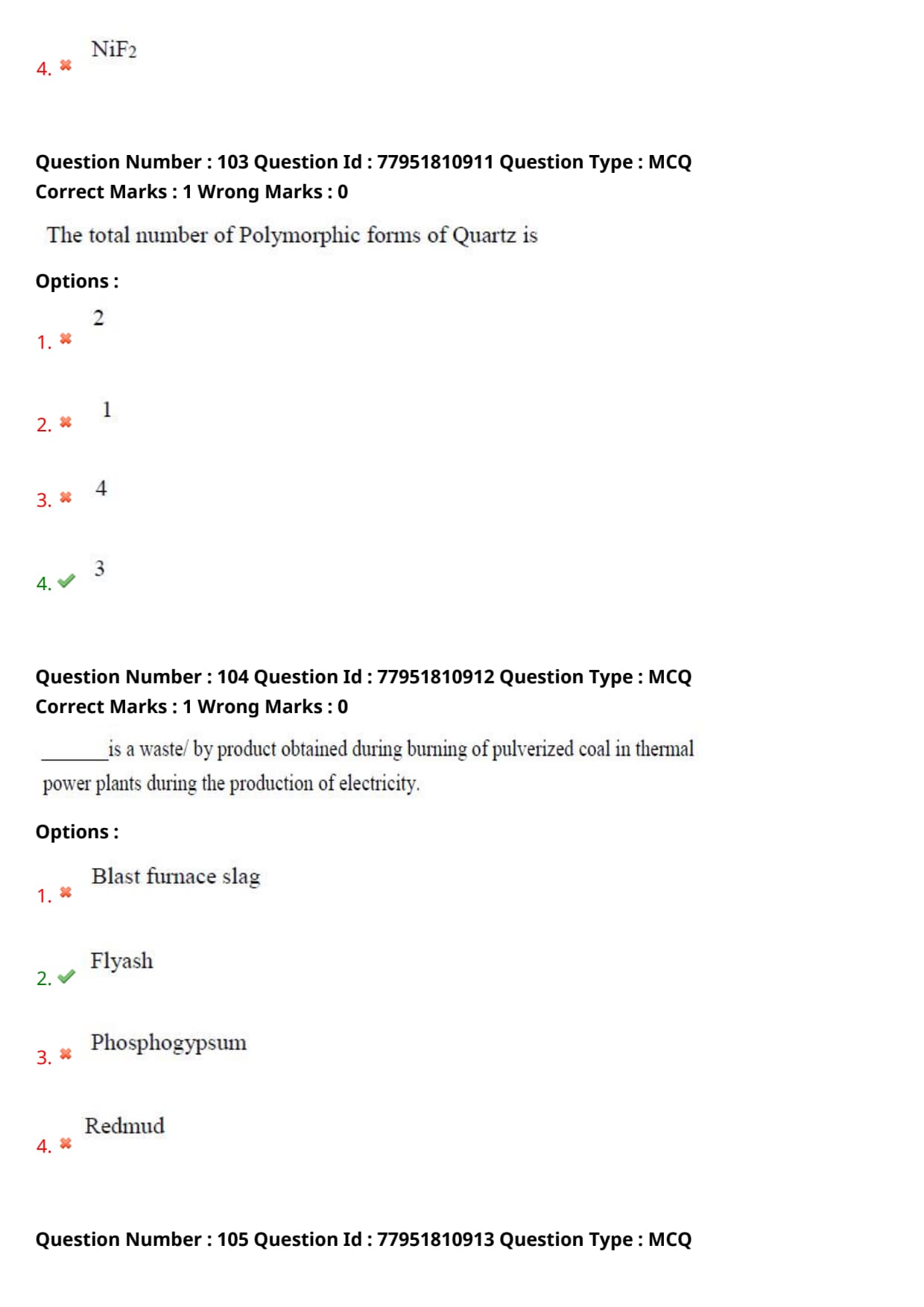
Question 103:
The total number of Polymorphic forms of Quartz is
- (A) \(2\)
- (B) \(1\)
- (C) \(4\)
- (D) \(3\)
Question 104:
__________ is a waste/by-product obtained during burning of pulverized coal in thermal power plants during the production of electricity.
- (A) Blast furnace slag
- (B) Flyash
- (C) Phosphogypsum
- (D) Redmud
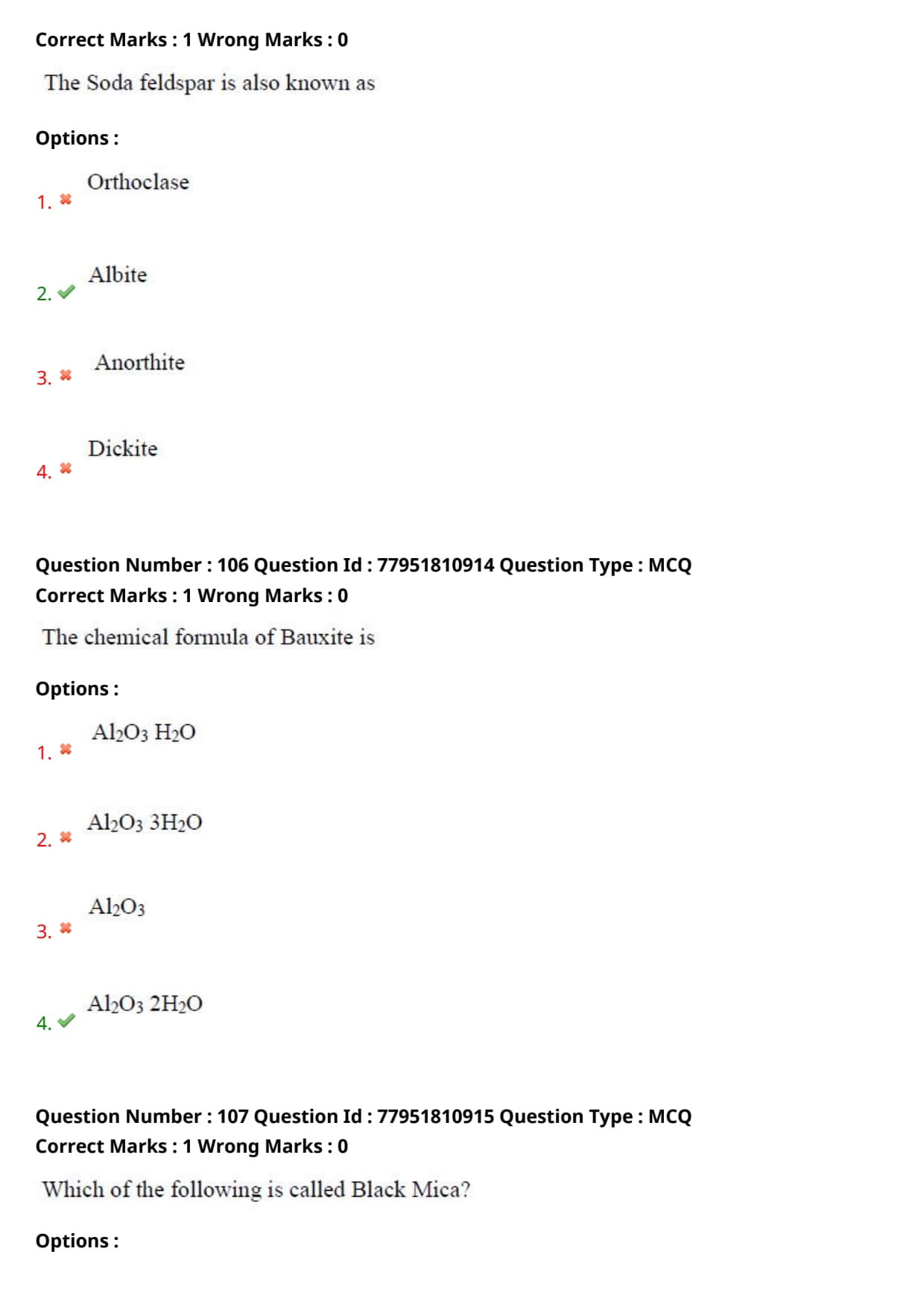
Question 105:
The Soda feldspar is also known as
- (A) Orthoclase
- (B) Albite
- (C) Anorthite
- (D) Dickite
Question 106:
The chemical formula of Bauxite is
- (A) \(Al_2O_3\cdot H_2O\)
- (B) \(Al_2O_3\cdot 3H_2O\)
- (C) \(Al_2O_3\)
- (D) \(Al_2O_3\cdot 2H_2O\)
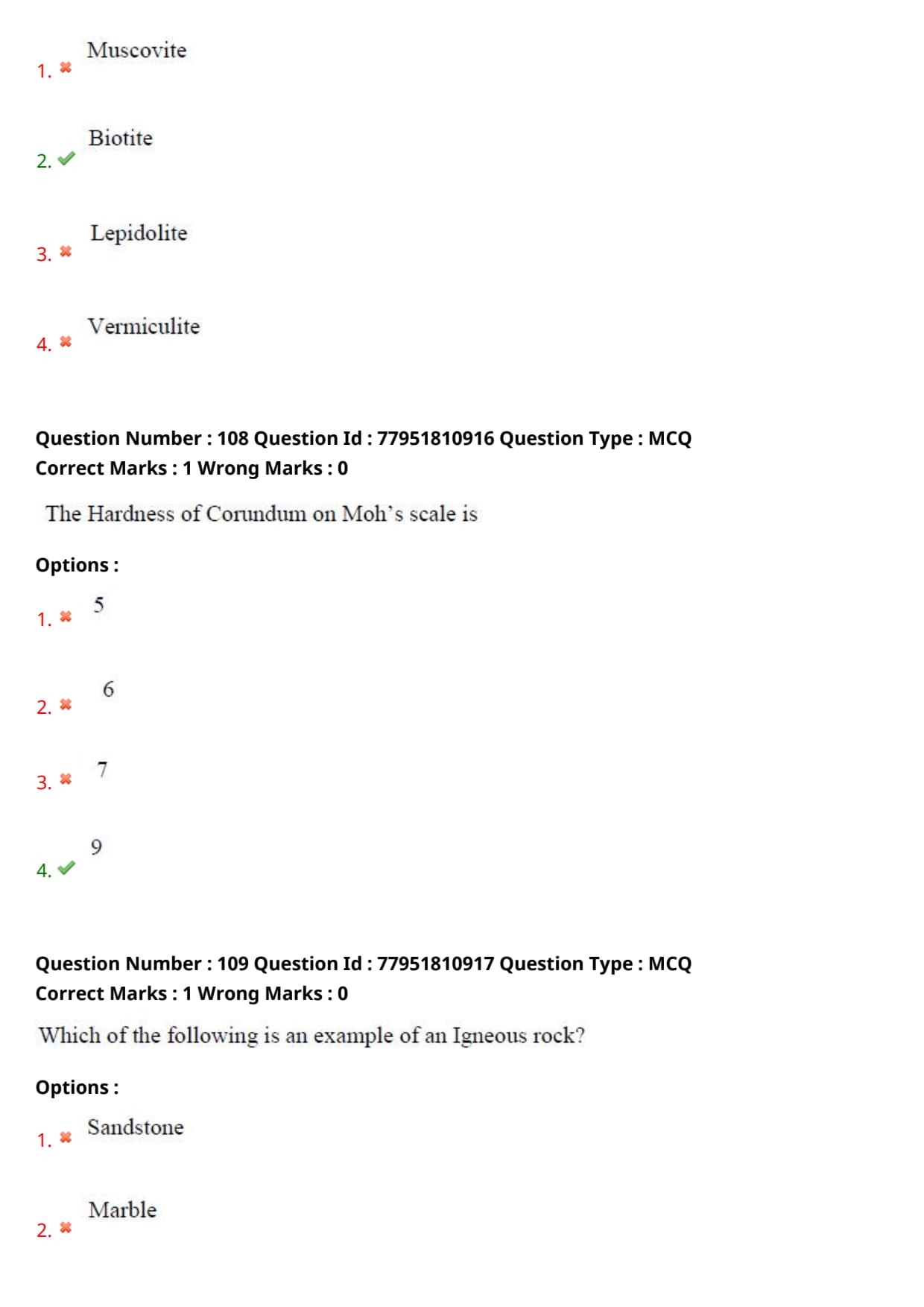
Question 107:
Which of the following is called Black Mica?
- (A) Muscovite
- (B) Biotite
- (C) Lepidolite
- (D) Vermiculite
Question 108:
The Hardness of Corundum on Moh's scale is
- (A) \(5\)
- (B) \(6\)
- (C) \(7\)
- (D) \(9\)
Question 109:
Which of the following is an example of an Igneous rock?
- (A) Sandstone
- (B) Marble
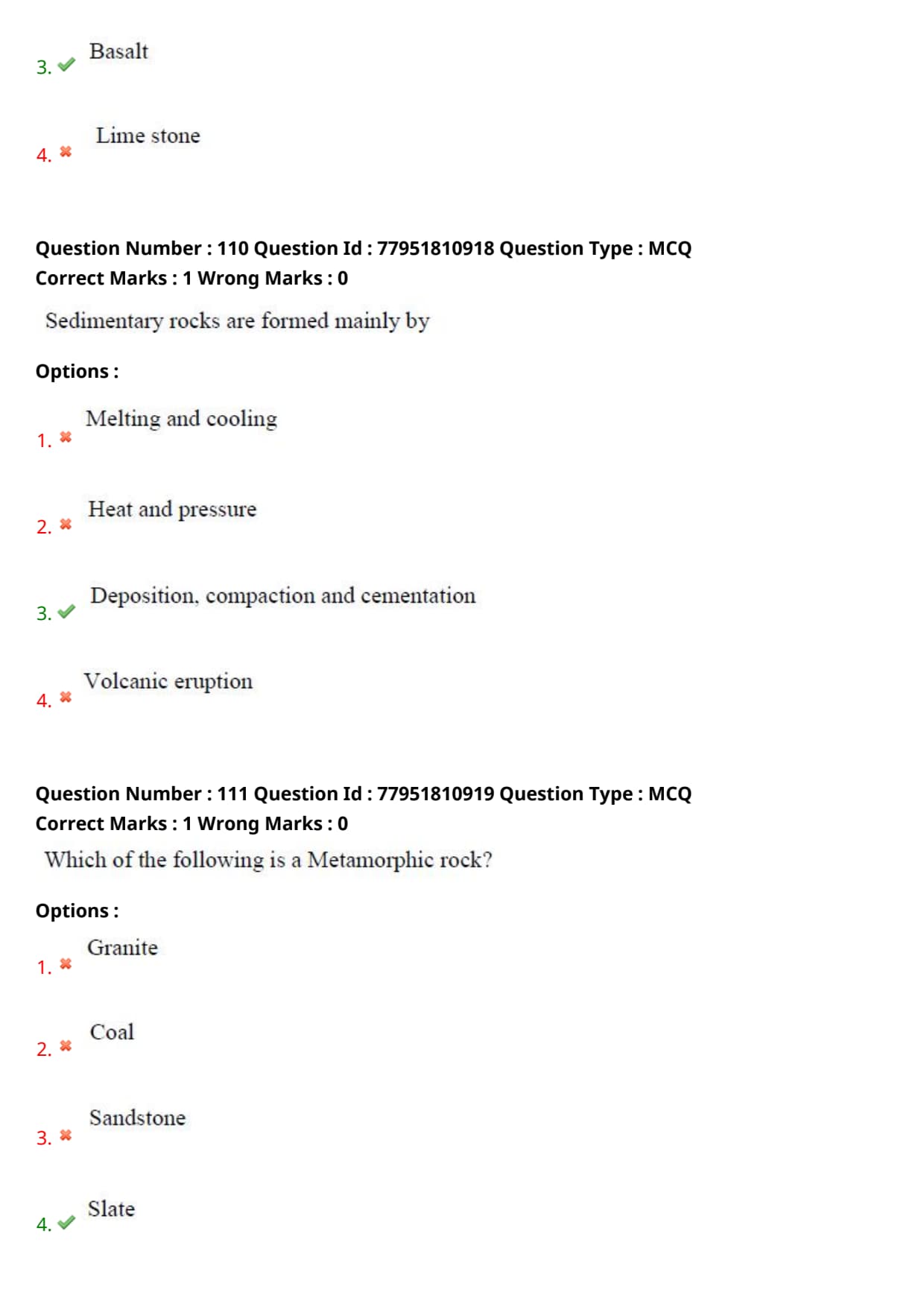
- (C) Basalt
- (D) Lime stone
Question 110:
Sedimentary rocks are formed mainly by
- (A) Melting and cooling
- (B) Heat and pressure
- (C) Deposition, compaction and cementation
- (D) Volcanic eruption
Question 111:
Which of the following is a Metamorphic rock?
- (A) Granite
- (B) Coal
- (C) Sandstone
- (D) Slate
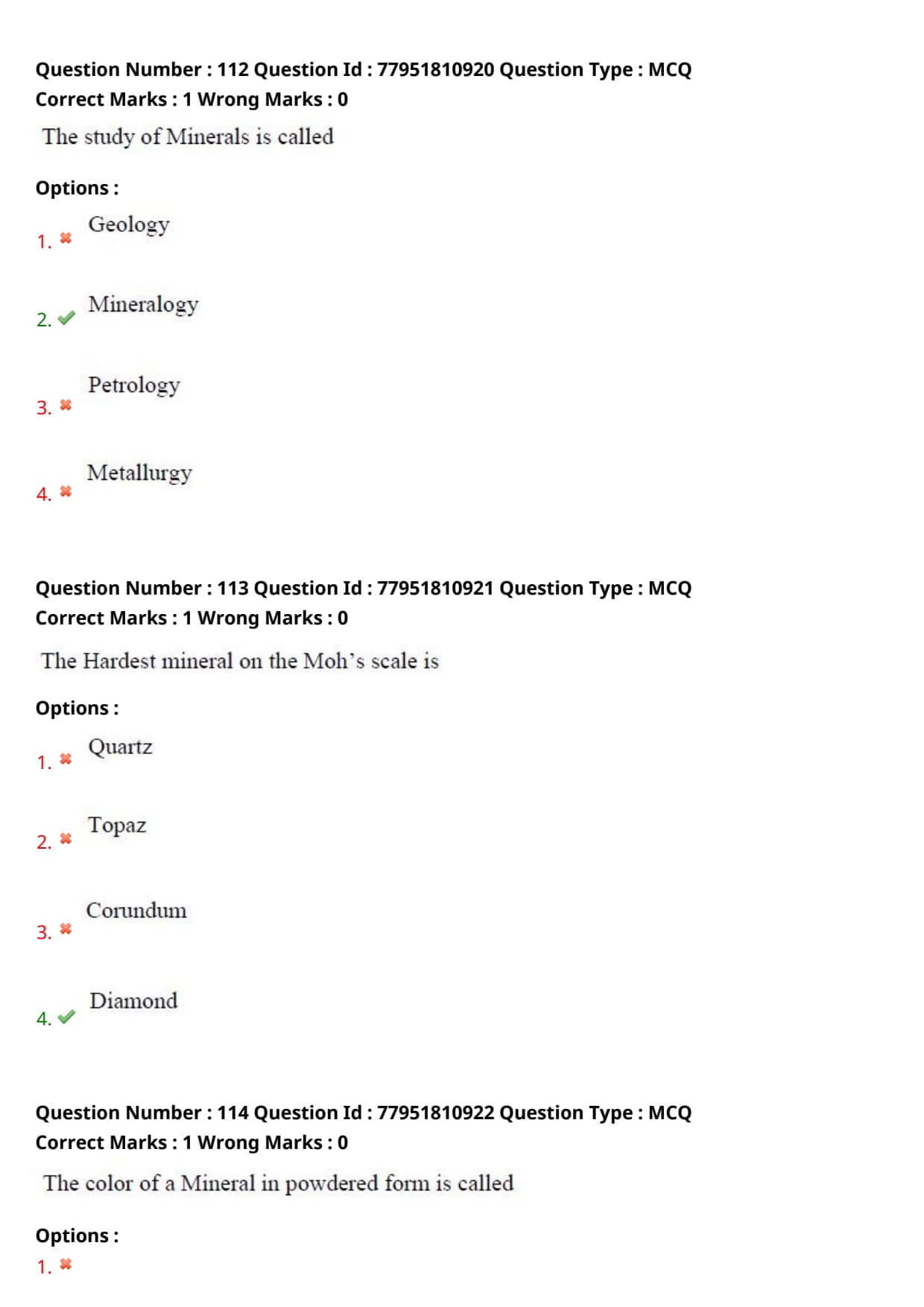
Question 112:
The study of Minerals is called
- (A) Geology
- (B) Mineralogy
- (C) Petrology
- (D) Metallurgy
Question 113:
The Hardest mineral on the Moh's scale is
- (A) Quartz
- (B) Topaz
- (C) Corundum
- (D) Diamond
Question 114:
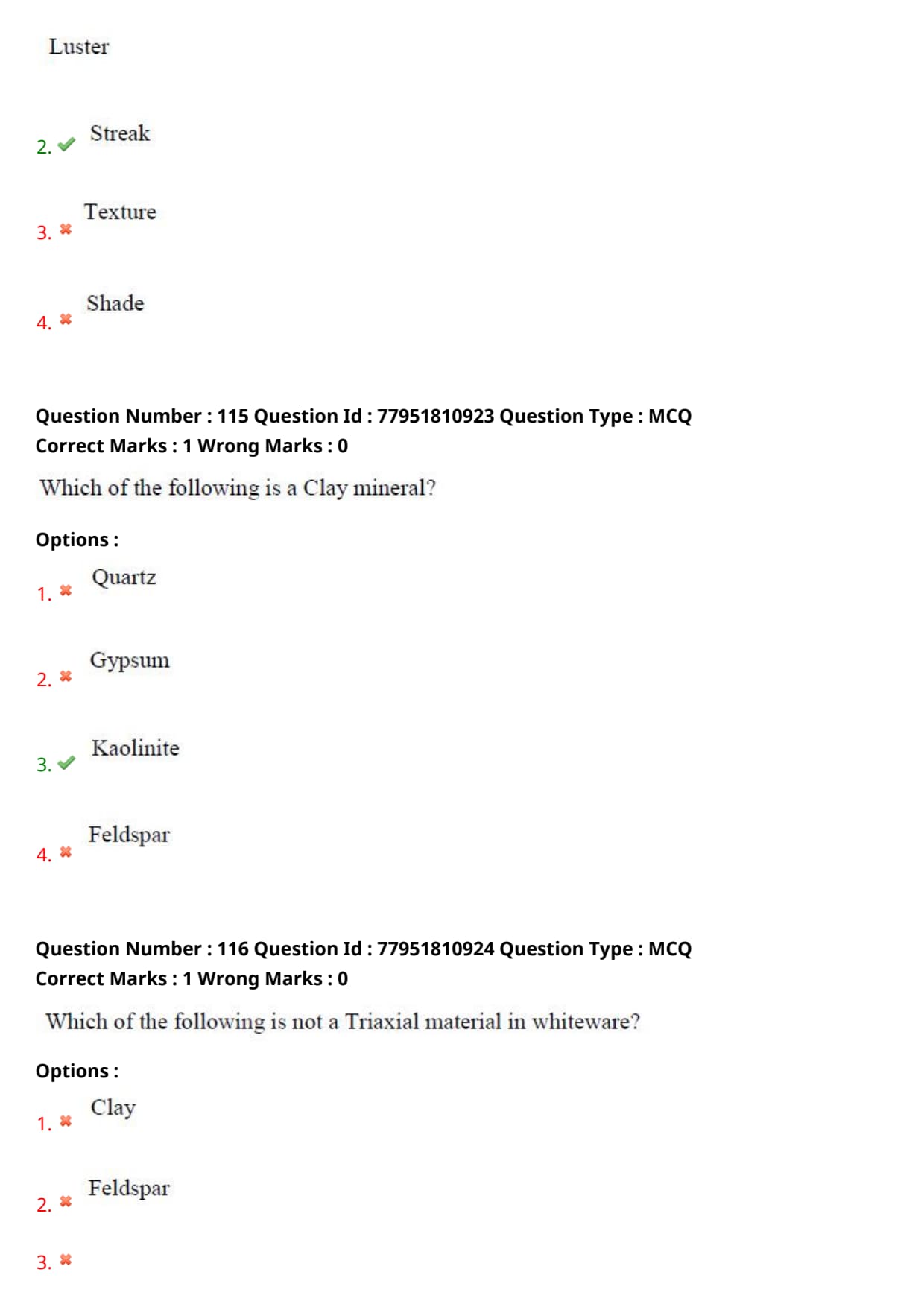
The color of a Mineral in powdered form is called
- (A) Luster
- (B) Streak
- (C) Texture
- (D) Shade
Question 115:
Which of the following is a Clay mineral?
- (A) Quartz
- (B) Gypsum
- (C) Kaolinite
- (D) Feldspar
Question 116:
Which of the following is not a Triaxial material in whiteware?
- (A) Clay
- (B) Feldspar
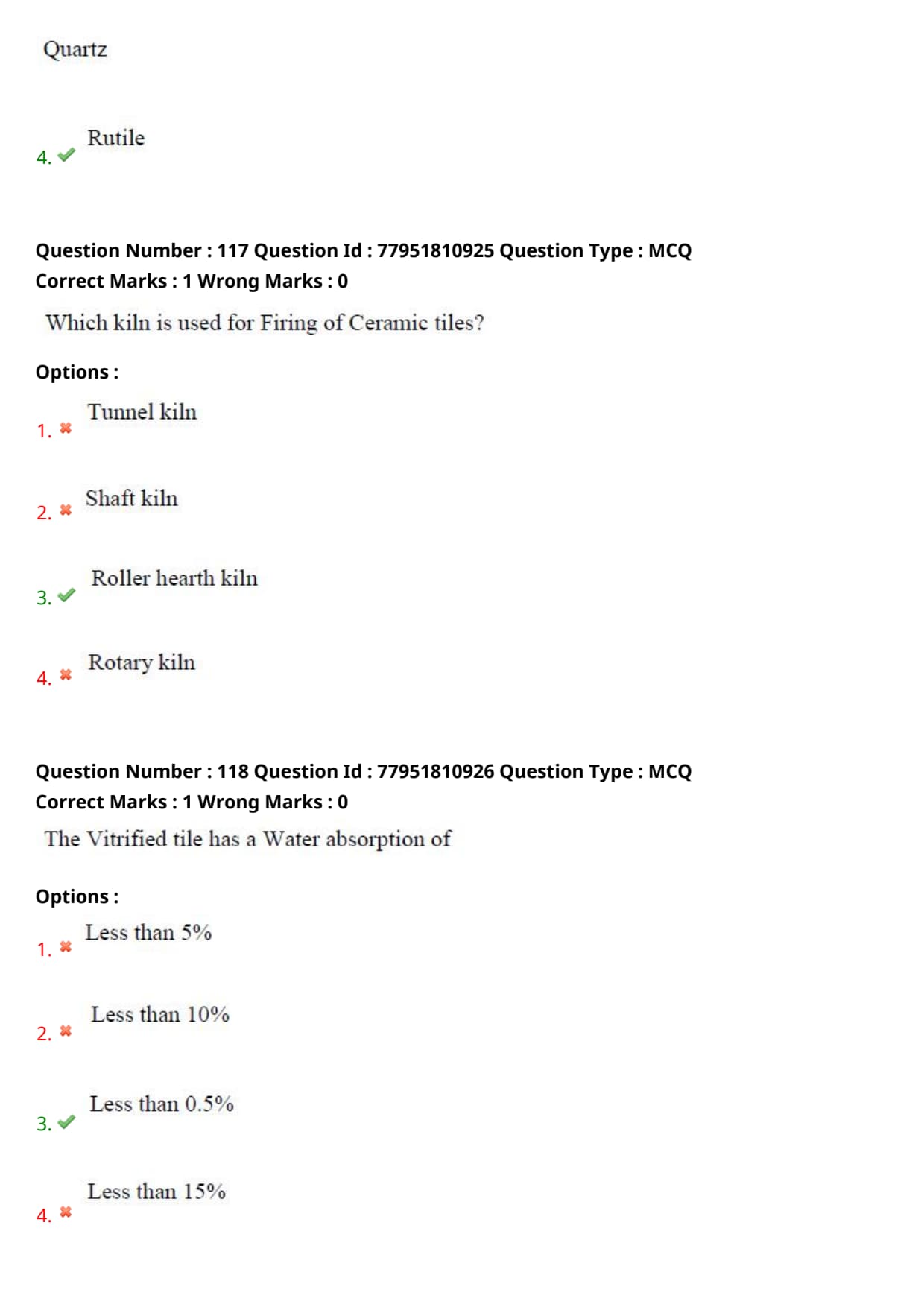
- (C) Quartz
- (D) Rutile
Question 117:
Which kiln is used for Firing of Ceramic tiles?
- (A) Tunnel kiln
- (B) Shaft kiln
- (C) Roller hearth kiln
- (D) Rotary kiln
Question 118:
The Vitrified tile has a Water absorption of
- (A) Less than \(5%\)
- (B) Less than \(10%\)
- (C) Less than \(0.5%\)
- (D) Less than \(15%\)
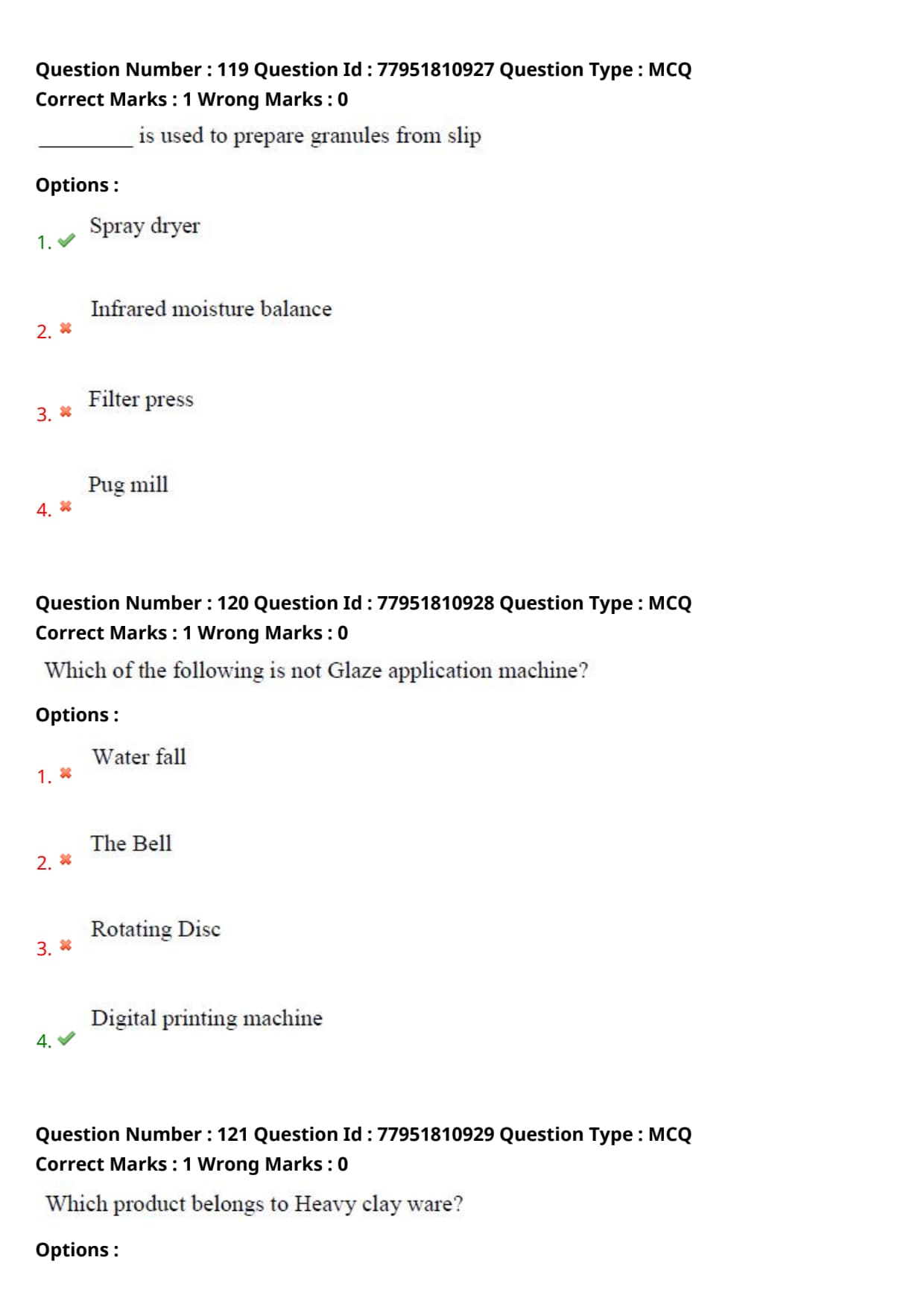
Question 119:
__________ is used to prepare granules from slip.
- (A) Spray dryer
- (B) Infrared moisture balance
- (C) Filter press
- (D) Pug mill
Question 120:
Which of the following is not Glaze application machine?
- (A) Water fall
- (B) The Bell
- (C) Rotating Disc
- (D) Digital printing machine
Question 121:
Which product belongs to Heavy clay ware?
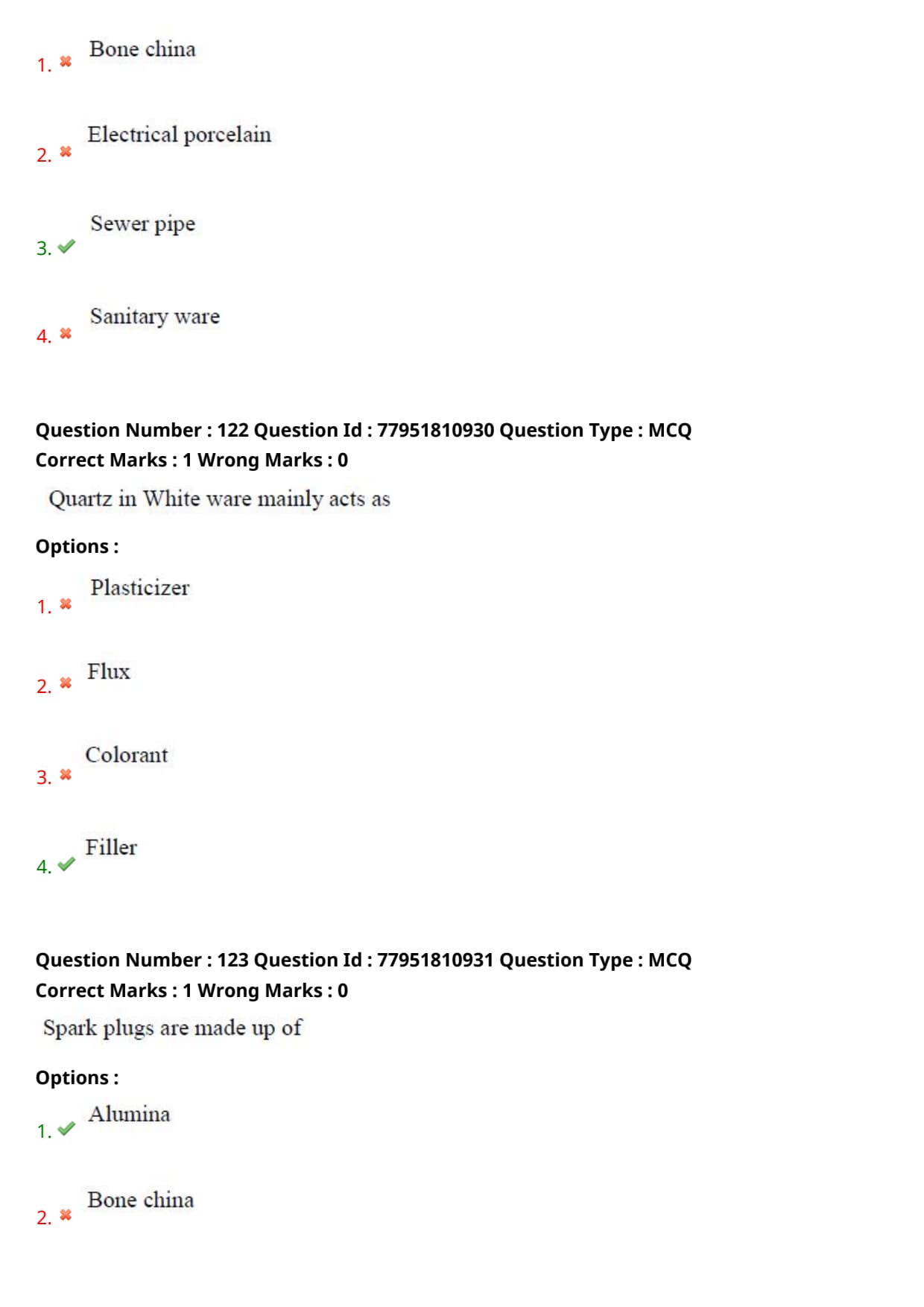
- (A) Bone china
- (B) Electrical porcelain
- (C) Sewer pipe
- (D) Sanitary ware
Question 122:
Quartz in White ware mainly acts as
- (A) Plasticizer
- (B) Flux
- (C) Colorant
- (D) Filler
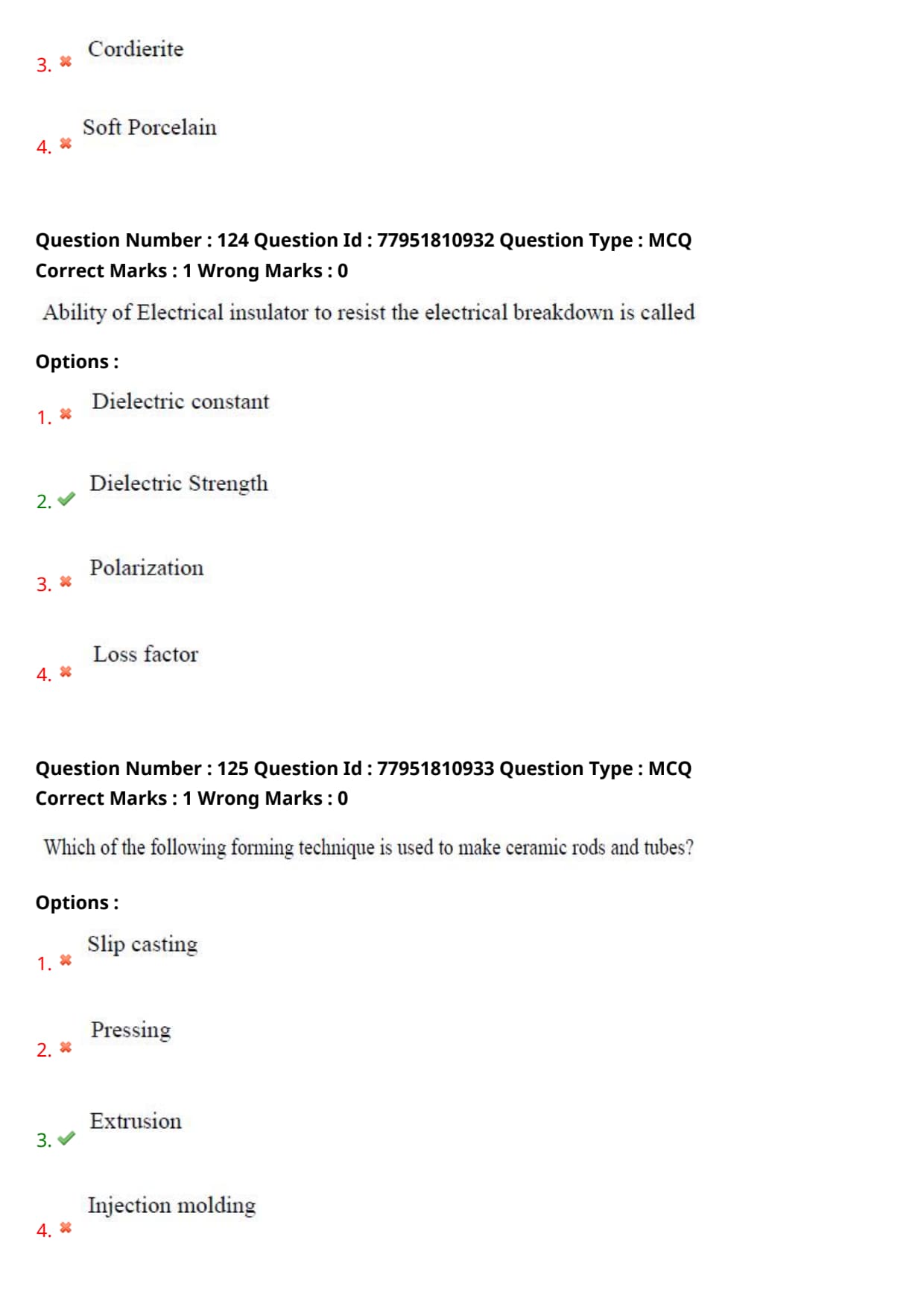
Question 123:
Spark plugs are made up of
- (A) Alumina
- (B) Bone china
- (C) Cordierite
- (D) Soft Porcelain
Question 124:
Ability of Electrical insulator to resist the electrical breakdown is called
- (A) Dielectric constant
- (B) Dielectric Strength
- (C) Polarization
- (D) Loss factor
Question 125:
Which of the following forming technique is used to make ceramic rods and tubes?
- (A) Slip casting
- (B) Pressing
- (C) Extrusion
- (D) Injection molding
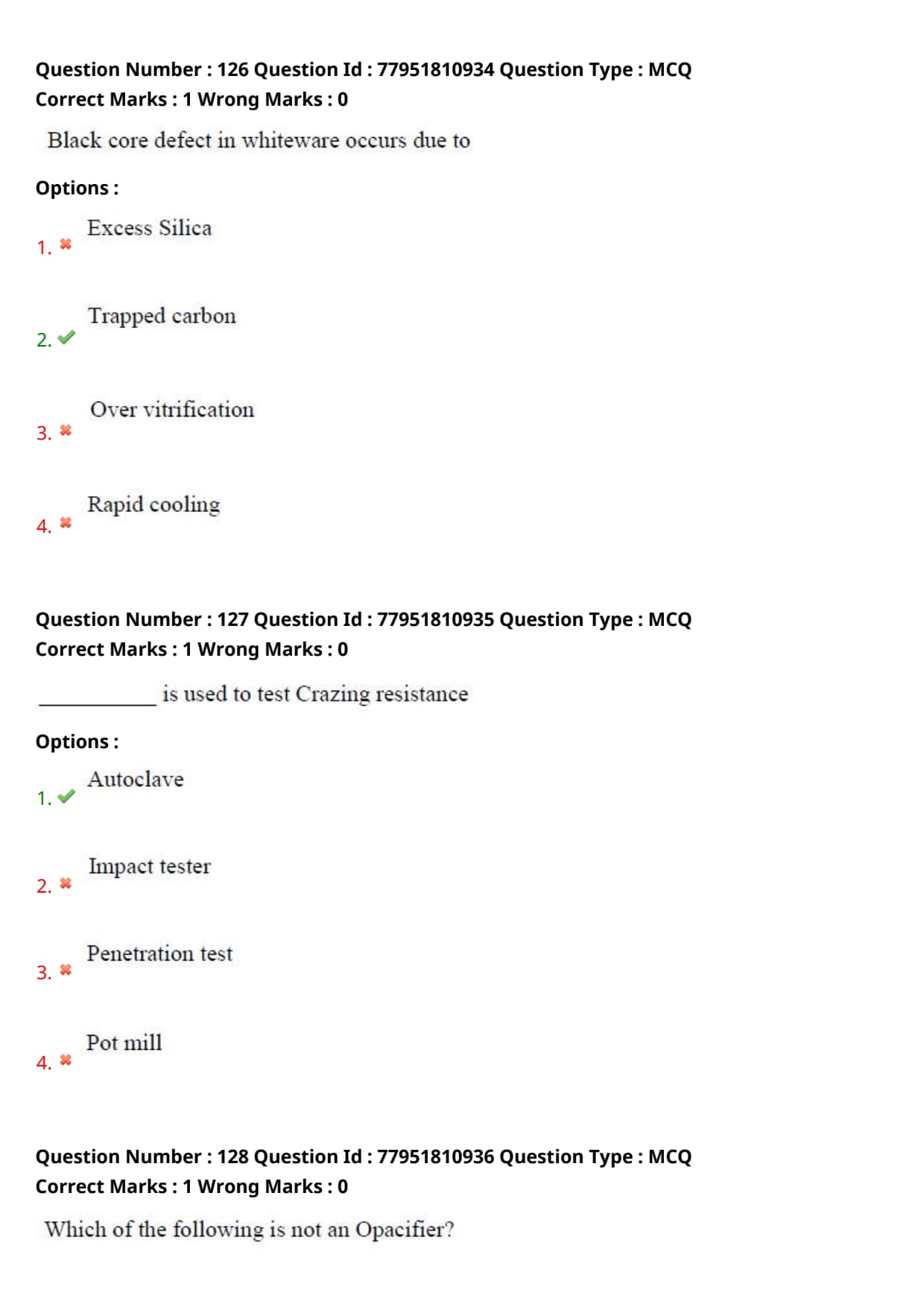
Question 126:
Black core defect in whiteware occurs due to
- (A) Excess Silica
- (B) Trapped carbon
- (C) Over vitrification
- (D) Rapid cooling
Question 127:
__________ is used to test Crazing resistance
- (A) Autoclave
- (B) Impact tester
- (C) Penetration test
- (D) Pot mill
Question 128:
Which of the following is not an Opacifier?
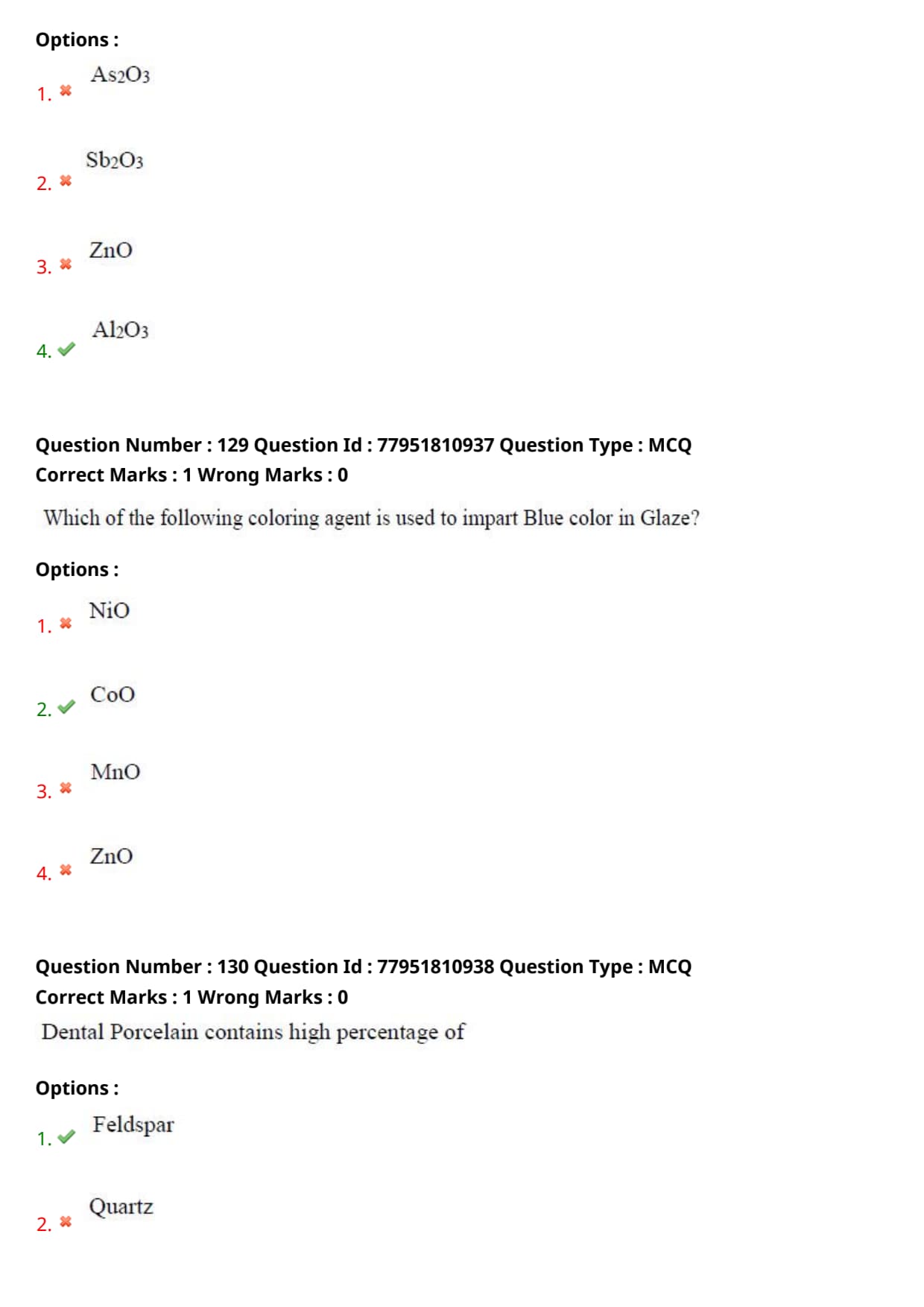
- (A) \(As_2O_3\)
- (B) \(Sb_2O_3\)
- (C) \(ZnO\)
- (D) \(Al_2O_3\)
Question 129:
Which of the following coloring agent is used to impart Blue color in Glaze?
- (A) \(NiO\)
- (B) \(CoO\)
- (C) \(MnO\)
- (D) \(ZnO\)
Question 130:
Dental Porcelain contains high percentage of
- (A) Feldspar
- (B) Quartz
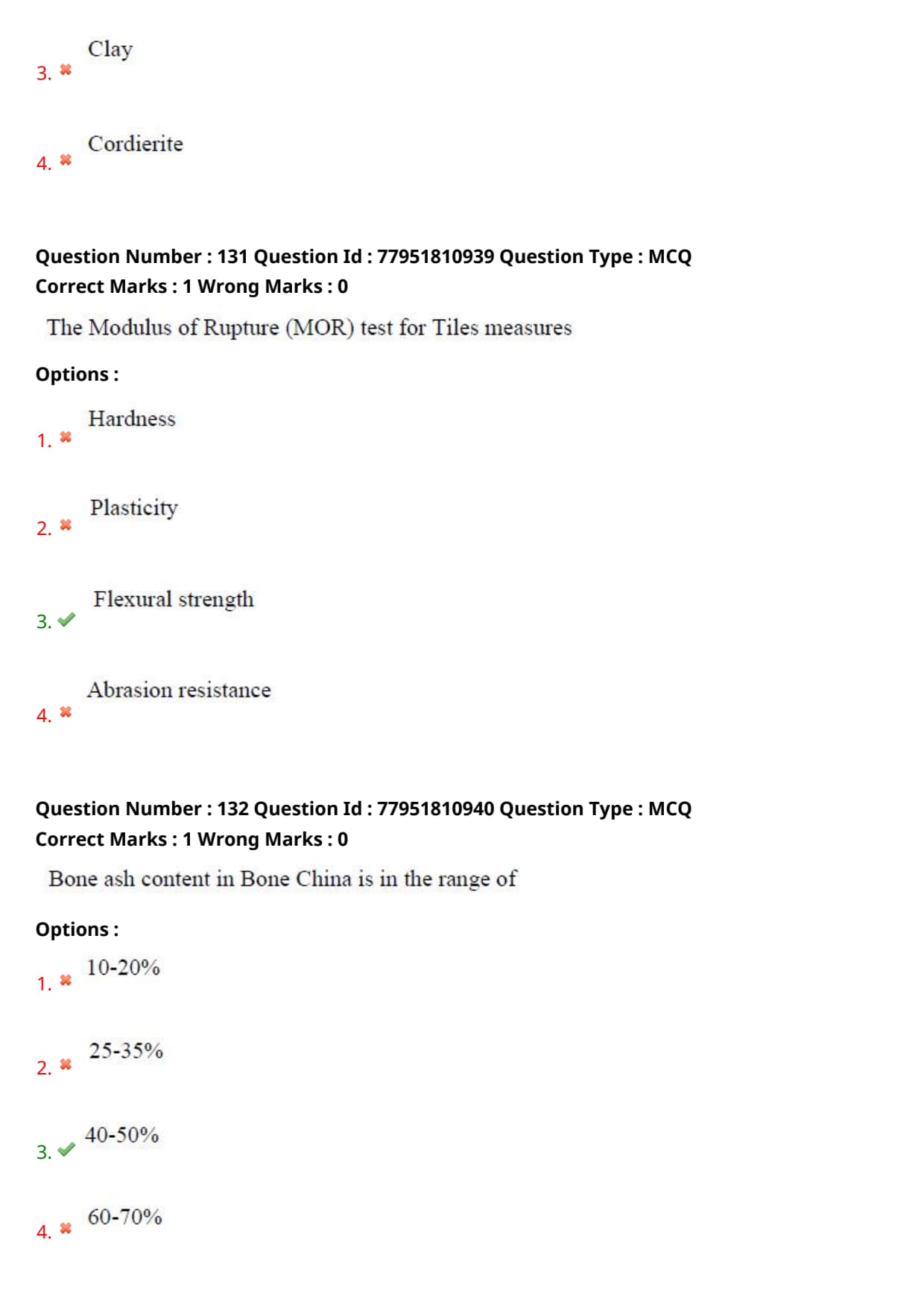
- (C) Clay
- (D) Cordierite
Question 131:
The Modulus of Rupture (MOR) test for Tiles measures
- (A) Hardness
- (B) Plasticity
- (C) Flexural strength
- (D) Abrasion resistance
Question 132:
Bone ash content in Bone China is in the range of
- (A) \(10-20%\)
- (B) \(25-35%\)
- (C) \(40-50%\)
- (D) \(60-70%\)
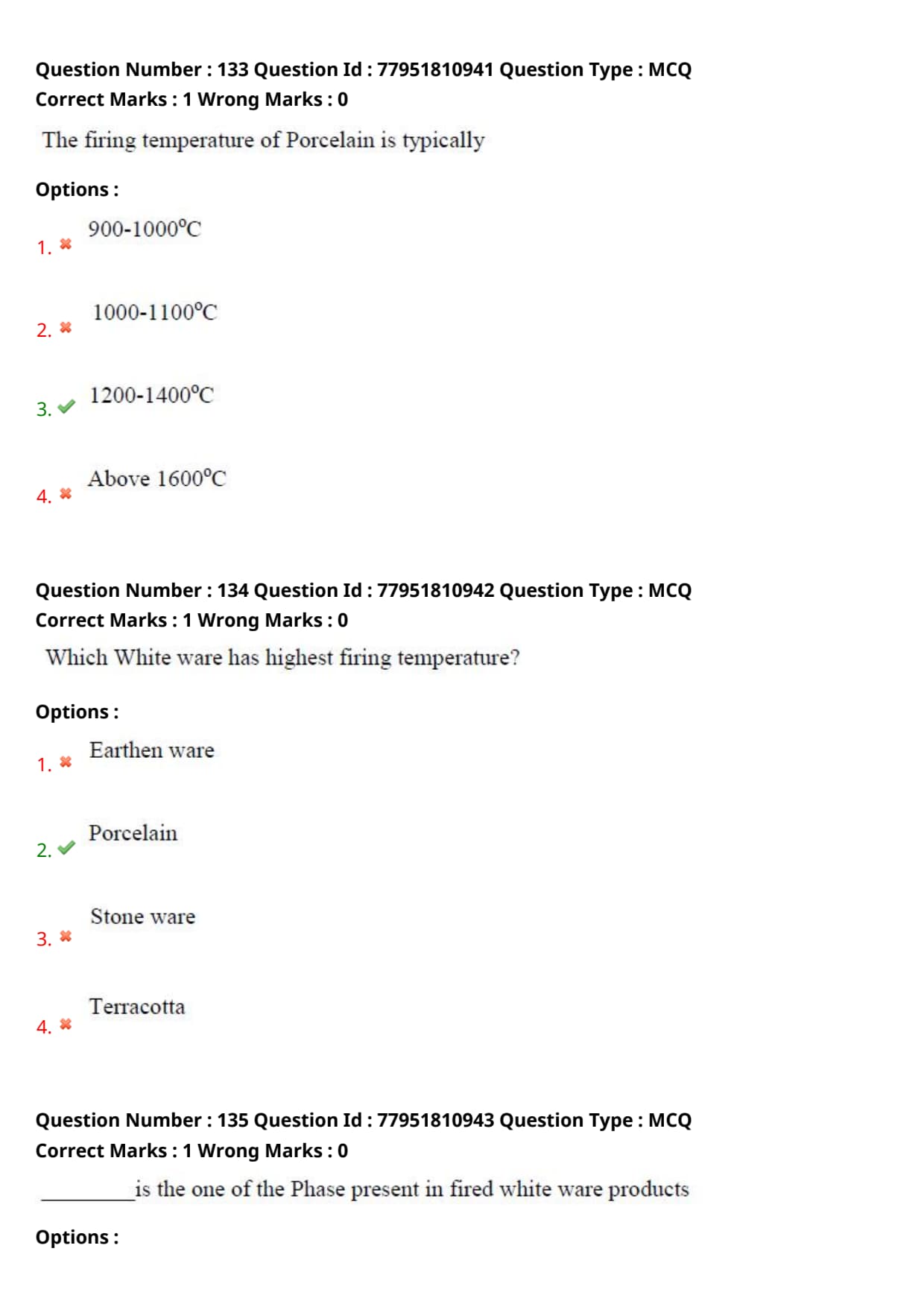
Question 133:
The firing temperature of Porcelain is typically
- (A) \(900-1000° C\)
- (B) \(1000-1100° C\)
- (C) \(1200-1400° C\)
- (D) Above \(1600° C\)
Question 134:
Which White ware has highest firing temperature?
- (A) Earthen ware
- (B) Porcelain
- (C) Stone ware
- (D) Terracotta
Question 135:
__________ is the one of the Phase present in fired white ware products
- (A) Mullite
- (B) Rutile
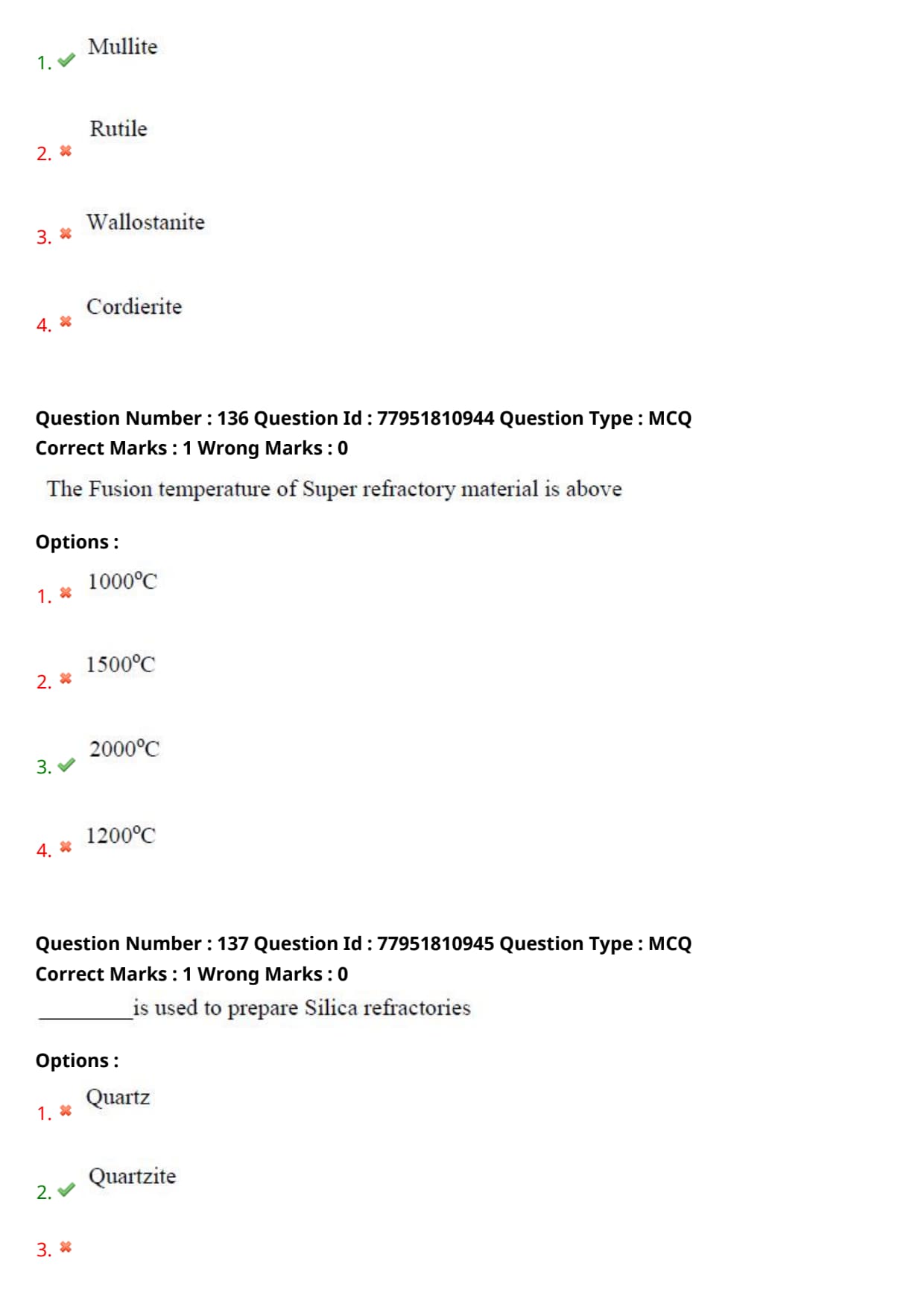
- (C) Wollastonite
- (D) Cordierite
Question 136:
The Fusion temperature of Super refractory material is above
- (A) \(1000° C\)
- (B) \(1500° C\)
- (C) \(2000° C\)
- (D) \(1200° C\)
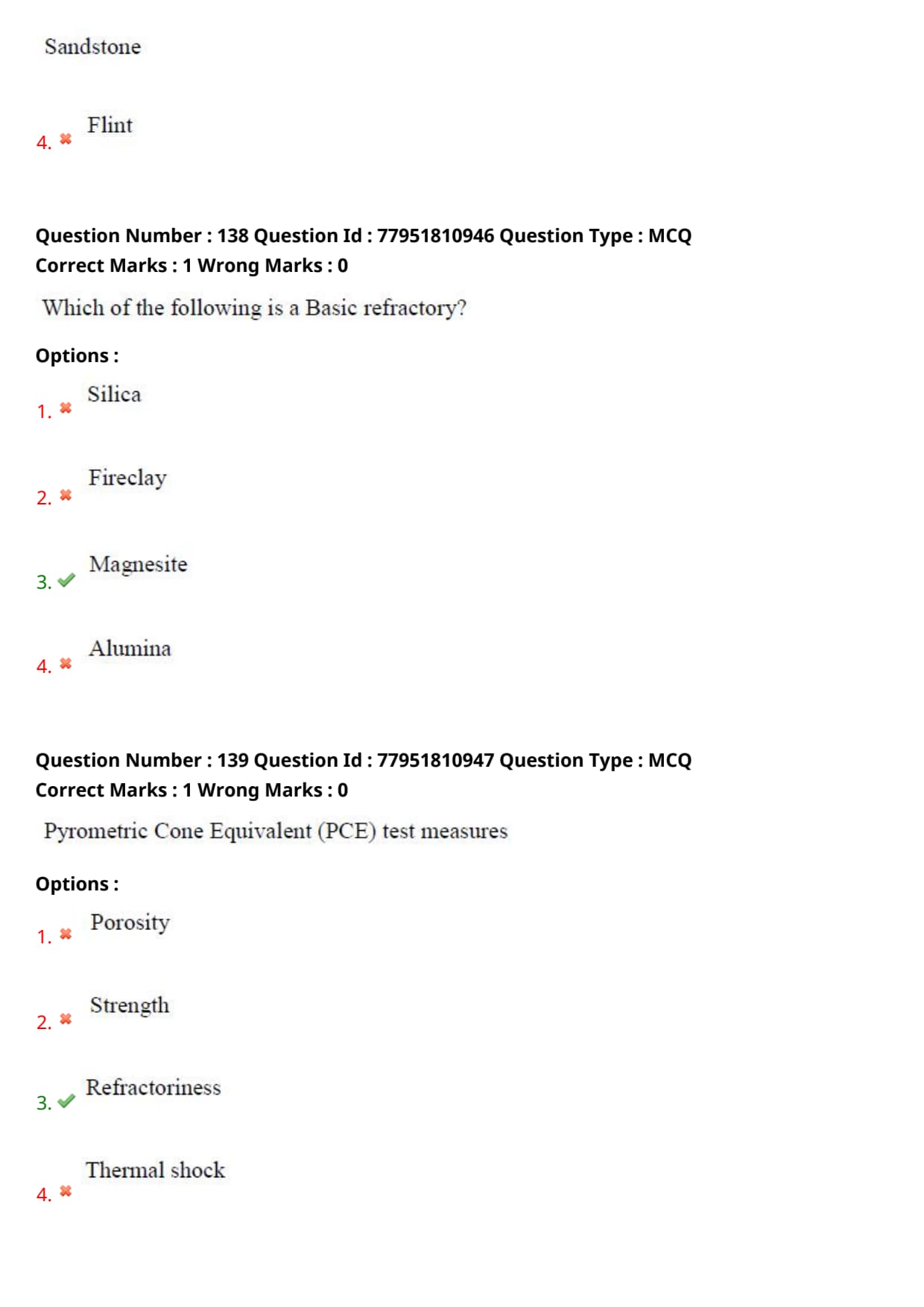
Question 137:
__________ is used to prepare Silica refractories
- (A) Quartz
- (B) Quartzite
- (C) Sandstone
- (D) Flint
Question 138:
Which of the following is a Basic refractory?
- (A) Silica
- (B) Fireclay
- (C) Magnesite
- (D) Alumina
Question 139:
Pyrometric Cone Equivalent (PCE) test measures
- (A) Porosity
- (B) Strength
- (C) Refractoriness
- (D) Thermal shock
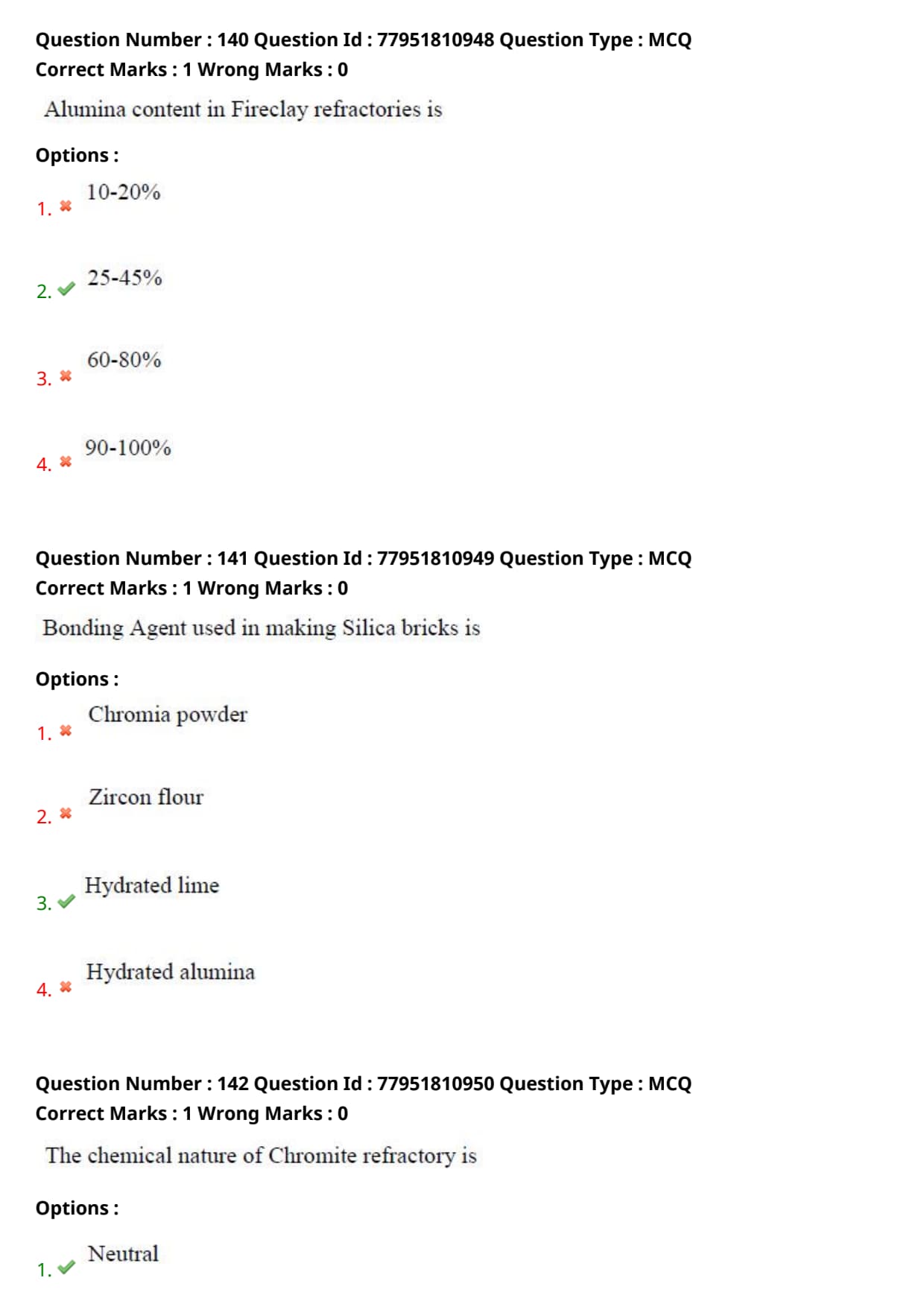
Question 140:
Alumina content in Fireclay refractories is
- (A) \(10-20%\)
- (B) \(25-45%\)
- (C) \(60-80%\)
- (D) \(90-100%\)
Question 141:
Bonding Agent used in making Silica bricks is
- (A) Chromia powder
- (B) Zircon flour
- (C) Hydrated lime
- (D) Hydrated alumina
Question 142:
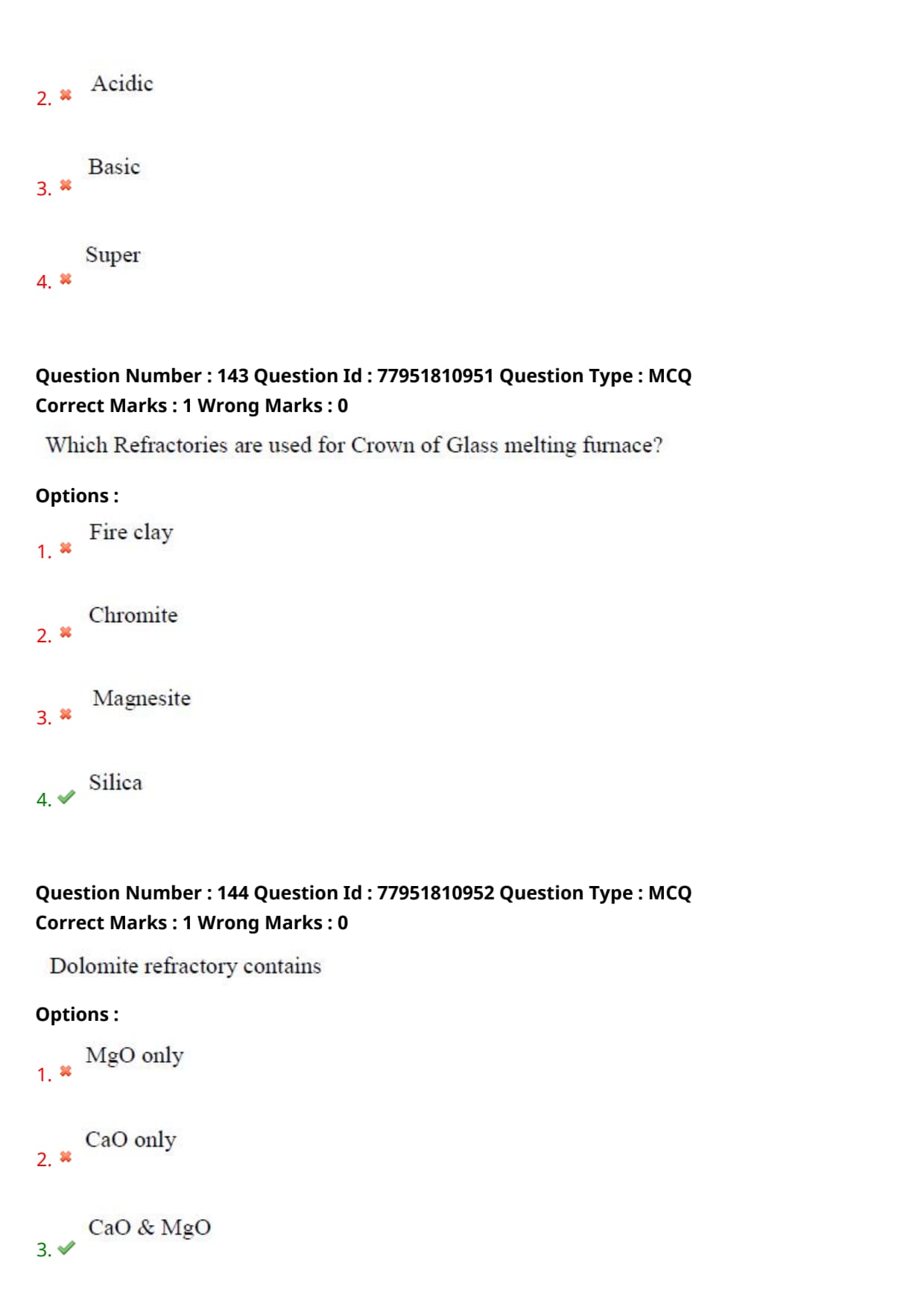
The chemical nature of Chromite refractory is
- (A) Neutral
- (B) Acidic
- (C) Basic
- (D) Super
Question 143:
Which Refractories are used for Crown of Glass melting furnace?
- (A) Fire clay
- (B) Chromite
- (C) Magnesite
- (D) Silica
Question 144:
Dolomite refractory contains
- (A) \(MgO\) only
- (B) \(CaO\) only
- (C) \(CaO\) \& \(MgO\)
- (D) \(Al_2O_3\)
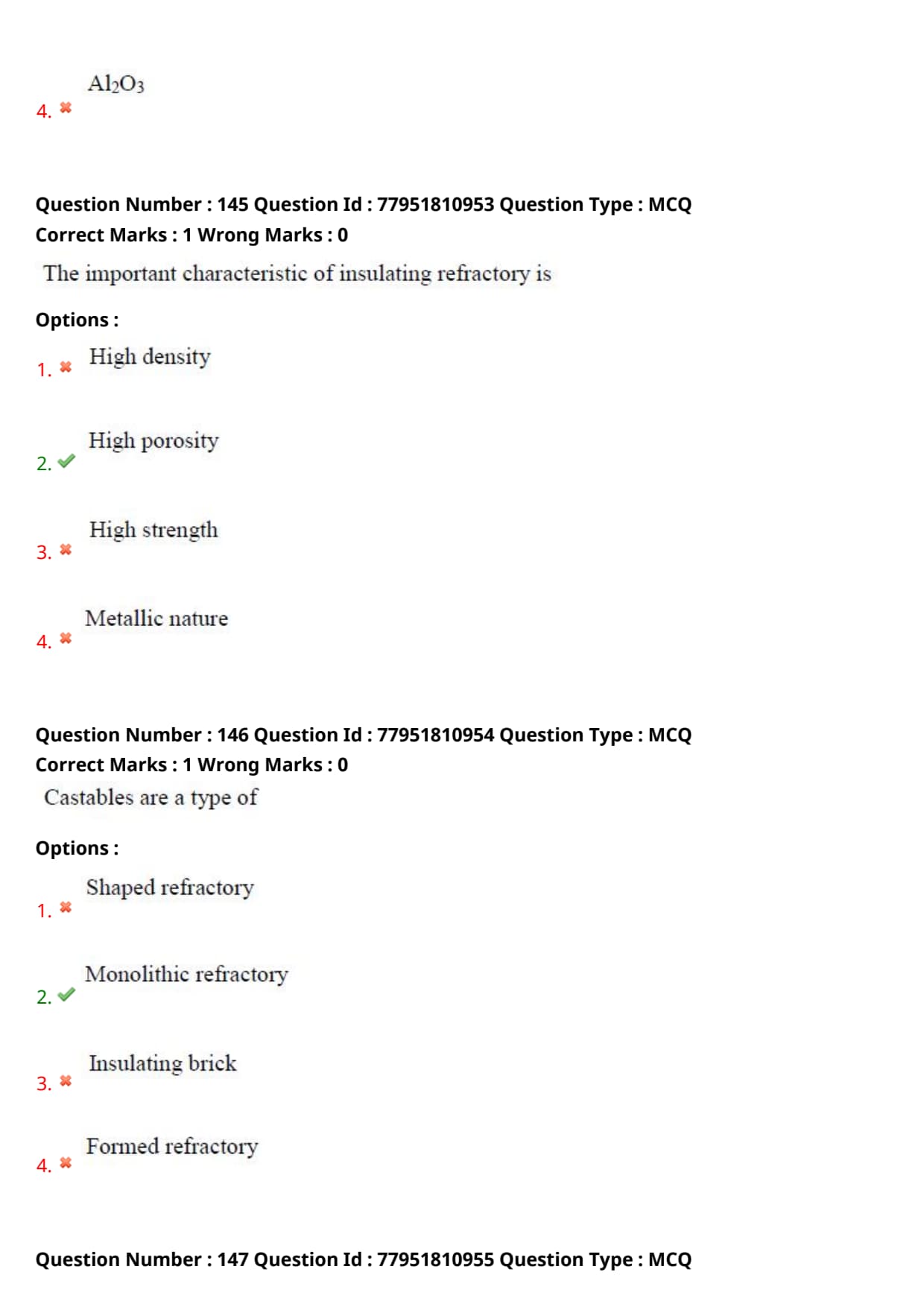
Question 145:
The important characteristic of insulating refractory is
- (A) High density
- (B) High porosity
- (C) High strength
- (D) Metallic nature
Question 146:
Castables are a type of
- (A) Shaped refractory
- (B) Monolithic refractory
- (C) Insulating brick
- (D) Formed refractory
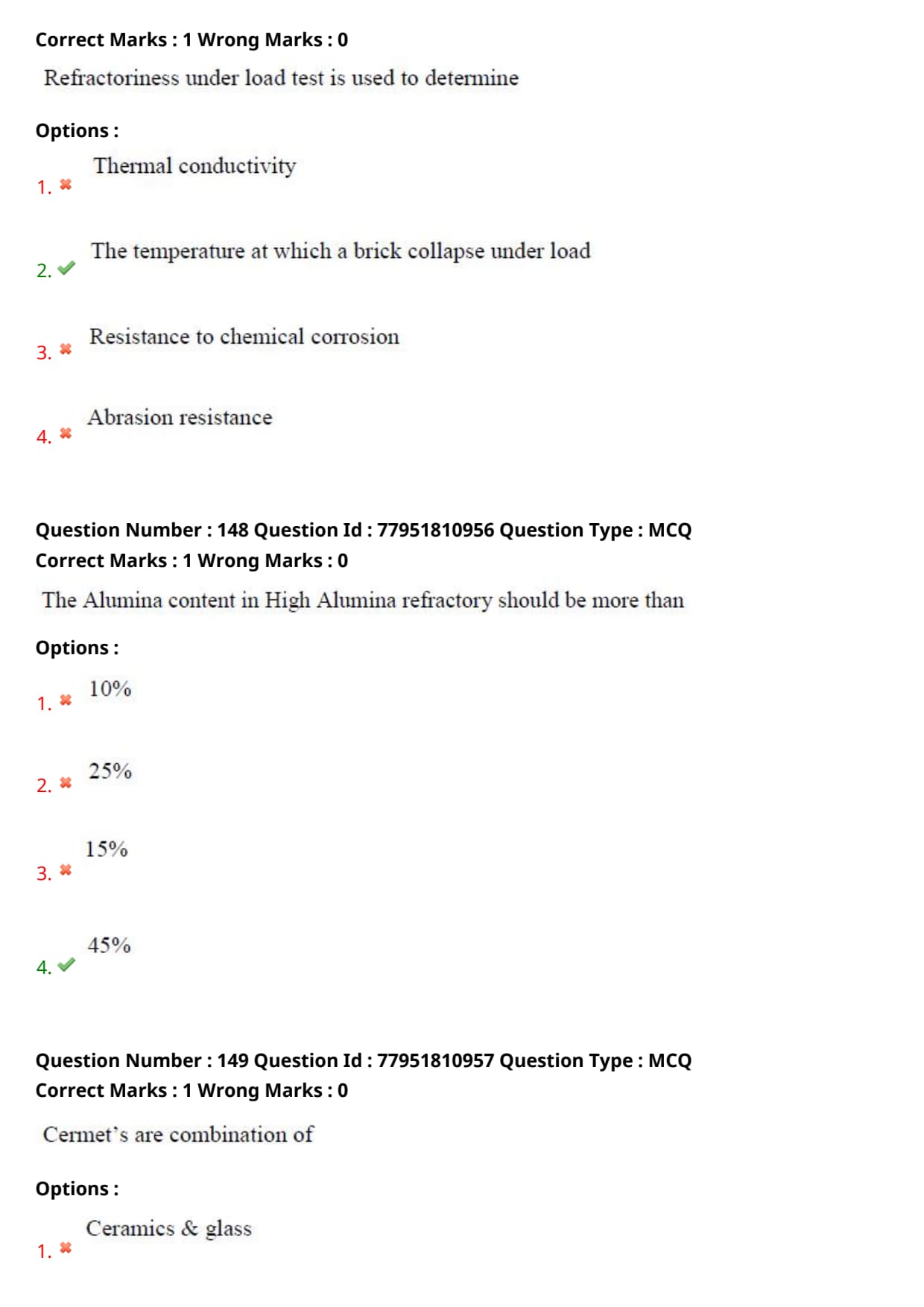
Question 147:
Refractoriness under load test is used to determine
- (A) Thermal conductivity
- (B) The temperature at which a brick collapse under load
- (C) Resistance to chemical corrosion
- (D) Abrasion resistance
Question 148:
The Alumina content in High Alumina refractory should be more than
- (A) \(10%\)
- (B) \(25%\)
- (C) \(15%\)
- (D) \(45%\)
Question 149:
Cermet's are combination of
- (A) Ceramics \& glass
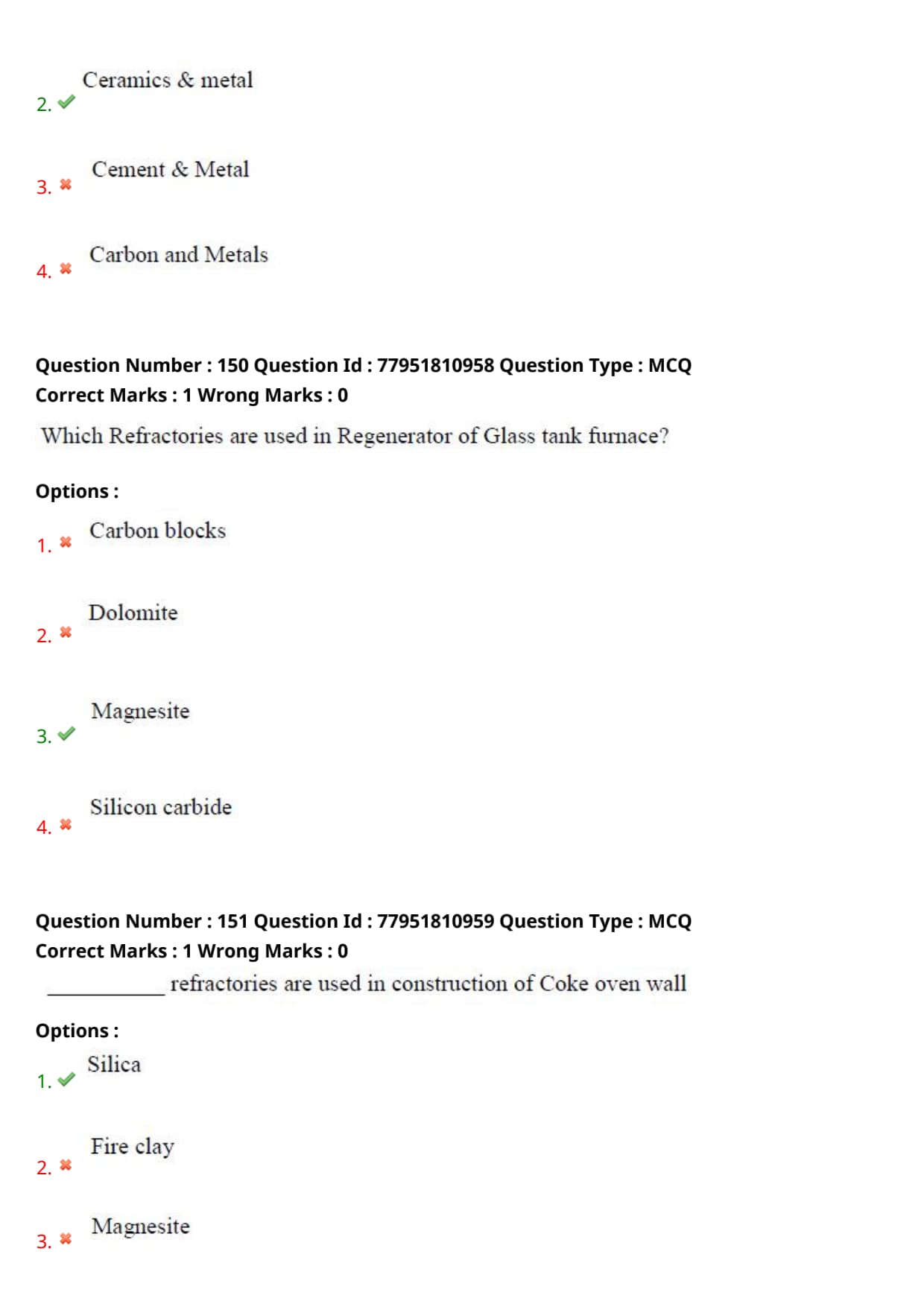
- (B) Ceramics \& metal
- (C) Cement \& Metal
- (D) Carbon and Metals
Question 150:
Which Refractories are used in Regenerator of Glass tank furnace?
- (A) Carbon blocks
- (B) Dolomite
- (C) Magnesite
- (D) Silicon carbide
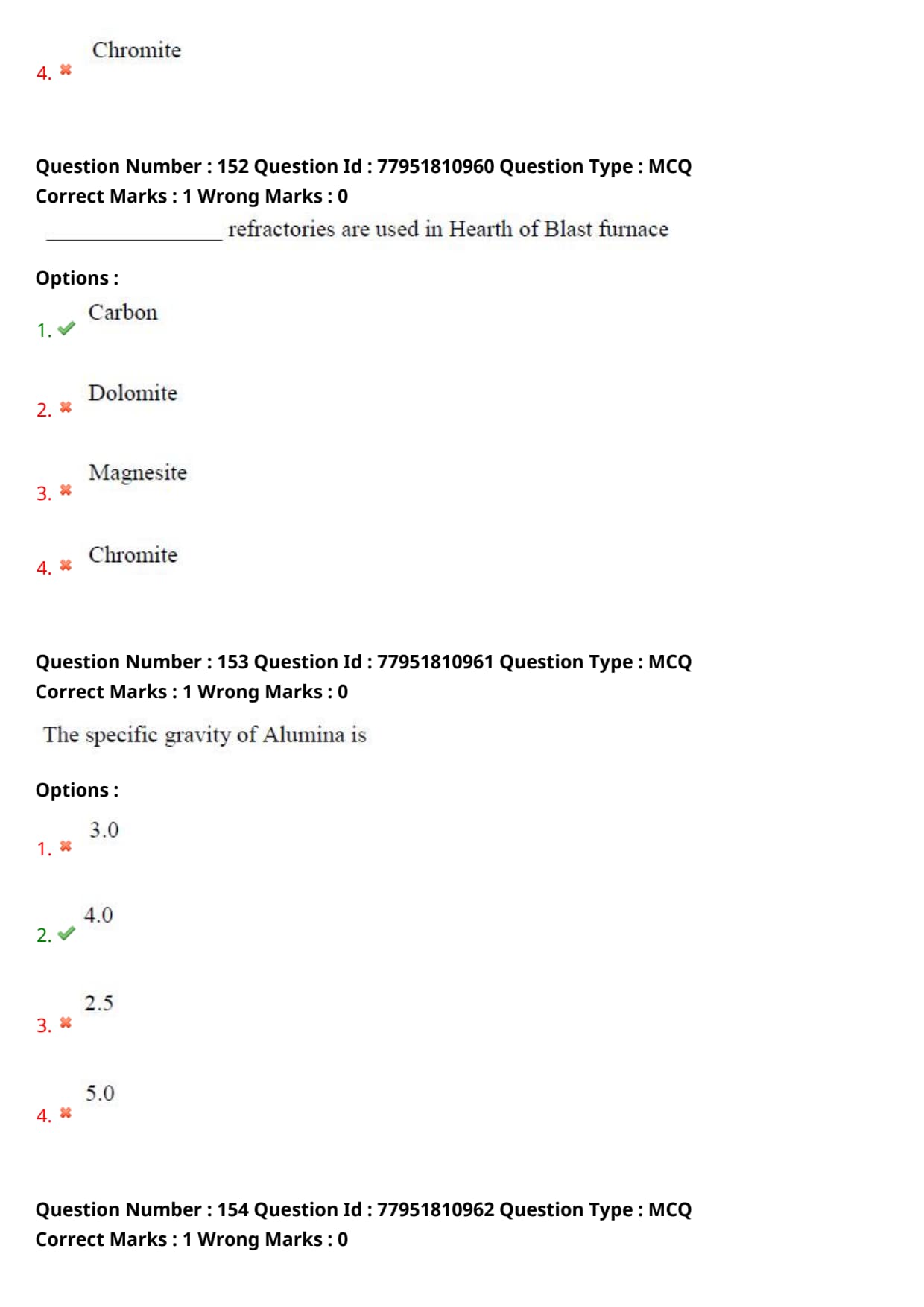
Question 151:
__________ refractories are used in construction of Coke oven wall
- (A) Silica
- (B) Fire clay
- (C) Magnesite
- (D) Chromite
Question 152:
__________ refractories are used in Hearth of Blast furnace
- (A) Carbon
- (B) Dolomite
- (C) Magnesite
- (D) Chromite
Question 153:
The specific gravity of Alumina is
- (A) \(3.0\)
- (B) \(4.0\)
- (C) \(2.5\)
- (D) \(5.0\)
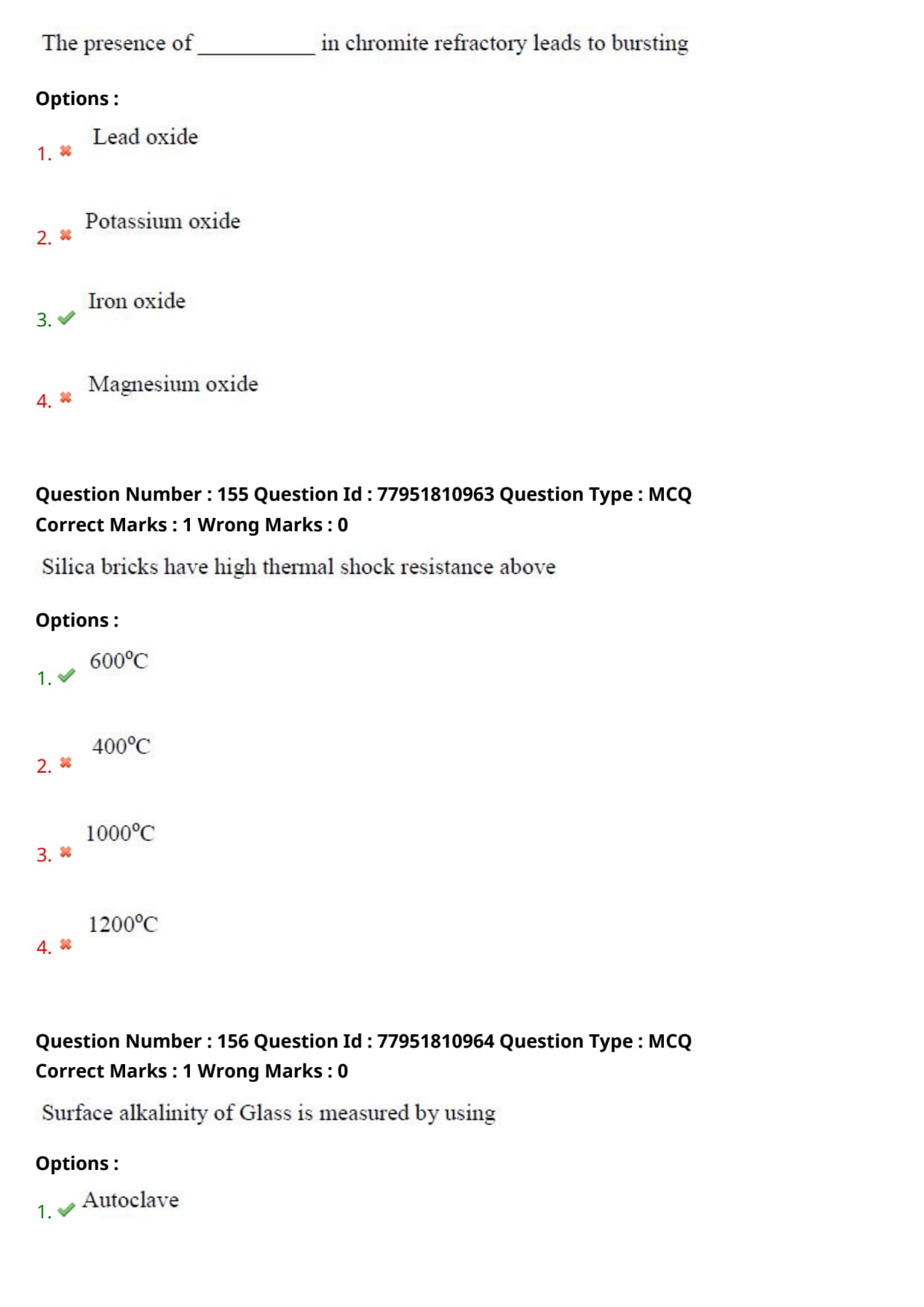
Question 154:
The presence of __________ in chromite refractory leads to bursting
- (A) Lead oxide
- (B) Potassium oxide
- (C) Iron oxide
- (D) Magnesium oxide
Question 155:
Silica bricks have high thermal shock resistance above
- (A) \(600° C\)
- (B) \(400° C\)
- (C) \(1000° C\)
- (D) \(1200° C\)
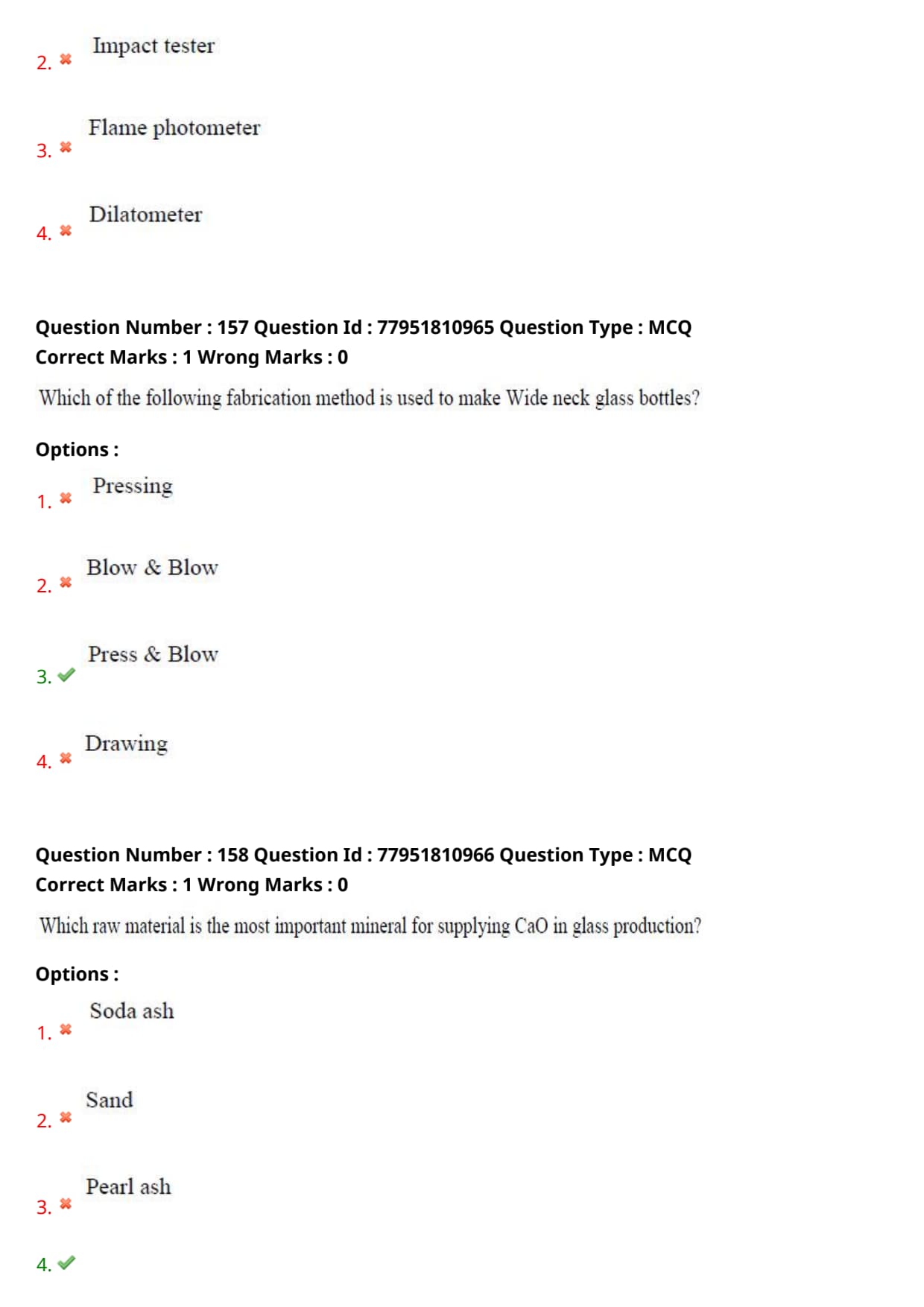
Question 156:
Surface alkalinity of Glass is measured by using
- (A) Autoclave
- (B) Impact tester
- (C) Flame photometer
- (D) Dilatometer
Question 157:
Which of the following fabrication method is used to make Wide neck glass bottles?
- (A) Pressing
- (B) Blow \& Blow
- (C) Press \& Blow
- (D) Drawing
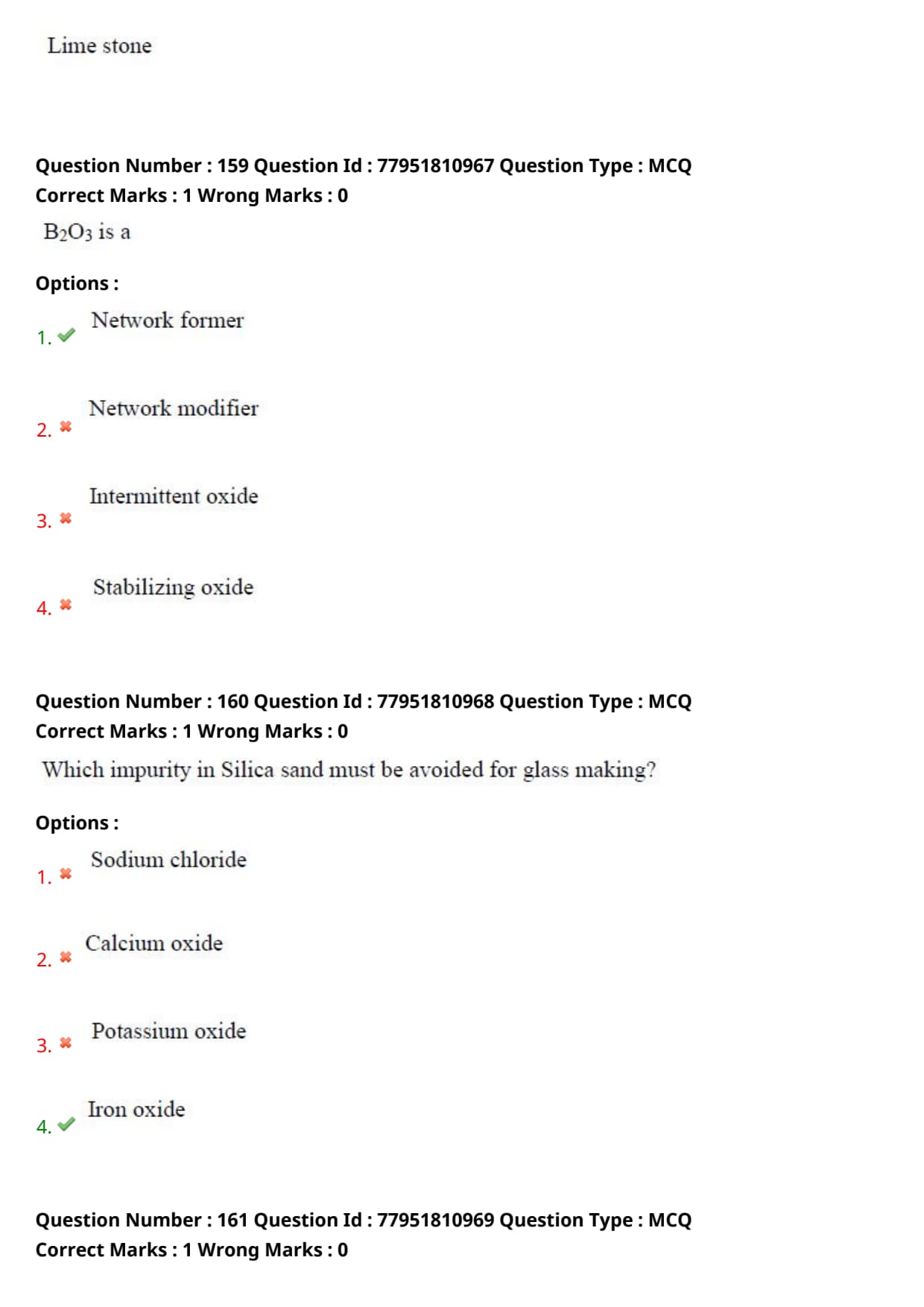
Question 158:
Which raw material is the most important mineral for supplying \(CaO\) in glass production?
- (A) Soda ash
- (B) Sand
- (C) Pearl ash
- (D) Lime stone
Question 159:
\(B_2O_3\) is a
- (A) Network former
- (B) Network modifier
- (C) Intermittent oxide
- (D) Stabilizing oxide
Question 160:
Which impurity in Silica sand must be avoided for glass making?
- (A) Sodium chloride
- (B) Calcium oxide
- (C) Potassium oxide
- (D) Iron oxide
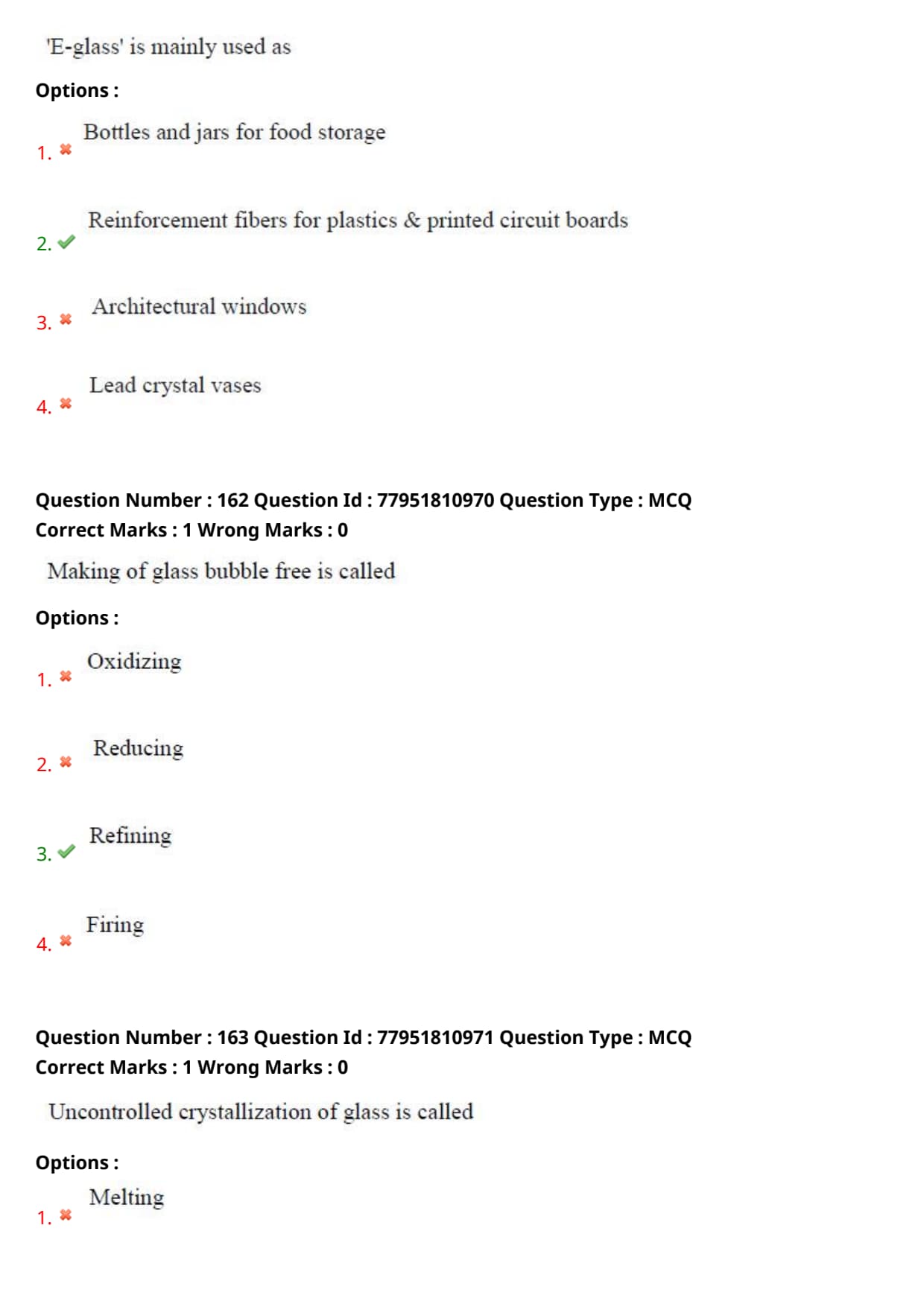
Question 161:
`E-glass' is mainly used as
- (A) Bottles and jars for food storage
- (B) Reinforcement fibers for plastics \& printed circuit boards
- (C) Architectural windows
- (D) Lead crystal vases
Question 162:
Making of glass bubble free is called
- (A) Oxidizing
- (B) Reducing
- (C) Refining
- (D) Firing
Question 163:
Uncontrolled crystallization of glass is called
- (A) Melting
- (B) Refining
- (C) Heat conditioning
- (D) Devitrification
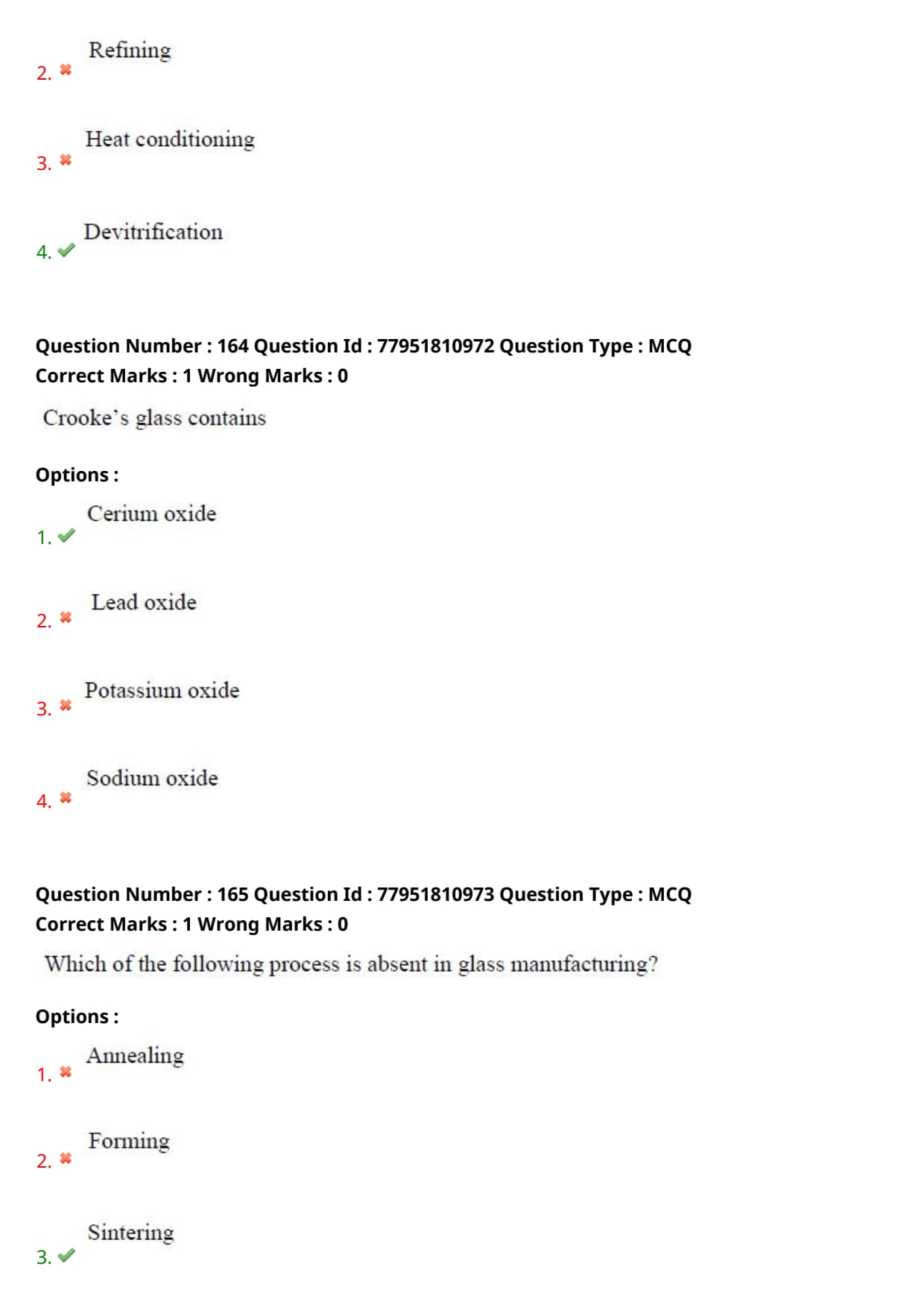
Question 164:
Crooke's glass contains
- (A) Cerium oxide
- (B) Lead oxide
- (C) Potassium oxide
- (D) Sodium oxide
Question 165:
Which of the following process is absent in glass manufacturing?
- (A) Annealing
- (B) Forming
- (C) Sintering
- (D) Melting
Question 166:
Glass ceramics contain
- (A) Fully crystalline structure
- (B) Amorphous matrix with crystalline phases
- (C) Only silica
- (D) Only alumina
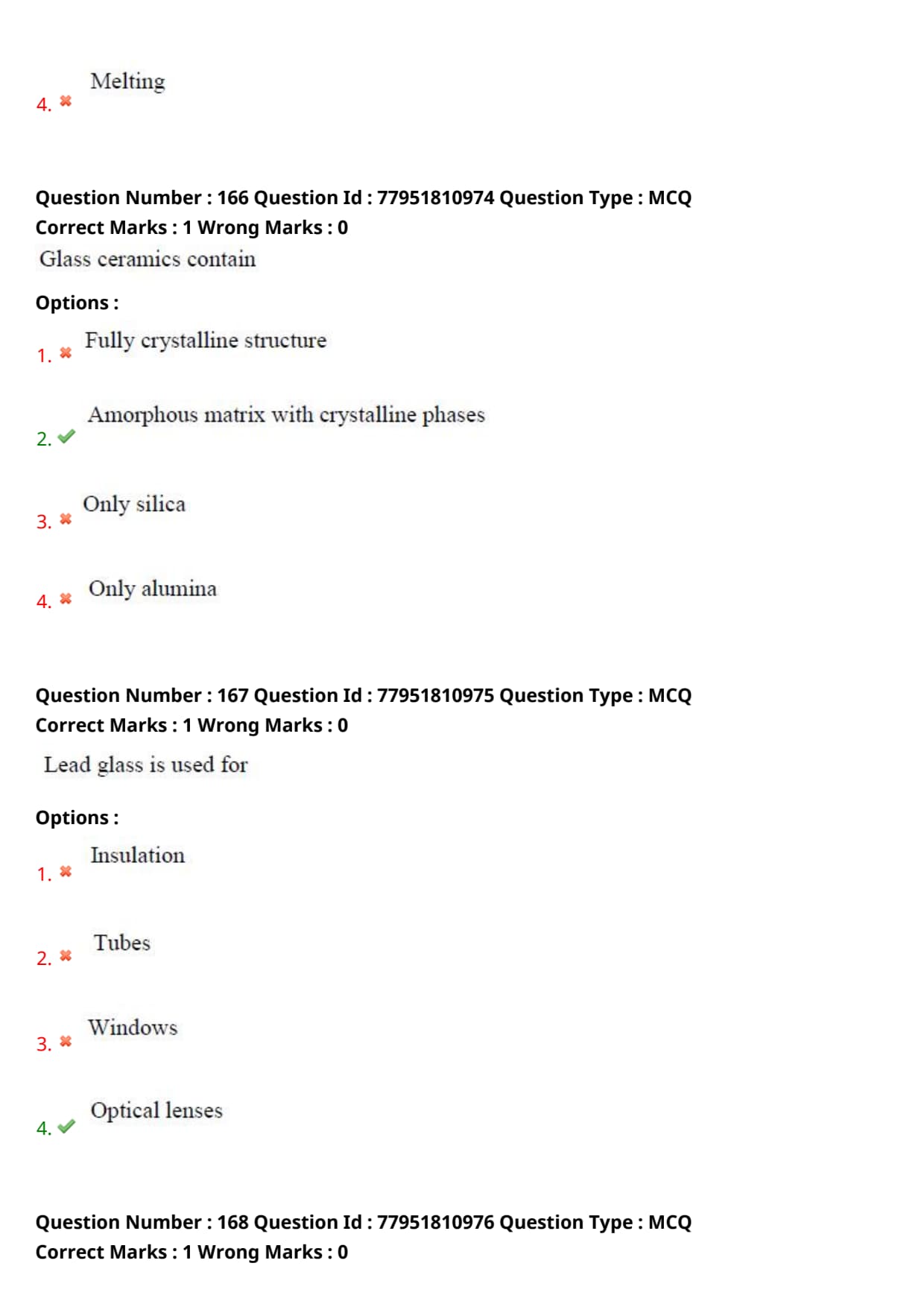
Question 167:
Lead glass is used for
- (A) Insulation
- (B) Tubes
- (C) Windows
- (D) Optical lenses
Question 168:
The main purpose of annealing is to
- (A) Increase optical clarity
- (B) Relieve stresses
- (C) Harden the surface
- (D) Add color
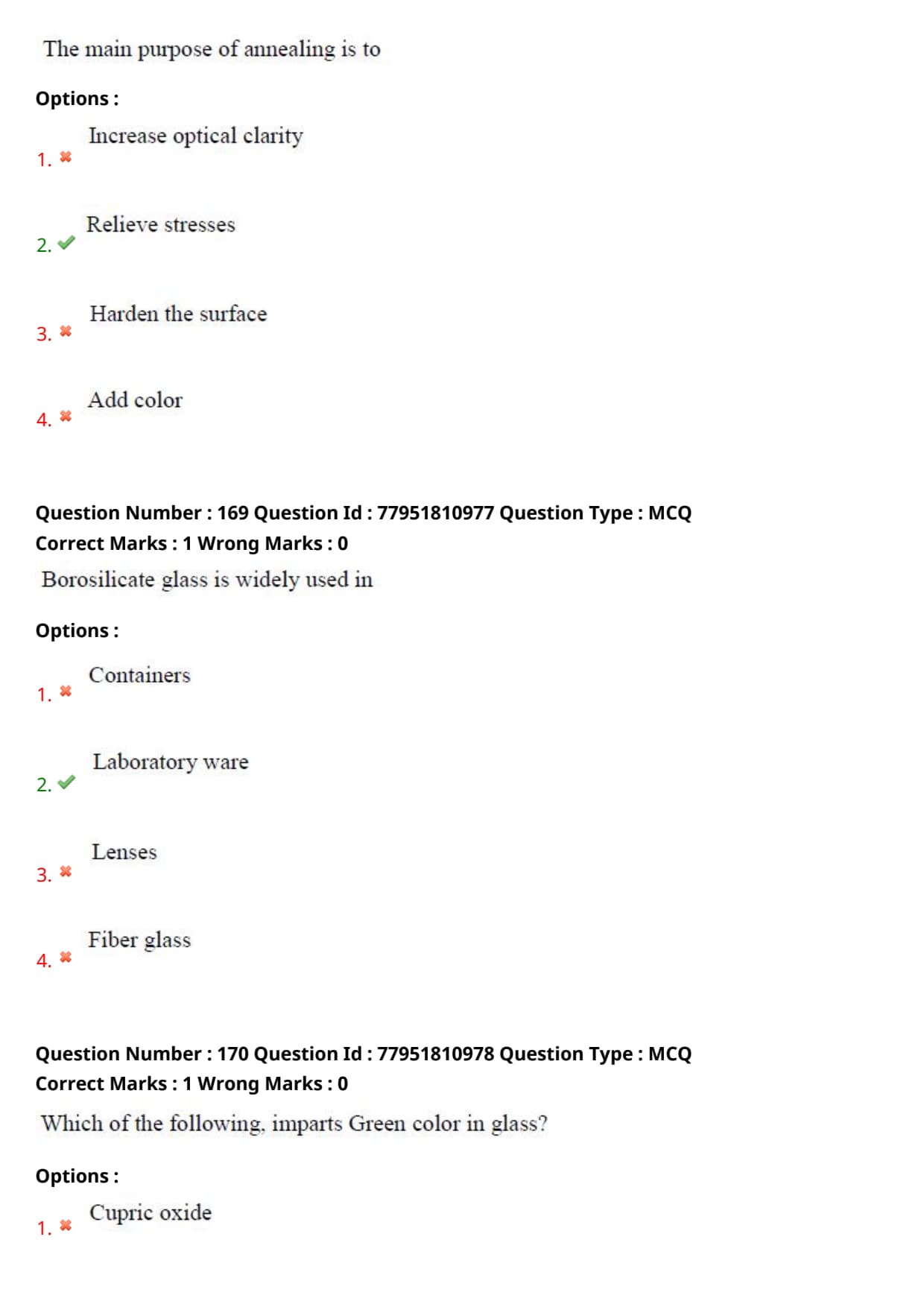
Question 169:
Borosilicate glass is widely used in
- (A) Containers
- (B) Laboratory ware
- (C) Lenses
- (D) Fiber glass
Question 170:
Which of the following, imparts Green color in glass?
- (A) Cupric oxide
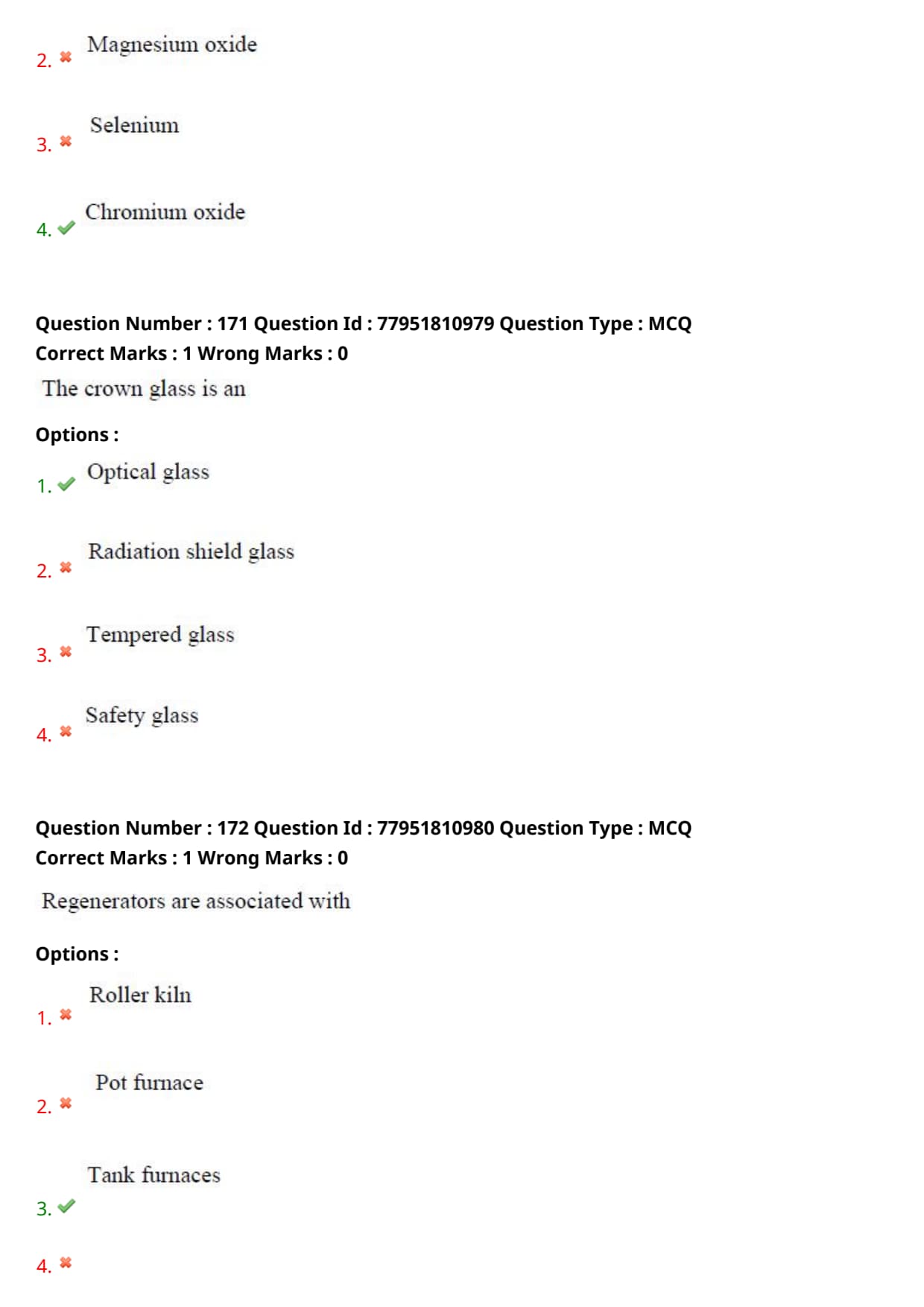
- (B) Magnesium oxide
- (C) Selenium
- (D) Chromium oxide
Question 171:
The crown glass is an
- (A) Optical glass
- (B) Radiation shield glass
- (C) Tempered glass
- (D) Safety glass
Question 172:
Regenerators are associated with
- (A) Roller kiln
- (B) Pot furnace
- (C) Tank furnaces
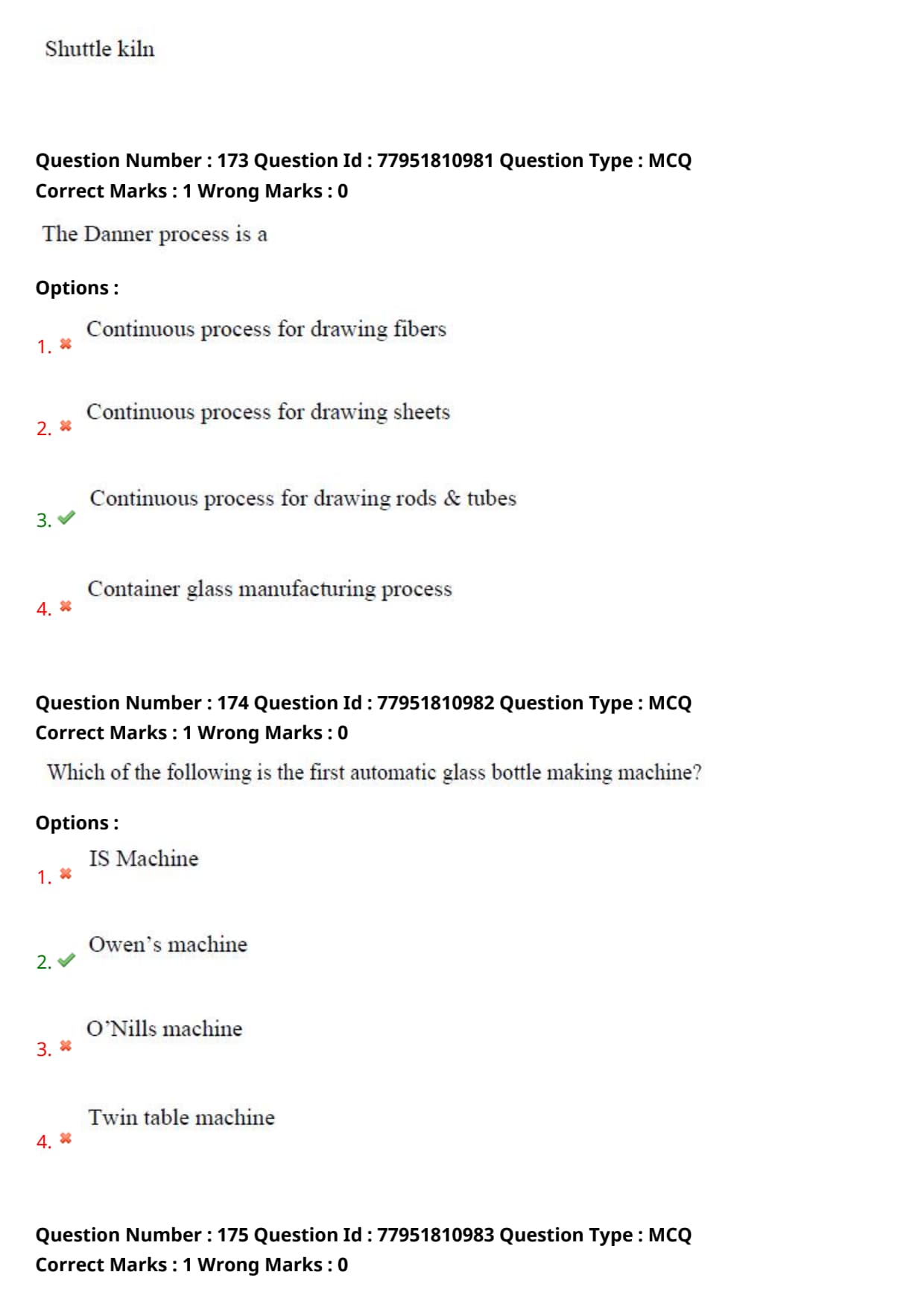
- (D) Shuttle kiln
Question 173:
The Danner process is a
- (A) Continuous process for drawing fibers
- (B) Continuous process for drawing sheets
- (C) Continuous process for drawing rods \& tubes
- (D) Container glass manufacturing process
Question 174:
Which of the following is the first automatic glass bottle making machine?
- (A) IS Machine
- (B) Owen's machine
- (C) O'Neill's machine
- (D) Twin table machine
Question 175:
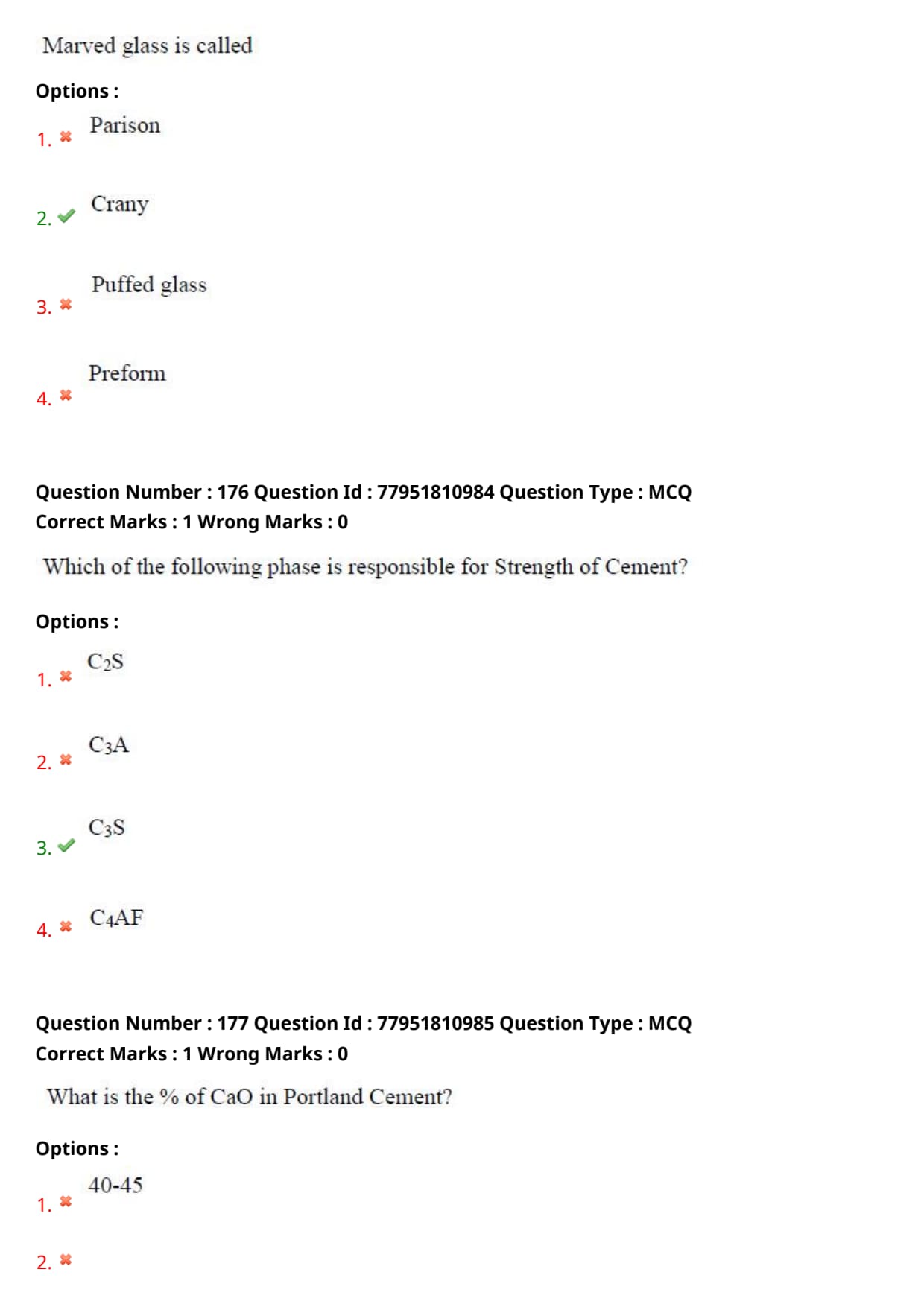
Marved glass is called
- (A) Parison
- (B) Crany
- (C) Puffed glass
- (D) Preform
Question 176:
Which of the following phase is responsible for Strength of Cement?
- (A) \(C_2S\)
- (B) \(C_3A\)
- (C) \(C_3S\)
- (D) \(C_4AF\)
Question 177:
What is the % of \(CaO\) in Portland Cement?
- (A) \(40-45\)
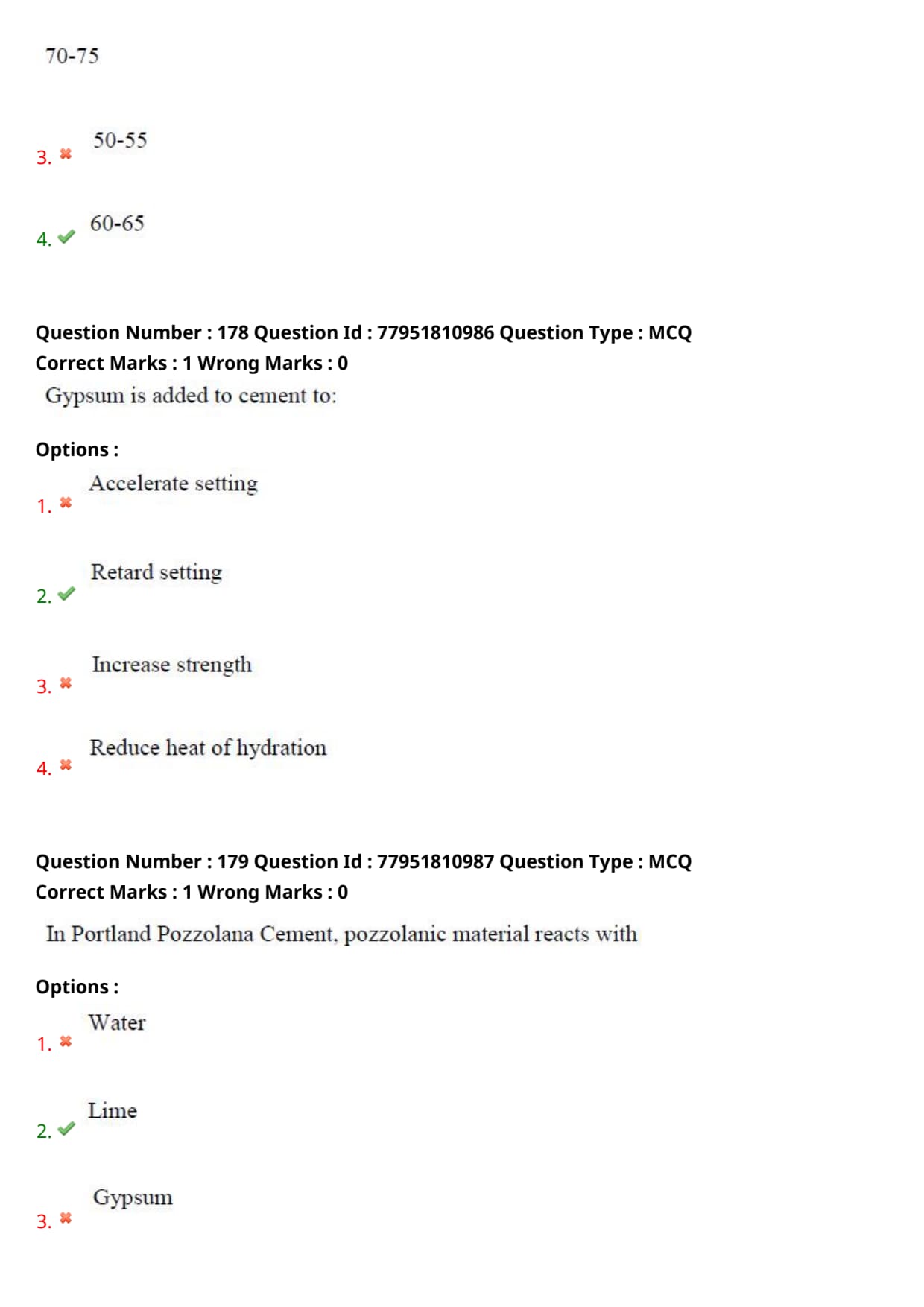
- (B) \(70-75\)
- (C) \(50-55\)
- (D) \(60-65\)
Question 178:
Gypsum is added to cement to:
- (A) Accelerate setting
- (B) Retard setting
- (C) Increase strength
- (D) Reduce heat of hydration
Question 179:
In Portland Pozzolana Cement, pozzolanic material reacts with
- (A) Water
- (B) Lime
- (C) Gypsum
- (D) Sand
Question 180:
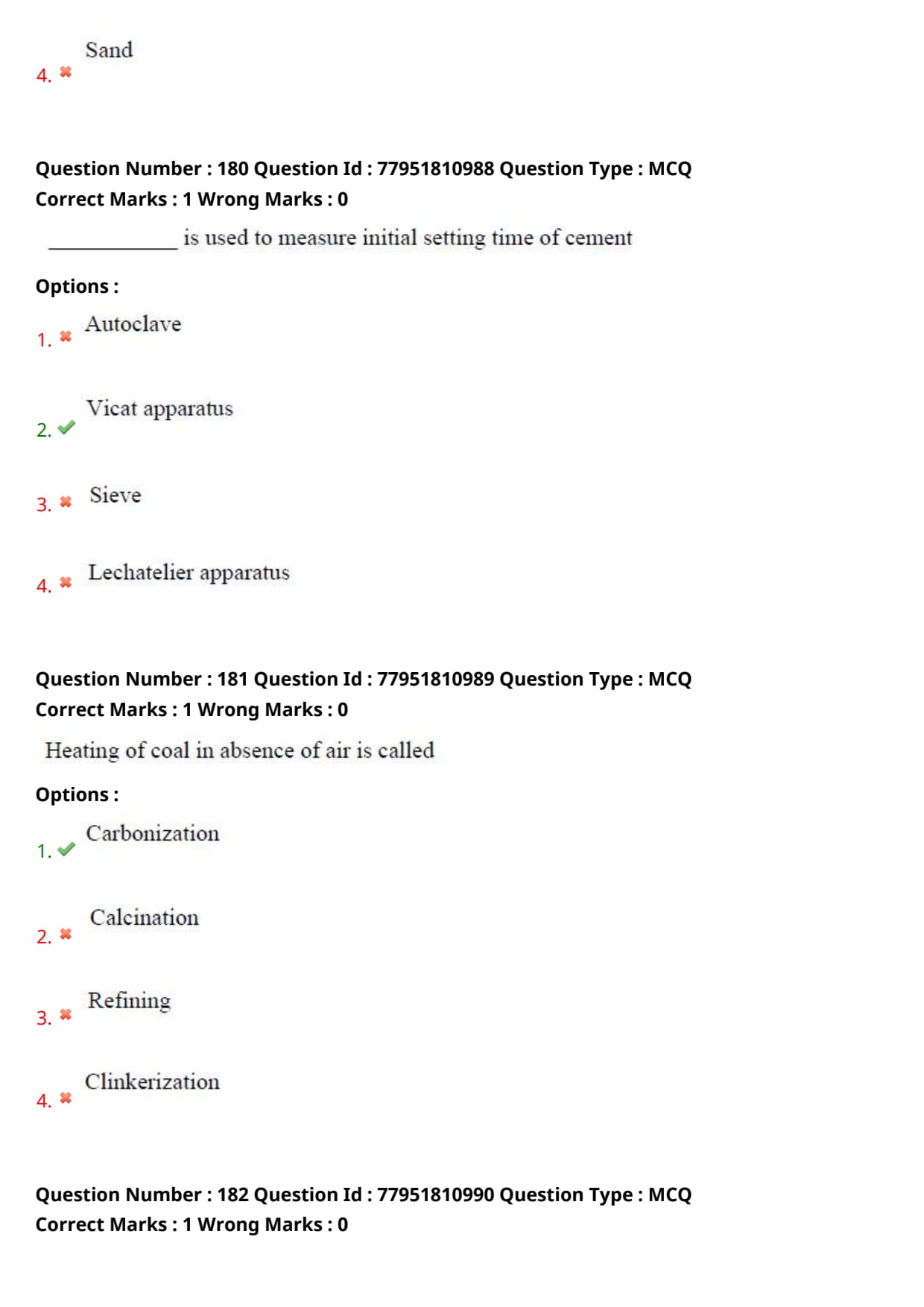
__________ is used to measure initial setting time of cement
- (A) Autoclave
- (B) Vicat apparatus
- (C) Sieve
- (D) Lechatelier apparatus
Question 181:
Heating of coal in absence of air is called
- (A) Carbonization
- (B) Calcination
- (C) Refining
- (D) Clinkerization
Question 182:
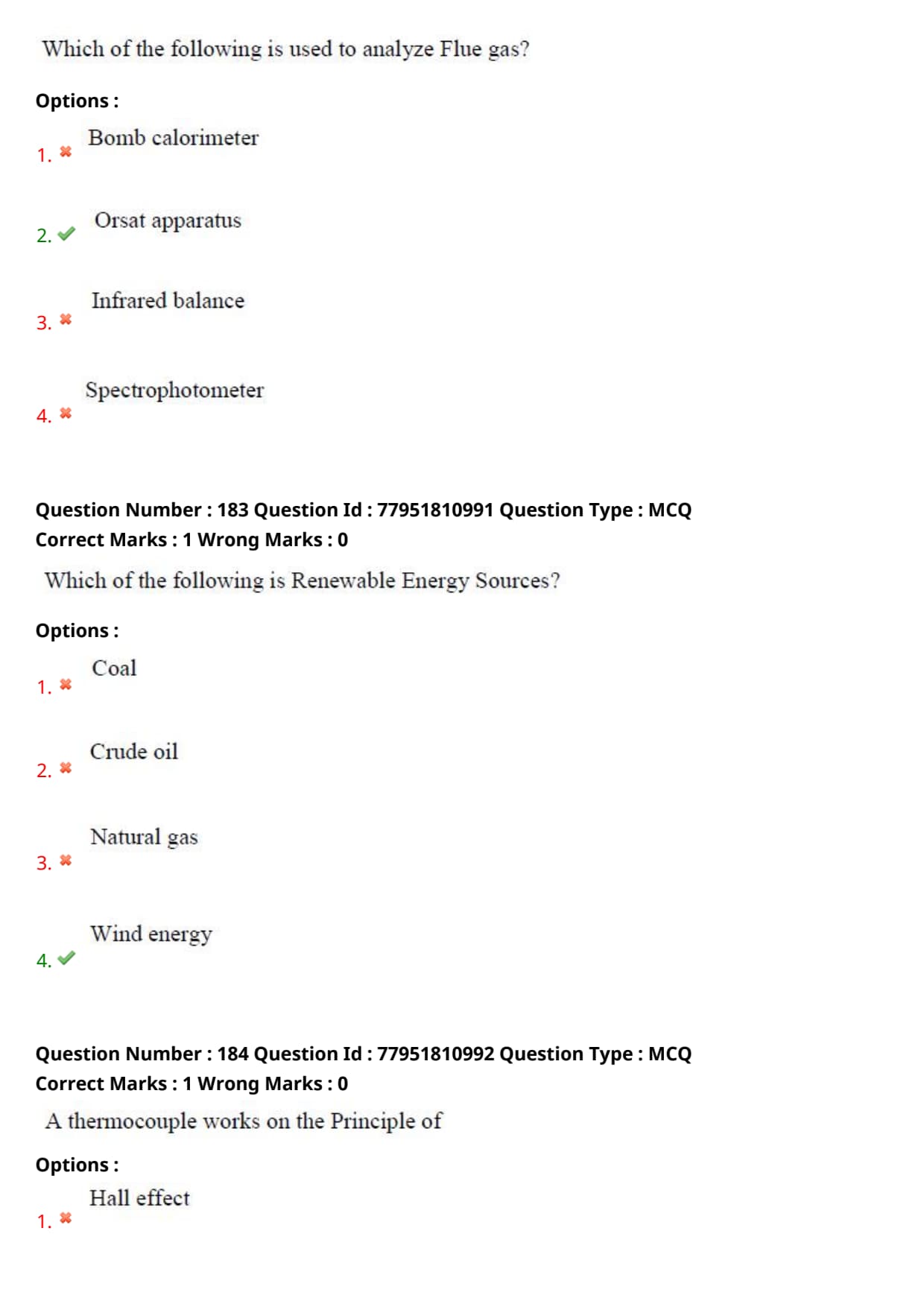
Which of the following is used to analyze Flue gas?
- (A) Bomb calorimeter
- (B) Orsat apparatus
- (C) Infrared balance
- (D) Spectrophotometer
Question 183:
Which of the following is Renewable Energy Sources?
- (A) Coal
- (B) Crude oil
- (C) Natural gas
- (D) Wind energy
Question 184:
A thermocouple works on the Principle of
- (A) Hall effect
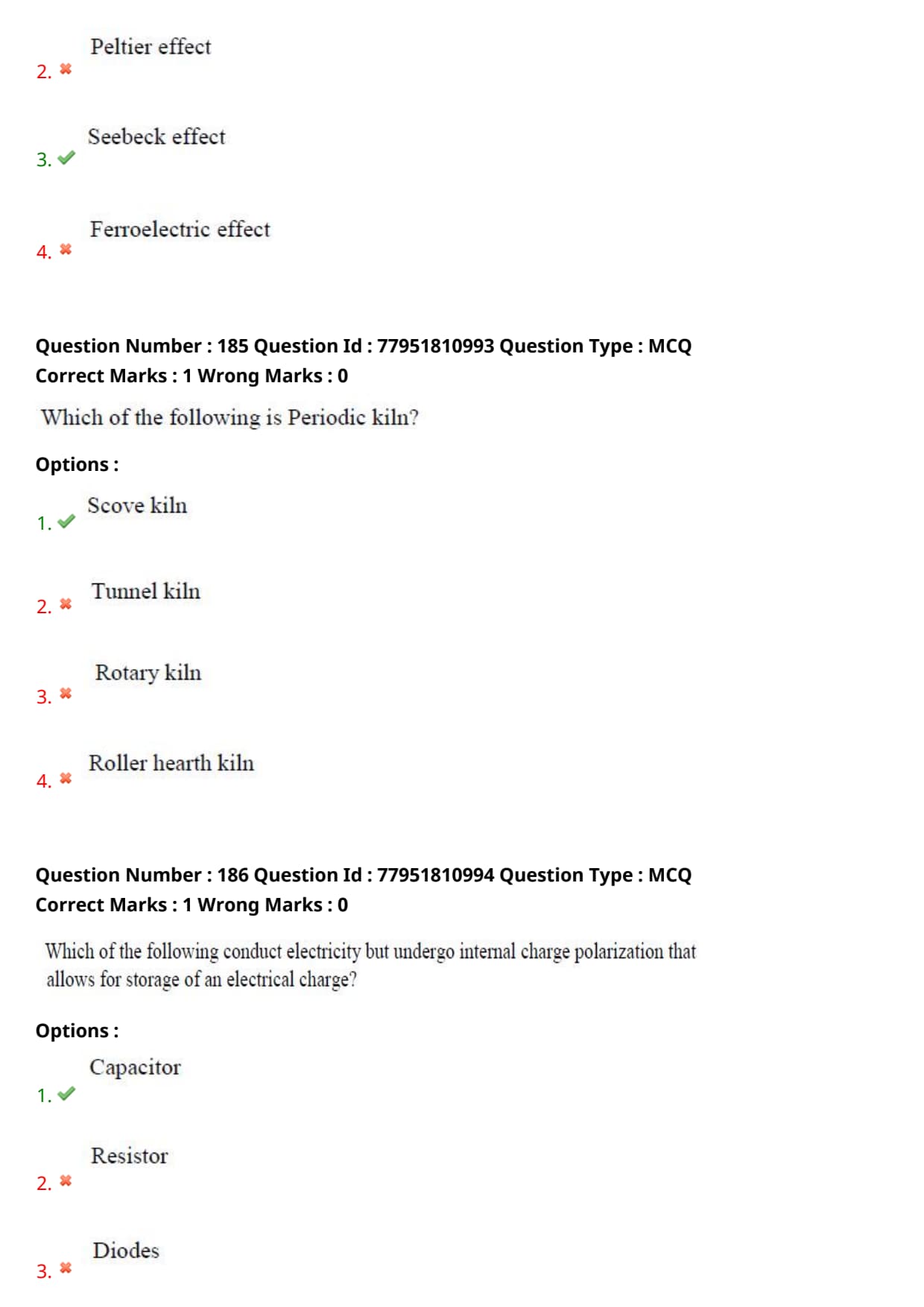
- (B) Peltier effect
- (C) Seebeck effect
- (D) Ferroelectric effect
Question 185:
Which of the following is Periodic kiln?
- (A) Scove kiln
- (B) Tunnel kiln
- (C) Rotary kiln
- (D) Roller hearth kiln
Question 186:
Which of the following conduct electricity but undergo internal charge polarization that allows for storage of an electrical charge?
- (A) Capacitor
- (B) Resistor
- (C) Diodes
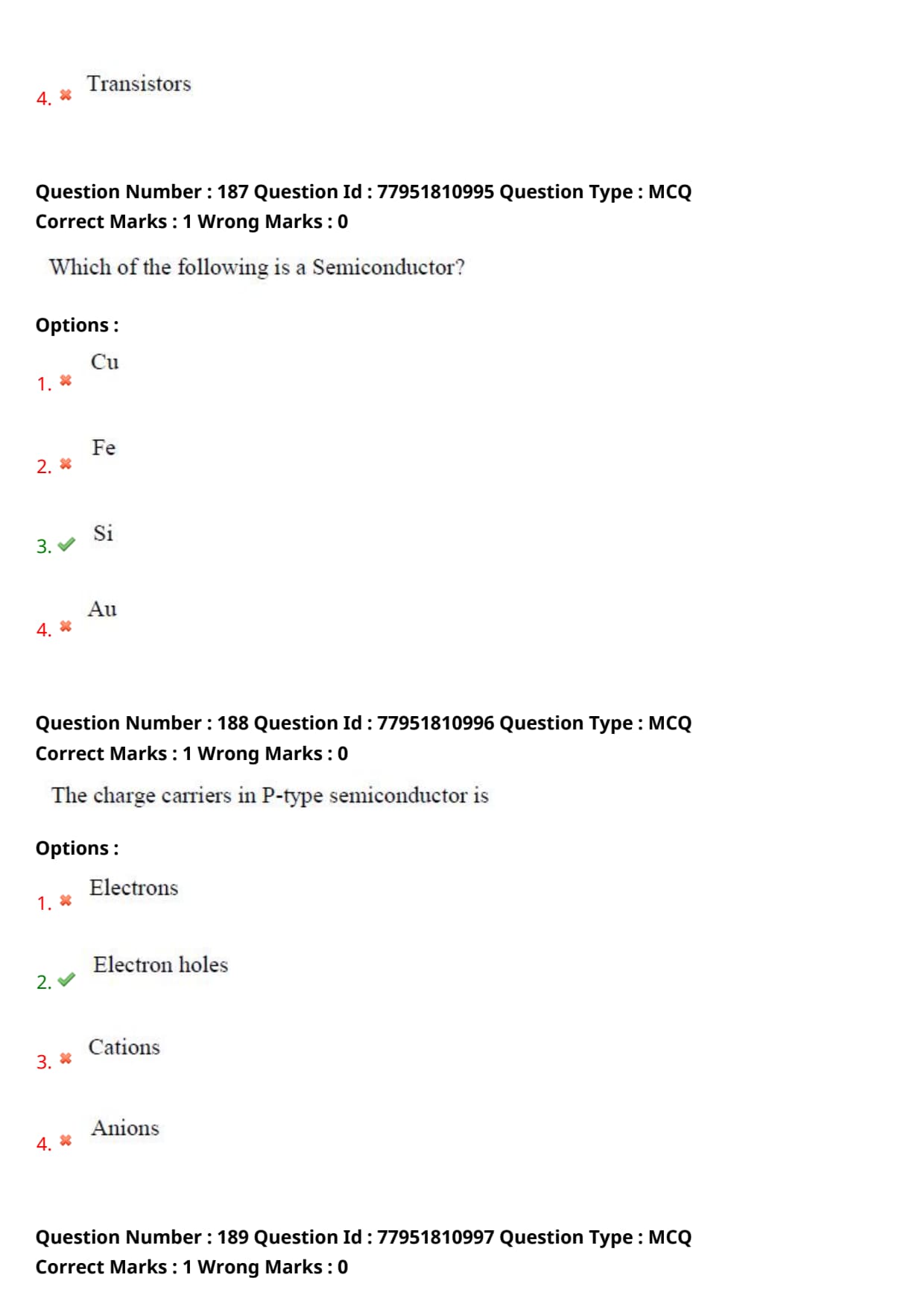
- (D) Transistors
Question 187:
Which of the following is a Semiconductor?
- (A) \(Cu\)
- (B) \(Fe\)
- (C) \(Si\)
- (D) \(Au\)
Question 188:
The charge carriers in P-type semiconductor is
- (A) Electrons
- (B) Electron holes
- (C) Cations
- (D) Anions
Question 189:
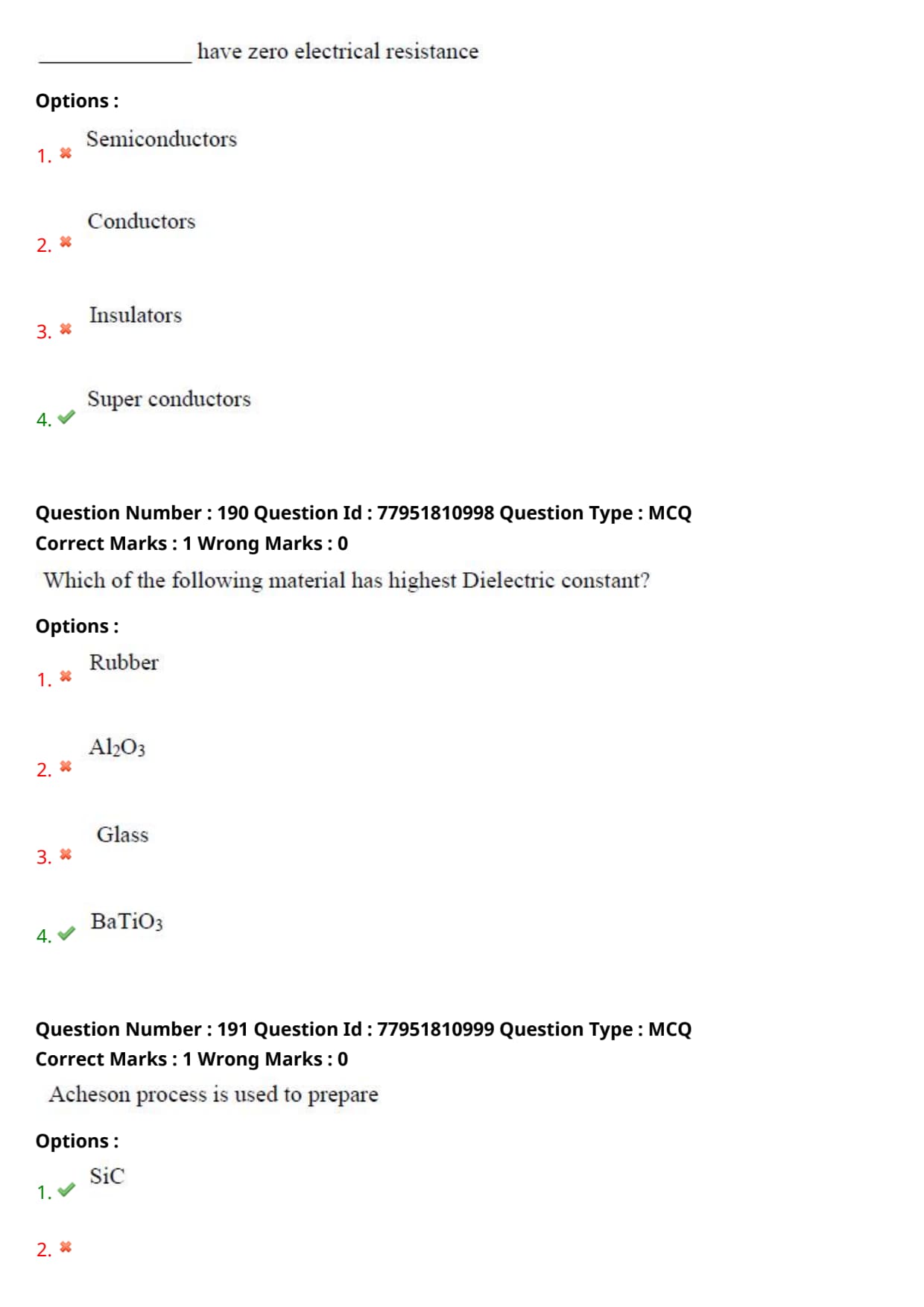
__________ have zero electrical resistance
- (A) Semiconductors
- (B) Conductors
- (C) Insulators
- (D) Super conductors
Question 190:
Which of the following material has highest Dielectric constant?
- (A) Rubber
- (B) \(Al_2O_3\)
- (C) Glass
- (D) \(BaTiO_3\)
Question 191:
Acheson process is used to prepare
- (A) \(SiC\)
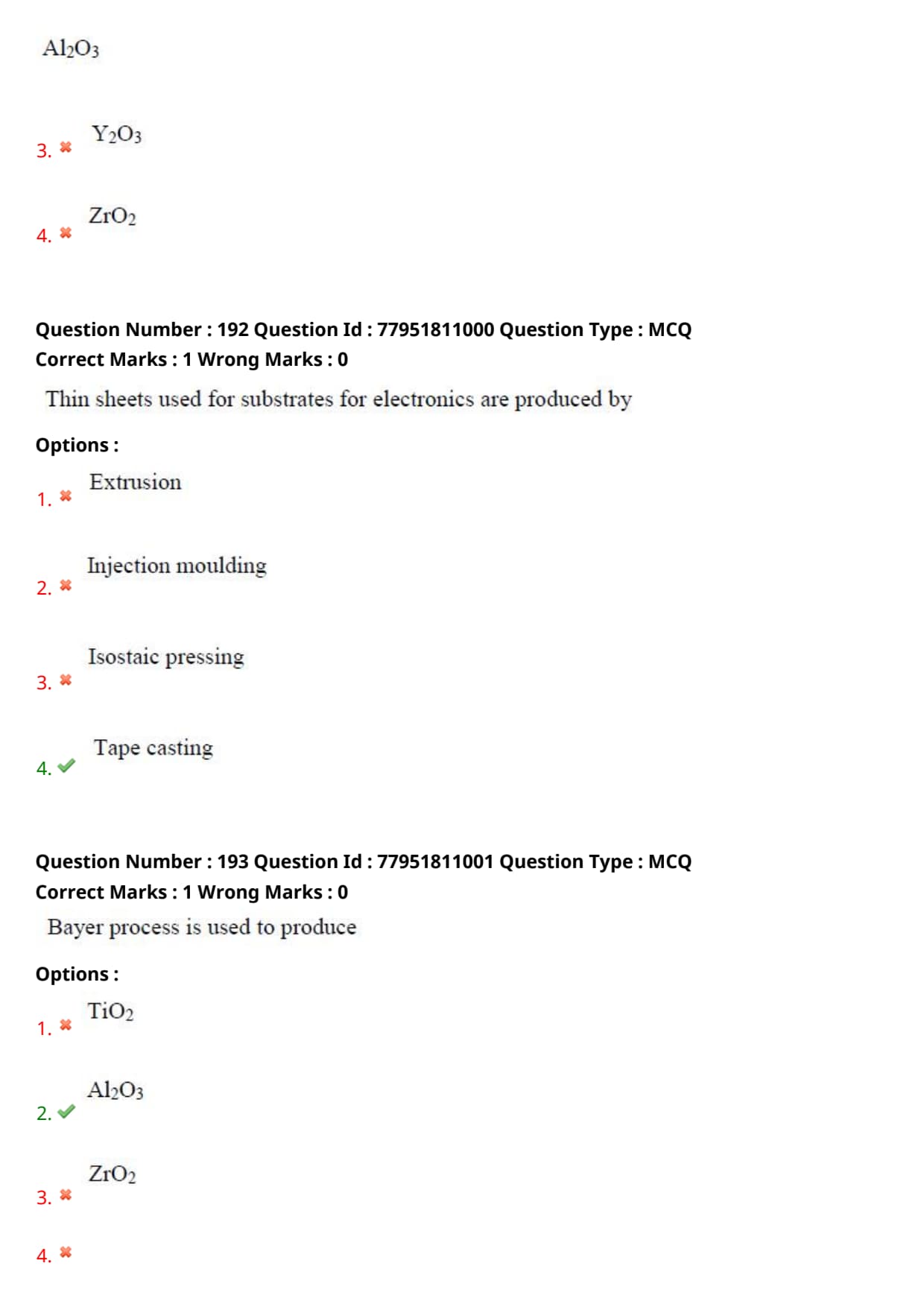
- (B) \(Al_2O_3\)
- (C) \(Y_2O_3\)
- (D) \(ZrO_2\)
Question 192:
Thin sheets used for substrates for electronics are produced by
- (A) Extrusion
- (B) Injection moulding
- (C) Isostatic pressing
- (D) Tape casting
Question 193:
Bayer process is used to produce
- (A) \(TiO_2\)
- (B) \(Al_2O_3\)
- (C) \(ZrO_2\)
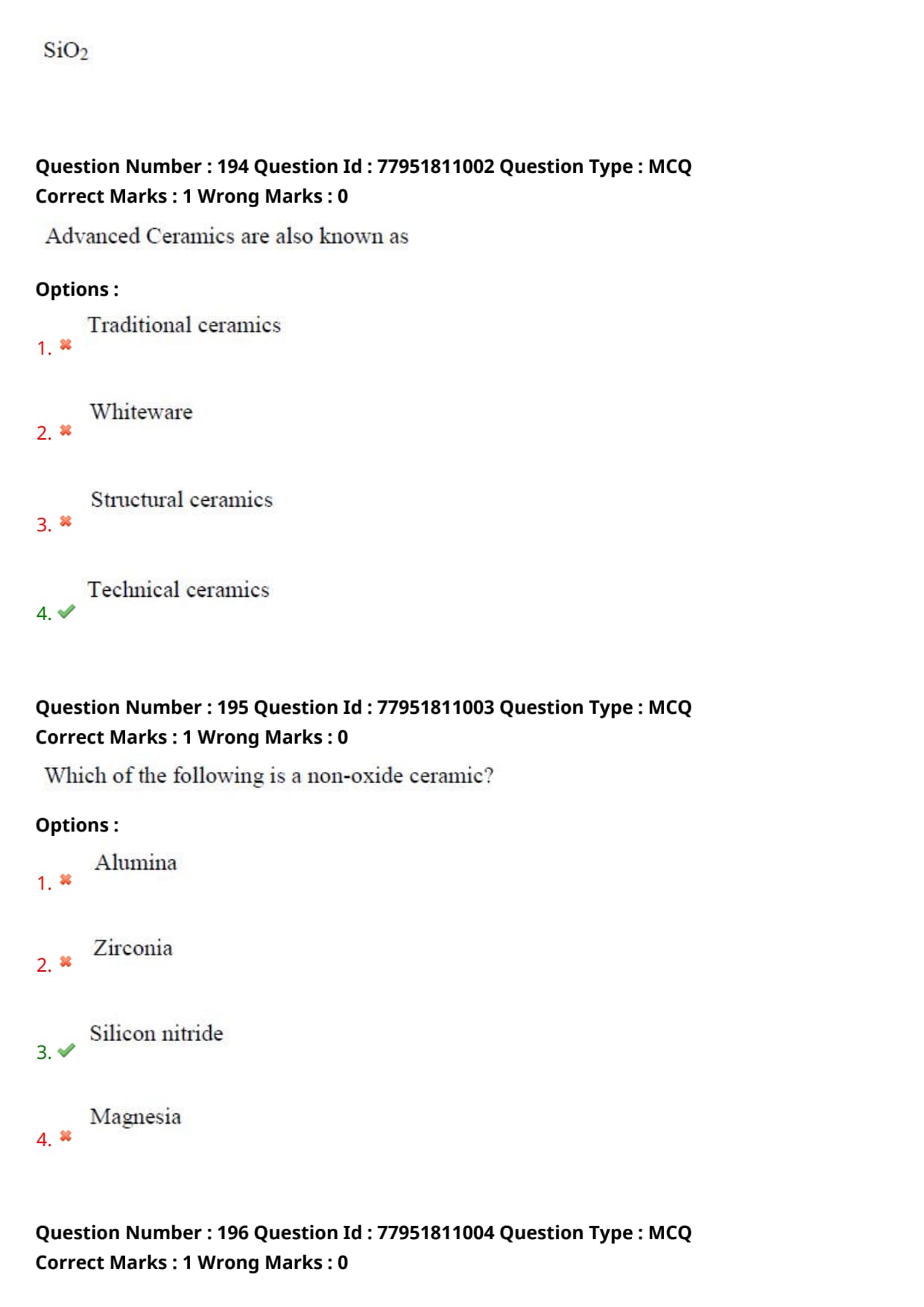
- (D) \(SiO_2\)
Question 194:
Advanced Ceramics are also known as
- (A) Traditional ceramics
- (B) Whiteware
- (C) Structural ceramics
- (D) Technical ceramics
Question 195:
Which of the following is a non-oxide ceramic?
- (A) Alumina
- (B) Zirconia
- (C) Silicon nitride
- (D) Magnesia
Question 196:
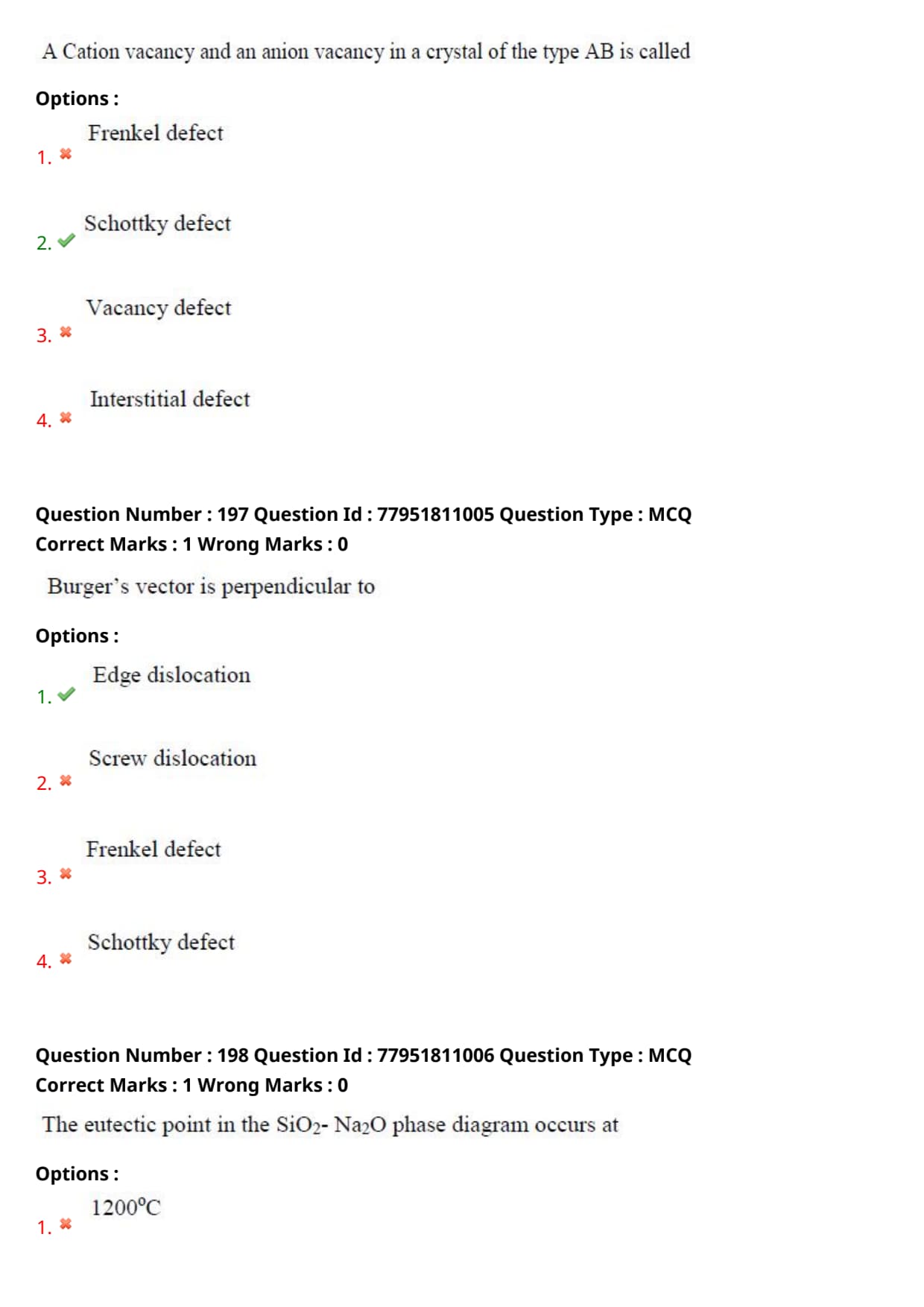
A Cation vacancy and an anion vacancy in a crystal of the type \(AB\) is called
- (A) Frenkel defect
- (B) Schottky defect
- (C) Vacancy defect
- (D) Interstitial defect
Question 197:
Burger's vector is perpendicular to
- (A) Edge dislocation
- (B) Screw dislocation
- (C) Frenkel defect
- (D) Schottky defect
Question 198:
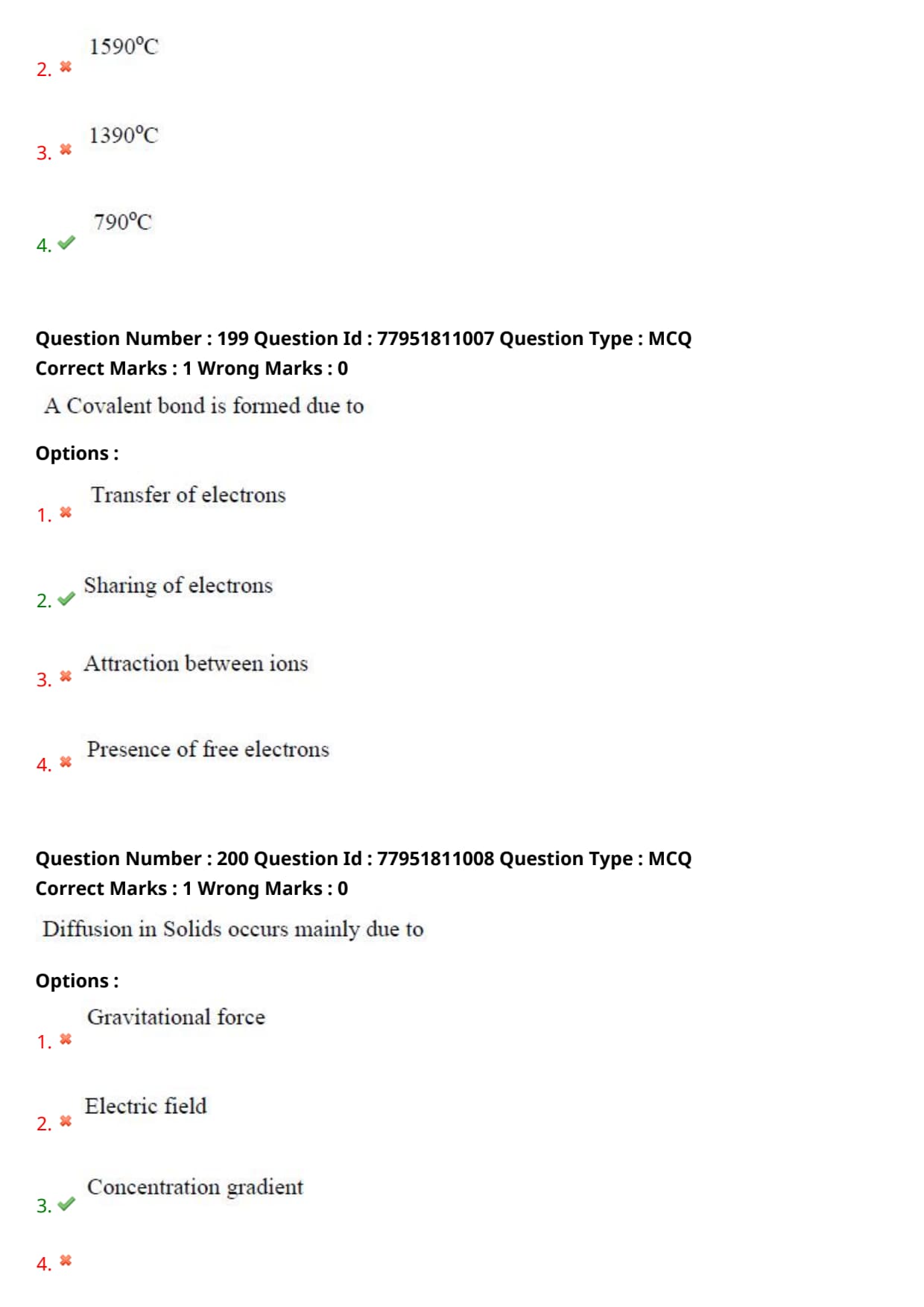
The eutectic point in the \(SiO_2-Na_2O\) phase diagram occurs at
- (A) \(1200° C\)
- (B) \(1590° C\)
- (C) \(1390° C\)
- (D) \(790° C\)
Question 199:
A Covalent bond is formed due to
- (A) Transfer of electrons
- (B) Sharing of electrons
- (C) Attraction between ions
- (D) Presence of free electrons
Question 200:
Diffusion in Solids occurs mainly due to
- (A) Gravitational force
- (B) Electric field
- (C) Concentration gradient
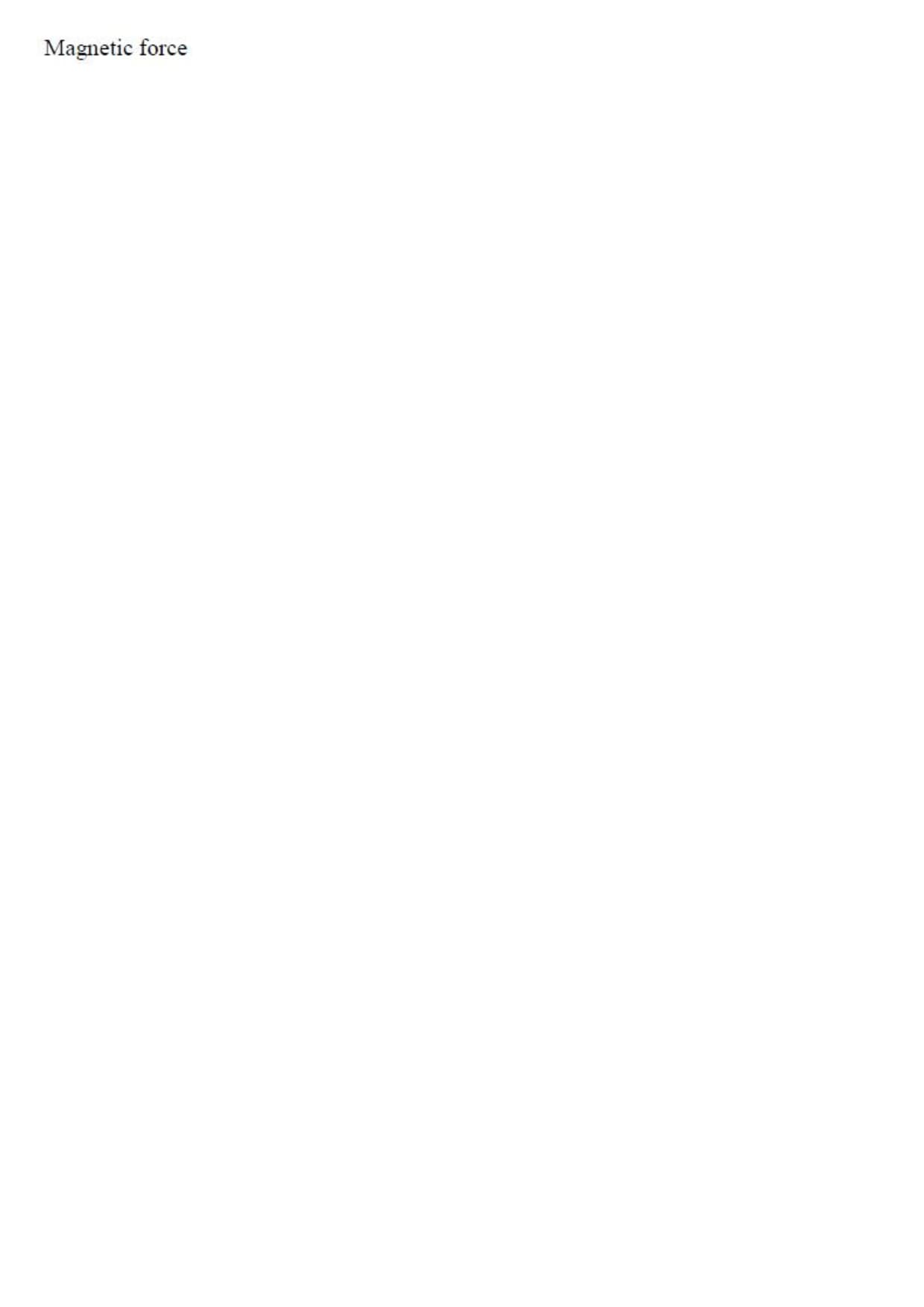
- (D) Magnetic field
AP ECET 2026 Exam Pattern
| Subjects |
Maximum Questions |
Maximum Marks |
| Physics |
25 |
25 |
| Chemistry |
25 |
25 |
| Mathematics |
50 |
50 |
| Engineering Branch |
100 |
100 |
| Total |
200 |
200 |
AP ECET 2026 Final Tips









Comments