




MAH B.Ed CET 2026 Question paper with solution pdf is available for download. The exam was successfully organized by Maharashtra CET Cell. The question paper comprised a total of 100 questions divided among three sections.
MAH B.Ed CET 2026 Question Paper with Solution PDF – Memory Based
| MAH B.Ed CET 2026 Question Paper with Solutions | Download PDF | Check Solution |
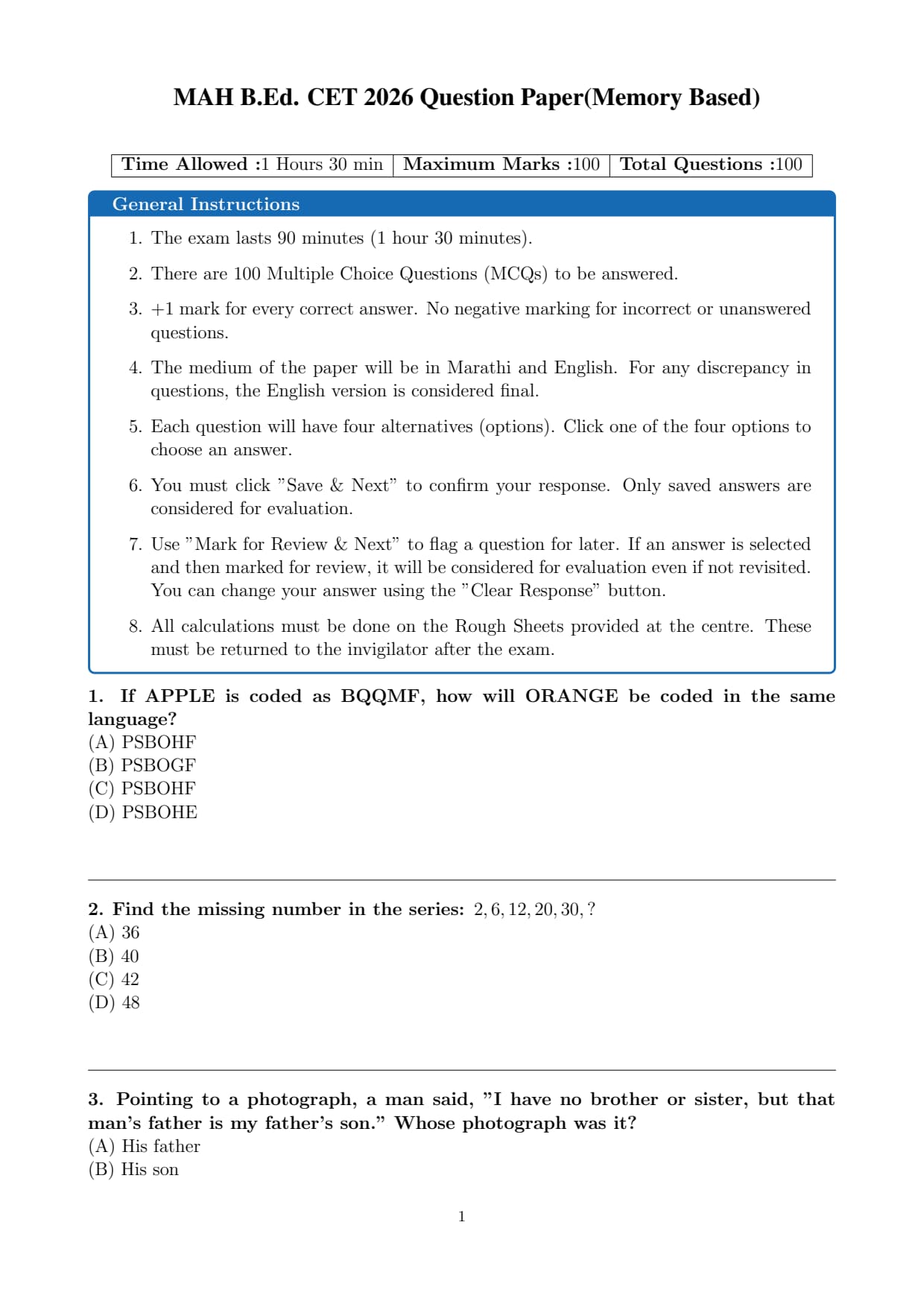
If APPLE is coded as BQQMF, how will ORANGE be coded in the same language?
View Solution
Concept:
In this type of coding, each letter of the word is shifted forward by one position in the English alphabet.
A \(\rightarrow\) B
P \(\rightarrow\) Q
L \(\rightarrow\) M
E \(\rightarrow\) F
Thus, every letter increases by +1 position.
Step 1: Understanding the given example APPLE \(\rightarrow\) BQQMF.
\[ A \rightarrow B, \quad P \rightarrow Q, \quad P \rightarrow Q, \quad L \rightarrow M, \quad E \rightarrow F \]
So, the rule is: each letter is shifted forward by 1.
Step 2: Apply the same rule to ORANGE.
\[ O \rightarrow P, \quad R \rightarrow S, \quad A \rightarrow B, \quad N \rightarrow O, \quad G \rightarrow H, \quad E \rightarrow F \]
Step 3: Write the final coded word.
\[ ORANGE \rightarrow PSBOHF \] Quick Tip: In coding-decoding problems, first identify the pattern by comparing each letter. Most common patterns involve shifting positions in the alphabet.
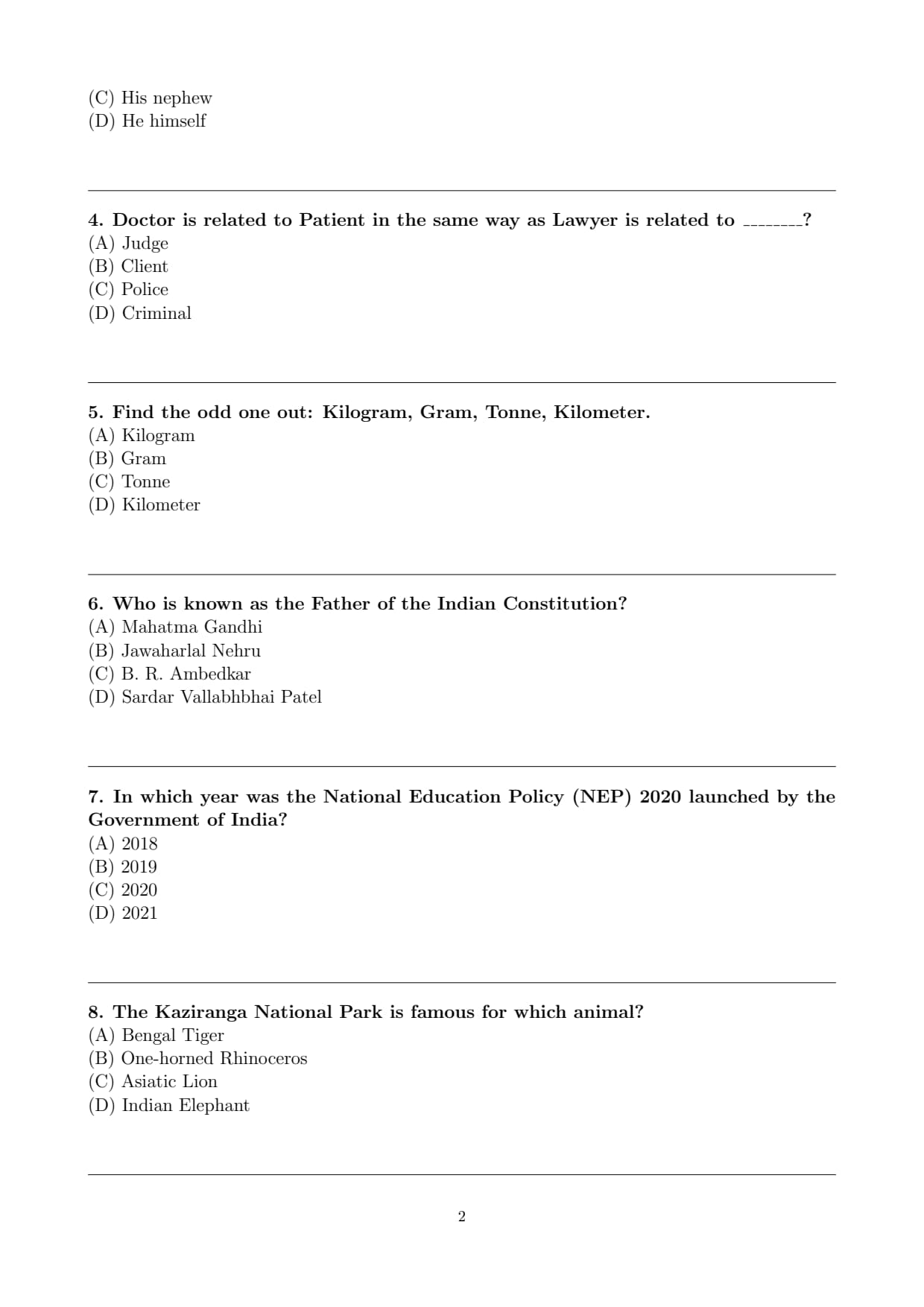
Find the missing number in the series: \(2, 6, 12, 20, 30, ?\)
View Solution
Concept:
Number series questions often follow a systematic pattern such as differences, multiplication, squares, or a combination of these operations.
A common approach is to examine the difference between consecutive terms to identify the pattern.
Step 1: Find the difference between consecutive terms. \[ \begin{aligned} 6 - 2 &= 4
12 - 6 &= 6
20 - 12 &= 8
30 - 20 &= 10 \end{aligned} \]
Step 2: Observe the pattern in the differences.
The differences form an arithmetic pattern: \[ 4,\,6,\,8,\,10 \]
Each difference increases by \(2\).
Step 3: Find the next difference.
\[ 10 + 2 = 12 \]
Step 4: Add the next difference to the last term.
\[ 30 + 12 = 42 \]
Thus, the missing number in the series is:
\[ \boxed{42} \] Quick Tip: For number series problems, first compute the differences between consecutive terms. If the differences follow a simple pattern (like increasing by a constant), continue the pattern to find the missing term.
Pointing to a photograph, a man said, "I have no brother or sister, but that man’s father is my father’s son." Whose photograph was it?
View Solution
Concept:
In blood relation problems, statements must be simplified step-by-step by interpreting each phrase carefully.
Often, phrases like \textit{my father's son or \textit{my mother's daughter refer either to the person himself/herself or their sibling depending on the condition given.
Step 1: Analyze the statement ``I have no brother or sister.''
Since the man has no siblings, the phrase:
\[ my father's son \]
must refer to the man himself.
Step 2: Substitute the meaning in the statement.
The statement becomes:
\[ that man's father is me \]
This means the man in the photograph is the son of the speaker.
Step 3: Determine whose photograph it is.
If the father of the person in the photograph is the speaker, then the photograph must be of his son.
\[ Therefore, the photograph is of his son. \] Quick Tip: In blood relation questions, first simplify phrases like ``my father's son'' or ``my mother's daughter.'' If the person has no siblings, these phrases usually refer to the person himself/herself.
Doctor is related to Patient in the same way as Lawyer is related to ________?
View Solution
Concept:
Analogy questions test the relationship between two given words. The task is to identify the same type of relationship in another pair of words.
Here, the relationship is based on profession and the person they serve.
Step 1: Identify the relationship in the first pair.
A Doctor is a professional who treats a Patient.
\[ Doctor \rightarrow Patient \]
Step 2: Find a similar relationship.
A Lawyer is a professional who provides legal services to a Client.
\[ Lawyer \rightarrow Client \]
Step 3: Select the correct option.
Thus, the relationship matches as:
\[ Doctor : Patient :: Lawyer : Client \] Quick Tip: In analogy questions, first identify the type of relationship (profession, function, cause-effect, part-whole, etc.). Then look for the option that follows the same relationship.
Find the odd one out: Kilogram, Gram, Tonne, Kilometer.
View Solution
Concept:
Odd-one-out questions require identifying the element that does not belong to the same category as the others. The classification is usually based on function, type, measurement, or category.
Step 1: Identify the category of each term.
\[ \begin{aligned} Kilogram &\rightarrow Unit of mass
Gram &\rightarrow Unit of mass
Tonne &\rightarrow Unit of mass
Kilometer &\rightarrow Unit of distance \end{aligned} \]
Step 2: Compare the units.
- Kilogram, Gram, and Tonne are all units used to measure mass (weight).
- Kilometer is a unit used to measure distance (length).
Step 3: Determine the odd one out.
Since Kilometer belongs to a different category (distance), it is the odd one out.
\[ \boxed{Kilometer} \] Quick Tip: In odd-one-out problems, group the items based on their common property. The item that does not share the same category or function as the others is the correct answer.
Who is known as the Father of the Indian Constitution?
View Solution
Concept:
The title Father of the Indian Constitution refers to the person who played the most significant role in drafting and shaping the Constitution of India. This role involved framing legal principles, structuring governance systems, and ensuring democratic rights for citizens.
Step 1: Understand the historical role in drafting the Constitution.
The Constitution of India was drafted by the \textit{Constituent Assembly, which was formed in 1946 to prepare the governing framework of independent India.
Step 2: Identify the chairman of the Drafting Committee.
Dr. B. R. Ambedkar was appointed as the Chairman of the Drafting Committee of the Constituent Assembly. He played a crucial role in preparing the final draft of the Constitution.
Step 3: Reason for the title.
Because of his significant contribution in shaping and drafting the Constitution, Dr. B. R. Ambedkar is widely recognized as the Father of the Indian Constitution.
\[ \boxed{B. R. Ambedkar \] Quick Tip: Dr. B. R. Ambedkar served as the Chairman of the Drafting Committee and was instrumental in framing the Indian Constitution, which came into effect on 26 January 1950.
In which year was the National Education Policy (NEP) 2020 launched by the Government of India?
View Solution
Concept:
The National Education Policy (NEP) is a policy framework formulated by the Government of India to guide the development of education in the country. It outlines reforms in school education, higher education, curriculum structure, and skill development.
Step 1: Understand what NEP 2020 refers to.
The National Education Policy 2020 is the first major education reform in India in the 21st century. It replaced the earlier National Policy on Education of 1986.
Step 2: Identify the year of its launch.
The Government of India officially approved and launched the National Education Policy (NEP) 2020 on:
\[ 29^{th}\ July,\ 2020 \]
Step 3: Select the correct option.
Since the policy was launched in 2020, the correct answer is:
\[ \boxed{2020} \] Quick Tip: NEP 2020 introduced the new 5+3+3+4 education structure, replacing the traditional 10+2 system and focusing on multidisciplinary learning and skill development.
The Kaziranga National Park is famous for which animal?
View Solution
Concept:
National parks are protected areas established to conserve wildlife and natural habitats. Many parks are particularly known for protecting specific endangered species.
Step 1: Identify the location of Kaziranga National Park.
Kaziranga National Park is located in the state of Assam, India, and is recognized as a UNESCO World Heritage Site.
Step 2: Recognize the species it protects.
The park is world-famous for conserving the Great Indian One-horned Rhinoceros.
It hosts the largest population of one-horned rhinoceroses in the world.
Step 3: Select the correct option.
Thus, Kaziranga National Park is famous for the:
\[ \boxed{One-horned Rhinoceros} \] Quick Tip: Kaziranga National Park in Assam is internationally known for protecting the endangered Great Indian One-horned Rhinoceros and is also home to tigers, elephants, and wild water buffalo.
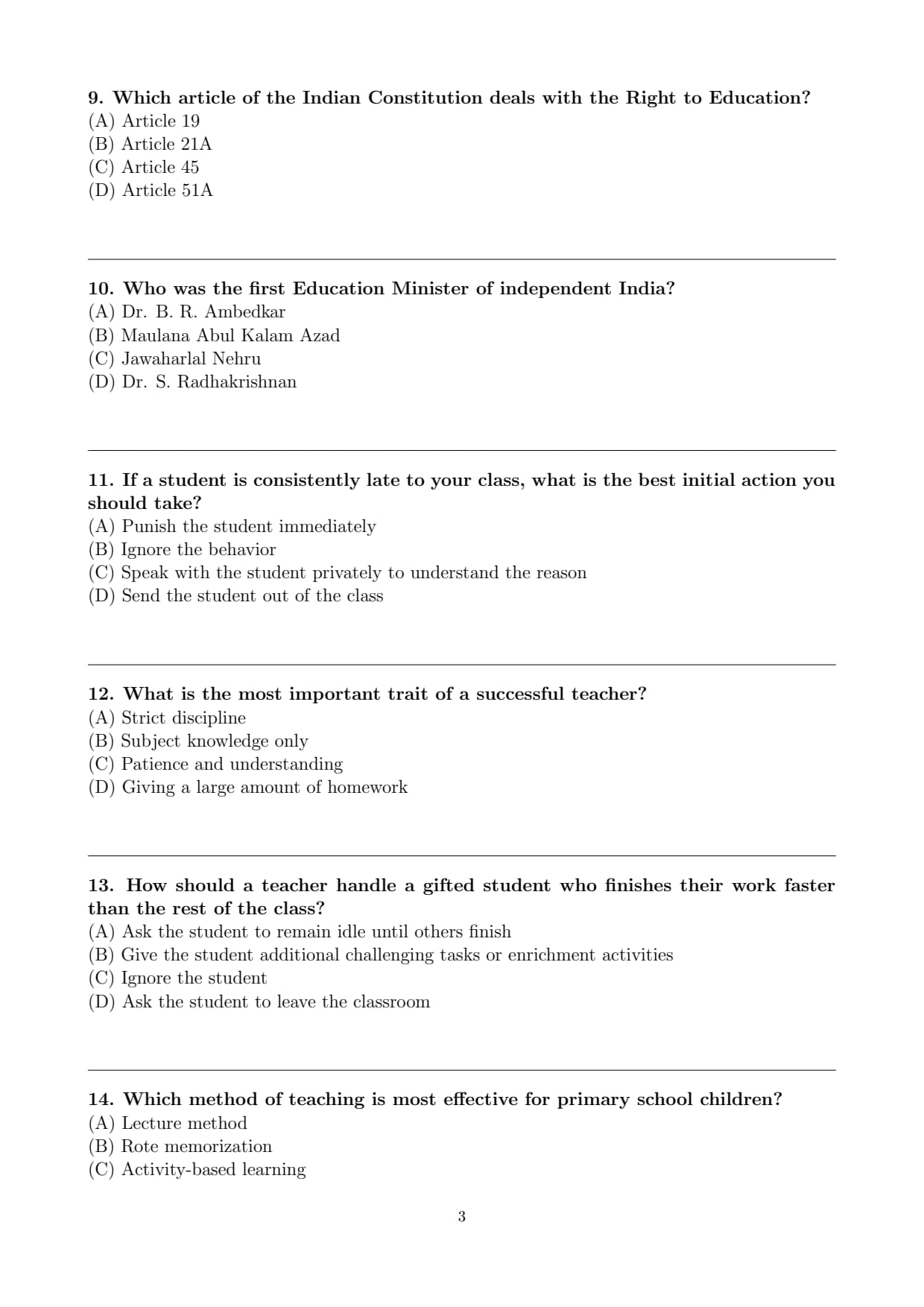
Which article of the Indian Constitution deals with the Right to Education?
View Solution
Concept:
The Right to Education (RTE) is a fundamental right that ensures free and compulsory education for children. This provision was added to the Constitution to promote universal education and improve literacy in India.
Step 1: Understand the constitutional amendment.
The Right to Education was introduced through the 86th Constitutional Amendment Act, 2002, which inserted a new article in the Constitution.
Step 2: Identify the relevant article.
The amendment added Article 21A, which states that the State shall provide free and compulsory education to all children between the ages of 6 and 14 years.
Step 3: Select the correct option.
Therefore, the Right to Education is provided under:
\[ \boxed{Article 21A} \] Quick Tip: Article 21A of the Indian Constitution guarantees free and compulsory education for children aged 6–14 years. It became effective with the implementation of the Right to Education Act in 2010.
Who was the first Education Minister of independent India?
View Solution
Concept:
After India gained independence in 1947, the Government of India formed its first cabinet to manage different ministries such as education, finance, defense, and home affairs. The Education Minister is responsible for developing policies and programs related to education in the country.
Step 1: Identify the first cabinet of independent India.
When India became independent on 15 August 1947, the first Prime Minister, Jawaharlal Nehru, formed the first cabinet of independent India.
Step 2: Recognize the first Education Minister.
Maulana Abul Kalam Azad was appointed as the first Education Minister of independent India. He served in this position from 1947 to 1958.
Step 3: Contribution to Indian education.
Maulana Abul Kalam Azad played a major role in developing the modern education system in India and was instrumental in establishing institutions such as the University Grants Commission (UGC) and promoting higher education and scientific research.
\[ \boxed{Maulana Abul Kalam Azad} \] Quick Tip: Maulana Abul Kalam Azad's birthday (11 November) is celebrated in India as National Education Day to honor his contributions to the field of education.
If a student is consistently late to your class, what is the best initial action you should take?
View Solution
Concept:
Effective classroom management emphasizes understanding student behavior and addressing issues constructively. Teachers are encouraged to identify the underlying cause of a student's behavior before taking disciplinary action.
Step 1: Understand the situation.
A student arriving late repeatedly may be facing certain difficulties such as transportation issues, family responsibilities, or personal challenges.
Step 2: Consider the role of a teacher.
A teacher should first attempt to understand the reason behind the behavior and provide guidance rather than immediately imposing punishment.
Step 3: Choose the most appropriate initial action.
The best first step is to speak with the student privately to understand the cause of the problem and then decide the appropriate solution.
\[ \boxed{Speak with the student privately to understand the reason} \] Quick Tip: In classroom management, it is always advisable to understand the root cause of a student's behavior before taking corrective action. Communication and empathy help build a positive learning environment.
What is the most important trait of a successful teacher?
View Solution
Concept:
A successful teacher is not only knowledgeable but also able to guide, support, and motivate students. Teaching involves understanding the diverse learning needs, abilities, and behaviors of students.
Step 1: Evaluate the qualities of an effective teacher.
Important qualities of a good teacher include patience, empathy, clear communication, and the ability to adapt teaching methods according to students’ needs.
Step 2: Analyze the given options.
Strict discipline alone cannot ensure effective learning.
Subject knowledge only is important but not sufficient without understanding students.
Giving large amounts of homework does not necessarily improve learning.
Patience and understanding help teachers support students and create a positive learning environment.
Step 3: Identify the most important trait.
Among the given options, the quality that contributes most to successful teaching is:
\[ \boxed{Patience and understanding} \] Quick Tip: Patience allows teachers to support students with different learning speeds and abilities, while understanding helps build trust and encourages active learning.
How should a teacher handle a gifted student who finishes their work faster than the rest of the class?
View Solution
Concept:
Gifted students often learn quickly and may complete tasks earlier than others. Effective teaching involves providing opportunities that keep such students engaged and help them further develop their abilities.
Step 1: Understand the needs of gifted students.
Gifted students require stimulating and challenging learning opportunities so that their abilities can be nurtured and they remain motivated.
Step 2: Evaluate the options.
Asking the student to remain idle can reduce motivation.
Ignoring the student does not support their learning needs.
Asking the student to leave the classroom is inappropriate.
Providing additional challenging or enrichment tasks helps maintain engagement and supports advanced learning.
Step 3: Select the best teaching approach.
Therefore, the most appropriate action is to provide additional challenging tasks or enrichment activities.
\[ \boxed{Give the student additional challenging tasks or enrichment activities} \] Quick Tip: Teachers can support gifted students by offering enrichment activities such as advanced problems, creative projects, research tasks, or peer tutoring opportunities.
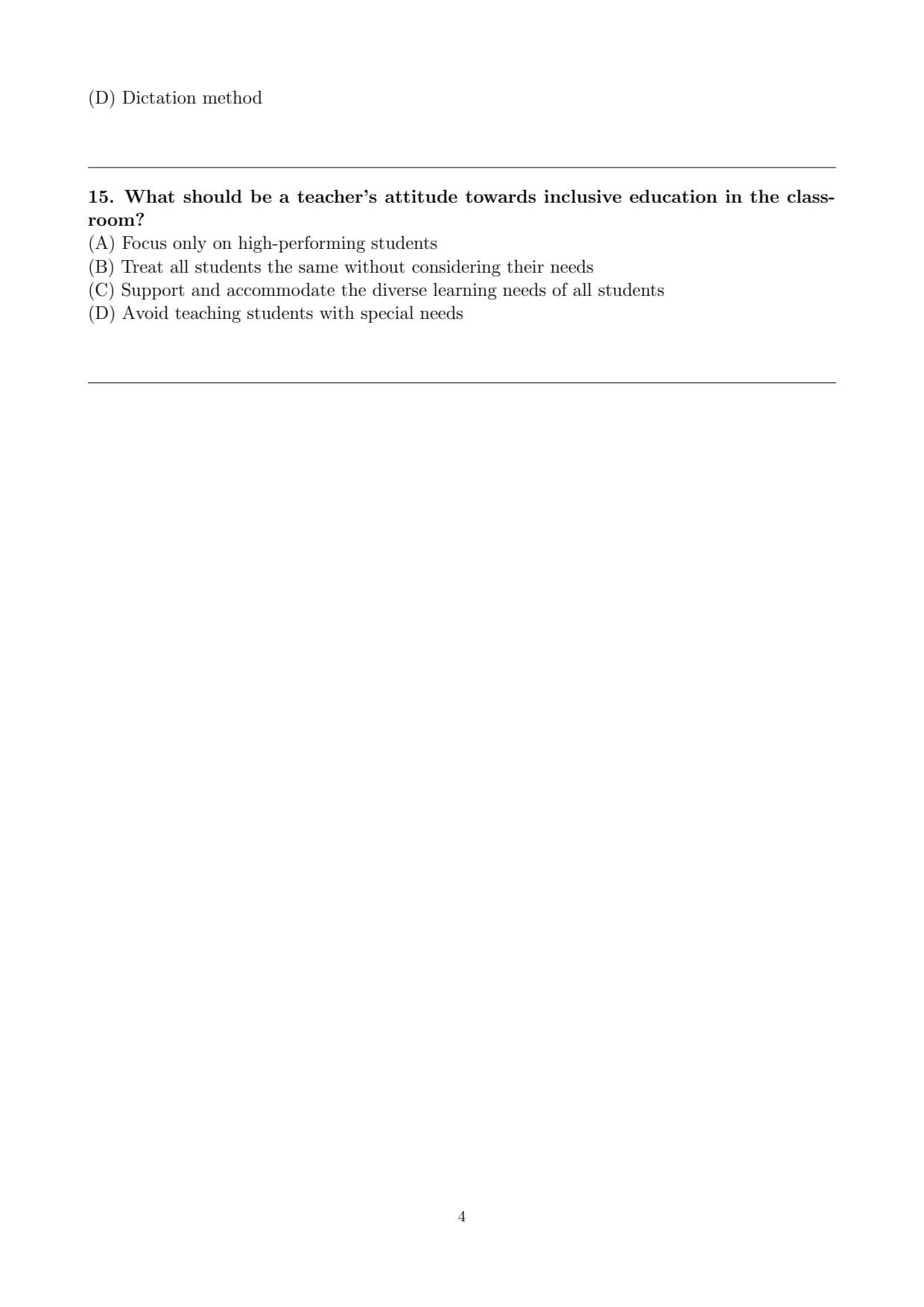
Which method of teaching is most effective for primary school children?
View Solution
Concept:
Primary school children learn best when they actively participate in the learning process. Teaching methods that involve hands-on activities, interaction, and exploration help improve understanding and retention.
Step 1: Understand the learning characteristics of primary students.
Children at the primary level are naturally curious and learn effectively through play, activities, and direct experiences rather than passive listening.
Step 2: Evaluate the given options.
Lecture method is mostly teacher-centered and less engaging for young learners.
Rote memorization focuses on memorizing facts without understanding.
Activity-based learning involves participation, experiments, games, and practical tasks.
Dictation method mainly focuses on writing practice and is not interactive.
Step 3: Identify the most effective method.
Among the options, activity-based learning is the most suitable method because it encourages participation, creativity, and better understanding among primary school children.
\[ \boxed{Activity-based learning} \] Quick Tip: Activity-based learning includes games, experiments, storytelling, role play, and group activities, which help young learners understand concepts more effectively.
What should be a teacher's attitude towards inclusive education in the classroom?
View Solution
Concept:
Inclusive education aims to ensure that all students, including those with different abilities, backgrounds, and learning needs, learn together in the same classroom. It promotes equality, participation, and respect for diversity in the educational environment.
Step 1: Understand the meaning of inclusive education.
Inclusive education emphasizes providing equal learning opportunities for all students, including those with disabilities, learning difficulties, or different social backgrounds.
Step 2: Analyze the role of the teacher.
A teacher should create a supportive and flexible learning environment by adapting teaching methods, providing necessary assistance, and encouraging participation from every student.
Step 3: Evaluate the given options.
Focusing only on high-performing students ignores the needs of others.
Treating all students exactly the same may overlook individual learning differences.
Supporting and accommodating diverse learning needs ensures that every student can participate and learn effectively.
Avoiding students with special needs contradicts the principle of inclusive education.
Therefore, the correct approach is:
\[ \boxed{Support and accommodate the diverse learning needs of all students} \] Quick Tip: Inclusive education encourages teachers to adapt teaching strategies, learning materials, and classroom practices so that students with diverse abilities can learn together effectively.
MAH B.ED CET 2026 Paper Pattern & Marking Scheme
MAH B.Ed CET 2026 Difficulty Analysis: March 2026 Session (Expected)
Based on candidate feedback from the exams held between March 27 and March 29, 2026, the overall paper was rated as Easy to Moderate.
| Section | Difficulty Level | Analysis |
| Mental Ability | Moderate to Difficult | This was the most time-consuming section. Questions on puzzles and series required quick thinking. |
| General Knowledge | Moderate | Focus was heavily on current events from the last 6 months and Maharashtra-specific history. |
| Teaching Aptitude | Easy to Moderate | Most questions were situation-based and could be solved with basic logic and a positive teaching mindset. |
| Overall Paper | Moderate | A score of 75+ is considered a good attempt for top-tier colleges. |



Comments