




The NCHMCT JEE 2026 exam was conducted on 25 April 2026, in a single shift from 11:00 AM to 1:00 PM by NTA.
The NCHMCT JEE 2026 followed the revised exam pattern of 120 questions in 120 minutes.
As per the paper analysis and student reactions, the NCHM JEE 2026 exam was easy to moderate in difficulty. Here is the complete breakdown of subject-wise paper analysis.
- English Language: Easy, focused on Reading Comprehension (Direct), Vocabulary, Synonyms/Antonyms.
- General Knowledge & Current Affairs: Moderate to difficult, Heavy on Current Affairs (Sports, Awards, Science). Static GK was minimal.
- Numerical Ability: Moderate to difficult, had Lengthy calculations. Focus on Profit & Loss, Averages, and Percentages.
- Reasoning & Logical Deduction: Moderate, Focused on Puzzles, Coding-Decoding, and Blood Relations. Some questions were time-consuming.
- Aptitude for the Service Sector: Easy, Situational judgment, and common-sense hospitality scenarios were asked.
Related Links:
- NCHMCT JEE 2026 Question Paper, Download Answer Key with Solution PDF
- NCHMCT JEE Cut off 2026: Check Expected Cut-off, Opening & Closing Ranks, Previous Years Cut off & Reservation Criteria
- Top Colleges in India Accepting NCHMCT JEE
NCHMCT JEE Overall Exam Analysis 2026
The previous year's analysis shows moderate difficulty with math being the toughest and aptitude easiest. Papers are usually balanced with no out-of-syllabus questions.
| Section | No. of Questions | Difficulty Level | Key Topics & Feedback | Good Attempts |
| English Language | 45 | Easy | Reading Comprehension (Direct), Vocabulary, Synonyms/Antonyms. High scoring. | 38 - 42 |
| Aptitude for Service Sector | 30 | Easy | Situational judgment, common-sense hospitality scenarios. No partial marking this year. | 26 - 28 |
| Numerical Ability | 15 | Moderate to Difficult | Lengthy calculations. Focus on Profit & Loss, Averages, and Percentages. | 10 - 12 |
| Reasoning & Logical Deduction | 15 | Moderate | Puzzles, Coding-Decoding, and Blood Relations. Some questions were time-consuming. | 11 - 13 |
| GK & Current Affairs | 15 | Moderate to Difficult | Heavy on Current Affairs (Sports, Awards, Science). Static GK was minimal. | 9 - 11 |
| OVERALL | 120 | Easy to Moderate | Balanced paper but required quick decision-making due to the new 2-hour format. | 95 - 105 |
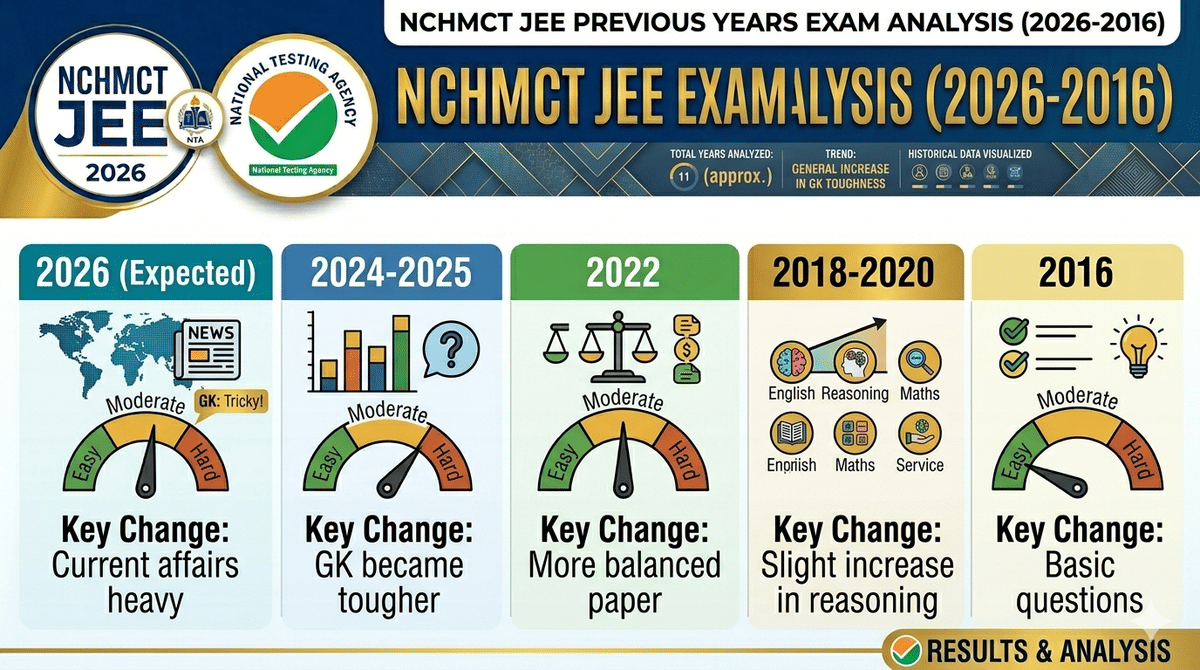
NCHMCT Difficulty Analysis (2026-2016)
The NCHMCT JEE paper has evolved from easy (2016) to consistently moderate in recent years, with a clear shift in focus.
Earlier exams were more direct, but from 2018 onwards, reasoning and analytical questions increased.
Since 2024, GK has become tougher, and the 2026 exam was moderate with current affairs playing a key role, making awareness a major scoring factor.
| Year | Overall Difficulty | Key Change |
|---|---|---|
| 2026 | Moderate (with tricky GK) | Current affairs heavy |
| 2024–2025 | Moderate | GK became tougher |
| 2022 | Moderate | More balanced paper |
| 2018–2020 | Easy–Moderate | Slight increase in reasoning |
| 2016 | Easy | Basic questions |
Sectional NCHMCT JEE 2026 Exam Analysis
The difficulty analysis of NCHMCT JEE 2026 suggests a moderate overall paper, but with clear sectional variation.
- Numerical Ability and Reasoning was time-consuming, with around 50–60% moderate and lengthy questions, meaning speed will play a crucial role.
- GK & Current Affairs was the toughest section, with nearly 30% difficult questions and only 50–60% safe attempts, making it the key rank differentiator.
- In contrast, English and Service Aptitude remain highly scoring, with 60–70% easy questions and expected attempts as serious as 85–90%.
Numerical Ability & Analytical Aptitude
| Parameter | Analysis |
|---|---|
| Difficulty | Moderate |
| Nature of Questions | Calculation-heavy, formula-based |
| Key Topics | Percentage, Ratio, Profit & Loss, SI/CI, Time & Work |
| Concept Level | Easy to Moderate |
| Time Consumption | High (most time-consuming section) |
| Easy Questions (%) | 40–50% |
| Moderate Questions (%) | 50–60% |
| Common Challenge | Lengthy calculations |
| Attempt Strategy | Attempt easy first, skip lengthy ones initially |
| Expected Attempts (Good) | 70–80% of section |
| Key Insight | Speed > Concept depth |
Reasoning & Logical Deduction
| Parameter | Analysis |
|---|---|
| Difficulty | Moderate to Slightly Difficult |
| Nature of Questions | Logical, puzzle-based |
| Key Topics | Coding-Decoding, Series, Syllogism, Puzzles, Direction |
| Concept Level | Moderate |
| Time Consumption | High |
| Easy Questions (%) | ~40% |
| Moderate Questions (%) | ~40% |
| Difficult Questions (%) | ~20% |
| Common Challenge | Puzzles and lengthy arrangements |
| Attempt Strategy | Solve direct questions first, leave puzzles for later |
| Expected Attempts (Good) | 65–75% |
| Key Insight | Accuracy matters more than attempts |
General Knowledge & Current Affairs
| Parameter | Analysis |
|---|---|
| Difficulty | Difficult |
| Nature of Questions | Fact-based, unpredictable |
| Coverage | Current Affairs (last 6–8 months), Static GK |
| Weightage Trend | Current Affairs ↑, Static GK ↓ |
| Easy Questions (%) | ~30% |
| Moderate Questions (%) | ~40% |
| Difficult Questions (%) | ~30% |
| Time Consumption | Low |
| Common Challenge | Unknown questions, guesswork risk |
| Attempt Strategy | Attempt only known answers |
| Expected Attempts (Good) | 50–60% |
| Key Insight | Rank-deciding section |
English Language
| Parameter | Analysis |
|---|---|
| Difficulty | Easy to Moderate |
| Nature of Questions | Direct, comprehension-based |
| Key Topics | Vocabulary, Grammar, RC, Synonyms/Antonyms |
| Concept Level | Easy |
| Time Consumption | Low |
| Easy Questions (%) | 60–70% |
| Moderate Questions (%) | 30–40% |
| Common Challenge | Vocabulary gaps |
| Attempt Strategy | Attempt maximum with high accuracy |
| Expected Attempts (Good) | 85–90% |
| Key Insight | Highest scoring section |
Aptitude for Service Sector
| Parameter | Analysis |
| Difficulty | Easy |
| Nature of Questions | Situational, behavioral |
| Focus Area | Customer service, decision-making |
| Concept Level | Easy (practical thinking) |
| Time Consumption | Moderate |
| Easy Questions (%) | ~70% |
| Confusing Questions (%) | ~30% |
| Common Challenge | Multiple correct-looking options |
| Attempt Strategy | Choose most professional/ethical answer |
| Expected Attempts (Good) | 80–90% |
| Key Insight | Tests personality, not knowledge |



Comments