




Assam CEE 2026 Question Paper with Solution Pdf is available here for download. ASTU has conducted Assam CEE Exam on June 14, 2026 from 11:00 AM to 2:00 PM in offline mode.
The Question Paper Consists 120 MCQs from three sections: Physics,Chemistry and Mathematics,40 Questions from Each section.As Per Marking Scheme +4 Marks was given for every correct answer and -1 Marks were deducted for each incorrect answer.
Candidates can download the Assam CEE 2026 Question Paper with Answer Key and Solution PDF from the links provided below.
Assam CEE 2026 Question Paper
| Assam CEE 2026 Question Paper | Download PDF | Check Solution |
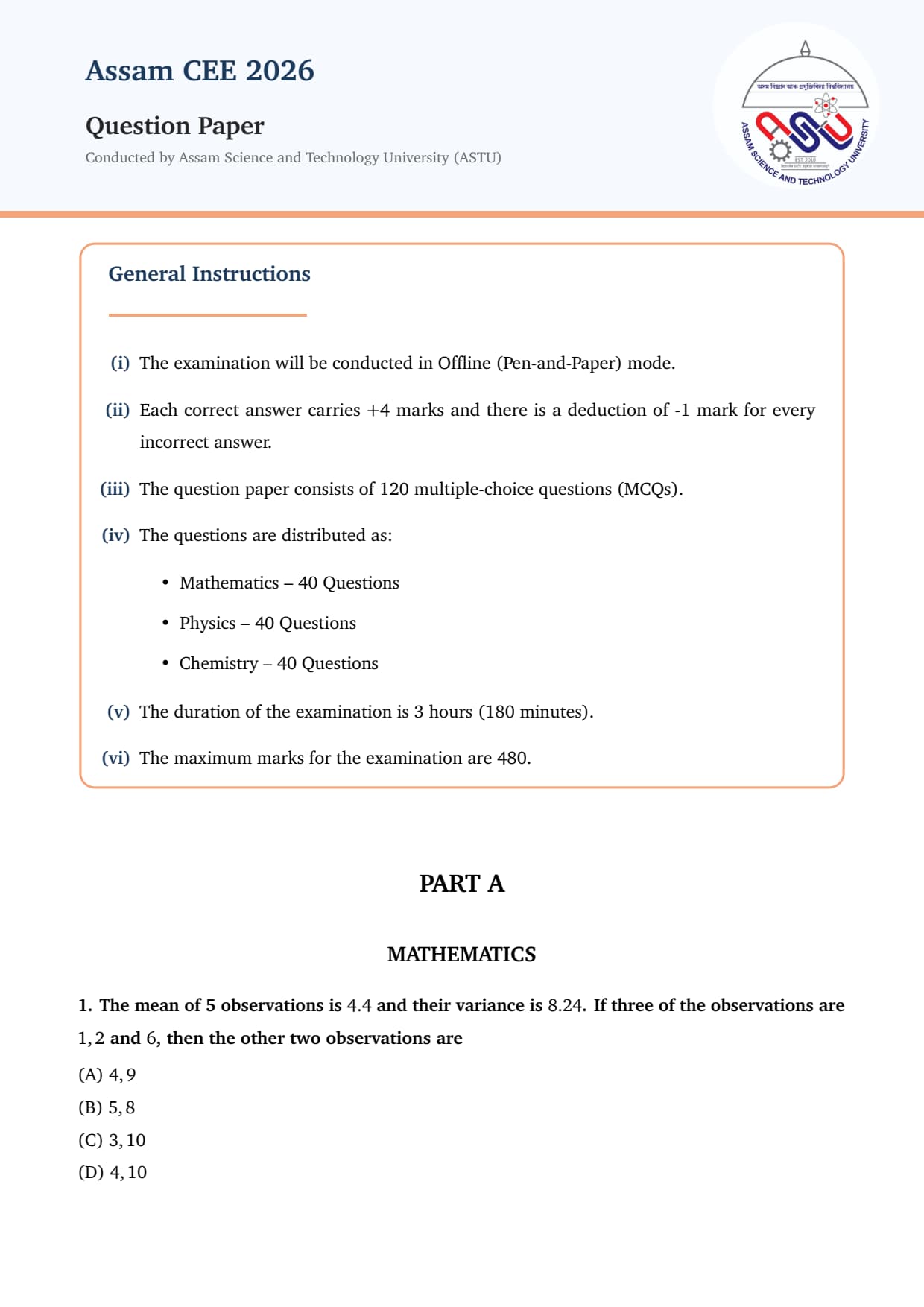
The mean of 5 observations is 4.4 and their variance is 8.24. If three of the observations are 1, 2 and 6, then the other two observations are
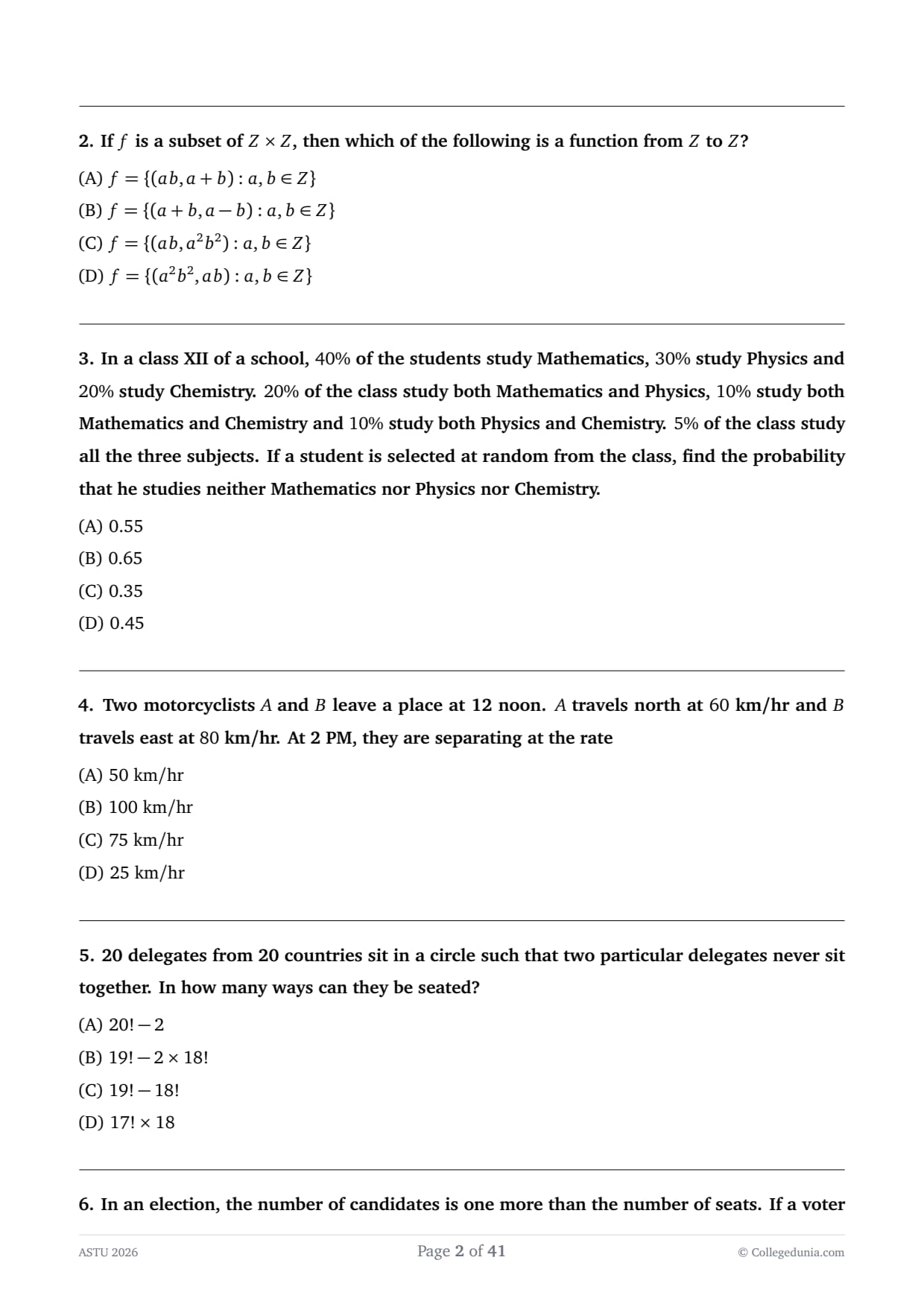
If f is a subset of Z\times Z, then which of the following is a function from Z to Z?
In a class XII of a school, 40% of the students study Mathematics, 30% study Physics and 20% study Chemistry. 20% of the class study both Mathematics and Physics, 10% study both Mathematics and Chemistry and 10% study both Physics and Chemistry. 5% of the class study all the three subjects. If a student is selected at random from the class, find the probability that he studies neither Mathematics nor Physics nor Chemistry.
Two motorcyclists A and B leave a place at 12 noon. A travels north at 60 km/hr and B travels east at 80 km/hr. At 2 PM, they are separating at the rate
20 delegates from 20 countries sit in a circle such that two particular delegates never sit together. In how many ways can they be seated?
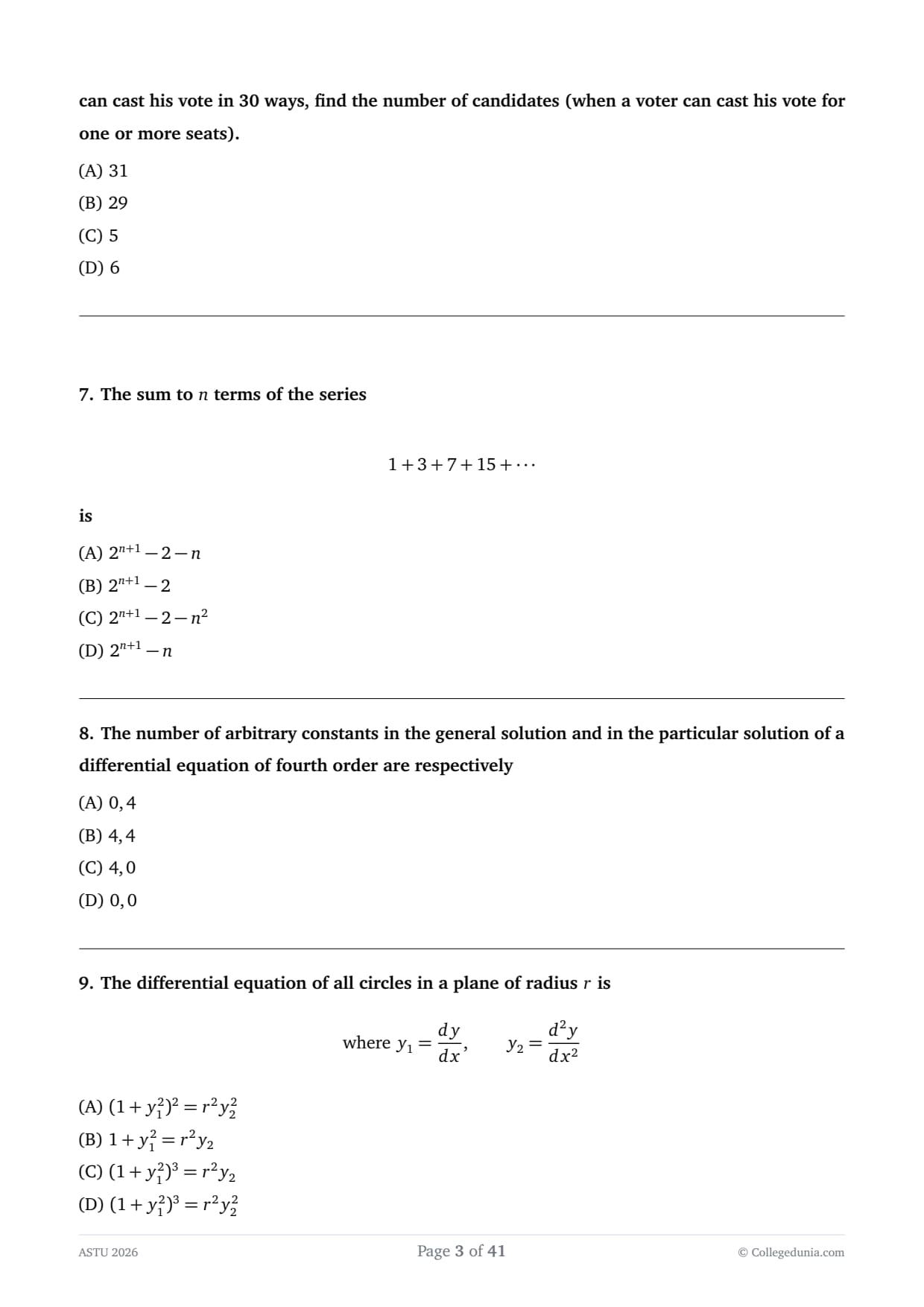
In an election, the number of candidates is one more than the number of seats. If a voter can cast his vote in 30 ways, find the number of candidates (when a voter can cast his vote for one or more seats).
The sum to n terms of the series
\[ 1+3+7+15+\cdots \]
is
The number of arbitrary constants in the general solution and in the particular solution of a differential equation of fourth order are respectively
The differential equation of all circles in a plane of radius r is \[ where y_1=\frac{dy}{dx}, \qquad y_2=\frac{d^2y}{dx^2} \]
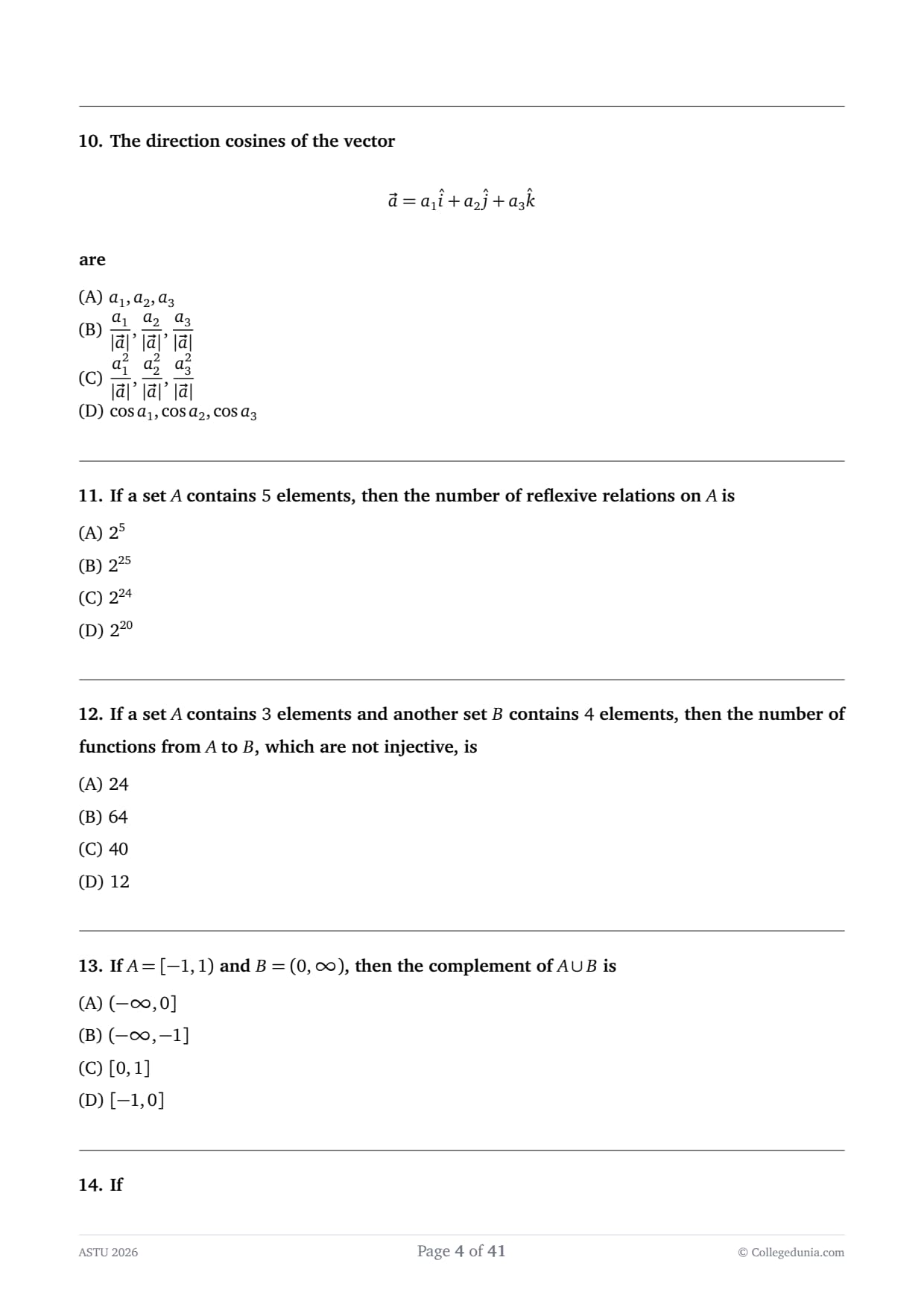
The direction cosines of the vector \[ \vec a=a_1\hat i+a_2\hat j+a_3\hat k \]
are
If a set A contains 5 elements, then the number of reflexive relations on A is
If a set A contains 3 elements and another set B contains 4 elements, then the number of functions from A to B, which are not injective, is
If A=[-1,1) and B=(0,\infty), then the complement of A\cup B is
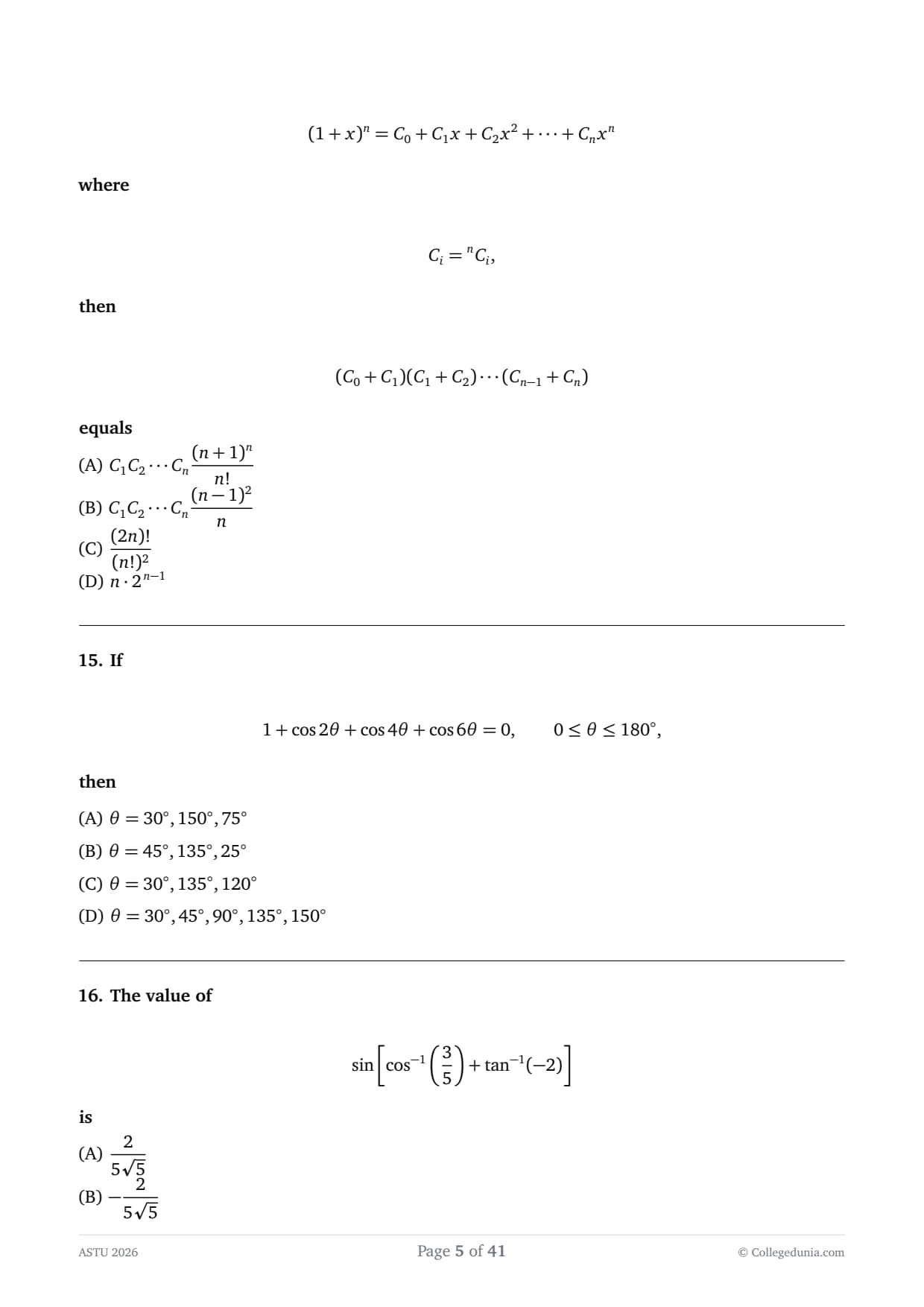
If
\[ (1+x)^n=C_0+C_1x+C_2x^2+\cdots+C_nx^n \]
where
\[ C_i={}^{n}C_i, \]
then
\[ (C_0+C_1)(C_1+C_2)\cdots(C_{n-1}+C_n) \]
equals
If
\[ 1+\cos2\theta+\cos4\theta+\cos6\theta=0, \qquad 0\le\theta\le180^\circ, \]
then
The value of
\[ \sin\left[\cos^{-1}\left(\frac{3}{5}\right)+\tan^{-1}(-2)\right] \]
is
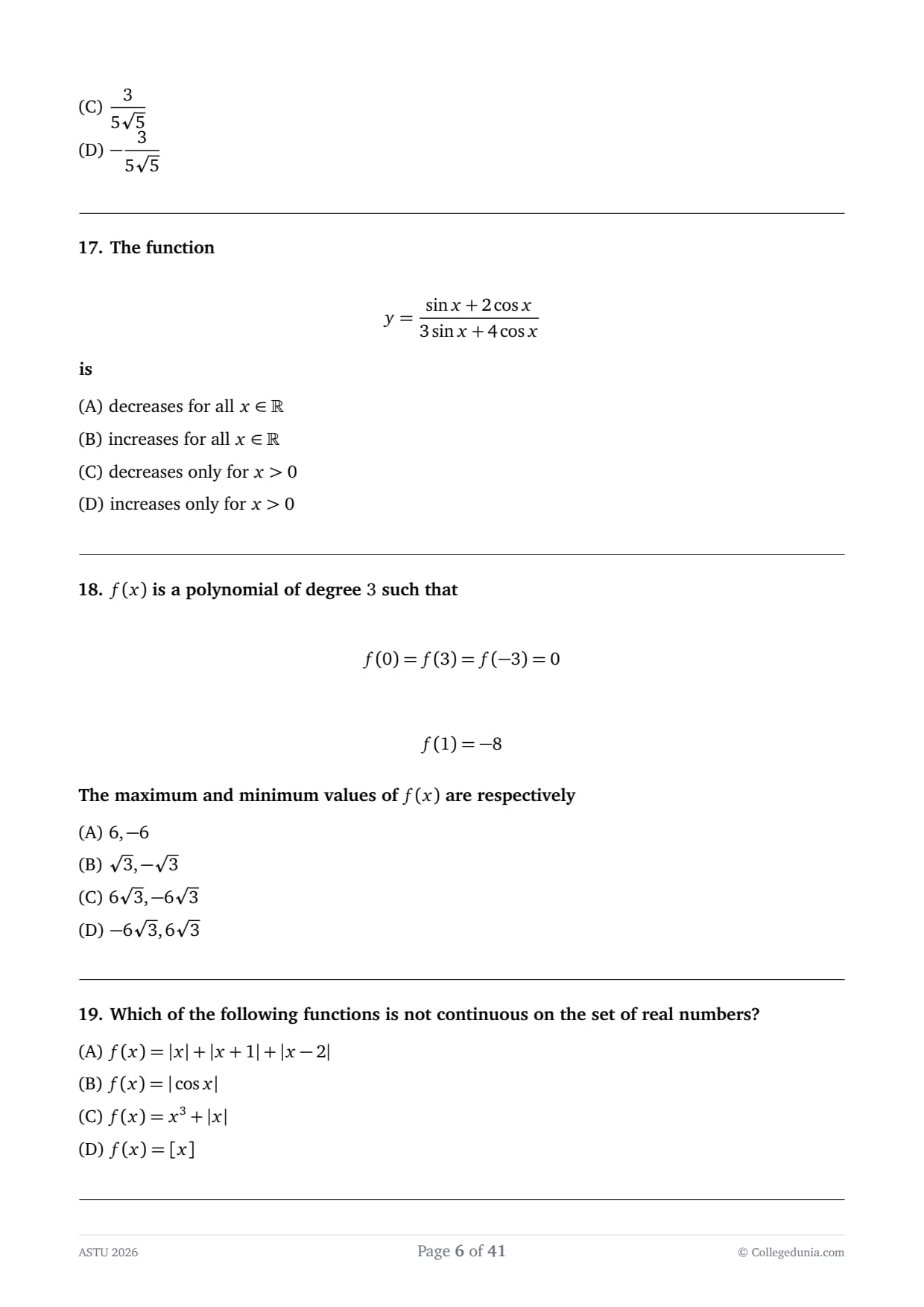
The function
\[ y=\frac{\sin x+2\cos x}{3\sin x+4\cos x} \]
is
f(x) is a polynomial of degree 3 such that
\[ f(0)=f(3)=f(-3)=0 \]
\[ f(1)=-8 \]
The maximum and minimum values of f(x) are respectively
Which of the following functions is not continuous on the set of real numbers?
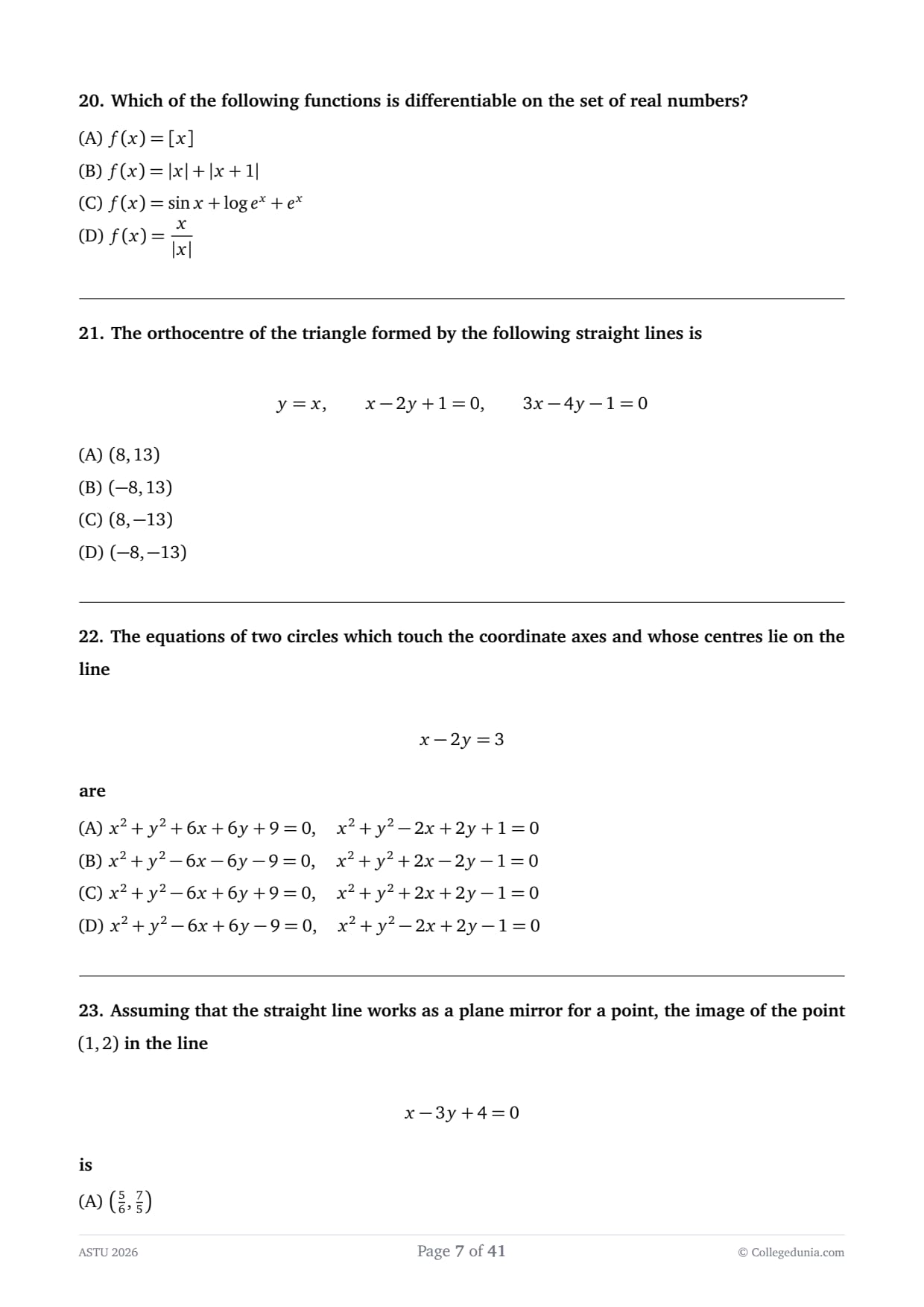
Which of the following functions is differentiable on the set of real numbers?
The orthocentre of the triangle formed by the following straight lines is
\[ y=x,\qquad x-2y+1=0,\qquad 3x-4y-1=0 \]
The equations of two circles which touch the coordinate axes and whose centres lie on the line
\[ x-2y=3 \]
are
Assuming that the straight line works as a plane mirror for a point, the image of the point (1,2) in the line
\[ x-3y+4=0 \]
is
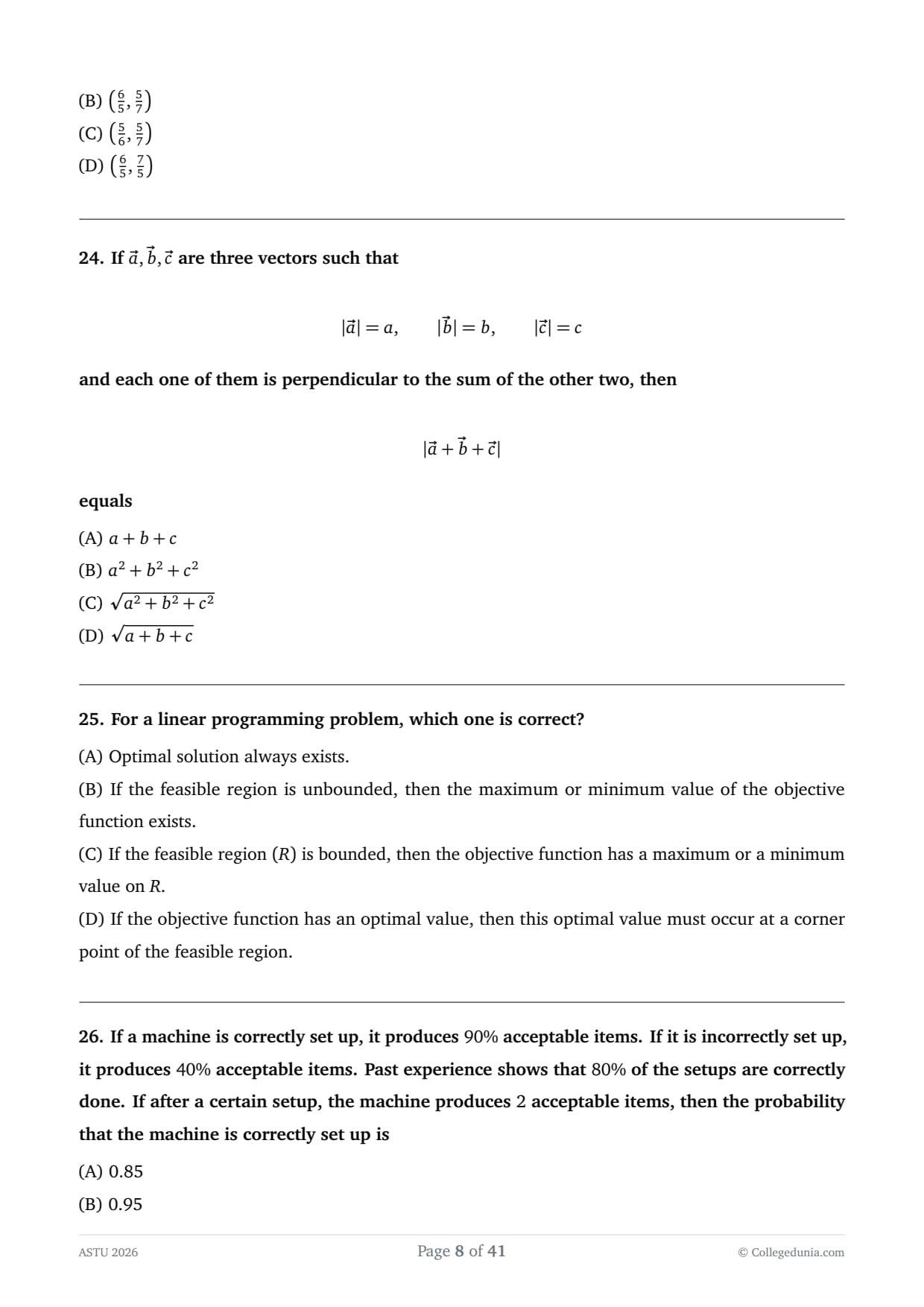
If \vec a,\vec b,\vec c are three vectors such that
\[ |\vec a|=a,\qquad |\vec b|=b,\qquad |\vec c|=c \]
and each one of them is perpendicular to the sum of the other two, then
\[ |\vec a+\vec b+\vec c| \]
equals
For a linear programming problem, which one is correct?
If a machine is correctly set up, it produces 90% acceptable items. If it is incorrectly set up, it produces 40% acceptable items. Past experience shows that 80% of the setups are correctly done. If after a certain setup, the machine produces 2 acceptable items, then the probability that the machine is correctly set up is
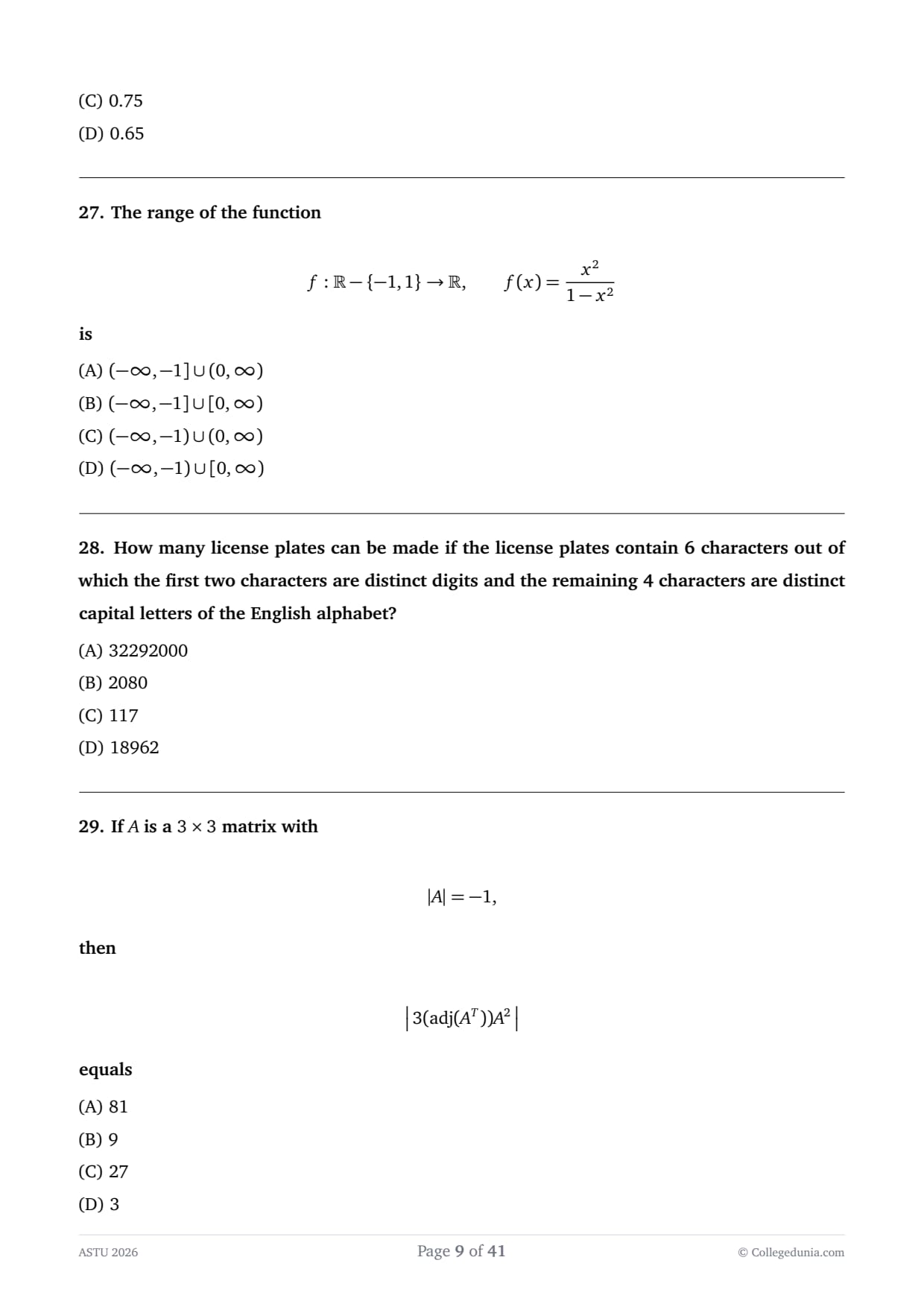
The range of the function
\[ f:\mathbb{R}-\{-1,1\}\to\mathbb{R}, \qquad f(x)=\frac{x^2}{1-x^2} \]
is
How many license plates can be made if the license plates contain 6 characters out of which the first two characters are distinct digits and the remaining 4 characters are distinct capital letters of the English alphabet?
If A is a 3\times3 matrix with
\[ |A|=-1, \]
then
\[ \left|\,3(\operatorname{adj}(A^T))A^2\,\right| \]
equals
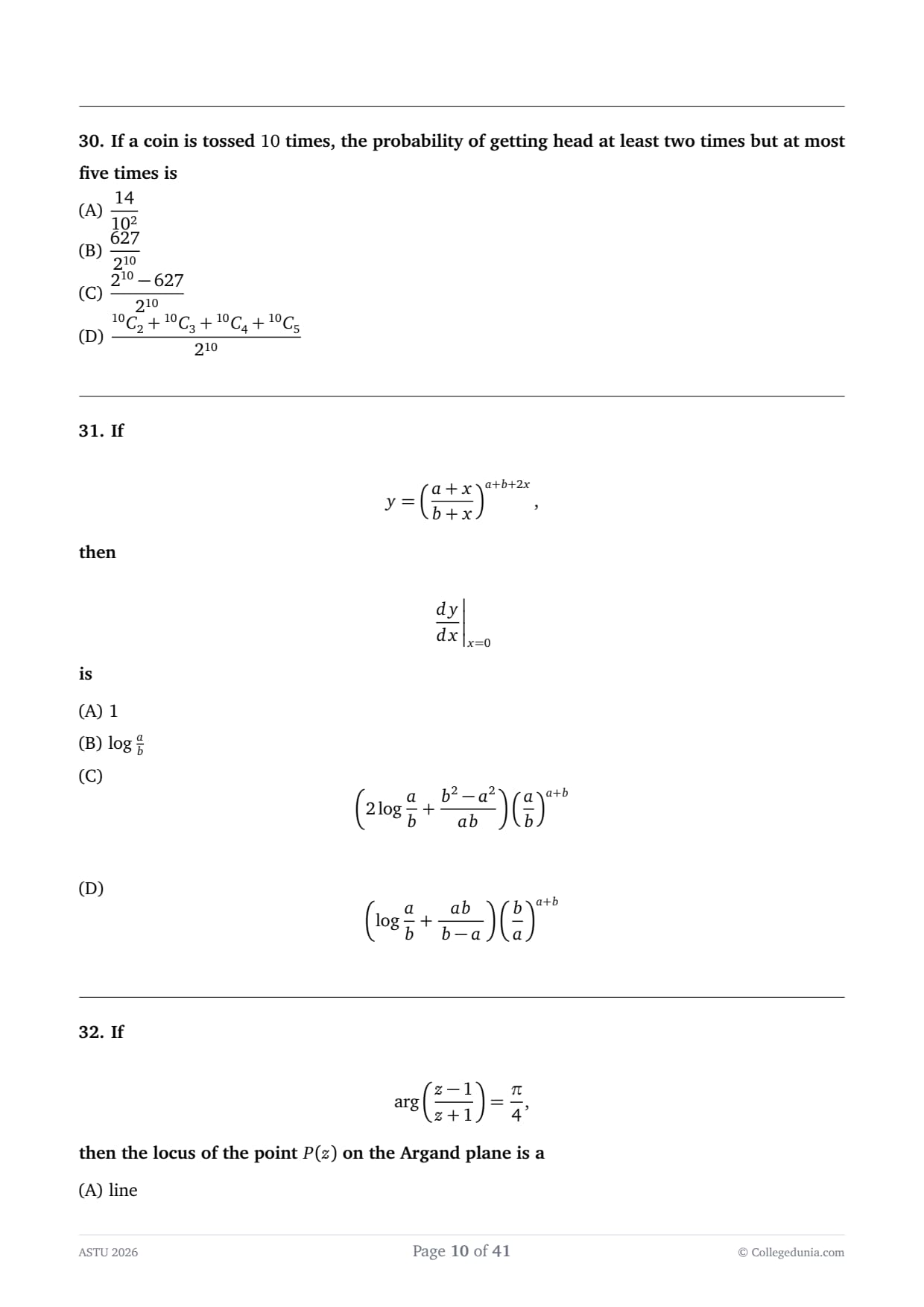
If a coin is tossed 10 times, the probability of getting head at least two times but at most five times is
If
\[ y=\left(\frac{a+x}{b+x}\right)^{a+b+2x}, \]
then
\[ \left.\frac{dy}{dx}\right|_{x=0} \]
is
If
\[ \arg\left(\frac{z-1}{z+1}\right)=\frac{\pi}{4}, \]
then the locus of the point P(z) on the Argand plane is a
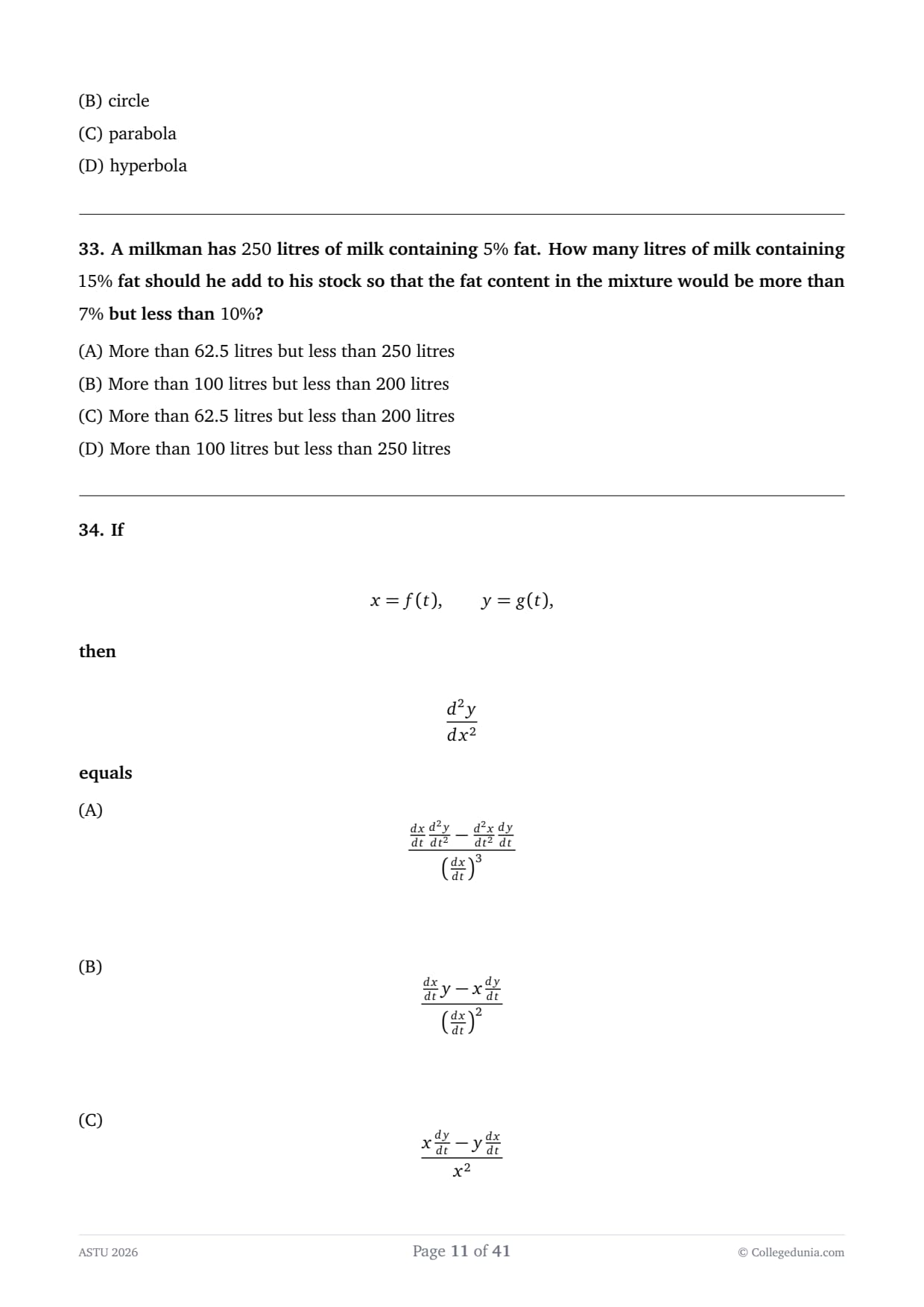
A milkman has 250 litres of milk containing 5% fat. How many litres of milk containing 15% fat should he add to his stock so that the fat content in the mixture would be more than 7% but less than 10%?
If
\[ x=f(t), \qquad y=g(t), \]
then
\[ \frac{d^2y}{dx^2} \]
equals
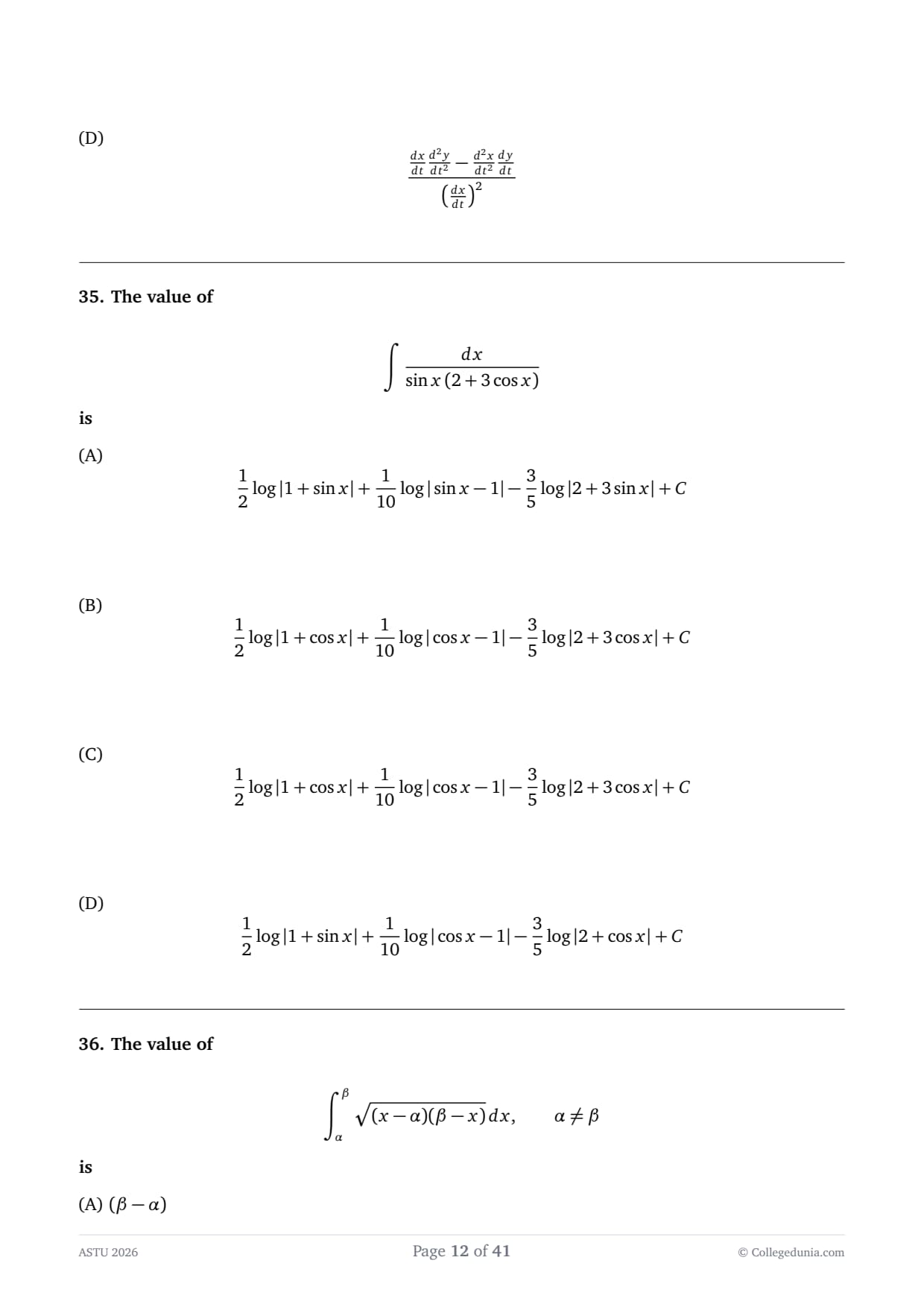
The value of
\[ \int \frac{dx}{\sin x\,(2+3\cos x)} \]
is
The value of
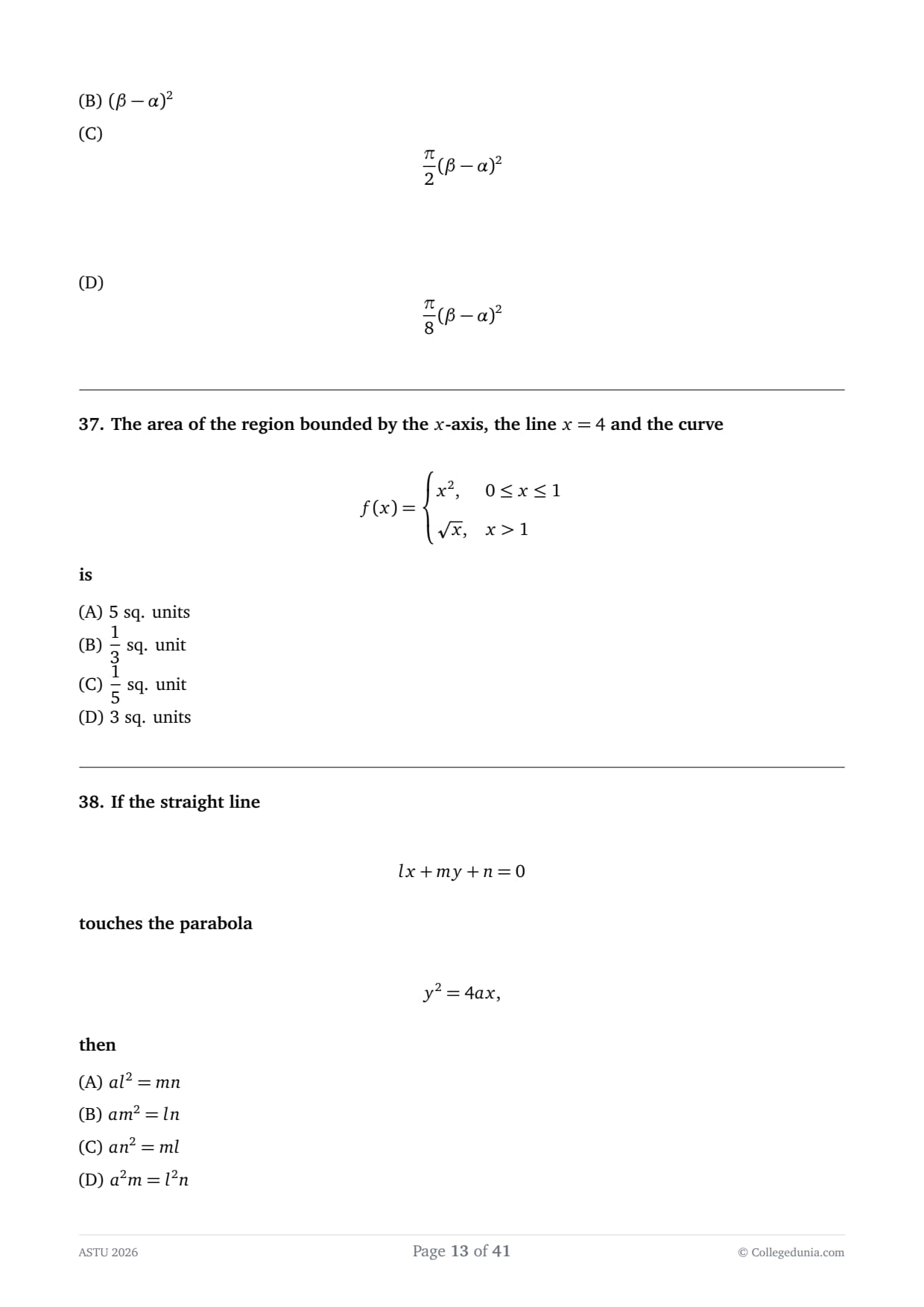
\[ \int_{\alpha}^{\beta} \sqrt{(x-\alpha)(\beta-x)}\,dx, \qquad \alpha\ne\beta \]
is
The area of the region bounded by the x-axis, the line x=4 and the curve
\[ f(x)= \begin{cases} x^2, & 0\le x\le 1
\sqrt{x}, & x>1 \end{cases} \]
is
If the straight line
\[ lx+my+n=0 \]
touches the parabola
\[ y^2=4ax, \]
then
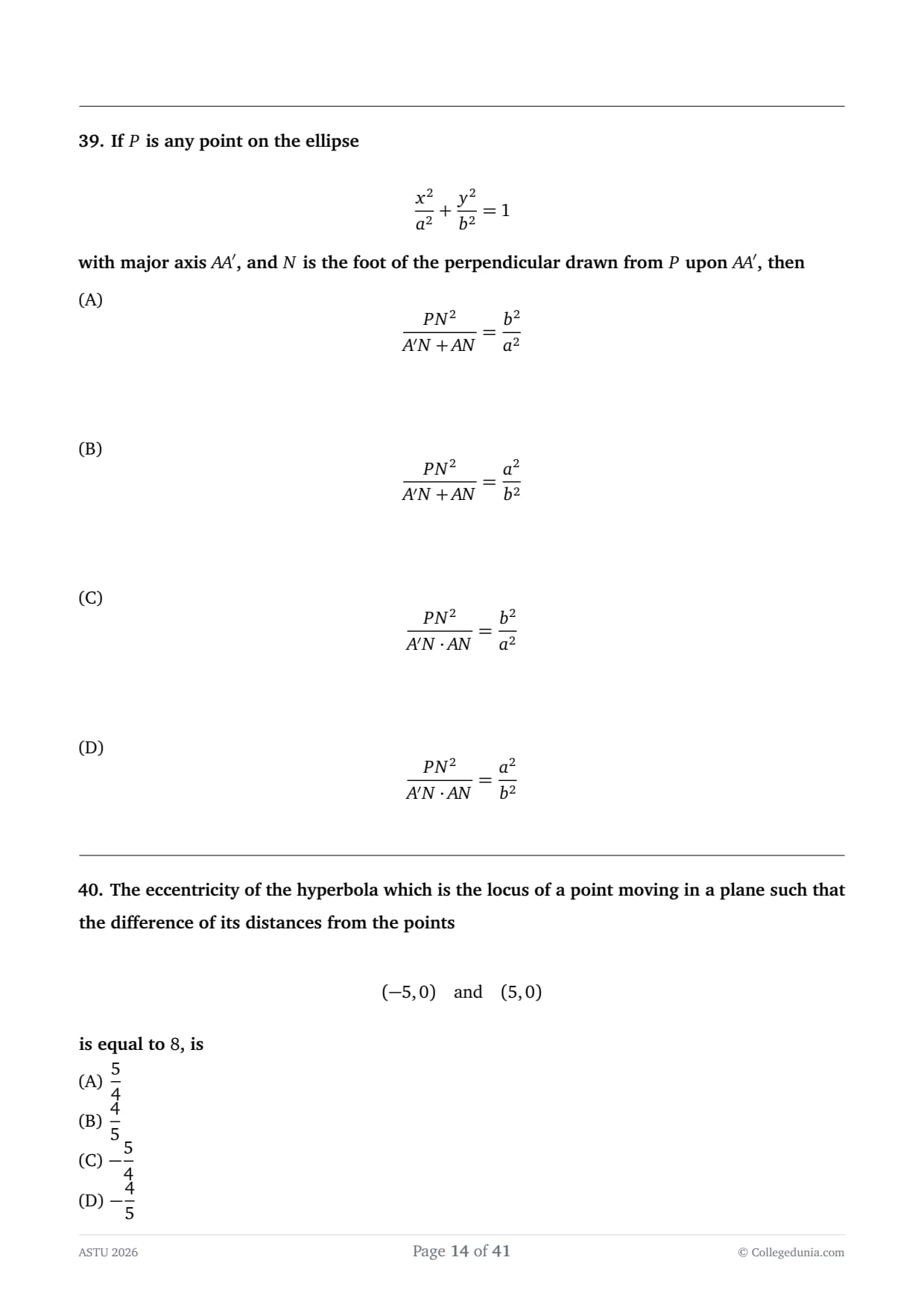
If P is any point on the ellipse
\[ \frac{x^2}{a^2}+\frac{y^2}{b^2}=1 \]
with major axis AA', and N is the foot of the perpendicular drawn from P upon AA', then
The eccentricity of the hyperbola which is the locus of a point moving in a plane such that the difference of its distances from the points
\[ (-5,0) \quadand\quad (5,0) \]
is equal to 8, is
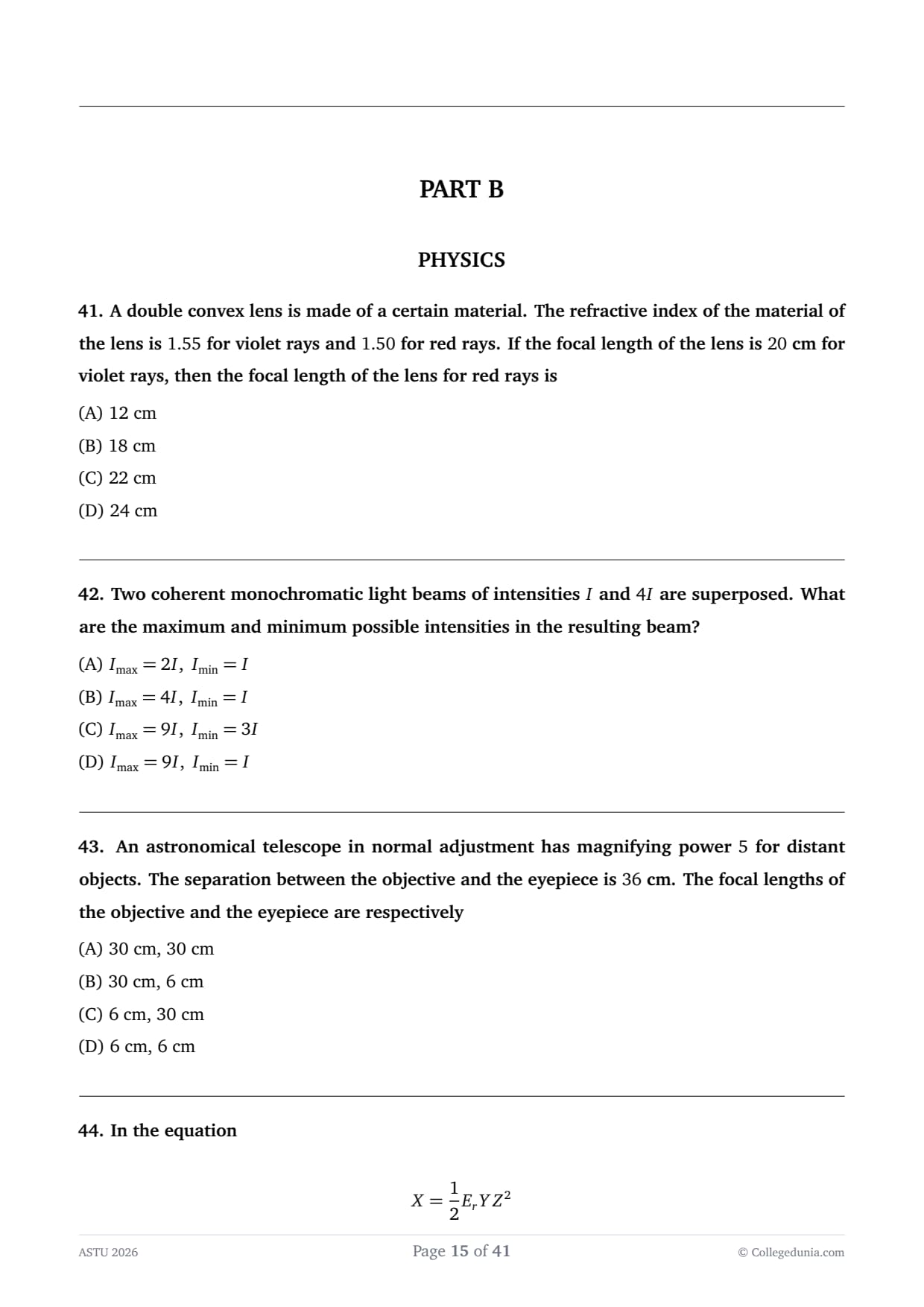
A double convex lens is made of a certain material. The refractive index of the material of the lens is 1.55 for violet rays and 1.50 for red rays. If the focal length of the lens is 20 cm for violet rays, then the focal length of the lens for red rays is
Two coherent monochromatic light beams of intensities I and 4I are superposed. What are the maximum and minimum possible intensities in the resulting beam?
An astronomical telescope in normal adjustment has magnifying power 5 for distant objects. The separation between the objective and the eyepiece is 36 cm. The focal lengths of the objective and the eyepiece are respectively
In the equation
\[ X=\frac12 E_rYZ^2 \]
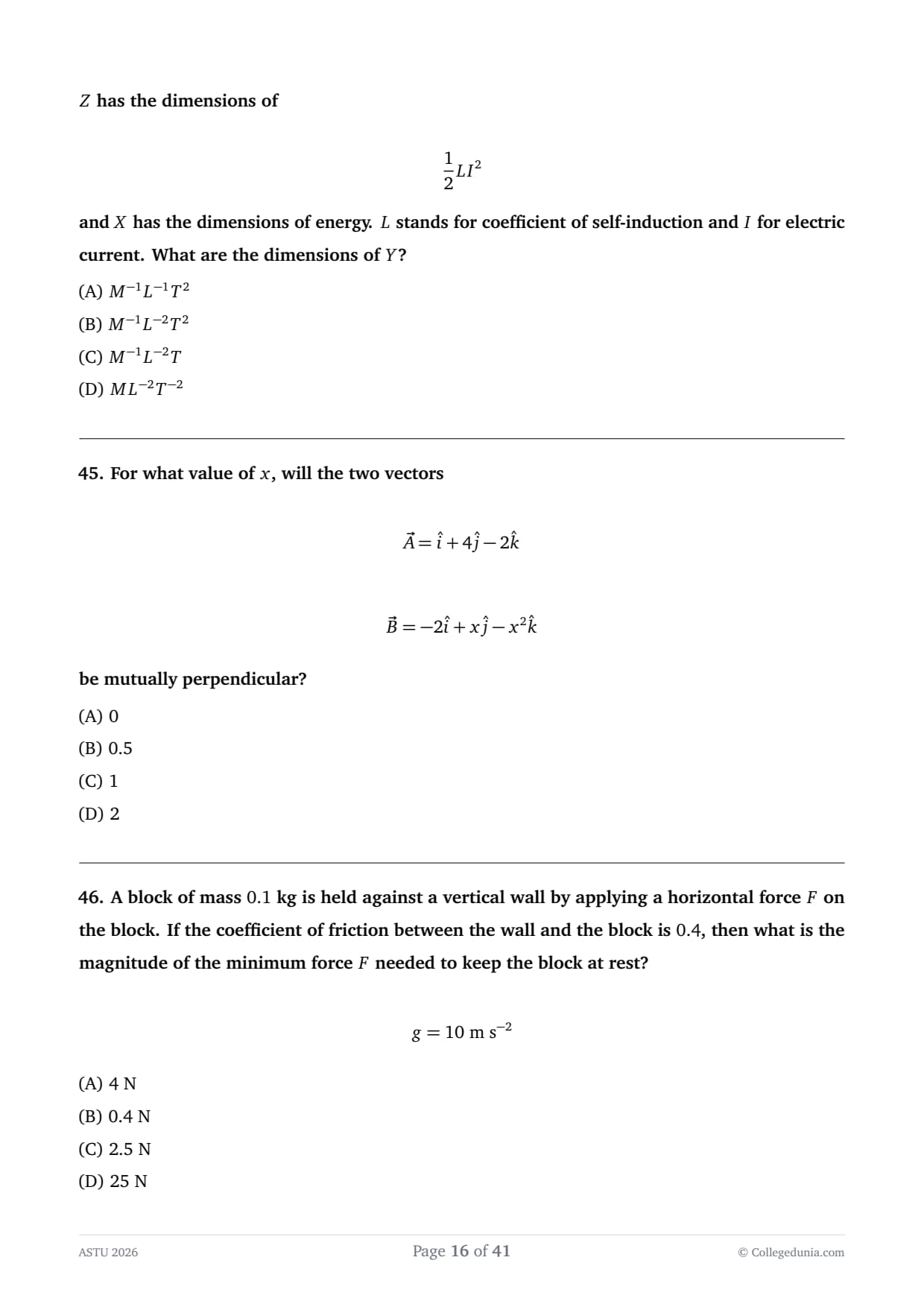
Z has the dimensions of
\[ \frac12 LI^2 \]
and X has the dimensions of energy. L stands for coefficient of self-induction and I for electric current. What are the dimensions of Y?
For what value of x, will the two vectors
\[ \vec A=\hat i+4\hat j-2\hat k \]
\[ \vec B=-2\hat i+x\hat j-x^2\hat k \]
be mutually perpendicular?
A block of mass 0.1 kg is held against a vertical wall by applying a horizontal force F on the block. If the coefficient of friction between the wall and the block is 0.4, then what is the magnitude of the minimum force F needed to keep the block at rest?
\[ g=10\ m s^{-2} \]
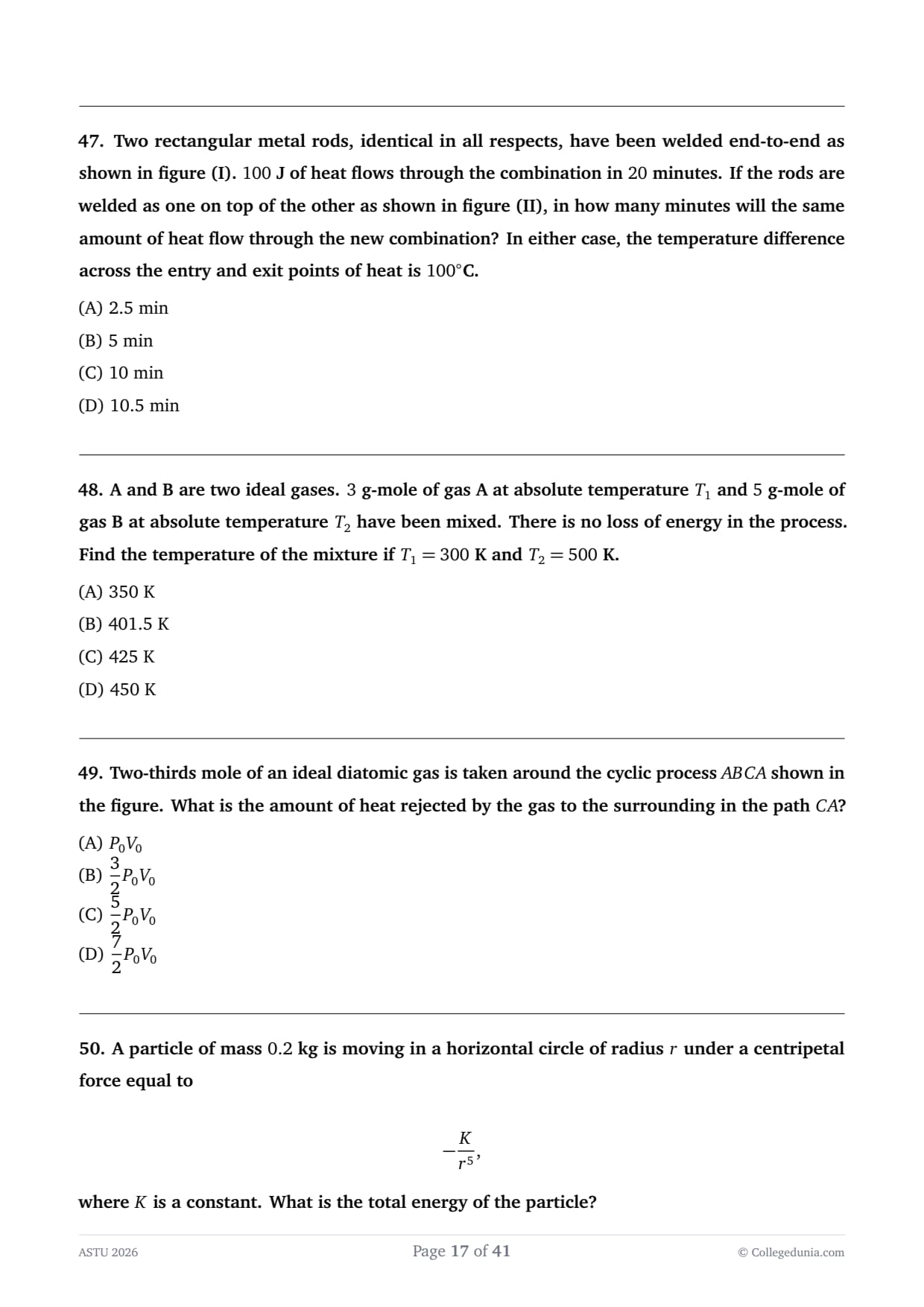
Two rectangular metal rods, identical in all respects, have been welded end-to-end as shown in figure (I). 100 J of heat flows through the combination in 20 minutes. If the rods are welded as one on top of the other as shown in figure (II), in how many minutes will the same amount of heat flow through the new combination? In either case, the temperature difference across the entry and exit points of heat is 100^\circC.
A and B are two ideal gases. 3 g-mole of gas A at absolute temperature T_1 and 5 g-mole of gas B at absolute temperature T_2 have been mixed. There is no loss of energy in the process. Find the temperature of the mixture if T_1=300 K and T_2=500 K.
Two-thirds mole of an ideal diatomic gas is taken around the cyclic process ABCA shown in the figure. What is the amount of heat rejected by the gas to the surrounding in the path CA?
A particle of mass 0.2 kg is moving in a horizontal circle of radius r under a centripetal force equal to
\[ -\frac{K}{r^5}, \]
where K is a constant. What is the total energy of the particle?
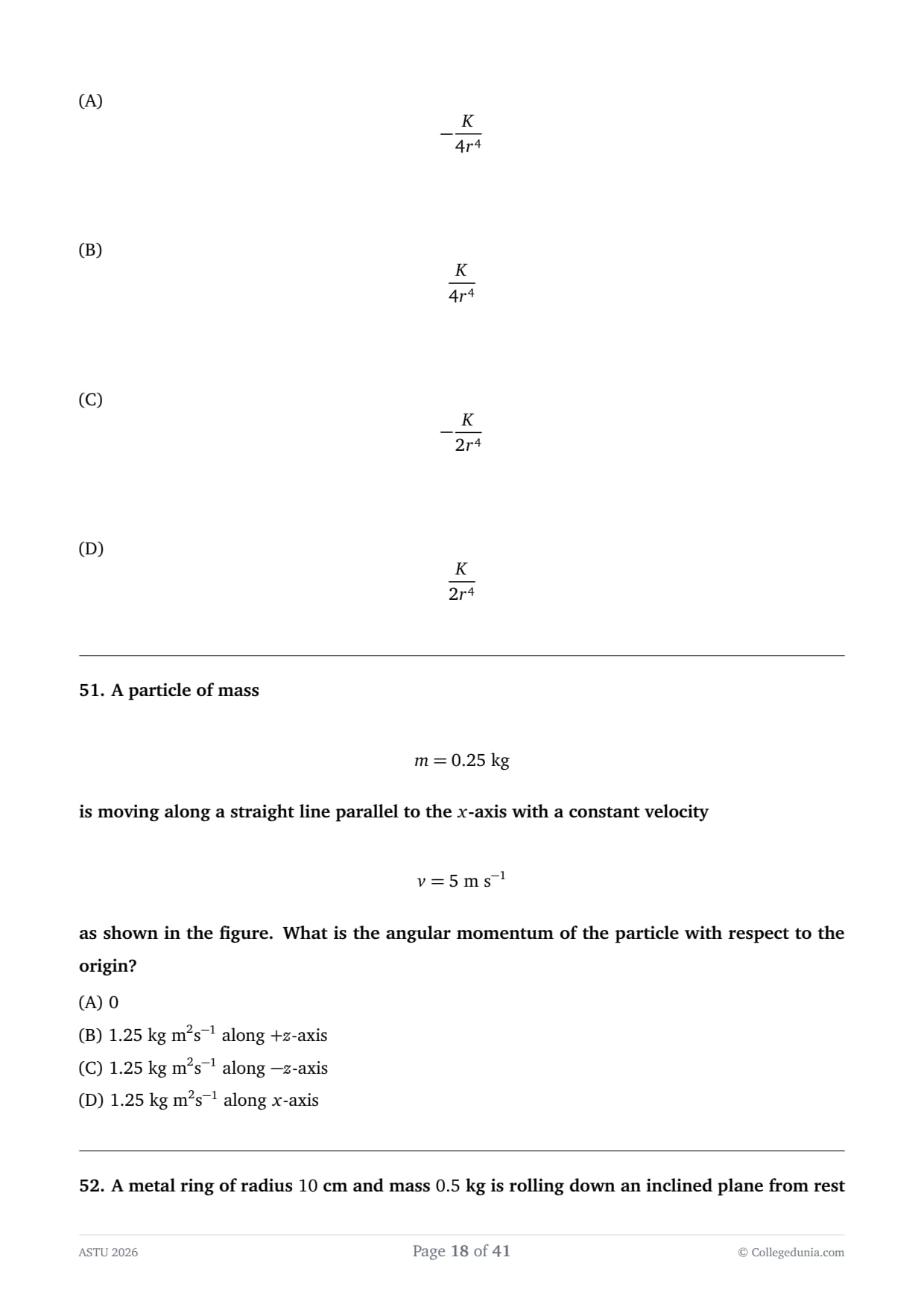
A particle of mass
\[ m=0.25\ kg \]
is moving along a straight line parallel to the x-axis with a constant velocity
\[ v=5\ m s^{-1} \]
as shown in the figure. What is the angular momentum of the particle with respect to the origin?
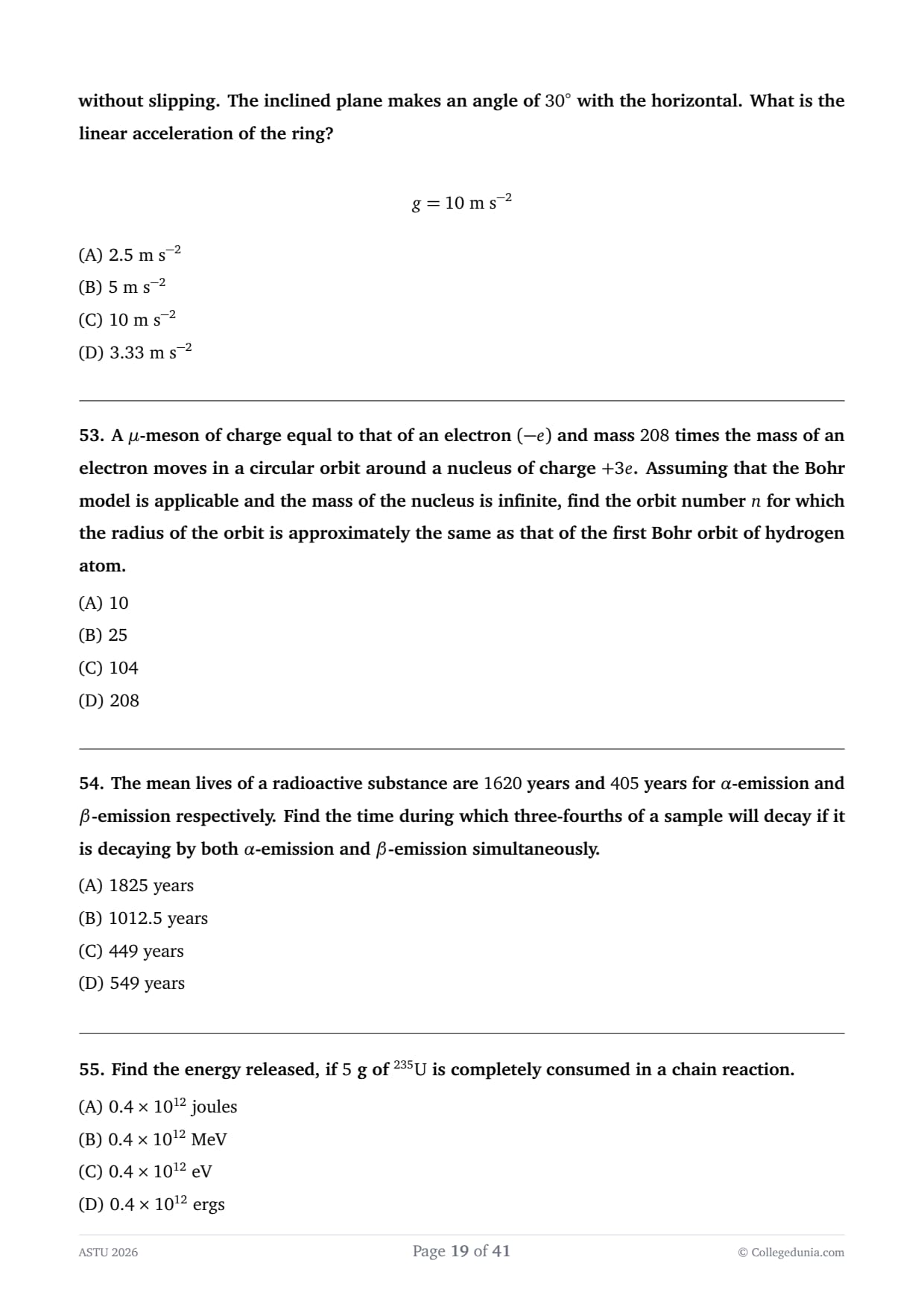
A metal ring of radius 10 cm and mass 0.5 kg is rolling down an inclined plane from rest without slipping. The inclined plane makes an angle of 30^\circ with the horizontal. What is the linear acceleration of the ring?
\[ g=10\ m s^{-2} \]
A \mu-meson of charge equal to that of an electron (-e) and mass 208 times the mass of an electron moves in a circular orbit around a nucleus of charge +3e. Assuming that the Bohr model is applicable and the mass of the nucleus is infinite, find the orbit number n for which the radius of the orbit is approximately the same as that of the first Bohr orbit of hydrogen atom.
The mean lives of a radioactive substance are 1620 years and 405 years for \alpha-emission and \beta-emission respectively. Find the time during which three-fourths of a sample will decay if it is decaying by both \alpha-emission and \beta-emission simultaneously.
Find the energy released, if 5 g of ^{235}\mathrm{U} is completely consumed in a chain reaction.
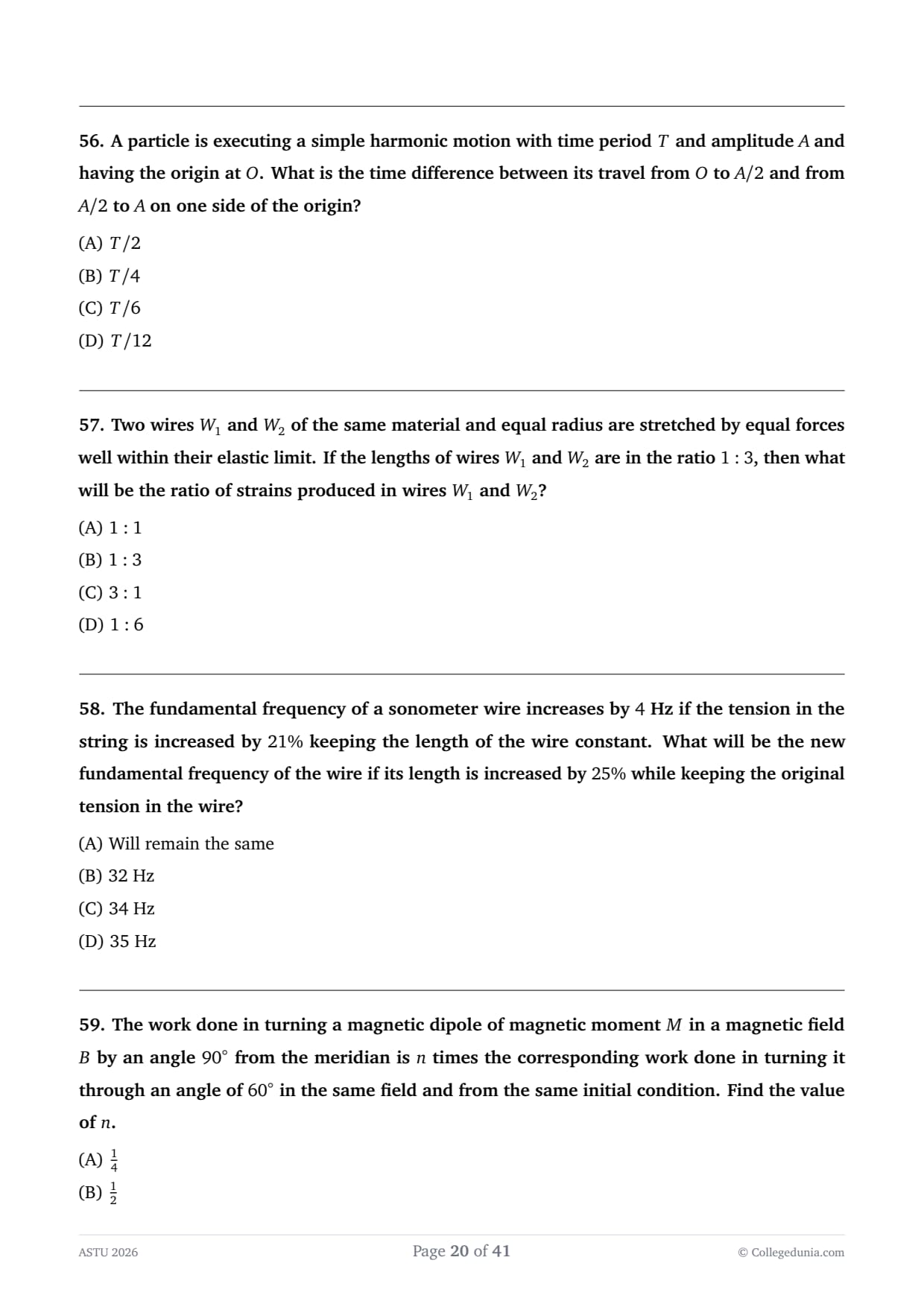
A particle is executing a simple harmonic motion with time period T and amplitude A and having the origin at O. What is the time difference between its travel from O to A/2 and from A/2 to A on one side of the origin?
Two wires W_1 and W_2 of the same material and equal radius are stretched by equal forces well within their elastic limit. If the lengths of wires W_1 and W_2 are in the ratio 1:3, then what will be the ratio of strains produced in wires W_1 and W_2?
The fundamental frequency of a sonometer wire increases by 4 Hz if the tension in the string is increased by 21% keeping the length of the wire constant. What will be the new fundamental frequency of the wire if its length is increased by 25% while keeping the original tension in the wire?
The work done in turning a magnetic dipole of magnetic moment M in a magnetic field B by an angle 90^\circ from the meridian is n times the corresponding work done in turning it through an angle of 60^\circ in the same field and from the same initial condition. Find the value of n.
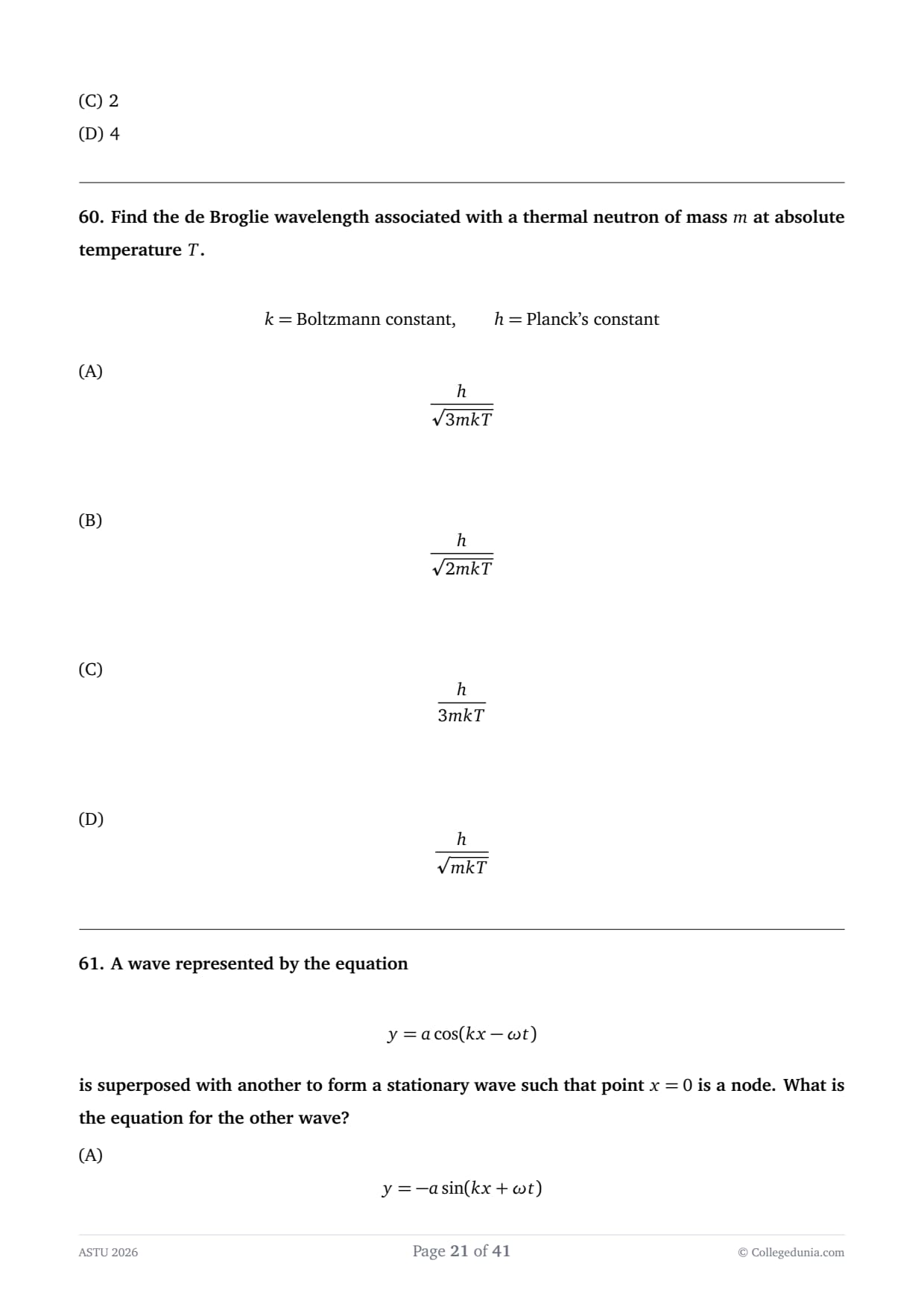
Find the de Broglie wavelength associated with a thermal neutron of mass m at absolute temperature T.
\[ k=Boltzmann constant, \qquad h=Planck's constant \]
A wave represented by the equation
\[ y=a\cos(kx-\omega t) \]
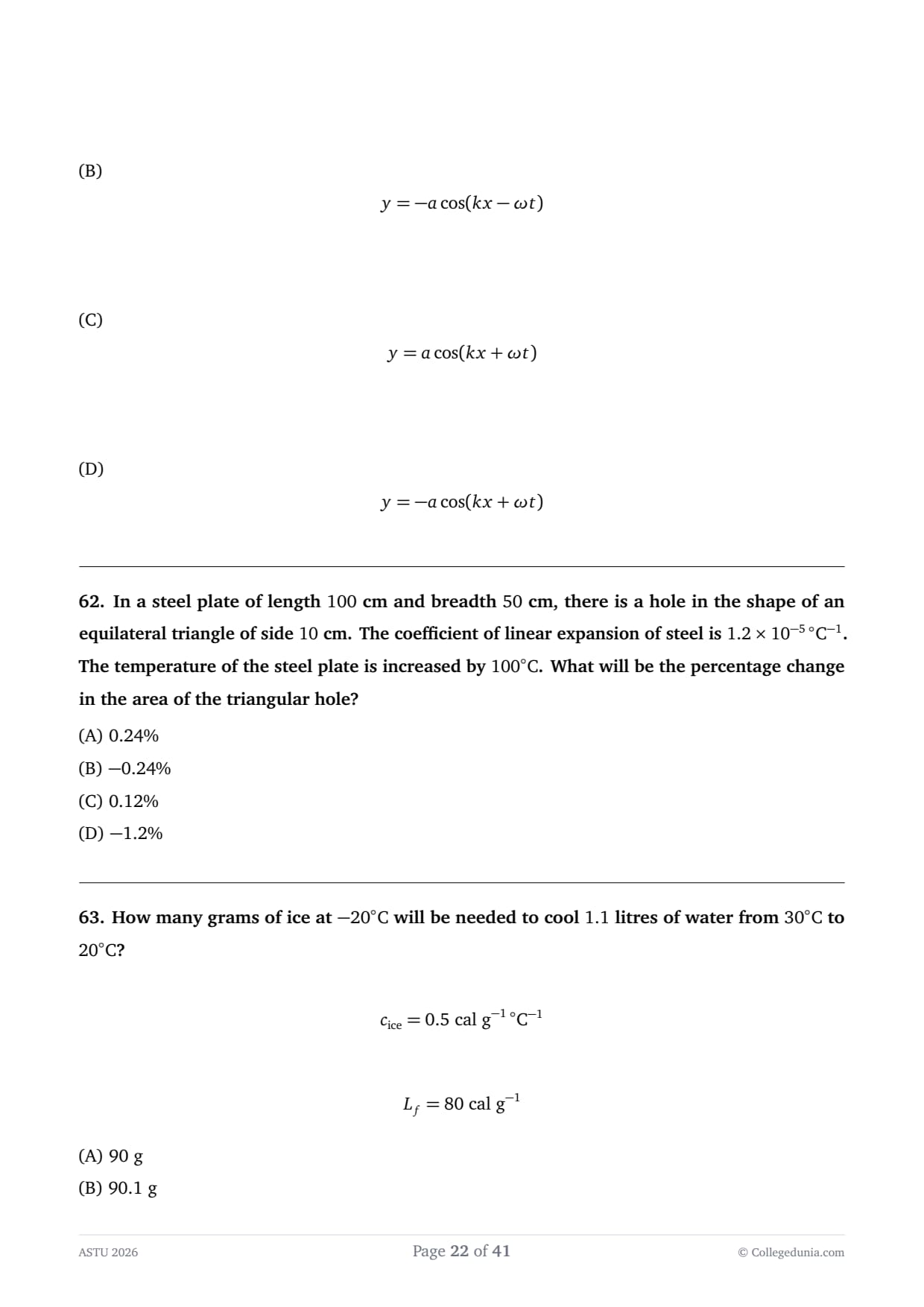
is superposed with another to form a stationary wave such that point x=0 is a node. What is the equation for the other wave?
In a steel plate of length 100 cm and breadth 50 cm, there is a hole in the shape of an equilateral triangle of side 10 cm. The coefficient of linear expansion of steel is 1.2\times10^{-5}\,^\circ\mathrm{C}^{-1}. The temperature of the steel plate is increased by 100^\circ\mathrm{C}. What will be the percentage change in the area of the triangular hole?
How many grams of ice at -20^\circ\mathrm{C} will be needed to cool 1.1 litres of water from 30^\circ\mathrm{C} to 20^\circ\mathrm{C}?
\[ c_{ice}=0.5\ cal g^{-1}\,^\circ\mathrm{C}^{-1} \]
\[ L_f=80\ cal g^{-1} \]
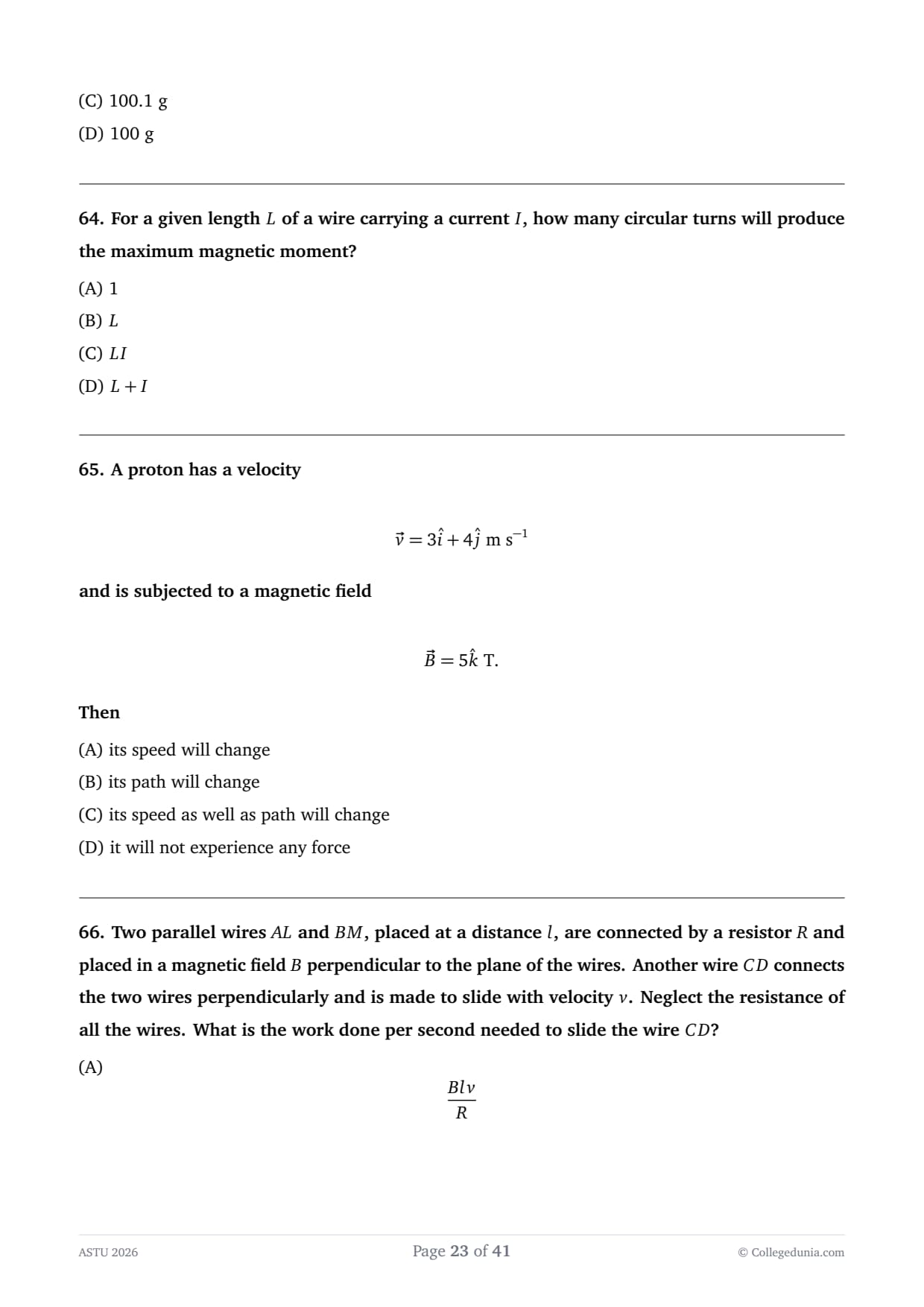
For a given length L of a wire carrying a current I, how many circular turns will produce the maximum magnetic moment?
A proton has a velocity
\[ \vec v=3\hat i+4\hat j\ m s^{-1} \]
and is subjected to a magnetic field
\[ \vec B=5\hat k\ T. \]
Then
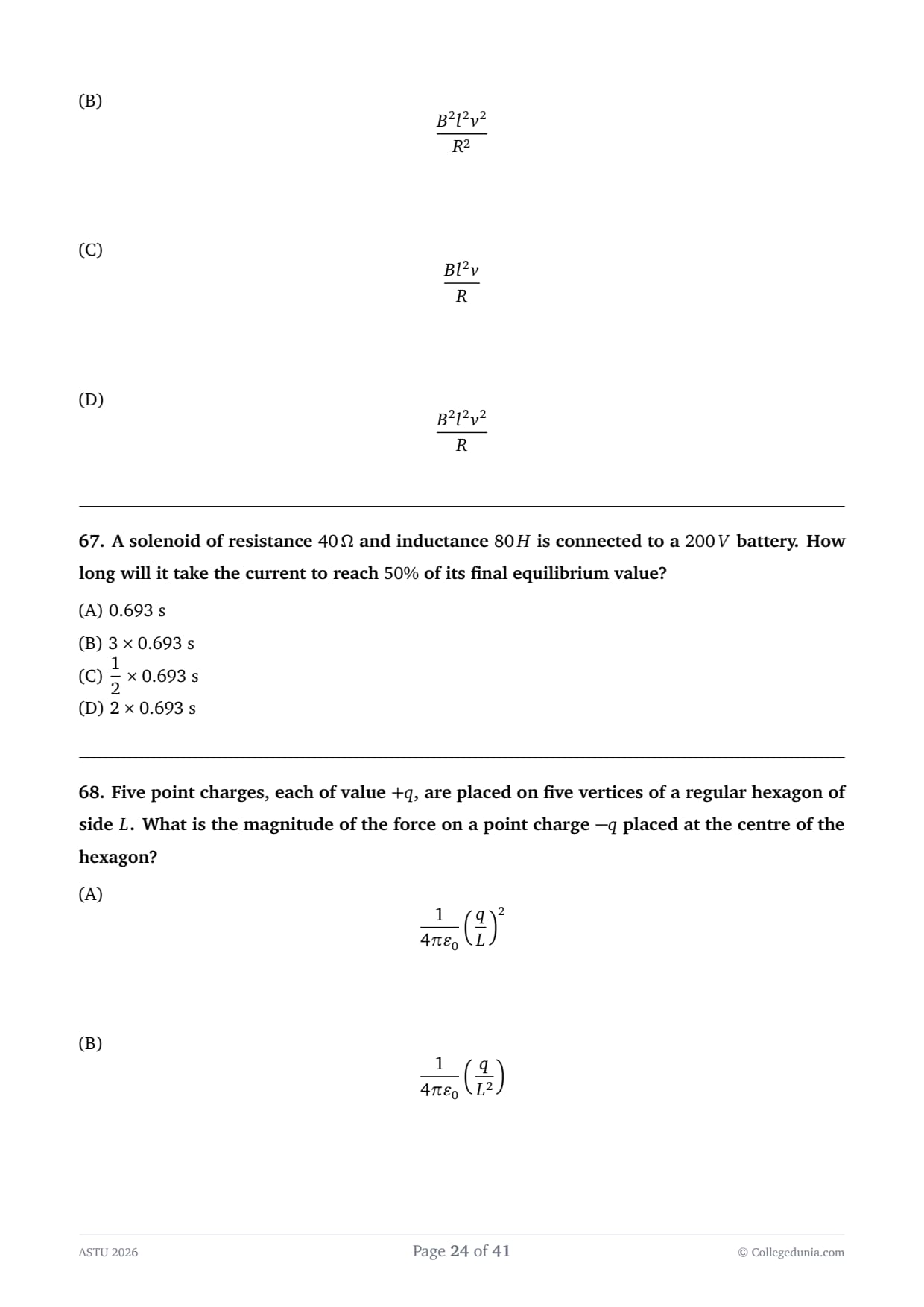
Two parallel wires AL and BM, placed at a distance l, are connected by a resistor R and placed in a magnetic field B perpendicular to the plane of the wires. Another wire CD connects the two wires perpendicularly and is made to slide with velocity v. Neglect the resistance of all the wires. What is the work done per second needed to slide the wire CD?
A solenoid of resistance 40\,\Omega and inductance 80\,H is connected to a 200\,V battery. How long will it take the current to reach 50% of its final equilibrium value?
Five point charges, each of value +q, are placed on five vertices of a regular hexagon of side L. What is the magnitude of the force on a point charge -q placed at the centre of the hexagon?
Which of the following semiconductors is electrically negative?
In the circuit shown below, determine the current in the resistor.
Given:
\[ E=10.7\ V \]
\[ R=10\,k\Omega \]
Silicon diode in forward bias.
Two spheres of the same material have radii 1\,m and 2\,m, and temperatures 2000\,K and 1000\,K respectively. What is the ratio of energy radiated per second by the first sphere to that by the second?
Three small particles A, B and C of equal mass move with equal speed v along the medians of an equilateral triangle as shown. They collide at the centroid G of the triangle. After the collision, A comes to rest, while B retraces its path with the same speed v. What is the speed and direction of motion of C after the collision?
A particle accelerates from rest at constant rate
\[ \alpha=6\ m s^{-2} \]
for some time, after which it decelerates at constant rate
\[ \beta=4\ m s^{-2} \]
to come to rest. If the total time of travel is 10 seconds, what is the maximum speed attained by the particle during its motion?
A hollow metal sphere of radius r contains a charge +Q. Consider an imaginary circle of radius R\,(R>r) concentric with the charged sphere. A point charge q is carried from (I) A to B and then from (II) A to C. Choose the correct answer from the given alternatives.
A battery is kept connected to the plates of a parallel-plate capacitor. A dielectric slab of dielectric constant K is then introduced between the plates such that it covers the entire space between the plates. Choose the correct answer from the given alternatives.
The current-voltage graphs for a given conducting sample at two different temperatures T_1 and T_2 are shown in the figure below. R_1 is the resistance of the sample at temperature T_1 and R_2 is the resistance at temperature T_2. Choose the correct answer.
Find the value of current I in the circuit shown in the figure below.
A satellite A of mass m is orbiting around the Earth in a stable circular orbit of radius r and another satellite B of mass 2m is orbiting in a similar orbit of radius 2r. What is the ratio of the time periods of revolution of satellites A and B?
A cubical metal block 5\,cm on each side is floating in mercury in a vessel. Now, a liquid is gently poured into the vessel so that it just covers the metal block as shown. What is the depth of the liquid that has been poured over the mercury?
Given:
\[ \rho_{Hg}=13.6, \qquad \rho_{metal}=7.6, \qquad \rho_{liquid}=1.6 \]
A ray of light is incident normally on a refracting face of a prism. The subsequent journey of the ray through the prism is shown in the figure. The refractive index of the prism material is 1.5. Find the angle of the prism (\angle A).
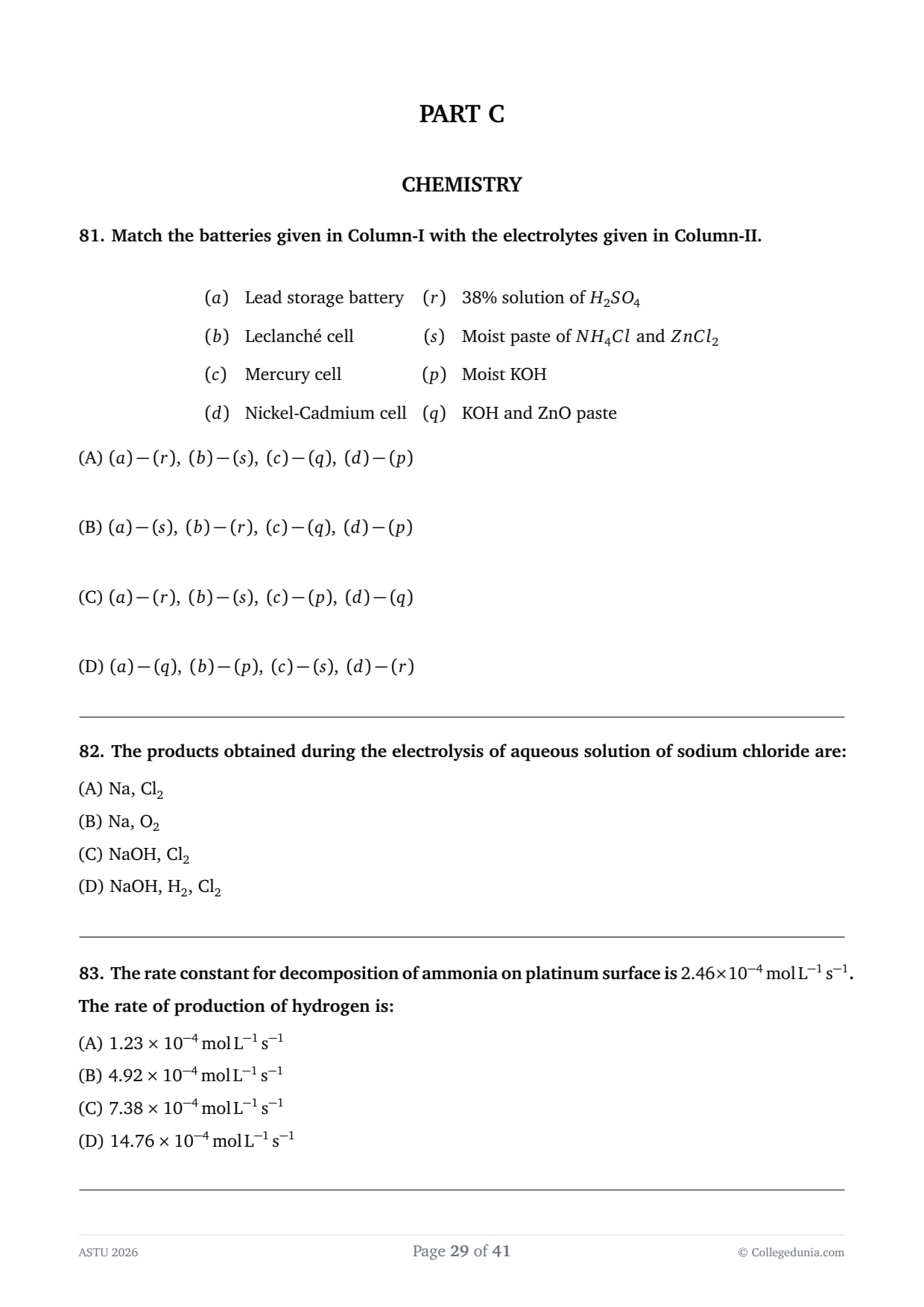
Match the batteries given in Column-I with the electrolytes given in Column-II.
\[ \begin{array}{llcl} (a) & Lead storage battery & (r) & 38% solution of H_2SO_4
[4pt] (b) & Leclanché cell & (s) & Moist paste of NH_4Cl and ZnCl_2
[4pt] (c) & Mercury cell & (p) & Moist KOH
[4pt] (d) & Nickel-Cadmium cell & (q) & KOH and ZnO paste \end{array} \]
The products obtained during the electrolysis of aqueous solution of sodium chloride are:
The rate constant for decomposition of ammonia on platinum surface is 2.46 \times 10^{-4}\,\mathrm{mol\,L^{-1}\,s^{-1}}. The rate of production of hydrogen is:
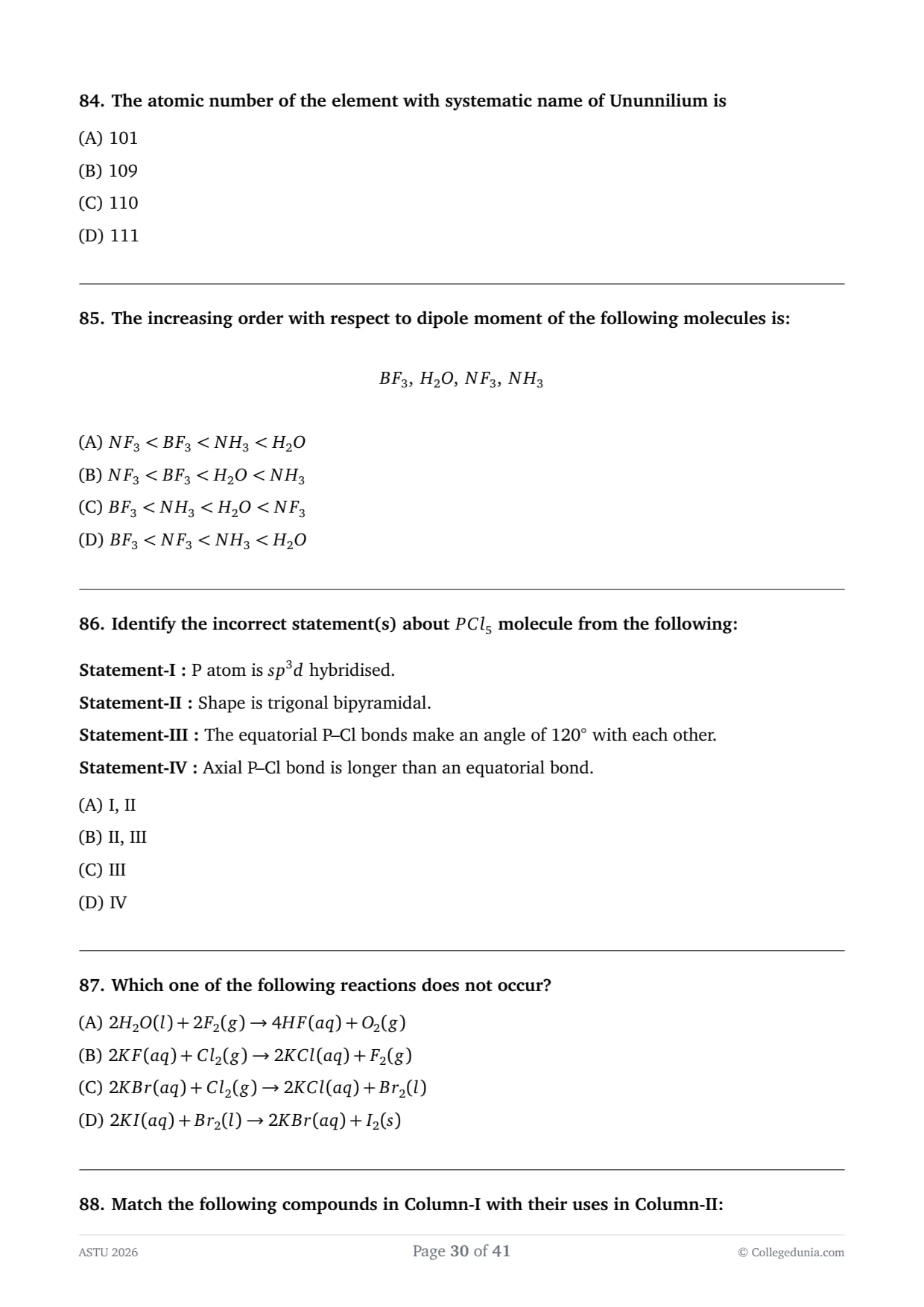
The atomic number of the element with systematic name of Ununnilium is
The increasing order with respect to dipole moment of the following molecules is:
BF_3,\; H_2O,\; NF_3,\; NH_3
Identify the incorrect statement(s) about PCl_5 molecule from the following:
\medskip
Statement-I : P atom is sp^3d hybridised.
Statement-II : Shape is trigonal bipyramidal.
Statement-III : The equatorial P--Cl bonds make an angle of 120^\circ with each other.
Statement-IV : Axial P--Cl bond is longer than an equatorial bond.
Which one of the following reactions does not occur?
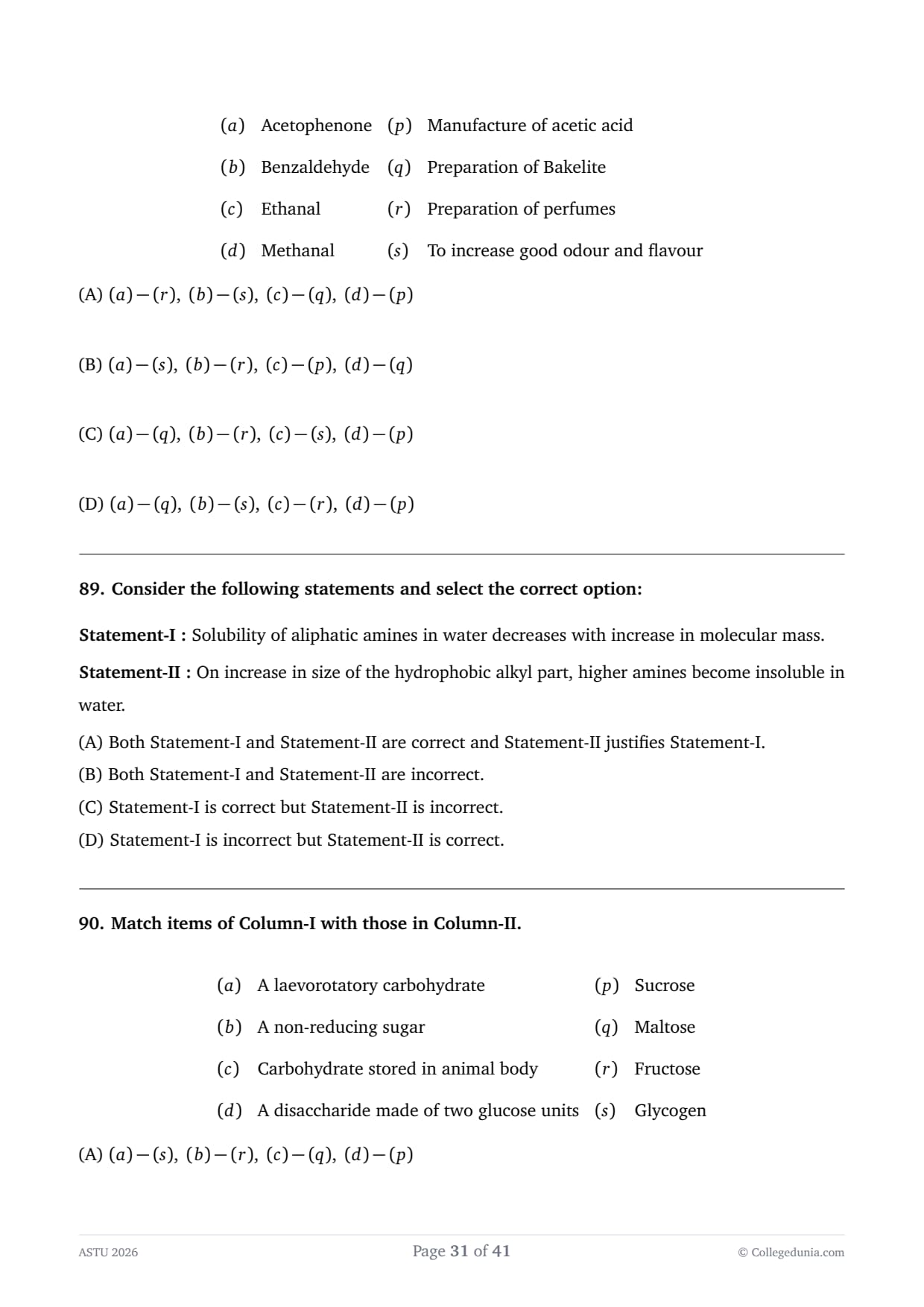
Match the following compounds in Column-I with their uses in Column-II:
\[ \begin{array}{llll} (a) & Acetophenone & (p) & Manufacture of acetic acid
[6pt] (b) & Benzaldehyde & (q) & Preparation of Bakelite
[6pt] (c) & Ethanal & (r) & Preparation of perfumes
[6pt] (d) & Methanal & (s) & To increase good odour and flavour \end{array} \]
Consider the following statements and select the correct option:
\medskip
Statement-I : Solubility of aliphatic amines in water decreases with increase in molecular mass.
Statement-II : On increase in size of the hydrophobic alkyl part, higher amines become insoluble in water.
Match items of Column-I with those in Column-II.
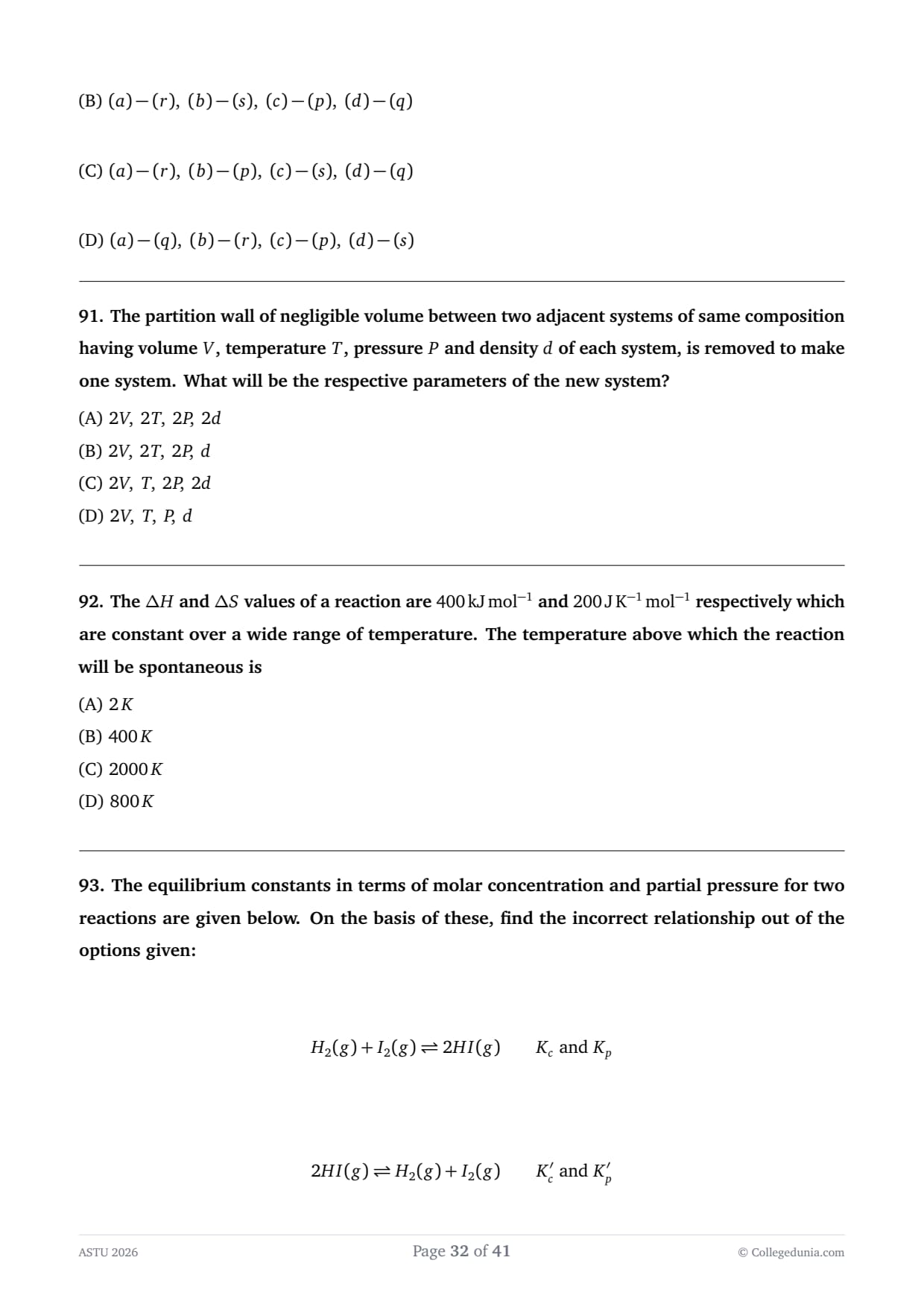
\[ \begin{array}{llll} (a) & A laevorotatory carbohydrate & (p) & Sucrose
[6pt] (b) & A non-reducing sugar & (q) & Maltose
[6pt] (c) & Carbohydrate stored in animal body & (r) & Fructose
[6pt] (d) & A disaccharide made of two glucose units & (s) & Glycogen \end{array} \]
The partition wall of negligible volume between two adjacent systems of same composition having volume V, temperature T, pressure P and density d of each system, is removed to make one system. What will be the respective parameters of the new system?
The \Delta H and \Delta S values of a reaction are 400\,\mathrm{kJ\,mol^{-1}} and 200\,\mathrm{J\,K^{-1}\,mol^{-1}} respectively which are constant over a wide range of temperature. The temperature above which the reaction will be spontaneous is
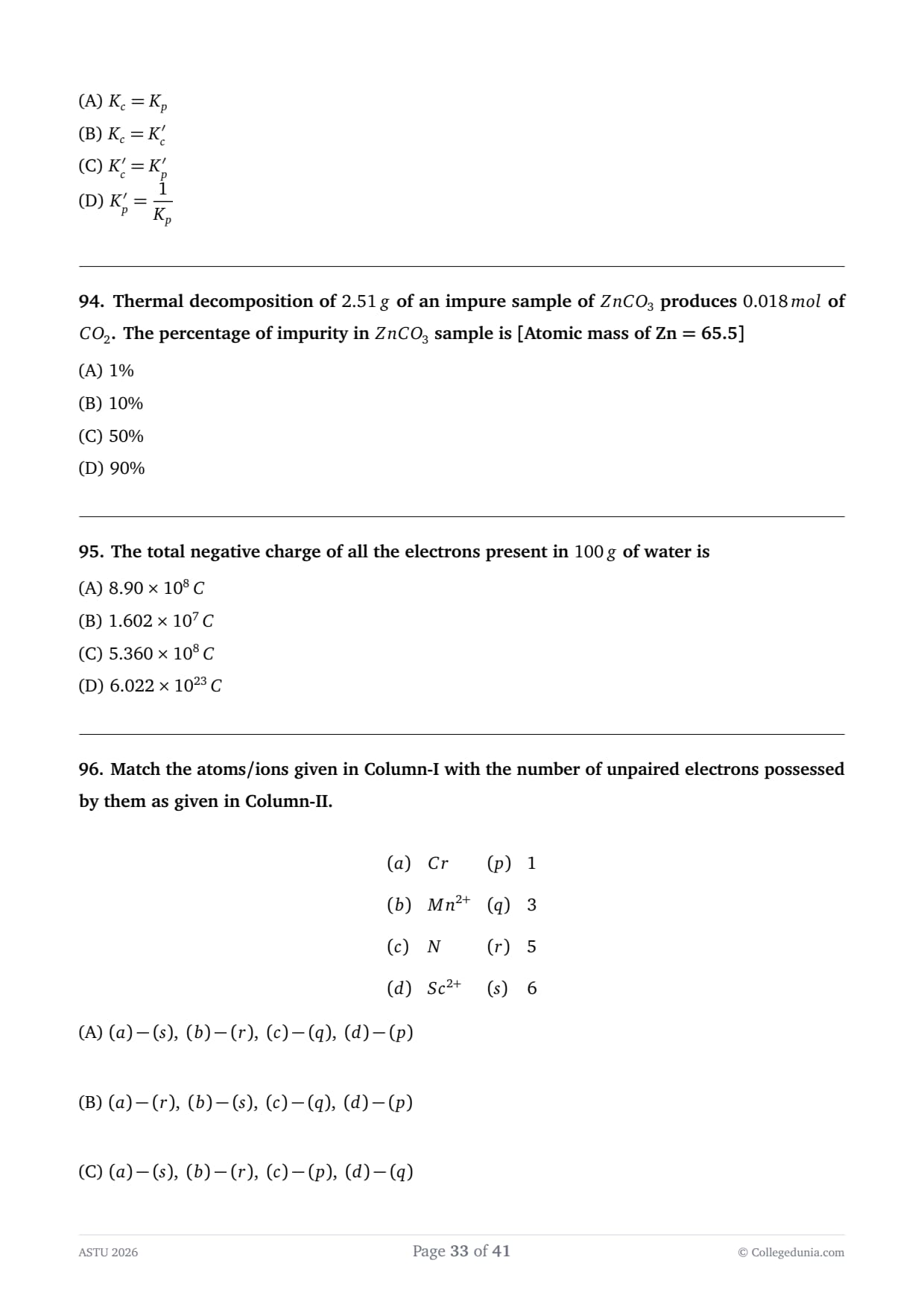
The equilibrium constants in terms of molar concentration and partial pressure for two reactions are given below. On the basis of these, find the incorrect relationship out of the options given:
H_2(g)+I_2(g)\rightleftharpoons 2HI(g)
\qquad K_c and K_p
2HI(g)\rightleftharpoons H_2(g)+I_2(g)
\qquad K'_c and K'_p
Thermal decomposition of 2.51\,g of an impure sample of ZnCO_3 produces 0.018\,mol of CO_2. The percentage of impurity in ZnCO_3 sample is [Atomic mass of Zn = 65.5]
The total negative charge of all the electrons present in 100\,g of water is
Match the atoms/ions given in Column-I with the number of unpaired electrons possessed by them as given in Column-II.
\[ \begin{array}{llll} (a) & Cr & (p) & 1
[6pt] (b) & Mn^{2+} & (q) & 3
[6pt] (c) & N & (r) & 5
[6pt] (d) & Sc^{2+} & (s) & 6 \end{array} \]
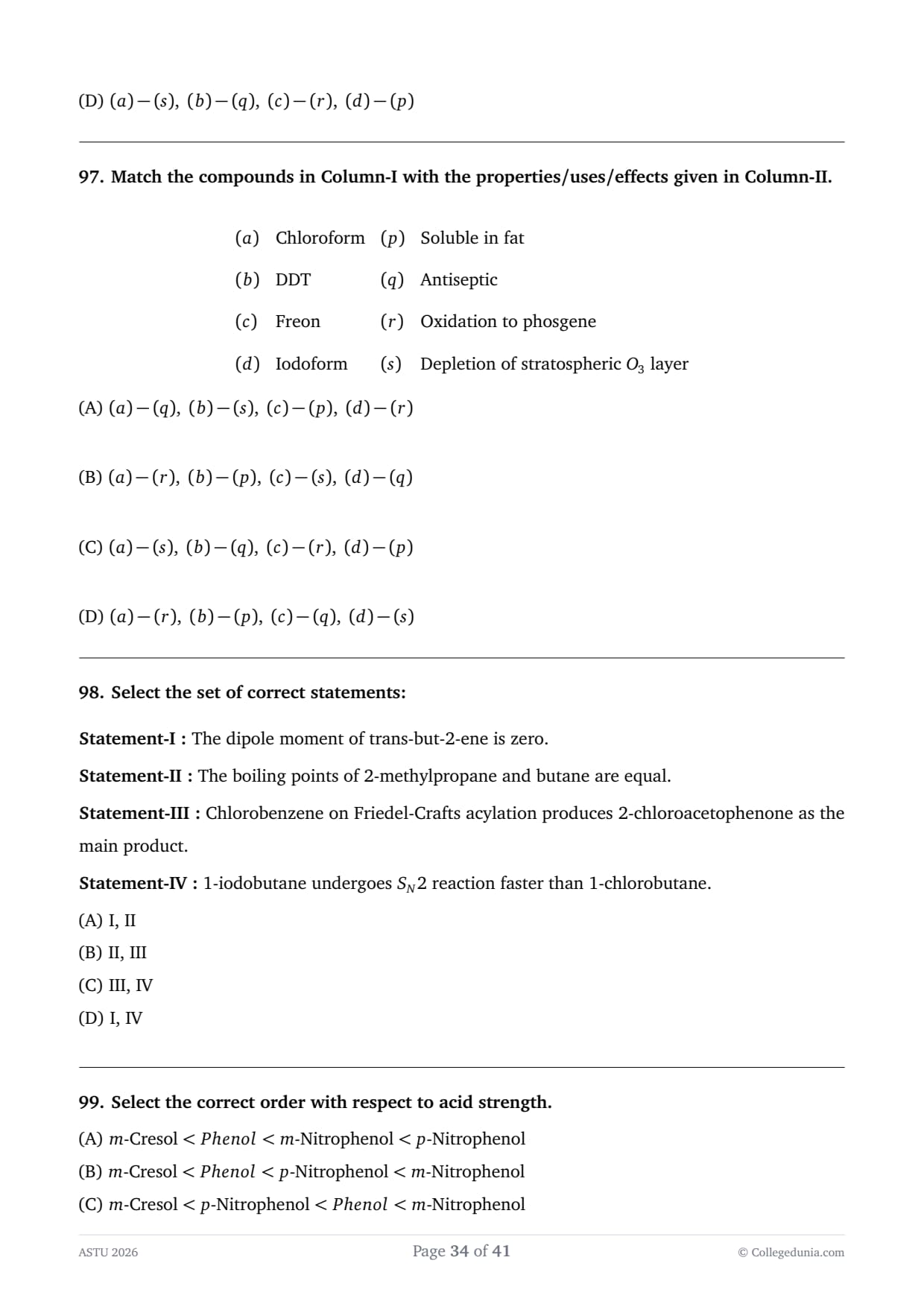
Match the compounds in Column-I with the properties/uses/effects given in Column-II.
\[ \begin{array}{llll} (a) & Chloroform & (p) & Soluble in fat
[6pt] (b) & DDT & (q) & Antiseptic
[6pt] (c) & Freon & (r) & Oxidation to phosgene
[6pt] (d) & Iodoform & (s) & Depletion of stratospheric O_3 layer \end{array} \]
Select the set of correct statements:
\medskip
Statement-I : The dipole moment of trans-but-2-ene is zero.
Statement-II : The boiling points of 2-methylpropane and butane are equal.
Statement-III : Chlorobenzene on Friedel-Crafts acylation produces 2-chloroacetophenone as the main product.
Statement-IV : 1-iodobutane undergoes S_N2 reaction faster than 1-chlorobutane.
Select the correct order with respect to acid strength.
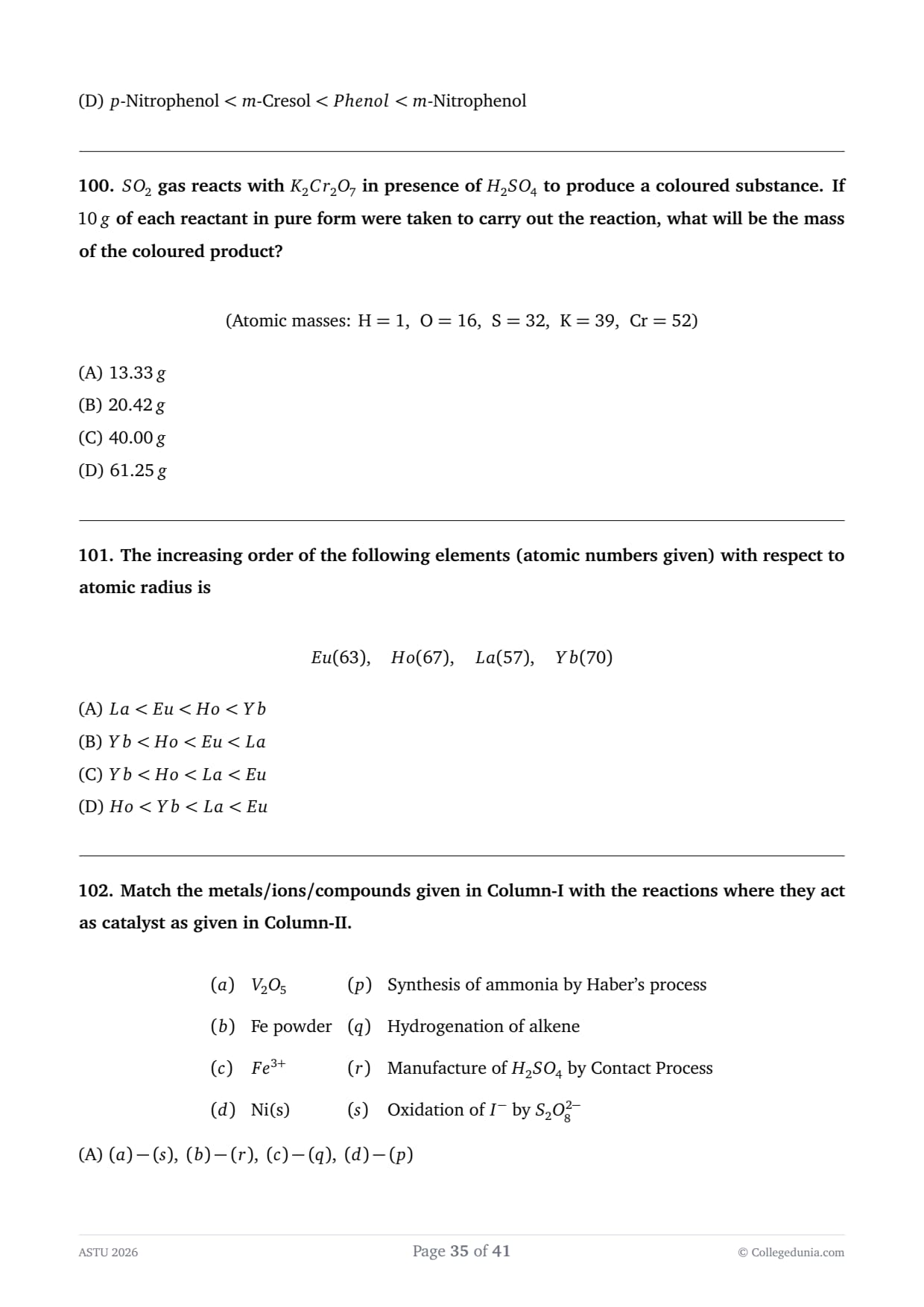
SO_2 gas reacts with K_2Cr_2O_7 in presence of H_2SO_4 to produce a coloured substance. If 10\,g of each reactant in pure form were taken to carry out the reaction, what will be the mass of the coloured product?
\[ (Atomic masses: H = 1,\; O = 16,\; S = 32,\; K = 39,\; Cr = 52) \]
The increasing order of the following elements (atomic numbers given) with respect to atomic radius is
\[ Eu(63),\quad Ho(67),\quad La(57),\quad Yb(70) \]
Match the metals/ions/compounds given in Column-I with the reactions where they act as catalyst as given in Column-II.
\[ \begin{array}{llll} (a) & V_2O_5 & (p) & Synthesis of ammonia by Haber's process
[6pt] (b) & Fe powder & (q) & Hydrogenation of alkene
[6pt] (c) & Fe^{3+} & (r) & Manufacture of H_2SO_4 by Contact Process
[6pt] (d) & Ni(s) & (s) & Oxidation of I^- by S_2O_8^{2-} \end{array} \]
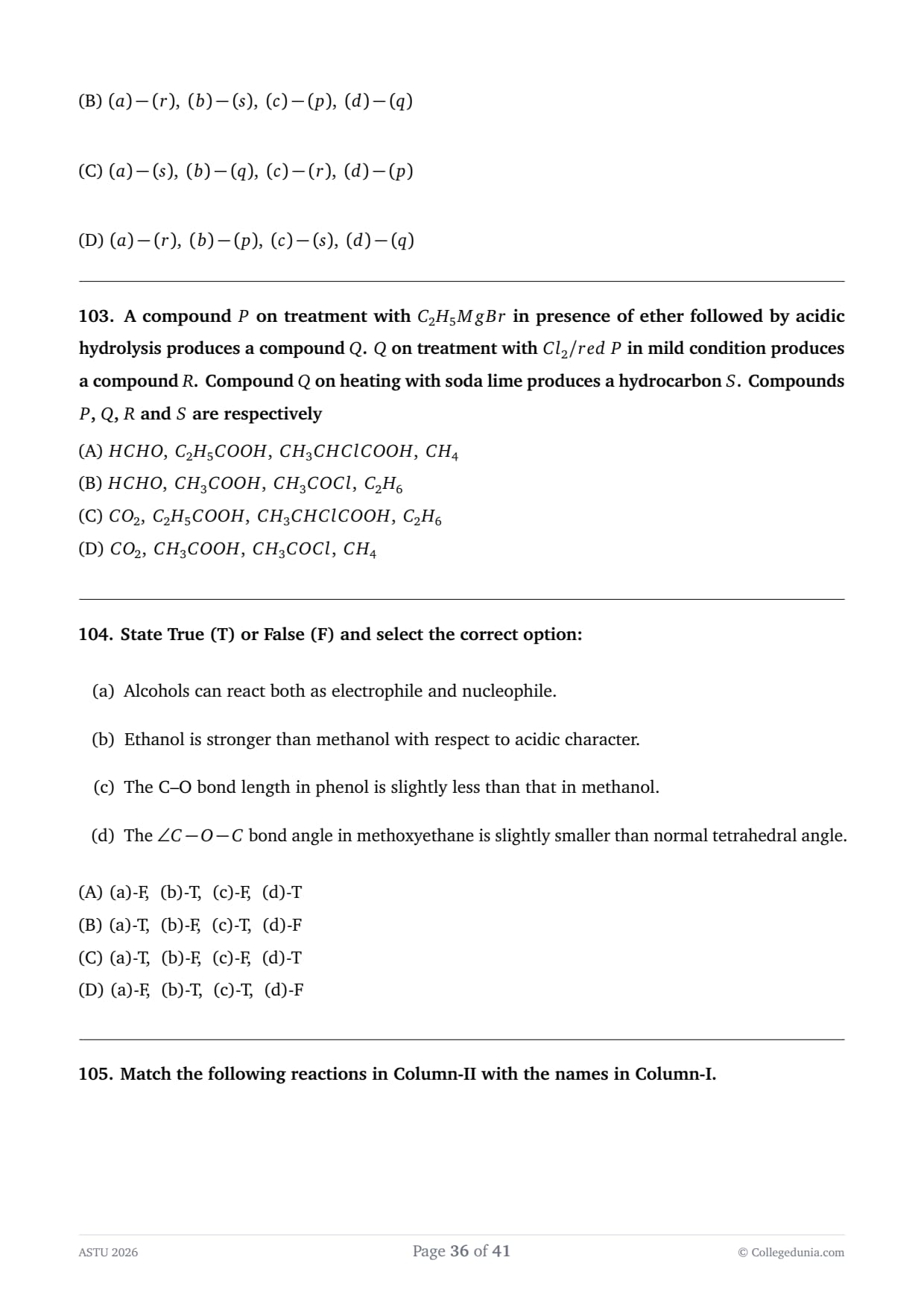
A compound P on treatment with C_2H_5MgBr in presence of ether followed by acidic hydrolysis produces a compound Q. Q on treatment with Cl_2/red\;P in mild condition produces a compound R. Compound Q on heating with soda lime produces a hydrocarbon S. Compounds P, Q, R and S are respectively
State True (T) or False (F) and select the correct option:
[(a)] Alcohols can react both as electrophile and nucleophile.
[(b)] Ethanol is stronger than methanol with respect to acidic character.
[(c)] The C--O bond length in phenol is slightly less than that in methanol.
[(d)] The \angle C-O-C bond angle in methoxyethane is slightly smaller than normal tetrahedral angle.
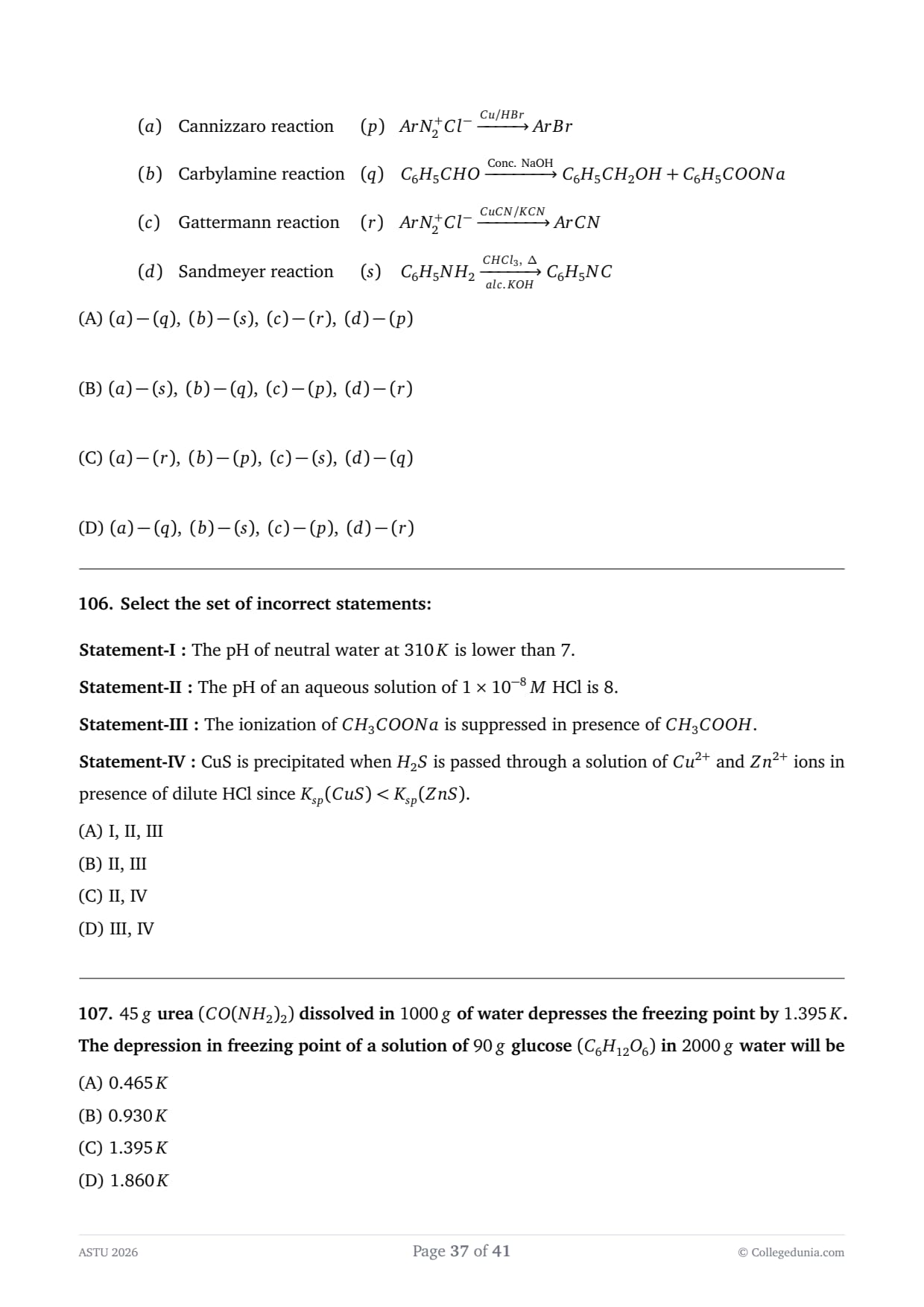
Match the following reactions in Column-II with the names in Column-I.
\[ \begin{array}{llll} (a) & Cannizzaro reaction & (p) & ArN_2^+Cl^- \xrightarrow{Cu/HBr} ArBr
[10pt] (b) & Carbylamine reaction & (q) & C_6H_5CHO \xrightarrow{Conc. NaOH} C_6H_5CH_2OH + C_6H_5COONa
[10pt] (c) & Gattermann reaction & (r) & ArN_2^+Cl^- \xrightarrow{CuCN/KCN} ArCN
[10pt] (d) & Sandmeyer reaction & (s) & C_6H_5NH_2 \xrightarrow[alc.\,KOH]{CHCl_3,\ \Delta} C_6H_5NC \end{array} \]
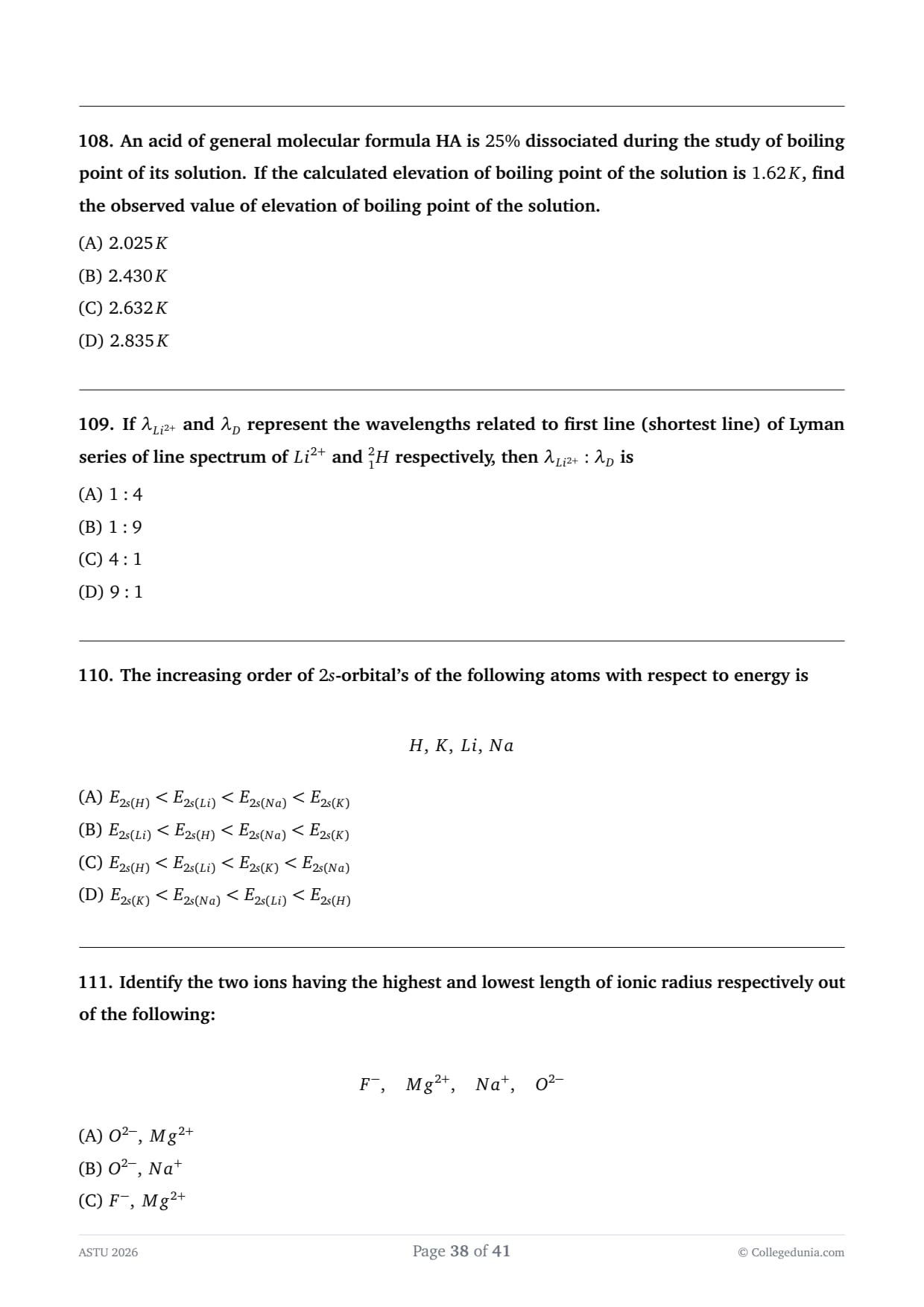
Select the set of incorrect statements:
\medskip
Statement-I : The pH of neutral water at 310\,K is lower than 7.
Statement-II : The pH of an aqueous solution of 1\times10^{-8}\,M HCl is 8.
Statement-III : The ionization of CH_3COONa is suppressed in presence of CH_3COOH.
Statement-IV : CuS is precipitated when H_2S is passed through a solution of Cu^{2+} and Zn^{2+} ions in presence of dilute HCl since K_{sp}(CuS)
45\,g urea (CO(NH_2)_2) dissolved in 1000\,g of water depresses the freezing point by 1.395\,K. The depression in freezing point of a solution of 90\,g glucose (C_6H_{12}O_6) in 2000\,g water will be
An acid of general molecular formula HA is 25% dissociated during the study of boiling point of its solution. If the calculated elevation of boiling point of the solution is 1.62\,K, find the observed value of elevation of boiling point of the solution.
If \lambda_{Li^{2+}} and \lambda_D represent the wavelengths related to first line (shortest line) of Lyman series of line spectrum of Li^{2+} and ^2_1H respectively, then \lambda_{Li^{2+}} : \lambda_D is
The increasing order of 2s-orbital's of the following atoms with respect to energy is
\[ H,\; K,\; Li,\; Na \]
Identify the two ions having the highest and lowest length of ionic radius respectively out of the following:
\[ F^{-},\quad Mg^{2+},\quad Na^{+},\quad O^{2-} \]
Select the option in which all the given functional groups exhibit +R effect.
Identify the incorrect reaction from the following.
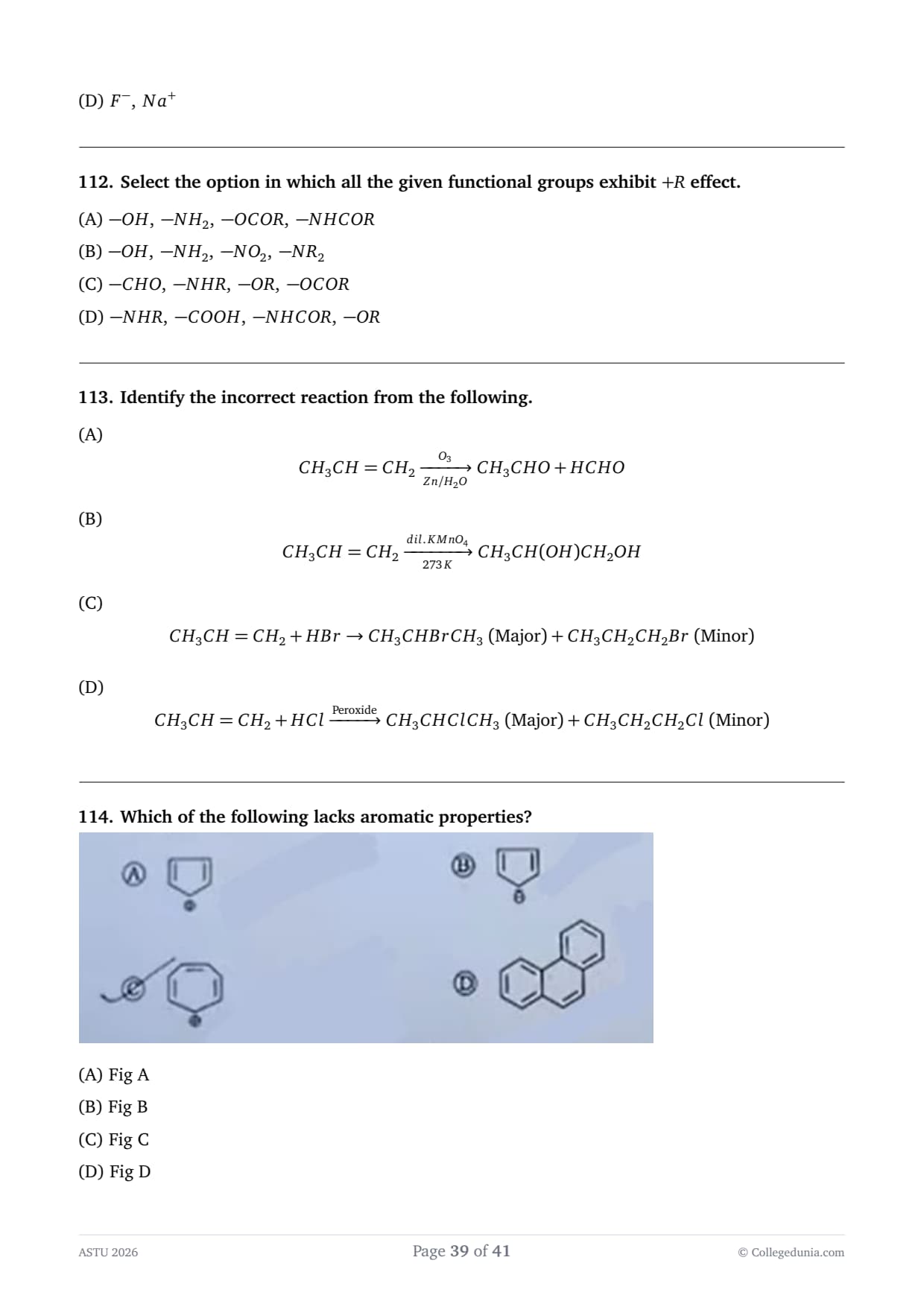
Which of the following lacks aromatic properties?

In which of the following compounds, an electrophile prefers to attack the meta position?
A first-order reaction is carried out at two different temperatures of 300\,K and 310\,K, where the rate constants are k_1 and k_2 respectively. The activation energies of the reaction in absence and presence of catalyst are E_{a1} and E_{a2} respectively. Which of the following options is correct?
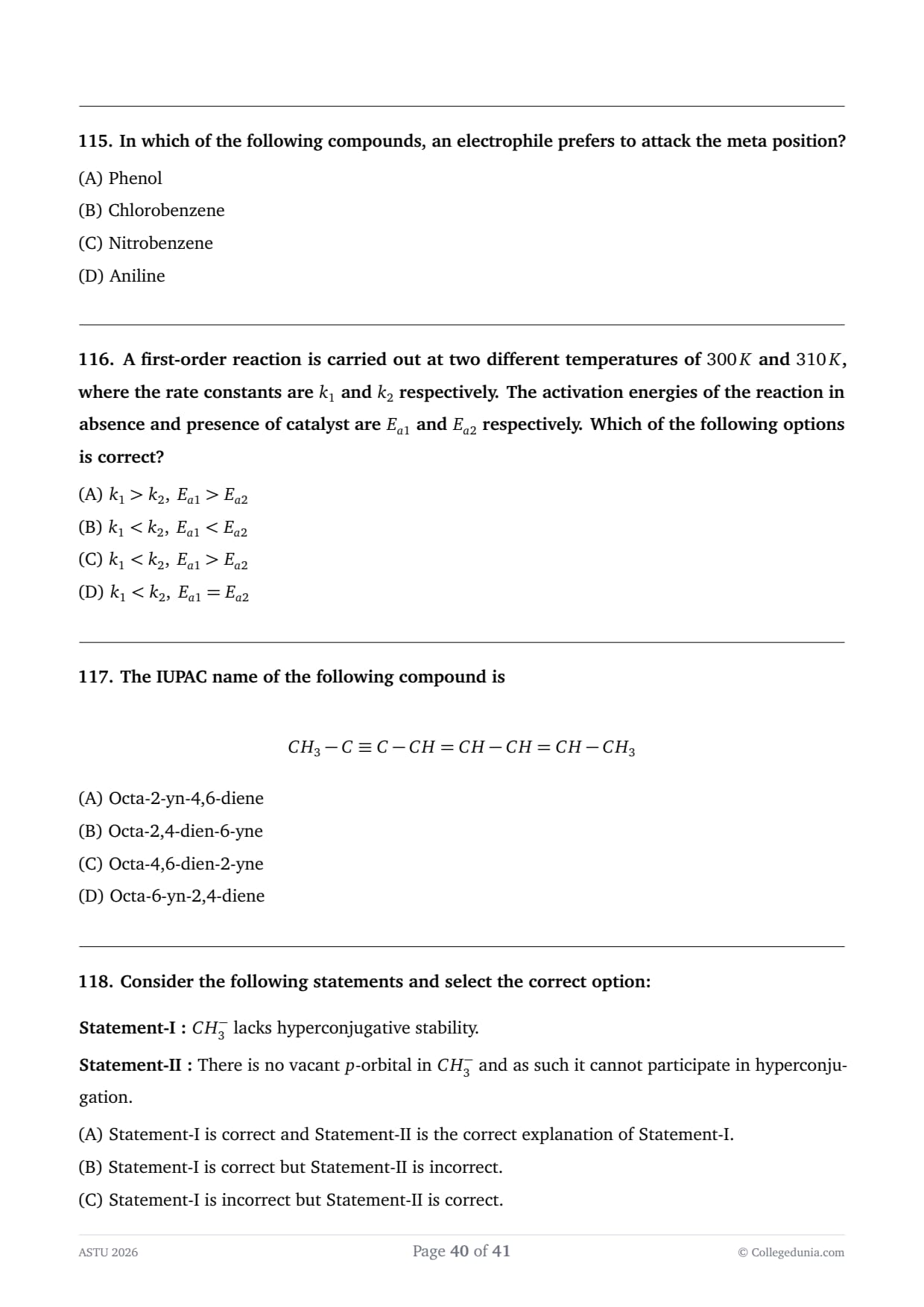
The IUPAC name of the following compound is
\[ CH_3-C\equiv C-CH=CH-CH=CH-CH_3 \]
Consider the following statements and select the correct option:
\medskip
Statement-I : CH_3^- lacks hyperconjugative stability.
Statement-II : There is no vacant p-orbital in CH_3^- and as such it cannot participate in hyperconjugation.
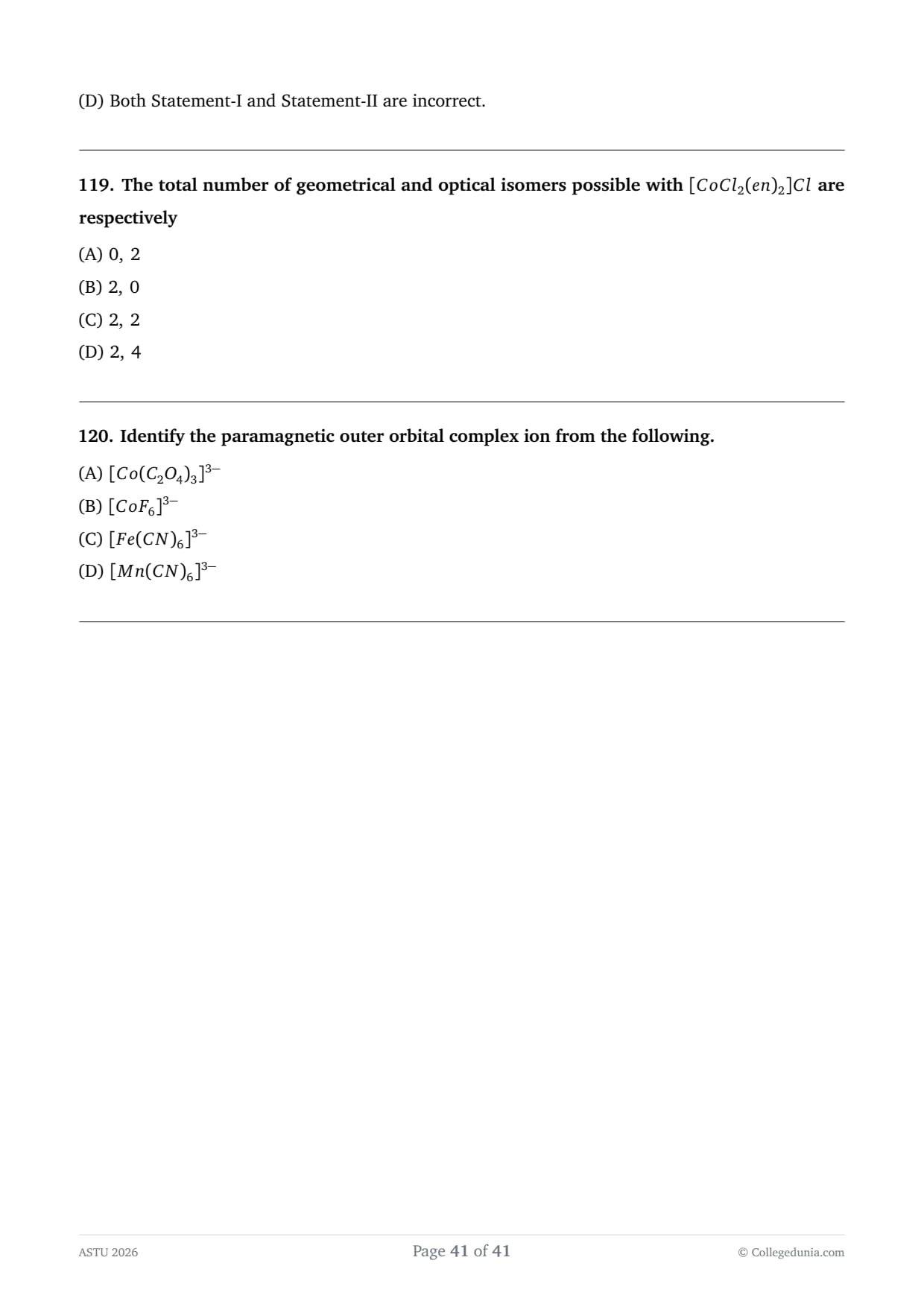
The total number of geometrical and optical isomers possible with [CoCl_2(en)_2]Cl are respectively
Identify the paramagnetic outer orbital complex ion from the following.
Assam CEE 2026 Marking Scheme
| Parameter | Details |
| Exam Name | Assam CEE (Common Entrance Examination) |
| Conducting Body | Assam Science and Technology University (ASTU) |
| Mode of Exam | Offline (Pen & Paper / OMR Sheet) |
| Language | English and Assamese |
| Total Questions | 120 |
| Question Type | Multiple Choice Questions (MCQs) |
| Duration | 3 Hours |
| Sections | Physics, Chemistry, Mathematics |
| Questions per Section | 40 Questions Each |
| Total Marks | 480 |
| Correct Answer | +4 Marks |
| Wrong Answer | −1 Mark |
| Unattempted | 0 Marks |
| Syllabus Based On | Class 11 & 12 (NCERT / AHSEC) |
| Admission For | B.Tech Programs in Engineering Colleges across Assam |
Assam CEE 2026 Preparation



Comments