The ICAR AIEEA PG 2023 Agricultural Engineering and Technology question paper is now available with detailed solutions for free download. ICAR AIEEA PG 2023 was conducted by the National Testing Agency (NTA) on behalf of ICAR on July 9, 2023, and the Agricultural Engineering and Technology paper carried 120 questions in 2 hours.

ICAR AIEEA PG 2023 Agricultural Engineering and Technology Question Paper with Solutions Download PDF Check Solutions

ICAR AIEEA PG 2023 Agricultural Engineering Questions with Solutions

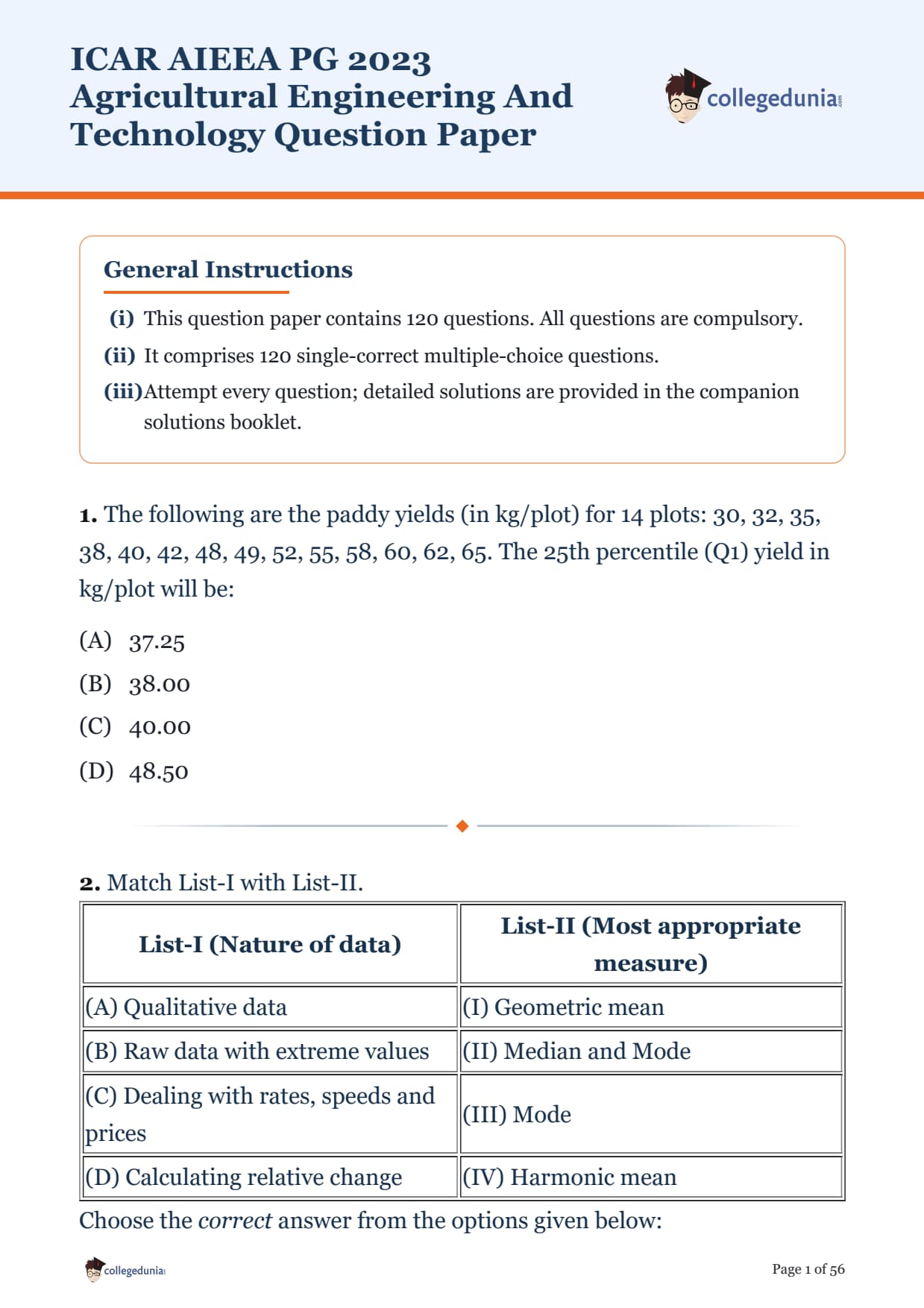
Question 1:

The following are the paddy yields (in kg/plot) for 14 plots: 30, 32, 35, 38, 40, 42, 48, 49, 52, 55, 58, 60, 62, 65. The 25th percentile (Q1) yield in kg/plot will be:

  • (A) 37.25
  • (B) 38.00
  • (C) 40.00
  • (D) 48.50

Question 2:

Match List-I with List-II.

List-I (Nature of data)List-II (Most appropriate measure)
(A) Qualitative data(I) Geometric mean
(B) Raw data with extreme values(II) Median and Mode
(C) Dealing with rates, speeds and prices(III) Mode
(D) Calculating relative change(IV) Harmonic mean
Choose the correct answer from the options given below:

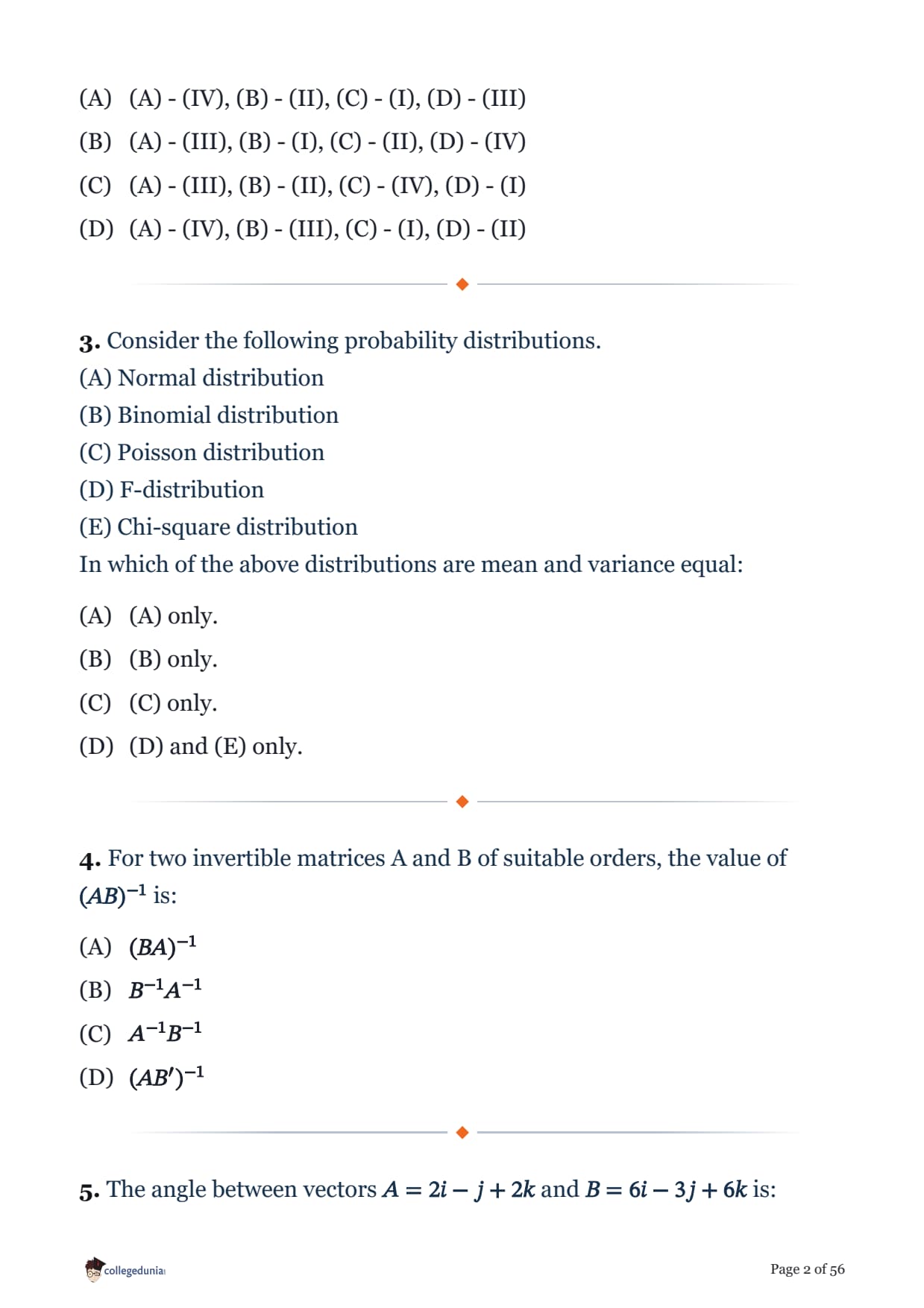
  • (A) (A) - (IV), (B) - (II), (C) - (I), (D) - (III)
  • (B) (A) - (III), (B) - (I), (C) - (II), (D) - (IV)
  • (C) (A) - (III), (B) - (II), (C) - (IV), (D) - (I)
  • (D) (A) - (IV), (B) - (III), (C) - (I), (D) - (II)

Question 3:

Consider the following probability distributions.
(A) Normal distribution
(B) Binomial distribution
(C) Poisson distribution
(D) F-distribution
(E) Chi-square distribution
In which of the above distributions are mean and variance equal:

  • (A) (A) only.
  • (B) (B) only.
  • (C) (C) only.
  • (D) (D) and (E) only.

Question 4:

For two invertible matrices A and B of suitable orders, the value of \((AB)^{-1}\) is:

  • (A) \((BA)^{-1}\)
  • (B) \(B^{-1}A^{-1}\)
  • (C) \(A^{-1}B^{-1}\)
  • (D) \((AB')^{-1}\)

Question 5:

The angle between vectors \(A = 2i - j + 2k\) and \(B = 6i - 3j + 6k\) is:

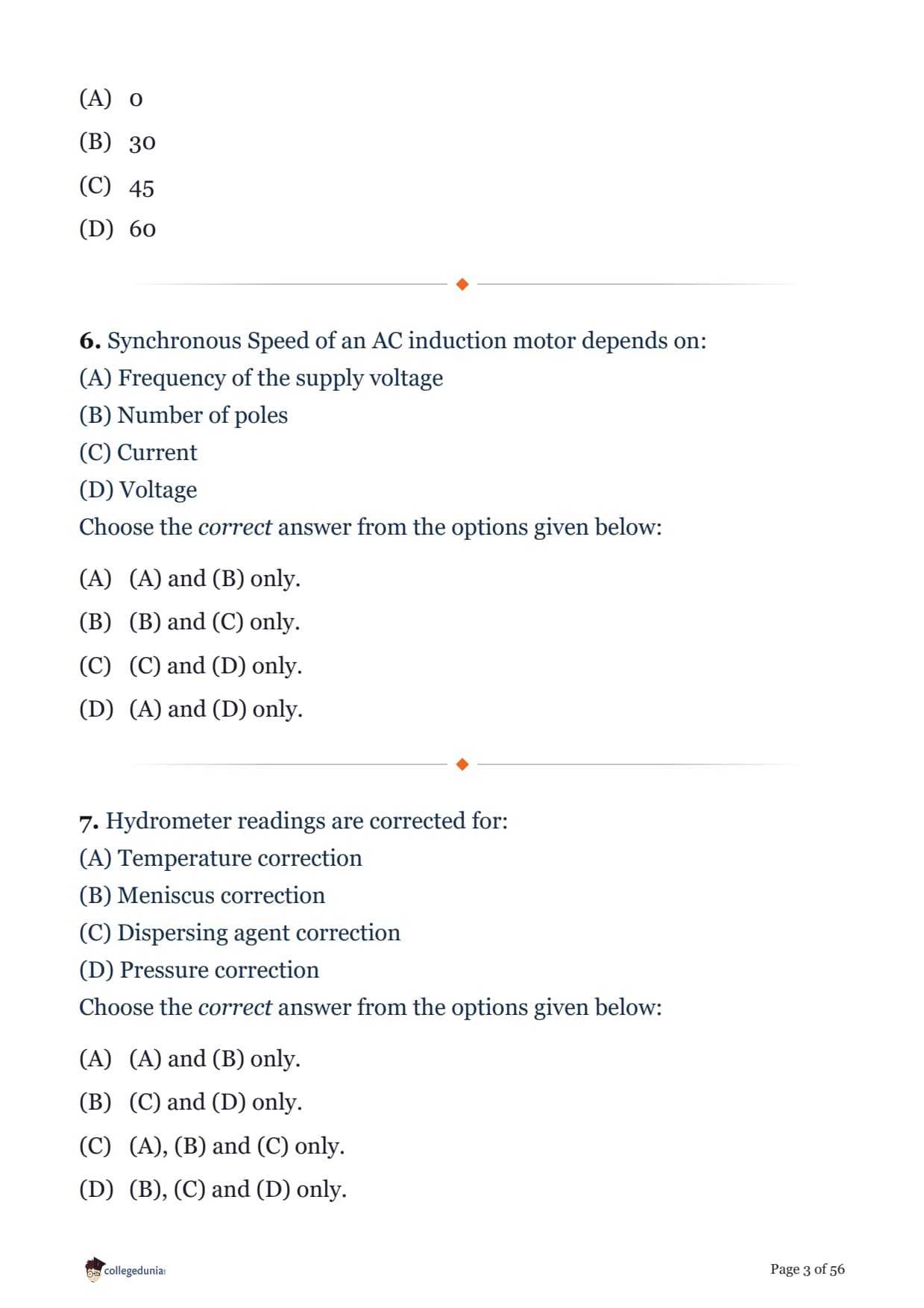
  • (A) 0
  • (B) 30
  • (C) 45
  • (D) 60

Question 6:

Synchronous Speed of an AC induction motor depends on:
(A) Frequency of the supply voltage
(B) Number of poles
(C) Current
(D) Voltage
Choose the correct answer from the options given below:

  • (A) (A) and (B) only.
  • (B) (B) and (C) only.
  • (C) (C) and (D) only.
  • (D) (A) and (D) only.

Question 7:

Hydrometer readings are corrected for:
(A) Temperature correction
(B) Meniscus correction
(C) Dispersing agent correction
(D) Pressure correction
Choose the correct answer from the options given below:

  • (A) (A) and (B) only.
  • (B) (C) and (D) only.
  • (C) (A), (B) and (C) only.
  • (D) (B), (C) and (D) only.

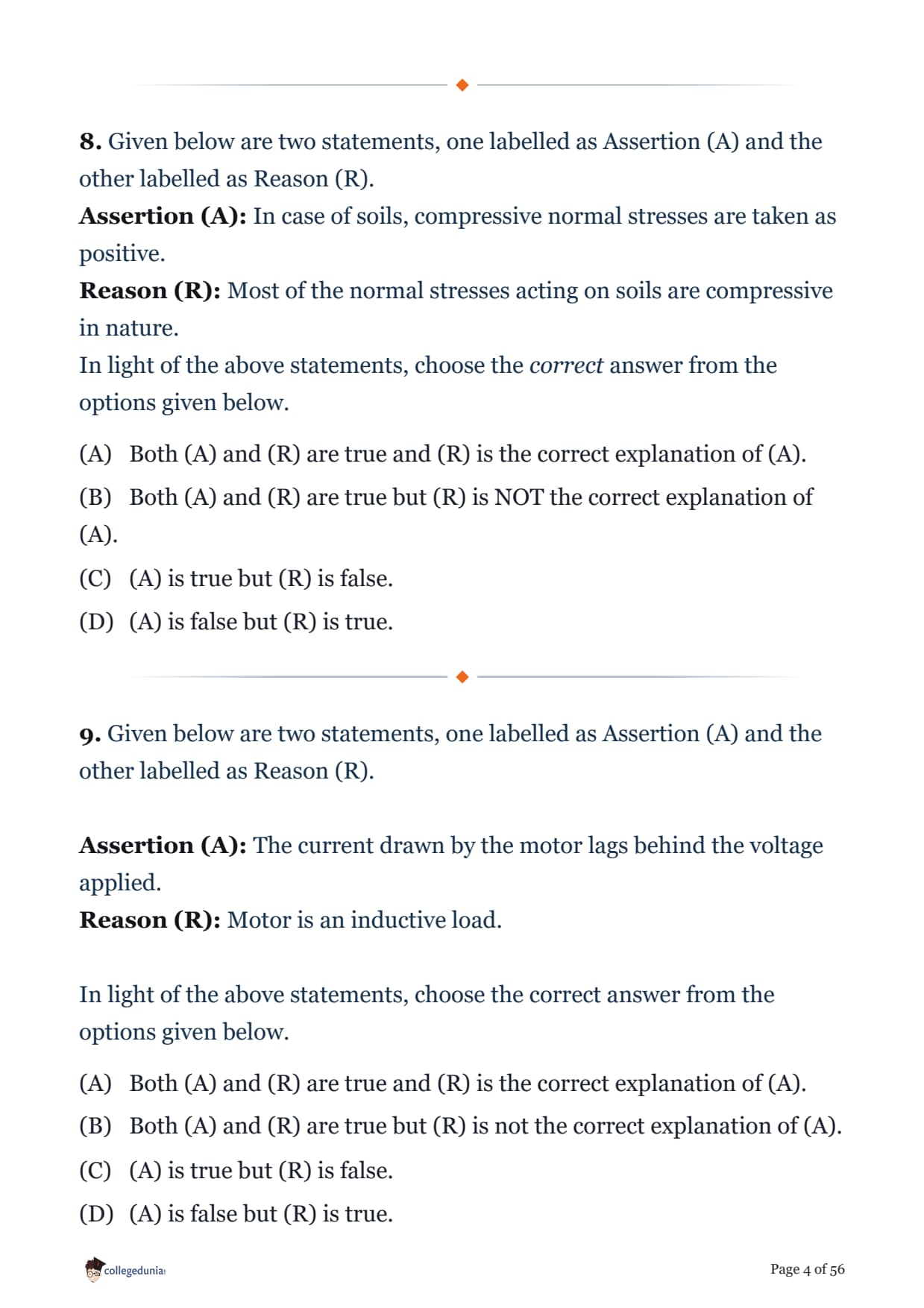
Question 8:

Given below are two statements, one labelled as Assertion (A) and the other labelled as Reason (R).
Assertion (A): In case of soils, compressive normal stresses are taken as positive.
Reason (R): Most of the normal stresses acting on soils are compressive in nature.
In light of the above statements, choose the correct answer from the options given below.

  • (A) Both (A) and (R) are true and (R) is the correct explanation of (A).
  • (B) Both (A) and (R) are true but (R) is NOT the correct explanation of (A).
  • (C) (A) is true but (R) is false.
  • (D) (A) is false but (R) is true.

Question 9:

Given below are two statements, one labelled as Assertion (A) and the other labelled as Reason (R).

Assertion (A): The current drawn by the motor lags behind the voltage applied.
Reason (R): Motor is an inductive load.

In light of the above statements, choose the correct answer from the options given below.

  • (A) Both (A) and (R) are true and (R) is the correct explanation of (A).
  • (B) Both (A) and (R) are true but (R) is not the correct explanation of (A).
  • (C) (A) is true but (R) is false.
  • (D) (A) is false but (R) is true.

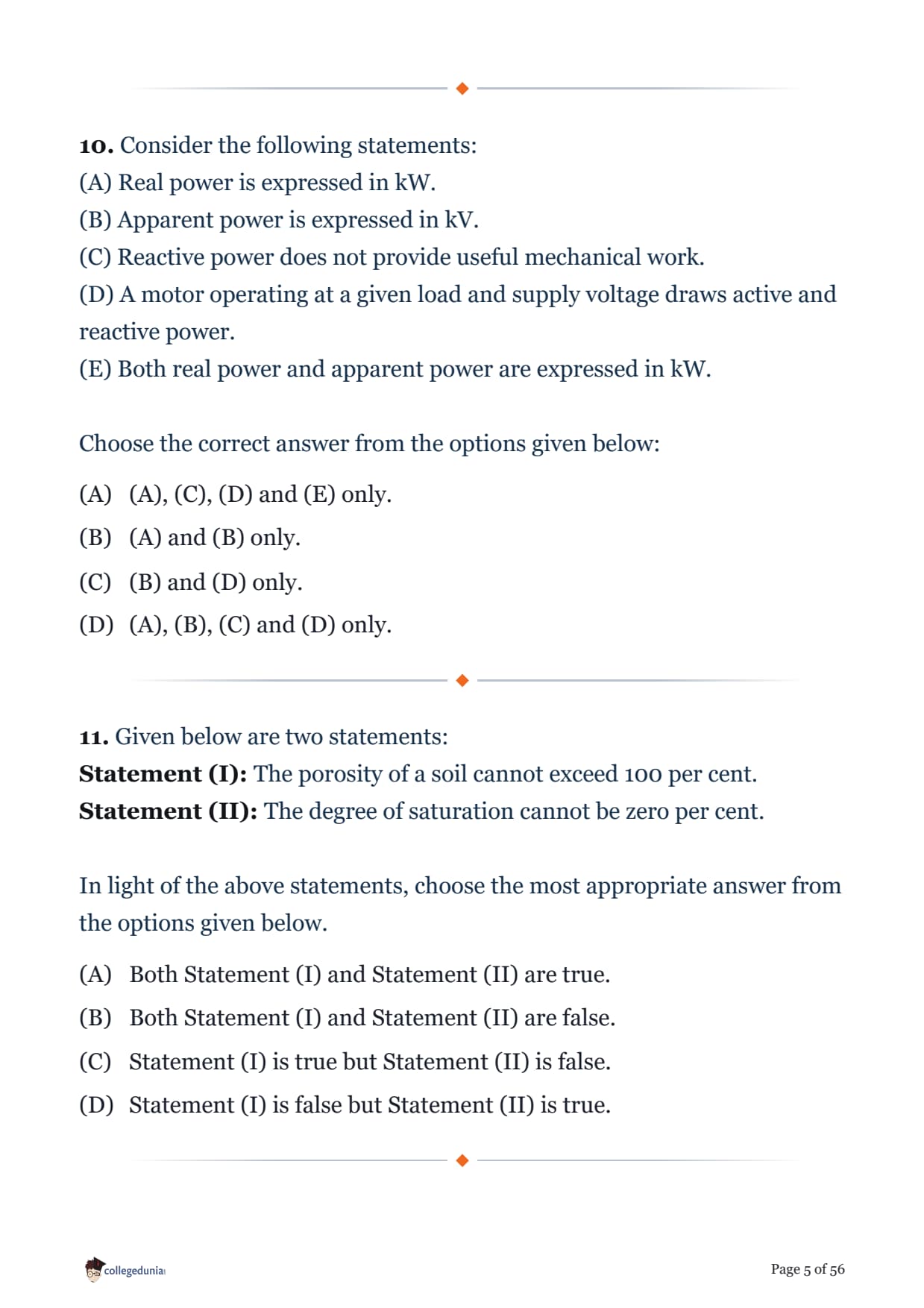
Question 10:

Consider the following statements:
(A) Real power is expressed in kW.
(B) Apparent power is expressed in kV.
(C) Reactive power does not provide useful mechanical work.
(D) A motor operating at a given load and supply voltage draws active and reactive power.
(E) Both real power and apparent power are expressed in kW.

Choose the correct answer from the options given below:

  • (A) (A), (C), (D) and (E) only.
  • (B) (A) and (B) only.
  • (C) (B) and (D) only.
  • (D) (A), (B), (C) and (D) only.

Question 11:

Given below are two statements:
Statement (I): The porosity of a soil cannot exceed 100 per cent.
Statement (II): The degree of saturation cannot be zero per cent.

In light of the above statements, choose the most appropriate answer from the options given below.

  • (A) Both Statement (I) and Statement (II) are true.
  • (B) Both Statement (I) and Statement (II) are false.
  • (C) Statement (I) is true but Statement (II) is false.
  • (D) Statement (I) is false but Statement (II) is true.

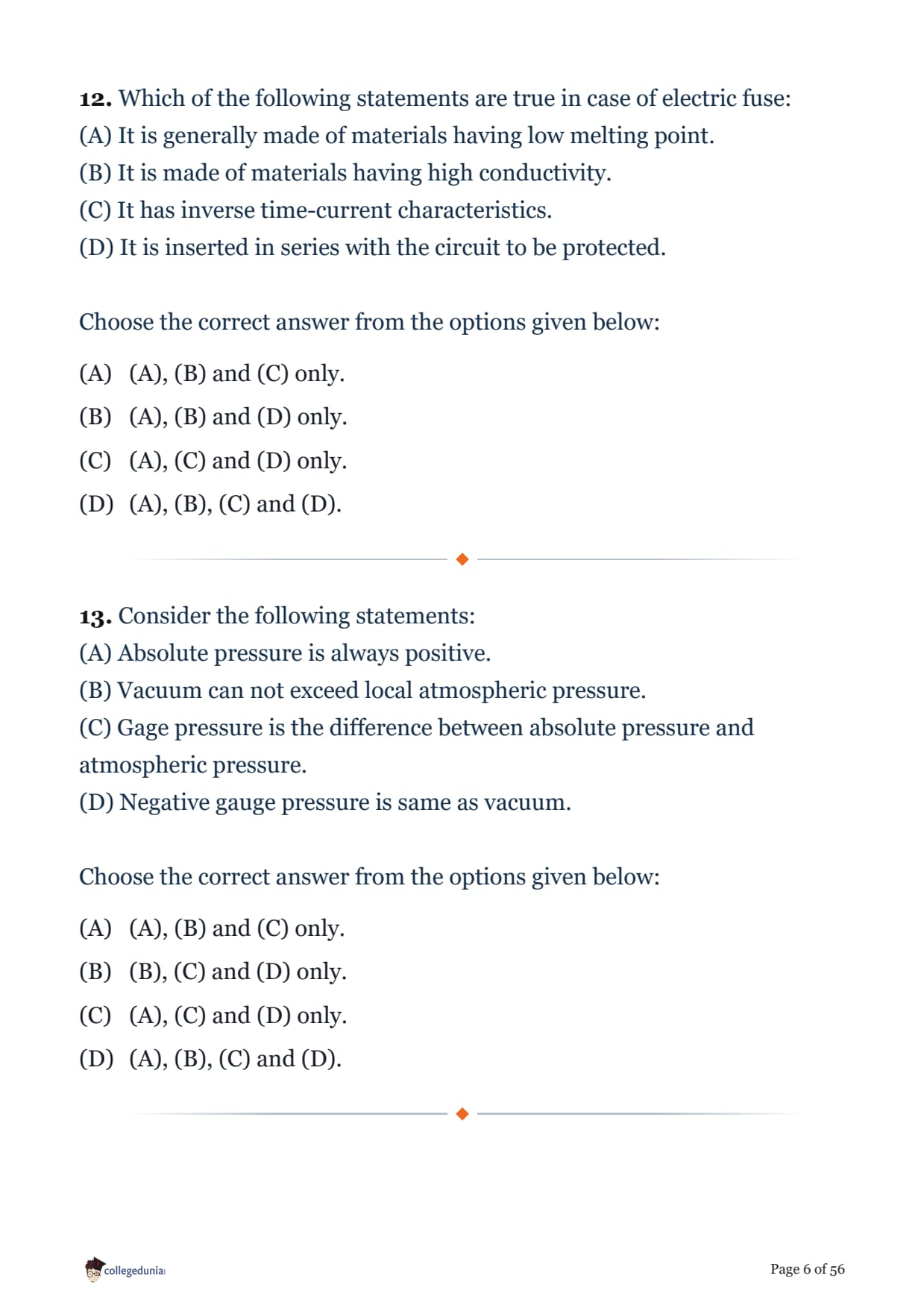
Question 12:

Which of the following statements are true in case of electric fuse:
(A) It is generally made of materials having low melting point.
(B) It is made of materials having high conductivity.
(C) It has inverse time-current characteristics.
(D) It is inserted in series with the circuit to be protected.

Choose the correct answer from the options given below:

  • (A) (A), (B) and (C) only.
  • (B) (A), (B) and (D) only.
  • (C) (A), (C) and (D) only.
  • (D) (A), (B), (C) and (D).

Question 13:

Consider the following statements:
(A) Absolute pressure is always positive.
(B) Vacuum can not exceed local atmospheric pressure.
(C) Gage pressure is the difference between absolute pressure and atmospheric pressure.
(D) Negative gauge pressure is same as vacuum.

Choose the correct answer from the options given below:

  • (A) (A), (B) and (C) only.
  • (B) (B), (C) and (D) only.
  • (C) (A), (C) and (D) only.
  • (D) (A), (B), (C) and (D).

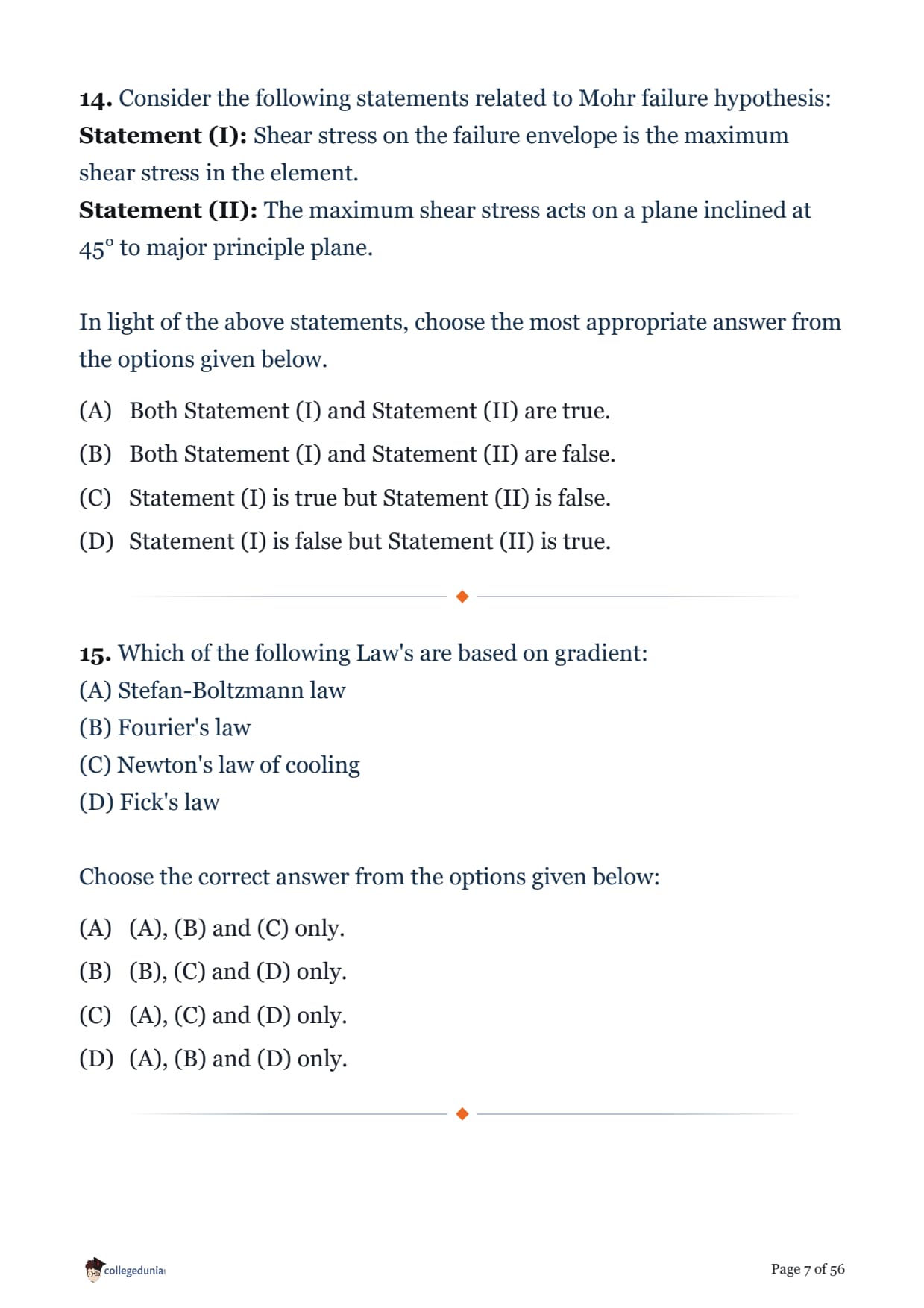
Question 14:

Consider the following statements related to Mohr failure hypothesis:
Statement (I): Shear stress on the failure envelope is the maximum shear stress in the element.
Statement (II): The maximum shear stress acts on a plane inclined at 45° to major principle plane.

In light of the above statements, choose the most appropriate answer from the options given below.

  • (A) Both Statement (I) and Statement (II) are true.
  • (B) Both Statement (I) and Statement (II) are false.
  • (C) Statement (I) is true but Statement (II) is false.
  • (D) Statement (I) is false but Statement (II) is true.

Question 15:

Which of the following Law's are based on gradient:
(A) Stefan-Boltzmann law
(B) Fourier's law
(C) Newton's law of cooling
(D) Fick's law

Choose the correct answer from the options given below:

  • (A) (A), (B) and (C) only.
  • (B) (B), (C) and (D) only.
  • (C) (A), (C) and (D) only.
  • (D) (A), (B) and (D) only.

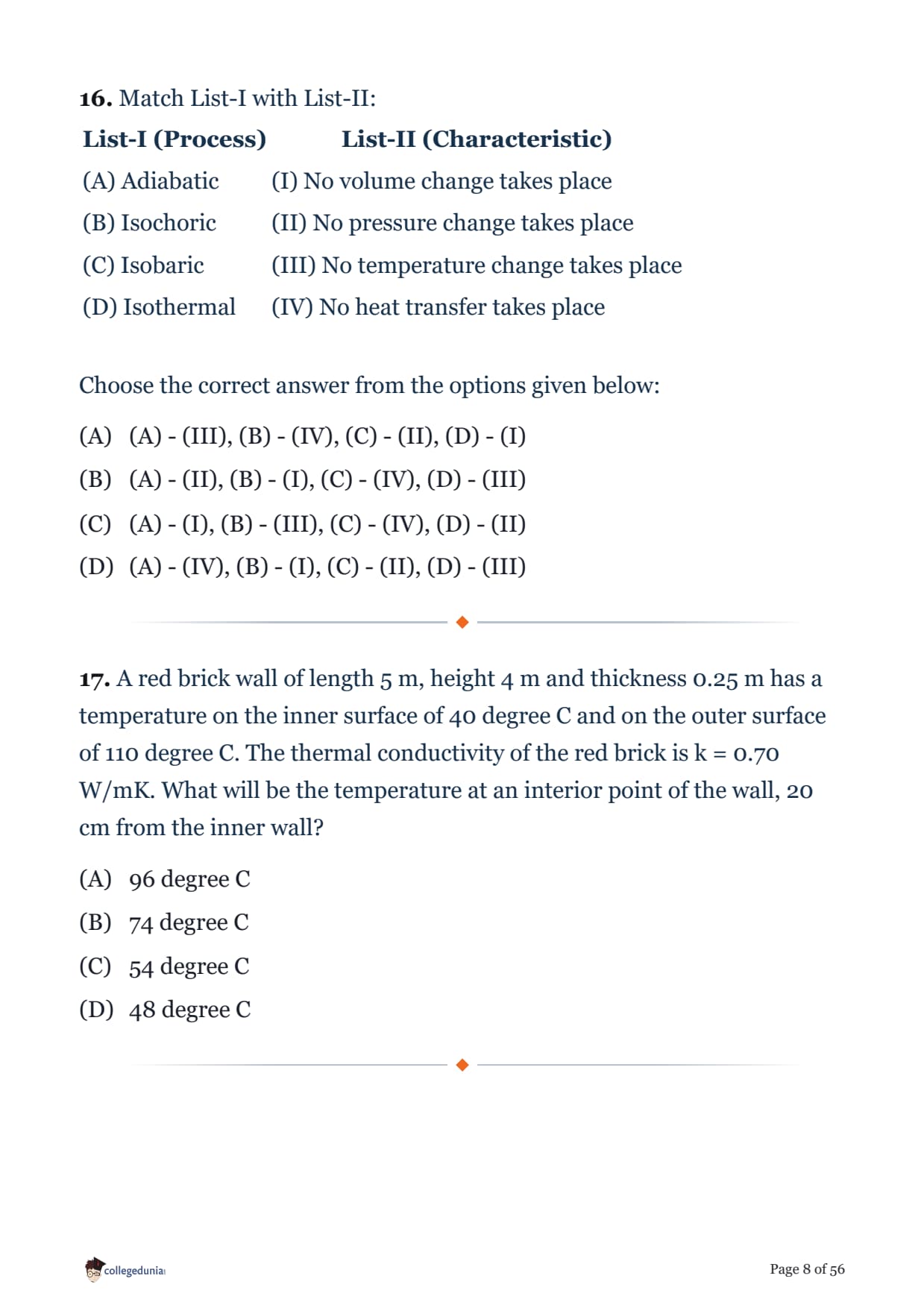
Question 16:

Match List-I with List-II:

List-I (Process)List-II (Characteristic)
(A) Adiabatic(I) No volume change takes place
(B) Isochoric(II) No pressure change takes place
(C) Isobaric(III) No temperature change takes place
(D) Isothermal(IV) No heat transfer takes place

Choose the correct answer from the options given below:

  • (A) (A) - (III), (B) - (IV), (C) - (II), (D) - (I)
  • (B) (A) - (II), (B) - (I), (C) - (IV), (D) - (III)
  • (C) (A) - (I), (B) - (III), (C) - (IV), (D) - (II)
  • (D) (A) - (IV), (B) - (I), (C) - (II), (D) - (III)

Question 17:

A red brick wall of length 5 m, height 4 m and thickness 0.25 m has a temperature on the inner surface of 40 degree C and on the outer surface of 110 degree C. The thermal conductivity of the red brick is k = 0.70 W/mK. What will be the temperature at an interior point of the wall, 20 cm from the inner wall?

  • (A) 96 degree C
  • (B) 74 degree C
  • (C) 54 degree C
  • (D) 48 degree C

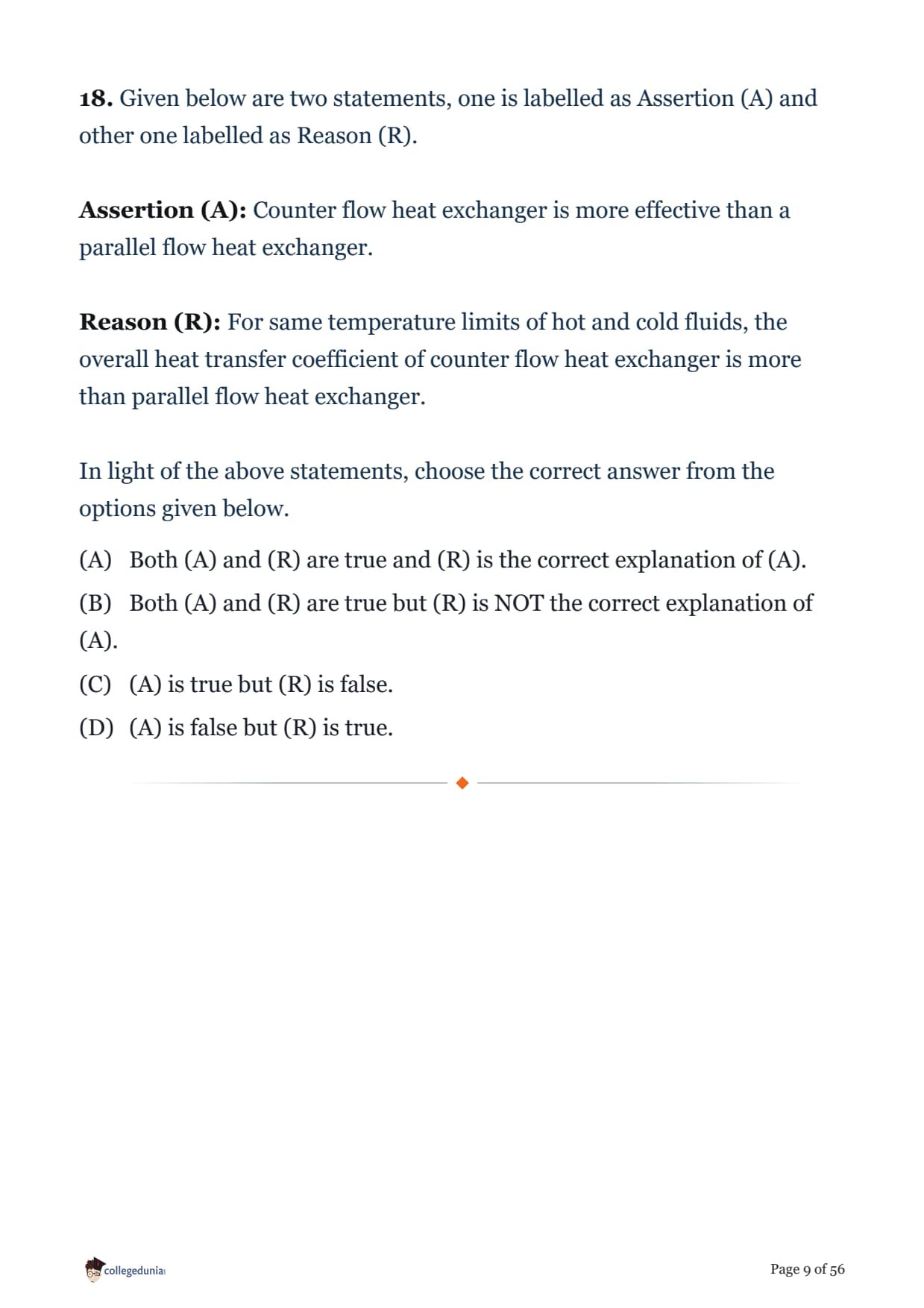
Question 18:

Given below are two statements, one is labelled as Assertion (A) and other one labelled as Reason (R).

Assertion (A): Counter flow heat exchanger is more effective than a parallel flow heat exchanger.

Reason (R): For same temperature limits of hot and cold fluids, the overall heat transfer coefficient of counter flow heat exchanger is more than parallel flow heat exchanger.

In light of the above statements, choose the correct answer from the options given below.

  • (A) Both (A) and (R) are true and (R) is the correct explanation of (A).
  • (B) Both (A) and (R) are true but (R) is NOT the correct explanation of (A).
  • (C) (A) is true but (R) is false.
  • (D) (A) is false but (R) is true.

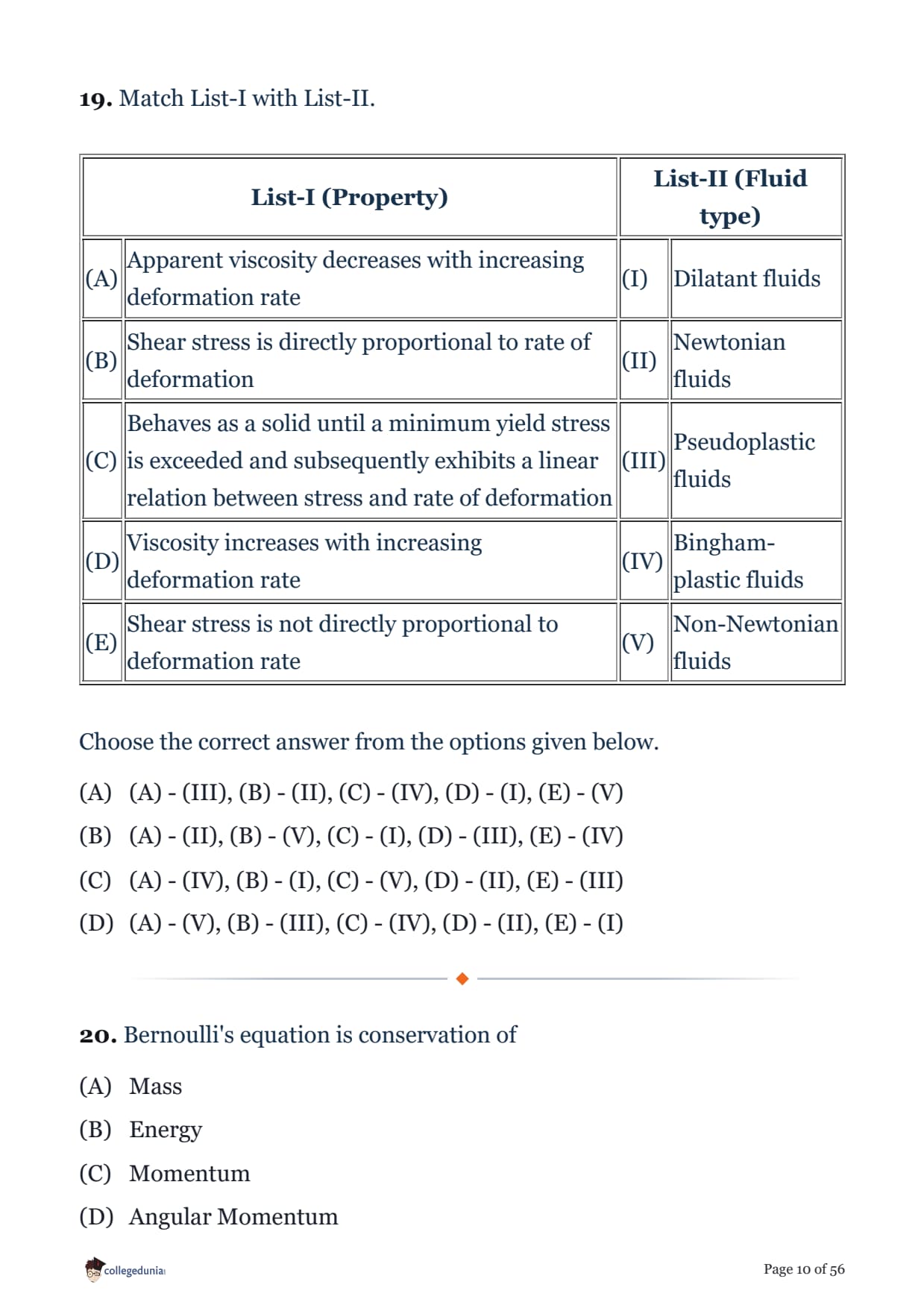
Question 19:

Match List-I with List-II.

List-I (Property)List-II (Fluid type)
(A)Apparent viscosity decreases with increasing deformation rate(I)Dilatant fluids
(B)Shear stress is directly proportional to rate of deformation(II)Newtonian fluids
(C)Behaves as a solid until a minimum yield stress is exceeded and subsequently exhibits a linear relation between stress and rate of deformation(III)Pseudoplastic fluids
(D)Viscosity increases with increasing deformation rate(IV)Bingham-plastic fluids
(E)Shear stress is not directly proportional to deformation rate(V)Non-Newtonian fluids

Choose the correct answer from the options given below.

  • (A) (A) - (III), (B) - (II), (C) - (IV), (D) - (I), (E) - (V)
  • (B) (A) - (II), (B) - (V), (C) - (I), (D) - (III), (E) - (IV)
  • (C) (A) - (IV), (B) - (I), (C) - (V), (D) - (II), (E) - (III)
  • (D) (A) - (V), (B) - (III), (C) - (IV), (D) - (II), (E) - (I)

Question 20:

Bernoulli's equation is conservation of

  • (A) Mass
  • (B) Energy
  • (C) Momentum
  • (D) Angular Momentum

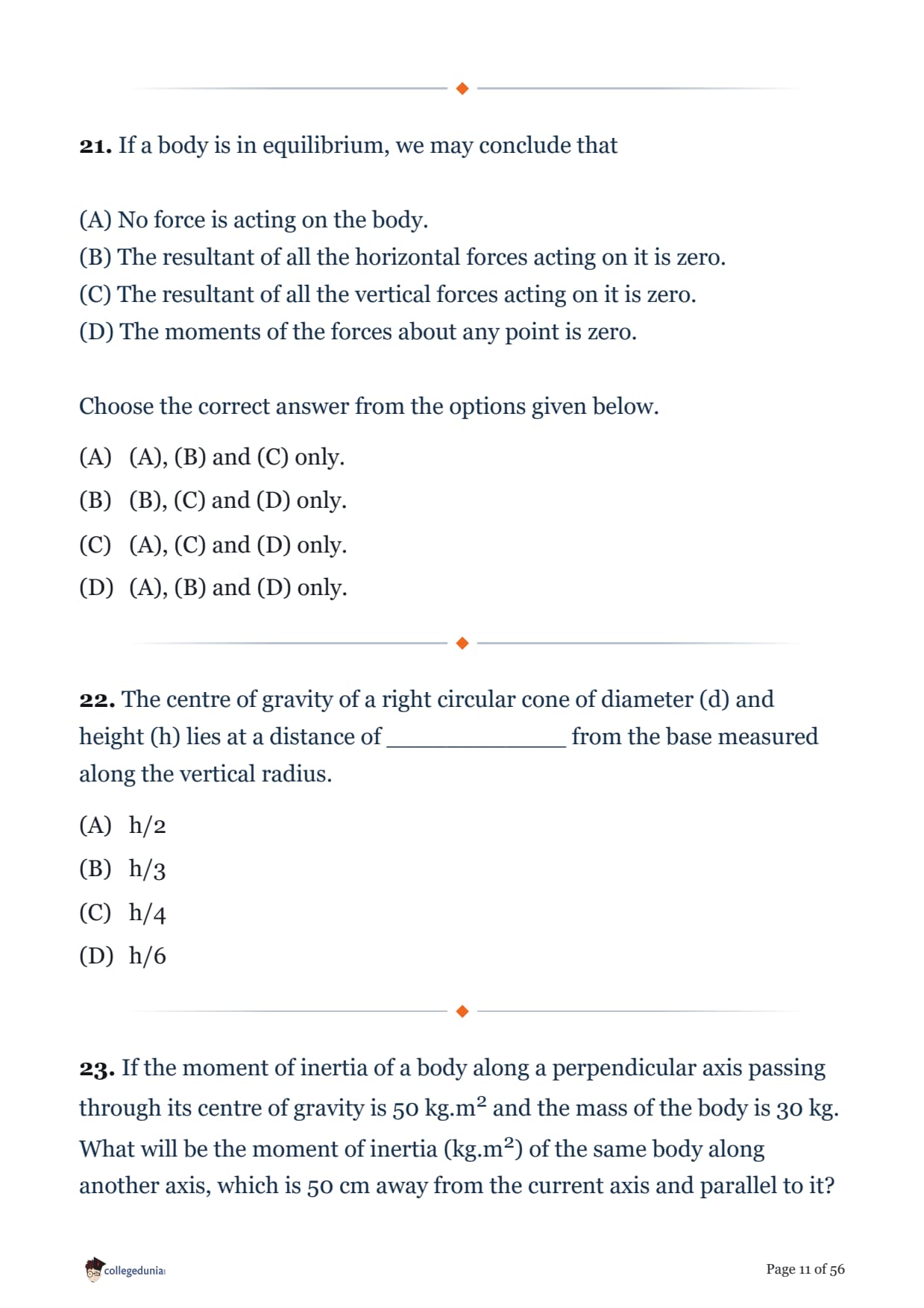
Question 21:

If a body is in equilibrium, we may conclude that

(A) No force is acting on the body.
(B) The resultant of all the horizontal forces acting on it is zero.
(C) The resultant of all the vertical forces acting on it is zero.
(D) The moments of the forces about any point is zero.

Choose the correct answer from the options given below.

  • (A) (A), (B) and (C) only.
  • (B) (B), (C) and (D) only.
  • (C) (A), (C) and (D) only.
  • (D) (A), (B) and (D) only.

Question 22:

The centre of gravity of a right circular cone of diameter (d) and height (h) lies at a distance of ____________ from the base measured along the vertical radius.

  • (A) h/2
  • (B) h/3
  • (C) h/4
  • (D) h/6

Question 23:

If the moment of inertia of a body along a perpendicular axis passing through its centre of gravity is 50 kg.m2 and the mass of the body is 30 kg. What will be the moment of inertia (kg.m2) of the same body along another axis, which is 50 cm away from the current axis and parallel to it?

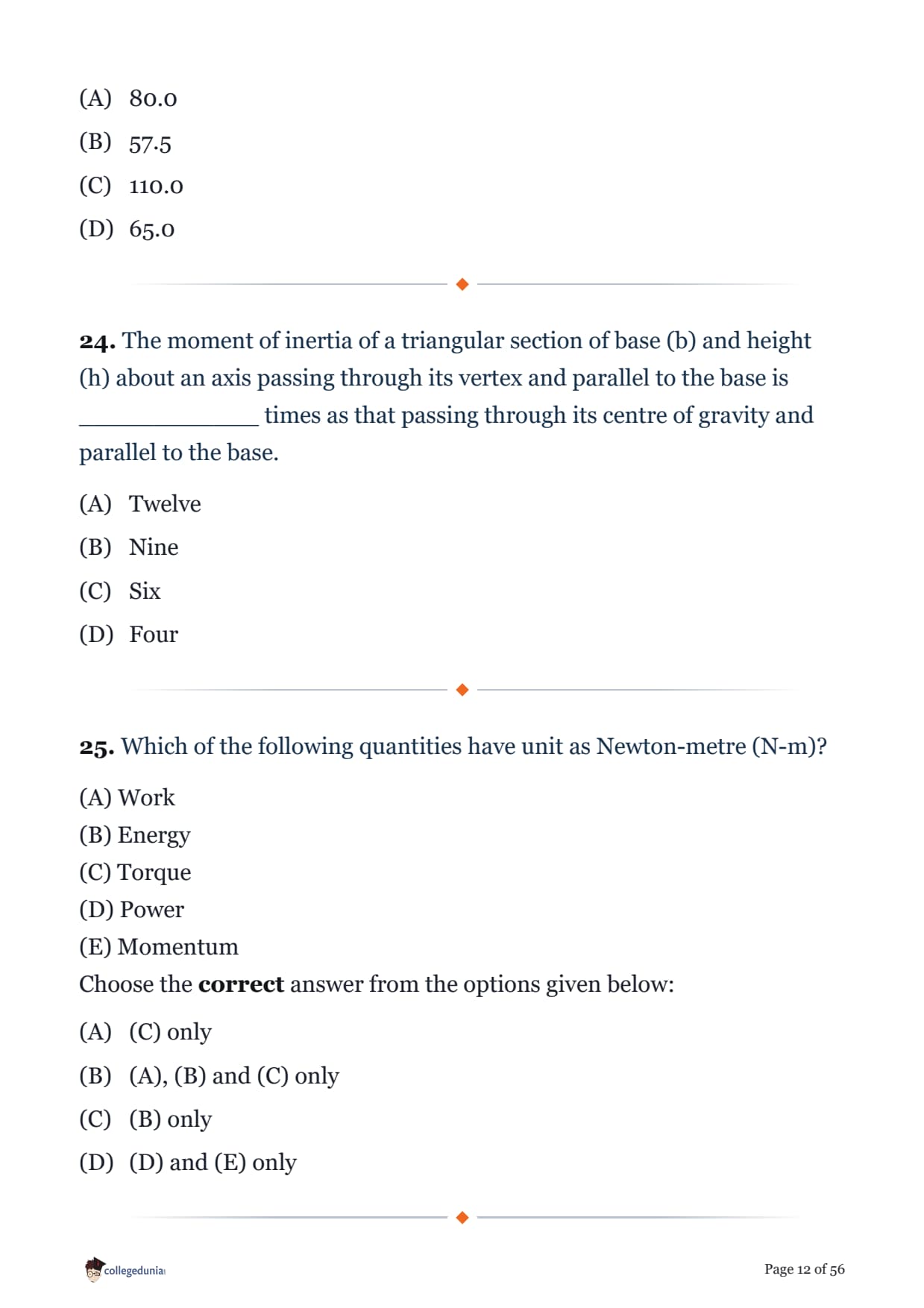
  • (A) 80.0
  • (B) 57.5
  • (C) 110.0
  • (D) 65.0

Question 24:

The moment of inertia of a triangular section of base (b) and height (h) about an axis passing through its vertex and parallel to the base is ____________ times as that passing through its centre of gravity and parallel to the base.

  • (A) Twelve
  • (B) Nine
  • (C) Six
  • (D) Four

Question 25:

Which of the following quantities have unit as Newton-metre (N-m)?

(A) Work
(B) Energy
(C) Torque
(D) Power
(E) Momentum
Choose the correct answer from the options given below:

  • (A) (C) only
  • (B) (A), (B) and (C) only
  • (C) (B) only
  • (D) (D) and (E) only

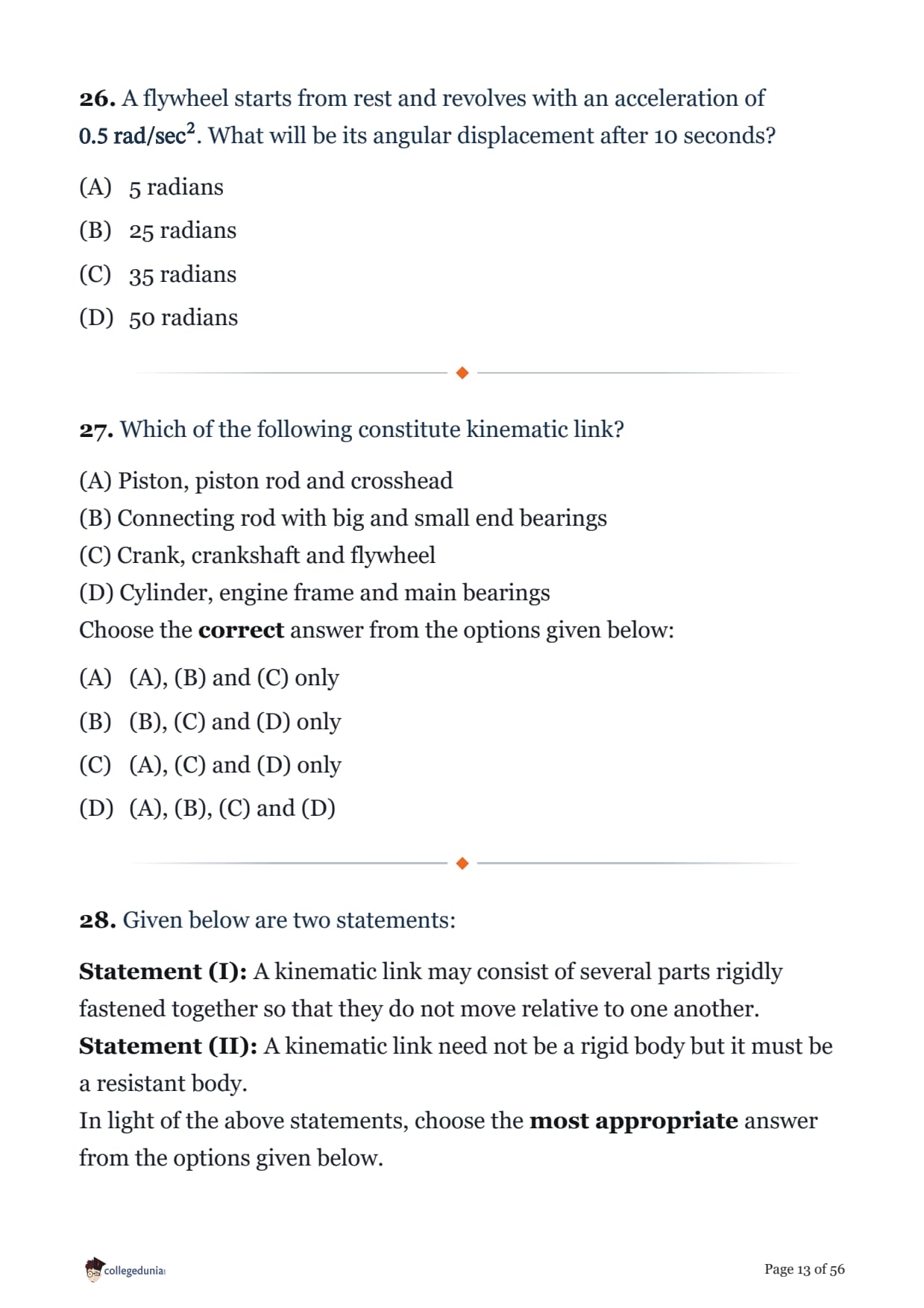
Question 26:

A flywheel starts from rest and revolves with an acceleration of \(0.5\ \text{rad/sec}^2\). What will be its angular displacement after 10 seconds?

  • (A) 5 radians
  • (B) 25 radians
  • (C) 35 radians
  • (D) 50 radians

Question 27:

Which of the following constitute kinematic link?

(A) Piston, piston rod and crosshead
(B) Connecting rod with big and small end bearings
(C) Crank, crankshaft and flywheel
(D) Cylinder, engine frame and main bearings
Choose the correct answer from the options given below:

  • (A) (A), (B) and (C) only
  • (B) (B), (C) and (D) only
  • (C) (A), (C) and (D) only
  • (D) (A), (B), (C) and (D)

Question 28:

Given below are two statements:

Statement (I): A kinematic link may consist of several parts rigidly fastened together so that they do not move relative to one another.
Statement (II): A kinematic link need not be a rigid body but it must be a resistant body.
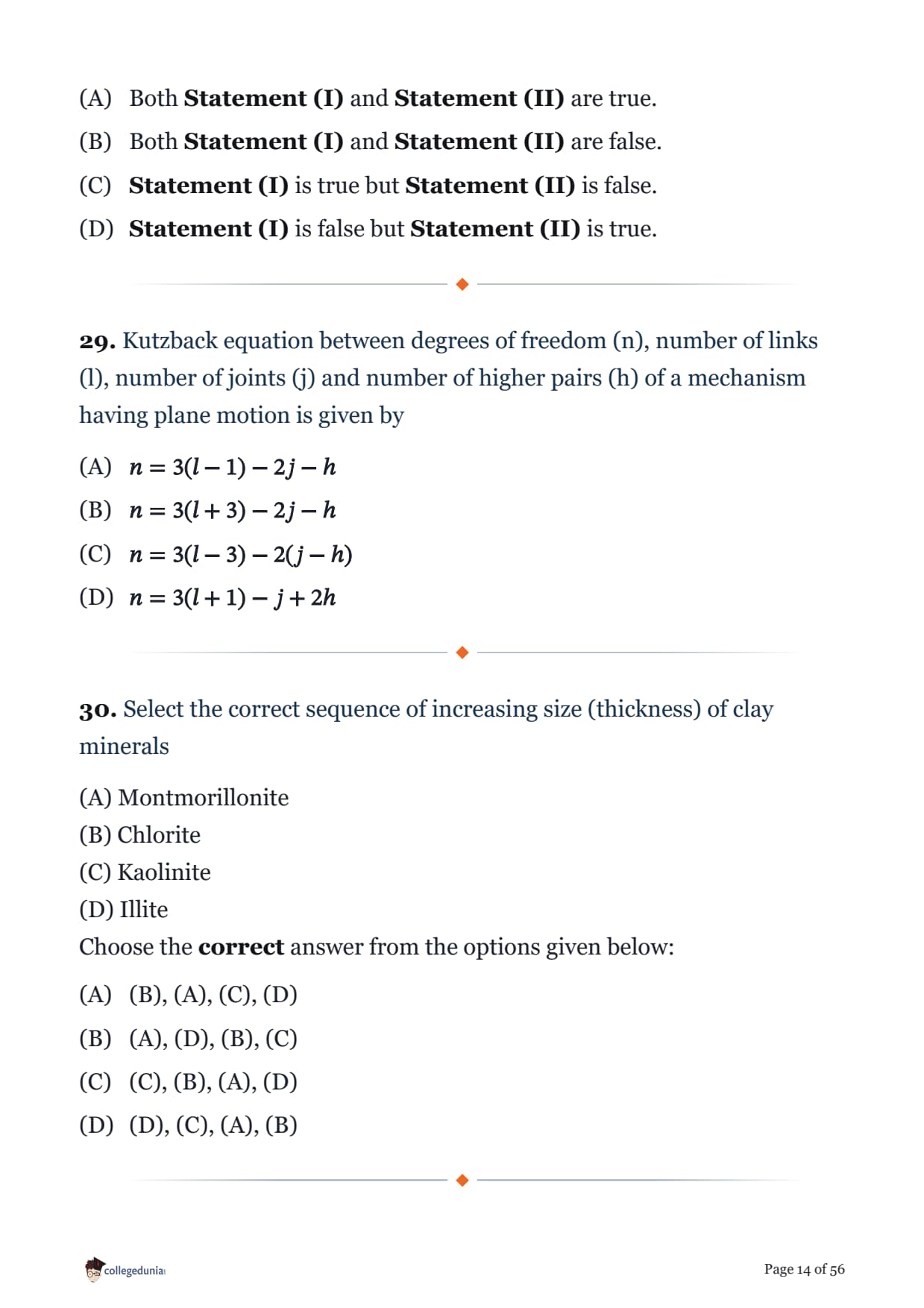
In light of the above statements, choose the most appropriate answer from the options given below.

  • (A) Both Statement (I) and Statement (II) are true.
  • (B) Both Statement (I) and Statement (II) are false.
  • (C) Statement (I) is true but Statement (II) is false.
  • (D) Statement (I) is false but Statement (II) is true.

Question 29:

Kutzback equation between degrees of freedom (n), number of links (l), number of joints (j) and number of higher pairs (h) of a mechanism having plane motion is given by

  • (A) \(n = 3(l-1) - 2j - h\)
  • (B) \(n = 3(l+3) - 2j - h\)
  • (C) \(n = 3(l-3) - 2(j-h)\)
  • (D) \(n = 3(l+1) - j + 2h\)

Question 30:

Select the correct sequence of increasing size (thickness) of clay minerals

(A) Montmorillonite
(B) Chlorite
(C) Kaolinite
(D) Illite
Choose the correct answer from the options given below:

  • (A) (B), (A), (C), (D)
  • (B) (A), (D), (B), (C)
  • (C) (C), (B), (A), (D)
  • (D) (D), (C), (A), (B)

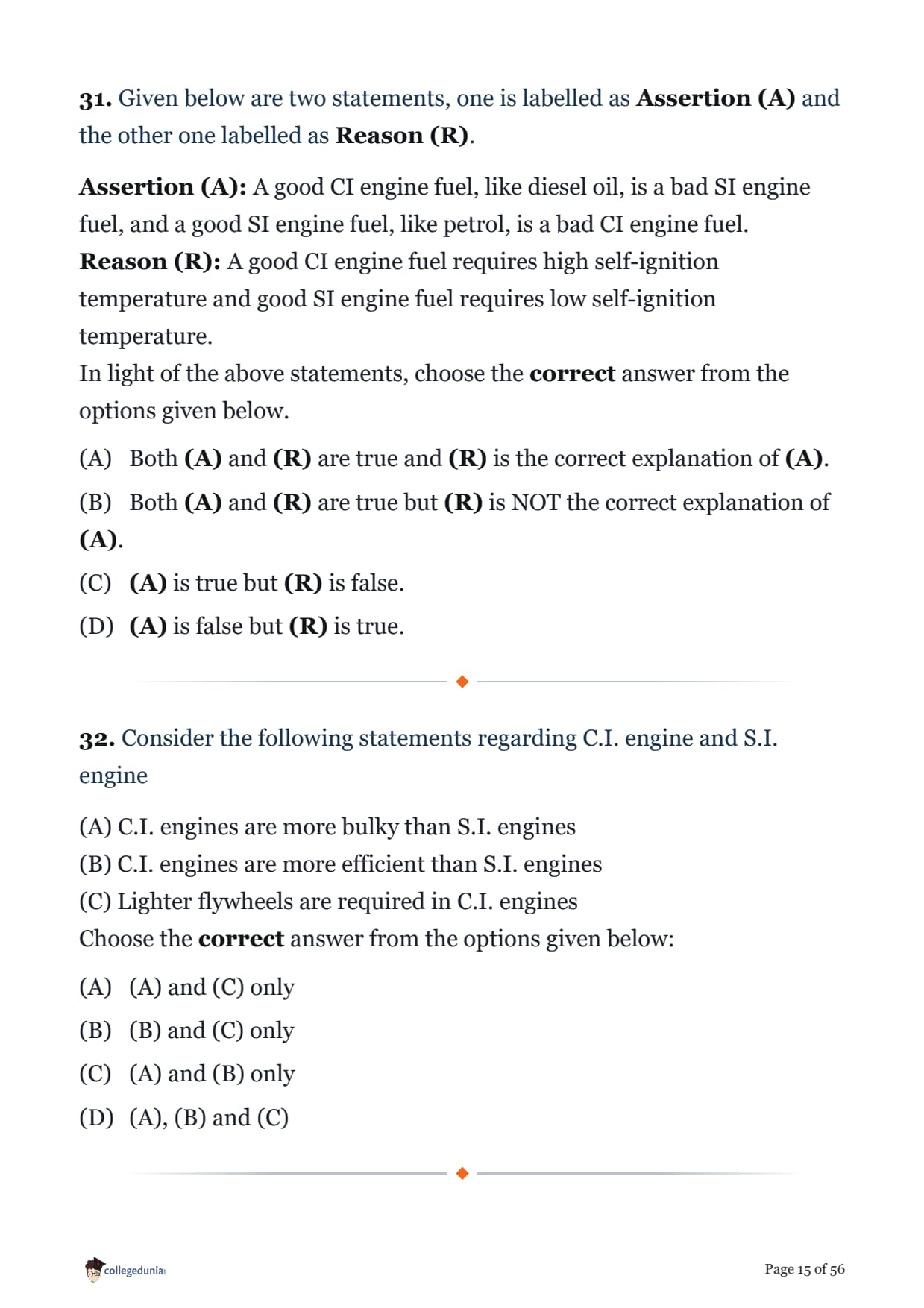
Question 31:

Given below are two statements, one is labelled as Assertion (A) and the other one labelled as Reason (R).

Assertion (A): A good CI engine fuel, like diesel oil, is a bad SI engine fuel, and a good SI engine fuel, like petrol, is a bad CI engine fuel.
Reason (R): A good CI engine fuel requires high self-ignition temperature and good SI engine fuel requires low self-ignition temperature.
In light of the above statements, choose the correct answer from the options given below.

  • (A) Both (A) and (R) are true and (R) is the correct explanation of (A).
  • (B) Both (A) and (R) are true but (R) is NOT the correct explanation of (A).
  • (C) (A) is true but (R) is false.
  • (D) (A) is false but (R) is true.

Question 32:

Consider the following statements regarding C.I. engine and S.I. engine

(A) C.I. engines are more bulky than S.I. engines
(B) C.I. engines are more efficient than S.I. engines
(C) Lighter flywheels are required in C.I. engines
Choose the correct answer from the options given below:

  • (A) (A) and (C) only
  • (B) (B) and (C) only
  • (C) (A) and (B) only
  • (D) (A), (B) and (C)

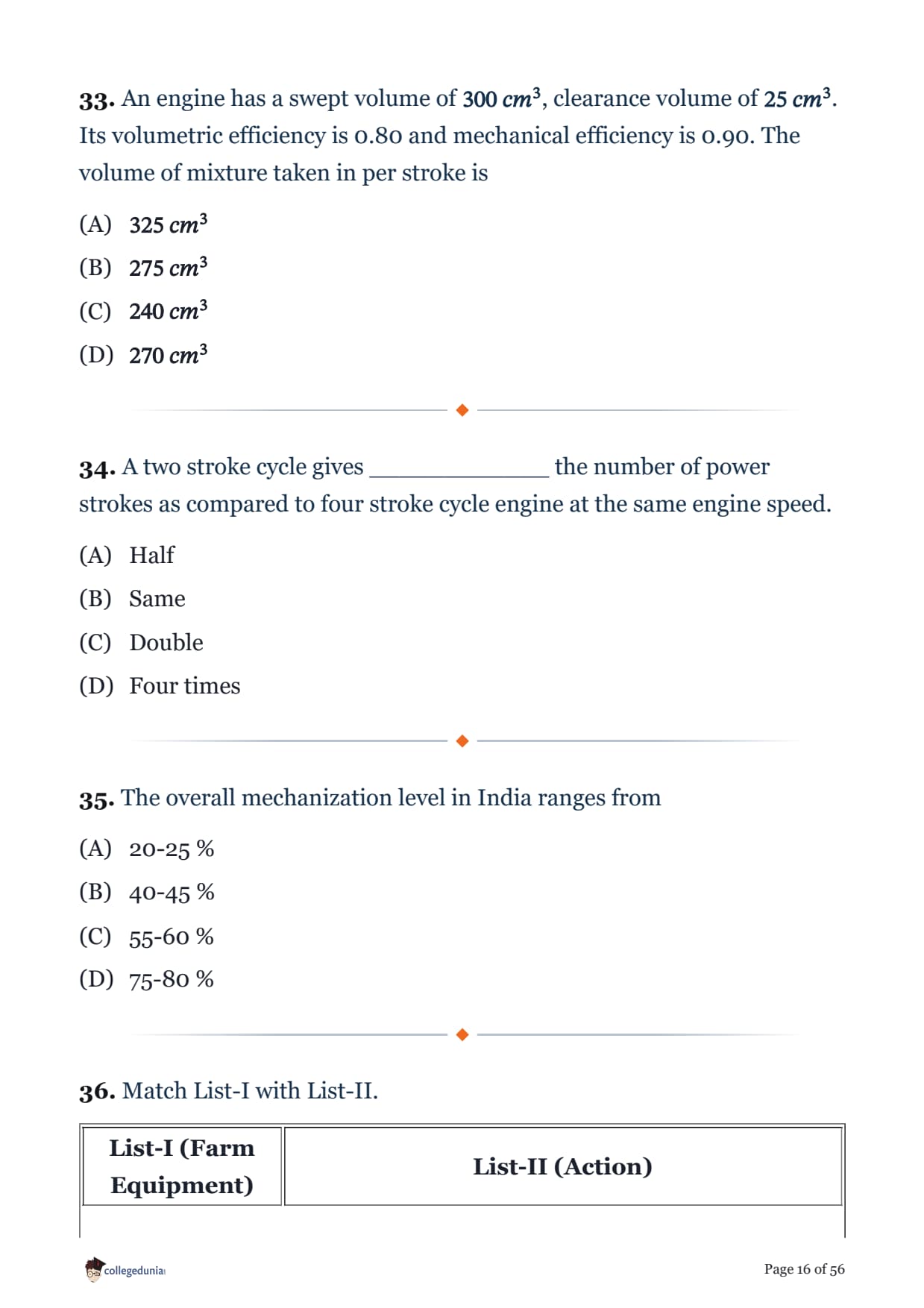
Question 33:

An engine has a swept volume of \(300\ cm^3\), clearance volume of \(25\ cm^3\). Its volumetric efficiency is 0.80 and mechanical efficiency is 0.90. The volume of mixture taken in per stroke is

  • (A) \(325\ cm^3\)
  • (B) \(275\ cm^3\)
  • (C) \(240\ cm^3\)
  • (D) \(270\ cm^3\)

Question 34:

A two stroke cycle gives ____________ the number of power strokes as compared to four stroke cycle engine at the same engine speed.

  • (A) Half
  • (B) Same
  • (C) Double
  • (D) Four times

Question 35:

The overall mechanization level in India ranges from

  • (A) 20-25 %
  • (B) 40-45 %
  • (C) 55-60 %
  • (D) 75-80 %

Question 36:

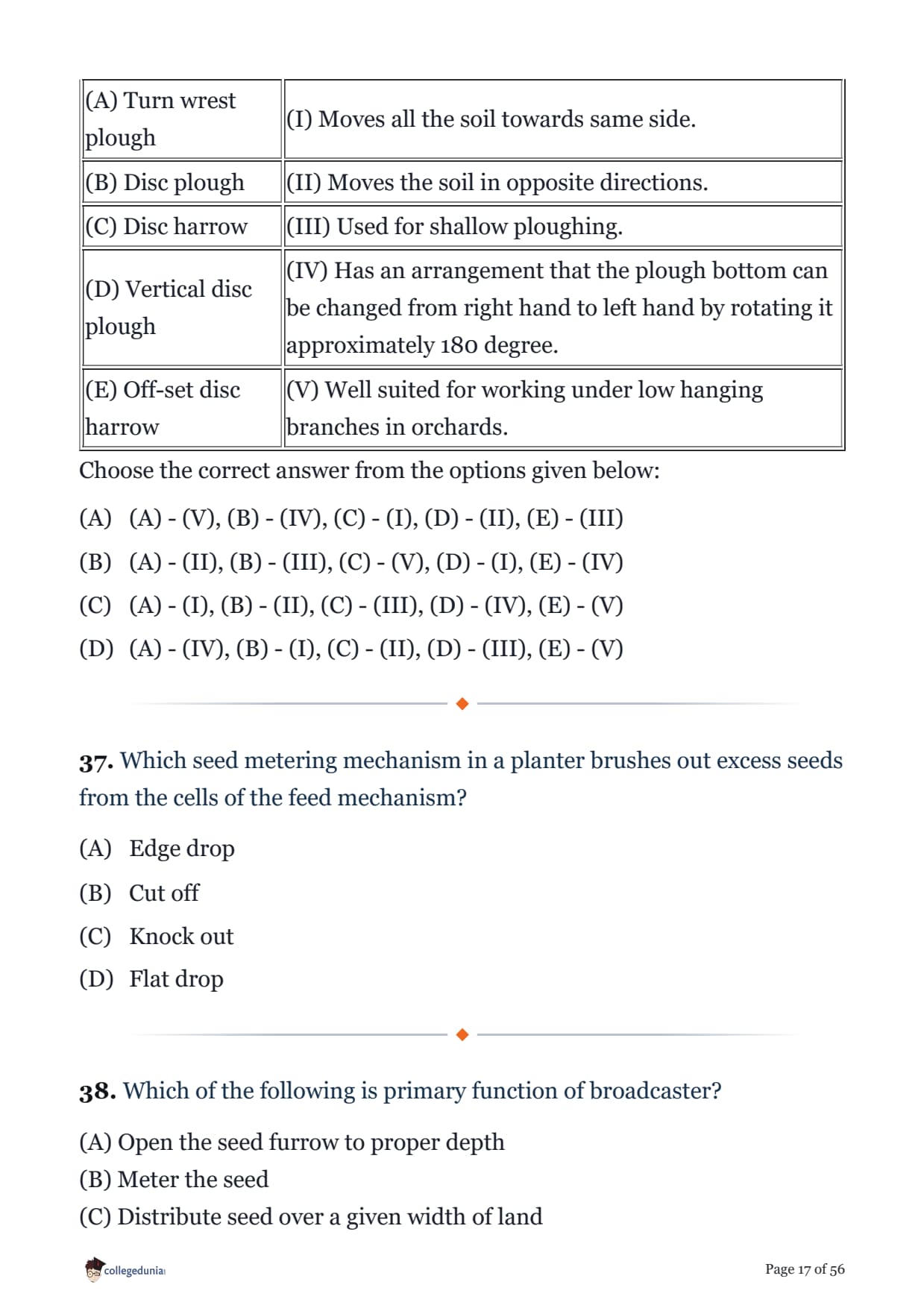
Match List-I with List-II.

List-I (Farm Equipment)List-II (Action)
(A) Turn wrest plough(I) Moves all the soil towards same side.
(B) Disc plough(II) Moves the soil in opposite directions.
(C) Disc harrow(III) Used for shallow ploughing.
(D) Vertical disc plough(IV) Has an arrangement that the plough bottom can be changed from right hand to left hand by rotating it approximately 180 degree.
(E) Off-set disc harrow(V) Well suited for working under low hanging branches in orchards.
Choose the correct answer from the options given below:

  • (A) (A) - (V), (B) - (IV), (C) - (I), (D) - (II), (E) - (III)
  • (B) (A) - (II), (B) - (III), (C) - (V), (D) - (I), (E) - (IV)
  • (C) (A) - (I), (B) - (II), (C) - (III), (D) - (IV), (E) - (V)
  • (D) (A) - (IV), (B) - (I), (C) - (II), (D) - (III), (E) - (V)

Question 37:

Which seed metering mechanism in a planter brushes out excess seeds from the cells of the feed mechanism?

  • (A) Edge drop
  • (B) Cut off
  • (C) Knock out
  • (D) Flat drop

Question 38:

Which of the following is primary function of broadcaster?

(A) Open the seed furrow to proper depth
(B) Meter the seed
(C) Distribute seed over a given width of land
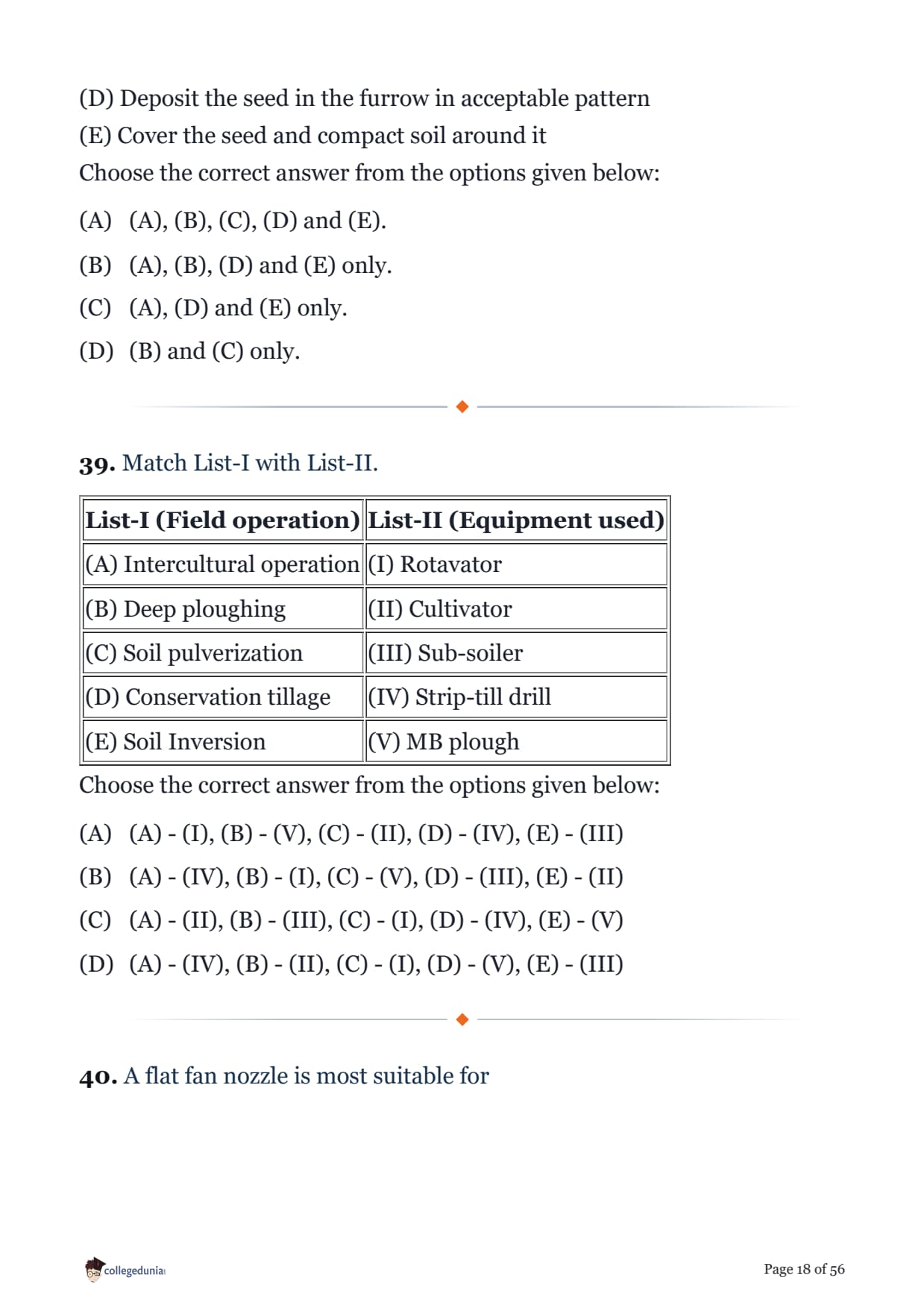
(D) Deposit the seed in the furrow in acceptable pattern
(E) Cover the seed and compact soil around it
Choose the correct answer from the options given below:

  • (A) (A), (B), (C), (D) and (E).
  • (B) (A), (B), (D) and (E) only.
  • (C) (A), (D) and (E) only.
  • (D) (B) and (C) only.

Question 39:

Match List-I with List-II.

List-I (Field operation)List-II (Equipment used)
(A) Intercultural operation(I) Rotavator
(B) Deep ploughing(II) Cultivator
(C) Soil pulverization(III) Sub-soiler
(D) Conservation tillage(IV) Strip-till drill
(E) Soil Inversion(V) MB plough
Choose the correct answer from the options given below:

  • (A) (A) - (I), (B) - (V), (C) - (II), (D) - (IV), (E) - (III)
  • (B) (A) - (IV), (B) - (I), (C) - (V), (D) - (III), (E) - (II)
  • (C) (A) - (II), (B) - (III), (C) - (I), (D) - (IV), (E) - (V)
  • (D) (A) - (IV), (B) - (II), (C) - (I), (D) - (V), (E) - (III)

Question 40:

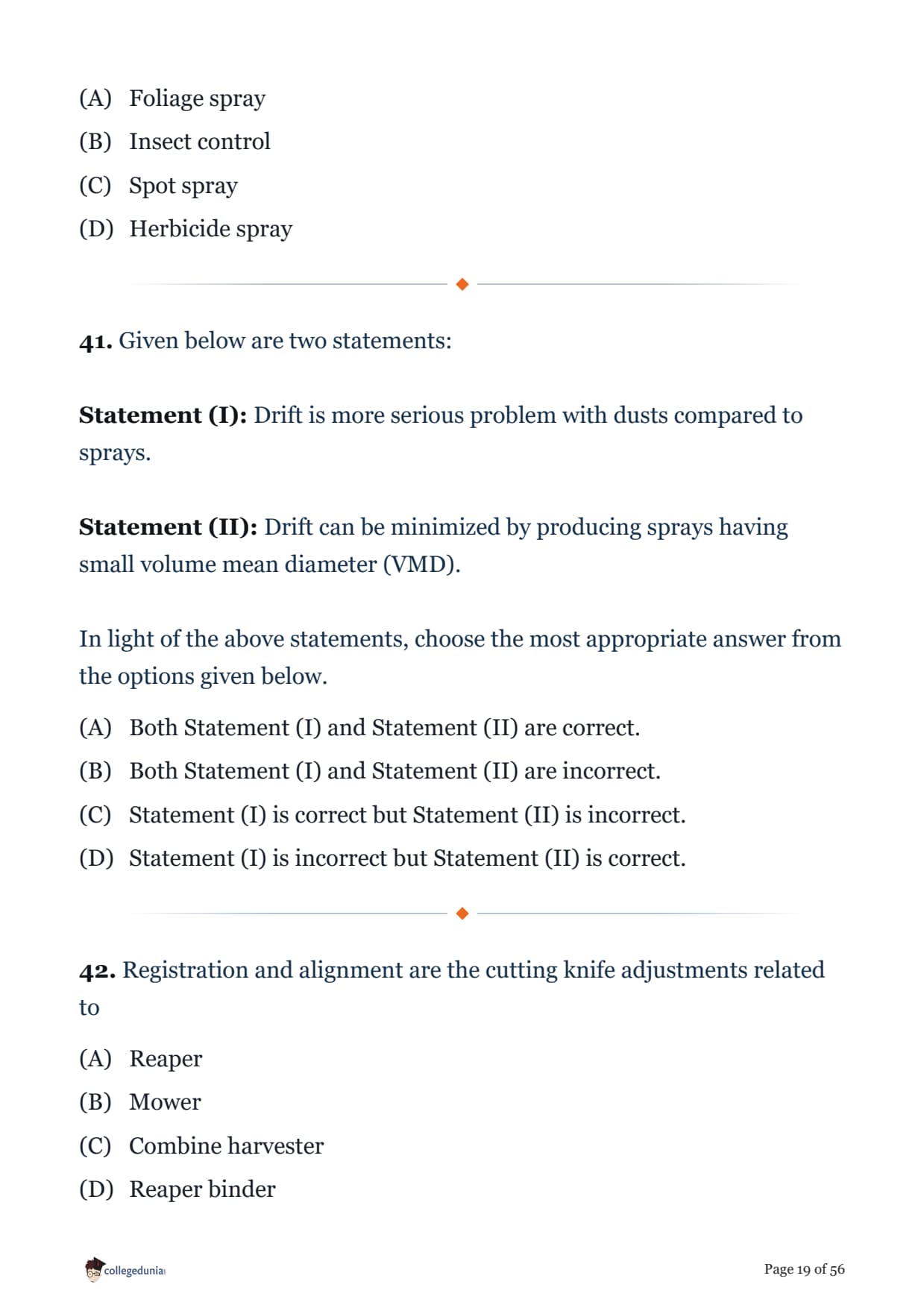
A flat fan nozzle is most suitable for

  • (A) Foliage spray
  • (B) Insect control
  • (C) Spot spray
  • (D) Herbicide spray

Question 41:

Given below are two statements:

Statement (I): Drift is more serious problem with dusts compared to sprays.

Statement (II): Drift can be minimized by producing sprays having small volume mean diameter (VMD).

In light of the above statements, choose the most appropriate answer from the options given below.

  • (A) Both Statement (I) and Statement (II) are correct.
  • (B) Both Statement (I) and Statement (II) are incorrect.
  • (C) Statement (I) is correct but Statement (II) is incorrect.
  • (D) Statement (I) is incorrect but Statement (II) is correct.

Question 42:

Registration and alignment are the cutting knife adjustments related to

  • (A) Reaper
  • (B) Mower
  • (C) Combine harvester
  • (D) Reaper binder

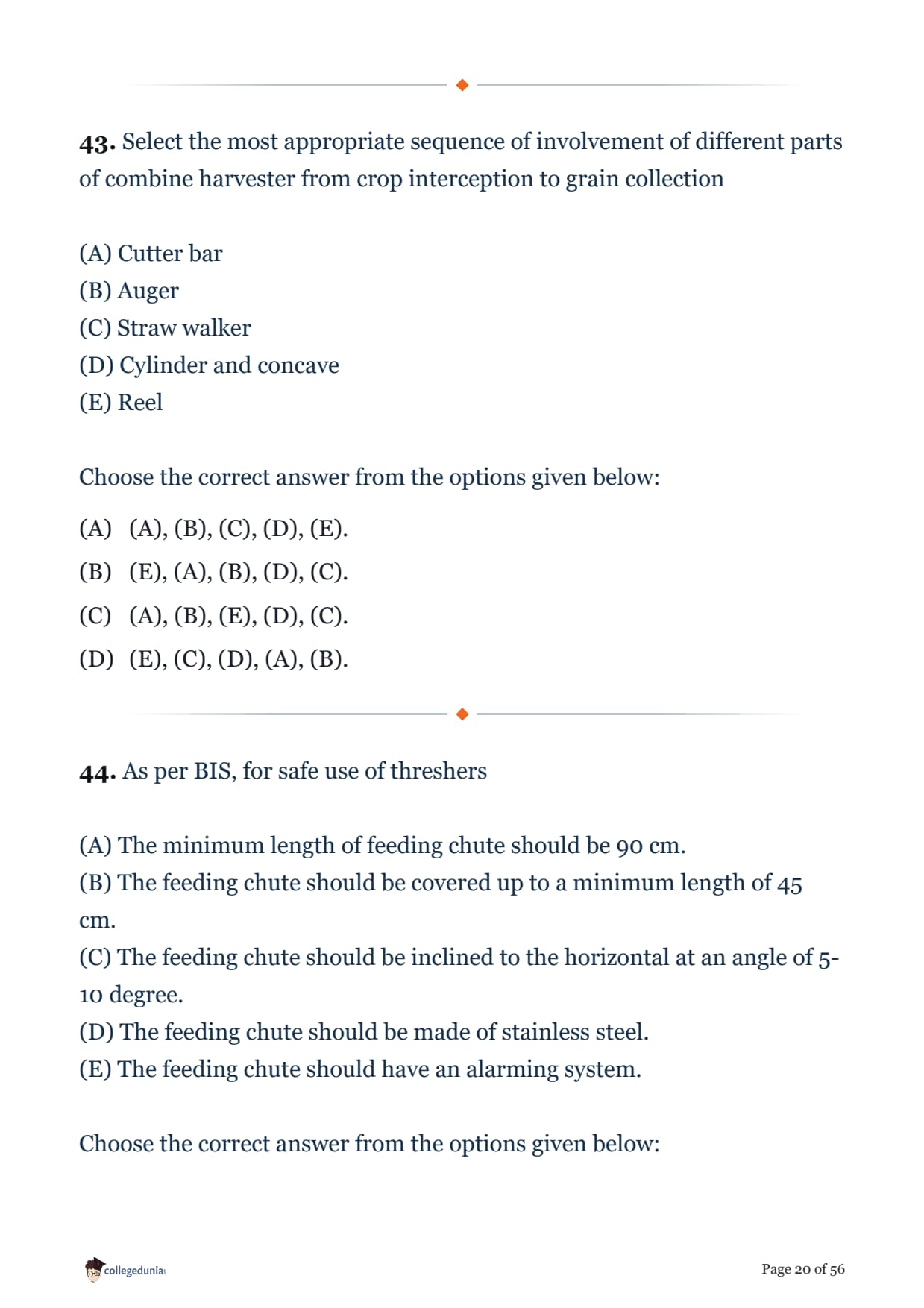
Question 43:

Select the most appropriate sequence of involvement of different parts of combine harvester from crop interception to grain collection

(A) Cutter bar
(B) Auger
(C) Straw walker
(D) Cylinder and concave
(E) Reel

Choose the correct answer from the options given below:

  • (A) (A), (B), (C), (D), (E).
  • (B) (E), (A), (B), (D), (C).
  • (C) (A), (B), (E), (D), (C).
  • (D) (E), (C), (D), (A), (B).

Question 44:

As per BIS, for safe use of threshers

(A) The minimum length of feeding chute should be 90 cm.
(B) The feeding chute should be covered up to a minimum length of 45 cm.
(C) The feeding chute should be inclined to the horizontal at an angle of 5-10 degree.
(D) The feeding chute should be made of stainless steel.
(E) The feeding chute should have an alarming system.

Choose the correct answer from the options given below:

  • (A) (A), (B) and (C) only.
  • (B) (B), (C) and (D) only.
  • (C) (B), (D) and (E) only.
  • (D) (A), (B) and (E) only.

Question 45:

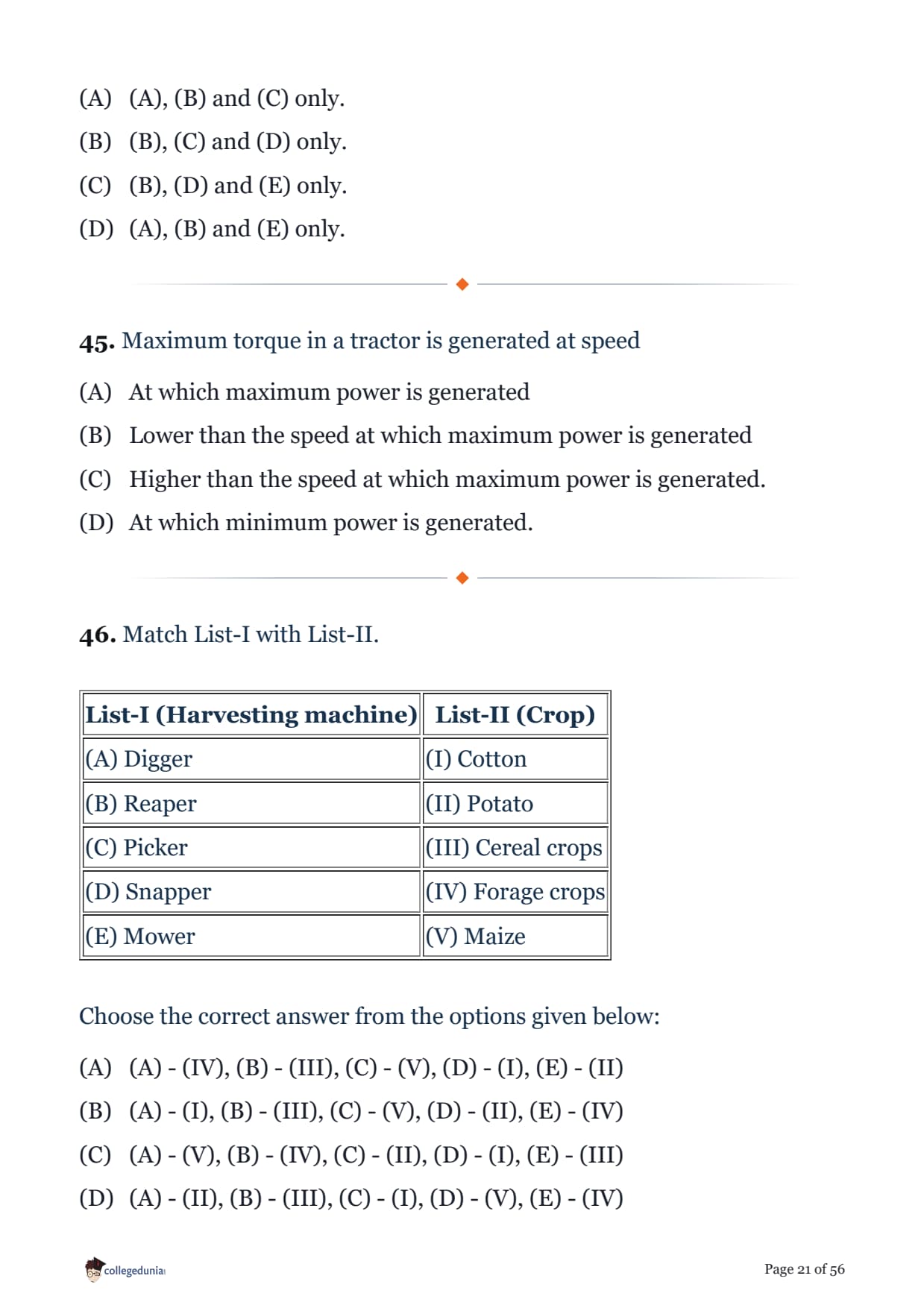
Maximum torque in a tractor is generated at speed

  • (A) At which maximum power is generated
  • (B) Lower than the speed at which maximum power is generated
  • (C) Higher than the speed at which maximum power is generated.
  • (D) At which minimum power is generated.

Question 46:

Match List-I with List-II.

List-I (Harvesting machine)List-II (Crop)
(A) Digger(I) Cotton
(B) Reaper(II) Potato
(C) Picker(III) Cereal crops
(D) Snapper(IV) Forage crops
(E) Mower(V) Maize

Choose the correct answer from the options given below:

  • (A) (A) - (IV), (B) - (III), (C) - (V), (D) - (I), (E) - (II)
  • (B) (A) - (I), (B) - (III), (C) - (V), (D) - (II), (E) - (IV)
  • (C) (A) - (V), (B) - (IV), (C) - (II), (D) - (I), (E) - (III)
  • (D) (A) - (II), (B) - (III), (C) - (I), (D) - (V), (E) - (IV)

Question 47:

Which of the following is harvesting machine?

(A) Cotton picker
(B) Potato Digger
(C) Mower
(D) Tree shaker

Choose the correct answer from the options given below:

  • (A) (C) only.
  • (B) (A) and (B) only.
  • (C) (B), (C) and (D) only.
  • (D) (A), (B), (C) and (D).

Question 48:

The acceptable work load for average Indian workers is about

  • (A) 35 % of individual's maximum aerobic power (VO2max)
  • (B) 50 % of individual's maximum aerobic power (VO2max)
  • (C) 65 % of individual's maximum aerobic power (VO2max)
  • (D) 80 % of individual's maximum aerobic power (VO2max)

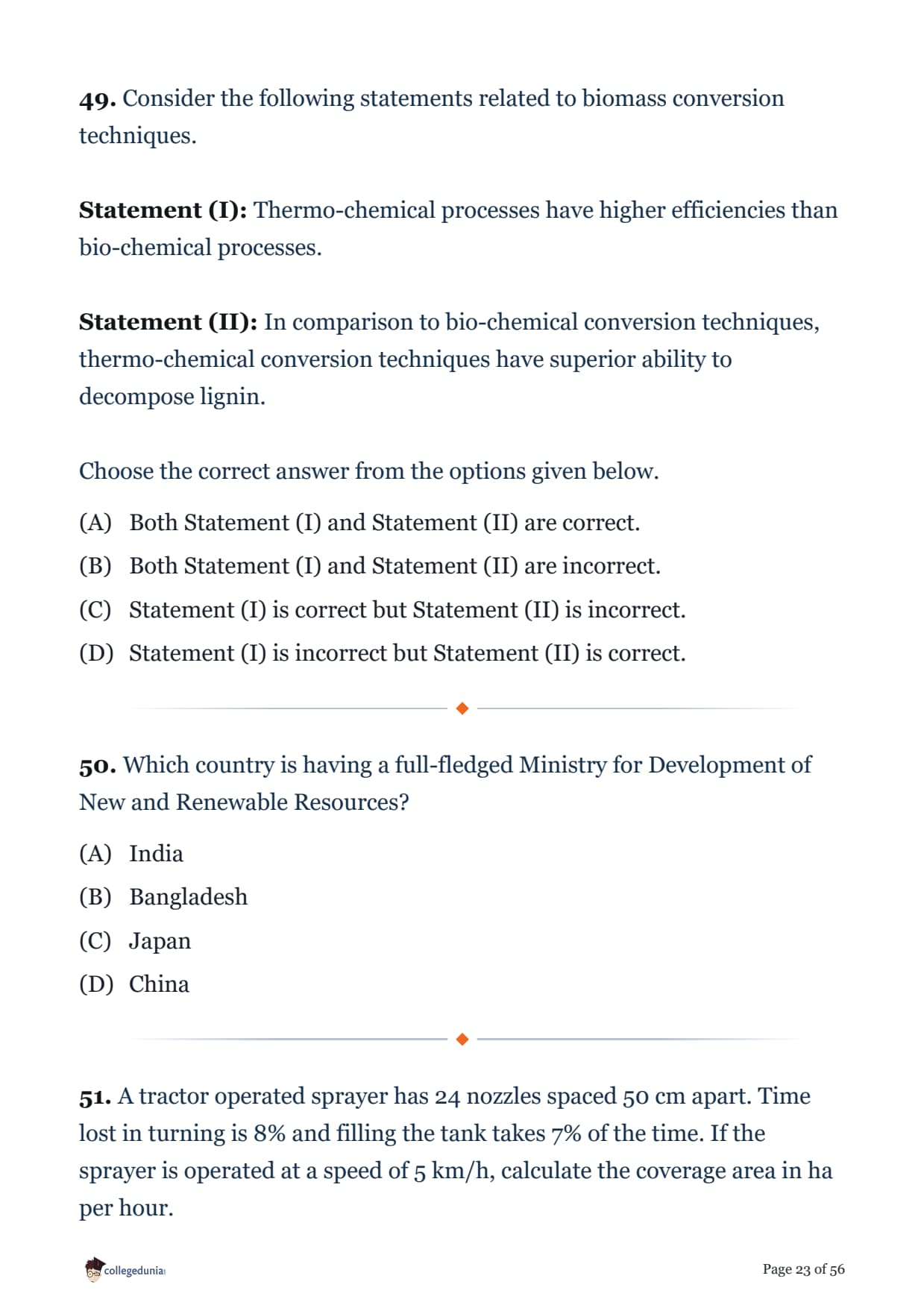
Question 49:

Consider the following statements related to biomass conversion techniques.

Statement (I): Thermo-chemical processes have higher efficiencies than bio-chemical processes.

Statement (II): In comparison to bio-chemical conversion techniques, thermo-chemical conversion techniques have superior ability to decompose lignin.

Choose the correct answer from the options given below.

  • (A) Both Statement (I) and Statement (II) are correct.
  • (B) Both Statement (I) and Statement (II) are incorrect.
  • (C) Statement (I) is correct but Statement (II) is incorrect.
  • (D) Statement (I) is incorrect but Statement (II) is correct.

Question 50:

Which country is having a full-fledged Ministry for Development of New and Renewable Resources?

  • (A) India
  • (B) Bangladesh
  • (C) Japan
  • (D) China

Question 51:

A tractor operated sprayer has 24 nozzles spaced 50 cm apart. Time lost in turning is 8% and filling the tank takes 7% of the time. If the sprayer is operated at a speed of 5 km/h, calculate the coverage area in ha per hour.

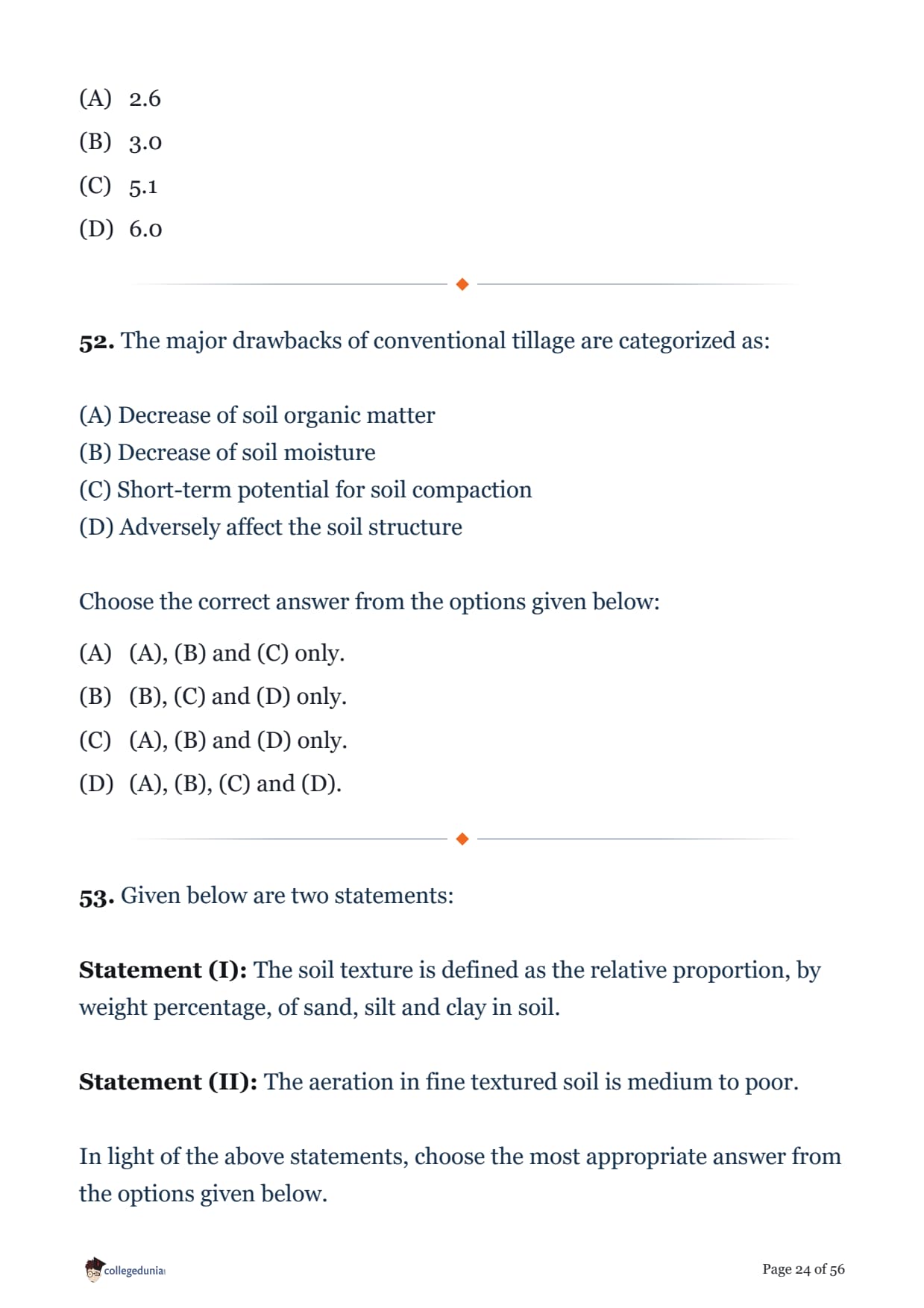
  • (A) 2.6
  • (B) 3.0
  • (C) 5.1
  • (D) 6.0

Question 52:

The major drawbacks of conventional tillage are categorized as:

(A) Decrease of soil organic matter
(B) Decrease of soil moisture
(C) Short-term potential for soil compaction
(D) Adversely affect the soil structure

Choose the correct answer from the options given below:

  • (A) (A), (B) and (C) only.
  • (B) (B), (C) and (D) only.
  • (C) (A), (B) and (D) only.
  • (D) (A), (B), (C) and (D).

Question 53:

Given below are two statements:

Statement (I): The soil texture is defined as the relative proportion, by weight percentage, of sand, silt and clay in soil.

Statement (II): The aeration in fine textured soil is medium to poor.

In light of the above statements, choose the most appropriate answer from the options given below.

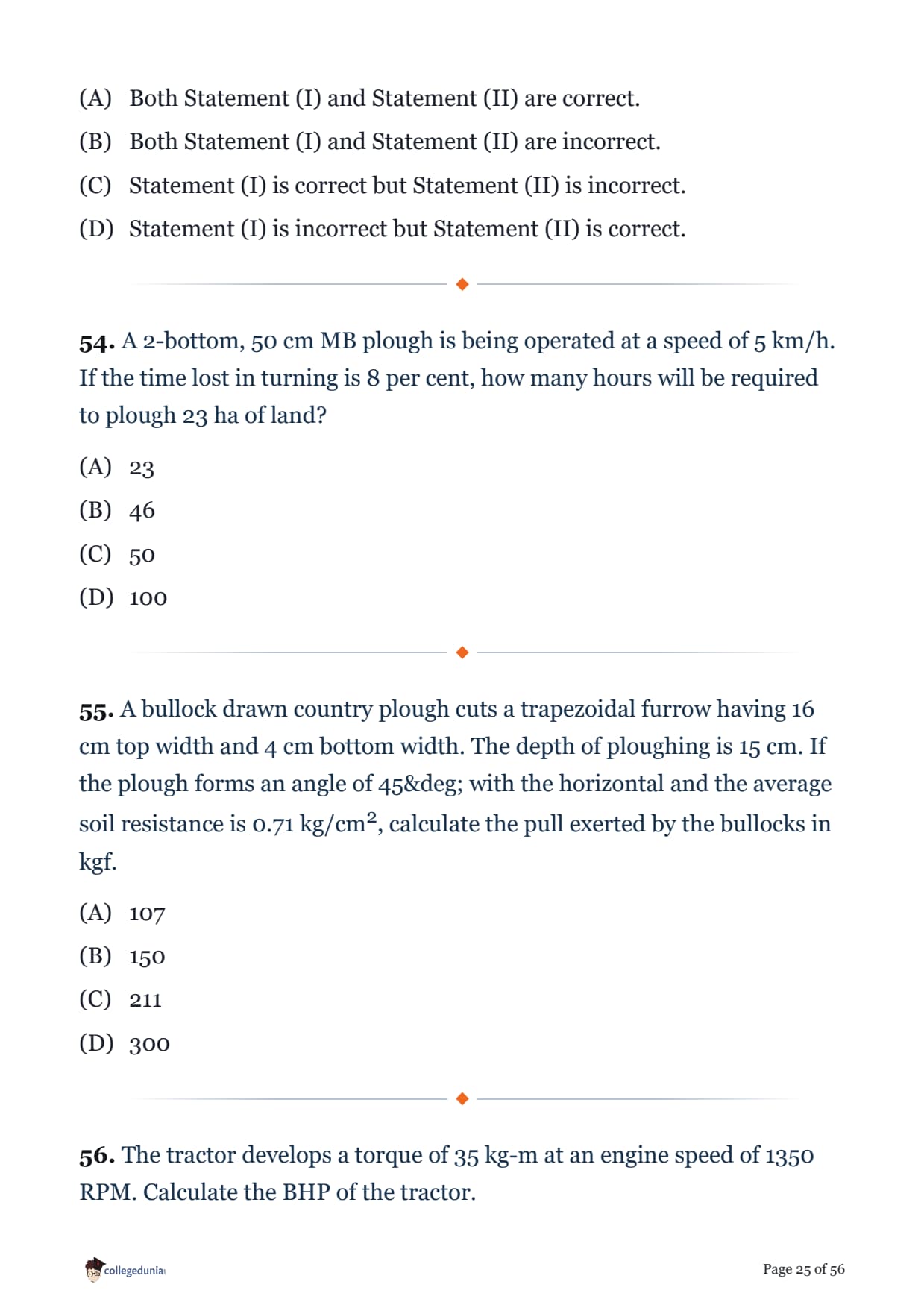
  • (A) Both Statement (I) and Statement (II) are correct.
  • (B) Both Statement (I) and Statement (II) are incorrect.
  • (C) Statement (I) is correct but Statement (II) is incorrect.
  • (D) Statement (I) is incorrect but Statement (II) is correct.

Question 54:

A 2-bottom, 50 cm MB plough is being operated at a speed of 5 km/h. If the time lost in turning is 8 per cent, how many hours will be required to plough 23 ha of land?

  • (A) 23
  • (B) 46
  • (C) 50
  • (D) 100

Question 55:

A bullock drawn country plough cuts a trapezoidal furrow having 16 cm top width and 4 cm bottom width. The depth of ploughing is 15 cm. If the plough forms an angle of 45° with the horizontal and the average soil resistance is 0.71 kg/cm2, calculate the pull exerted by the bullocks in kgf.

  • (A) 107
  • (B) 150
  • (C) 211
  • (D) 300

Question 56:

The tractor develops a torque of 35 kg-m at an engine speed of 1350 RPM. Calculate the BHP of the tractor.

  • (A) 45
  • (B) 66
  • (C) 90
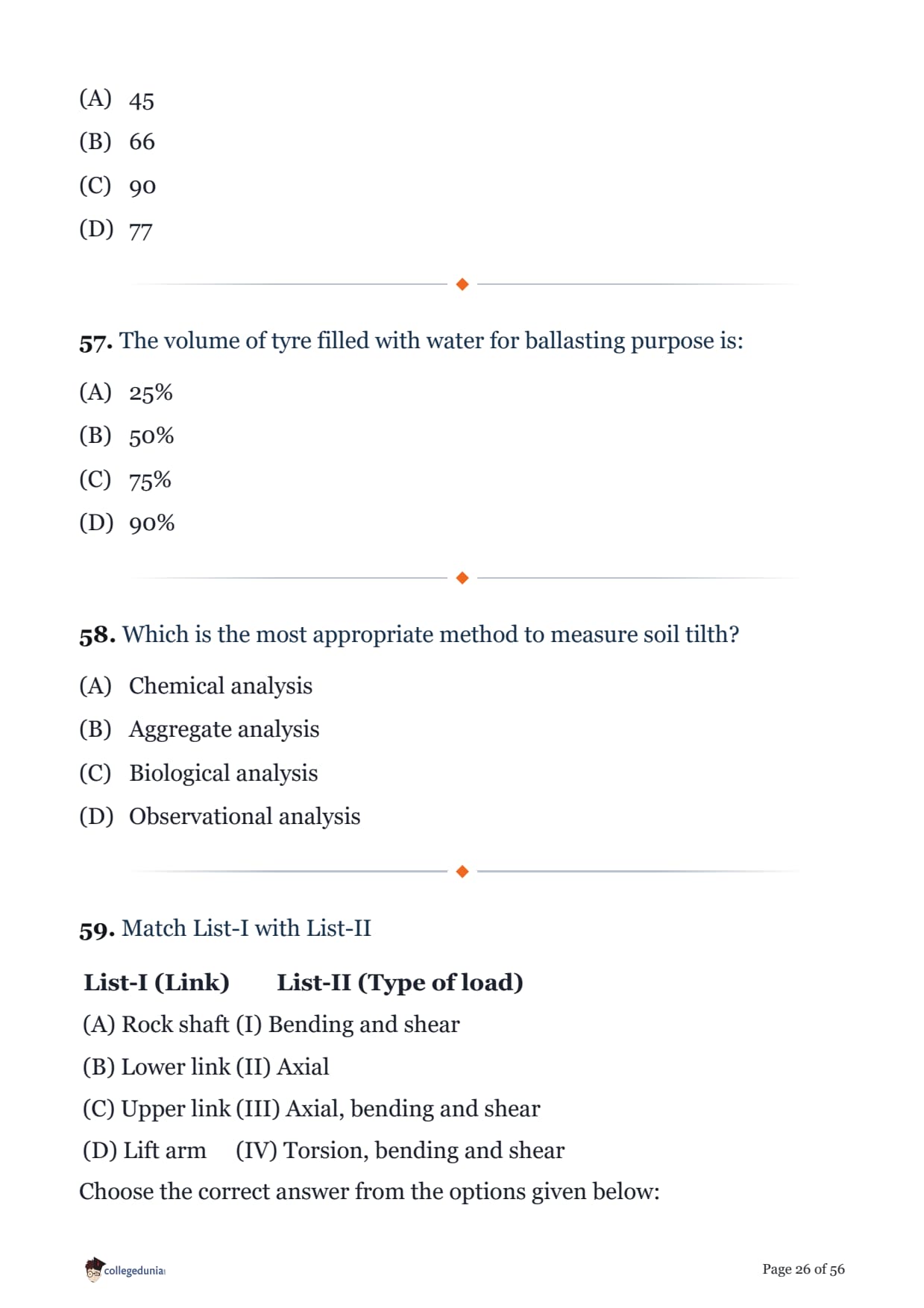
  • (D) 77

Question 57:

The volume of tyre filled with water for ballasting purpose is:

  • (A) 25%
  • (B) 50%
  • (C) 75%
  • (D) 90%

Question 58:

Which is the most appropriate method to measure soil tilth?

  • (A) Chemical analysis
  • (B) Aggregate analysis
  • (C) Biological analysis
  • (D) Observational analysis

Question 59:

Match List-I with List-II

List-I (Link)List-II (Type of load)
(A) Rock shaft(I) Bending and shear
(B) Lower link(II) Axial
(C) Upper link(III) Axial, bending and shear
(D) Lift arm(IV) Torsion, bending and shear
Choose the correct answer from the options given below:

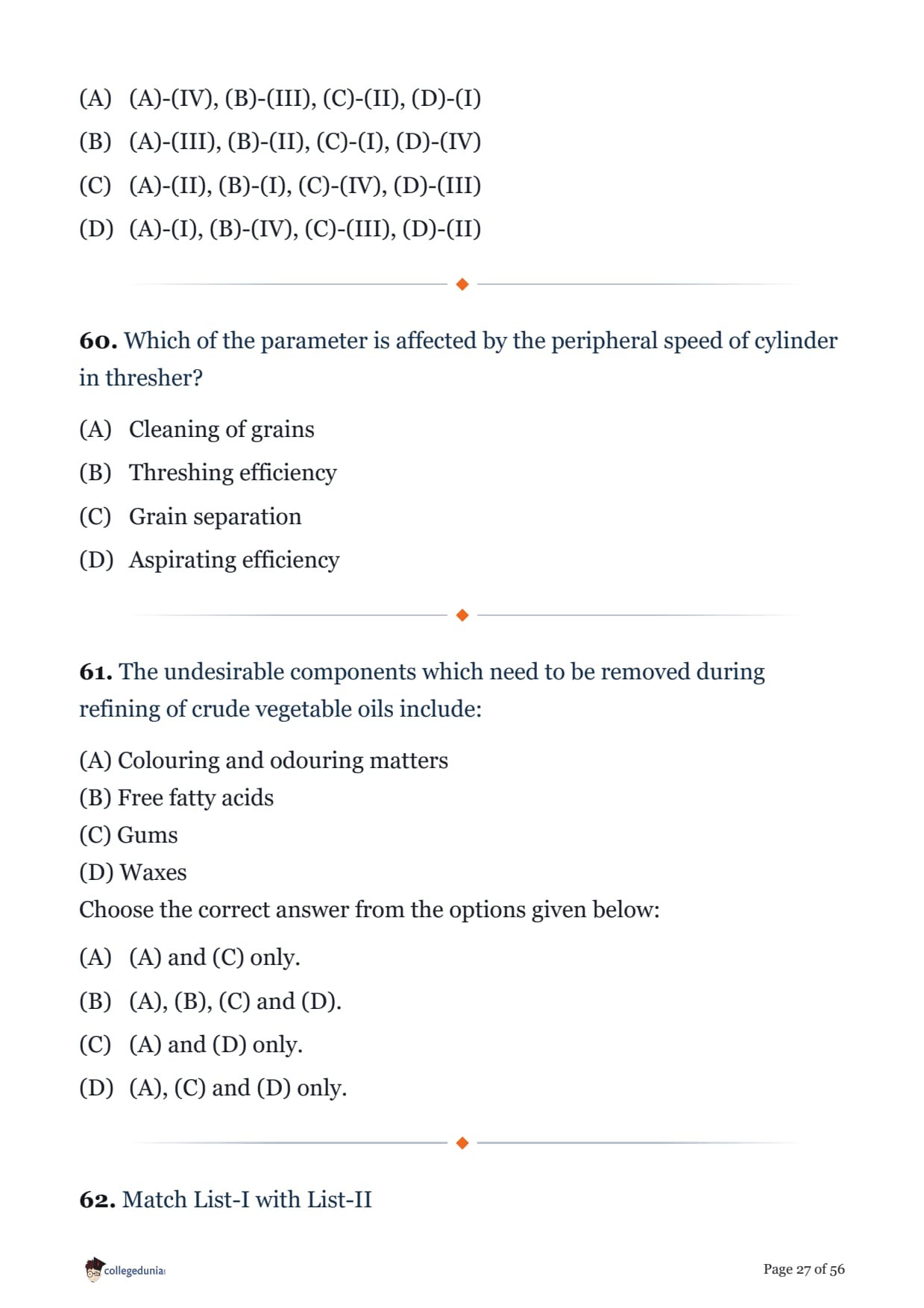
  • (A) (A)-(IV), (B)-(III), (C)-(II), (D)-(I)
  • (B) (A)-(III), (B)-(II), (C)-(I), (D)-(IV)
  • (C) (A)-(II), (B)-(I), (C)-(IV), (D)-(III)
  • (D) (A)-(I), (B)-(IV), (C)-(III), (D)-(II)

Question 60:

Which of the parameter is affected by the peripheral speed of cylinder in thresher?

  • (A) Cleaning of grains
  • (B) Threshing efficiency
  • (C) Grain separation
  • (D) Aspirating efficiency

Question 61:

The undesirable components which need to be removed during refining of crude vegetable oils include:

(A) Colouring and odouring matters
(B) Free fatty acids
(C) Gums
(D) Waxes
Choose the correct answer from the options given below:

  • (A) (A) and (C) only.
  • (B) (A), (B), (C) and (D).
  • (C) (A) and (D) only.
  • (D) (A), (C) and (D) only.

Question 62:

Match List-I with List-II

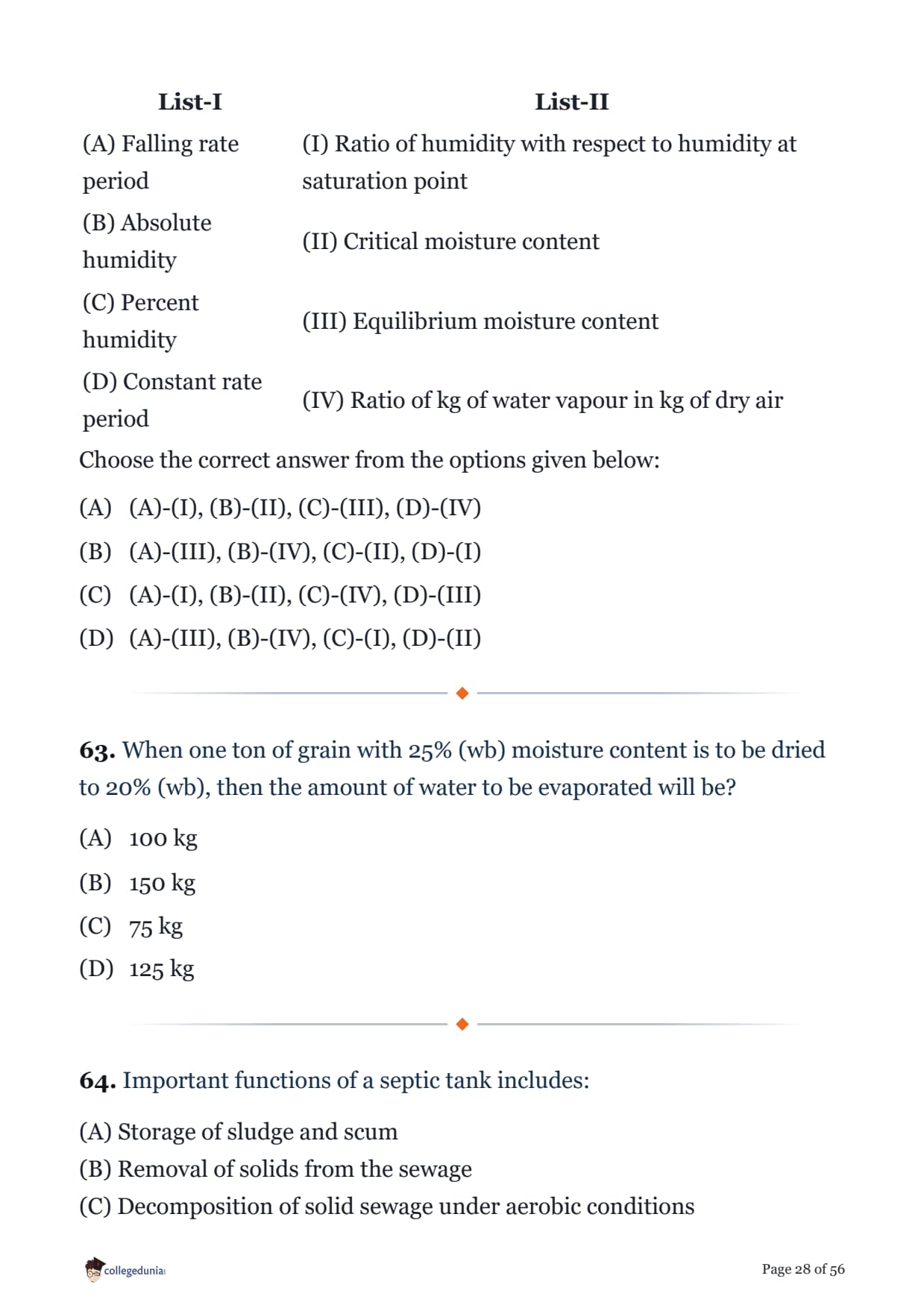
List-IList-II
(A) Falling rate period(I) Ratio of humidity with respect to humidity at saturation point
(B) Absolute humidity(II) Critical moisture content
(C) Percent humidity(III) Equilibrium moisture content
(D) Constant rate period(IV) Ratio of kg of water vapour in kg of dry air
Choose the correct answer from the options given below:

  • (A) (A)-(I), (B)-(II), (C)-(III), (D)-(IV)
  • (B) (A)-(III), (B)-(IV), (C)-(II), (D)-(I)
  • (C) (A)-(I), (B)-(II), (C)-(IV), (D)-(III)
  • (D) (A)-(III), (B)-(IV), (C)-(I), (D)-(II)

Question 63:

When one ton of grain with 25% (wb) moisture content is to be dried to 20% (wb), then the amount of water to be evaporated will be?

  • (A) 100 kg
  • (B) 150 kg
  • (C) 75 kg
  • (D) 125 kg

Question 64:

Important functions of a septic tank includes:

(A) Storage of sludge and scum
(B) Removal of solids from the sewage
(C) Decomposition of solid sewage under aerobic conditions
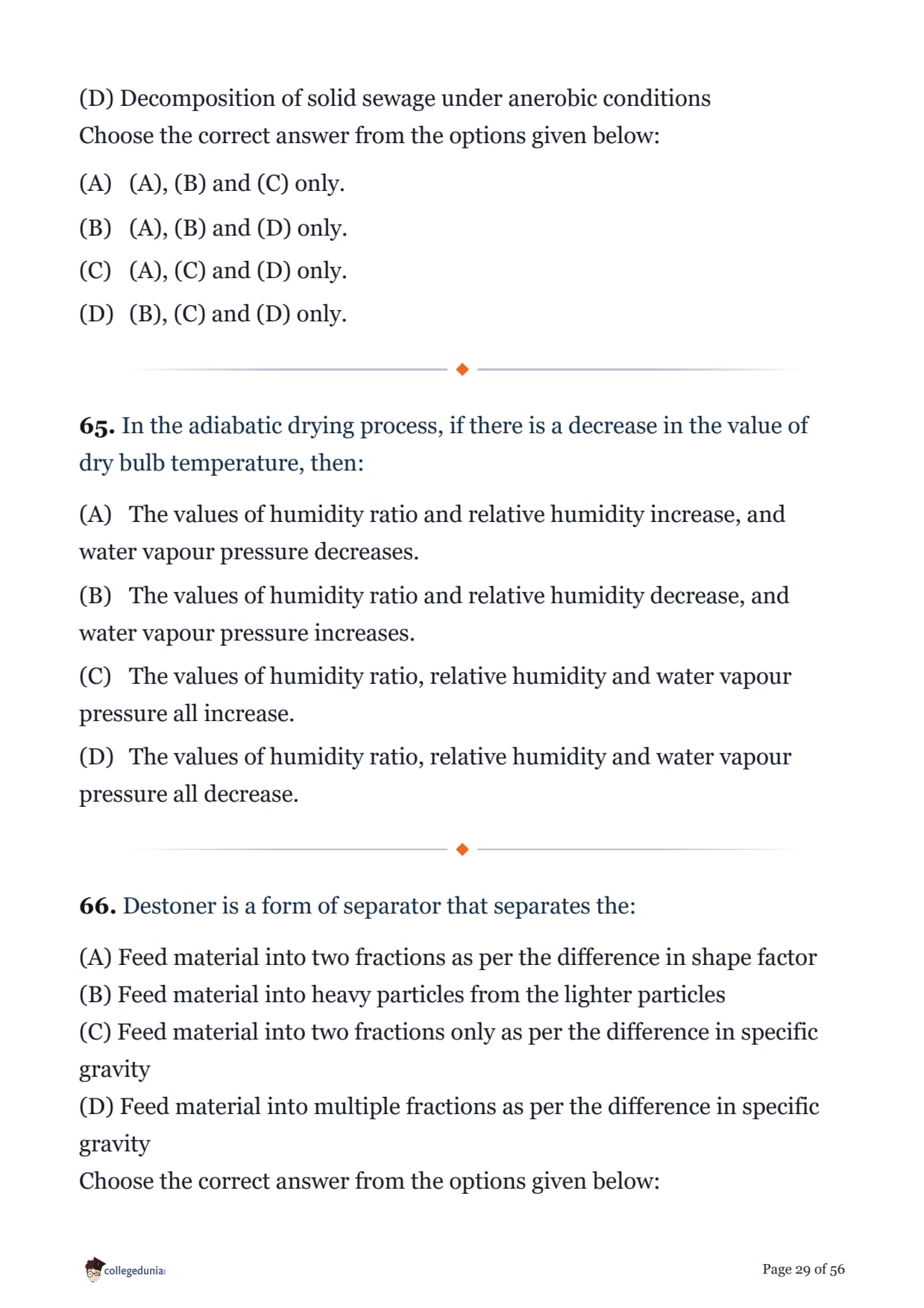
(D) Decomposition of solid sewage under anerobic conditions
Choose the correct answer from the options given below:

  • (A) (A), (B) and (C) only.
  • (B) (A), (B) and (D) only.
  • (C) (A), (C) and (D) only.
  • (D) (B), (C) and (D) only.

Question 65:

In the adiabatic drying process, if there is a decrease in the value of dry bulb temperature, then:

  • (A) The values of humidity ratio and relative humidity increase, and water vapour pressure decreases.
  • (B) The values of humidity ratio and relative humidity decrease, and water vapour pressure increases.
  • (C) The values of humidity ratio, relative humidity and water vapour pressure all increase.
  • (D) The values of humidity ratio, relative humidity and water vapour pressure all decrease.

Question 66:

Destoner is a form of separator that separates the:

(A) Feed material into two fractions as per the difference in shape factor
(B) Feed material into heavy particles from the lighter particles
(C) Feed material into two fractions only as per the difference in specific gravity
(D) Feed material into multiple fractions as per the difference in specific gravity
Choose the correct answer from the options given below:

  • (A) (A) only.
  • (B) (B) and (C) only.
  • (C) (C) only.
  • (D) (B) and (D) only.

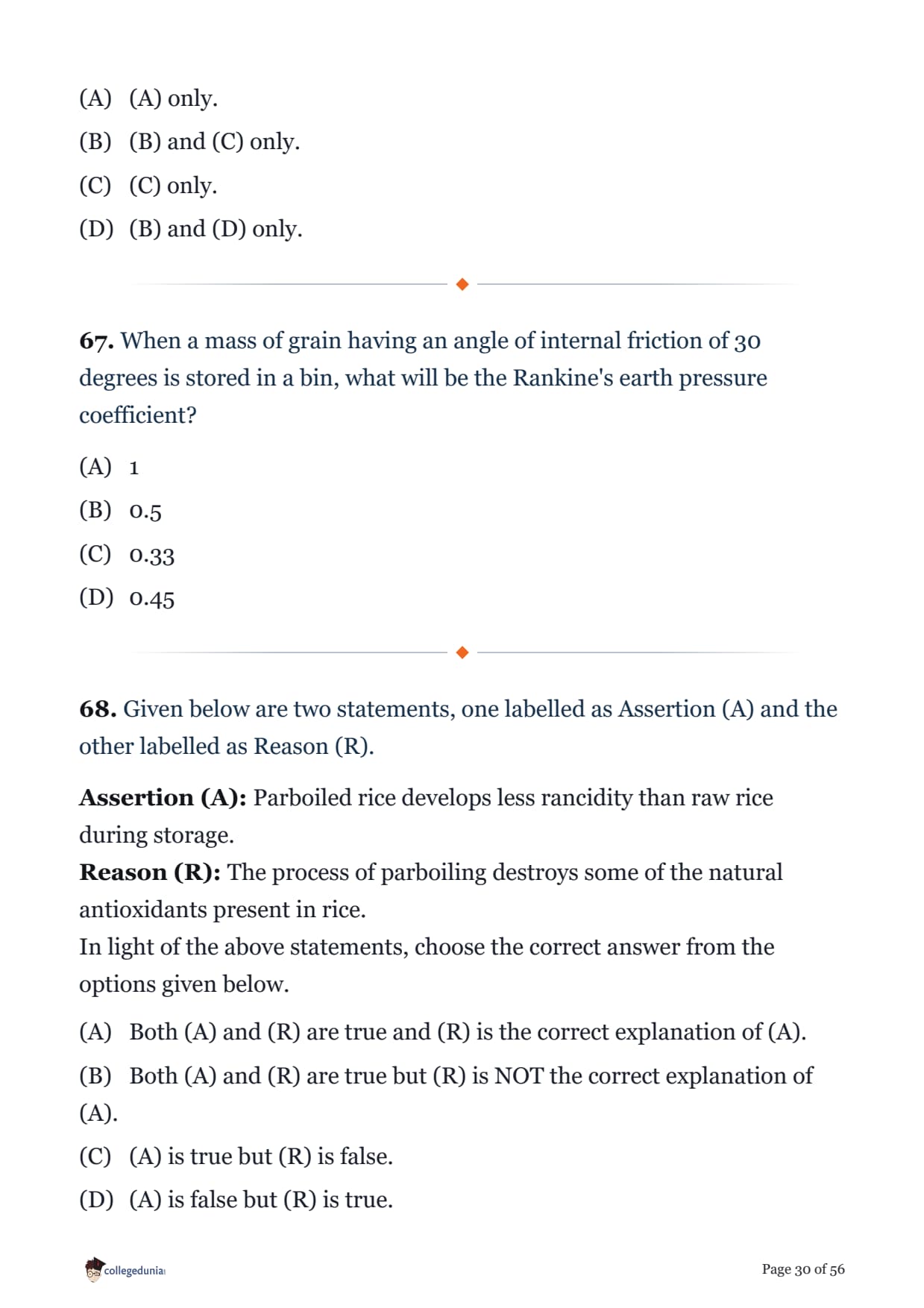
Question 67:

When a mass of grain having an angle of internal friction of 30 degrees is stored in a bin, what will be the Rankine's earth pressure coefficient?

  • (A) 1
  • (B) 0.5
  • (C) 0.33
  • (D) 0.45

Question 68:

Given below are two statements, one labelled as Assertion (A) and the other labelled as Reason (R).

Assertion (A): Parboiled rice develops less rancidity than raw rice during storage.
Reason (R): The process of parboiling destroys some of the natural antioxidants present in rice.
In light of the above statements, choose the correct answer from the options given below.

  • (A) Both (A) and (R) are true and (R) is the correct explanation of (A).
  • (B) Both (A) and (R) are true but (R) is NOT the correct explanation of (A).
  • (C) (A) is true but (R) is false.
  • (D) (A) is false but (R) is true.

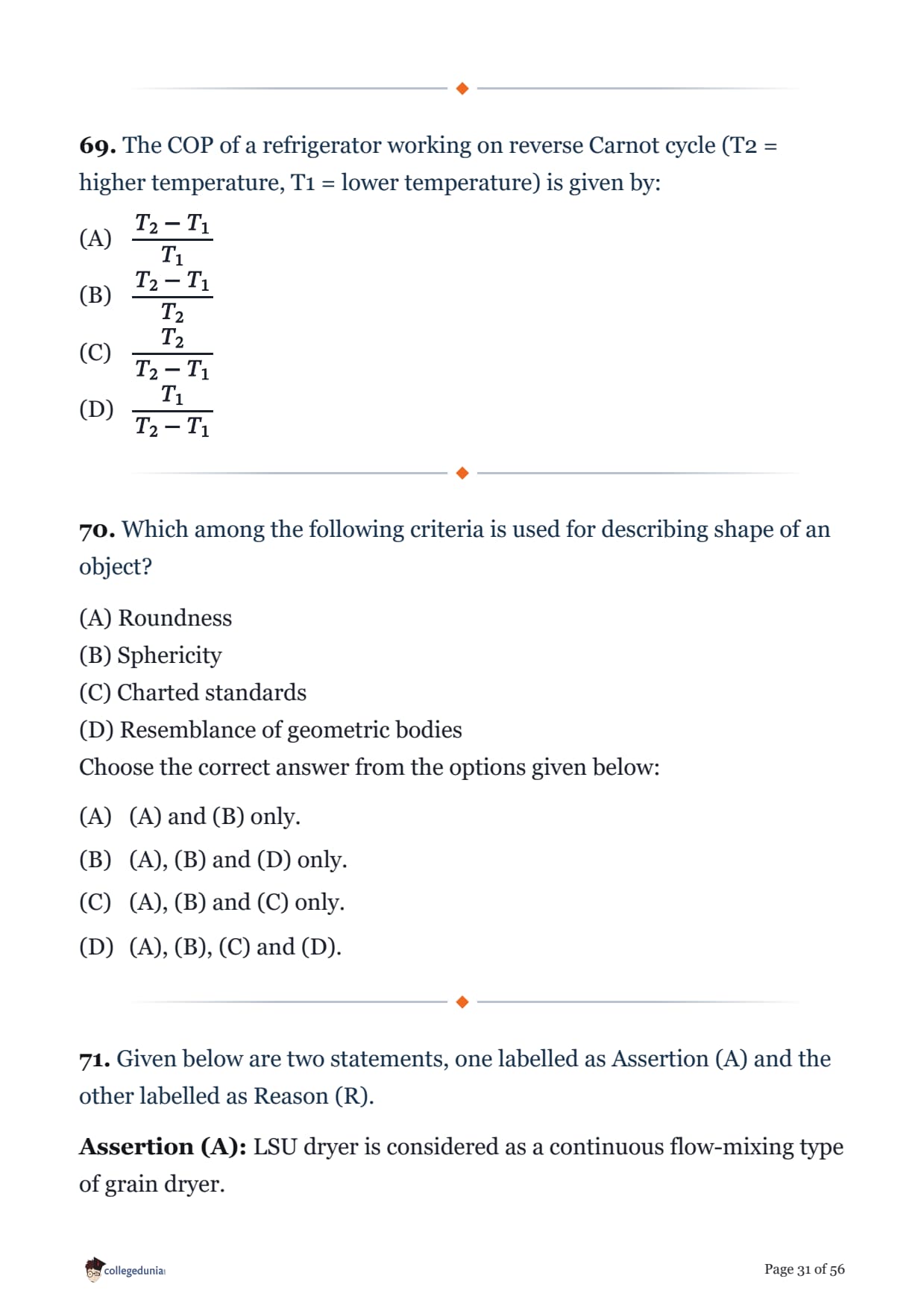
Question 69:

The COP of a refrigerator working on reverse Carnot cycle (T2 = higher temperature, T1 = lower temperature) is given by:

  • (A) \( \dfrac{T_2-T_1}{T_1} \)
  • (B) \( \dfrac{T_2-T_1}{T_2} \)
  • (C) \( \dfrac{T_2}{T_2-T_1} \)
  • (D) \( \dfrac{T_1}{T_2-T_1} \)

Question 70:

Which among the following criteria is used for describing shape of an object?

(A) Roundness
(B) Sphericity
(C) Charted standards
(D) Resemblance of geometric bodies
Choose the correct answer from the options given below:

  • (A) (A) and (B) only.
  • (B) (A), (B) and (D) only.
  • (C) (A), (B) and (C) only.
  • (D) (A), (B), (C) and (D).

Question 71:

Given below are two statements, one labelled as Assertion (A) and the other labelled as Reason (R).

Assertion (A): LSU dryer is considered as a continuous flow-mixing type of grain dryer.
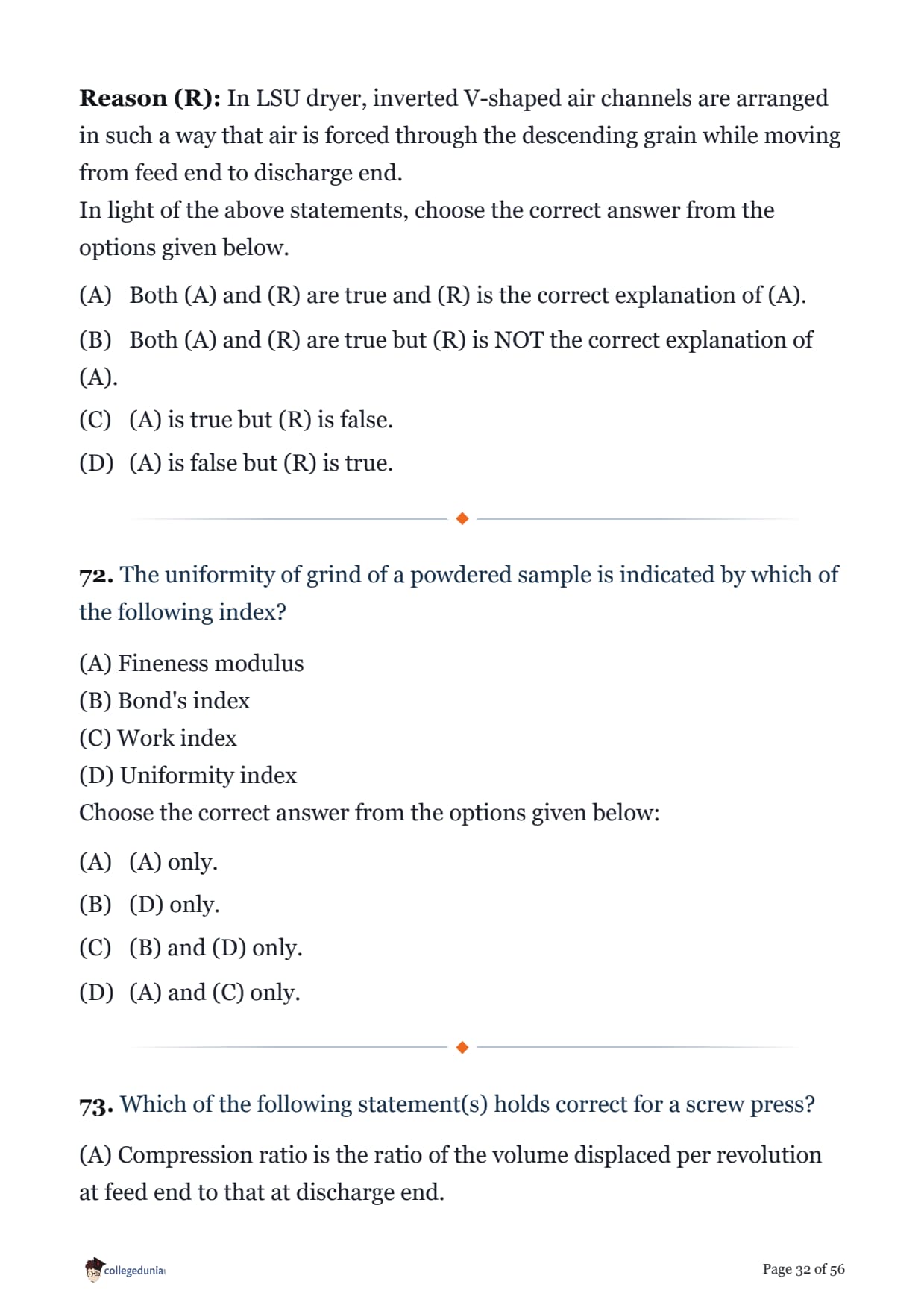
Reason (R): In LSU dryer, inverted V-shaped air channels are arranged in such a way that air is forced through the descending grain while moving from feed end to discharge end.
In light of the above statements, choose the correct answer from the options given below.

  • (A) Both (A) and (R) are true and (R) is the correct explanation of (A).
  • (B) Both (A) and (R) are true but (R) is NOT the correct explanation of (A).
  • (C) (A) is true but (R) is false.
  • (D) (A) is false but (R) is true.

Question 72:

The uniformity of grind of a powdered sample is indicated by which of the following index?

(A) Fineness modulus
(B) Bond's index
(C) Work index
(D) Uniformity index
Choose the correct answer from the options given below:

  • (A) (A) only.
  • (B) (D) only.
  • (C) (B) and (D) only.
  • (D) (A) and (C) only.

Question 73:

Which of the following statement(s) holds correct for a screw press?

(A) Compression ratio is the ratio of the volume displaced per revolution at feed end to that at discharge end.
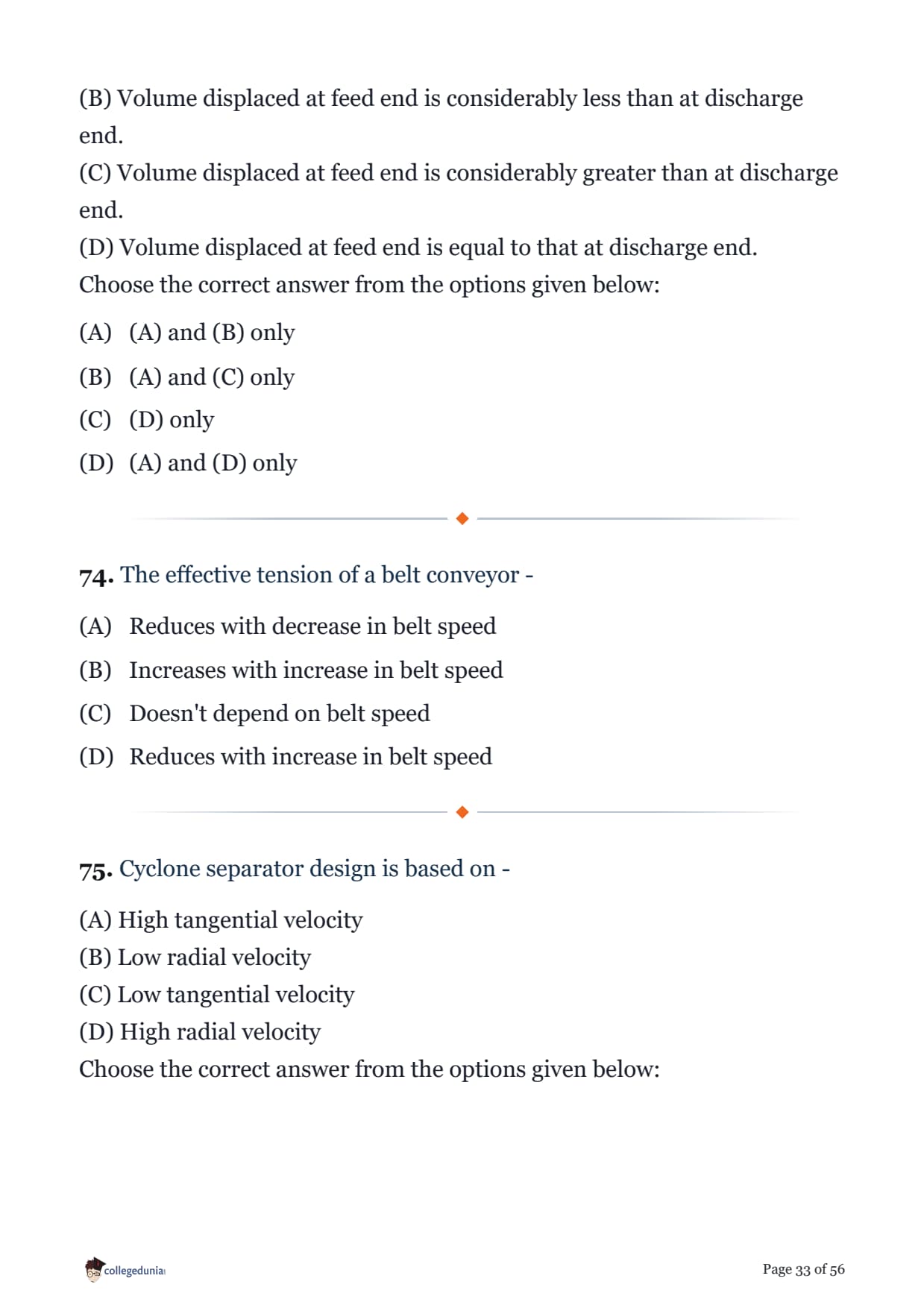
(B) Volume displaced at feed end is considerably less than at discharge end.
(C) Volume displaced at feed end is considerably greater than at discharge end.
(D) Volume displaced at feed end is equal to that at discharge end.
Choose the correct answer from the options given below:

  • (A) (A) and (B) only
  • (B) (A) and (C) only
  • (C) (D) only
  • (D) (A) and (D) only

Question 74:

The effective tension of a belt conveyor -

  • (A) Reduces with decrease in belt speed
  • (B) Increases with increase in belt speed
  • (C) Doesn't depend on belt speed
  • (D) Reduces with increase in belt speed

Question 75:

Cyclone separator design is based on -

(A) High tangential velocity
(B) Low radial velocity
(C) Low tangential velocity
(D) High radial velocity
Choose the correct answer from the options given below:

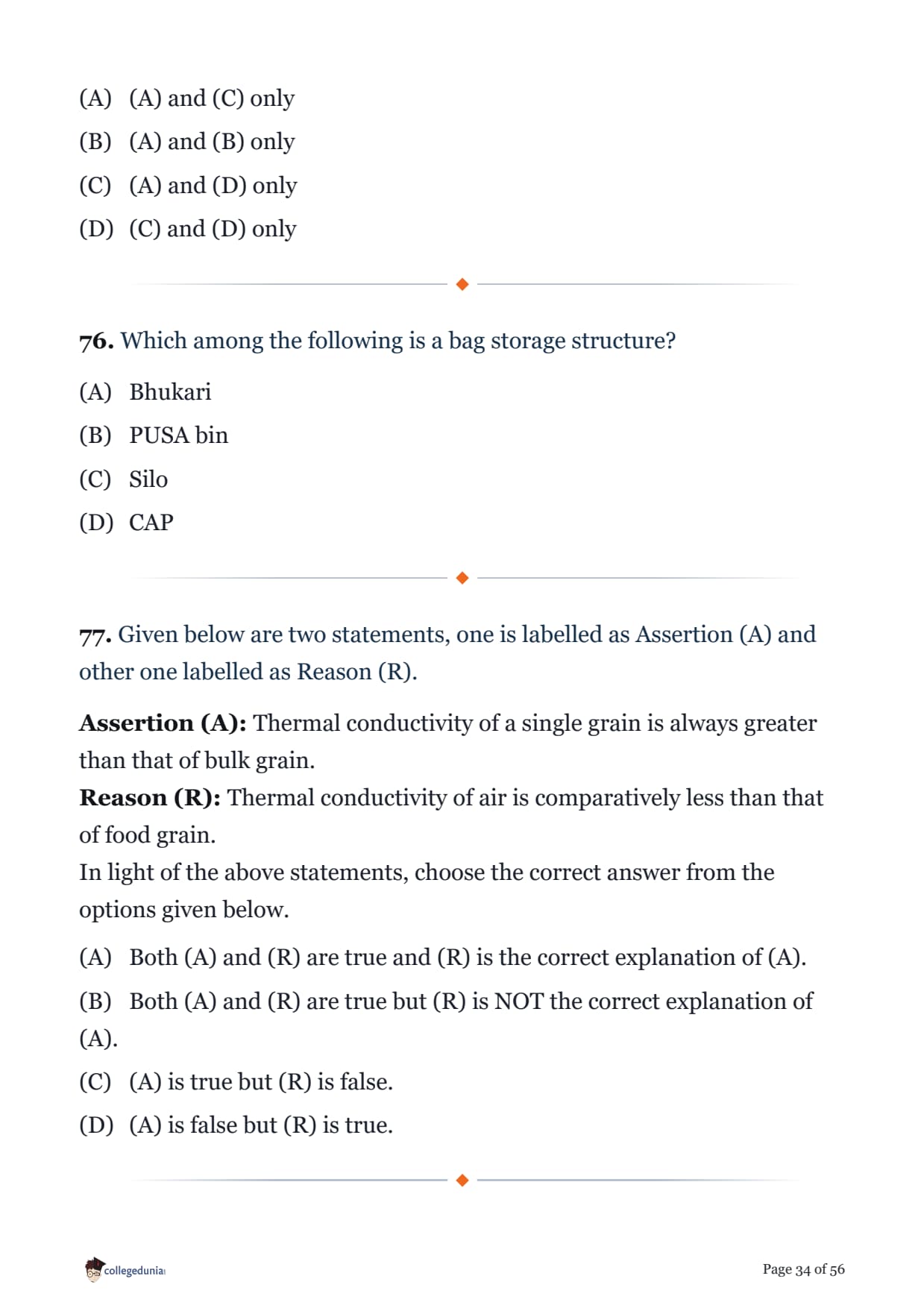
  • (A) (A) and (C) only
  • (B) (A) and (B) only
  • (C) (A) and (D) only
  • (D) (C) and (D) only

Question 76:

Which among the following is a bag storage structure?

  • (A) Bhukari
  • (B) PUSA bin
  • (C) Silo
  • (D) CAP

Question 77:

Given below are two statements, one is labelled as Assertion (A) and other one labelled as Reason (R).

Assertion (A): Thermal conductivity of a single grain is always greater than that of bulk grain.
Reason (R): Thermal conductivity of air is comparatively less than that of food grain.
In light of the above statements, choose the correct answer from the options given below.

  • (A) Both (A) and (R) are true and (R) is the correct explanation of (A).
  • (B) Both (A) and (R) are true but (R) is NOT the correct explanation of (A).
  • (C) (A) is true but (R) is false.
  • (D) (A) is false but (R) is true.

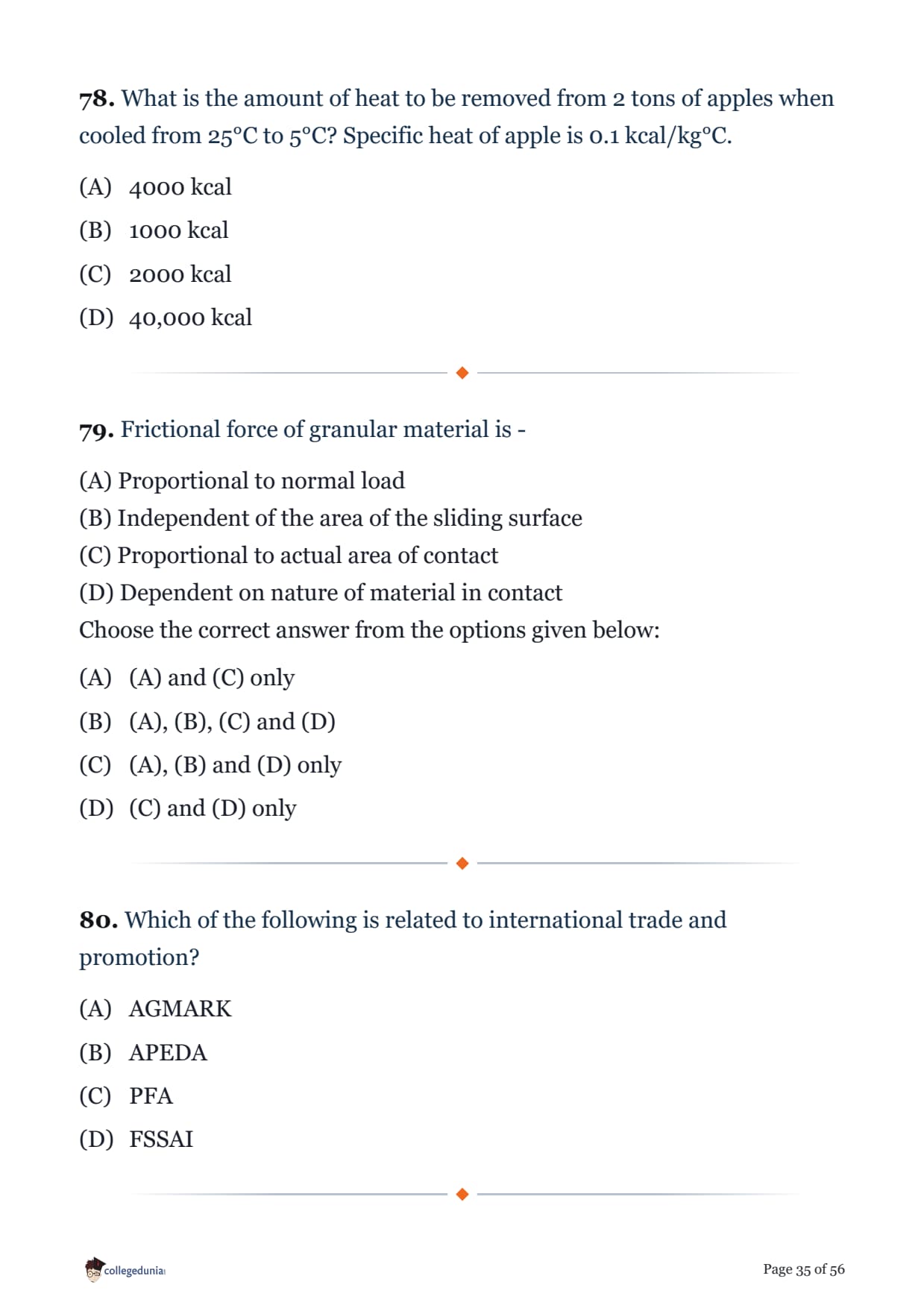
Question 78:

What is the amount of heat to be removed from 2 tons of apples when cooled from 25°C to 5°C? Specific heat of apple is 0.1 kcal/kg°C.

  • (A) 4000 kcal
  • (B) 1000 kcal
  • (C) 2000 kcal
  • (D) 40,000 kcal

Question 79:

Frictional force of granular material is -

(A) Proportional to normal load
(B) Independent of the area of the sliding surface
(C) Proportional to actual area of contact
(D) Dependent on nature of material in contact
Choose the correct answer from the options given below:

  • (A) (A) and (C) only
  • (B) (A), (B), (C) and (D)
  • (C) (A), (B) and (D) only
  • (D) (C) and (D) only

Question 80:

Which of the following is related to international trade and promotion?

  • (A) AGMARK
  • (B) APEDA
  • (C) PFA
  • (D) FSSAI

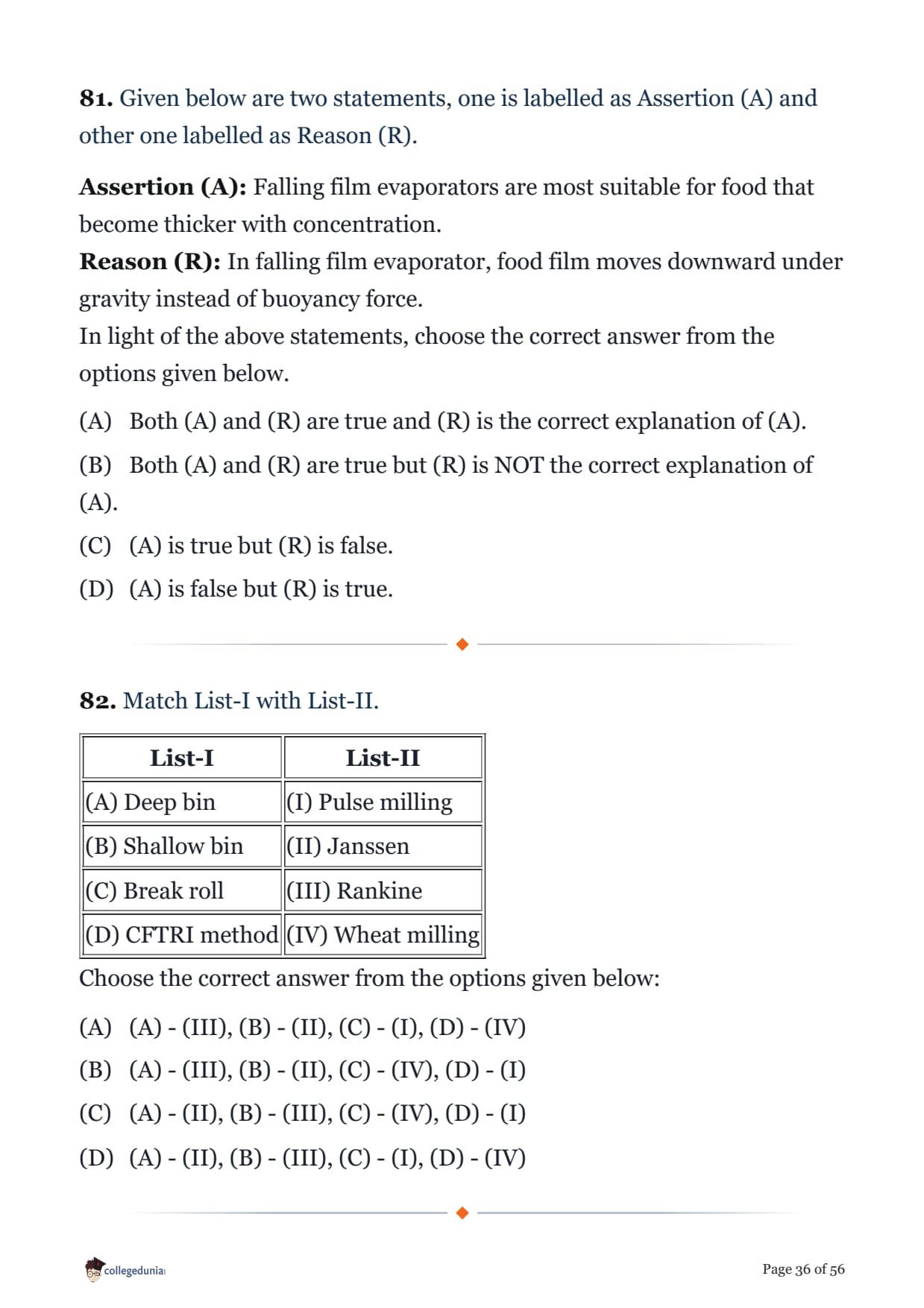
Question 81:

Given below are two statements, one is labelled as Assertion (A) and other one labelled as Reason (R).

Assertion (A): Falling film evaporators are most suitable for food that become thicker with concentration.
Reason (R): In falling film evaporator, food film moves downward under gravity instead of buoyancy force.
In light of the above statements, choose the correct answer from the options given below.

  • (A) Both (A) and (R) are true and (R) is the correct explanation of (A).
  • (B) Both (A) and (R) are true but (R) is NOT the correct explanation of (A).
  • (C) (A) is true but (R) is false.
  • (D) (A) is false but (R) is true.

Question 82:

Match List-I with List-II.

List-IList-II
(A) Deep bin(I) Pulse milling
(B) Shallow bin(II) Janssen
(C) Break roll(III) Rankine
(D) CFTRI method(IV) Wheat milling
Choose the correct answer from the options given below:

  • (A) (A) - (III), (B) - (II), (C) - (I), (D) - (IV)
  • (B) (A) - (III), (B) - (II), (C) - (IV), (D) - (I)
  • (C) (A) - (II), (B) - (III), (C) - (IV), (D) - (I)
  • (D) (A) - (II), (B) - (III), (C) - (I), (D) - (IV)

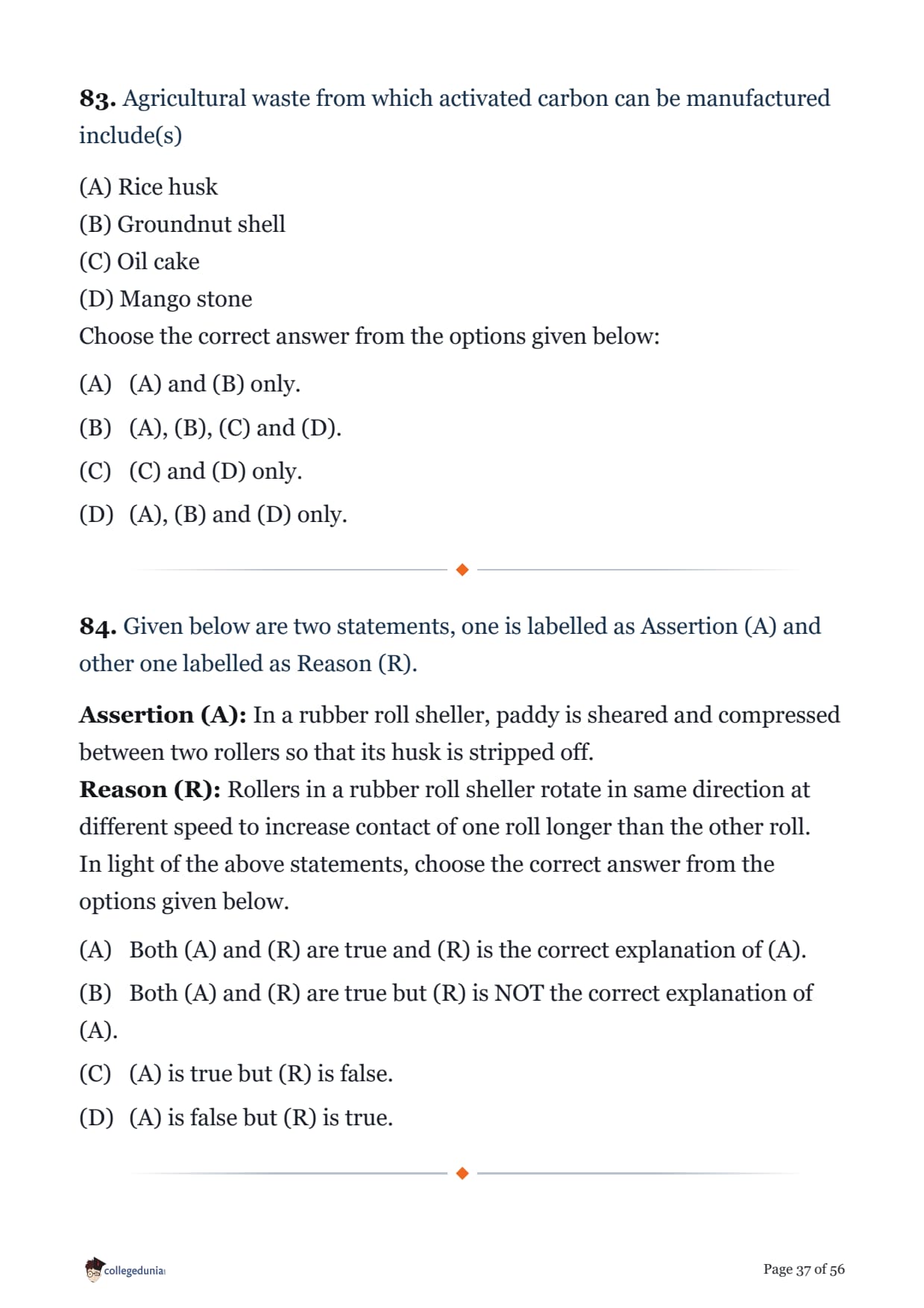
Question 83:

Agricultural waste from which activated carbon can be manufactured include(s)

(A) Rice husk
(B) Groundnut shell
(C) Oil cake
(D) Mango stone
Choose the correct answer from the options given below:

  • (A) (A) and (B) only.
  • (B) (A), (B), (C) and (D).
  • (C) (C) and (D) only.
  • (D) (A), (B) and (D) only.

Question 84:

Given below are two statements, one is labelled as Assertion (A) and other one labelled as Reason (R).

Assertion (A): In a rubber roll sheller, paddy is sheared and compressed between two rollers so that its husk is stripped off.
Reason (R): Rollers in a rubber roll sheller rotate in same direction at different speed to increase contact of one roll longer than the other roll.
In light of the above statements, choose the correct answer from the options given below.

  • (A) Both (A) and (R) are true and (R) is the correct explanation of (A).
  • (B) Both (A) and (R) are true but (R) is NOT the correct explanation of (A).
  • (C) (A) is true but (R) is false.
  • (D) (A) is false but (R) is true.

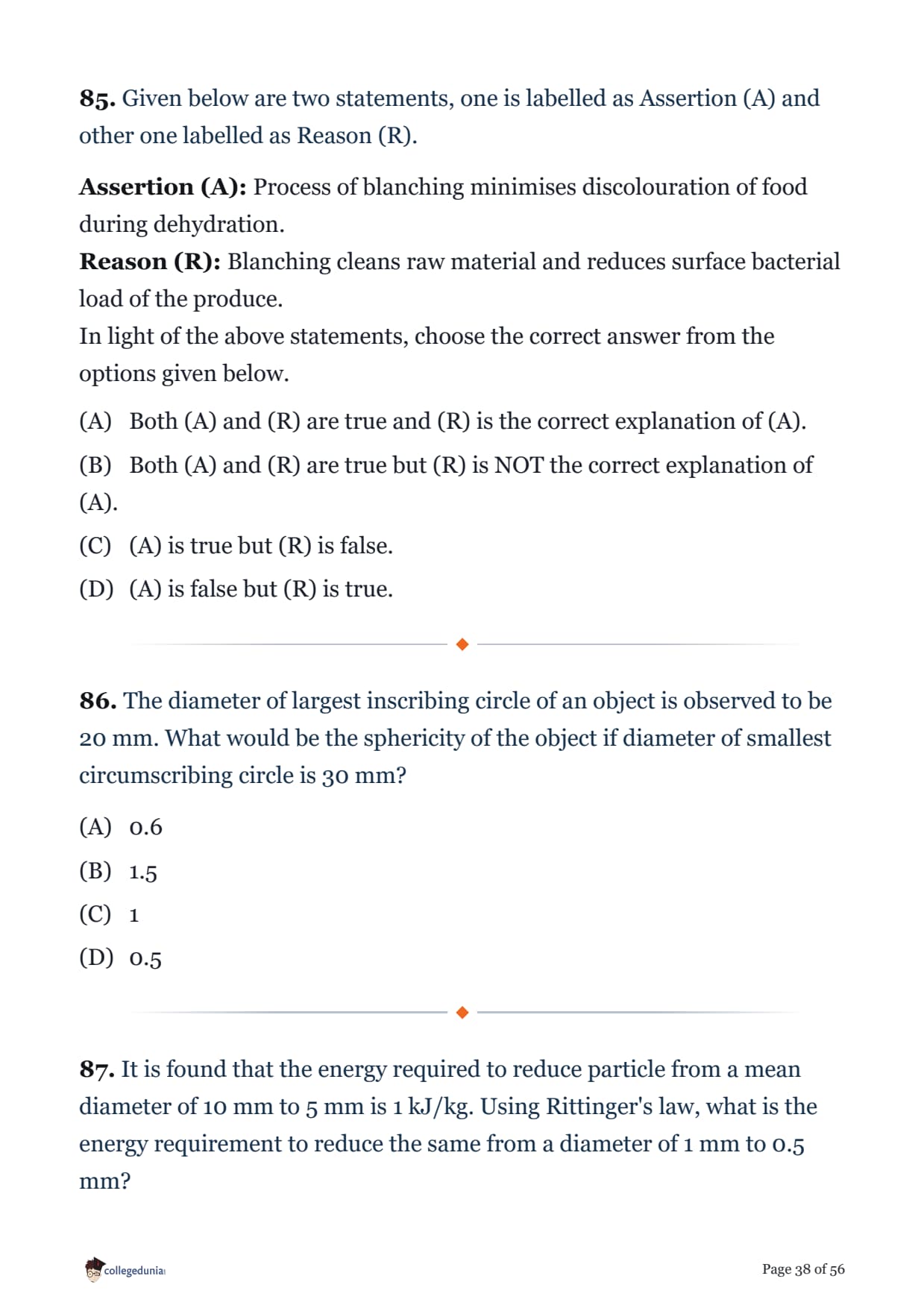
Question 85:

Given below are two statements, one is labelled as Assertion (A) and other one labelled as Reason (R).

Assertion (A): Process of blanching minimises discolouration of food during dehydration.
Reason (R): Blanching cleans raw material and reduces surface bacterial load of the produce.
In light of the above statements, choose the correct answer from the options given below.

  • (A) Both (A) and (R) are true and (R) is the correct explanation of (A).
  • (B) Both (A) and (R) are true but (R) is NOT the correct explanation of (A).
  • (C) (A) is true but (R) is false.
  • (D) (A) is false but (R) is true.

Question 86:

The diameter of largest inscribing circle of an object is observed to be 20 mm. What would be the sphericity of the object if diameter of smallest circumscribing circle is 30 mm?

  • (A) 0.6
  • (B) 1.5
  • (C) 1
  • (D) 0.5

Question 87:

It is found that the energy required to reduce particle from a mean diameter of 10 mm to 5 mm is 1 kJ/kg. Using Rittinger's law, what is the energy requirement to reduce the same from a diameter of 1 mm to 0.5 mm?

  • (A) 5 kJ/kg
  • (B) 100 kJ/kg
  • (C) 10 kJ/kg
  • (D) 1 kJ/kg

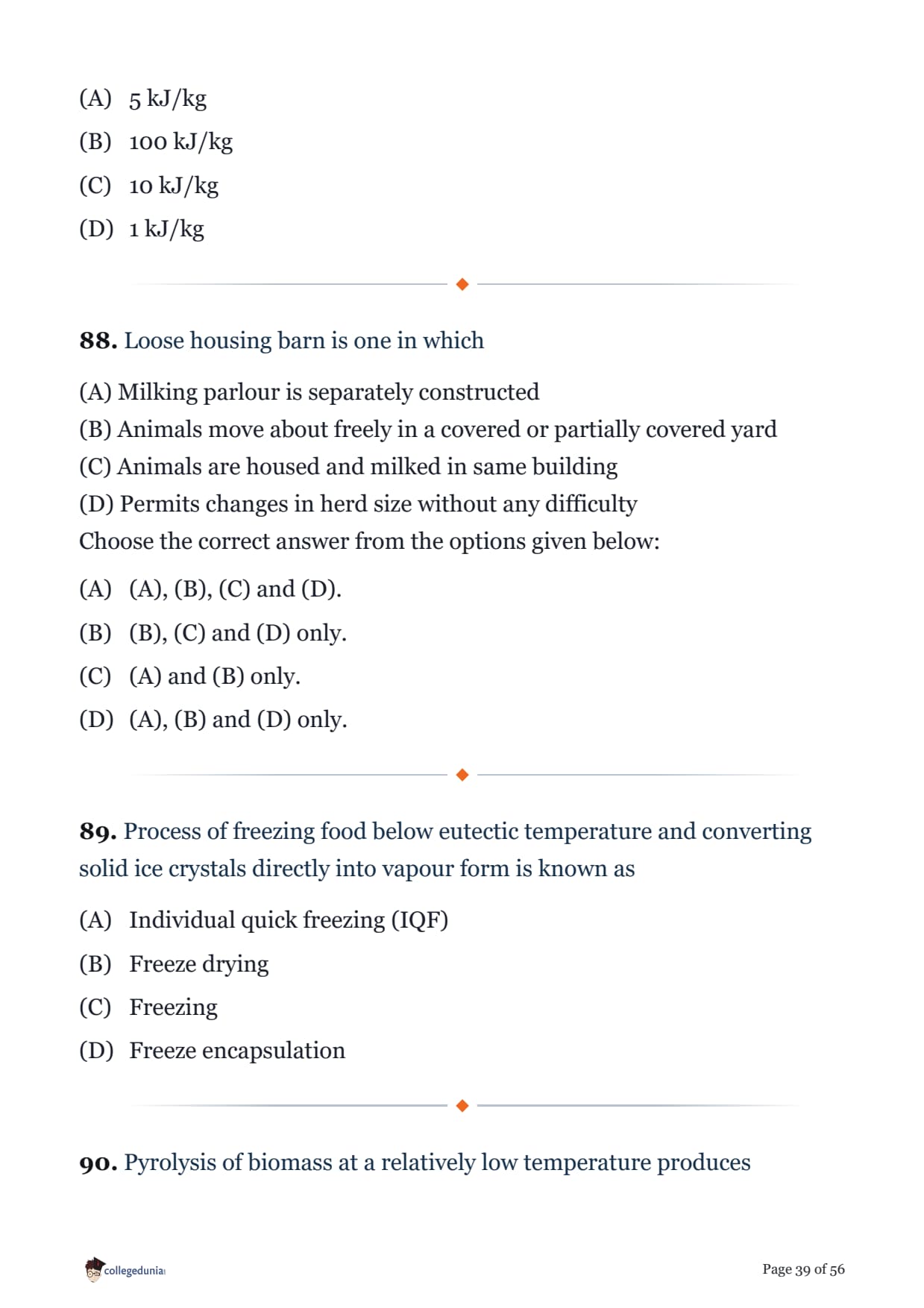
Question 88:

Loose housing barn is one in which

(A) Milking parlour is separately constructed
(B) Animals move about freely in a covered or partially covered yard
(C) Animals are housed and milked in same building
(D) Permits changes in herd size without any difficulty
Choose the correct answer from the options given below:

  • (A) (A), (B), (C) and (D).
  • (B) (B), (C) and (D) only.
  • (C) (A) and (B) only.
  • (D) (A), (B) and (D) only.

Question 89:

Process of freezing food below eutectic temperature and converting solid ice crystals directly into vapour form is known as

  • (A) Individual quick freezing (IQF)
  • (B) Freeze drying
  • (C) Freezing
  • (D) Freeze encapsulation

Question 90:

Pyrolysis of biomass at a relatively low temperature produces

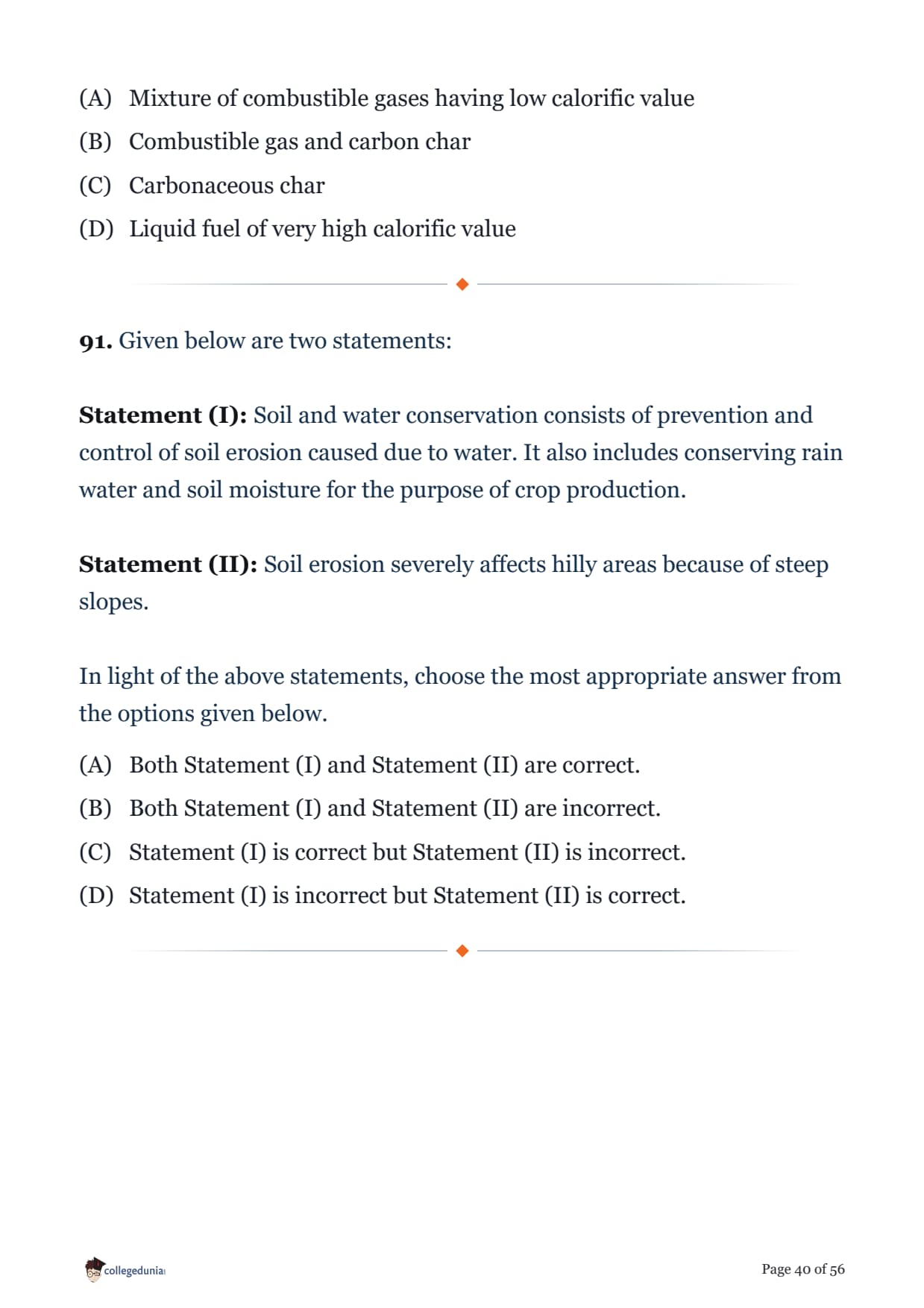
  • (A) Mixture of combustible gases having low calorific value
  • (B) Combustible gas and carbon char
  • (C) Carbonaceous char
  • (D) Liquid fuel of very high calorific value

Question 91:

Given below are two statements:

Statement (I): Soil and water conservation consists of prevention and control of soil erosion caused due to water. It also includes conserving rain water and soil moisture for the purpose of crop production.

Statement (II): Soil erosion severely affects hilly areas because of steep slopes.

In light of the above statements, choose the most appropriate answer from the options given below.

  • (A) Both Statement (I) and Statement (II) are correct.
  • (B) Both Statement (I) and Statement (II) are incorrect.
  • (C) Statement (I) is correct but Statement (II) is incorrect.
  • (D) Statement (I) is incorrect but Statement (II) is correct.

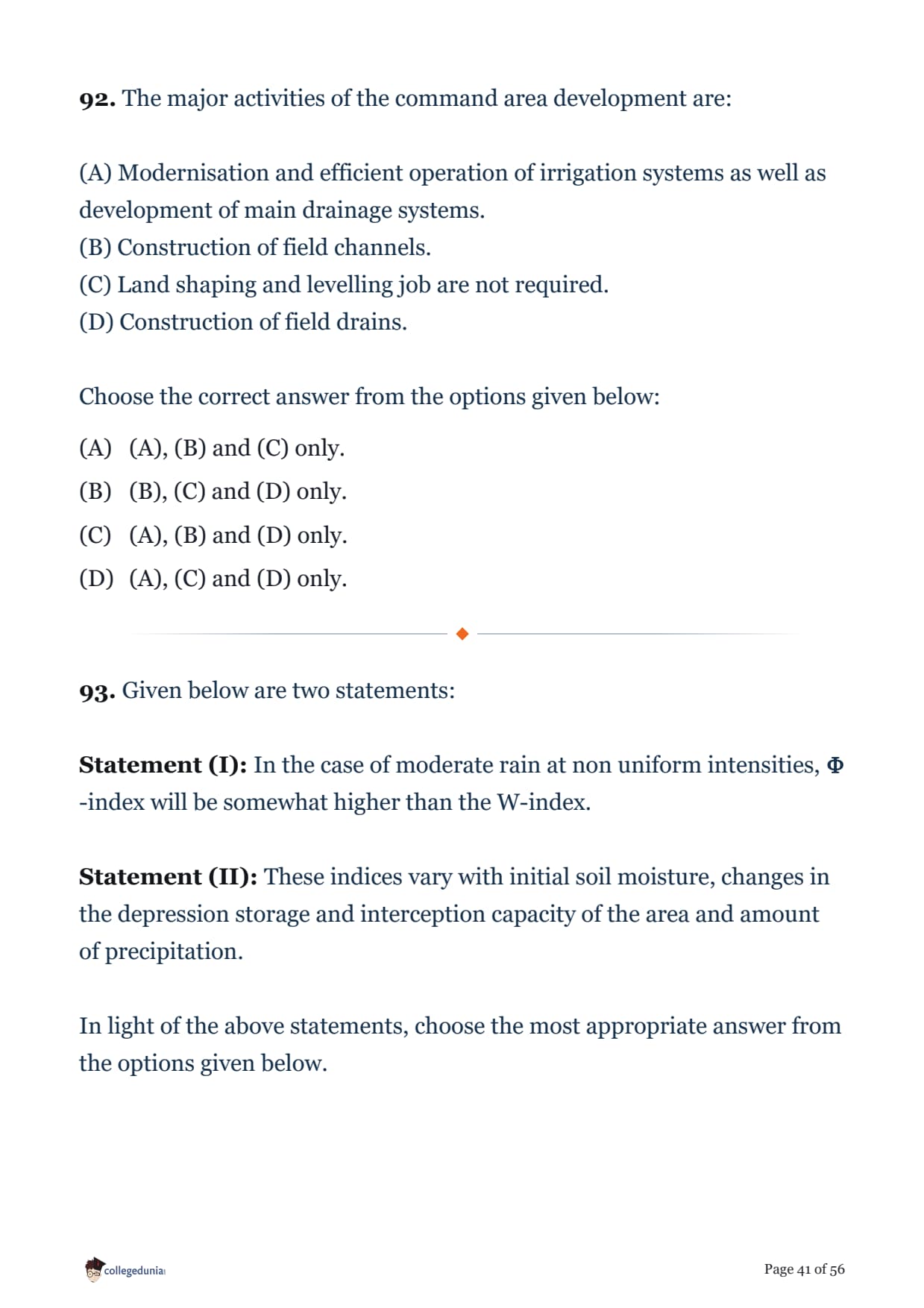
Question 92:

The major activities of the command area development are:

(A) Modernisation and efficient operation of irrigation systems as well as development of main drainage systems.
(B) Construction of field channels.
(C) Land shaping and levelling job are not required.
(D) Construction of field drains.

Choose the correct answer from the options given below:

  • (A) (A), (B) and (C) only.
  • (B) (B), (C) and (D) only.
  • (C) (A), (B) and (D) only.
  • (D) (A), (C) and (D) only.

Question 93:

Given below are two statements:

Statement (I): In the case of moderate rain at non uniform intensities, \(\Phi\)-index will be somewhat higher than the W-index.

Statement (II): These indices vary with initial soil moisture, changes in the depression storage and interception capacity of the area and amount of precipitation.

In light of the above statements, choose the most appropriate answer from the options given below.

  • (A) Both Statement (I) and Statement (II) are correct.
  • (B) Both Statement (I) and Statement (II) are incorrect.
  • (C) Statement (I) is correct but Statement (II) is incorrect.
  • (D) Statement (I) is incorrect but Statement (II) is correct.

Question 94:

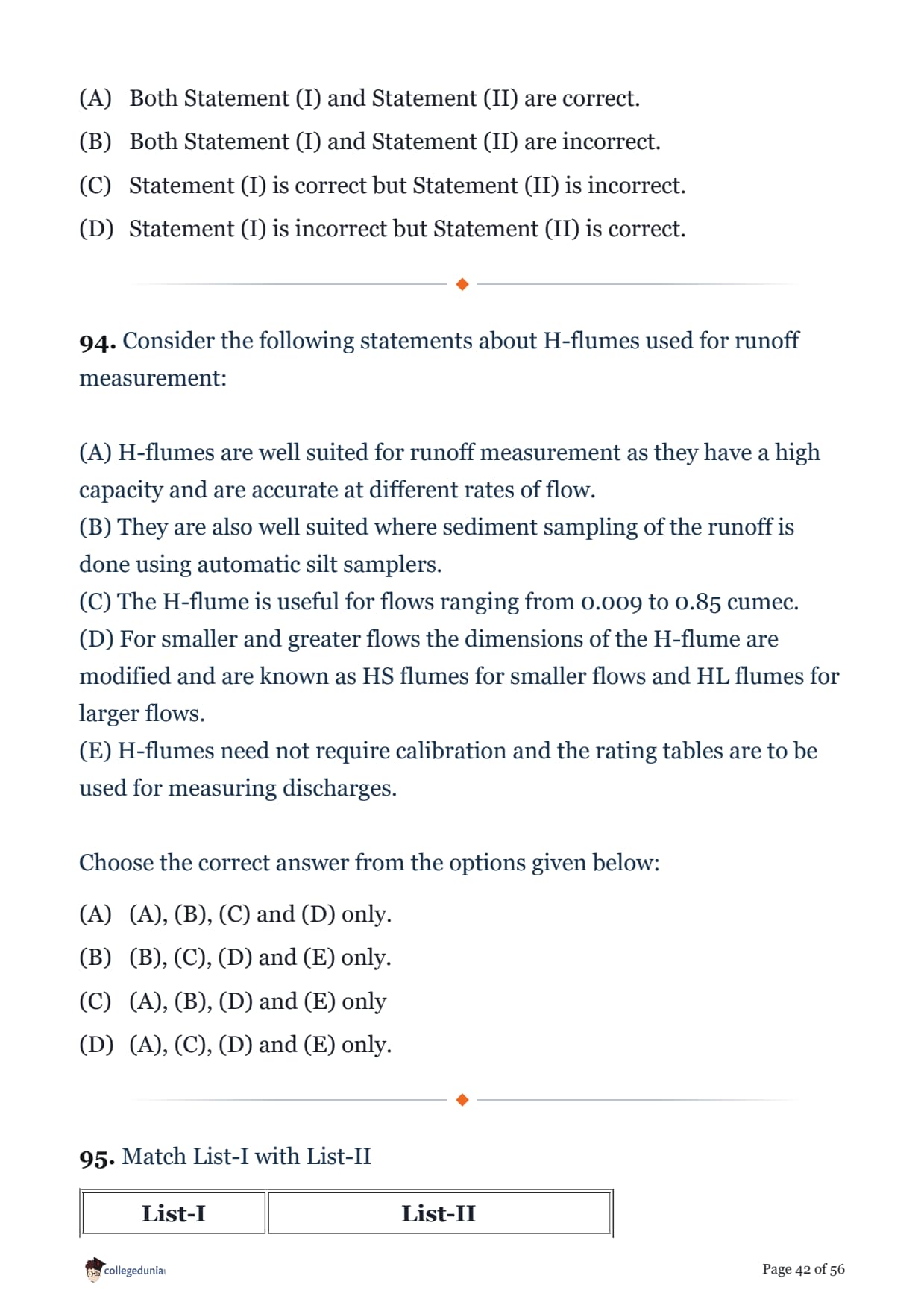
Consider the following statements about H-flumes used for runoff measurement:

(A) H-flumes are well suited for runoff measurement as they have a high capacity and are accurate at different rates of flow.
(B) They are also well suited where sediment sampling of the runoff is done using automatic silt samplers.
(C) The H-flume is useful for flows ranging from 0.009 to 0.85 cumec.
(D) For smaller and greater flows the dimensions of the H-flume are modified and are known as HS flumes for smaller flows and HL flumes for larger flows.
(E) H-flumes need not require calibration and the rating tables are to be used for measuring discharges.

Choose the correct answer from the options given below:

  • (A) (A), (B), (C) and (D) only.
  • (B) (B), (C), (D) and (E) only.
  • (C) (A), (B), (D) and (E) only
  • (D) (A), (C), (D) and (E) only.

Question 95:

Match List-I with List-II

List-IList-II
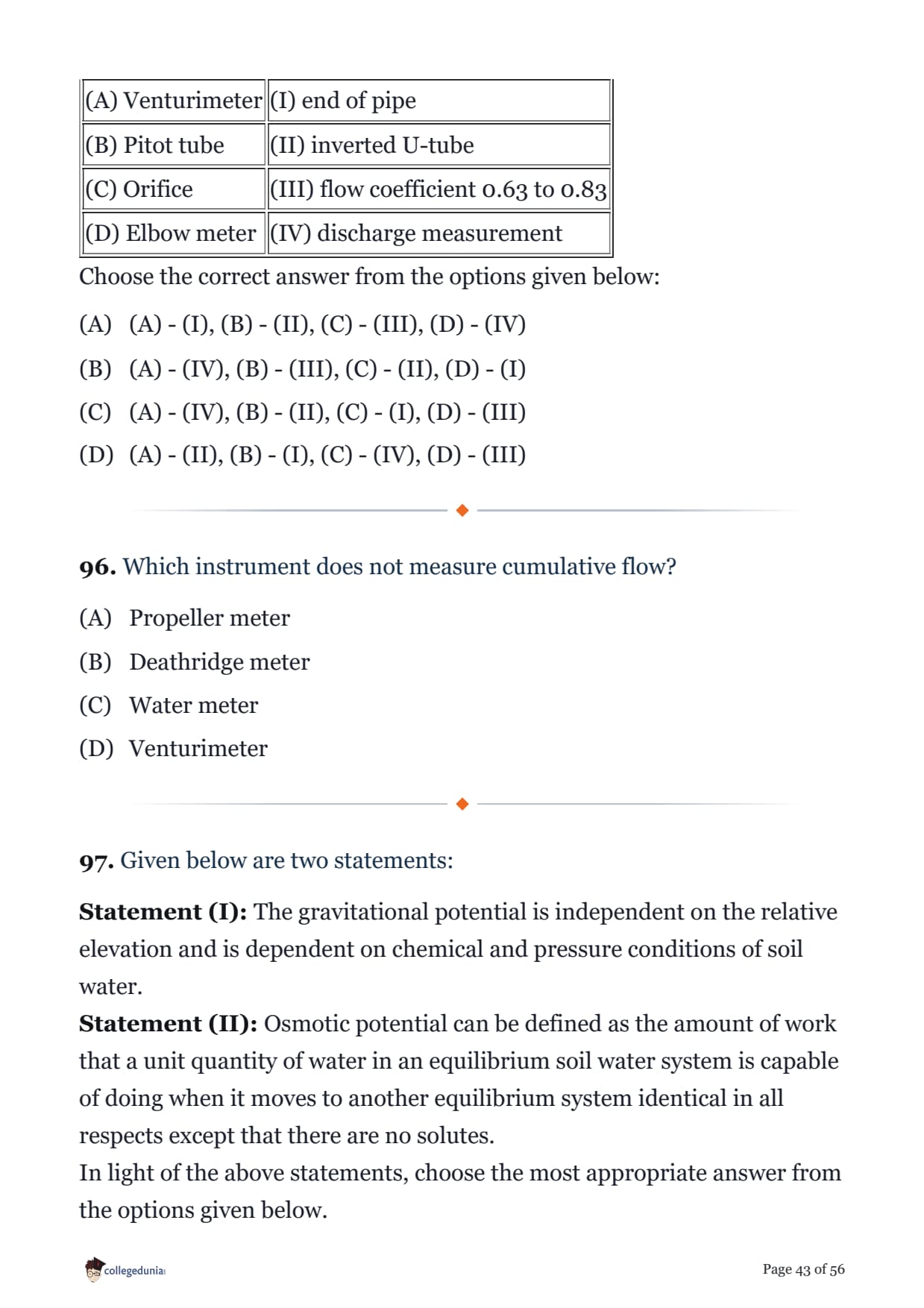
(A) Venturimeter(I) end of pipe
(B) Pitot tube(II) inverted U-tube
(C) Orifice(III) flow coefficient 0.63 to 0.83
(D) Elbow meter(IV) discharge measurement
Choose the correct answer from the options given below:

  • (A) (A) - (I), (B) - (II), (C) - (III), (D) - (IV)
  • (B) (A) - (IV), (B) - (III), (C) - (II), (D) - (I)
  • (C) (A) - (IV), (B) - (II), (C) - (I), (D) - (III)
  • (D) (A) - (II), (B) - (I), (C) - (IV), (D) - (III)

Question 96:

Which instrument does not measure cumulative flow?

  • (A) Propeller meter
  • (B) Deathridge meter
  • (C) Water meter
  • (D) Venturimeter

Question 97:

Given below are two statements:

Statement (I): The gravitational potential is independent on the relative elevation and is dependent on chemical and pressure conditions of soil water.
Statement (II): Osmotic potential can be defined as the amount of work that a unit quantity of water in an equilibrium soil water system is capable of doing when it moves to another equilibrium system identical in all respects except that there are no solutes.
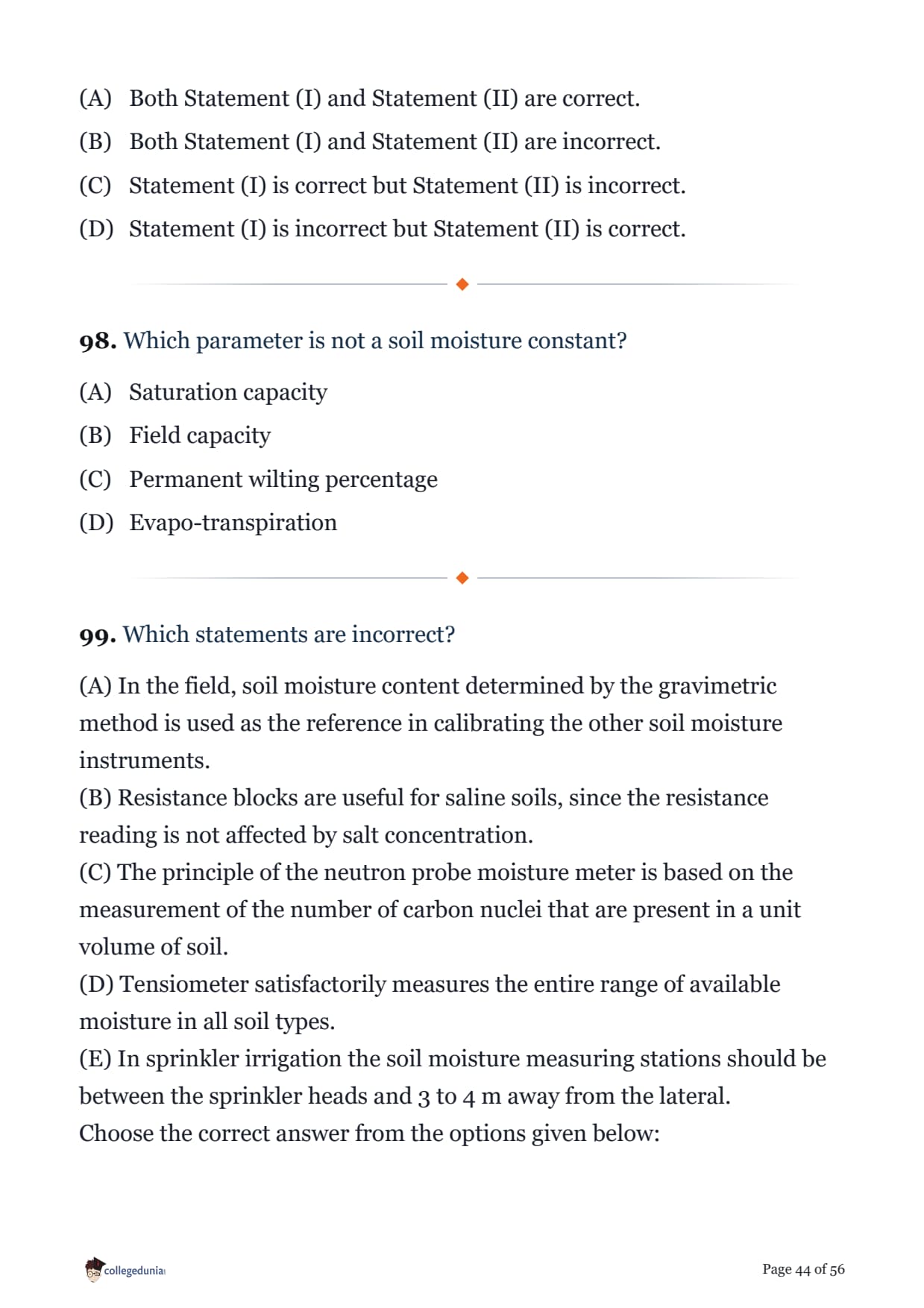
In light of the above statements, choose the most appropriate answer from the options given below.

  • (A) Both Statement (I) and Statement (II) are correct.
  • (B) Both Statement (I) and Statement (II) are incorrect.
  • (C) Statement (I) is correct but Statement (II) is incorrect.
  • (D) Statement (I) is incorrect but Statement (II) is correct.

Question 98:

Which parameter is not a soil moisture constant?

  • (A) Saturation capacity
  • (B) Field capacity
  • (C) Permanent wilting percentage
  • (D) Evapo-transpiration

Question 99:

Which statements are incorrect?

(A) In the field, soil moisture content determined by the gravimetric method is used as the reference in calibrating the other soil moisture instruments.
(B) Resistance blocks are useful for saline soils, since the resistance reading is not affected by salt concentration.
(C) The principle of the neutron probe moisture meter is based on the measurement of the number of carbon nuclei that are present in a unit volume of soil.
(D) Tensiometer satisfactorily measures the entire range of available moisture in all soil types.
(E) In sprinkler irrigation the soil moisture measuring stations should be between the sprinkler heads and 3 to 4 m away from the lateral.
Choose the correct answer from the options given below:

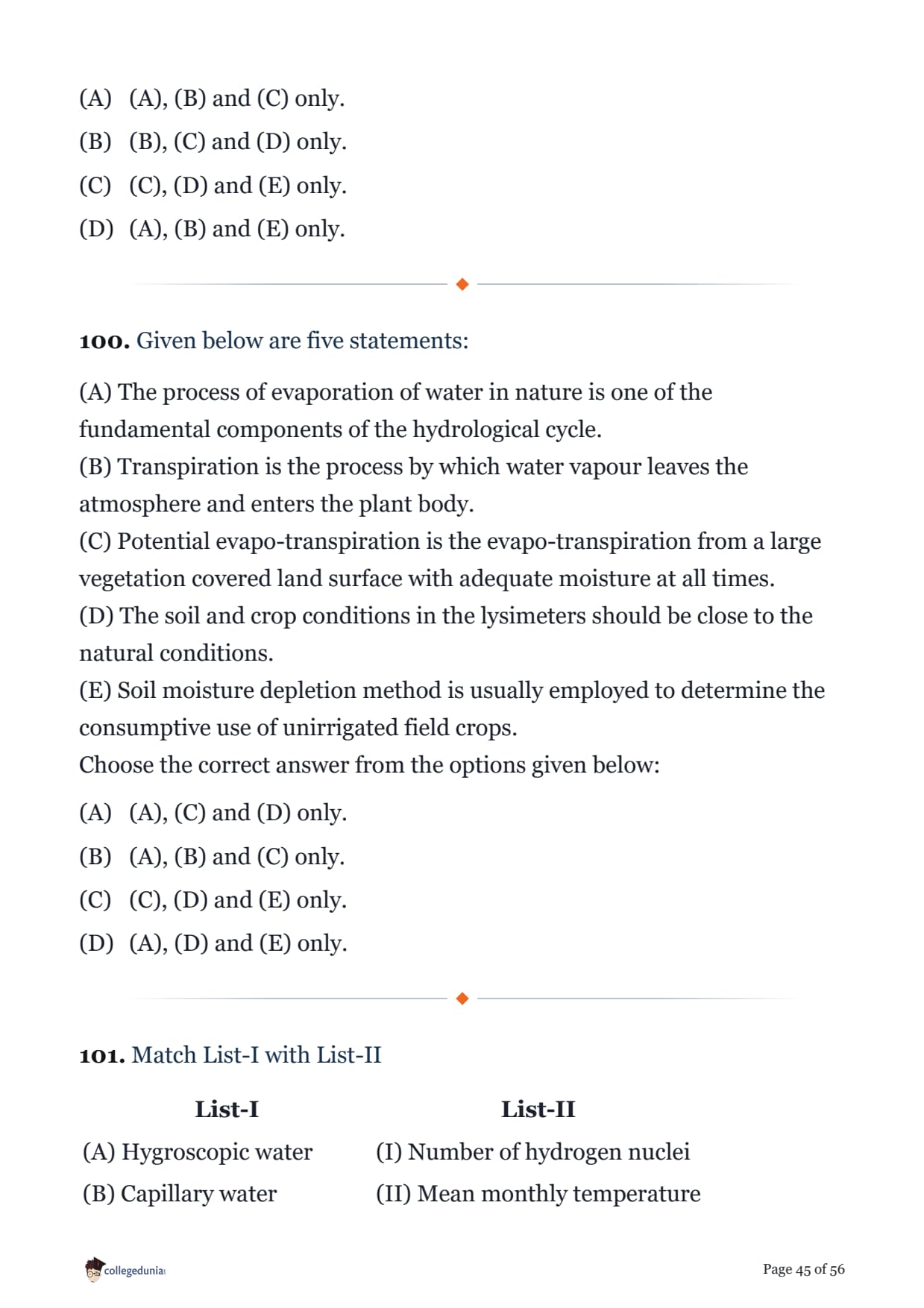
  • (A) (A), (B) and (C) only.
  • (B) (B), (C) and (D) only.
  • (C) (C), (D) and (E) only.
  • (D) (A), (B) and (E) only.

Question 100:

Given below are five statements:

(A) The process of evaporation of water in nature is one of the fundamental components of the hydrological cycle.
(B) Transpiration is the process by which water vapour leaves the atmosphere and enters the plant body.
(C) Potential evapo-transpiration is the evapo-transpiration from a large vegetation covered land surface with adequate moisture at all times.
(D) The soil and crop conditions in the lysimeters should be close to the natural conditions.
(E) Soil moisture depletion method is usually employed to determine the consumptive use of unirrigated field crops.
Choose the correct answer from the options given below:

  • (A) (A), (C) and (D) only.
  • (B) (A), (B) and (C) only.
  • (C) (C), (D) and (E) only.
  • (D) (A), (D) and (E) only.

Question 101:

Match List-I with List-II

List-IList-II
(A) Hygroscopic water(I) Number of hydrogen nuclei
(B) Capillary water(II) Mean monthly temperature
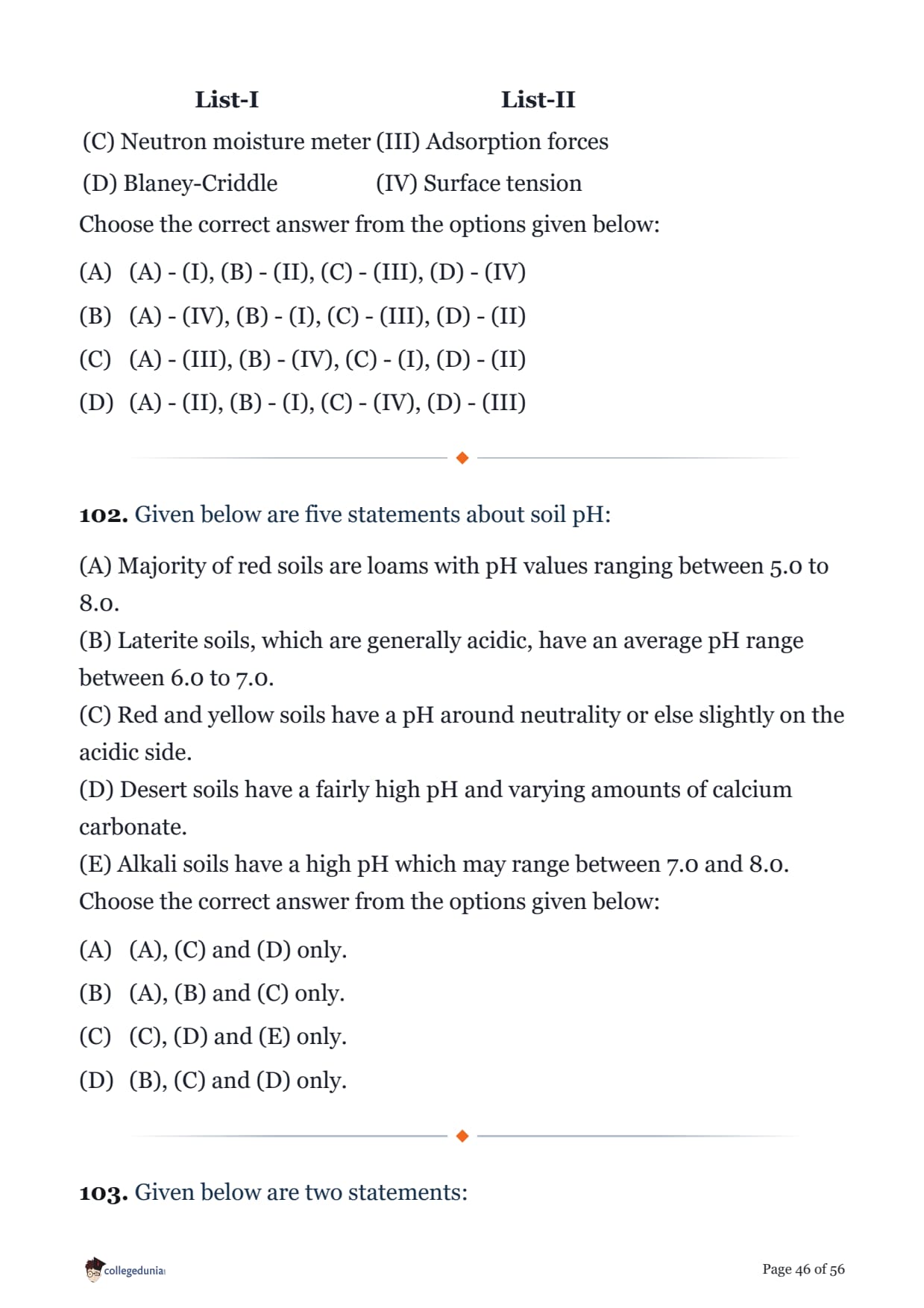
(C) Neutron moisture meter(III) Adsorption forces
(D) Blaney-Criddle(IV) Surface tension
Choose the correct answer from the options given below:

  • (A) (A) - (I), (B) - (II), (C) - (III), (D) - (IV)
  • (B) (A) - (IV), (B) - (I), (C) - (III), (D) - (II)
  • (C) (A) - (III), (B) - (IV), (C) - (I), (D) - (II)
  • (D) (A) - (II), (B) - (I), (C) - (IV), (D) - (III)

Question 102:

Given below are five statements about soil pH:

(A) Majority of red soils are loams with pH values ranging between 5.0 to 8.0.
(B) Laterite soils, which are generally acidic, have an average pH range between 6.0 to 7.0.
(C) Red and yellow soils have a pH around neutrality or else slightly on the acidic side.
(D) Desert soils have a fairly high pH and varying amounts of calcium carbonate.
(E) Alkali soils have a high pH which may range between 7.0 and 8.0.
Choose the correct answer from the options given below:

  • (A) (A), (C) and (D) only.
  • (B) (A), (B) and (C) only.
  • (C) (C), (D) and (E) only.
  • (D) (B), (C) and (D) only.

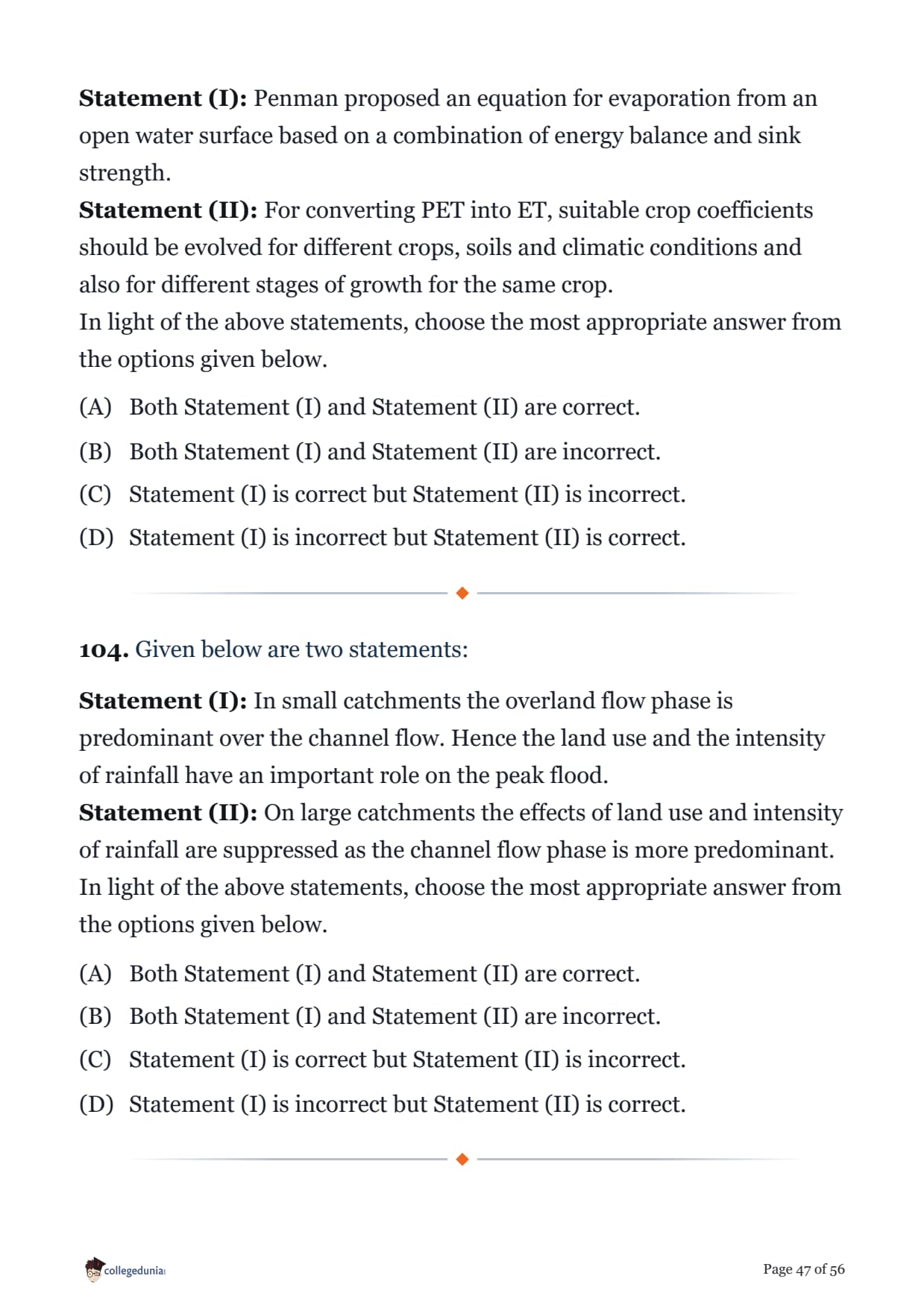
Question 103:

Given below are two statements:

Statement (I): Penman proposed an equation for evaporation from an open water surface based on a combination of energy balance and sink strength.
Statement (II): For converting PET into ET, suitable crop coefficients should be evolved for different crops, soils and climatic conditions and also for different stages of growth for the same crop.
In light of the above statements, choose the most appropriate answer from the options given below.

  • (A) Both Statement (I) and Statement (II) are correct.
  • (B) Both Statement (I) and Statement (II) are incorrect.
  • (C) Statement (I) is correct but Statement (II) is incorrect.
  • (D) Statement (I) is incorrect but Statement (II) is correct.

Question 104:

Given below are two statements:

Statement (I): In small catchments the overland flow phase is predominant over the channel flow. Hence the land use and the intensity of rainfall have an important role on the peak flood.
Statement (II): On large catchments the effects of land use and intensity of rainfall are suppressed as the channel flow phase is more predominant.
In light of the above statements, choose the most appropriate answer from the options given below.

  • (A) Both Statement (I) and Statement (II) are correct.
  • (B) Both Statement (I) and Statement (II) are incorrect.
  • (C) Statement (I) is correct but Statement (II) is incorrect.
  • (D) Statement (I) is incorrect but Statement (II) is correct.

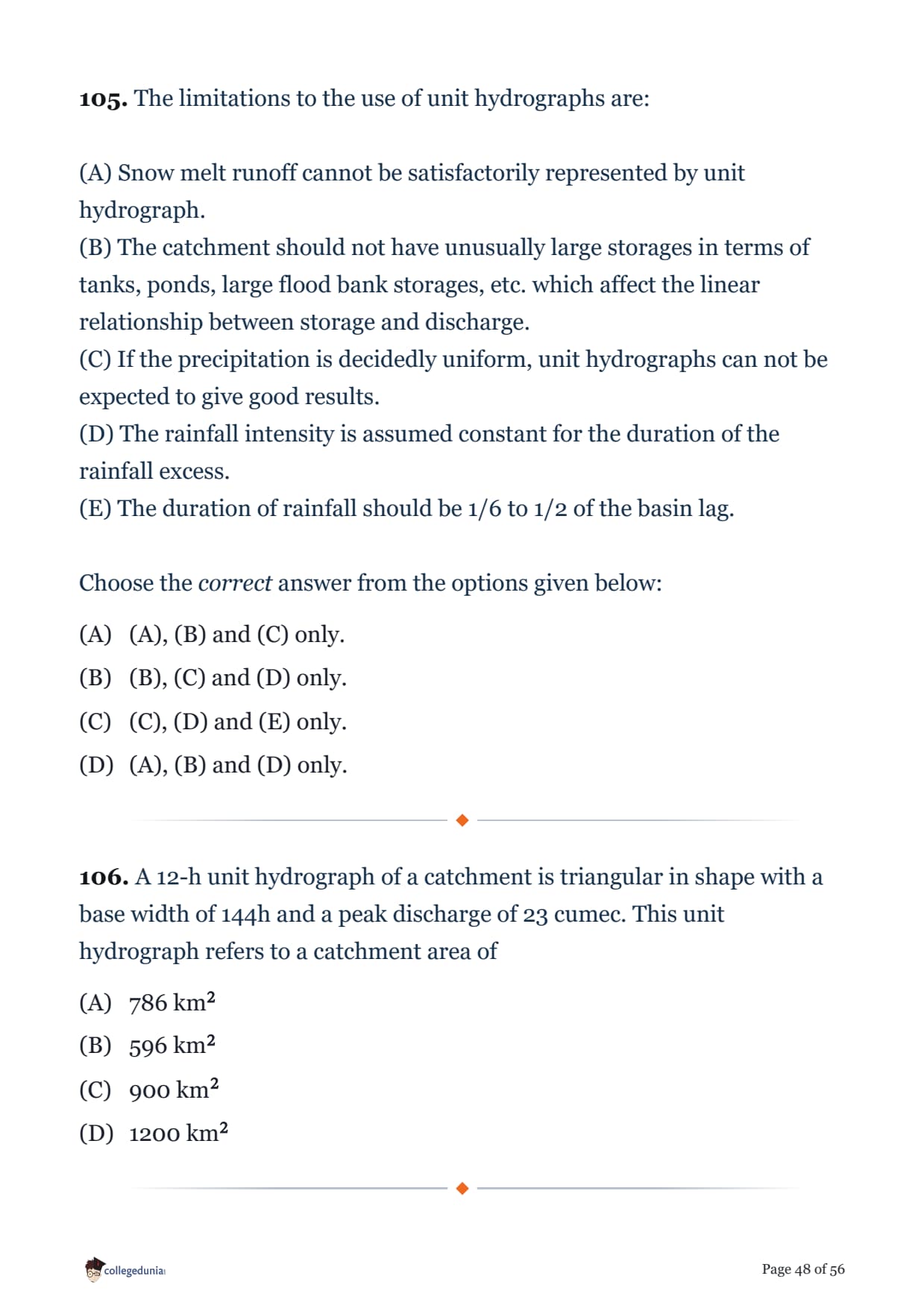
Question 105:

The limitations to the use of unit hydrographs are:

(A) Snow melt runoff cannot be satisfactorily represented by unit hydrograph.
(B) The catchment should not have unusually large storages in terms of tanks, ponds, large flood bank storages, etc. which affect the linear relationship between storage and discharge.
(C) If the precipitation is decidedly uniform, unit hydrographs can not be expected to give good results.
(D) The rainfall intensity is assumed constant for the duration of the rainfall excess.
(E) The duration of rainfall should be 1/6 to 1/2 of the basin lag.

Choose the correct answer from the options given below:

  • (A) (A), (B) and (C) only.
  • (B) (B), (C) and (D) only.
  • (C) (C), (D) and (E) only.
  • (D) (A), (B) and (D) only.

Question 106:

A 12-h unit hydrograph of a catchment is triangular in shape with a base width of 144h and a peak discharge of 23 cumec. This unit hydrograph refers to a catchment area of

  • (A) 786 km\(^2\)
  • (B) 596 km\(^2\)
  • (C) 900 km\(^2\)
  • (D) 1200 km\(^2\)

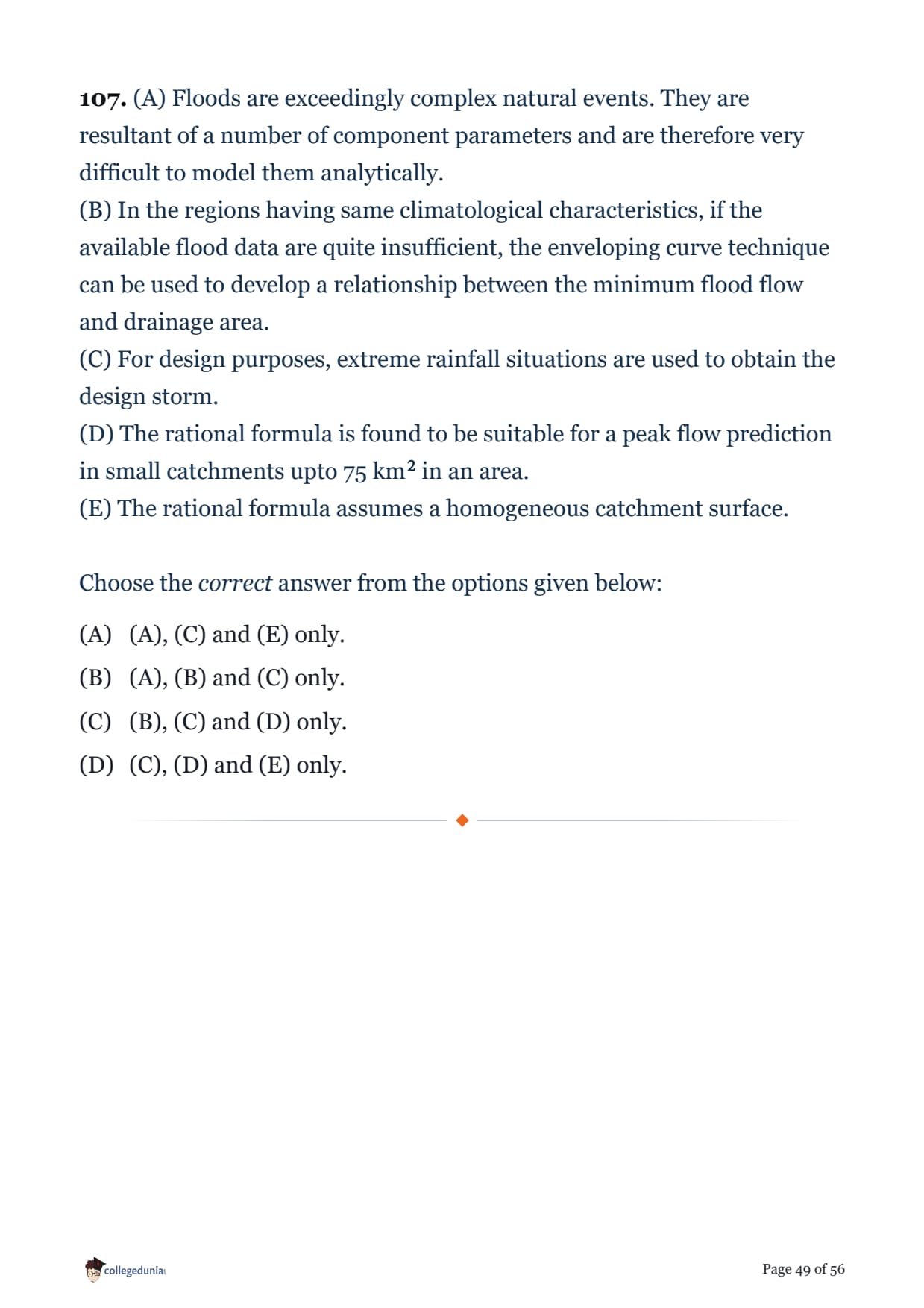
Question 107:

(A) Floods are exceedingly complex natural events. They are resultant of a number of component parameters and are therefore very difficult to model them analytically.
(B) In the regions having same climatological characteristics, if the available flood data are quite insufficient, the enveloping curve technique can be used to develop a relationship between the minimum flood flow and drainage area.
(C) For design purposes, extreme rainfall situations are used to obtain the design storm.
(D) The rational formula is found to be suitable for a peak flow prediction in small catchments upto 75 km\(^2\) in an area.
(E) The rational formula assumes a homogeneous catchment surface.

Choose the correct answer from the options given below:

  • (A) (A), (C) and (E) only.
  • (B) (A), (B) and (C) only.
  • (C) (B), (C) and (D) only.
  • (D) (C), (D) and (E) only.

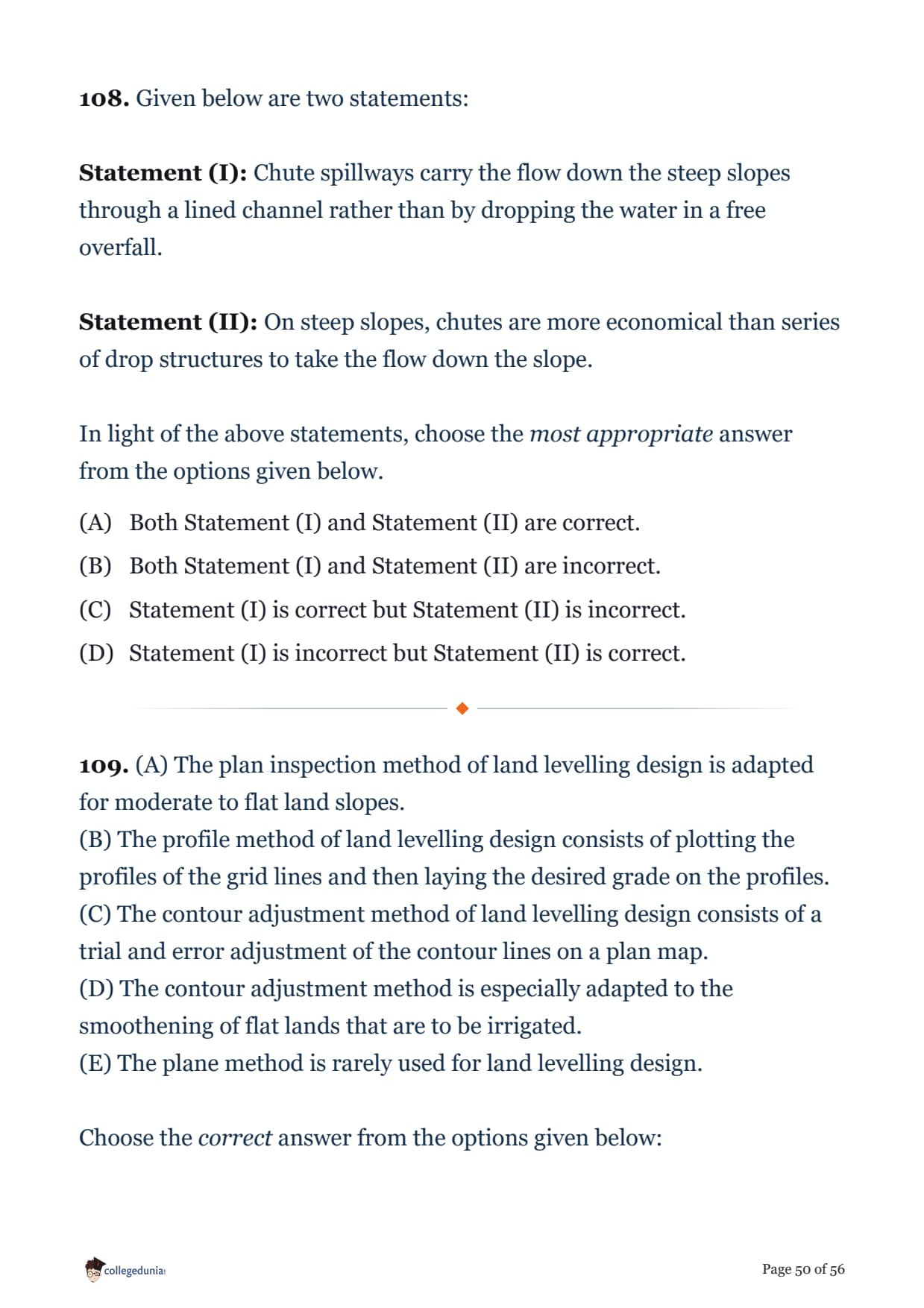
Question 108:

Given below are two statements:

Statement (I): Chute spillways carry the flow down the steep slopes through a lined channel rather than by dropping the water in a free overfall.

Statement (II): On steep slopes, chutes are more economical than series of drop structures to take the flow down the slope.

In light of the above statements, choose the most appropriate answer from the options given below.

  • (A) Both Statement (I) and Statement (II) are correct.
  • (B) Both Statement (I) and Statement (II) are incorrect.
  • (C) Statement (I) is correct but Statement (II) is incorrect.
  • (D) Statement (I) is incorrect but Statement (II) is correct.

Question 109:

(A) The plan inspection method of land levelling design is adapted for moderate to flat land slopes.
(B) The profile method of land levelling design consists of plotting the profiles of the grid lines and then laying the desired grade on the profiles.
(C) The contour adjustment method of land levelling design consists of a trial and error adjustment of the contour lines on a plan map.
(D) The contour adjustment method is especially adapted to the smoothening of flat lands that are to be irrigated.
(E) The plane method is rarely used for land levelling design.

Choose the correct answer from the options given below:

  • (A) (C), (D) and (E) only.
  • (B) (B), (C) and (D) only.
  • (C) (A), (B) and (C) only.
  • (D) (A), (B) and (E) only.

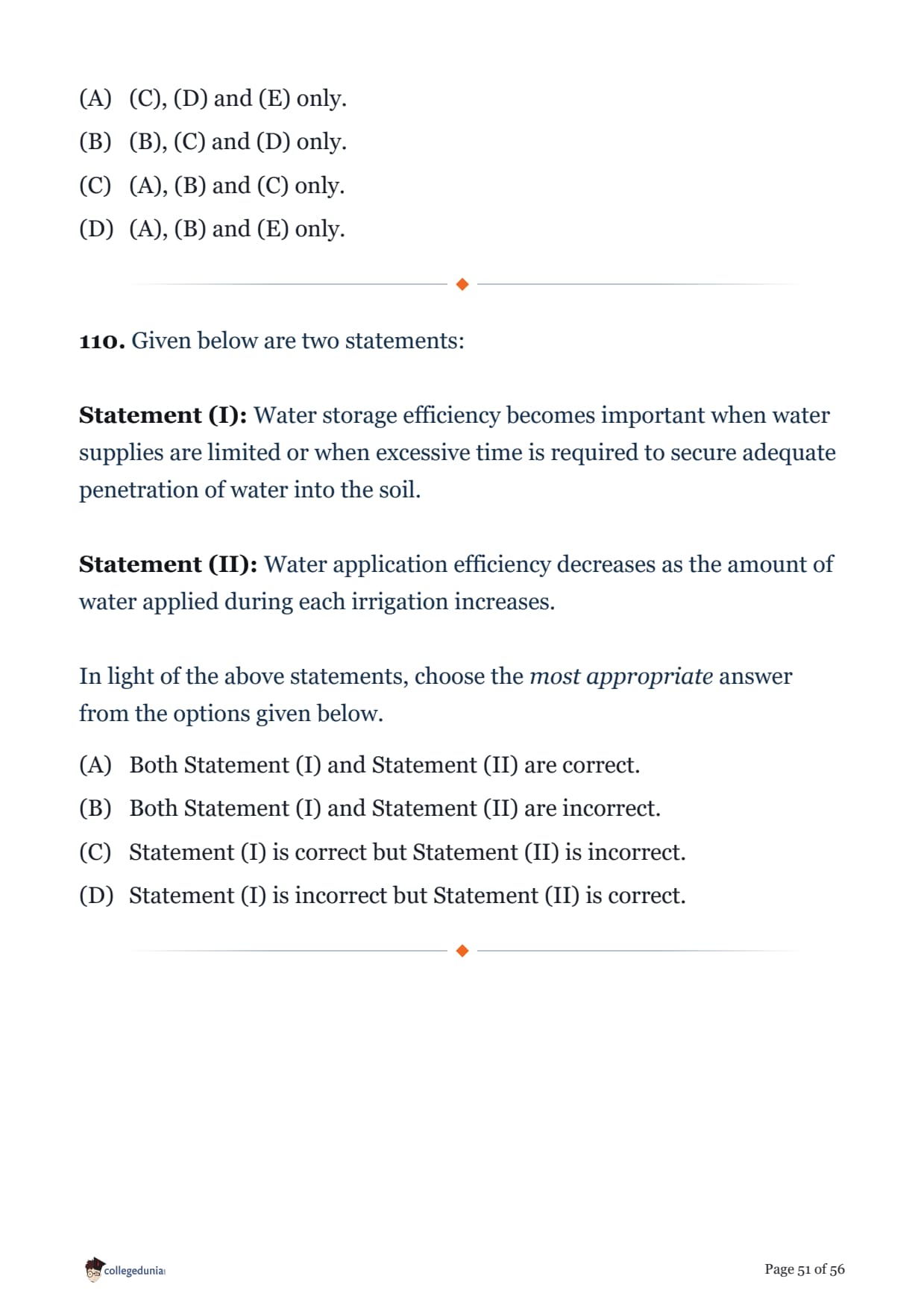
Question 110:

Given below are two statements:

Statement (I): Water storage efficiency becomes important when water supplies are limited or when excessive time is required to secure adequate penetration of water into the soil.

Statement (II): Water application efficiency decreases as the amount of water applied during each irrigation increases.

In light of the above statements, choose the most appropriate answer from the options given below.

  • (A) Both Statement (I) and Statement (II) are correct.
  • (B) Both Statement (I) and Statement (II) are incorrect.
  • (C) Statement (I) is correct but Statement (II) is incorrect.
  • (D) Statement (I) is incorrect but Statement (II) is correct.

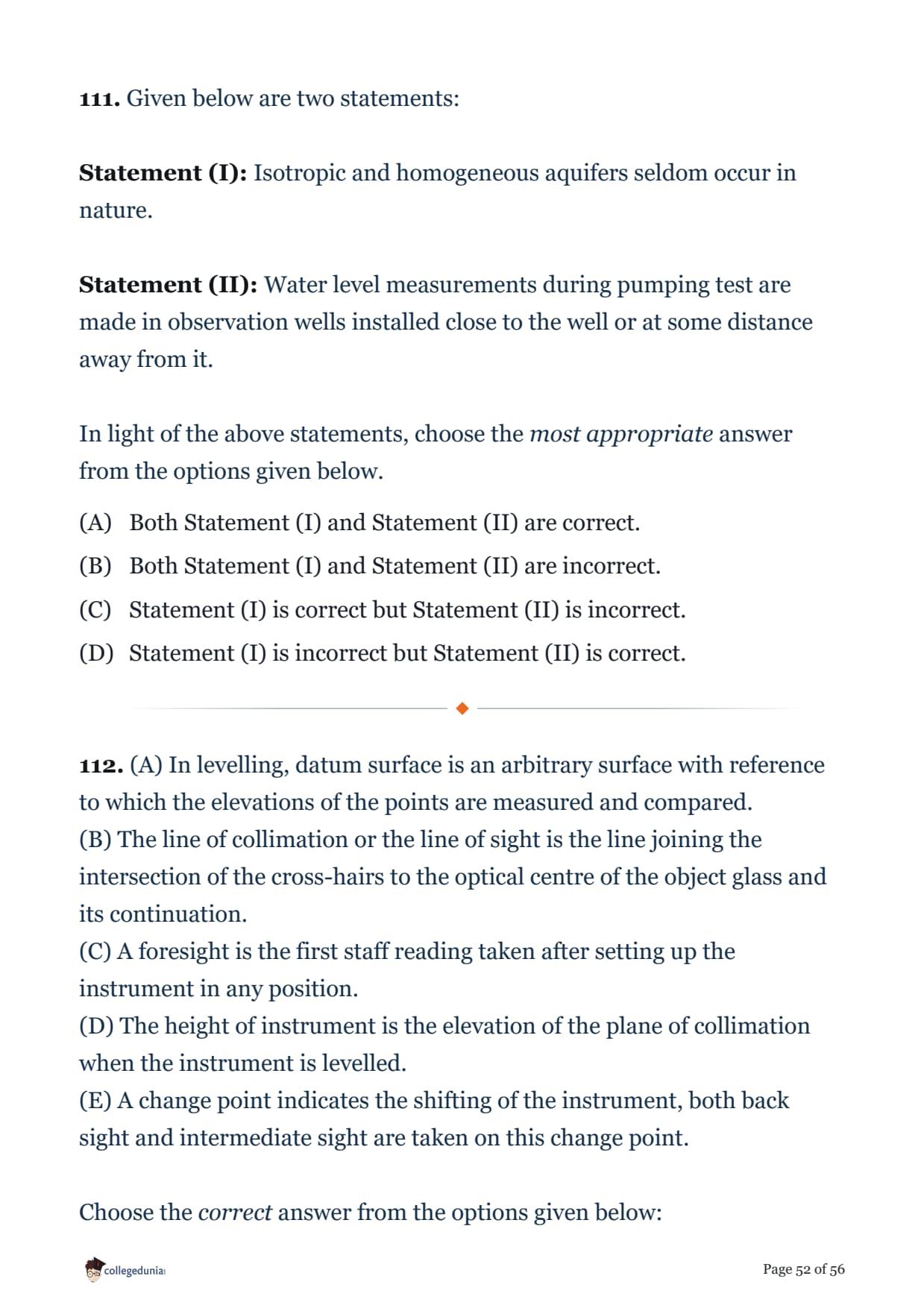
Question 111:

Given below are two statements:

Statement (I): Isotropic and homogeneous aquifers seldom occur in nature.

Statement (II): Water level measurements during pumping test are made in observation wells installed close to the well or at some distance away from it.

In light of the above statements, choose the most appropriate answer from the options given below.

  • (A) Both Statement (I) and Statement (II) are correct.
  • (B) Both Statement (I) and Statement (II) are incorrect.
  • (C) Statement (I) is correct but Statement (II) is incorrect.
  • (D) Statement (I) is incorrect but Statement (II) is correct.

Question 112:

(A) In levelling, datum surface is an arbitrary surface with reference to which the elevations of the points are measured and compared.
(B) The line of collimation or the line of sight is the line joining the intersection of the cross-hairs to the optical centre of the object glass and its continuation.
(C) A foresight is the first staff reading taken after setting up the instrument in any position.
(D) The height of instrument is the elevation of the plane of collimation when the instrument is levelled.
(E) A change point indicates the shifting of the instrument, both back sight and intermediate sight are taken on this change point.

Choose the correct answer from the options given below:

  • (A) (A), (B) and (D) only.
  • (B) (A), (B) and (C) only.
  • (C) (C), (D) and (E) only.
  • (D) (B), (C) and (D) only.

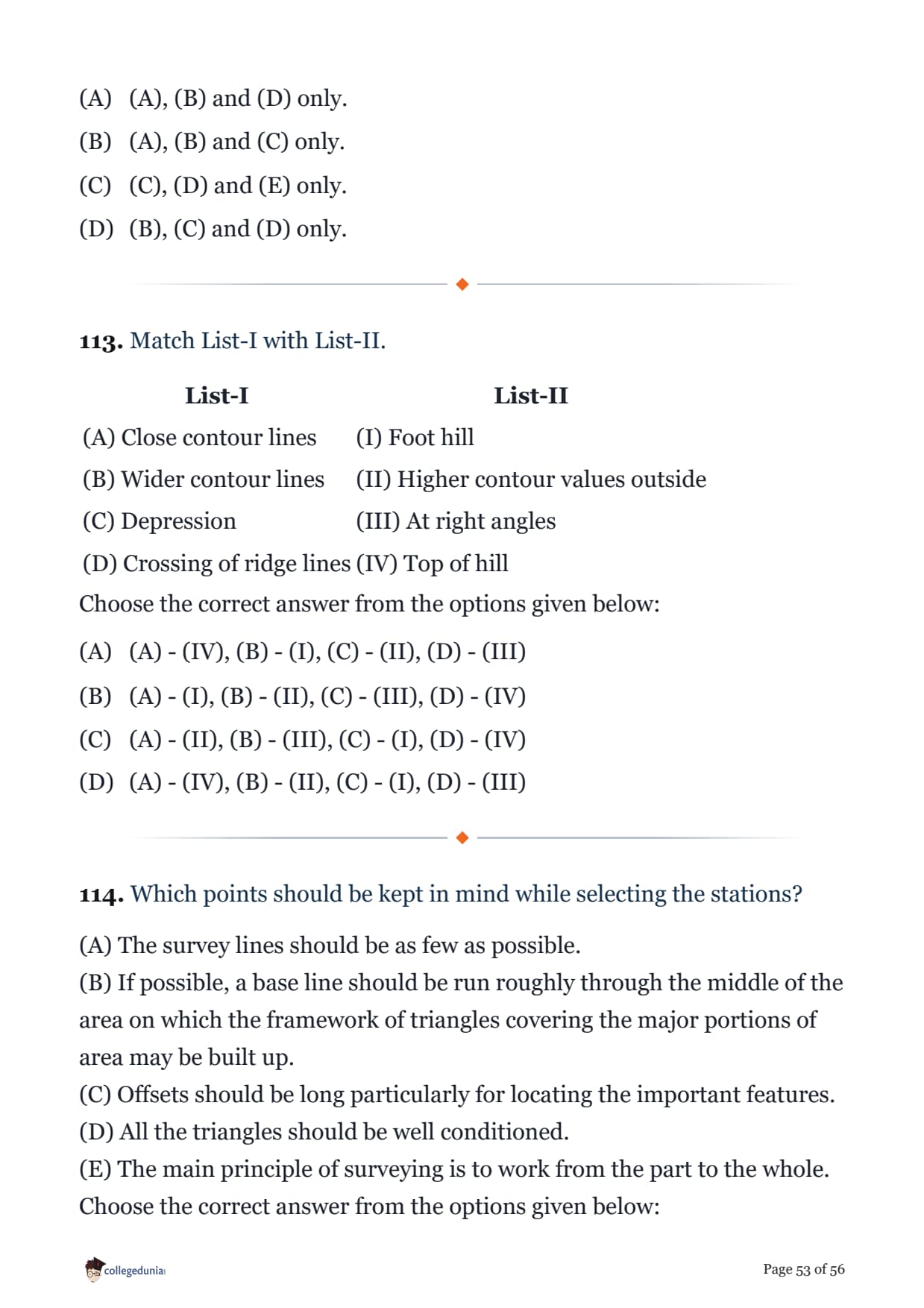
Question 113:

Match List-I with List-II.

List-IList-II
(A) Close contour lines(I) Foot hill
(B) Wider contour lines(II) Higher contour values outside
(C) Depression(III) At right angles
(D) Crossing of ridge lines(IV) Top of hill
Choose the correct answer from the options given below:

  • (A) (A) - (IV), (B) - (I), (C) - (II), (D) - (III)
  • (B) (A) - (I), (B) - (II), (C) - (III), (D) - (IV)
  • (C) (A) - (II), (B) - (III), (C) - (I), (D) - (IV)
  • (D) (A) - (IV), (B) - (II), (C) - (I), (D) - (III)

Question 114:

Which points should be kept in mind while selecting the stations?

(A) The survey lines should be as few as possible.
(B) If possible, a base line should be run roughly through the middle of the area on which the framework of triangles covering the major portions of area may be built up.
(C) Offsets should be long particularly for locating the important features.
(D) All the triangles should be well conditioned.
(E) The main principle of surveying is to work from the part to the whole.
Choose the correct answer from the options given below:

  • (A) (A), (B) and (C) only.
  • (B) (B), (C) and (D) only.
  • (C) (A), (B) and (D) only.
  • (D) (C), (D) and (E) only.

Question 115:

The design of bench terraces consists in determining the

(A) type of bench terraces
(B) terrace spacing
(C) terrace cross section
(D) terrace length
(E) terrace alignment
Choose the correct answer from the options given below:

  • (A) (A), (B) and (C) only.
  • (B) (B), (C) and (D) only.
  • (C) (C), (D) and (E) only.
  • (D) (A), (B) and (E) only.

Question 116:

Which land capability classes are suitable for pastures?

  • (A) class I and class II
  • (B) class II and class III
  • (C) class III and class IV
  • (D) class V and class VI

Question 117:

Orchard benched terraces has a width of about

  • (A) 2m
  • (B) 3m
  • (C) 0.5m
  • (D) 1m

Question 118:

A quantity of 100ml gypsum solution having 36 meq/l concentration as calcium, on reacting with 5gm of an alkali soil showed 32 meq/l of Ca+Mg concentration in the filtrate. Estimate the gypsum requirement in meq/100gm of soil.

  • (A) 6
  • (B) 8
  • (C) 12
  • (D) 16

Question 119:

Convert 1300 ppm sodium chloride salt concentration into meq/l

  • (A) 22.22
  • (B) 20.22
  • (C) 18.75
  • (D) 23.25

Question 120:

Given below are two statements:

Statement (I): The axis of the bubble tube should be perpendicular to the vertical axis in dumpy level.
Statement (II): The line of collimation of the telescope of the dumpy level should be perpendicular to the axis of the bubble tube.
In light of the above statements, choose the most appropriate answer from the options given below.

  • (A) Both Statement (I) and Statement (II) are correct.
  • (B) Both Statement (I) and Statement (II) are incorrect.
  • (C) Statement (I) is correct but Statement (II) is incorrect.
  • (D) Statement (I) is incorrect but Statement (II) is correct.

ICAR AIEEA PG 2023 Agricultural Engineering Exam Pattern and Marking Scheme Explained

As per the NTA information bulletin on the official website (exams.nta.nic.in/icar), every ICAR AIEEA PG subject paper follows the same fixed format, and Agricultural Engineering and Technology is no different.

  • Total questions: 120 MCQs, all from the Agricultural Engineering and Technology subject group
  • Duration: 2 hours (120 minutes), computer-based test
  • Total marks: 480
  • Marking scheme: +4 for a correct answer, -1 for a wrong one, 0 for not attempting
  • Question types: single-correct MCQs, several with assertion-reason pairs and match-the-following lists

High-Weightage Subjects in ICAR AIEEA PG 2023 Agricultural Engineering to Focus On First

Going question by question through this paper, three areas alone account for close to half the marks.

  • Post-harvest engineering was the single biggest area, with 22 of the 120 questions covering drying, storage, milling, oil expression and refrigeration
  • Soil and water conservation engineering followed with 18 questions, including runoff, hydrographs and land levelling
  • Farm machinery made up 15 questions, spanning tillage implements, seeding and harvesting equipment
  • Farm structures and grain storage design accounted for 7 questions
  • Irrigation and drainage engineering added another 7 questions between design and command area development topics
  • Farm power, IC engines and theory of machines together made up close to 10 more questions, so engine and mechanism basics are still worth a quick revision

ICAR AIEEA PG 2023 Agricultural Engineering Question Paper Analysis Video

Source: AgriAddict: English Medium

How to Use the ICAR AIEEA PG Agricultural Engineering Question Paper for Practice

Since ICAR AIEEA PG has no sectional cutoff within a subject paper, treat this as one full 2-hour mock rather than solving it topic by topic.

  • Solve all 120 questions in one sitting under the real 2-hour limit before you look at the solutions PDF
  • Score yourself with the +4/-1 scheme so you know your real net marks out of 480
  • Review every post-harvest engineering and soil and water conservation question first, since together they are almost a third of the paper
  • Redo the assertion-reason and match-the-following questions separately, they came up more than a dozen times in this paper and reward careful reading over speed

ICAR AIEEA PG Agricultural Engineering Preparation Priority List

  • Post-harvest engineering and soil and water conservation together, since they cover a third of the paper
  • Farm machinery and tillage implements next, given their steady 12 percent share
  • Farm power, IC engines and theory of machines as a supporting block, not the main focus

ICAR AIEEA PG 2023 Agricultural Engineering Question Paper FAQs

Ques. How many questions were there in the ICAR AIEEA PG 2023 Agricultural Engineering and Technology paper?

Ans. The paper had 120 multiple-choice questions worth 480 marks total, with +4 for every correct answer and -1 for every wrong one, in a 2-hour computer-based test.

Ques. Which topics had the highest weightage in ICAR AIEEA PG 2023 Agricultural Engineering?

Ans. Post-harvest engineering led with 22 of 120 questions, followed by soil and water conservation engineering with 18 and farm machinery with 15. These three topics alone made up close to half the paper.

Ques. Are ICAR AIEEA PG Agricultural Engineering questions repeated from previous years?

Ans. Core numerical types, like field capacity calculations, moisture removal problems and parallel axis theorem questions, repeat in concept every year even though the exact numbers change, so solving multiple past papers of this subject is worth your time.

Ques. How is ICAR AIEEA PG 2023 different from the ICAR AIEEA UG exam?

Ans. AIEEA PG is a subject-specific 120-question paper used for admission to ICAR-affiliated master's programmes, while AIEEA UG is a common entrance test for undergraduate agriculture admissions with a different, broader syllabus.

Ques. Where can I download the ICAR AIEEA PG 2023 Agricultural Engineering question paper with solutions PDF for free?

Ans. Use the download table at the top of this page for the free question paper and solutions PDF. For the official question paper and answer key, check the NTA ICAR portal at exams.nta.nic.in/icar.

Ques. What subjects does ICAR AIEEA PG Agricultural Engineering and Technology cover?

Ans. This paper draws from farm machinery, farm power and IC engines, soil and water conservation engineering, irrigation and drainage engineering, post-harvest engineering, farm structures, surveying, and engineering mechanics and mathematics.