




The ICAR AIEEA PG 2023 Agri Business Management question paper is available here with detailed solutions for free download. ICAR AIEEA PG 2023 was conducted by the National Testing Agency (NTA) on behalf of ICAR on July 9, 2023, and the Agri Business Management paper carried 120 questions in 120 minutes.
| ICAR AIEEA PG 2023 Agri Business Management Question Paper with Solutions | Download PDF | Check Solutions |
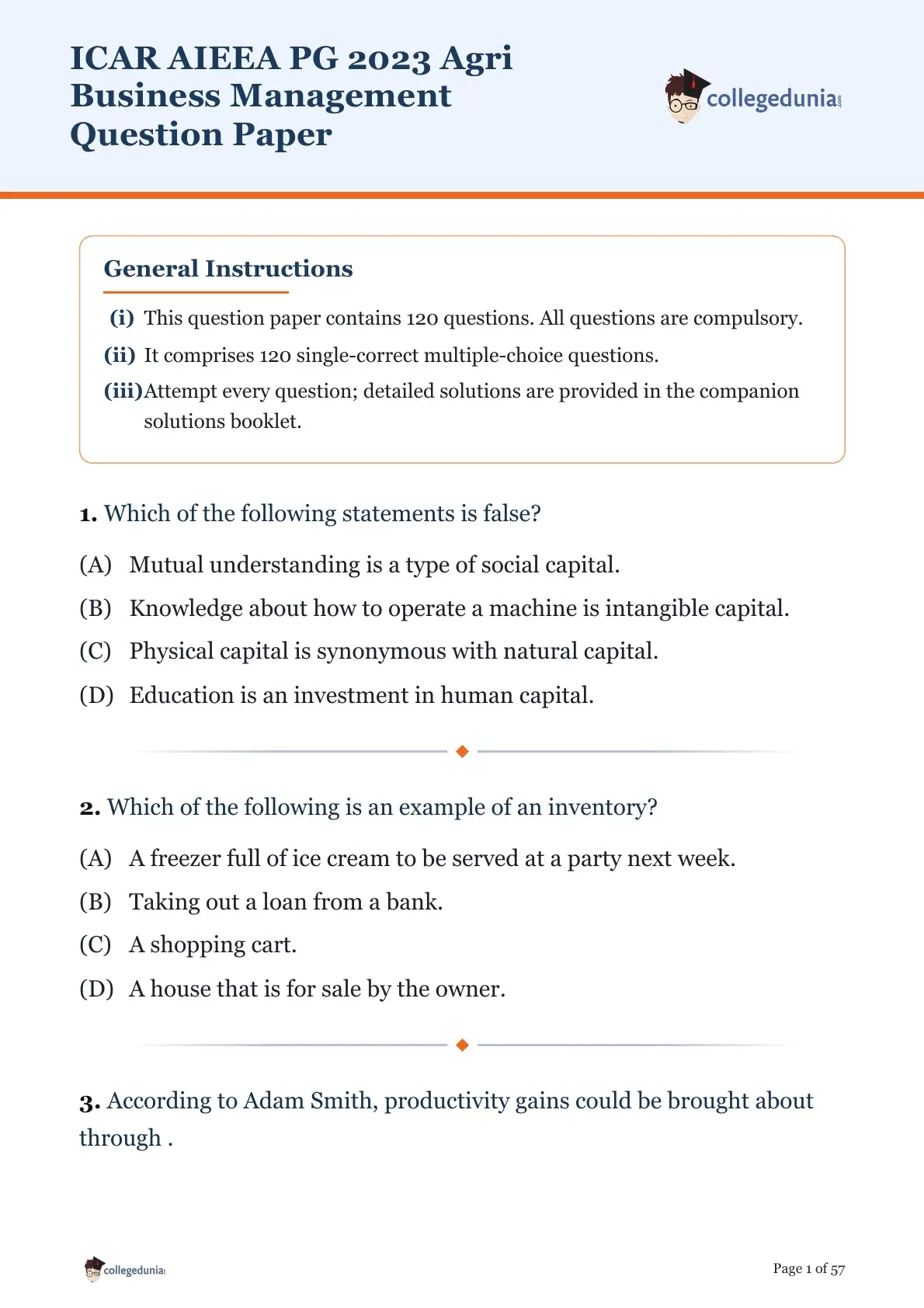
ICAR AIEEA PG 2023 Agri Business Management Questions with Solutions
Which of the following statements is false?
Which of the following is an example of an inventory?
According to Adam Smith, productivity gains could be brought about through .
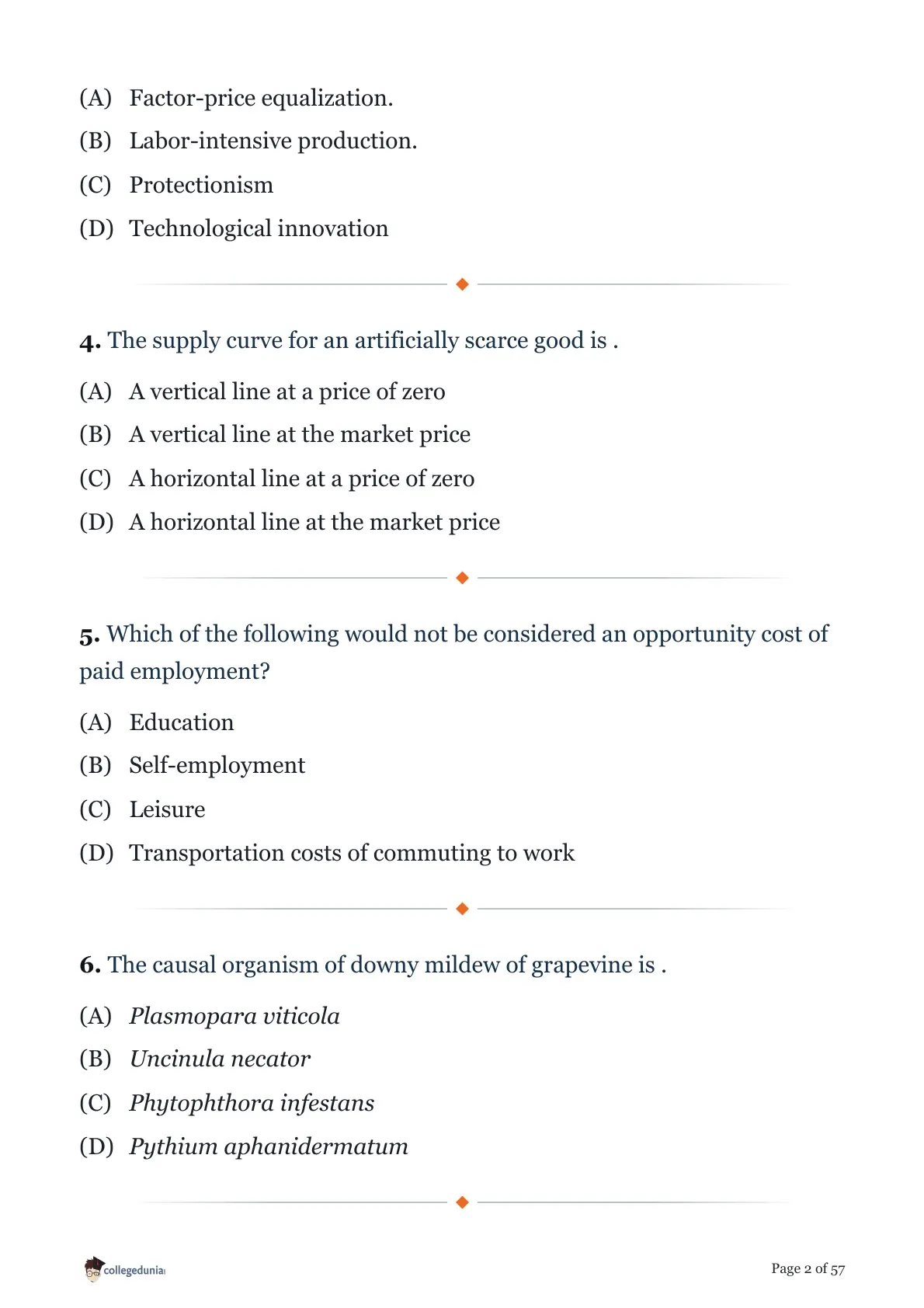
The supply curve for an artificially scarce good is .
Which of the following would not be considered an opportunity cost of paid employment?
The causal organism of downy mildew of grapevine is .
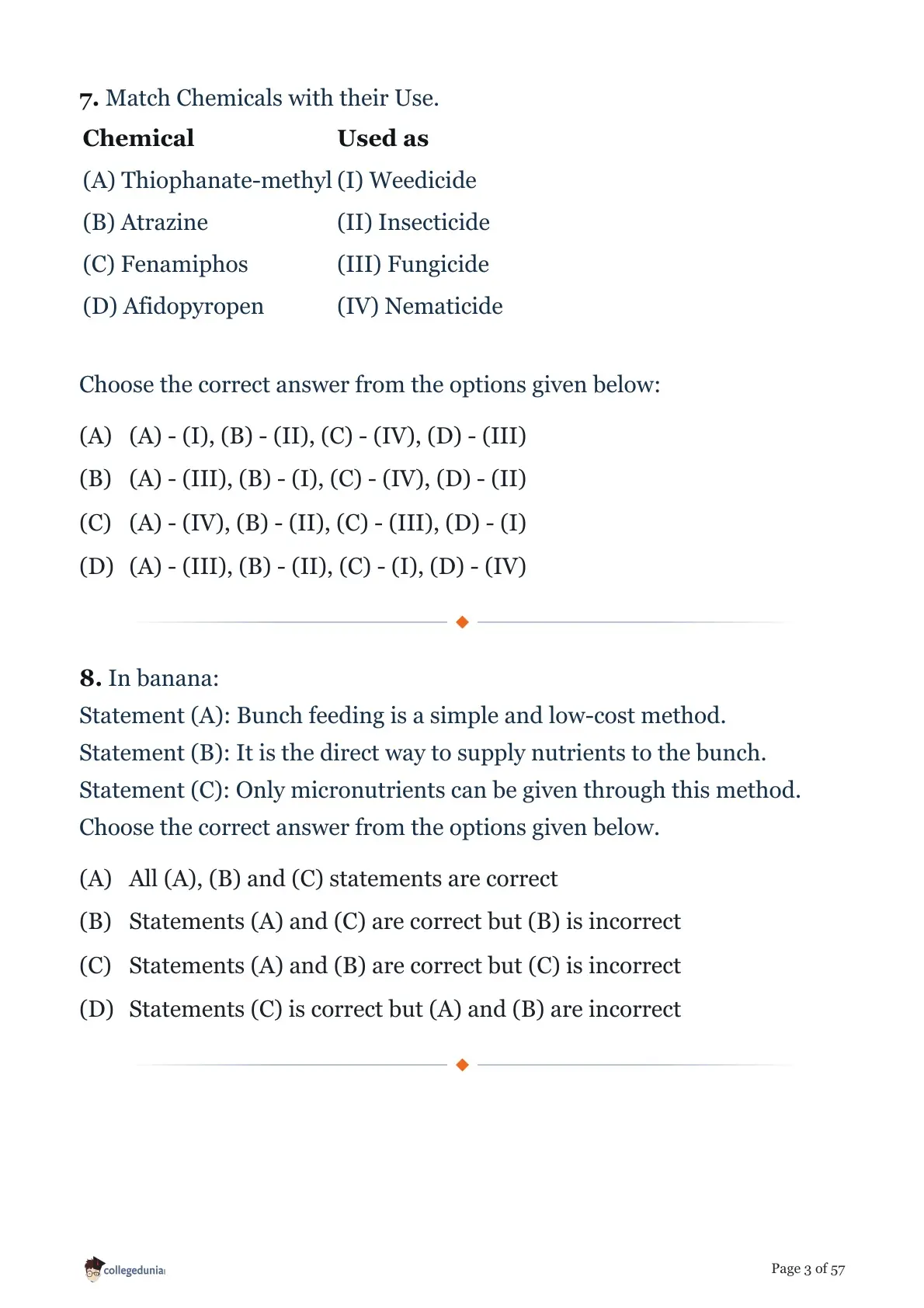
Match Chemicals with their Use.
| Chemical | Used as |
| (A) Thiophanate-methyl | (I) Weedicide |
| (B) Atrazine | (II) Insecticide |
| (C) Fenamiphos | (III) Fungicide |
| (D) Afidopyropen | (IV) Nematicide |
Choose the correct answer from the options given below:
In banana:
Statement (A): Bunch feeding is a simple and low-cost method.
Statement (B): It is the direct way to supply nutrients to the bunch.
Statement (C): Only micronutrients can be given through this method.
Choose the correct answer from the options given below.
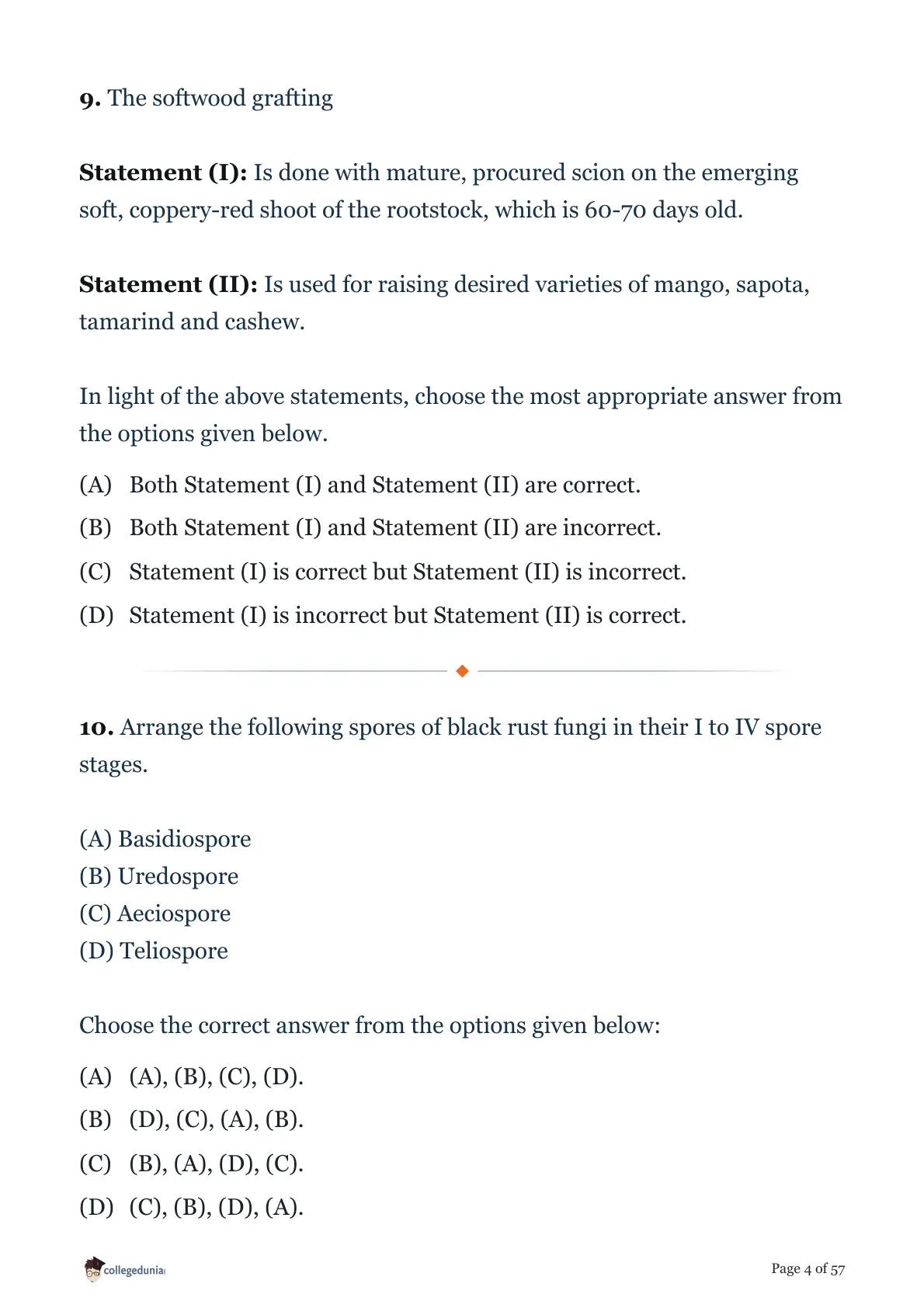
The softwood grafting
Statement (I): Is done with mature, procured scion on the emerging soft, coppery-red shoot of the rootstock, which is 60-70 days old.
Statement (II): Is used for raising desired varieties of mango, sapota, tamarind and cashew.
In light of the above statements, choose the most appropriate answer from the options given below.
Arrange the following spores of black rust fungi in their I to IV spore stages.
(A) Basidiospore
(B) Uredospore
(C) Aeciospore
(D) Teliospore
Choose the correct answer from the options given below:
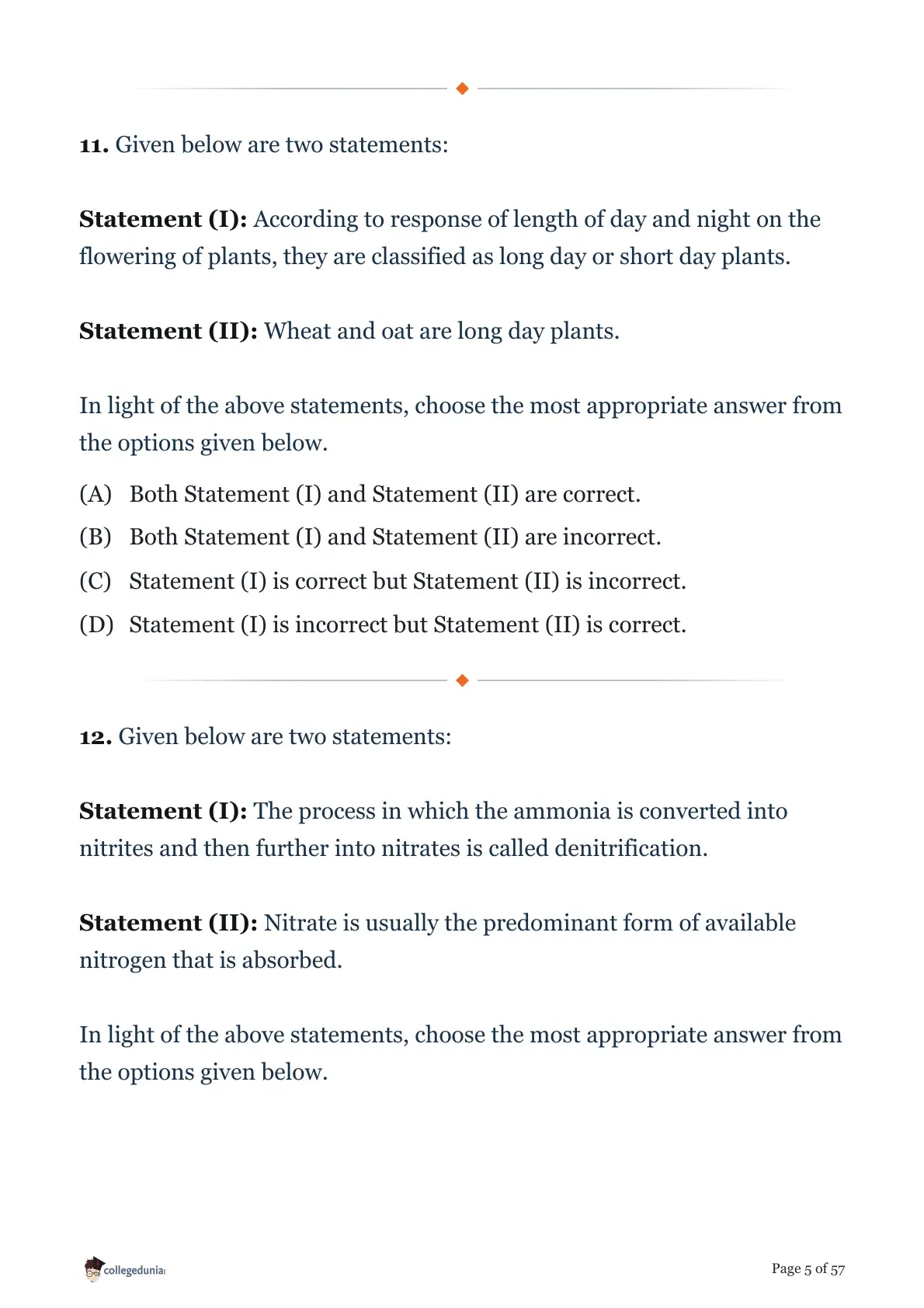
Given below are two statements:
Statement (I): According to response of length of day and night on the flowering of plants, they are classified as long day or short day plants.
Statement (II): Wheat and oat are long day plants.
In light of the above statements, choose the most appropriate answer from the options given below.
Given below are two statements:
Statement (I): The process in which the ammonia is converted into nitrites and then further into nitrates is called denitrification.
Statement (II): Nitrate is usually the predominant form of available nitrogen that is absorbed.
In light of the above statements, choose the most appropriate answer from the options given below.
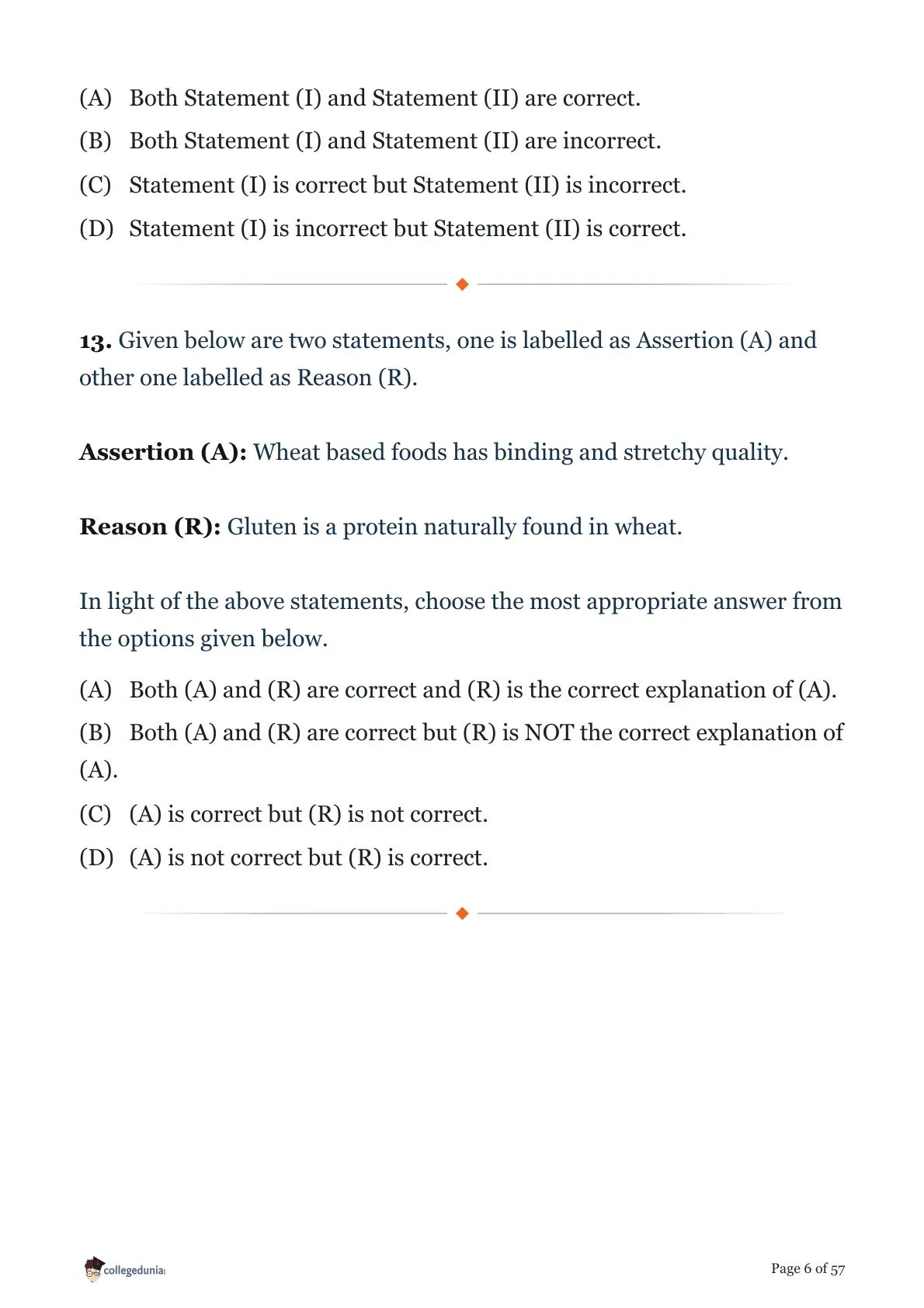
Given below are two statements, one is labelled as Assertion (A) and other one labelled as Reason (R).
Assertion (A): Wheat based foods has binding and stretchy quality.
Reason (R): Gluten is a protein naturally found in wheat.
In light of the above statements, choose the most appropriate answer from the options given below.
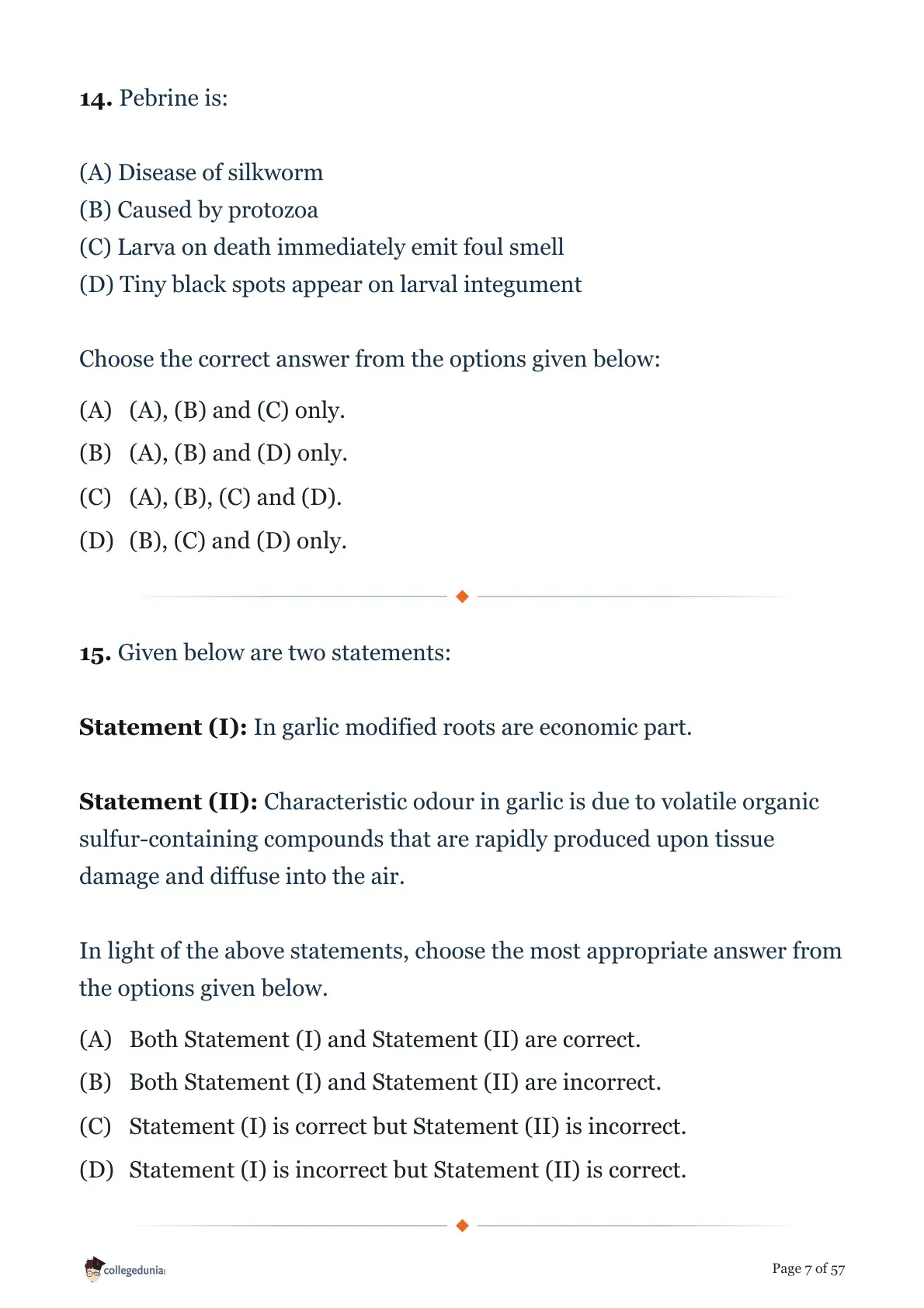
Pebrine is:
(A) Disease of silkworm
(B) Caused by protozoa
(C) Larva on death immediately emit foul smell
(D) Tiny black spots appear on larval integument
Choose the correct answer from the options given below:
Given below are two statements:
Statement (I): In garlic modified roots are economic part.
Statement (II): Characteristic odour in garlic is due to volatile organic sulfur-containing compounds that are rapidly produced upon tissue damage and diffuse into the air.
In light of the above statements, choose the most appropriate answer from the options given below.
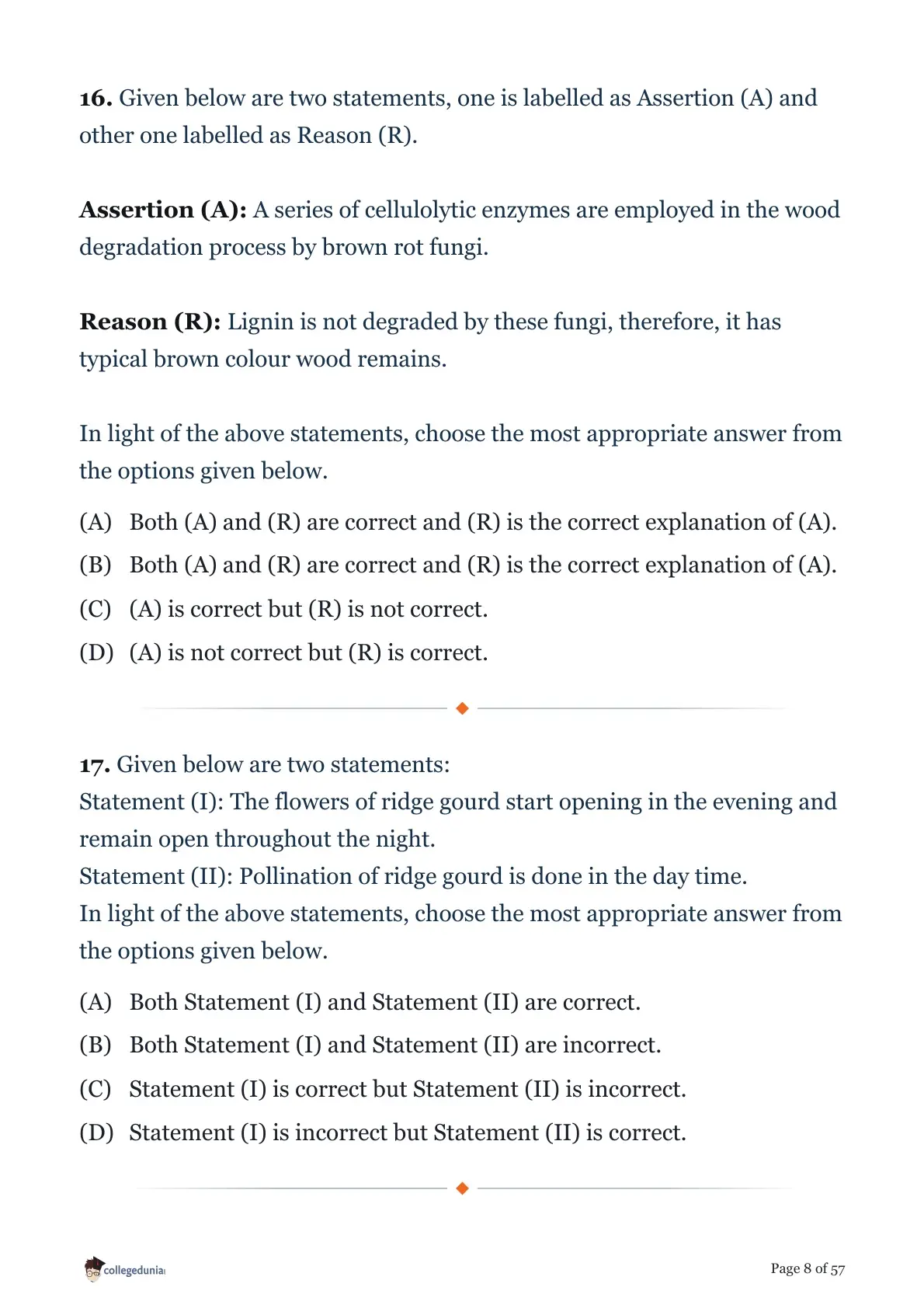
Given below are two statements, one is labelled as Assertion (A) and other one labelled as Reason (R).
Assertion (A): A series of cellulolytic enzymes are employed in the wood degradation process by brown rot fungi.
Reason (R): Lignin is not degraded by these fungi, therefore, it has typical brown colour wood remains.
In light of the above statements, choose the most appropriate answer from the options given below.
Given below are two statements:
Statement (I): The flowers of ridge gourd start opening in the evening and remain open throughout the night.
Statement (II): Pollination of ridge gourd is done in the day time.
In light of the above statements, choose the most appropriate answer from the options given below.
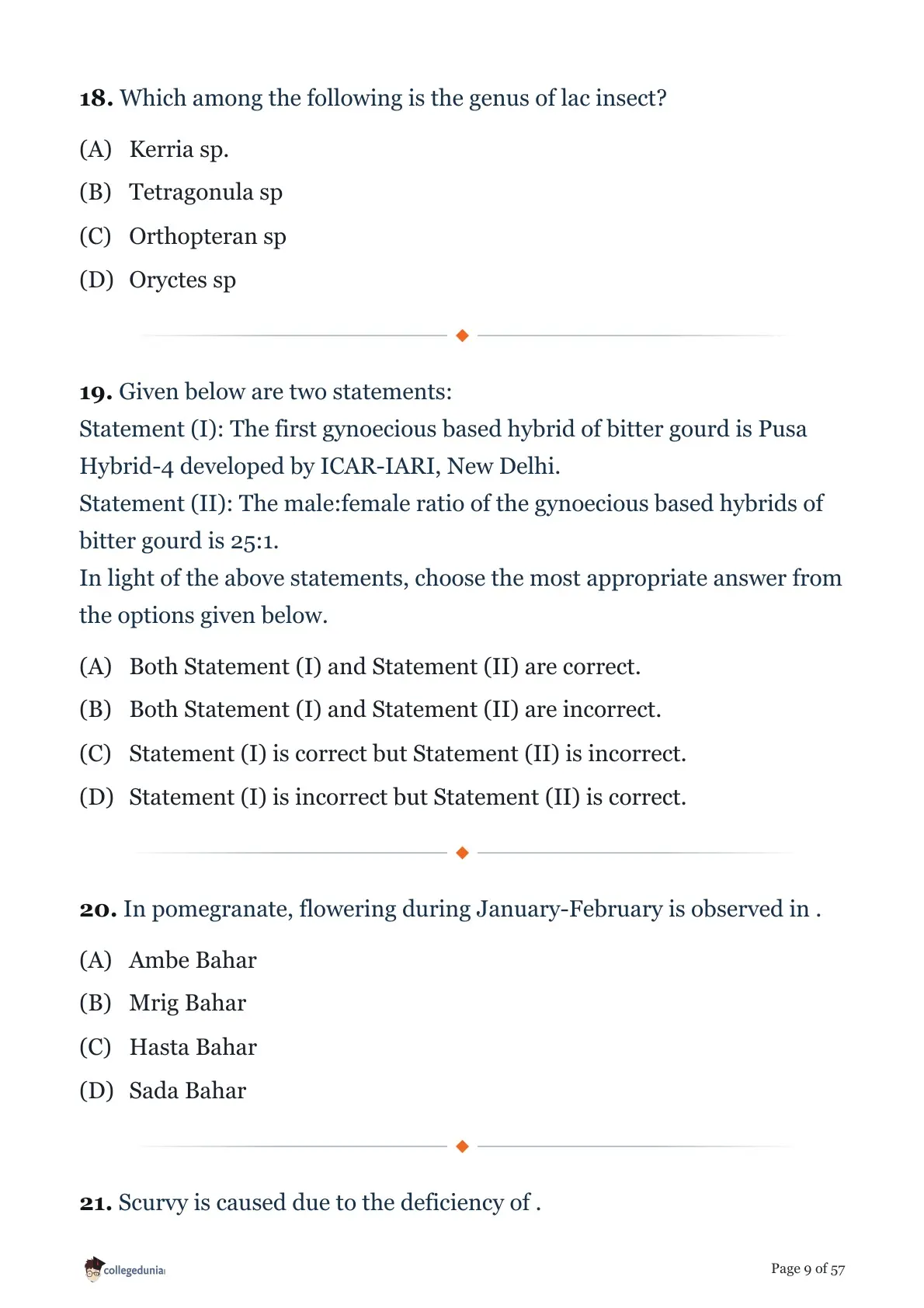
Which among the following is the genus of lac insect?
Given below are two statements:
Statement (I): The first gynoecious based hybrid of bitter gourd is Pusa Hybrid-4 developed by ICAR-IARI, New Delhi.
Statement (II): The male:female ratio of the gynoecious based hybrids of bitter gourd is 25:1.
In light of the above statements, choose the most appropriate answer from the options given below.
In pomegranate, flowering during January-February is observed in .
Scurvy is caused due to the deficiency of .
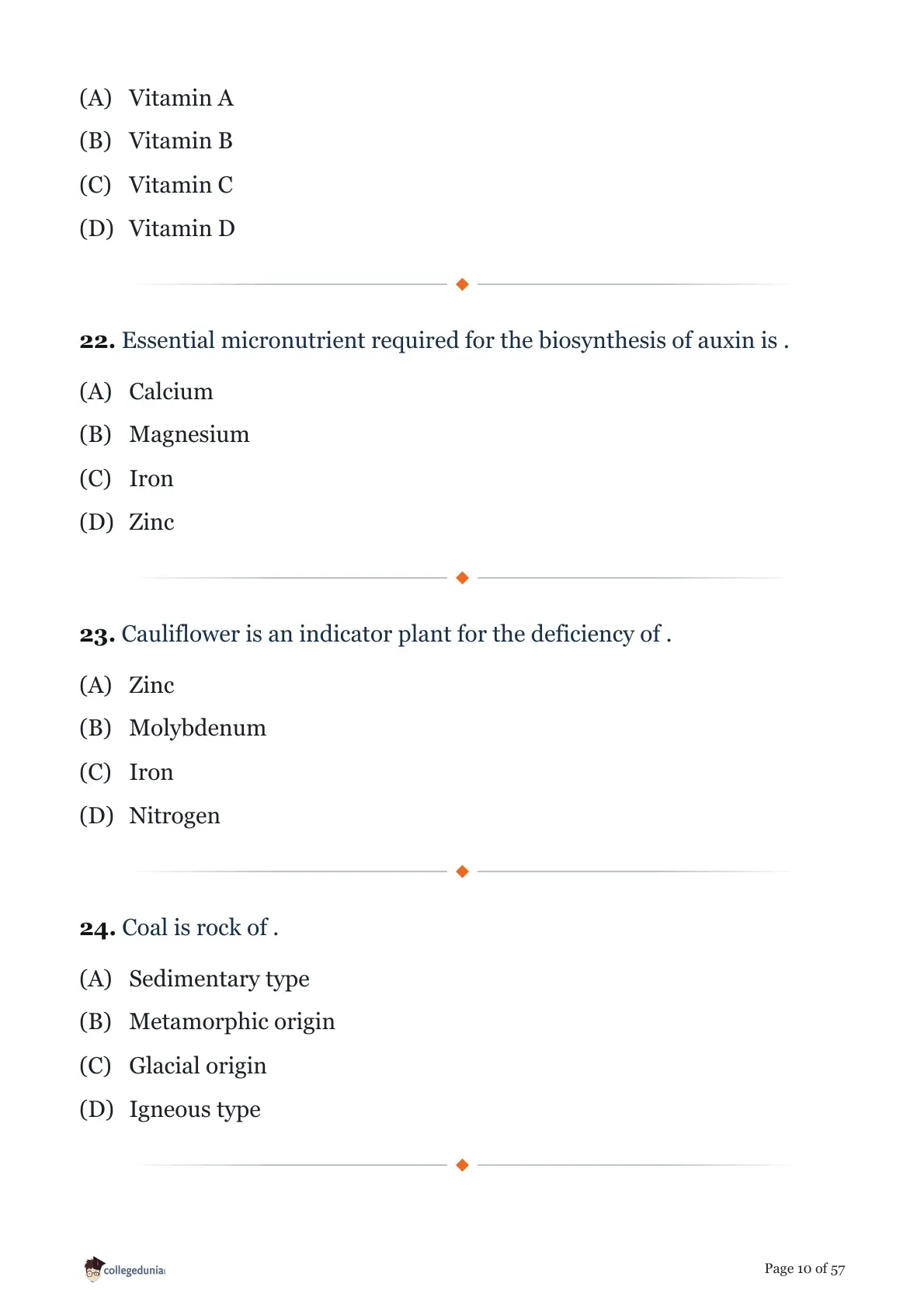
Essential micronutrient required for the biosynthesis of auxin is .
Cauliflower is an indicator plant for the deficiency of .
Coal is rock of .
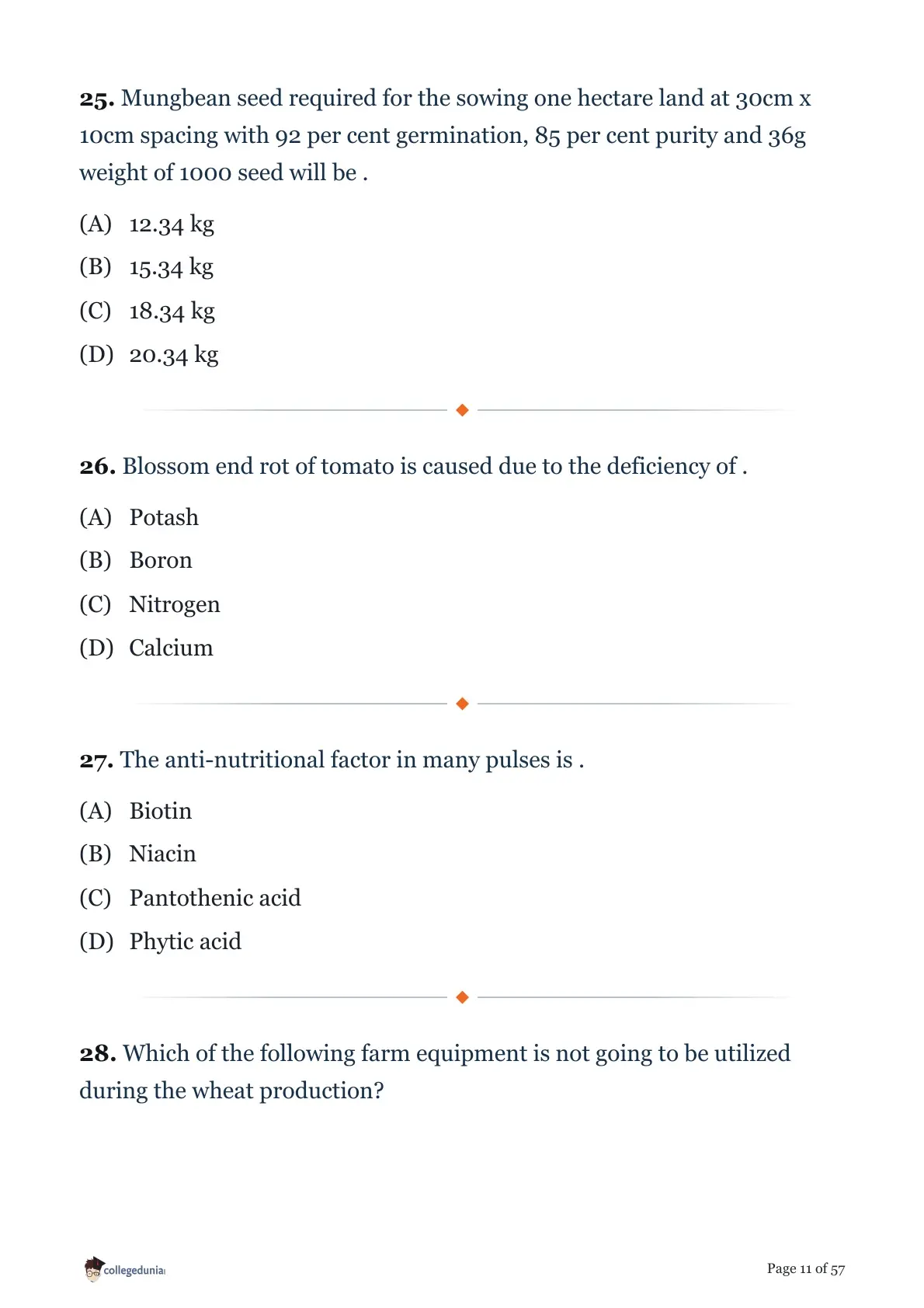
Mungbean seed required for the sowing one hectare land at 30cm x 10cm spacing with 92 per cent germination, 85 per cent purity and 36g weight of 1000 seed will be .
Blossom end rot of tomato is caused due to the deficiency of .
The anti-nutritional factor in many pulses is .
Which of the following farm equipment is not going to be utilized during the wheat production?
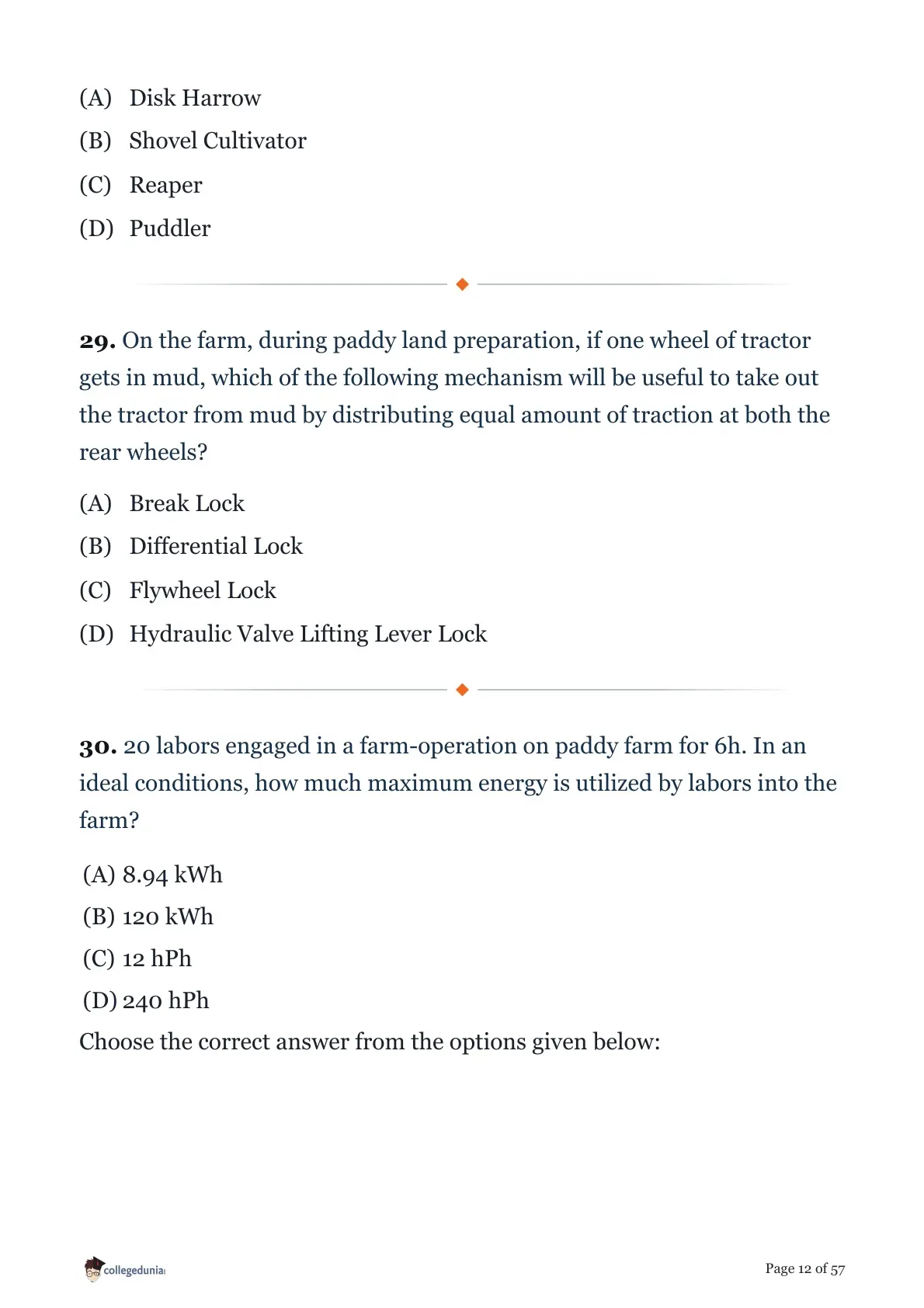
On the farm, during paddy land preparation, if one wheel of tractor gets in mud, which of the following mechanism will be useful to take out the tractor from mud by distributing equal amount of traction at both the rear wheels?
20 labors engaged in a farm-operation on paddy farm for 6h. In an ideal conditions, how much maximum energy is utilized by labors into the farm?
| (A) | 8.94 kWh |
| (B) | 120 kWh |
| (C) | 12 hPh |
| (D) | 240 hPh |
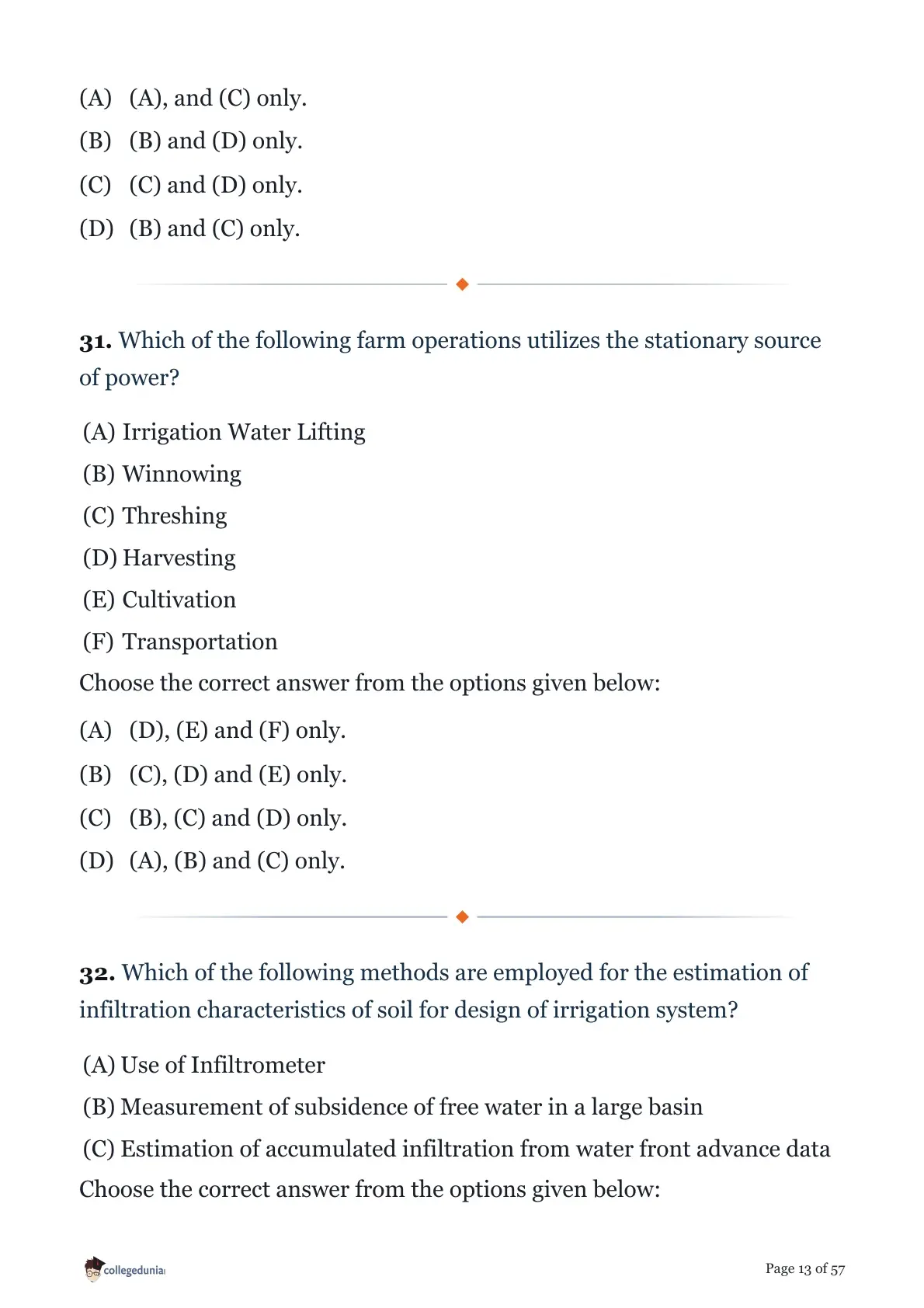
Which of the following farm operations utilizes the stationary source of power?
| (A) | Irrigation Water Lifting |
| (B) | Winnowing |
| (C) | Threshing |
| (D) | Harvesting |
| (E) | Cultivation |
| (F) | Transportation |
Which of the following methods are employed for the estimation of infiltration characteristics of soil for design of irrigation system?
| (A) | Use of Infiltrometer |
| (B) | Measurement of subsidence of free water in a large basin |
| (C) | Estimation of accumulated infiltration from water front advance data |
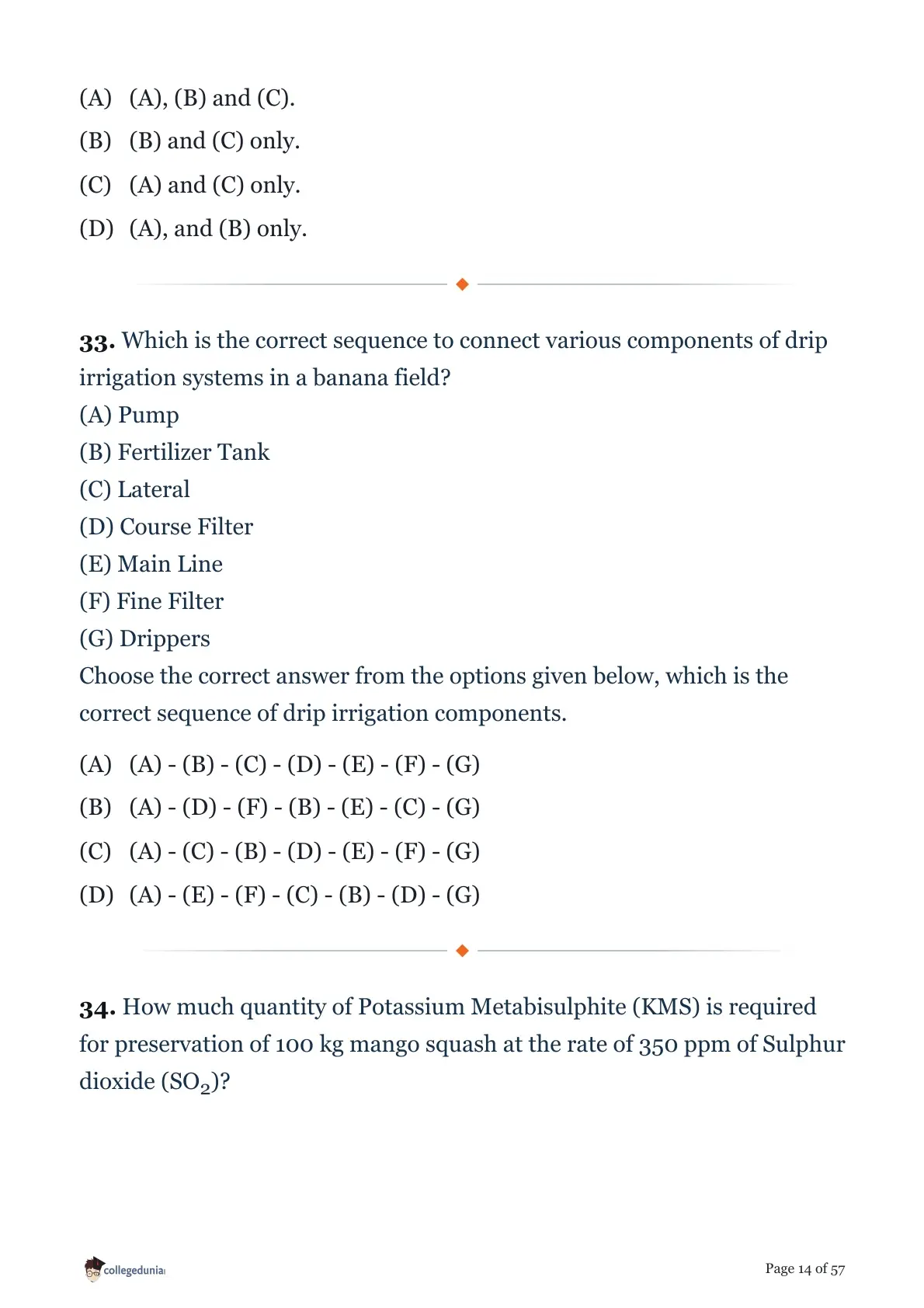
Which is the correct sequence to connect various components of drip irrigation systems in a banana field?
(A) Pump
(B) Fertilizer Tank
(C) Lateral
(D) Course Filter
(E) Main Line
(F) Fine Filter
(G) Drippers
Choose the correct answer from the options given below, which is the correct sequence of drip irrigation components.
How much quantity of Potassium Metabisulphite (KMS) is required for preservation of 100 kg mango squash at the rate of 350 ppm of Sulphur dioxide (SO2)?
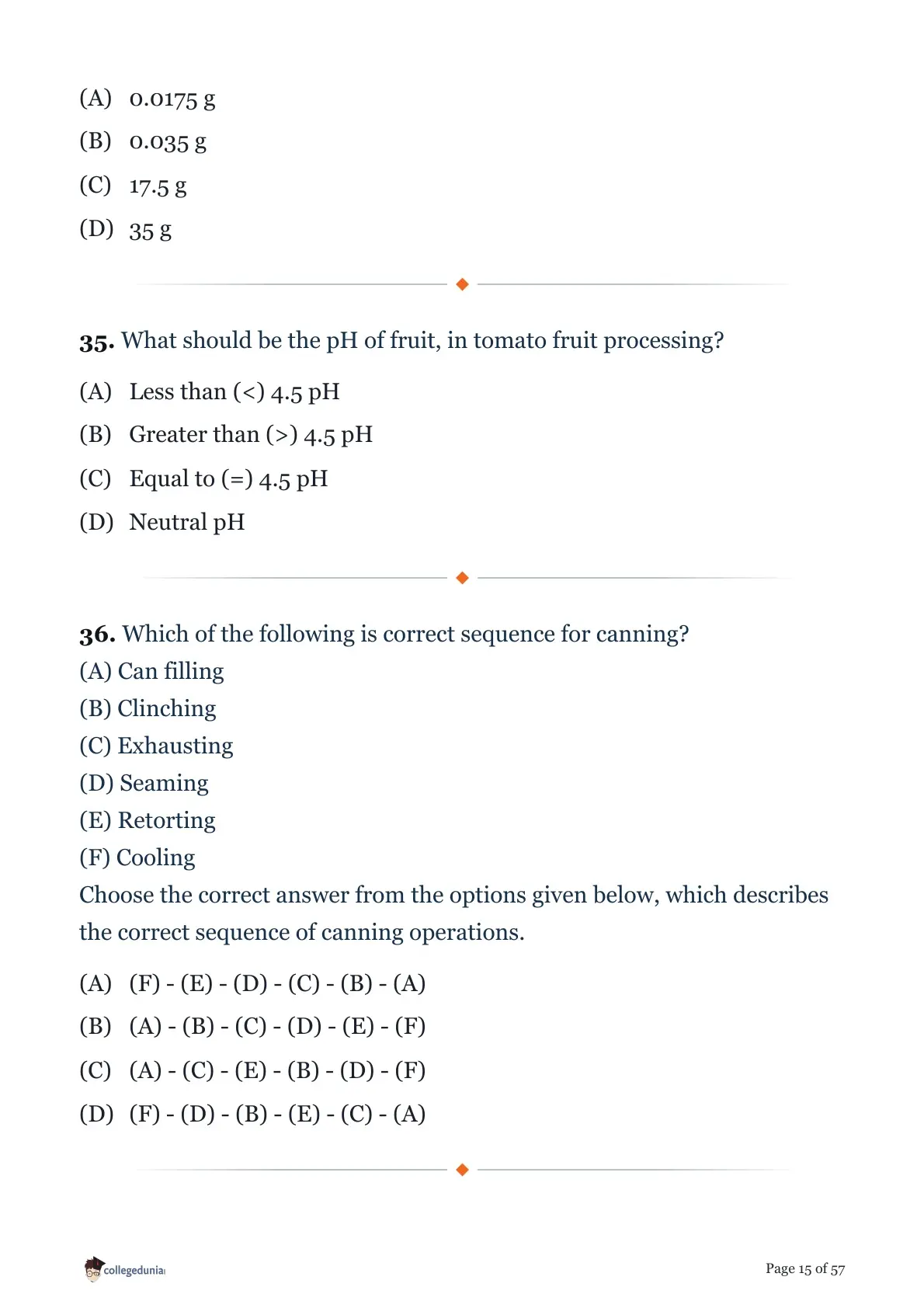
What should be the pH of fruit, in tomato fruit processing?
Which of the following is correct sequence for canning?
(A) Can filling
(B) Clinching
(C) Exhausting
(D) Seaming
(E) Retorting
(F) Cooling
Choose the correct answer from the options given below, which describes the correct sequence of canning operations.
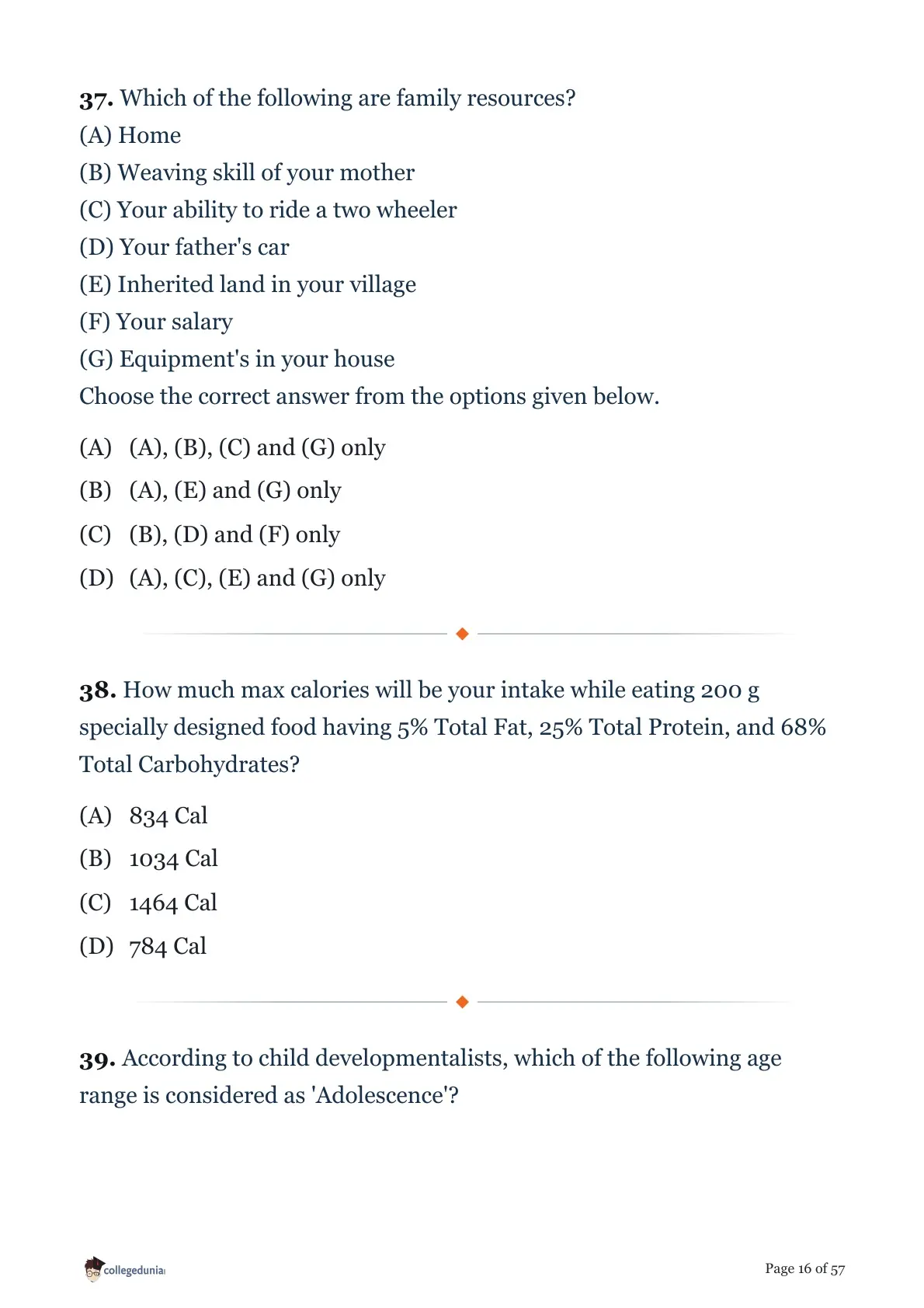
Which of the following are family resources?
(A) Home
(B) Weaving skill of your mother
(C) Your ability to ride a two wheeler
(D) Your father's car
(E) Inherited land in your village
(F) Your salary
(G) Equipment's in your house
Choose the correct answer from the options given below.
How much max calories will be your intake while eating 200 g specially designed food having 5% Total Fat, 25% Total Protein, and 68% Total Carbohydrates?
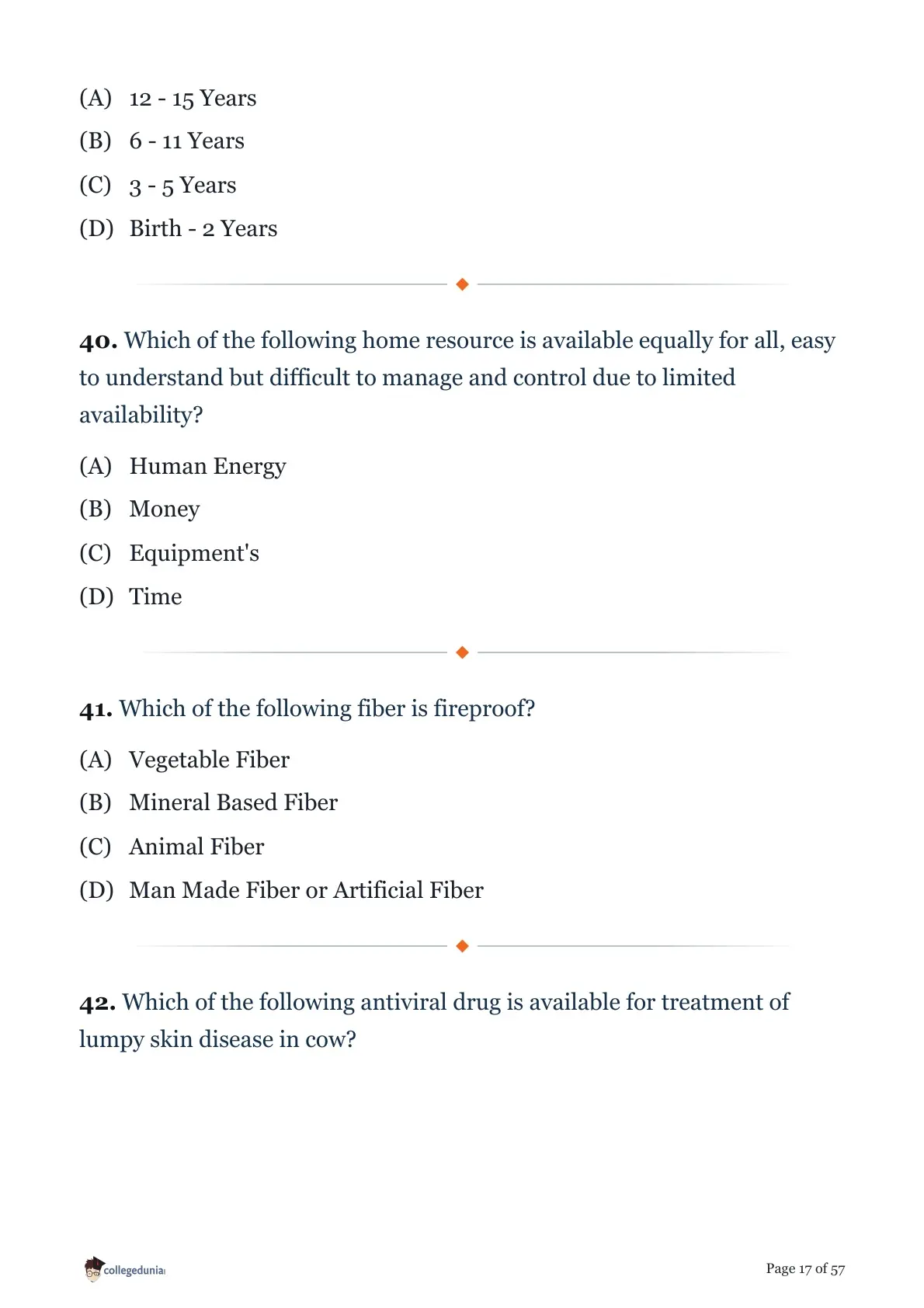
According to child developmentalists, which of the following age range is considered as 'Adolescence'?
Which of the following home resource is available equally for all, easy to understand but difficult to manage and control due to limited availability?
Which of the following fiber is fireproof?
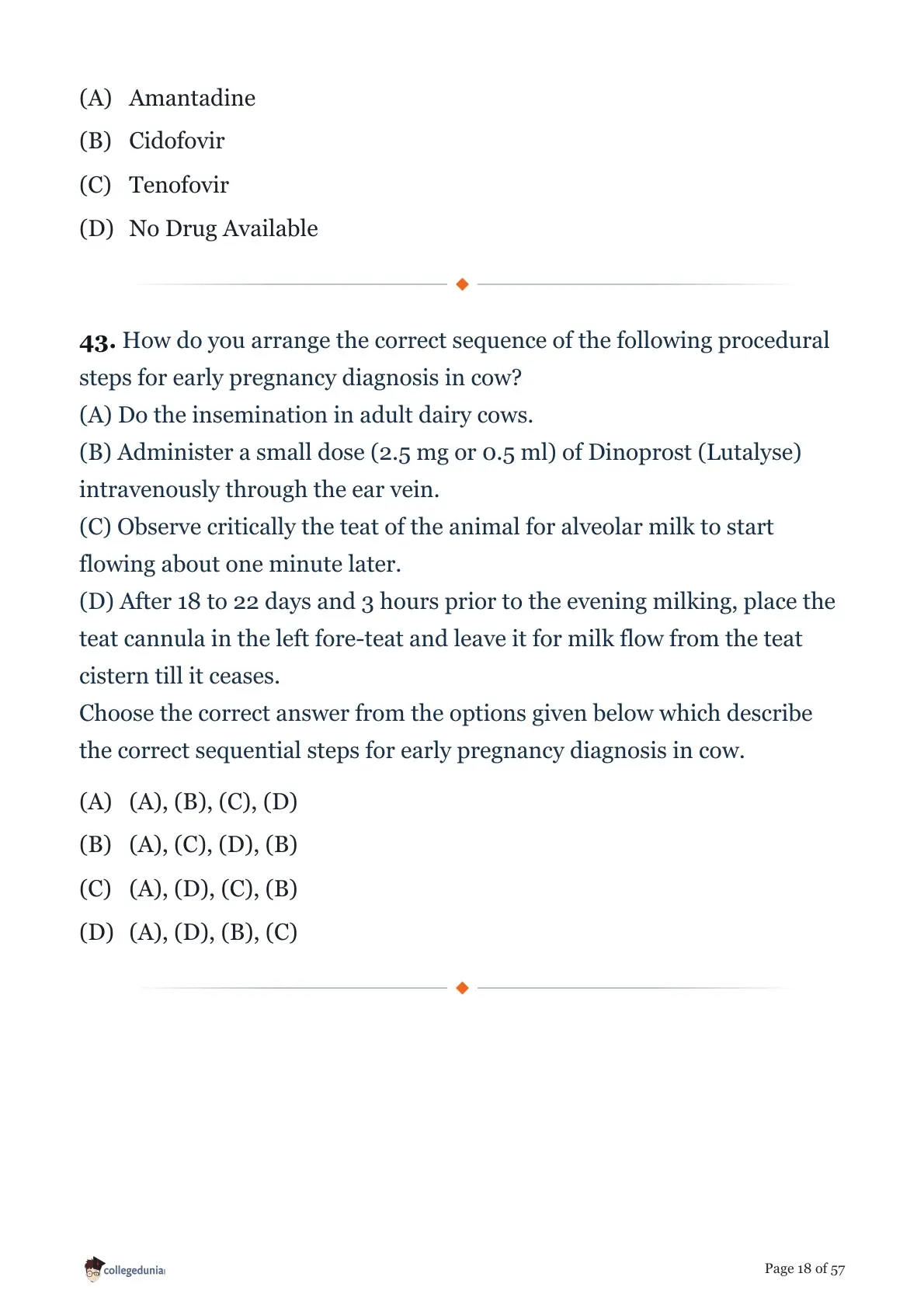
Which of the following antiviral drug is available for treatment of lumpy skin disease in cow?
How do you arrange the correct sequence of the following procedural steps for early pregnancy diagnosis in cow?
(A) Do the insemination in adult dairy cows.
(B) Administer a small dose (2.5 mg or 0.5 ml) of Dinoprost (Lutalyse) intravenously through the ear vein.
(C) Observe critically the teat of the animal for alveolar milk to start flowing about one minute later.
(D) After 18 to 22 days and 3 hours prior to the evening milking, place the teat cannula in the left fore-teat and leave it for milk flow from the teat cistern till it ceases.
Choose the correct answer from the options given below which describe the correct sequential steps for early pregnancy diagnosis in cow.
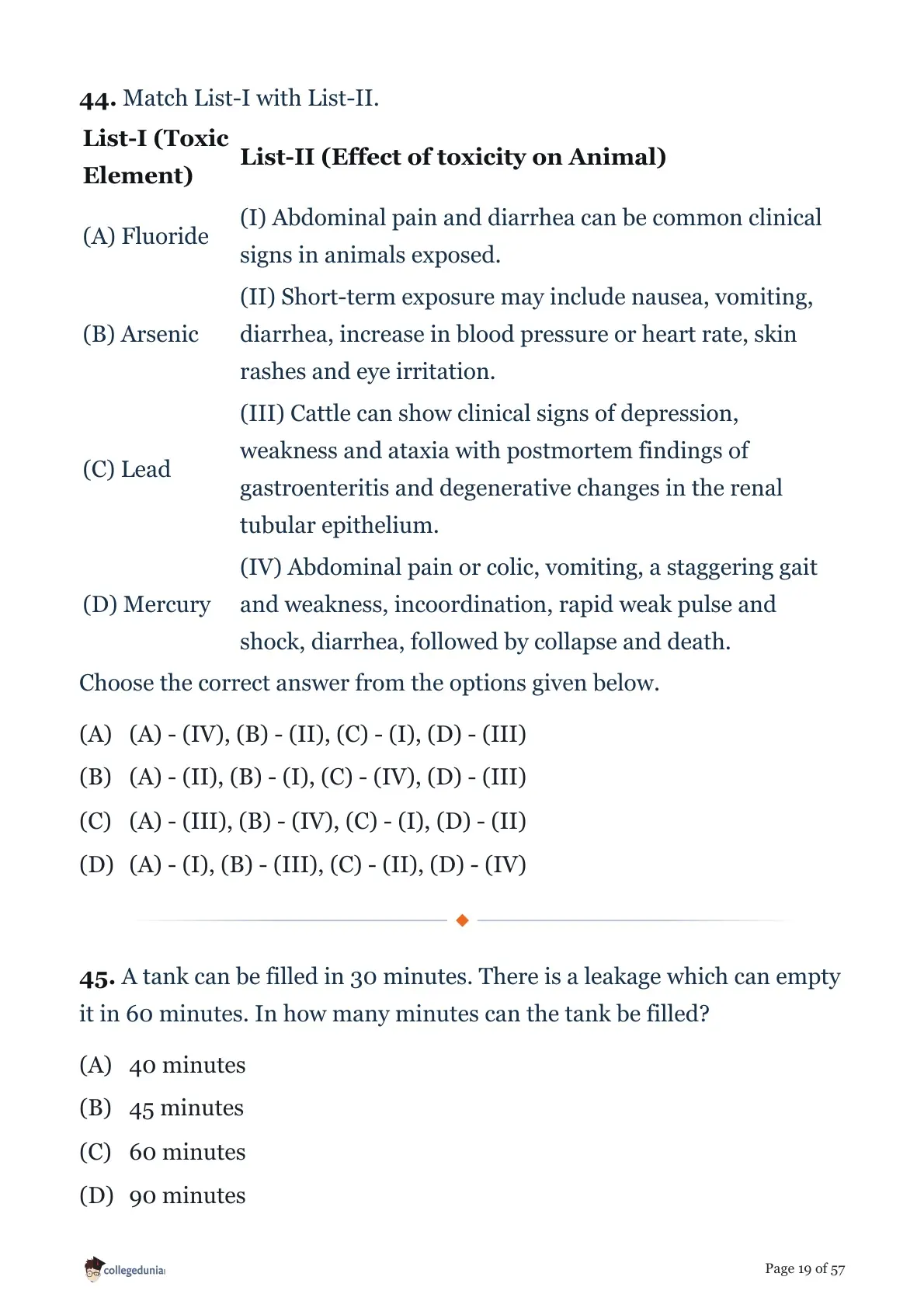
Match List-I with List-II.
| List-I (Toxic Element) | List-II (Effect of toxicity on Animal) |
| (A) Fluoride | (I) Abdominal pain and diarrhea can be common clinical signs in animals exposed. |
| (B) Arsenic | (II) Short-term exposure may include nausea, vomiting, diarrhea, increase in blood pressure or heart rate, skin rashes and eye irritation. |
| (C) Lead | (III) Cattle can show clinical signs of depression, weakness and ataxia with postmortem findings of gastroenteritis and degenerative changes in the renal tubular epithelium. |
| (D) Mercury | (IV) Abdominal pain or colic, vomiting, a staggering gait and weakness, incoordination, rapid weak pulse and shock, diarrhea, followed by collapse and death. |
A tank can be filled in 30 minutes. There is a leakage which can empty it in 60 minutes. In how many minutes can the tank be filled?
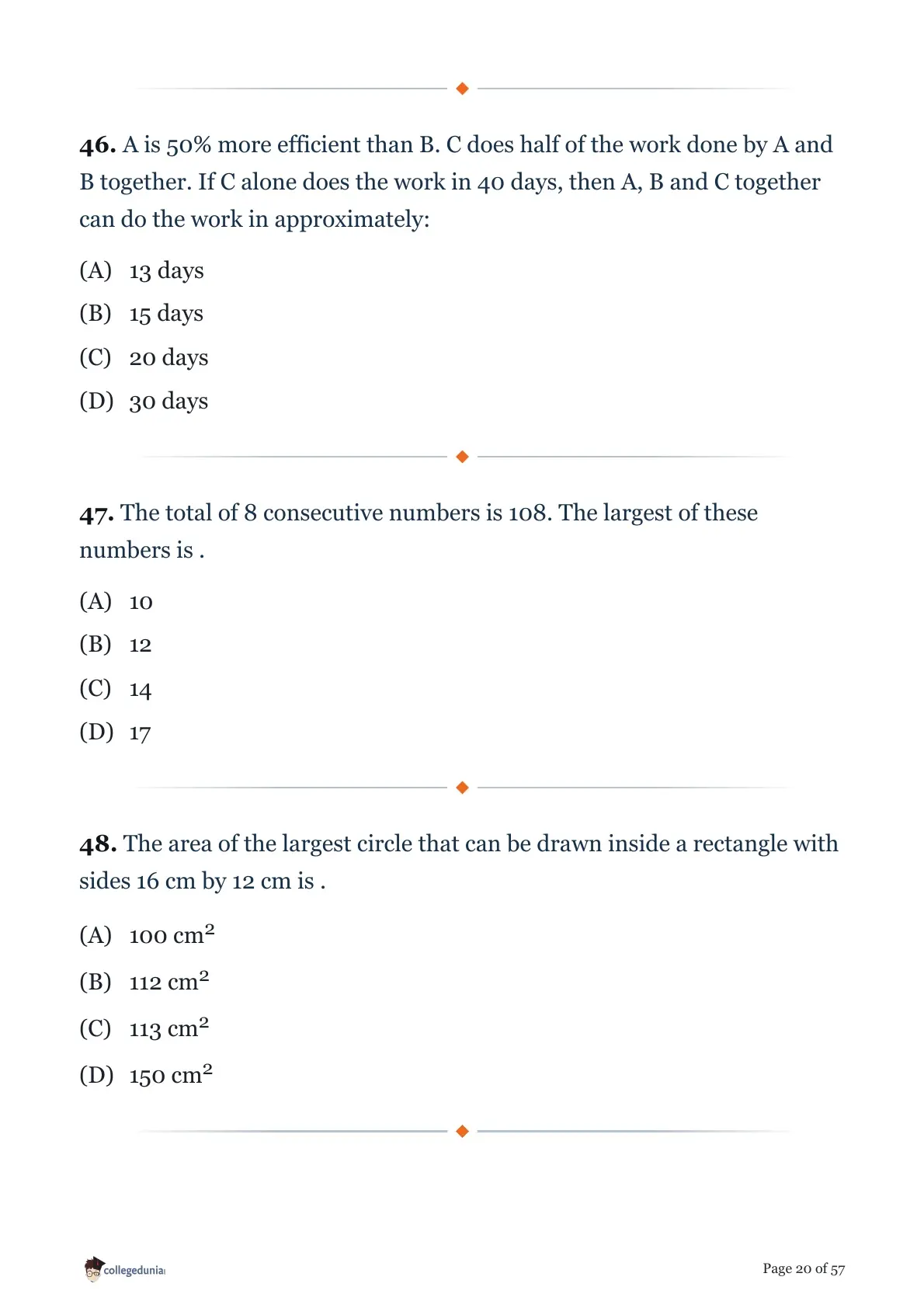
A is 50% more efficient than B. C does half of the work done by A and B together. If C alone does the work in 40 days, then A, B and C together can do the work in approximately:
The total of 8 consecutive numbers is 108. The largest of these numbers is .
The area of the largest circle that can be drawn inside a rectangle with sides 16 cm by 12 cm is .
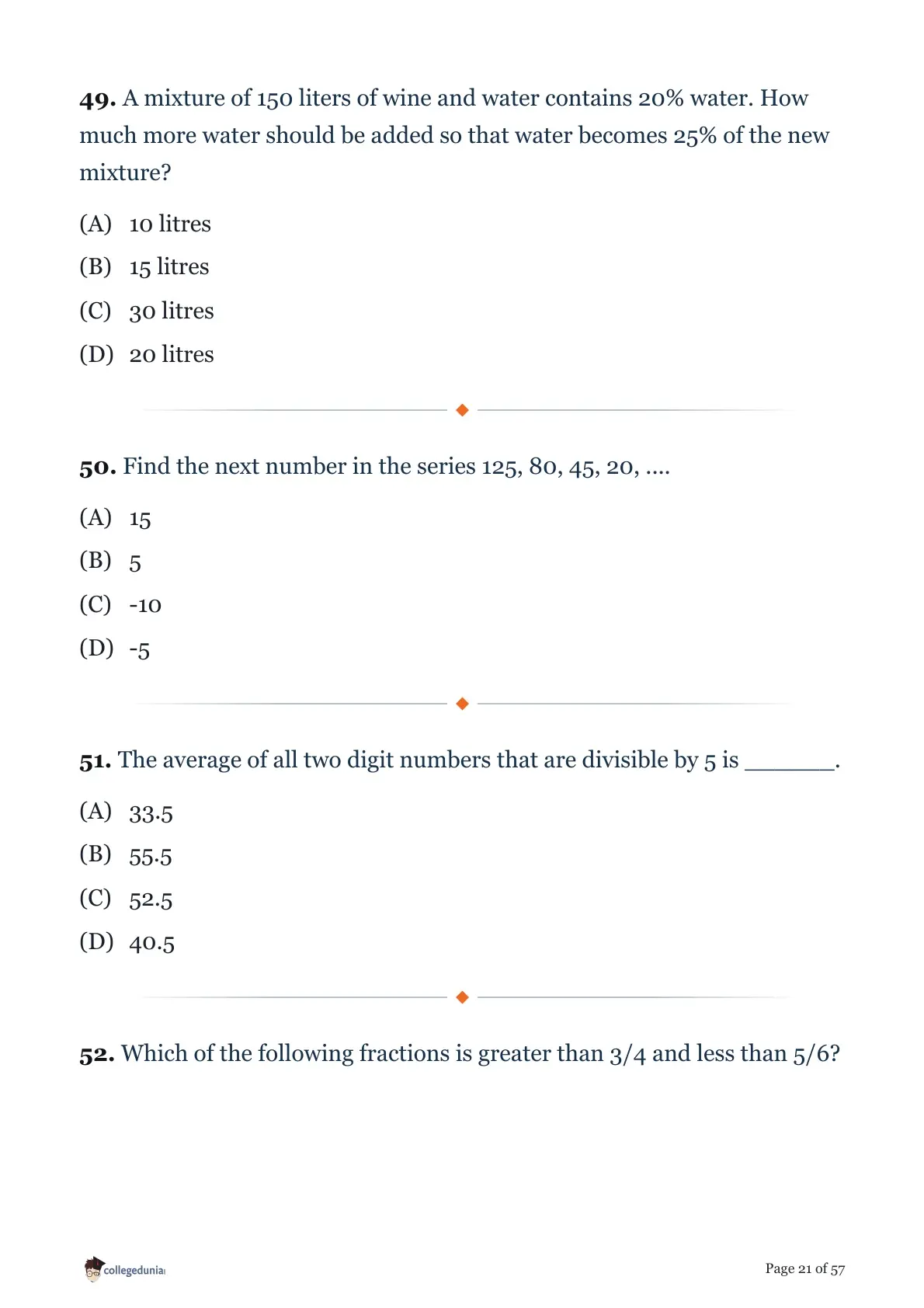
A mixture of 150 liters of wine and water contains 20% water. How much more water should be added so that water becomes 25% of the new mixture?
Find the next number in the series 125, 80, 45, 20, ....
The average of all two digit numbers that are divisible by 5 is ______.
Which of the following fractions is greater than 3/4 and less than 5/6?
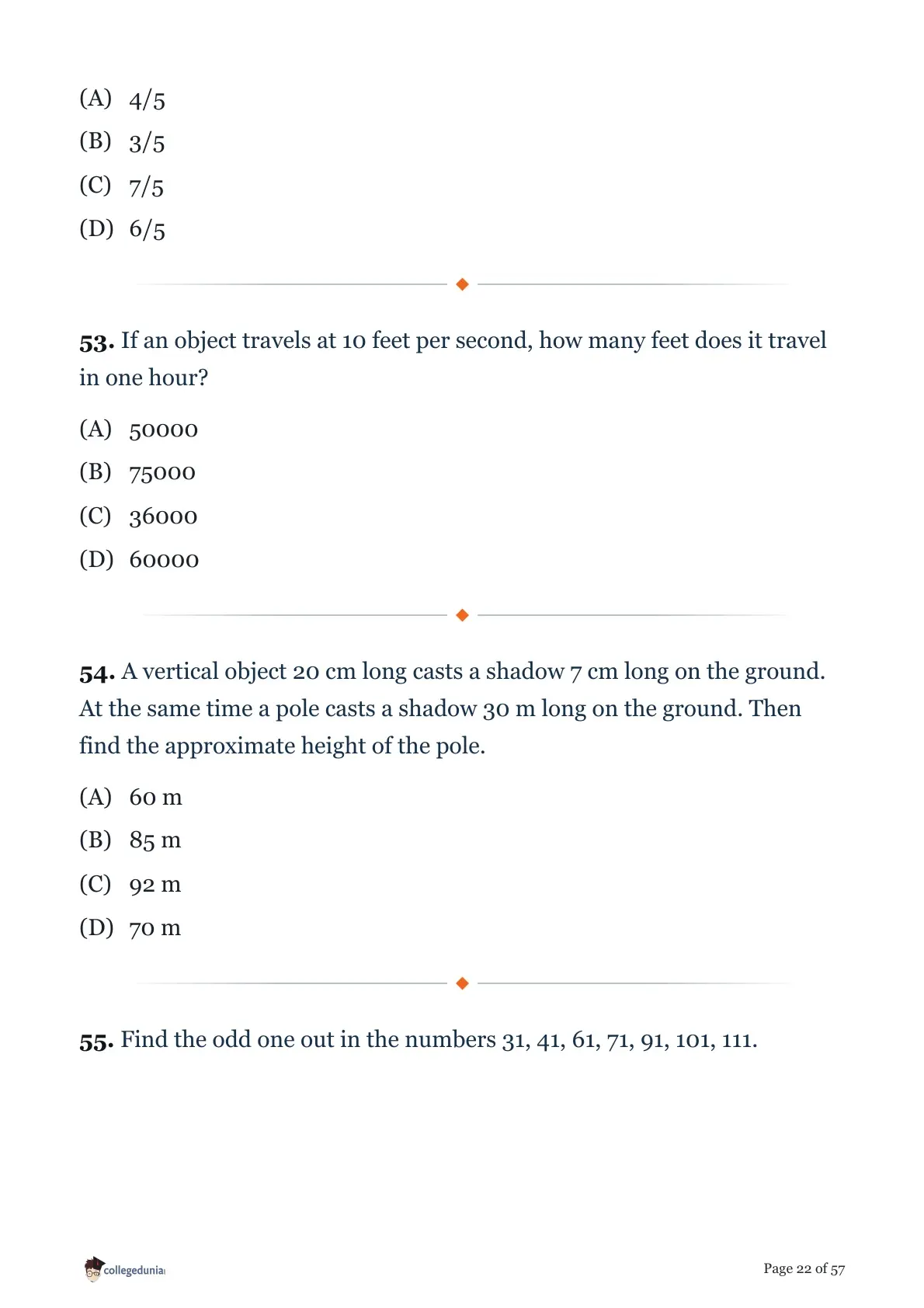
If an object travels at 10 feet per second, how many feet does it travel in one hour?
A vertical object 20 cm long casts a shadow 7 cm long on the ground. At the same time a pole casts a shadow 30 m long on the ground. Then find the approximate height of the pole.
Find the odd one out in the numbers 31, 41, 61, 71, 91, 101, 111.
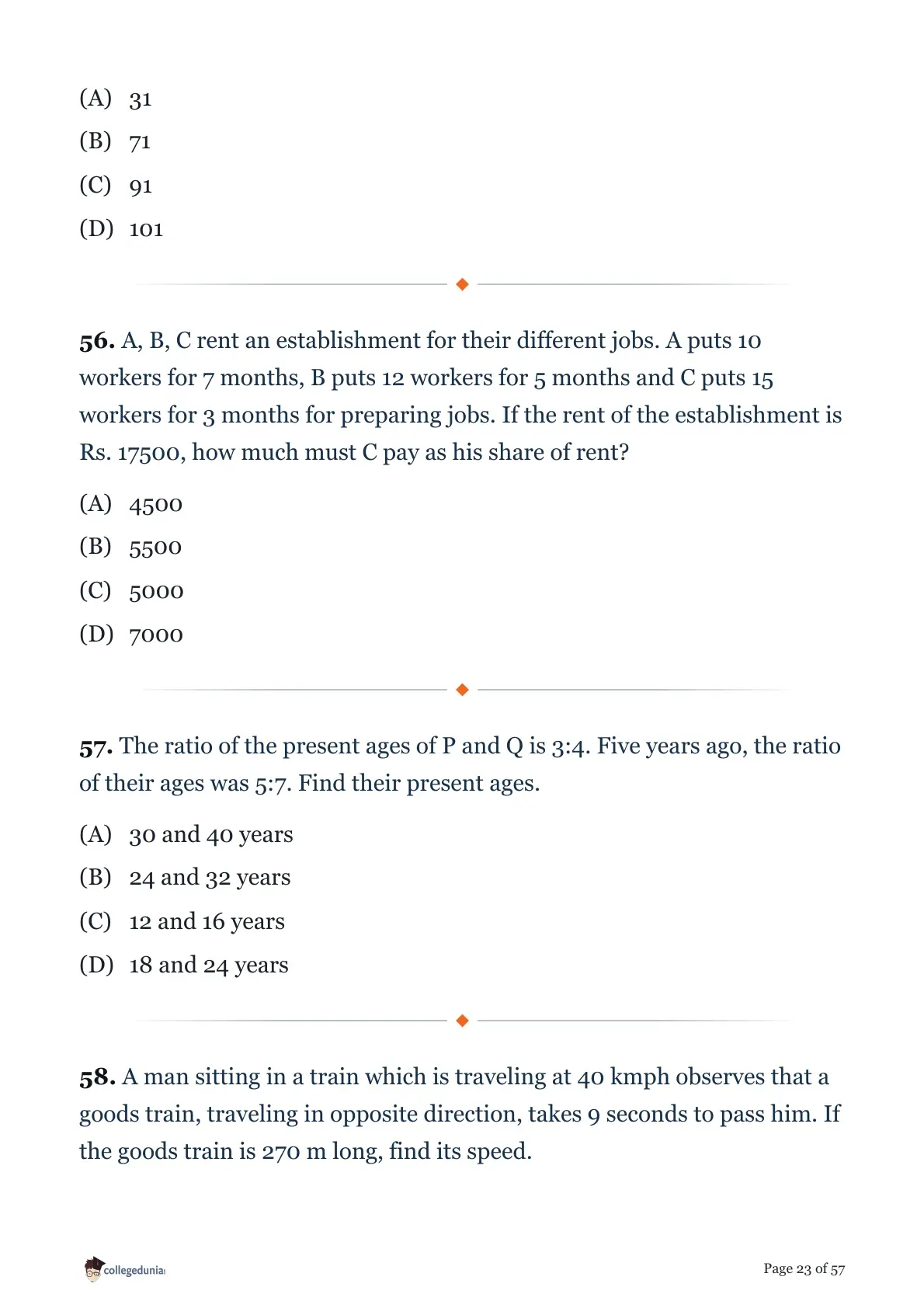
A, B, C rent an establishment for their different jobs. A puts 10 workers for 7 months, B puts 12 workers for 5 months and C puts 15 workers for 3 months for preparing jobs. If the rent of the establishment is Rs. 17500, how much must C pay as his share of rent?
The ratio of the present ages of P and Q is 3:4. Five years ago, the ratio of their ages was 5:7. Find their present ages.
A man sitting in a train which is traveling at 40 kmph observes that a goods train, traveling in opposite direction, takes 9 seconds to pass him. If the goods train is 270 m long, find its speed.
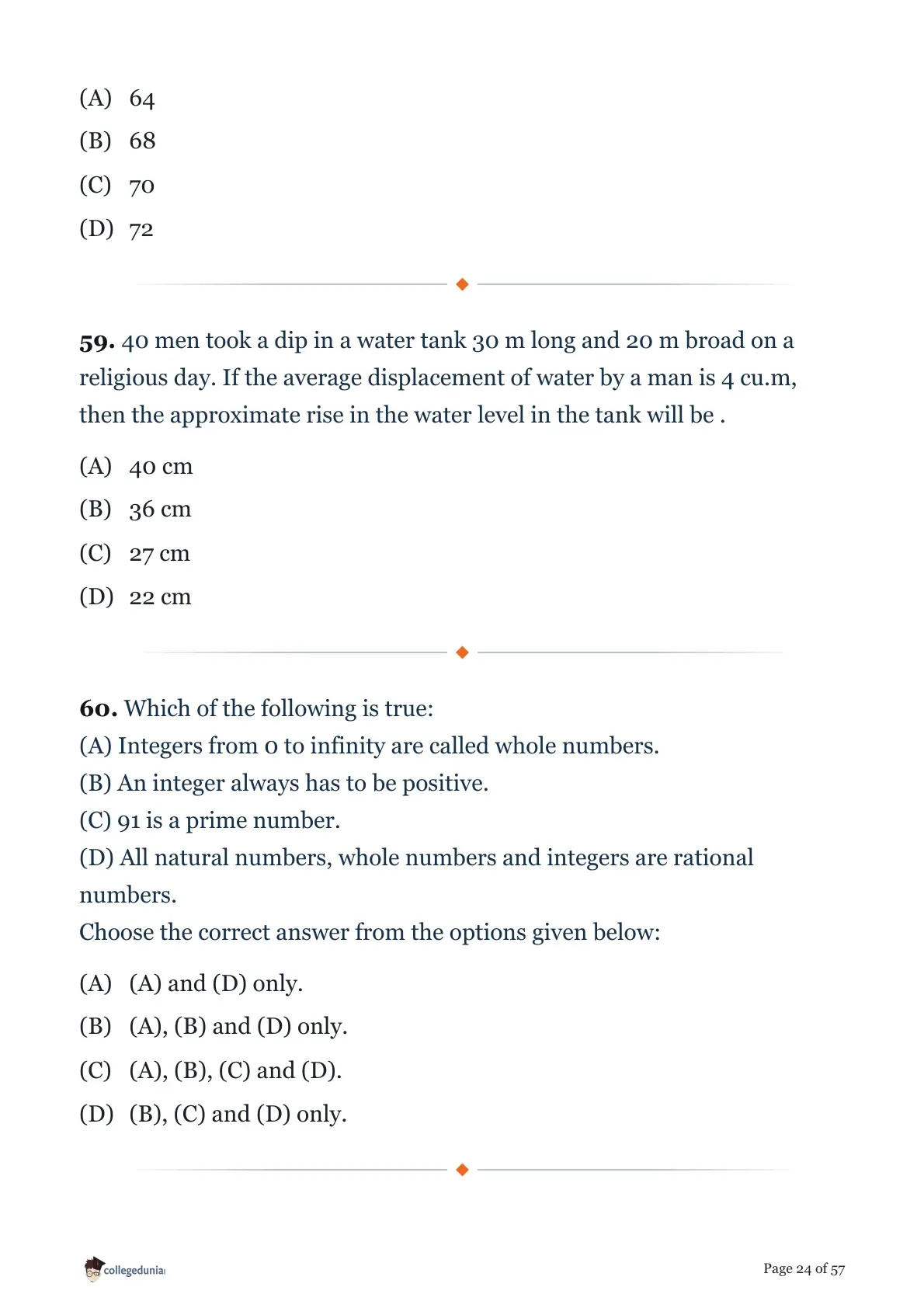
40 men took a dip in a water tank 30 m long and 20 m broad on a religious day. If the average displacement of water by a man is 4 cu.m, then the approximate rise in the water level in the tank will be .
Which of the following is true:
(A) Integers from 0 to infinity are called whole numbers.
(B) An integer always has to be positive.
(C) 91 is a prime number.
(D) All natural numbers, whole numbers and integers are rational numbers.
Choose the correct answer from the options given below:
Which of the following is not true:
(A) Zero is a prime number.
(B) One is an integer.
(C) 31 is a whole number but not a prime number.
(D) -31 is an integer but not a whole number.
Choose the correct answer from the options given below:
Salaries of Ankita and Ishita are in the ratio 2:3. If the salary of each is increased by Rs. 4000, the new ratio becomes 40:57. What is Ishita's salary?
A man went downstream for 28 km in a motor boat and immediately returned. It took the man twice as long to make the return trip. If the speed of the river flow were twice as high, the trip downstream and back would take 672 minutes. Find the speed of the boat in still water and the speed of the river flow.
If \(1.5x = 0.04y\), then the value of \(\dfrac{y-x}{y+x}\) is:
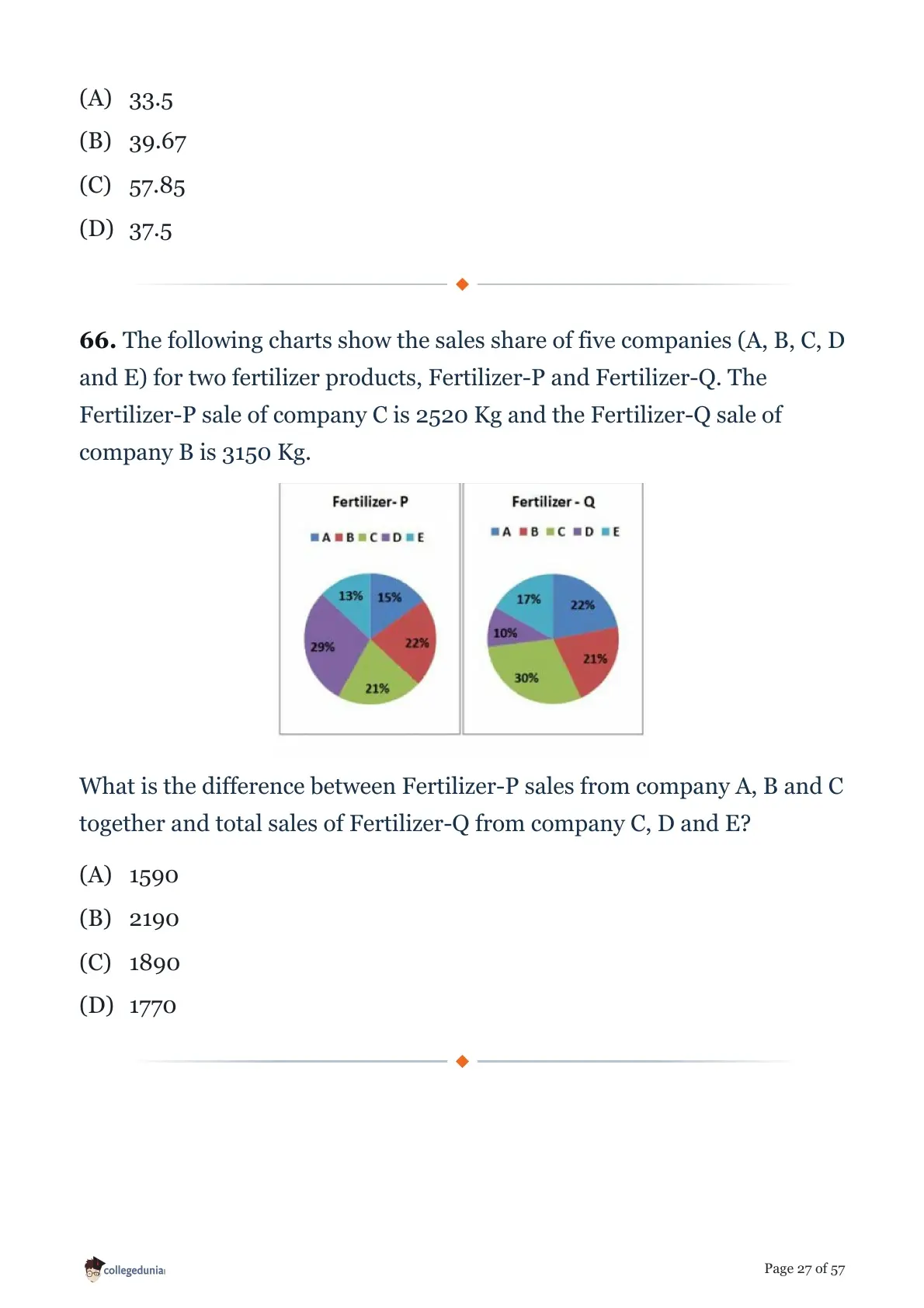
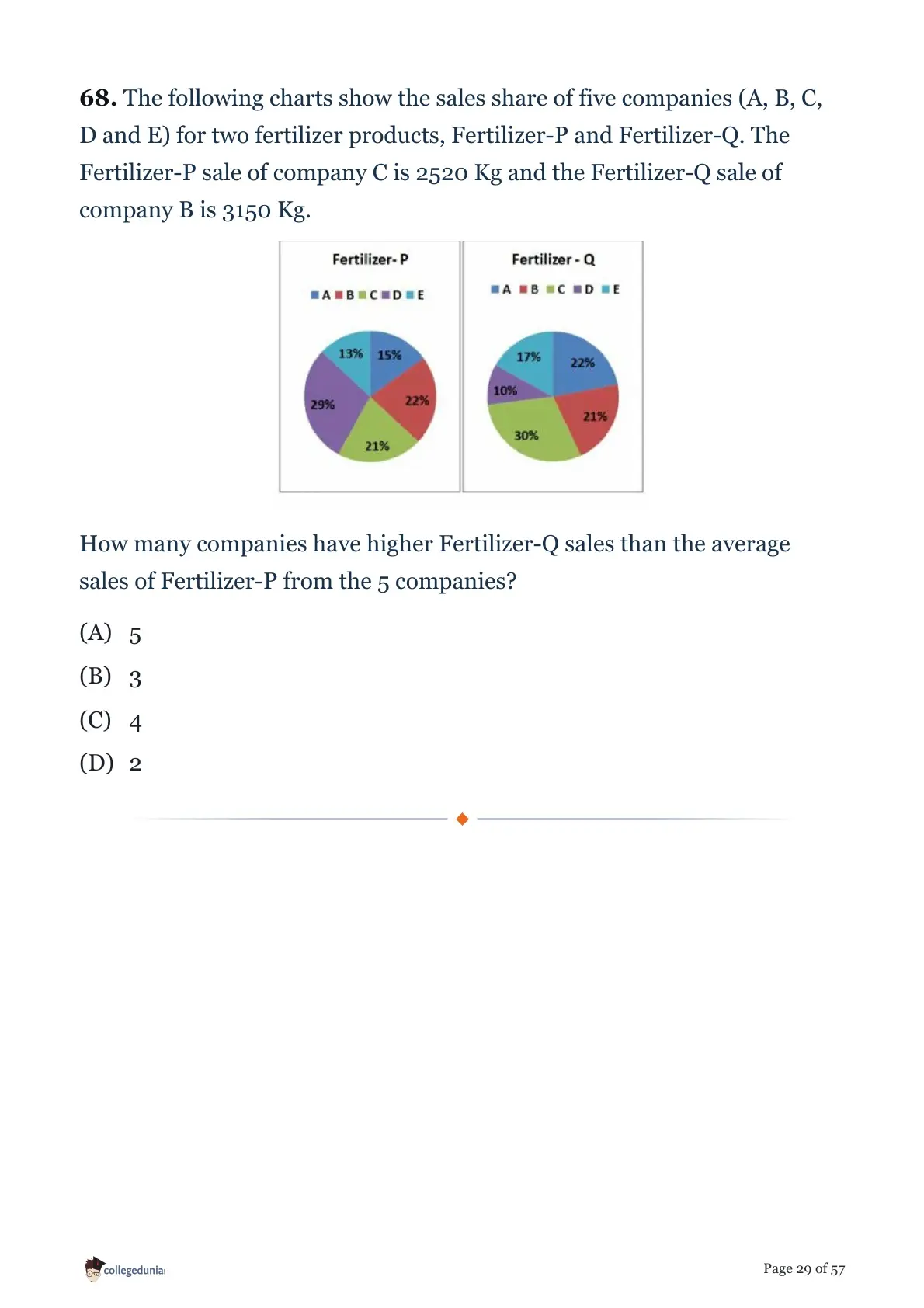
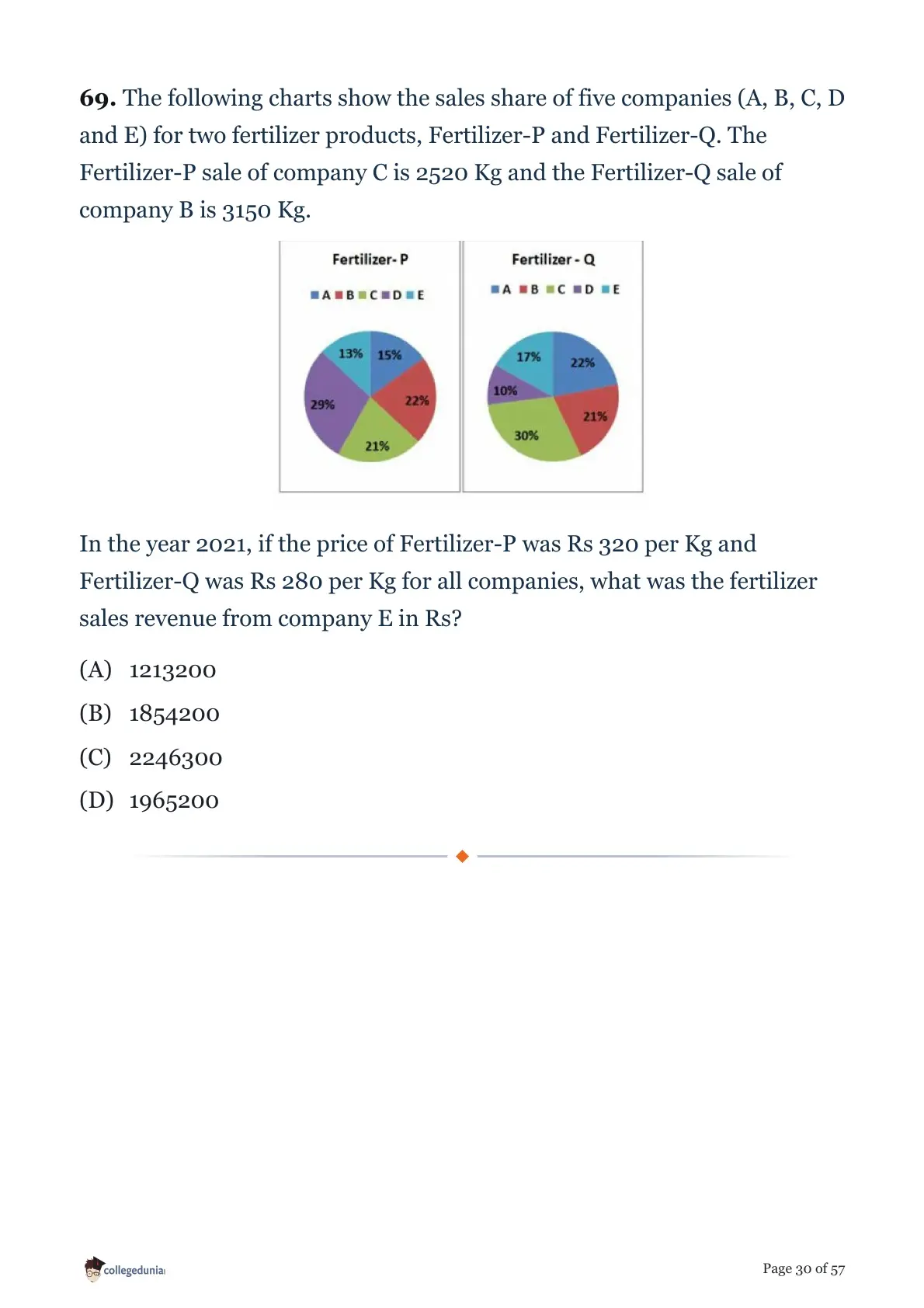
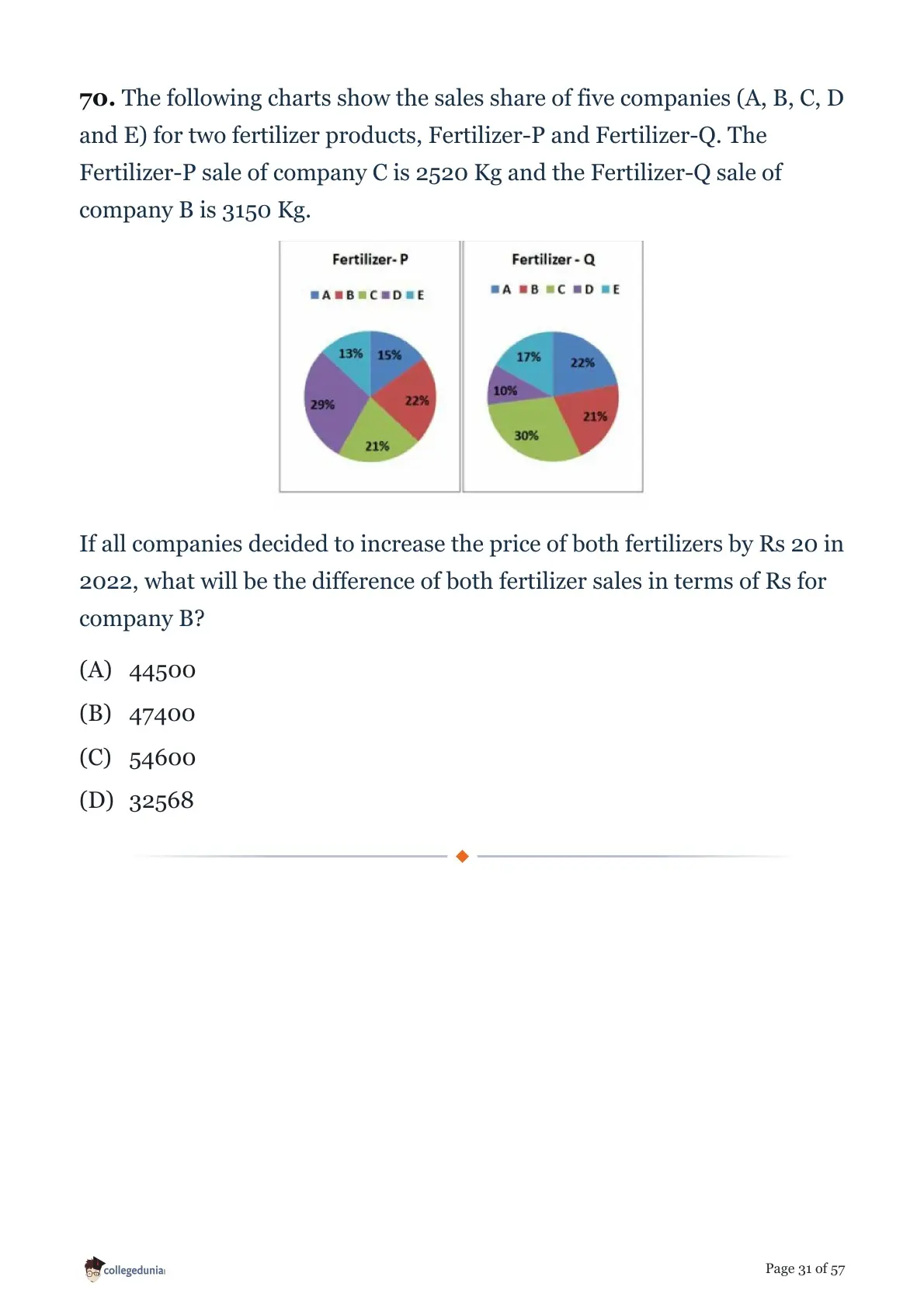
The following charts show the sales share of five companies (A, B, C, D and E) for two fertilizer products, Fertilizer-P and Fertilizer-Q. The Fertilizer-P sale of company C is 2520 Kg and the Fertilizer-Q sale of company B is 3150 Kg. What percentage of sales of fertilizer-Q from company C is to total sales of Fertilizer-P?
The following charts show the sales share of five companies (A, B, C, D and E) for two fertilizer products, Fertilizer-P and Fertilizer-Q. The Fertilizer-P sale of company C is 2520 Kg and the Fertilizer-Q sale of company B is 3150 Kg.What is the difference between Fertilizer-P sales from company A, B and C together and total sales of Fertilizer-Q from company C, D and E?
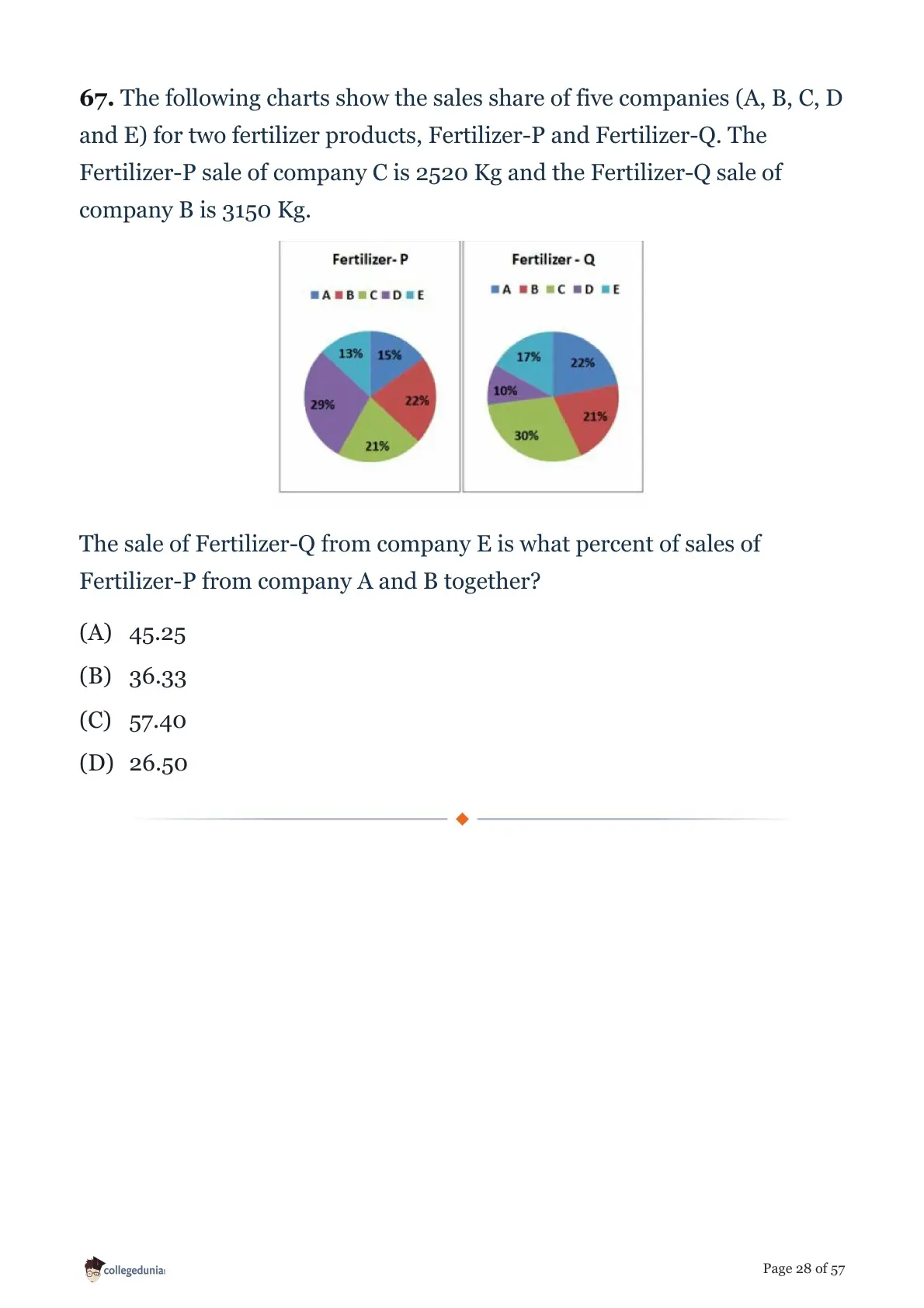
The following charts show the sales share of five companies (A, B, C, D and E) for two fertilizer products, Fertilizer-P and Fertilizer-Q. The Fertilizer-P sale of company C is 2520 Kg and the Fertilizer-Q sale of company B is 3150 Kg.The sale of Fertilizer-Q from company E is what percent of sales of Fertilizer-P from company A and B together?
The following charts show the sales share of five companies (A, B, C, D and E) for two fertilizer products, Fertilizer-P and Fertilizer-Q. The Fertilizer-P sale of company C is 2520 Kg and the Fertilizer-Q sale of company B is 3150 Kg.How many companies have higher Fertilizer-Q sales than the average sales of Fertilizer-P from the 5 companies?
The following charts show the sales share of five companies (A, B, C, D and E) for two fertilizer products, Fertilizer-P and Fertilizer-Q. The Fertilizer-P sale of company C is 2520 Kg and the Fertilizer-Q sale of company B is 3150 Kg.In the year 2021, if the price of Fertilizer-P was Rs 320 per Kg and Fertilizer-Q was Rs 280 per Kg for all companies, what was the fertilizer sales revenue from company E in Rs?
The following charts show the sales share of five companies (A, B, C, D and E) for two fertilizer products, Fertilizer-P and Fertilizer-Q. The Fertilizer-P sale of company C is 2520 Kg and the Fertilizer-Q sale of company B is 3150 Kg.If all companies decided to increase the price of both fertilizers by Rs 20 in 2022, what will be the difference of both fertilizer sales in terms of Rs for company B?
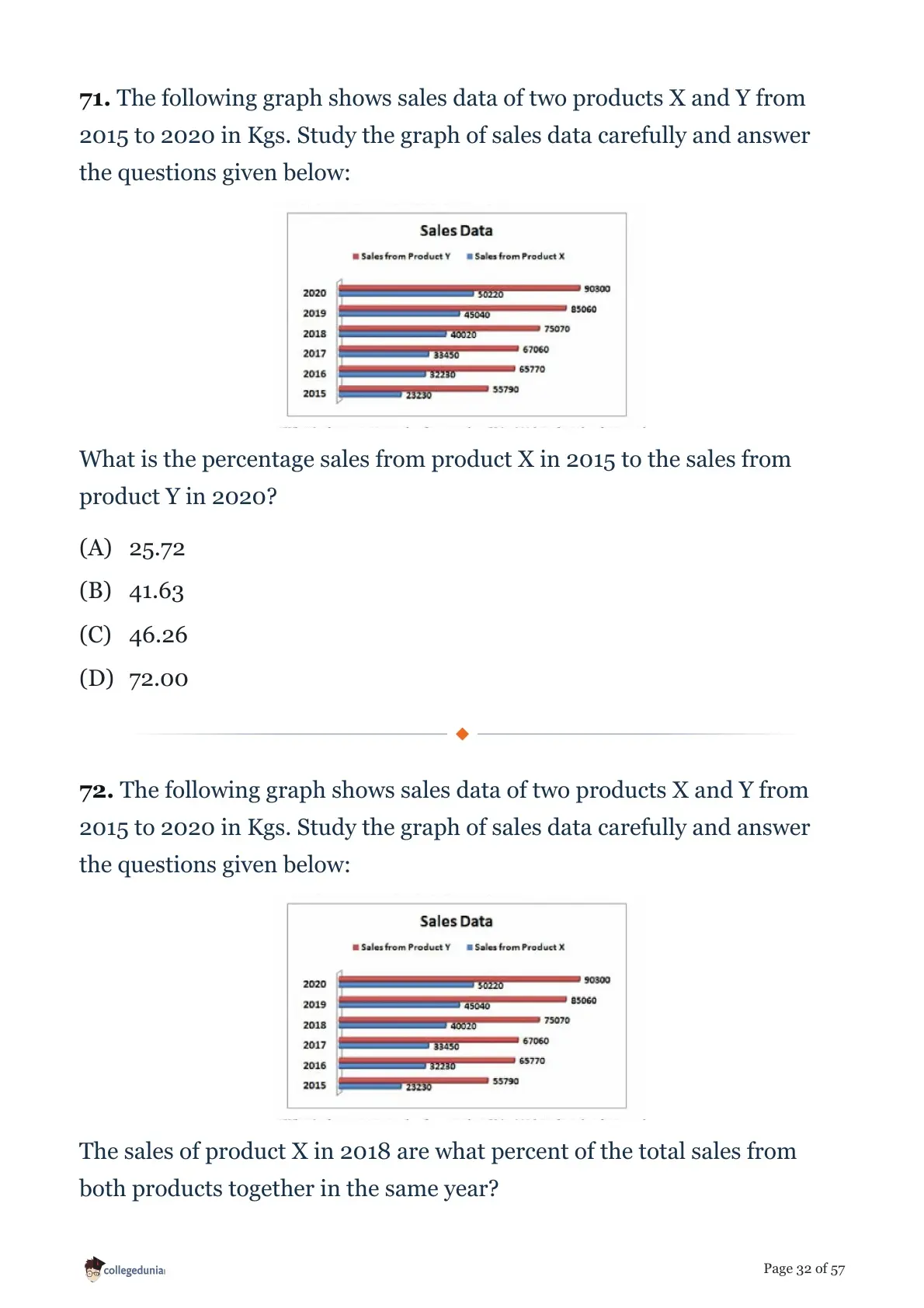
The following graph shows sales data of two products X and Y from 2015 to 2020 in Kgs. Study the graph of sales data carefully and answer the questions given below:  What is the percentage sales from product X in 2015 to the sales from product Y in 2020?
The following graph shows sales data of two products X and Y from 2015 to 2020 in Kgs. Study the graph of sales data carefully and answer the questions given below: The sales of product X in 2018 are what percent of the total sales from both products together in the same year?
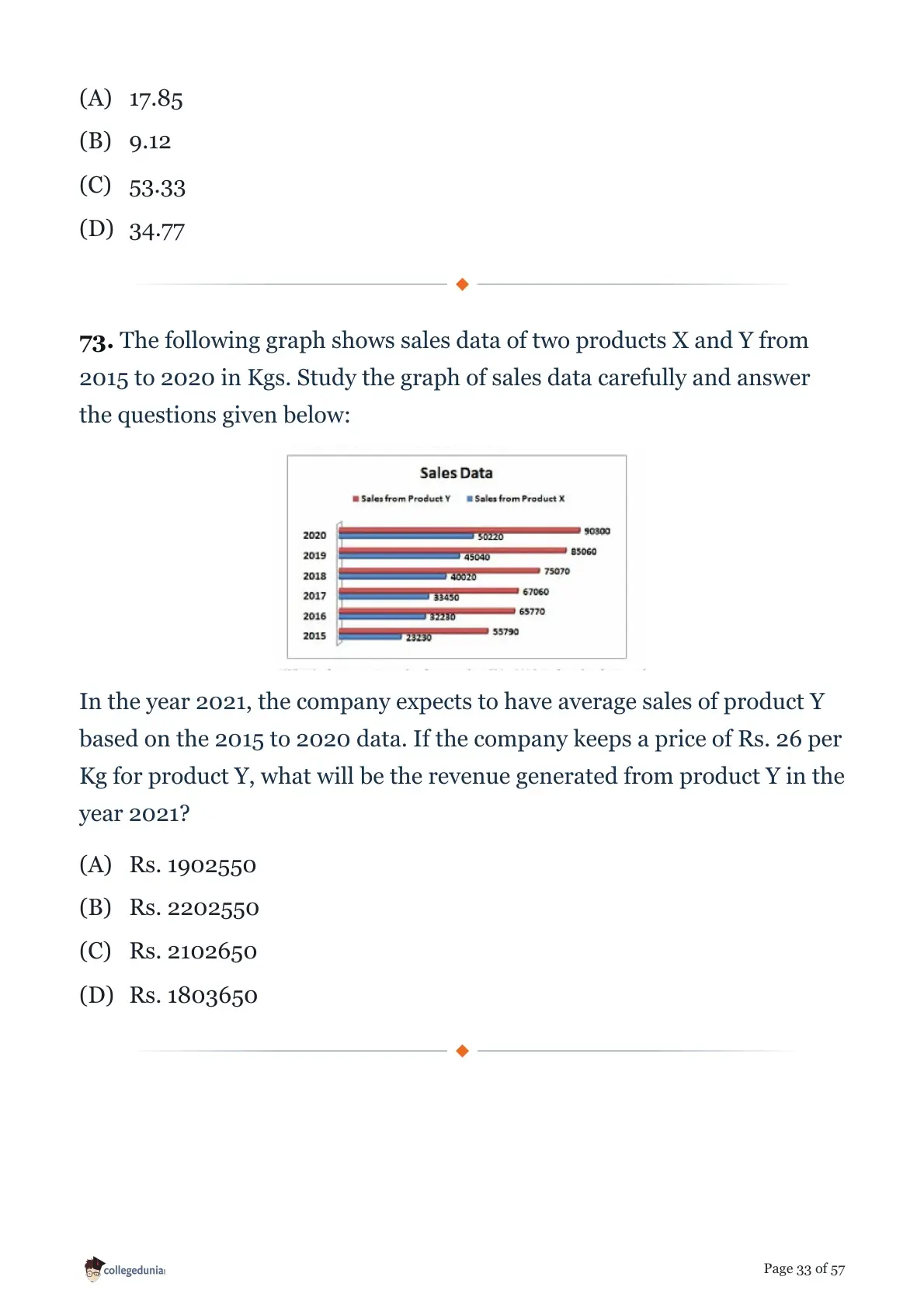
The following graph shows sales data of two products X and Y from 2015 to 2020 in Kgs. Study the graph of sales data carefully and answer the questions given below: In the year 2021, the company expects to have average sales of product Y based on the 2015 to 2020 data. If the company keeps a price of Rs. 26 per Kg for product Y, what will be the revenue generated from product Y in the year 2021?
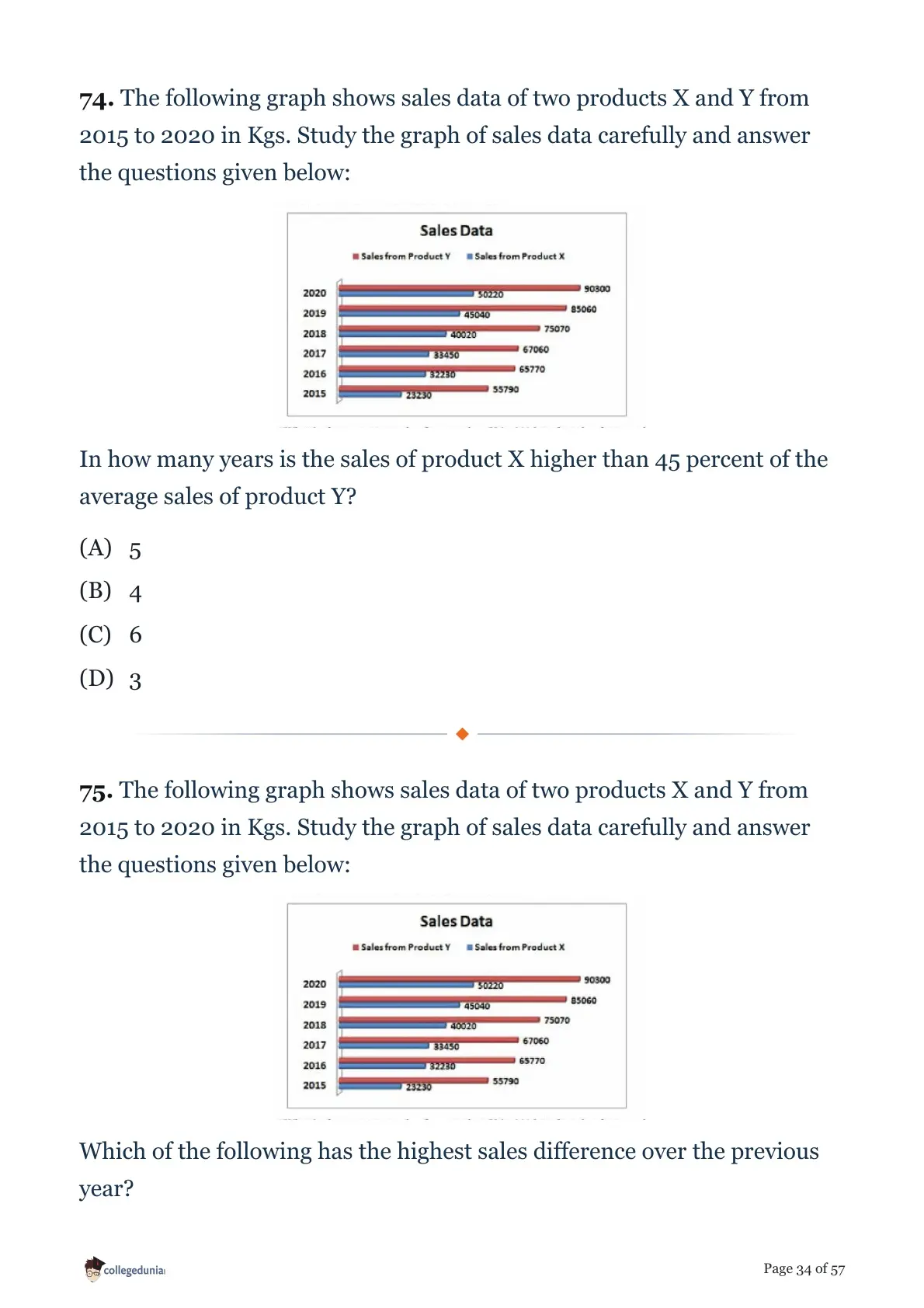
The following graph shows sales data of two products X and Y from 2015 to 2020 in Kgs. Study the graph of sales data carefully and answer the questions given below: In how many years is the sales of product X higher than 45 percent of the average sales of product Y?
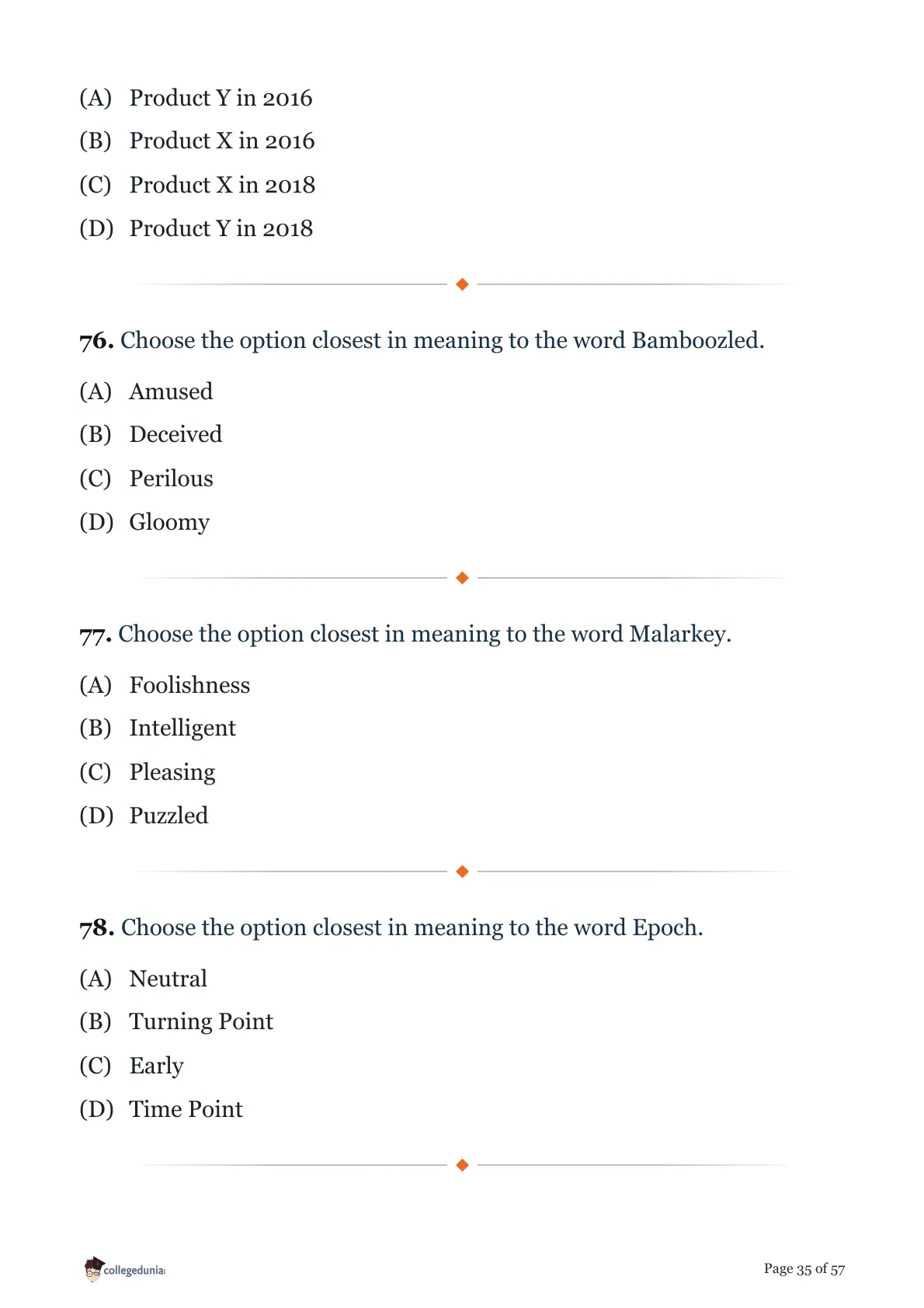
The following graph shows sales data of two products X and Y from 2015 to 2020 in Kgs. Study the graph of sales data carefully and answer the questions given below: Which of the following has the highest sales difference over the previous year?
Choose the option closest in meaning to the word Bamboozled.
Choose the option closest in meaning to the word Malarkey.
Choose the option closest in meaning to the word Epoch.
Which among the following is NOT a synonym of the word Synergy?
Which among the following is NOT a synonym of the word eccentricity?
Which among the following is NOT a synonym of the word Validate?
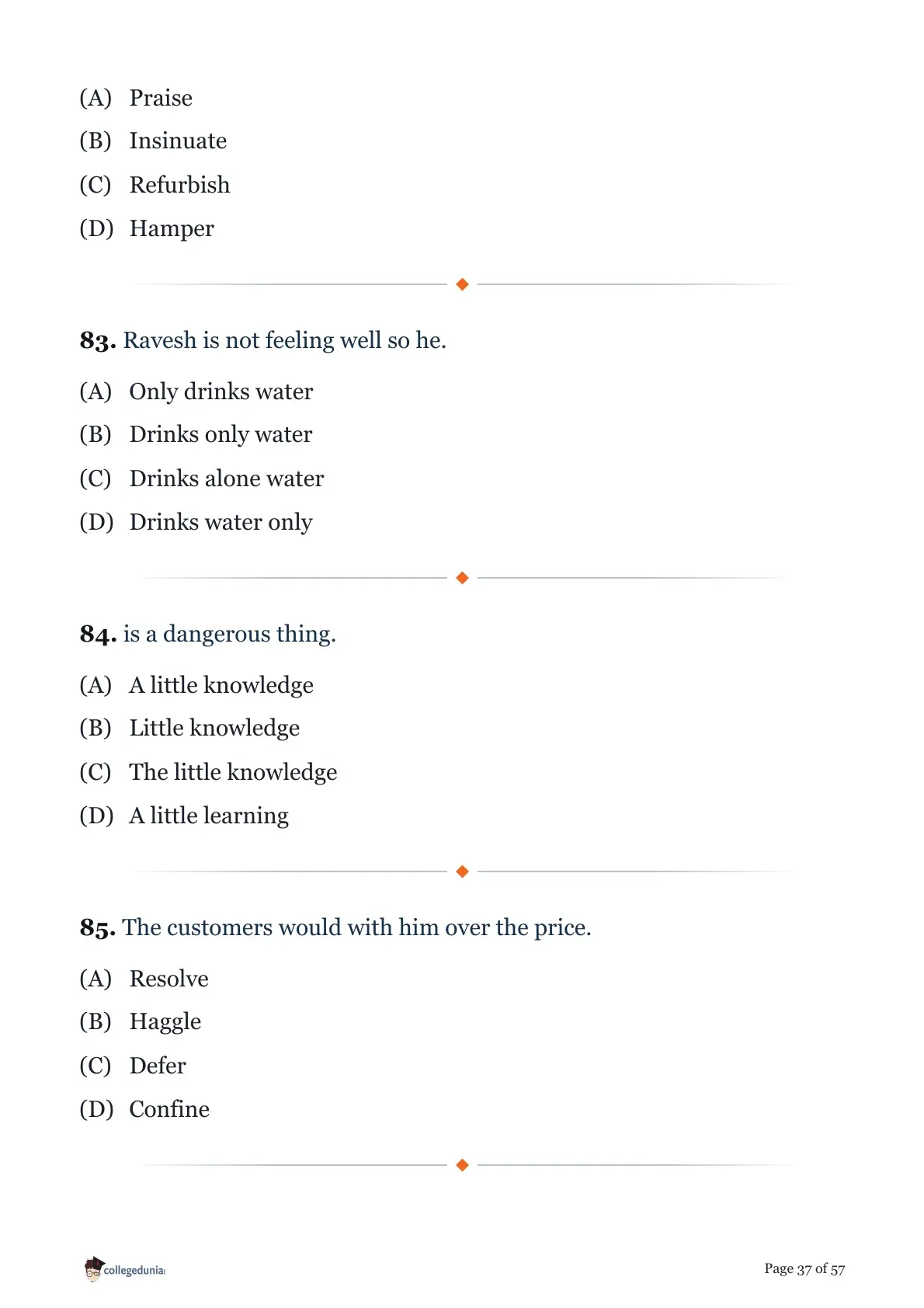
Amit has tried his best to the brand image of his company by projecting it as a pro-consumer.
Ravesh is not feeling well so he.
is a dangerous thing.
The customers would with him over the price.
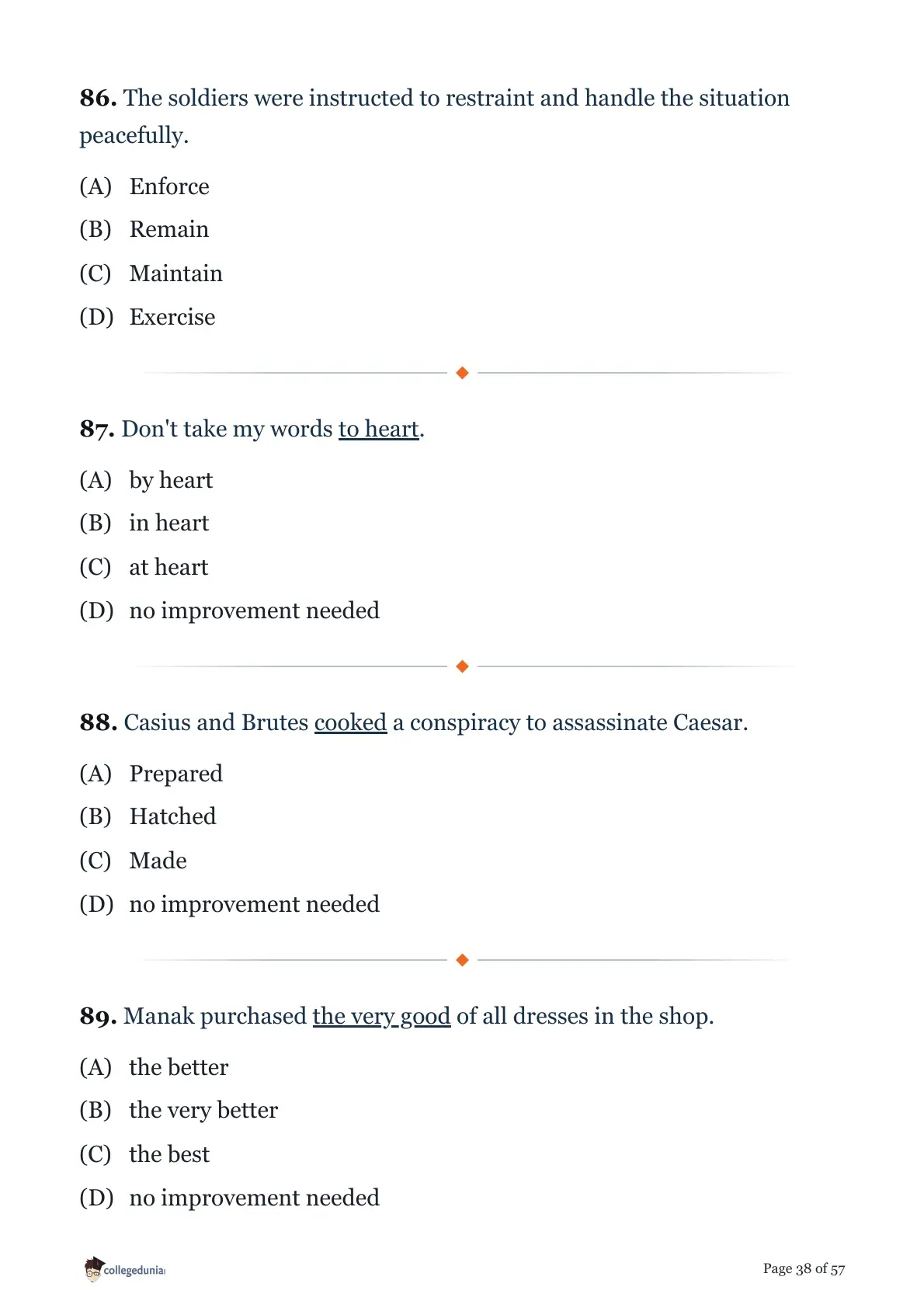
The soldiers were instructed to restraint and handle the situation peacefully.
Don't take my words to heart.
Casius and Brutes cooked a conspiracy to assassinate Caesar.
Manak purchased the very good of all dresses in the shop.
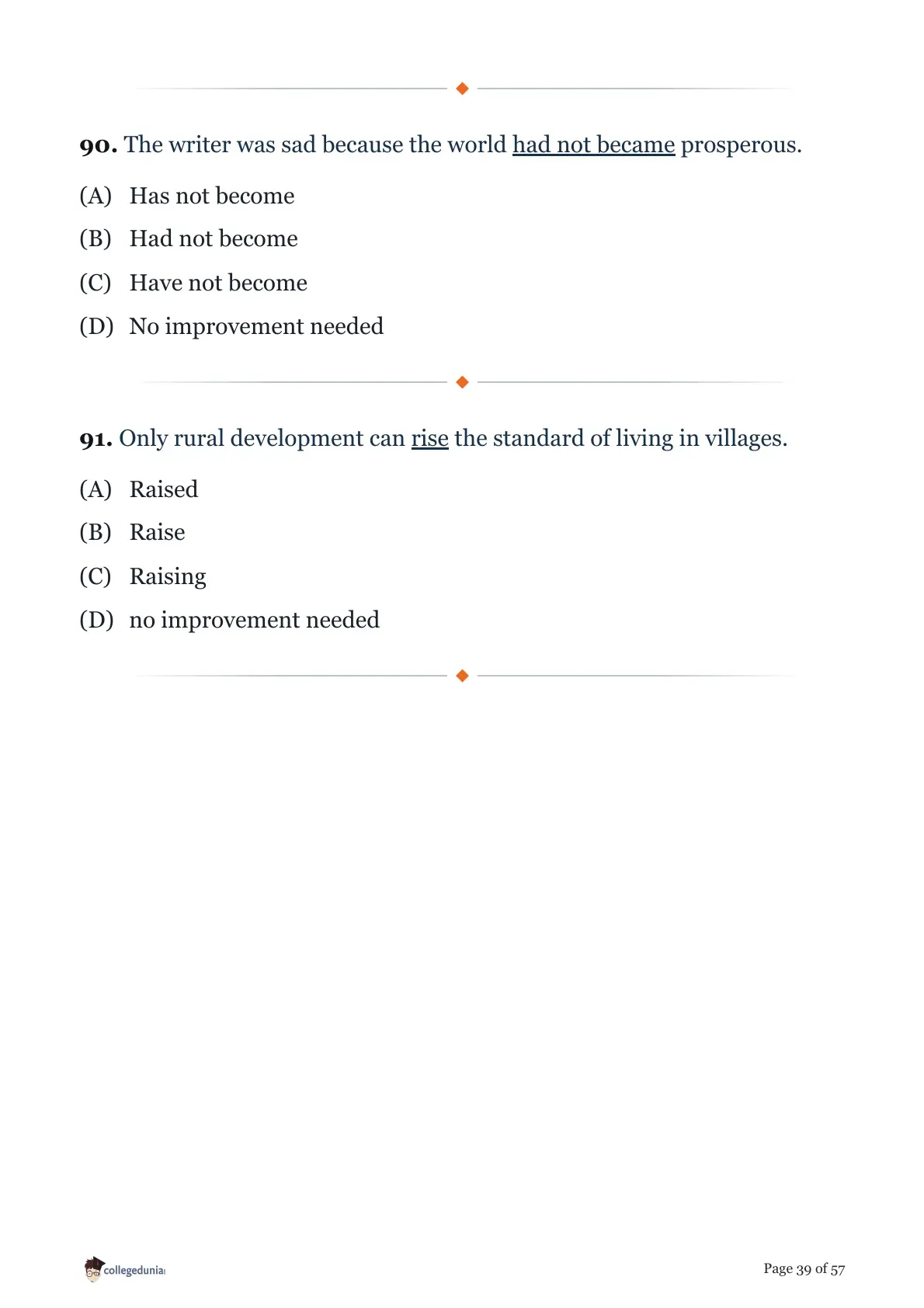
The writer was sad because the world had not became prosperous.
Only rural development can rise the standard of living in villages.
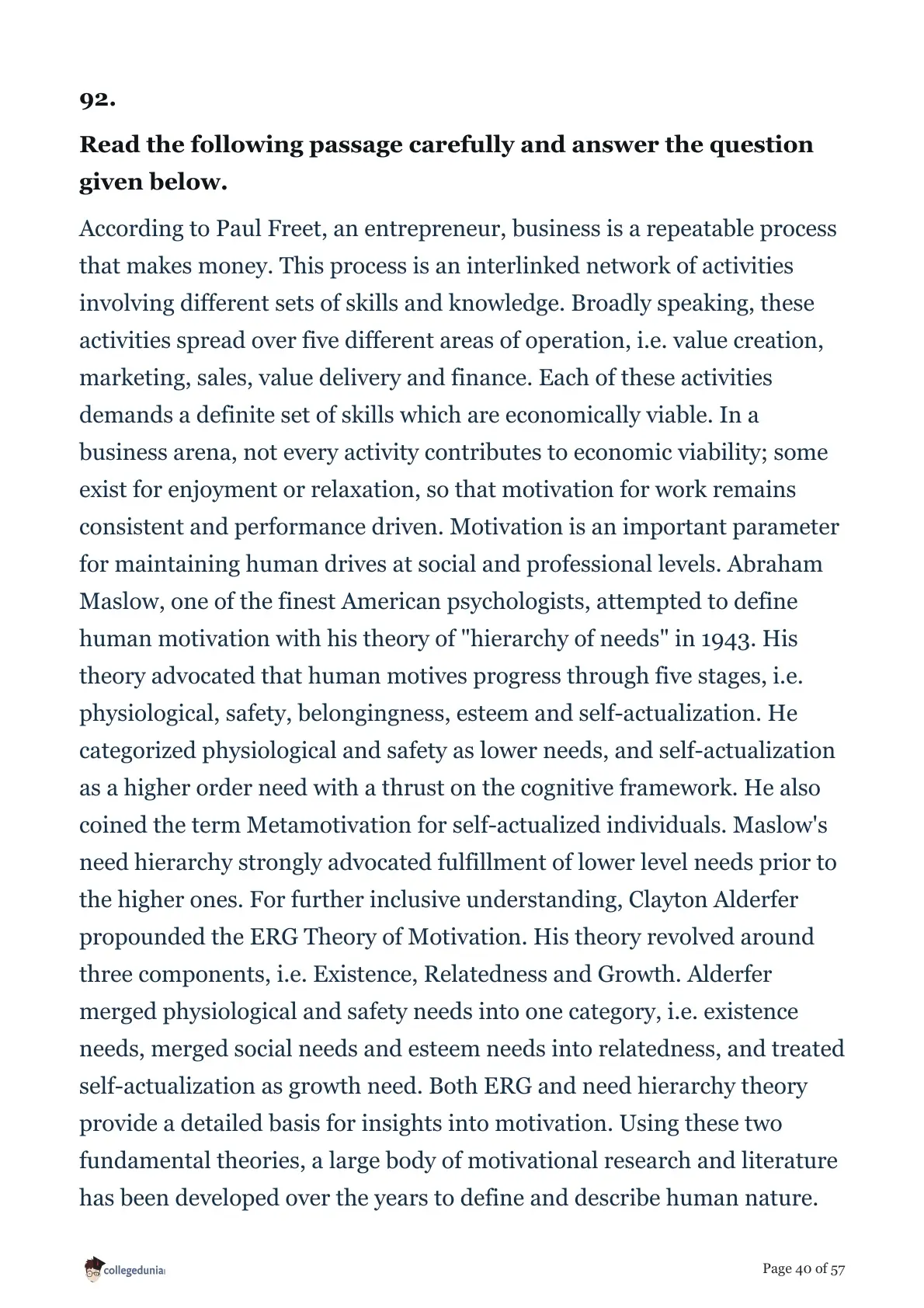
Read the following passage carefully and answer the question given below.
According to Paul Freet, an entrepreneur, business is a repeatable process that makes money. This process is an interlinked network of activities involving different sets of skills and knowledge. Broadly speaking, these activities spread over five different areas of operation, i.e. value creation, marketing, sales, value delivery and finance. Each of these activities demands a definite set of skills which are economically viable. In a business arena, not every activity contributes to economic viability; some exist for enjoyment or relaxation, so that motivation for work remains consistent and performance driven. Motivation is an important parameter for maintaining human drives at social and professional levels. Abraham Maslow, one of the finest American psychologists, attempted to define human motivation with his theory of "hierarchy of needs" in 1943. His theory advocated that human motives progress through five stages, i.e. physiological, safety, belongingness, esteem and self-actualization. He categorized physiological and safety as lower needs, and self-actualization as a higher order need with a thrust on the cognitive framework. He also coined the term Metamotivation for self-actualized individuals. Maslow's need hierarchy strongly advocated fulfillment of lower level needs prior to the higher ones. For further inclusive understanding, Clayton Alderfer propounded the ERG Theory of Motivation. His theory revolved around three components, i.e. Existence, Relatedness and Growth. Alderfer merged physiological and safety needs into one category, i.e. existence needs, merged social needs and esteem needs into relatedness, and treated self-actualization as growth need. Both ERG and need hierarchy theory provide a detailed basis for insights into motivation. Using these two fundamental theories, a large body of motivational research and literature has been developed over the years to define and describe human nature. In recent times, Paul Lawrence and Nitin Nohria from Harvard Business School attempted to provide a renewed perspective by merging biological and social sciences to lay out a new theory on human nature. Their theory identified four core human drives, i.e. Drive to Acquire, Drive to Bond, Drive to Learn and Drive to Defend. There must also be a fifth drive in their theory, i.e. Drive to Feel, representing emotional and sensory stimulus. In the contemporary business world, new products and services are being developed to entice the sensory or emotional part of human nature.
Maslow advocated hierarchy of needs in .
Read the following passage carefully and answer the question given below.
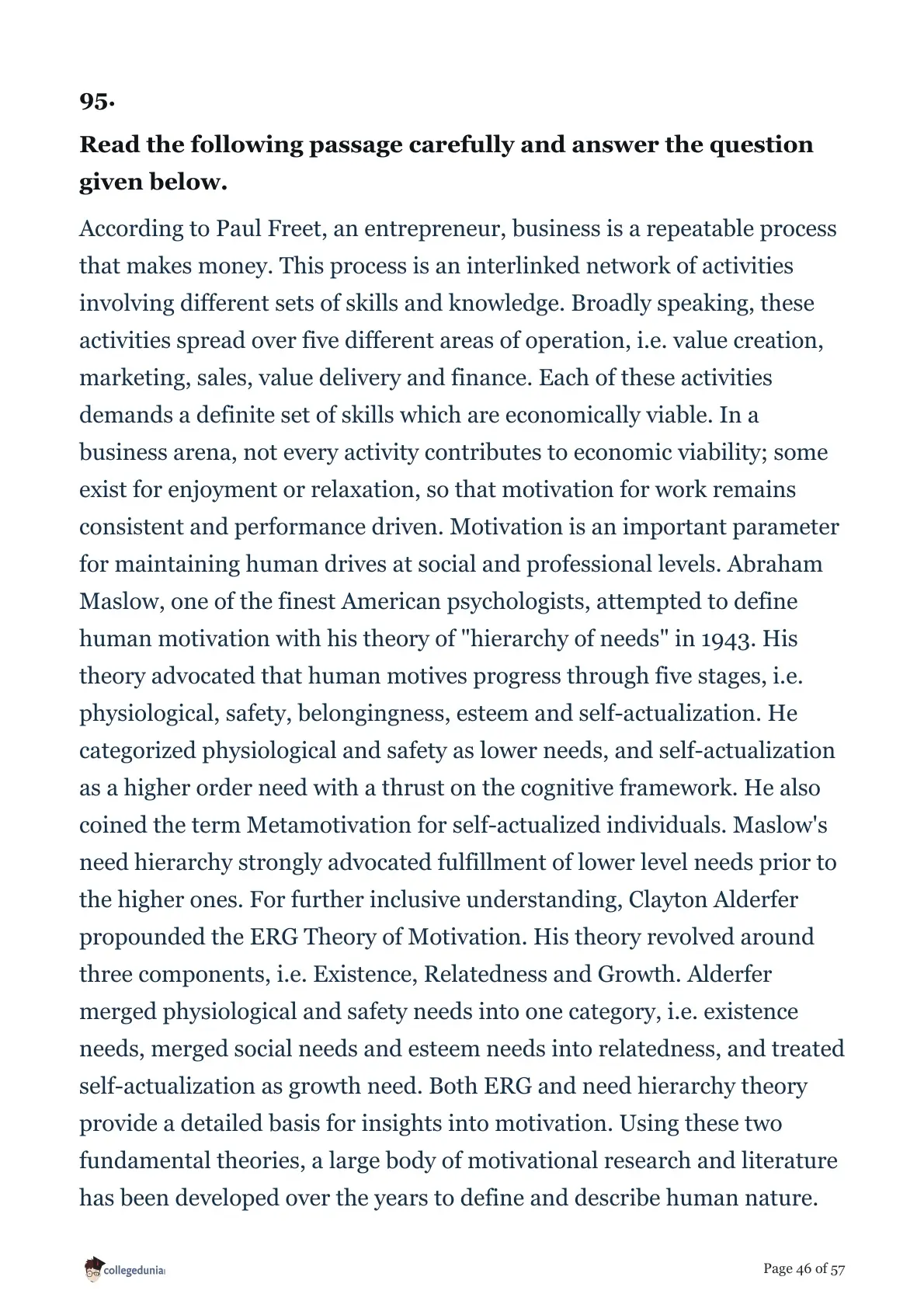
According to Paul Freet, an entrepreneur, business is a repeatable process that makes money. This process is an interlinked network of activities involving different sets of skills and knowledge. Broadly speaking, these activities spread over five different areas of operation, i.e. value creation, marketing, sales, value delivery and finance. Each of these activities demands a definite set of skills which are economically viable. In a business arena, not every activity contributes to economic viability; some exist for enjoyment or relaxation, so that motivation for work remains consistent and performance driven. Motivation is an important parameter for maintaining human drives at social and professional levels. Abraham Maslow, one of the finest American psychologists, attempted to define human motivation with his theory of "hierarchy of needs" in 1943. His theory advocated that human motives progress through five stages, i.e. physiological, safety, belongingness, esteem and self-actualization. He categorized physiological and safety as lower needs, and self-actualization as a higher order need with a thrust on the cognitive framework. He also coined the term Metamotivation for self-actualized individuals. Maslow's need hierarchy strongly advocated fulfillment of lower level needs prior to the higher ones. For further inclusive understanding, Clayton Alderfer propounded the ERG Theory of Motivation. His theory revolved around three components, i.e. Existence, Relatedness and Growth. Alderfer merged physiological and safety needs into one category, i.e. existence needs, merged social needs and esteem needs into relatedness, and treated self-actualization as growth need. Both ERG and need hierarchy theory provide a detailed basis for insights into motivation. Using these two fundamental theories, a large body of motivational research and literature has been developed over the years to define and describe human nature. In recent times, Paul Lawrence and Nitin Nohria from Harvard Business School attempted to provide a renewed perspective by merging biological and social sciences to lay out a new theory on human nature. Their theory identified four core human drives, i.e. Drive to Acquire, Drive to Bond, Drive to Learn and Drive to Defend. There must also be a fifth drive in their theory, i.e. Drive to Feel, representing emotional and sensory stimulus. In the contemporary business world, new products and services are being developed to entice the sensory or emotional part of human nature.
Which among the following is a major weakness of Maslow's theory?
Read the following passage carefully and answer the question given below.
According to Paul Freet, an entrepreneur, business is a repeatable process that makes money. This process is an interlinked network of activities involving different sets of skills and knowledge. Broadly speaking, these activities spread over five different areas of operation, i.e. value creation, marketing, sales, value delivery and finance. Each of these activities demands a definite set of skills which are economically viable. In a business arena, not every activity contributes to economic viability; some exist for enjoyment or relaxation, so that motivation for work remains consistent and performance driven. Motivation is an important parameter for maintaining human drives at social and professional levels. Abraham Maslow, one of the finest American psychologists, attempted to define human motivation with his theory of "hierarchy of needs" in 1943. His theory advocated that human motives progress through five stages, i.e. physiological, safety, belongingness, esteem and self-actualization. He categorized physiological and safety as lower needs, and self-actualization as a higher order need with a thrust on the cognitive framework. He also coined the term Metamotivation for self-actualized individuals. Maslow's need hierarchy strongly advocated fulfillment of lower level needs prior to the higher ones. For further inclusive understanding, Clayton Alderfer propounded the ERG Theory of Motivation. His theory revolved around three components, i.e. Existence, Relatedness and Growth. Alderfer merged physiological and safety needs into one category, i.e. existence needs, merged social needs and esteem needs into relatedness, and treated self-actualization as growth need. Both ERG and need hierarchy theory provide a detailed basis for insights into motivation. Using these two fundamental theories, a large body of motivational research and literature has been developed over the years to define and describe human nature. In recent times, Paul Lawrence and Nitin Nohria from Harvard Business School attempted to provide a renewed perspective by merging biological and social sciences to lay out a new theory on human nature. Their theory identified four core human drives, i.e. Drive to Acquire, Drive to Bond, Drive to Learn and Drive to Defend. There must also be a fifth drive in their theory, i.e. Drive to Feel, representing emotional and sensory stimulus. In the contemporary business world, new products and services are being developed to entice the sensory or emotional part of human nature.
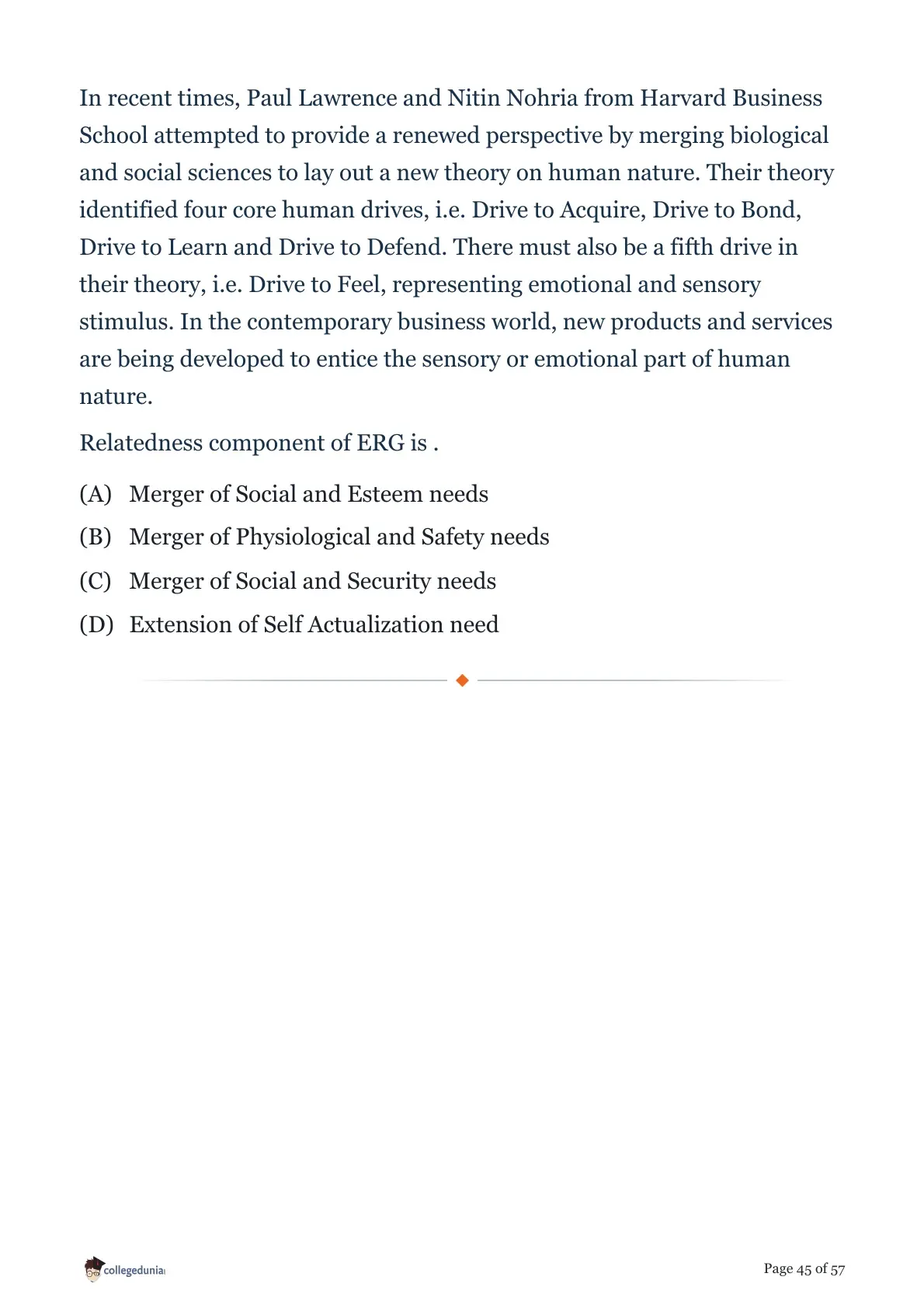
Relatedness component of ERG is .
Read the following passage carefully and answer the question given below.
According to Paul Freet, an entrepreneur, business is a repeatable process that makes money. This process is an interlinked network of activities involving different sets of skills and knowledge. Broadly speaking, these activities spread over five different areas of operation, i.e. value creation, marketing, sales, value delivery and finance. Each of these activities demands a definite set of skills which are economically viable. In a business arena, not every activity contributes to economic viability; some exist for enjoyment or relaxation, so that motivation for work remains consistent and performance driven. Motivation is an important parameter for maintaining human drives at social and professional levels. Abraham Maslow, one of the finest American psychologists, attempted to define human motivation with his theory of "hierarchy of needs" in 1943. His theory advocated that human motives progress through five stages, i.e. physiological, safety, belongingness, esteem and self-actualization. He categorized physiological and safety as lower needs, and self-actualization as a higher order need with a thrust on the cognitive framework. He also coined the term Metamotivation for self-actualized individuals. Maslow's need hierarchy strongly advocated fulfillment of lower level needs prior to the higher ones. For further inclusive understanding, Clayton Alderfer propounded the ERG Theory of Motivation. His theory revolved around three components, i.e. Existence, Relatedness and Growth. Alderfer merged physiological and safety needs into one category, i.e. existence needs, merged social needs and esteem needs into relatedness, and treated self-actualization as growth need. Both ERG and need hierarchy theory provide a detailed basis for insights into motivation. Using these two fundamental theories, a large body of motivational research and literature has been developed over the years to define and describe human nature. In recent times, Paul Lawrence and Nitin Nohria from Harvard Business School attempted to provide a renewed perspective by merging biological and social sciences to lay out a new theory on human nature. Their theory identified four core human drives, i.e. Drive to Acquire, Drive to Bond, Drive to Learn and Drive to Defend. There must also be a fifth drive in their theory, i.e. Drive to Feel, representing emotional and sensory stimulus. In the contemporary business world, new products and services are being developed to entice the sensory or emotional part of human nature.
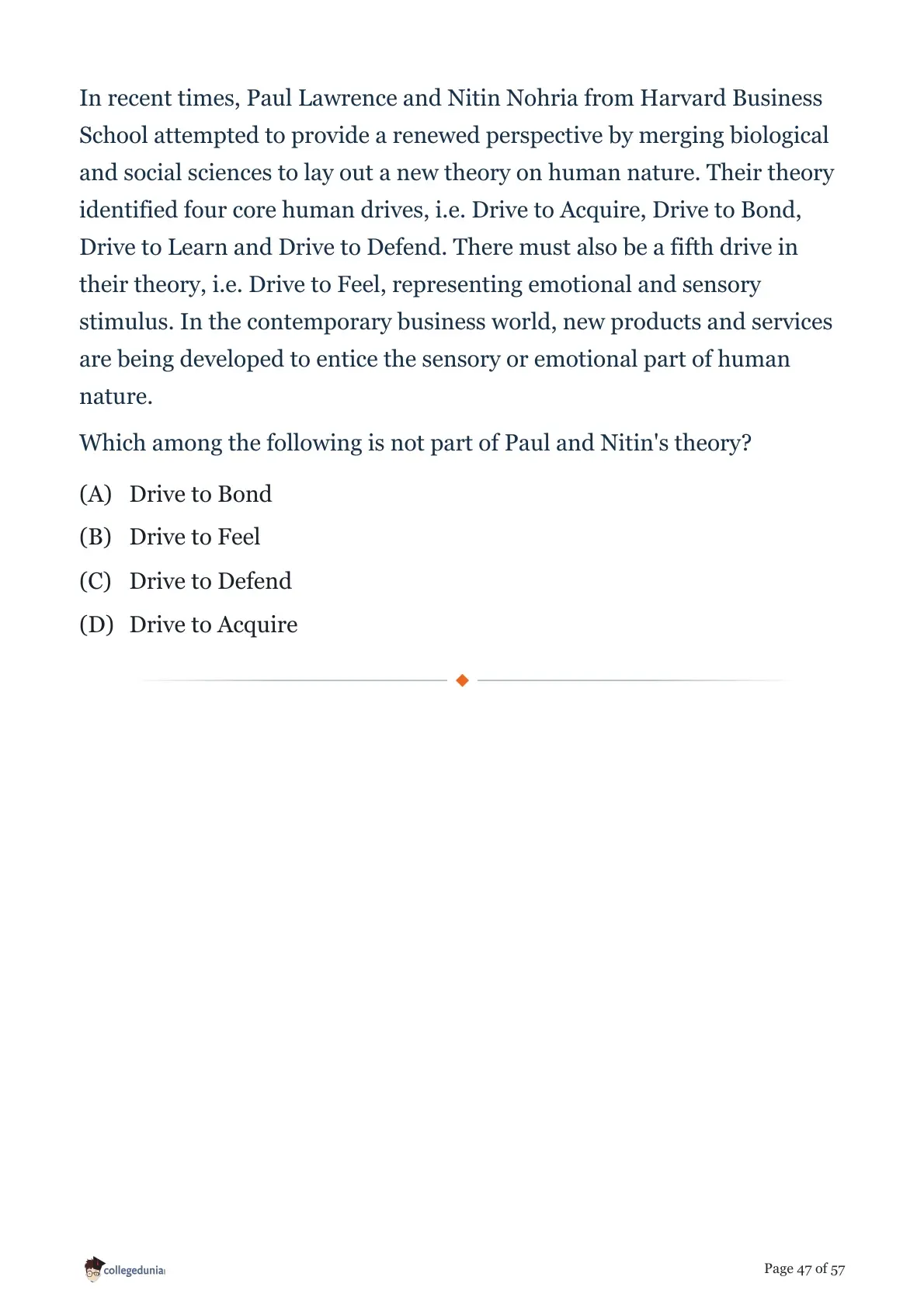
Which among the following is not part of Paul and Nitin's theory?
Read the following passage carefully and answer the question given below.
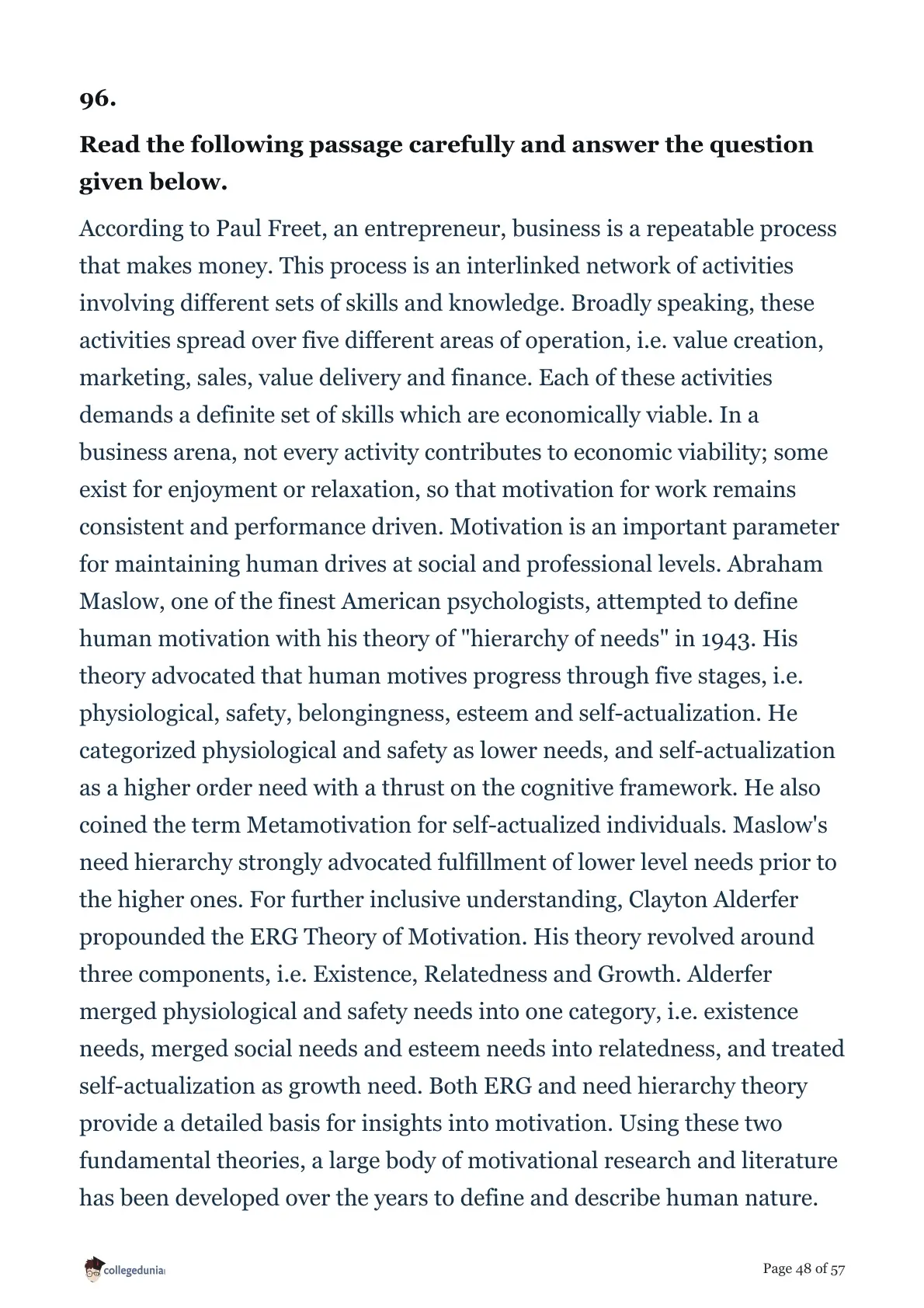
According to Paul Freet, an entrepreneur, business is a repeatable process that makes money. This process is an interlinked network of activities involving different sets of skills and knowledge. Broadly speaking, these activities spread over five different areas of operation, i.e. value creation, marketing, sales, value delivery and finance. Each of these activities demands a definite set of skills which are economically viable. In a business arena, not every activity contributes to economic viability; some exist for enjoyment or relaxation, so that motivation for work remains consistent and performance driven. Motivation is an important parameter for maintaining human drives at social and professional levels. Abraham Maslow, one of the finest American psychologists, attempted to define human motivation with his theory of "hierarchy of needs" in 1943. His theory advocated that human motives progress through five stages, i.e. physiological, safety, belongingness, esteem and self-actualization. He categorized physiological and safety as lower needs, and self-actualization as a higher order need with a thrust on the cognitive framework. He also coined the term Metamotivation for self-actualized individuals. Maslow's need hierarchy strongly advocated fulfillment of lower level needs prior to the higher ones. For further inclusive understanding, Clayton Alderfer propounded the ERG Theory of Motivation. His theory revolved around three components, i.e. Existence, Relatedness and Growth. Alderfer merged physiological and safety needs into one category, i.e. existence needs, merged social needs and esteem needs into relatedness, and treated self-actualization as growth need. Both ERG and need hierarchy theory provide a detailed basis for insights into motivation. Using these two fundamental theories, a large body of motivational research and literature has been developed over the years to define and describe human nature. In recent times, Paul Lawrence and Nitin Nohria from Harvard Business School attempted to provide a renewed perspective by merging biological and social sciences to lay out a new theory on human nature. Their theory identified four core human drives, i.e. Drive to Acquire, Drive to Bond, Drive to Learn and Drive to Defend. There must also be a fifth drive in their theory, i.e. Drive to Feel, representing emotional and sensory stimulus. In the contemporary business world, new products and services are being developed to entice the sensory or emotional part of human nature.
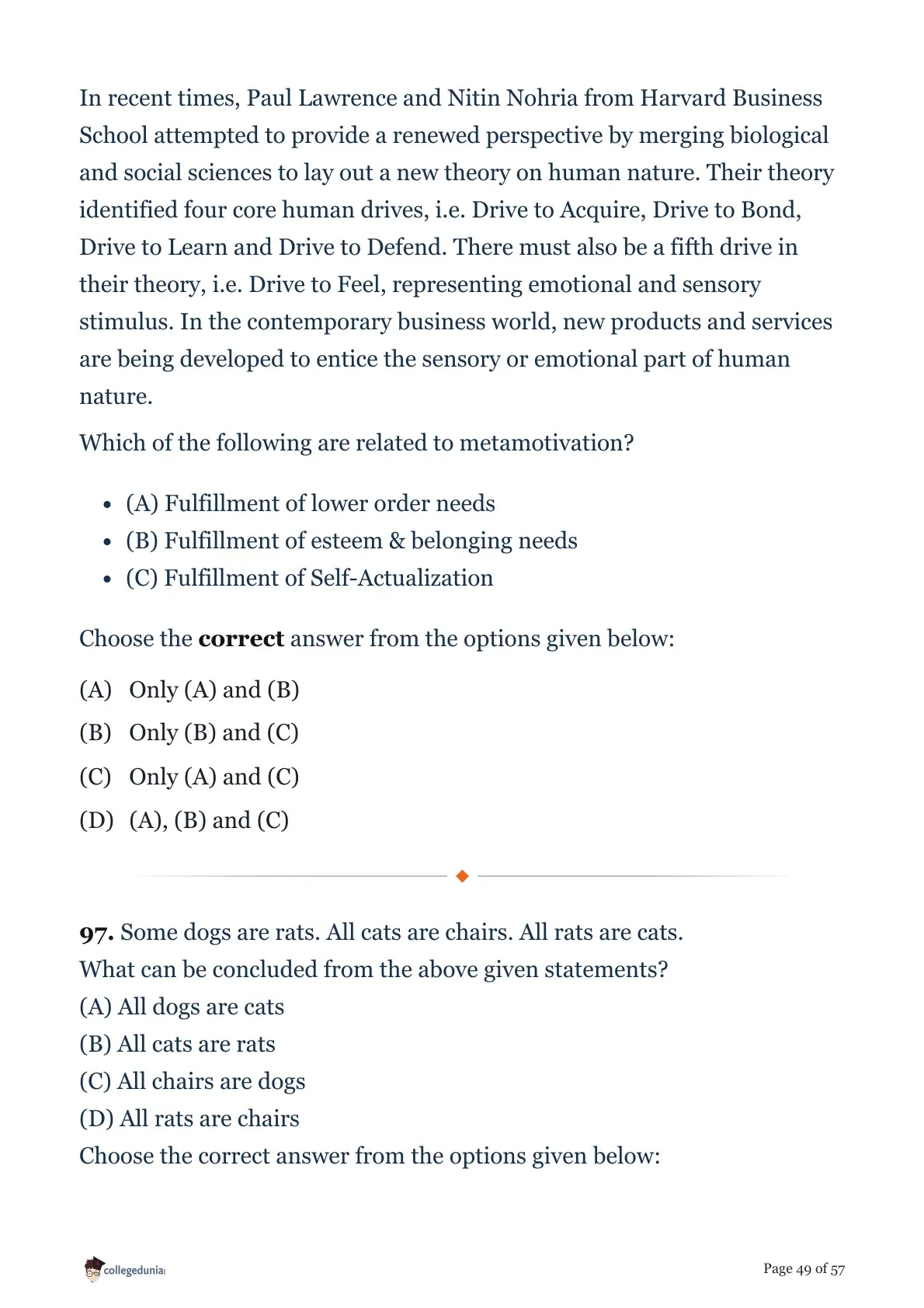
Which of the following are related to metamotivation?
- (A) Fulfillment of lower order needs
- (B) Fulfillment of esteem & belonging needs
- (C) Fulfillment of Self-Actualization
Choose the correct answer from the options given below:
Some dogs are rats. All cats are chairs. All rats are cats.
What can be concluded from the above given statements?
(A) All dogs are cats
(B) All cats are rats
(C) All chairs are dogs
(D) All rats are chairs
Choose the correct answer from the options given below:
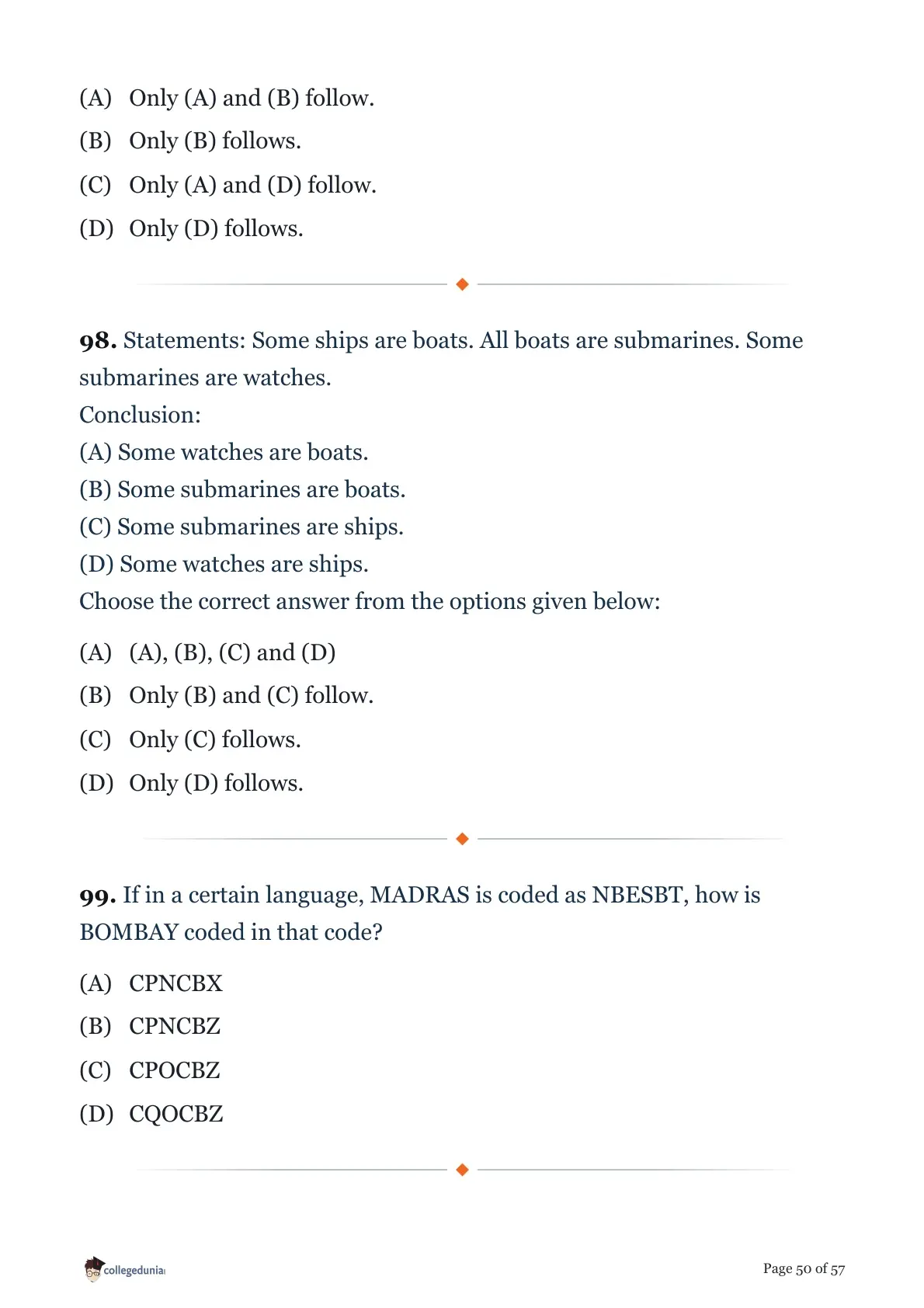
Statements: Some ships are boats. All boats are submarines. Some submarines are watches.
Conclusion:
(A) Some watches are boats.
(B) Some submarines are boats.
(C) Some submarines are ships.
(D) Some watches are ships.
Choose the correct answer from the options given below:
If in a certain language, MADRAS is coded as NBESBT, how is BOMBAY coded in that code?
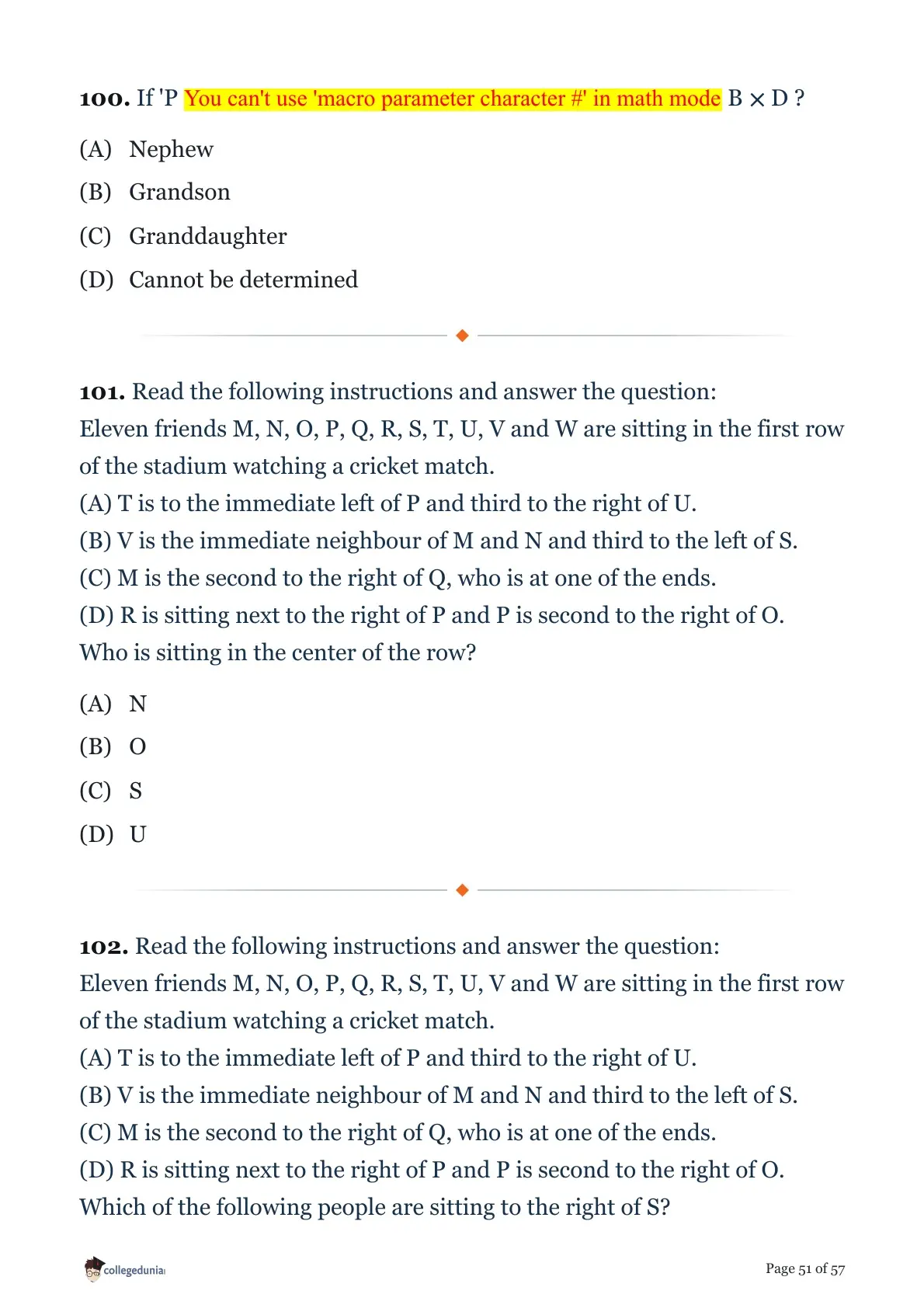
If 'P $ Q' means 'P is father of Q'; 'P # Q' means 'P is mother of Q'; 'P \(\times\) Q' means 'P is sister of Q', then how is D related to N in N # A $ B \(\times\) D ?
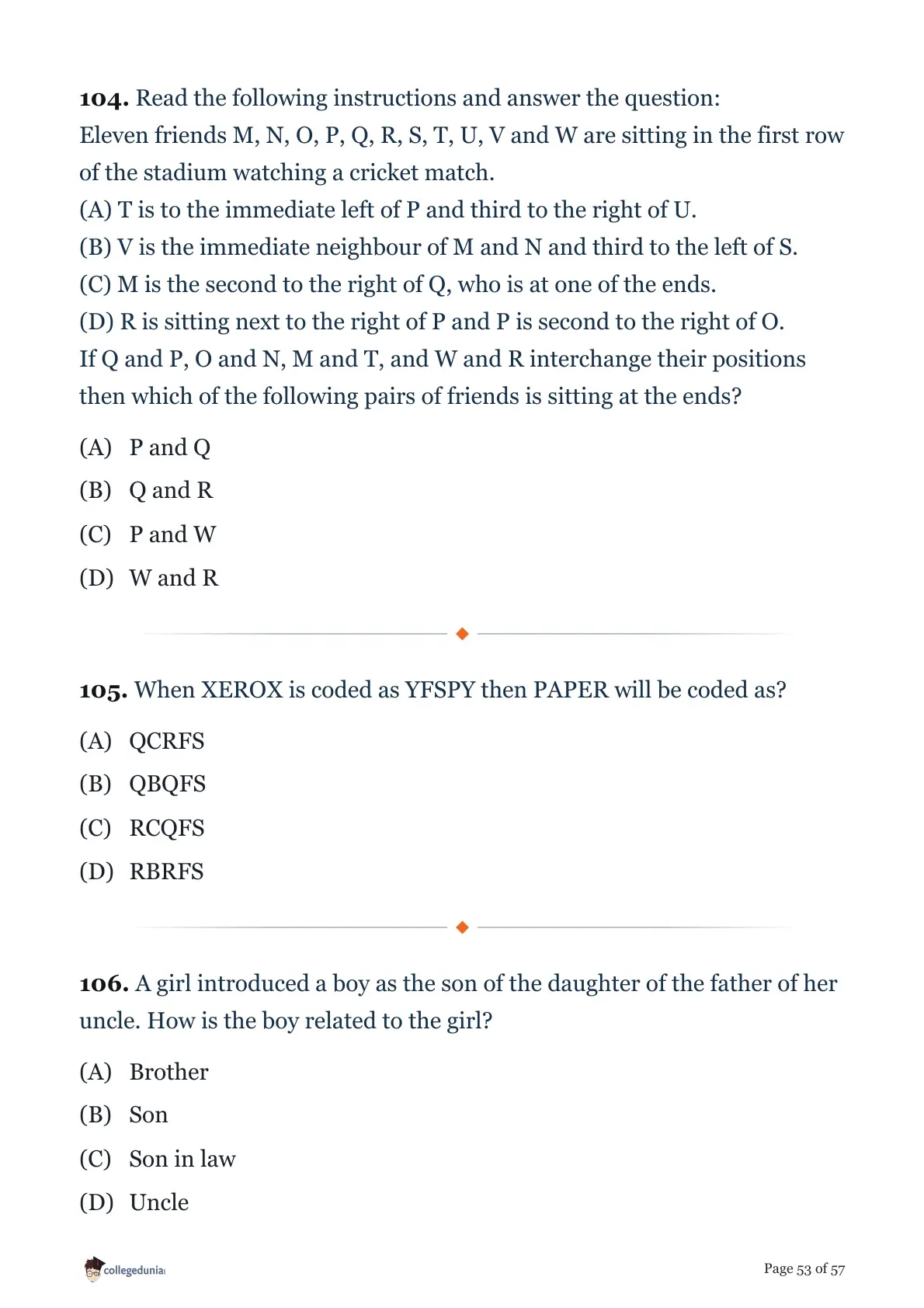
Read the following instructions and answer the question:
Eleven friends M, N, O, P, Q, R, S, T, U, V and W are sitting in the first row of the stadium watching a cricket match.
(A) T is to the immediate left of P and third to the right of U.
(B) V is the immediate neighbour of M and N and third to the left of S.
(C) M is the second to the right of Q, who is at one of the ends.
(D) R is sitting next to the right of P and P is second to the right of O.
Who is sitting in the center of the row?
Read the following instructions and answer the question:
Eleven friends M, N, O, P, Q, R, S, T, U, V and W are sitting in the first row of the stadium watching a cricket match.
(A) T is to the immediate left of P and third to the right of U.
(B) V is the immediate neighbour of M and N and third to the left of S.
(C) M is the second to the right of Q, who is at one of the ends.
(D) R is sitting next to the right of P and P is second to the right of O.
Which of the following people are sitting to the right of S?
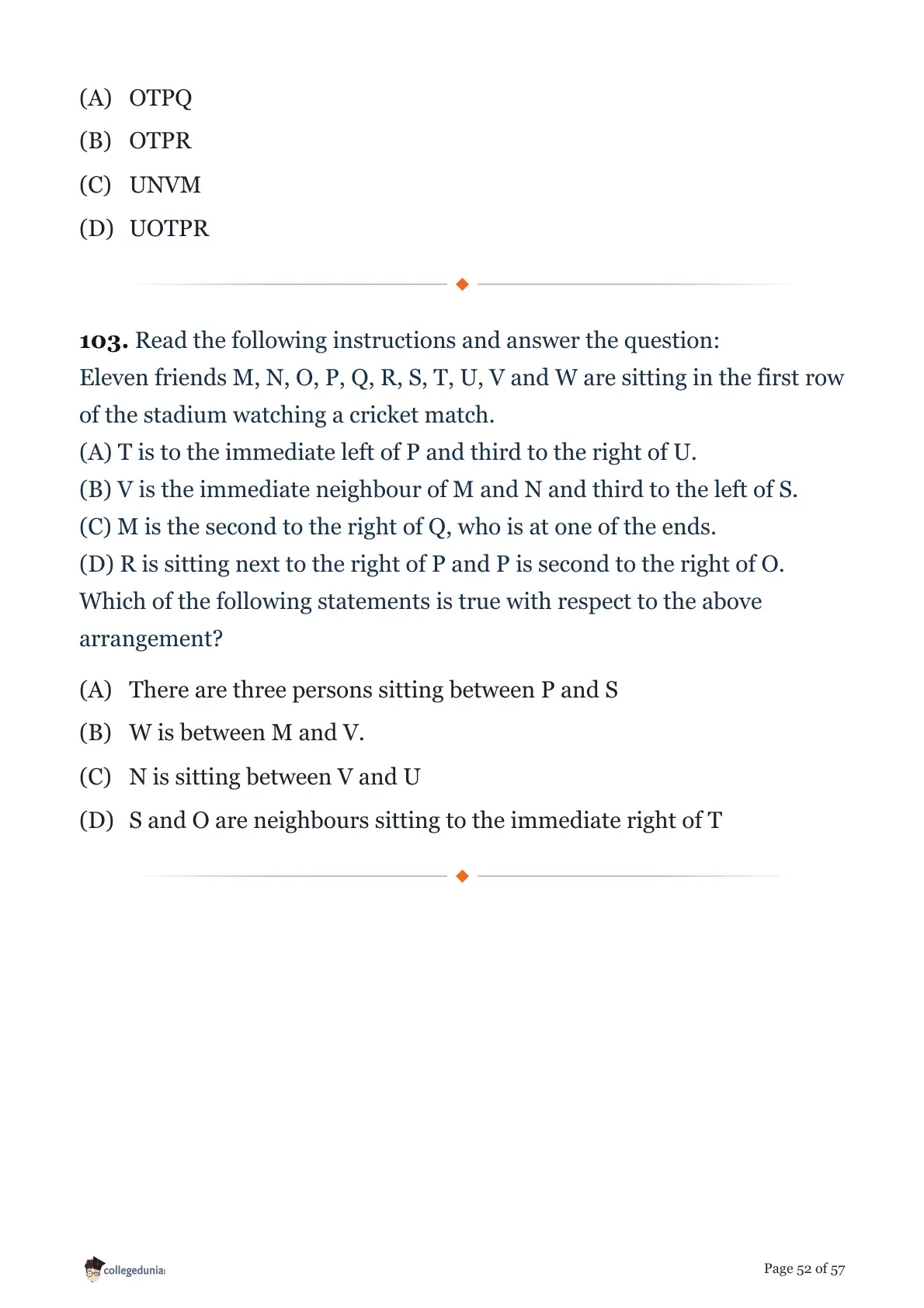
Read the following instructions and answer the question:
Eleven friends M, N, O, P, Q, R, S, T, U, V and W are sitting in the first row of the stadium watching a cricket match.
(A) T is to the immediate left of P and third to the right of U.
(B) V is the immediate neighbour of M and N and third to the left of S.
(C) M is the second to the right of Q, who is at one of the ends.
(D) R is sitting next to the right of P and P is second to the right of O.
Which of the following statements is true with respect to the above arrangement?
Read the following instructions and answer the question:
Eleven friends M, N, O, P, Q, R, S, T, U, V and W are sitting in the first row of the stadium watching a cricket match.
(A) T is to the immediate left of P and third to the right of U.
(B) V is the immediate neighbour of M and N and third to the left of S.
(C) M is the second to the right of Q, who is at one of the ends.
(D) R is sitting next to the right of P and P is second to the right of O.
If Q and P, O and N, M and T, and W and R interchange their positions then which of the following pairs of friends is sitting at the ends?
When XEROX is coded as YFSPY then PAPER will be coded as?
A girl introduced a boy as the son of the daughter of the father of her uncle. How is the boy related to the girl?
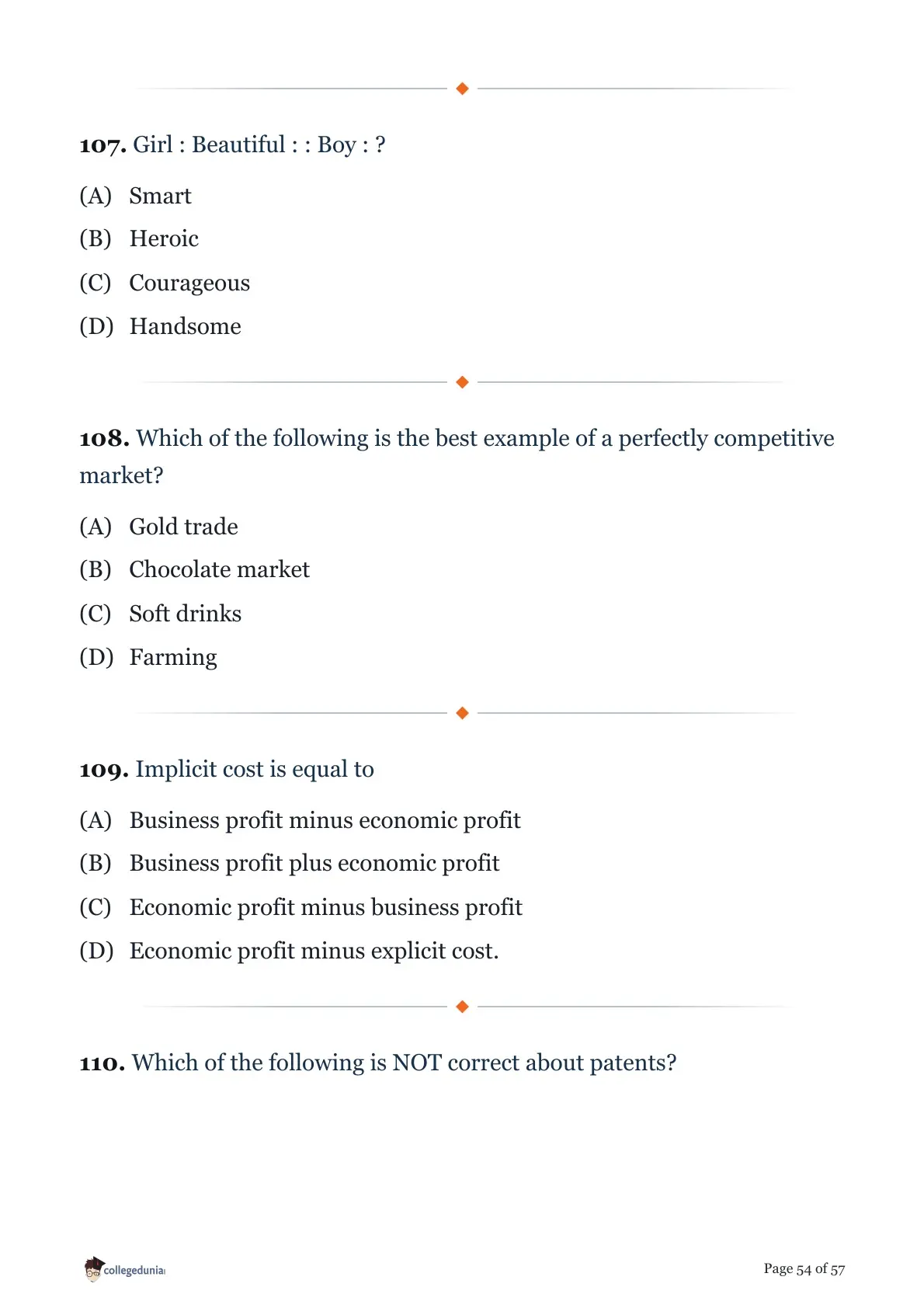
Girl : Beautiful : : Boy : ?
Which of the following is the best example of a perfectly competitive market?
Implicit cost is equal to
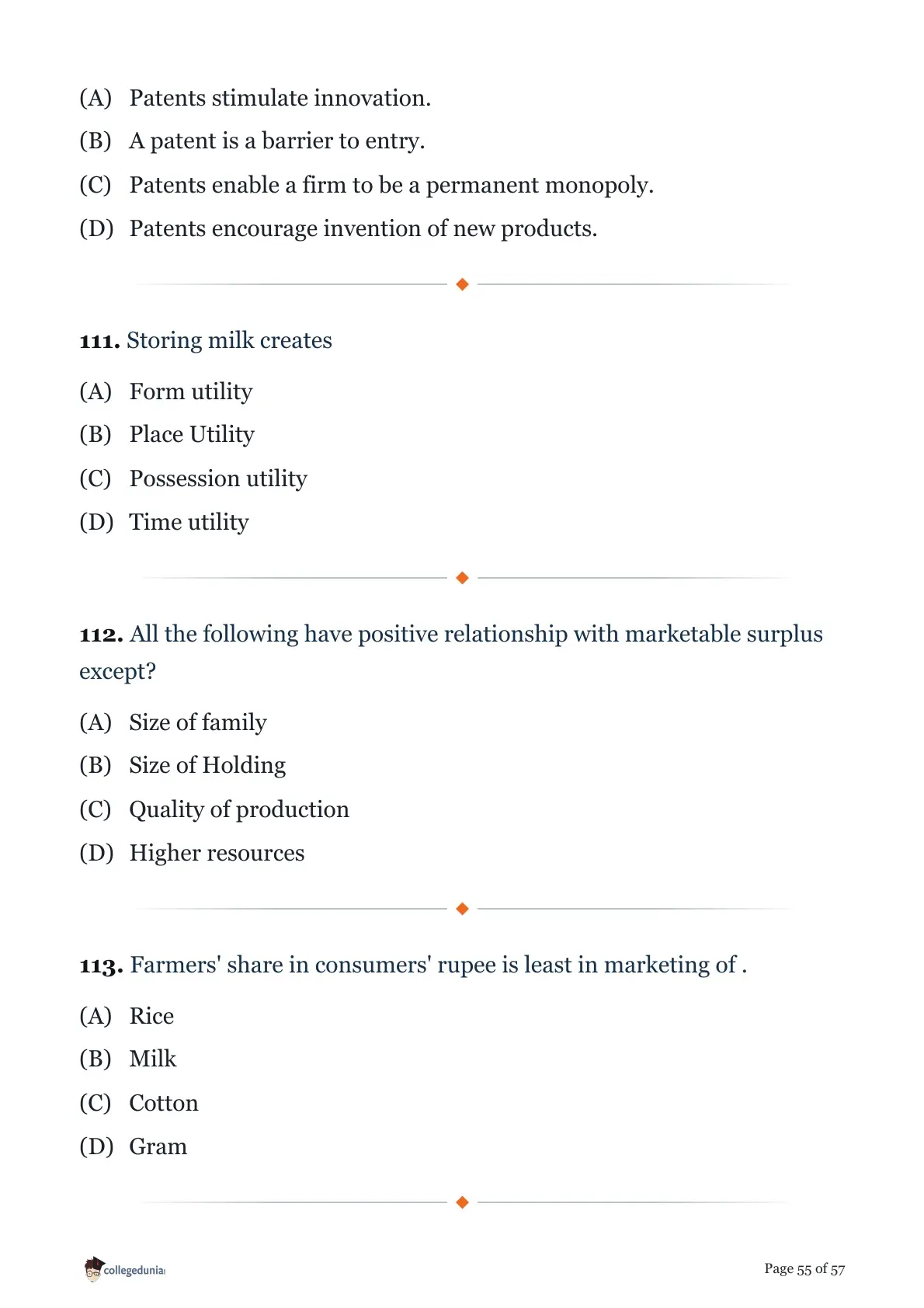
Which of the following is NOT correct about patents?
Storing milk creates
All the following have positive relationship with marketable surplus except?
Farmers' share in consumers' rupee is least in marketing of .
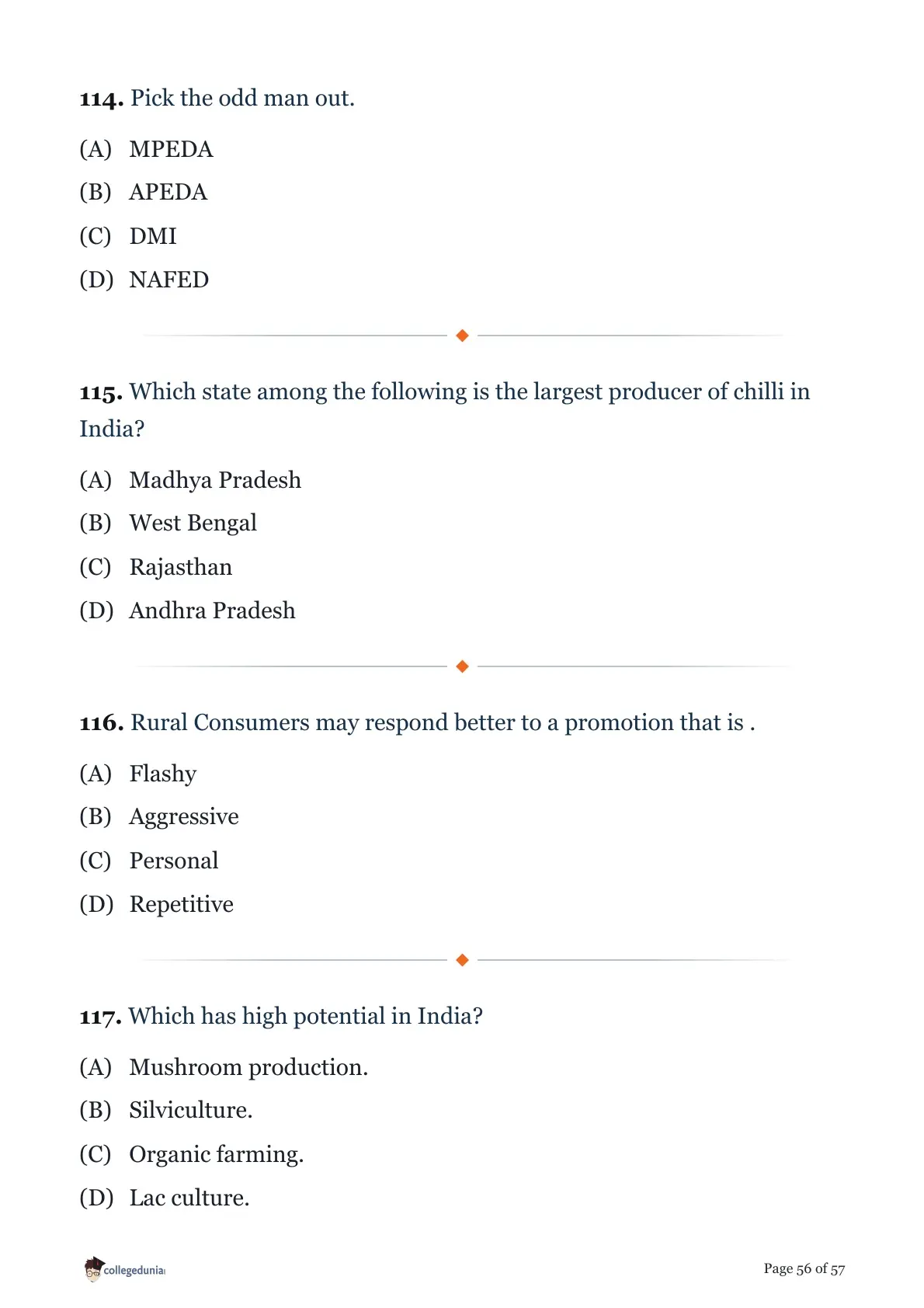
Pick the odd man out.
Which state among the following is the largest producer of chilli in India?
Rural Consumers may respond better to a promotion that is .
Which has high potential in India?
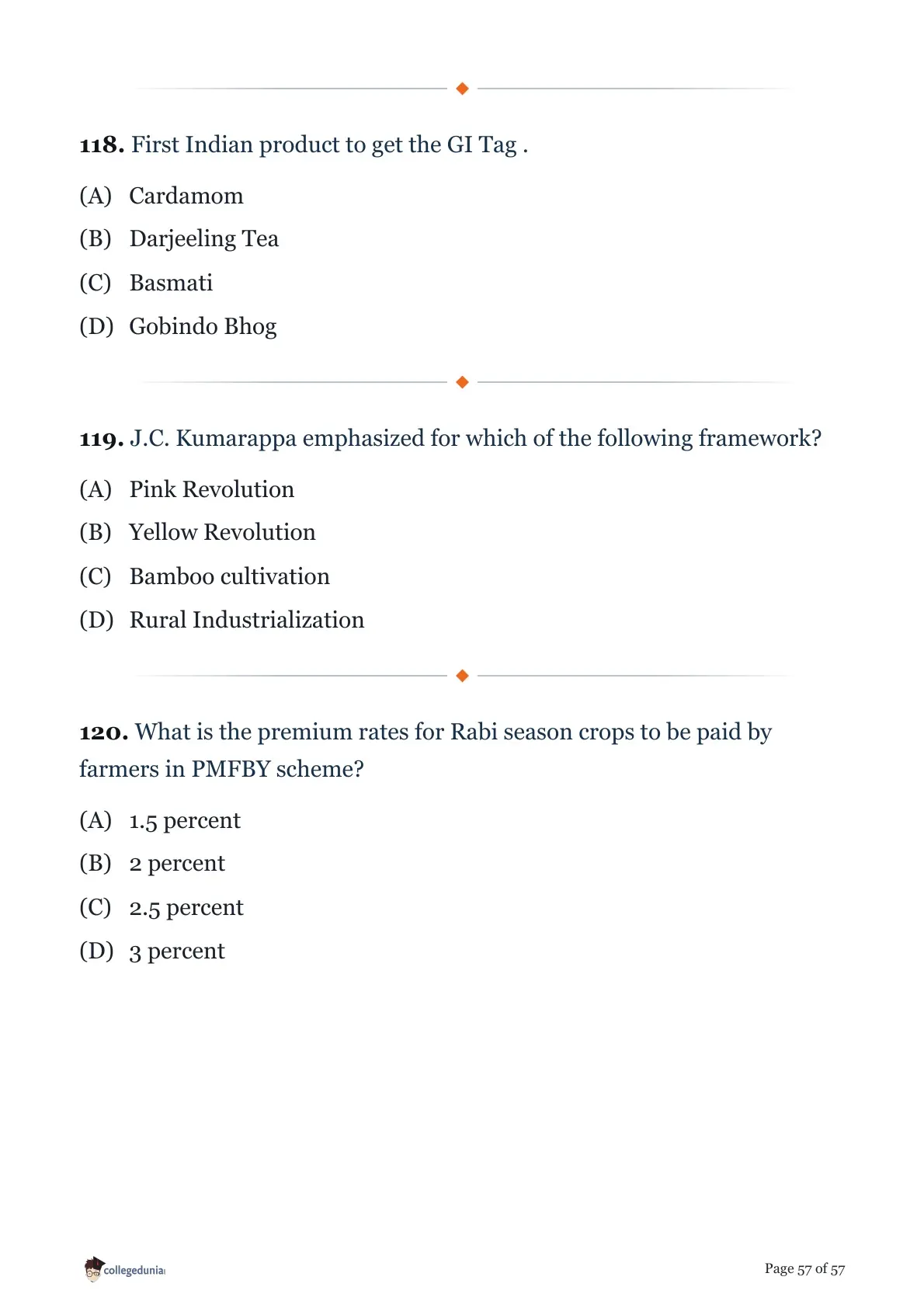
First Indian product to get the GI Tag .
J.C. Kumarappa emphasized for which of the following framework?
What is the premium rates for Rabi season crops to be paid by farmers in PMFBY scheme?
ICAR AIEEA PG 2023 Agri Business Management Exam Pattern and Marking Scheme Explained
ICAR AIEEA PG 2023 was a computer-based test of single-correct multiple-choice questions, and Agri Business Management was one of the roughly 20 PG major subject groups you could pick. The full spec you attempted on July 9, 2023 is below.
- Total questions: 120 single-correct MCQs
- Duration: 120 minutes
- Total marks: 480
- Marking scheme: +4 for a correct answer, -1 for a wrong one
- Question types: objective MCQs covering agri-business plus a large aptitude, English and reasoning section
High-Weightage Subjects in ICAR AIEEA PG 2023 Agri Business Management to Focus On First
This paper was split almost evenly between a general aptitude block and core agriculture and agri-business topics, so your prep cannot ignore either half. The counts below are from this actual 2023 paper.
- Quantitative Aptitude and Data Interpretation: around 30 of the 120 questions, including two full DI sets on pie charts and a sales bar graph
- English (vocabulary, grammar, sentence correction): about 16 questions, from synonyms like "bamboozled" to error-correction lines
- Logical Reasoning: roughly 11 questions on syllogisms, coding-decoding, blood relations and a seating puzzle
- Agriculture and Horticulture science: close to 40 questions on crop diseases, propagation, plant nutrition, farm machinery and food processing
- Agri-Business and Agri-Marketing: about 13 questions on marketable surplus, farmer share, GI tags, PMFBY and rural marketing
- Motivation theory (Maslow, ERG): a 5-question reading set that rewarded quick passage reading
ICAR AIEEA PG 2023 Agri Business Management Question Paper Analysis Video
Source: AgriBee - Agriculture Exams, Jobs in India
How to Use the ICAR AIEEA PG 2023 Agri Business Management Question Paper for Practice
Treat this paper as a timed mock before you treat it as a reading exercise. That is the only way the +4/-1 marking teaches you when to skip.
- Solve all 120 questions in a single 120-minute sitting, no pauses, to feel the real time pressure
- Score with +4 for each correct and -1 for each wrong answer, then check every question against the solution PDF
- Redo the Quantitative Aptitude and DI sets first, since that 30-question block is where speed decides your score
- Keep a short list of the agriculture facts you missed, like the causal organism of grapevine downy mildew or the first GI-tagged Indian product, and revise them weekly
ICAR AIEEA PG 2023 Agri Business Management Question Paper FAQs
Ques. How many questions were there in the ICAR AIEEA PG 2023 Agri Business Management paper and what was the marking scheme?
Ans. The paper had 120 single-correct MCQs to be solved in 120 minutes for a total of 480 marks. You gained 4 marks for each correct answer and lost 1 mark for each wrong one, so blind guessing hurt your score.
Ques. Which topics had the highest weightage in ICAR AIEEA PG 2023 Agri Business Management?
Ans. Quantitative Aptitude and Data Interpretation led with about 30 questions, followed by nearly 40 agriculture and horticulture science questions. English carried around 16 and Logical Reasoning about 11, so aptitude and core agriculture together decided the paper.
Ques. Where can I download the ICAR AIEEA PG 2023 Agri Business Management question paper with solutions PDF for free?
Ans. Use the download table above on Collegedunia for the full question paper and the step-by-step solutions PDF. For the official paper and answer key, check the NTA ICAR portal at icar.nta.ac.in.
Ques. Is the ICAR AIEEA PG Agri Business Management paper only about agriculture?
Ans. No. Almost half of the 2023 paper was general aptitude, with about 30 Quantitative Aptitude and DI questions, 16 English and 11 Logical Reasoning questions. The rest tested agriculture, horticulture and agri-business topics, so you must prepare both halves.
Ques. Are ICAR AIEEA PG Agri Business Management questions repeated from previous years?
Ans. Core concepts repeat far more than exact questions. Facts like blossom end rot being a calcium deficiency, scurvy from Vitamin C, or the PMFBY Rabi premium of 1.5 percent show up across years, so solving 5 to 7 past papers builds real coverage.
Ques. Who conducts the ICAR AIEEA PG Agri Business Management exam?
Ans. The National Testing Agency (NTA) conducts ICAR AIEEA PG on behalf of the Indian Council of Agricultural Research. Agri Business Management is one of about 20 PG major subject groups you can choose while applying on the official NTA ICAR portal.



Comments