




UP CNET 2026 B.Sc. Nursing Question Paper is available for download here. ABVM University, Uttar Pradesh conducted UP CNET 2026 B.Sc. Nursing exam on June 6 from 11 AM to 1:20 PM. UP CNET B.Sc. Nursing Question Paper consists of 120 questions for 120 marks to be attempted in 140 minutes.
- UP CNET B.Sc. Nursing Question Paper 2026 is divided into 5 sections- Nursing Aptitude, Physics, Chemistry, Biology and English, each containing 24 questions.
- Each correct answer carries 1 mark and there is no negative marking for incorrect answers.
Candidates can download UP CNET 2026 B.Sc. Nursing Question Paper with Answer Key and Solution PDF from the links provide below.
UP CNET 2026 B.Sc. Nursing Question Paper with Solutions
| UP CNET B.Sc. Nursing Question Paper 2026 | Download PDF | Check Solutions |
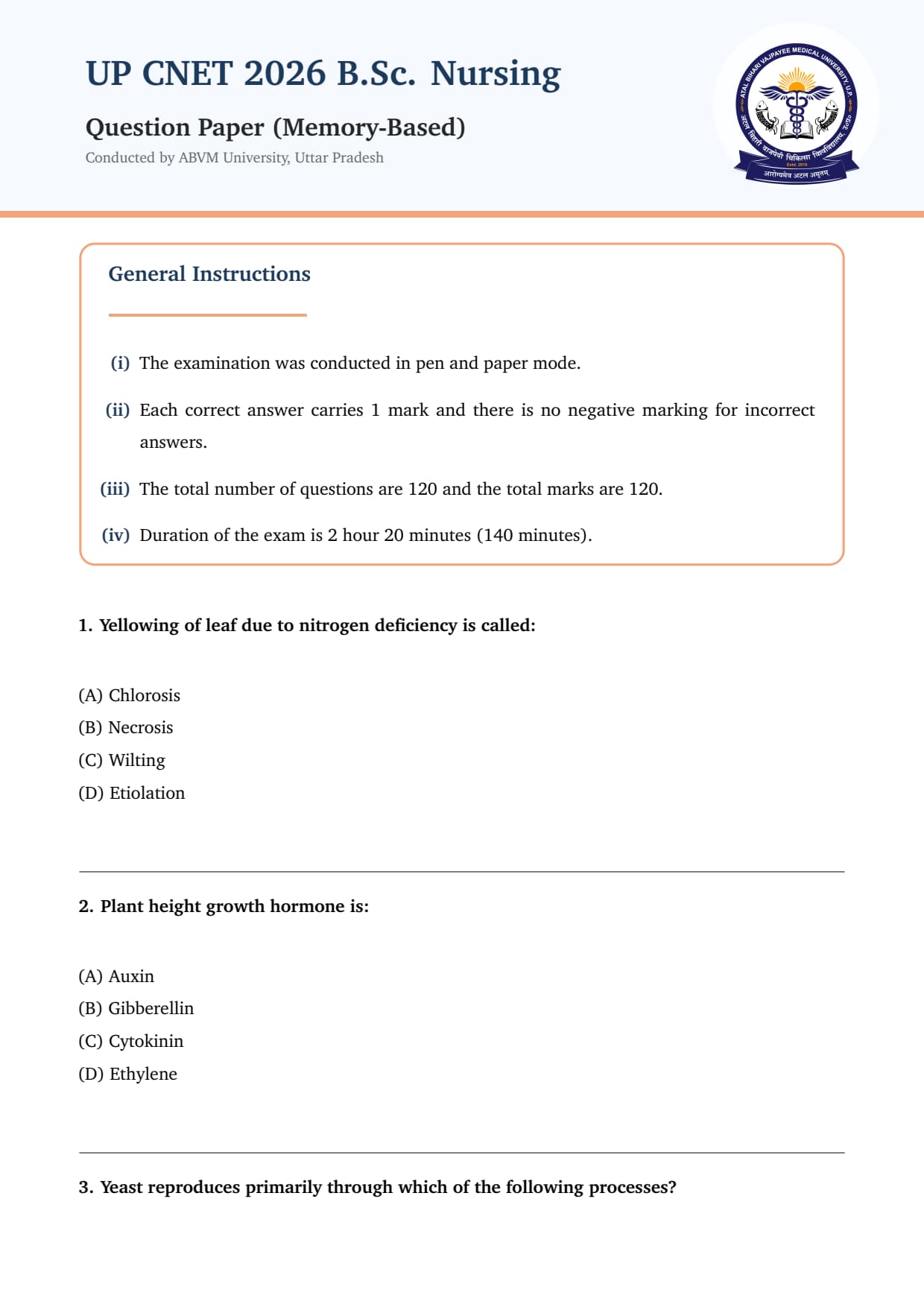


Yellowing of leaf due to nitrogen deficiency is called:
View Solution
Step 1: Understanding the Question:
The question asks for the physiological term used when plant leaves turn yellow due to a deficiency in nitrogen.
Nitrogen is an essential macronutrient required for various biological processes in plants.
Step 2: Detailed Explanation:
1. Chlorophyll is the green pigment in plants responsible for photosynthesis, and nitrogen is a key structural component of its molecule.
2. When there is a deficiency of nitrogen, the plant cannot synthesize adequate chlorophyll, leading to a loss of green color.
3. This loss of chlorophyll and subsequent yellowing of leaves is clinically termed as chlorosis.
4. Necrosis refers to the localized death of plant tissues or cells, which usually manifests as brown or black spots on the leaves.
5. Wilting is the loss of rigidity or turgidity in non-woody parts of plants due to a lack of water.
6. Etiolation is the developmental response of plants grown in complete or partial absence of light, characterized by long, weak stems and pale yellow leaves.
Step 3: Final Answer:
Therefore, the yellowing of leaves due to nitrogen deficiency is called chlorosis.
Quick Tip: Chlorosis is primarily caused by deficiencies of nitrogen, potassium, magnesium, and iron.
Remember that nitrogen deficiency specifically affects older leaves first because it is highly mobile.
Plant height growth hormone is:
View Solution
Step 1: Understanding the Question:
The question asks to identify the plant hormone primarily responsible for increasing plant height.
Phytohormones regulate various aspects of growth, development, and elongation.
Step 2: Detailed Explanation:
1. Gibberellins (GAs) are a class of plant hormones that play a key role in stem elongation and plant height.
2. They stimulate cell division and cell elongation in the internodal regions of the stem.
3. Applying gibberellins to genetically dwarf plants can restore their normal height by causing dramatic stem elongation.
4. Auxin is mainly responsible for apical dominance, root initiation, and phototropism.
5. Cytokinins promote cell division (cytokinesis) and delay leaf senescence.
6. Ethylene is a gaseous hormone primarily involved in fruit ripening and triple response.
7. Therefore, gibberellin is the hormone most directly associated with overall height and stem elongation.
Step 3: Final Answer:
The hormone responsible for promoting plant height growth is Gibberellin.
Quick Tip: Remember that Gibberellins overcome genetic dwarfism in plants.
They are also responsible for bolting, which is rapid stem elongation prior to flowering.
Yeast reproduces primarily through which of the following processes?
View Solution
Step 1: Understanding the Question:
This question asks for the primary mode of reproduction in yeasts.
Yeasts are unicellular eukaryotic microorganisms belonging to the kingdom Fungi.
Identifying how they propagate is vital in microbiology and industrial processes.
Step 2: Detailed Explanation:
Asexual Reproduction via Budding: Budding is the primary asexual reproduction method for most yeast species, such as Saccharomyces cerevisiae.
Mechanism of Budding: It begins when a localized softening of the cell wall leads to a small bulge or "bud" protruding from the parent cell.
The nucleus of the parent cell undergoes mitotic division, generating two identical nuclei.
One of these nuclei migrates into the growing bud.
A cell wall eventually forms between the parent cell and the bud, separating them into two independent cells.
Alternative Reproductive Methods:
Spore Formation: Under nutrient-deprived or harsh environmental conditions, yeast can undergo sexual reproduction to form haploid spores (ascospores).
This is a survival mechanism rather than a primary mode of routine reproduction.
Binary Fission: This involves equal division of the cell body into two equal halves.
It is characteristic of bacteria and fission yeasts (like Schizosaccharomyces pombe) but is not the primary mode for common yeasts.
Fragmentation: This is a process where multicellular organisms break into fragments, which then grow into new organisms.
This is typical of filamentous fungi, not unicellular yeasts.
Step 3: Final Answer:
Because budding is the standard, most common asexual process through which unicellular yeasts reproduce, the correct option is (D).
Quick Tip: Remember that during budding, the parent cell leaves a permanent "bud scar" on its chitin-rich cell wall.
Counting the number of bud scars under a microscope is a classic laboratory method to determine the reproductive age of a single yeast cell.
A prokaryotic cell lacks which of the following?
View Solution
Step 1: Understanding the Question:
This question requires identifying the key structural components that are absent in prokaryotic cells.
Prokaryotes represent primitive cellular life forms, encompassing bacteria and archaea.
Understanding their differences from eukaryotic cells is a fundamental topic in cell biology.
Step 2: Detailed Explanation:
Etymology of Prokaryotes: The name "prokaryote" is derived from the Greek "pro" (meaning before) and "karyon" (meaning kernel or nucleus).
This literally means "before a nucleus," signifying that these cells emerged before the evolution of a defined nucleus.
The Nucleus vs. Nucleoid: Prokaryotic cells lack a double-membrane-enclosed true nucleus.
Their genetic material is a single circular chromosome located in a non-membrane-bound region called the nucleoid.
Presence of Other Structures:
Plasma Membrane: All living cells, including prokaryotes, must possess a plasma membrane to define cellular boundaries and regulate molecular transport.
Ribosomes: Prokaryotes require ribosomes to translate genetic information into functional proteins.
They contain 70S ribosomes, which are structurally distinct from eukaryotic 80S ribosomes.
Cell Wall: Most prokaryotes have a cell wall (composed of peptidoglycan in bacteria) to maintain shape and prevent osmotic lysis.
Step 3: Final Answer:
Since prokaryotic cells are defined by the absolute absence of a membrane-bound true nucleus, the correct option is (C).
Quick Tip: A simple mnemonic to distinguish cell types:
"Pro" rhymes with "No" (no true nucleus and no membrane-bound organelles).
"Eu" rhymes with "Do" (do have a nucleus and membrane-bound organelles like mitochondria and endoplasmic reticulum).
What is the normal hemoglobin (Hb) level in an adult female?
View Solution
Step 1: Understanding the Question:
This question asks for the standard laboratory reference range of hemoglobin in a healthy, non-pregnant adult female.
Hemoglobin is the iron-containing oxygen-transport metalloprotein in red blood cells.
Its level is a key clinical indicator of a patient's overall oxygenation capacity and hematological health.
Step 2: Detailed Explanation:
Normal Hemoglobin Reference Ranges: Hemoglobin levels vary dynamically based on biological factors including age, sex, and physical altitude.
Adult Female Range: The standard reference interval for healthy adult females is typically \(12.0 to 15.5 g/dL\), which is commonly simplified to \(12 to 15 g/dL\) in nursing exams.
Adult Male Range: The standard range for adult males is higher, typically \(13.5 to 17.5 g/dL\) (or \(14 to 18 g/dL\)).
This disparity is primarily due to male androgens (testosterone) stimulating erythropoiesis (red blood cell production) and menstrual blood loss in reproductive-age females.
Clinical Deviations:
Low Hb (\(<12 g/dL\) in females): Indicates anemia, which can cause fatigue, paleness, and dyspnea.
High Hb (\(>16 g/dL\) in females): May suggest polycythemia, chronic hypoxia, or severe dehydration.
Step 3: Final Answer:
The typical reference range of hemoglobin for healthy adult females is \(12 to 15 g/dL\), matching option (B).
Quick Tip: When reading vital signs or lab results in nursing exams, look closely at the gender of the patient.
Females systematically show lower normal thresholds for hemoglobin, red blood cells, and hematocrit compared to males.
What is the typical phenotypic ratio of a Mendelian dihybrid cross?
View Solution
Step 1: Understanding the Question:
This question asks for the classic phenotypic ratio observed in the \(F_2\) generation of a Mendelian dihybrid cross.
A dihybrid cross tracks the inheritance patterns of two distinct, independently assorting genetic traits.
Step 2: Detailed Explanation:
Derivation of Dihybrid Ratio: The phenotypic distribution can be mathematically derived using the product law of probability.
The phenotypic ratio for a single trait in a Mendelian monohybrid cross is \(3 : 1\).
Since the two traits assort independently, the combined phenotypic ratio of a dihybrid cross is the product of their individual monohybrid ratios:
\[ (3 : 1) \times (3 : 1) = 9 : 3 : 3 : 1 \]
Mendelian Dihybrid Cross Setup: Consider a cross between homozygous dominant (yellow and round seeds, \(YYRR\)) and homozygous recessive (green and wrinkled seeds, \(yyrr\)) pea plants.
F1 Generation: All offspring are heterozygous (\(YyRr\)), showing the double dominant yellow and round phenotypes.
F2 Generation (Selfing F1): When \(YyRr\) is self-pollinated (\(YyRr \times YyRr\)), a 16-square Punnett grid represents the potential genetic outcomes.
Phenotypic Categories and Distribution:
9/16: Yellow and Round (dominant for both traits, \(Y\_R\_\)).
3/16: Yellow and Wrinkled (dominant for first, recessive for second, \(Y\_rr\)).
3/16: Green and Round (recessive for first, dominant for second, \(yyR\_\)).
1/16: Green and Wrinkled (recessive for both traits, \(yyrr\)).
Alternative Options:
\(3 : 1\) is the monohybrid phenotypic ratio.
\(1 : 2 : 1\) is the monohybrid genotypic ratio.
\(1 : 1 : 1 : 1\) is the phenotypic ratio of a dihybrid test cross.
Step 3: Final Answer:
The characteristic phenotypic ratio of an \(F_2\) generation dihybrid cross is \(9 : 3 : 3 : 1\), corresponding to option (C).
Quick Tip: To easily find the phenotypic ratio for any cross with \(n\) independent heterozygous genes, raise the monohybrid phenotype ratio to the power of \(n\).
For a monohybrid cross (\(n = 1\)): \((3:1)^1 = 3:1\).
For a dihybrid cross (\(n = 2\)): \((3:1)^2 = 9:3:3:1\).
For a trihybrid cross (\(n = 3\)): \((3:1)^3 = 27:9:9:9:3:3:3:1\).
What is the correct sequence of steps in Basic Life Support (BLS)?
View Solution
Step 1: Understanding the Question:
This question asks for the standard emergency clinical sequence used when initiating cardiopulmonary resuscitation (CPR) under Basic Life Support (BLS) guidelines.
These guidelines are periodically updated by international bodies like the American Heart Association (AHA).
Step 2: Detailed Explanation:
Evolution of BLS Guidelines: Before 2010, medical guidelines recommended the "ABC" (Airway, Breathing, Compressions) sequence.
The Transition to CAB: The sequence was updated to "CAB" (Compressions, Airway, Breathing) to emphasize the critical role of maintaining immediate organ perfusion.
Rationale for the Change:
Minimizing Delay in Perfusion: When cardiac arrest occurs, oxygen remains in the lungs and bloodstream for a few minutes.
Beginning with chest compressions immediately pumps this oxygenated blood to the brain and heart, reducing tissue ischemia.
If rescuers start with Airway management, there is a delay in initiating compressions, reducing the victim's chance of survival.
Phase Breakdown:
C - Compressions: Actively compress the chest to restore systemic blood flow.
A - Airway: Open the patient's airway using the head-tilt, chin-lift or jaw-thrust maneuver.
B - Breathing: Deliver rescue breaths to replenish blood oxygen levels.
Step 3: Final Answer:
The correct and currently recommended sequence of steps in BLS is CAB (Compressions, Airway, Breathing), which is option (B).
Quick Tip: Remember that "C" (Circulation/Compressions) is the foundation of cardiac arrest management.
In a clinical crisis, you must establish circulation first to keep vital organs alive, followed by opening the airway and breathing support.
What is the primary function of hemoglobin in the blood?
View Solution
Step 1: Understanding the Question:
This question asks for the principal physiological role played by hemoglobin in human circulation.
Hemoglobin is the dominant protein constituent of mature erythrocytes (red blood cells).
Step 2: Detailed Explanation:
Structure of Hemoglobin: Hemoglobin is a metalloprotein with a quaternary structure containing four globin chains.
Each globin chain is bound to an iron-containing heme prosthetic group.
Oxygen Transport Mechanism: The iron atom (\(Fe^{2+}\)) within each heme group can reversibly bind one molecule of oxygen (\(O_2\)).
Consequently, a single hemoglobin molecule can bind and transport up to four oxygen molecules from the high-tension environment of the lungs to oxygen-demanding tissues.
Carbon Dioxide Transport: It also aids in transporting about \(20%\) of metabolic waste carbon dioxide back to the lungs as carbaminohemoglobin.
Analysis of Alternative Options:
Fighting Infection: This is the specialized role of leukocytes (white blood cells), such as neutrophils and lymphocytes.
Blood Clotting: This cascade is driven by platelets (thrombocytes) and plasma coagulation factors.
Antibody Production: This function is carried out by plasma cells, which are mature B-lymphocytes.
Step 3: Final Answer:
The primary, life-sustaining function of hemoglobin in blood circulation is to transport oxygen, corresponding to option (A).
Quick Tip: Carbon monoxide (\(CO\)) has an affinity for hemoglobin that is roughly 200 times higher than that of oxygen.
This high affinity explains why carbon monoxide poisoning is highly lethal, as it displaces oxygen and prevents tissue oxygenation.
What is the immediate nursing action for a patient with a suspected bone fracture?
View Solution
Step 1: Understanding the Question:
This question asks for the primary, immediate nursing intervention when a bone fracture is suspected.
Skeletal injuries require stabilization to prevent further anatomical or vascular damage.
Step 2: Detailed Explanation:
Rationale for Immobilization: The immediate first-aid priority for any suspected fracture is to immobilize the limb or area.
This is done using a splint, cast, or sling.
Preventing Secondary Damage: If a fractured bone is allowed to move, the sharp, jagged ends of the bone fragments can tear surrounding tissues, severed nerves, and injure nearby blood vessels.
This can cause severe internal bleeding or permanent nerve damage.
Pain Mitigation: Preventing movement directly reduces muscle spasms and intense pain at the site of injury.
Analysis of Incorrect Actions:
Mobilization: Encouraging movement will aggravate the bone displacement and pain.
Exercise: This is highly dangerous and completely contraindicated during acute structural skeletal trauma.
Massage: Rubbing or massaging the area can disrupt initial blood clotting, increase tissue swelling, worsen internal bleeding, and displace bone fragments.
Step 3: Final Answer:
To ensure safety and prevent secondary complications, the nurse must immediately immobilize the suspected fracture site, matching option (A).
Quick Tip: Remember the classic rules of splinting a suspected fracture:
Always immobilize the joint immediately above and the joint immediately below the site of the suspected bone fracture to ensure effective stabilization.
What is the recommended compression-to-ventilation ratio for CPR in adults?
View Solution
Step 1: Understanding the Question:
This question asks for the standard, universally recommended ratio of chest compressions to rescue breaths during adult cardiopulmonary resuscitation (CPR).
This baseline guideline is standardized globally to optimize patient outcomes during sudden cardiac arrest.
Step 2: Detailed Explanation:
The 30:2 Standard Ratio: For adult CPR, clinical guidelines state that rescuers should perform \(30\) chest compressions followed by \(2\) rescue breaths.
This applies whether there is a single rescuer or two rescuers present.
Maximizing Compressions: This high ratio of compressions to ventilations helps maintain coronary and cerebral perfusion pressures.
Frequent pauses for breathing would cause perfusion pressures to drop rapidly.
Quality of Compressions: Chest compressions must be delivered at a rapid rate of \(100 to 120\) compressions per minute, at a depth of \(2.0 to 2.4\) inches (\(5 to 6 cm\)), allowing complete chest recoil.
Analysis of Alternative Ratios:
15:2 Ratio: This is used for pediatric resuscitation (infants and children up to puberty) only when two professional healthcare rescuers are present.
This addresses the higher metabolic and respiratory rate of children.
30:1 or 15:1 Ratios: These ratios are obsolete or incorrect under standard BLS guidelines.
Step 3: Final Answer:
The recommended compression-to-ventilation ratio for adult CPR is \(30 : 2\), corresponding to option (B).
Quick Tip: For adults in cardiac arrest, the CPR ratio is always \(30:2\), regardless of whether there is one rescuer or two.
The ratio only shifts to \(15:2\) for pediatric patients when two professional rescuers are on the scene.
Which of the following is a major risk or complication of uncontrolled high blood pressure (hypertension)?
View Solution
Step 1: Understanding the Question:
This question asks about the primary life-threatening systemic complication that can result from chronic, uncontrolled arterial hypertension.
Hypertension is often called a "silent killer" because it causes progressive, asymptomatic vascular damage.
Step 2: Detailed Explanation:
Pathophysiology of Vascular Stress: Elevated arterial pressure exerts continuous mechanical stress on arterial walls throughout the body.
This leads to endothelial injury, accelerated atherosclerosis, and structural weakening of blood vessels.
Cerebrovascular Impact (Stroke): The delicate blood vessels supplying the brain are highly vulnerable to high pressure.
This stress can lead to two main types of stroke:
Hemorrhagic Stroke: A weakened blood vessel in the brain ruptures under high pressure, leaking blood into the brain tissue.
Ischemic Stroke: Chronic vascular damage promotes plaque rupture and blood clot formation, blocking blood flow to brain regions.
Target Organ Damage: Uncontrolled hypertension is also a primary cause of myocardial infarction (heart attack), heart failure, nephropathy (kidney damage), and retinopathy (eye damage).
Analysis of Other Options:
Vertigo: This can be a transient symptom of a blood pressure spike, but it is not a major organ-damaging complication.
Asthma: This is a chronic inflammatory disorder of the airways, unrelated to systemic blood pressure.
Peptic Ulcer: This is an inflammatory lesion of the gastrointestinal tract, typically caused by acid irritation, H. pylori infection, or NSAID use.
Step 3: Final Answer:
The most critical and well-established major vascular complication of uncontrolled hypertension among the choices is stroke, which is option (A).
Quick Tip: To easily recall the major complications of chronic high blood pressure, remember the four key "Target Organs" affected:
1. Brain (Stroke)
2. Heart (Myocardial Infarction / Heart Failure)
3. Kidneys (Chronic Kidney Disease / Renal Failure)
4. Eyes (Retinopathy)
A deficiency of iron in the body primarily leads to which condition?
View Solution
Step 1: Understanding the Question:
This question asks about the primary clinical disorder caused by an insufficient intake, absorption, or storage of iron in the body.
Iron is an essential dietary micronutrient required for physiological oxygen transport.
Step 2: Detailed Explanation:
Metabolic Role of Iron: Iron serves as the core atom of the heme prosthetic group.
Heme is essential for producing functional hemoglobin, which allows red blood cells to bind and transport oxygen.
Pathogenesis of Anemia: When body iron stores are depleted, erythropoiesis is impaired.
The bone marrow produces fewer red blood cells, and those that are formed are smaller (microcytic) and contain less hemoglobin (hypochromic).
This is clinically classified as iron-deficiency anemia, leading to fatigue, pallor, weakness, and cold sensitivity.
Analysis of Other Nutritional Deficiencies:
Scurvy: This is caused by a severe deficiency of Vitamin C (ascorbic acid), which is required for stable collagen synthesis.
Goiter: This thyroid gland enlargement is primarily caused by dietary iodine deficiency, impairing thyroid hormone synthesis.
Rickets: This is a childhood bone-weakening disorder caused by a lack of Vitamin D, calcium, or phosphate.
Step 3: Final Answer:
Since iron is the critical structural element for hemoglobin, its deficiency directly results in anemia, which matches option (B).
Quick Tip: To improve dietary iron absorption, recommend consuming iron-rich foods with Vitamin C (ascorbic acid).
Vitamin C reduces ferric iron (\(Fe^{3+}\)) to the more soluble ferrous iron (\(Fe^{2+}\)) , which is much more readily absorbed in the duodenum.
Which is the largest artery in the human body?
View Solution
Step 1: Understanding the Question:
This question asks to identify the artery with the largest physical caliber (diameter and length) in the human cardiovascular system.
This vessel receives blood under high pressure directly from the heart.
Step 2: Detailed Explanation:
The Aorta: The aorta is the largest artery in the body.
It originates directly from the superior aspect of the left ventricle of the heart.
Anatomical Path and Size: The aorta ascends, forms an arch (the aortic arch), and then descends through the thoracic and abdominal cavities.
In healthy adults, its diameter can reach up to \(2.5 to 3.0 cm\) at its origin.
Physiological Function: It carries oxygenated blood under high pressure and distributes it through various branches to all systemic organs of the body.
Analysis of Alternative Vessels:
Pulmonary Artery: This carries oxygen-poor blood from the right ventricle to the lungs.
While it is a major vessel, its path is short and its diameter is smaller than that of the aorta.
Carotid Artery: These are smaller arteries located in the neck that supply blood to the head and brain.
Femoral Artery: This is a large artery supplying the lower limbs, but it is a branch arising further down the arterial tree.
Step 3: Final Answer:
The largest systemic artery in the human body is the aorta, corresponding to option (C).
Quick Tip: The elastic walls of the aorta expand during ventricular contraction (systole) and recoil during ventricular relaxation (diastole).
This structural property, known as the Windkessel effect, helps maintain a steady flow of blood to peripheral organs throughout the cardiac cycle.
The scientific study of bones is known as:
View Solution
Step 1: Understanding the Question:
This question asks for the correct medical and scientific term used to describe the study of bones and skeletal systems.
Analyzing Greek and Latin prefixes is key to identifying anatomical terms.
Step 2: Detailed Explanation:
Etymology of Osteology: The term comes from the Greek roots "osteon" (meaning bone) and "logos" (meaning study).
Therefore, osteology is the scientific study of bones, including their structure, development, function, and associated diseases.
Focus of Osteology: It covers bone composition, growth (ossification), skeletal patterns, and biomechanical properties.
Defining Other Scientific Fields:
Myology: This is the study of the muscular system, muscles, and their function (from the prefix "myo-", meaning muscle).
Neurology: This is the branch of medicine and science dealing with the nervous system, brain, spinal cord, and nerves (from "neuro-", meaning nerve).
Pathology: This is the study of the essential nature of diseases, their causes, processes, and structural alterations in tissues (from "pathos-", meaning suffering).
Step 3: Final Answer:
The scientific discipline dedicated to the study of bones is osteology, which is option (C).
Quick Tip: Familiarizing yourself with medical prefixes can help you solve terminology questions:
- "Osteo-" always refers to bone (e.g., osteocyte, osteoporosis, osteoarthritis).
- "Myo-" always refers to muscle (e.g., myocardium, myoglobin).
- "Chondro-" always refers to cartilage (e.g., chondrocyte).
Which is the most common and accessible site for measuring a routine pulse in adults?
View Solution
Step 1: Understanding the Question:
This question asks for the most typical, convenient, and non-invasive anatomical site used by healthcare professionals to measure an adult's heart rate during a routine assessment.
Step 2: Detailed Explanation:
Radial Artery Pulse: The radial artery is located on the lateral aspect of the inner wrist, just proximal to the base of the thumb.
Accessibility and Convenience: It lies superficially over the radial bone, making it exceptionally easy to compress with the fingertips.
Because it is easily reached without requiring the patient to change clothes or position, it is the standard site for routine physical examinations in conscious patients.
Analysis of Other Pulse Sites:
Carotid Artery: Located in the neck, this artery is highly superficial but is reserved primarily for emergencies (like assessing circulation in an unconscious patient during CPR).
Palpating it routinely is not recommended because it can stimulate baroreceptors, potentially causing a drop in heart rate or blood pressure.
Femoral Artery: Located in the groin crease, this site is less accessible, requires exposing the patient, and is used mainly in emergencies or critical care settings.
Apical Pulse: Measured using a stethoscope placed directly over the apex of the heart on the chest wall.
This is used for infants, patients with irregular rhythms, or before administering specific cardiac drugs like digoxin, but is not the most convenient routine site.
Step 3: Final Answer:
The most common and accessible site for routine pulse assessment in adults is the radial artery, which is option (C).
Quick Tip: Never use your own thumb to palpate a patient's radial pulse.
The thumb has its own strong arterial pulse (the princeps pollicis artery), which can easily lead to miscounting the patient's heart rate by counting your own pulse instead.
Molality depends upon:
View Solution
Step 1: Understanding the Question:
The question asks for the physical quantity upon which the concentration term 'molality' depends.
We must analyze the mathematical definition of molality to determine its dependence.
Step 2: Key Formula or Approach:
Molality (\(m\)) is defined as the number of moles of solute per kilogram of solvent.
The formula is given by:
\[ m = \frac{moles of solute}{mass of solvent in kg} \]
Step 3: Detailed Explanation:
1. From the definition, molality is calculated using the mass of the solvent, not the volume of the solution.
2. Mass is an intensive property that does not change with external factors like temperature or pressure.
3. Therefore, molality is independent of temperature and pressure.
4. Concentration terms like molarity (\(M\)) and normality (\(N\)) depend on the volume of the solution, which changes with temperature.
5. Since molality is solely based on mass, it remains constant when temperature fluctuates, making it a preferred unit in thermodynamic calculations.
Step 4: Final Answer:
Hence, molality depends on the mass of the solvent.
Quick Tip: Always remember that mass-based concentration terms (like molality, mass fraction, and mole fraction) are temperature-independent.
Volume-based terms (like molarity and normality) are temperature-dependent because volume changes with temperature.
Weakest intermolecular force is:
View Solution
Step 1: Understanding the Question:
The question asks to identify the weakest type of force among the given chemical bonds and intermolecular interactions.
We need to compare the relative strengths of primary chemical bonds and secondary intermolecular forces.
Step 2: Detailed Explanation:
1. Ionic bonds are strong primary chemical bonds formed by the electrostatic attraction between oppositely charged ions.
2. Hydrogen bonding is a relatively strong intermolecular force occurring between a hydrogen atom bonded to a highly electronegative atom (N, O, F) and another electronegative atom.
3. Dipole-dipole forces exist between polar molecules with permanent dipoles, which are weaker than hydrogen bonds but stronger than non-polar interactions.
4. London dispersion forces (also known as induced dipole-induced dipole forces) are the weakest intermolecular forces.
5. These forces arise from temporary, instantaneous fluctuations in electron density in non-polar molecules or atoms.
6. Because these temporary dipoles are extremely short-lived, the resulting attractive forces are highly transient and weak.
Step 3: Final Answer:
Therefore, London dispersion forces are the weakest intermolecular force.
Quick Tip: The general order of strength for chemical interactions is:
Ionic bond \(>\) Covalent bond \(>\) Hydrogen bond \(>\) Dipole-dipole interaction \(>\) London dispersion forces.
Denaturation of protein does NOT break which bonds?
View Solution
Step 1: Understanding the Question:
The question asks which type of chemical bond remains intact when a protein undergoes denaturation.
Denaturation is the process where a protein loses its native structural conformation.
Step 2: Detailed Explanation:
1. Proteins have four levels of structural organization: primary, secondary, tertiary, and quaternary.
2. Denaturation involves the unfolding and disruption of the secondary, tertiary, and quaternary structures of the protein.
3. Factors like heat, pH changes, and chemical agents disrupt non-covalent interactions like hydrogen bonds, hydrophobic interactions, and ionic interactions.
4. In some cases, disulfide bonds (which are covalent but part of tertiary structure stabilization) can also be cleaved or rearranged.
5. However, the primary structure, which consists of the specific sequence of amino acids joined by strong covalent peptide bonds, remains completely unaffected during standard denaturation.
6. Breaking peptide bonds requires specific enzymatic hydrolysis or harsh chemical treatment (like strong acids at high temperatures), which is a process of protein degradation, not denaturation.
Step 3: Final Answer:
Hence, denaturation of protein does not break peptide bonds.
Quick Tip: Remember that primary structure is maintained solely by covalent peptide bonds.
Denaturation alters only the secondary, tertiary, and quaternary structures, leaving the primary sequence intact.
Ion with highest charge density:
View Solution
Step 1: Understanding the Question:
The question asks to identify the ion with the highest charge density among the given options.
We must analyze charge density based on the charge and ionic radius of each ion.
Step 2: Key Formula or Approach:
Charge density is defined as the ratio of ionic charge to the ionic radius:
\[ Charge Density \propto \frac{Ionic Charge}{Ionic Radius} \]
Step 3: Detailed Explanation:
1. Let us examine the charge and ionic radius of each given ion.
2. \(Na^+\) has a charge of \(+1\) and a relatively large radius because it is in Period 3.
3. \(Li^+\) has a charge of \(+1\) but a smaller ionic radius than \(Na^+\) as it is in Period 2.
4. \(Mg^{2+}\) has a charge of \(+2\) and a smaller radius than \(Na^+\) because of increased nuclear charge.
5. \(Al^{3+}\) has a high charge of \(+3\). Its ionic radius is very small because of the high effective nuclear charge pulling the electron cloud closer to the nucleus.
6. Comparing all options, \(Al^{3+}\) has the highest positive charge combined with the lowest ionic radius.
7. This combination gives \(Al^{3+}\) a significantly higher charge-to-size ratio compared to \(Li^+\), \(Mg^{2+}\), and \(Na^+\).
Step 4: Final Answer:
Thus, the ion with the highest charge density is \(Al^{3+}\).
Quick Tip: As ionic charge increases and ionic radius decreases, charge density increases.
High charge density ions have strong polarizing power according to Fajan's rules.
Entropy is a measure of:
View Solution
Step 1: Understanding the Question:
The question asks what physical or thermodynamic state property is measured by entropy.
We need to understand entropy from both thermodynamic and statistical mechanics viewpoints.
Step 2: Detailed Explanation:
1. Entropy (\(S\)) is a fundamental state function in thermodynamics.
2. Qualitatively, entropy is defined as a measure of the degree of randomness or disorder in a system.
3. According to statistical mechanics, Boltzmann's formula links entropy to the number of microstates (\(\Omega\)): \(S = k_B \ln \Omega\).
4. A higher number of microstates corresponds to a higher state of disorder or randomness.
5. For example, during the phase transition from solid to liquid, and liquid to gas, the molecular arrangement becomes increasingly random, leading to a significant increase in entropy.
6. Enthalpy is a measure of total heat content, while temperature and pressure are state variables representing thermal kinetic energy and molecular collision force, respectively.
Step 3: Final Answer:
Therefore, entropy is a measure of the molecular disorder or randomness of a system.
Quick Tip: The Second Law of Thermodynamics states that the total entropy of an isolated system always increases over time.
Solid state has the lowest entropy, while gaseous state has the highest entropy.
According to Graham's law, rate of diffusion is inversely proportional to:
View Solution
Step 1: Understanding the Question:
The question asks for the relationship between the rate of diffusion of a gas and its density according to Graham's Law.
We must analyze the mathematical expression of Graham's Law.
Step 2: Key Formula or Approach:
Graham's Law states that at constant temperature and pressure, the rate of diffusion (\(r\)) of a gas is inversely proportional to the square root of its density (\(d\)):
\[ r \propto \frac{1}{\sqrt{d}} \]
Since density is directly proportional to molecular mass (\(M\)) under constant conditions, we also have:
\[ r \propto \frac{1}{\sqrt{M}} \]
Step 3: Detailed Explanation:
1. Diffusion is the movement of gas molecules from an area of higher concentration to lower concentration.
2. Graham's Law describes how the speed of this movement depends on the physical properties of the gas molecules.
3. Heavier or denser gases diffuse slower because their molecular velocity is lower at a given temperature.
4. According to the formula, the rate of diffusion is inversely proportional to the square root of density (\(d^{1/2}\)).
5. Looking at the options, option (A) correctly states "Square root of density".
6. Option (C) states "Molecular weight" but lacks the "square root of" modifier to be completely precise under Graham's direct relational definition, making (A) the most accurate choice.
Step 4: Final Answer:
Thus, the rate of diffusion is inversely proportional to the square root of density.
Quick Tip: To compare the diffusion rates of two gases, use the formula:
\[ \frac{r_1}{r_2} = \sqrt{\frac{d_2}{d_1}} = \sqrt{\frac{M_2}{M_1}} \]
Lighter gases like Hydrogen and Helium diffuse much faster than heavier gases like Oxygen or Carbon Dioxide.
In electrolysis of aqueous NaCl, which ion is formed at the cathode?
View Solution
Step 1: Understanding the Question:
The question asks which ion is produced/formed at the cathode during the electrolysis of aqueous sodium chloride (NaCl).
We must look at the competing reduction reactions at the cathode in an aqueous medium.
Step 2: Detailed Explanation:
1. Aqueous NaCl solution contains \(Na^+\) and \(Cl^-\) ions from the salt, along with \(H^+\) and \(OH^-\) ions from water.
2. At the cathode, reduction takes place. Both \(Na^+\) ions and \(H_2O\) molecules compete for reduction.
3. The standard reduction potential of water is higher than that of sodium ions:
\[ E^\circ(H_2O/H_2) = -0.83 V \] \[ E^\circ(Na^+/Na) = -2.71 V \]
4. Since water is much easier to reduce than \(Na^+\) ions, water undergoes reduction at the cathode.
5. The reduction half-reaction at the cathode is:
\[ 2H_2O(l) + 2e^- \rightarrow H_2(g) + 2OH^-(aq) \]
6. This reaction produces neutral hydrogen gas (\(H_2\)) which is liberated, and leaves behind hydroxide ions (\(OH^-\)) in the solution near the cathode.
7. Since \(H_2\) is a gas and not an ion, the specific ion formed at the cathode region is \(OH^-\).
Step 3: Final Answer:
Therefore, the ion formed at the cathode during the electrolysis of aqueous NaCl is \(OH^-\).
Quick Tip: During the electrolysis of brine (aqueous NaCl), the products are:
At Cathode: Hydrogen gas (\(H_2\)).
At Anode: Chlorine gas (\(Cl_2\)).
In solution: Sodium Hydroxide (NaOH) is formed due to the accumulation of \(Na^+\) and \(OH^-\) ions.
Nitrogen deficiency symptom in plants is:
View Solution
Step 1: Understanding the Question:
The question asks to identify the specific pattern of nitrogen deficiency symptoms in plants.
Nutrient mobility within the plant determines where the symptoms first appear.
Step 2: Detailed Explanation:
1. Nitrogen is a highly mobile element within the plant vascular system.
2. When a plant faces a shortage of nitrogen, it prioritizes the growth of younger, actively growing parts.
3. To achieve this, the plant mobilizes nitrogen from the older, mature leaves and translocates it to the younger leaves.
4. Consequently, the older leaves lose their nitrogen content first, leading to a breakdown of chlorophyll in these areas.
5. This results in the yellowing of older leaves first, while younger leaves remain green temporarily.
6. Immobile elements like calcium and sulfur show deficiency symptoms first in younger leaves because they cannot be translocated.
7. Purpling of leaves is typically associated with phosphorus deficiency due to anthocyanin accumulation.
8. Leaf curling can be caused by viral infections, calcium deficiency, or water stress.
Step 3: Final Answer:
Thus, the nitrogen deficiency symptom in plants is characterized by the yellowing of older leaves first.
Quick Tip: Highly mobile nutrients include Nitrogen (N), Phosphorus (P), and Potassium (K).
Their deficiency always appears in older leaves first.
Immobile nutrients like Calcium (Ca) and Iron (Fe) show symptoms in younger leaves first.
The charge on an alpha particle is:
View Solution
Step 1: Understanding the Question:
The question asks for the electrical charge of an alpha (\(\alpha\)) particle in terms of elementary charge units.
We need to understand the physical composition of an alpha particle.
Step 2: Detailed Explanation:
1. An alpha particle is a fast-moving helium-4 nucleus (\(He^{2+}\)).
2. It consists of two protons and two neutrons bound together.
3. Since neutrons are electrically neutral, they do not contribute to the overall charge.
4. Each proton carries an elementary positive charge of \(+1e\).
5. Since there are two protons, the total net charge of the alpha particle is \(+2e\) (or simply \(+2\)).
6. Because it lacks electrons, it behaves as a doubly charged positive ion with a mass of approximately 4 atomic mass units.
Step 3: Final Answer:
Thus, the charge on an alpha particle is +2.
Quick Tip: An alpha particle is identical to a helium nucleus (\(He^{2+}\)).
Its high positive charge and relatively large mass make it highly ionizing but give it low penetrating power.
The hybridization of methane (\(CH_4\)) is:
View Solution
Step 1: Understanding the Question:
The question asks for the hybridization state of the central carbon atom in a methane (\(CH_4\)) molecule.
We can determine hybridization using the valence shell electron pair repulsion (VSEPR) theory or the steric number method.
Step 2: Key Formula or Approach:
The steric number (SN) is given by:
\[ SN = Number of sigma bonds + Number of lone pairs on the central atom \]
Step 3: Detailed Explanation:
1. In methane (\(CH_4\)), the central carbon atom has 4 valence electrons.
2. Carbon shares these 4 electrons with 4 hydrogen atoms to form 4 single covalent bonds (sigma bonds).
3. There are no remaining unshared valence electrons, so the number of lone pairs on the carbon atom is 0.
4. Therefore, the steric number is: \(SN = 4 + 0 = 4\).
5. A steric number of 4 corresponds to \(sp^3\) hybridization.
6. The mixing of one \(2s\) and three \(2p\) orbitals of carbon results in four equivalent \(sp^3\) hybrid orbitals directed towards the corners of a regular tetrahedron.
7. This gives methane a tetrahedral geometry with a bond angle of \(109.5^\circ\).
Step 4: Final Answer:
Hence, the hybridization of methane is \(sp^3\).
Quick Tip: Quick guide for carbon hybridization:
Carbon with only single bonds is \(sp^3\) hybridized.
Carbon with one double bond is \(sp^2\) hybridized.
Carbon with one triple bond (or two double bonds) is \(sp\) hybridized.
How many bonds are present in an alkene?
View Solution
Step 1: Understanding the Question:
The question asks to identify the characteristic bonding feature of alkenes.
Alkenes are a class of hydrocarbons defined by their functional group.
Step 2: Detailed Explanation:
1. Hydrocarbons are organic compounds composed entirely of hydrogen and carbon.
2. They are classified into alkanes, alkenes, and alkynes based on the types of carbon-carbon bonds present.
3. Alkanes are saturated hydrocarbons containing only single covalent bonds (C-C).
4. Alkenes are unsaturated hydrocarbons containing at least one carbon-carbon double bond (C=C).
5. This double bond consists of one strong sigma (\(\sigma\)) bond and one weaker pi (\(\pi\)) bond.
6. Alkynes are unsaturated hydrocarbons containing at least one carbon-carbon triple bond.
7. The general formula for acyclic alkenes is \(C_nH_{2n}\).
Step 3: Final Answer:
Therefore, alkenes are characterized by the presence of at least one double bond.
Quick Tip: Alkanes contain single bonds, Alkenes contain double bonds, and Alkynes contain triple bonds.
Double bonds in alkenes undergo characteristic electrophilic addition reactions.
Electrolysis of \(H_2O\) gives:
View Solution
Step 1: Understanding the Question:
The question asks for the gaseous products obtained when water (\(H_2O\)) undergoes electrolytic decomposition.
We must analyze the oxidation and reduction reactions occurring at the anode and cathode.
Step 2: Detailed Explanation:
1. Electrolysis of water is the decomposition of water into its constituent elements by passing an electric current.
2. Since pure water is a very poor conductor of electricity, a small amount of an electrolyte (like sulfuric acid) is added to facilitate ion conduction.
3. At the cathode (reduction): Hydrogen ions or water molecules are reduced to produce hydrogen gas (\(H_2\)).
\[ 4H^+(aq) + 4e^- \rightarrow 2H_2(g) \]
4. At the anode (oxidation): Water molecules are oxidized to produce oxygen gas (\(O_2\)) and protons.
\[ 2H_2O(l) \rightarrow O_2(g) + 4H^+(aq) + 4e^- \]
5. Combining both half-reactions, the overall cell reaction is:
\[ 2H_2O(l) \rightarrow 2H_2(g) + O_2(g) \]
6. This shows that two volumes of hydrogen gas are produced for every one volume of oxygen gas.
Step 3: Final Answer:
Thus, the electrolysis of water gives \(H_2\) and \(O_2\) gases.
Quick Tip: During water electrolysis, Hydrogen gas is liberated at the negative electrode (cathode).
Oxygen gas is liberated at the positive electrode (anode).
The volume ratio of \(H_2 : O_2\) is always \(2 : 1\).
The quantity that remains constant in an isothermal process is:
View Solution
Step 1: Understanding the Question:
The question asks to identify which physical quantity is kept constant during an isothermal thermodynamic process.
We need to review the definitions of standard thermodynamic processes.
Step 2: Detailed Explanation:
1. A thermodynamic process is a pathway along which a system transitions from an initial state to a final state.
2. The prefix "iso-" means equal or constant.
3. "Thermal" relates to heat and temperature.
4. Therefore, an isothermal process is defined as a thermodynamic process in which the temperature of the system remains constant (\(\Delta T = 0\)) throughout.
5. For comparison, an isobaric process is one where pressure remains constant (\(\Delta P = 0\)).
6. An isochoric process is one where volume remains constant (\(\Delta V = 0\)).
7. An adiabatic process is one where there is no heat exchange with the surroundings (\(q = 0\)), during which temperature, pressure, and volume can all change.
Step 3: Final Answer:
Thus, the quantity that remains constant in an isothermal process is Temperature.
Quick Tip: For an ideal gas undergoing an isothermal process, the change in internal energy (\(\Delta U\)) is also zero because internal energy depends solely on temperature.
Boyle's Law (\(PV = constant\)) describes an ideal gas in an isothermal process.
SI unit of magnetic flux is:
View Solution
Step 1: Understanding the Question:
The question asks for the Standard International (SI) unit used to measure magnetic flux.
We must analyze the units associated with magnetic fields and flux.
Step 2: Key Formula or Approach:
Magnetic flux (\(\Phi\)) is defined as the surface integral of the normal component of the magnetic field (\(B\)) passing through a given surface area (\(A\)):
\[ \Phi = \vec{B} \cdot \vec{A} = B A \cos\theta \]
Step 3: Detailed Explanation:
1. The SI unit of magnetic field strength (\(B\)) is the Tesla (\(T\)).
2. The SI unit of area (\(A\)) is the square meter (\(m^2\)).
3. Therefore, the unit of magnetic flux is Tesla-square meter (\(T \cdot m^2\)).
4. This combined unit is designated as the Weber (\(Wb\)) in the honor of the German physicist Wilhelm Eduard Weber.
5. Let us review the other choices:
6. Tesla (\(T\)) is the SI unit of magnetic flux density (or magnetic field strength).
7. Henry (\(H\)) is the SI unit of electrical inductance.
8. Gauss (\(G\)) is the CGS (centimeter-gram-second) unit of magnetic flux density, where \(1 Tesla = 10^4 Gauss\).
Step 4: Final Answer:
Hence, the SI unit of magnetic flux is Weber.
Quick Tip: Keep the units of magnetic field and magnetic flux distinct:
Magnetic Field (\(B\)) = Tesla (\(T\))
Magnetic Flux (\(\Phi\)) = Weber (\(Wb\))
\(1 Weber = 1 Tesla \cdot meter^2\)
The turns ratio of a step-up transformer is 1:5. If the primary voltage is 20 V, what will be the secondary voltage?
View Solution
Step 1: Understanding the Question:
The question asks to calculate the output voltage (secondary voltage) of a step-up transformer given its turns ratio and primary input voltage.
Transformers transfer electrical energy between circuits through electromagnetic induction.
Step 2: Key Formula or Approach:
The relation between the voltages and the number of turns in the primary and secondary coils is given by the transformer equation:
\[ \frac{V_s}{V_p} = \frac{N_s}{N_p} \]
Where:
\(V_s\) is the secondary voltage,
\(V_p\) is the primary voltage,
\(N_s\) is the number of turns in the secondary coil,
\(N_p\) is the number of turns in the primary coil.
Step 3: Detailed Explanation:
1. We are given the turns ratio of a step-up transformer as \(1:5\).
2. Since it is a step-up transformer, the secondary coil has more turns than the primary coil. Hence:
\[ \frac{N_s}{N_p} = \frac{5}{1} = 5 \]
3. The primary voltage (\(V_p\)) is given as \(20 V\).
4. Rearranging the transformer equation to solve for secondary voltage (\(V_s\)):
\[ V_s = V_p \times \left( \frac{N_s}{N_p} \right) \]
5. Substituting the given values:
\[ V_s = 20 V \times 5 = 100 V \]
6. This indicates that the voltage is stepped up by a factor of 5, resulting in \(100 V\).
Step 4: Final Answer:
Thus, the secondary voltage is 100 V.
Quick Tip: In a step-up transformer, \(N_s > N_p\) and \(V_s > V_p\).
While voltage increases, the secondary current decreases by the same factor (assuming \(100%\) efficiency) to conserve power (\(P = V \cdot I\)).
What is the work done by gravity on a body moving in a uniform circular motion (like a satellite orbiting Earth)?
View Solution
Step 1: Understanding the Question:
The question asks for the work done by the force of gravity on an object executing uniform circular motion, such as an orbiting satellite.
We must analyze the vector relationship between the force and displacement vectors.
Step 2: Key Formula or Approach:
Work done (\(W\)) by a constant force is defined mathematically as the dot product of the force vector (\(\vec{F}\)) and the displacement vector (\(\vec{d}\)):
\[ W = \vec{F} \cdot \vec{d} = F d \cos\theta \]
Where \(\theta\) is the angle between the force and displacement vectors.
Step 3: Detailed Explanation:
1. In uniform circular motion, the gravitational force acts as the centripetal force.
2. This force is always directed radially inward towards the center of the circular orbit.
3. The instantaneous displacement of the body is always along the tangent to the circular path at any given point.
4. The radius of a circle is always perpendicular to its tangent at the point of contact.
5. Therefore, the angle \(\theta\) between the inward radial gravitational force and the tangential displacement is exactly \(90^\circ\).
6. Substituting this angle into the work formula:
\[ W = F d \cos(90^\circ) = F d \times 0 = 0 \]
7. Consequently, the work done by gravity on the orbiting body is zero.
Step 4: Final Answer:
Thus, the work done by gravity on a body in uniform circular motion is Zero.
Quick Tip: Whenever the force vector is perpendicular to the displacement vector (\(\theta = 90^\circ\)), the work done is always zero.
Examples include carrying a suitcase horizontally or a satellite orbiting the Earth.
In an n-type semiconductor, the majority charge carriers are:
View Solution
Step 1: Understanding the Question:
The question asks to identify the majority charge carriers in an n-type semiconductor.
We must analyze how doping affects charge carrier concentrations in extrinsic semiconductors.
Step 2: Detailed Explanation:
1. Pure semiconductors like Silicon and Germanium are tetravalent, having four valence electrons.
2. To increase electrical conductivity, they are doped with specific impurity atoms to form extrinsic semiconductors.
3. An n-type semiconductor is created by doping a tetravalent semiconductor with a pentavalent impurity (Group 15 elements like Phosphorus, Arsenic, or Antimony).
4. Pentavalent dopants have five valence electrons. Four of these form covalent bonds with adjacent silicon atoms.
5. The fifth valence electron is weakly bound to the impurity atom and easily becomes a free conduction electron at room temperature.
6. Since each dopant atom provides one extra conduction electron without creating a corresponding hole, the concentration of free electrons (\(n_e\)) becomes far greater than the concentration of holes (\(n_h\)).
7. Hence, electrons are the majority charge carriers, while holes are the minority charge carriers.
8. The 'n' in n-type stands for negative, representing the negative charge of the majority carrier electrons.
Step 3: Final Answer:
Therefore, in an n-type semiconductor, the majority charge carriers are Electrons.
Quick Tip: In n-type semiconductors: Majority carriers are Electrons, Minority carriers are Holes.
In p-type semiconductors: Majority carriers are Holes, Minority carriers are Electrons.
UP CNET 2026 B.Sc. Nursing Exam Pattern
| Particulars | Details |
|---|---|
| Mode | Offline (Pen & Paper) |
| Total Questions | 120 MCQs |
| Total Marks | 120 |
| Duration | 140 minutes |
| Sections | 5 (Physics, Chemistry, Biology, English, Nursing Aptitude) |
| Questions per Section | 24 each |
| Language | English/Hindi |



Comments