





University of Pennsylvania's acceptance rate for the Class of 2030 is 5.4% — 3,523 students admitted from over 61,000 applications. This is Penn's first admissions cycle with a mandatory SAT/ACT requirement since 2020, and the applicant pool dropped by over 11,000 from the previous year. For Indian students, the international acceptance rate remains approximately 2.5% — only 441 international students were admitted from 17,882 international applicants in the Class of 2029 cycle, the last year Penn published detailed international breakdowns. With 13% of Penn's first-year class comprising international students and 35% of those from Asia, the competition for Indian applicants remains among the most intense of any Ivy League school.
Source: University of Pennsylvania Facts page (upenn.edu/about/facts); Class of 2030 data.
Also Check: University of Pennsylvania Cuts Study Abroad Deadline by 3 Months
- UPenn Acceptance Rate: Current Statistics and Trends
- SAT and ACT Score Requirements for UPenn Admission
- GPA Requirements and Academic Profile for Indian Students
- UPenn Application Requirements and Deadlines
- Essays and Recommendation Letters: What UPenn Looks For
- International Student at UPenn (15% of Class)
- Indian Student Experiences: Reddit Insights and Real Stories
- Comparison: UPenn vs. Other Ivy League Schools for Indian Students
- Tips to Increase Your Chances of Admission to UPenn
- Frequently Asked Questions About UPenn Acceptance Rate
UPenn Acceptance Rate: Current Statistics and Trends
UPenn's acceptance rate for the Class of 2030 is 5.4%, based on Penn's official admissions announcement released March 26, 2026. Over 61,000 students applied and approximately 3,523 were admitted. This is a slight increase from the Class of 2029's 4.87% rate — driven by a 16% drop in total applications, not by Penn admitting more students.
The total cost of attendance at UPenn for 2024–25 is 87,860 USD per year - comprising tuition and fees of USD 68,686 and room and board of $19,174 (approximately Rs. 86.55 lakh at 1 USD = Rs. 94.21). This substantial investment underscores why Indian families must approach applications strategically.
Check courses offered at University of Pennsylvania
Historical Acceptance Rate Trends (2013–2029)
UPenn's acceptance rate has declined dramatically over the past decade, reflecting increased global competition and the university's growing reputation.
| Class of | Applications Received | Students Admitted | Acceptance Rate |
|---|---|---|---|
| 2030 | ~61,000 | ~3,523 | 5.4% |
| 2029 | 72,544 | 3,570 | 4.87% |
| 2028 | 65,236 | 3,508 | 5.4% |
| 2027 | 59,465 | 3,489 | 5.8% |
| 2026 | 54,588 | 3,549 | 6.3% |
| 2025 | 56,332 | 3,304 | 5.8% |
| 2024 | 42,205 | 3,789 | 8.9% |
| 2023 | 44,960 | 3,345 | 7.4% |
| 2013 | 22,808 | 4,040 | 17.7% |
Note: Class of 2030 figures are based on Penn's March 2026 announcement. Penn does not publish an official overall acceptance rate — 5.4% is calculated from available application and admission data.
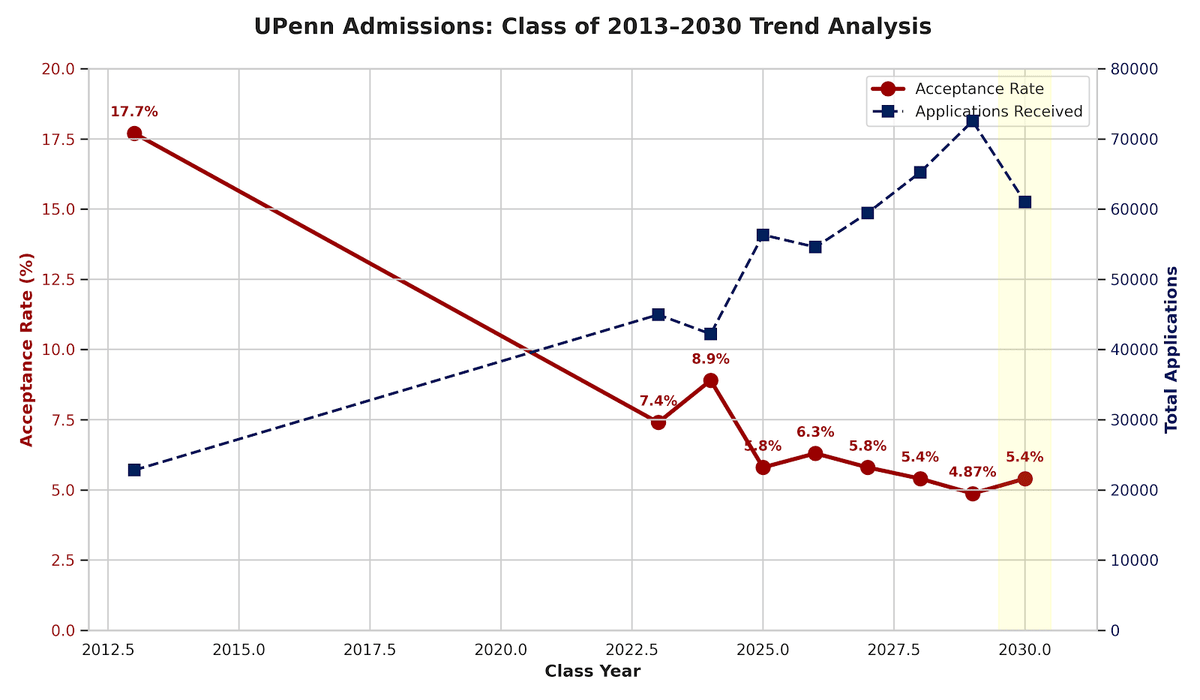
Key Updates & Observations:
- After a peak of over 72,000 applications for the Class of 2029, the volume for the Class of 2030 saw a correction down to approximately 61,000. This caused the acceptance rate to tick back up to 5.4% (matching the Class of 2028).
- The Class of 2029 remains the "most selective" year in university history, with a sub-5% rate (4.87%) driven by a massive surge in applications.
- Despite the volatility in application numbers (ranging from 42k to 72k in recent years), UPenn’s target class size remains remarkably consistent, hovering between 3,300 and 3,600 students admitted.
Penn Admissions Context
The return to a 5.4% acceptance rate suggests that while the "Ivy League fever" remains high, the extreme application spike of 2029 may have been an outlier rather than the new permanent floor. However, compared to the 17.7% rate for the Class of 2013, the university remains nearly 3.5x harder to get into than it was a decade ago.
Early Decision vs. Regular Decision Acceptance Rates
UPenn offers two application pathways with significantly different acceptance rates:
| Decision Plan | Applications | Admitted | Acceptance Rate |
|---|---|---|---|
| Early Decision (Class of 2030) | ~7,800 | Not Disclosed | Est. ~14 to 16% |
| Early Decision (Class of 2029) | ~9,500 | ~1,232 | ~13% |
| Regular Decision (Class of 2030) | ~53,200 | Not disclosed | Not disclosed |
| Overall (Class of 2030) | ~61,000 | ~3,523 | 5.4% |
Key change for Class of 2030: ED applications dropped from 9,500 to approximately 7,800 — an 18% decline. Penn has not disclosed the Class of 2030 ED acceptance rate. The estimated range of 14 to 16% is based on historical ED-to-total-class ratios. Penn stopped publishing detailed ED breakdowns after 2022.
Check Out: Early Action Vs Early Decision Vs Regular Decision – Explained
UPenn Acceptance Rate by School
UPenn comprises four undergraduate schools with varying selectivity:
| School | Approximate Acceptance Rate |
|---|---|
| Wharton School of Business | 4–5% |
| School of Engineering and Applied Science | 5–6% |
| College of Arts and Sciences | 5–6% |
| School of Nursing | 6–8% |
Wharton attracts the highest concentration of Indian applicants due to its global business reputation. Competition for Wharton admission is particularly intense for Indian students.
What the Class of 2030 Application Drop Means for Indian Students?
Penn received approximately 61,000 applications for the Class of 2030 — down from 72,544 for the Class of 2029. This is the largest single-year application decline at Penn in over a decade. The acceptance rate rose slightly from 4.87% to 5.4% as a result.
Two factors drove the drop.
- First, Penn's reinstatement of mandatory SAT/ACT testing deterred applicants who could not submit competitive scores.
- Second, broader uncertainty around US student visas and F-1 processing times reduced international applications in the 2025 to 2026 cycle.
For Indian students, this creates a marginally more favourable environment than the Class of 2029 cycle — but only marginally. The admitted class size remained essentially flat at approximately 3,523 students. The acceptance rate increase reflects fewer applicants, not more seats. Indian students should not interpret the 5.4% rate as meaningfully easier than 4.87%.
The more significant implication is the test score floor. With mandatory testing restored, the middle 50% SAT range of 1500 to 1560 is now a hard competitive benchmark rather than a soft one. Indian students scoring below 1480 on the SAT face a significantly steeper climb than they would have in the test-optional years of 2021 to 2024.
SAT and ACT Score Requirements for UPenn Admission
According to Penn Admissions' official data for the Class of 2029, the middle 50% of admitted students who submitted SAT scores scored between 1510 and 1560. Breaking this down by section:
| SAT Section | Middle 50% Range |
|---|---|
| Evidence-Based Reading & Writing | 730–770 |
| Math | 770–800 |
83% of admitted students scored 1500–1600, while only 1% scored below 1400. For Indian applicants, scoring in the 1500+ range significantly strengthens your profile.
Note: The above scores are from the Class of 2029 admitted profile — the last full cycle before mandatory testing was reinstated. Class of 2030 score data will be published by Penn in September 2026. The competitive benchmark is expected to remain in the 1500 to 1560 range or higher given the return to mandatory testing.
Middle 50% ACT Score Range (34–35)
For students submitting ACT scores:
| ACT Section | Middle 50% Range |
|---|---|
| Composite | 34–35 |
| English | 35–36 |
| Math | 33–36 |
| Reading | 34–36 |
| Science | 33–35 |
63% of admitted students scored 35–36 on the ACT composite, indicating that a 35+ is highly competitive.
Penn's SAT/ACT Requirement Is Back — What Indian Students Applying for Class of 2031 Must Know
Penn reinstated its mandatory SAT or ACT requirement in 2025 after a five-year test-optional period introduced during COVID-19.
- The Class of 2030 was the first cycle where test scores were required from all applicants.
- Penn was the sixth Ivy League school to restore mandatory testing, following Harvard, Brown, Yale, MIT and Dartmouth.
For Indian students applying for the Class of 2031 (applications due November 2026 for ED and January 2027 for RD), submitting SAT or ACT scores is now mandatory — not optional. The competitive benchmark based on Class of 2029 admitted student data remains SAT 1500 to 1560 (middle 50%) or ACT 34 to 35 (middle 50%).
One important nuance: Penn uses superscoring for both SAT and ACT. Indian students who have taken the test multiple times should submit all scores — Penn will combine your highest section scores across attempts. This policy directly benefits students who improved specific sections across test dates.
GPA Requirements and Academic Profile for Indian Students
While UPenn's minimum GPA is 3.25, this is rarely sufficient for admission. According to the Common Data Set:
- 36% of admitted students had a GPA of 3.75 and above
- 54% of admitted students had a perfect 4.0 GPA
Competitive Target: Aim for a 3.9–4.0 GPA to be competitive.
Percentage of Admitted Students by GPA Range
| GPA Range | Percentage of Admitted Students |
|---|---|
| 3.9–4.0 | 54% |
| 3.75–3.89 | 36% |
| 3.5–3.74 | 8% |
| Below 3.5 | 2% |
How Indian Board Exams (CBSE, ICSE) Are Evaluated?
UPenn evaluates Indian board transcripts by converting them to the US GPA scale. A student with 95% in CBSE/ICSE typically translates to a 4.0 GPA equivalent. However, UPenn also considers:
- School Profile: The rigor of your school (top CBSE/ICSE schools are well-recognised)
- Course Difficulty: AP, IB, or honours-level courses strengthen your profile
- Consistency: Upward grade trends are viewed favourably
Indian students from top schools (Delhi Public School, Cathedral School, etc.) have a slight advantage as admissions officers are familiar with these institutions' rigor.
UPenn Application Requirements and Deadlines
Early Decision applications are due November 1. If admitted, you are legally bound to attend UPenn and withdraw applications from other universities. This is binding even if financial aid is insufficient.
For Indian Students: ED applications require:
- Completed Common App or Coalition App
- School report and transcript
- Two teacher recommendations
- Personal essay and UPenn-specific essays
- SAT/ACT scores (mandatory from Class of 2030 onwards)
- Application fee: $75 USD (Rs. 7,066)
Regular Decision Deadline (January 5)
Regular Decision applications are due January 5, with admission decisions released in April. This pathway allows you to compare financial aid packages from multiple universities.
Timeline for Indian Students
Indian students should follow this 18-month roadmap:
| Timeline | Action Items |
|---|---|
| Month 1–3 | Take SAT/ACT; build extracurricular profile; identify recommenders |
| Month 4–6 | Request teacher recommendations; draft personal essay; research UPenn programs |
| Month 7–8 | Finalize essays; prepare transcripts and school report; gather documents |
| Month 9 | Submit Early Decision application (if applicable) |
| Month 10–11 | ED decision released; if rejected, prepare Regular Decision application |
| Month 12 | Submit Regular Decision application by January 5 |
| Month 13–14 | Receive admission decision (April); apply for F-1 visa |
| Month 15–18 | Complete visa interview; arrange accommodation; prepare for enrollment |
Critical Note: F-1 visa processing for Indian students typically takes 4–6 weeks. Plan accordingly if admitted.
Essays and Recommendation Letters: What UPenn Looks For
UPenn requires:
- Common App Personal Essay (650 words): Showcase your authentic voice and unique perspective
- Why UPenn Essay (250 words): Demonstrate genuine interest in specific programs, professors, or opportunities
- Additional Supplemental Essays (varies by school): Address school-specific prompts
For Indian Students: Avoid generic statements like "I want to study abroad" or "UPenn is prestigious." Instead, highlight:
- Specific research interests or professors
- How UPenn's interdisciplinary approach aligns with your goals
- Your contribution to UPenn's diverse community
Recommendation Letter Strategy
UPenn requires three letters of recommendation:
- School Counselor (mandatory)
- Teacher 1 (preferably in a core subject: Math, Science, English, or Social Studies)
- Teacher 2 or Non-Academic Recommender (coach, research mentor, employer)
For Indian Students: Request recommendations 4–6 weeks before the deadline. Provide recommenders with:
- Your CV/resume
- A brief note on why you chose them
- Key achievements or qualities you'd like highlighted
- Submission deadline
International Student at UPenn (15% of Class)
For Fall 2025, 17,882 international students applied to UPenn's undergraduate programs. Only 441 (2.5%) received admission offers — making the international acceptance rate less than half the overall 5.4% rate. International students make up 13% of UPenn's first-year class, with 35% of enrolled international students coming from Asia, making it the largest regional group. India is among the top source countries within this cohort.
F-1 Visa Requirements and Timeline for Indians
After admission, Indian students must:
- Receive I-20 Form from UPenn (issued after enrollment deposit)
- Pay SEVIS Fee ($350 USD / Rs. 32,974)
- Schedule Visa Interview at US Embassy in India (Delhi, Mumbai, Bangalore, Hyderabad, Chennai, Kolkata)
- Attend Interview with required documents (passport, I-20, financial proof, admission letter)
- Receive Visa Approval (typically 1–2 weeks after interview)
Timeline: 4–6 weeks from I-20 receipt to visa approval. Plan accordingly if admitted in April.
Cost of Attendance in USD and INR
The following table shows the official cost of attendance at UPenn with Conversion: 1 USD = Rs. 94.21.
| Expense Category | USD (Annual) | INR (Annual) |
|---|---|---|
| Tuition and Fees | $68,686 | Rs. 64.72 lakh |
| Room and Board | $19,174 | Rs. 18.07 lakh |
| Books and Supplies | $1,500 | Rs. 1.41 lakh |
| Personal Expenses | $2,500 | Rs. 2.35 lakh |
| Total (Estimated) | ~$91,860 | ~Rs. 86.55 lakh |
Indian Student Experiences: Reddit Insights and Real Stories
Indian students who get into the University of Pennsylvania (UPenn) typically stand out with a combination of exceptional academics, meaningful extracurricular impact, and highly tailored application essays.
- Many successful applicants report near-perfect GPAs, 1550+ SAT scores, leadership roles, research experience, or entrepreneurial ventures with real social impact.
- Essays—especially the “Why UPenn” response are often described as a decisive factor, with students emphasizing alignment with specific professors or programs.
- Post-graduation outcomes are particularly strong, with many Indian graduates securing roles in top tech, finance, and consulting firms.
Key Takeaways:
- Strong academics are expected, but impact and leadership make the difference.
- A specific, well-researched “Why UPenn” essay is critical.
- Recommendation letters may require proactive guidance in Indian schools.
- Financial planning (aid + loans) is a common part of the process.
- Large Indian community and strong alumni network support long-term success.
Comparison: UPenn vs. Other Ivy League Schools for Indian Students
UPenn's overall acceptance rate of 5.4% for Class of 2030 is slightly higher than Harvard, Yale, and Princeton, making it marginally more accessible among the Ivies. However, the international acceptance rate of 2.5% remains highly competitive across all schools.
| University | Overall Acceptance Rate | International Acceptance Rate | Source |
|---|---|---|---|
| Harvard | 3.6% | ~1.8% | Harvard CDS 2024–25 |
| Princeton | 3.7% | ~2.0% | Princeton CDS 2024–25 |
| Yale | 3.7% | ~2.1% | Yale CDS 2024–25 |
| Columbia | 3.9% | ~2.0% | Columbia CDS 2024–25 |
| UPenn | 5.4% | 2.5% | Penn Today, March 2026 |
| Dartmouth | 5.3% | ~2.5% | Dartmouth CDS 2024–25 |
| Brown | 5.5% | ~3.0% | Brown CDS 2024–25 |
| Cornell | 8.0% | ~4.2% | Cornell CDS 2024–25 |
International acceptance rates for non-UPenn schools are estimates based on available CDS data. UPenn international rate is official (upenn.edu/about/facts).
Why Indian Students Choose UPenn
- Wharton's Global Reputation: Ranked #1 in business programs globally
- Interdisciplinary Approach: Unique dual-degree programs (Huntsman, Fisher, Vagelos)
- Strong Alumni Network in India: Extensive connections in tech, finance, and entrepreneurship
- Philadelphia Location: Vibrant city with lower cost of living than Boston or New York
- Diverse Student Body: 35% of international students from South Asia
Tips to Increase Your Chances of Admission to UPenn
Some important tips for Indian students to get admission in University of Pennsylvania include:
Build a Strong Academic Profile (GPA, Course Rigor)
- Maintain a 3.9–4.0 GPA in the most challenging courses available
- Take 12+ AP/IB courses across your high school career
- Excel in STEM courses (especially for Engineering or Wharton)
- Ensure consistent upward grade trends
Prepare Strategically for SAT/ACT
- Target 1500+ SAT or 35+ ACT
- Take the test 2–3 times to achieve competitive scores
- Use superscoring to your advantage
- Consider test prep courses (₹20,000–₹1,00,000 in India)
Develop Meaningful Extracurriculars (Not a Checklist)
- Focus on depth over breadth
- Aim for at least one Tier 1 activity (competition win, published research, social impact)
- Show consistent commitment over 3–4 years
- Demonstrate leadership progression (member → captain → founder)
Write Compelling Essays That Show Self-Awareness
- Personal Essay: Reveal your authentic voice; avoid clichés
- Why UPenn Essay: Be specific; mention professors, programs, or opportunities
- Supplemental Essays: Address school-specific prompts directly
- Avoid Generic Statements: "I want to study abroad" or "UPenn is prestigious" won't work
Secure Strong Recommendation Letters
- Choose recommenders who know you well and can speak to your character
- Provide them with context about UPenn and your goals
- Request letters 4–6 weeks before the deadline
- Follow up politely to ensure timely submission
Apply Early Decision if UPenn is Your First Choice
- ED acceptance rate (13.6%) is 4 times higher than RD (3.7%)
- Only apply ED if you're certain about UPenn and can afford it
- Ensure your financial situation is stable (no need for aid negotiation)
Demonstrate Genuine Interest in UPenn (Why UPenn Essay)
- Research specific programs, professors, or opportunities
- Mention unique aspects of UPenn (Huntsman Program, SEAS, Wharton)
- Connect your goals to UPenn's resources
- Show you've done your homework
UPenn's 5.4% acceptance rate for the Class of 2030 reflects its position as one of the world's most selective universities. For Indian students, the approximately 2.5% international acceptance rate demands exceptional academic credentials, distinctive extracurricular achievements and authentic essays that reveal your unique perspective.
Frequently Asked Questions About UPenn Acceptance Rate
Ques. What is UPenn's acceptance rate for Indian students?
Ans. UPenn's overall acceptance rate for the Class of 2030 is 5.4% — approximately 3,523 students admitted from over 61,000 applications, based on Penn's March 2026 admissions announcement. The international acceptance rate is approximately 2.5% — based on Class of 2029 data (the last year Penn published detailed international breakdowns), only 441 international students were admitted from 17,882 international applicants. For Indian students specifically, the acceptance rate is estimated at 2 to 3%. India is among the top source countries within UPenn's international student body, which comprises 13% of the first-year class.
Ques. Can I apply to multiple UPenn schools?
Ans. No. You can apply to only one UPenn school per application cycle. Choose carefully between Wharton, Engineering, Arts & Sciences, or Nursing based on your interests and strengths.
Ques. Do Indian board exams (CBSE/ICSE) affect my chances?
Ans. UPenn evaluates Indian board transcripts by converting them to the US GPA scale. A 95% in CBSE/ICSE typically translates to a 4.0 GPA equivalent. UPenn also considers your school's profile and course rigor. Students from top schools (DPS, Cathedral, etc.) have a slight advantage as admissions officers are familiar with these institutions.






interested in this College ?
Follow & Share this college to get information about admission.



Comments