



| KdTvCV - Jun 9, 2026
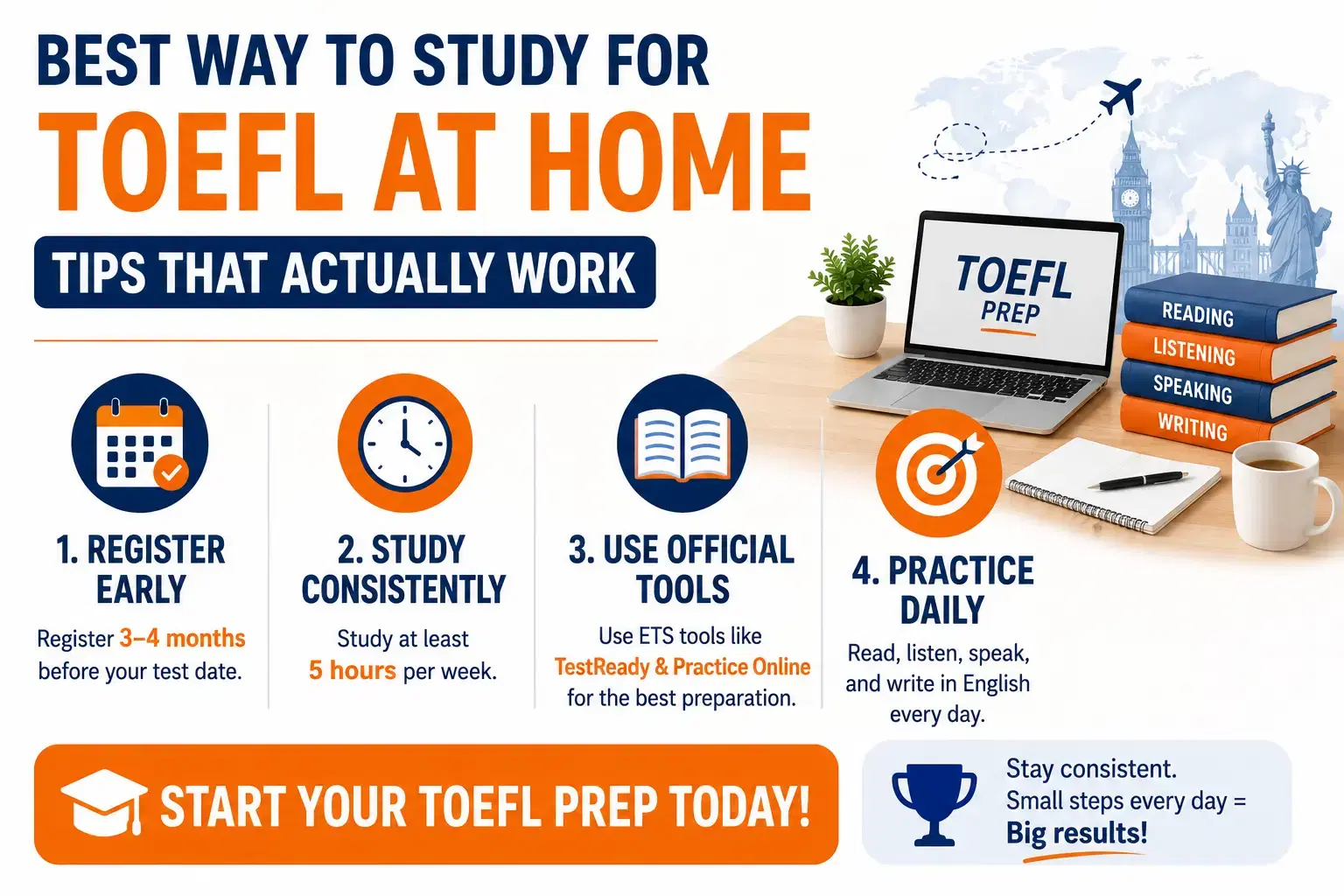
TOEFL iBT preparation at home is possible with the right plan. The test has 4 sections: Reading, Listening, Speaking, and Writing. It takes about 2 hours to complete. ETS recommends registering 3-4 months before your test date. Studying at least 5 hours per week is advised. Official tools like TOEFL TestReady and TOEFL Practice Online can help you prepare section by section, track progress, and build confidence before test day.
Understand the TOEFL iBT Test Format First
Before you start studying, know what you are preparing for. The TOEFL iBT test pattern has 4 sections, each testing a different skill.
Here is a quick breakdown:
- Reading: Read passages and answer questions about the content.
- Listening: Listen to lectures and classroom discussions, then answer questions.
- Speaking: Talk about a familiar topic; discuss what you read or heard.
- Writing: Read a passage, listen to a recording, and write a response.
The total test time is about 90 minutes. Plan for 2 hours, including the check-in process.
Also Check: TOEFL iBT Full Syllabus for 2026
Register 3-4 Months Before Your Test Date
Giving yourself enough time is one of the most important steps. ETS officially advises registering for the TOEFL 3 to 4 months before your planned test date.
This gives you:
- Enough time to find a test slot that fits your schedule.
- Time to study without rushing.
- Room to take TOEFL mock tests and review weak areas.
Do not wait until the last minute to register. Test slots fill up fast, especially in cities with high demand.
Related Articles:
Build a Weekly Study Schedule
A TOEFL study schedule keeps your preparation on track. ETS recommends studying at least 5 hours per week in the weeks leading up to your test.
Follow these tips when making your schedule:
- Spread study time across multiple days — do not cram everything in one day.
- Assign each session a specific section — Reading on Monday, Listening on Wednesday, etc.
- Prioritise your weak areas — spend more time on sections you find difficult.
Tip: Study at the same time of day you plan to take your exam. As your test date gets closer, practise in the same room where you will take the test.
Also Read
Set Up a Distraction-Free Study Space
Your study environment matters. A clean, organised space helps you focus better.
Keep these things in mind:
- Keep all study materials within easy reach.
- Keep water nearby to stay hydrated.
- Play soft, relaxing music if it helps you focus — or study in silence if that works better.
Find what works for you and stick to it.
Use Official TOEFL Prep Tools
ETS offers official TOEFL preparation resources that are built to match the real test. These are the most reliable tools for home preparation.
Here are the key options:
- TOEFL TestReady: A personalised, interactive platform with practice exercises, mock tests, and progress tracking. It is free to use.
- TOEFL Practice Online: Full-length mock tests with real scoring. Starts at
- USD 49 for 1 test (INR 4,700)
- USD 99 for 3 tests (Trio pack) (INR 9,500)
- USD 179 for 6 tests (Six Pack) (INR 17,100)
- Official TOEFL iBT Prep Course: A self-paced online course with lessons and activities, priced at USD 149 (approx. 14,240 INR).
- TOEFL iBT® Readiness Pack: Combines the Official Guide with a full mock test, priced at USD 69 (approx. 6,600 INR).
- Free Full-Length Practice Tests: 2 free full-length practice tests are available on the ETS website.
According to ETS, among students who used official TOEFL preparation:
- 90% felt more prepared for test day.
- 86% were better able to show their English skills.
- 82% felt less anxious.
(Source: Survey of 315 users across the US, India, China, and Japan)
Also Check:
How to Practise TOEFL Reading and Writing at Home?
This section covers simple daily habits to improve your TOEFL Reading and Writing skills.
Read every day — even outside study hours
- Read college-level textbooks, news articles, and magazines in English.
- Read topics that interest you, like food, sports, health, technology, etc.
Summarise what you read
- After reading a long passage, write a short summary of the main points.
- Then add supporting details.
- Check for spelling and grammar errors.
Keep a Word Journal
- Write down new or difficult words.
- Note the meaning, spelling, and how to use each word in a sentence.
- Make flashcards and quiz yourself regularly.
Also Check:
How to Practise Speaking and Listening at Home
This section covers daily habits to improve your Speaking and Listening skills.
Talk in English as much as possible
- Have conversations with English-speaking friends or family.
- If no one is nearby, use phone or video calls.
- Talk about everyday topics — your day, your goals, university plans.
Listen to English recordings daily
- Listen to podcasts, YouTube videos, English TV shows, and lectures.
- You can do this while doing household tasks — no dedicated study time needed.
- After listening, write down the main points and key details you remember.
Many recordings are completely free online. Make the most of them.
Also Check:
Studying for the TOEFL at home is fully doable with a structured plan. Register 3–4 months early, study at least 5 hours a week, and use official ETS tools like TOEFL TestReady and TOEFL Practice Online for the most accurate preparation. Focus on daily reading, listening, and speaking habits — these small steps add up over time.
FAQs
Ques. Can I take the TOEFL iBT from home in India?
Ans. Yes. The TOEFL iBT Home Edition is available in India. It is the same test as the test centre version — same format, same scoring, same acceptance by universities.
Ques. Is TOEFL TestReady free to use?
Ans. Yes. TOEFL TestReady is a free, personalised prep platform by ETS. It includes practice exercises and mock tests. You can access it through the official ETS website.
Ques. How many times can I take the TOEFL iBT?
Ans. You can take the TOEFL iBT once every 3 days, up to 5 times in a 12-month period. This gives Indian students multiple chances to improve their score.
Ques. Are there free practice tests available for TOEFL?
Ans. Yes. ETS offers 2 free full-length practice tests on its official website. These help you get familiar with the test structure before the actual exam.
Ques. What is a good TOEFL score for Indian students applying abroad?
Ans. Most top universities require a score of 90-100+ (4.5-5.0 in the new scale) out of 120. Some programmes, especially in the US, UK, and Canada, may require 100 or above. Always check the specific score requirement of your target university.


1787567517.png?tr=w-305,h-145,c-force?h=175&w=350&mode=stretch)



Comments