



Study Abroad Content Specialist | Updated On - Jul 19, 2026
MBBS in South Korea for Indian students is offered as a 6-year MD (Doctor of Medicine) degree. South Korea does not use the term "MBBS" — the equivalent degree is called MD. It is structured as 2 years Pre-Medicine followed by 4 years Medicine. All programs are taught entirely in Korean. Indian students must achieve TOPIK Level 3 for admission and Level 5 to 6 for clinical years.
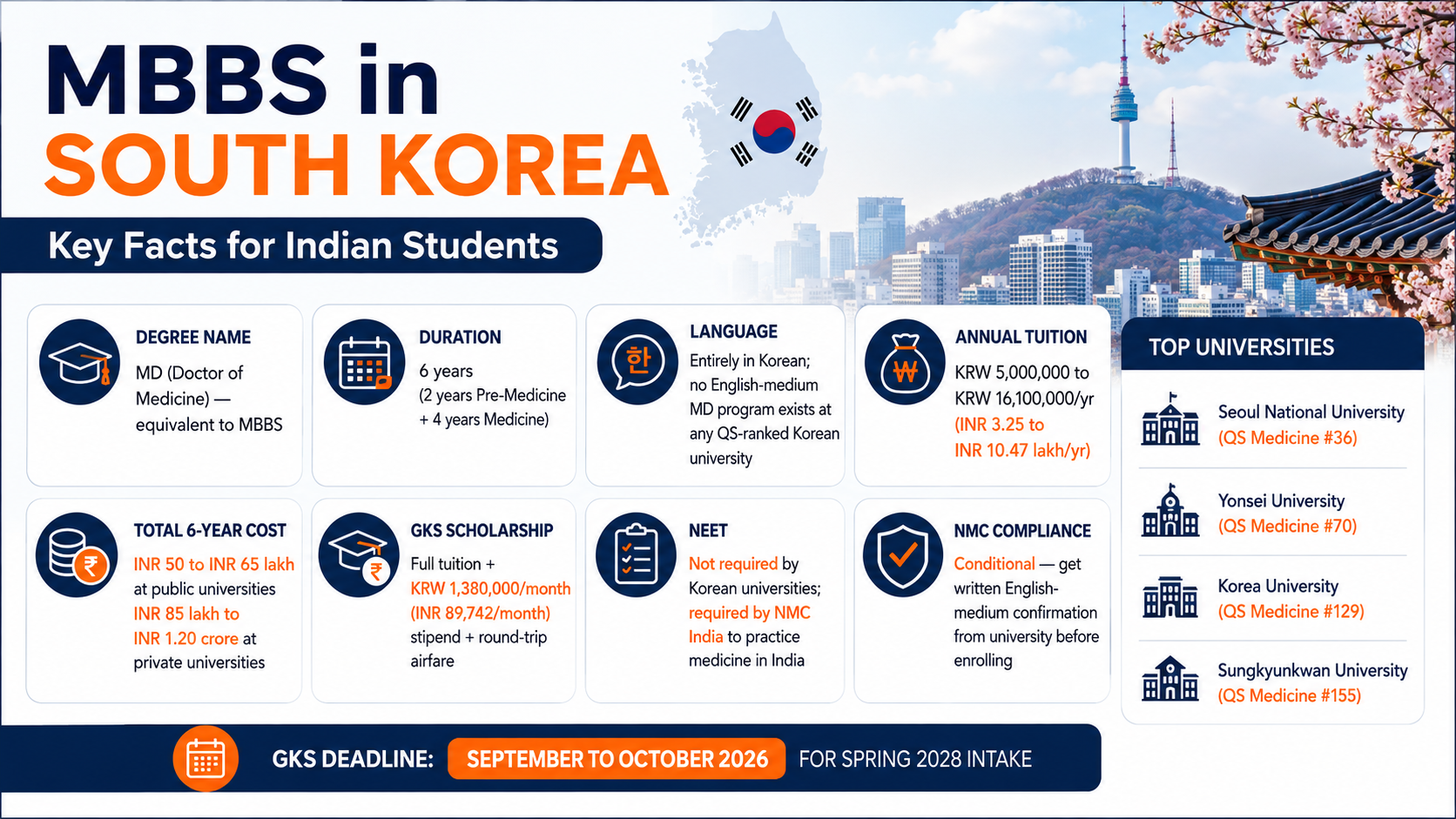
Here are the key facts before you apply:
- Degree name: MD (Doctor of Medicine) — equivalent to MBBS
- Duration: 6 years (2 years Pre-Medicine + 4 years Medicine)
- Language: Entirely in Korean; no English-medium MD program exists at any QS-ranked Korean university
- Annual tuition: KRW 5,000,000 to KRW 16,100,000/yr (INR 3.25 to INR 10.47 lakh/yr)
- Total 6-year cost: INR 50 to INR 65 lakh at public universities; INR 85 lakh to INR 1.20 crore at private universities
- GKS Scholarship: Full tuition + KRW 1,380,000/month (INR 89,742/month) stipend + round-trip airfare
- NEET: Not required by Korean universities; required by NMC India to practice medicine in India
- NMC compliance: Conditional — get written English-medium confirmation from university before enrolling
- Top universities: SNU (QS Medicine #36), Yonsei (QS #70), Korea University (QS #129), SKKU (QS #155)
- GKS deadline: September to October 2026 for Spring 2028 intake
Latest Updates — August 2026
Indian students in August 2026 are at the right starting point for the GKS Scholarship for Spring 2028 intake. The GKS application window opens in September to October 2026.
Key actions right now:
- Start Korean immediately: Enroll in Korean language classes now. Target TOPIK Level 2 to 3 by September 2026. Use Korean Cultural Center India, private tutors, or apps like TTMIK and Duolingo.
- Appear for NEET: Indian students must have a valid NEET score to comply with NMC FMGL 2021. Without NEET, you cannot appear for FMGE or NExT in India after graduation.
- Apply for GKS (September to October 2026): Apply via the Embassy Track at the Embassy of Korea in New Delhi. Apply to 3 universities — SNU (Type A) + Yonsei (Type A) + KNU (Type B) is the strongest combination.
- Apostille documents: Get Class 10 and 12 marksheets apostilled from MEA, New Delhi by September 2026.
- NMC compliance check: Before paying any deposit, get a written letter from the university confirming the program is English-medium. If they cannot provide this, the degree may not qualify for FMGE or NExT in India.
All fees are converted at KRW 1 = INR 0.065 and USD 1 = INR 96.29 (July 2026).
- Why Study MBBS in South Korea?
- Top Universities for MBBS in South Korea
- MBBS in South Korea Fees
- MBBS in South Korea Requirements
- MBBS in South Korea Intakes and Application Deadlines
- Cost of Living for MBBS Students in South Korea
- Scholarships for MBBS in South Korea
- Jobs and Salary After MBBS in South Korea
- NMC Recognition and FMGE for South Korea MD
- MBBS in South Korea vs Other Countries
- FAQs
Why Study MBBS in South Korea?
South Korea offers a unique combination of world-class medical education, affordable public university fees, and the fully funded GKS Scholarship. No other MBBS destination offers a #36 globally ranked medical school at INR 3.92 lakh/yr in tuition.
Key reasons to consider South Korea:
- World-class ranking: SNU is ranked #36 globally in Medicine — higher than any medical school in Russia, Philippines, Georgia, or China
- Affordable public universities: KNU, PNU, and CNU charge only INR 3.25 to INR 4.55 lakh/yr — lower than most Indian private medical colleges
- GKS Scholarship: Full tuition + INR 89,742/month stipend + airfare — effectively free education with a living allowance
- Advanced healthcare system: Clinical training at hospitals like Samsung Medical Center (SKKU), Severance Hospital (Yonsei), and Seoul National University Hospital
- Safe country: South Korea is consistently ranked among the safest countries in the world
- Global recognition: Korean MD from SNU or Yonsei is recognised for USMLE (USA) and PLAB (UK)
Honest limitations for Indian students:
- All clinical years are in Korean — TOPIK Level 5 to 6 required
- NMC compliance is conditional — written English-medium confirmation required
- Only 1 in 3 international graduates pass the Korean Medical Licensing Exam
- GKS Medicine seats are extremely limited — India gets approximately 5 to 10 seats per year across all fields
Top Universities for MBBS in South Korea
South Korea has 10 QS-ranked universities offering a 6-year MD program open to international students. All programs are taught entirely in Korean. Public national universities are significantly cheaper than private universities.
| University | Location | QS Rank (Medicine 2026) |
|---|---|---|
| Seoul National University | Seoul | #36 |
| Yonsei University | Seoul | #70 |
| Korea University | Seoul | #129 |
| Sungkyunkwan University (SKKU) | Seoul | #155 |
| The Catholic University of Korea | Gyeonggi | #251 to #300 |
| Hanyang University | Seoul | #251 to #300 |
| Kyung Hee University | Seoul | #351 to #400 |
| Kyungpook National University | Daegu | #601 to #650 |
| Pusan National University | Busan | #601 to #650 |
| Chungnam National University | Daejeon | #701 to #850 |
Key points to note:
- SNU is ranked #36 globally in Medicine and charges only KRW 6,034,163/yr (INR 3.92 lakh/yr) — one of the most affordable top-ranked medical schools in the world
- SKKU is affiliated with Samsung Medical Center — one of Asia's leading hospitals
- Public universities (KNU, PNU, CNU) are the most affordable and accessible for Indian students
- Harvard, MIT, and other Western universities do not offer comparable rankings at this price point
Student Insight
According to Reddit discussions, Indian students recommend applying to a mix of Type A (SNU, Yonsei) and Type B (KNU, PNU) universities in the GKS application. This maximises admission chances while keeping options open across price ranges.
MBBS in South Korea Requirements
No GRE or GMAT is required at any Korean university. TOPIK is the primary eligibility requirement and the single biggest barrier for Indian students. Indian students must also have a valid NEET score to comply with NMC FMGL 2021 guidelines.
| University | Class 12 PCB | TOPIK | Interview |
|---|---|---|---|
| Seoul National University | Min. 80%+ | Level 3 for admission; Level 5 to 6 for clinical | Yes |
| Yonsei University | Min. 80%+ | Level 3 for Pre-Med; Level 4 to 5 for Medical school | Yes |
| Korea University | Min. 80%+ | Level 3 minimum; Level 5 for clinical | Yes |
| Sungkyunkwan University | Min. 75%+ | Level 3 minimum | Yes |
| Catholic University of Korea | Min. 70%+ | Level 3 (50% scholarship); Level 5 (100% scholarship) | Yes |
| Hanyang University | Min. 75%+ | Level 3 minimum | Yes |
| Kyung Hee University | Min. 70%+ | Level 3 minimum | Yes |
| Kyungpook National University | Min. 70%+ | Level 3 minimum | Yes |
| Pusan National University | Min. 70%+ | Level 3 minimum | Yes |
| Chungnam National University | Min. 70%+ | Level 3 minimum | Yes |
The Korean Language Requirement (TOPIK)
TOPIK has 6 levels — Level 1 to 2 (Beginner), Level 3 to 4 (Intermediate), Level 5 to 6 (Advanced). Korean is classified as a Category IV language by the US Foreign Service Institute — one of the hardest languages for English speakers to learn.
| Stage | TOPIK Level Required | Study Time from Zero |
|---|---|---|
| University Admission | Level 3 minimum | 18 to 24 months |
| Pre-Medical Years (Years 1 to 2) | Level 3 to 4 | Achieved during GKS language training |
| Medical School Entry (Year 3) | Level 4 to 5 | By end of Year 2 |
| Clinical Rotations (Years 5 to 6) | Level 5 to 6 | By Year 4 to 5 |
Key facts about TOPIK in India:
- TOPIK is held 3 to 4 times per year in India (April, July, October, November)
- Test centers are at Korean Cultural Centers and designated venues
- Register at topik.go.kr
- GKS Scholarship includes 1 year of free Korean language training in Korea before the MD program begins
Documents Required
- Class 10 and 12 marksheets (apostilled from MEA, New Delhi)
- TOPIK score certificate (Level 3 minimum)
- Valid NEET scorecard (for NMC compliance)
- Statement of Purpose (600 to 800 words)
- 2 Letters of Recommendation from PCB teachers
- Valid Indian passport (minimum 18 months validity)
- Bank statement showing minimum KRW 20,000,000 (INR 1.30 lakh) for D-2 visa
- Medical fitness certificate and TB test result (mandatory for Indian applicants)
Student Insight
According to Reddit discussions, Indian students who start Korean from Class 11 are significantly better positioned than those who start after Class 12. One student noted: "Korean students shed blood, sweat and tears to get into medical school — basic Korean is not enough."
MBBS in South Korea Intakes and Application Deadlines
All 10 Korean medical universities admit students for Spring (March) intake only. There is no Fall intake for MD programs. The GKS application window opens in September to October 2026 for Spring 2028 intake.
| Route | Application Period | Korean Language Training | MD Program Starts |
|---|---|---|---|
| GKS Scholarship (Embassy Track) | September to October 2026 | March 2027 (1 year, fully funded) | March 2028 |
| GKS Scholarship (University Track) | September to October 2026 | March 2027 (1 year, fully funded) | March 2028 |
| Self-funded (TOPIK Level 3 achieved) | October to November 2026 | Not required | March 2027 |
Key points about the D-2 Student Visa:
- Visa type: D-2-2 (Bachelor's Degree Program)
- Visa fee: USD 60 (INR 5,777)
- Processing time: 5 to 10 working days
- Work rights: Up to 20 hours/week during semesters; full-time during vacations
- TB test: Mandatory for Indian applicants
- Financial proof: Minimum KRW 20,000,000 (INR 1.30 lakh) in bank statement
- Apply at: Embassy of Korea in New Delhi, or Consulate General in Mumbai or Chennai
Student Insight
According to Reddit discussions, Indian students who applied for GKS recommend submitting as early as possible within the September to October window. Even a TOPIK Level 1 to 2 score at the time of application strengthens the profile significantly.
MBBS in South Korea Fees
Annual tuition at public universities ranges from KRW 5,000,000 to KRW 7,000,000/yr (INR 3.25 to INR 4.55 lakh/yr). Private universities charge KRW 10,400,000 to KRW 16,100,000/yr (INR 6.76 to INR 10.47 lakh/yr). With the GKS Scholarship, tuition is zero at all 10 universities.
| University | Type | Annual Tuition (KRW) | Annual Tuition (INR) | Total 6-Year Tuition (INR) |
|---|---|---|---|---|
| Seoul National University | Public | KRW 6,034,163 | INR 3.92 lakh | INR 23.53 lakh |
| Yonsei University | Private | KRW 14,710,000 to KRW 15,138,000 | INR 9.56 to INR 9.84 lakh | INR 57.37 to INR 59.04 lakh |
| Korea University | Private | KRW 11,110,000 to KRW 14,000,000 | INR 7.22 to INR 9.10 lakh | INR 43.33 to INR 54.60 lakh |
| Sungkyunkwan University (SKKU) | Private | KRW 10,400,000 to KRW 16,200,000 | INR 6.76 to INR 10.53 lakh | INR 40.56 to INR 63.18 lakh |
| Catholic University of Korea | Private | KRW 16,100,000 | INR 10.47 lakh | INR 62.79 lakh |
| Hanyang University | Private | KRW 11,000,000 to KRW 14,000,000 | INR 7.15 to INR 9.10 lakh | INR 42.90 to INR 54.60 lakh |
| Kyung Hee University | Private | KRW 9,900,000 to KRW 15,900,000 | INR 6.44 to INR 10.34 lakh | INR 38.61 to INR 62.01 lakh |
| Kyungpook National University | Public | KRW 5,000,000 to KRW 7,000,000 | INR 3.25 to INR 4.55 lakh | INR 19.50 to INR 27.30 lakh |
| Pusan National University | Public | KRW 5,000,000 to KRW 7,000,000 | INR 3.25 to INR 4.55 lakh | INR 19.50 to INR 27.30 lakh |
| Chungnam National University | Public | KRW 5,000,000 to KRW 7,000,000 | INR 3.25 to INR 4.55 lakh | INR 19.50 to INR 27.30 lakh |
Key points:
- KNU, PNU, and CNU are the most affordable at INR 3.25 to INR 4.55 lakh/yr
- Even without GKS, public university tuition is lower than most Indian private medical colleges
- GKS Scholarship makes tuition zero at all 10 universities
- Currency: KRW 1 = INR 0.065 (July 2026)
Student Insight
According to Quora discussions, Indian students note that even without GKS, public university tuition at KNU or PNU is lower than most Indian private medical colleges. The GKS stipend of INR 89,742/month comfortably covers living costs in non-Seoul cities.
Cost of Living for MBBS Students in South Korea
Seoul is the most expensive city at KRW 850,000 to KRW 1,300,000/month (INR 55,250 to INR 84,500/month). Non-Seoul cities like Daegu, Busan, and Daejeon are 20 to 30% cheaper. South Korea's cost of living is significantly lower than the UK, USA, or Australia.
| City | University | Monthly Cost (KRW) | Monthly Cost (INR) | Annual Cost (INR) |
|---|---|---|---|---|
| Seoul | SNU, Yonsei, Korea University, SKKU, Hanyang, Kyung Hee | KRW 850,000 to KRW 1,300,000 | INR 55,250 to INR 84,500 | INR 6.63 to INR 10.14 lakh |
| Gyeonggi (Bucheon) | Catholic University of Korea | KRW 710,000 to KRW 1,110,000 | INR 46,150 to INR 72,150 | INR 5.54 to INR 8.66 lakh |
| Daegu | Kyungpook National University | KRW 570,000 to KRW 970,000 | INR 37,050 to INR 63,050 | INR 4.45 to INR 7.57 lakh |
| Busan | Pusan National University | KRW 570,000 to KRW 970,000 | INR 37,050 to INR 63,050 | INR 4.45 to INR 7.57 lakh |
| Daejeon | Chungnam National University | KRW 570,000 to KRW 970,000 | INR 37,050 to INR 63,050 | INR 4.45 to INR 7.57 lakh |
Additional cost facts:
- University cafeteria meal: KRW 5,000 to KRW 15,000 (INR 325 to INR 975)
- Seoul monthly public transport pass: KRW 61,300 (INR 3,985)
- National Health Insurance (NHIS): KRW 80,000 to KRW 100,000/month (INR 5,200 to INR 6,500/month)
- GKS stipend of KRW 1,380,000/month (INR 89,742/month) covers all living costs in non-Seoul cities
Student Insight
According to Quora discussions, Indian students at KNU and PNU highlight Daegu and Busan as the most affordable cities. Monthly costs of INR 37,050 to INR 63,050 mean the GKS stipend covers all expenses with savings left over.
Scholarships for MBBS in South Korea
The GKS (Global Korea Scholarship) is the most important scholarship for Indian students. It covers full tuition, monthly stipend, airfare, and 1 year of Korean language training. The GKS application window opens in September to October 2026 — this is the most time-sensitive action for Indian students right now.
| Scholarship | Offered By | Value (INR) | Eligibility | Deadline |
|---|---|---|---|---|
| GKS (Global Korea Scholarship) | Korean Government (NIIED) | Full tuition + INR 89,742/month + airfare + INR 13,000 one-time | Under 25 years; 80%+ in Class 12; Indian passport; both parents non-Korean | September to October 2026 |
| SNU International Student Scholarship | Seoul National University | Full tuition (up to 8 semesters) + INR 58,500/month | International students at SNU; academic excellence | At admission |
| Yonsei University International Scholarship | Yonsei University | 30 to 100% tuition waiver | International students; academic performance | At admission |
| Catholic University Freshman Scholarship | Catholic University of Korea | TOPIK 5: 100% tuition Year 1; TOPIK 3: 50% tuition Year 1 | International freshmen with TOPIK 3 or above | At admission |
| University Merit Scholarships | All 10 universities | 30 to 100% tuition waiver | International students with GPA 3.5+/4.5 | Each semester |
| Inlaks Shivdasani Foundation | Inlaks (India) | Up to INR 1.16 crore total | Indian passport holders; top global universities | April 2027 |
GKS full benefits package:
- Full tuition for all 6 years of MD program
- KRW 1,380,000/month (INR 89,742/month) living stipend
- Round-trip economy class airfare (India to Korea)
- KRW 200,000 (INR 13,000) one-time settlement allowance on arrival
- 1 year of Korean language training (fully funded)
- Medical insurance coverage
- India receives approximately 5 to 10 GKS undergraduate seats per year across all fields — Medicine seats are extremely limited
Student Insight
According to Reddit discussions, Indian students who received GKS had TOPIK Level 1 to 2 at application time, 85%+ in Class 12, and a strong personal statement focused on research interest in Korean medicine.
Jobs and Salary After MBBS in South Korea
South Korea has one of the most advanced healthcare systems in the world. Korean doctors are among the highest-paid professionals in the country. However, practicing medicine in South Korea as a foreign graduate is difficult — it requires passing the Korean Medical Licensing Exam (KMLE) with TOPIK Level 4 minimum. As of 2023, only 1 in 3 international medical graduates who applied for Korean licensure succeeded.
Doctor Salaries in South Korea
| Job Role | Average Annual Salary (KRW) | Average Annual Salary (INR) |
|---|---|---|
| Junior Doctor (Intern/Resident) | KRW 35,000,000 | INR 22.75 lakh |
| Medical Doctor (General, Average) | KRW 1,04,898,900 | INR 68.18 lakh |
| Physician (General) | KRW 1,18,931,019 | INR 77.31 lakh |
| Senior/Specialist Doctor | KRW 3,01,000,000+ | INR 1.96 crore+ |
Career Pathways for Indian MD Graduates
| Career Path | Feasibility | Requirements |
|---|---|---|
| Practice in India | Possible | Pass FMGE or NExT + 1-year CRMI + State Medical Council registration |
| Practice in South Korea | Difficult | KMLE + TOPIK Level 4 minimum; only 1 in 3 international graduates succeed |
| Practice in USA | Possible | USMLE; ECFMG-recognised universities only (SNU and Yonsei qualify) |
| Practice in UK | Possible | PLAB 1 + PLAB 2 |
| Research and Academia in Korea | Good | Korean universities actively recruit international researchers |
NMC Compliance Warning: NMC FMGL 2021 requires the program to be taught in English. South Korea's clinical years (Years 3 to 6) are in Korean. Before paying any deposit, get written confirmation from the university that the program is English-medium. Without this letter, the degree may not qualify for FMGE or NExT in India. Always verify at nmc.org.in before enrolling.
Student Insight
According to Reddit discussions, Indian students who returned to India after the Korean MD note that maintaining strong English medical knowledge alongside Korean studies is critical for FMGE or NExT performance.
NMC Recognition and FMGE for South Korea MD
This is the most critical section for Indian students planning to practice medicine in India. NMC FMGL 2021 sets four mandatory conditions. South Korea satisfies three of the four — the English-medium requirement is the key risk point.
| NMC Requirement | South Korea Status |
|---|---|
| University listed in WHO WDOMS | Met |
| Minimum 54 months of academic instruction | Met |
| 12-month internship at same institution | Met |
| English medium of instruction | Risk — clinical years are in Korean; written confirmation required |
| NEET qualifying score before enrollment | Required |
| FMGE or NExT after returning to India | Required |
| 12-month CRMI in India | Required |
Practical pathway for Indian students:
- Class 12 (India) with PCB
- Appear for NEET (mandatory for NMC compliance)
- Achieve TOPIK Level 3
- Complete 6-year Korean MD program
- Complete 1-year internship in Korea
- Return to India
- Pass FMGE or NExT exam
- Complete 1-year Compulsory Rotatory Internship (CRI) in India
- Register with State Medical Council
- Practice medicine in India
MBBS in South Korea vs Other Countries
South Korea offers world-class rankings (SNU #36 globally in Medicine) and affordable public university fees. However, the Korean language barrier and NMC compliance risk make it more complex than Georgia or Nepal for students focused on practicing in India.
| Factor | South Korea | Russia | Philippines | Georgia | China |
|---|---|---|---|---|---|
| Degree | MD (6 years) | MD (6 years) | MD (5 years) | MD (6 years) | MBBS (5 to 6 years) |
| Language | Korean only | Russian (some English) | English | English | Chinese (some English) |
| Annual Tuition | INR 3.25 to INR 10.47 lakh | INR 2.50 to INR 6.70 lakh | INR 2.50 to INR 5.00 lakh | INR 3.72 to INR 7.45 lakh | INR 2.50 to INR 8.40 lakh |
| QS Medicine Rank | #36 (SNU) | #200 to #500 | #500+ | Unranked | #50 to #200 |
| FMGE Pass Rate | No data (language barrier) | 29.54% | Higher (English medium) | 35.65% | Moderate |
| Full Scholarship | Yes (GKS) | No | No | No | No |
| NMC Compliance | Conditional | Yes | Yes | Yes | Yes |
| Safety for Indians | Very safe | Concerns (ongoing conflict) | Safe | Very safe | Generally safe |
Key takeaway:
- South Korea is the best choice for students who want a top-ranked medical degree and can commit to Korean language learning
- Georgia is the best choice for students focused on practicing in India (35.65% FMGE pass rate, no language barrier, clear NMC compliance)
- Philippines is the best choice for students who prefer English-medium instruction with higher FMGE pass rates
Also Read: Best Countries for MBBS Abroad
MBBS in South Korea is a strong option for Indian students who are willing to invest in Korean language learning and can secure the GKS Scholarship. For students targeting public universities, Kyungpook National University charges only INR 3.25 to INR 4.55 lakh/yr — among the lowest of any developed country. For students whose primary goal is to practice in India, Georgia (35.65% FMGE pass rate, no language barrier) or Nepal (no visa, no language barrier) are lower-risk choices. Three steps before enrolling: verify the university on wdoms.org, get written English-medium confirmation from the university, and start TOPIK preparation immediately.
FAQs
Ques: Is MBBS available in English in South Korea?
Ans: No. There is no English-medium MBBS or MD program at any QS-ranked Korean university. All clinical years (Years 3 to 6) are entirely in Korean. Indian students must achieve TOPIK Level 5 to 6 for clinical rotations.
Ques: Is NEET required for MBBS in South Korea?
Ans: Korean universities do not require NEET for admission. However, Indian students who wish to practice medicine in India must have a valid NEET score as per NMC FMGL 2021 guidelines. Without NEET, graduates cannot appear for FMGE or NExT in India.
Ques: What is the total cost of MBBS in South Korea for Indian students?
Ans: Total 6-year cost ranges from INR 50 to INR 65 lakh at public universities to INR 85 lakh to INR 1.20 crore at private universities. With the GKS Scholarship, tuition is zero and students receive INR 89,742/month as a living stipend.
Ques: What is TOPIK and what level do Indian students need?
Ans: TOPIK is the official Korean language proficiency test with 6 levels. Most universities require Level 3 for admission and Level 5 to 6 for clinical rotations. It takes 18 to 24 months to reach Level 3 from zero. Begin preparation as early as possible — ideally from Class 11.
Ques: What is the GKS Scholarship and how can Indian students apply?
Ans: The GKS covers full tuition, INR 89,742/month stipend, round-trip airfare, and 1 year of Korean language training. Eligibility: under 25 years, 80%+ in Class 12, Indian citizen, both parents non-Korean.
Ques: Which is the cheapest medical university in South Korea?
Ans: Kyungpook National University in Daegu charges INR 3.25 to INR 4.55 lakh/yr — the lowest of any major South Korean medical school. Monthly living costs in Daegu are INR 37,050 to INR 63,050 — significantly lower than Seoul.
Ques: Are South Korean medical universities recognised by NMC India?
Ans: Korean medical universities are recognised by the Korean Ministry of Education and listed in WHO WDOMS. However, NMC FMGL 2021 requires English-medium instruction — and South Korea's clinical years are in Korean. Get written English-medium confirmation from the university before enrolling. Always verify at nmc.org.in.
Ques: Can Indian students practice in South Korea after MD?
Ans: Yes, but it is highly competitive. Graduates must pass the Korean Medical Licensing Exam (KMLE) with TOPIK Level 4 minimum. As of 2023, only 1 in 3 international medical graduates who applied for Korean licensure succeeded.
Ques: How does MBBS in South Korea compare to Georgia?
Ans: South Korea has lower public university tuition (INR 3.25 to INR 3.92 lakh/yr vs Georgia's INR 3.72 to INR 7.45 lakh/yr) and offers the GKS full scholarship. However, Georgia has a confirmed 35.65% FMGE pass rate, no language barrier, and clear NMC compliance — making it a lower-risk choice for students focused on practicing in India.
Ques: What is the best strategy for an Indian student targeting MBBS in South Korea in 2027 to 2028?
Ans: Start Korean language preparation immediately — target TOPIK Level 2 to 3 by September 2026. Apply for the GKS Scholarship via the Embassy Track in September to October 2026. Apply to 3 universities: SNU (Type A) + Yonsei (Type A) + KNU (Type B). Appear for NEET to maintain NMC compliance.



Comments