



| Updated On - Jun 17, 2026
IELTS and TOEFL tests are globally accepted language competency exams recognised in 150 countries. Both tests aim to examine the applicants' English proficiency through 4 skills (Listening, Reading, Writing, and Speaking).
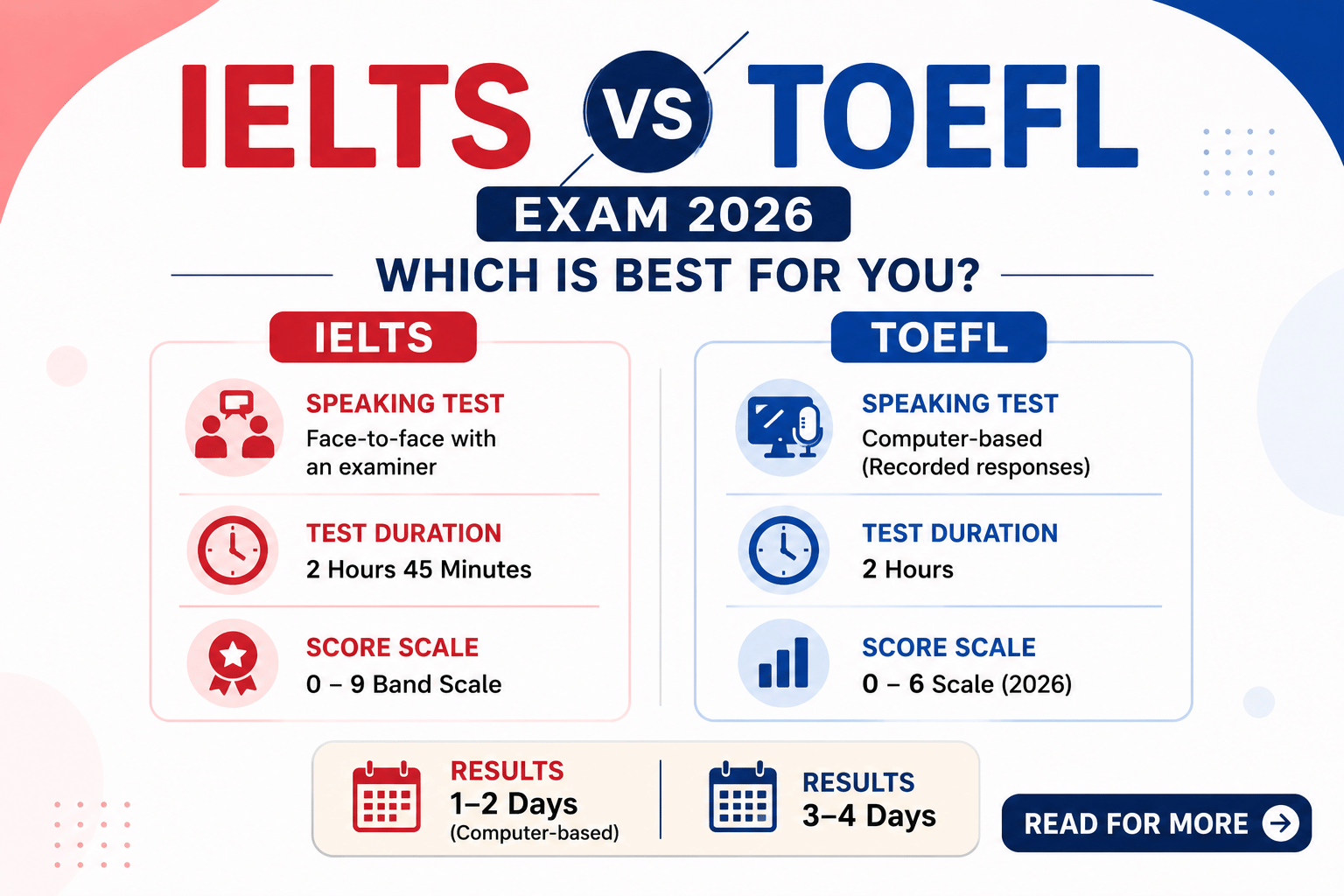
The core difference between the IELTS test and TOEFL is the test format, scoring system, and the type of English used. The IELTS test includes a face-to-face speaking interview and offers both paper-based and computer-delivered options, whereas TOEFL is primarily a computer-based test with recorded speaking responses.
IELTS is used universally for university admission, PR, and visa purposes. Whereas the TOEFL test is more centric for academic purposes. Here’s a breakdown of the IELTS and TOEFL test format:
| Difference Domain | IELTS | TOEFL |
|---|---|---|
| Full Form | International English Language Testing System | Test of English as a Foreign Language |
| Score scale | 0-9 Score Band | 0-6 score (New scoring system) |
| Test duration | 2 hours 45 minutes | 2 hours |
| Results | 1-2 days (Computer-based) | 3-4 days |
Also read: IELTS vs New TOEFL Band Scale: Which Exam is Easier to Clear in 2026?
- What is the Difference Between the IELTS & TOEFL Test 2026?
- IELTS vs TOEFL Exam Pattern 2026
- IELTS vs TOEFL Speaking Comparison 2026
- IELTS vs TOEFL Listening Comparison 2026
- IELTS vs TOEFL Reading Comparison 2026
- IELTS vs TOEFL Writing Comparison 2026
- Which Test Should You Prefer: IELTS or TOEFL in 2026?
- FAQs
What is the Difference Between the IELTS & TOEFL Test 2026?
IELTS and TOEFL exams have a common objective of testing English proficiency, but the test format of the 2 test differ from each other. The IELTS Exam pattern involves various test parameters, such as a speaking test with an examiner, to check the fluency of the applicant.
Here’s the key difference between IELTS and TOEFL:
| Difference Domain | IELTS | TOEFL |
|---|---|---|
| Conducting Body | Jointly managed by the British Council, IDP IELTS, and Cambridge Assessment English | Managed by the Educational Testing Service |
| Test Format | Listening, Reading, Writing, Speaking | Reading, Listening, Writing, Speaking |
| Speaking Test | Conducted live with an examiner | Responses recorded and evaluated by ETS scoring systems |
| Score Scale | Band score from 0-9 | New 1-6 scale (from January 2026), with comparable 0-120 scores during the transition period |
| Fees | ₹19,000 (IELTS Academic and General Training) ₹19,250 (UKVI) | ₹ 15,254 (Registration charges, other services include additional cost.) |
| Results | 1-2 days (Computer-based), 7 days for paper-based | 3-4 days |
IELTS is widely accepted because of its Cambridge setting and format. Whereas the TOEFL is primarily preferred for academic purposes. The IELTS gives faster results in a computer-based test, whereas the TOEFL take 72 hours for the same. Here’s an overview:
- IELTS is scored on a score band from 0-9. TOEFL is scored on a score band of 0-6 according to its new scoring criteria.
- The IELTS Speaking test is examined more accurately as it is conducted manually by an examiner. Whereas in TOEFL, it is computer-based. The applicants repeat the given words on the screen.
Also Read
IELTS vs TOEFL Exam Pattern 2026
The key difference between the IELTS and TOEFL exam patterns lies mainly in the reading time. Here’s an overview of the exam pattern of the IELTS and TOEFL:
| Section | Time and Questions in the IELTS Test | Time and Question in the TOEFL Test |
|---|---|---|
| Listening | 40 questions to solve in 30 minutes. | 28-39 questions, 41-57 minutes. |
| Reading | 40 questions to solve in 60 minutes. | 30-40 questions, 54-72 minutes. |
| Writing | 2 tasks, 60 minutes. | 2 tasks, in 50 minutes. |
| Speaking | 3 parts, 11-14 minutes | 4 tasks, in 17 minutes. |
The IELTS, as compared to the TOEFL, is more focused on Reading and Writing. The IELTS Speaking test is divided into 3 parts, which include an interview, a talk on a generalised topic, and a discussion round. The TOEFL Speaking test is divided into 2 parts, which include an interview and a “listen and repeat” task.
IELTS vs TOEFL Speaking Comparison 2026
The IELTS and TOEFL speaking sections have a major difference in the mode used to test the speaking skills of the applicant. Here’s an overview of the difference between the evaluation, test mode, and examination areas of IELTS and TOEFL:
| Difference Domain | IELTS | TOEFL |
|---|---|---|
| Test Mode | Live with an examiner. | Computer-based test through a microphone. |
| Evaluation | Evaluation done by the examiner. | Evaluation done by AI tools and computer-based software. |
| Examination area | Fluency and coherence,Lexical resource, Grammatical range, and Accuracy of pronunciation. | The candidate's ability to communicate in academic settings. |
The IELTS Speaking exam examines the fluency and coherence of the applicant through an “in-person” conversation. The applicants appear not only for an interview but also for discussion rounds.
Whereas in TOEFL Speaking, you need to appear for an interview round, and the rest of the test is conducted through a computer. You need to read the words on screen, and the computer application measures the pronunciation accuracy.
Also Read
IELTS vs TOEFL Listening Comparison 2026
The IELTS and TOEFL Listening sections differ in how they divide the tasks. IELTS Listening has 4 listening tasks, whereas TOEFL has 2 major parts. Here’s an overview:
| Difference Domain | IELTS | TOEFL |
|---|---|---|
| Exam structure | The Listening section contains four parts and 40 questions.
|
Divided into 2 major parts:
|
| Topics | Social and academic situations | Primarily focuses on academic communication. |
The IELTS Listening task includes social topics as well as the academic setting for the examination. Whereas the TOEFL Listening is designed to test academic communication specifically.
Also Read
IELTS vs TOEFL Reading Comparison 2026
The IELTS and TOEFL Reading sections differ in their question types. The IELTS Reading test is focused on a wide variety of topics, whereas the TOEFL is focused on university-based academic tasks. Here’s a complete breakdown:
| Difference Domain | IELTS | TOEFL |
|---|---|---|
| Structure | Academic IELTS includes passages taken from books, journals, magazines, and newspapers on which the candidate needs to answer:
|
The TOEFL Reading section includes:
|
| Question Types | Wider variety of question types. | Focuses heavily on academic reading. |
The IELTS Reading exam gives passages and questions from a wide variety of social, journal, and academic sources. It aims to test the reading ability of the applicant in broad situations and discussions.
The TOEFL Reading exam is primarily focused on testing the applicant's academic reading skills. Unlike IELTS, TOEFL limits the reading section to just academic passages.
Also Read
IELTS vs TOEFL Writing Comparison 2026
The IELTS and TOEFL Writing sections are focused on writing skills. The primary difference between these two is that the IELTS Writing test is focused on visual data, whereas the TOEFL Writing is focused on academic communication. Here’s the difference between the two:
| Difference Domain | IELTS | TOEFL |
|---|---|---|
| Structure | Divided into 2 parts, 1st a graph-based question followed by an essay writing task. | Divided into 3 parts, 1st is “Build a sentence”, 2nd “Write an Email”, and 3rd “Write for an academic discussion” |
| Question Types | Focused on visual data interpretation and writing skills. | Focused on academic communication and integrated language skills. |
The IELTS Writing test is a 60-minute-long test, which includes 2 tasks. The 1st task is a graph-based task where you need to describe the given information in 150 words. 2nd task is to write an essay of 250 words.
The TOEFL Writing test aims to test the professional and academic writing skills through its tasks, such as “write an email” and “write an academic discussion.” The TOEFL examines the academic writing capabilities of the applicant.
Also Read
Which Test Should You Prefer: IELTS or TOEFL in 2026?
Indian students on Reddit have suggested that IELTS is more preferred due to its wide acceptance. IELTS offers more flexibility (paper and computer-based test), a human speaking test (better accent understanding), broader immigration acceptance, especially in Canada and the UK.
Students also suggest the TOEFL exam, as it is easier compared to IELTS. But the TOEFL is not widely accepted due to changes in its scoring system recently. TOEFL is also not widely accepted as compared to the IELTS test.
Also Read
IELTS and TOEFL both assess Listening, Reading, Writing, and Speaking skills, but they differ in their test format, scoring system, and duration. IELTS uses a 0-9 band scale and includes a face-to-face speaking interview, while TOEFL follows a new 0-6 scoring scale and is primarily computer-based. Students should compare the exam pattern, fees, and acceptance requirements of their target institutions before choosing between the two tests.
FAQs
Ques. How are IELTS Speaking scores assessed?
Ans. The IELTS Speaking test is done face-to-face with an examiner. Examiners assess candidates based on four criteria: Fluency and Coherence, Lexical Resource, Grammatical Range and Accuracy, and Pronunciation.
Ques. Is there a passing score on the TOEFL?
Ans. No. ETS does not set a pass or fail score for the TOEFL test. Each university or institution determines its own score requirements for admission.
Ques. How long are TOEFL and IELTS scores valid?
Ans. According to ETS and IDP, TOEFL iBT and IELTS scores remain valid for two years from the test date.
Ques. How is the TOEFL Speaking section conducted?
Ans. The TOEFL Speaking section is completed on a computer. Candidates speak into a microphone, and their responses are evaluated through ETS's centralised scoring process.
Ques. Which test is shorter, IELTS or TOEFL?
Ans. Based on the current formats, TOEFL takes approximately 2 hours, while IELTS takes approximately 2 hours and 45 minutes. TOEFL is 45 minutes shorter than IELTS.



Comments