



| Updated On - May 13, 2026
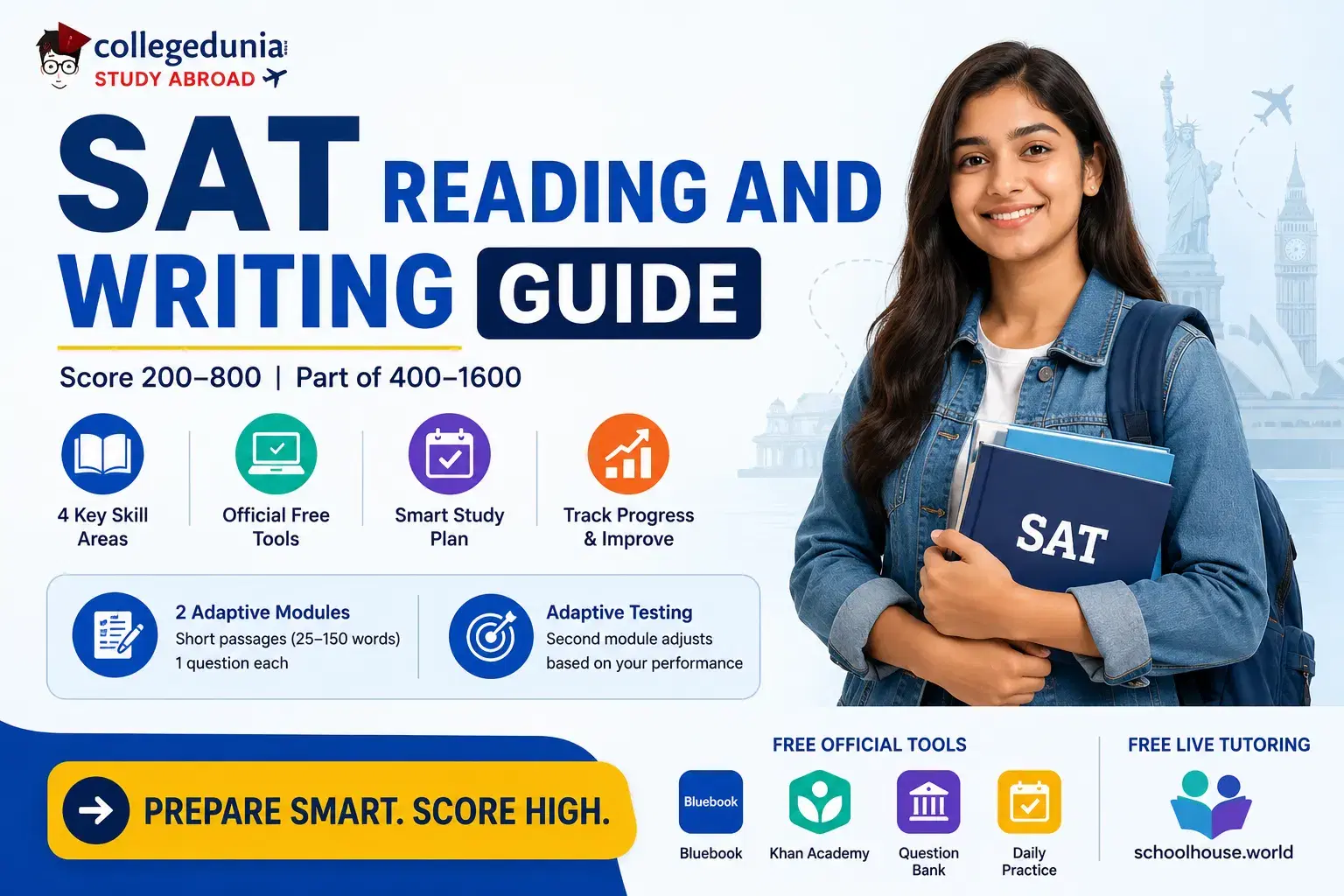
The SAT Reading and Writing section scores range from 200-800, as part of a total SAT score of 400-1600. For Indian students preparing to study abroad, this section tests 4 key skill areas.
College Board, the conducting body of SAT, offers free, official tools, including Bluebook practice tests, Khan Academy prep, and the Student Question Bank, to help every student prepare. This article covers what the section tests, how it is structured, and what preparation steps work best.
- What the SAT Reading and Writing Section Tests?
- How the Section Is Structured
- Start with a Diagnostic: Know Your Weak Areas First
- Use Official Free Tools to Prepare
- How to Build a SAT Study Plan
- Strategies for the SAT Reading and Writing Section
- Track Your Score and Understand Your Report
- Free Tutoring Support
- FAQs
What the SAT Reading and Writing Section Tests?
The SAT Reading and Writing section is not just about grammar. It covers 4 content areas that test different skills. These are:
- Information and Ideas — Tests your ability to read, understand, and use information from passages and graphs
- Craft and Structure — Tests vocabulary in context, how a text is written, and connections between two related texts
- Expression of Ideas — Tests your ability to improve written text to make it clearer and more effective
- Standard English Conventions — Tests grammar, punctuation, and sentence structure
Each domain appears in both modules of the section. Questions go from easy to hard within each domain group.
Read About: Adaptive Testing in the Digital SAT
How the Section Is Structured
Knowing the SAT format helps you plan your time better. Here is what the Reading and Writing section looks like:
- The section is split into 2 modules.
- Each module has questions from all 4 domains.
- Passages are short — between 25 to 150 words.
- Each passage is followed by 1 multiple-choice question.
- Passages come from literature, history/social studies, humanities, and science.
The SAT uses multistage adaptive testing. This means the second module becomes harder or easier based on how you do in the first module. Your final score depends on performance across both modules.
Start with a Diagnostic: Know Your Weak Areas First
Before you start studying, you need to know where you stand. The College Board recommends these steps to check your current level:
- Take a Bluebook practice test — This is the most accurate way to measure your skills. It also gets you used to the digital testing app you will use on test day.
- Take the Khan Academy Course Challenge — This is a short test on the SAT Reading and Writing course. It shows which content areas need more work.
- Review your school tests — Look at your English or language arts tests from school. Spot any skill gaps you already know about.
Once you know your weak areas, you can focus your study time where it matters most.
Check: SAT Reading and Writing Practice Tests by Collegedunia
Use Official Free Tools to Prepare
The College Board provides free, official preparation tools for all students. Indian students can access all of these online.
Here are the key tools:
- Bluebook App — Download it to take full-length practice tests. It works on Mac, Windows, iPad, and school-managed Chromebooks. The app also has a Test Preview feature to get familiar with tools like the highlighter, line reader, and answer eliminator.
- Official SAT Prep on Khan Academy — Built in partnership with College Board. It covers every skill at 3 levels: Foundations, Medium, and Advanced. It also has short video lessons (most under 5 minutes) and skill-specific quizzes.
- Student Question Bank — Has thousands of official questions. You can filter by domain, skill, and difficulty level. This lets you build a custom quiz for any skill you want to practise.
- Question of the Day — A quick daily question from the makers of the SAT. Good for short, regular practice.
All of these tools are free of cost.
How to Build a SAT Study Plan
College Board recommends creating a SAT study plan based on how much time you have before test day.
If you have more than a month:
- Take a full-length Bluebook practice test first.
- Review your scores in My Practice.
- Use Khan Academy to work on weak areas at all 3 levels (Foundations, then Medium, and then Advanced).
- Take another practice test after at least 2 weeks.
- Track your progress over time.
If you have less time:
- Use the Student Question Bank for targeted practice (15 minutes or less per session).
- Watch 2-3 Khan Academy videos daily on specific skills.
- Do the Skill Booster activity — go back to wrong answers and understand why you got them wrong.
The College Board also recommends spacing out practice tests by at least 2 weeks, so you have time to improve between attempts.
Strategies for the SAT Reading and Writing Section
College Board's official guidance includes specific test-taking strategies for the Reading and Writing sections:
- Decide your reading order — Some students read the question first, then the passage. Others read the passage first. Try both during practice tests and stick to what works for you.
- Use the flag tool — If a question takes too long, flag it and come back later. Do not waste time on one question.
- Use the annotation tool — Highlight key parts of the passage. This helps you stay focused on short passages.
- Use the answer eliminator — Cross out options you have already ruled out. This reduces confusion.
- Do not second-guess yourself too much — College Board advises setting a limit on how often you change answers. Changing answers without a clear reason often hurts your score.
Track Your Score and Understand Your Report
After each practice test, your scores appear in My Practice on the College Board website. Your score report shows:
- Total SAT score (400–1600).
- Reading and Writing section score (200–800).
- Performance by content domain — Shows how many questions came from each area and how you did.
Use the "Practice Specific Questions" feature in My Practice. It creates a custom set of questions based on your weak areas from the last practice test.
Also, use the Score Details page — it shows every question, your answer, the correct answer, and an explanation. This is one of the best ways to learn from mistakes.
Free Tutoring Support
College Board has partnered with Schoolhouse.world to offer free, live, small-group tutoring sessions. These are led by trained peer tutors. Sessions run for four weeks and are open to all students. This is a good option if you want guided help on specific skills.
For non-native English speakers, including Indian students, SAT Reading and Writing preparation works best when focused on skill-based practice rather than memorisation. Using official tools like Bluebook, Khan Academy, and the Student Question Bank can help students improve specific weak areas, track progress, and become comfortable with the adaptive digital format before test day.
FAQs
Ques. Is the SAT Reading and Writing section the same for Indian students as for US students?
Ans. Yes. The SAT is the same test worldwide. Indian students take the same Reading and Writing section with the same question types and scoring scale (200–800).
Ques. How many questions are in the Reading and Writing section?
Ans. The section has two modules. Each module has questions from all four content domains. Passages are short (25–150 words), each followed by one multiple-choice question.
Ques. Is Khan Academy SAT prep really free?
Ans. Yes. Official SAT Prep on Khan Academy is completely free. It is built in partnership with the College Board and covers all skills tested on the SAT.
Ques. What is the Bluebook app, and do I need it?
Ans. Bluebook is the official digital testing app by College Board. You must use it on the test day. Download it before your test date to practise and get familiar with its tools.
Ques. How does the adaptive testing format affect my Reading and Writing scores?
Ans. The second module adjusts in difficulty based on your first module performance. A harder second module means you are on track for a higher score. Your final score is calculated across both modules.
Ques. How often should I take a full-length practice test?
Ans. The College Board recommends spacing practice tests at least two weeks apart. This gives you time to study and improve before testing yourself again.
Ques. What is the Student Question Bank, and how is it useful?
Ans. It is a free tool with thousands of official SAT questions. You can filter by domain, skill, and difficulty. It is useful for targeted practice on specific weak areas.
Ques. Can I get free tutoring help for SAT preparation?
Ans. Yes. College Board has partnered with Schoolhouse.world for free, live, small-group tutoring. Sessions are four weeks long and led by trained peer tutors. All students can join.


1787567517.png?tr=w-305,h-145,c-force?h=175&w=350&mode=stretch)



Comments