



Study Abroad Content Writer | Updated On - May 14, 2026
Romania is becoming an increasingly popular choice for Indian students pursuing MBBS abroad. Romania offers a 6-year medicine degree, also known as a Doctor of Medicine (MD). The course consists of a 5-year study program and 1 year of internship.
One key advantage is that most universities provide fully English-taught courses, making it easier for international students to adapt. Other reasons are that no separate entrance exam is required. Admission is based on your academic profile and a valid NEET qualifying score. The annual tuition fees for Romanian medical universities lie in the range of EUR 7,000-10,000 (INR 7.7-11 lakh). The average monthly cost of living in Romania lies in the range of EUR 475-990/INR 52,416-1.09 lakh.
Note: A Romanian medical degree (MD) is considered equivalent to the Indian medical degree (MBBS).
Explore: MBBS Abroad 2026- Countries, Fees, FMGE and NMC Rules
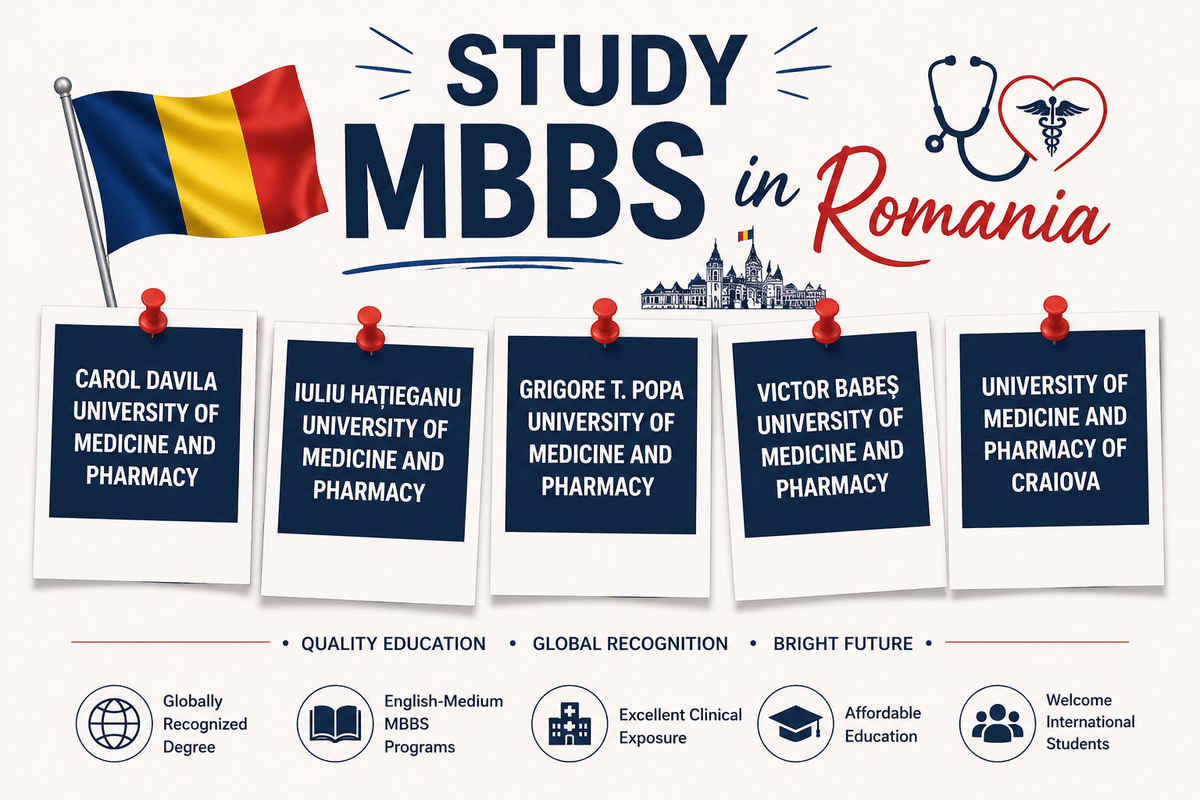
Studying MBBS in Romania in 2026
Some of the reasons to study medicine in Romania are the following:
- Modern Campuses: Students learn in Modern laboratories and research centres
- No Entrance Exam: Indian students must qualify for NEET-UG as per NMC rules, but Romanian universities usually don’t conduct any additional entrance exams. Admission is generally based on your 12th marks (PCB) and academic documents, not a separate test.
- English-taught programs: Top Romanian universities offer full MBBS programs in English, so students are not required to learn Romanian initially
So, when is Romanian needed?
Romanian is usually needed from the 3rd year onwards. This is the time when clinical rotations (hospital training) begin, and students start interacting with real patients.
Also Read: 5 Medical Schools for MBBS with Direct Admission for NEET
Top Universities for MBBS in Romania
Romania has many medical universities that offer MBBS (medicine) programs in English to international students. Some of the popular universities are mentioned below.
| University Name | Location | Annual Tuition fees (EUR) | Annual Tuition fees (INR) |
|---|---|---|---|
| Carol davila university of medicine and pharmacy | Bucharest | EUR 10,000 | INR 11 lakh |
| Iuliu Hatieganu University of Medicine and Pharmacy | Cluj-Napoca | EUR 7,000-10,000 | INR 7.7-11 lakh |
| Grigore T. Popa University of Medicine and Pharmacy | Iași | EUR 9,000 | INR 9.93 lakh |
| Victor Babeș University of Medicine and Pharmacy | Timișoara | EUR 9,000 | INR 9.93 lakh |
| University of Medicine and Pharmacy of Craiova | Craiova | EUR 8,500 | INR 9.3 lakh |
Currency conversion used: EUR 1 = INR 110.35 (for April,2026)
Admission Requirements for MBBS in Romania
Meeting the admission requirements is the most important step when applying for university admission. It includes eligibility, NEET requirements and a list of documents required for admission.
Eligibility Criteria for Admission to MBBS in Romania
The eligibility for international students planning to pursue MBBS in Romania is as follows:
- Academic qualification: Completed Class 12 with physics, chemistry and biology as main subjects.
- Min. Marks: 50% aggregate in PCB (General category); 40% for SC/ST/OBC
- Age requirements: Minimum 17-18 years old by the time of admission
- NEET scorecard: Valid qualifying NEET score (120-150 marks)
- English language proficiency: IELTS (6-7)/TOEFL iBT (70-90), depending on the university.
Note: Some universities also accept a Medium of Instruction (MOI) certificate as proof that your previous education was in English, so IELTS/TOEFL may not be required in such cases.
Check out: NMC Guidelines for Indian Students
Document requirements for MBBS in Romania
The necessary documents required for admission to the universities in Romania for MBBS (MD) are the following:
- 10 & 12 Marksheets
- Valid passport
- Medical certificate
- Birth certificates
- Application form
- Optional Volunteering in extracurricular activities
- Recommendation letters (optional)
- Affidavit (dated and signed) that all documents are authentic
Cost of Living in Romania
As per Numbeo, the cost of living in Romania is, on average, 128.3% higher than in India. The average monthly cost of living in Romania lies in the range of EUR 475-990/INR 52,416-1.09 lakh.
| Expense | Monthly Cost (EUR) | Monthly Cost (INR) |
|---|---|---|
| Accommodation (hostel/shared flat) | EUR 200-400 | INR 22,070-44,140 |
| Food and groceries | EUR 150-300 | INR 16,552-33,105 |
| Public Transport | EUR 15-40 | INR 1,655-4,414 |
| Utilities | EUR 50-120 | INR 5,517-13,242 |
| Health insurance | EUR 10-30 | INR 1,103-3,310 |
| Miscellaneous | EUR 50-100 | INR 5,517-11,035 |
| Total Expense | EUR 475-990 | INR 52,416-1.09 lakh |
Source of Data: Numbeo
Visa Application for Romania
Before applying for a visa, students need to secure admission to a Romanian medical university first. The Romanian student visa (Type D/SD) is issued to international students planning to stay in Romania for more than 90 days. Students can apply for a student visa through the Embassy of Romania in India or the consulate.
Indian students apply for a Romanian student visa through VFS Global. You just submit your documents and fingerprints there, and they send your application to the Embassy of Romania in India, which makes the final decision. The visa is issued for 90 days initially and can be converted into a resident permit (TRC) after arrival (issued by the immigration office).
Documents required for a Romanian visa are the following:
- 10 & 12 Marksheets
- Photographs
- Valid passport
- Acceptance letter
- Fee payment Proof
- Medical certificates
- HIV test reports
- Proof of financial support of EUR 2,000-4,000 (INR 2.2-4.4 lakh)
Scholarships for MBBS in Romania
Scholarships in Romania are limited but available for international students. Most are merit-based or government-funded: Top Romanian medical universities, such as Carol Davila and Iuliu Hațieganu offer merit-based and social scholarships, including for international students. However, these are typically awarded after enrolment based on academic performance and are not full funding options for MBBS programs.
Career Prospects After MBBS in Romania
After completing an MBBS in Romania, Indian students can appear for the FMGE/NEXT and register with the NMC to practise in India.
Since Romania is part of the EU, students can apply for medical practice in Romania. A degree from Romania is recognised across many EU countries. Students can apply for PLAB to practise in the UK and the USMLE to practise in the USA.
Check out: Countries with High FMGE pass rates
MBBS in Romania offers a balanced mix of affordability, quality education, and global career opportunities for Indian students. With English-taught programs, no separate entrance exams, and EU recognition, it stands out as a practical choice for studying medicine abroad.
FAQs
Ques. How are practicals and hospital exposure in Romanian universities?
Ans. Practical training in Romanian medical universities is generally strong, and students start with clinical training in the first 2-3 years.
Ques. Can Indian students work part-time during MBBS in Romania?
Ans. Yes, International students in Romania can work up to 6 hours per day (around 30 hours per week) without a work permit, although most students typically work around 20 hours per week
Ques. Are there any hidden costs apart from tuition fees?
Ans. Yes, Students need to pay for Resident permit fees, health insurance, study materials, etc.
Ques. Are classes really in English or mixed with Romanian?
Ans. Yes, theoretical classes are in English, but for clinical training with patients, you need to learn Romanian.



Comments