



| Updated On - May 14, 2026
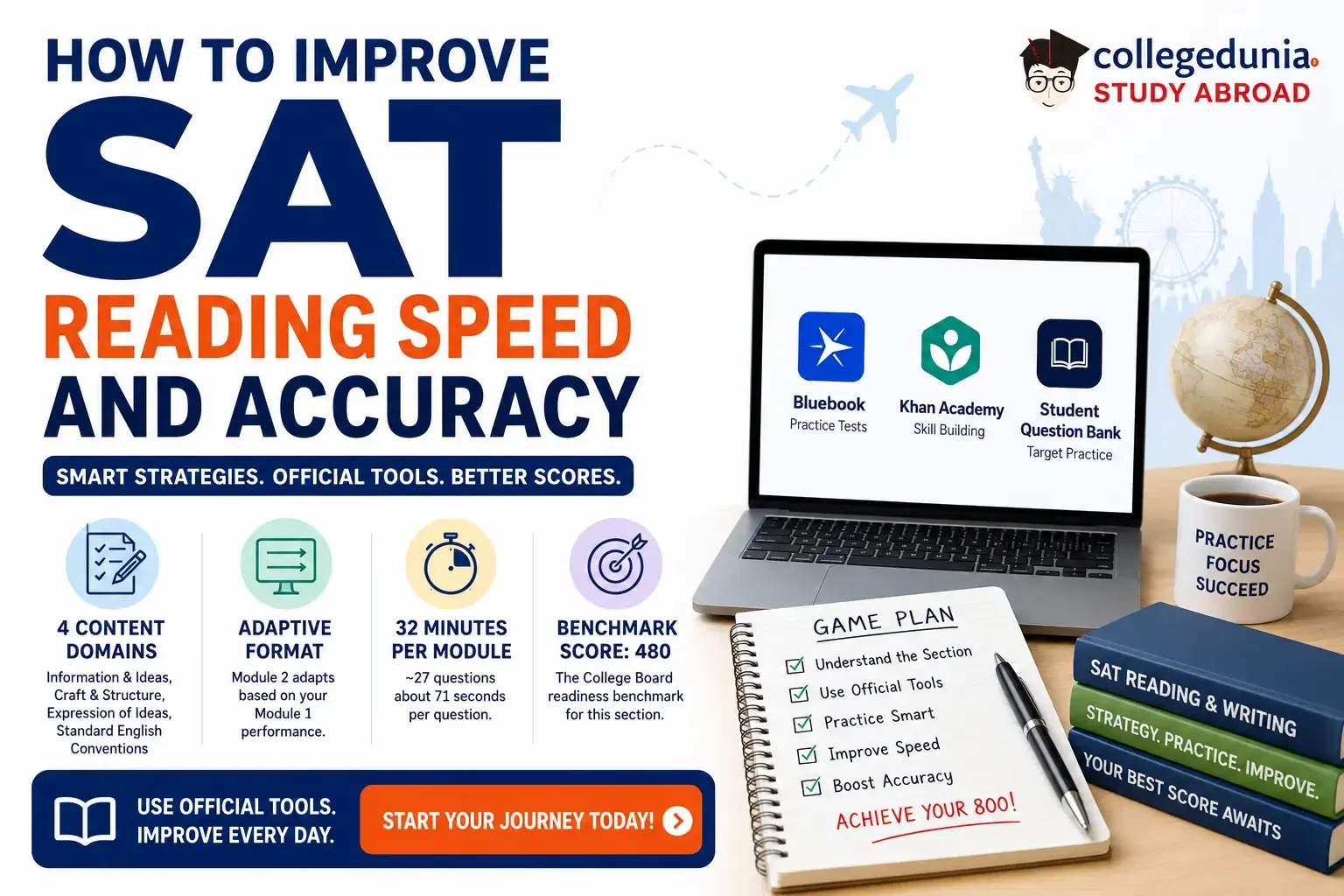
The SAT Reading and Writing section has 54 questions across 2 modules, with 32 minutes per module (64 minutes total). Each passage is short — just 25 to 150 words — followed by one multiple-choice question.
The SAT Reading and Writing section is scored on a 200-800 scale. The College Board's benchmark score for this section is 480 out of 800. To hit that benchmark, Indian students need both speed and accuracy. This article covers what the section tests, how the adaptive format works, and the official tools you can use to improve.
- What the SAT Reading and Writing Section Actually Tests?
- How the Adaptive Format Affects Your Reading Strategy
- Use Bluebook Tools to Read Faster and More Accurately
- The Right Way to Practice for Reading Speed
- Use Khan Academy to Build Reading Skills by Level
- How to Handle Timing During the Test
- Track Your Weak Areas and Fix Them
- FAQs
What the SAT Reading and Writing Section Actually Tests?
Before improving speed and accuracy, you need to know what you're reading for.
The SAT Reading and Writing section covers 4 content domains:
- Information and Ideas — Find, understand, and use info from texts and graphs
- Craft and Structure — Understand words in context, analyse text, connect two passages
- Expression of Ideas — Improve how a text is written
- Standard English Conventions — Fix grammar, punctuation, and sentence structure
Each module has questions from all 4 domains. Questions go from easiest to hardest within each domain group. This means you can plan your time better — easier questions come first.
How the Adaptive Format Affects Your Reading Strategy
The digital SAT uses a multistage adaptive design. Here's how it works:
- Module 1: All students get the same mix of easy, medium, and hard questions.
- Module 2: Based on your Module 1 performance, you get either a higher difficulty or a lower difficulty set of questions.
Your final score depends on both modules combined. So do not rush through Module 1. Every question counts.
Key fact: The College Board says students should try their best on every single question — even if they're unsure. For most students, guessing is better than leaving a question blank, especially if you can remove one or two wrong options first.
Must Read:
How the Adaptive Format in the Digital SAT WorksUse Bluebook Tools to Read Faster and More Accurately
The digital SAT is taken on the Bluebook app by the College Board. It has built-in tools that directly help with reading speed and accuracy:
- Highlighter/Annotation tool — Mark key parts of the passage as you read.
- Line reader tool — Focus on one line at a time; reduces distraction.
- Answer eliminator — Cross out options you've already ruled out.
- Flag for review — Skip a hard question and come back later.
The College Board recommends getting familiar with these tools before test day. Use them during practice tests in Bluebook so they feel natural on the actual test.
The Right Way to Practice for Reading Speed
College Board's official advice: the best way to prepare is to take full-length practice tests in the Bluebook app.
Here's what the official study plan recommends:
- Take a Bluebook practice test first — This shows your current level and weak areas
- Review your score in My Practice — See which domains you got wrong
- Use "Practice Specific Questions" — My Practice creates a custom set based on your weak areas
- Space out practice tests — At least 2 weeks apart if possible
For quick daily practice (15 minutes or less), use the Student Question Bank. You can filter by:
- Test (Reading and Writing or SAT Math)
- Domain
- Skill
- Difficulty level
This lets you target exactly the type of reading question you struggle with.
Use Khan Academy to Build Reading Skills by Level
Official SAT Prep on Khan Academy is free and made in partnership with the College Board. It covers every Reading and Writing skill at 3 levels:
- Foundations — Basic level
- Medium — Mid-level
- Advanced — Hardest level
College Board's tip: Start from Foundations, even for skills you think you know. Move to Medium, then Advanced. This builds your reading ability step by step.
Khan Academy also has short video walkthroughs (most under 5 minutes) for each skill. These are good for quick daily study — on the bus, during a break, or after dinner.
Check: SAT Daily Study Routine
After taking a Bluebook practice test, click "Practice on Khan Academy" from your My Practice scorecard. It gives a detailed explanation of every question you attempted.
How to Handle Timing During the Test
Each Reading and Writing module gives you 32 minutes for about 27 questions — roughly 71 seconds per question.
College Board's official advice on timing:
- Decide your strategy in advance — Should you read the question first or the passage first? Try both during practice and pick what works for you
- Flag hard questions — Don't spend too long on one question. Flag it and move on
- Come back at the end — You can go back to flagged questions within the same module
Since passages are only 25-150 words, reading the full passage before the question is usually fast. But test this during practice to find your best approach.
Track Your Weak Areas and Fix Them
After every practice test, the College Board recommends a "Skill Booster" activity:
- Go back to every wrong answer.
- Ask: Did I misread the question? Did I not understand the passage? Was I confused between two options?
- Note patterns — Are you always wrong on "Craft and Structure"? Or "Information and Ideas"?
Use the Student Question Bank to then practice only those specific skills. This is more useful than re-reading full passages without a target.
The SAT Reading and Writing section tests 4 skill areas across 2 adaptive modules, with a benchmark of 480. College Board's free tools — Bluebook practice tests, the Student Question Bank, and Khan Academy — are the most direct way to improve both speed and accuracy. Use them together with a structured study plan for the best results.
FAQs
Ques. Does the SAT Reading and Writing section have a penalty for wrong answers?
Ans. No. The digital SAT has no negative marking. College Board says it is better to guess than leave a question blank, especially if you can eliminate one or two options.
Ques. Can I use the Bluebook tools like the highlighter and line reader on the actual SAT?
Ans. Yes. These tools are available in the official Bluebook app on test day. College Board recommends practising with them during mock tests so you are comfortable using them.
Ques. What is the College Board's benchmark score for the Reading and Writing section?
Ans. The College Board's College and Career Readiness Benchmark for the Reading and Writing section is 480 out of 800. Scoring at or above this shows readiness for college-level work.
Ques. Is Official SAT Prep on Khan Academy really free for Indian students?
Ans. Yes. Khan Academy's Official SAT Prep is completely free. It is made in partnership with College Board and covers all Reading and Writing skills at three difficulty levels — Foundations, Medium, and Advanced.
Ques. What happens if I perform poorly in Module 1 of the Reading and Writing section?
Ans. You will be routed to a lower difficulty Module 2. However, College Board confirms that students can still meet the College and Career Readiness Benchmark regardless of which module they are routed to. Both modules offer a full range of possible scores.
Ques. How many practice tests are available for free on Bluebook?
Ans. The College Board offers full-length free practice tests on the Bluebook app. You can access them under "Practice and Prepare" on the Bluebook homepage. After completing a test, your scores and answer explanations are available in My Practice.


1787567517.png?tr=w-305,h-145,c-force?h=175&w=350&mode=stretch)



Comments