



Education Journalist | Study Abroad Lead | Updated On - May 30, 2026
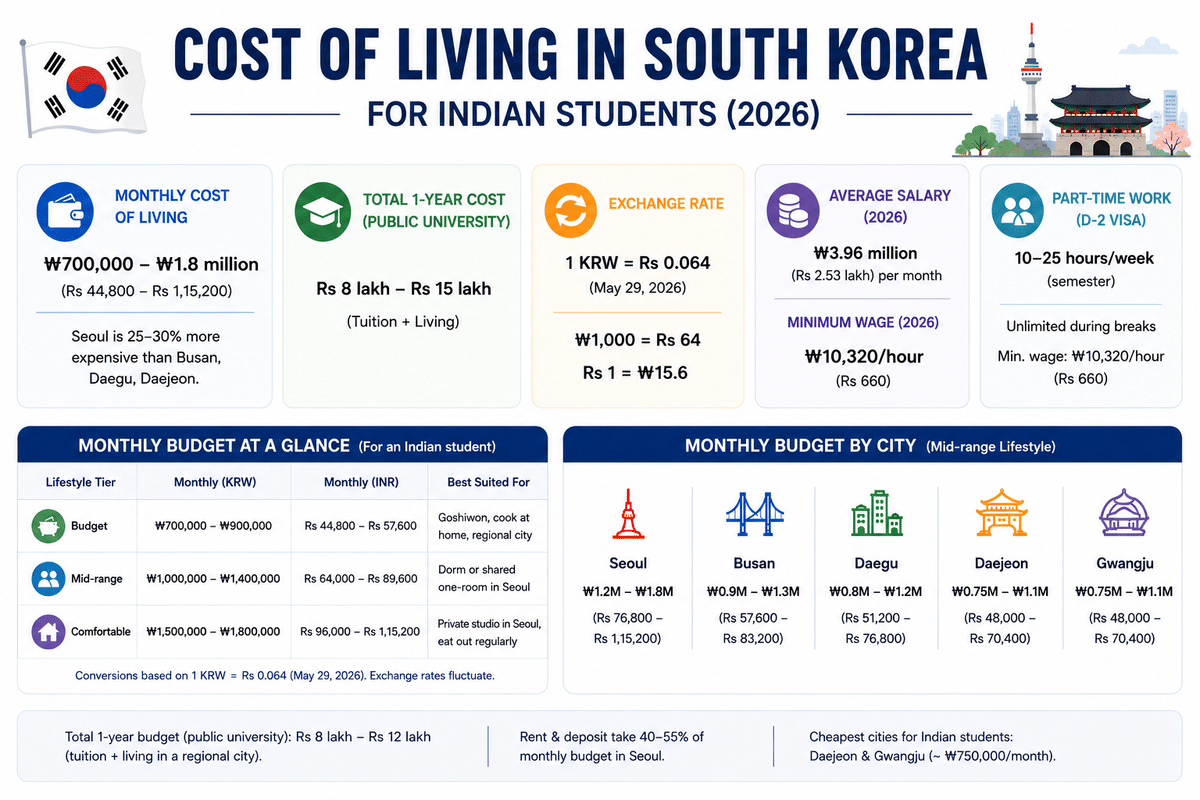
Cost of living in South Korea for Indian students sits between ₩700,000 and ₩1.8 million per month, which is approximately Rs 44,800 to Rs 1,15,200 at the current rate. Seoul runs 25 to 30% higher than Busan, Daegu or Daejeon. A typical one-year stay at a public Korean university, tuition plus living, costs Rs 8 lakh to Rs 15 lakh.
- The monthly budget for an Indian student is approximately Rs 50,000 to Rs 90,000 in Seoul; Rs 35,000 to Rs 65,000 in Busan, Daegu, Daejeon or Gwangju.
- The Korean won to Indian rupee rate is 1 KRW = Rs 0.064, which means ₩1,000 = Rs 64 and Rs 1 = ₩15.6 as of May 29, 2026.
- Average salary in South Korea is approximately ₩3.96 million (Rs 2.53 lakh) per month, with a minimum wage of ₩10,320 per hour (Rs 660) in 2026.
- Goshiwon rooms start at ₩300,000 (Rs 19,200) per month, while Seoul one-room studios run ₩500,000 to ₩1,150,000 (Rs 32,000 to Rs 73,600) plus a refundable deposit.
Most Indian families plan for a tidy ₩1.2 million monthly budget and then hit the apartment leasing desk: a Seoul studio asks for ₩5 million to ₩10 million in upfront Key Money deposit before handing over keys. Goshiwon and dormitory routes skip the deposit but ask Indian students to live in roughly 4 square metres of space.
Getting the housing call right saves more rupees than every other monthly category combined.
Quick Facts: Cost of Living in South Korea (2026)
- Is South Korea cheaper than India? No. South Korea is approximately 68% more expensive than India on a standardised cost basket, mainly driven by rent, groceries and dining out.
- What is 1,000 KRW in rupees? Approximately Rs 64 at the rate of Rs 0.064 per won on May 29, 2026.
- Cheapest city for Indian students? Daejeon and Gwangju, with monthly budgets near ₩750,000 (Rs 48,000).
- Can D-2 visa students work part-time? Yes, between 10 and 25 hours per week depending on TOPIK score, and unlimited during semester breaks.
- Total 1-year budget at a public university? Approximately Rs 8 lakh to Rs 12 lakh for tuition plus living in a regional city.
- Is rent the biggest expense? Yes. Rent and the one-time Key Money deposit together absorb 40 to 55% of an Indian student's monthly budget in Seoul.
Cost of Living in South Korea: Monthly Budget at a Glance
An Indian student in South Korea spends ₩700,000 to ₩1,800,000 per month (Rs 44,800 to Rs 1,15,200), with three clear tiers based on city, housing choice and lifestyle.
Most students looking at studying in South Korea fall into one of three monthly budget brackets. The lowest tier suits students who pick Goshiwon housing, cook at home and stay outside Seoul. The mid tier is the typical Seoul dorm or shared one-room arrangement. The comfortable tier covers a private studio in Seoul with regular eating out.
| Lifestyle Tier | Monthly (KRW) | Monthly (INR) | Best Suited For |
|---|---|---|---|
| Budget | ₩700,000 to ₩900,000 | Rs 44,800 to Rs 57,600 | Goshiwon, cook at home, regional city |
| Mid-range | ₩1,000,000 to ₩1,400,000 | Rs 64,000 to Rs 89,600 | Dorm or shared one-room in Seoul |
| Comfortable | ₩1,500,000 to ₩1,800,000 | Rs 96,000 to Rs 1,15,200 | Private studio in Seoul, eat out regularly |
| Family (4 members) | ₩4,500,000 to ₩6,000,000 | Rs 2.88 lakh to Rs 3.84 lakh | Working professionals with dependents |
Conversions based on a KRW-INR rate of Rs 0.064 per 1 KRW as of May 29, 2026. Exchange rates fluctuate; check the current rate before financial planning.
The budget tier is realistic only for students who accept a 4 to 6 square metre Goshiwon and a near-zero social life. Most Indian students settle into the mid-range bracket within two months of landing. Add a one-time setup cost of ₩200,000 to ₩500,000 (Rs 12,800 to Rs 32,000) in the first month for bedding, kitchenware, registration fees and phone deposit.
One-time setup costs Indian students miss
Beyond monthly rent and food, three one-time costs catch most Indian families off guard. The Key Money deposit on a private studio is typically ₩5 million to ₩10 million (Rs 3.2 lakh to Rs 6.4 lakh) and is refundable when the lease ends. Goshiwons and dorms skip this. The mandatory National Health Insurance Service (NHIS) contribution is approximately ₩40,000 to ₩70,000 per month (Rs 2,560 to Rs 4,480) from the seventh month onwards. Finally, the alien registration card and one-way airfare from India add approximately Rs 50,000 to Rs 80,000 in the first 60 days.
Important: Budget at least Rs 1 lakh extra for the first 60 days in Korea. The Key Money deposit, alien registration fee, one-time furnishing and pre-payment of the first month's rent all hit before any scholarship or stipend lands.
KRW to INR Quick Conversion Cheatsheet
The Korean won to Indian rupee rate is approximately Rs 0.064 per 1 KRW as of May 29, 2026. That means 1,000 KRW equals Rs 64, and Rs 1 equals approximately ₩15.6.
Indian students search for every won amount they hear in their pre-departure research, from a ₩3,000 lunch to a ₩3.5 lakh dorm fee. The table below maps the most common KRW amounts to rupees so a budget conversation with parents is one tap away. The 52-week range for KRW-INR has stayed between Rs 0.0601 and Rs 0.0658, so the actual rate on the day of remittance can move 5 to 8% either way.
| Korean Won (KRW) | Indian Rupees (INR) | Typical Use Case |
|---|---|---|
| ₩1 | Rs 0.064 | Reference rate |
| ₩100 | Rs 6.40 | Cheapest convenience store snack |
| ₩1,000 | Rs 64 | Bottle of water, bus ticket |
| ₩2,000 | Rs 128 | Subway one-way fare |
| ₩3,000 | Rs 192 | University cafeteria meal |
| ₩6,000 | Rs 384 | Mid-range lunch combo |
| ₩7,000 | Rs 448 | Coffee plus dessert at a cafe |
| ₩12,000 | Rs 768 | Restaurant meal for one |
| ₩1,00,000 | Rs 6,400 | Weekly grocery basket |
| ₩1,50,000 | Rs 9,600 | Monthly electricity plus internet bill |
| ₩3,00,000 | Rs 19,200 | Cheapest Goshiwon monthly rent |
| ₩3,50,000 | Rs 22,400 | University dormitory monthly rent |
| ₩5,00,000 | Rs 32,000 | Shared one-room outside Seoul |
| ₩10,00,000 (1 million) | Rs 64,000 | Total monthly budget, budget tier |
| ₩15,00,000 | Rs 96,000 | Total monthly budget, mid-range tier |
| ₩20,00,000 (2 million) | Rs 1,28,000 | Comfortable Seoul private studio life |
How the Korean won compares to the rupee in 2026
The Korean won is a low-denomination currency, similar to the Japanese yen. A ₩1,000 note feels like a Rs 64 coin in spending power, not a Rs 1,000 bill. This trips up first-time Indian visitors who assume ₩50,000 is a large bill. It is approximately Rs 3,200. Always think in groups of thousands.
Note: The South Korean won has depreciated roughly 9% against the Indian rupee since 2024, which makes 2026 a slightly cheaper year for Indian students compared with the same budget two years ago. The 52-week range is Rs 0.0601 to Rs 0.0658 per 1 KRW.
Check Out: Global Korea Scholarship 2026: Full Tuition Plus Stipend for Indian Students
Rent and Housing Cost of Living in South Korea
Rent absorbs 30 to 45% of an Indian student's monthly budget in Korea. Options range from ₩300,000 Goshiwon rooms to ₩1.15 million Seoul studios, with university dorms as the safe middle path.
South Korean student housing has five distinct formats, each with a clear price band and trade-off. Picking the wrong format costs ₩200,000 to ₩600,000 (Rs 12,800 to Rs 38,400) in unnecessary monthly rent for the same standard of comfort. The table below lays out the realistic monthly cost for an Indian student in 2026.
| Housing Type | Monthly Rent (KRW) | Monthly Rent (INR) | Key Money Deposit |
|---|---|---|---|
| University dormitory | ₩200,000 to ₩450,000 | Rs 12,800 to Rs 28,800 | None to ₩100,000 |
| Goshiwon (single room) | ₩300,000 to ₩500,000 | Rs 19,200 to Rs 32,000 | None |
| Hasukjib (boarding house) | ₩350,000 to ₩550,000 | Rs 22,400 to Rs 35,200 | 1 month rent |
| One-room (studio outside Seoul) | ₩400,000 to ₩600,000 | Rs 25,600 to Rs 38,400 | ₩3 million to ₩5 million |
| One-room (studio in Seoul) | ₩500,000 to ₩1,150,000 | Rs 32,000 to Rs 73,600 | ₩5 million to ₩10 million |
| Officetel (premium studio) | ₩800,000 to ₩1,500,000 | Rs 51,200 to Rs 96,000 | ₩10 million plus |
University dormitories are the safest first-year choice. They include utilities, a clean shared bathroom and proximity to lectures. The downside is a strict curfew at many private universities and a 2-person room as the default.
Goshiwon, Hasukjib and university dorms
A Goshiwon is a 4 to 8 square metre private room with shared bathrooms and a communal kitchen. Free rice and kimchi are usually included. A Hasukjib goes one step further by serving two daily meals from a landlady's kitchen. Both skip the Key Money deposit entirely, which is the single biggest reason Indian students pick them in the first six months.
Key Money deposit explained for Indian renters
The Korean rental market runs on two formats: Wolse (monthly rent with a refundable deposit) and Jeonse (large lump-sum deposit, no monthly rent). Indian students almost always sign Wolse contracts. The deposit is held interest-free by the landlord and returned in full when the lease ends. A standard Seoul Wolse contract requires ₩5 million to ₩10 million (Rs 3.2 lakh to Rs 6.4 lakh) upfront, which is roughly 10 months of rent in a Goshiwon.
What university dorms cover:
- Basic furniture (bed, desk, chair, cupboard).
- Utilities (electricity, water, heating, internet) bundled into rent.
- Shared kitchen and laundry facilities on each floor.
- 24-hour security and a roommate matching service.
What university dorms do not cover:
- Meals (most dorms do not include the cafeteria plan).
- Private bathrooms (shared on most floors).
- Guest stays (visitors are rarely allowed overnight).
- Summer and winter break months (many dorms shut between semesters).
Important: Apply for university housing within 7 days of receiving the admission letter. Most Korean university dorms allocate rooms first-come-first-served after April, and Indian students often miss the window because of visa processing delays.
Food, Groceries and Eating Out in South Korea
Food costs an Indian student ₩300,000 to ₩600,000 per month (Rs 19,200 to Rs 38,400), depending on whether the meals come from a university cafeteria, home cooking or restaurants.
Korean food is the cheapest path. A university cafeteria meal costs ₩3,000 to ₩5,000 (Rs 192 to Rs 320), and a kimbap-and-ramen lunch from a local joint runs ₩6,000 to ₩8,000 (Rs 384 to Rs 512). The challenge for Indian students is that grocery prices in Seoul are approximately 270% higher than Delhi for staples like vegetables, fruit, lentils and rice. Cooking at home cuts the monthly food bill but Indian-style cooking costs more than Korean-style.
| Food Category | Typical Cost (KRW) | Typical Cost (INR) | Notes |
|---|---|---|---|
| University cafeteria meal | ₩3,000 to ₩5,000 | Rs 192 to Rs 320 | Cheapest sit-down option |
| Local Korean restaurant meal | ₩7,000 to ₩12,000 | Rs 448 to Rs 768 | Bibimbap, kimbap, jjigae |
| Indian restaurant meal in Seoul | ₩15,000 to ₩25,000 | Rs 960 to Rs 1,600 | Curry, naan, dal at Itaewon or Insadong |
| Monthly groceries (cook 4 meals/week) | ₩200,000 to ₩300,000 | Rs 12,800 to Rs 19,200 | Rice, vegetables, eggs, lentils |
| Monthly groceries (cook daily) | ₩400,000 to ₩600,000 | Rs 25,600 to Rs 38,400 | Includes paneer, spices, atta from H Mart |
| Soju (375 ml bottle) | ₩2,000 to ₩4,000 | Rs 128 to Rs 256 | Convenience store price |
| Cafe latte | ₩4,500 to ₩6,000 | Rs 288 to Rs 384 | Standard Seoul cafe |
Cooking at home vs cafeteria vs Indian restaurants
An Indian student who eats two cafeteria meals on weekdays and cooks dinner spends approximately ₩350,000 (Rs 22,400) per month on food. Switching to one daily restaurant meal pushes that to ₩600,000 (Rs 38,400). Eating at Indian restaurants twice a week alone adds another ₩150,000 (Rs 9,600) on top.
Vegetarian and halal grocery costs
Vegetarian Indian students should plan for slightly higher grocery bills. Paneer, atta, ghee and Indian spices are sold at premium prices in H Mart, Lotte Mart and online Indian grocery sites. A 1 kg pack of dal that costs Rs 100 in India sells for ₩6,000 to ₩9,000 (Rs 384 to Rs 576) in Seoul. Vegetarian Korean food does exist, especially Buddhist temple cuisine and bibimbap variants, but most Korean menus assume meat or seafood.
Note: Indian restaurants in Seoul (Jyoti, Bombay Grill, Taj, Pooja, OTSAL) cluster in Itaewon, Insadong and the Seoul National University area in Gwanak. A full Indian thali costs approximately ₩18,000 to ₩25,000 (Rs 1,150 to Rs 1,600), which is 3 to 4 times what a comparable thali costs in India.
Transport, Utilities and Mobile Costs in South Korea
Transport, utilities, internet and mobile together add ₩200,000 to ₩350,000 per month (Rs 12,800 to Rs 22,400) to an Indian student's South Korea cost of living, with public transport being one of the cheapest in the developed world.
Seoul's subway system covers every major university campus, and the integrated T-money card works on subways, buses and even taxis. Mobile and broadband plans are competitive, with three carriers (SK Telecom, KT and LG U Plus) fighting on student bundles. Utilities can swing sharply in winter because Korean floor heating runs on gas or electricity.
| Expense Item | Monthly Cost (KRW) | Monthly Cost (INR) |
|---|---|---|
| Subway plus bus (T-money card) | ₩50,000 to ₩70,000 | Rs 3,200 to Rs 4,480 |
| Seoul Climate Card (unlimited transit) | ₩55,000 to ₩65,000 | Rs 3,520 to Rs 4,160 |
| Electricity, gas, water (winter peak) | ₩100,000 to ₩200,000 | Rs 6,400 to Rs 12,800 |
| Electricity, gas, water (summer) | ₩60,000 to ₩100,000 | Rs 3,840 to Rs 6,400 |
| Home Wi-Fi (100 Mbps) | ₩25,000 to ₩35,000 | Rs 1,600 to Rs 2,240 |
| Mobile postpaid plan (5G unlimited) | ₩30,000 to ₩55,000 | Rs 1,920 to Rs 3,520 |
| NHIS health insurance (mandatory) | ₩40,000 to ₩70,000 | Rs 2,560 to Rs 4,480 |
T-money card, Climate Card and intercity travel
A T-money card is sold at any convenience store for ₩2,500 to ₩4,000 (Rs 160 to Rs 256) and works across the country. A standard Seoul subway ride is ₩1,400 (Rs 90) on the card. The newer Seoul Climate Card at ₩62,000 per month (Rs 3,970) gives unlimited subway and bus rides, which works out cheaper than 45 rides on T-money. For trips between Seoul and Busan, the KTX bullet train costs ₩59,800 (Rs 3,830) one-way in standard class.
Electricity, gas, internet and NHIS health insurance
Korean winters are colder than most parts of India, and floor heating (ondol) drives the November to February electricity bill to ₩150,000 to ₩200,000 (Rs 9,600 to Rs 12,800). Indian students often skip the heating to save money and learn the hard way that the building's pipes can freeze. Budget for winter heating, do not skip it.
The National Health Insurance Service (NHIS) is mandatory from the seventh month onwards for D-2 visa holders. The base contribution is approximately ₩40,000 (Rs 2,560) per month, and it covers 60 to 80% of medical and dental costs. This is significantly cheaper than private US-style health insurance and is one reason Korea ranks well on student affordability.
Important: Buy a SIM card within 72 hours of landing in Korea. Without a Korean phone number, opening a bank account, getting a delivery, registering for the alien card or receiving an OTP from your university portal becomes a multi-week ordeal.
Cost of Living in Seoul vs Busan, Daegu, Daejeon and Gwangju
Seoul is approximately 25 to 35% more expensive than Busan, Daegu, Daejeon or Gwangju for Indian students. The biggest gaps show up in rent and Key Money deposits, not in food or transport.
South Korea has six major university cities. Seoul houses Seoul National University, Korea University, Yonsei and Hanyang, but it also charges the steepest rent. Busan (Pusan National), Daegu (Kyungpook National), Daejeon (KAIST and Chungnam National) and Gwangju (Chonnam National) all sit at substantially lower monthly budgets while offering globally ranked programmes. The table below shows total monthly cost for a single Indian student in a shared dorm or one-room.
| City | Monthly Budget (KRW) | Monthly Budget (INR) | Notes |
|---|---|---|---|
| Seoul | ₩1,200,000 to ₩1,800,000 | Rs 76,800 to Rs 1,15,200 | Most expensive, highest density |
| Incheon | ₩1,000,000 to ₩1,500,000 | Rs 64,000 to Rs 96,000 | Cheaper than Seoul, still pricey near airport |
| Busan | ₩900,000 to ₩1,300,000 | Rs 57,600 to Rs 83,200 | Coastal, second-largest city |
| Daegu | ₩800,000 to ₩1,200,000 | Rs 51,200 to Rs 76,800 | Strong medical and engineering schools |
| Daejeon | ₩750,000 to ₩1,100,000 | Rs 48,000 to Rs 70,400 | KAIST hub, lowest-rent capital city |
| Gwangju | ₩750,000 to ₩1,100,000 | Rs 48,000 to Rs 70,400 | Smaller city, lower cost of living |
The Seoul premium is not just rent. Coffee at a Seoul cafe is ₩5,500 (Rs 350) against ₩4,000 (Rs 256) in Daejeon. A studio in Daegu or Daejeon city centre costs around ₩400,000 (Rs 25,600), while the same studio in Seoul runs ₩800,000 to ₩1,150,000 (Rs 51,200 to Rs 73,600). The biggest financial win in Busan and the regional cities is the deposit: ₩3 million to ₩5 million versus Seoul's ₩10 million.
Why are regional Korean cities cheaper for Indian students?
- Rent is 30 to 50% lower because demand is less concentrated.
- Key Money deposits are 50% smaller, freeing up the equivalent of 6 to 12 months of living costs.
- Universities like KAIST in Daejeon and POSTECH in Pohang offer free tuition through full scholarships.
- Smaller Indian communities mean less peer pressure to spend on Indian restaurants and imports.
Cost of Living in South Korea vs India
South Korea is approximately 68% more expensive than India on a standard cost basket, with rent and groceries driving most of the gap. Transport, healthcare and convenience services are cheaper in Korea than the headline number suggests.
Comparing Seoul to Mumbai or Delhi is the fair benchmark, since both are Tier-1 metros. On that basis, Seoul is approximately 121% more expensive than Mumbai, while Busan is closer to 50 to 60% more expensive than Bengaluru or Pune. The gap is widest in rent (Korea costs 3 to 4 times more) and groceries (270% higher in Seoul versus Delhi), but narrowest in public transport (only 50% more expensive) and healthcare (Korea is sometimes cheaper because of NHIS).
| Expense Category | Seoul (Monthly INR) | Delhi or Mumbai (Monthly INR) | Price Gap |
|---|---|---|---|
| Studio apartment rent | Rs 51,200 to Rs 73,600 | Rs 15,000 to Rs 30,000 | 3 to 4 times higher |
| Groceries (single) | Rs 25,000 to Rs 38,400 | Rs 6,000 to Rs 10,000 | 3 to 4 times higher |
| Mid-range restaurant meal | Rs 768 to Rs 1,600 | Rs 400 to Rs 700 | 2 times higher |
| Monthly transit pass | Rs 3,970 | Rs 1,500 to Rs 2,500 | 1.5 times higher |
| Mobile postpaid plan | Rs 1,920 to Rs 3,520 | Rs 500 to Rs 1,000 | 3 times higher |
| Doctor visit (consult) | Rs 320 with NHIS | Rs 500 to Rs 1,500 | Cheaper in Korea |
Where Korea is cheaper, where it is costlier
The areas where South Korea is genuinely cheaper than India: subsidised public healthcare (NHIS covers 60 to 80% of bills), university cafeteria meals (₩3,500 vs Rs 250), public transport per kilometre, library and study facilities, and Wi-Fi speeds. Areas where Korea is significantly costlier: housing, branded groceries, dining out, alcohol, branded clothing and the Indian food premium.
For Indian students moving in directly from a Tier-2 city like Lucknow, Indore or Coimbatore, the cost shock is sharper: monthly spending rises 4 to 5 times. From a Mumbai or Delhi base it is closer to a 2 to 2.5 times increase. The cost of living in Germany and Singapore are useful benchmarks at a similar bracket.
Total Cost of Studying in South Korea
Tuition plus living for an Indian student in South Korea totals approximately Rs 8 lakh to Rs 15 lakh per year, with the wide range driven by university type, city and lifestyle.
South Korea is one of the most affordable advanced education destinations for Indian students. Public university tuition at Seoul National University (SNU), Pusan National University, KAIST and POSTECH is much lower than US, UK or Australian equivalents. Private universities (Yonsei, Korea University, Sungkyunkwan, Hanyang) charge 1.5 to 2 times more. The Global Korea Scholarship, university merit awards and TOPIK-based incentives can drop the total bill significantly.
| Component | Annual (KRW) | Annual (INR) |
|---|---|---|
| Tuition (public university UG) | ₩4,000,000 to ₩6,000,000 | Rs 2.56 lakh to Rs 3.84 lakh |
| Tuition (private university UG) | ₩8,000,000 to ₩12,000,000 | Rs 5.12 lakh to Rs 7.68 lakh |
| Tuition (PG and PhD, public) | ₩5,000,000 to ₩8,000,000 | Rs 3.20 lakh to Rs 5.12 lakh |
| Monthly living (Seoul, mid-range) | ₩14,400,000 | Rs 9.22 lakh |
| Monthly living (regional, mid-range) | ₩10,800,000 | Rs 6.91 lakh |
| Total (public, regional city) | ₩14,800,000 to ₩16,800,000 | Rs 9.47 lakh to Rs 10.75 lakh |
| Total (private, Seoul) | ₩22,400,000 to ₩26,400,000 | Rs 14.34 lakh to Rs 16.90 lakh |
Seoul National University and KAIST sample budgets
Seoul National University (SNU), the country's top-ranked public institution, charges approximately ₩4.88 million (Rs 3.12 lakh) per year for UG international students in humanities and around ₩6.2 million (Rs 3.97 lakh) for engineering. KAIST, the science and tech heavyweight in Daejeon, offers tuition-free degrees for accepted graduate students through institutional funding. Adding Seoul living costs to SNU brings the annual total to approximately Rs 12 lakh to Rs 14 lakh. KAIST plus Daejeon living comes in at approximately Rs 8 lakh to Rs 9 lakh.
Annual cost in INR for a typical Indian student
The realistic annual cost for an Indian student is approximately Rs 10 lakh to Rs 12 lakh at a national university in Daejeon, Busan or Daegu, and Rs 13 lakh to Rs 16 lakh at a private university in Seoul. These totals assume no scholarship. A Global Korea Scholarship recipient drops the out-of-pocket cost to nearly zero, since the award covers tuition, monthly stipend of ₩900,000 (Rs 57,600), return airfare and medical insurance.
Part-Time Work, Average Salary and Funding Your Stay
D-2 visa holders can work 10 to 25 hours per week during the semester and unlimited hours during breaks. At the 2026 minimum wage of ₩10,320 per hour (Rs 660), a student earning the maximum permitted hours brings home ₩1 million to ₩1.5 million per month (Rs 64,000 to Rs 96,000), enough to cover most regional-city living costs.
South Korea's part-time work system is generous on paper, but the actual hours depend on Korean language proficiency (TOPIK level) and a separate work permit from immigration. Without TOPIK certification, hours are capped at 10 per week. The 2026 average salary in Korea is approximately ₩3.96 million per month (Rs 2.53 lakh), with the median closer to ₩3.2 million (Rs 2.05 lakh). That benchmarks well against the cost of living for working professionals, but Indian students at the part-time tier earn closer to half that.
D-2 visa work hours by TOPIK level
| Student Level and TOPIK Score | Hours per Week (Semester) | Hours During Breaks |
|---|---|---|
| UG, TOPIK below Level 4 | 10 hours | Unlimited |
| UG, TOPIK Level 4 to 5 | 25 hours | Unlimited |
| UG, TOPIK Level 5 plus A grade | 25 hours (plus weekends unrestricted) | Unlimited |
| PG, TOPIK below Level 4 | 15 hours | Unlimited |
| PG, TOPIK Level 4 plus B+ grade | 30 hours | Unlimited |
| PG, TOPIK Level 5 plus A grade | 35 hours (plus weekends unrestricted) | Unlimited |
Common allowed work: convenience store, cafe, restaurant service, English tutoring, university research assistant. Restricted work: delivery rider, manufacturing line, hostess bars. English tutoring pays the most at ₩25,000 to ₩50,000 per hour (Rs 1,600 to Rs 3,200), far above minimum wage. Most students aim for the tutoring route once their network is set up.
Education loans for Indian students
For students who fall outside scholarship coverage, Indian education loans cover the South Korea cost gap. The main lenders are State Bank of India (SBI Global Ed-Vantage), Bank of Baroda, HDFC Credila, Avanse, Auxilo, InCred and Prodigy Finance. SBI offers the lowest interest rates at 8.65% to 10.65% with collateral, while Credila and Avanse provide unsecured loans up to Rs 45 lakh at 11 to 12.5%. For a typical South Korea budget of Rs 10 lakh to Rs 12 lakh per year, even unsecured loans cover the full ticket without collateral.
Important: Apply for an education loan at least 3 months before the D-2 visa application deadline. Indian lenders need 4 to 6 weeks for unsecured approvals and 8 to 12 weeks for secured loans, and Korean university deposits are non-refundable if the loan slips past the deadline.
How to Cut Cost of Living in South Korea
Smart housing and food choices alone cut an Indian student's monthly cost of living in South Korea by 30 to 40%. The single biggest lever is picking the right city plus the right housing format in the first month.
The practical cost-savers that consistently work for Indian students in Korea: stay in a Goshiwon or university dorm for the first year, pick a regional city if the programme is comparable, cook 5 out of 7 dinners at home, and use the Climate Card for unlimited transit. None of these involves a major lifestyle compromise. They simply skip the expensive defaults.
What aggressive budgeting in Korea gives you:
- Monthly spend down to ₩700,000 (Rs 44,800) in a regional city, dorm and home cooking.
- Zero Key Money deposit liability across the first 12 months.
- Buffer for emergencies, family visits or a domestic trip to Jeju.
- Faster loan repayment after graduation since the principal is smaller.
What aggressive budgeting in Korea does not buy you:
- Independent living space (Goshiwons are 4 to 6 square metres).
- Regular Indian restaurant meals (one a fortnight is the practical max).
- Branded clothing, latest electronics or premium gym memberships.
- Frequent inter-city travel for sightseeing.
Strategic tip: Apply for the Global Korea Scholarship, the SNU President Fellowship, the KAIST International Student Scholarship and the POSCO Asia Fellowship in the same cycle. Each has a separate deadline and selection process, and one acceptance turns the South Korea budget from Rs 12 lakh per year to near zero. Apply by October to December for the September intake the following year.
Other practical levers: use traditional markets (Gwangjang, Tongin, Namdaemun) instead of branded supermarkets for vegetables and fruit, share a Costco membership with two other students, switch to a prepaid SIM in months 1 to 2 before committing to a postpaid plan, and apply for the on-campus part-time roles which are flexible on TOPIK requirements.
Important: Open a Hana Bank or KB Bank account within the first 30 days of arrival. International remittances from India arrive 24 to 48 hours faster through these banks compared to a Western Union or PayPal route, and the foreign exchange spread is approximately 1 to 1.5% lower, saving Rs 5,000 to Rs 8,000 over a year on Rs 5 lakh in transfers.
FAQs on Cost of Living in South Korea
Ques. Is South Korea cheaper than India for Indian students?
Ans. No. South Korea is approximately 68% more expensive than India on a standardised cost basket, and Seoul alone is around 121% more expensive than Mumbai. Rent and groceries drive most of the gap. However, South Korea is still cheaper than the US, UK, Canada and Australia for similar quality education. Cities like Daejeon and Gwangju keep the monthly budget close to Rs 50,000, which is workable for Indian middle-income families.
Ques. How much is 1 KRW in Indian rupees in 2026?
Ans. 1 KRW equals approximately Rs 0.064 as of May 29, 2026, which means 1,000 KRW is around Rs 64 and 1 lakh KRW is around Rs 6,400. The reverse rate is approximately Rs 1 = ₩15.6. Rates fluctuate daily within a band of Rs 0.060 to Rs 0.066, so check the live rate on the day of remittance before transferring funds.
Ques. What is the monthly cost of living in Seoul for an Indian student?
Ans. Approximately ₩1.2 million to ₩1.8 million (Rs 76,800 to Rs 1,15,200) per month in Seoul for a mid-range lifestyle covering rent, food, transport, utilities and a small entertainment buffer. A Goshiwon plus home cooking can bring this down to ₩900,000 (Rs 57,600). A private studio plus regular eating out can push it to ₩2 million plus (Rs 1.28 lakh plus).
Ques. Can Indian students work part-time in South Korea?
Ans. Yes, on a D-2 visa. UG students can work 10 to 25 hours per week and PG students 15 to 35 hours per week, depending on TOPIK level and academic grade. Hours are unlimited during semester breaks. The minimum wage in 2026 is ₩10,320 per hour (Rs 660), so a maxed-out part-time schedule brings in approximately ₩1 million to ₩1.5 million (Rs 64,000 to Rs 96,000) per month. English tutoring at ₩25,000 to ₩50,000 per hour (Rs 1,600 to Rs 3,200) pays the best.
Ques. What is the average salary in South Korea in 2026?
Ans. The 2026 average salary in South Korea is approximately ₩3.96 million per month (Rs 2.53 lakh), with the median closer to ₩3.2 million (Rs 2.05 lakh). Entry-level tech graduates start at ₩2.5 million to ₩4.5 million (Rs 1.6 lakh to Rs 2.88 lakh) per month, with senior conglomerate roles at Samsung, LG and SK Hynix paying significantly more.
Ques. What is a Goshiwon and how much does it cost?
Ans. A Goshiwon is a 4 to 8 square metre private room with shared bathrooms and a communal kitchen, typically located near universities. Monthly rent runs ₩300,000 to ₩500,000 (Rs 19,200 to Rs 32,000). Goshiwons usually include free rice, kimchi and Wi-Fi, and they do not require a Key Money deposit. They are the cheapest realistic housing option for Indian students new to Korea, although the room size is genuinely tight.
Ques. How much is 3,000 won in rupees?
Ans. 3,000 KRW equals approximately Rs 192 at the May 29, 2026 rate of Rs 0.064 per won. This is roughly the price of a university cafeteria meal in South Korea. For higher amounts, 12,000 KRW is Rs 768 and 1.5 lakh KRW is Rs 9,600.
Ques. Is rent expensive in South Korea compared to India?
Ans. Yes. A one-bedroom studio in Seoul rents for approximately ₩740,000 to ₩1,150,000 (Rs 47,000 to Rs 73,600) per month, which is 3 to 4 times more than the same standard of housing in Delhi or Mumbai. On top of that, Korean rentals demand a Key Money deposit of ₩5 million to ₩10 million (Rs 3.2 lakh to Rs 6.4 lakh) that is refundable when the lease ends. Goshiwons and university dorms skip the deposit and are the standard student workaround.
Ques. What is the cheapest city to study in South Korea?
Ans. Daejeon and Gwangju are the cheapest major university cities for Indian students, with monthly budgets near ₩750,000 to ₩1,100,000 (Rs 48,000 to Rs 70,400). Daejeon hosts KAIST and Chungnam National University. Gwangju is home to Chonnam National University. Both cities have well-developed public transport, lower rent, smaller Key Money deposits and a quieter campus lifestyle compared to Seoul.
Ques. How much does Seoul National University cost for Indian students?
Ans. Seoul National University tuition for international UG students is approximately ₩4.88 million (Rs 3.12 lakh) per year for humanities and around ₩6 million (Rs 3.84 lakh) per year for engineering and sciences. Adding Seoul living costs of approximately Rs 9 lakh per year brings the total annual budget to roughly Rs 12 lakh to Rs 14 lakh. SNU offers the President Fellowship and other merit awards that can cover full tuition plus a monthly stipend of ₩1.5 million (Rs 96,000).
Ques. Are scholarships available for Indian students in South Korea?
Ans. Yes. The most prestigious is the Global Korea Scholarship (GKS), which covers full tuition, return airfare, a monthly stipend of ₩900,000 to ₩1.5 million (Rs 57,600 to Rs 96,000), medical insurance and Korean language training. University-specific awards include the SNU President Fellowship, Korea University Global Leader Scholarship, KAIST Graduate Scholarship and POSCO TJ Park Asia Fellowship. A typical Indian applicant who lands one of these brings out-of-pocket cost to near zero.
Ques. Is it possible to live in South Korea on Rs 50,000 per month?
Ans. Yes, but only in a regional city like Daejeon, Gwangju or Daegu, in a Goshiwon or university dorm, and with home cooking 5 out of 7 days. The typical budget breakdown is Rs 22,400 rent, Rs 19,200 food and groceries, Rs 4,500 transport, Rs 3,500 utilities and mobile. Seoul on a Rs 50,000 monthly budget is not realistic for an Indian student, even with the cheapest Goshiwon and zero social life.


1778823093.png?tr=w-305,h-145,c-force?h=175&w=350&mode=stretch)
1778819769.png?tr=w-305,h-145,c-force?h=175&w=350&mode=stretch)



Comments