



The Maharashtra Board 2024 Class 12th Political Science (42-J-856) Question Paper PDF is now available for download. The Maharashtra State Board of Secondary and Higher Secondary Education (MSBSHSE) conducted the Class 12 Mathematics and Statistics for 3 hours, and the question paper carries a total of 80 marks.
Candidates can use the link below to download the Maharashtra Board Class 12 Political Science (42-J-856) Question Paper with detailed solutions.
Maharashtra Board Class 12 Political Science (42-J-856) Question Paper 2024 with Answer Key
| Maharashtra Class 12 2024 Mathematics and Statistics Question Paper With Answer Key |  Download Download |
Check Solution |
Maharashtra Board Class 12 Political Science Question Paper With Solutions
Question:1 (A)
Choose the correct alternative and complete the following statements:
[20, 22, 30, 32]
[Mixed, Communist, Socialist, Capitalist]
[1967, 1983, 1990, 2001]
[Election, Economic, Social, NITI]
[Japan, Bhutan, South Africa, Nepal]
(i) Today ________ countries of the European Union are part of the Schengen Area.
(ii) In ________ Economic System, the public and private sectors play an important role.
(iii) The United Nations set up the World Commission on Environment and Development in the year ________.
(iv) The Planning Commission was replaced by the ________ Aayog.
(v) ________ joined BRICS in 2010.
View Solution
Today 22 countries of the European Union are part of the Schengen Area.
In the Mixed Economic System, both public and private sectors play an important role.
The United Nations set up the World Commission on Environment and Development in the year 1983.
The Planning Commission was replaced by the NITI Aayog.
South Africa joined BRICS in 2010.
Question:1 (B)
Identify the incorrect pair in every set, correct it and rewrite:
(i)
(a) Rise of China and India - Emergence of multipolarity
(b) Ethnic Nationalism - Principle of self-determination
(c) Currency of European Union - Dollar
(ii)
(a) Adult Franchise in India - 20 years completed
(b) National policy for the empowerment of women - 2001
(c) Planning Commission of India - 1950
(iii)
(a) Trade unions - Political institutions
(b) Birth and death certificate - Administrative machinery
(c) International Organisation - Asian Development Bank
View Solution
(i)
Incorrect:
Currency of European Union - Dollar →
Correct:
Currency of European Union - Euro.
(ii)
Incorrect:
Adult Franchise in India - 20 years completed →
Correct:
Adult Franchise in India - 18 years completed.
(iii)
Incorrect:
Trade unions - Political institutions →
Correct:
Trade unions - Social institutions.
Question:1 (C)
Complete the following statements by using the appropriate option:
(i) There was growth in international economic relations, because ________.
(a) Spread of globalisation
(b) Availability of foreign capital
(c) Increased connectivity through mobile phones
(ii) Planning Commission was set up in India, ________.
(a) To increase agricultural productivity
(b) To develop industries
(c) To improve the standard of living of the people and overall development
(iii) Unilever is a transnational company because ________.
(a) It does not consider any particular country as its base
(b) It functions in all sectors
(c) It operates in all countries
(iv) There was growth of regionalism, because ________.
(a) Of disintegration of Russia
(b) Of multipolarity in the world order
(c) Of end of American supremacy
View Solution
(i) (a) Spread of globalisation.
(ii) (c) To improve the standard of living of the people and overall development.
(iii) (a) It does not consider any particular country as its base.
(iv) (b) Of multipolarity in the world order.
Question:1 (D)
State the appropriate concept for the given statements:
(i) When a state influences other states without the use of military force - ________.
(ii) The introduction of high-yielding variety of seeds and increased use of irrigation methods - ________.
(iii) The person that investigates allegations or grievances arising out of the conduct of public servants in India - ________.
(iv) The instrument of a country to establish, maintain, and develop relations with the rest of the world - ________.
View Solution
(i) Soft Power.
(ii) Green Revolution.
(iii) Lokayukta.
(iv) Foreign Policy.
Question:1 (E)
Find the odd word in the given set and rewrite:
(i) Lal Bahadur Shastri, Narendra Modi, Dr. Babasaheb Ambedkar, Atal Bihari Vajpayee.
(ii) International Monetary Fund, Asian Development Bank, World Bank, Maharashtra Bank.
(iii) Climate change, deforestation, pollution, political parties.
(iv) Members of SAARC - India, Nepal, Sri Lanka, China.
View Solution
(i)
Odd word:
Dr. Babasaheb Ambedkar.
(ii)
Odd word:
Maharashtra Bank.
(iii)
Odd word:
Political parties.
(iv)
Odd word:
China.
Question:2 (A)
Complete the concept map:

View Solution
The concept map is completed as follows:
1992:
Rio de Janeiro, Brazil (Earth Summit)
1972:
Stockholm, Sweden (First UN Conference on the Human Environment)
2002:
Johannesburg, South Africa (World Summit on Sustainable Development)
2012:
Rio de Janeiro, Brazil (Rio+20 Summit)
Question:2 (B)
Observe the given map and answer the following questions:
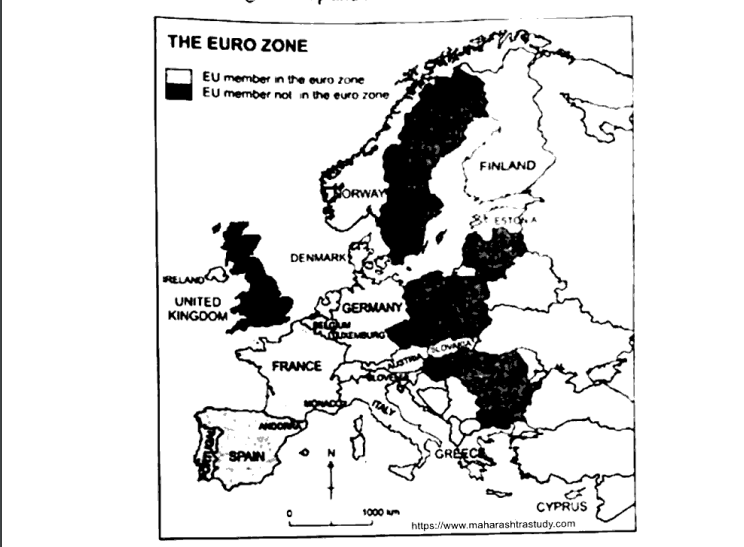
(i) Write the name of three countries of the European Union who are members of the Eurozone.
(ii) Write the name of two countries of the European Union who are not members of the Eurozone.
View Solution
(i) Three Eurozone countries:
Germany, France, Spain
(ii) Two non-Eurozone countries:
United Kingdom, Denmark
Question:3
State whether the following statements are True or False with reasons (Any FIVE):
(i) The decade of 1980s is seen as the golden age of humanitarian intervention.
(ii) Globalisation introduced the concept of Market Economy.
(iii) Planning Commission was established to promote development in the agricultural sector.
(iv) Good governance aims at efficient use of natural resources.
(v) National freedom movement in India played an important role in national integration.
(vi) Lokayukta can investigate complaints against political executives.
(vii) Democracy is required to establish national integration.
View Solution
(i) False.
The golden age of humanitarian intervention is more associated with the 1990s, after the Cold War, with cases like the Balkans and Rwanda.
(ii) True.
Globalisation spread market economies worldwide, leading to increased trade, capital flow, and privatization.
(iii) False.
The Planning Commission was established to promote economic development, including agriculture, industry, and services.
(iv) True.
Good governance includes promoting environmental sustainability and responsible use of resources.
(v) True.
The national freedom movement united diverse regions and communities in India in their fight for independence.
(vi) True.
The Lokayukta is a state-level body in India investigating corruption and misconduct by government officials.
(vii) True.
Democracy ensures equality, representation, and participation, fostering national integration.
Question:4
Explain the correlation between the following (Any THREE):
(i) Economic Interest and Trade Blocs.
View Solution
Economic interests are the primary driving force behind the formation of trade blocs. These blocs allow countries to work together to achieve mutual economic benefits, including increased trade, reduced tariffs, and shared economic growth. By joining trade blocs like the European Union (EU), Association of Southeast Asian Nations (ASEAN), or Mercosur, member countries can strengthen their economic ties and increase access to each other's markets.
View Solution
India and Africa have long-standing historical, economic, and cultural ties. India has significantly invested in Africa's infrastructure, energy, technology, and agricultural sectors. The India-Africa trade relationship has grown, with India becoming one of Africa's largest trading partners. India’s approach towards Africa is focused on enhancing cooperation in key areas such as agriculture, energy, healthcare, and infrastructure. Additionally, India has provided financial support for the development of various sectors within Africa through loans, grants, and capacity-building programs.
View Solution
Good governance is centered around the principles of transparency, accountability, participation, and rule of law. It seeks to ensure that governments serve the public effectively and efficiently while minimizing corruption. E-governance refers to the use of information and communication technology (ICT) to deliver government services, improve administrative processes, and enhance communication between government bodies and citizens.
View Solution
The General Agreement on Tariffs and Trade (GATT) was established in 1947 as a multilateral agreement aimed at reducing trade barriers, promoting international trade, and enhancing economic cooperation. GATT focused on reducing tariffs and establishing trade rules. However, in 1995, GATT was replaced by the World Trade Organisation (WTO), which took over the responsibility of administering international trade agreements. While GATT served primarily as a framework for trade negotiations, the WTO is a more robust institution with a broader mandate, including the regulation of trade-related intellectual property rights (TRIPs), dispute resolution, and trade policy reviews.
View Solution
Globalisation refers to the process of increasing interconnectedness and interdependence among the world’s economies, societies, and cultures. While globalisation promotes the free flow of goods, services, and ideas, it also has a profound impact on culture. On the one hand, globalisation has led to the spread of cultural ideas, practices, and values across borders, allowing cultures to influence each other. This has led to cultural exchange, the sharing of technology and knowledge, and the popularisation of global trends like music, fashion, and food.
Question:5
Express your opinion in 25 to 30 words on the following (Any THREE):
(i) There is a need to protect the environment.
View Solution
The protection of the environment is critical to prevent the depletion of natural resources, mitigate climate change, and safeguard biodiversity for future generations' well-being and prosperity.
View Solution
E-governance facilitates quicker decision-making, reduces corruption, and improves accessibility to public services, thus making governmental processes more efficient and transparent for citizens.
View Solution
India holds strategic importance in the Indian Ocean, ensuring maritime security, facilitating trade, and fostering diplomatic relations with neighboring nations, contributing to regional stability.
View Solution
Regionalism in international politics promotes cooperation within a region, strengthening economic, political, and security ties. However, it may lead to division and undermine global cooperation in certain instances.
View Solution
Globalisation encourages economic growth, cultural exchange, and technological progress. However, it also leads to economic inequality, cultural homogenization, and environmental challenges, requiring a balanced approach.
Question:6
Answer the following questions in 80 to 100 words (Any TWO):
(i) Discuss the political issues in the context of globalisation.
View Solution
Globalisation has led to greater interconnectedness between nations, but it also raises political issues such as the erosion of national sovereignty, unequal distribution of wealth, and the dominance of multinational corporations. This has caused tension between global governance and local governance, as well as challenges in maintaining cultural identity. Additionally, political instability can arise when domestic policies are influenced by global economic trends.
View Solution
Women empowerment refers to enabling women to have control over their lives, decisions, and resources. It includes improving their access to education, healthcare, economic opportunities, and political participation. Measures include legislation for gender equality, awareness campaigns, reservation policies, and support for women entrepreneurship. Programs like Beti Bachao Beti Padhao, and schemes for maternal health are further steps taken to promote women empowerment.
View Solution
The structural dimension for creating national unity involves political, social, and economic systems that ensure equality, representation, and access to resources. Key features include a well-established legal framework, equitable distribution of wealth and resources, and inclusive governance that represents all sections of society. It also emphasizes cultural diversity, freedom of expression, and the rule of law, while promoting national integration and harmony.
View Solution
India has several institutions that protect the rights of different sections, such as the National Human Rights Commission (NHRC), the National Commission for Women (NCW), and the National Commission for Scheduled Castes (NCSC). These bodies ensure the protection and promotion of rights for marginalized groups. The judiciary also plays a vital role in safeguarding the Constitution's guarantees of equality and justice for all citizens.
Question:7
Answer the following questions in 150 to 200 words with reference to the given points (Any ONE):
(i) Explain the principles of Indian foreign policy.
View Solution
The principles of Indian foreign policy are centered on the ideals of peace, stability, and international cooperation. These principles include:
Non-Alignment:
India followed the non-alignment policy to maintain its independence in decision-making without aligning with any power bloc during the Cold War. It aimed to remain neutral in international conflicts.
Sovereignty and Territorial Integrity:
India firmly upholds the principle of sovereignty and territorial integrity in its foreign relations, ensuring that no foreign interference disrupts its domestic affairs.
Non-Intervention in Internal Affairs:
India advocates for respecting the internal sovereignty of nations and believes in resolving conflicts without foreign interference.
Belief in Peaceful Co-existence:
India's foreign policy emphasizes the peaceful co-existence of nations, promoting mutual understanding, dialogue, and cooperation.
Active Participation in International Organizations:
India actively participates in international organizations like the United Nations, ASEAN, BRICS, and the Commonwealth, to foster multilateral cooperation.
View Solution
In the contemporary period, the role of the state is multifaceted, as it addresses various societal, political, and economic challenges. Some key roles of the state include:
Governance:
The state is responsible for creating and enforcing laws, ensuring justice, and promoting democratic values. Effective governance includes transparency, accountability, and ensuring the rule of law.
Economic Development:
The state plays a critical role in driving economic growth by regulating markets, providing infrastructure, promoting investments, and ensuring equitable distribution of resources.
Welfare:
The state must ensure the well-being of its citizens, especially marginalized sections, through welfare programs such as healthcare, education, and social security benefits.
Nation Building:
The state fosters national unity, cultural identity, and social harmony by promoting inclusivity and shared national goals.
Peace and Order:
The state is responsible for maintaining internal security, preventing conflicts, and ensuring that law and order prevail in society.





Comments