



MH Board Class 12 Geography Question Paper 2025 PDF is available for download here. The total marks for the theory paper are 80. Students described the paper as balanced, with a mix of straightforward and application-based questions.
MH Board Class 12 Geography 2025 Question Paper with Answer Key PDF
| MH Board Class 12 Geography 2025 Question Paper with Solutions PDF | Download PDF | Check Solutions |

MH Board Class 12 Geography 2025 Question Paper with Solutions
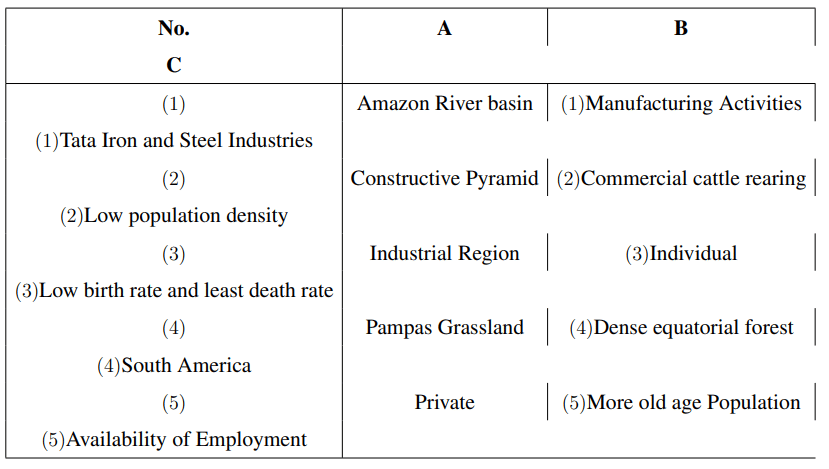
Appalachian mountain region of U.S.A has dense population because-
Ideal location for fishing.
In USA, industrial areas are found in the North-Eastern region.
Choose one subregion in the northern plain region of India.
Major physical factor which affects regional development.
A: Hardwood trees are found in equatorial evergreen forests.
R: Lumbering is not developed on a commercial level in equatorial regions.
A: In India, industrial areas are found concentrated in a few regions.
R: India is an agricultural country.
A: In tertiary occupation, there is no derivation from nature.
R: It provides only services so it is known as a service sector.
A: Each formal region has distinct boundaries which make them easy to identify.
R: Region is bounded by economic activities.
A: Physical or human factors are not static but highly dynamic. They change over time.
R: The earth is dynamic. We find there are variations in its physical and cultural environments.
Densely populated region due to mineral deposits -
Primary occupations depending upon natural resources -
Footloose industries:
Permanent Human Settlements are not found in Antarctica.
Factors studied in physical geography:
View Solution
Reasoning:
A higher literacy rate is directly linked to economic and social development. Educated individuals are more likely to participate in the workforce, contribute to technological advancements, and improve the overall standard of living, leading to better economic growth and development in society.
Quick Tip: Higher literacy rates improve workforce productivity and contribute to overall economic growth.
Agriculture is practised on a large scale in India.
Distribution of industries is uneven.
Industrial development is not found in Central Australia.
Factors like illiteracy, poverty affect regional development.
Land use and Land cover
Public sector industry and Private industry
Physical region and Political region
Regional development and Regional imbalance
Possibilism and Determinism
Thinly populated region of South America.
Show an African Country in the second phase of demographic transition.
Major administrative city in Maharashtra.
Area of animal husbandry in Australia.
Leading country of Asia in Fishing.
Cape of Good Hope waterways.
Nile River Basin.
Siberian Plateau.
Read the following map/graphs and answer the questions given below:

Questions:
Correlation between birth rate and death rate
Mixed land use
Hunting and loss of ecosystem
Role of transportation in industries
Importance of satellites as means of communication
Read the following passage and answer the questions given below:
Considering the latitudinal distribution of animal husbandry in the world, it is located between 30°N to 60°N and 30°S to 55°S latitudes.
Climate is one of the most influencing factors in the development of animal husbandry. It is more developed in the Northern Hemisphere. Presence of grasslands in Australia and North and South America has led to the distribution of this occupation. But, this occupation is influenced by advanced technology, market, and availability of large estates.
It has developed on a commercial basis in North America, South America, and Australia. The animal husbandry in North and South America is carried out with the help of advanced technology on a commercial scale.
Dense forests, inhospitable climate, low-quality fodder in the equatorial region has discouraged the development of animal husbandry in these regions.
Questions:
Stationary Pyramid
Circular Settlement
Relationship of Geography with Other Subjects
Answer the following questions in detail (ANY ONE):

Question 45:
Explain the human factors affecting the distribution of population.
Explain the factors affecting trade.



Comments