



Maharashtra Board Class 12 Biology Question Paper 2023 with Answer Key pdf is available for download here. The exam was conducted by Maharashtra State Board of Secondary & Higher Secondary Education (MSBSHSE) on March 7, 2023 in the Forenoon Session 11 AM to 2 PM. The question paper comprised a total of 31 questions divided among 4 sections.
Maharashtra Board Class 12 Biology Question Paper 2023 with Answer Key
| Maharashtra Board Class 12 Biology Question Paper | Maharashtra Board Class 12 Biology Answer Key + Solutions |
|---|---|
| Download PDF | Download PDF |
Histones are rich in _______.
View Solution
Histones are basic proteins that package DNA into nucleosomes in eukaryotic cells. They are rich in positively charged amino acids, specifically lysine and arginine, which facilitate binding to negatively charged DNA.
Answer: Lysine and Arginine. Quick Tip: Histones are basic due to lysine and arginine; recall their role in DNA packaging.
How many mitotic divisions take place during the formation of a female gametophyte from a functional megaspore?
View Solution
In angiosperms, the female gametophyte (embryo sac) develops from a functional megaspore through three mitotic divisions. The megaspore divides to form 2 nuclei, then 4, and finally 8 nuclei, resulting in a 7-celled, 8-nucleate embryo sac.
Answer: Three. Quick Tip: The female gametophyte requires three mitotic divisions to form the 8-nucleate embryo sac.
Which of the following is the only gaseous plant growth regulator?
View Solution
Ethylene is a gaseous plant hormone that regulates processes like fruit ripening and senescence. ABA, cytokinin, and gibberellin are not gases; they are typically solid or liquid compounds.
Answer: Ethylene. Quick Tip: Ethylene is unique as the only gaseous plant growth regulator; recall its role in ripening.
The pH of nutrient medium for plant tissue culture is in the range of _______.
View Solution
The nutrient medium for plant tissue culture, such as Murashige and Skoog medium, is typically maintained at a pH of 5 to 5.8 to optimize nutrient availability and cell growth.
Answer: 5 to 5.8.
Quick Tip: Plant tissue culture media are slightly acidic (pH 5–5.8) for optimal growth.
Rivet Popper Hypothesis is an analogy to explain the significance of _______.
View Solution
The Rivet Popper Hypothesis, proposed by Paul Ehrlich, uses an airplane analogy to illustrate the importance of biodiversity. Each species (rivet) contributes to ecosystem stability; removing species weakens the system, like removing rivets from an airplane.
Answer: Biodiversity.
Quick Tip: The Rivet Popper Hypothesis highlights the critical role of species diversity in ecosystems.
Which of the following group shows ZW-ZZ type of sex determination?
View Solution
ZW-ZZ sex determination is characteristic of birds, where females are ZW (heterogametic) and males are ZZ (homogametic). Pigeons, parrots, and sparrows are all birds, exhibiting this system. Bats and cats (mammals) have XX-XY systems.
Answer: Pigeon, Parrot, Sparrow.
Quick Tip: ZW-ZZ sex determination is typical in birds; mammals use XX-XY.
In Hamburger’s phenomenon, _______.
View Solution
Hamburger’s phenomenon (chloride shift) involves the diffusion of chloride ions (Cl\(^-\)) into red blood cells (RBCs) to balance the movement of bicarbonate ions out of RBCs during CO\(_2\) transport in blood.
Answer: Cl\(^-\) diffuse into RBCs.
Quick Tip: Hamburger’s phenomenon (chloride shift) maintains charge balance in RBCs during CO\(_2\) transport.
Calcium and Phosphate ions are balanced between blood and other tissues by ______.
View Solution
Collip’s hormone (parathormone) increases blood calcium and phosphate levels, while calcitonin decreases them, maintaining balance. Thymosin affects immunity, and somatostatin regulates other hormones.
Answer: Collip’s hormone and Calcitonin.
Quick Tip: Parathormone (Collip’s hormone) and calcitonin regulate calcium and phosphate homeostasis.
Identify the INCORRECT statement.
View Solution
- (A) True: In a flaccid cell, turgor pressure (T.P.) is zero due to no water pressure against the cell wall.
- (B) True: In a turgid cell, diffusion pressure deficit (DPD) is zero as the cell is fully saturated.
- (C) True: In a fully turgid cell, turgor pressure (TP) equals osmotic pressure (OP).
- (D) False: Water potential of pure water is zero (maximum), not negative.
Answer: Water potential of pure water is negative.
Quick Tip: Water potential of pure water is zero; understand TP, OP, and DPD in plant cells.
Which of the following is a hormone releasing contraceptive?
View Solution
LNG-20 is a hormone-releasing intrauterine device (IUD) that releases levonorgestrel, a progestin, to prevent pregnancy. Cu-T, Cu-7, and Multiload-375 are copper-based IUDs, not hormone-releasing.
Answer: LNG-20.
Quick Tip: Hormone-releasing IUDs release progestins; copper IUDs rely on copper ions for contraception.
Which disease is caused by HPV?
View Solution
Human Papillomavirus (HPV), particularly high-risk types like HPV-16 and HPV-18, is the primary cause of cervical cancer. It can also lead to other cancers such as anal, oropharyngeal, penile, vaginal, and vulvar cancers, but cervical cancer is the most commonly associated. Quick Tip: HPV vaccines (e.g., Gardasil) prevent infection by high-risk types, significantly reducing cervical cancer risk.
Which device is used to clean both dust and gases from polluted air?
View Solution
An electrostatic precipitator uses electric charges to attract and remove fine particles (dust) from exhaust gases and can also capture certain gaseous pollutants when combined with wet scrubbing. It is widely used in industrial settings for air pollution control. Quick Tip: Electrostatic precipitators achieve over 99% efficiency for particulate removal; wet scrubbers are used for gases.
Mention the name of sterile animal produced by intergeneric hybridisation.
View Solution
A mule is a sterile hybrid resulting from intergeneric hybridisation between a male donkey (Equus asinus) and a female horse (Equus caballus). Due to mismatched chromosomes (63 total), mules are almost always infertile. Quick Tip: Mules are valued for strength and endurance but cannot reproduce, exemplifying hybrid sterility.
Give the name of first transgenic plant.
View Solution
The first transgenic plant was tobacco (Nicotiana tabacum), developed in 1983 by inserting antibiotic resistance genes using Agrobacterium tumefaciens, marking the beginning of plant genetic engineering. Quick Tip: Tobacco's ease of transformation via Agrobacterium made it ideal for early transgenic experiments.
A child has low BMR, delayed puberty and mental retardation. Identify the disease.
View Solution
Cretinism, caused by congenital hypothyroidism (often due to iodine deficiency), results in low basal metabolic rate (BMR), delayed puberty, and mental retardation. It leads to stunted growth and developmental delays if untreated. Quick Tip: Cretinism is preventable with iodized salt; early thyroid hormone replacement is crucial.
Identify ‘A’ in the given graph of population growth.

View Solution
In a standard population growth graph (J-shaped or S-shaped curve), label 'A' typically refers to the initial exponential growth phase where population increases rapidly due to unlimited resources, before density-dependent factors limit growth. Quick Tip: Exponential phase occurs when birth rate exceeds death rate without environmental constraints.
Complete the following box with reference to symptoms of mineral deficiency:
Abscission: Pre-mature fall of flowers, fruits and leaves
______: Appearance of green and non-green patches on leaves
View Solution
Necrosis refers to the death of leaf tissues, often appearing as green and non-green patches due to mineral deficiencies (e.g., calcium or potassium). Abscission is premature shedding linked to deficiencies like boron. Quick Tip: Necrosis (tissue death) causes patchy discoloration; chlorosis is yellowing, while necrosis involves browning/dead spots.
Give an example of plant having both kidney and dumb-bell shaped guard cells in stomata.
View Solution
Cyperus (e.g., Cyperus esculentus) exhibits both kidney-shaped (typical of dicots) and dumbbell-shaped (typical of monocots) guard cells in its stomata, due to its transitional anatomy in the Cyperaceae family. Quick Tip: Kidney-shaped guard cells are in dicots; dumbbell-shaped in monocots; Cyperus shows variation.
Define the terms:
a. Gross Primary Productivity
b. Net Primary Productivity
View Solution
a. Gross Primary Productivity (GPP): The total rate of photosynthesis, including the organic matter used up by plants in respiration, measured as the amount of organic matter or energy produced per unit area per unit time.
b. Net Primary Productivity (NPP): The rate of organic matter stored by plants after accounting for losses due to respiration, expressed as \( NPP = GPP - Respiration losses \). It represents the biomass available for consumers.
Answer: GPP is total photosynthetic production; NPP is GPP minus respiration losses. Quick Tip: GPP includes all photosynthetic output; NPP is what remains for herbivores after plant respiration.
Draw a neat diagram of thyroid gland and label thyroid follicle, follicular cells, and blood capillaries.

View Solution
Below is a simplified LaTeX diagram using TikZ to represent the thyroid gland with labeled parts.
Answer: Diagram shows thyroid gland with thyroid follicle (central cavity), follicular cells (surrounding the follicle), and blood capillaries (adjacent vessels). Quick Tip: Thyroid follicles store thyroglobulin; follicular cells produce thyroid hormones, supported by blood capillaries.
i. Give reason – ABA is also known as antitranspirant.
ii. Explain the role of chlorophyllase enzyme in banana.
View Solution
i. Reason: Abscisic acid (ABA) is called an antitranspirant because it induces stomatal closure, reducing water loss through transpiration, especially under water stress conditions.
ii. Role of Chlorophyllase: Chlorophyllase in bananas catalyzes the breakdown of chlorophyll into chlorophyllide and phytol during ripening, leading to the yellowing of the fruit as chloroplasts convert to chromoplasts.
Answer: i. ABA reduces transpiration; ii. Chlorophyllase degrades chlorophyll during banana ripening. Quick Tip: ABA regulates water loss; chlorophyllase drives color change in ripening fruits.
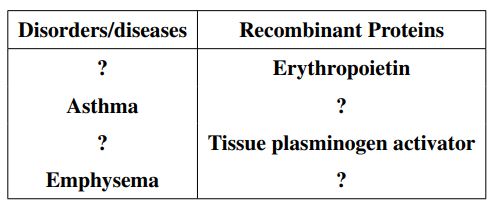
Complete the chart showing human proteins produced by rDNA technology to treat human diseases and re-write.
View Solution
- Erythropoietin treats anemia (stimulates red blood cell production).
- Asthma is treated with Omalizumab (anti-IgE antibody).
- Tissue plasminogen activator treats stroke or heart attack (dissolves blood clots).
- Emphysema is treated with Alpha-1 antitrypsin (prevents lung tissue breakdown).
Completed chart:

Quick Tip: Match recombinant proteins to their therapeutic roles; e.g., erythropoietin for anemia, omalizumab for asthma.
i. Define – Imbibition
ii. Explain how imbibition helps root hairs in adsorption of water.
View Solution
i. Imbibition: The process by which dry colloidal substances (e.g., cell walls, proteins) absorb water, causing swelling due to their affinity for water molecules.
ii. Role in Root Hairs: Root hair cell walls, rich in cellulose, imbibe water, creating a water potential gradient. This facilitates water adsorption into root hairs, aiding absorption from soil to root cells.
Answer: i. Imbibition is water absorption by colloids; ii. It drives water uptake in root hairs via cell wall swelling.
Quick Tip: Imbibition initiates water uptake in seeds and root hairs due to colloidal properties.
Draw a neat diagram of the conducting system of human heart and label AV node, Bundle of His, and Purkinje fibres.
View Solution
Below is a simplified LaTeX diagram using TikZ for the heart’s conducting system.
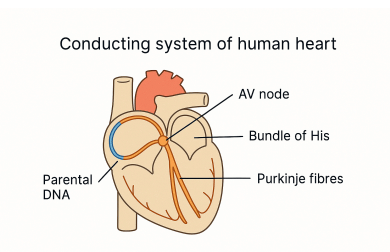
Answer: Diagram shows AV node (central relay), Bundle of His (conduction pathway), and Purkinje fibres (ventricular spread).
Quick Tip: The conducting system ensures coordinated heart contractions; AV node delays, Bundle of His and Purkinje fibres distribute signals.
Distinguish between heterochromatin and euchromatin with reference to staining property and activity.
View Solution

Answer: Heterochromatin is darkly stained and inactive; euchromatin is lightly stained and active.
Quick Tip: Heterochromatin’s density reduces gene expression; euchromatin’s open structure allows active transcription.
Complete the following chart regarding energy flow in an Ecosystem and re-write:

View Solution
- Herbivores are primary consumers.
- Primary producers are plants/phytoplankton.
- Man and lion are tertiary consumers.
- Secondary consumers are carnivores/omnivores (e.g., frogs, spiders).
Completed chart:

Quick Tip: Energy flows from producers to primary, secondary, and tertiary consumers in ecosystems.
i. What is biofortification?
ii. Mention one example each of fortification with reference to –
a. Amino acid content
b. Vitamin-C content
View Solution
i. Biofortification: The process of breeding or genetically modifying crops to increase their nutritional content (e.g., vitamins, minerals, amino acids) to improve human health.
ii. Examples:
a. Amino Acid Content: Quality Protein Maize (QPM) with enhanced lysine and tryptophan.
b. Vitamin-C Content: Biofortified tomatoes with increased vitamin C levels.
Answer: i. Biofortification enhances crop nutrition; ii. a. QPM, b. Biofortified tomatoes.
Quick Tip: Biofortification targets nutrient deficiencies; examples include QPM for amino acids, golden rice for vitamin A.
Differentiate between X-chromosome and Y-chromosome with reference to –
i. length of non-homologous regions
ii. type as per position of centromere.
View Solution
| Feature | X-Chromosome | Y-Chromosome |
| Length of Non-Homologous Regions | Longer (large non-homologous region) | Shorter (small non-homologous region) |
| Type as per Centromere Position | Metacentric/Submetacentric | Acrocentric |
Answer: X has longer non-homologous regions and is metacentric/submetacentric; Y has shorter regions and is acrocentric.
Quick Tip: X and Y differ genetically; non-homologous regions drive sex-linked traits, centromere position defines chromosome type.
Define the terms:
i. Genetic drift
ii. Homologous organs
View Solution
i. Genetic Drift: Random changes in allele frequencies in a population, especially in small populations, leading to loss or fixation of alleles independent of natural selection.
ii. Homologous Organs: Organs with similar structure and embryonic origin but different functions, indicating common ancestry (e.g., human arm and whale flipper).
Answer: i. Genetic drift is random allele frequency change; ii. Homologous organs share origin but differ in function.
Quick Tip: Genetic drift is significant in small populations; homologous organs reflect evolutionary divergence.
i. What is ex-situ conservation?
ii. Mention any two places where the ex-situ conservation is undertaken.
View Solution
i. Ex-Situ Conservation: Conservation of species outside their natural habitats, such as in zoos, botanical gardens, or seed banks, to protect biodiversity.
ii. Places:
a. National Botanical Garden, Lucknow
b. Arignar Anna Zoological Park, Chennai
Answer: i. Ex-situ conservation is off-site species protection; ii. National Botanical Garden, Arignar Anna Zoological Park.
Quick Tip: Ex-situ conservation preserves species in controlled environments; contrast with in-situ (natural habitats).
i. Define – Incomplete dominance.
ii. If a red flowered Mirabilis jalapa plant is crossed with a white flowered plant, what will be the phenotypic ratio in F2 generation? Show it by a chart.
View Solution
i. Incomplete Dominance: A genetic phenomenon where neither allele is completely dominant, resulting in an intermediate phenotype in heterozygotes (e.g., pink flowers in Mirabilis jalapa from red and white parents).
ii. F2 Phenotypic Ratio:
Let red flower allele = \( R \), white flower allele = \( r \).
- Parents: Red (\( RR \)) × White (\( rr \)) → F1: Pink (\( Rr \)).
- F1 self-cross: \( Rr \times Rr \).
Punnett Square:

F2 phenotypic ratio: 1 Red : 2 Pink : 1 White.
Answer: i. Intermediate phenotype in heterozygotes; ii. 1:2:1 (Red:Pink:White).
Quick Tip: In incomplete dominance, heterozygotes show a blended trait; use Punnett square for F2 ratios.
i. Differentiate between sympathetic and parasympathetic nervous system with reference to:
a. Pre and post ganglionic nerve fibres.
b. Effect on heart beat.
ii. Give reason – All spinal nerves are of mixed type.
View Solution
i. Differentiation:
| Feature | Sympathetic | Parasympathetic |
| Pre and Post Ganglionic Fibres | Short pre-ganglionic, long post-ganglionic | Long pre-ganglionic, short post-ganglionic |
| Effect on Heart Beat | Increases heart rate | Decreases heart rate |
ii. Reason: Spinal nerves are mixed because they contain both sensory (afferent) and motor (efferent) fibres, carrying sensory signals to the spinal cord and motor signals to muscles/glands.
Answer: i. Sympathetic has short pre-ganglionic, increases heart rate; parasympathetic has long pre-ganglionic, decreases heart rate; ii. Spinal nerves carry both sensory and motor fibres.
Quick Tip: Sympathetic prepares for "fight or flight"; parasympathetic promotes "rest and digest"; mixed nerves have dual roles.
i. Draw a suitable diagram of replication of eukaryotic DNA and label any three parts.
ii. How many amino acids will be there in the polypeptide chain formed on the following mRNA?
\( 5' GCCACAUGGAGAUGACGACAAAAUUUUACUAGAAAA 3' \)
View Solution
i. Diagram: Simplified TikZ diagram of DNA replication fork.

ii. Amino Acid Count:
Start codon: AUG (position 7–9). Stop codon: UAG (position 28–30).
Coding region: AUGGAGAUGACGACAAAAUUUUACUAG (21 nucleotides).
Number of codons = \( 21 \div 3 = 7 \).
Subtract stop codon (not translated): 6 amino acids.
Answer: i. Diagram labels Leading Strand, Lagging Strand, Replication Fork; ii. 6 amino acids.
Quick Tip: DNA replication forms leading and lagging strands at the fork; count codons between start and stop for amino acids.
Describe the steps in breathing.
View Solution
Breathing involves:
1. Inspiration: Diaphragm contracts, thoracic cavity expands, intrapulmonary pressure decreases, air enters lungs.
2. Expiration: Diaphragm relaxes, thoracic cavity contracts, intrapulmonary pressure increases, air is expelled.
Answer: Inspiration (air intake via diaphragm contraction) and expiration (air expulsion via relaxation).
Quick Tip: Breathing relies on pressure changes driven by diaphragm and intercostal muscle movements.
i. What is spermatogenesis?
ii. Draw a neat and labelled diagram of spermatogenesis.
View Solution
i. Spermatogenesis: The process of sperm cell formation in the testes, involving mitosis, meiosis, and differentiation to produce mature spermatozoa from spermatogonia.
ii. Diagram: Simplified TikZ diagram.
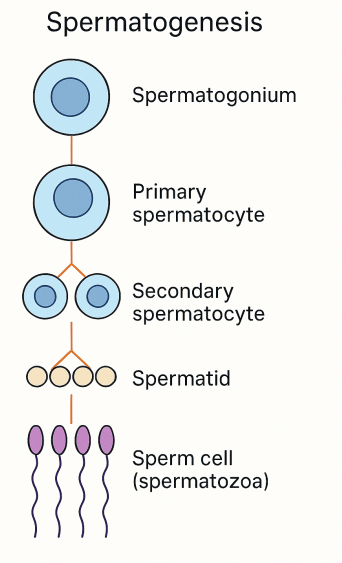
Answer: i. Sperm formation via mitosis and meiosis; ii. Diagram labels Spermatogonia, Primary Spermatocyte, Spermatozoa.
Quick Tip: Spermatogenesis occurs in seminiferous tubules; stages include spermatogonia to spermatozoa.
i. What is a connecting link?
ii. Which fossil animal is considered as the connecting link between reptiles and birds? Give any one character of each class found in it.
View Solution
i. Connecting Link: An organism exhibiting characteristics of two taxonomic groups, indicating evolutionary transitions.
ii. Fossil Animal: Archaeopteryx
- Reptilian Character: Presence of teeth.
- Avian Character: Presence of feathers.
Answer: i. Organism bridging two groups; ii. Archaeopteryx, with teeth (reptile) and feathers (bird).
Quick Tip: Connecting links like Archaeopteryx show transitional traits, supporting evolutionary theory.
Complete the following chart regarding population interaction and re-write:

View Solution
- Plasmodium and Man: Parasitism (Plasmodium benefits, man harmed).
- Leopard and Lion: Competition (compete for resources).
- Clown fish and Sea-anemone: Mutualism (both benefit).
Completed chart:

Quick Tip: Population interactions include mutualism, competition, and parasitism; identify benefits/harm to species.
i. What is composition of bio-gas?
ii. Mention any four benefits of bio-gas.
View Solution
i. Composition: Bio-gas primarily contains methane (50–70%), carbon dioxide (30–40%), and traces of hydrogen sulfide, nitrogen, and water vapor.
ii. Benefits:
1. Renewable energy source.
2. Reduces greenhouse gas emissions.
3. Utilizes organic waste, reducing landfill use.
4. Provides clean fuel for cooking/heating.
Answer: i. Methane, CO\(_2\), traces of H\(_2\)S, N\(_2\); ii. Renewable, reduces emissions, waste management, clean fuel.
Quick Tip: Bio-gas is methane-rich; its benefits include sustainability and waste reduction.
i. Give reason – Water acts as thermal buffer.
ii. Draw a neat and proportionate diagram of root hair and label mitochondria, nucleus, and vacuole.
View Solution
i. Reason: Water has a high specific heat capacity, allowing it to absorb and release large amounts of heat with minimal temperature change, stabilizing environmental and organismal temperatures.
ii. Diagram:

Answer: i. High specific heat stabilizes temperature; ii. Diagram labels Nucleus, Vacuole, Mitochondria.
Quick Tip: Water’s thermal buffering is due to high specific heat; root hair organelles support absorption.
Explain three main functions of free antibodies produced by B-lymphocytes.
View Solution
1. Neutralization: Antibodies bind to pathogens or toxins, preventing them from infecting cells or causing harm.
2. Opsonization: Antibodies mark pathogens for phagocytosis by immune cells like macrophages.
3. Complement Activation: Antibodies trigger the complement system, leading to pathogen lysis or enhanced immune response.
Answer: Neutralization, opsonization, complement activation.
Quick Tip: Antibodies enhance immune response by targeting pathogens for neutralization, phagocytosis, or lysis.
i. Following are the diagrams of entry of pollen tube into ovule. Identify the type A and B.

ii. Give any four points of significance of double fertilization.
View Solution
i. Types of Pollen Tube Entry:
- Type A: Porogamy (pollen tube enters via micropyle).
- Type B: Chalazogamy (pollen tube enters via chalaza).
ii. Significance of Double Fertilization:
1. Ensures formation of both embryo (from egg fertilization) and endosperm (from polar nuclei fertilization).
2. Provides nutrition to developing embryo via endosperm.
3. Enhances reproductive efficiency in angiosperms.
4. Promotes genetic diversity through two fertilization events.
Answer: i. A: Porogamy, B: Chalazogamy; ii. Embryo/endosperm formation, nutrition, efficiency, genetic diversity.
Quick Tip: Double fertilization is unique to angiosperms; porogamy is the most common pollen tube entry.
i. Name the hormone which is responsible for apical dominance.
ii. A farmer wants to remove broad-leaved weeds from the jowar plantation in his field. Suggest any plant hormone to remove such weeds.
iii. Mention any two applications of cytokinin.
View Solution
i. Hormone: Auxin (e.g., IAA) is responsible for apical dominance, inhibiting lateral bud growth.
ii. Hormone for Weeds: 2,4-D (synthetic auxin) selectively kills broad-leaved weeds without harming monocots like jowar.
iii. Applications of Cytokinin:
1. Promotes cell division in tissue culture.
2. Delays senescence in leaves.
Answer: i. Auxin; ii. 2,4-D; iii. Cell division, delays senescence.
Quick Tip: Auxins control growth patterns; synthetic auxins like 2,4-D are selective herbicides; cytokinins promote growth and longevity.
i. What is blood pressure?
ii. Give the name of the instrument which is used to measure the blood pressure.
iii. Differentiate between an artery and a vein with reference to lumen and thickness of wall.
View Solution
i. Blood Pressure: The force exerted by circulating blood against the walls of blood vessels, primarily arteries, measured as systolic (during heart contraction) and diastolic (during heart relaxation) pressures, typically in mmHg.
ii. Instrument: Sphygmomanometer
iii. Differentiation:
| Feature | Artery | Vein |
| Lumen | Narrow, smaller Diameter | Wider, larger diameter |
| Thickness of Wall | Thicker, with more muscle and elastic tissue | Thinner, with less muscle and elastic tissue |
Answer: i. Force of blood on vessel walls; ii. Sphygmomanometer; iii. Artery: narrow lumen, thick wall; Vein: wide lumen, thin wall.
Quick Tip: Blood pressure reflects cardiovascular health; arteries have robust walls for high pressure, veins have wider lumens for low pressure.
i. Describe any three adaptations in anemophilous flowers. Mention any one example of the anemophilous flower.
ii. Describe any three adaptations in hydrophilous flowers. Mention any one example of the hydrophilous flower.
View Solution
i. Anemophilous Flowers:
- Large amounts of light, dry pollen to facilitate wind dispersal.
- Exposed stamens and stigmas to maximize pollen transfer.
- Lack of nectar or bright colors, as no insect attraction is needed.
Example: Maize (Zea mays).
ii. Hydrophilous Flowers:
- Pollen grains with mucilaginous coating to prevent water damage.
- Submerged or floating flowers to enable water-mediated pollination.
- Reduced petals to minimize water resistance.
Example: Vallisneria.
Answer: i. Light pollen, exposed reproductive parts, no nectar; e.g., Maize. ii. Mucilaginous pollen, aquatic flowers, reduced petals; e.g., Vallisneria.
Quick Tip: Anemophilous flowers rely on wind, hydrophilous on water; adaptations optimize pollen transfer in their medium.
104i. What is polymerase chain reaction (PCR)?
ii. Describe three steps involved in mechanism of PCR.
View Solution
i. PCR: A molecular biology technique used to amplify specific DNA segments in vitro, utilizing thermal cycling, primers, and DNA polymerase to produce multiple copies of a DNA sequence.
ii. Steps in PCR:
1. Denaturation: Heating to 94–98°C to separate double-stranded DNA into single strands.
2. Annealing: Cooling to 50–65°C to allow primers to bind to complementary DNA sequences.
3. Extension: Heating to 72°C for DNA polymerase to synthesize new DNA strands from primers.
Answer: i. DNA amplification technique; ii. Denaturation, annealing, extension.
Quick Tip: PCR amplifies DNA exponentially; each cycle doubles the target sequence.
i. Give any four significances of fertilization in human.
ii. Mention the names of any two organs each derived from ectoderm and mesoderm.
View Solution
i. Significances of Fertilization:
1. Initiates embryo development by forming a zygote.
2. Restores diploid chromosome number (46 in humans).
3. Triggers genetic recombination, promoting diversity.
4. Activates egg for development via sperm penetration.
ii. Organs:
- Ectoderm: Skin, Brain.
- Mesoderm: Heart, Muscles.
Answer: i. Zygote formation, diploidy, genetic diversity, egg activation; ii. Ectoderm: Skin, Brain; Mesoderm: Heart, Muscles.
Quick Tip: Fertilization ensures genetic continuity; embryonic germ layers (ectoderm, mesoderm) form specific organs.
i. Give any two functions of cerebellum.
ii. Write the names of any four motor cranial nerves with their appropriate serial number.
iii. Which hormones stimulate liver for glycogenesis and glycogenolysis?
View Solution
i. Cerebellum Functions:
1. Coordinates voluntary movements and balance.
2. Regulates muscle tone and motor learning.
ii. Motor Cranial Nerves:
1. Oculomotor (III)
2. Trochlear (IV)
3. Abducens (VI)
4. Hypoglossal (XII)
iii. Hormones:
- Glycogenesis: Insulin (promotes glucose storage as glycogen).
- Glycogenolysis: Glucagon (promotes glycogen breakdown to glucose).
Answer: i. Movement coordination, muscle tone; ii. Oculomotor (III), Trochlear (IV), Abducens (VI), Hypoglossal (XII); iii. Insulin, Glucagon.
Quick Tip: Cerebellum ensures smooth movements; insulin stores glucose, glucagon releases it.



Comments