



| Updated On - May 7, 2026
Ireland is among Europe’s fastest-growing study destinations, with 40,000+ international students enrolled in 2026. Students who are willing to study in Ireland can easily apply for a student visa, depending on the tenure of their course.
There are two types of student visas in Ireland that are:
- C-type visa(short stay), and
- D-type visa(long stay)
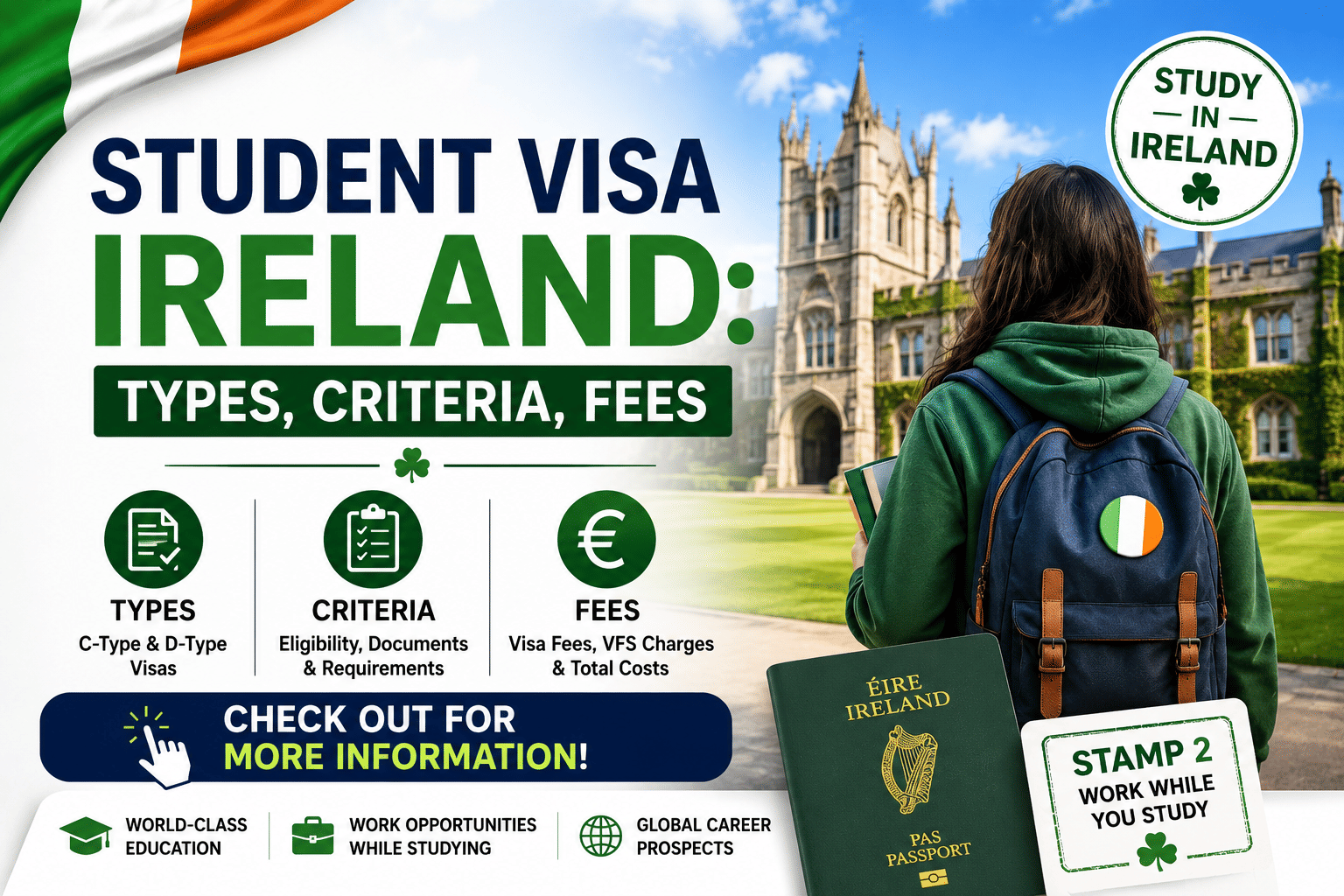
Visa fees include €60 (₹6,660) for a single entry, €100 (₹11,100) for multiple entries, and a mandatory VFS service charge of €22 (₹2,442). A D-type visa is mainly preferred by Indian students as it brings employment and residency opportunities.
Note: €1 = ₹111 is the currency conversion taken throughout the article as of 1st May, 2026.
Also read,
- Types of Student Visa Offered by Ireland
- Criteria for a Student Visa in Ireland
2.1 Documents required for a student visa in Ireland
- What are the Fees for a Student Visa in Ireland?
- Employment Opportunities with a Student Visa in Ireland
- Total Expenditure on Education in Ireland
- Annual Living Expenses of Indian Students in Ireland
- FAQs
Types of Student Visa Offered by Ireland
Students need to review the courses they are willing to study and note the tenure of each course. There are two student visa permits issued by the Immigration Service Delivery (ISD), Ireland.
C-style visa permitted for those students whose course lasts only for 90 days. The student cannot stay longer than 3 months with a C-type visa.
- The student must leave immediately.
- If the student wishes to stay longer, s/he can apply for a visa only after their return.
- Application sheets and proof of home return should be attested for a C visa.
D-style visa permitted for those students who are to stay and study in Ireland for more than 90 days or 3 months. A type D visa can allow
- A longer stay in Ireland.
- Brings employment opportunities
- Students can also register for an Irish Residence Permit(IRP).
Also read,
Criteria for a Student Visa in Ireland
To own a student visa in Ireland, a student must have a 'letter of enrolment’, and should be enrolled in a full-time course on the Interim List of Eligible Programmes (ILEP). The student should have paid the fees. A D-type visa is generally preferred more by Indian students than a C-type visa, as it has a shorter tenure.
Documents required for a student visa in Ireland
To get a D-Study visa, the student must have valid travel documents, IELTS proficiency, and evidence of funds for the expenses to be covered during the course. The student will also need to appear for an interview at Ireland embassy or consulate.
The list of required documents for a study visa is as follows
- A 12-month valid passport or a valid travel document.
- The passport must be valid for 12 months after the proposed date of arrival in Ireland.
- Letter of enrollment in a recognised Irish institution.
- Passport-sized coloured photographs.
- Score of IELTS or any other English proficiency test.
- Evidence/receipt of the payment for the course to the Irish institution.
- The student must ensure a fund of €10,000 (₹12.9 lakhs) to provide for the living expenses for the duration of the course.
- Proof that accounts for educational gaps(if any).
- Details of Health insurance.
- Biometric information.
- Statement of Purpose stating their objectives.
- A statement of commitment ensuring that the student leaves on the expiry of the visa.
- Evidence of academic qualifications for the chosen course.
- 6.5 band is the minimum IELTS score required to apply for a student visa in Ireland.
Note: The documents which are not in English must be translated into English. The student must provide the details of the translator, along with the date of translation. The student should also provide the translator`s confirmation of the accurate translation of the original documents submitted.
What are the Fees for a Student Visa in Ireland?
The students can pay the fees for the application process and initiate the process by visiting the nearby Visa Facilitation Services Global (VFS). It is a private outsourcing and tech company that manages visa application centres.
- The primary role of VFS is to take biometrics, application checking documents and forwarding the documents to the Irish consulates.
- Applicants need to pay a €22 service fee (₹2,449), which is unavoidable. It is a mandatory service which works on the application process.
The fees for the student visa in Ireland can vary from a single entry to multiple entries in Ireland.
- A single-entry visa allows the holder to enter Ireland only once. The fees for a single entry are €60 (₹7,745).
- A multiple-entry visa allows the holder to re-enter Ireland within the valid period. While multiple entries can cost €100 (₹12,909). The transit fees are €25 (₹3,226).
Note: These fees are just to initiate the process of application and are non-refundable. The fees don't ensure the approval of the visa. In case of rejection of the form, the application fees will not be refunded.
Also read, Scholarships in Ireland for International Students
Employment Opportunities with a Student Visa in Ireland
Being a student of ILEP, the visa holds ‘stamp number 2’, which gives the student the opportunity to work in Ireland while studying and continuing their course. A student generally gets ‘stamp 2A’. A student can take up casual employment, part-time and work for 20 hours per week and earn €14.15 (₹1,575) according to the Irish National Minimum Wage effective 1 January 2026.
During the vacations, the working hours increase up to 40 hours per week and earn €10,188 (₹11.34 Lakhs) during the vacations. The vacation generally falls from June to September, and from 15 December to 15 January.
Note: The employment lasts only till the validity of the visa. Once the visa expires, the student can no longer hold any office or work.
Also read:
Total Expenditure on Education in Ireland
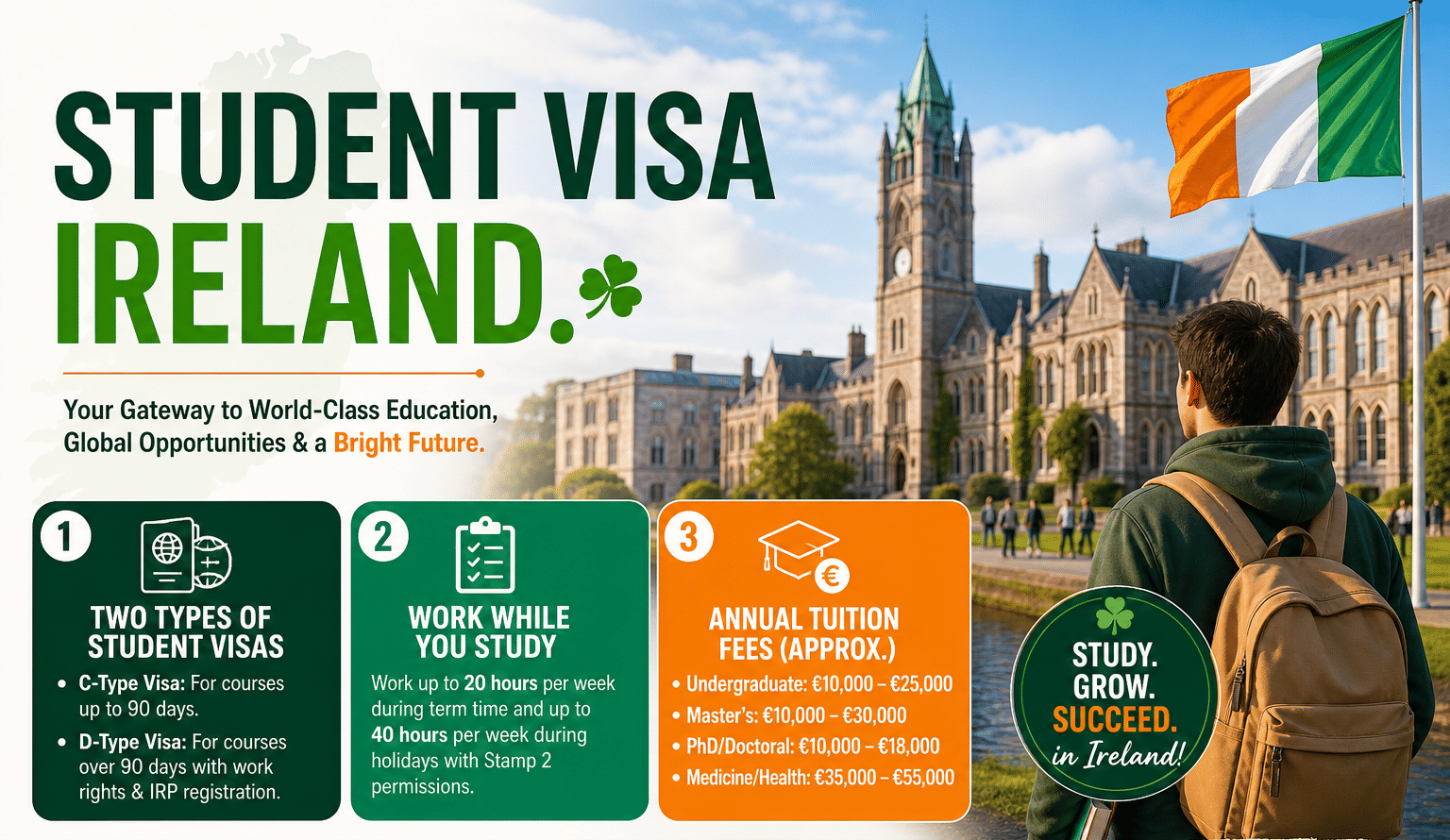
The total cost of expenditure can vary from course to course. The annual fees of undergraduates are comparatively higher than the high-yielding courses, such as PhD and medical studies.
| Level of study | Annual fees in Euro | Annual fees in INR |
|---|---|---|
| Undergraduate | €10,000 - €25,000 | ₹11.1 - ₹27.7 Lakhs |
| Master`s | €10,000 - €30,000 | ₹11.1 - ₹33.3 Lakhs |
| PhD/Doctoral | €10,000 - €18,000 | ₹11.1 - ₹20.0 Lakhs |
| Medicine/Health | €35,000 - €55,000 | ₹38.8 - ₹61.0 Lakhs |
| MBA | €10,000 - €40,000 | ₹11.10 - ₹44.40 lakhs |
Annual Living Expenses of Indian Students in Ireland
The annual living expenses can vary from region to region. A centrally located area will usually have a higher cost of living. Location is a major factor which affects the cost of living. Dublin is significantly more expensive than Limerick or Waterford.
| Expense Category | Monthly Cost (EUR) | Monthly Cost (INR) |
|---|---|---|
| Accommodation | €500 - €1,200 | ₹55,000 - ₹1.33 Lakhs |
| Food & Groceries | €250 - €400 | ₹27,000 - ₹44,000 |
| Transport | €60 - €100 | ₹6,600 - ₹11,000 |
| Utilities & Mobile | €100 - €150 | ₹11,000 - ₹16,600 |
| Total Monthly | €910 - €1,850 | ₹1 - ₹2 Lakhs |
| Total | €910 - €1,850 | ₹1 - ₹2.05 lakhs |
Also read: Study for free in Ireland
In 2026, Ireland offers Indian students structured affordability, with monthly living expenses ranging from €910 - €1,850 (₹1.01 lakh - ₹2.05 lakh) depending on the city. Visa requirements remain financially defined, including a mandatory €10,000 (₹11.10 lakh) proof of funds and visa fees between €60 - €100 (₹6,660 - ₹11,100) plus a €22 (₹2,442) VFS charge.
Students can also offset costs through part-time work, earning €14.15 per hour (₹1,571). With clear financial benchmarks across living, visa, and employment parameters, Ireland continues to present a transparent and data-backed pathway for Indian students.
FAQs
Ques. Can I get an Irish PR in 2 years?
Ans. The PR permit depends upon the visa permit a person holds. General Employment Permit users can apply for PR after they have lived in Ireland for 5 years. Whereas the Critical Skills Employment Permit holders can apply for PR just after 2 years.
Ques. How to get a PR in Ireland after studying?
Ans. Students who are planning to study and settle in Ireland need to secure a job first. To become a permanent resident of Ireland
- The student needs to transform their student visa into a work permit.
- A student needs to obtain Stamp 1G and live in Ireland for 5 years with a secured job.
- They can get a Critical Skills Employment Permit (CSEP), and then can apply for PR.
Ques. Which job is in high demand in Ireland?
Ans. In 2026, there's a high demand for skilled labour in the IT industry. Other major sectors, such as engineering, healthcare, and finance, are in high demand for skilled labour. Top roles such as software developers, data scientists, civil engineers, mechanical engineers and electrical engineers are also sectors with high employment. Cybersecurity, AI and biopharma are also lacking skilled labour.
Ques. How long can I stay and work in Ireland after my degree?
Ans. Undergraduates can stay for one year to find a job. At the same time, master's and PhD students can get 2 years to find a job under the Third-level Graduate Scheme.
Ques. Are there full scholarships available for Indian students in Ireland?
Ans. The Government of Ireland provides a 100% tuition fee waiver to master's students. PhD students can get a €25,000 (₹27,83,500) annual stipend for up to four years. The Indian government provides scholarships to students.



Comments