



At least one question on the CAT has to come from this part. Whenever there is a question about logarithm, the question is about how logarithm is used, and the reasoning behind the question is the use of logarithm. Another thing I want to say is that many students are afraid of this chapter. But I think they should not worry about the word "logarithm." Instead, they should think of logarithm problems as problems with exponents, and most of them can be answered quickly by plotting a graph. This part is important for tests like SNAP, MAT, IIFT, JMET, and XAT, among others.
Exponential Function
[Click Here for Previous Year CAT Questions]
For every x ∈ R, ex = \(1+ x+ \frac{x^2}{2!} + \frac{x^3}{3!} + ......or\ e^x = \Sigma \frac{x^n}{n!}\), where n = 1 to ∞.
ex is exponential function and it is a finite number for every x ∈R.

Properties
For every x ∈ R, ex is defined, then
(i) ex > 0 for all x ∈R and e0 =1
(ii) ea >eb if a>b and a,b∈R
(iii) ea × eb = e(a + b) for all a, b∈R
(iv) ea ÷ eb =e(a − b) for all a, b∈R
(v) (ea)b = eab for all a, b∈R
(vi) For each positive real number x there exists one and only one real number y such that ey = x
(vii) ex is one-one function
(viii) e ≈ 2.714
Logarithm
[Click Here for Previous Year CAT Questions]
Let a,b be positive real numbers
So, ax =b can be written as
loga b = x a \(\neq 1\), a > 0, b > 0
Ex:- 35 = 243 \(\Leftrightarrow\) log3 243 = 5
Types of Logarithms
[Click Here for Previous Year CAT Questions]
(I) Natural Logarithm : loge N is called natural Logarithm or Naperian Logarithm denoted by (ln N) i.e., when logarithm’s base is “e” then it is called natural logarithm. Ex: loge 7
(II) Common Logarithm : log10 N is called Brigg’s Logarithm when the base is 10. Ex: log10 100
Logarithm properties
[Click Here for Previous Year CAT Questions]
- loga 1 = 0, a > 0, a \(\neq\) 1
- loga a = 1, a > 0, a \(\neq\) 1
- Loga ax = x, x \(\forall\) x \(\in\) R, x >0
- aloga x = x, x \(\forall\) x \(\in\) R, x >0
- loga (m.n) = loga m + loga n, n \(\forall\) m, n > 0, a > 0, a \(\neq\) 1
- loga (m/n) = loga m – loga n, n \(\forall\) m, n > 0, a > 0, a \(\neq\) 1
- loga (mn) = n loga m, m \(\forall\) m, m > 0, a > 0, a \(\neq\) 1
- loga (\(\frac{1}{m}\)) = – loga m, m \(\forall\) m, n > 0, a > 0, a \(\neq\) 1
- loga (b) = \(\frac{1}{log_b a} = \frac{log_C b}{log_c a}\)\(\forall\) a,b,c > 0, a \(\neq\)1, b \(\neq\)1, c \(\neq\)1
- loga b = x \(\forall\) a, b > 0, a \(\neq\) 1 and x \(\in\) R
(I) log1/a b = – x (II) loga \((\frac{1}{b})\) = – x (III) log1/a \((\frac{1}{b})\) = – x
- logam b = \(\frac{1}{m}\) loga b
- loga x is a decreasing function, if 0 < a < 1
- loga x is a increasing function, if a > 1
- When 0 < a < 1 then
loga b \(\geq\) loga c, \(\Leftrightarrow\) b \( \leq\) c
loga b \(\geq\) c, \(\Leftrightarrow\) b \( \leq\) ac
- When a >1
loga b \(\geq\) loga c, \(\Leftrightarrow\) b \(\geq\) c > 0
loga b \(\geq\) c, \(\Leftrightarrow\) b \(\geq\) ac
Characteristics and Mantissa
[Click Here for Previous Year CAT Questions]
Characteristic: The integral part of logarithm is known as characteristic.
Mantissa: The decimal part is known as mantissa and is always positive
In log 3274 = 3.5150, the integral part is 3 i.e., characteristic is 3 and the decimal part is .5150 i.e., mantissa is .5150.
Points to Remember About Characteristics
[Click Here for Previous Year CAT Questions]
- The characteristic of common logarithm of positive number less than unity (i.e.,1) is negative.
- The characteristic of common logarithm of a positive number greater than 1 is positive.
- If the logarithm to any base a gives the characteristic ‘n’, then the number of possible integral values is given by an+1 −an. For example log10 x = n.abcd, then the number of integral values that x can have given by 10n+1 −10n
- If the characteristic of log10 x is negative (i.e., − n), then the number of zeros between the decimal and the first significant number after the decimal is (n −1)
Important Conversions
[Click Here for Previous Year CAT Questions]
- For a > 1, a 1, c > 0, a b > c \(\Leftrightarrow\) loga c < b
- For 0 < a < 1, a 1, c > 0, a b > c \(\Leftrightarrow\) loga c > b
Previous year CAT questions
Ques 1: Find x, if \(log_{2x} \sqrt x + log_{2\sqrt x} x = 0\). (CAT 2015)
Click Here for the Answer
Solution:

log2x = 0 then x = 20=1
log2x = -(6/5) then x = 2-(6/5)
x = 1 and x = 2-(6/5)
Ques 2: If x ≥ y and y > 1, then the value of the expression logx (\(\frac{x}{y}\)) + logy (\(\frac{y}{x}\))can never be (CAT 2014)
- −1
- −0.5
- 0
- 1
Click Here for the Answer
Solution: (D)
Let P = logx \(\frac{x}{y}\)+ logy\(\frac{y}{x}\)
= logx x - logx y + logy y - logy x
=2 - logx y – logy x
Again let t = logx y
p = 2 – \(\frac{1}{t}\) – t = – \((\sqrt t-\frac{1}{\sqrt t}) ^2\)
Which can never be 1.
Ques 3: What is the sum of n terms in the series log m + log \((\frac{m^2}{n})\) + log \((\frac{m^3}{n^2})\) + log \((\frac{m^4}{n^3})\) …….? (CAT 2014)
- \(log [ \frac{n^{(n-1)}}{m^{(n+1)}} ]^{n/2}\)
- \(log [ \frac{m^m}{n^n} ]^{n/2}\)
- \(log [ \frac{m^ {(1-n)}}{n^{(1-m)}} ]^{n/2}\)
- \(log [ \frac{m^{(n+1)}}{n^{(n-1)}} ]^{n/2}\)
Click Here for the Answer
Solution:- (D)

Ques 4: Find the values of x and y for the given equations (CAT 2013)
- xy2 = 4
- log3 (log2 x) + log1/3 (log1/2 x) = 1
- X= \(\frac{1}{8}\) , y =64
- x= 64, y = \(\frac{1}{4}\)
- x= 16 , y = \(\frac{1}{2}\)
- x = \(\frac{1}{16}\), y= 48
Click Here for the Answer
Solution:- (B)
log3 (log2 x)+log 1/3 (log ½ y)=1
log3(log2x)-log3(log ½ y) = 1

x=(1/y3), xy3=1
xy2=4
From Equation (i) and (ii) we get x= 64, y =(1/4)
Ques 5: logx (a - b) – logx (a + b) = \(log_x (\frac{b}{a})\) Find \(\frac{a^2}{b^2} + \frac{b ^2}{a^2}\) . (CAT 2012)
- 4
- 2
- 3
- 6
Click Here for the Answer
Solution: (D)
logx a− b/a + b = logx b/a
⇒ a(a−b) = b(a+b)
⇒ a2−ab = ab+b2
⇒ a2−b2 = 2ab
⇒ a2- 2ab – b2 = 0
⇒ \((\frac{a}{b})^2- 2 (\frac{a}{b}) -1 + 0\)
This is a quadratic in a/b. The product of the roots is −1,
i.e., if a is a root, then \((\frac{-1}{\alpha})\) will also be root i.e.,
if \(\frac{a}{b}\) (or \(\alpha\)) is one root, then the other root is \(\frac{-b}{a}\) .
\((\frac{a}{b} ) + ( \frac{b}{a}) = \alpha ^2 + \frac{1}{\alpha ^2}\)
\((\alpha + \frac{-1}{\alpha})^2 + 2 = 2^2 + 2 = 6\)
Ques 6: Which of the following statements is not correct? (CAT 2010)
- log10 10 = 1
- log (2+3) = log (2×3)
- log101 = 0
- log (1+2+3) log1 + log2 + log3
Click Here for the Answer
Solution: (B)
From the property of logarithms. log(a × b) = log a + log b
Ques 7: Let u = (log2 x)2 − 6log2 x + 12, where x is a real number. Then, the equation xu = 256, has __ . (CAT 2010)
- no solution for x
- exactly one solution for x
- exactly two distinct solutions for x
- exactly three distinct solutions for x
Click Here for the Answer
Solution: (B)
xu =256
u log2 x = 8 (28=256)
Let log x = p
P3 − 6p2 +12p−8=0
p2(p−2)−4p(p−2)+4(p−2)=0
(p2 −4p+4)(p−2)=0
(p−2)3 =0
p = 2
Hence, exactly one solution.
Ques 8: If then which of the following pairs of values of (a,b) is not possible? (CAT 2006)
- (-2,1/2)
- (1,1)
- (0.4, 2.5)
- (\(\pi, \frac{1}{\pi}\))
- (2,2)
Click Here for the Answer
Solution: (E)

Ques 9: If x ≥ y and y > 1, then the value of the expression logx (\(\frac{x}{y}\)) + logy (\(\frac{y}{x}\)) can never be. (CAT 2014)
- −1
- −0.5
- 0
- 1
Click Here for the Answer
Solution: (D)
Let P = logx \(\frac{x}{y}\)+ logy\(\frac{y}{x}\)
= logx x - logx y + logy y - logy x
=2 - logx y – logy x
Again let t = logx y
p = 2 – \(\frac{1}{t}\) – t = – \((\sqrt t-\frac{1}{\sqrt t}) ^2\)
Ques 10: Let u = (log2 x)2 − 6log2 x + 12, where x is a real number. Then, the equation xu = 256, has __ . (CAT 2010)
- no solution for x
- exactly one solution for x
- exactly two distinct solutions for x
- exactly three distinct solutions for x
Click Here for the Answer
Solution: (B)
u = (log2x)2 − 6(log2x) + 12
Let log2 x = p ...(i)
⇒ u = p2 − 6 p + 12
xu =256(=28)
Applying log to base 2 on both sides, we get
ulog2x=log228,
ulog2x=8 ...(ii)
Dividing Eq. (ii) by Eq, (i), we get
u = 8 / p ⇒ 8 / p = p2 − 6 p + 12
⇒ 8−p3 −6p2 +12p
⇒ p3 −6p2 +12p−8 = 0
⇒ (p−2)3 = 0
⇒ p = 2
log2x = 2
⇒x=22 = 4
So, we have exactly one solution.
Ques 11: If log3 2, log3 (2x − 5), log3 (2x − 7 / 2) are in arithmetic progression, then the value of x is equal to (CAT 2003)
- 5
- 4
- 2
- 3
Click Here for the Answer
Solution:- (D)
the three terms in AP are a, b, c which are related as 2b = a + c
2 [log3 ( 2x – 5)] = log3 2 + log3 (2x- \(-\frac{7}{2}\))
log(2x-5)2=(2(x+1) - 7)
Putting the options provided , only x = 3 satisfies the condition.
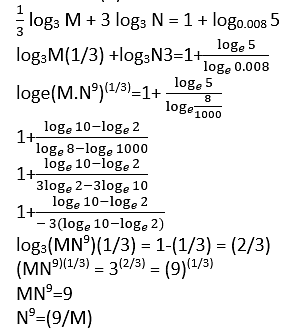
Ques 12: If \(\frac{1}{3}\) log3 M + 3 log3 N = 1 + log0.008 5, then (CAT 2003)
- M9 =(9/N)
- N9 = (9/M)
- M3=(3/N)
- N9=(3/M)
Click Here for the Answer
Solution: (B)
Ques 13: If log10 x − log10 \(\sqrt x\) = 2 logx 10, then a possible value of x is given by (CAT 2003)
- 10
- \(\frac{1}{100}\)
- \(\frac{1}{1000}\)
- None of these
Click Here for the Answer
Solution: (B)


Ques 14: log2 [ log7 (x2 − x + 37) ] = 1, then what could be the value of x ? (CAT 1997)
- 3
- 5
- 4
- None of these
Click Here for the Answer
Solution: (C)
log2 [log7 (x2 − x + 37)] = 1
using log p x = y
⇒py = x
∴ 2 = log7 (x2 − x + 37)
⇒ 49 = x2 − x + 37
⇒ x2 − x − 12 = 0 ⇒ (x − 4)(x + 3) = 0
∴ x=4, -3
So the solution is 4 based on the options given.
Ques 15: If log 7 log5 \((\sqrt{ x+5} + \sqrt x) = 0\) . Find the value of x. (CAT 1994)
- 1
- 0
- 2
- None of these
Click Here for the Answer
Solution: (B)

How to approach Logarithm questions in CAT
- Formulae and properties are crucial for attemting questions in CAT from this chapter
- Go through every formulae and property and the interchangeable forms for easy calculation.
- Try to attempt questions from series and logarithms for preparing for CAT.



Comments