




Duolingo results are a key part of the exam, as they determine your English language proficiency for university admissions, scholarships, and visa applications. Unlike traditional English tests, DET uses an AI scoring system and delivers results quickly, usually within 48 hours of completing the test. Scores are reported on a 10-160 scale and are aligned with the Common European Framework of Reference (CEFR) levels. CEFR levels are European standards for measuring language proficiency.
DET results include an overall score, individual subscores for 4 language skills: Literacy, Comprehension, Conversation, and Production, and a Duolingo English Test certificate that can be shared directly with institutions. The test also provides a video interview and writing sample, which are sent along with scores to help universities assess a candidate’s real-world communication ability.
Understanding how the Duolingo English Test scoring works, how results are calculated, and how long scores remain valid is essential for test takers planning to apply to universities that accept DET scores.
- How are the DET Scores Calculated?
- DET Score to CEFR Level Conversion
- DET to IELTS Score Comparison
- DET to TOEFL iBT Score Comparison
- How to Check Your Duolingo Results?
- How to Send Duolingo Results to Universities?
- Duolingo English Test Score Report 2026
- What is a Good Duolingo Result for 2026?
- DET Result Validity 2026
- DET Score for Universities Abroad in 2026
- FAQs
How are the DET Scores Calculated?
The DET total score ranges from 0 to 160 in 5-point increments. Since the DET pattern does not have separate sections for speaking, writing, reading, and listening skills, subscores are given on these parameters. Then, based on the average of a pair of skills, integrated subscores are calculated. The subscores and their respective pairs of skills are mentioned below:
- Literacy: Reading and Writing
- Comprehension: Reading and Listening
- Conversation: Speaking and Listening
- Production: Speaking and Writing
These subscores provide a more granular view, helping institutions assess targeted skills. For example, a strong Production subscore might highlight your ability to express ideas effectively.
After these, machine learning algorithms are used to evaluate responses automatically. Factors include:
- Vocabulary range and accuracy.
- Grammatical complexity and correctness.
- Fluency and pronunciation in speaking tasks.
- Comprehension speed and depth in reading and listening.
- The test is adaptive, so question difficulty adjusts based on your performance, influencing the final score.
Note: These are only the parameters used for scoring. The actual scoring is done by AI engines trained to replicate human scoring.
DET Score to CEFR Level Conversion
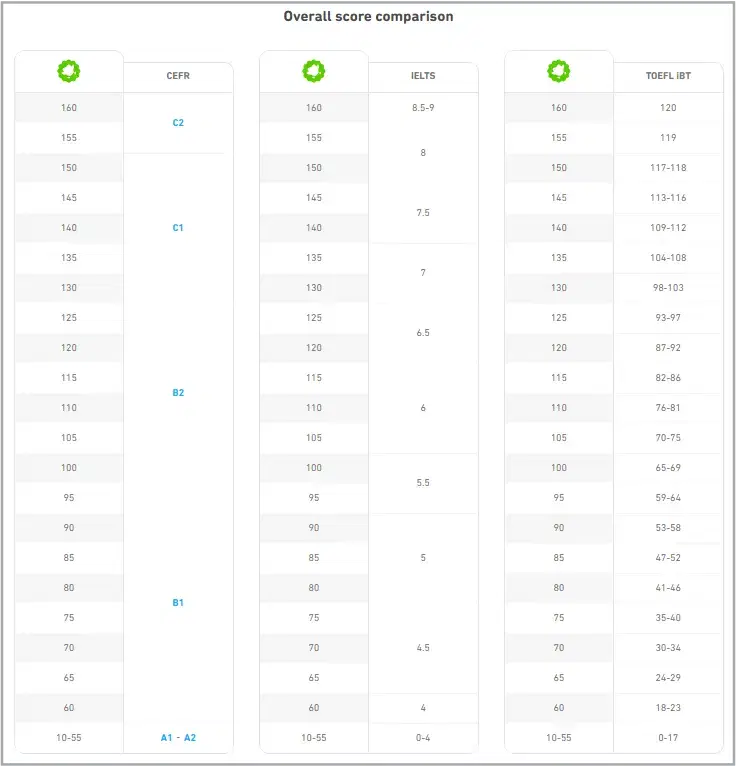
The DET score to CEFR level conversion helps candidates and institutions understand how DET scores compare with internationally recognized language proficiency standards. Since the DET is aligned with the CEFR, this conversion makes it easier to interpret scores for academic admissions and English proficiency requirements.
The table below gives the ranges of DET scores that correspond to each level.
| CEFR Level | Equivalent DET Score Range |
|---|---|
| C2 | 155-160 |
| C1 | 130-150 |
| B2 | 100-125 |
| B1 | 60-95 |
| A1-A2 | 10-55 |
DET to IELTS Score Comparison
The DET score to IELTS score comparison provides an approximate alignment between DET scores and IELTS band scores. It allows you to assess whether your DET score meets the English language requirements of institutions that traditionally rely on IELTS results.
| DET Score | Equivalent IELTS Score |
|---|---|
| 160 | 8.5-9 |
| 150-155 | 8 |
| 140-145 | 7.5 |
| 130-135 | 7 |
| 120-125 | 6.5 |
| 105-115 | 6 |
| 95-100 | 5.5 |
| 80-90 | 5 |
| 65-75 | 4.5 |
| 60 | 4 |
| 10-55 | 0-4 |
DET to TOEFL iBT Score Comparison
The DET score to TOEFL iBT score comparison helps applicants understand how DET scores align with one of the most widely accepted English proficiency exams. This comparison is useful for students applying to universities that accept multiple test scores and publish equivalent score ranges.
| DET Score | Equivalent TOEFL iBT Score |
|---|---|
| 150-160 | 117-120 |
| 135-145 | 104-113 |
| 120-130 | 87-103 |
| 105-115 | 70-86 |
| 90-100 | 53-69 |
| 75-85 | 35-52 |
| 60-70 | 18-34 |
| 10-55 | 0-17 |
How to Check Your Duolingo Results?
Duolingo result is usually released within 48 hours after finishing the test. At the time of DET booking, you can opt for 12-hour delivery by paying an additional fee of USD $33 (approx. 3,026 INR).
You will receive an email with your result. If you have taken the test multiple times, you can also see and compare all your past scores in your Duolingo account.
Here’s how to check your results:
- Visit the official Duolingo English Test website.
- Log in with the email you used to register.
- Open the “My Tests” section to see your test history and results.
- Click “Certificate” to download your DET score as a PDF.
Can my Duolingo result be delayed beyond 48 hours?
Yes, results may take longer if the test is flagged for additional review. This is common when there are internet disruptions, unclear video, or unusual test behavior.
How to Send Duolingo Results to Universities?
Duolingo allows you to send your DET result to unlimited universities for FREE. This, combined with the lower DET fees of USD $59 (approx. 5,410 INR), makes the test an affordable option for Indian students.
Here’s how to send your scores:
- Log in to your Duolingo English Test account.
- Go to the “My Tests” section.
- Find your certified result and click “Share Score.”
- Choose the type of institution (university, school, etc.).
- Search for your university and select it.
- Add your Application ID if required.
- Click “Send” to share your Duolingo score.
Will universities see my video interview and writing sample with my score?
Yes, the video interview and writing sample are automatically shared along with your DET scores. Universities use them to assess your real-life speaking and writing ability.
Duolingo English Test Score Report 2026
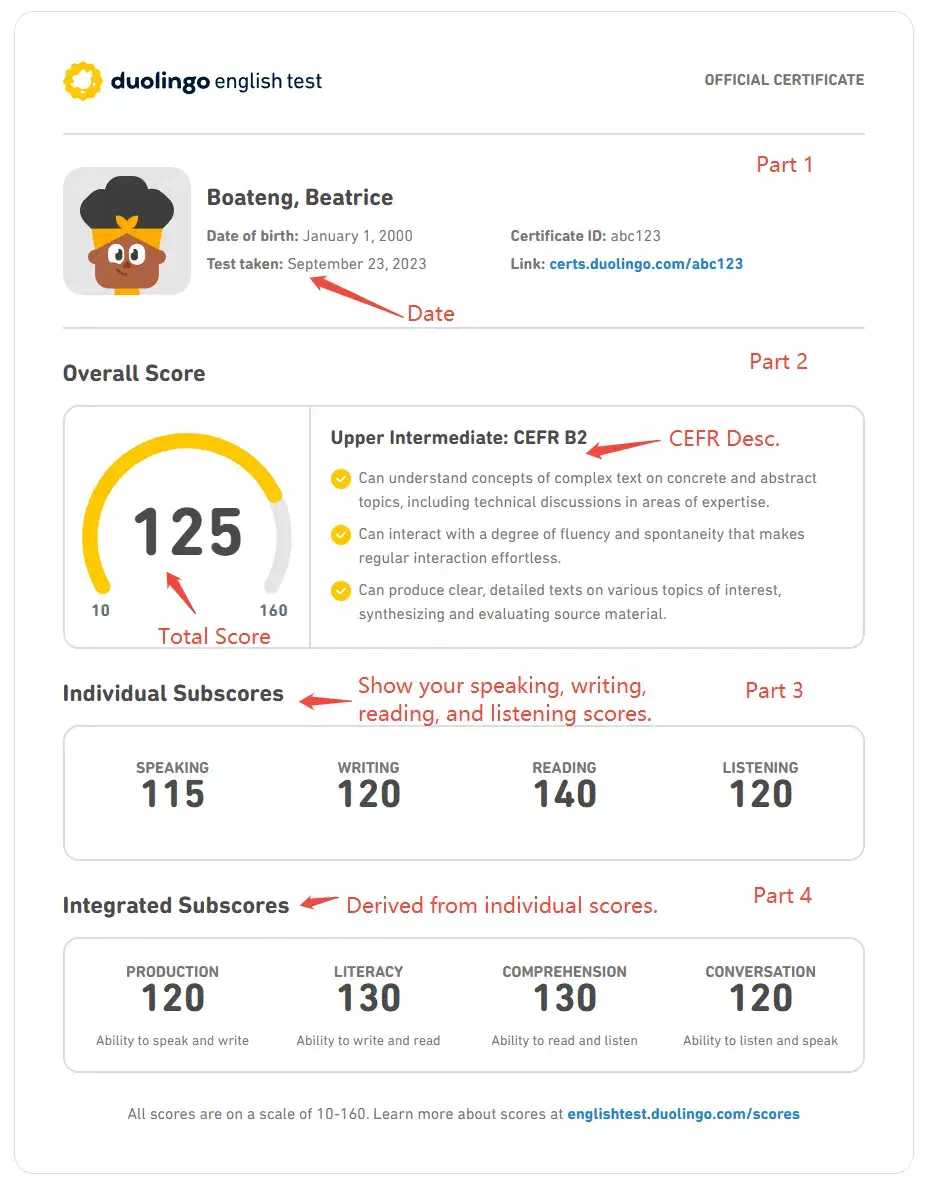
The Duolingo score report shows your overall score and subscores for each skill. Below, we have explained the overall score and the subscores in detail. Your score report includes the following:
- Overall score:
- The overall score is reported on a scale from 10 to 160.
- The overall scores comprise a general description of what a candidate can do.
- The overall scores are not the average of the subscores.
- Subscores:
- Subscores show your ability in specific English skills.
- They help evaluate how well you perform in different areas of the language.
- The subscores are divided into 4 sections, and each is scored on a scale of 10-160.
This is how a DET score report looks like:
Why is my Duolingo result marked as “Not Certified”?
A result may be marked “Not Certified” if there are rule violations, such as looking away from the screen, background noise, or technical issues. In such cases, the score cannot be sent to universities.
What is a Good Duolingo Result for 2026?
A “good” DET result depends on the requirements of the universities or programs you are applying to, as different institutions have different score expectations. The table below explains the typical score ranges and what they mean.
| Score Range | Description |
|---|---|
| Basic (10-50) |
|
| Intermediate (55-80) |
|
| Upper-Intermediate (85-120) |
|
| Advanced (125-160) |
|
DET Result Validity 2026
Duolingo results are valid for 2 years from the test date.
Is there a time limit for sending scores to universities?
You can send scores anytime after receiving them, as long as your test scores are still valid.
DET Score for Universities Abroad in 2026
As per Duolingo, DET results are now accepted by more than 6,000 institutions worldwide, including 95% of the top 100 US News-ranked universities in the US. Here’s a partial list of universities along with their score requirements:
| Country | University | QS World University Ranking 2026 | Minimum DET Score | Notes |
|---|---|---|---|---|
| USA | Harvard University | #=5 | 140 | All programs |
| USA | MIT | #=1 | UG: 125 PG: 135 | STEM-focused. |
| USA | Stanford University | #=3 | 125-140 | Not mandatory, but need fluency |
| USA | Yale University | #=21 | 120 | Both UG and PG. |
| Canada | University of Toronto | #=29 | 120 overall, 100 in each subscore | Engineering and business programs. |
| Canada | University of British Columbia | #=40 | Overall: 125 Reading: 115 Listening: 115 Writing: 120 Speaking: 120 | STEM and environmental sciences. |
| Australia | University of Melbourne | #=19 | 120 | DET not accepted for visa. |
| Germany | Technical University of Munich | #=22 | 125+ | Equivalent to IELTS 6.5 |
DET is also accepted by many countries for student visa applications. These include the USA, Canada, and New Zealand. Read the requirements here.
Note: Always check the university’s official admissions page, as some programs, like medicine, law, etc., may have exceptions.
The Duolingo English Test provides a fast, flexible, and widely accepted way to demonstrate English proficiency. With scores available in 48 hours, detailed subscores, and a validity of two years, it allows students to plan and share results efficiently. Understanding the score range, subscores, and reporting process helps candidates prepare effectively and meet university requirements confidently.
FAQs
Ques. Can I retake the Duolingo test if I am not satisfied with my result?
Ans. Yes, you can retake the test, but there are limits. You can attempt the test up to 3 times in 30 days.
Ques. Do universities prefer DET subscores or the overall score?
Ans. Most universities focus on the overall score, but some programs, especially STEM and business, may check subscores to assess specific skills.
Ques. Will my Duolingo result expire if I don’t send it immediately?
Ans. No, your score will remain valid for 2 years from the test date, regardless of when you choose to send it to universities.
Ques. Can I see which universities accept my DET subscores?
Ans. While universities mainly consider the overall score, some may look at subscores. You should check individual university requirements on their official websites.
*The article might have information for the previous academic years, which will be updated soon subject to the notification issued by the University/College.



Comments