




The Duolingo exam pattern has a fully computer-adaptive format rather than fixed, skill-based sections. Instead of separating reading, writing, listening, and speaking into distinct modules, the Duolingo English Test pattern has integrated question types whose difficulty level changes based on your responses. This structure is intended to assess overall English proficiency within a shorter duration.
The Duolingo English Test is conducted online and takes approximately 1 hour to complete. The test includes an initial setup, a 45-minute adaptive assessment, and a final writing and speaking sample. During the adaptive section, you will encounter a variety of tasks that will measure your literacy, comprehension, conversation, and production skills.
Duolingo English Test scores are reported on a scale of 10 to 160. Along with the official scores, writing and speaking samples are shared with institutions.

Click Here to Register for Duolingo English Test
| If you are planning to take the Duolingo English Test in 2026, check out the following articles to help you in the registration process: | ||
|---|---|---|
| How to book a Duolingo English Test 2026? | What is the Duolingo English Test Fee in India for 2026? | Who is eligible to take the Duolingo English Test? |
- Download Free Duolingo Practice Tests PDF 2026
- Duolingo Test Pattern 2026
- Duolingo Test Question Types
- Read and Select
- Fill in the Blanks
- Read and Complete
- Listen and Type
- Complete the Sentences
- Complete the Passage
- Highlight the Answer
- Identify the Idea
- Title the Passage
- Listen and Complete
- Listen and Respond
- Summarise the Conversation
- Write About the Photo
- Interactive Writing
- Interactive Speaking
- Speak About the Photo
- Read, Then Speak
- Duolingo English Test Writing and Speaking
20.1 Duolingo English Test Writing Sample
20.2 Duolingo English Test Speaking Sample
- Duolingo Exam Pattern Scoring 2026
- Duolingo English Test Preparation Tips 2026
- FAQs
DET Free Practice Tests 2026
Check out some free DET sample questions by Collegedunia in the table below.
Duolingo Exam Pattern 2026
The Duolingo English Test is an adaptive 1-hour exam that adjusts the difficulty of questions based on your performance. Instead of a fixed syllabus, it measures real-world and academic English skills through interactive tasks. The test has 3 parts:
| Section | Duration | Purpose | Key Features |
|---|---|---|---|
| Introduction and Setup | 5 minutes | Equipment check and ID verification | Not scored; ensures fair testing |
| Adaptive Test | 45 minutes | Assess core proficiency | 25-50 adaptive questions; multiple-choice & interactive |
| Writing and Speaking sample | 10 minutes | Showcase free responses | 2 tasks (1 writing, 1 speaking); video-recorded, unscored |
Must Read: How to set up the DET test environment?
Duolingo Exam Pattern 2026: Question Types
The Duolingo English Test questions are multimedia (text, audio, images). They are designed to test your literacy, comprehension, conversation, and production skills. There is no fixed number of questions in each type. Here's a breakdown of common question types:
| Question Type | Description | Number of Questions | Time Limit |
|---|---|---|---|
| Read and select | Pick real English words from a list of real and fake words. | 15-18 | 5 seconds |
| Fill in the blanks | Choose or type words to complete gaps in a short text, focusing on grammar and vocabulary. | 6-8 | 20 seconds |
| Read and complete | Select the best sentence to finish a partial passage logically. | 3-6 | 3 minutes |
| Listen and type | Listen to 1-3 audio sentences and type exactly what you hear. | 6-9 | 1 minute |
| Complete the sentences | Fill gaps in a short text, testing grammar and vocabulary. | 2 sets of 6 questions | 7-8 minutes |
| Complete the passage | Add words or phrases to blanks in a longer text to convey the overall meaning. | 2 sets of 6 questions | 7-8 minutes |
| Highlight the answer | Read or listen and highlight key phrases or sentences that answer the question. | 2 sets of 6 questions | 7-8 minutes |
| Identify the idea | Select the main idea or supporting detail from a passage or audio. | 2 sets of 6 questions | 7-8 minutes |
| Title the passage | Choose the most suitable title based on the core theme. | 2 sets of 6 questions | 7-8 minutes |
| Listen and respond | Listen to a prompt and respond verbally in a natural way. | 2 sets of 5-6 questions | 4 minutes |
| Summarise the Conversation | Listen to a dialogue and write or speak a summary of key points. | 2 sets of 5-6 questions | 75 seconds |
| Write About the Photo | Describe a shown image in 30-50 words, including people, setting, and action. | 3 | 1 minute |
| Interactive Writing | Step 1: Respond to a written prompt. Step 2: Respond to a follow-up prompt based on your first answer. | 1 set of 2 questions | Step 1: 5 minutes Step 2: 3 minutes |
| Interactive Speaking | Simulated conversation with an animated character. | 6-8 | 35 seconds for each question |
| Speak About the Photo | Verbally describe an image for 30-60 seconds. | 1 | Min 30 seconds Max 90 seconds |
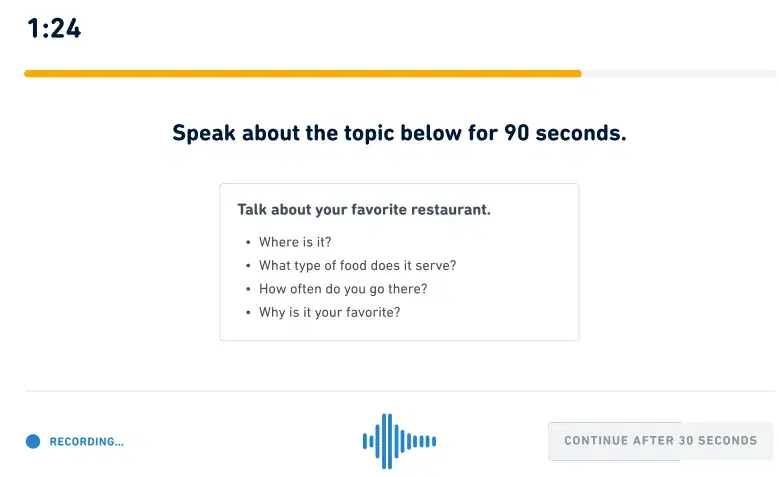
| Read, Then Speak | Read a short text, then speak about it (summarise or give an opinion). | 1 | 90 seconds |
The sections below give details of each of the question types:
Read and Select
Read and Select asks you to answer, “Is this a real English word?” You will need to read each word and decide if it is an actual word in English.
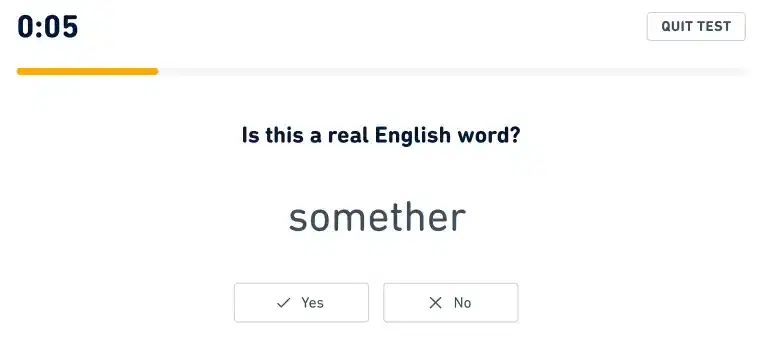
Tips:
- Always select either YES or NO. Skipped answers will be marked incorrect.
- There can be any number of real words, so do not worry if the count varies.
- Read carefully, as some words may look real but have small differences from actual English words.
Fill in the Blanks
Fill in the Blanks asks you to “Complete the sentence with the correct word.” In this question, you will read a sentence with one unfinished word, then fill in the blanks to complete the word.
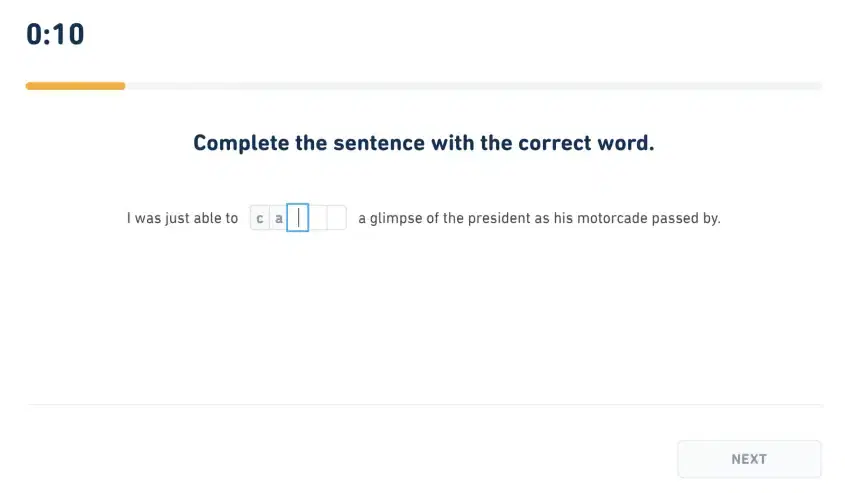
Tips:
- Read the entire sentence before focusing on the incomplete word.
- Use context clues.
Read and Complete
Read and Complete asks you to “Type the missing letters to complete the text below.” For this question type, you will fill in the blanks of unfinished words in a passage.
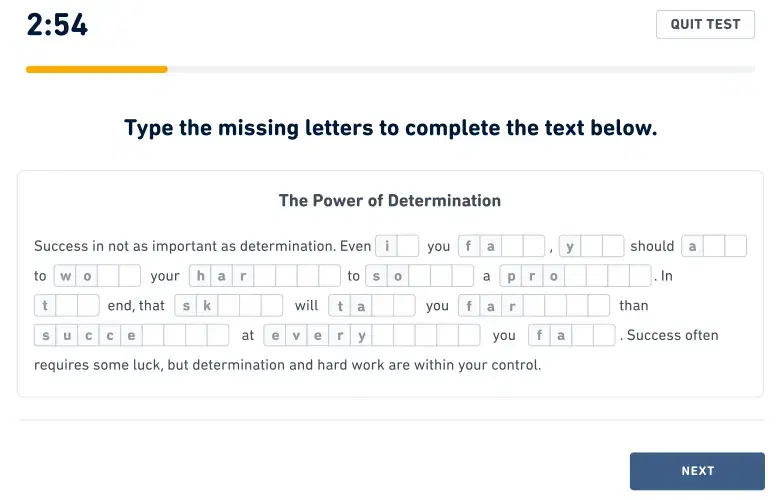
Tips:
- Read the entire passage before focusing on individual words.
- Use context clues.
Listen and Type
Listen and Type asks you to “Type the statement that you hear.” In this task, you will listen to a person speaking a statement and then transcribe what you hear.
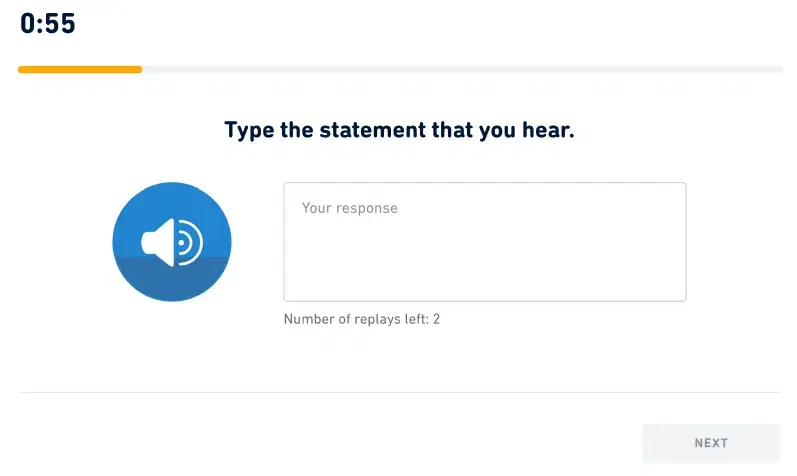
Tip: Type exactly what you hear first. Replay the statement and compare it to your writing to check your response.
Complete the Sentences
Complete the Sentences asks you to “Select the best option for each missing word.” In this task, you will see a passage with several blank spaces and select a word to complete the sentence.
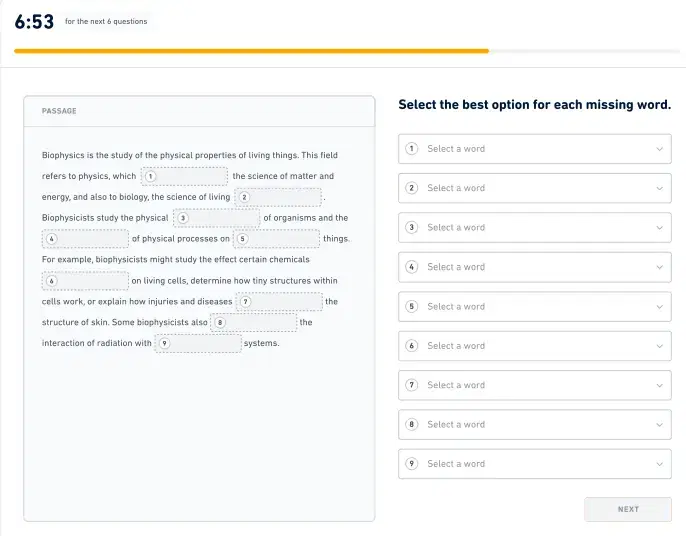
Tips:
- Read the entire sentence and use context clues to choose the best word.
- If you have time, read the full passage after completing all sentences to double-check your answers.
Complete the Passage
Complete the Passage asks you to “Select the best sentence to fill in the blank.” In this task, you will see 2 sections of a passage with a missing sentence in the middle.
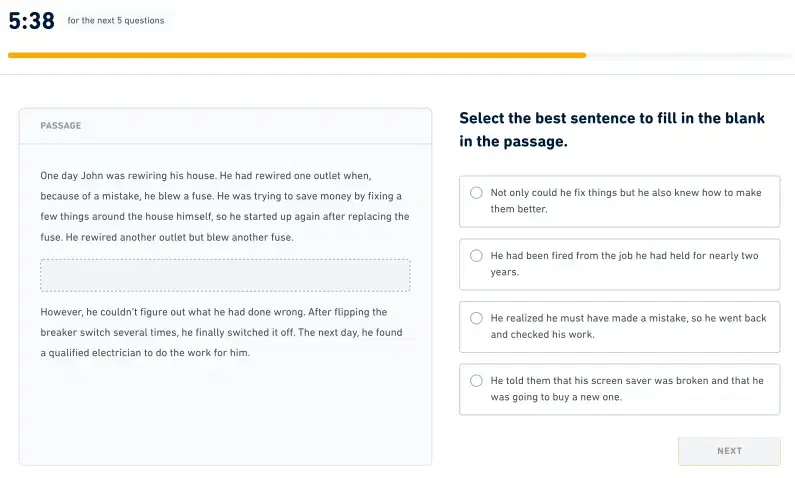
Tips:
- Some parts of the passage may be familiar from the Complete the Sentences question.
- Read each section carefully, especially any new material.
- Focus on the sentences before and after the blank, especially if you are unsure.
Highlight the Answer
Highlight the Answer asks you to “Click and drag the text to highlight the answer to the question below.” You will see a question on screen, then you will find and highlight the answer within the passage.
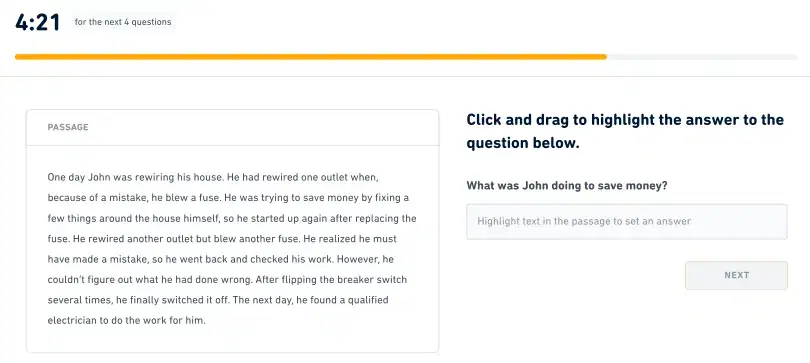
Tip: Be precise and thorough when selecting your answer. Highlight only what directly answers the question, avoiding too much or too little.
Identify the Idea
Identify the Idea asks you to “Select the idea that is expressed in the passage.” In this task, you will select an idea from the list that best represents what you read in the passage.
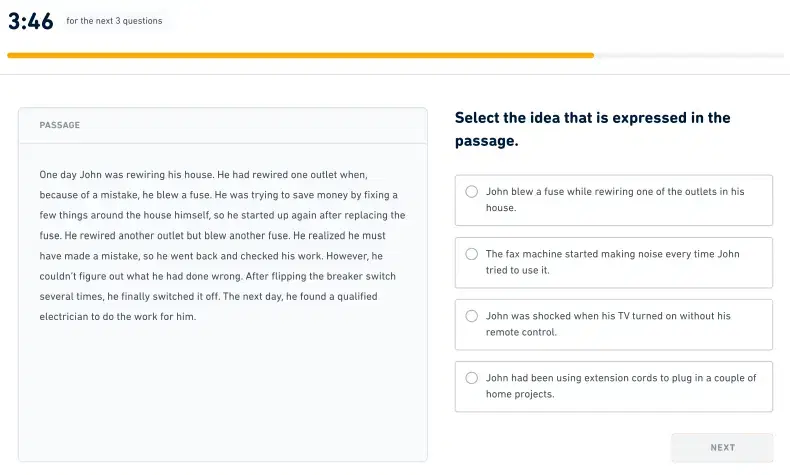
Tip: Read all the options carefully. Some may seem partially relevant, but choose the one that best describes the text.
Title the Passage
Title the Passage asks you “Select the best title of the passage.” You will select a title from a list of given options.
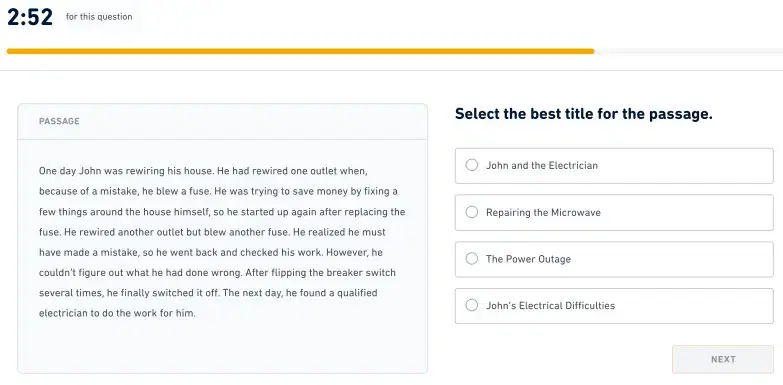
Tip: Read and consider all the options carefully. Some may seem somewhat relevant, but choose the one that best fits the entire text.
Listen and Complete
Listen and Complete asks you to listen to a scenario and answer 3-4 fill-in-the-blank questions about it.
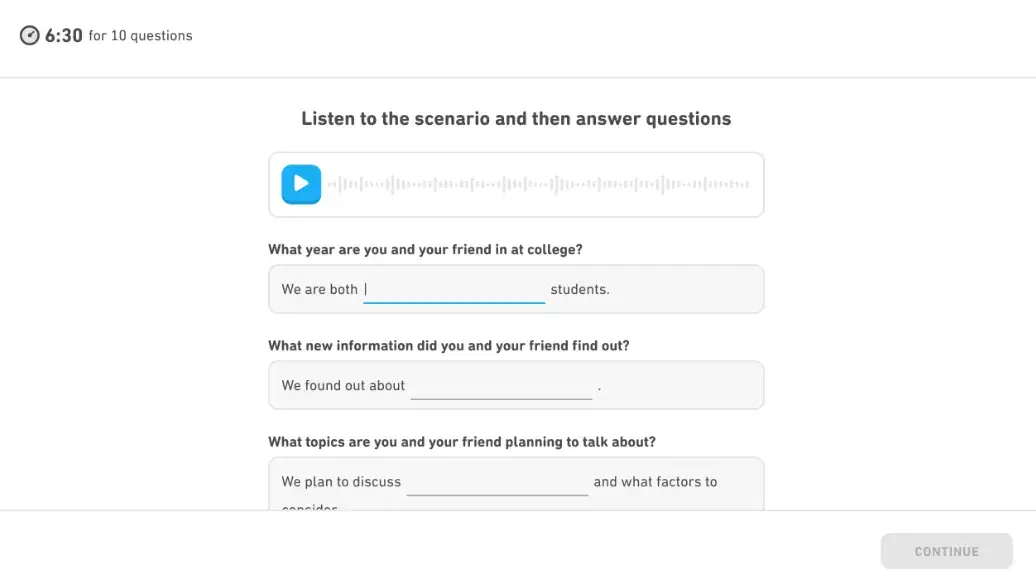
Tips:
- Write only what is needed to answer the question.
- Do not include extra or irrelevant information.
- If you cannot write more, try paraphrasing your response.
Listen and Respond
Read about the situation. Pick the best option to start the conversation. Select the best response each time it’s your turn.
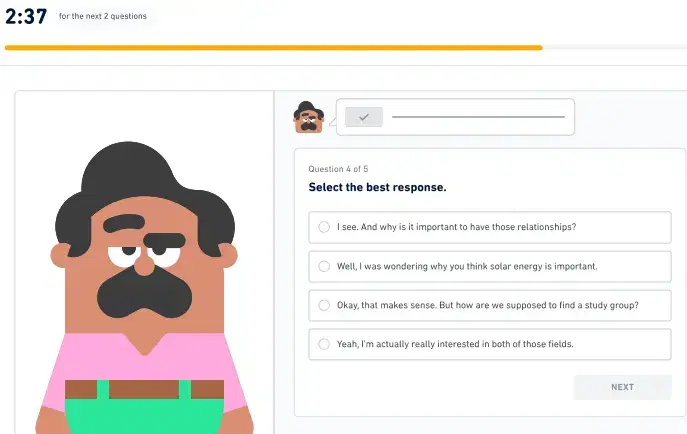
Tips:
- Notice the relationship between the speakers. Think about how two students or a teacher and a student would talk.
- Do not worry if your response is not perfect. The test will guide you, and you can still answer the next questions correctly.
- Pay attention to the correct answers to follow the conversation.
- Remember the main ideas for the summary task that comes next.
Summarise the Conversation
Summarise the conversation you just had in 75 seconds.
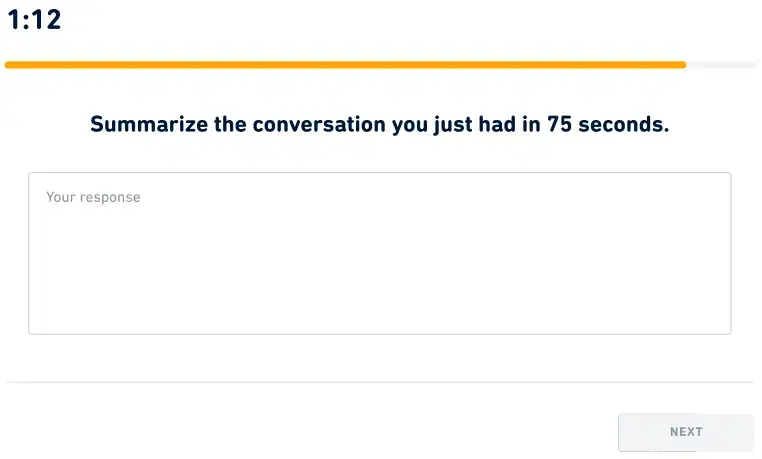
Tips:
- Write a complete paragraph, not bullet points.
- Start with the basic facts: who spoke, what the conversation was about, and the outcome.
- Use it all the time to summarise the task in detail.
- If possible, check your spelling and grammar before submitting.
Write About the Photo
Write About the Photo asks you to “Write a description of the image below for 1 minute.” For this question type, you will see an image on the screen, and you will write a description of the image.
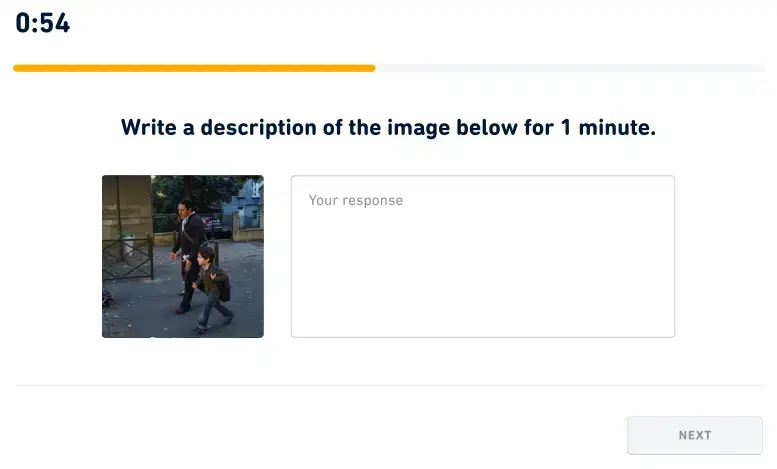
Tips:
- Do more than just label the image; describe it in detail.
- The directions ask for one complete sentence, but try to write more. A longer response can show more of your skills.
Interactive Writing
Interactive Writing asks you to:
- Step 1: Respond to a prompt in writing. (5 minutes)
- Step 2: Answer prompts based on your previous response in writing. (3 minutes)
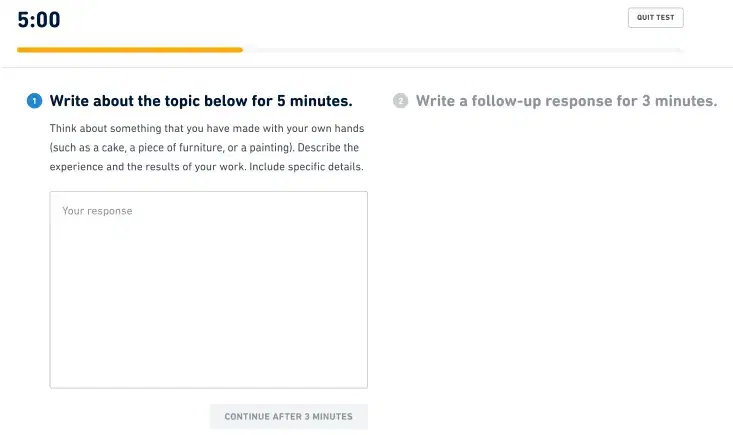
Tips:
- Use all the time available to make your responses as strong as possible.
- Write as much as you can. Just make sure your English is clear, and the content is relevant to the topic.
- Follow good writing practices to develop your responses.
Interactive Speaking
In Interactive Speaking, you will answer 6-8 questions in a conversation with an animated character.
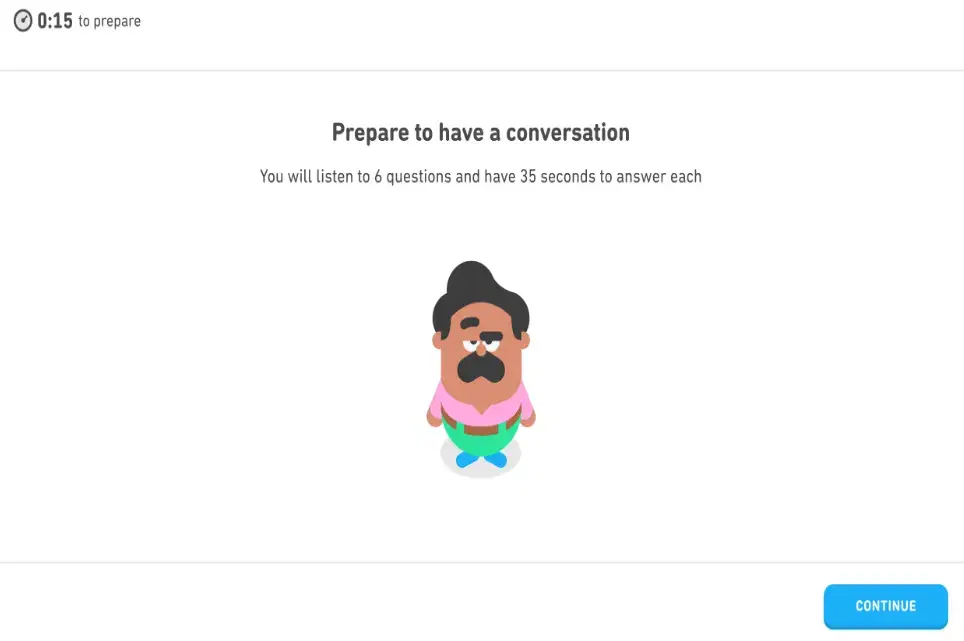
Tips:
- Pay close attention to follow-up prompts, as they refer to your previous response.
- Speak at a natural pace and pronounce your words clearly with proper intonation.
Speak About the Photo
Speak About the Photo asks you to “Speak about the image below for 90 seconds.” In this task, you will talk about an image that appears on the screen.
Notes:
- The directions and image will appear for 20 seconds before the test moves to the recording screen. You can also click NEXT to go there early.
- You must speak for at least 30 seconds before you can continue.
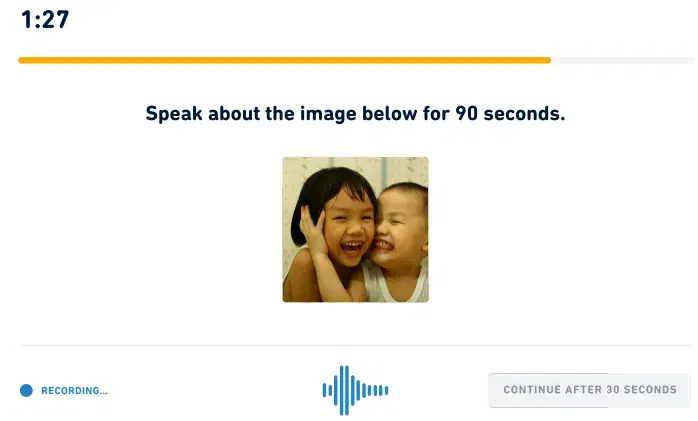
Tips:
- Describe the image as if you are explaining it to someone who cannot see it.
- Speak at a natural pace and pronounce your words clearly.
- Do not worry if you make a small mistake. Just correct yourself and continue speaking.
Read, Then Speak
Read, Then Speak asks you to “Speak about the topic below for 90 seconds.” For this question type, you will see a written prompt. You will speak your response to this prompt for at least 30 seconds.
Tips:
- Speak naturally and clearly, and try to use a variety of words and sentence structures.
- Make sure your answer covers every part of the question.
DET Writing and Speaking Samples
In the Writing and Speaking section of the test, you will be given a prompt and asked to respond at length. The Speaking sample allows for a 1-3 minute response, and the Writing sample allows for a 3-5 minute response. For each, directions appear for 30 seconds before recording begins. During this time, you will read and consider the prompt and prepare to respond.
You will be able to review your responses to these samples after the test has concluded.
These sections are unscored but are sent to universities along with the score report because they serve a different purpose from the AI-scored adaptive test. The extended speaking and writing tasks allow candidates to demonstrate sustained communication and provide qualitative, human-reviewable evidence rather than contributing to the automated scoring process.
Duolingo English Test Writing Sample
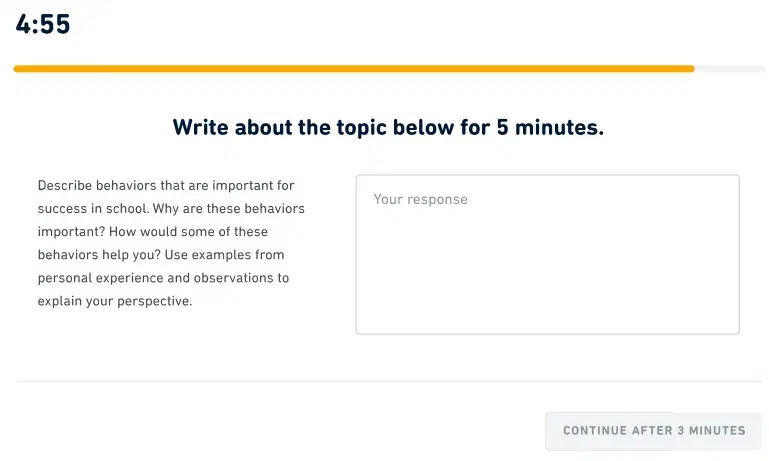
The Writing sample asks you to “Write about the topic below for 5 minutes.” You will read a written prompt and write about it for at least 3 minutes.
Tips:
- Practice good writing habits. Use different sentence structures and vocabulary, and present your ideas with clear and logical transitions.
- Leave some time at the end to check your spelling, grammar, and punctuation.
- The topic of your response will be shared with the institutions that receive your results, so make sure you stay on topic.
- Think of this task as a short essay. Institutions may use your Writing Sample to learn more about your writing skills.
Duolingo English Test Speaking Sample
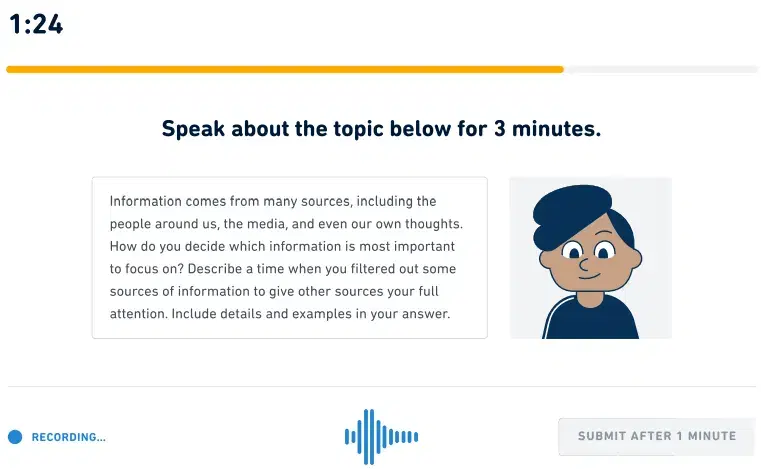
The Speaking sample asks you to “Speak about the topic below for 3 minutes.” You will read a written prompt and speak at length about it.
Tips:
- Do not look at the timer because it can distract you and affect your speaking.
- Keep talking until the NEXT button turns blue. If you can, continue speaking a little longer. Then finish your answer naturally and click NEXT to submit.
- Practice speaking on a topic for 1-3 minutes before the test so you get used to the required length.
- The Speaking Sample is recorded as a video. The institutions that receive your scores will be able to see you during this response.
- The topic of your response will also be shared with them. Make sure you stay on topic and try your best to show your speaking skills.
Duolingo Results 2026
The DET uses a fully AI-based scoring system that applies only to the 45-minute adaptive section. It provides 4 subscores for each section on a 10-160 scale. These reflect performance in specific language areas and are derived from your responses in the adaptive section.
From these, 4 integrated subscores are calculated by combining pairs of skills:
- Literacy: Reading and Writing
- Comprehension: Reading and Listening
- Conversation: Speaking and Listening
- Production: Writing and Speaking
The overall score (10-160) is a holistic measure of your English proficiency, calculated from the Individual Subscores rather than a simple average of the Integrated Subscores. This system gives universities both a detailed view of individual skills and a broader picture of overall language ability.
DET Preparation Tips
Preparing for the DET doesn’t require a fixed syllabus, but regular practice can improve confidence and performance. Here are some tips to improve your English and get ready for the test:
- Practice reading short texts to build vocabulary and grammar.
- Listen to English podcasts or videos to improve comprehension.
- Speak for 1-2 minutes daily on different topics to build fluency.
- Take official practice tests to get used to question types and timing.
- Write short paragraphs regularly to improve clarity and structure.
Also Check
The Duolingo English Test has a unique, adaptive pattern that measures real-world language skills in just 1 hour. By understanding its structure, question types, and scoring system, you can prepare more efficiently and avoid surprises on exam day. With its simple setup, affordable fee, and growing global acceptance, the DET provides a convenient pathway for students aiming to meet English proficiency requirements worldwide.
FAQs
Ques. What makes the Duolingo English Test different from other exams?
Ans. The DET is fully online, adaptive, and only takes 1 hour. It changes question difficulty based on your answers and can be taken from home.
Ques. Is there a fixed syllabus for the DET?
Ans. No, the test focuses on real-life English skills. Questions cover everyday and academic topics instead of a set syllabus.
Ques. How soon will I receive my DET results?
Ans. Results are usually available within 48 hours after you finish the test.
Ques. How many times can I retake the test?
Ans. You can take the test twice in 30 days, and there is no lifetime limit.
Ques. Are the test questions based on academic topics, or are they more general?
Ans. The test questions are general and cover a range of topics, including everyday situations, but they may touch on academic themes to assess your ability to use English in academic settings.
*The article might have information for the previous academic years, which will be updated soon subject to the notification issued by the University/College.



Comments