


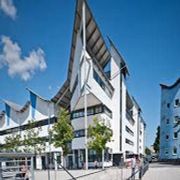
Liverpool John Moores University is a highly respected public university situated in Liverpool, England in the region of Merseyside. It is a large university with 25,050 undergraduate students. Admissions are relatively competitive, and Liverpool John Moores University's acceptance rate is around 70%. Some majors offered are Business, Engineering, Social Sciences, Computer Science, and Art & Design. Six-year graduation rate is about 83%, and their graduates have a median starting salary of around INR 30,15,000 (a decade since graduation, converted from the £28,500 median income).
University of East London is a public university located in London, England in the Greater London metropolitan area. It is a mid-sized university with a total enrollment of 17,250 undergraduate students. The admissions are moderately competitive since the University of East London acceptance rate stands at approximately 45%. Popular majors include Business, Psychology, Health Sciences, Computer Science, and Education. The six-year graduation rate is roughly 80%, while the graduates still receive a median starting salary of approximately INR 27,62,000 (approximate conversion of £26,100 ten years after graduation).
| Liverpool John Moores University | University of East London | |
|---|---|---|
| Collegedunia Score | 4.2 Out of 10 | 4.1 Out of 10 |
| ranking (overall) | # 551 Times Higher Education 2027 # 42 The Guardian 2026 # 380 Collegedunia Study Abroad 2026 | # 801 Times Higher Education 2027 # 33 The Guardian 2026 # 612 Collegedunia Study Abroad 2026 |
| Subject Strength | # 278 for Engineering by Collegedunia Study Abroad 2026 # 220 for Medicine by Collegedunia Study Abroad 2026 # 49 for Law by The Guardian 2026 | # 1001 for Engineering by Times Higher Education 2023 # 323 for Medicine by Collegedunia Study Abroad 2026 # 68 for Law by The Guardian 2026 |
| Programs | UG Programs -62 PG Programs -43 Doctorate Programs -4 | UG Programs -107 PG Programs -74 Doctorate Programs -2 |
| Acceptance Rate | 70.0 % | 45.0 % |
| Exam Score | IELTS-6 PTE-61 TOEFL-78 | - |
| Cost to Study | Average Tuition Fees 22218 [For UG Program] Average Tuition Fees 22218 [For PG Program] Hostel + Meal - 1136 Per Year | Average Tuition Fees 13740 [For UG Program] Average Tuition Fees 15240 [For PG Program] Hostel + Meal - 25543 Per Year |
| placement (average package) | Some of the programs and the average salary are as follows: Bachelor (Other): $55,000 Executive Masters: $53,000 MBA: $50,000 Masters of Arts: $49,000 Master (Other): $47,000 Masters in Science: $43,000 | Some of the programs and the average salary are as follows: MBA : $65,000 Master (Other) : $56,000 LLM : $49,000 Masters in Finance : $48,000 Other Degree : $45,000 Masters in Science : $43,000 |
| application requirements | Submit official transcripts Submit English language requirements Check program specific requirements | Academic Transcripts; Proof of English language proficiency; Personal Statement; Work Experience; Interviews (for a few PG programs); Other supplementary documents (Portfolios, Auditions, Research proposal, etc.). |
| CollegeDunia Reviews | 8.7/10 Read 3 reviews | 7.6/10 Read 13 reviews |
Top Courses Comparison
| ranking | # 21 for Business by The Guardian 2026 # 401 for Business by Times Higher Education 2025 | # 72 for Business by The Guardian 2026 # 801 for Business by Times Higher Education 2025 |
| exam scores | GMAT - 600/800IELTS - 6.5/9PTE - 55/90TOEFL - 78/120 | IELTS - 6/9 |
| documents required | #Letter of Recommendation + Statement of Purpose | #Letter of Recommendation + Statement of Purpose |
| application dates | Jun 30, 2026 (Application Deadline For September 2026 Intake) Jul 10, 2026 (Early Payment deadline For September 2026 Intake) Jul 31, 2026 (Deposit Deadline For September 2026 Intake) Aug 14, 2026 (CAS Issuing deadline For September 2026 Intake) | Jul 31, 2027 (Fall 2027 intake application deadline) |
Other Popular Comparisons






| General Facts | Liverpool John Moores University | University of East London |
|---|---|---|
| Type of University | University | University |
| Established | 1823 | 1898 |
| Student:Faculty Ratio | 18:1 | 29:1:1 |
| Male:Female | 46% Male, 54% Female | 43% Male, 0% Female |
| Location Facts | The university is separated into two campuses in Liverpool:
| 2 campuses- Stratford (located in one of the best-connected area of London, close to Stratford’s thriving town center, 15 min from London’s West End, close to the Queen Elizabeth Olympic Park) and London Docklands (near Waterfront campus located in Royal Albert Dock). |
| Library | There are currently two libraries operated by LJMU, one for either campus. There are more than 68,500 books in the Libraries' collections, with 1,630 work spaces available for students 24 hours a day. In addition to this there are over 16,000 e-books and 5,000 e-journals available. | 2 Physical Libraries; Library, Archives and Learning Services open 24/7 during term time; houses high-quality academic resources, expert advice, inspirational study spaces, books, journals, DVDs, archival collection |
| Campus Life | All full-time International students request accommodation through the same process as UK students, and each year LJMU sets aside rooms for new postgraduate and mature students too. The accommodation university offers is in ‘halls’ – large blocks of flats designed to meet the needs of modern student life. Getting involved in sports, clubs and societies at Liverpool John Moores University is a great way to challenge yourself, meet people who share your interests, and feel more connected to the University community. Sports teams, academic or social societies are run by Liverpool John Moores Students' Union (the body representing all 20,000 students at Liverpool John Moores University). There is a huge range of academic, social, charitable, political and cultural societies you can join. | Docklands Campus: 24/7 Docklands library; 26 million USD SportsDock centre; Campus shop & bookstore; Children’s Garden Nursery; Cafés, eateries, & a late bar; Student Union facilities- student lounge. |
| Hostel | #Living Expenses per month - $1136 | #Rooms (Standard) - $8036 #Rooms (Detached Flat) - $8323 #Rooms (Studio) - $9184 |
| Famous Alumni | Joe Anderson (politician), Former 1st Mayor of Liverpool | Sonam Kapoor (Bollywood Actress); Kemi Adeosun (Minister of Finance of Nigeria); Tazeen Ahmad (British journalist & broadcaster); Roger Ashton-Griffiths (British actor, writer & director); Garry Bushell (British journalist & broadcaster); Simon Carter (Artist); Gemma Gibbons (Judo Olympian); Jeffrey Lawal-Balogun (track athlete) |
| City Life | In 2015, Liverpool was voted the 110th best place to live in the UK. The average weekly household food expenditure in Liverpool is just below the UK average at £53 per week, and petrol is also close to national averages costing 117p. Technologically Liverpool is considered to be one of the best places to be, it has 99% coverage from mobile phone networks, faster than average broadband speeds. Average property rental cost for a flat in Liverpool is £780 PCM, for a house is £1,020 PCM and for a room is £679. The most sort after and nicest areas to live in in Liverpool are Blundellsands, Brighton-le-Sands, Crosby, Little Crosby, and Thornton districts. | London- 1st in QS News Best Student Cities (2019); Capital city of England; known for Palace of Westminster, Tower of London, London Eye, Arts Galleries, Museum of London, Science Museum, Victoria and Albert Museum, & various other cultural attractions; UK parliament; PM’s home; BBC headquarters. |
| Weather |
Liverpool John Moores University vs University of East London
Subject Strength & Global Rankings (2025/2026)
Neither Liverpool John Moores University (LJMU) nor the University of East London (UEL) are among the global top-level universities, but LJMU tends to perform better in international rankings.Liverpool John Moores University ranks #851-900 in QS and 601-800th in Times Higher Education whereas University of East London ranks #1001-1200 in QS and 1001-1200th in Times Higher Education. In subject performance, LJMU is particularly good in Engineering, Sports Science, Architecture, and Maritime Studies, thanks to its traditional associations with industry and applied sciences. UEL excels in Social Sciences, Psychology, and Creative Industries, usually touted for community outreach and professionalism.
General Information
Liverpool John Moores University, in Liverpool, traces its history back to the 19th century as a mechanics' institute before being granted university status in 1992. It has approximately 25,000 students and is recognized for its industry connections, vocational learning, and applied science research. The University of East London, founded in 1898 and awarded university status in 1992, currently has around 19,000 students on its Docklands, Stratford, and University Square campuses in East London. The university is recognized for its career-focused learning, widening participation, and commitment to the support of diverse, international student groups.
Acceptance Rate & Admissions
Both of these universities are more accessible than research-focused Russell Group universities. LJMU has fairly modest entry standards, with a focus on academic experience and appropriate qualifications. UEL has a reputation for being very inclusive, frequently with flexible entry routes for international, mature, and non-traditional students.
Research Impact & Facilities
LJMU has made considerable investments in facilities like the Astrophysics Research Institute, maritime simulators, and engineering laboratories, facilitating research with practical applications. UEL focuses on applied research in health, psychology, social work, and urban development, with community-led initiatives and state-of-the-art Docklands-based facilities that facilitate entrepreneurship and technology.
Cost & Financial Aid
They are both public universities in the UK, with comparable international student tuition fees (typically in the range of £14,000–£17,000 per annum, varying depending on course). Scholarships and bursaries exist, although UEL provides more financial aid for disadvantaged and foreign students, as opposed to the more merit-based LJMU funding.
Career Outcomes & Alumni Success
LJMU alumni tend to thrive in engineering, sports science, maritime commerce, and architecture, with close employer links in Liverpool and elsewhere. UEL graduates thrive in creative professions, community leadership, enterprise, and social sciences, benefiting from East London's proximity to international business, NGOs, and cultural institutions. In general, LJMU offers better academic prestige and STEM prospects, whereas UEL is strongly reputed for inclusivity, work placement potential in London, and innovative career options.


