




Juris Doctor [JD]/Master of Business Administration [MBA]
₹36.6 L/Yr

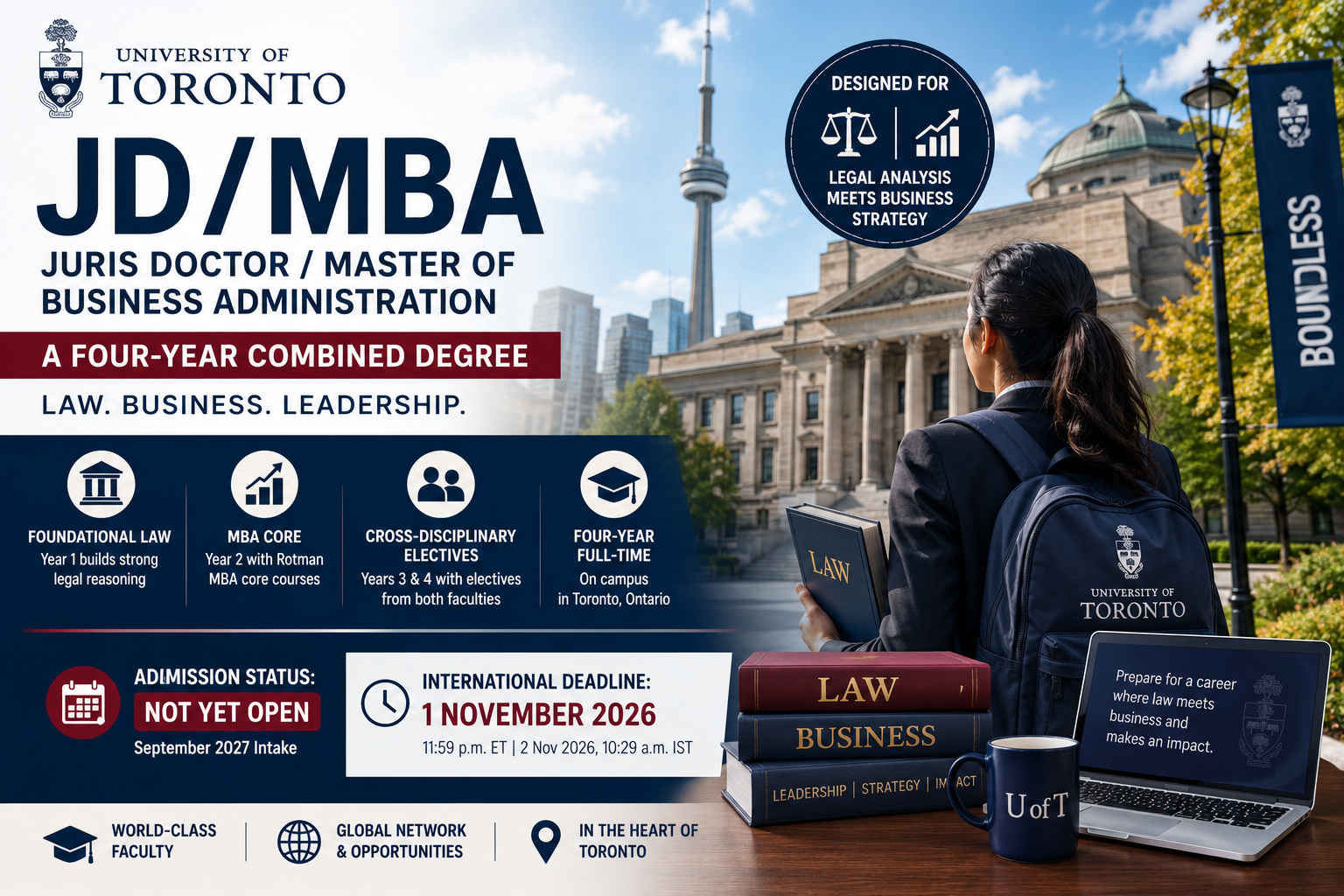
University of Toronto Juris Doctor/Master of Business Administration (JD/MBA) is a four-year combined degree in Toronto, Ontario, delivered full-time on campus. September 2027 tuition is unpublished; September 2024 academic fee was C$46,270 (INR 31.64 Lakhs) per year as a prior-cycle reference. Applicants also need an accredited bachelor’s equivalent, at least three years of full-time university study and the Law School Admission Test (LSAT).
Designed for applicants who want to connect legal analysis with corporate decision-making, the programme sequences foundational law, MBA core courses and upper-year electives across both faculties. The strongest fit is a student ready for intensive cross-disciplinary study. The key tradeoff is that four years still carries Canadian law licensing limits and a demanding combined workload.
- The first year follows the core JD curriculum, so legal reasoning is established before business specialisation begins.
- The second year uses Rotman’s MBA core, including finance, strategy, accounting, operations and decision-making with models and data.
- The final two years integrate upper-year law requirements with nine MBA elective courses under both faculties’ progression rules.
Current Admission Status
Applications for the September 2027 intake are Not Yet Open. International student deadline: 1 November 2026 at 11:59 p.m. Eastern Time (2 November 2026 at 10:29 a.m. Indian Standard Time (IST)).
Submit the Ontario Law School Application Service (OLSAS) application and required written components by this cutoff. Transcripts and LSAT reports can follow when available, but review starts only after all required documents arrive.
All INR conversions in the article use a conversion rate of CAD 1 = INR 68.37 as of 13 August 2026. Rates fluctuate daily, verify before applying.
Also Check: University of Toronto JD/MBA admission
University of Toronto JD/MBA Fees and Living Costs 2027
September 2027 tuition is unpublished, so the table separates the live September 2024 academic reference from current OLSAS application charges. This prevents an older fee from being mistaken for a target-cycle quote while giving Indian applicants a usable planning baseline.
| Fee item | Billing basis | CAD amount | INR equivalent |
|---|---|---|---|
| Academic fee, September 2024 prior-cycle reference | Per academic year | C$46,270 | INR 31.64 Lakhs |
| University incidental fees, September 2024 prior-cycle reference | September to April | Approximately C$1,600 | INR 1.09 Lakhs |
| Rotman ancillary fee, September 2024 prior-cycle reference | First MBA year | Approximately C$650 | INR 44,447 |
| OLSAS processing fee for the 2027 entry application | Application | C$200 | INR 13,676 |
| Jackman Law university fee for the 2027 entry application | Each law school selection | C$115 | INR 7,864 |
Source: University of Toronto Rotman JD/MBA programme page and Jackman Law admissions pages.
The published academic fee is only a prior-cycle reference, and the university says annual academic, incidental and ancillary fees can change. Verify the target fee on the official JD/MBA fee page before paying a deposit or arranging an education loan.
- The four-year billing pattern spans one law year followed by three Rotman years, so a single annual reference cannot establish the September 2027 total.
- International students should reserve additional funds for the University Health Insurance Plan (UHIP) because it is added to international invoices.
- Application charges are separate from tuition and are non-refundable, making the OLSAS submission a cost to budget before admission is decided.
Cost of Living in Toronto for JD/MBA Students
Toronto’s cached annual living estimate is C$26,400 to C$34,800 (INR 18.05 Lakhs to INR 23.80 Lakhs) before tuition and immigration costs. Housing choice drives the range, so Indian applicants should test an on-campus budget against a shared-housing scenario before arranging proof of funds.
| Expense | Monthly (CAD) | Monthly (INR) |
|---|---|---|
| On-campus housing | C$1,400 to C$1,900 | INR 95,731 to INR 1.30 Lakhs |
| Shared housing | C$1,000 to C$1,400 | INR 68,379 to INR 95,731 |
| Food | C$300 to C$500 | INR 20,514 to INR 34,190 |
| Local transport | C$150 | INR 10,257 |
| Recommended annual living total | C$26,400 to C$34,800 | INR 18.05 Lakhs to INR 23.80 Lakhs |
The annual range is a Toronto spending estimate, not the Canadian study-permit maintenance amount. Separately, cached Canada guidance requires C$22,895 (INR 15.66 Lakhs) for one student outside Quebec, excluding tuition and transportation, so keep the immigration figure separate from actual Toronto spending.
Four years of the published academic fee equals C$185,080 (INR 1.27 Crore) in a prior-cycle planning illustration. This excludes changing incidental charges, ancillary fees, UHIP and living costs, and is not a September 2027 quote.
Read More: University of Toronto JD/MBA fee planning
Fee planning note
Target-cycle academic fees are unpublished, so INR 1.27 Crore is only a prior-cycle tuition illustration. Request the 2027 fee schedule before committing funds.
ROI reality: The four-year structure saves one year against separate degrees, but target tuition is unpublished. Secure the current fee schedule and a Toronto living budget before comparing financing options.
University of Toronto JD/MBA Admission 2027
The JD/MBA is not a single admission decision: applicants must first seek Jackman Law admission and separately apply to Rotman. The combined degree is available only after both faculties admit the applicant, so Indian candidates should build one evidence set for law and another for management.
Academic and test thresholds below are current programme requirements; the Indian percentage and 10-point Cumulative Grade Point Average (CGPA) figures are approximate planning equivalents, not a university conversion.
| Requirement | Current standard | Indian applicant action |
|---|---|---|
| Jackman Law academic route | At least three years of full-time study at an accredited postsecondary institution, completed by the end of May 2027 | Use a recognized bachelor’s degree or equivalent and arrange a World Education Services (WES) course-by-course evaluation for undergraduate study outside Canada or the United States. |
| Rotman academic route | Appropriate bachelor’s degree or equivalent, with a final-year GPA of 3.0 on a 4.0 scale or at least a mid-B average | Plan around approximately 75% to 80%, or CGPA 7.5 to 8.0 on 10, until the university confirms equivalency. |
| Standardized test | A satisfactory Law School Admission Test (LSAT) score is required; LSAT is used instead of the Graduate Management Admission Test (GMAT) or Graduate Record Examination (GRE). | Prepare the LSAT and LSAT Writing; no JD/MBA minimum score is published on the checked current pages. |
| Work experience | No work experience is required for JD/MBA applicants. | Use academic, community or professional evidence to show leadership and motivation in the written application. |
| References | Two professional references are required for the Rotman application, with academic references accepted for JD/MBA applicants. | Secure referees who can explain your analytical ability, leadership and readiness for a combined law and management workload. |
Meeting the minimum does not establish a JD/MBA admission probability. Jackman Law reports about 205 first-year places and over 2,000 applications annually. Those are law-school figures, not combined-degree selectivity.
No qualifying programme-specific ranking was verified for the combined JD/MBA, so overall university rankings are not used as a programme outcome claim.
English Language Proficiency for JD/MBA 2027
Rotman sets the operative English threshold for the MBA component, while Jackman Law states that an English test is not required for the JD. For Indian applicants, an English-medium university degree may provide a waiver, but the institution and instruction record must satisfy Rotman’s recognition policy.
| Route | Published requirement | Applicant implication |
|---|---|---|
| IELTS Academic (International English Language Testing System) | 7.0 overall with at least 6.5 in each component | Keep every component at or above 6.5 because the overall score alone is insufficient. |
| TOEFL iBT (Test of English as a Foreign Language internet-based test) | 4.5 overall, 4.5 in writing and 4.0 in speaking under the current 1.0 to 6.0 scale | Do not self-convert scores from the earlier 0 to 120 scale. |
| Recognized English-medium degree | An undergraduate or graduate degree from a recognized English-language university may satisfy Rotman’s English facility requirement. | Retain transcripts and institutional evidence showing English as the language of instruction and examinations. |
| Jackman Law English requirement | An English proficiency test is not required or requested for the JD. | Meet the Rotman standard when the MBA component requires proof, even though the law application does not. |
The dedicated JD/MBA page still retains legacy TOEFL wording, while the current Rotman graduate admissions page publishes the revised scale. Verify the scale in the application portal before sending scores, because the current graduate policy controls the target-cycle submission.
- Take the LSAT early enough to complete both the multiple-choice test and LSAT Writing before the file is reviewed.
- Use IELTS Academic when a familiar 0 to 9 scale is easier to schedule, but protect every 6.5 component threshold.
- Request an English-language exemption only after confirming that the university and examination language appear clearly on your official academic record.
Tip for Indian students: The strongest preparation combines a WES-ready transcript file, an LSAT plan and a verified Rotman English route, because admission requires two independent faculty decisions.
Check Out: University of Toronto Rankings
University of Toronto JD/MBA Application 2027
Apply to the September 2027 JD/MBA through two linked but independent submissions: the OLSAS law application and a separate Rotman application. Jackman Law must receive the first-year application by 1 November 2026 at 11:59 p.m. Eastern Time, so the law file should be ready before the management file becomes actionable.
The target-cycle timeline below includes every published first-year stage and converts the main cutoff for Indian applicants. Rotman does not publish a separate JD/MBA deadline on the checked page because its application follows JD admission and enrolment.
| Stage | Target-cycle timing | Applicant action |
|---|---|---|
| OLSAS application opening | Late August 2026; exact opening date is not published | Create the OLSAS profile and select both the First Year JD and JD/MBA options when the form opens. |
| JD application submission | 1 November 2026 at 11:59 p.m. Eastern Time, equivalent to 2 November 2026 at 10:29 a.m. IST | Submit the OLSAS form, Autobiographical Sketch, Personal Statement and any Optional Essay by the cutoff. |
| Acceptable LSAT window | Tests taken from June 2021 through November 2026 inclusively | Complete both the LSAT multiple-choice test and LSAT Writing, then keep the LSAC account reportable. |
| Jackman Law decision timing | Most offers mid to late January 2027, with rolling offers until March; waitlist notices and refusals in mid-March | Monitor email after the file becomes complete because no single fixed decision date is published. |
| Final transcript condition | 30 June 2027 | Send official final transcripts to OLSAS if the admission offer requires completion of an ongoing degree. |
On the law form, choosing JD/MBA signals interest but does not replace the partner application or influence the independent JD decision. Once enrolled in the JD, submit the Rotman application with its own references, timed written assessment and interview process, then confirm the internal deadline directly with Rotman.
Check the official Jackman Law application instructions before uploading documents, because the page controls the character limits, document routing and current cycle rules.
- Build the Personal Statement around your reason for legal education and fit with Jackman Law within the published 5,000-character limit.
- Use the Optional Essay only for material that adds context beyond the Personal Statement, keeping it within 2,500 characters.
- Arrange transcripts and LSAT reporting early because incomplete files are reviewed only after all required components arrive.
- Prepare two referees for the Rotman stage, since academic references are permitted but the school prefers professional supervisors when available.
Application tip: Treat 1 November 2026 as the controlling Indian planning date, submit the combined-program selection in OLSAS, and then track the separate Rotman deadline after JD enrolment.
University of Toronto JD/MBA Scholarships 2027
Funding is possible through automatic Rotman entrance consideration, application-based awards and external international scholarships. The checked pages publish no target-cycle JD/MBA award amount or scholarship cutoff. Indian applicants should therefore treat scholarships as funding opportunities to pursue, not as a confirmed reduction of the unpublished tuition.
The award routes below are the named options that can fit an international JD/MBA applicant or provide a realistic external route. Eligibility, legal status and application timing still need to be checked for the specific award year.
| Award route | Applicant fit | Application route and timing |
|---|---|---|
| Rotman Entrance Awards | Applicants admitted to a Rotman programme, including combined MBA programmes | Automatic consideration with the admission offer; award-specific value and target-cycle deadline are not published. |
| Rotman First-Year Application-Based Awards | Students enrolled in the first year of their Rotman programme, subject to each award’s criteria | Separate applications open in Fall and Winter periods; prepare the required cover letter, résumé and financial information where requested. |
| Rotman Upper-Year Awards | JD/MBA students continuing into the second or third Rotman year, subject to award conditions | Applications open in Summer, Fall and Winter periods through the Registrar’s process. |
| International Peace Scholarship Fund | Selected women who are citizens outside the United States and Canada and are pursuing full-time graduate study | External application route; the sponsoring organisation sets the annual eligibility rules and deadline. |
| Rotary Foundation scholarships | Applicants who are nationals of countries with Rotary clubs and have completed at least two years of university coursework | External application route through Rotary; district deadlines and award conditions vary by country. |
Ontario Graduate Scholarship (OGS) appears in the published JD/MBA cohort list, but current Rotman rules open the master’s competition only to Canadian citizens, permanent residents and protected persons. Indian applicants should exclude OGS from their core funding plan unless their legal status changes before application.
- Submit the JD and Rotman applications early enough to receive automatic entrance-award consideration with the admission decision.
- Keep a separate award file with a résumé, tailored cover letter and evidence of financial need because application-based awards can require these documents.
- Use external scholarships as supplementary funding because their citizenship, gender, district or return-service conditions may not match every Indian applicant.
Rotman states that all applicants are considered for scholarships and entrance awards, while its awards office warns that competition is fierce. That combination supports an application strategy based on early submission and multiple funding routes rather than a tuition waiver assumption.
Read More: University of Toronto JD/MBA scholarships
Scholarship reality
Target-cycle JD/MBA award value is unconfirmed, so build the September 2027 financing plan around gross tuition and living costs. Apply every eligible award before its own deadline.
Scholarship reality: Automatic consideration improves access to Rotman entrance awards, but the unpublished value and uncertain award timing mean Indian applicants should secure a primary funding source before enrolment.
University of Toronto JD/MBA Salary 2027
Rotman publishes one course-cohort salary figure: the JD/MBA Class of 2023 recorded an average total starting salary of C$192,161 (INR 1.31 Crore). This is a gross total salary measure, not a median, offer rate or guaranteed starting pay.
| Evidence type | Scope | CAD figure | INR equivalent | Decision use |
|---|---|---|---|---|
| Course-cohort outcome | JD/MBA Class of 2023 | C$192,161 average total starting salary | INR 1.31 Crore | Use as a published cohort outcome, not as an individual forecast. |
| Course employment opportunity | JD/MBA programme page | Four-month paid internship | Not a monetary figure | The opportunity is described, but the pay amount and participation rate are not published. |
Source: University of Toronto Rotman JD/MBA programme page.
The programme page also describes career coaching and a paid internship with an advisor, but it does not publish a course-specific offer rate, sector mix or current salary median. The evidence is therefore useful for direction, while the Class of 2023 date requires applicants to request newer employment detail before making a large borrowing decision.
JD/MBA ROI and Career Risk 2027
The financial case remains provisional because September 2027 tuition is unpublished. The only usable anchor is C$185,080 (INR 1.27 Crore) as a prior-cycle academic-fee illustration before living and non-tuition charges.
- The Class of 2023 outcome is C$192,161 (INR 1.31 Crore) gross, so compare it with four-year funding needs rather than treating it as take-home cash.
- The programme describes a four-month paid internship with an advisor, so confirm its availability, timing and compensation before counting internship income against your Toronto budget.
- The integrated degree finishes in four years instead of five separate years, so test whether the saved year offsets the added intensity and professional licensing requirements.
- No course-specific offer rate or sector breakdown is published, so request the latest employment report before treating the Class of 2023 salary as representative.
- Gross salary varies with province, deductions and compensation mix, so model take-home pay with the Canada Revenue Agency payroll calculator.
India-return tradeoff: The JD/MBA gives a combined legal and management credential, but the published salary evidence is Canada-facing and does not establish Indian placement outcomes. Applicants returning to India should compare licensing transferability, employer recognition and rupee cash flow separately from the Canadian salary headline.
ROI reality: The Class of 2023 salary shows possible value, but 2027 tuition and course-level employment detail remain limited. Confirm the current fee and funding capacity before relying on the outcome.
Canada Visa for University of Toronto JD/MBA Students 2027
Indian students need a Canadian Study Permit for full-time JD/MBA study, with a Provincial Attestation Letter (PAL) after admission. The attestation is a provincial document used in the study-permit application, so request it only after receiving the university offer.
Budget C$150 (INR 10,257) for the study permit and C$85 (INR 5,812) for biometrics. Cached maintenance guidance is C$22,895 (INR 15.66 Lakhs) for one student outside Quebec, excluding tuition and transportation. The four-year programme may support a Post-Graduation Work Permit (PGWP) of up to three years if current eligibility is met. This permit is open and does not require employer sponsorship, but applicants should verify the current Immigration, Refugees and Citizenship Canada (IRCC) PGWP eligibility rules before enrolment.
- The study permit and biometrics cost C$235 in total (INR 16,069), so include both charges in the visa-stage budget rather than treating them as tuition.
- Eligible graduates may seek an open PGWP for up to three years, so confirm the programme’s current eligibility and passport validity before relying on Canadian work experience.
- Cached Canada guidance lists Express Entry or Ontario’s Provincial Nominee Program after 12 months of skilled work, with a C$62,000 salary threshold (INR 42.40 Lakhs).
- Permanent residence processing is listed at about 12 months and citizenship eligibility after three years of qualifying residence, so neither route is automatic at graduation.
Spouse and dependant permissions are conditional under current immigration rules, so confirm each family member’s eligibility and work rights before making a joint relocation budget.
Check Out: University of Toronto international student profile
Visa reality: A four-year JD/MBA can support a three-year open work-permit window if eligible. The study permit, attestation, funding proof and permanent residence route remain separate checks.
University of Toronto JD/MBA fits Indian applicants who want Canadian legal training alongside structured management education and can manage two independent admissions processes. Its four-year sequence saves one year against separate degrees while demanding full-time study, LSAT preparation and law licensing decisions. The material tradeoff is financial uncertainty because September 2027 tuition and current course-level employment detail are not fully published. Start by preparing the OLSAS file for 1 November 2026, then secure the Rotman timeline and a primary funding plan before relying on scholarships or post-study work.
FAQs
Ques. Who is a good fit for the University of Toronto JD/MBA rather than a standalone JD?
Ans. The combined degree fits applicants who want management training to shape legal, regulatory or corporate decisions and can sustain four years of full-time study. A standalone JD is a clearer fit when business coursework, MBA electives and the second faculty’s application are not central to the career plan.
Ques. Do JD/MBA applicants need the GMAT or GRE if they take the LSAT?
Ans. The dedicated JD/MBA policy uses a satisfactory LSAT score instead of GMAT or GRE scores for Rotman consideration. The university does not publish a JD/MBA LSAT minimum, so submit the complete LSAT and Writing record and meet the separate English requirement if no waiver applies.
Ques. How should Indian applicants budget when September 2027 tuition is unpublished?
Ans. Use the prior-cycle academic-fee illustration of C$185,080 (INR 1.27 Crore) for four years only. Add Toronto living costs of INR 18.05 Lakhs to INR 23.80 Lakhs annually. Treat that figure as planning context, not a target-cycle quote, and obtain the 2027 fee schedule before borrowing.
Ques. Can an Indian student rely on the Ontario Graduate Scholarship or a Rotman award?
Ans. The current master’s Ontario Graduate Scholarship competition is limited to domestic students, so an Indian applicant should not count it as core funding. Rotman entrance awards automatically consider admitted students, but the target-cycle value is unpublished, making external scholarships and primary financing necessary.
Ques. Does the JD/MBA guarantee a Canadian salary or post-study work permit?
Ans. No. Class of 2023 JD/MBA graduates reported C$192,161 (INR 1.31 Crore) in average total starting salary, while eligible graduates may seek a PGWP of up to three years. Neither figure guarantees an individual job, licence or immigration outcome.
8EJTse
| Year | 1st Year Fees |
|---|---|
| Tuition Fees | ₹3659048 (CAD 54040) |
uPlTcS
| rhEkXj | Znqz7Q |
|---|---|
| Housing | ₹918148 (CAD 13560) |
| Food | ₹889709 (CAD 13140) |
XA/HUy
| 3PAU4M | N4s6oj |
|---|---|
| 2024 | ₹2957573 (CAD 43680) |
| 2022 | ₹2451237 (CAD 36202) |
| 2021 | ₹3089743 (CAD 45632) |
7N6V25
| 0pC/y6 | 7d7ba6 |
|---|---|
| Application Deadline For Round 3 Intake | |
- There is no minimum requirement for GMAT/GRE scores.
- Average GMAT: 670
- Average undergraduate GPA: 3.5
LPsZaM
The Documents required are:
- College Transcripts: The marks statement provided by the education board after completion of the previous academic qualifications.
- Financial Documentation: The Proof that shows the financial background of the student.
- Letter of Recommendation: This shows who recommended the student to pursue the degree.
- Statement of Purpose: This is an essay or any written statement written by the student while applying.
- Resume/CV: This provides a summary of the experience and skills of the student.
- Tests Score statement: IELTS/TOEFL/PTE or other English proficiency testing results.


Do you think the Rankings are wrong ? Report Here
uJXHGo
| GkV5N/ | k/jX7I | vvWrCI |
|---|---|---|
| University of Toronto International Scholar Award | $25,000 | Applicants must show exceptional academic progress, active engagement with evolving ideas in their field, leadership within the university, and meaningful community outreach—especially beyond their discipline. |
| Connaught International Scholarship | $10,000 | Applicants must be international (non-Canadian), not currently enrolled at U of T, admitted to a funded full-time doctoral program starting September, and hold an A- average in their last two years. |


scy3LD
- Lawyers
- Judges
3o6p3A
| 6YtxFj | a+VJO9 | sFGV92 | +zy2Nq | |
|---|---|---|---|---|
| Forktip Women’s- Innovation Scholarship | NDHjH0Variable Amount | 70v4DRBachelor | +zy2NqCollege-Specific | |
| Ontario Graduate Fellowship | NDHjH0₹ 6 L/Yr$8,875 | 70v4DRDoctorate | +zy2NqMerit-Based | |
| University of Montreal Scholarships | NDHjH0Variable Amount | 70v4DRBachelor | +zy2NqCollege-Specific | |
| Go Clean Scholarship | NDHjH0₹ 2.4 L/Yr$3,500 | 70v4DRBachelor | +zy2NqMerit-Based |
FfUuzJ
| 8MIU1T | S2h7Mt | BxsfMK | uN65io | bwRvnp |
|---|---|---|---|---|
Application Deadline for Fall Intake (1st Mar 2027) | INR 8 L/Yr CAD 11,788 /Yr |
| ||
 J.D, University of Alberta J.D, University of Alberta3 years | Application Deadline for Fall 2027 Intake (1st Dec 2026) | INR 42.6 L/Yr CAD 62,925 /Yr |
| |
 J.D, University of Calgary J.D, University of Calgary3 years | Application Deadline for Fall 2027 Intake (1st Apr 2027) | INR 43.1 L/Yr CAD 63,708 /Yr |
| |
 JD, York University JD, York University3 years | Application Deadline for Fall 2027 Intake (1st Nov 2026) | INR 34.1 L/Yr CAD 50,299 /Yr |
| |
-- | INR 4.3 L/Yr CAD 6,321 /Yr |
|


Do you think the Dates are wrong ? Report Here
rd7VuE
qd/VKU



Comments
Found 9 Comments
Application for undegraduate programs offered at the University of Toronto must be submitted through the Ontario Universities’ Application Centre. You can find the link of this centre under the Undergraduate Admission section at the University of Toronto Admission.
If you have graduated from a designated learning institution in Canada, you may be eligible to apply for PGWP. However, graduating from a designated learning institution does not automatically make you eligible to appy for PGWP. You will be able to apply for PGWP after completing the one-year Certificate in Cloud Computing program of this university.
The University of Toronto does not offer Master in Child Counseling. But the university offers MA Child Study and Education, MA Counselling and Clinical Psychology, M.Ed Counselling and Psychotherapy, M.Ed Global Mental Health and Counselling Psychology, M.Ed Guidance and Counselling, MA School and Clinical Child Psychology. To apply for these programs, you must have a bachelor’s degree in Psychology.