


.png?h=35&w=35&mode=stretch)
| Updated On - Aug 6, 2026
IIT vs NIT is one of the most common comparisons among JEE aspirants seeking admission to India's top engineering colleges. The Indian Institutes of Technology (IITs) and National Institutes of Technology (NITs) are premier government-funded institutions recognised as Institutes of National Importance.
Indian Institutes of Technology (IITs)
The Indian Institutes of Technology (IITs) are India's premier public engineering and research institutions, recognized as Institutes of National Importance. Established to produce world-class engineers, scientists, and innovators, IITs are known for their academic excellence, cutting-edge research, and global alumni network.
Key Highlights
- 23 IITs across India.
- Governed under the Institutes of Technology Act, 1961.
- Coordinated by the IIT Council, chaired by the Union Minister of Education.
- Admission to B.Tech programmes is through JEE Advanced.
- Renowned for world-class education, research, innovation, and strong industry collaborations.
National Institutes of Technology (NITs)
The National Institutes of Technology (NITs) are a network of premier public engineering institutes, also recognized as Institutes of National Importance. Originally established as Regional Engineering Colleges (RECs), they were later upgraded to NITs to strengthen technical education across India.
Key Highlights
- 31 NITs located across the country.
- Governed by the National Institutes of Technology Act, 2007.
- Managed by the Council of NITSER, chaired by the Union Minister of Education.
- Admission to B.Tech programmes is through JEE Main followed by JoSAA Counselling.
- Focus on quality technical education, research, innovation, and regional development.
Also Read:
- NIRF 2025 Full Ranking Report (Official): Download PDF
- NIRF Engineering Rankings 2025 (Live table): View Here
This ranking is one of the most official and trusted ways to understand which IIT stands where in terms of overall quality.
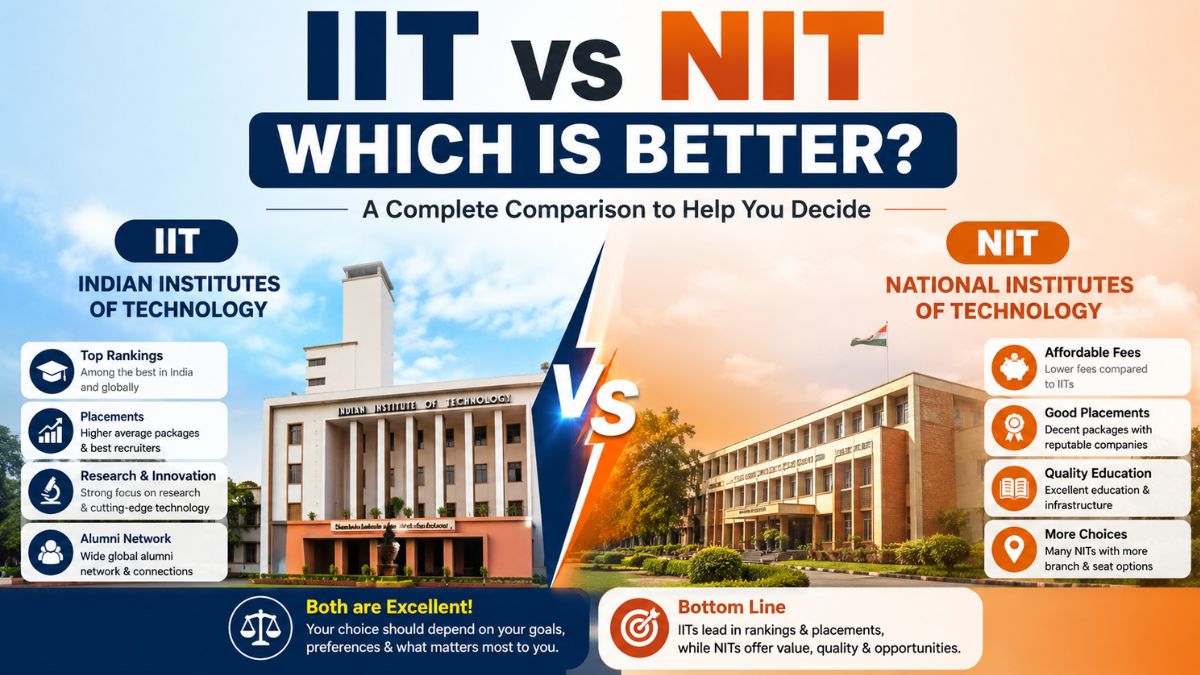
IITs vs NITs: Major Differences
IITs and NITs are well-known for their high educational standards. However, IITs and NITs are critical to the development of India's educational framework. Also, IITs and NITs have significantly improved the country's educational standards. They have contributed significantly to India's global rise in technology and science. The following are the major distinctions between IITs and NITs.
| Particulars | Indian Institute of Technology (IIT) | National Institute of Technology (NIT) |
|---|---|---|
| Number of Institutes | 23 IITs in India | 31 NITs in India |
| Act | Institute of Technology Act 1961 | National Institute of Technology Act 2007 |
| Authority | Central Government | State government |
| Admission Criteria | JEE Advanced | JEE Mains |
| Average Package | INR 18- 28 LPA | INR 10-15 LPA |
IITs vs NITs: Number of Institutes
There are 23 IITs and 31 NITs in all, therefore, the number of seats in NITs is significantly more than the number of seats in IITs.The sole distinction between IIT and NIT is the type of batch each institute receives. Here is a full list of IITs and NITs across India.
IIT vs NIT Government Funding 2026 - 27: Budget Allocation, Research Investment & Comparison
While both IITs and NITs receive funding from the Government of India and national research agencies, IITs secure significantly higher research investments due to their stronger research ecosystem, larger doctoral programmes, advanced laboratories, and greater industry collaborations.
According to the Union Budget 2026–27, the Government of India has increased funding for both IITs and NITs.
| Institution | Budget Allocation (2026–27) | Budget Allocation (2025–26) | Increase |
|---|---|---|---|
| Indian Institutes of Technology (23 IITs) | INR 12,123 crore | INR 11,349 crore | +INR 774 crore (6.82%) |
| National Institutes of Technology (31 NITs + IIEST) | INR 6,260 crore | INR 5,687 crore | +INR 572.53 crore (10.07%) |
 Source: official Press Information Bureau (PIB), Ministry of Education press release.
IIT Vs NIT Eligibility 2026
The table below compares the essential eligibility requirements that candidates must fulfil to secure admission to IIT and NIT undergraduate programmes.
| Admission Requirement | Who is Eligible for IIT Admission | Who is Eligibile for NIT Admission |
|---|---|---|
| Entrance Exam | Must first qualify JEE Main to become eligible for JEE Advanced. | Must qualify JEE Main. No separate entrance exam is required. |
| Rank Required | Admission is based on a valid JEE Advanced rank obtained after qualifying JEE Advanced. | Admission is based on a valid JEE Main rank (CRL/Category Rank). |
| Class 12 Eligibility | Candidates must meet the Class 12 eligibility criteria prescribed by the IITs, including the required subjects and other conditions. | Candidates must meet the Class 12 eligibility criteria prescribed by NITs and JoSAA. |
| Counselling Process | Candidates with a valid JEE Advanced rank must participate in JoSAA Counselling to secure an IIT seat. | Candidates with a valid JEE Main rank must participate in JoSAA Counselling to secure an NIT seat. |
| Final Admission | Admission is offered to B.Tech and Dual Degree programmes at IITs after seat allotment. | Admission is offered to B.Tech programmes at NITs after seat allotment. |
Check: JEE Main 2027: Notification Expected in October
IIT Vs NIT Placements
A common question among JEE aspirants is: "Which is more beneficial in terms of placement and salary package—an IIT with an average branch or an NIT with a top branch?" This question has been widely discussed on student forums such as Quora.
According to Aalok A. Yadav, JEE Mentor, Career Counsellor & Engineering Admission Expert, in a Quora discussion: "The IIT brand opens doors, but your skills, dedication, and career goals ultimately shape your success. When choosing between an IIT and an NIT, prioritize the branch that aligns with your interests rather than focusing only on the institute's brand or placement package.”
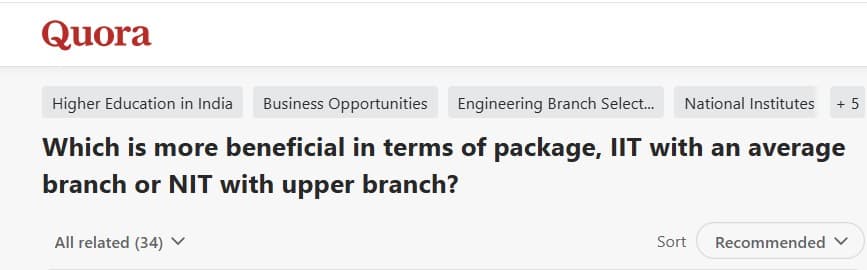
Explore more Quora discussions where experts, students, and community members have shared detailed answers, practical insights, and real experiences on related topics.
NIT Warangal Achieves Record Placement Success in 2026
- NIT Warangal recorded a 93.75% UG placement rate in the 2025–26 placement season, with 660 of 704 eligible students securing job offers.
- A Computer Science student received the institute's highest-ever domestic package of ₹1.27 crore, while an ECE student secured a ₹1 crore offer.
- More than 360 companies participated in campus placements, offering roles across software, core engineering, analytics, and other sectors.
- The average UG package stood at ₹18.54 lakh, with a median salary of ₹15 lakh, reflecting strong industry demand for NIT Warangal graduates.
IIT Placements 2025: Key Highlights
- IIT Kanpur recorded its best-ever Day 1 placements, receiving 672 job offers, a 16% increase over the previous year, with 500+ students placed on the opening day.
- Leading recruiters included Airbus, BlackRock, Qualcomm, and several global companies across software, analytics, and core engineering.
- IIT Bombay reported the highest package of ₹1.48 crore, driven by strong demand for AI, Data Science, and emerging technology professionals.
- Despite the slowdown and layoffs in the global tech industry, IIT graduates continued to receive strong placement offers across core engineering, software, and next-generation technology sectors.
IIT Admission Process 2026: Step-by-Step Guide
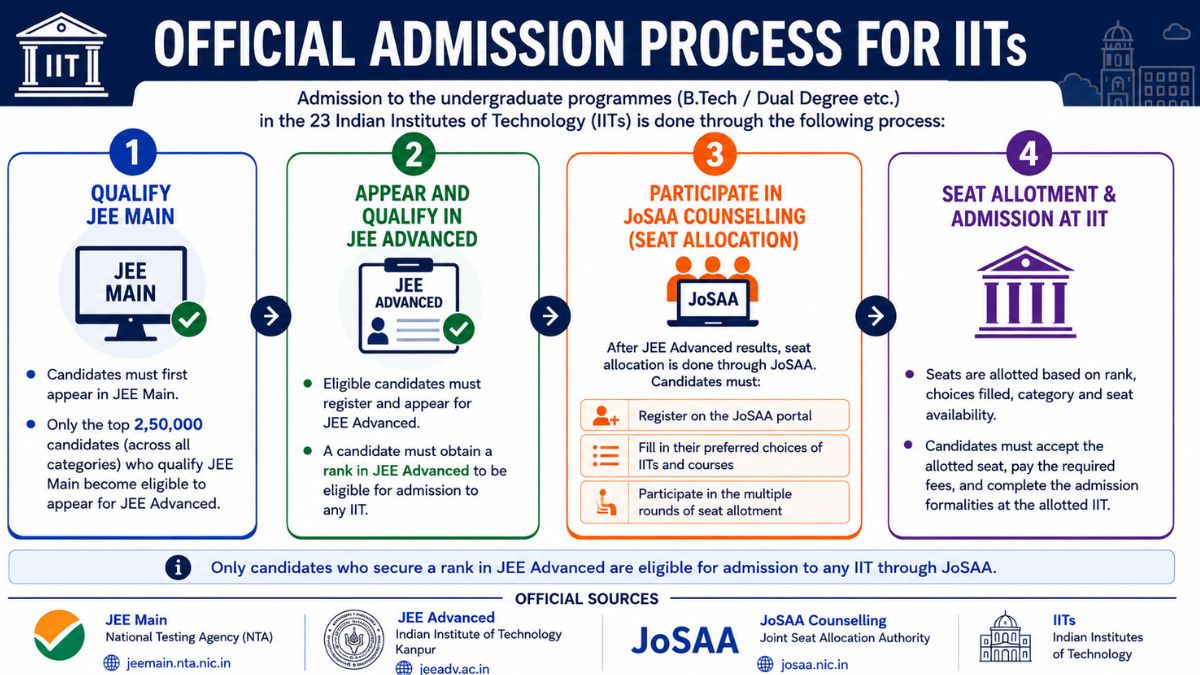
Admission to undergraduate programmes such as B.Tech, Dual Degree, and Integrated Courses offered by the 23 Indian Institutes of Technology (IITs) is based on a structured admission process. Candidates must complete each stage successfully to secure an IIT seat.
Step 1: Qualify JEE Main
The first stage of the IIT admission process is to appear for JEE Main, which is conducted by the National Testing Agency (NTA).
- Every IIT aspirant must first register for and appear in JEE Main 2026.
- Based on JEE Main results, only the top 2,50,000 candidates (across all categories) become eligible to appear for JEE Advanced 2026.
- Qualifying JEE Main alone does not guarantee admission to IITs.
Step 2: Qualify JEE Advanced
The second stage of the How to Get Admission in IIT process is JEE Advanced.
- Eligible candidates must register separately for JEE Advanced 2026.
- Candidates must obtain a valid JEE Advanced rank to become eligible for IIT admission.
- Without a JEE Advanced rank, candidates cannot participate in IIT seat allocation.
Step 3: Meet IIT Class 12 Eligibility Criteria
Apart from qualifying JEE Advanced, candidates must satisfy the IIT admission eligibility criteria prescribed by the Joint Admission Board (JAB).
Candidates must have studied Physics, Chemistry, and Mathematics (PCM) and fulfil any one of the following conditions:
Option 1: Minimum Marks Requirement
- Secure at least 75% aggregate marks in the Class 12 (or equivalent) examination.
- SC, ST, and PwD candidates must secure at least 65% aggregate marks.
OR
Option 2: Top 20 Percentile Criterion
Candidates should be among the Top 20 percentile of successful candidates in their respective Class 12 Board examination (category-wise wherever applicable).
Note: Meeting either of these conditions is mandatory for IIT admission 2026.
Step 4: Participate in JoSAA Counselling 2026
After the declaration of JEE Advanced Result 2026, admission to IITs is carried out through JoSAA Counselling 2026 (Joint Seat Allocation Authority).
Candidates who secure a JEE Advanced rank must:
- Register on the JoSAA Counselling Portal.
- Fill and lock their preferred IITs and B.Tech courses.
- Participate in all rounds of JoSAA Seat Allotment 2026.
- Accept the allotted IIT seat.
- Complete document verification and fee payment before the deadline.
Candidates who fail to complete any of these steps may lose their allotted seat.
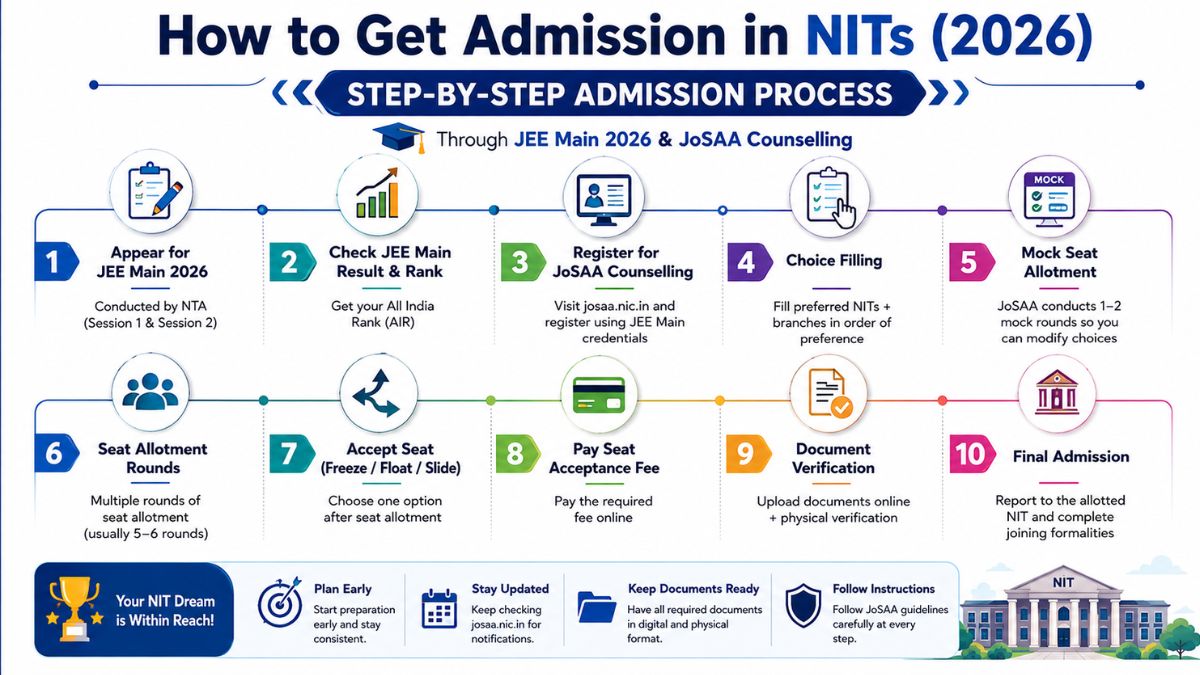
How to Get Admission in NITs 2026?
The step-by-step NIT admission process is explained below:
| Step | Process | Details |
|---|---|---|
| 1 | Appear for JEE Main 2026 | Conducted by NTA (Session 1 & Session 2) |
| 2 | Check JEE Main Result & Rank | Get your All India Rank (AIR) |
| 3 | Register for JoSAA Counselling | Visit josaa.nic.in and register using JEE Main credentials |
| 4 | Choice Filling | Fill preferred NITs + branches in order of preference |
| 5 | Mock Seat Allotment | JoSAA conducts 1–2 mock rounds so you can modify choices |
| 6 | Seat Allotment Rounds | Multiple rounds of seat allotment (usually 5–6 rounds) |
| 7 | Accept Seat (Freeze / Float / Slide) | Choose one option after seat allotment |
| 8 | Pay Seat Acceptance Fee | Pay the required fee online |
| 9 | Document Verification | Upload documents online + physical verification |
| 10 | Final Admission | Report to the allotted NIT and complete joining formalities |
Important Points
- Admission is only through JEE Main (No JEE Advanced needed for NITs).
- Seats are allotted based on JEE Main All India Rank.
- 50% seats are reserved for Home State candidates.
- 50% seats are for Other State candidates.
- JoSAA counselling is common for IITs, NITs, IIITs, and GFTIs.
What is the Home State quota in NITs?
Every NIT reserves 50% of its seats under the Home State (HS) quota for students who have passed their Class 12 (or equivalent qualifying examination) from the same state or Union Territory where the NIT is located.
The remaining 50% seats are allotted under the Other State (OS) quota, allowing candidates from across India to compete.
For example:
- Students who completed Class 12 in Karnataka are eligible for the Home State quota at NIT Surathkal.
- Students from other states compete under the Other State quota.
The Home State quota often results in different closing ranks compared to the Other State quota.
How to Choose Between IIT and NIT?
Here’s a clear decision table to help you decide:
| Factor | Choose IIT if... | Choose NIT if... |
|---|---|---|
| JEE Rank | You have a good rank in JEE Advanced (especially top 10,000–12,000) | Your rank is good in JEE Main but not enough for a decent IIT branch |
| Branch Preference | You are getting a preferred branch (CSE, ECE, EE, Mechanical) in any IIT | You are getting a better branch in a top NIT (e.g. CSE/ECE in NIT Trichy, Warangal, Surathkal) than a lower branch in a new IIT |
| Brand Value | You want the strongest brand, alumni network & global recognition | Brand is important but not the only factor for you |
| Placements | You want higher average packages and more international opportunities | You are okay with good (but slightly lower) packages, especially in top NITs |
| Campus & Peer Group | You want a highly competitive peer group and research-oriented environment | You prefer a relatively balanced campus life with good academics |
| Fees & ROI | Fees are higher but ROI is still excellent due to packages | Slightly better ROI in some cases (especially top NITs) |
| Location Preference | Location is secondary for you | You prefer a specific city/state (many good NITs are well located) |
| Long-term Goal | Research, higher studies abroad, or top product companies | Industry jobs, core engineering, or government jobs |
Quick Decision Rules
| Situation | Better Choice |
|---|---|
| Old IIT (Bombay, Delhi, Madras, Kanpur, Kharagpur, Roorkee) + any branch | IIT |
| New IIT + lower branch vs Top NIT (Trichy, Warangal, Surathkal, Rourkela) + better branch | Top NIT usually better |
| Mid-tier IIT vs Mid-tier NIT | Prefer IIT for brand |
| Getting CSE/ECE in top NIT vs lower branch in mid/new IIT | Prefer Top NIT |
| Rank is not enough for any good IIT | Go for best possible NIT |
When to Prefer a Top NIT over a Mid/New IIT?
Prefer a Top NIT (Trichy, Surathkal, Warangal, Rourkela, Calicut) if:
- You are getting CSE / ECE / EE in a top NIT, but only a lower branch (Civil, Chemical, Metallurgy, etc.) in a mid or new IIT.
- You value better placements in core + software (top NITs often match or beat newer IITs in CSE/ECE packages).
- You want a more established campus culture, better alumni network (in some cases), and stronger peer group in your preferred branch.
- You have Home State advantage and can get a much better branch in your home NIT.
IITs vs NITs: Courses
After the first year, every student of IITs and NITs is required to begin a course from another discipline, such as humanities, social sciences, or management. However, when compared to NITs, IITs provide a diversified array of courses taught by highly qualified professors who prefer creative teaching methodologies. Here is a comparison of the courses offered by IITs and NITs:
| Degree | IIT | NIT |
|---|---|---|
| Undergraduate | B-Tech | B-Tech |
| Dual Degree M.Sc. | Dual Degree Integrated Courses | |
| Dual Degree MA | BA | |
| B.Sc. | ||
| B-Arch | B-Arch | |
| B-Planning | B-Planning | |
| Post Graduate | M-Tech | M-Tech |
| MBA | MBA | |
| M.Sc. | M.Sc. | |
| M-Arch | M-Arch | |
| MS | MS | |
| Master of Design | MCA | |
| Post Graduate Diploma in Information and Technology (PGDIT) | – | |
| Master in Medical Science & Technology (MMST) | – | |
| Post Graduate Diploma (PGDIPL) | – | |
| Postgraduate Diploma in Maritime Operation & Management (PGDMOM) | – | |
| Doctorate | PhD | PhD |
The variety of courses available is not restricted to those listed above. All IITs and NITs offer identical technical courses. Furthermore, the most important aspect is the variety of specialisations given at both campuses, with enough support from the professors. This is something that most prominent private colleges don’t offer.
IIT Delhi Partners with 18 NITs to Boost Research, Student Exchange, and Higher Education Opportunities.
- IIT Delhi signed MoUs with 18 National Institutes of Technology (NITs) to establish one of India's largest academic and research collaboration networks under the vision of NEP 2020.
- The partnership will promote joint research, academic collaboration, innovation, and talent development by enabling students and faculty from IIT Delhi and participating NITs to work together on research projects and academic initiatives.
- Undergraduate and postgraduate students from partner NITs will get opportunities to study and conduct research at IIT Delhi through structured exchange programmes and research immersion initiatives.
- A new Early Admission Scheme allows meritorious students from participating NITs to seek admission to M.Tech., MS (Research), and Ph.D. programmes at IIT Delhi without qualifying GATE, subject to academic and research performance criteria.
- The collaboration introduces credit transfer and credit-sharing mechanisms, enabling students to earn academic credits at IIT Delhi that can be recognized by both institutions.
- IIT Delhi launched the ALIGN (Academic Linkages for Innovation and National Growth) initiative to strengthen long-term collaboration with NITs.
- ALIGN includes three major schemes:
- Predoctoral Fellowship Scheme for students aspiring to pursue Ph.D. programmes at IIT Delhi.
- Research Seed Grant Scheme to support collaborative research, faculty exchanges, and joint publications.
- Research Immersion Visit Scheme to facilitate faculty interactions, knowledge sharing, and collaborative research opportunities.
- The first phase of the initiative includes 18 NITs, including NIT Trichy, NIT Surathkal, NIT Warangal, MNIT Jaipur, MANIT Bhopal, NIT Rourkela, NIT Calicut, VNIT Nagpur, and others, with plans to expand the network further.
IITs vs NITs: Alumni and Entrepreneurs List
IIT and NIT graduates have founded numerous companies both in India and overseas. IITians are among the leading founders of America's most successful firms, according to a US analysis. The majority of US company founders have graduated from IITs. Numerous entrepreneurs from IIT and NIT have launched businesses in India as well. NITs are also competing to develop leaders. Numerous companies and large salaries have been earned in India by students from various NITs.
| Notable IIT Alumni | Notable NIT Alumni |
|---|---|
| Sachin Bansal – Co-Founder, Flipkart | Natarajan Chandrasekaran – Chairman, Tata Sons |
| Binny Bansal – Co-Founder, Flipkart | Rajesh Gopinathan – Former CEO & MD, Tata Consultancy Services (TCS) |
| Arvind Krishna – Chairman & CEO, IBM | T. V. Narendran – CEO & MD, Tata Steel |
| N. R. Narayana Murthy – Co-Founder, Infosys (M.Tech, IIT Kanpur) | K. V. Kamath – Former CEO, ICICI Bank & Former President, New Development Bank |
| Kris Gopalakrishnan – Co-Founder, Infosys | C. P. Gurnani – Former CEO, Tech Mahindra |
| Vineeta Singh – Founder & CEO, SUGAR Cosmetics | Shyam Srinivasan – MD & CEO, Federal Bank |
| Naveen Tewari – Founder & CEO, InMobi | K. R. Sridhar – Founder & CEO, Bloom Energy |
| Prabhakar Raghavan – Chief Technologist, Google | Abid Ali Neemuchwala – Former CEO, Wipro |
| Raghuram Rajan – Economist & Former RBI Governor | Vivek Ravishankar – Co-Founder, HackerRank |
| Chetan Bhagat – Bestselling Author | Harishankaran K. – Co-Founder, HackerRank |
- IITs have a higher quality of education than NITs because they place a larger emphasis on core topics.
- In comparison to NITs, IITs have a superior infrastructure in terms of courses, scope, faculty, and top-scoring students.
- NIT, on the other hand, is still coming up in these areas, which is why it is still the second choice for individuals interested in technical degrees.
- Compared to premier private colleges, NITs have batches of diligent and intelligent students.
IITs vs NITs: Faculty
Exceptional teachers of IITs use a variety of creative teaching strategies to provide learners with a very distinctive and interesting educational experience. IIT has created its popularity in the country by having an experienced as well as academically and professionally accomplished faculty and by being famous for its research standards. However, this does not imply that NITs are inadequate. Both IITs and NITs are excellent at offering great education and creating good engineers but IITs have the upper hand.
IITs vs NITs: Infrastructure and Facilities.
- IIT infrastructure is technologically modern, extensive, and furnished. Furthermore, they offer great lecture rooms and laboratory facilities.
- NITs do not presently have world-class infrastructure. Moreover, this type of infrastructure may take some years to establish.
- IITs possess significantly bigger campuses as well.
- Campuses of the NITs are likewise outfitted with modern facilities but in comparison to the IITs, the infrastructure of NITs is still in development.
IITs vs NITs: Extracurricular Environment
- IITs and NITs conduct nearly the same competition in extracurricular activities.
- Numerous sporting events and other competitions occur each year, helping pupils improve their decision-making ability.
- Each year, students who are actively engaged in their studies form their bands, dancing troupes, sports teams, and theatrical groups for colleges.
- Students at both IITs and NITs are encouraged to participate in sports, which improves their competence and temperament while also giving them opportunities to compete at the national level.
- Both institutes include cultural festivals in their curricula.
- There are IITs vs NITs competitions at the intercollegiate and international levels.
Important Links:
| Particulars | Links |
|---|---|
| JoSAA FAQs | Click Here |
| JEE (Main) | Click Here |
| JEE (Advanced) | Click Here |
Frequently Asked Questions
Ques. Is JEE Advanced required for NIT admission?
Ans. No. JEE Advanced is not required for admission to National Institutes of Technology (NITs). Admission to all NIT B.Tech and Dual Degree programmes is based only on the JEE Main rank. Candidates who qualify JEE Main, meet the eligibility criteria, and participate in JoSAA counselling are considered for seat allocation.
Ques. Is JoSAA counselling compulsory for NIT admission?
Ans. Yes. JoSAA counselling is mandatory for admission to all NITs. After the declaration of JEE Main results, candidates must register on the JoSAA portal, fill in their preferred institutes and branches, lock their choices, and participate in the counselling process. Without participating in JoSAA counselling, candidates cannot secure admission to an NIT.
Ques. Can I get admission to an NIT without JEE Main?
Ans. No. Admission to B.Tech and Dual Degree programmes at NITs is not possible without qualifying JEE Main. There is no direct admission, management quota, or separate entrance examination for NIT undergraduate engineering programmes.
Ques. Is an IIT degree more valuable than an NIT degree?
Ans. Both IITs and NITs are among India's premier engineering institutions. An IIT degree generally carries stronger global recognition, a larger alumni network, and may provide advantages in higher education admissions, research opportunities, and recruitment by certain multinational companies. At the same time, graduates from top NITs also enjoy excellent career prospects, with many securing high-paying jobs, pursuing higher studies at prestigious universities, or joining leading technology companies. Success ultimately depends on a student's skills, academic performance, internships, projects, and overall profile rather than the institute alone.
Ques. Which is better for CSE Top NIT or a lower-ranked IIT?
Ans. If your primary goal is software engineering or placements in the technology sector, a top NIT with CSE may offer better immediate opportunities than a lower-ranked IIT in a less preferred branch. However, if you prioritize the IIT ecosystem, brand value, research opportunities, and long-term networking, a newer IIT may still be an attractive choice. The decision should be based on Preferred branch, Placement records, Career aspirations, Higher education plans, Personal interests.
Ques. How to Get Admission in IIT After Class 12?
Ans. The IIT admission process 2026 is conducted through JEE Main, JEE Advanced, and JoSAA Counselling. Students seeking admission to undergraduate programmes such as B.Tech, Dual Degree, Integrated B.Tech-M.Tech, and BS programmes offered by the 23 Indian Institutes of Technology (IITs) must complete every stage of the admission process. Simply qualifying JEE Main is not enough, as only candidates with a valid JEE Advanced rank are eligible for IIT admission through JoSAA.


.jpeg?h=40&w=40&mode=stretch)







Comments