




CG Pre B.Ed. 2026 Question Paper is available for download here. CGSSB conducted CG Pre B.Ed. 2026 exam on June 11 in single shift from 10 AM to 12.15 PM. CG Pre B.Ed Question Paper consists of 100 questions for 100 marks to be attempted in 135 minutes.
- CG Pre B.Ed. Question Paper 2026 is divided into 5 sections- General Mental Ability (30 questions), General Knowledge (20 questions), Teaching Aptitude (30 questions), General Hindi (10 questions), General English (10 questions).
- Each question carries 1 mark and there is no negative marking for incorrect answers.
Candidates can download CG Pre B.Ed. 2026 Question Paper with Answer Key and Solution PDF from the links provided below.
CG Pre B.Ed. 2026 Question Paper with Solutions PDF
| CG Pre B.Ed. Question Paper 2026 | Download PDF | Check Solutions |
Direction - For the below Assertion [As] and Reason [R], choose the correct alternative-
Assertion [As] : Mercury is the farthest planet from the Sun.
Reason [R] : Mercury is the smallest planet in the entire solar system.
Read the following information carefully and answer the question from the given options:
If 'A + B' means 'A' is the son of 'B', 'A \(-\) B' means 'A' is the wife of 'B', 'A \(\times\) B' means 'A' is the brother of 'B', 'A \(\div\) B' means 'A' is the mother of 'B' and 'A = B' means 'A' is the sister of 'B'.
What does 'P + R \(-\) Q' mean?
If OVER is coded as QYIW and UP as WS, then STAR is coded as:
Direction - For the below Assertion [As] and Reason [R], choose the correct alternative-
Assertion [As] : The Indian Constitution came into force with effect from \( 26^{th} \) January 1950.
Reason [R] : \( 26^{th} \) January is celebrated as Republic Day.
Some equations have been solved based on a certain system. From the given options, write the answer of the equation that has not been solved-
7 \(-\) 4 \(-\) 1 = 714
9 \(-\) 2 \(-\) 3 = 932
8 \(-\) 0 \(-\) 4 = ?
Find the next term in the alpha-numeric series-
Z1A, X2D, V6G, T21J, R88M, P445P, ?
In the following sequence find the odd one out-
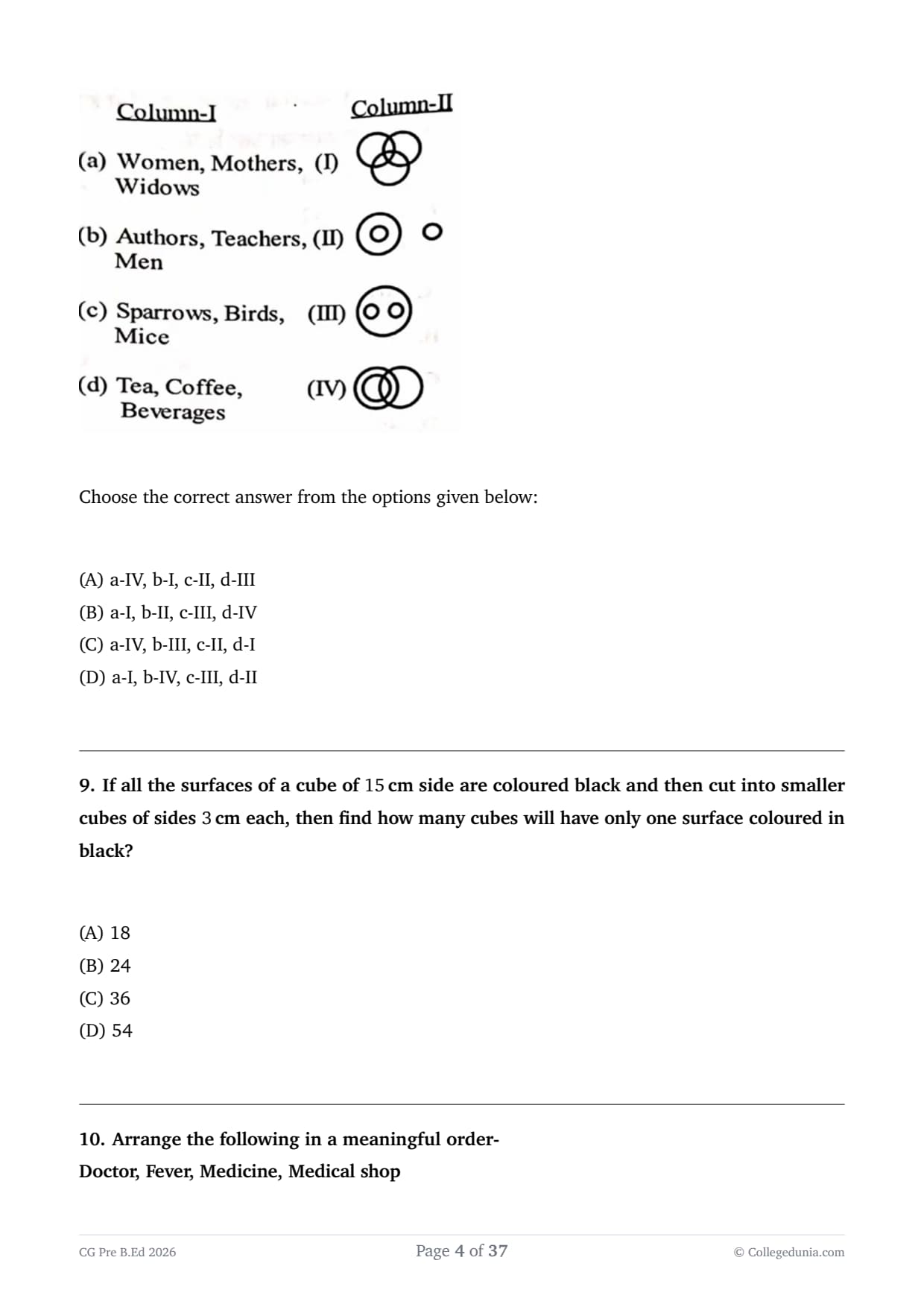
Match the following-

Choose the correct answer from the options given below:
If all the surfaces of a cube of \( 15 \, cm \) side are coloured black and then cut into smaller cubes of sides \( 3 \, cm \) each, then find how many cubes will have only one surface coloured in black?
Arrange the following in a meaningful order-
Doctor, Fever, Medicine, Medical shop
Gyan Prakash left for his college in his car -
(J) He drove 15 km towards the North and then 10 km towards the West.
(K) He then turned South and covered 5 km.
(L) Further, he turned to the East and moved 8 km.
(M) Finally, he turned right and drove 10 km.
How far and in which direction is he from his starting point?
In the series given below how many 8s are there each of which is exactly divisible by its preceding as well as succeeding numbers?
2, 8, 3, 8, 2, 4, 8, 2, 4, 8, 6, 8, 2, 8, 2, 4, 8, 3, 8, 2, 8, 6
Six friends are sitting in a circle and playing cards. Ashok is to the left of Dinesh. Raghav is between Sumit and Amit. Ramesh is between Ashok and Sumit. Who is sitting to the right of Raghav?
In the following question there is a certain relationship between the given words on one side of :: and one word is given on another side of :: while another word is to be found from the given alternatives having the same relation with this word as in the pair given; find the correct option-
Menu : Food :: Catalogue : ?
A, B, C, D, E, F and G are members of a family consisting of four adults & three children, two of whom F and G are girls.
(J) A and D are brothers and A is a doctor.
(K) E is an engineer married to one of the brothers and has two children.
(L) B is married to D and G is their child.
Who is C?
If the first and fifth position of the numbers 5, 3, 2, 6, 4, 1, 8, 9 are exchanged and the positions of the second and sixth numbers are also exchanged and so on. Find the sixth number from the right of the rearranged pattern-
It is given that
\(\times\) denotes greater than,
\(\phi\) denotes equal to,
\(<\) denotes not less than,
\(\perp\) denotes not equal to,
\(\Delta\) denotes less than,
\(+\) denotes not greater than.
Choose the correct statement from the following-
If a \(\times\) b \(\Delta\) c it follows that-
Match the following-
| Column-I | Column-II |
|---|---|
| (\(a, b\) as given in Euclidean Algorithm \(a=bq+r\)) | (Values of \(q\) and \(r\)) |
| (a) \(a=-112,\ b=-7\) | (I) \(q=-13,\ r=1\) |
| (b) \(a=118,\ b=-9\) | (II) \(q=14,\ r=3\) |
| (c) \(a=-109,\ b=6\) | (III) \(q=-19,\ r=5\) |
| (d) \(a=115,\ b=8\) | (IV) \(q=16,\ r=0\) |
Choose the correct answer from the options given below:
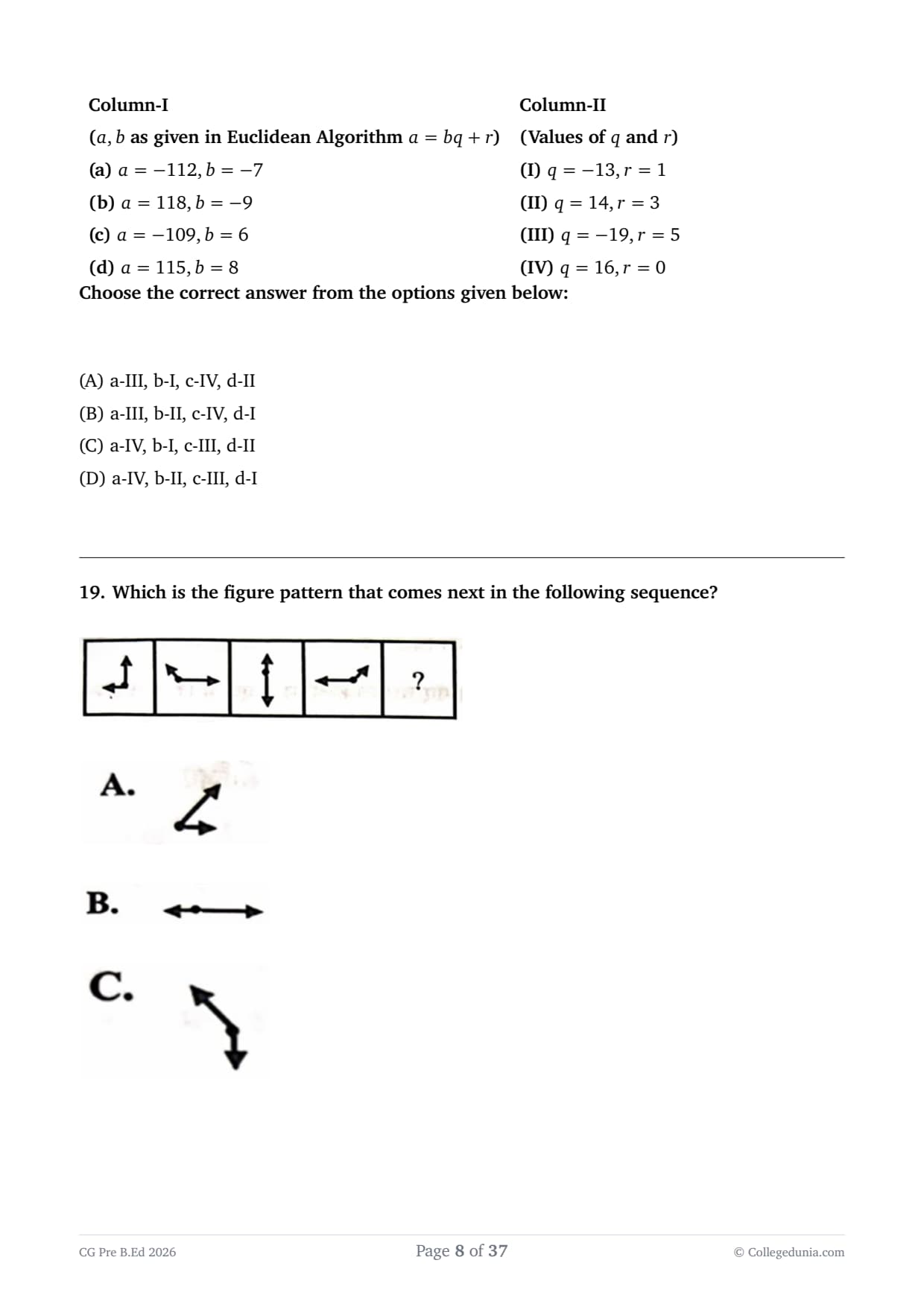
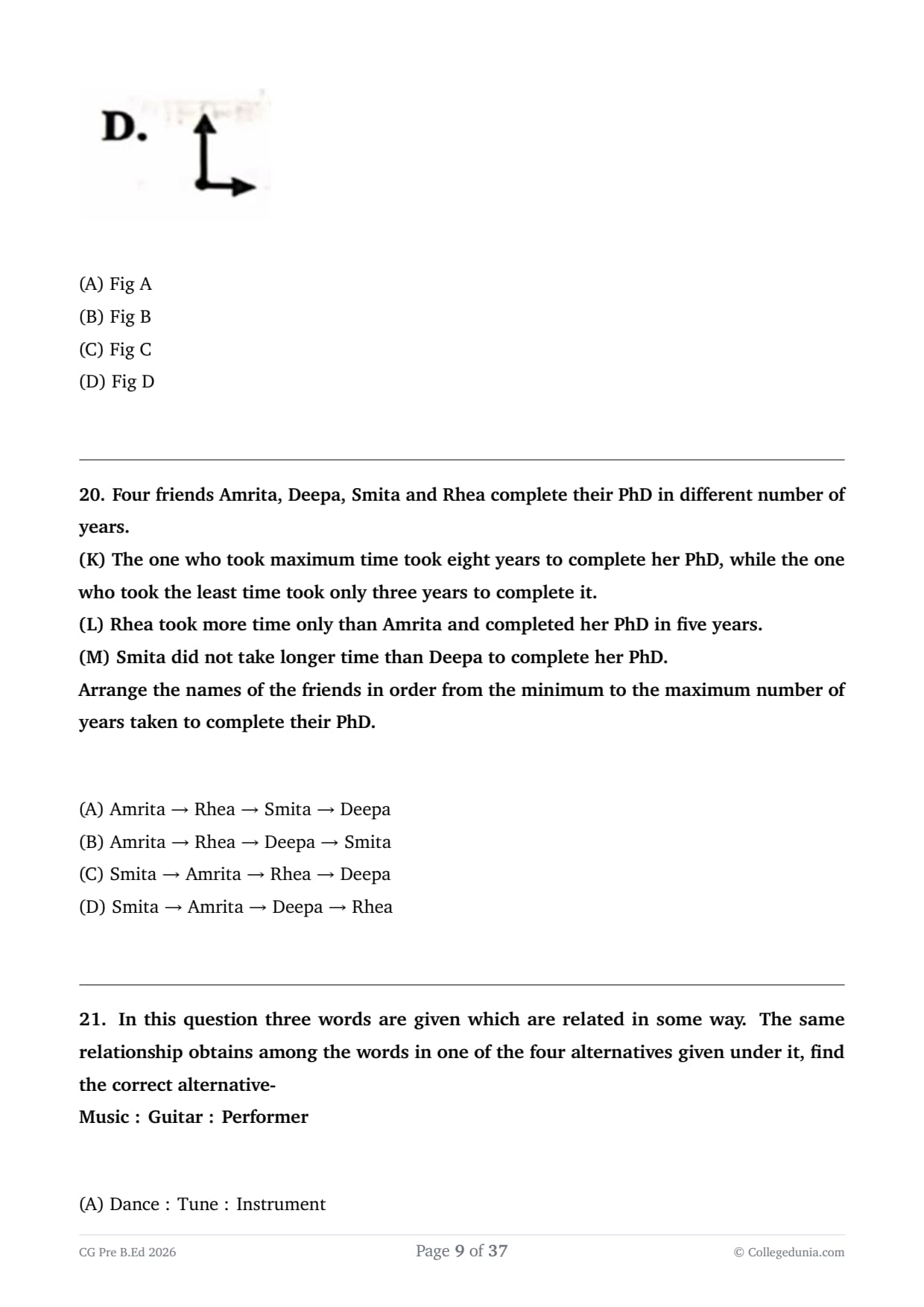
Which is the figure pattern that comes next in the following sequence?


Four friends Amrita, Deepa, Smita and Rhea complete their PhD in different number of years.
(K) The one who took maximum time took eight years to complete her PhD, while the one who took the least time took only three years to complete it.
(L) Rhea took more time only than Amrita and completed her PhD in five years.
(M) Smita did not take longer time than Deepa to complete her PhD.
Arrange the names of the friends in order from the minimum to the maximum number of years taken to complete their PhD.
In this question three words are given which are related in some way. The same relationship obtains among the words in one of the four alternatives given under it, find the correct alternative-
Music : Guitar : Performer
What will be the next term in the sequence?
\( \frac{17}{14}, \frac{18}{13}, \frac{16}{15}, \frac{19}{12}, \frac{?}{?} \)
Read the information given below and answer the questions that follow-
(J) If P + Q means; P is the brother of Q.
(K) P \(\times\) Q means; P is the father of Q; and
(L) P \(-\) Q means; P is the sister of Q.
Then, which of the following represents S is the niece of T?
Which is the missing number in the given number sequence?
7, 15, 32, -----, 138, 281
P, Q, R, S, T, V and W are seven friends who left for seven destinations Delhi, Chennai, Hyderabad, Bangalore, Kolkata, Chandigarh and Jaipur, each on a different day of the week-
(K) R left for Jaipur on Monday. On Sunday, one of them left for Bangalore.
(L) T left the next day of P who left for Chandigarh and on the previous day of W.
(M) S left for Kolkata on Friday.
(N) Q did not leave for either Hyderabad or Bangalore and W left for Delhi.
What is the correct sequence of departure of the friends from Monday to Sunday?
Two statements are given followed by four conclusions J, K, L, M taking statements to be true even if they are at variance from the commonly known facts. Decide which conclusion logically follows from the given statement.
Statement:
Some bottles are drinks.
All drinks are cups.
Conclusions:
(J) Some bottles are cups
(K) Some cups are drinks
(L) All drinks are bottles
(M) All cups are drinks
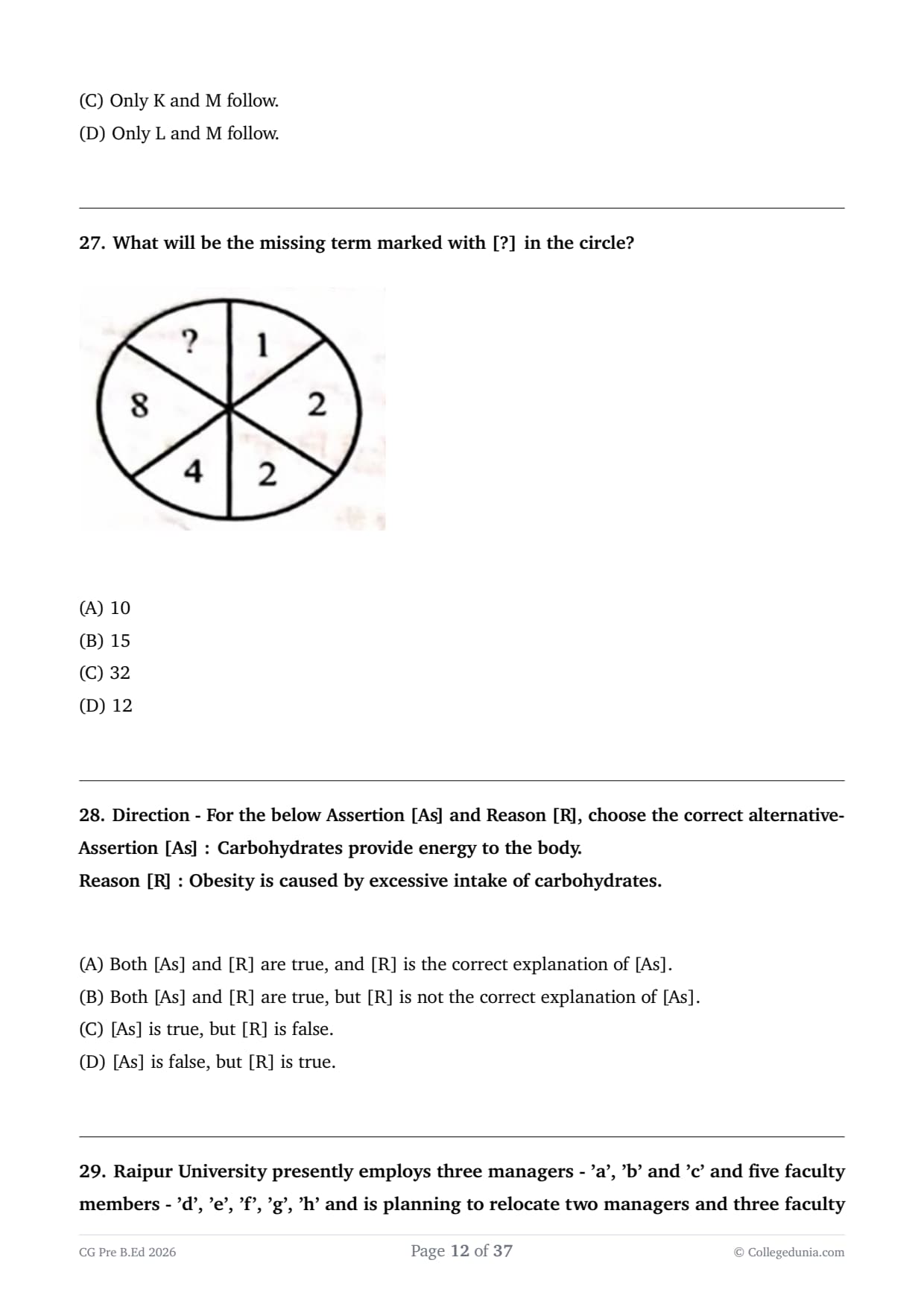
What will be the missing term marked with [?] in the circle?

Direction - For the below Assertion [As] and Reason [R], choose the correct alternative-
Assertion [As] : Carbohydrates provide energy to the body.
Reason [R] : Obesity is caused by excessive intake of carbohydrates.
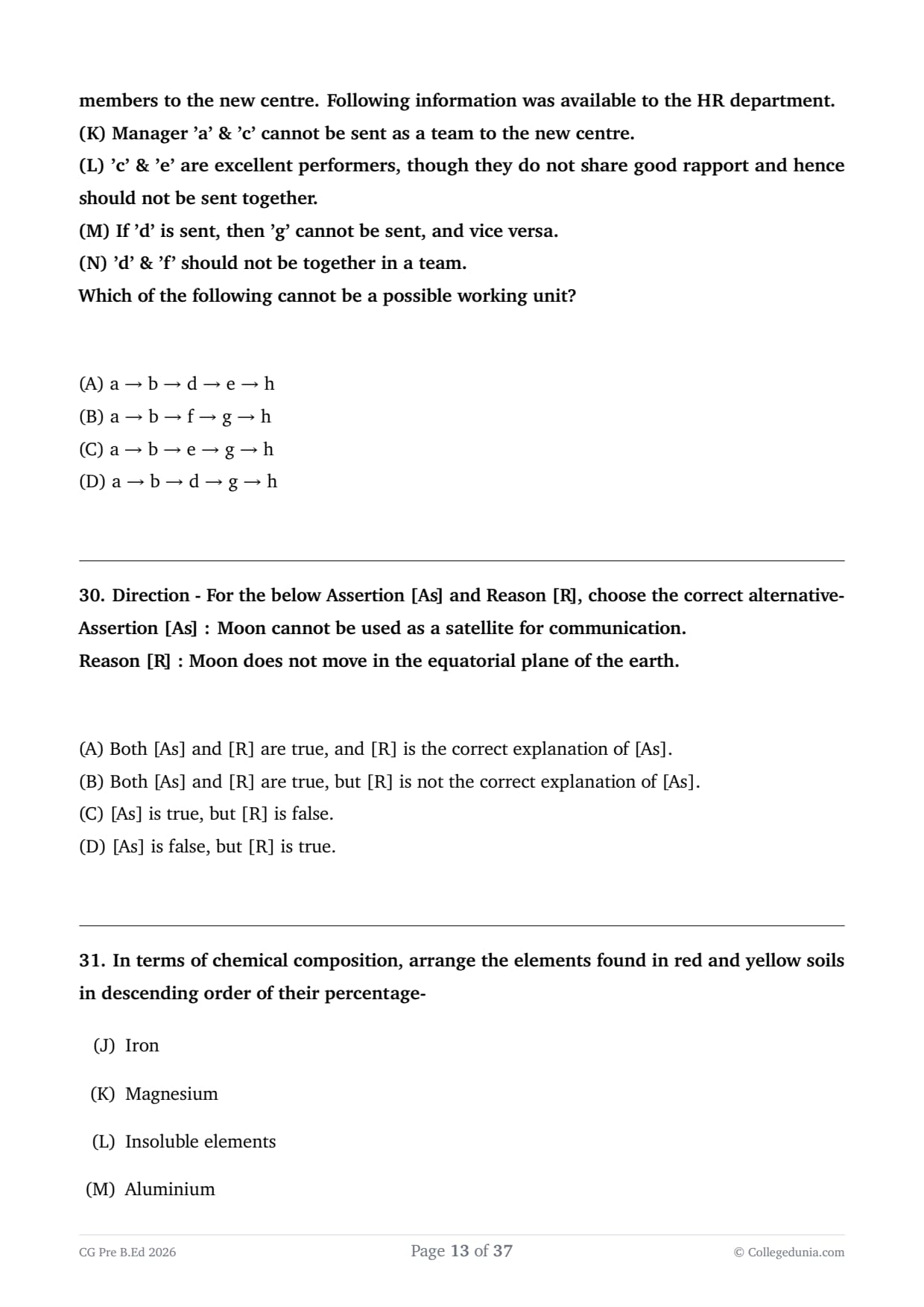
Raipur University presently employs three managers - 'a', 'b' and 'c' and five faculty members - 'd', 'e', 'f', 'g', 'h' and is planning to relocate two managers and three faculty members to the new centre. Following information was available to the HR department.
(K) Manager 'a' & 'c' cannot be sent as a team to the new centre.
(L) 'c' & 'e' are excellent performers, though they do not share good rapport and hence should not be sent together.
(M) If 'd' is sent, then 'g' cannot be sent, and vice versa.
(N) 'd' & 'f' should not be together in a team.
Which of the following cannot be a possible working unit?
Direction - For the below Assertion [As] and Reason [R], choose the correct alternative-
Assertion [As] : Moon cannot be used as a satellite for communication.
Reason [R] : Moon does not move in the equatorial plane of the earth.
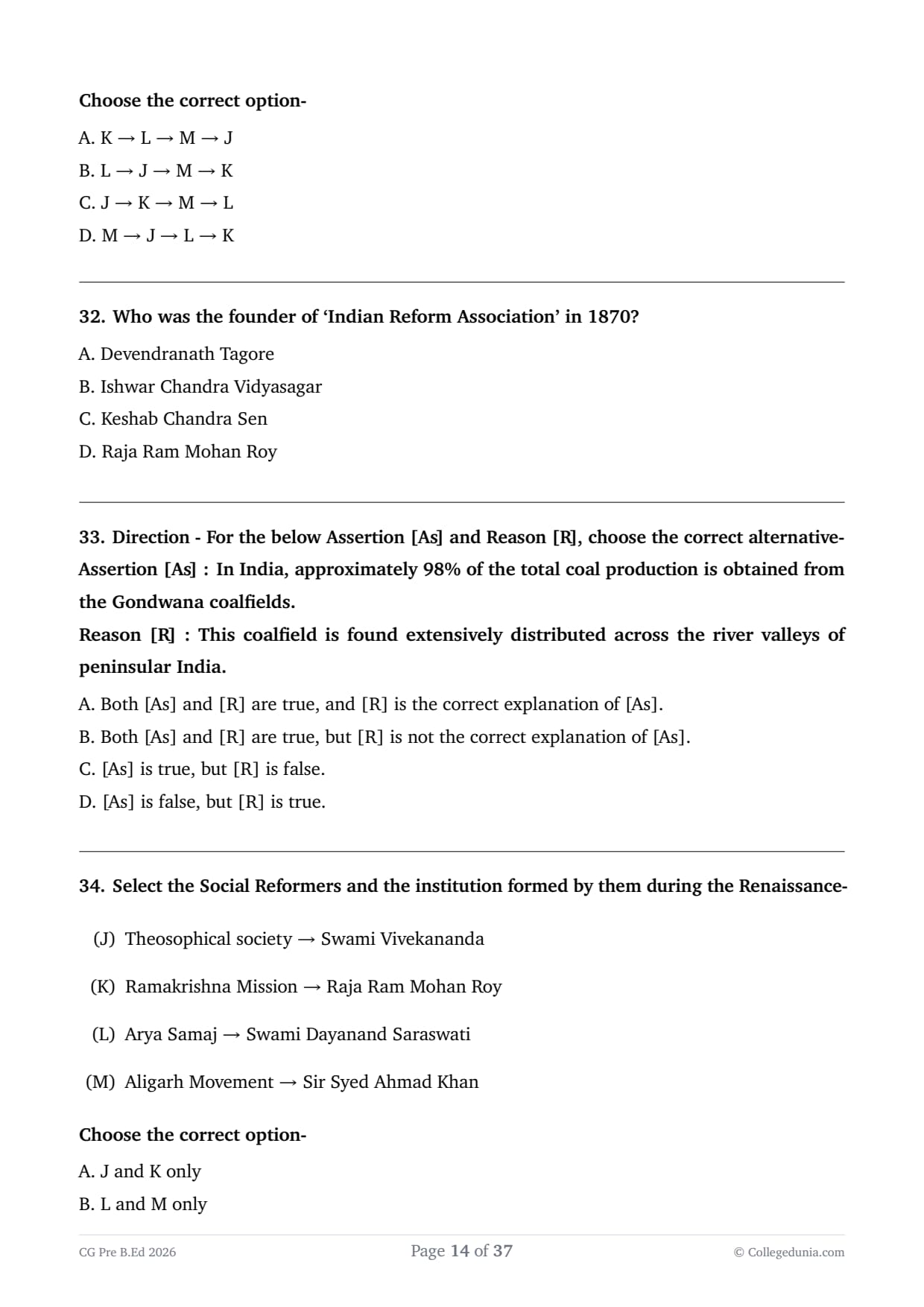
In terms of chemical composition, arrange the elements found in red and yellow soils in descending order of their percentage-
[(J)] Iron
[(K)] Magnesium
[(L)] Insoluble elements
[(M)] Aluminium
Choose the correct option-
View Solution
Concept:
Red and yellow soils are highly weathered soils formed mainly in tropical and subtropical regions under conditions of high temperature and moderate rainfall. These soils are characterized by intense leaching, which removes soluble bases and leaves behind a residue dominated by insoluble materials such as silica and quartz. The reddish or yellowish color is mainly due to the presence of iron oxides in different hydration states. Because of long-term weathering, the proportion of nutrients like magnesium is very low, while insoluble minerals remain the dominant fraction.
Step 1: Understanding the general composition of red and yellow soils
In highly weathered soils like red and yellow soils, the composition typically follows a consistent trend:
The largest component is insoluble material (mainly silica and quartz residues).
Next comes iron oxides, which give the characteristic red/yellow coloration.
Aluminium compounds are present in smaller amounts as part of clay minerals.
Magnesium and other basic nutrients exist only in trace amounts due to leaching.
Step 2: Interpreting each component
(L) Insoluble elements: These include quartz and siliceous residues which resist chemical weathering. Since leaching removes most soluble components, these remain in highest proportion.
(J) Iron: Present mainly as ferric oxide (\(Fe_2O_3\)), responsible for red/yellow coloration, but still much less than insoluble fraction.
(M) Aluminium: Occurs as alumina in clay minerals, typically less abundant than iron compounds.
(K) Magnesium: Highly leached basic nutrient, present only in very small trace amounts.
Step 3: Logical ordering based on weathering and leaching
Since intense leaching removes mobile ions first and leaves resistant materials behind, the descending order must follow: \[ Insoluble residues > Iron oxides > Aluminium compounds > Magnesium \]
Substituting symbols: \[ L > J > M > K \]
Thus, the correct sequence is: \[ L \rightarrow J \rightarrow M \rightarrow K \] Quick Tip: In red and yellow soils, remember the simple trend: Silica (insoluble) dominates first, iron gives color, aluminium is moderate, and magnesium is minimal due to heavy leaching.
Who was the founder of ‘Indian Reform Association’ in 1870?
View Solution
Concept:
The Indian Reform Association was an important socio-religious and socio-educational organization established during the Bengal Renaissance. It emerged in the context of 19th-century reform movements that aimed at modernizing Indian society through education, women’s upliftment, temperance, and social welfare activities. The association was closely linked with the Brahmo Samaj movement and reflected liberal, progressive ideals influenced by Western education and reformist thought.
Step 1: Identifying the historical background
During the second half of the 19th century, several reform movements arose in India, particularly in Bengal, focusing on eliminating social evils like child marriage, illiteracy, and alcoholism. Leaders of the Brahmo Samaj played a key role in expanding reformist activities beyond religious discourse into social action.
Step 2: Establishment of Indian Reform Association
The Indian Reform Association was founded on 29 October 1870 by Keshab Chandra Sen after his return from Englan(D) His exposure to Western liberal ideas encouraged him to create an organized platform for social reform activities that would work practically among the masses.
Step 3: Objectives and activities
The association focused on structured reform through different departments:
Promotion of female education and establishment of schools for women.
Encouragement of affordable literature to spread literacy among common people.
Promotion of temperance movement (anti-alcohol campaigns).
Support for charity, industrial training, and social upliftment of the poor.
Step 4: Eliminating incorrect options
Devendranath Tagore: Associated with Brahmo Samaj leadership but not founder of this association.
Ishwar Chandra Vidyasagar: Known for widow remarriage reforms and education but not related to this institution.
Raja Ram Mohan Roy: Founder of Brahmo Samaj (1828), predates this organization.
Thus, the correct answer is clearly Keshab Chandra Sen. Quick Tip: Remember: Keshab Chandra Sen (1870) → Indian Reform Association, while Raja Ram Mohan Roy (1828) → Brahmo Samaj.
Direction - For the below Assertion [As] and Reason [R], choose the correct alternative-
Assertion [As] : In India, approximately 98% of the total coal production is obtained from the Gondwana coalfields.
Reason [R] : This coalfield is found extensively distributed across the river valleys of peninsular Indi(A)
View Solution
Concept:
Coal in India is mainly classified into two geological groups: Gondwana coalfields (older, Carboniferous–Permian period) and Tertiary coalfields (younger deposits). Gondwana coal is the most important source of commercial coal in India due to its abundance, quality, and wide distribution in structurally stable peninsular regions.
Step 1: Verifying the Assertion
The Gondwana coalfields account for about 98% of India’s total coal production. These coalfields are the backbone of India’s energy sector, supplying most of the coal used in thermal power plants and industries. Hence, the Assertion is true.
Step 2: Verifying the Reason
Gondwana coal deposits are widely distributed in the river valley basins of peninsular India such as:
Damodar valley (Jharkhand–West Bengal)
Mahanadi valley (Odisha)
Godavari valley (Telangana–Andhra Pradesh)
Wardha valley (Maharashtra)
These basins are structurally stable and rich in ancient plant deposits, making the Reason also true.
Step 3: Establishing the relationship
The reason correctly explains the assertion because the extensive distribution of Gondwana coal across major river valleys of peninsular India led to large-scale accumulation of coal-forming vegetation in ancient geological times. This geological setting explains why most of India’s coal production comes from these fields.
Therefore, both statements are true and the Reason correctly explains the Assertion. Quick Tip: Gondwana coal = old + high quality + peninsular river basins}, while Tertiary coal = younger + limited + north-eastern India.
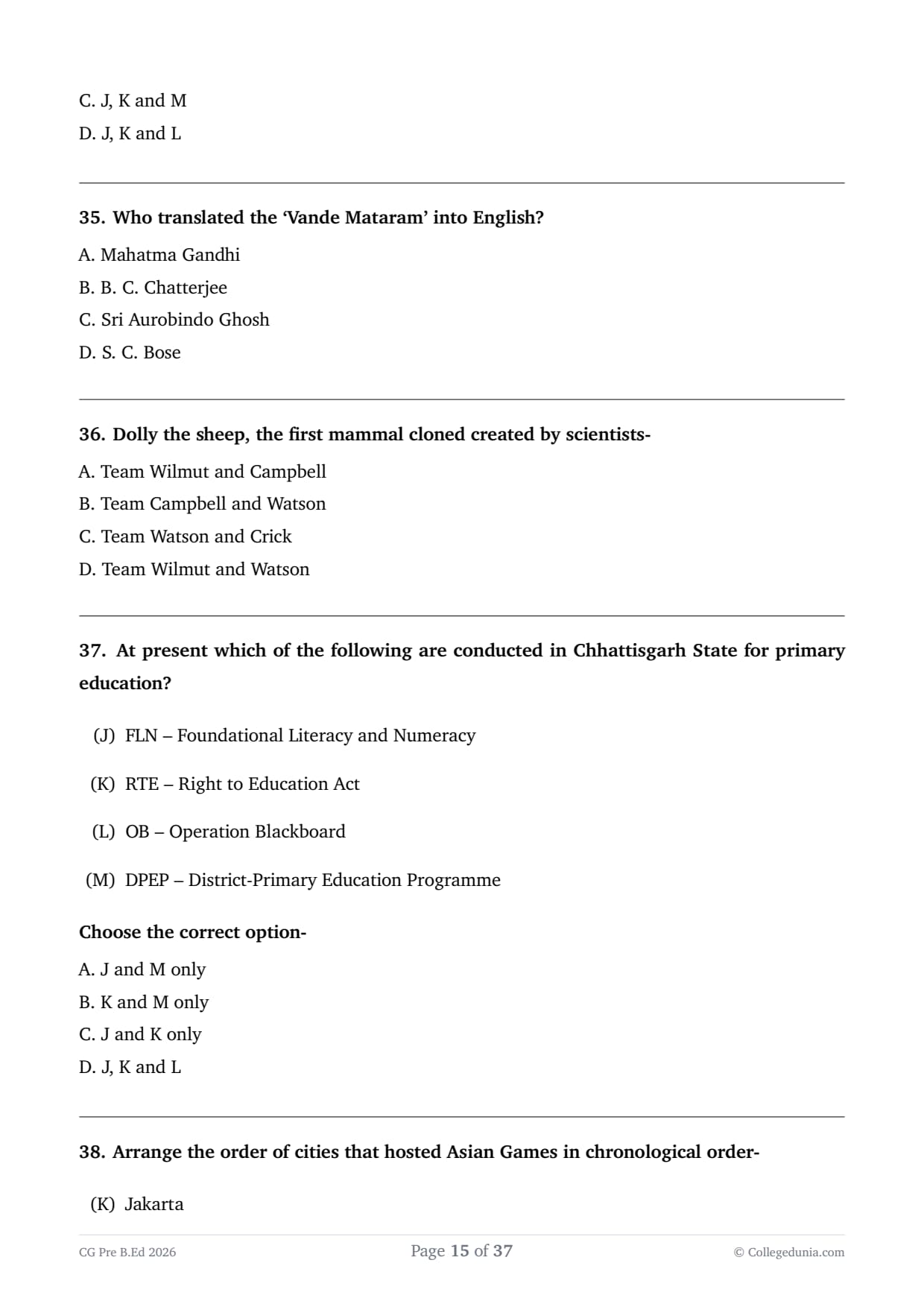
Select the Social Reformers and the institution formed by them during the Renaissance-
[(J)] Theosophical society \(\rightarrow\) Swami Vivekananda
[(K)] Ramakrishna Mission \(\rightarrow\) Raja Ram Mohan Roy
[(L)] Arya Samaj \(\rightarrow\) Swami Dayanand Saraswati
[(M)] Aligarh Movement \(\rightarrow\) Sir Syed Ahmad Khan
Choose the correct option-
View Solution
Concept:
The Indian Renaissance refers to the 19th-century socio-religious reform movement aimed at modernizing Indian society through education, rational thinking, and religious reform. Various leaders established institutions to promote different aspects of reform such as education, religious purification, and social upliftment.
Step 1: Evaluating statement (J)
The Theosophical Society was founded by Helena Blavatsky and Colonel Olcott in 1875 in the USA and later shifted to Indi(A) Swami Vivekananda was associated with the Ramakrishna Mission, not the Theosophical Society. Hence, (J) is incorrect.
Step 2: Evaluating statement (K)
The Ramakrishna Mission was founded by Swami Vivekananda in 1897 to propagate the teachings of Ramakrishna Paramahams(A) Raja Ram Mohan Roy founded the Brahmo Samaj, not this mission. Hence, (K) is incorrect.
Step 3: Evaluating statement (L)
Arya Samaj was founded by Swami Dayanand Saraswati in 1875 with the motto “Back to the Vedas,” promoting Vedic purity and social reform. Hence, (L) is correct.
Step 4: Evaluating statement (M)
The Aligarh Movement was led by Sir Syed Ahmad Khan to promote modern education among Muslims through institutions like MAO College. Hence, (M) is correct.
Final Evaluation:
Only (L) and (M) are correctly matched, so option B is correct. Quick Tip: Quick memory trick: Arya Samaj → Dayanand Saraswati Aligarh Movement → Sir Syed Ahmad Khan Ramakrishna Mission → Swami Vivekananda
Who translated the ‘Vande Mataram’ into English?
View Solution
Concept:
“Vande Mataram” is a patriotic song originally composed by Bankim Chandra Chatterjee in his novel Anandamath (1882). It became one of the most powerful nationalist symbols during the Indian freedom struggle, especially during the Swadeshi Movement. Because the song was originally written in a mix of Sanskritized Bengali, it was later translated into English by nationalist leaders to make its meaning accessible to a wider audience, both in India and abroa(D)
Step 1: Identifying the original composer
The original composition of “Vande Mataram” was done by Bankim Chandra Chatterjee. Therefore, option B ((B) (C) Chatterjee) refers to the composer, not the translator.
Step 2: Identifying the English translation
The widely accepted English translation of “Vande Mataram” was done by Sri Aurobindo Ghosh in 1909. He translated it in a deeply spiritual and lyrical form under the title:
“Mother, I bow to thee”
This translation preserved the emotional intensity and nationalistic spirit of the original Sanskritized Bengali text while making it understandable for English readers.
Step 3: Historical significance of the translation
Sri Aurobindo’s translation appeared in nationalist publications and became widely circulated during the revolutionary phase of the freedom struggle. It played an important role in spreading the ideological message of nationalism beyond linguistic barriers.
Step 4: Eliminating incorrect options
Mahatma Gandhi: Associated with freedom movements but not with translation of the song.
(B) (C) Chatterjee: Original composer, not translator.
S. (C) Bose: Leader of INA, not related to translation work.
Thus, Sri Aurobindo Ghosh is the correct answer. Quick Tip: Always remember: Bankim Chandra Chatterjee = Composer (Anandamath) and Sri Aurobindo = English translator of Vande Mataram.
Dolly the sheep, the first mammal cloned created by scientists-
View Solution
Concept:
Cloning is a biotechnological process of producing genetically identical organisms. The most significant breakthrough in cloning history was the successful creation of Dolly the sheep, the first mammal cloned from an adult somatic cell using the technique known as Somatic Cell Nuclear Transfer (SCNT).
Step 1: Identifying the experiment
Dolly the sheep was born on 5 July 1996 at the Roslin Institute, Scotland. The experiment demonstrated that a fully differentiated adult cell nucleus can be reprogrammed to develop into a complete organism.
Step 2: Scientists involved
The research was led by:
Sir Ian Wilmut
Keith Campbell
These scientists successfully cloned Dolly, proving that adult somatic cells retain full genetic potential.
Step 3: Eliminating incorrect options
Watson and Crick: Discovered DNA structure (1953), unrelated to cloning.
Watson (in other options): Not involved in Dolly’s cloning experiment.
Hence, only Wilmut and Campbell are correct. Quick Tip: Dolly the sheep = Roslin Institute (1996) + Ian Wilmut and Keith Campbell + SCNT technique.
At present which of the following are conducted in Chhattisgarh State for primary education?
[(J)] FLN – Foundational Literacy and Numeracy
[(K)] RTE – Right to Education Act
[(L)] OB – Operation Blackboard
[(M)] DPEP – District-Primary Education Programme
Choose the correct option-
View Solution
Concept:
Primary education in India is governed by a combination of constitutional provisions and contemporary educational missions. Some programs are currently active, while others have been phased out or merged into broader schemes like Samagra Shiksha and NEP-aligned initiatives.
Step 1: Evaluating FLN (J)
FLN (Foundational Literacy and Numeracy) is part of the NIPUN Bharat Mission under NEP 2020. It is actively implemented in all states including Chhattisgarh to ensure that children achieve basic reading and arithmetic skills by Grade 3. Hence, it is currently conducte(D)
Step 2: Evaluating RTE (K)
The Right to Education Act, 2009 is a constitutional legal framework ensuring free and compulsory education for children aged 6–14 years. It is continuously enforced and remains active.
Step 3: Evaluating Operation Blackboard (L)
Operation Blackboard was launched in 1987 to improve primary school infrastructure. However, it has been discontinued as a standalone scheme and absorbed into later programs. Hence, it is not currently conducte(D)
Step 4: Evaluating DPEP (M)
The District Primary Education Programme (DPEP) was launched in 1994 with World Bank assistance. It was phased out after Sarva Shiksha Abhiyan and is no longer active.
Final Decision:
Only (J) FLN and (K) RTE are currently active. Quick Tip: Modern education policy keywords: FLN (NIPUN Bharat) + RTE Act are active; older schemes like DPEP and Operation Blackboard are discontinue(D)
Arrange the order of cities that hosted Asian Games in chronological order-
[(K)] Jakarta
[(L)] Doha
[(M)] Beijing
[(N)] Seoul
Choose the correct option-
View Solution
Concept:
The Asian Games is a continental multi-sport event held every four years. Correct chronological ordering requires identifying the exact years when each city hosted the Games.
Step 1: Identifying hosting years
Seoul (N): Hosted in 1986
Beijing (M): Hosted in 1990
Doha (L): Hosted in 2006
Jakarta (K): Hosted in 2018
Step 2: Arranging chronologically \[ 1986 \rightarrow 1990 \rightarrow 2006 \rightarrow 2018 \]
Thus: \[ N \rightarrow M \rightarrow L \rightarrow K \] Quick Tip: Asian Games timeline shortcut: Seoul (1986) → Beijing (1990) → Doha (2006) → Jakarta (2018).
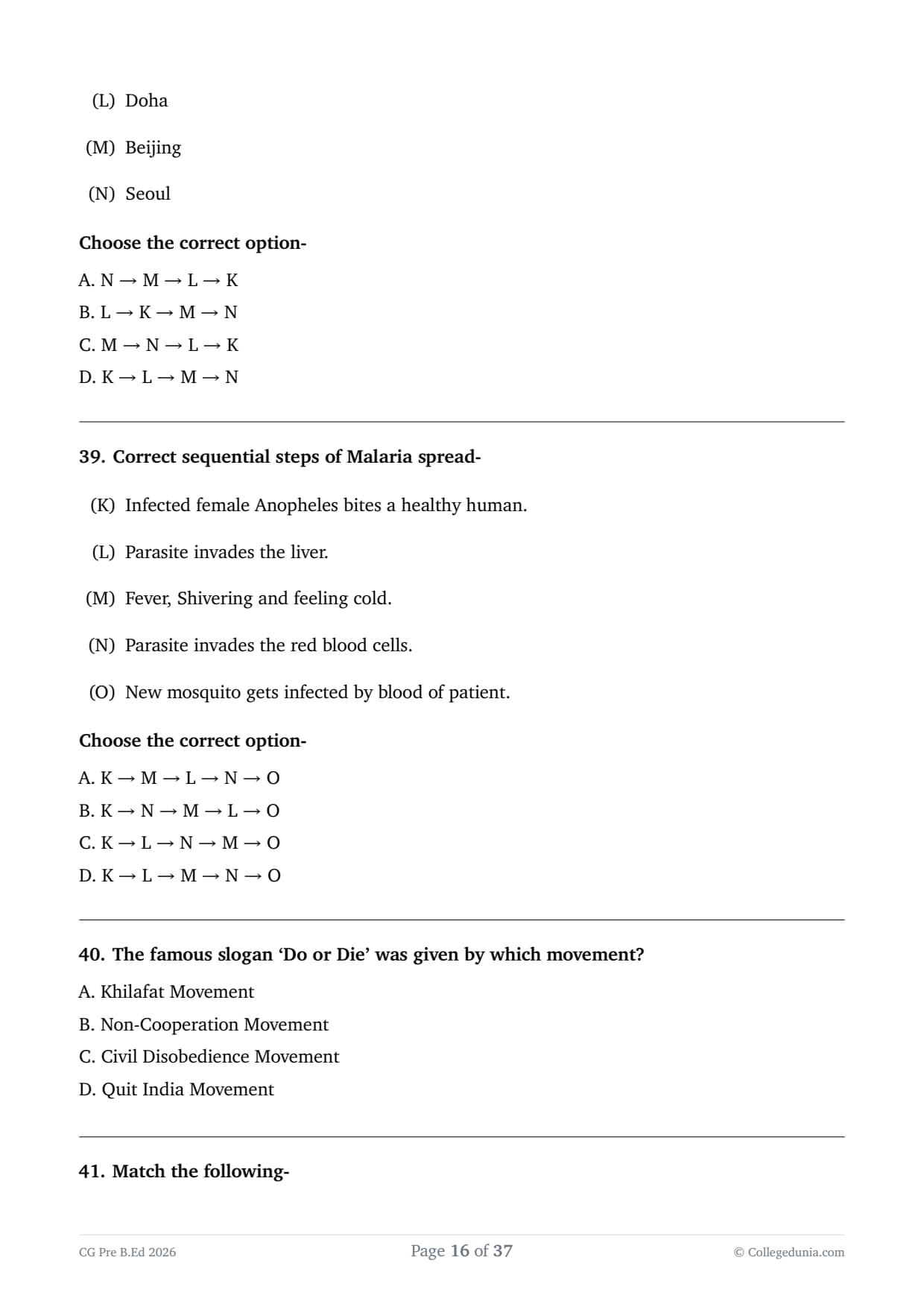
Correct sequential steps of Malaria spread-
[(K)] Infected female Anopheles bites a healthy human.
[(L)] Parasite invades the liver.
[(M)] Fever, Shivering and feeling col(D)
[(N)] Parasite invades the red blood cells.
[(O)] New mosquito gets infected by blood of patient.
Choose the correct option-
View Solution
Concept:
Malaria is caused by the protozoan parasite Plasmodium and is transmitted through the bite of an infected female Anopheles mosquito. Its life cycle includes stages in both the human liver and red blood cells, followed by transmission back to mosquitoes.
Step 1: Infection begins
(K) The cycle starts when an infected female Anopheles mosquito bites a healthy human and injects sporozoites.
Step 2: Liver stage
(L) Sporozoites travel to the liver and multiply inside hepatocytes.
Step 3: Blood stage
(N) Merozoites are released and invade red blood cells.
Step 4: Symptom stage
(M) Rupture of RBCs releases toxins causing fever, chills, and shivering.
Step 5: Transmission stage
(O) A new mosquito bites the infected person and becomes infecte(D)
Final sequence: \[ K \rightarrow L \rightarrow N \rightarrow M \rightarrow O \] Quick Tip: Malaria flow: Mosquito bite → Liver → RBC → Symptoms → New mosquito.
The famous slogan ‘Do or Die’ was given by which movement?
View Solution
Concept:
Slogans played a crucial role in mobilizing mass participation during India’s freedom struggle. One of the most powerful slogans was “Do or Die,” which symbolized the final and decisive phase of resistance against British rule.
Step 1: Identifying the origin
The slogan “Do or Die” (Hindi: Karo ya Maro) was given by Mahatma Gandhi during his speech at the Gowalia Tank Maidan, Bombay on 8 August 1942.
Step 2: Linking to the movement
This speech marked the launch of the Quit India Movement, which demanded immediate British withdrawal from Indi(A)
Step 3: Significance
The slogan represented a call for uncompromising struggle:
Either achieve complete independence
Or sacrifice life in the struggle
Thus, it is directly associated with the Quit India Movement. Quick Tip: “Do or Die” = 1942 + Quit India Movement + Gandhi’s final mass call for independence.
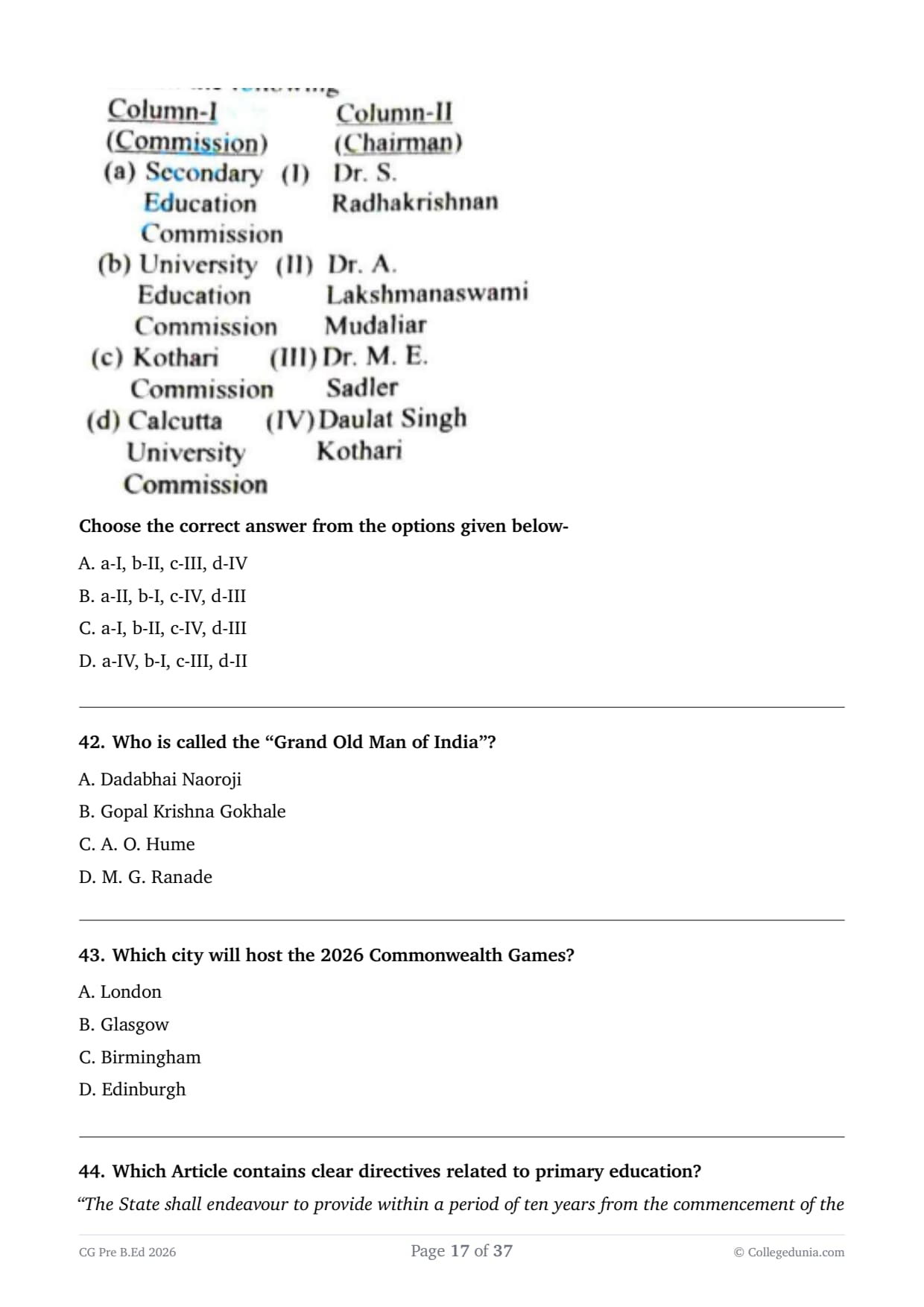
Match the following-

Choose the correct answer from the options given below-
View Solution
Concept:
Educational commissions in India were constituted at different historical stages to reform school and higher education systems. Each commission is identified with its chairman, and correct matching requires recalling both historical chronology and institutional roles.
Step 1: Secondary Education Commission (a)
The Secondary Education Commission was established in 1952 after independence to evaluate secondary school structure in Indi(A) It was chaired by Dr. (A) Lakshmanaswami Mudaliar. Therefore: \[ (a) \rightarrow (II) \]
Step 2: University Education Commission (b)
The University Education Commission was set up in 1948 to reform higher education in independent Indi(A) It was chaired by Dr. S. Radhakrishnan, who later became the President of Indi(A) Therefore: \[ (b) \rightarrow (I) \]
Step 3: Kothari Commission (c)
The Kothari Commission (1964–1966) was a major national education commission chaired by Daulat Singh Kothari. It recommended the famous 10+2+3 education structure. Therefore: \[ (c) \rightarrow (IV) \]
Step 4: Calcutta University Commission (d)
The Calcutta University Commission (1917), also known as the Sadler Commission, was chaired by Dr. M. E. Sadler. It examined the functioning of Calcutta University and proposed structural reforms. Therefore: \[ (d) \rightarrow (III) \]
Step 5: Final matching
Combining all correct pairs: \[ a-II,\quad b-I,\quad c-IV,\quad d-III \]
Thus, Option B is correct. Quick Tip: Remember the four key education commissions: Radhakrishnan (1948) – University Education Commission, Mudaliar (1952) – Secondary Education Commission, Kothari (1964) – National Education Policy base, Sadler (1917) – Calcutta University Commission.
Who is called the “Grand Old Man of India”?
View Solution
Concept:
Honorific titles in Indian nationalism were given to leaders who made long-standing intellectual, political, and organizational contributions to the freedom movement. One such leader was Dadabhai Naoroji, whose work spanned both economic critique and political leadership.
Step 1: Identifying Dadabhai Naoroji
Dadabhai Naoroji (1825–1917) was one of the earliest Indian political leaders and co-founder of the Indian National Congress (1885).
He served as President of INC three times.
He was the first Indian member of the British Parliament.
Step 2: Why he is called “Grand Old Man of India”
He earned this title due to:
His long and continuous political service to Indi(A)
His pioneering economic critique of British colonial rule.
His famous “Drain of Wealth” theory explaining economic exploitation.
Step 3: Eliminating incorrect options
Gokhale: Known as political mentor of Gandhi, not this title.
(A) O. Hume: Founder of INC but British administrator.
M. G. Ranade: Social reformer and judge, not associated with this title.
Thus, Dadabhai Naoroji is the correct answer. Quick Tip: Dadabhai Naoroji = Grand Old Man of India + Drain of Wealth Theory + First Indian MP (British Parliament).
Which city will host the 2026 Commonwealth Games?
View Solution
Concept:
International sporting events such as the Commonwealth Games are awarded through a bidding process. Sometimes, host cities withdraw due to financial or logistical constraints, leading to reassignment of hosting rights.
Step 1: Original host selection
The 2026 Commonwealth Games were initially awarded to Victoria, Australia.
Step 2: Withdrawal of original host
Victoria withdrew due to high projected costs and budget constraints in 2023, leaving the event without a host.
Step 3: New host selection
The Commonwealth Games Federation selected Glasgow, Scotland, as the replacement host due to:
Existing sports infrastructure from 2014 Games
Lower financial burden
Experience in hosting large-scale events
Thus, Glasgow was confirmed as the host city for 2026. Quick Tip: 2026 CWG = originally Victoria (Australia) → shifted to Glasgow (Scotland) due to financial withdrawal.
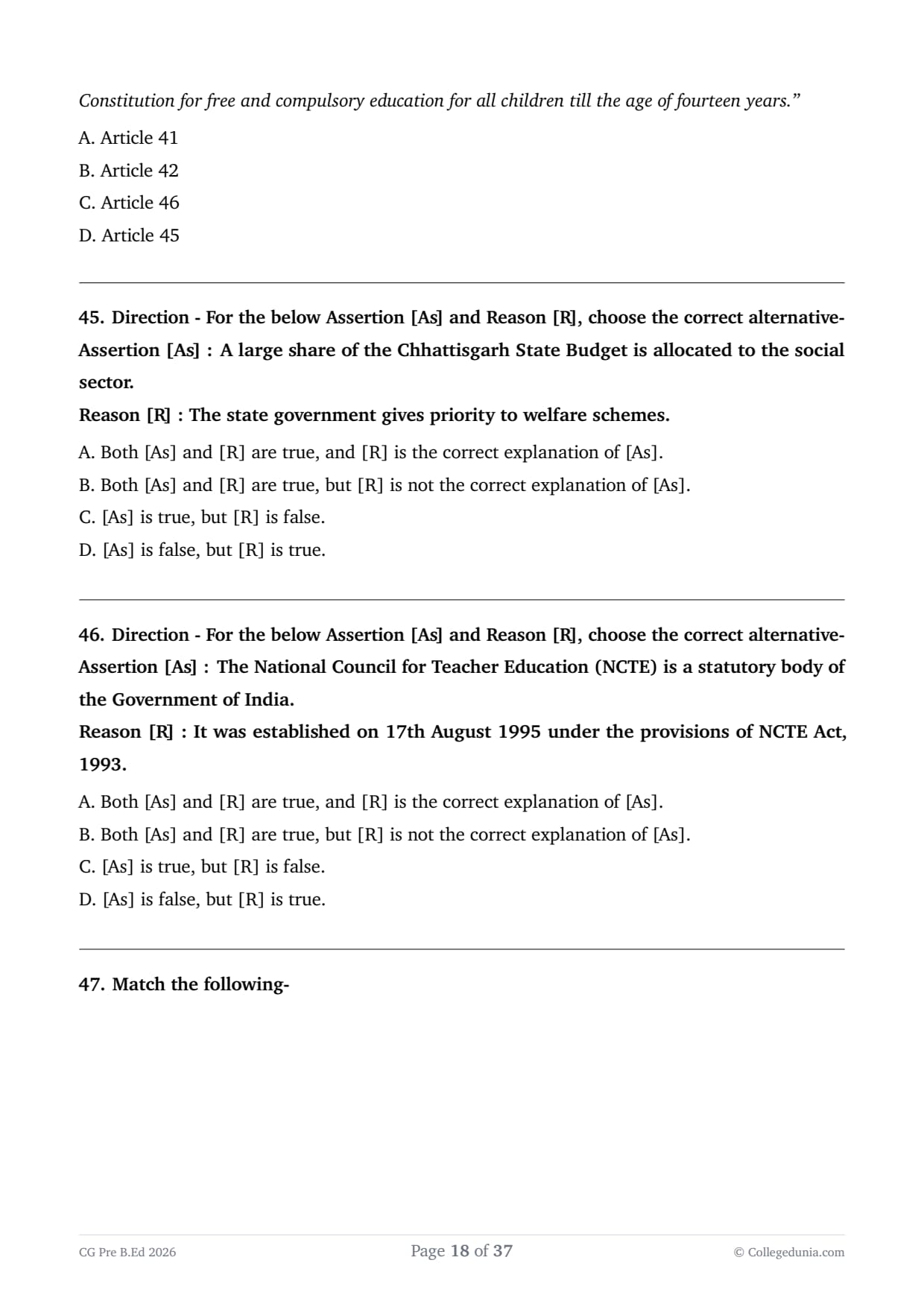
Which Article contains clear directives related to primary education?
“The State shall endeavour to provide within a period of ten years from the commencement of the Constitution for free and compulsory education for all children till the age of fourteen years.”
View Solution
Concept:
The Directive Principles of State Policy (Part IV of the Indian Constitution) guide the state in social and economic policymaking. Article 45 originally focused on universal elementary education.
Step 1: Original constitutional provision
Article 45 originally stated that the State shall provide free and compulsory education for children up to 14 years within 10 years of the Constitution’s commencement.
Step 2: Constitutional amendment
After the 86th Constitutional Amendment Act (2002):
Education for ages 6–14 became a Fundamental Right under Article 21(A)
Article 45 was modified to focus on early childhood care (0–6 years).
Step 3: Evaluating options
Article 41: Employment, education, assistance
Article 42: Working conditions and maternity relief
Article 46: Welfare of SC/ST and weaker sections
Article 45: Primary education (original provision)
Thus, Article 45 is correct. Quick Tip: Article 45 (old) → primary education (6–14 years) Article 21A (new) → Fundamental Right to education after 86th Amendment (2002)
Direction - For the below Assertion [As] and Reason [R], choose the correct alternative-
Assertion [As] : A large share of the Chhattisgarh State Budget is allocated to the social sector.
Reason [R] : The state government gives priority to welfare schemes.
View Solution
Concept:
State budgets reflect policy priorities. In developing states like Chhattisgarh, a significant portion of expenditure is directed toward social sectors such as health, education, nutrition, and rural welfare.
Step 1: Verifying Assertion
Chhattisgarh consistently allocates a large share of its budget to:
Education
Health
Food security
Tribal welfare
Hence, the Assertion is true.
Step 2: Verifying Reason
The state government prioritizes welfare schemes aimed at poverty reduction and inclusive development. Hence, the Reason is also true.
Step 3: Causal relationship
Since prioritization of welfare schemes directly leads to higher allocation in social sectors, the Reason correctly explains the Assertion.
Thus, Option A is correct. Quick Tip: In public finance questions: Welfare priority → Higher social sector allocation.
Direction - For the below Assertion [As] and Reason [R], choose the correct alternative-
Assertion [As] : The National Council for Teacher Education (NCTE) is a statutory body of the Government of Indi(A)
Reason [R] : It was established on 17th August 1995 under the provisions of NCTE Act, 1993.
View Solution
Concept:
A statutory body is an institution created by an Act of Parliament or State Legislature. Its powers, functions, structure, and authority are legally defined by that Act, making it different from advisory or executive bodies that do not have a direct legislative foundation.
Step 1: Verifying the Assertion
The National Council for Teacher Education (NCTE) is the apex regulatory body in India responsible for:
Maintaining standards in teacher education
Granting recognition to teacher training institutions
Regulating curriculum frameworks for teacher education
Since it derives its authority directly from a parliamentary Act, it is correctly classified as a statutory body. Hence, the Assertion is true.
Step 2: Verifying the Reason
The NCTE was originally set up as an advisory body under NCERT in 1973. Later, it was given statutory status through the National Council for Teacher Education Act, 1993. In accordance with this Act, it became fully functional as a statutory body on 17 August 1995. Hence, the Reason is also true.
Step 3: Relationship between Assertion and Reason
The Reason correctly explains the Assertion because a body becomes “statutory” only when it is established under a specific Act passed by Parliament. Since the NCTE derives its existence, authority, and functions from the NCTE Act, 1993, it is legally a statutory body. Therefore, [R] directly explains why [As] is true. Quick Tip: A body is statutory only when created by a Parliament Act. NCTE = NCTE Act, 1993 → hence statutory body.
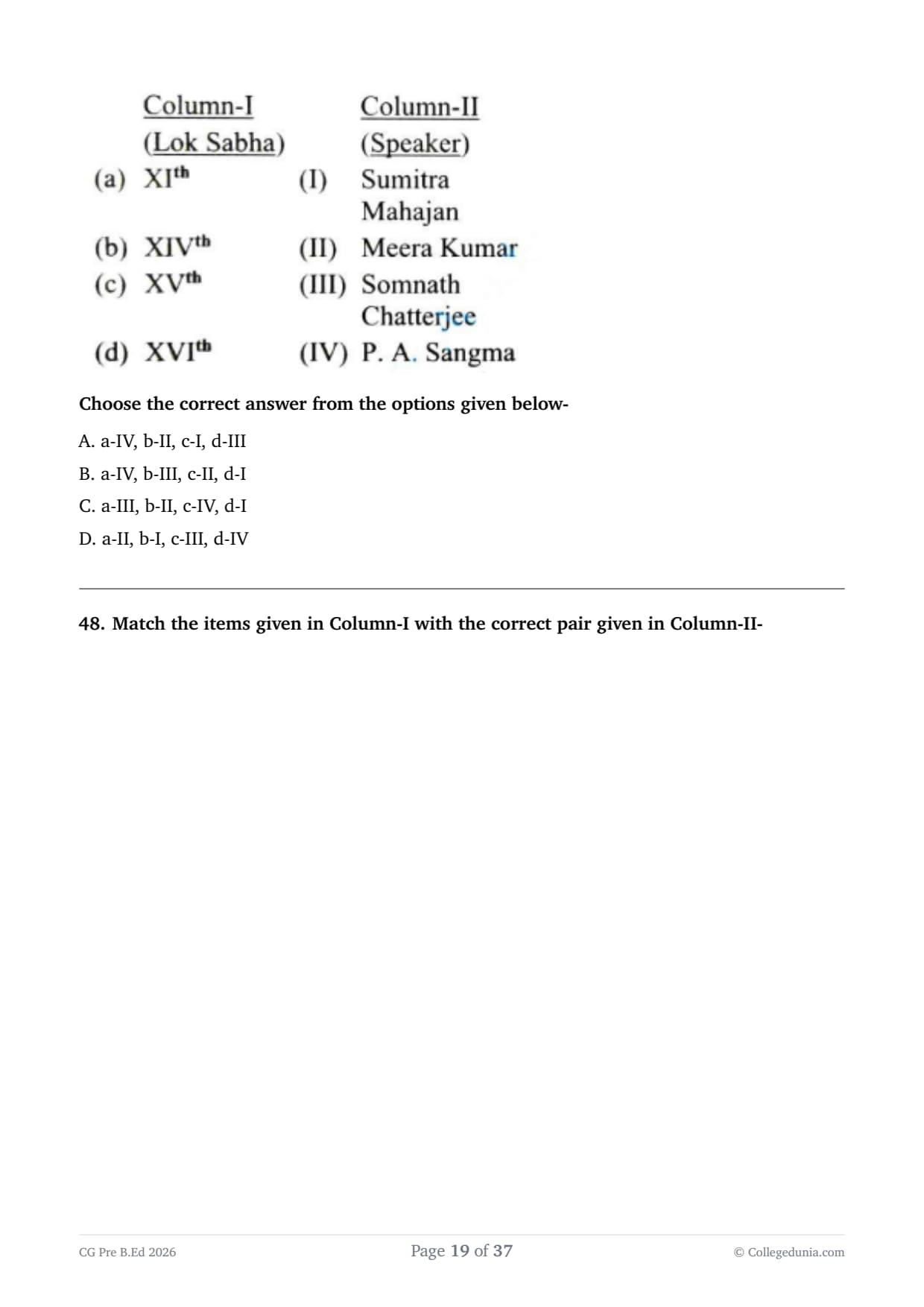
Match the following-

Choose the correct answer from the options given below-
View Solution
Concept:
The Speaker of the Lok Sabha is the presiding officer of the lower house of Parliament of Indi(A) Each Lok Sabha term corresponds to a specific Speaker elected by the members of the house. Correct matching requires knowledge of parliamentary chronology.
Step 1: XIth Lok Sabha (1996–1997)
The XI Lok Sabha saw a fragmented coalition er(A) P. (A) Sangma was elected as Speaker, becoming one of the prominent leaders from the North-East to hold this constitutional post. \[ (a) \rightarrow (IV) \]
Step 2: XIVth Lok Sabha (2004–2009)
During the UPA-1 government, Somnath Chatterjee served as the Speaker and presided over parliamentary proceedings. \[ (b) \rightarrow (III) \]
Step 3: XVth Lok Sabha (2009–2014)
Meira Kumar became the first woman Speaker of the Lok Sabha, marking a historic milestone in Indian parliamentary history. \[ (c) \rightarrow (II) \]
Step 4: XVIth Lok Sabha (2014–2019)
Sumitra Mahajan served as Speaker, becoming the second woman to hold this position. \[ (d) \rightarrow (I) \]
Step 5: Final Matching \[ a-IV,\quad b-III,\quad c-II,\quad d-I \]
Thus, Option B is correct. Quick Tip: Key memory trick: Sangma (XI) → first NE Speaker, Somnath (XIV), Meira Kumar (XV)} → first woman Speaker, Sumitra Mahajan (XVI) → second woman Speaker.
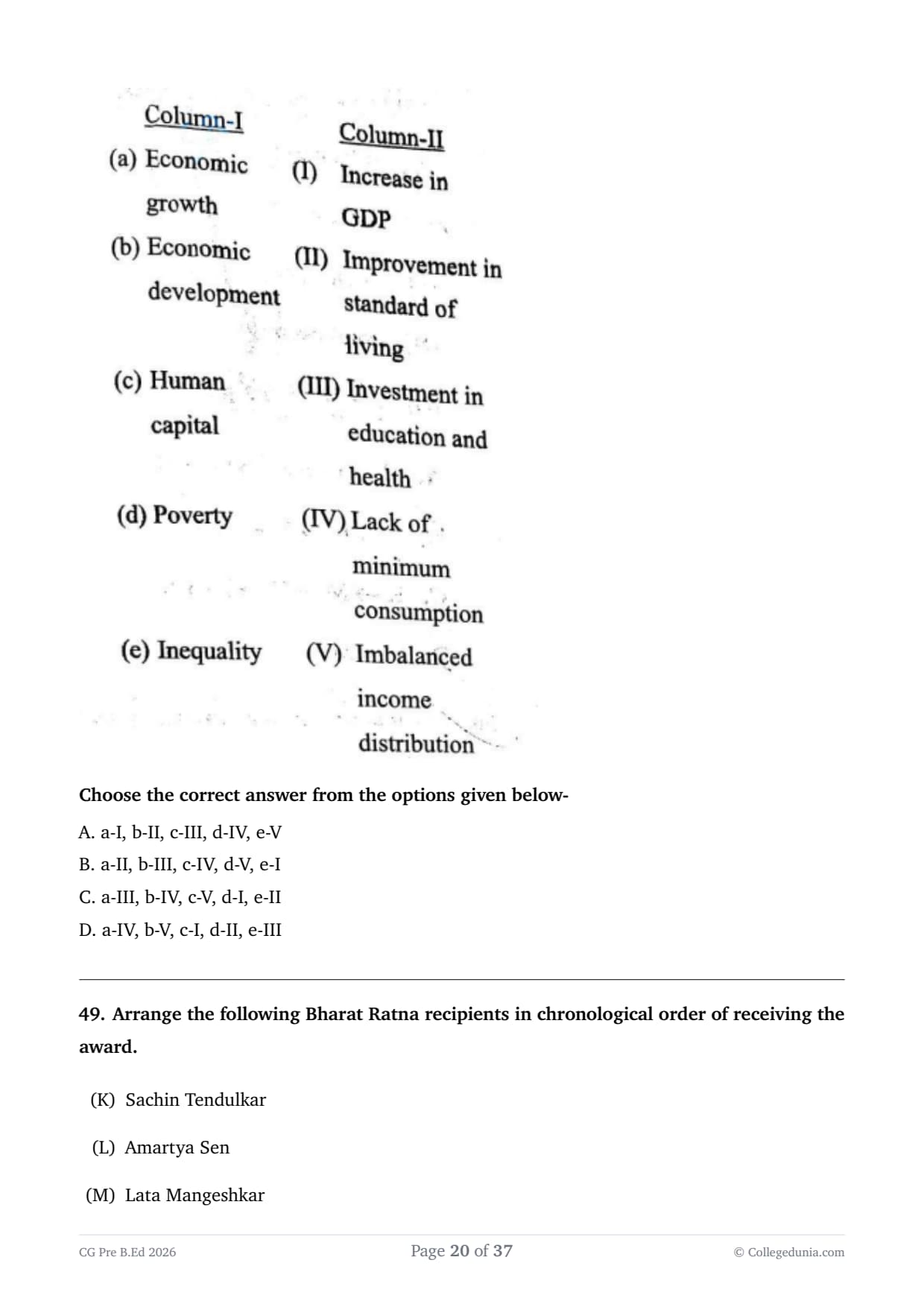
Match the items given in Column-I with the correct pair given in Column-II-

Choose the correct answer from the options given below-
View Solution
Concept:
Economics distinguishes between quantitative indicators like growth and qualitative indicators like development, along with foundational concepts such as human capital, poverty, and inequality which describe structural conditions of an economy.
Step 1: Economic growth (a)
Economic growth refers to the quantitative increase in output of an economy over time, most commonly measured through GDP. \[ (a) \rightarrow (I) \]
Step 2: Economic development (b)
Economic development refers to qualitative improvement in living standards, including health, education, and income distribution. \[ (b) \rightarrow (II) \]
Step 3: Human capital (c)
Human capital refers to the stock of skills and knowledge in a population, built through investment in education and health. \[ (c) \rightarrow (III) \]
Step 4: Poverty (d)
Poverty is defined as a condition of lack of minimum consumption requirements such as food, shelter, and basic services. \[ (d) \rightarrow (IV) \]
Step 5: Inequality (e)
Inequality refers to the uneven distribution of income and wealth among individuals in a society. \[ (e) \rightarrow (V) \]
Final Matching \[ a-I,\quad b-II,\quad c-III,\quad d-IV,\quad e-V \]
Thus, Option A is correct. Quick Tip: Quick distinction: Growth = GDP, Development = quality of life, Human capital = education + health investment.
Arrange the following Bharat Ratna recipients in chronological order of receiving the awar(D)
[(K)] Sachin Tendulkar
[(L)] Amartya Sen
[(M)] Lata Mangeshkar
[(N)] Nanaji Deshmukh
[(O)] Atal Bihari Vajpayee
Choose the correct option-
View Solution
Concept:
The Bharat Ratna is the highest civilian award of India, instituted in 1954. To arrange recipients chronologically, we must identify the exact year in which each personality was conferred the award and then order them in ascending sequence of time.
Step 1: Identify the award year of each recipient
(L) Amartya Sen: Awarded in 1999 for his contributions to welfare economics and development studies.
(M) Lata Mangeshkar: Awarded in 2001 for her unparalleled contribution to Indian music and playback singing.
(K) Sachin Tendulkar: Awarded in 2014 as the first sportsperson and youngest recipient of the Bharat Ratn(A)
(O) Atal Bihari Vajpayee: Awarded in 2015 for his statesmanship and lifelong political service as former Prime Minister.
(N) Nanaji Deshmukh: Awarded posthumously in 2019 for his rural development and social service contributions.
Step 2: Arrange in chronological order
Now arranging the award years in ascending order:
\[ 1999 \; (L) \rightarrow 2001 \; (M) \rightarrow 2014 \; (K) \rightarrow 2015 \; (O) \rightarrow 2019 \; (N) \]
Step 3: Final sequence
Thus, the correct chronological order is:
\[ L \rightarrow M \rightarrow K \rightarrow O \rightarrow N \]
Hence, Option D is correct. Quick Tip: Memorize recent Bharat Ratna sequence: 1999 (Amartya Sen) \(\rightarrow\) 2001 (Lata Mangeshkar) \(\rightarrow\) 2014 (Sachin Tendulkar) \(\rightarrow\) 2015 (Vajpayee) \(\rightarrow\) 2019 (Nanaji Deshmukh).
Who calculates the Gross Domestic Product (GDP) in India?
View Solution
Concept:
Gross Domestic Product (GDP) is the total monetary value of all final goods and services produced within a country during a specific perio(D) In India, GDP estimation is carried out by the official national statistical agency under the Government of Indi(A)
Step 1: Identify the responsible agency
The National Statistical Office (NSO) is the official body responsible for compiling and estimating India’s national income statistics, including GDP, GVA, and related macroeconomic indicators. It functions under the Ministry of Statistics and Programme Implementation (MoSPI).
Step 2: Institutional background
The NSO was formed after the merger of:
Central Statistical Office (CSO)
National Sample Survey Office (NSSO)
This merger created a unified structure for efficient and standardized data collection and computation of macroeconomic indicators like GDP.
Step 3: Role of other institutions
RBI: Uses GDP data for monetary policy but does not compute GDP.
Finance Ministry: Uses GDP for budget formulation and fiscal planning.
NITI Aayog: Provides policy guidance but does not calculate national income.
Thus, the correct answer is NSO. Quick Tip: NSO calculates GDP, while RBI uses GDP for monetary policy decisions like repo rate changes.
When a teacher shows positive thinking and supportive behaviour towards children, it reflects which type of attitude?
View Solution
Concept:
Attitude in educational psychology refers to a learned tendency to evaluate and respond to people or situations in a consistent manner. A teacher’s attitude strongly influences classroom environment, student motivation, and learning outcomes.
Step 1: Analyze the given behaviour
The teacher exhibits:
Positive thinking: Optimistic expectations, constructive interpretation of student performance, and encouragement.
Supportive behaviour: Guidance, empathy, assistance in learning difficulties, and emotional encouragement.
Step 2: Match with attitude types
Neutral attitude: Lack of emotional involvement → not applicable.
Inconsistent attitude: Unpredictable behaviour → not applicable.
Negative attitude: Criticism and discouragement → opposite of given behavior.
Positive attitude: Encouragement, optimism, and support → exact match.
Step 3: Conclusion
Therefore, the described behaviour reflects a positive attitude. Quick Tip: In teaching aptitude questions, support + encouragement + optimism = positive attitude.
The term ‘kindergarten’ means-
View Solution
Concept:
The term “kindergarten” originates from the German language and represents an early childhood education philosophy developed by Friedrich Fröbel, emphasizing learning through play and natural development.
Step 1: Etymology
The word is derived from two German words:
Kinder = children
Garten = garden
Step 2: Meaning
Literally, “kindergarten” means Children’s Garden.
Step 3: Educational philosophy
Fröbel used the term to represent his belief that children grow best in a nurturing environment, similar to plants in a garden, where teachers act as gardeners guiding natural growth through play, creativity, and activity-based learning. Quick Tip: Kindergarten = Kinder (children) + Garten (garden) → concept introduced by Friedrich Fröbel.
On what basis does vocational guidance guide an individual toward a specific vocation?
[(J)] Capacities
[(K)] Attitudes
[(L)] Available opportunities
[(M)] Personal resources
Choose the correct option-
View Solution
Concept:
Vocational guidance is a systematic process that helps individuals choose, prepare for, and adjust to a suitable occupation. It is based on the principle of matching internal traits with external environmental conditions.
Step 1: Analyze Capacities (J):
Capacities refer to an individual’s innate abilities, intelligence, physical strength, and acquired skills. These determine whether a person can successfully perform tasks required in a specific occupation.
Step 2: Analyze Attitudes (K):
Attitudes include interests, motivations, values, and psychological orientation. They influence job satisfaction and long-term commitment to a profession.
Step 3: Analyze Available Opportunities (L):
Career decisions must align with labor market demand, employment trends, and societal needs. Without opportunity analysis, career choice becomes unrealisti(C)
Step 4: Analyze Personal Resources (M):
Personal resources include financial capacity, educational access, family support, and training availability. These factors determine feasibility of career pathways.
Step 5: Conclusion:
Since vocational guidance integrates internal factors (capacities and attitudes) and external factors (opportunities and resources), all four factors are essential. Hence, option C is correct. Quick Tip: Always remember: vocational guidance = self factors + environmental factors.
Children are given the opportunity to discover and acquire new knowledge on their own without any special guidance.
View Solution
Concept:
The heuristic method is a discovery-based learning approach where learners independently explore and construct knowledge with minimal teacher intervention.
Step 1: Meaning of Heuristic Method:
The term "heuristic" comes from the Greek word *heuriskein*, meaning "to discover." It encourages learners to act as independent discoverers.
Step 2: Compare with other methods:
Project method involves structured group work, Dalton method involves contract learning, and play-way method involves learning through play. None emphasize complete independent discovery like heuristic metho(D)
Step 3: Conclusion:
Since the question emphasizes self-discovery without special guidance, heuristic method is correct. Quick Tip: Heuristic = discovery learning with minimum teacher guidance.
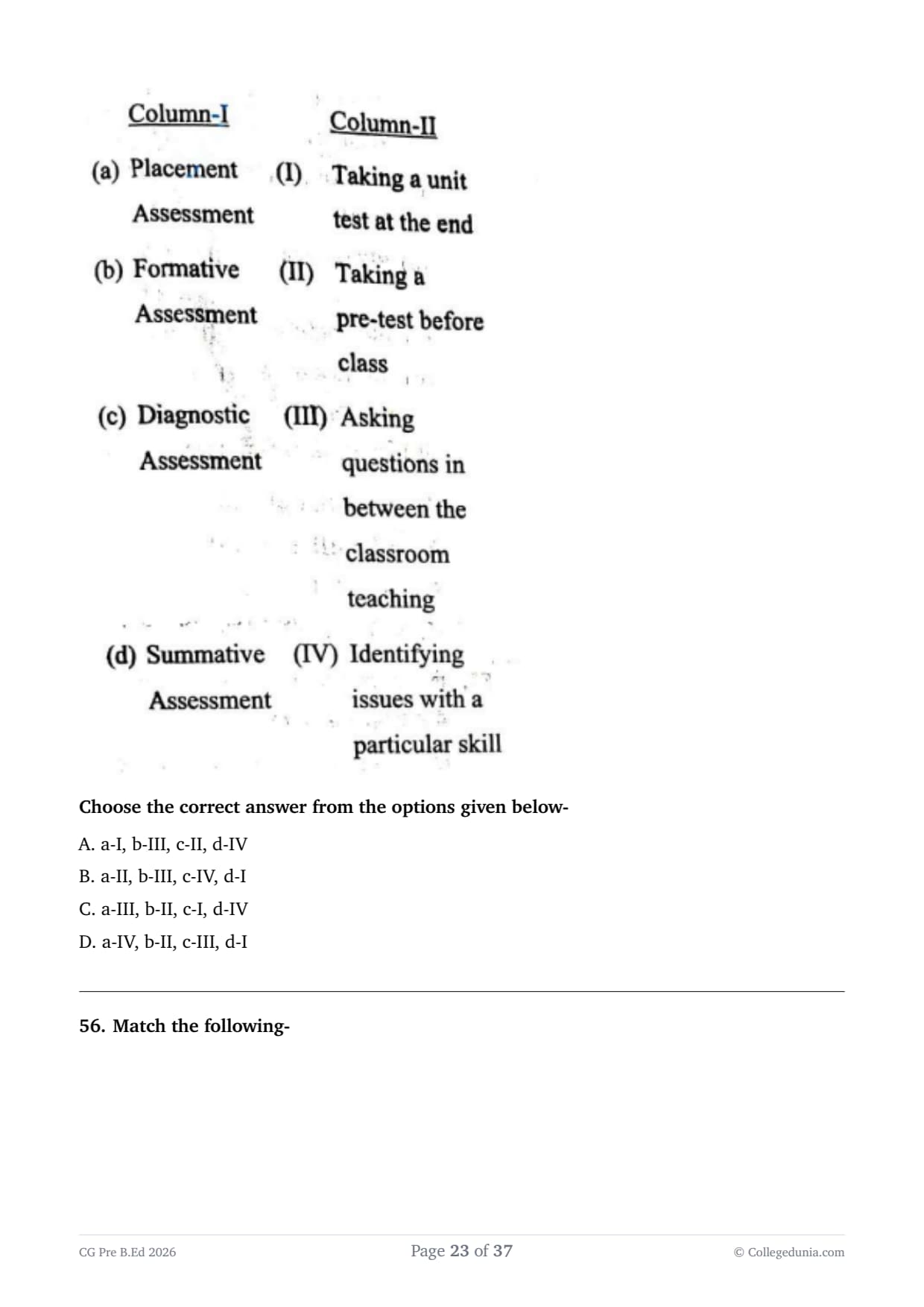
Match the following-

Choose the correct answer from the options given below-
View Solution
Concept:
Assessment types differ based on timing and purpose in the teaching-learning process.
Step 1: Placement Assessment:
It is conducted before instruction to determine readiness; hence pre-test before class.
Step 2: Formative Assessment:
It occurs during instruction; asking questions helps monitor learning.
Step 3: Diagnostic Assessment:
It identifies learning difficulties in specific skills.
Step 4: Summative Assessment:
It evaluates learning at the end through unit tests.
Step 5: Conclusion:
Thus correct matching is a-II, b-III, c-IV, d-I. Quick Tip: Placement = before, Formative = during, Summative = after.
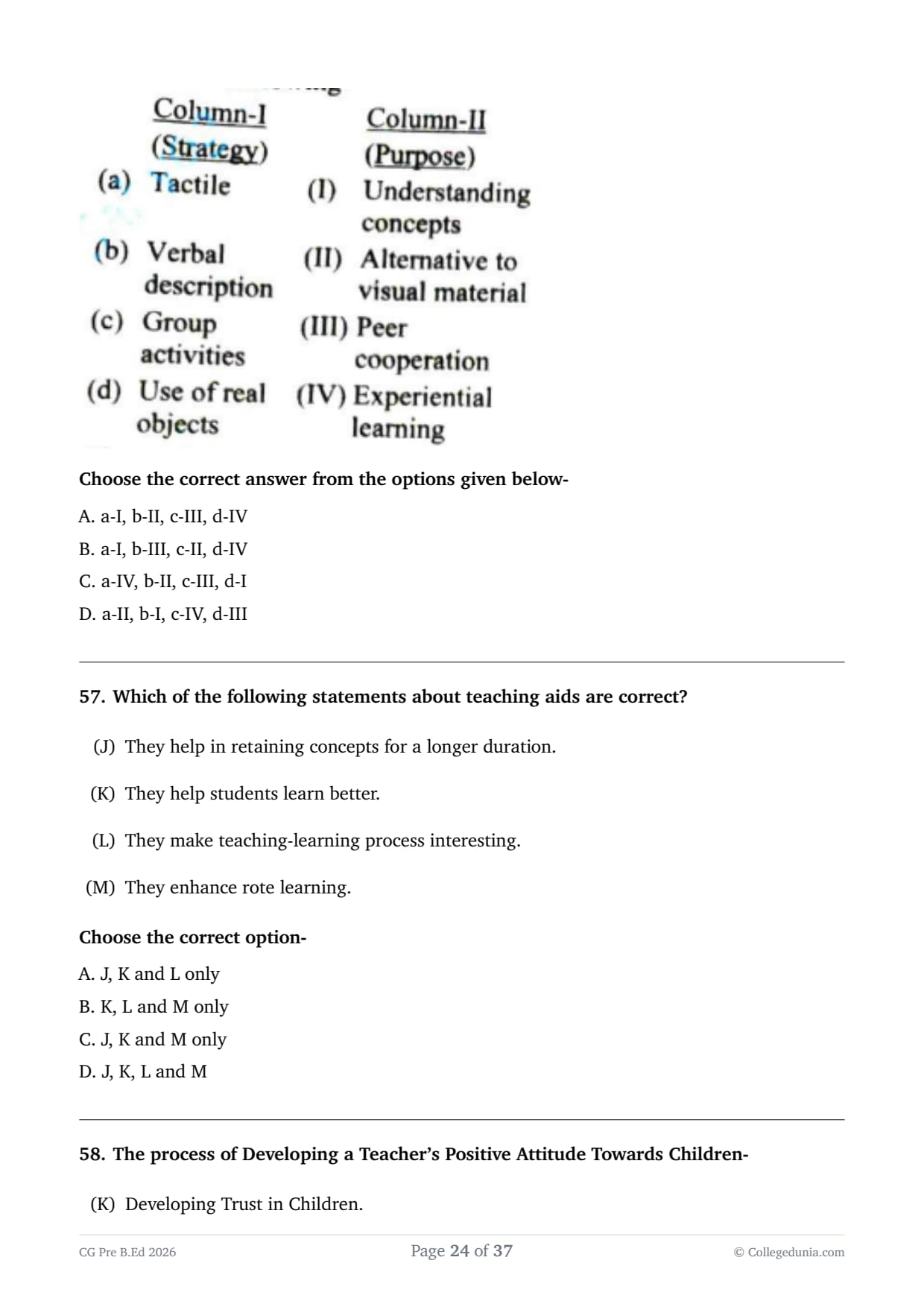
Match the following-

Choose the correct answer from the options given below-
View Solution
Concept:
Teaching strategies are aligned with sensory and collaborative learning principles.
Step 1: Tactile:
Touch-based learning improves conceptual understanding.
Step 2: Verbal description:
Acts as substitute for visual content.
Step 3: Group activities:
Promote peer cooperation.
Step 4: Real objects:
Enable experiential learning.
Conclusion:
Thus a-I, b-II, c-III, d-IV. Quick Tip: Hands-on learning improves retention and understanding.
Which of the following statements about teaching aids are correct?
[(J)] They help in retaining concepts for a longer duration.
[(K)] They help students learn better.
[(L)] They make teaching-learning process interesting.
[(M)] They enhance rote learning.
Choose the correct option-
View Solution
Concept:
Teaching aids improve learning by making concepts concrete and engaging.
Step 1: J is correct:
They improve retention through visual-auditory learning.
Step 2: K is correct:
They enhance understanding.
Step 3: L is correct:
They make learning interesting.
Step 4: M is incorrect:
Teaching aids discourage rote learning.
Conclusion:
Thus correct answer is (A) Quick Tip: Teaching aids promote understanding, not memorization.
The process of Developing a Teacher’s Positive Attitude Towards Children-
[(K)] Developing Trust in Children.
[(L)] Gaining Positive Experiences.
[(M)] Formation of Values and Beliefs.
[(N)] Building Enduring Attitudes.
[(O)] Expression in Behavior.
Choose the correct option-
View Solution
Concept:
The development of attitude in psychology follows a structured progression from initial interpersonal interaction to stable internal belief systems and finally outward behavioral expression. In educational settings, a teacher’s positive attitude is formed through sequential cognitive and emotional layering.
Step 1: Developing Trust in Children (K):
The foundation of any positive teacher–student relationship begins with trust. A teacher must first consciously establish emotional safety and confidence in students. Without trust, no meaningful interaction or learning environment can be built.
Step 2: Gaining Positive Experiences (L):
Once trust is established, classroom interactions become more cooperative and productive. This leads to repeated positive experiences such as successful communication, student participation, and effective teaching-learning outcomes. These experiences reinforce emotional bonding.
Step 3: Formation of Values and Beliefs (M):
Accumulated positive experiences gradually shape internal cognitive frameworks. The teacher begins to develop stable values and beliefs regarding student potential, discipline, empathy, and learning capacity. This represents deep internalization.
Step 4: Building Enduring Attitudes (N):
Over time, these beliefs consolidate into long-lasting psychological dispositions. These enduring attitudes are stable, resistant to situational fluctuations, and guide the teacher’s general approach toward students across different contexts.
Step 5: Expression in Behavior (O):
Finally, internal attitudes manifest externally through observable behavior such as tone of communication, teaching style, classroom management, patience, encouragement, and supportive actions toward learners.
Conclusion:
Thus, the correct psychological progression is: \[ Trust \rightarrow Experience \rightarrow Beliefs \rightarrow Attitude \rightarrow Behavior \]
which corresponds to: \[ K \rightarrow L \rightarrow M \rightarrow N \rightarrow O \] Quick Tip: Attitude formation always moves from interaction → experience → belief → stable attitude → behavior.
A teacher’s positive attitude towards children helps in developing-
[(J)] Self-confidence
[(K)] Motivation to learn
[(L)] Classroom participation
[(M)] Fear
Choose the correct option-
View Solution
Concept:
A teacher’s positive attitude creates a supportive and psychologically safe classroom environment. Such an environment directly influences cognitive, emotional, and behavioral development of learners.
Step 1: Self-confidence (J):
Positive reinforcement, encouragement, and acceptance from teachers help students overcome fear of failure. This builds confidence in their abilities and strengthens self-esteem.
Step 2: Motivation to learn (K):
A supportive teacher increases intrinsic motivation by making learning enjoyable, meaningful, and emotionally rewarding. Students feel encouraged to engage in learning activities.
Step 3: Classroom participation (L):
When students feel safe and respected, they actively participate in discussions, ask questions, and contribute ideas without fear of criticism.
Step 4: Fear (M):
Fear is associated with punishment-based or negative reinforcement environments. A positive attitude eliminates fear rather than producing it.
Conclusion:
Therefore, J, K, and L are correct outcomes, while M is incorrect. Quick Tip: Positive teacher attitude reduces fear and increases confidence, motivation, and participation.
How should a teacher behave with students?
View Solution
Concept:
Modern educational philosophy emphasizes learner-centered pedagogy where the teacher acts as a facilitator rather than an authoritarian figure.
Step 1: Understanding the role:
A teacher should create an open, democratic, and supportive learning environment where students feel comfortable expressing ideas and doubts.
Step 2: Evaluating options:
A father-like or leader-like approach may create hierarchy and distance, whereas a friendly approach promotes communication and trust.
Step 3: Why “Like a Friend” is correct:
Being like a friend means being approachable, empathetic, and respectful while still maintaining professional boundaries. It encourages active participation and emotional security.
Conclusion:
Thus, the most appropriate pedagogical role is “Like a Friend”. Quick Tip: Best teaching style = Friendly + Professional + Supportive.
Which of the following are essential for successful classroom communication?
[(K)] Define the purpose.
[(L)] Opt for presentations.
[(M)] Use un-risky humour.
[(N)] Avoid rehearsals.
[(O)] Repeat speech-tags.
Choose the correct option-
View Solution
Concept:
Effective classroom communication depends on clarity of purpose, engagement techniques, and reinforcement strategies.
Step 1: Define the purpose (K):
Clear objectives ensure that communication is structured, meaningful, and goal-oriente(D)
Step 2: Use un-risky humour (M):
Appropriate humour reduces anxiety, increases attention, and improves engagement without harming classroom discipline.
Step 3: Repeat speech-tags (O):
Repetition reinforces key ideas, improves retention, and ensures clarity for all learners.
Step 4: Eliminate incorrect options:
Avoiding rehearsal (N) is incorrect because preparation improves communication quality, and presentations alone (L) are not sufficient without clarity and engagement.
Conclusion:
Thus, K, M, and O are essential. Quick Tip: Good communication = Purpose + Engagement + Reinforcement.
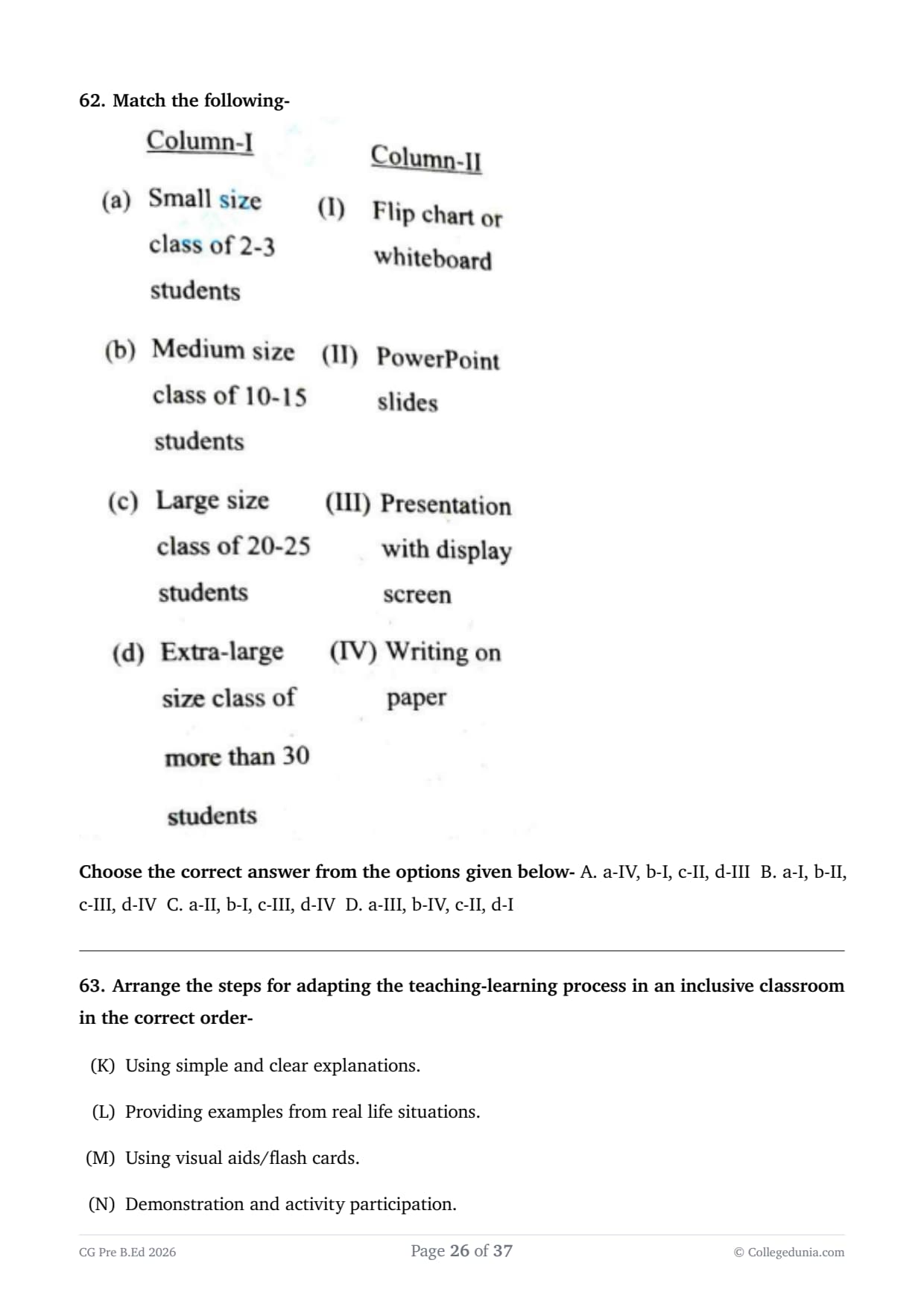
Match the following-

Choose the correct answer from the options given below-
View Solution
Concept:
Selection of teaching media depends on visibility, interaction level, and scalability with class size.
Step 1: Small class (2–3 students):
Personalized instruction is best done using writing on paper for direct explanation.
Step 2: Medium class (10–15 students):
A flip chart or whiteboard ensures visibility and interaction.
Step 3: Large class (20–25 students):
PowerPoint slides provide structured visual clarity.
Step 4: Extra-large class (>30 students):
A display screen ensures visibility for large audiences.
Conclusion:
Thus correct matching is a-IV, b-I, c-II, d-III. Quick Tip: Match media with class size: small = personal, medium = board, large = slides, very large = screen.
Arrange the steps for adapting the teaching-learning process in an inclusive classroom in the correct order-
[(K)] Using simple and clear explanations.
[(L)] Providing examples from real life situations.
[(M)] Using visual aids/flash cards.
[(N)] Demonstration and activity participation.
[(O)] Asking short answer or MCQ questions for assessment.
View Solution
Concept: Inclusive education follows a structured progression from conceptual clarity to contextual understanding, then multimodal reinforcement, followed by experiential learning and finally evaluation. This ensures accessibility for diverse learners.
Step 1: Foundational clarity (K)
Teaching begins with simple and clear explanations to ensure that all learners, regardless of cognitive or linguistic differences, can grasp the basic ide(A)
Step 2: Contextual grounding (L)
Real-life examples connect abstract knowledge with familiar experiences, making learning meaningful and relatable.
Step 3: Multisensory reinforcement (M)
Visual aids and flashcards support dual coding and improve retention, especially for visual learners and learners with special needs.
Step 4: Experiential learning (N)
Demonstration and participation allow students to actively construct knowledge through doing, observation, and interaction.
Step 5: Evaluation (O)
Short-answer and MCQ-based assessments measure understanding and provide feedback on learning outcomes.
Thus, the correct logical sequence is: \[ K \rightarrow L \rightarrow M \rightarrow N \rightarrow O \] Quick Tip: In inclusive pedagogy, always move from simple explanation → real-life connection → visual support → activity-based learning → assessment.
What is the main purpose of vocational information?
View Solution
Concept: Vocational information is an essential component of career guidance which focuses on making learners aware of different occupational fields, job roles, and employment opportunities.
Step 1: Understanding vocational information
Vocational information provides structured and factual knowledge about various careers such as required skills, qualifications, working conditions, and growth opportunities.
Step 2: Evaluating options
Option A is limited to academic exams and does not relate to career awareness.
Option C is unrelated as it refers to sports activities.
Option D refers to financial support systems, not informational guidance.
Option B correctly aligns with the objective of vocational awareness.
Step 3: Final reasoning
Since vocational guidance aims at helping individuals make informed career choices, providing occupational information is its core function. Quick Tip: Vocational always relates to jobs, careers, and occupational awareness.
Classroom interaction is called:
View Solution
Concept: Classroom interaction refers to reciprocal communication and shared learning experiences between teachers and students.
Step 1: Meaning of interaction
Interaction is a two-way or multi-way communication process involving exchange of ideas, questions, responses, and feedback.
Step 2: Option evaluation
Option A represents punishment, not interaction.
Option B describes independent discovery learning, not interaction.
Option C describes an objective, not a definition.
Option D correctly defines interaction as collaborative learning.
Step 3: Final interpretation
Classroom interaction is best defined as active engagement between teacher and learners. Quick Tip: Interaction always involves communication between teacher and students or among peers.
The major objective of education is-
View Solution
Concept: Education is derived from Latin “educere,” meaning to draw out innate potential.
Step 1: Understanding educational aim
Modern education focuses on holistic development of learner potential rather than external control.
Step 2: Option comparison
Option A is a social outcome, not the primary aim.
Option B is a disciplinary method, not the objective.
Option D promotes dependency, contradicting modern education.
Option C reflects the true child-centric philosophy.
Step 3: Final reasoning
Education primarily develops internal abilities of learners. Quick Tip: Education = drawing out inner potential, not imposing discipline.
Select the alternative which consists of positive factors contributing to the effectiveness of teaching:
[(J)] Teacher's knowledge of the subject.
[(K)] Teacher's socio-economic backgroun(D)
[(L)] Communication skill of the teacher.
[(M)] Teacher's competence in managing the classroom transactions.
View Solution
Concept: Teaching effectiveness depends on professional competencies that directly impact classroom learning.
Step 1: Evaluation of each factor
J: Subject knowledge ensures conceptual clarity and accuracy.
K: Socio-economic background does not influence teaching quality.
L: Communication skills ensure effective knowledge transfer.
M: Classroom management ensures organized learning environment.
Step 2: Elimination logic
K is irrelevant; J, L, and M are essential teaching competencies.
Step 3: Final conclusion
Thus, effective teaching depends on J, L, and M. Quick Tip: Teaching effectiveness depends on skills, not personal backgroun(D)
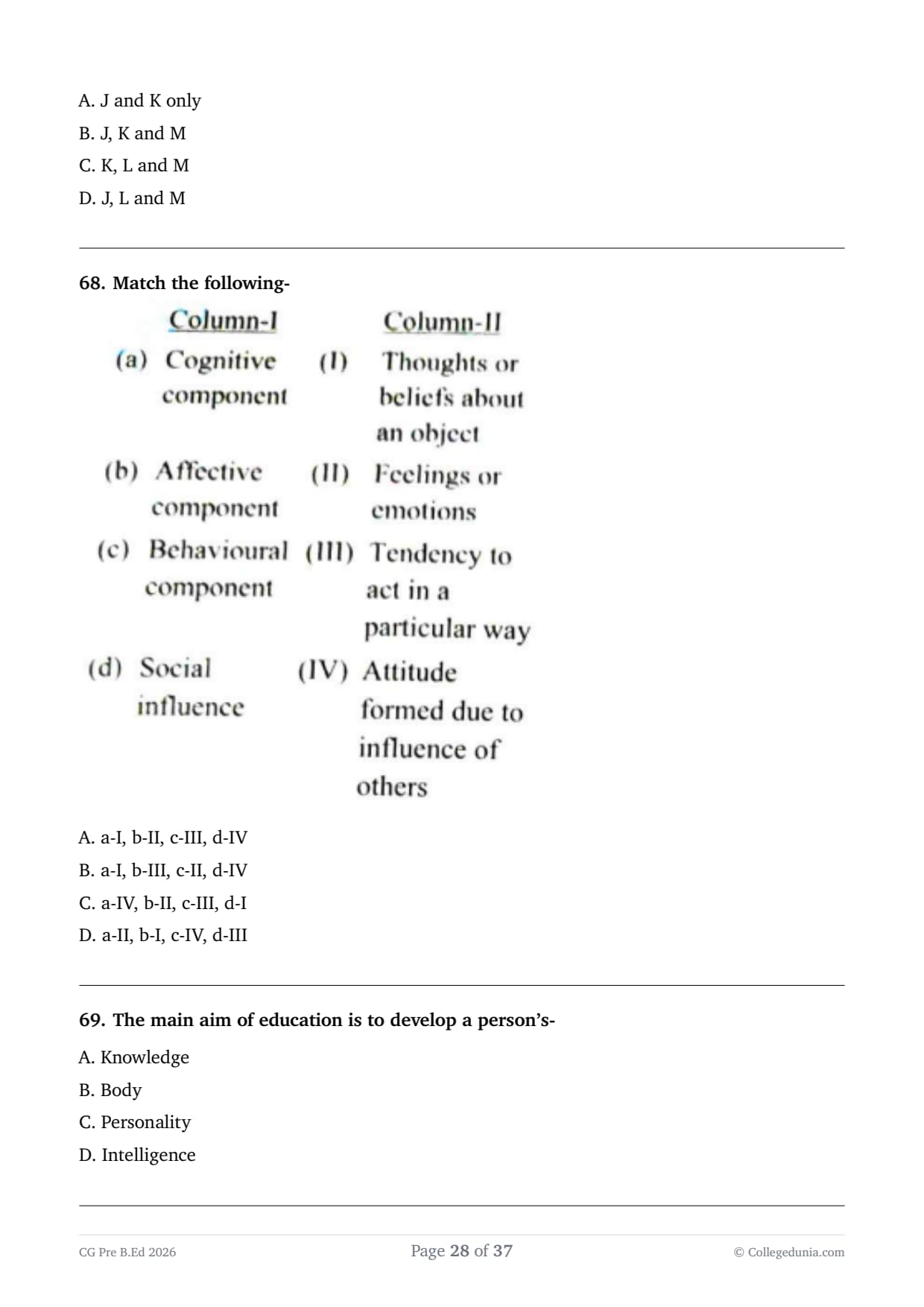
Match the following-

View Solution
Concept: Attitude consists of three components: cognitive, affective, and behavioural, along with social influence factors.
Step 1: Mapping components
Cognitive relates to thoughts and beliefs.
Affective relates to emotions and feelings.
Behavioural relates to actions and tendencies.
Social influence reflects external impact on attitude formation.
Step 2: Matching logic
Each component directly corresponds to its psychological definition.
Step 3: Final answer
Thus, correct matching is a-I, b-II, c-III, d-IV. Quick Tip: ABC of attitude: Cognitive = thoughts, Affective = feelings, Behavioural = actions.
The main aim of education is to develop a person's-
View Solution
Concept: Education aims at holistic personality development of an individual.
Step 1: Analysis of options
Knowledge, body, and intelligence represent partial aspects of development.
Step 2: Integration concept
Personality integrates cognitive, emotional, social, and physical development.
Step 3: Final conclusion
Thus, personality is the most comprehensive aim of education. Quick Tip: Always select the most holistic and integrative option in education objectives.
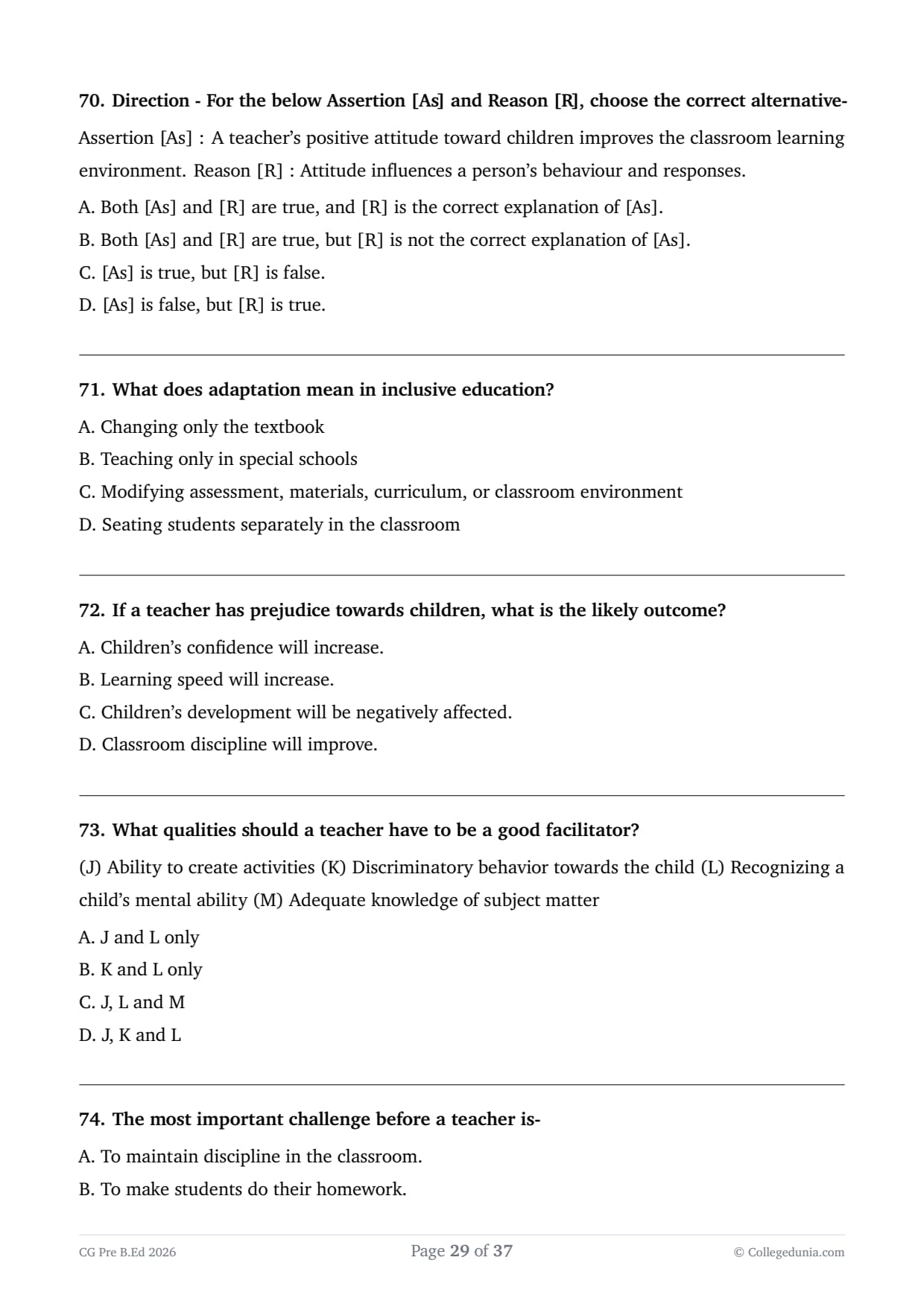
Direction - For the below Assertion [As] and Reason [R], choose the correct alternative-
Assertion [As] : A teacher’s positive attitude toward children improves the classroom learning environment.
Reason [R] : Attitude influences a person’s behaviour and responses.
View Solution
Concept:
In educational psychology, attitude is a core determinant of behavior. A teacher’s positive attitude directly shapes classroom climate through supportive actions and interactions.
Step 1: Evaluate Assertion [As]
A positive teacher attitude promotes encouragement, emotional safety, and active participation. This improves classroom learning environment. Hence, true.
Step 2: Evaluate Reason [R]
Attitude is a psychological predisposition that directly influences behavior, responses, and interaction patterns. Hence, true.
Step 3: Link [As] and [R]
Since behavior shaped by attitude is what creates classroom climate, Reason correctly explains Assertion. Quick Tip: Read Assertion + Reason with “because”. If it forms a logical explanation, both are true and correct explanation is given.
What does adaptation mean in inclusive education?
View Solution
Concept:
Adaptation in inclusive education refers to systematic modifications in teaching-learning processes to meet diverse learner needs.
Step 1: Analyze Option A
Too narrow; adaptation is not limited to textbooks.
Step 2: Analyze Option B
Opposes inclusion; promotes segregation.
Step 3: Analyze Option C
Includes curriculum, assessment, materials, and environment. Fully inclusive approach.
Step 4: Analyze Option D
Leads to isolation, not inclusion.
Final Conclusion:
Option C is correct because it reflects holistic adaptation. Quick Tip: Inclusive education always focuses on modification of systems, not segregation of learners.
If a teacher has prejudice towards children, what is the likely outcome?
View Solution
Concept:
Prejudice creates bias, discrimination, and negative expectations in classrooms.
Step 1: Impact on confidence
Students feel undervalued → confidence decreases.
Step 2: Impact on learning
Stress and bias reduce cognitive performance.
Step 3: Impact on development
Emotional, social, and academic growth is harme(D)
Step 4: Conclusion
Only Option C reflects realistic outcome. Quick Tip: Prejudice always leads to negative educational and emotional consequences.
What qualities should a teacher have to be a good facilitator?
(J) Ability to create activities
(K) Discriminatory behavior towards the child
(L) Recognizing a child’s mental ability
(M) Adequate knowledge of subject matter
View Solution
Concept:
A facilitator supports learning by designing activities and guiding students.
Step 1: Analyze J
Essential for active learning.
Step 2: Analyze K
Incorrect; discrimination is harmful.
Step 3: Analyze L
Important for understanding learner level.
Step 4: Analyze M
Subject knowledge is necessary for guidance.
Conclusion:
J + L + M = correct set. Quick Tip: Eliminate negative traits like discrimination immediately in MCQs.
The most important challenge before a teacher is-
View Solution
Concept:
Engagement is the core challenge in modern teaching.
Step 1: Routine tasks
A, B, C are administrative or control-base(D)
Step 2: Core teaching challenge
Motivating learners is the real difficulty.
Step 3: Why D is correct
Enjoyable learning increases motivation and participation. Quick Tip: Engagement is more important than discipline in modern pedagogy.
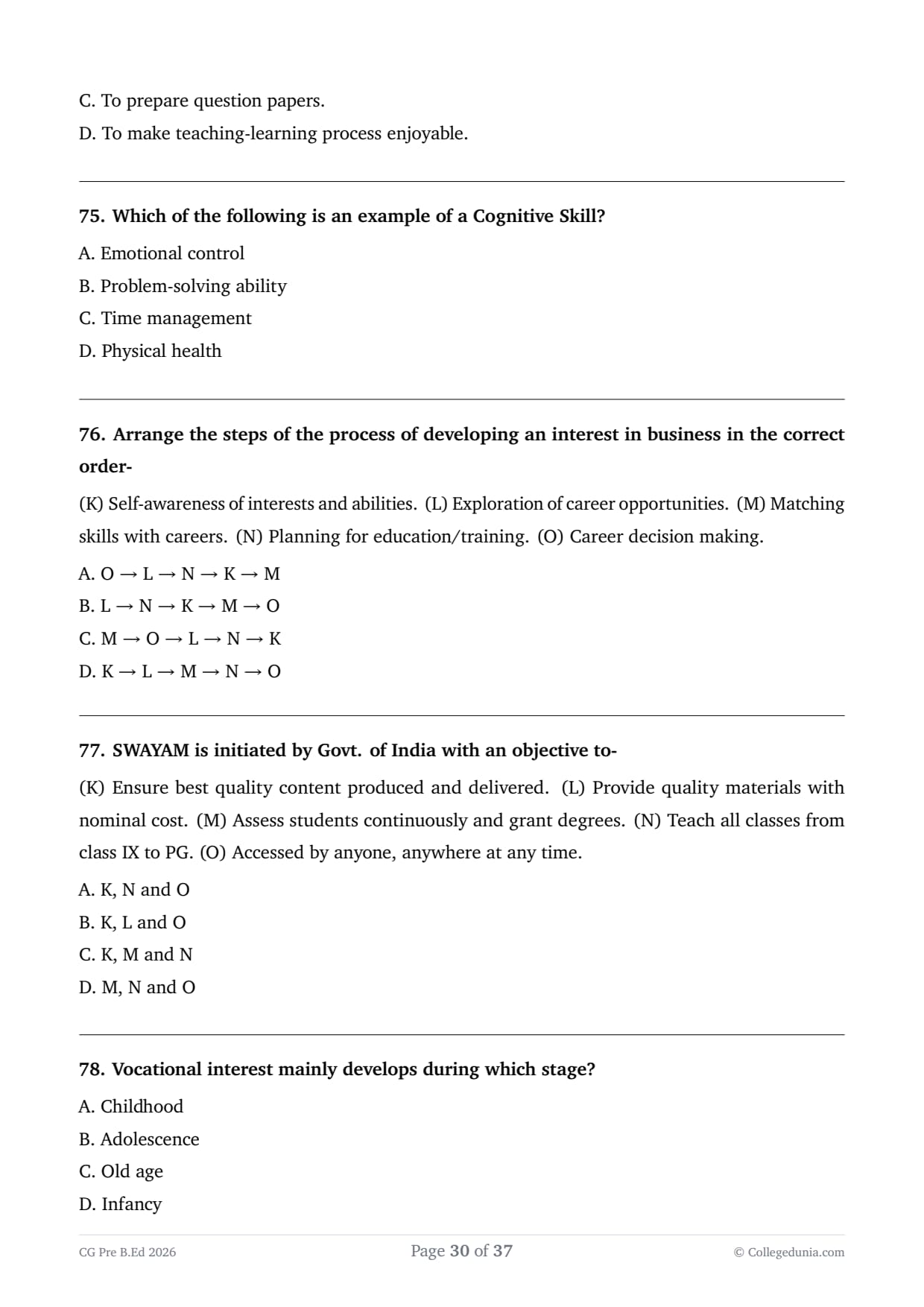
Which of the following is an example of a Cognitive Skill?
View Solution
Concept:
Cognitive skills involve thinking, reasoning, and problem-solving.
Step 1: A
Emotional → affective domain.
Step 2: B
Problem-solving → cognitive domain.
Step 3: C
Time management → executive skill.
Step 4: D
Physical health → psychomotor domain.
Conclusion:
Only B matches cognitive skills. Quick Tip: Cognitive = thinking + reasoning + analysis.
Arrange the steps of the process of developing an interest in business in the correct order-
(K) Self-awareness of interests and abilities.
(L) Exploration of career opportunities.
(M) Matching skills with careers.
(N) Planning for education/training.
(O) Career decision making.
View Solution
Concept:
Career development is a sequential psychological and informational process in which an individual first understands the self, then explores external opportunities, evaluates compatibility, makes a decision, and finally prepares for execution. This aligns with major vocational theories such as Holland’s theory of career choice and Super’s self-concept theory.
Step 1: Establishing self-awareness (Foundation stage)
(K) Self-awareness of interests and abilities is the starting point of any career development process. A person must first identify:
- What they are interested in
- What skills they possess
- What strengths and limitations define their profile
Without this internal clarity, external career choices become random and unstructure(D)
Step 2: Exploring career opportunities (Environmental scanning)
Once self-awareness is achieved, the next logical step is (L) Exploration of career opportunities. At this stage:
- The learner studies different business fields
- Investigates entrepreneurial options
- Understands market demands and job roles
This step connects the individual to the external vocational worl(D)
Step 3: Matching skills with careers (Compatibility analysis)
(M) Matching skills with careers is the evaluation phase. Here:
- Personal abilities are compared with career requirements
- Strength–demand alignment is analyzed
- Suitability of business or job roles is assessed
This ensures realistic and achievable career planning.
Step 4: Planning for education/training (Preparation phase)
(N) Planning for education/training involves:
- Selecting courses, certifications, or skill development programs
- Structuring learning pathways
- Preparing for entry into the chosen field
This step converts a career idea into an actionable roadmap.
Step 5: Career decision making (Final commitment)
(O) Career decision making is the final stage where:
- The individual selects one specific path
- Alternatives are evaluated and rejected
- A commitment to a business or profession is made
This completes the decision-making cycle.
Final Sequence: \(\)
K \(\rightarrow\) L \(\rightarrow\) M \(\rightarrow\) N \(\rightarrow\) O \(\) Quick Tip: Career development always moves from self-understanding → exploration → matching → planning → final decision.
SWAYAM is initiated by Govt. of India with an objective to-
(K) Ensure best quality content produced and delivere(D)
(L) Provide quality materials with nominal cost.
(M) Assess students continuously and grant degrees.
(N) Teach all classes from class IX to PG.
(O) Accessed by anyone, anywhere at any time.
View Solution
Concept:
SWAYAM (Study Webs of Active Learning for Young Aspiring Minds) is a Government of India digital learning platform designed to provide high-quality education through MOOCs (Massive Open Online Courses). Its core principles are accessibility, equity, and quality.
Step 1: Evaluating statement (K)
K is correct because SWAYAM courses are developed by national coordinators such as NPTEL, UGC, CEC, IGNOU, ensuring high-quality academic content.
Step 2: Evaluating statement (L)
L is incorrect because:
- Learning content is free
- Only certification exams may have a fee
Hence “nominal cost” is misleading.
Step 3: Evaluating statement (M)
M is incorrect because SWAYAM:
- Does not directly grant degrees
- Only provides certificates and credit transfer support
Step 4: Evaluating statement (N)
N is correct because courses range from school level (Class IX) to postgraduate education.
Step 5: Evaluating statement (O)
O is correct because SWAYAM is:
- Open access
- Time-independent
- Location-independent
Final Conclusion: \(\)
K, N, O \(\) Quick Tip: SWAYAM = Study anytime, anywhere, by anyone with high-quality national-level content.
Vocational interest mainly develops during which stage?
View Solution
Concept:
Vocational interest develops when individuals acquire abstract thinking, identity formation ability, and future-oriented decision-making capacity. According to Erikson’s psychosocial theory, this occurs most prominently during adolescence.
Step 1: Infancy and Childhood
- Interest is based on imitation and play
- No stable vocational preference exists
Step 2: Adolescence (Correct stage)
- Identity vs Role Confusion stage (Erikson)
- Development of abstract reasoning (Piaget)
- Exploration of career identity begins
- Students begin evaluating real-world occupations
Step 3: Old age
- Focus shifts to reflection and retirement
- No new vocational formation occurs
Final Conclusion:
Adolescence is the key stage for vocational interest formation. Quick Tip: Vocational interest emerges when identity formation begins — mainly during adolescence.
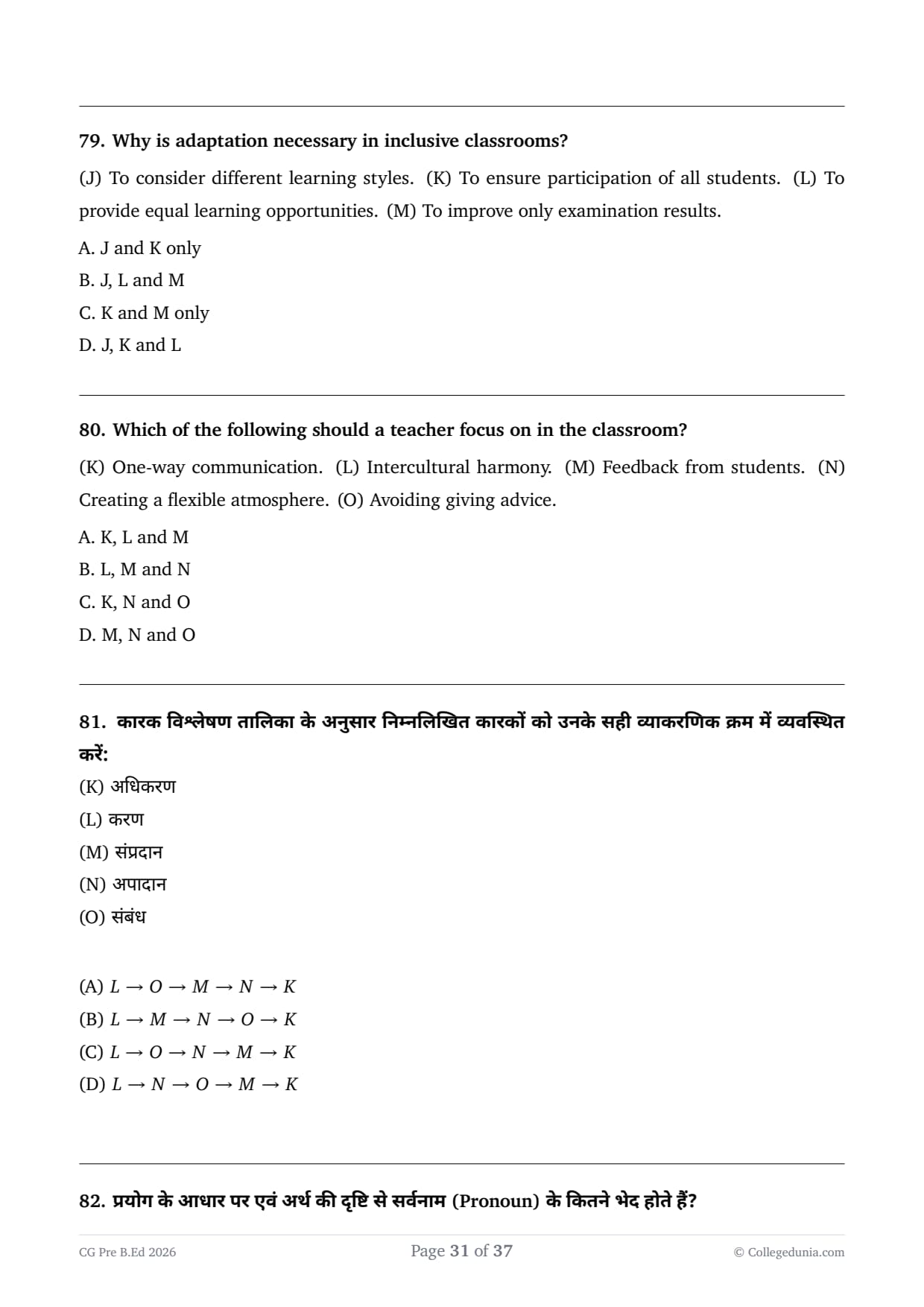
Why is adaptation necessary in inclusive classrooms?
(J) To consider different learning styles.
(K) To ensure participation of all students.
(L) To provide equal learning opportunities.
(M) To improve only examination results.
View Solution
N/A Quick Tip: Inclusive education is about participation and equity, not exam scores alone.
Which of the following should a teacher focus on in the classroom?
(K) One-way communication.
(L) Intercultural harmony.
(M) Feedback from students.
(N) Creating a flexible atmosphere.
(O) Avoiding giving advice.
View Solution
N/A Quick Tip: Modern teaching is two-way, flexible, and inclusive — not rigid or one-way.
कारक विश्लेषण तालिका के अनुसार निम्नलिखित कारकों को उनके सही व्याकरणिक क्रम में व्यवस्थित करें:
(K) अधिकरण
(L) करण
(M) संप्रदान
(N) अपादान
(O) संबंध
View Solution
Concept:
In Hindi grammar ( व्याकरण), cases ( कारक) represent the grammatical relationship between nouns/pronouns and other words in a sentence.
The standard sequence of cases is:
कर्ता
कर्म
करण (L)
संप्रदान (M)
अपादान (N)
संबंध (O)
अधिकरण (K)
Step 1: Mapping:
L = 3
M = 4
N = 5
O = 6
K = 7
Step 2: Increasing order: \[ 3 \rightarrow 4 \rightarrow 5 \rightarrow 6 \rightarrow 7 \]
So: \[ L \rightarrow M \rightarrow N \rightarrow O \rightarrow K \] Quick Tip: Learn the fixed order of कारक to solve all such questions quickly.
प्रयोग के आधार पर एवं अर्थ की दृष्टि से सर्वनाम} (Pronoun) के कितने भेद होते हैं?}
View Solution
Concept:
In Hindi grammar, a सर्वनाम (Pronoun) is a word that replaces a noun to avoid repetition and make sentences more concise and meaningful. When classified on the basis of usage ( प्रयोग) and meaning ( अर्थ), pronouns are grouped into specific functional categories depending on how and where they are used in communication.
The classification is not arbitrary but follows semantic roles such as reference to speaker, listener, unknown object, questioning entity, or relational dependency.
Step 1: Identifying functional categories
Hindi grammar recognizes the following six major types of pronouns:
पुरुषवाचक सर्वनाम (Personal Pronoun):
These pronouns refer to the speaker, listener, or a third person. For example: मैं, तुम, वह, हम. They are used to indicate person-based identity in communication.
निश्चयवाचक सर्वनाम (Demonstrative Pronoun):
These are used to point out specific persons or objects clearly. Example: यह, वह. They help in indicating proximity or definiteness.
अनिश्चयवाचक सर्वनाम (Indefinite Pronoun):
These refer to objects or persons in an indefinite or unknown manner. Example: कोई, कुछ. They do not specify exact identity.
संबंधवाचक सर्वनाम (Relative Pronoun):
These establish a relationship between two clauses or ideas. Example: जो, सो. They connect dependent and independent clauses.
प्रश्नवाचक सर्वनाम (Interrogative Pronoun):
These are used to ask questions about persons or things. Example: कौन, क्या. They introduce interrogative sentences.
निजवाचक सर्वनाम (Reflexive Pronoun):
These refer back to the subject itself and emphasize self-action. Example: स्वयं, खुद, आप.
Step 2: Analytical reasoning of classification
The classification is based on functional and semantic behavior, not on the total number of pronoun words. Each category represents a distinct grammatical usage pattern in sentence formation.
When all six functional categories are counted, the total number of pronoun types becomes:
\[ Total types = 6 \]
Step 3: Final conclusion
Since exactly six functional categories exist in standard Hindi grammar under usage and meaning-based classification, the correct answer is Option (A). Quick Tip: Always remember: pronoun "types" are categories, not individual pronoun words. Many students confuse the number of pronouns with classification groups.
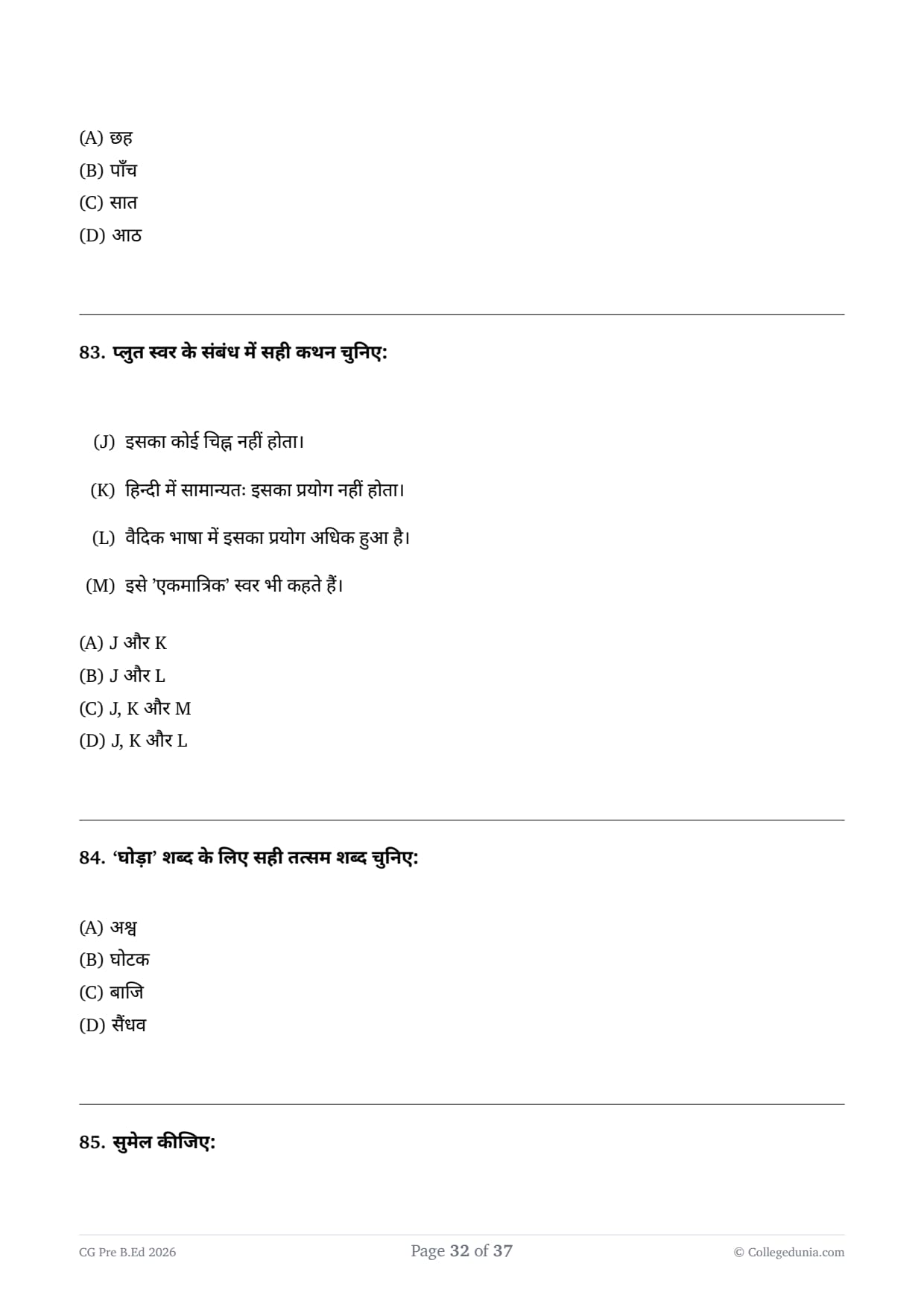
प्लुत स्वर के संबंध में सही कथन चुनिए:
[(J)] इसका कोई चिह्न नहीं होता।
[(K)] हिन्दी में सामान्यतः इसका प्रयोग नहीं होता।
[(L)] वैदिक भाषा में इसका प्रयोग अधिक हुआ है।
[(M)] इसे ' एकमात्रिक' स्वर भी कहते हैं।
View Solution
Concept:
In Sanskrit and Vedic phonetics, vowels are classified on the basis of pronunciation duration ( उच्चारण काल). This duration is measured in matras ( मात्रा), and vowels are divided into three main categories:
ह्रस्व स्वर (1 matra)
दीर्घ स्वर (2 matras)
प्लुत स्वर (3 or more matras)
Pluta vowels are special elongated vowels used primarily in Vedic chanting, dramatic expression, or calling out from a distance.
Step 1: Analysis of Statement J
Statement J says that pluta vowels do not have a standard independent alphabetic representation in modern Devanagari script like other vowels. Instead, they are often indicated using a numerical symbol ( ३) or special notation.
This makes J generally correct in the context of modern standard writing systems.
Step 2: Analysis of Statement K
Statement K claims that pluta vowels are not used in Hindi. This is partially incorrect because although they are rare in modern usage, they still appear in Vedic chanting traditions and certain formal phonetic contexts such as “ ओ३म्”.
Hence, it cannot be considered absolutely correct.
Step 3: Analysis of Statement L
Statement L states that pluta vowels are widely used in Vedic language. This is historically and grammatically correct because Vedic chanting relies on elongated pronunciation for meter and rhythmic accuracy.
Thus, L is correct.
Step 4: Analysis of Statement M
Statement M incorrectly defines pluta vowels as one-matra vowels. However, pluta vowels are three-matra ( त्रिमात्रिक), making this statement incorrect.
Step 5: Final evaluation
Only statements J and L are correct, while K is partially incorrect and M is wrong.
\[ Correct set = J + L \]
Thus, Option (B) is correct. Quick Tip: Pluta vowels are always longer than both short and long vowels and are mainly associated with Vedic pronunciation traditions.
` घोड़ा' शब्द के लिए सही तत्सम शब्द चुनिए:
View Solution
Concept:
In Hindi linguistics, words are classified into तत्सम and तद्भव categories. Tatsama words are those that are directly borrowed from Sanskrit without any phonetic or structural modification, whereas tadbhava words are modified forms that evolved naturally over time due to pronunciation simplification.
Step 1: Understanding the base word
The modern Hindi word घोड़ा is a tadbhava wor(D) It has evolved from its Sanskrit root through gradual phonetic transformation. The original Sanskrit form associated with this word is घोटक}.
Step 2: Etymological transformation process
The linguistic evolution can be represented as:
\[ \text{घोटक (Sanskrit)} \rightarrow \text{प्राकृत रूप} \rightarrow \text{घोड़ा (Hindi)} \]
During this transformation, consonant softening and vowel modification occurred to simplify pronunciation for everyday spoken usage.
Step 3: Evaluation of options
अश्व}: A classical Sanskrit synonym for horse, but not the direct root of “ घोड़ा”.
बाजि}: Literary Sanskrit term used in poetic contexts.
सैंधव}: Refers to a horse from the Sindh region, not a linguistic root form.
घोटक}: The direct Sanskrit base form that evolved into “ घोड़ा”.
Step 4: Final conclusion
Since घोटक is the direct Sanskrit equivalent form from which the tadbhava word “ घोड़ा” evolved, it is the correct answer. Quick Tip: Tatsam words preserve Sanskrit structure exactly, while tadbhav words evolve naturally in pronunciation over time.
सुमेल कीजिए:}
| Column I | Column II |
|---|---|
| (a) प्रत्येक | (I) तत्पुरुष |
| (b) हथकड़ी | (II) द्वंद्व |
| (c) मुनिवर | (III) अव्ययीभाव |
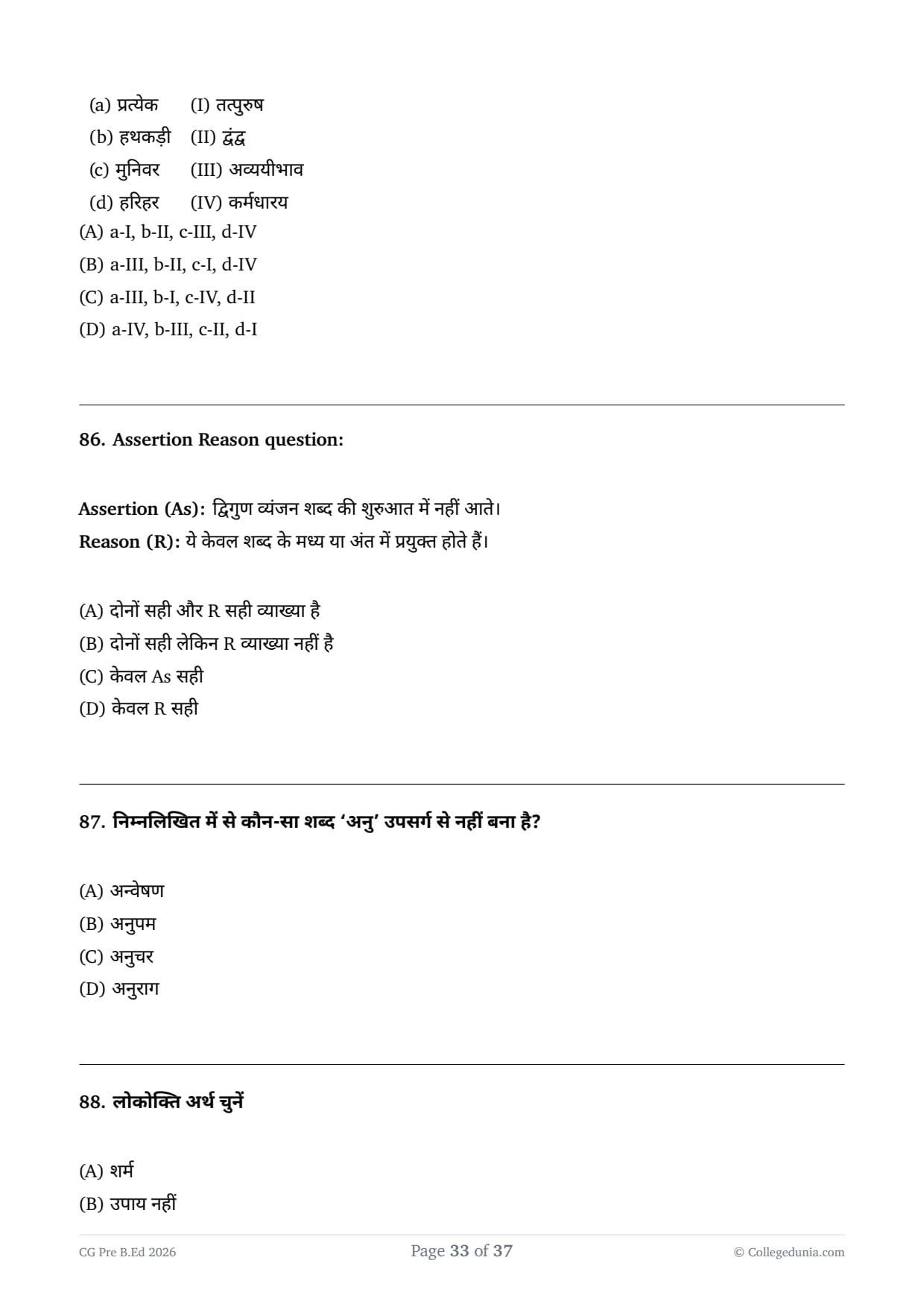
| (d) हरिहर} | (IV) कर्मधारय |
View Solution
Concept:
In Hindi grammar, समास (compound words) are formed when two or more words combine to form a single meaningful unit. The meaning of the compound depends on the relationship between the constituent words. Different types of समास are classified based on grammatical dependency such as prefix dominance, case relationship, coordination, and adjective–noun relation.
Step 1: Analysis of (a) प्रत्येक
The word प्रत्येक is formed as: \[ प्रति + एक = प्रत्येक \]
Here, the prefix “ प्रति” acts as an indeclinable ( अव्यय), and the meaning of the compound is dominated by the prefix itself (“each” or “every”). Such compounds are classified as अव्ययीभाव समास}.
So, \[ (a) \rightarrow (III) \]
Step 2: Analysis of (b) हथकड़ी
The word हथकड़ी is derived from: \[ हाथ के लिए कड़ी \]
Here, the relationship between words is expressed through a hidden case marker “ के लिए” (dative relation), which is omitted during compounding. Such compounds, where a case relationship is implied, are known as तत्पुरुष समास.
So, \[ (b) \rightarrow (I) \]
Step 3: Analysis of (c) मुनिवर
The compound मुनिवर} is formed from: \[ मुनि + वर \]
Here, “ वर” ( श्रेष्ठ) acts as an adjective describing the noun “ मुनि”. This adjective–noun relationship is the defining feature of कर्मधारय समास, where one word qualifies the other.
So, \[ (c) \rightarrow (IV) \]
Step 4: Analysis of (d) हरिहर
The word हरिहर consists of: \[ हरि + हर \]
Both components are equally important and neither word dominates the meaning of the other. The compound expresses coordination (“Hari and Hara”), which is the defining feature of द्वंद्व समास.
So, \[ (d) \rightarrow (II) \]
Final Answer: \[ a-III,\; b-I,\; c-IV,\; d-II \]
Thus, Option (C) is correct. Quick Tip: Identify Avyayibhav quickly by spotting prefixes like प्रति, अनु, यथा. They usually dominate meaning.
Assertion Reason question:
Assertion (As): द्विगुण व्यंजन शब्द की शुरुआत में नहीं आते।
Reason (R): ये केवल शब्द के मध्य या अंत में प्रयुक्त होते हैं।
View Solution
Concept:
In Hindi phonetics, द्विगुण व्यंजन (flap consonants) such as ड़ and ढ़ are modified forms of ड and ढ. These sounds are produced by a quick flap of the tongue and have specific positional constraints in word formation.
Step 1: Verification of Assertion (As)
The assertion states that these consonants do not appear at the beginning of words. This is correct because Hindi phonotactic rules do not allow flap consonants like ड़ or ढ़ to initiate a wor(D) Words always begin with their base forms like ड or ढ.
Thus, Assertion (As) is true.
Step 2: Verification of Reason (R)
The reason states that these consonants appear only in the middle or at the end of words. This is also correct. Examples include:
सड़क,; लड़का,; पढ़ना,; गढ़
Thus, Reason (R) is also true.
Step 3: Logical relationship
The reason correctly explains the assertion because the phonetic nature of flap consonants restricts them from occurring at word-initial positions and confines them to medial or final positions.
Therefore, both statements are correct and R is the correct explanation of As. Quick Tip: Flap consonants ( ड़, ढ़) are always derived forms and never appear at the start of native Hindi words.
निम्नलिखित में से कौन-सा शब्द ‘अनु’ उपसर्ग से नहीं बना है?
View Solution
Concept:
In Sanskrit and Hindi morphology, a उपसर्ग} (prefix) is a meaningful element added before a root word to modify its meaning. The prefix “ अनु” generally conveys meanings such as following, after, or along.
To solve this question, each word must be broken down morphologically.
Step 1: Analysis of (A) अन्वेषण}
\[ अनु} + एषण} = अन्वेषण} \]
Here, the prefix अनु} is clearly present.
Step 2: Analysis of (B) अनुपम}
\[ अन्} + उपम} = अनुपम} \]
Here, the prefix is not “ अनु” but “ अन्}”, which is a negative prefix meaning “without” or “not”.
Hence, this word does NOT contain the prefix अनु.
Step 3: Analysis of (C) अनुचर}
\[ अनु} + चर} = अनुचर} \]
Clearly formed using the prefix “ अनु”.
Step 4: Analysis of (D) अनुराग}
\[ अनु} + राग} = अनुराग} \]
Also formed using the prefix “ अनु”.
Final conclusion:
Only अनुपम} is formed using the prefix “ अन्”, not “ अनु”.
Therefore, Option (B) is correct. Quick Tip: Words beginning with “ अनु}” are not always true prefixes—always verify root splitting before concluding.
लोकोक्ति अर्थ चुनें
View Solution
Concept:
A लोकोक्ति (proverb) is a fixed traditional expression that conveys a deeper moral or social meaning beyond its literal wording. Proverbs are often based on real-life social behavior and highlight human tendencies such as hypocrisy, pride, honesty, or irony.
The given proverb reflects a situation where appearance and reality are completely contradictory.
Step 1: Literal interpretation
The expression “ शेखी सेठ की, धोती भाड़े की” can be broken as:
शेखी सेठ की: Showing pride or arrogance like a wealthy landlord or merchant.
धोती भाड़े की: Even basic clothing (dhoti) is rented, indicating lack of actual wealth.
Step 2: Logical interpretation
This contrast clearly highlights a person who pretends to be wealthy, powerful, or socially superior, while in reality they lack even basic resources. The proverb criticizes false display and hypocrisy in social behavior.
Step 3: Final meaning
The correct implied meaning is:
“ बिना वास्तविक क्षमता के केवल दिखावटी बड़ा बनना”.
Thus, the correct option is (D) बनावटी बड़प्पन. Quick Tip: Proverbs often rely on irony: what is said is opposite to what is meant.
‘ चिन्मय’ में संधि कौन-सी है?
View Solution
Concept:
संधि (Sandhi) is the phonetic fusion of two sounds occurring at word boundaries or within compound words. When consonants merge or transform due to phonetic rules, it is classified as व्यंजन संधि (consonant sandhi).
Step 1: Word decomposition
The word चिन्मय is derived as:
\[ चित् + मय \]
Step 2: Sandhi transformation
Here the final consonant of the first word is: \[ त्} \]
and it comes in contact with: \[ म् \]
According to consonant sandhi rules, when a dental consonant ( त्) is followed by a nasal consonant ( म्), it changes into its corresponding nasal sound from the same class:
\[ \text{त्} \rightarrow \text{न्} \]
Thus the transformation becomes:
\[ \text{चित्} + \text{मय} \rightarrow \text{चिन्मय} \]
Step 3: Classification
Since this transformation occurs due to interaction between consonants, it is clearly an example of व्यंजन संधि.
Final Answer: Option (B) Quick Tip: In consonant sandhi, dental consonants often convert into nasal sounds before “ म”.
‘ जलज’ शब्द के लिए सही अनेकार्थी शब्द समूह चुनिए
View Solution
Concept:
An अनेकार्थी शब्द (polysemous word) is a word that carries multiple related meanings depending on context. The word “ जलज” is formed from:
\[ जल + ज = जल में जन्म लेने वाला \]
It refers to anything that originates or is born in water.
Step 1: Meaning analysis of each option
(J) कमल (Lotus): Grows and blooms in water, hence correctly called जलज.
(K) मछली}(Fish): Lives and reproduces in water, also correctly called जलज.
(L) बादल (Cloud): Not born in water; instead it contains water vapor. It is correctly called जलद (giver of water), not जलज.
(M) मोती (Pearl): Forms inside oysters underwater, hence also considered जलज.
Step 2: Final selection
Since J, K, and M satisfy the condition of “born in water”, they correctly represent the meanings of जलज.
\[ Correct set = J + K + M \]
Thus, Option (C) is correct. Quick Tip: “ ज” means born from — जलज = born in water, जलद = gives water.
Direction - For the below Assertion [As] and Reason [R], choose the correct alternative-
Assertion [As] : It was not possible to "linger on the expedition".
Reason [R] : Once the tide turned, it came in rapidly and could cut off the return path.
View Solution
Concept:
This question tests reading comprehension, logical deduction, and cause-and-effect relationships. To determine the correct answer, we must first assess whether the statements are factually true on their own, and then determine if there is a direct logical connection linking the cause (Reason) to the effect (Assertion).
Step 1: Evaluate the validity of Assertion [As].
The assertion states that it was impossible to delay or "linger on the expedition." This describes an explicit constraint or limitation on time during a journey, implying that lingering would introduce danger. This statement functions as a true situational premise in coastal expeditions.
Step 2: Evaluate the validity of Reason [R].
The reason mentions that when a tide changes direction, it rushes in with immense speed, which can completely submerge low-lying areas and trap travelers by blocking their escape route back to safety. This is a well-documented physical hazard of coastal geography, making the statement factually true.
Step 3: Analyze the logical link between [As] and [R].
Let us link the two statements using the explanatory conjunction 'because': \[ "It was not possible to linger on the expedition because once the tide turned, \] \[ it came in rapidly and could cut off the return path." \]
The sentence flows logically. The high risk of being cut off by a fast-moving tide perfectly explains why travelers could not afford to waste time or linger. Therefore, both statements are true, and the reason serves as a clear, valid explanation for the assertion. This corresponds to option (A). Quick Tip: To verify assertion-reason questions smoothly, read the assertion, add the word "because" at the end, and then read the reason. If the resulting combined sentence makes logical sense as a cause-and-effect scenario, select the option stating it is the correct explanation.
Choose the correct answer from the options given below the sentence:
When the principal entered the class, a student _____ on the blackboar(D)
View Solution
Concept:
This sentence deals with past tense temporal clauses. When an ongoing background action in the past is suddenly interrupted or intersected by a specific, shorter completed event, we use two different tenses:
Past Continuous Tense (\(S + was/were + V-ing\)): Reserved for the continuous, ongoing background activity.
Simple Past Tense (\(S + V_2\)): Reserved for the sudden action that interrupts the ongoing background scenario.
Step 1: Analyze the timeline anchor of the sentence.
The sentence starts with the dependent clause: "When the principal entered the class".
The verb 'entered' is in the Simple Past tense (\(V_2\)). This firmly establishes that the entire scene takes place in the past. This allows us to eliminate options written in the present tense:
Option (C) 'writes' (Simple Present) is incorrect.
Option (D) 'is writing' (Present Continuous) is incorrect.
Step 2: Determine the relationship between the two past actions.
We are left with option (A) 'wrote' and option (B) 'was writing'. Let us look at how the actions interact:
The act of writing on a blackboard is a continuous activity that takes time. The principal entering the room happens at a specific single moment during that ongoing writing process.
Using the simple past 'wrote' in both clauses would imply that the student started and finished writing on the board *as a consequence of* or *at the exact same instance* the principal walked in, which distorts the natural sequence of events.
Instead, the student was already in the middle of writing on the board when the principal entere(D) This background action requires the Past Continuous tense form: 'was writing'. This perfectly aligns with option (B). Quick Tip: Remember this classic sentence pattern: When + Subject + Simple Past (\(V_2\)), Subject + Past Continuous (\(was/were + V-ing\)) Example: *When the bell rang, we were having lunch.*
Fill in the blanks with suitable preposition:
"The dog is lying _____ the floor."
View Solution
Concept:
Prepositions indicate spatial relationships between objects. To select the correct option, let us evaluate the positional rules for resting on a flat horizontal plane:
on: Used when an object is resting on and physically touching a flat surface.
at: Focuses on a specific point or location in space rather than physical contact with a flat plane.
above: Indicates something is higher than a surface without direct physical contact.
upon: Typically used to describe an object moving toward and landing on a surface, rather than an object already resting in a static state.
Step 1: Examine the state of the subject in the sentence.
The sentence states: "The dog is lying ____ the floor." The verb 'is lying' indicates that the dog is in a static, resting position. The floor acts as a flat physical boundary supporting the dog's weight. Because the dog is in direct physical contact with this flat horizontal surface, the standard preposition required is 'on'.
Step 2: Verify why other options do not fit.
Let us check why the alternatives are less suitable:
*at the floor* would incorrectly imply a general proximity point rather than resting on top of the surface.
*above the floor* would mean the dog is floating in mid-air above the ground, which violates gravity and common sense.
*upon the floor* implies active movement or a dynamic shift onto the floor (e.g., *The dog jumped upon the table*), which contradicts the static verb 'lying'.
Thus, 'on' is the most accurate choice, matching option (C). Quick Tip: Use on for static contact with a flat surface (e.g., *on the floor*, *on the table*). Use upon when there is active physical movement or a jump directed onto that surface.
Choose the correct answer from the options given below the sentence:
He always ____ to prove that the earth revolves around the sun.
View Solution
Concept:
The choice of verb tense depends on frequency modifiers and structural clues within a sentence. The adverb 'always' signifies an ongoing habit, consistent trait, or regular recurring routine. Habitual actions, timeless characteristics, or repetitive personal behaviors are structured using the Simple Present Tense (\(S + V_1 / V_{s/es}\)).
Step 1: Analyze the subject and the frequency modifier.
The sentence contains the adverb 'always', which means the action is a regular habit rather than a temporary single event. The subject of the sentence is the third-person singular pronoun 'He'. In the Simple Present tense, a singular subject requires a verb ending with an '-s' or '-es' suffix modifier (\(V_{s/es}\)).
Step 2: Evaluate the options against simple present tense rules.
Let us filter the choices based on our tense criteria:
(A) tried: Simple Past form. This contradicts the habitual continuity implied by 'always'.
(B) tries: Present tense third-person singular form. This fits the subject 'He' and matches the frequency modifier 'always'.
(C) was trying: Past Continuous form. This describes a temporary background event in the past, which does not fit here.
(D) is trying: Present Continuous form. This describes a temporary action happening right at this moment, which conflicts with the permanent habit implied by 'always'.
This leaves 'tries' as the correct grammatical fit, matching option (B). Quick Tip: Signal keywords like always, usually, often, everyday, daily point directly to habitual routines. Pair them with the Simple Present Tense to ensure correct sentence structure.
Below is given sentence in active/passive voice. Out of the four alternative suggested, select one which best expresses the same sentence in passive/active voice:
"The waiter filled the glasses with water."
View Solution
Concept:
To convert a sentence from Active Voice to Passive Voice, we follow a reliable set of structural transformations:
Identify the core components of the active sentence: Subject (\(S\)), Verb (\(V\)), and Direct Object (\(O\)).
Shift the Direct Object (\(O\)) so it becomes the new grammatical subject of the passive sentence.
Adjust the auxiliary helping verb to match the original tense of the active ver(B) For the Simple Past Tense (\(V_2\)), the passive auxiliary pattern is:
\[ \text{was / were} + \text{Past Participle (V}_3\text{)} \]
Move the original subject to the end of the clause, preceded by the preposition 'by'.
Step 1: Analyze the components of the active sentence.
Let us break down the provided sentence: "The waiter filled the glasses with water."
Subject (\(S\)): The waiter
Verb (\(V\)): filled (Simple Past Tense, \(V_2\) form)
Object (\(O\)): the glasses
Adjunct Phrase: with water
Step 2: Apply the passive transformation rules.
Let us reassemble the components step-by-step into a passive structure:
The object 'The glasses' becomes our new leading plural subject.
Since 'The glasses' is plural and the original tense is Simple Past, we choose the auxiliary verb 'were'.
The past participle (\(V_3\)) form of 'filled' remains 'filled'.
Combine these parts with the remaining descriptive details: *were filled with water*.
Append the agent clause at the end: 'by the waiter'.
Putting it all together gives: "The glasses were filled with water by the waiter." This matches option (B).
Quick Tip: Always track the singular or plural status of your new passive subject. Here, glasses is strictly plural, which means it requires were, not was. This helps you quickly rule out incorrect choices.
Active \(V_2\) → Passive \((\text{was/were} + V_3)\)
Change the following sentence from the active voice to the passive voice-
"The peon opened the gate."
View Solution
Concept:
This question focuses on converting a sentence from active to passive voice in the Simple Past tense. The core conversion formula for structural mapping is: \[ Active: Subject + V_2 + Object \] \[ Passive: Object + (was / were) + V_3 + by + Subject \]
Step 1: Deconstruct the active sentence components.
Let us analyze the components of the phrase: "The peon opened the gate."
Subject: The peon
Verb: opened (\(V_2\), indicating Simple Past Tense)
Object: the gate
Step 2: Reconstruct the sentence into passive voice.
Let us build the passive sentence step by step:
Move 'The gate' to the beginning as our new singular subject.
Because 'The gate' is singular and the sentence is in the past tense, we use the singular past auxiliary verb 'was'.
The past participle (\(V_3\)) form of the verb is 'opened'.
Add the original agent at the end: 'by the peon'.
Combining these parts gives: "The gate was opened by the peon."
Step 3: Cross-verify against the given options.
Let us double-check why the alternative options are incorrect:
(A) *is opened* incorrectly switches the tense to the present.
(B) *were opened* incorrectly uses a plural auxiliary verb for a singular subject ('the gate').
(C) *has opened* changes the tense to the present perfect.
Thus, option (D) is the only grammatically correct selection. Quick Tip: Always double-check that your auxiliary verb matches both the original tense and the number of your new subject: Singular Subject (The gate) + Past Tense \(\rightarrow\) was
Choose the prefix for the word 'Possible' to make it opposite:
View Solution
Concept:
A prefix is an affix placed before the stem of a word to alter its meaning. In English grammar, negative prefixes such as un-, in-, il-, ir-, and im- are used to create antonyms (opposites).
The choice of a negative prefix often depends on the initial letter of the base wor(D) A specific phonological rule determines the placement of the prefix im-: \[ The prefix 'in-' shifts phonetically to 'im-' when it is attached to a root word starting with the bilabial consonants 'p', 'b', or 'm'. \]
This phonetic adjustment happens because both 'm' and 'p' are bilabial sounds made using both lips, making the transition much smoother to pronounce.
Step 1: Analyze the starting letter of the base root wor(D)
The base word provided in the question is 'Possible'.
Let us identify its initial letter and phonetic classification:
Initial Letter: 'P'
Phonetic Type: Bilabial plosive consonant
Step 2: Test the given prefixes against the root wor(D)
Let us systematically evaluate each option to see which combination yields a linguistically valid English word:
(A) Un + Possible = Unpossible: This is structurally incorrect and does not exist in standard English lexicon.
(B) Im + Possible = Impossible: This follows the bilabial assimilation rule perfectly. The resulting word correctly means "not able to occur, exist, or be done."
(C) Ill + Possible = Illpossible: This is an invalid lexical combination.
(D) In + Possible = Inpossible: This violates the phonetic rule of bilabial modification. The 'n' sound naturally assimilates into an 'm' sound before a 'p'.
Therefore, the correct prefix is 'Im', which creates the word Impossible. This corresponds directly to option (B). Quick Tip: To easily remember when to use the prefix im-, check if the root word begins with M, B, or P (think of the mnemonic acronym MBP). Examples: *Patient \(\rightarrow\) Impatient*, *Balance \(\rightarrow\) Imbalance*, *Moral \(\rightarrow\) Immoral*.
Below is given sentence in active/passive voice. Out of the four alternative suggested, select one which best expresses the same sentence in passive/active voice:
"The waiter filled the glasses with water."
View Solution
Concept:
Voice conversion requires shifting the focus from the agent performing the action to the entity receiving the action. To convert a sentence from Active Voice to Passive Voice, we follow these core structural rules:
Locate the active subject (\(S\)), principal verb (\(V\)), and direct object (\(O\)).
Swap positions so that the active object (\(O\)) becomes the new passive subject.
Introduce the appropriate helping verb depending on the tense. For the Simple Past Tense (\(V_2\)), the auxiliary verbs used are:
\[ \text{was} \quad \text{(for singular subjects)} \quad \text{or} \quad \text{were} \quad \text{(for plural subjects)} \]
Change the main verb into its past participle form (\(V_3\)).
Position the original active subject at the end, introduced by the preposition 'by'.
Step 1: Analyze the syntactic elements of the active sentence.
Let us examine the sentence: "The waiter filled the glasses with water."
Subject (\(S\)): The waiter (Singular agent)
Verb (\(V\)): filled (Simple Past Tense form, \(V_2\))
Direct Object (\(O\)): the glasses (Plural recipient)
Prepositional Phrase: with water (Adverbial modifier)
Step 2: Apply the passive transformation template.
Let us construct the passive layout step-by-step:
The plural object 'The glasses' shifts to the front as our new subject.
Since the new subject is plural and the original tense is Simple Past, we select the auxiliary verb 'were'.
The past participle (\(V_3\)) of 'filled' is also 'filled'.
Combine the predicate elements with the modifier: 'were filled with water'.
Add the original subject as an agent clause: 'by the waiter'.
Combining these parts yields: "The glasses were filled with water by the waiter."
Step 3: Evaluate the incorrect options for clarity.
Let us inspect why the other alternatives fail:
(A) *The glasses fille(D)..* lacks the mandatory passive auxiliary verb 'were', changing the meaning to imply the glasses performed the action of filling.
(C) *The waiter was fille(D)..* incorrectly turns the waiter into the recipient who was filled with water.
(D) *The water were fille(D)..* uses the plural auxiliary verb 'were' with 'water', which is an uncountable singular noun, violating subject-verb agreement.
Hence, option (B) is the only structurally perfect fit. Quick Tip: Always double-check your subject-verb agreement immediately after moving the object. Even though the original subject (*the waiter*) is singular, the new passive subject (the glasses) is plural, which strictly demands the plural auxiliary verb were. Active: \(S + V_2 + O \rightarrow\) Passive: \(O_{plural} + were + V_3 + by S\)
Arrange the following major ideas from the passage in the most logical order for writing a coherent précis:
[(K)] Disarmament assumes overriding importance despite continued arms competition.
[(L)] The nuclear age presents humanity with only two alternatives: annihilation or peaceful co-existence.
[(M)] Achieving peace requires cultivating tolerance and reshaping policies.
[(N)] Immediate and serious action is necessary as delay is dangerous.
[(O)] The United Nations bears the primary responsibility for ensuring progress toward disarmament.
View Solution
Concept:
A précis is a concise, structured summary of a longer text that preserves its core thematic flow and logical roadmap. To organize ideas logically, a text typically transitions from a broad existential problem or premise, moves toward specific structural responses, outlines the method of execution, stresses temporal urgency, and concludes with the institutional body responsible for enforcing the final outcome.
Step 1: Identify the foundational core premise.
Let us analyze statement (L): "The nuclear age presents humanity with only two alternatives: annihilation or peaceful co-existence."
This statement sets up the universal, grand existential dilemma that frames the entire topi(C) A global argument on peace and weapons cannot begin with specific policies or organizations without first establishing this fundamental context. Therefore, statement (L) must be our absolute starting point. This narrows down the options to (A) and (D).
Step 2: Determine the logical bridge following the premise.
Once the choice between peaceful co-existence and annihilation is stated, the next logical question is: how do we prevent annihilation? We do this through disarmament.
Statement (K) directly answers this: "Disarmament assumes overriding importance despite continued arms competition." This establishes disarmament as the primary target response to the dilemma raised in (L). Thus, the sequence must begin with L \(\rightarrow\) K.
Step 3: Trace the internal implementation steps and urgency.
Now that disarmament is established as the key goal, the passage transitions to how to build a world capable of disarming, followed by the urgency of taking action:
(M) Achieving peace requires cultivating tolerance and reshaping policies: This details the specific behavioral and political shifts needed to make disarmament work. Hence, M follows K naturally (L \(\rightarrow\) K \(\rightarrow\) M).
(N) Immediate and serious action is necessary as delay is dangerous: This injects a sense of real-time urgency, warning the reader that these programmatic changes must occur without delay.
Step 4: Isolate the definitive closing institutional body.
Finally, statement (O) introduces the specialized global authority tasked with overseeing this long-term campaign: "The United Nations bears the primary responsibility for ensuring progress toward disarmament."
Naming the specific global organization serves as a logical conclusion for the summary, defining accountability for everything discussed so far.
This completes our analytical sequence: \[ L (Existential Dilemma) \rightarrow K (Solution: Disarmament) \rightarrow M (Method) \rightarrow N (Urgency) \rightarrow O (Accountability Authority) \]
This layout perfectly matches option (A). Quick Tip: When ordering ideas for summaries or précis, look for a "Macro to Micro" hierarchy: Existential Context (L) \(\rightarrow\) Targeted Objective (K) \(\rightarrow\) Institutional Ownership (O) Identifying that the United Nations (O) represents the final stabilizing conclusion helps confirm the correct option.
Choose the correct complex sentence from the options given below:
"My brother gave me a watch and I have lost it."
View Solution
Concept:
Sentences are classified structurally into three main types based on their clause combinations:
Simple Sentence: Contains exactly one independent clause with a subject and a predicate.
Compound Sentence: Contains two or more independent clauses joined together by coordinating conjunctions (FANBOYS: for, and, nor, but, or, yet, so).
Complex Sentence: Contains exactly one principal independent clause and at least one dependent (subordinate) clause, joined via a subordinating conjunction or relative pronoun (e.g., which, that, who, because, although).
Step 1: Deconstruct the original sentence structure.
The prompt sentence is: "My brother gave me a watch and I have lost it."
Let us separate the clauses:
*My brother gave me a watch* (Independent Clause)
*I have lost it* (Independent Clause)
These clauses are linked by the coordinating conjunction 'and', making the source text a compound sentence. Our goal is to convert it into a complex sentence without altering the meaning.
Step 2: Convert the compound layout into a main and subordinate clause pair.
To transform this into a complex structure, we can convert one of these independent statements into an adjective (relative) clause that describes the object noun ("the watch").
Principal Clause: I have lost the watch
Subordinate Adjective Clause: which my brother gave me
Here, "which my brother gave me" cannot stand alone as a complete sentence; it is dependent on the main clause and is linked using the relative pronoun 'which'. This fulfills the structural definition of a complex sentence.
Step 3: Evaluate why the other options are incorrect.
Let us inspect the alternative choices to ensure accuracy:
(B) My brother gave me a watch, but I have lost it: The clauses are joined by 'but', which is a coordinating conjunction. This keeps the sentence structure compound, not complex.
(C) Since my brother gave me a watch, I lost it: The subordinating conjunction 'since' implies a false cause-and-effect relationship, suggesting that the brother's gift was the direct cause of the loss. This distorts the original meaning.
(D) I lost the watch that was given to me by my brother: While this is a complex sentence, it unnecessarily introduces passive construction ("that was given to me by..."), making it less direct than option (A), which retains the active profile of the original clauses perfectly.
Therefore, option (A) is the most accurate and natural complex presentation. Quick Tip: To easily convert a compound sentence about an object into a complex sentence, use relative pronouns like 'which' or 'that' to turn the secondary clause into a descriptive modifier for that noun object. Main Event (I lost the watch) + Relative Clause (which my brother gave me)
CG Pre B.Ed. 2026 Exam Pattern
| Particulars | Details |
|---|---|
| Exam Mode | Offline (OMR-based) |
| Exam Date | June 11, 2026 |
| Total Questions | 100 |
| Total Marks | 100 |
| Duration | 120 minutes (2 hours) |
| Negative Marking | No |
| Medium | Hindi and English |
| Number of Sections | 5 |



Comments