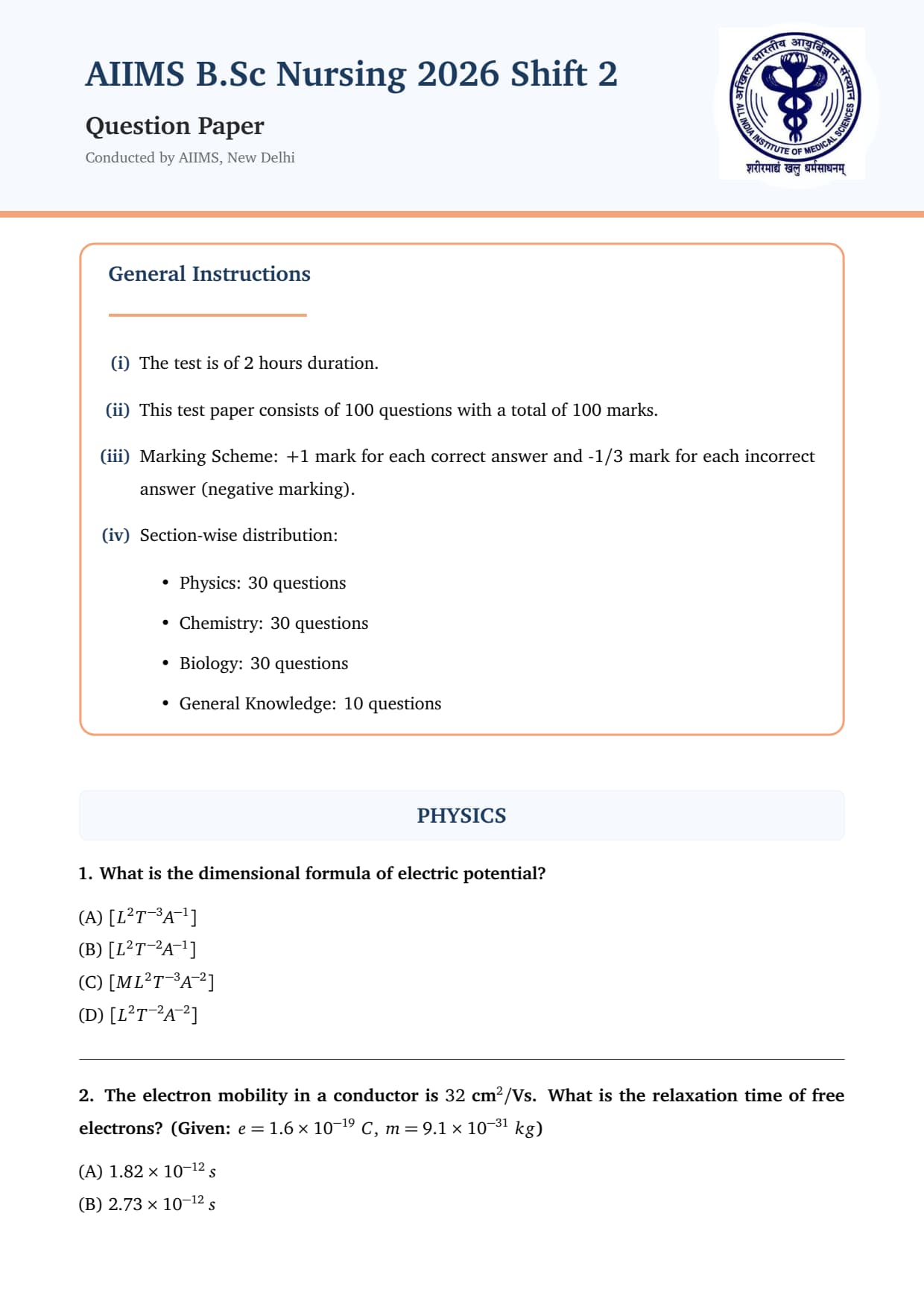
AIIMS B.Sc. Nursing 2026 Question Paper for Shift 2 is available for download here. All India Institute of Medical Sciences (AIIMS), New Delhi conducted B.Sc. Nursing exam 2026 on 27 June in Shift 2 from 12.30 PM to 2.30 PM. AIIMS B.Sc. Nursing Question Paper consists of 100 questions for 100 marks to be attempted in 2 hours.

  • AIIMS B.Sc Nursing Question Paper is divided into 4 sections- Physics, Chemistry, Biology with 30 questions each and General Knowledge with 10 questions.
  • Each question carries 1 mark and there is negative marking of 1/3 for incorrect answers.

Candidates can download AIIMS B.Sc. Nursing 2026 Question Paper with Answer Key and Solution PDF from the links provided below.

AIIMS BSc Nursing 2026 Question Paper June 27 Shift 2 with Solution PDF

AIIMS B.Sc. Nursing Question Paper 2026 Shift 2 Download PDF Check Solution


Question 1:

What is the dimensional formula of electric potential?

  • (A) \( [L^{2}T^{-3}A^{-1}] \)
  • (B) \( [L^{2}T^{-2}A^{-1}] \)
  • (C) \( [ML^{2}T^{-3}A^{-2}] \)
  • (D) \( [L^{2}T^{-2}A^{-2}] \)

Question 2:

The electron mobility in a conductor is \(32~cm^{2}/Vs\). What is the relaxation time of free electrons? (Given: \(e=1.6\times10^{-19}~C,\; m=9.1\times10^{-31}~kg\))

  • (A) \(1.82\times10^{-12}\;s\)
  • (B) \(2.73\times10^{-12}\;s\)
  • (C) \(1.82\times10^{-14}\;s\)
  • (D) \(2.73\times10^{-14}\;s\)

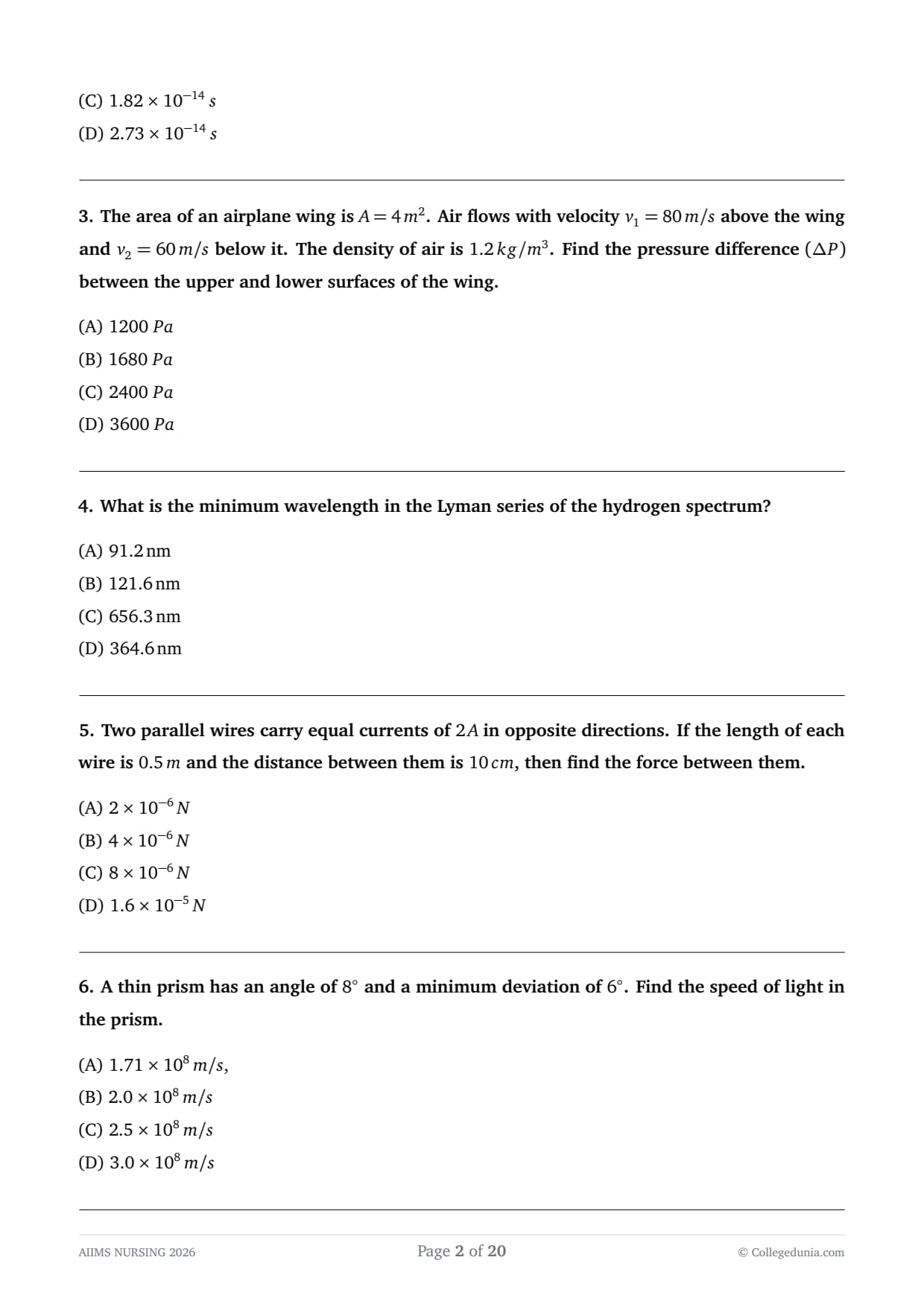
Question 3:

The area of an airplane wing is \(A=4\,m^{2}\). Air flows with velocity \(v_{1}=80\,m/s\) above the wing and \(v_{2}=60\,m/s\) below it. The density of air is \(1.2\,kg/m^{3}\). Find the pressure difference \((\Delta P)\) between the upper and lower surfaces of the wing.

  • (A) \(1200\;Pa\)
  • (B) \(1680\;Pa\)
  • (C) \(2400\;Pa\)
  • (D) \(3600\;Pa\)

Question 4:

What is the minimum wavelength in the Lyman series of the hydrogen spectrum?

  • (A) \(91.2\,nm\)
  • (B) \(121.6\,nm\)
  • (C) \(656.3\,nm\)
  • (D) \(364.6\,nm\)

Question 5:

Two parallel wires carry equal currents of \(2\,A\) in opposite directions. If the length of each wire is \(0.5\,m\) and the distance between them is \(10\,cm\), then find the force between them.

  • (A) \(2\times10^{-6}\,N\)
  • (B) \(4\times10^{-6}\,N\)
  • (C) \(8\times10^{-6}\,N\)
  • (D) \(1.6\times10^{-5}\,N\)

Question 6:

A thin prism has an angle of \(8^{\circ}\) and a minimum deviation of \(6^{\circ}\). Find the speed of light in the prism.

  • (A) \(1.71\times10^{8}\,m/s,\)
  • (B) \(2.0\times10^{8}\,m/s\)
  • (C) \(2.5\times10^{8}\,m/s\)
  • (D) \(3.0\times10^{8}\,m/s\)

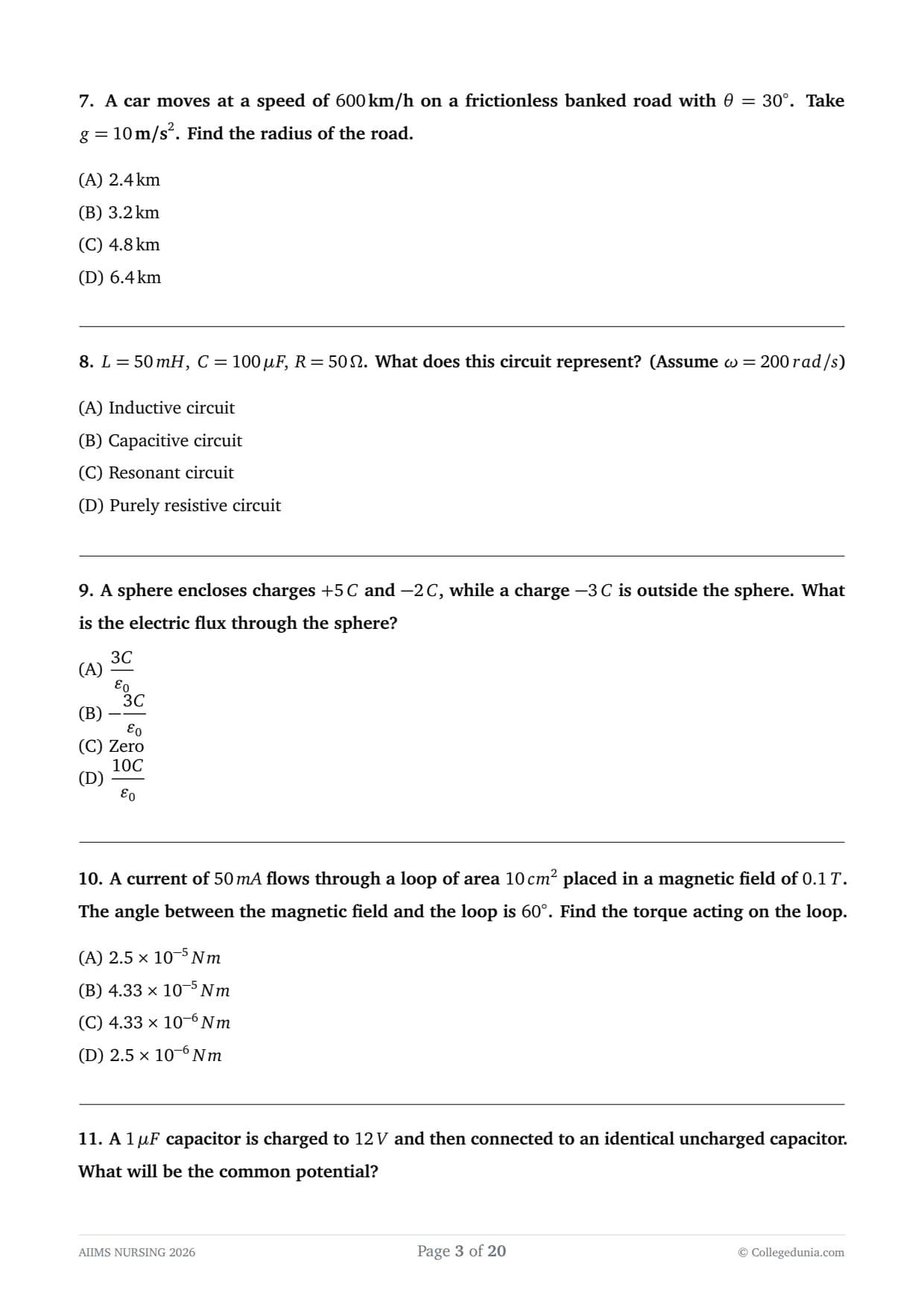
Question 7:

A car moves at a speed of \(600\,km/h\) on a frictionless banked road with \(\theta=30^{\circ}\). Take \(g=10\,m/s^{2}\). Find the radius of the road.

  • (A) \(2.4\,km\)
  • (B) \(3.2\,km\)
  • (C) \(4.8\,km\)
  • (D) \(6.4\,km\)

Question 8:

\(L=50\,mH,\; C=100\,\mu F,\; R=50\,\Omega\). What does this circuit represent? (Assume \(\omega=200\,rad/s\))

  • (A) Inductive circuit
  • (B) Capacitive circuit
  • (C) Resonant circuit
  • (D) Purely resistive circuit

Question 9:

A sphere encloses charges \(+5\,C\) and \(-2\,C\), while a charge \(-3\,C\) is outside the sphere. What is the electric flux through the sphere?

  • (A) \(\dfrac{3C}{\varepsilon_{0}}\)
  • (B) \(-\dfrac{3C}{\varepsilon_{0}}\)
  • (C) Zero
  • (D) \(\dfrac{10C}{\varepsilon_{0}}\)

Question 10:

A current of \(50\,mA\) flows through a loop of area \(10\,cm^{2}\) placed in a magnetic field of \(0.1\,T\). The angle between the magnetic field and the loop is \(60^{\circ}\). Find the torque acting on the loop.

  • (A) \(2.5\times10^{-5}\,Nm\)
  • (B) \(4.33\times10^{-5}\,Nm\)
  • (C) \(4.33\times10^{-6}\,Nm\)
  • (D) \(2.5\times10^{-6}\,Nm\)

Question 11:

A \(1\,\mu F\) capacitor is charged to \(12\,V\) and then connected to an identical uncharged capacitor. What will be the common potential?

  • (A) \(12\,V\)
  • (B) \(6\,V\)
  • (C) \(3\,V\)
  • (D) \(4\,V\)

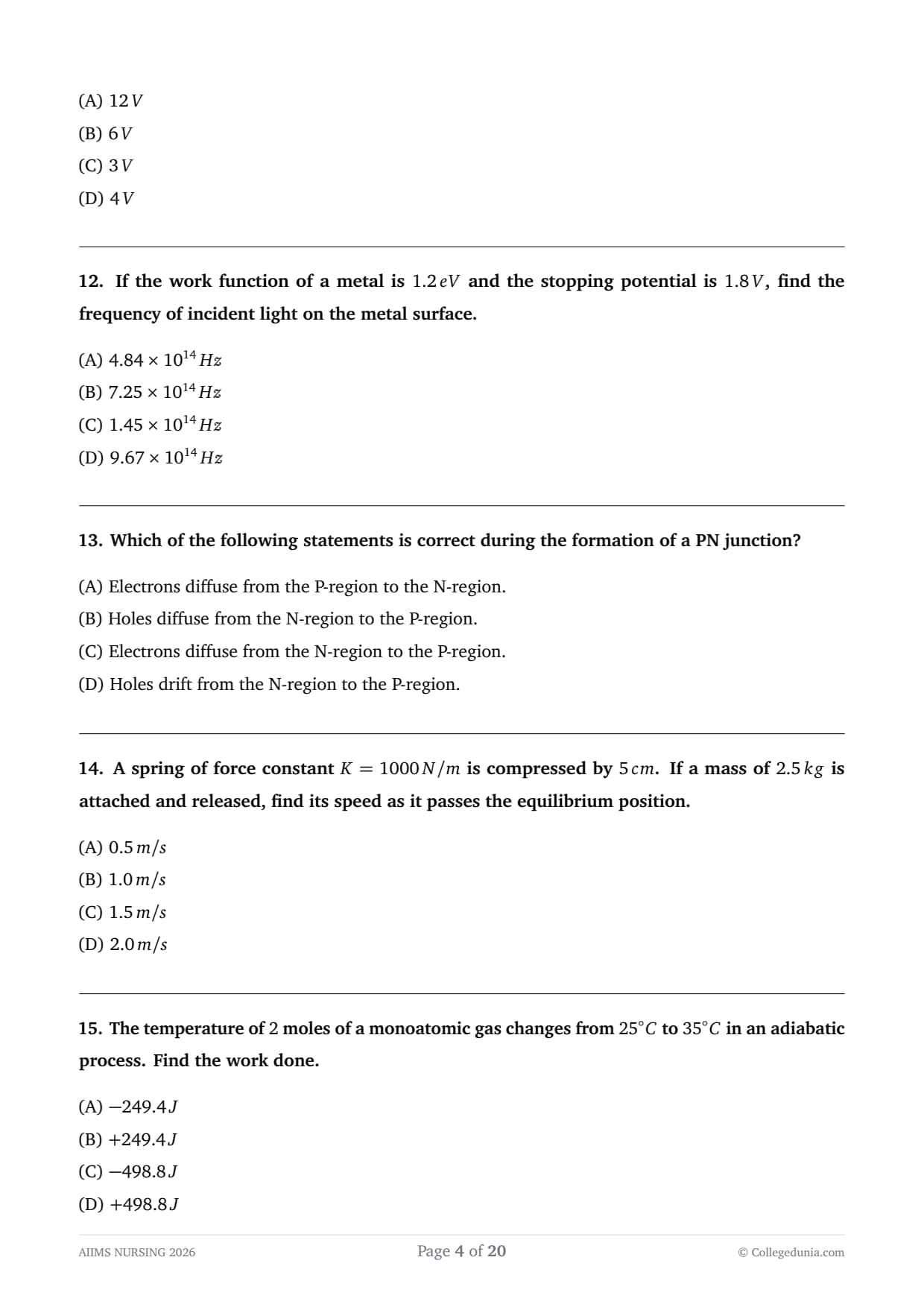
Question 12:

If the work function of a metal is \(1.2\,eV\) and the stopping potential is \(1.8\,V\), find the frequency of incident light on the metal surface.

  • (A) \(4.84\times10^{14}\,Hz\)
  • (B) \(7.25\times10^{14}\,Hz\)
  • (C) \(1.45\times10^{14}\,Hz\)
  • (D) \(9.67\times10^{14}\,Hz\)

Question 13:

Which of the following statements is correct during the formation of a PN junction?

  • (A) Electrons diffuse from the P-region to the N-region.
  • (B) Holes diffuse from the N-region to the P-region.
  • (C) Electrons diffuse from the N-region to the P-region.
  • (D) Holes drift from the N-region to the P-region.

Question 14:

A spring of force constant \(K=1000\,N/m\) is compressed by \(5\,cm\). If a mass of \(2.5\,kg\) is attached and released, find its speed as it passes the equilibrium position.

  • (A) \(0.5\,m/s\)
  • (B) \(1.0\,m/s\)
  • (C) \(1.5\,m/s\)
  • (D) \(2.0\,m/s\)

Question 15:

The temperature of \(2\) moles of a monoatomic gas changes from \(25^{\circ}C\) to \(35^{\circ}C\) in an adiabatic process. Find the work done.

  • (A) \(-249.4\,J\)
  • (B) \(+249.4\,J\)
  • (C) \(-498.8\,J\)
  • (D) \(+498.8\,J\)

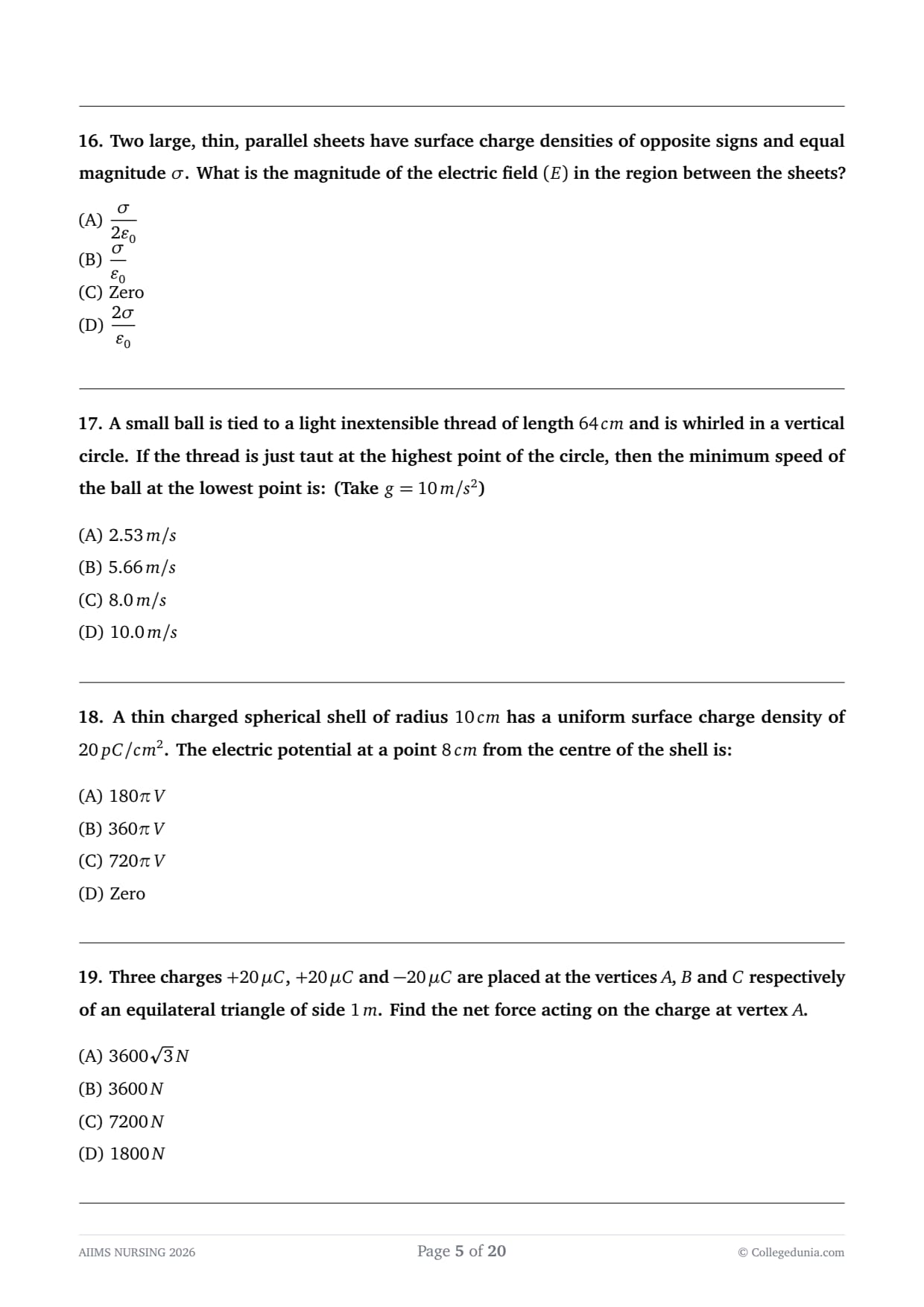
Question 16:

Two large, thin, parallel sheets have surface charge densities of opposite signs and equal magnitude \(\sigma\). What is the magnitude of the electric field \((E)\) in the region between the sheets?

  • (A) \(\dfrac{\sigma}{2\varepsilon_{0}}\)
  • (B) \(\dfrac{\sigma}{\varepsilon_{0}}\)
  • (C) Zero
  • (D) \(\dfrac{2\sigma}{\varepsilon_{0}}\)

Question 17:

A small ball is tied to a light inextensible thread of length \(64\,cm\) and is whirled in a vertical circle. If the thread is just taut at the highest point of the circle, then the minimum speed of the ball at the lowest point is: (Take \(g=10\,m/s^{2}\))

  • (A) \(2.53\,m/s\)
  • (B) \(5.66\,m/s\)
  • (C) \(8.0\,m/s\)
  • (D) \(10.0\,m/s\)

Question 18:

A thin charged spherical shell of radius \(10\,cm\) has a uniform surface charge density of \(20\,pC/cm^{2}\). The electric potential at a point \(8\,cm\) from the centre of the shell is:

  • (A) \(180\pi\,V\)
  • (B) \(360\pi\,V\)
  • (C) \(720\pi\,V\)
  • (D) Zero

Question 19:

Three charges \(+20\,\mu C\), \(+20\,\mu C\) and \(-20\,\mu C\) are placed at the vertices \(A\), \(B\) and \(C\) respectively of an equilateral triangle of side \(1\,m\). Find the net force acting on the charge at vertex \(A\).

  • (A) \(3600\sqrt3\,N\)
  • (B) \(3600\,N\)
  • (C) \(7200\,N\)
  • (D) \(1800\,N\)

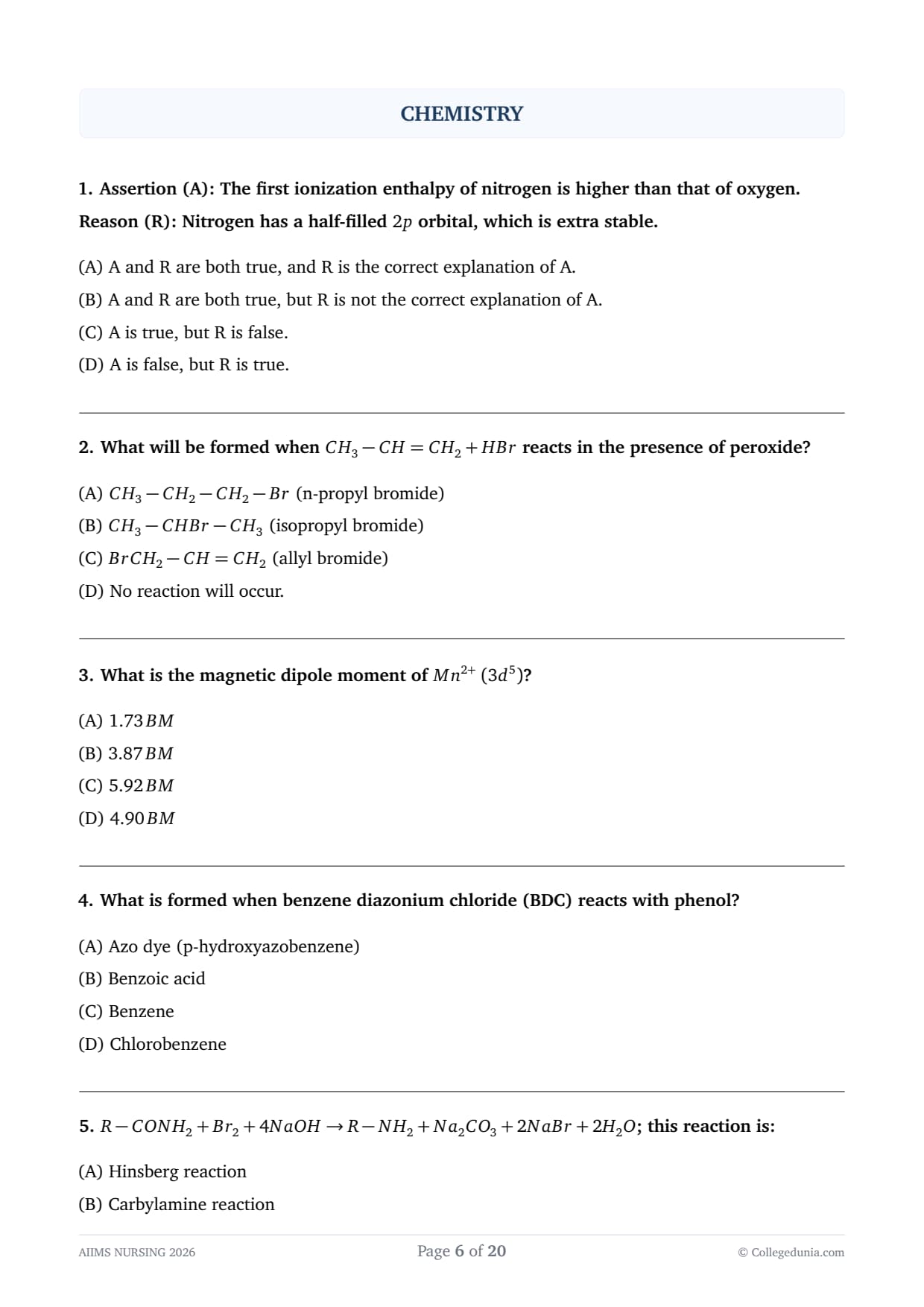
Question 20:

Assertion (A): The first ionization enthalpy of nitrogen is higher than that of oxygen.

Reason (R): Nitrogen has a half-filled \(2p\) orbital, which is extra stable.

  • (A) A and R are both true, and R is the correct explanation of A.
  • (B) A and R are both true, but R is not the correct explanation of A.
  • (C) A is true, but R is false.
  • (D) A is false, but R is true.

Question 21:

What will be formed when \(CH_{3}-CH=CH_{2}+HBr\) reacts in the presence of peroxide?

  • (A) \(CH_{3}-CH_{2}-CH_{2}-Br\) (n-propyl bromide)
  • (B) \(CH_{3}-CHBr-CH_{3}\) (isopropyl bromide)
  • (C) \(BrCH_{2}-CH=CH_{2}\) (allyl bromide)
  • (D) No reaction will occur.

Question 22:

What is the magnetic dipole moment of \(Mn^{2+}\;(3d^{5})\)?

  • (A) \(1.73\,BM\)
  • (B) \(3.87\,BM\)
  • (C) \(5.92\,BM\)
  • (D) \(4.90\,BM\)

Question 23:

What is formed when benzene diazonium chloride (BDC) reacts with phenol?

  • (A) Azo dye (p-hydroxyazobenzene)
  • (B) Benzoic acid
  • (C) Benzene
  • (D) Chlorobenzene

Question 24:

\(R-CONH_{2}+Br_{2}+4NaOH \rightarrow R-NH_{2}+Na_{2}CO_{3}+2NaBr+2H_{2}O\); this reaction is:

  • (A) Hinsberg reaction
  • (B) Carbylamine reaction
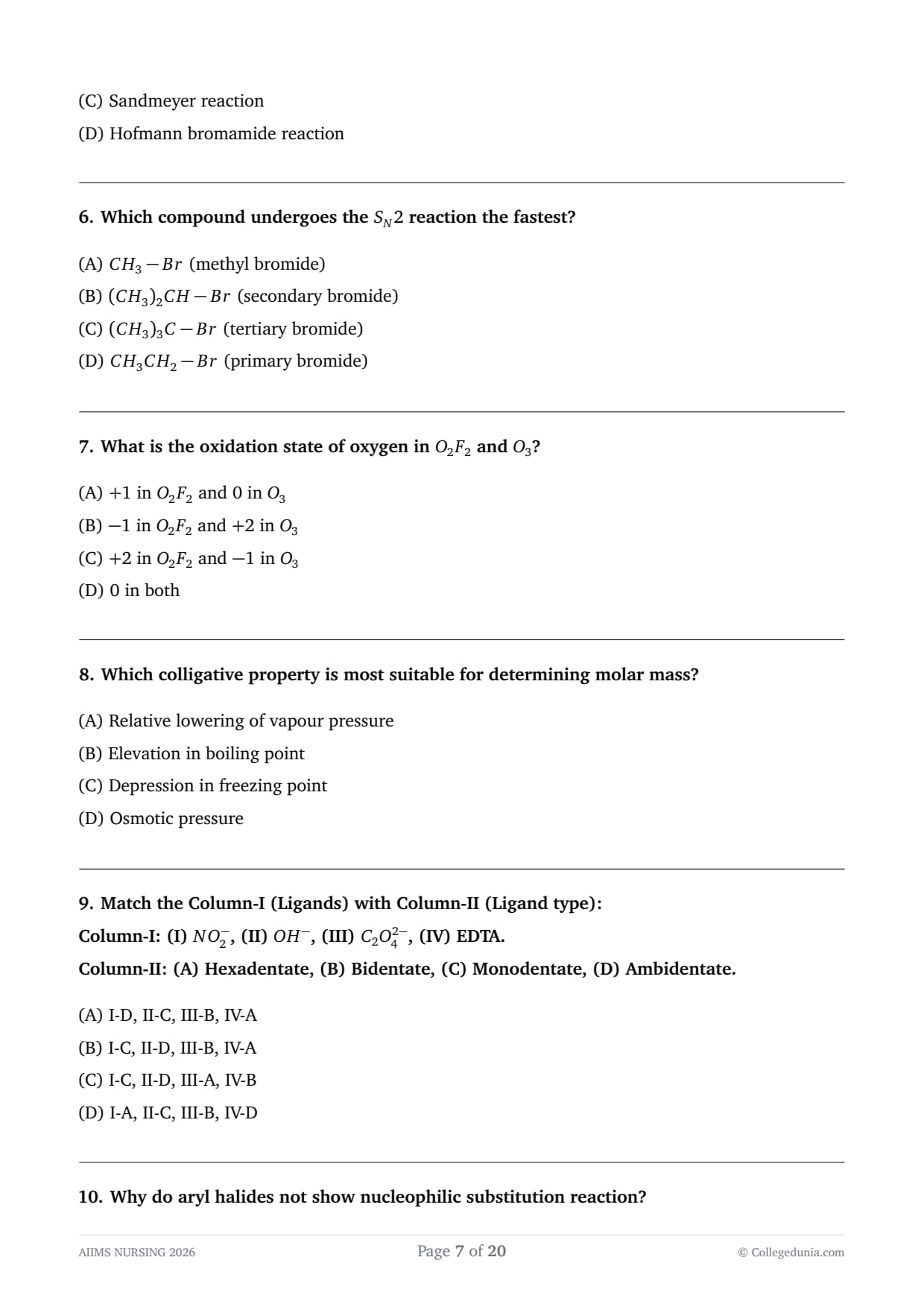
  • (C) Sandmeyer reaction
  • (D) Hofmann bromamide reaction

Question 25:

Which compound undergoes the \(S_{N}2\) reaction the fastest?

  • (A) \(CH_{3}-Br\) (methyl bromide)
  • (B) \((CH_{3})_{2}CH-Br\) (secondary bromide)
  • (C) \((CH_{3})_{3}C-Br\) (tertiary bromide)
  • (D) \(CH_{3}CH_{2}-Br\) (primary bromide)

Question 26:

What is the oxidation state of oxygen in \(O_{2}F_{2}\) and \(O_{3}\)?

  • (A) \(+1\) in \(O_{2}F_{2}\) and \(0\) in \(O_{3}\)
  • (B) \(-1\) in \(O_{2}F_{2}\) and \(+2\) in \(O_{3}\)
  • (C) \(+2\) in \(O_{2}F_{2}\) and \(-1\) in \(O_{3}\)
  • (D) \(0\) in both

Question 27:

Which colligative property is most suitable for determining molar mass?

  • (A) Relative lowering of vapour pressure
  • (B) Elevation in boiling point
  • (C) Depression in freezing point
  • (D) Osmotic pressure

Question 28:

Match the Column-I (Ligands) with Column-II (Ligand type):

Column-I: (I) \(NO_{2}^{-}\), (II) \(OH^{-}\), (III) \(C_{2}O_{4}^{2-}\), (IV) EDTA.

Column-II: (A) Hexadentate, (B) Bidentate, (C) Monodentate, (D) Ambidentate.

  • (A) I-D, II-C, III-B, IV-A
  • (B) I-C, II-D, III-B, IV-A
  • (C) I-C, II-D, III-A, IV-B
  • (D) I-A, II-C, III-B, IV-D

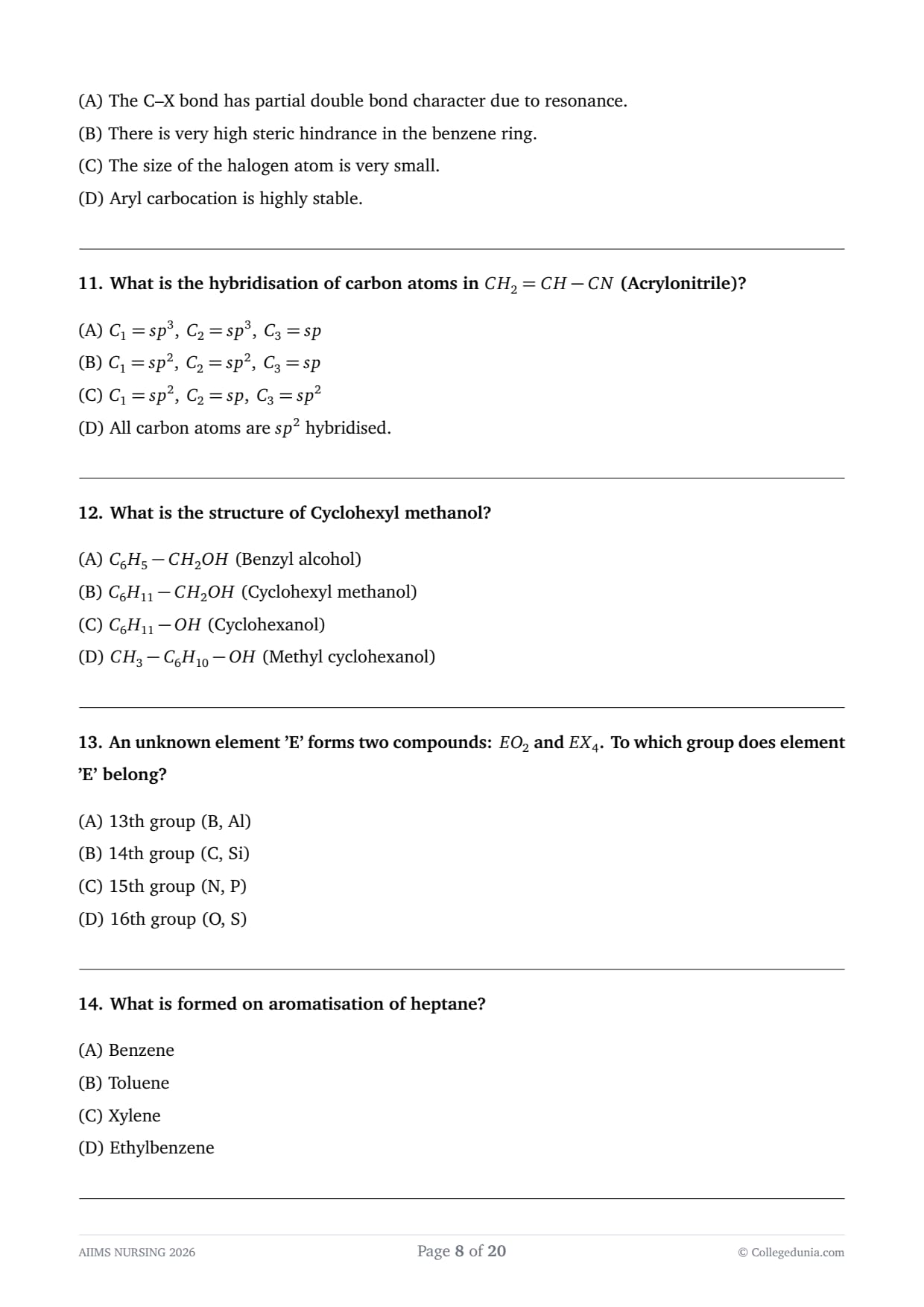
Question 29:

Why do aryl halides not show nucleophilic substitution reaction?

  • (A) The C--X bond has partial double bond character due to resonance.
  • (B) There is very high steric hindrance in the benzene ring.
  • (C) The size of the halogen atom is very small.
  • (D) Aryl carbocation is highly stable.

Question 30:

What is the hybridisation of carbon atoms in \(CH_{2}=CH-CN\) (Acrylonitrile)?

  • (A) \(C_{1}=sp^{3},\;C_{2}=sp^{3},\;C_{3}=sp\)
  • (B) \(C_{1}=sp^{2},\;C_{2}=sp^{2},\;C_{3}=sp\)
  • (C) \(C_{1}=sp^{2},\;C_{2}=sp,\;C_{3}=sp^{2}\)
  • (D) All carbon atoms are \(sp^{2}\) hybridised.

Question 31:

What is the structure of Cyclohexyl methanol?

  • (A) \(C_{6}H_{5}-CH_{2}OH\) (Benzyl alcohol)
  • (B) \(C_{6}H_{11}-CH_{2}OH\) (Cyclohexyl methanol)
  • (C) \(C_{6}H_{11}-OH\) (Cyclohexanol)
  • (D) \(CH_{3}-C_{6}H_{10}-OH\) (Methyl cyclohexanol)

Question 32:

An unknown element 'E' forms two compounds: \(EO_{2}\) and \(EX_{4}\). To which group does element 'E' belong?

  • (A) 13th group (B, Al)
  • (B) 14th group (C, Si)
  • (C) 15th group (N, P)
  • (D) 16th group (O, S)

Question 33:

What is formed on aromatisation of heptane?

  • (A) Benzene
  • (B) Toluene
  • (C) Xylene
  • (D) Ethylbenzene

Question 34:

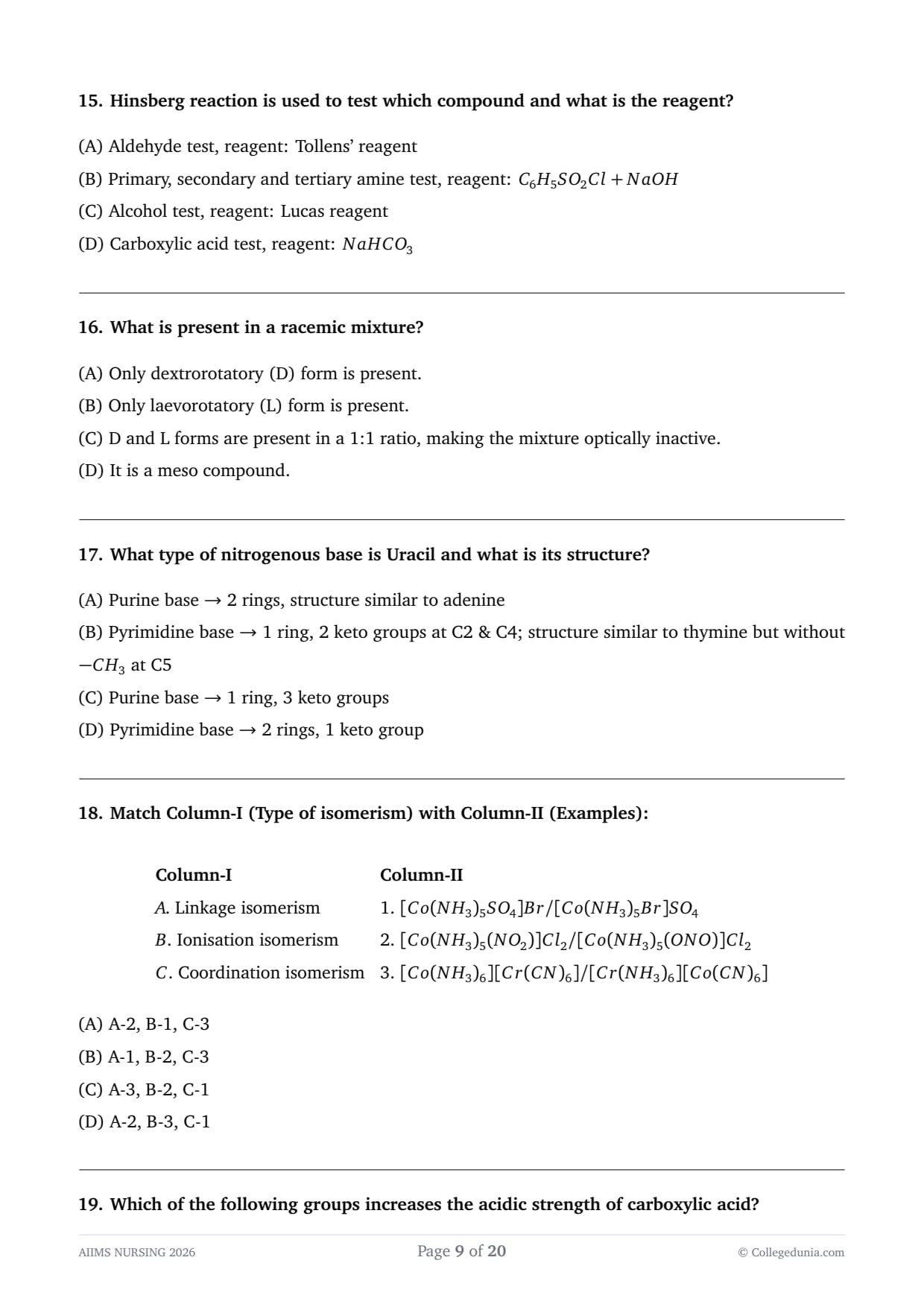
Hinsberg reaction is used to test which compound and what is the reagent?

  • (A) Aldehyde test, reagent: Tollens' reagent
  • (B) Primary, secondary and tertiary amine test, reagent: \(C_{6}H_{5}SO_{2}Cl+NaOH\)
  • (C) Alcohol test, reagent: Lucas reagent
  • (D) Carboxylic acid test, reagent: \(NaHCO_{3}\)

Question 35:

What is present in a racemic mixture?

  • (A) Only dextrorotatory (D) form is present.
  • (B) Only laevorotatory (L) form is present.
  • (C) D and L forms are present in a 1:1 ratio, making the mixture optically inactive.
  • (D) It is a meso compound.

Question 36:

What type of nitrogenous base is Uracil and what is its structure?

  • (A) Purine base \(\rightarrow\) 2 rings, structure similar to adenine
  • (B) Pyrimidine base \(\rightarrow\) 1 ring, 2 keto groups at C2 & C4; structure similar to thymine but without \(-CH_{3}\) at C5
  • (C) Purine base \(\rightarrow\) 1 ring, 3 keto groups
  • (D) Pyrimidine base \(\rightarrow\) 2 rings, 1 keto group

Question 37:

Match Column-I (Type of isomerism) with Column-II (Examples):

Column-I Column-II
A. Linkage isomerism 1. [Co(NH3)5SO4]Br / [Co(NH3)5Br]SO4
B. Ionisation isomerism 2. [Co(NH3)5(NO2)]Cl2 / [Co(NH3)5(ONO)]Cl2
C. Coordination isomerism 3. [Co(NH3)6][Cr(CN)6] / [Cr(NH3)6][Co(CN)6]

  • (A) A-2, B-1, C-3
  • (B) A-1, B-2, C-3
  • (C) A-3, B-2, C-1
  • (D) A-2, B-3, C-1

Question 38:

Which of the following groups increases the acidic strength of carboxylic acid?

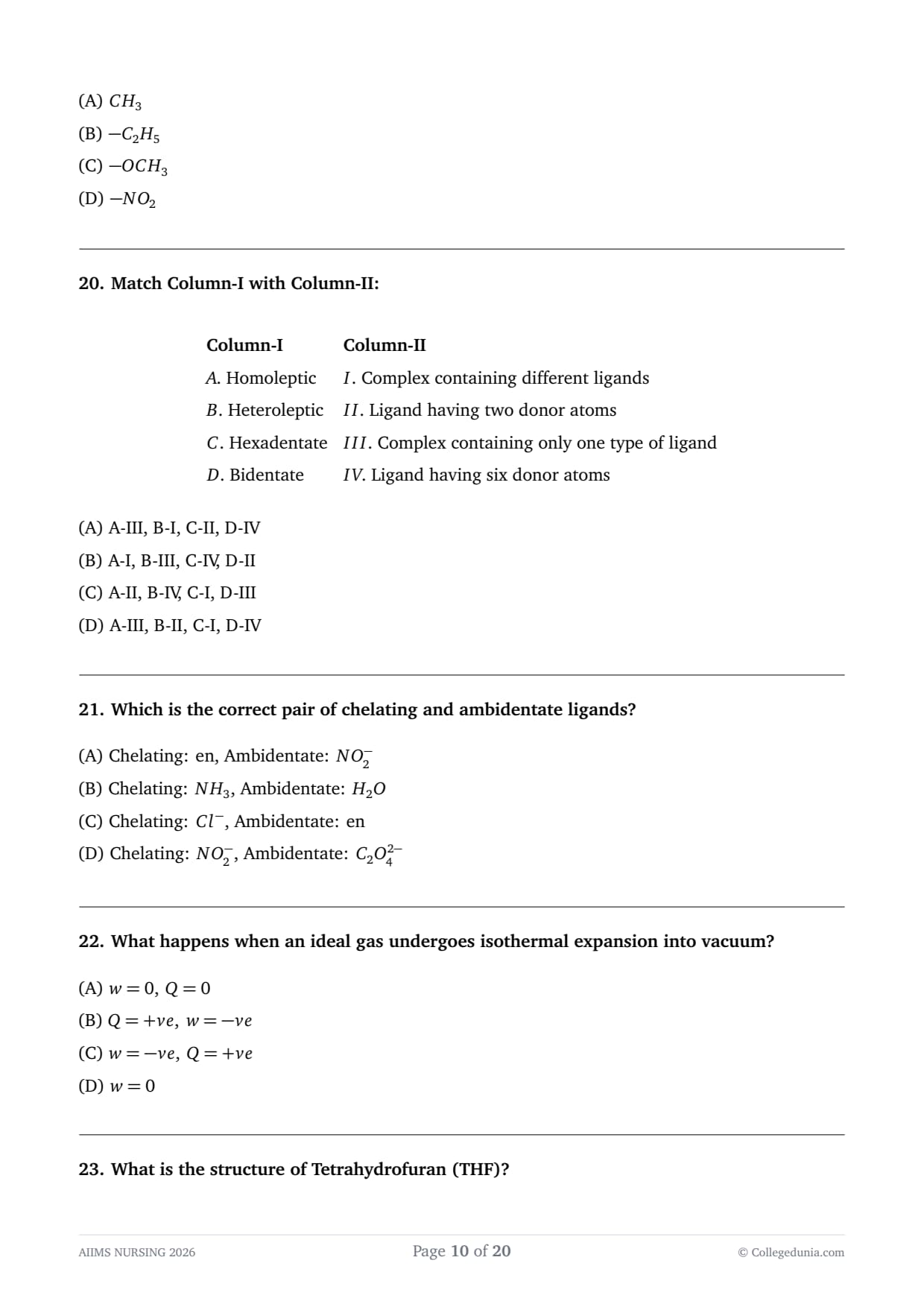
  • (A) \(CH_{3}\)
  • (B) \(-C_{2}H_{5}\)
  • (C) \(-OCH_{3}\)
  • (D) \(-NO_{2}\)

Question 39:

Match Column-I with Column-II:

Column-I Column-II
A. Homoleptic III. Complex containing only one type of ligand
B. Heteroleptic I. Complex containing different ligands
C. Hexadentate IV. Ligand having six donor atoms
D. Bidentate II. Ligand having two donor atoms

  • (A) A-III, B-I, C-II, D-IV
  • (B) A-I, B-III, C-IV, D-II
  • (C) A-II, B-IV, C-I, D-III
  • (D) A-III, B-II, C-I, D-IV

Question 40:

Which is the correct pair of chelating and ambidentate ligands?

  • (A) Chelating: en, Ambidentate: \(NO_{2}^{-}\)
  • (B) Chelating: \(NH_{3}\), Ambidentate: \(H_{2}O\)
  • (C) Chelating: \(Cl^{-}\), Ambidentate: en
  • (D) Chelating: \(NO_{2}^{-}\), Ambidentate: \(C_{2}O_{4}^{2-}\)

Question 41:

What happens when an ideal gas undergoes isothermal expansion into vacuum?

  • (A) \(w=0,\;Q=0\)
  • (B) \(Q=+ve,\;w=-ve\)
  • (C) \(w=-ve,\;Q=+ve\)
  • (D) \(w=0\)

Question 42:

What is the structure of Tetrahydrofuran (THF)?

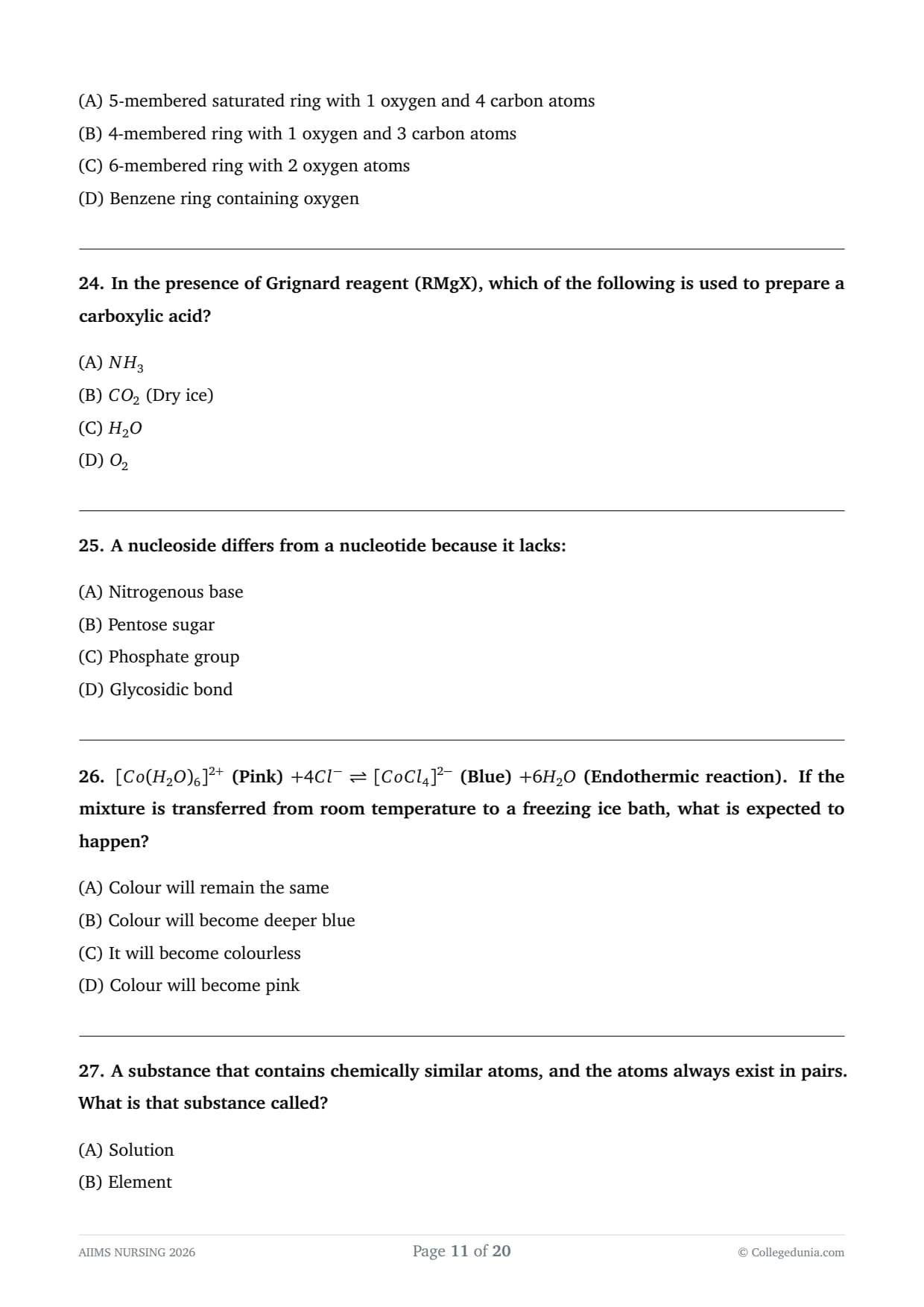
  • (A) 5-membered saturated ring with 1 oxygen and 4 carbon atoms
  • (B) 4-membered ring with 1 oxygen and 3 carbon atoms
  • (C) 6-membered ring with 2 oxygen atoms
  • (D) Benzene ring containing oxygen

Question 43:

In the presence of Grignard reagent (RMgX), which of the following is used to prepare a carboxylic acid?

  • (A) \(NH_{3}\)
  • (B) \(CO_{2}\) (Dry ice)
  • (C) \(H_{2}O\)
  • (D) \(O_{2}\)

Question 44:

A nucleoside differs from a nucleotide because it lacks:

  • (A) Nitrogenous base
  • (B) Pentose sugar
  • (C) Phosphate group
  • (D) Glycosidic bond

Question 45:

\([Co(H_{2}O)_{6}]^{2+}\) (Pink) \(+4Cl^{-}\rightleftharpoons[CoCl_{4}]^{2-}\) (Blue) \(+6H_{2}O\) (Endothermic reaction). If the mixture is transferred from room temperature to a freezing ice bath, what is expected to happen?

  • (A) Colour will remain the same
  • (B) Colour will become deeper blue
  • (C) It will become colourless
  • (D) Colour will become pink

Question 46:

A substance that contains chemically similar atoms, and the atoms always exist in pairs. What is that substance called?

  • (A) Solution
  • (B) Element
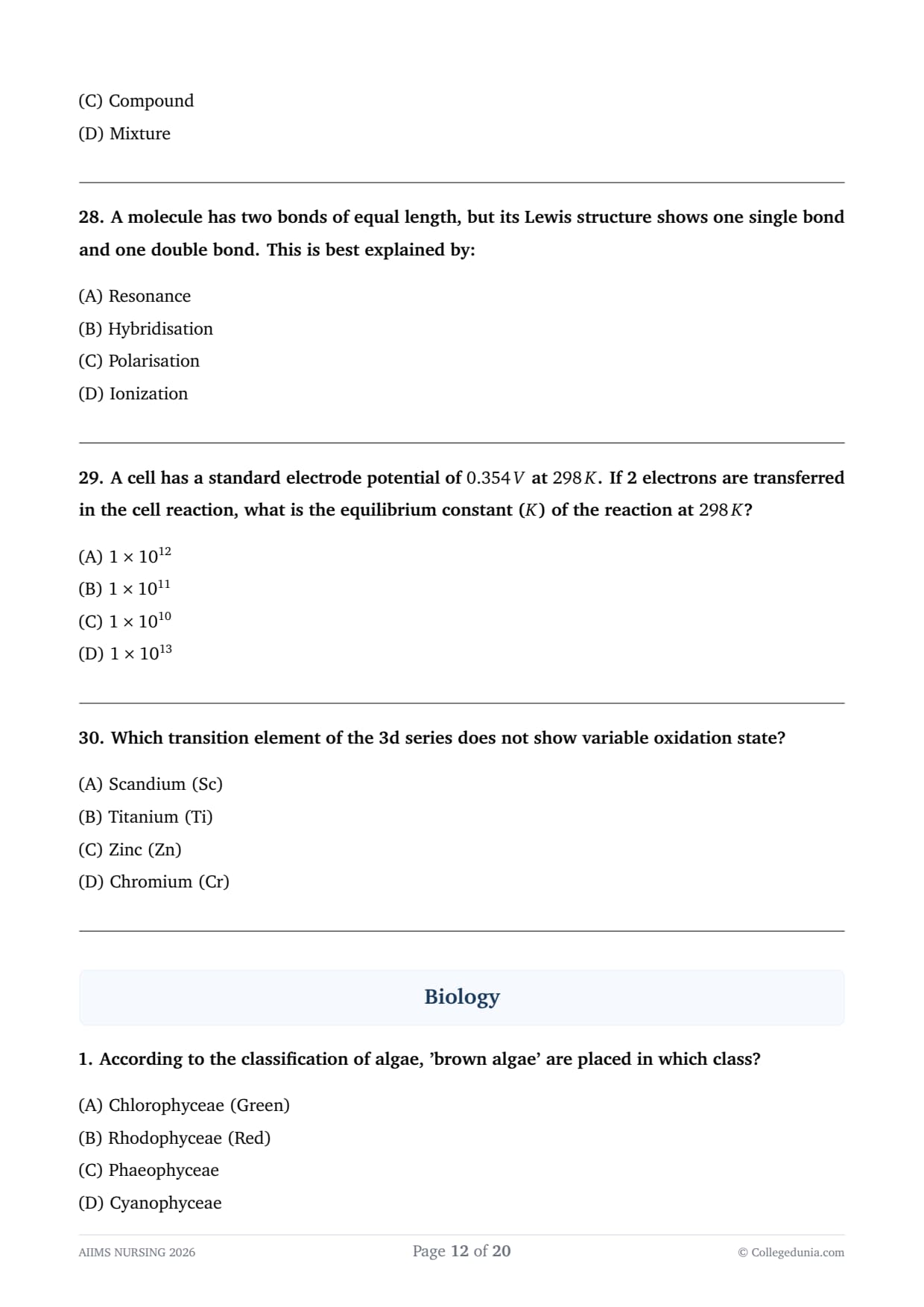
  • (C) Compound
  • (D) Mixture

Question 47:

A molecule has two bonds of equal length, but its Lewis structure shows one single bond and one double bond. This is best explained by:

  • (A) Resonance
  • (B) Hybridisation
  • (C) Polarisation
  • (D) Ionization

Question 48:

A cell has a standard electrode potential of \(0.354\,V\) at \(298\,K\). If 2 electrons are transferred in the cell reaction, what is the equilibrium constant (\(K\)) of the reaction at \(298\,K\)?

  • (A) \(1\times10^{12}\)
  • (B) \(1\times10^{11}\)
  • (C) \(1\times10^{10}\)
  • (D) \(1\times10^{13}\)

Question 49:

Which transition element of the 3d series does not show variable oxidation state?

  • (A) Scandium (Sc)
  • (B) Titanium (Ti)
  • (C) Zinc (Zn)
  • (D) Chromium (Cr)

Question 50:

According to the classification of algae, 'brown algae' are placed in which class?

  • (A) Chlorophyceae (Green)
  • (B) Rhodophyceae (Red)
  • (C) Phaeophyceae
  • (D) Cyanophyceae

Question 51:

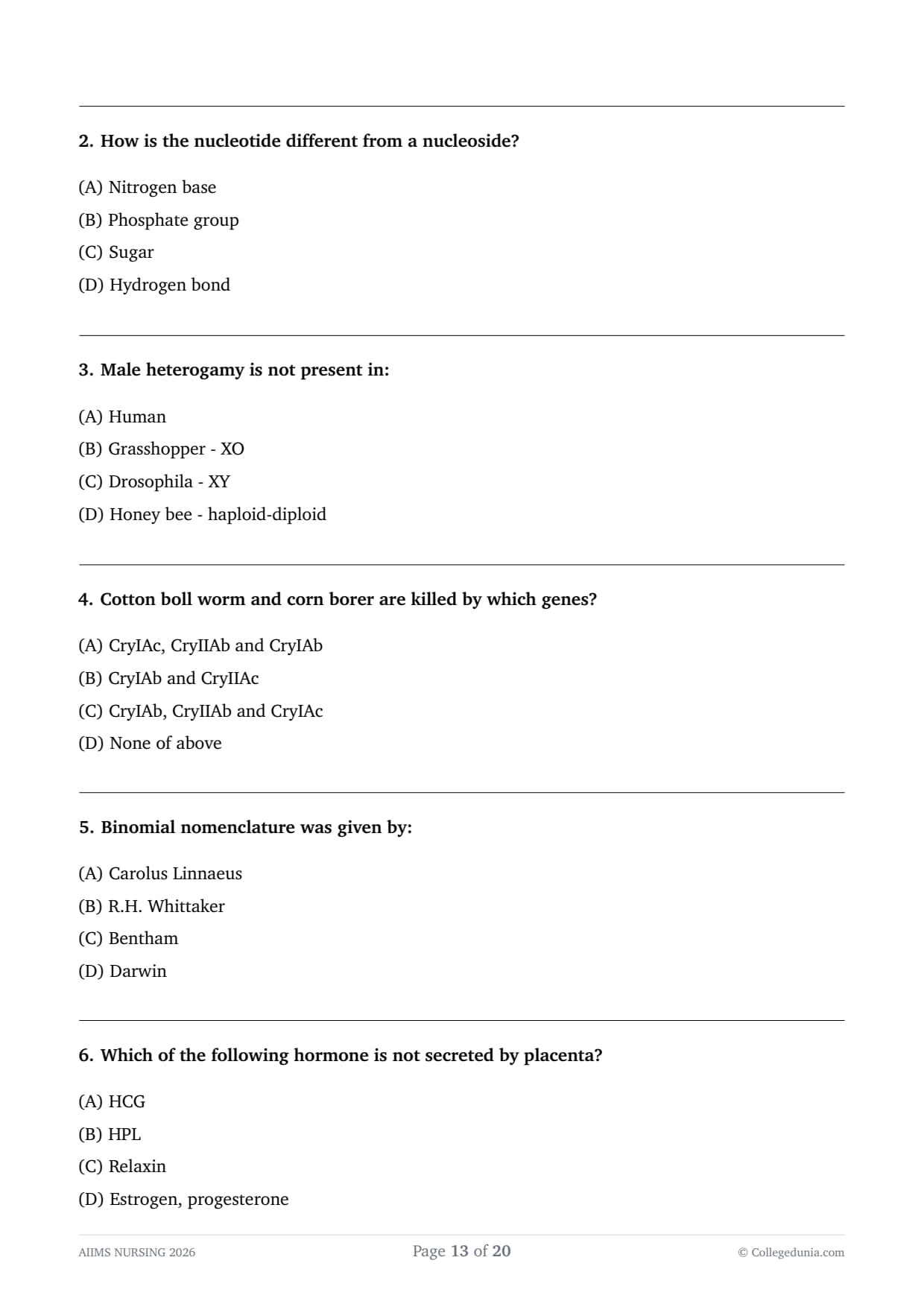
How is the nucleotide different from a nucleoside?

  • (A) Nitrogen base
  • (B) Phosphate group
  • (C) Sugar
  • (D) Hydrogen bond

Question 52:

Male heterogamy is not present in:

  • (A) Human
  • (B) Grasshopper - XO
  • (C) Drosophila - XY
  • (D) Honey bee - haploid-diploid

Question 53:

Cotton boll worm and corn borer are killed by which genes?

  • (A) CryIAc, CryIIAb and CryIAb
  • (B) CryIAb and CryIIAc
  • (C) CryIAb, CryIIAb and CryIAc
  • (D) None of above

Question 54:

Binomial nomenclature was given by:

  • (A) Carolus Linnaeus
  • (B) R.H. Whittaker
  • (C) Bentham
  • (D) Darwin

Question 55:

Which of the following hormone is not secreted by placenta?

  • (A) HCG
  • (B) HPL
  • (C) Relaxin
  • (D) Estrogen, progesterone

Question 56:

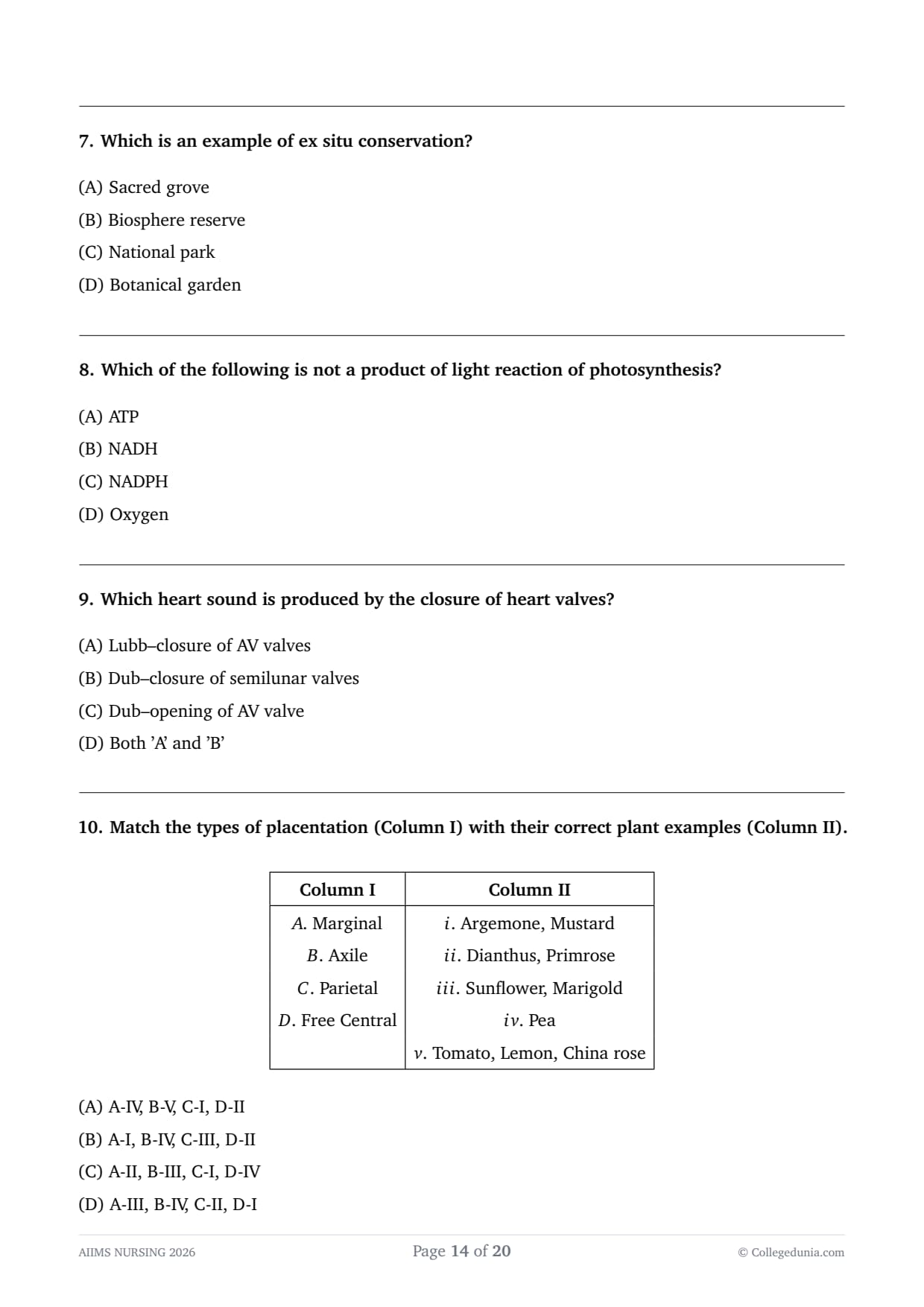
Which is an example of ex situ conservation?

  • (A) Sacred grove
  • (B) Biosphere reserve
  • (C) National park
  • (D) Botanical garden

Question 57:

Which of the following is not a product of light reaction of photosynthesis?

  • (A) ATP
  • (B) NADH
  • (C) NADPH
  • (D) Oxygen

Question 58:

Which heart sound is produced by the closure of heart valves?

  • (A) Lubb--closure of AV valves
  • (B) Dub--closure of semilunar valves
  • (C) Dub--opening of AV valve
  • (D) Both 'A' and 'B'

Question 59:

Match the types of placentation (Column I) with their correct plant examples (Column II).

Column I Column II
A. Marginal iv. Pea
B. Axile v. Tomato, Lemon, China rose
C. Parietal i. Argemone, Mustard
D. Free Central ii. Dianthus, Primrose

  • (A) A-IV, B-V, C-I, D-II
  • (B) A-I, B-IV, C-III, D-II
  • (C) A-II, B-III, C-I, D-IV
  • (D) A-III, B-IV, C-II, D-I

Question 60:

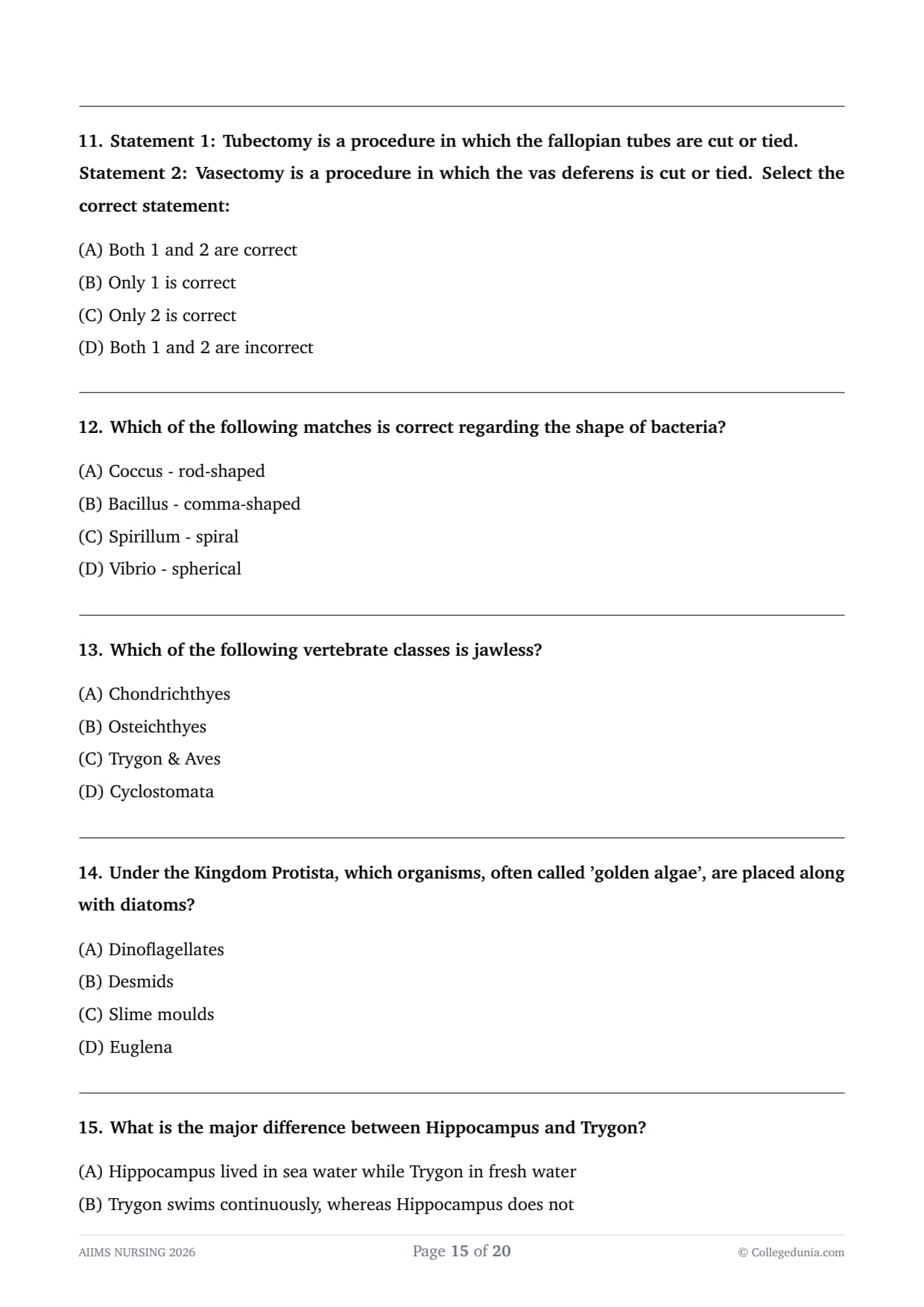
Statement 1: Tubectomy is a procedure in which the fallopian tubes are cut or tied.

Statement 2: Vasectomy is a procedure in which the vas deferens is cut or tied. Select the correct statement:

  • (A) Both 1 and 2 are correct
  • (B) Only 1 is correct
  • (C) Only 2 is correct
  • (D) Both 1 and 2 are incorrect

Question 61:

Which of the following matches is correct regarding the shape of bacteria?

  • (A) Coccus - rod-shaped
  • (B) Bacillus - comma-shaped
  • (C) Spirillum - spiral
  • (D) Vibrio - spherical

Question 62:

Which of the following vertebrate classes is jawless?

  • (A) Chondrichthyes
  • (B) Osteichthyes
  • (C) Trygon & Aves
  • (D) Cyclostomata

Question 63:

Under the Kingdom Protista, which organisms, often called 'golden algae', are placed along with diatoms?

  • (A) Dinoflagellates
  • (B) Desmids
  • (C) Slime moulds
  • (D) Euglena

Question 64:

What is the major difference between Hippocampus and Trygon?

  • (A) Hippocampus lived in sea water while Trygon in fresh water
  • (B) Trygon swims continuously, whereas Hippocampus does not
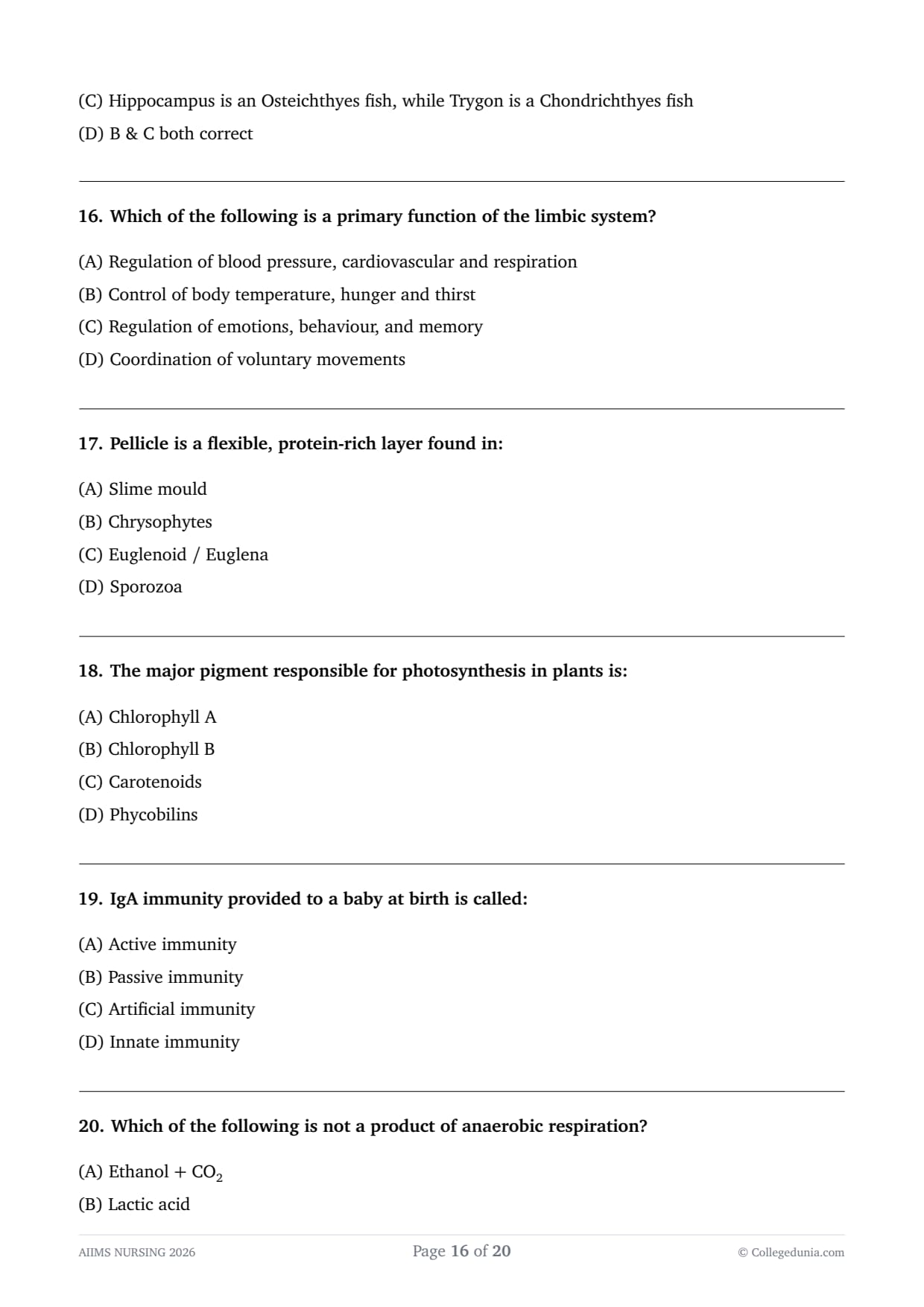
  • (C) Hippocampus is an Osteichthyes fish, while Trygon is a Chondrichthyes fish
  • (D) B & C both correct

Question 65:

Which of the following is a primary function of the limbic system?

  • (A) Regulation of blood pressure, cardiovascular and respiration
  • (B) Control of body temperature, hunger and thirst
  • (C) Regulation of emotions, behaviour, and memory
  • (D) Coordination of voluntary movements

Question 66:

Pellicle is a flexible, protein-rich layer found in:

  • (A) Slime mould
  • (B) Chrysophytes
  • (C) Euglenoid / Euglena
  • (D) Sporozoa

Question 67:

The major pigment responsible for photosynthesis in plants is:

  • (A) Chlorophyll A
  • (B) Chlorophyll B
  • (C) Carotenoids
  • (D) Phycobilins

Question 68:

IgA immunity provided to a baby at birth is called:

  • (A) Active immunity
  • (B) Passive immunity
  • (C) Artificial immunity
  • (D) Innate immunity

Question 69:

Which of the following is not a product of anaerobic respiration?

  • (A) Ethanol + CO\(_2\)
  • (B) Lactic acid
  • (C) Acetyl CoA
  • (D) None of the above

Question 70:

Which is the major difference between interkinesis and interphase?

  • (A) Only (I) and (II)
  • (B) Only (II) and (III)
  • (C) Only (I) and (III)
  • (D) (I), (II) and (III)

Question 71:

Which of the following structures in an anther develops into a pollen sac?

  • (A) Sporogenous tissue
  • (B) Microspore
  • (C) Tapetum
  • (D) Microsporangium

Question 72:

Choose the right option based on the diagram: 1) Stomatal aperture, 2) Guard cells, 3) Subsidiary cells, 4) Chloroplast

  • (A) A-1, B-2, C-3, D-4
  • (B) A-2, B-3, C-1
  • (C) A-3, B-1, C-2
  • (D) A-2, B-1, C-3

Question 73:

What is Oviparity?

  • (A) Animals that give birth to live young ones
  • (B) They lay eggs, and the embryo develops outside the mother's body
  • (C) Development inside uterus until birth
  • (D) Asexual reproduction

Question 74:

Match the type of chromosome (Column I) with the position of its centromere (Column II):
Column I: A. Metacentric, B. Sub-metacentric, C. Acrocentric, D.
Telocentric

Column II:
i. One extremely short arm and one very long arm
ii. Terminal centromere
iii. One short arm and one long arm
iv. Two equal arms

  • (A) A-IV, B-III, C-I, D-II
  • (B) A-IV, B-I, C-III, D-II
  • (C) A-II, B-III, C-I, D-IV
  • (D) A-III, B-IV, C-II, D-I

Question 75:

Which of the following is not considered a primary limiting factor for the rate of photosynthesis?

  • (A) Light intensity
  • (B) Temperature
  • (C) Carbon dioxide concentration
  • (D) Oxygen concentration

Question 76:

Which of the following statements are correct?


I) Homologous organs have the same structure but show different functions.

II) Homologous organs have common ancestors.

III) Analogous organs show divergent evolution.

IV) Wings of butterfly and birds are homologous.

  • (A) I, II and IV are correct
  • (B) I and II are correct
  • (C) II, III and IV are correct
  • (D) Only I and IV are correct

Question 77:

Choose the correct option based on the diagram: 1) Hypothalamus, 2) Anterior pituitary, 3) Posterior pituitary, 4) Hypothalamic neuron

  • (A) A-1, B-2, C-3, D-4
  • (B) A-2, B-3, C-4, D-1
  • (C) A-1, B-3, C-2, D-4
  • (D) A-4, B-1, C-2, D-3

Question 78:

Which one is the structure of Uracil in RNA?

  • (A) It is a purine base with a double ring
  • (B) It is similar to thymine (5-methyl uracil), but lacks the methyl group
  • (C) It only binds with deoxyribose sugar
  • (D) It forms hydrogen bonds with guanine

Question 79:

What is the capital of Israel?

  • (A) Tel Aviv
  • (B) Jerusalem
  • (C) Haifa
  • (D) Gaza

Question 80:

What is the official currency of Japan?

  • (A) Yuan
  • (B) Yen
  • (C) Won
  • (D) Dollar

Question 81:

Which number is wrong in the sequence 6, 12, 24, 48, 96, 244?

  • (A) 96
  • (B) 244
  • (C) 12
  • (D) 48

Question 82:

Which is the main and official national language of China?

  • (A) Cantonese
  • (B) Mandarin / Putonghua
  • (C) Uyghur
  • (D) Tibetan

Question 83:

What is a member of the Lok Sabha mainly called?

  • (A) MLA
  • (B) MP
  • (C) Councillor
  • (D) Governor

Question 84:

Who is the current Union Minister of Agriculture and Farmers Welfare of India?

  • (A) Narendra Singh Tomar
  • (B) Arjun Munda
  • (C) Shivraj Singh Chouhan
  • (D) Rajnath Singh

Question 85:

Lakshmi is Priya's mother, and Jatin is Priya's brother. Shia is Jatin's daughter. How is Lakshmi related to Shia?

  • (A) Grandmother
  • (B) Mother
  • (C) Aunt
  • (D) Sister-in-law

AIIMS B.Sc Nursing Exam Pattern

Subject Number of Questions Total Marks
Physics 30 30
Chemistry 30 30
Biology 30 30
General Knowledge 10 10
Total 100 Questions 100 Marks

AIIMS B.Sc Nursing 2026 Exam Analysis

AIIMS B.Sc. Nursing 2026 Question Paper for Shift 2 is available for download here. All India Institute of Medical Sciences (AIIMS), New Delhi conducted B.Sc. Nursing exam 2026 on 27 June in Shift 2 from 12.30 PM to 2.30 PM. AIIMS B.Sc. Nursing Question Paper consists of 100 questions for 100 marks to be attempted in 2 hours.

  • AIIMS B.Sc Nursing Question Paper is divided into 4 sections- Physics, Chemistry, Biology with 30 questions each and General Knowledge with 10 questions.
  • Each question carries 1 mark and there is negative marking of 1/3 for incorrect answers.

Candidates can download AIIMS B.Sc. Nursing 2026 Question Paper with Answer Key and Solution PDF from the links provided below.

AIIMS BSc Nursing 2026 Question Paper June 27 Shift 2 with Solution PDF

AIIMS B.Sc. Nursing Question Paper 2026 Shift 2 Download PDF Check Solution


Question 1:

What is the dimensional formula of electric potential?

  • (A) \( [L^{2}T^{-3}A^{-1}] \)
  • (B) \( [L^{2}T^{-2}A^{-1}] \)
  • (C) \( [ML^{2}T^{-3}A^{-2}] \)
  • (D) \( [L^{2}T^{-2}A^{-2}] \)

Question 2:

The electron mobility in a conductor is \(32~cm^{2}/Vs\). What is the relaxation time of free electrons? (Given: \(e=1.6\times10^{-19}~C,\; m=9.1\times10^{-31}~kg\))

  • (A) \(1.82\times10^{-12}\;s\)
  • (B) \(2.73\times10^{-12}\;s\)
  • (C) \(1.82\times10^{-14}\;s\)
  • (D) \(2.73\times10^{-14}\;s\)

Question 3:

The area of an airplane wing is \(A=4\,m^{2}\). Air flows with velocity \(v_{1}=80\,m/s\) above the wing and \(v_{2}=60\,m/s\) below it. The density of air is \(1.2\,kg/m^{3}\). Find the pressure difference \((\Delta P)\) between the upper and lower surfaces of the wing.

  • (A) \(1200\;Pa\)
  • (B) \(1680\;Pa\)
  • (C) \(2400\;Pa\)
  • (D) \(3600\;Pa\)

Question 4:

What is the minimum wavelength in the Lyman series of the hydrogen spectrum?

  • (A) \(91.2\,nm\)
  • (B) \(121.6\,nm\)
  • (C) \(656.3\,nm\)
  • (D) \(364.6\,nm\)

Question 5:

Two parallel wires carry equal currents of \(2\,A\) in opposite directions. If the length of each wire is \(0.5\,m\) and the distance between them is \(10\,cm\), then find the force between them.

  • (A) \(2\times10^{-6}\,N\)
  • (B) \(4\times10^{-6}\,N\)
  • (C) \(8\times10^{-6}\,N\)
  • (D) \(1.6\times10^{-5}\,N\)

Question 6:

A thin prism has an angle of \(8^{\circ}\) and a minimum deviation of \(6^{\circ}\). Find the speed of light in the prism.

  • (A) \(1.71\times10^{8}\,m/s,\)
  • (B) \(2.0\times10^{8}\,m/s\)
  • (C) \(2.5\times10^{8}\,m/s\)
  • (D) \(3.0\times10^{8}\,m/s\)

Question 7:

A car moves at a speed of \(600\,km/h\) on a frictionless banked road with \(\theta=30^{\circ}\). Take \(g=10\,m/s^{2}\). Find the radius of the road.

  • (A) \(2.4\,km\)
  • (B) \(3.2\,km\)
  • (C) \(4.8\,km\)
  • (D) \(6.4\,km\)

Question 8:

\(L=50\,mH,\; C=100\,\mu F,\; R=50\,\Omega\). What does this circuit represent? (Assume \(\omega=200\,rad/s\))

  • (A) Inductive circuit
  • (B) Capacitive circuit
  • (C) Resonant circuit
  • (D) Purely resistive circuit

Question 9:

A sphere encloses charges \(+5\,C\) and \(-2\,C\), while a charge \(-3\,C\) is outside the sphere. What is the electric flux through the sphere?

  • (A) \(\dfrac{3C}{\varepsilon_{0}}\)
  • (B) \(-\dfrac{3C}{\varepsilon_{0}}\)
  • (C) Zero
  • (D) \(\dfrac{10C}{\varepsilon_{0}}\)

Question 10:

A current of \(50\,mA\) flows through a loop of area \(10\,cm^{2}\) placed in a magnetic field of \(0.1\,T\). The angle between the magnetic field and the loop is \(60^{\circ}\). Find the torque acting on the loop.

  • (A) \(2.5\times10^{-5}\,Nm\)
  • (B) \(4.33\times10^{-5}\,Nm\)
  • (C) \(4.33\times10^{-6}\,Nm\)
  • (D) \(2.5\times10^{-6}\,Nm\)

Question 11:

A \(1\,\mu F\) capacitor is charged to \(12\,V\) and then connected to an identical uncharged capacitor. What will be the common potential?

  • (A) \(12\,V\)
  • (B) \(6\,V\)
  • (C) \(3\,V\)
  • (D) \(4\,V\)

Question 12:

If the work function of a metal is \(1.2\,eV\) and the stopping potential is \(1.8\,V\), find the frequency of incident light on the metal surface.

  • (A) \(4.84\times10^{14}\,Hz\)
  • (B) \(7.25\times10^{14}\,Hz\)
  • (C) \(1.45\times10^{14}\,Hz\)
  • (D) \(9.67\times10^{14}\,Hz\)

Question 13:

Which of the following statements is correct during the formation of a PN junction?

  • (A) Electrons diffuse from the P-region to the N-region.
  • (B) Holes diffuse from the N-region to the P-region.
  • (C) Electrons diffuse from the N-region to the P-region.
  • (D) Holes drift from the N-region to the P-region.

Question 14:

A spring of force constant \(K=1000\,N/m\) is compressed by \(5\,cm\). If a mass of \(2.5\,kg\) is attached and released, find its speed as it passes the equilibrium position.

  • (A) \(0.5\,m/s\)
  • (B) \(1.0\,m/s\)
  • (C) \(1.5\,m/s\)
  • (D) \(2.0\,m/s\)

Question 15:

The temperature of \(2\) moles of a monoatomic gas changes from \(25^{\circ}C\) to \(35^{\circ}C\) in an adiabatic process. Find the work done.

  • (A) \(-249.4\,J\)
  • (B) \(+249.4\,J\)
  • (C) \(-498.8\,J\)
  • (D) \(+498.8\,J\)

Question 16:

Two large, thin, parallel sheets have surface charge densities of opposite signs and equal magnitude \(\sigma\). What is the magnitude of the electric field \((E)\) in the region between the sheets?

  • (A) \(\dfrac{\sigma}{2\varepsilon_{0}}\)
  • (B) \(\dfrac{\sigma}{\varepsilon_{0}}\)
  • (C) Zero
  • (D) \(\dfrac{2\sigma}{\varepsilon_{0}}\)

Question 17:

A small ball is tied to a light inextensible thread of length \(64\,cm\) and is whirled in a vertical circle. If the thread is just taut at the highest point of the circle, then the minimum speed of the ball at the lowest point is: (Take \(g=10\,m/s^{2}\))

  • (A) \(2.53\,m/s\)
  • (B) \(5.66\,m/s\)
  • (C) \(8.0\,m/s\)
  • (D) \(10.0\,m/s\)

Question 18:

A thin charged spherical shell of radius \(10\,cm\) has a uniform surface charge density of \(20\,pC/cm^{2}\). The electric potential at a point \(8\,cm\) from the centre of the shell is:

  • (A) \(180\pi\,V\)
  • (B) \(360\pi\,V\)
  • (C) \(720\pi\,V\)
  • (D) Zero

Question 19:

Three charges \(+20\,\mu C\), \(+20\,\mu C\) and \(-20\,\mu C\) are placed at the vertices \(A\), \(B\) and \(C\) respectively of an equilateral triangle of side \(1\,m\). Find the net force acting on the charge at vertex \(A\).

  • (A) \(3600\sqrt3\,N\)
  • (B) \(3600\,N\)
  • (C) \(7200\,N\)
  • (D) \(1800\,N\)

Question 20:

Assertion (A): The first ionization enthalpy of nitrogen is higher than that of oxygen.

Reason (R): Nitrogen has a half-filled \(2p\) orbital, which is extra stable.

  • (A) A and R are both true, and R is the correct explanation of A.
  • (B) A and R are both true, but R is not the correct explanation of A.
  • (C) A is true, but R is false.
  • (D) A is false, but R is true.

Question 21:

What will be formed when \(CH_{3}-CH=CH_{2}+HBr\) reacts in the presence of peroxide?

  • (A) \(CH_{3}-CH_{2}-CH_{2}-Br\) (n-propyl bromide)
  • (B) \(CH_{3}-CHBr-CH_{3}\) (isopropyl bromide)
  • (C) \(BrCH_{2}-CH=CH_{2}\) (allyl bromide)
  • (D) No reaction will occur.

Question 22:

What is the magnetic dipole moment of \(Mn^{2+}\;(3d^{5})\)?

  • (A) \(1.73\,BM\)
  • (B) \(3.87\,BM\)
  • (C) \(5.92\,BM\)
  • (D) \(4.90\,BM\)

Question 23:

What is formed when benzene diazonium chloride (BDC) reacts with phenol?

  • (A) Azo dye (p-hydroxyazobenzene)
  • (B) Benzoic acid
  • (C) Benzene
  • (D) Chlorobenzene

Question 24:

\(R-CONH_{2}+Br_{2}+4NaOH \rightarrow R-NH_{2}+Na_{2}CO_{3}+2NaBr+2H_{2}O\); this reaction is:

  • (A) Hinsberg reaction
  • (B) Carbylamine reaction
  • (C) Sandmeyer reaction
  • (D) Hofmann bromamide reaction

Question 25:

Which compound undergoes the \(S_{N}2\) reaction the fastest?

  • (A) \(CH_{3}-Br\) (methyl bromide)
  • (B) \((CH_{3})_{2}CH-Br\) (secondary bromide)
  • (C) \((CH_{3})_{3}C-Br\) (tertiary bromide)
  • (D) \(CH_{3}CH_{2}-Br\) (primary bromide)

Question 26:

What is the oxidation state of oxygen in \(O_{2}F_{2}\) and \(O_{3}\)?

  • (A) \(+1\) in \(O_{2}F_{2}\) and \(0\) in \(O_{3}\)
  • (B) \(-1\) in \(O_{2}F_{2}\) and \(+2\) in \(O_{3}\)
  • (C) \(+2\) in \(O_{2}F_{2}\) and \(-1\) in \(O_{3}\)
  • (D) \(0\) in both

Question 27:

Which colligative property is most suitable for determining molar mass?

  • (A) Relative lowering of vapour pressure
  • (B) Elevation in boiling point
  • (C) Depression in freezing point
  • (D) Osmotic pressure

Question 28:

Match the Column-I (Ligands) with Column-II (Ligand type):

Column-I: (I) \(NO_{2}^{-}\), (II) \(OH^{-}\), (III) \(C_{2}O_{4}^{2-}\), (IV) EDTA.

Column-II: (A) Hexadentate, (B) Bidentate, (C) Monodentate, (D) Ambidentate.

  • (A) I-D, II-C, III-B, IV-A
  • (B) I-C, II-D, III-B, IV-A
  • (C) I-C, II-D, III-A, IV-B
  • (D) I-A, II-C, III-B, IV-D

Question 29:

Why do aryl halides not show nucleophilic substitution reaction?

  • (A) The C--X bond has partial double bond character due to resonance.
  • (B) There is very high steric hindrance in the benzene ring.
  • (C) The size of the halogen atom is very small.
  • (D) Aryl carbocation is highly stable.

Question 30:

What is the hybridisation of carbon atoms in \(CH_{2}=CH-CN\) (Acrylonitrile)?

  • (A) \(C_{1}=sp^{3},\;C_{2}=sp^{3},\;C_{3}=sp\)
  • (B) \(C_{1}=sp^{2},\;C_{2}=sp^{2},\;C_{3}=sp\)
  • (C) \(C_{1}=sp^{2},\;C_{2}=sp,\;C_{3}=sp^{2}\)
  • (D) All carbon atoms are \(sp^{2}\) hybridised.

Question 31:

What is the structure of Cyclohexyl methanol?

  • (A) \(C_{6}H_{5}-CH_{2}OH\) (Benzyl alcohol)
  • (B) \(C_{6}H_{11}-CH_{2}OH\) (Cyclohexyl methanol)
  • (C) \(C_{6}H_{11}-OH\) (Cyclohexanol)
  • (D) \(CH_{3}-C_{6}H_{10}-OH\) (Methyl cyclohexanol)

Question 32:

An unknown element 'E' forms two compounds: \(EO_{2}\) and \(EX_{4}\). To which group does element 'E' belong?

  • (A) 13th group (B, Al)
  • (B) 14th group (C, Si)
  • (C) 15th group (N, P)
  • (D) 16th group (O, S)

Question 33:

What is formed on aromatisation of heptane?

  • (A) Benzene
  • (B) Toluene
  • (C) Xylene
  • (D) Ethylbenzene

Question 34:

Hinsberg reaction is used to test which compound and what is the reagent?

  • (A) Aldehyde test, reagent: Tollens' reagent
  • (B) Primary, secondary and tertiary amine test, reagent: \(C_{6}H_{5}SO_{2}Cl+NaOH\)
  • (C) Alcohol test, reagent: Lucas reagent
  • (D) Carboxylic acid test, reagent: \(NaHCO_{3}\)

Question 35:

What is present in a racemic mixture?

  • (A) Only dextrorotatory (D) form is present.
  • (B) Only laevorotatory (L) form is present.
  • (C) D and L forms are present in a 1:1 ratio, making the mixture optically inactive.
  • (D) It is a meso compound.

Question 36:

What type of nitrogenous base is Uracil and what is its structure?

  • (A) Purine base \(\rightarrow\) 2 rings, structure similar to adenine
  • (B) Pyrimidine base \(\rightarrow\) 1 ring, 2 keto groups at C2 & C4; structure similar to thymine but without \(-CH_{3}\) at C5
  • (C) Purine base \(\rightarrow\) 1 ring, 3 keto groups
  • (D) Pyrimidine base \(\rightarrow\) 2 rings, 1 keto group

Question 37:

Match Column-I (Type of isomerism) with Column-II (Examples):

Column-I Column-II
A. Linkage isomerism 1. [Co(NH3)5SO4]Br / [Co(NH3)5Br]SO4
B. Ionisation isomerism 2. [Co(NH3)5(NO2)]Cl2 / [Co(NH3)5(ONO)]Cl2
C. Coordination isomerism 3. [Co(NH3)6][Cr(CN)6] / [Cr(NH3)6][Co(CN)6]

  • (A) A-2, B-1, C-3
  • (B) A-1, B-2, C-3
  • (C) A-3, B-2, C-1
  • (D) A-2, B-3, C-1

Question 38:

Which of the following groups increases the acidic strength of carboxylic acid?

  • (A) \(CH_{3}\)
  • (B) \(-C_{2}H_{5}\)
  • (C) \(-OCH_{3}\)
  • (D) \(-NO_{2}\)

Question 39:

Match Column-I with Column-II:

Column-I Column-II
A. Homoleptic III. Complex containing only one type of ligand
B. Heteroleptic I. Complex containing different ligands
C. Hexadentate IV. Ligand having six donor atoms
D. Bidentate II. Ligand having two donor atoms

  • (A) A-III, B-I, C-II, D-IV
  • (B) A-I, B-III, C-IV, D-II
  • (C) A-II, B-IV, C-I, D-III
  • (D) A-III, B-II, C-I, D-IV

Question 40:

Which is the correct pair of chelating and ambidentate ligands?

  • (A) Chelating: en, Ambidentate: \(NO_{2}^{-}\)
  • (B) Chelating: \(NH_{3}\), Ambidentate: \(H_{2}O\)
  • (C) Chelating: \(Cl^{-}\), Ambidentate: en
  • (D) Chelating: \(NO_{2}^{-}\), Ambidentate: \(C_{2}O_{4}^{2-}\)

Question 41:

What happens when an ideal gas undergoes isothermal expansion into vacuum?

  • (A) \(w=0,\;Q=0\)
  • (B) \(Q=+ve,\;w=-ve\)
  • (C) \(w=-ve,\;Q=+ve\)
  • (D) \(w=0\)

Question 42:

What is the structure of Tetrahydrofuran (THF)?

  • (A) 5-membered saturated ring with 1 oxygen and 4 carbon atoms
  • (B) 4-membered ring with 1 oxygen and 3 carbon atoms
  • (C) 6-membered ring with 2 oxygen atoms
  • (D) Benzene ring containing oxygen

Question 43:

In the presence of Grignard reagent (RMgX), which of the following is used to prepare a carboxylic acid?

  • (A) \(NH_{3}\)
  • (B) \(CO_{2}\) (Dry ice)
  • (C) \(H_{2}O\)
  • (D) \(O_{2}\)

Question 44:

A nucleoside differs from a nucleotide because it lacks:

  • (A) Nitrogenous base
  • (B) Pentose sugar
  • (C) Phosphate group
  • (D) Glycosidic bond

Question 45:

\([Co(H_{2}O)_{6}]^{2+}\) (Pink) \(+4Cl^{-}\rightleftharpoons[CoCl_{4}]^{2-}\) (Blue) \(+6H_{2}O\) (Endothermic reaction). If the mixture is transferred from room temperature to a freezing ice bath, what is expected to happen?

  • (A) Colour will remain the same
  • (B) Colour will become deeper blue
  • (C) It will become colourless
  • (D) Colour will become pink

Question 46:

A substance that contains chemically similar atoms, and the atoms always exist in pairs. What is that substance called?

  • (A) Solution
  • (B) Element
  • (C) Compound
  • (D) Mixture

Question 47:

A molecule has two bonds of equal length, but its Lewis structure shows one single bond and one double bond. This is best explained by:

  • (A) Resonance
  • (B) Hybridisation
  • (C) Polarisation
  • (D) Ionization

Question 48:

A cell has a standard electrode potential of \(0.354\,V\) at \(298\,K\). If 2 electrons are transferred in the cell reaction, what is the equilibrium constant (\(K\)) of the reaction at \(298\,K\)?

  • (A) \(1\times10^{12}\)
  • (B) \(1\times10^{11}\)
  • (C) \(1\times10^{10}\)
  • (D) \(1\times10^{13}\)

Question 49:

Which transition element of the 3d series does not show variable oxidation state?

  • (A) Scandium (Sc)
  • (B) Titanium (Ti)
  • (C) Zinc (Zn)
  • (D) Chromium (Cr)

Question 50:

According to the classification of algae, 'brown algae' are placed in which class?

  • (A) Chlorophyceae (Green)
  • (B) Rhodophyceae (Red)
  • (C) Phaeophyceae
  • (D) Cyanophyceae

Question 51:

How is the nucleotide different from a nucleoside?

  • (A) Nitrogen base
  • (B) Phosphate group
  • (C) Sugar
  • (D) Hydrogen bond

Question 52:

Male heterogamy is not present in:

  • (A) Human
  • (B) Grasshopper - XO
  • (C) Drosophila - XY
  • (D) Honey bee - haploid-diploid

Question 53:

Cotton boll worm and corn borer are killed by which genes?

  • (A) CryIAc, CryIIAb and CryIAb
  • (B) CryIAb and CryIIAc
  • (C) CryIAb, CryIIAb and CryIAc
  • (D) None of above

Question 54:

Binomial nomenclature was given by:

  • (A) Carolus Linnaeus
  • (B) R.H. Whittaker
  • (C) Bentham
  • (D) Darwin

Question 55:

Which of the following hormone is not secreted by placenta?

  • (A) HCG
  • (B) HPL
  • (C) Relaxin
  • (D) Estrogen, progesterone

Question 56:

Which is an example of ex situ conservation?

  • (A) Sacred grove
  • (B) Biosphere reserve
  • (C) National park
  • (D) Botanical garden

Question 57:

Which of the following is not a product of light reaction of photosynthesis?

  • (A) ATP
  • (B) NADH
  • (C) NADPH
  • (D) Oxygen

Question 58:

Which heart sound is produced by the closure of heart valves?

  • (A) Lubb--closure of AV valves
  • (B) Dub--closure of semilunar valves
  • (C) Dub--opening of AV valve
  • (D) Both 'A' and 'B'

Question 59:

Match the types of placentation (Column I) with their correct plant examples (Column II).

Column I Column II
A. Marginal iv. Pea
B. Axile v. Tomato, Lemon, China rose
C. Parietal i. Argemone, Mustard
D. Free Central ii. Dianthus, Primrose

  • (A) A-IV, B-V, C-I, D-II
  • (B) A-I, B-IV, C-III, D-II
  • (C) A-II, B-III, C-I, D-IV
  • (D) A-III, B-IV, C-II, D-I

Question 60:

Statement 1: Tubectomy is a procedure in which the fallopian tubes are cut or tied.

Statement 2: Vasectomy is a procedure in which the vas deferens is cut or tied. Select the correct statement:

  • (A) Both 1 and 2 are correct
  • (B) Only 1 is correct
  • (C) Only 2 is correct
  • (D) Both 1 and 2 are incorrect

Question 61:

Which of the following matches is correct regarding the shape of bacteria?

  • (A) Coccus - rod-shaped
  • (B) Bacillus - comma-shaped
  • (C) Spirillum - spiral
  • (D) Vibrio - spherical

Question 62:

Which of the following vertebrate classes is jawless?

  • (A) Chondrichthyes
  • (B) Osteichthyes
  • (C) Trygon & Aves
  • (D) Cyclostomata

Question 63:

Under the Kingdom Protista, which organisms, often called 'golden algae', are placed along with diatoms?

  • (A) Dinoflagellates
  • (B) Desmids
  • (C) Slime moulds
  • (D) Euglena

Question 64:

What is the major difference between Hippocampus and Trygon?

  • (A) Hippocampus lived in sea water while Trygon in fresh water
  • (B) Trygon swims continuously, whereas Hippocampus does not
  • (C) Hippocampus is an Osteichthyes fish, while Trygon is a Chondrichthyes fish
  • (D) B & C both correct

Question 65:

Which of the following is a primary function of the limbic system?

  • (A) Regulation of blood pressure, cardiovascular and respiration
  • (B) Control of body temperature, hunger and thirst
  • (C) Regulation of emotions, behaviour, and memory
  • (D) Coordination of voluntary movements

Question 66:

Pellicle is a flexible, protein-rich layer found in:

  • (A) Slime mould
  • (B) Chrysophytes
  • (C) Euglenoid / Euglena
  • (D) Sporozoa

Question 67:

The major pigment responsible for photosynthesis in plants is:

  • (A) Chlorophyll A
  • (B) Chlorophyll B
  • (C) Carotenoids
  • (D) Phycobilins

Question 68:

IgA immunity provided to a baby at birth is called:

  • (A) Active immunity
  • (B) Passive immunity
  • (C) Artificial immunity
  • (D) Innate immunity

Question 69:

Which of the following is not a product of anaerobic respiration?

  • (A) Ethanol + CO\(_2\)
  • (B) Lactic acid
  • (C) Acetyl CoA
  • (D) None of the above

Question 70:

Which is the major difference between interkinesis and interphase?

  • (A) Only (I) and (II)
  • (B) Only (II) and (III)
  • (C) Only (I) and (III)
  • (D) (I), (II) and (III)

Question 71:

Which of the following structures in an anther develops into a pollen sac?

  • (A) Sporogenous tissue
  • (B) Microspore
  • (C) Tapetum
  • (D) Microsporangium

Question 72:

Choose the right option based on the diagram: 1) Stomatal aperture, 2) Guard cells, 3) Subsidiary cells, 4) Chloroplast

  • (A) A-1, B-2, C-3, D-4
  • (B) A-2, B-3, C-1
  • (C) A-3, B-1, C-2
  • (D) A-2, B-1, C-3

Question 73:

What is Oviparity?

  • (A) Animals that give birth to live young ones
  • (B) They lay eggs, and the embryo develops outside the mother's body
  • (C) Development inside uterus until birth
  • (D) Asexual reproduction

Question 74:

Match the type of chromosome (Column I) with the position of its centromere (Column II):
Column I: A. Metacentric, B. Sub-metacentric, C. Acrocentric, D.
Telocentric

Column II:
i. One extremely short arm and one very long arm
ii. Terminal centromere
iii. One short arm and one long arm
iv. Two equal arms

  • (A) A-IV, B-III, C-I, D-II
  • (B) A-IV, B-I, C-III, D-II
  • (C) A-II, B-III, C-I, D-IV
  • (D) A-III, B-IV, C-II, D-I

Question 75:

Which of the following is not considered a primary limiting factor for the rate of photosynthesis?

  • (A) Light intensity
  • (B) Temperature
  • (C) Carbon dioxide concentration
  • (D) Oxygen concentration

Question 76:

Which of the following statements are correct?


I) Homologous organs have the same structure but show different functions.

II) Homologous organs have common ancestors.

III) Analogous organs show divergent evolution.

IV) Wings of butterfly and birds are homologous.

  • (A) I, II and IV are correct
  • (B) I and II are correct
  • (C) II, III and IV are correct
  • (D) Only I and IV are correct

Question 77:

Choose the correct option based on the diagram: 1) Hypothalamus, 2) Anterior pituitary, 3) Posterior pituitary, 4) Hypothalamic neuron

  • (A) A-1, B-2, C-3, D-4
  • (B) A-2, B-3, C-4, D-1
  • (C) A-1, B-3, C-2, D-4
  • (D) A-4, B-1, C-2, D-3

Question 78:

Which one is the structure of Uracil in RNA?

  • (A) It is a purine base with a double ring
  • (B) It is similar to thymine (5-methyl uracil), but lacks the methyl group
  • (C) It only binds with deoxyribose sugar
  • (D) It forms hydrogen bonds with guanine

Question 79:

What is the capital of Israel?

  • (A) Tel Aviv
  • (B) Jerusalem
  • (C) Haifa
  • (D) Gaza

Question 80:

What is the official currency of Japan?

  • (A) Yuan
  • (B) Yen
  • (C) Won
  • (D) Dollar

Question 81:

Which number is wrong in the sequence 6, 12, 24, 48, 96, 244?

  • (A) 96
  • (B) 244
  • (C) 12
  • (D) 48

Question 82:

Which is the main and official national language of China?

  • (A) Cantonese
  • (B) Mandarin / Putonghua
  • (C) Uyghur
  • (D) Tibetan

Question 83:

What is a member of the Lok Sabha mainly called?

  • (A) MLA
  • (B) MP
  • (C) Councillor
  • (D) Governor

Question 84:

Who is the current Union Minister of Agriculture and Farmers Welfare of India?

  • (A) Narendra Singh Tomar
  • (B) Arjun Munda
  • (C) Shivraj Singh Chouhan
  • (D) Rajnath Singh

Question 85:

Lakshmi is Priya's mother, and Jatin is Priya's brother. Shia is Jatin's daughter. How is Lakshmi related to Shia?

  • (A) Grandmother
  • (B) Mother
  • (C) Aunt
  • (D) Sister-in-law

AIIMS B.Sc Nursing Exam Pattern

Subject Number of Questions Total Marks
Physics 30 30
Chemistry 30 30
Biology 30 30
General Knowledge 10 10
Total 100 Questions 100 Marks

AIIMS B.Sc Nursing 2026 Exam Analysis