





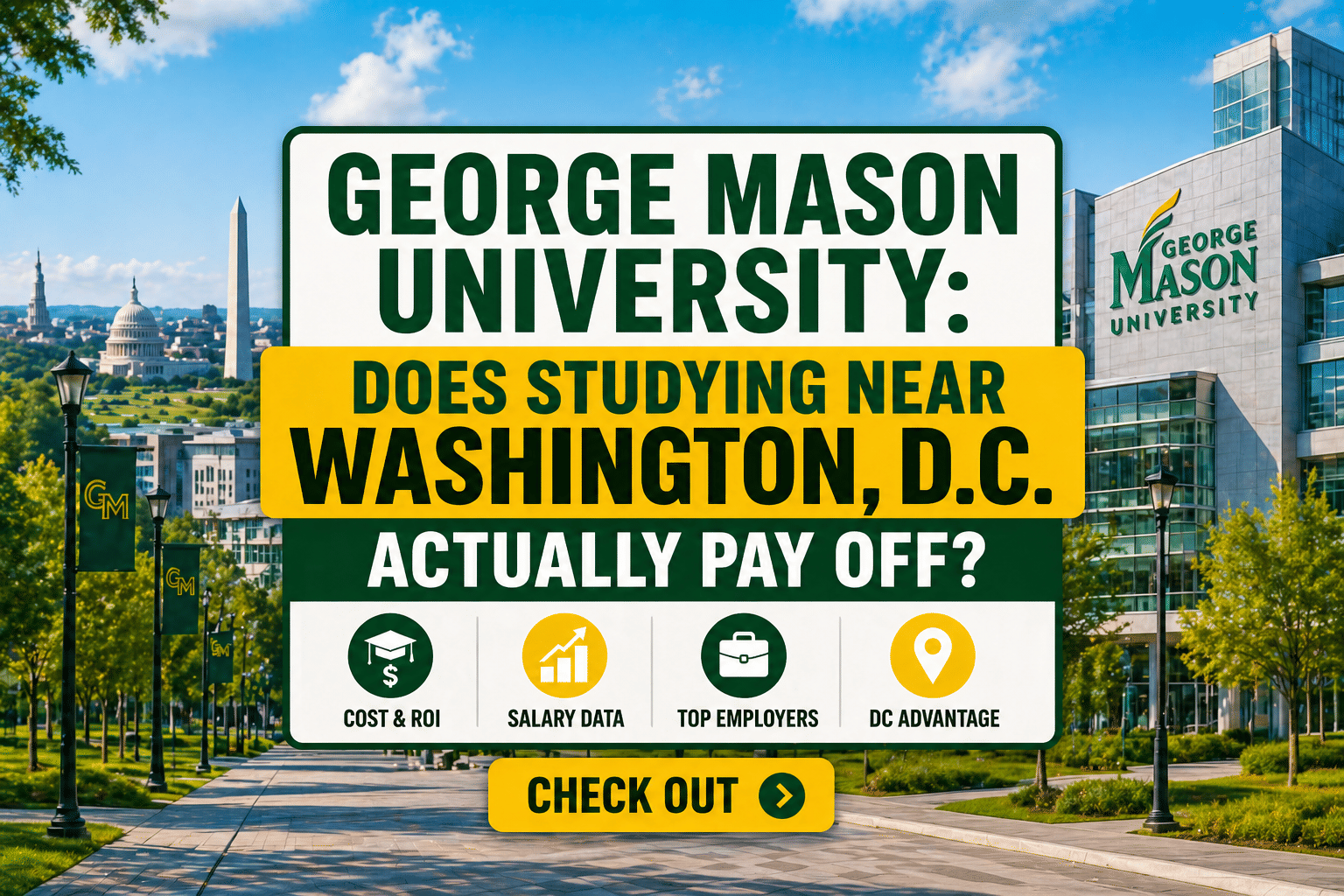
For Indian students considering George Mason University, the key question is not just admission, but return on investment. With an estimated total cost of around $158,492 (₹150 Lakhs approx.) for a 2-year graduate program, GMU falls into a higher-cost bracket compared to many US universities.
However, its location near Washington, D.C. places students within one of the most concentrated job markets for technology, policy, consulting, and defence roles. George Mason University reports a $73,000 median starting salary and 92% positive career outcomes within six months (Class of 2025).
Check out the guide to study in the US
- What GMU Actually Costs: The Full Number in INR
- GMU's Rankings and What They Mean for Your Resume
- The DC Advantage: How Location Translates to Real Jobs
- Placement Data: What the Class of 2025 Actually Achieved
- The ROI Calculation: Does the Investment Pay Off?
- Cost of Living Near GMU vs. Smaller University Towns
- Bottom Line
- FAQs
What GMU Actually Costs: The Full Number in INR
For the 2025–26 academic year, out-of-state graduate tuition at GMU is $37,200 (₹ 35.28 Lakhs approx.) per year. Add the mandatory student fee of 3,924 (₹3.72 Lakhs approx.), and your annual tuition bill comes to $41,124 (₹39.00 Lakhs approx.).
That's tuition alone. GMU's official Cost of Attendance estimate adds:
- Off-campus housing and food: $27,484/year (₹26.07 Lakhs approx.)
- Transportation: $2,985/year (₹2.83 Lakhs approx.)
- Books: $1,290/year (₹1.22 Lakhs approx.)
- Personal expenses: $6,363/year (₹6.03 Lakhs approx.)
Total estimated annual cost: ~79,246(₹ 75.15Lakhs approx). This is the number to keep in mind for every comparison that follows.
See how much it will cost you to study at GMU for various courses
GMU's Rankings and What They Mean for Your Resume
GMU ranks #117 nationally and #57 among public universities in the US News 2026 rankings. That places it solidly in the second tier of American research universities, not an Ivy, but not a regional unknown either.
The rankings that matter more for career-focused students are the program-specific ones:
- Graduate Computer Science: #65 nationally, #38 among public universities (US News, 2026)
- Graduate Engineering: #76 nationally (US News, 2026)
- Graduate Public Affairs: #36 nationally, #1 in Virginia (US News, 2026)
- Homeland Security & Emergency Management: #4 nationally (US News, 2026)
- Best Salaries among public universities: #12 nationally, #1 in Virginia and the DMV region (WSJ/College Pulse, 2025)
The Wall Street Journal's salary ranking is particularly relevant. It measures actual graduate earnings, not just academic reputation. GMU ranking #1 in Virginia for salary outcomes among public universities is a data point that goes beyond prestige.
The DC Advantage: How Location Translates to Real Jobs
GMU's Fairfax campus sits 15 miles from Washington, D.C. That distance matters. It is because the D.C. metro area is home to the highest concentration of federal agencies, defence contractors, cybersecurity firms, international organisations, and policy think tanks in the United States.
The employers actively hiring GMU graduates include Amazon/AWS, Google, Microsoft, Capital One, Deloitte, Goldman Sachs, Morgan Stanley, Northrop Grumman, General Dynamics IT, Booz Allen Hamilton, NASA, the U.S. Department of State, the U.S. Department of Homeland Security, the World Bank Group, and the International Monetary Fund.
This is not a list of local employers. These are organisations that recruit nationally, and they show up at GMU's career fairs because the university is in their backyard.
Students on Reddit have noted that for software engineering and tech roles specifically, GMU's location gives access to job fairs and local networking that are harder to replicate at universities in smaller cities. The proximity means internships during the semester are logistically possible; a student can intern in D.C. and still attend classes in Fairfax.
Placement Data: What the Class of 2025 Actually Achieved
GMU released its Class of 2025 career outcomes in April 2026. The headline numbers:
- 92% reported a positive career outcome within six months of graduation
- 81% remained in the Washington, D.C. region
- 74% are employed in positions aligned with their career goals
- $73,000 median starting salary
- 50% remained employed with the same organisation they worked for as students
Over a 10-year horizon, the trajectory is steeper. GMU bachelor's degree recipients earn approximately 43,000 one year after graduation, with that figure rising to over 80,000 (₹75.87 Lakhs approx.) ten years out.
One honest note: the 2025 outcomes data covers 45% of the 9,960 graduates, supplemented by LinkedIn and National Student Clearinghouse data. The 92% figure is not based on a 100% response rate. That said, it is the most recent official data available.
The ROI Calculation: Does the Investment Pay Off?
Here is the math, using only official figures:
| Item | USD | INR (approx.) |
|---|---|---|
| Total 2-year graduate program cost | $158,492 | ₹150.30 Lakhs |
| Median starting salary (Class of 2025) | $73,000/year | ₹69.23 Lakhs/year |
| Years to recover full investment (pre-tax) | ~2.2 years | — |
At a $73,000 starting salary, a GMU graduate recovers the full cost of a 2-year program in roughly 2.2 years of working. That assumes no salary growth, which is conservative; the 10-year trajectory shows salaries more than doubling.
The comparison that matters for Indian students is not GMU vs. a top-10 US university. It is GMU vs. a cheaper, less-connected university in a smaller city. A program that costs 30,000 less but places graduates at $15,000–$20,000 lower starting salaries closes that gap within 2–3 years of employment.
The cost of living near D.C. is real and higher than in smaller university towns. But 50% of GMU's 2025 graduates converted their student-era employer relationships into full-time jobs — a direct financial benefit of being in a major employment hub during your studies.
Cost of Living Near GMU vs. Smaller University Towns
Fairfax County, Virginia, is an expensive place to live. The MIT Living Wage Calculator puts the annual housing cost alone for a single adult in Fairfax County at $26,274/year (₹24.91 Lakhs approx.).
GMU's own off-campus estimate of $27,484/year for housing and food is consistent with this. For comparison, a graduate student at a university in a smaller Midwestern or Southern city might spend $12,000–16,000/year on housing and food, a difference of $10,000–$15,000 per year.
That gap is real. However, the same MIT data shows that Computer & Mathematical occupations in the Fairfax/D.C. metro area earn a typical annual salary of $127,880, significantly above national averages for the same roles. The higher cost of living is partially offset by higher local salaries, and more directly, by the density of employers who pay those salaries.
Students who manage to secure part-time or internship work during their studies, which is more feasible in D.C. than in a smaller city, can offset a portion of living costs. GMU's data shows 50% of 2025 graduates were already employed by their eventual full-time employer while still studying.
Bottom Line
The data shows GMU is a mid-tier national university with above-average salary outcomes, driven largely by its location in one of the most employer-dense regions in the United States. The total cost of a 2-year graduate program runs approximately $158,492(₹ 150.30 Lakhs approx), and the median starting salary for the Class of 2025 was 73,000 (₹69.23 Lakhs approx.).
If your target field is technology, cybersecurity, public policy, defence, consulting, or international organisations, the D.C. location provides direct access to the employers who dominate those sectors. If your target field has no particular concentration in D.C., the cost premium over a smaller university may not be justified.
Before applying, check GMU's program-specific placement data on the Career Services page and cross-reference it with the specific employers you want to work for. The employer list on that page is the most direct signal of whether GMU's network aligns with your goals.
FAQs
Ques. What is the total cost of attending GMU for a 2-year graduate program for an Indian student?
Ans. The estimated total cost is approximately $158,492 (₹150.30 Lakhs approx.), based on GMU's 2025–26 official Cost of Attendance figures including tuition, fees, housing, food, transport, books, and personal expenses.
Ques. What is the median starting salary for GMU graduates?
Ans. The Class of 2025 reported a median starting salary of $73,000 (₹69.23 Lakhs approx.) within six months of graduation, according to GMU's official career outcomes data released in April 2026.
Ques. How does GMU's cost of living compare to universities in smaller cities?
Ans. Fairfax County housing costs approximately 26,274/year for a single adult (MIT Living Wage Calculator,2026). This is higher than most smaller university towns by 10,000–$15,000/year. However, local salaries in tech and related fields are also higher, and the density of internship and part-time opportunities is greater.
Ques. Is GMU worth it compared to a cheaper university in a smaller city?
Ans. The answer depends on your target industry. For fields concentrated in D.C. — federal government, defense, cybersecurity, international policy, consulting — the location premium has a measurable career payoff. For fields with no particular D.C. concentration, a lower-cost program elsewhere may deliver comparable outcomes at lower total investment.

interested in this College ?
Follow & Share this college to get information about admission.



Comments