





Oxford University, the oldest university in the English-speaking world, accepts only around 14% to 17% of applicants, with fees and entry varying sharply by course. Teaching at Oxford dates back to about 1096, making it one of the oldest universities still running today. The University of Oxford is located in the medieval city of Oxford, Oxfordshire, England.
- Oxford is the oldest university in the English-speaking world, though not the oldest in the world.
- The overall acceptance rate sits near 14% to 17%, but some courses admit under 10%.
- International tuition runs roughly INR 46 lakh to 78 lakh a year, with full scholarships available.
- Only CBSE and CISCE Class 12 results are accepted for undergraduate entry, not state boards.
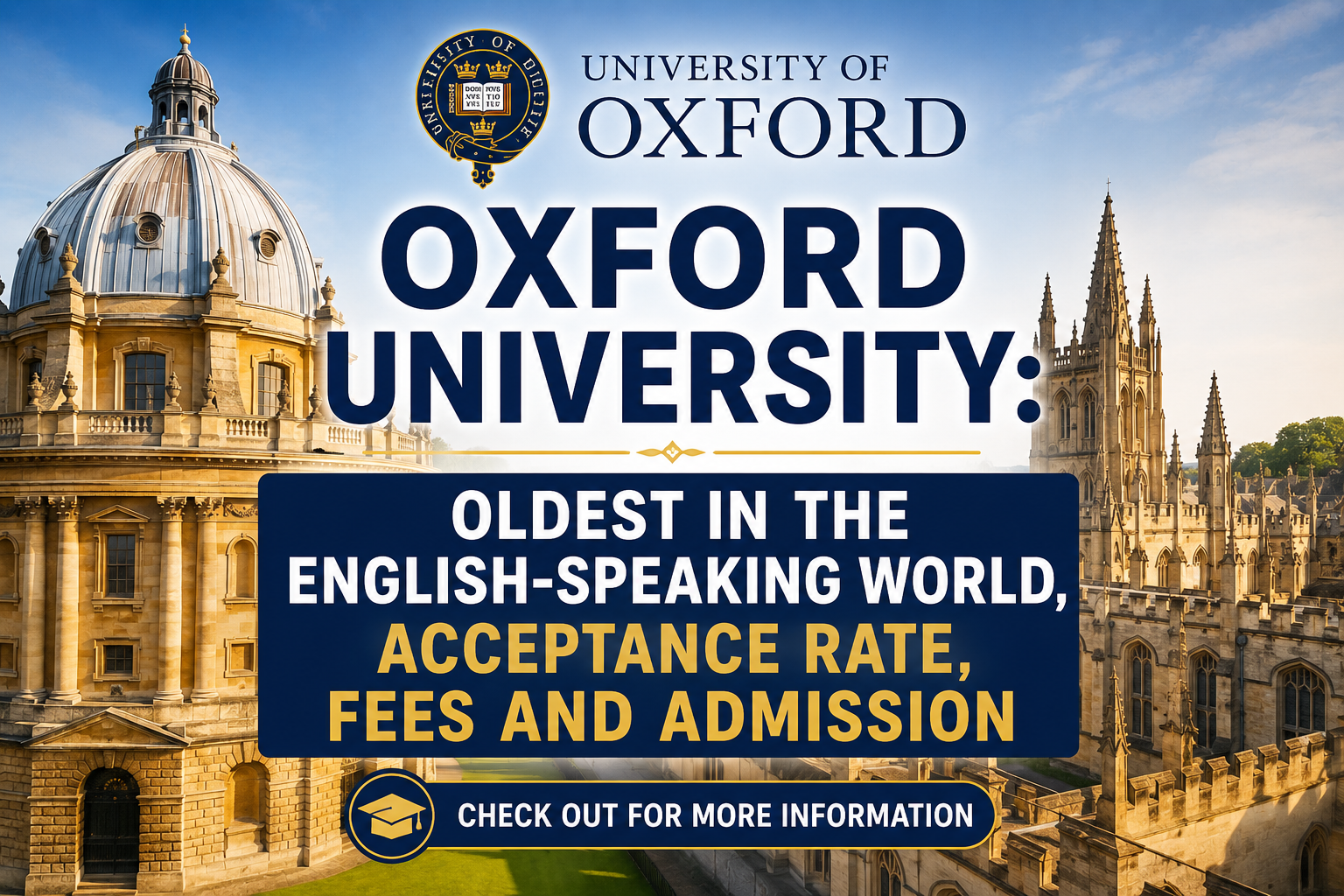
Oxford has taught students for more than nine centuries and sits at the top of global rankings, which is why it draws around 500 Indian students despite some of the steepest entry standards anywhere. For Indian students, Oxford offers a world-leading degree and strong funding, but the bar for marks, tests and interviews is high, so planning early matters. The university is ranked at #4 in the QS World University Rankings 2027. The university has also maintained the #1 position in the Times Higher Education World University Rankings for ten consecutive years, an achievement unmatched by any other institution.
Also Read:
Is Oxford the Oldest University in the World
No, Oxford is not the oldest university in the world, but it is the oldest in the English-speaking world and the oldest in the UK. The title of oldest depends on how you define a university.
By the records of UNESCO and Guinness World Records, the oldest continuously operating higher-learning institution is the University of al-Qarawiyyin in Fez, Morocco, founded in 859 AD by Fatima al-Fihri. By the medieval European model of a degree-granting body with faculties, the University of Bologna in Italy, where teaching began around 1088, is the oldest university in continuous operation. Oxford, with teaching attested by about 1096, comes next, which makes it the second-oldest in continuous operation in Europe and the oldest in the English-speaking world. The table below sets out the order.
| Institution | Teaching from | Status |
|---|---|---|
| University of al-Qarawiyyin, Morocco | 859 AD | Oldest by UNESCO and Guinness |
| University of Bologna, Italy | 1088 | Oldest in continuous operation in Europe |
| University of Oxford, UK | around 1096 | Oldest in the English-speaking world |
Oxford has no single founding date, and its own statement is that it is the oldest university in the English-speaking world with nine centuries of continuous teaching. It grew quickly after 1167, when English scholars were barred from Paris, and a town-and-gown dispute in 1209 led some scholars to leave and found Cambridge.
Also Read:
- Study in the UK: Top Universities, Courses, Fees & Intakes
- UK Universities List 2026: All 176 Universities, Rankings &Courses
- Intakes in the UK: September, January & May
Oxford University Acceptance Rate Explained
The Oxford University acceptance rate is around 14% to 17% overall, but it drops below 10% for the most competitive courses. Headline numbers hide a wide gap between subjects.
Oxford receives roughly 23,000 undergraduate applications each year for about 3,300 places, and around 38,000 graduate applications for about 5,500 places. International students make up close to 20% of the undergraduate intake, and Oxford does not publish a separate international rate, though UK-domiciled applicants are admitted at a higher rate. The subject you pick matters as much as your grades, as the figures below show.
| Course | Approx acceptance rate |
|---|---|
| Overall undergraduate | 14% to 16% |
| Economics and Management | around 6% |
| Medicine | around 8% to 9% |
| Computer Science, Mathematics, PPE | among the lowest |
| Classics, Theology | higher than average |
If you apply for a high-demand course like Medicine or Economics and Management, then the offer rate drops well below the overall figure. That means your subject choice shapes your odds as much as your marks do. Most Oxford offers ask for A*AA or AAA at A-level, and for Indian students, this usually means 90% and above in Class 12 with high scores in the subjects your course requires.
Note: Do not read the overall rate as your personal chance. A strong applicant in a less crowded subject can face better odds than a brilliant one in Medicine. Match your strengths to the course.
What the acceptance rate tells you and what it does not:
- Tells you: how selective Oxford is overall, useful for setting expectations.
- Does not tell you: your real odds, which depend on your course, test score and interview.
Also Read: Oxford University Admissions 2026: Acceptance Rate & Requirements
Courses at Oxford University, UK
Oxford University offers over 80 courses across undergraduate, master's and doctoral levels, taught through its famous small-group tutorial system. Programmes sit within four academic divisions.
The four divisions are Humanities, Social Sciences, Medical Sciences and Mathematical, Physical and Life Sciences. Oxford offers around 55 undergraduate programmes to international students, about 200 master's courses, and roughly 120 DPhil (PhD) programmes. Popular choices among Indian students include:
- Philosophy, Politics and Economics (PPE), Law and Economics and Management.
- Medicine (BM BCh), Mathematics and Computer Science.
- MBA at the Saïd Business School, MSc Financial Economics and MSc Law and Finance.
The tutorial system, where students discuss work weekly in groups of one to three with an expert tutor, is what sets Oxford apart from most universities. Several subjects rank among the world's best, with Oxford placed first globally for Anatomy and Physiology and second for both Medicine and Law in recent QS subject rankings. This academic depth is a core reason Indian students target Oxford over many other destinations.
Oxford University Fees for Indian Students
Oxford University fees for international students run from about GBP 37,380 to GBP 62,820 a year for undergraduate courses, rising higher for Medicine and the MBA. International students cannot access UK government loans, so funding must come from savings, loans or scholarships.
The table below shows typical annual tuition for overseas students in Indian rupees, followed by Oxford's own living-cost estimate.
| Programme (international) | Annual fee (GBP) | Approx INR |
|---|---|---|
| Undergraduate (humanities and social sciences) | £37,380 to £40,640 | INR 46.7 to 50.8 lakh |
| Undergraduate (sciences and laboratory) | £40,640 to £49,400 | INR 50.8 to 61.8 lakh |
| Medicine (clinical years 4 to 6) | £65,250 | INR 81.6 lakh |
| MBA (Saïd Business School) | £88,800 | INR 1.11 crore |
| Living costs (per year) | £12,600 to £17,400 | INR 15.8 to 21.8 lakh |
Conversions based on GBP 1 = INR 125 as of June 24, 2026. Fees and exchange rates change, so confirm the latest figures before you apply.
For most new students, the overseas fee shown on the offer letter is a single all-in figure covering both university tuition and college membership. Living costs, the Immigration Health Surcharge and the visa fee are paid on top.
What the overseas fee covers and what it does not:
- Covers: tuition, supervision, college membership and access to university facilities.
- Does not cover: accommodation, food, the health surcharge, the visa fee or personal expenses.
How to Get Admission in Oxford University
To get admission in Oxford University, Indian students apply through UCAS by 15 October, sit a required admissions test and attend an online interview in December. Oxford runs a single intake each year, so the timeline is fixed.
Unlike most universities, Oxford adds three filters on top of the standard UCAS form: admissions tests, written work for some courses and interviews. You apply for one specific course and may name a college or make an open application. The stages are below, and the wider UK process is covered in this guide on how to apply for the September intake in the UK.
| Stage | Timing |
|---|---|
| UCAS application deadline | 15 October |
| Admissions tests (UAT-UK, such as ESAT, TMUA) | October, at Pearson VUE centres in India |
| Written work (some courses) | by 10 November |
| Interviews (online) | December |
| Decisions via UCAS | mid-January |
| English proficiency proof | by 31 July, if offered a place |
For undergraduate entry, Oxford accepts only CBSE or CISCE Class 12 results, usually 90% and above with strong subject scores, and predicted grades are allowed at the application stage. For graduate entry, a first-class bachelor's degree, often 60% to 70% and above from a recognised Indian university, is expected, along with IELTS 7.5 with no band below 7.0. If you study a state board syllabus, then Oxford will not accept your Class 12 for undergraduate entry. That means CBSE or CISCE applicants have a clear advantage here.
Also Read:
- How to Apply to UCAS in 2026? A Complete Guide
- How to Write the UCAS Personal Statement?
- UK Student Visa 2026: Requirements, Fees & New Rules
Scholarships and Why Oxford Is Worth It
Oxford offers more than 40 scholarships, several of which fully fund Indian students, which can bring the high sticker price down to zero. Funding plus reputation is why the cost can still be worth it.
Many awards need no separate form and are considered automatically when you apply by the December or January deadline. The leading options for Indian students are below.
| Scholarship | Level | Coverage |
|---|---|---|
| Reach Oxford | Undergraduate | Full tuition, living grant and airfare |
| Clarendon Fund | Master's and DPhil | Full tuition plus living stipend |
| Rhodes Scholarship | Postgraduate | Full funding |
| Felix Scholarship | Postgraduate | Full tuition plus living grant |
| Weidenfeld-Hoffmann | Postgraduate | Tuition, living and leadership programme |
The full list with eligibility for Indian applicants sits on the Oxford scholarships list. If you win an award like Reach Oxford or Clarendon, then tuition and living costs can be fully covered. That means the sticker price is not the final word on whether Oxford is affordable.
Beyond funding, Oxford has held the number one position in the Times Higher Education World University Rankings for nearly a decade and ranks among the global top five in QS. Its alumni include 28 British Prime Ministers, around 30 world leaders and dozens of Nobel laureates, and its graduates command strong starting salaries, with Oxford computer scientists earning roughly GBP 43,895 six months after graduating. For the right student, the mix of history, teaching and outcomes justifies the effort and the cost.
Note: Apply for your course by the December or January deadline even if scholarships feel out of reach. Most major Oxford funds, including Clarendon, consider you automatically, so a single on-time application keeps every door open.
Also Read:
- Popular Scholarships to Study in the UK
- UK Scholarships for Indian Students
- UK Fully Funded Scholarships for Indian Students 2026
Oxford University rewards students who plan early and aim precisely. It is the oldest university in the English-speaking world, not the oldest on earth, yet its standing, teaching and outcomes place it among the very best anywhere. Pick a course that fits your strengths, prepare for the admissions test and interview and target the 15 October deadline. Line up your CBSE or CISCE results and a scholarship application in the same window, and a place at one of the world's most historic universities moves from a dream to a realistic plan.
FAQs
Ques. Is Oxford University the oldest university in the world?
Ans. No. Oxford is the oldest university in the English-speaking world, with teaching from around 1096, but not the oldest in the world. The University of al-Qarawiyyin in Morocco (859 AD) and the University of Bologna in Italy (1088) are both older.
Ques. What is the acceptance rate for Oxford University?
Ans. The Oxford acceptance rate is around 14% to 17% overall. It varies sharply by course, dropping to about 6% for Economics and Management and 8% to 9% for Medicine, while less crowded subjects admit a higher share of applicants.
Ques. What are the fees of Oxford University for Indian students?
Ans. International undergraduate tuition is about GBP 37,380 to GBP 62,820 a year, roughly INR 46.7 lakh to 78.5 lakh. The MBA costs around GBP 88,800 (about INR 1.11 crore). Living costs add about GBP 12,600 to 17,400 a year, near INR 15.8 lakh to 21.8 lakh.
Ques. What courses does Oxford University offer?
Ans. Oxford offers over 80 courses across four divisions, including around 55 undergraduate programmes, 200 master's courses and 120 DPhil programmes. Popular choices include PPE, Law, Medicine, Computer Science, the Saïd MBA and MSc Financial Economics.
Ques. How can an Indian student get admission to Oxford University?
Ans. Apply through UCAS by 15 October for one chosen course, sit any required admissions test in October, submit written work where asked and attend an online interview in December. Decisions arrive in mid-January. CBSE or CISCE Class 12 results of 90% and above are typically needed for undergraduate entry.
Ques. Which is the oldest university in the world?
Ans. By UNESCO and Guinness World Records, the University of al-Qarawiyyin in Fez, Morocco, founded in 859 AD, is the oldest continuously operating higher-learning institution. By the European degree-granting model, the University of Bologna (1088) is the oldest university in continuous operation.
Ques. What marks do Indian students need for Oxford University?
Ans. For undergraduate entry, Indian students usually need 90% and above in Class 12 from CBSE or CISCE, with high scores in course-specific subjects. For graduate entry, a first-class bachelor's degree, often 60% to 70% and above, plus IELTS 7.5 with no band below 7.0, is expected.
Ques. Does Oxford University accept students from the state board?
Ans. For undergraduate admission, Oxford accepts only CBSE or CISCE Class 12 qualifications. State Board and NIOS Class 12 results are not accepted for undergraduate entry. Students with these qualifications usually need a recognised foundation year or a different route.
Ques. Are there scholarships for Indian students at Oxford?
Ans. Yes. Oxford offers more than 40 scholarships, several fully funding Indian students. Key options include Reach Oxford for undergraduates and the Clarendon Fund, Rhodes, Felix and Weidenfeld-Hoffmann scholarships for postgraduates. Many need no separate form and are considered automatically.
Ques. Is Oxford University better than Cambridge?
Ans. Both are among the world's best and very close in rankings. Oxford has recently led Cambridge in some global tables and is slightly older, founded around 1096 against Cambridge's 1209. The better choice depends on your course, college preference and fit rather than overall reputation.

interested in this College ?
Follow & Share this college to get information about admission.



Comments