


Education Journalist | Study Abroad Strategy Lead | Updated On - Apr 13, 2026
Indian students preparing for the TOEFL iBT in 2026 are facing a test that looks fundamentally different from the one their preparation materials were built for. Since January 21, 2026, ETS has replaced the linear Reading and Listening sections with a multistage adaptive format — and introduced a new 1.0–6.0 score scale alongside the familiar 0–120 system. Students still using pre-2026 prep books, mock tests, or coaching modules are practising for a format that no longer exists.
The change affects every Indian student targeting universities in the US, UK, Canada, Australia, and Europe that accept TOEFL — an estimated 3–4 lakh Indian test-takers annually. The adaptive format, the new scoring system, and the shift in how universities now read score reports are three distinct changes that require three distinct adjustments in how Indian students prepare and apply.
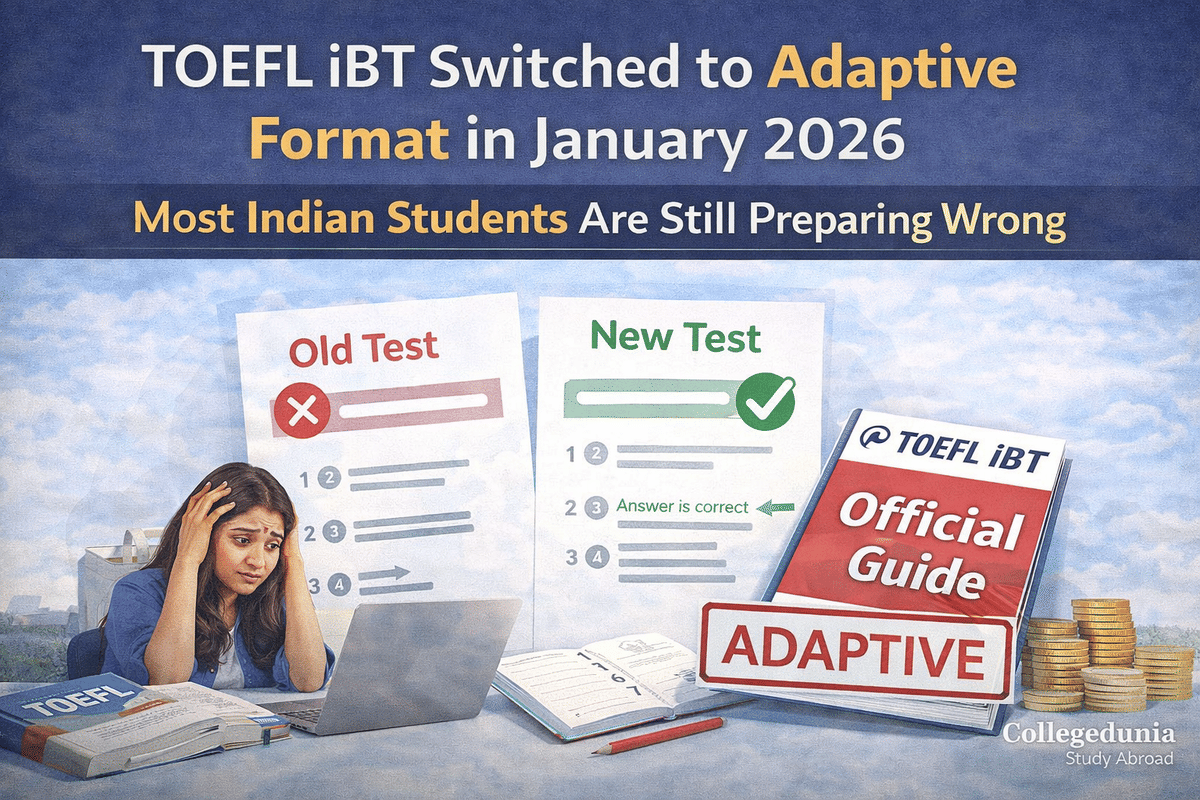
What Changed on January 21, 2026?
ETS implemented the most significant overhaul of the TOEFL iBT since its launch. Three changes are directly relevant to Indian students:
Change 1: Reading and Listening are now adaptive
The old TOEFL had a fixed, linear structure — every test-taker received the same questions in the same order. The new format uses a multistage adaptive design for both Reading and Listening. In practice, this means:
- Stage 1 of each section presents a set of questions at a standard difficulty level
- Your performance in Stage 1 determines the difficulty of Stage 2
- Strong Stage 1 performance routes you to harder Stage 2 questions — which carry higher scoring potential
- Weak Stage 1 performance routes you to easier Stage 2 questions — which cap your maximum score
This is structurally similar to the GMAT's adaptive model. The implication for Indian students is significant: you cannot afford to lose focus in the first stage. A slow start in Reading or Listening does not just cost you those questions — it limits your ceiling for the entire section.
Change 2: A new 1.0–6.0 score scale now appears on every report
From January 21, 2026, every TOEFL score report includes two scores:
- The existing 0–120 scale (still valid, still reported)
- A new 1.0–6.0 band scale in 0.5 increments, aligned with the Common European Framework of Reference (CEFR)
Both scales will appear on score reports simultaneously until at least 2028, giving universities time to transition their minimum score requirements. The 1.0–6.0 scale maps directly to CEFR levels — a 5.0 corresponds to C1 (Advanced), a 4.0 to B2 (Upper Intermediate).
Change 3: Test duration reduced to 90 minutes
The new TOEFL iBT runs approximately 90 minutes — down from the previous 3-hour format. The reduction comes from streamlining the number of questions per section, not from removing sections. All four sections (Reading, Listening, Speaking, Writing) remain.
The Score Conversion Indian Students Must Know
The most immediate practical problem for Indian students is understanding what their new 1.0–6.0 score means — and whether their target universities have updated their minimum requirements.
Official ETS score conversion (0–120 to 1.0–6.0):
| 0–120 Scale | 1.0–6.0 Band | CEFR Level | Proficiency |
|---|---|---|---|
| 114–120 | 6.0 | C2 | Mastery |
| 95–113 | 5.5 | C1+ | Advanced+ |
| 80–94 | 5.0 | C1 | Advanced |
| 60–79 | 4.0–4.5 | B2 | Upper Intermediate |
| 40–59 | 3.0–3.5 | B1–B2 | Intermediate |
| Below 40 | 1.0–2.5 | A1–B1 | Basic–Lower Intermediate |
What top universities now require (new scale equivalents):
| University / Programme | Old Requirement (0–120) | New Equivalent (1.0–6.0) |
|---|---|---|
| MIT, Stanford, Harvard (graduate) | 100+ | 5.5+ |
| University of Toronto, UBC | 93–100 | 5.0–5.5 |
| University of Edinburgh, UCL | 92–100 | 5.0–5.5 |
| University of Melbourne | 79–94 | 4.5–5.0 |
| Most US state universities (graduate) | 80+ | 4.5+ |
Note: Universities are updating their requirements on a rolling basis. Always verify the current threshold directly on your target university's admissions page before applying.
Check out top universities abroad
Why Indian Students Are Getting Caught Off-Guard?
Three specific preparation gaps are emerging among Indian test-takers in 2026:
Gap 1: Old mock tests do not reflect adaptive difficulty
The majority of TOEFL preparation books published before 2026 — including widely used titles from Barron's, Kaplan, and Princeton Review — use the linear format. Practising on these materials gives Indian students no experience with the adaptive routing logic. A student who scores well on a linear mock test may be unprepared for the psychological shift of Stage 2 difficulty escalation in the real exam.
Action: Use only ETS-official practice materials updated for the January 2026 format. The ETS TOEFL Practice Online (TPO) platform has been updated with adaptive mock tests. Third-party platforms including Magoosh and BestMyTest have also updated their question banks.
Gap 2: Score report confusion at the application stage
Indian students receiving their new score reports are encountering two scores — 0–120 and 1.0–6.0 — and are unsure which one to report to universities. The answer: report both. ETS sends the full score report to institutions automatically. However, when self-reporting scores on application portals (Common App, UCAS, university-specific forms), students should enter both scores where fields allow, or enter the 0–120 score where only one field exists.
Gap 3: Coaching centres still teaching the old format
A significant number of TOEFL coaching centres in India — particularly in Tier 2 and Tier 3 cities — have not updated their curriculum for the January 2026 format. Students enrolled in these programmes are learning passage-based linear reading strategies that do not account for adaptive difficulty routing. If your coaching centre has not explicitly updated its materials for the 2026 format, raise this directly with your instructor or switch to self-study using ETS official materials.
What Indian Students Should Do Now
If you are testing in April–June 2026:
- Verify your prep materials are post-January 2026. Check the publication or update date on every resource you are using. Anything published before January 21, 2026 uses the old linear format.
- Take at least two adaptive mock tests on the ETS TPO platform before your test date. The adaptive routing experience cannot be replicated on paper or linear digital tests.
- Understand the Stage 1 stakes. In both Reading and Listening, treat Stage 1 as the most important part of the section. A strong Stage 1 performance opens the higher-scoring Stage 2 pathway.
- Check your target university's updated TOEFL threshold. Many universities updated their minimum score requirements in January–February 2026. Do not assume the threshold you researched in 2025 is still current.
- When your scores arrive, read both scales. Your score report will show both 0–120 and 1.0–6.0. Both are valid. Both will be sent to your designated institutions automatically.
The TOEFL's shift to an adaptive format is part of a broader trend in standardised testing — the GMAT moved to adaptive in 2023, the GRE shortened its format in 2023, and now TOEFL has followed. For Indian students, who collectively represent one of the largest TOEFL test-taking populations in the world, the January 2026 change is not a minor update. It is a structural redesign of a test that gates admission to hundreds of universities across six continents.
The students who adapt their preparation now — switching to updated materials, practising adaptive mock tests, and understanding the new score scale — will be better positioned than those who discover the format change at the test centre. The window to adjust is open. The April–June 2026 test season is already underway.





1778317360.png?tr=w-305,h-145,c-force?h=175&w=350&mode=stretch)




Comments