



Education Journalist | Study Abroad Strategy Lead | Updated On - Apr 4, 2026
Indian students searching for the €1,400/month Europe stipend that went viral this week are looking at a real scholarship — but one that was awarded just to 101 Indian students in 2025, down from 161 in 2022. The Erasmus Mundus Joint Masters scholarship, funded by the European Union, pays eligible students up to €1,400 (~₹1.5 lakh) per month for up to 24 months — but it is among the most competitive fully funded programmes in the world, and the 2026-27 application window has already closed.
Here is what the scholarship actually covers, who qualifies, and what Indian students need to do to be in contention for the 2027-28 cycle.
Check top universities to study abroad for Indian Students
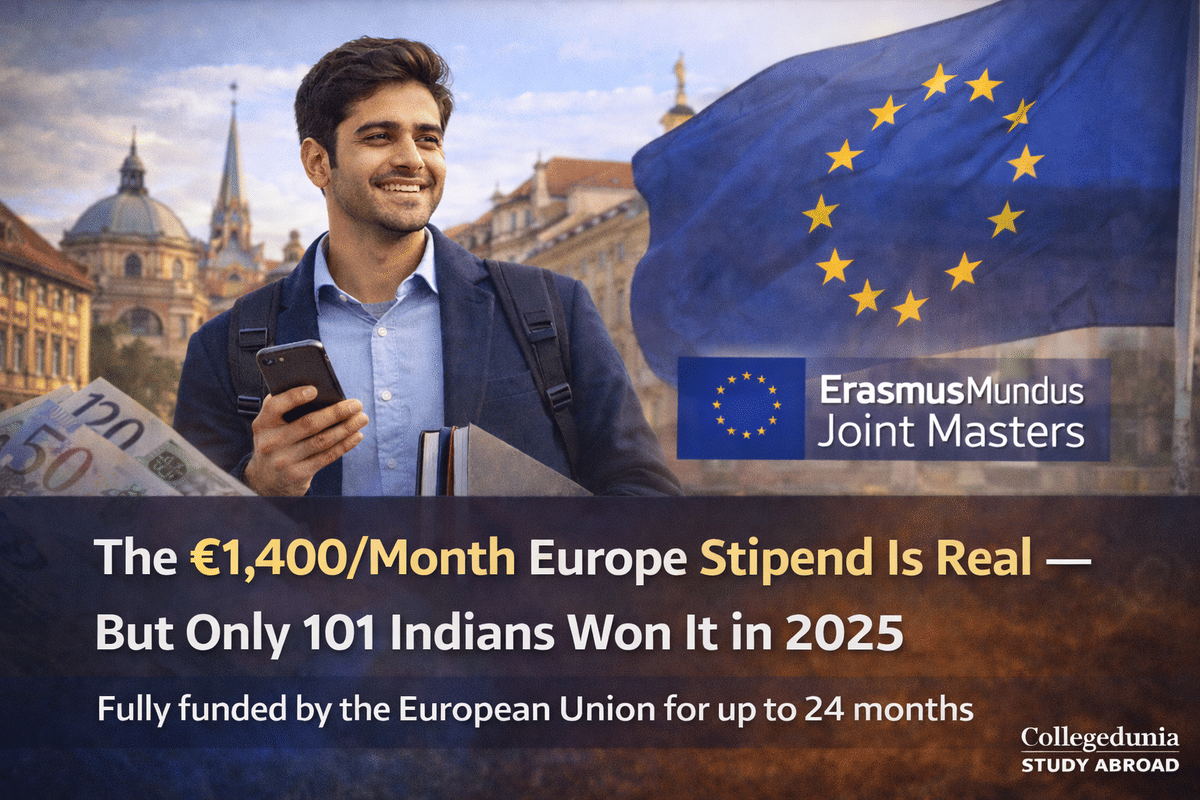
What the Viral Claim Got Right — and What It Left Out?
The video circulating on X since April 2, 2026 shows an Indian student in Europe describing a monthly payment of €1,400 from the EU, covering rent, travel, and meals, with €600 left over to save each month. He called it an "elite scholarship secret" requiring only a bachelor's degree, a passport, and English proficiency.
The scholarship he is describing is the Erasmus Mundus Joint Masters (EMJM) — a fully funded EU programme that has existed since 2004 and has supported nearly 50,000 students globally. It is not a secret. It is not a loophole. And it is not easy to get.
What the viral video omitted:
- The scholarship is awarded to approximately 1,000–1,200 students globally per year across all programmes
- Only 101 Indian students received it in 2025 — down 37% from 161 in 2022
- Applications for 2026-27 are already closed. The next cycle opens October 2026
- It requires applying to a specific joint Master's programme — not to the EU directly
- Acceptance is based on academic merit, research profile, and programme fit — not just a degree and a passport
What the Erasmus Mundus Scholarship Actually Covers
The Erasmus Mundus Joint Masters scholarship is one of the few genuinely fully funded study abroad options available to Indian students. Here is what it covers, verified against the official EU Erasmus+ programme page:
| Component | What's Covered | Value |
|---|---|---|
| Tuition fees | Full waiver across all partner universities | Varies by programme |
| Monthly living allowance | €1,400/month for non-EU students (Category A) | Up to €33,600 over 24 months (~₹36.1 lakh) |
| Travel allowance | Relocation + inter-university mobility costs | Included |
| Visa costs | Covered | Included |
Exchange rate: €1 = ₹107.41 (April 3, 2026; source: Twelve Data / European Central Bank)
Total scholarship value over 2 years: up to €33,600 in living allowance alone (~₹36.1 lakh), plus full tuition and travel. This is a genuinely transformative award — which is precisely why it is so competitive.
The programme runs for 1–2 academic years (60, 90, or 120 ECTS credits). Students study at a minimum of 3 universities across at least 3 different European countries, earning either a joint degree or multiple degrees.
The India Reality: 101 Winners in 2025, Down 37% in 3 Years
India has been the largest cumulative beneficiary of the Erasmus Mundus scholarship since the programme launched in 2004, with more than 2,200 Indian scholars receiving the award over two decades.
But the annual numbers tell a different story for 2026 applicants:
| Year | Indian Erasmus Mundus Recipients |
|---|---|
| 2022 | 161 |
| 2024 | 146 |
| 2025 | 101 |
The 37% decline from 2022 to 2025 does not reflect a change in eligibility rules — it reflects increasing global competition for a fixed number of slots, and a growing applicant pool from other countries as Europe becomes a more sought-after destination.
For Indian students, this means the scholarship is harder to win now than it was three years ago — even as interest in it has surged following the viral video.
Who Actually Qualifies — and What It Takes
The Erasmus Mundus scholarship is open to students of all nationalities, including Indian students. There is no age limit. The minimum requirement is a bachelor's degree (or final-year status at time of application).
But the real eligibility bar is academic and research excellence. Successful Indian applicants typically have:
- A strong undergraduate GPA (typically 8.5+/10 or equivalent)
- Published research, conference presentations, or significant project work
- A clear, specific research or professional motivation aligned with the chosen programme
- Strong letters of recommendation from academic supervisors
- English proficiency (IELTS/TOEFL — requirements vary by programme; IELTS is not always mandatory, as the viral video correctly noted)
You do not apply to "Erasmus Mundus" as a single entity. You apply to a specific EMJM programme — for example, an MSc in Computational Colour and Spectral Imaging, or an MA in Global Markets and Local Creativities. Each programme has its own consortium of universities, its own application portal, and its own deadline. The EU funds the scholarship; the programme consortium selects the scholars.
How to Apply: The 2027-28 Cycle Opens October 2026
The 2026-27 application cycle is closed. Most EMJM programmes accept applications between October and January for courses starting the following September.
For Indian students targeting the 2027-28 cycle:
- Search the EMJM catalogue now at: https://www.eacea.ec.europa.eu/scholarships/erasmus-mundus-catalogue_en — identify 3–5 programmes aligned with your field and academic profile.
- Contact programme coordinators at your shortlisted programmes. Many programmes require or strongly recommend early contact with supervisors or coordinators before the formal application window opens.
- Build your research profile between now and October 2026. The gap between a shortlisted and rejected application is almost always in research output and specificity of motivation — not in grades alone.
- Prepare your Statement of Purpose for each programme separately. Generic applications are rejected. Each SOP must address why this specific consortium of universities, in this specific country combination, is the right fit for your research goals.
- Apply to multiple EMJM programmes simultaneously. There is no restriction on applying to more than one programme. Given the acceptance rate, applying to 4–6 programmes is standard practice among successful applicants.
The Bigger Picture: Why This Went Viral Now
The timing of the viral video is not coincidental. Indian student interest in Europe has surged in 2025–26 as the Big Four — US, UK, Canada, Australia — have simultaneously tightened visa rules, raised costs, and cut post-study work rights. Germany, the Netherlands, Ireland, and France have all seen significant increases in Indian student enrolments.
Against this backdrop, a video showing an Indian student receiving €1,400/month from the EU — with zero debt — hit a nerve. For European critics, it triggered anti-immigration sentiment. For Indian students, it triggered a rush to find out how to access the same opportunity.
Both reactions missed the point. The Erasmus Mundus scholarship is a legitimate, rigorous, merit-based programme that has supported Indian academic talent for 20 years. It is not a loophole, and it is not easy. But for Indian students with strong academic profiles and a genuine research focus, it remains one of the most valuable fully funded pathways to European higher education available — and one that is significantly under-applied relative to the size of India's eligible student population.




Comments