



Education Journalist | Study Abroad Lead | Updated On - May 8, 2026
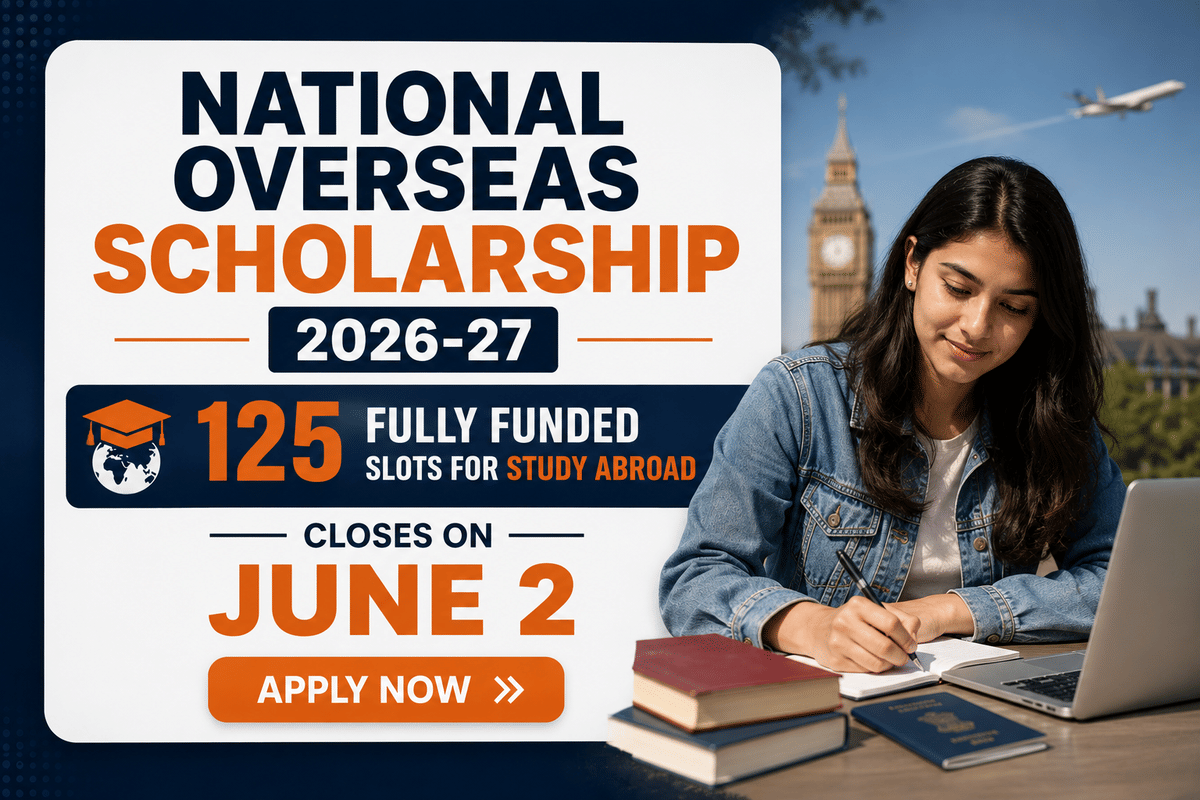
SC, DNT, and landless artisan students with a Master's or PhD ambition abroad have 25 days to apply for the only central government scholarship that covers the full cost of an overseas degree — tuition, living expenses, airfare, visa fees, and health insurance included. The Ministry of Social Justice and Empowerment has opened the National Overseas Scholarship (NOS) 2026–27 application portal, with a hard deadline of June 2, 2026 at 23:59 hours. Only 125 slots are available nationally, and the portal closes without exception.
For eligible students, NOS is the most comprehensive government-funded study abroad scheme in India — and one of the least applied-to, relative to its value. The annual maintenance allowance alone stands at $15,400 (~₹14.5 lakh at current rates), on top of full tuition paid directly to the foreign university.
What NOS Covers: The Full Financial Picture
Most study abroad scholarships cover one cost category. NOS covers all of them. Unlike the Commonwealth Master's Scholarship — which excludes visa fees and the UK Immigration Health Surcharge — or the DAAD, which does not cover tuition, NOS is structured as a comprehensive package for the full duration of study.
| Cost Component | NOS Coverage |
|---|---|
| Tuition fees | Full — paid directly to the institution |
| Annual maintenance allowance | $15,400 (~₹14.5 lakh) outside UK; £9,900 (~₹12.8 lakh) in UK |
| Return airfare (economy class) | Covered |
| Health and medical insurance | Covered |
| Visa fees | Covered |
| Contingency and equipment allowance | Covered |
| Local travel | Covered |
Funding runs for up to three years for Master's programmes and four years for PhD programmes, or until course completion — whichever comes first. For a student heading to the US or UK, where a self-funded Master's costs ₹80 lakh to ₹1.5 crore in total, NOS eliminates the financial barrier.
One important note: financial assistance is released only after the Final Award Letter is issued by the Ministry, following confirmation of admission by the Indian Mission abroad. Students must arrange their own travel and initial settlement expenses — no advance grant is provided before joining.
Also check: Reality of Study Abroad Scholarships for Indian Students in 2026 — What They Cover and What They Don't
Who Can Apply: Eligibility for 2026–27
The 125 slots are distributed across three target communities. 30% of all slots are reserved for women candidates across every category.
| Category | Slots |
|---|---|
| Scheduled Caste (SC) | 115 |
| Denotified, Nomadic and Semi-Nomadic Tribes (DNT) | 6 |
| Landless Agricultural Labourers and Traditional Artisans | 4 |
| Total | 125 |
All four of the following conditions must be met:
- Age: Below 35 years as of April 1, 2026
- Academic score: Minimum 60% marks (or equivalent grade) in the qualifying degree — Bachelor's for Master's applicants, Master's for PhD applicants
- Family income: Total annual family income from all sources must not exceed ₹8,00,000 for FY 2025–26. If income exceeds ₹2.5 lakh (old tax regime) or ₹3 lakh (new tax regime), ITR acknowledgment must be uploaded at the time of application
- University ranking: Applicants must have — or be seeking — an unconditional offer of admission from a university ranked in the QS World University Rankings top 500
A state-wise cap applies: no more than 10% of total slots (approximately 12–13 seats) can go to applicants from any single state or UT in the first round. Unfilled seats are carried forward to a second round.
Undergraduate courses are not covered. Candidates already settled or studying abroad are ineligible. A maximum of two children from the same family can avail the scholarship.
Key Dates: The June 2 Deadline Is Absolute
The NOS portal operates on a strict schedule confirmed on the official website at nosmsje.gov.in. Late or incomplete applications are not considered under any circumstances.
| Milestone | Date |
|---|---|
| Application portal opens | April 24, 2026 (00:00 hours) |
| Last date to apply | June 2, 2026 (23:59 hours) |
| Correction window — submitted applicants only, no new registrations | June 4–7, 2026 |
| Second round portal opening | September/October 2026 (40 days) |
The correction window from June 4–7 is for fixing errors in already-submitted applications only. Students who miss June 2 must wait for the second round in September/October 2026 — by which time most September intake university deadlines will have passed.
Also check: Study Abroad Scholarships for Indian Students Closing in May 2026
Documents to Prepare Before You Apply
All documents must be uploaded digitally through the NOS portal at nosmsje.gov.in. Physical submissions are not accepted. Incomplete applications are rejected without review.
- Aadhaar card
- Category certificate (SC/DNT/landless artisan) issued by a competent authority — District Magistrate, Tehsildar, or Revenue Officer
- Income certificate for FY 2025–26 in the format prescribed by the Ministry, issued by a competent authority. Must clearly state the financial year
- ITR acknowledgement (if family income exceeds ₹2.5 lakh under old tax regime or ₹3 lakh under new tax regime)
- All academic degree certificates and mark sheets
- Unconditional offer letter from a QS top-500 foreign university (if already secured; conditional applicants may apply but are ranked lower)
- Research proposal — mandatory for PhD applicants
- No Objection Certificate from the employer — mandatory for employed candidates
- Passport copy (if available)
The income certificate format is a common rejection trigger. It must be issued by a competent authority, reflect FY 2025–26 figures, and clearly state the financial year. Certificates that do not comply with these conditions are treated as invalid, per the official NOS FAQ.
What to Do in the Next 25 Days
- Register on the portal today at nosmsje.gov.in. Registration and application submission are separate steps — do not wait until June 1 to begin.
- Get the income certificate first. This is the most common document that causes delays. It must be issued by a Tehsildar or District Magistrate and reflect FY 2025–26 income. Allow 7–14 days for issuance in most states.
- Confirm your university's QS ranking. The Ministry requires applicants to target institutions in the QS World University Rankings top 500. Check the QS 2026 rankings at topuniversities.com before applying.
- If you don't have an offer letter, apply to universities now. Applicants with an unconditional offer are ranked above conditional applicants. Several US, UK, and German universities accept rolling applications. An offer letter significantly strengthens your NOS application.
- PhD applicants: prepare your research proposal carefully. This is a mandatory document and a key selection criterion. It should clearly state the research problem, methodology, and relevance to India's development priorities.
- Apply only through the official portal. The NOS portal accepts only direct applications at nosmsje.gov.in. Any third-party agency claiming to submit on your behalf is operating outside the official process.
Why This Scholarship Matters More in 2026 Than Any Previous Year
India now has over 1.33 million students studying abroad — a 45% increase in five years, according to Ministry of External Affairs data. But access remains sharply unequal. Students from SC, DNT, and landless artisan communities face compounded barriers: the cost of overseas education, collateral requirements for education loans, and the absence of family networks with international study experience.
The 2026 environment makes NOS more consequential than in previous cycles. US F-1 visa rejection rates for Indian students reached 61% in 2025. Australia rejected over 50% of Indian student visa applications in early 2026. Canada's refusal rate for Indian applicants hovers near 80%. In this environment, a government-backed scholarship carries weight in visa interviews that self-funded applications do not — it signals institutional endorsement, financial stability, and a clear return commitment to India.
NOS is the only central government scheme that addresses the full financial barrier simultaneously — covering tuition, living costs, travel, and visa fees — while also strengthening the visa application itself. For eligible students, the 25 days remaining are enough. But only if the application process starts today.



Comments