



| Updated On - Jul 6, 2026
An LOR for Computer Science is a formal letter from a professor or manager that vouches for your technical skills, projects, and fit for a CS program. It carries real weight in admissions. For Indian students applying to CS programs abroad, a sharp, specific LOR can set your file apart from thousands of strong applicants. This guide covers the LOR for Computer Science format, samples, and writing tips.
- A CS LOR should highlight coding skills, projects, and problem-solving.
- Most applications need 2 to 3 LORs, academic or professional.
- Strong letters use specific examples and peer rankings, not generic praise.
- It must be on official letterhead, signed, with the recommender's contact information.

| Parameter | Detail |
|---|---|
| What it is | A letter vouching for your CS ability |
| Who writes it | A professor or a manager |
| Number needed | Usually 2 to 3 |
| Length | Short, 400 to 600 words |
| Must show | Coding skills, projects, peer ranking |
| Format | Official letterhead, signed |
| Top mistake | Generic praise with no examples |
Must Read:
- Documents Required for Study Abroad 2026: Full Guide
- How to Study Abroad After 12th from India Full Guide
- Letter of Recommendation (LOR) for Study Abroad: Format, Types and Sample
- Statement of Purpose (SOP): Format, Samples & Writing Tips
What Is an LOR for Computer Science
An LOR for Computer Science is a recommendation letter that a professor or employer writes to endorse your technical ability, projects and readiness for a CS degree. It backs your own claims with authority.
Academic LORs come from faculty, while professional ones come from managers. Most CS applications need a mix of both, and the right choice depends on whether you are a recent graduate or already working in tech. A wider view is in this list of top universities abroad for Indian students.
What a CS LOR does and what it does not:
- Does: confirm your coding skills, projects, and character from someone credible.
- Does not: replace your SOP, transcripts, or coding portfolio.
Key Elements of a CS LOR
The key elements of a CS LOR are the recommender's introduction, your technical skills, a key project, personal qualities, a peer ranking, and a clear endorsement. Specifics make it work. Missing any of these weakens the letter, so treat them as a checklist. The image below maps these elements onto a real academic sample.
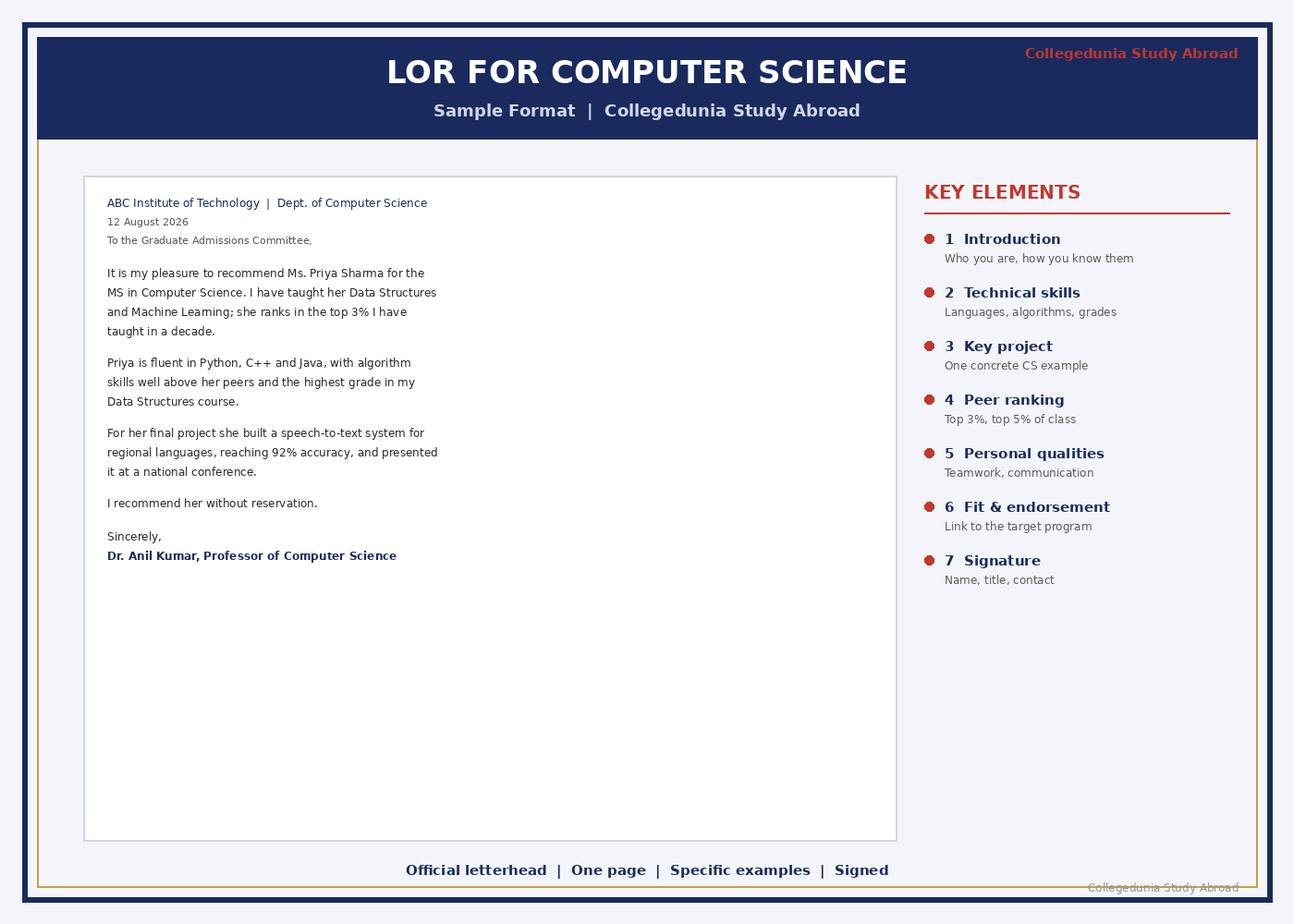
The wider application picture is in this study abroad guide for Indian students. The core elements are:
- Introduction, who the recommender is and how they know you, with their title.
- Technical skills, your programming languages, algorithms and standout coursework.
- A key project, one concrete CS example with your role and the result.
- Personal qualities, teamwork, communication and work ethic.
- Peer ranking and endorsement, such as top 5%, with a strong final recommendation.
Note: A peer comparison is the most powerful line in a CS LOR. A ranking like top 3% of students I have taught carries far more weight than adjectives, since committees compare thousands of applicants and want a credible benchmark.
Students can also check,
LOR for Computer Science Format
The LOR for Computer Science format runs from the letterhead and date through an introduction, technical ability, a project example, personal qualities and a signed endorsement. Keep it short, on one sheet.
Two full samples and a template are attached, showing the format for a professor and a manager. The format is below.
| Section | What to write |
|---|---|
| Letterhead and date | Institution or company letterhead, date, addressee |
| Introduction | Recommender's role, how they know you, overall recommendation |
| Technical ability | Languages, algorithms, grades or course rank |
| Key project | One example with your role, skills and result |
| Personal qualities | Teamwork, communication, peer comparison |
| Fit and closing | Link to the program, endorsement, contact offer |
| Signature block | Name, designation, department, email and phone |
Note: A CS LOR must be on official letterhead and signed, with the recommender's institutional email and phone. Committees may verify it, and a letter without verifiable contact details or a signature loses credibility instantly, however strong the content.
Computer Science LOR Samples
The attached samples cover the two main cases: an academic LOR from a professor and a professional LOR from an engineering manager, both tailored to a CS Master's. Use them as models, not scripts.
Both show how to turn skills into specific, quantified examples. The downloadable files are the format template plus these two samples. The two sample types are:
| Sample | Best for |
|---|---|
| Academic LOR (professor) | Recent graduates and Master's applicants |
| Professional LOR (manager) | Applicants with work experience |
CS LOR Writing Tips and Mistakes
The best CS LOR writing tips are to use specific projects, add numbers, include a peer ranking, tie strengths to the program and avoid generic praise. Detail beats adjectives every time.
Small fixes lift a letter above the pile, so use the checklist below. The common mistakes and fixes are:
| Common mistake | The fix |
|---|---|
| Generic praise with no proof | Add a specific project and result |
| No technical detail | Name languages, tools and algorithms |
| No comparison | Add a peer ranking like top 5% |
| Same letter for every university | Tie strengths to each program |
| No letterhead or signature | Use official letterhead and sign it |
What a strong CS LOR shows and what a weak one does:
- Strong: specific code, real projects, a peer ranking and a clear endorsement.
- Weak: vague praise, no technical depth and content that fits any student.
If your LOR could describe any CS student, then it is too generic. That means adding real projects, numbers and a peer comparison before you submit.
An LOR for Computer Science works when it proves your technical ability with real examples rather than praising it in the abstract. Choose recommenders who know your coding work, give them your projects and achievements, then ensure they add a peer ranking and a program-specific endorsement. Keep it to one signed sheet on letterhead, use the template and samples as a structure, then tailor each letter. Done well, a CS LOR becomes strong, credible evidence that you belong in the program.
FAQs
Ques. What is an LOR for Computer Science?
Ans. It is a recommendation letter from a professor or manager that endorses your technical skills, projects and readiness for a CS program. It backs your application with a credible, third-party view of your ability.
Ques. How many LORs do I need for a CS program?
Ans. Most universities ask for 2 to 3 LORs. For a Master's, at least one should be academic. If you are working, one professional letter from a manager strengthens the set.
Ques. Who should write my CS LOR?
Ans. Choose someone who knows your technical work well, such as a professor who taught your core CS courses or a manager who supervised your coding projects. A specific letter from a direct supervisor beats a senior name who barely knows you.
Ques. What should a CS LOR include?
Ans. An introduction, your technical skills, a key project, personal qualities, a peer ranking and a strong endorsement. It should name programming languages and give at least one concrete, quantified project example.
Ques. How long should a CS LOR be?
Ans. Short, about 400 to 600 words on one sheet. Committees read many letters, so a focused letter with specific examples works far better than a long, general one full of adjectives.



Comments