



Study Abroad Expert | Updated On - Oct 14, 2026
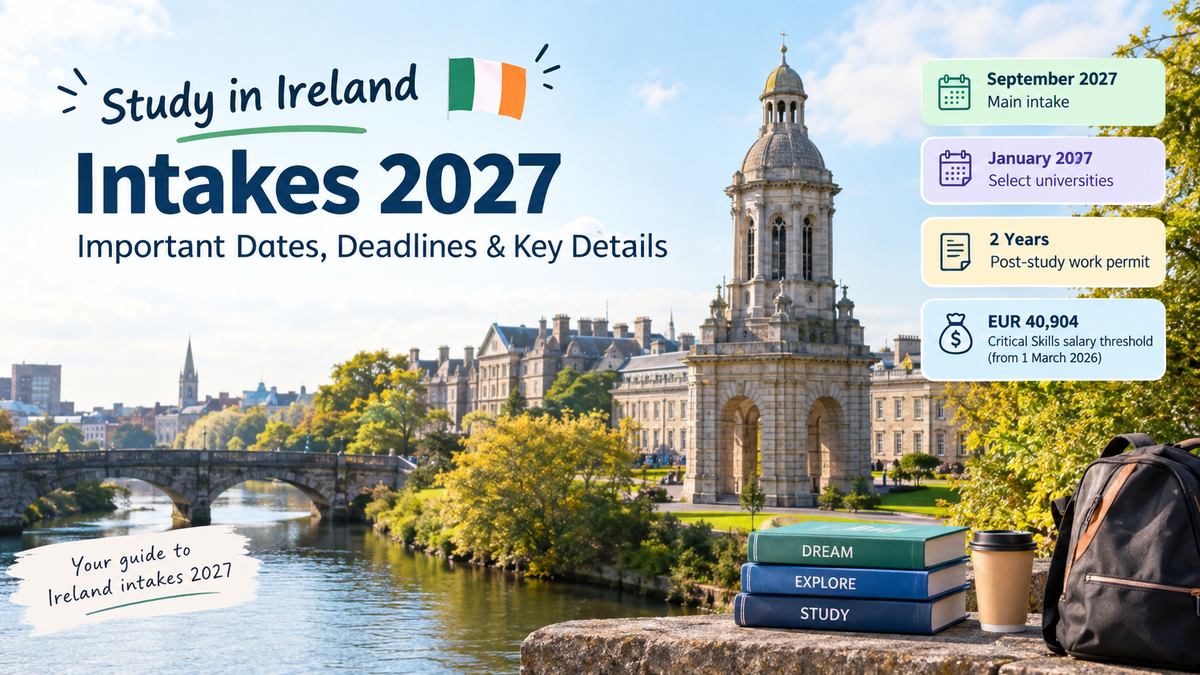
Ireland has two main intakes in 2027: September (Autumn) and January (Spring). September 2027 is the main window, with Trinity College Dublin closing on 30 June 2027 and Maynooth on 31 May 2027. Most other universities use rolling admissions through May and June 2027. January 2027 applications close in October and November 2026 at NCI, DBS, Griffith and Maynooth.
- September wins on course choice, scholarships and job-market timing for most applicants.
- January is a smaller window used by select universities, not by Trinity or UCD for most courses.
- Ireland's Third Level Graduate Programme gives masters graduates a 2-year post-study work permit.
- Rolling admissions mean popular courses close well before stated deadlines.
Check top Irish universities for Indian students
Ireland's Critical Skills Employment Permit salary threshold rose to EUR 40,904 from 1 March 2026. This affects job-visa planning after the degree. Your intake choice decides your deadlines, scholarship odds and graduate work timeline.
Quick Facts on Ireland Intakes 2027
| Parameter | Detail |
|---|---|
| Main intakes in Ireland 2027 | September (Autumn), January (Spring) |
| Trinity College Dublin September 2027 | 30 June 2027 (priority 1 February 2027) |
| Maynooth University September 2027 | 31 May 2027 |
| DCU September 2027 (non-EU) | 1 July 2027 |
| UCD, UCC, Galway, Limerick | Rolling admissions, apply May to June 2027 |
| Post-study work permit (masters) | 2 years under Third Level Graduate Programme |
| Critical Skills salary threshold | EUR 40,904 from 1 March 2026 |
Deadlines above follow university-published dates for the previous cycle. Verify each date on the official university portal before applying. Source: Collegedunia Ireland intakes guide and Irish government work permit updates.
- Quick Facts on Ireland Intakes 2027
- What Are the Intakes in Ireland 2027?
- September 2027 Intake Deadlines in Ireland
- January 2027 Intake in Ireland
- Which Ireland Intake Is Best in 2027?
- Documents for Ireland Intakes 2027
- Fees Across Ireland Intakes
- Visa and Post-Study Work in Ireland
- FAQs on Intakes in Ireland 2027
What Are the Intakes in Ireland 2027?
Ireland offers two main intakes each year: September and January. A small May intake exists at a few private colleges. Public universities mainly run the September Autumn cycle.
Indian applicants planning to study in Ireland apply directly on each university portal. There is no central application system for international students at the postgraduate level.
| Intake | Classes Start | Typical Deadlines | Scale |
|---|---|---|---|
| September 2027 (Autumn) | Mid September 2027 | May to July 2027 | Main intake, all universities open |
| January 2027 (Spring) | January to February 2027 | October to November 2026 | Select universities only |
| May 2027 (Summer) | May 2027 | Varies by college | A few private colleges |
September and January together cover nearly every masters and bachelor degree. May is rare and limited to specific private college programs.
- Trinity College Dublin, UCD, UCC and University of Galway admit mainly in September.
- DCU, Maynooth, NCI, Griffith and DBS open the January window for select programs.
Based on advisor-cycle estimates, Indian students mostly target September for the full course list and better placement timing.
September 2027 Intake Deadlines in Ireland
September 2027 is the main Irish intake, and deadlines span May to July 2027 across universities. Trinity College Dublin runs the earliest priority date, and most other universities use rolling admissions.
| University | September 2027 Deadline |
|---|---|
| Trinity College Dublin | 30 June 2027 (priority 1 February 2027) |
| Maynooth University | 31 May 2027 |
| DCU (non-EU) | 1 July 2027 |
| University College Dublin | Rolling; apply May to June 2027 |
| University College Cork | Rolling; apply early |
| University of Galway | Rolling; apply early |
| University of Limerick | Rolling; apply by June 2027 |
Source: Collegedunia Ireland intakes guide, based on previous-cycle data. Verify each date on the official university portal before applying.
- Trinity's priority round decision arrives by 1 April, which helps with early scholarship planning.
- Rolling admissions mean popular MS courses can close well before the final deadline.
- DCU and Maynooth usually open applications in October 2026 for September 2027 entry.
Business, data analytics and computer science programs fill fastest. Review the top MS universities abroad list to balance your Ireland shortlist with other options.
Read More: scholarships in Ireland for international students
January 2027 Intake in Ireland
January 2027 is Ireland's smaller intake, with deadlines falling in October and November 2026. Classes start in January or February 2027. Trinity and UCD do not offer January entry for most masters programs.
January suits late applicants who missed September 2026 but want to avoid a near full-year gap. The universities that run January include DCU, Maynooth, NCI, Griffith and DBS.
| University or College | January 2027 Deadline |
|---|---|
| Griffith College Dublin | 1 October 2026 |
| Maynooth University (select programs) | 31 October 2026 |
| DCU (select programs) | November 2026 |
| National College of Ireland | November 2026 |
| Dublin Business School | November 2026 |
What the January 2027 intake gives you:
- A 7-month shift rather than a full-year wait after missing September 2026.
- Access to business, IT and management masters at private and semi-private colleges.
- Smaller cohorts and quieter orientations in January.
What January does not cover:
- Trinity College Dublin and UCD for most masters programs.
- The full government scholarship cycle, which anchors on September.
- Many engineering and health-science programs tied to the September start.
Key Insight: January is not a weaker admit route. Academic standards stay the same. The real limit is which university runs your course in January, not the admit bar itself.
Which Ireland Intake Is Best in 2027?
September is the best Ireland intake for most Indian students in 2027. It carries all universities, the full scholarship cycle and clean post-study work timing. January suits late applicants or those targeting DCU, Maynooth or private colleges.
| Factor | September 2027 | January 2027 |
|---|---|---|
| Universities open | All public and private | Select universities and colleges |
| Trinity, UCD, UCC, Galway | All open | Not offered for most programs |
| Scholarships | Full cycle | Limited |
| Fit with Indian graduation | Natural after May results | Needs a half-year bridge |
| Graduation and job timing | Finish by August or September 2028 | Finish by December 2027 or January 2028 |
Graduation timing matters for the post-study work permit. September graduates typically finish during Ireland's main summer hiring window. January graduates finish in winter, when hiring is quieter.
Admission difficulty depends on the university, not the intake. Applicants worried about selectivity can balance their shortlist with options on the cost of studying in Ireland guide.
Key Insight: Choose by readiness, not calendar pride. A clean January file at DCU or Maynooth beats a rushed September file at Trinity. The visa stage magnifies every weakness in a hurried application.
Documents for Ireland Intakes 2027
Every Ireland intake 2027 needs the same core file. Only the dates change. Start building the file at least 8 to 10 months before your target start month.
The standard checklist for Indian applicants:
- Academic transcripts and degree or Class 12 certificates.
- An English test score accepted by the university.
- A statement of purpose and 2 academic recommendations.
- CV with internships, projects and work experience.
- Passport and funds proof for the Irish student visa.
Book the English test slot first because results take time to arrive. Irish universities widely accept the IELTS exam for admission and visa purposes. Many universities also take the PTE exam, which reports scores within days. That speed helps late January applicants.
GRE is rarely required for Irish masters. Business schools may ask for GMAT only in specific MBA tracks. Review your target program's exact test list on the official portal. Your statement of purpose carries real weight at Irish universities. Keep it specific to the course and tie it to work or project experience.
Fees Across Ireland Intakes
Fees in Ireland stay identical across September and January intakes. Masters tuition for non-EU students typically ranges from EUR 15,000 to EUR 25,000 per year (INR 14 to 24 lakh). Living costs add another EUR 10,000 to EUR 14,000 annually.
- Trinity and UCD typically sit at the higher end of masters tuition.
- Maynooth, DCU and Limerick usually fall mid-range for international fees.
- Private colleges like NCI, Griffith and DBS run lower tuition than top-tier public universities.
Funding plans do shift by intake. Government scholarships like the Government of Ireland International Education Scholarship follow the September cycle. January entrants rely more on university-specific awards and private lenders.
Compare award eligibility and timing on the scholarships in Ireland guide. Indian lenders also sanction education loans against Irish admit letters. Compare rates and timelines on the education loan options hub, because the sanction letter doubles as funds proof.
Key Insight: The 2-year post-study work permit changes ROI math for Ireland masters. A one-year masters plus 2 working years in Ireland typically pays back loan EMI within the first 18 months of full-time work.
Visa and Post-Study Work in Ireland
The Irish student visa (Stamp 2) takes about 4 to 8 weeks from India, so visa planning starts right after the admit arrives. You apply online through the AVATS portal with the admit letter, funds proof and tuition payment receipt. Ireland then adds something the UK and US do not: the Third Level Graduate Programme. This gives graduates a Stamp 1G extension to stay and work after their degree.
- Masters graduates receive a 2-year work permit under Stamp 1G.
- Bachelor graduates receive a 1-year work permit.
- PhD graduates receive a 2-year work permit.
- Stamp 1G allows full-time work for any employer without a prior job offer.
After the 2 years, graduates typically shift to the Critical Skills Employment Permit. The salary threshold for this permit rose to EUR 40,904 from 1 March 2026. That matters for roles in tech, finance and engineering.
Visa processing speeds vary by season. The May to August window sees the highest volume as September students apply together. Review the official process in the Ireland student visa guide before booking the file.
For long-term work plans, the Ireland work permit guide covers Critical Skills and General Employment Permit routes.
Also Check:
| University College Dublin | Trinity College Dublin | Dublin City University |
| Maynooth University | Average Cost of Studying Abroad | Course Finder for Study Abroad |
The intakes in Ireland 2027 give Indian students two real entry points across the year. September 2027 remains the strongest window for courses, scholarships and the full post-study work calendar. January 2027 rewards prepared applicants targeting DCU, Maynooth or private colleges. Work backwards from the deadline, not the semester start date, and the rest of the plan falls into place.
FAQs
Ques. How many intakes are there in Ireland for 2027?
Ans. There are two main intakes in Ireland 2027: September (Autumn) and January (Spring). A smaller May intake exists at a few private colleges. September is the primary intake, with every public and private university open.
Ques. What is the Trinity College Dublin deadline for September 2027?
Ans. Trinity College Dublin's final deadline is 30 June 2027. The priority deadline falls on 1 February 2027, with decisions by 1 April 2027. Applicants targeting scholarships should file in the priority round.
Ques. Which universities offer the January 2027 intake in Ireland?
Ans. DCU, Maynooth, NCI, Griffith College and Dublin Business School offer January 2027 entry for select programs. Trinity College Dublin and UCD do not offer January entry for most masters courses. January deadlines run from October to November 2026.
Ques. Which Ireland intake is best for Indian students?
Ans. September is best for most Indian students. It carries all universities, the full scholarship cycle and clean post-study work timing. January suits applicants who need extra prep time or target universities that run both intakes.
Ques. How long can I stay in Ireland after my masters?
Ans. 2 years under the Third Level Graduate Programme on a Stamp 1G permit. This allows full-time work for any employer without a prior job offer. Bachelor graduates receive 1 year, and PhD graduates receive 2 years.
Ques. What is the Critical Skills Employment Permit threshold in Ireland?
Ans. The threshold rose to EUR 40,904 from 1 March 2026. Graduates targeting a long-term stay typically move from Stamp 1G to the Critical Skills Employment Permit before their 2-year graduate window ends. Tech and finance roles usually clear the threshold.
Ques. When should I apply for the September 2027 intake in Ireland?
Ans. Start by October or November 2026, which gives a clean 10-month runway. Many universities open applications in October 2026 and admit on a rolling basis. Trinity's priority round in February 2027 is the first hard target.
Ques. How much does a masters in Ireland cost in 2027?
Ans. Masters tuition for non-EU students typically runs from EUR 15,000 to EUR 25,000 per year (around INR 14 to 24 lakh). Living costs add another EUR 10,000 to EUR 14,000 annually. Private college tuition sits lower than top-tier public universities.
Ques. Is the IELTS score for Ireland the same across intakes?
Ans. Yes. Most Irish universities ask for an IELTS 6.5 overall, with 6.0 in each band, across both September and January intakes. Trinity, UCD and some competitive programs may ask for 7.0 overall. Verify on each program's official portal.
Ques. Does Ireland offer rolling admissions?
Ans. Yes, most Irish universities run rolling admissions for international students. UCD, UCC, Galway and Limerick open applications in October of the previous year and admit on a first-come basis. Popular courses can close before the stated final deadline.
Ques. Can I switch from September to January intake after admit?
Ans. Only at universities that run both intakes for your target course. Most universities allow a one-time deferral if you request it before paying the deposit. Deferral policies differ, so check with the university admissions office directly.



Comments