



Study Abroad Expert | Updated On - Apr 2, 2026
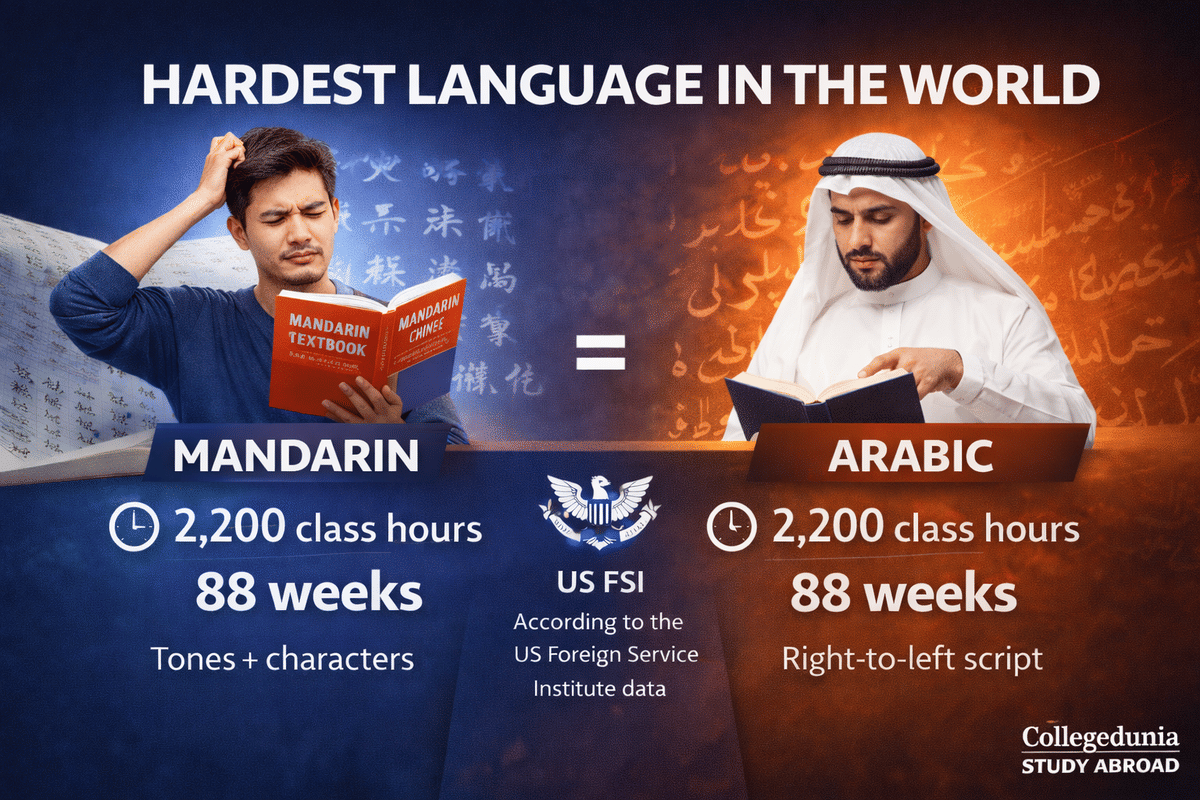
Most people assume Mandarin is the hardest language in the world — and they're not wrong. But here's what the US government's own data actually confirms: achieving basic professional proficiency in Mandarin takes 2,200 hours of full-time study. That's 88 weeks. For comparison, Spanish takes just 600 hours. The gap is staggering.
According to the US Foreign Service Institute (FSI) — the world's most authoritative language training body with 70+ years of data — Mandarin Chinese is the hardest language in the world for English speakers, requiring 2,200 class hours to reach Professional Working Proficiency. Arabic, Japanese, Korean, and Cantonese share this top-difficulty tier.
- What is the Hardest Language in the World?
- Top 10 Hardest Languages in the World (2026 Ranked List)
- FSI Language Difficulty Rankings
- What Makes a Language the Hardest to Learn?
- Hardest Languages to Learn for Hindi Speakers
- Is Mandarin or Arabic Harder to Learn?
- How Long Does It Take to Learn the Hardest Languages?
- Why Learn a Hard Language? Study Abroad and Career Benefits
- Tips to Learn the Hardest Languages Faster
- FAQs
What is the Hardest Language in the World?
Mandarin Chinese is widely recognised as the hardest language in the world, based on the Foreign Service Institute (FSI) rankings. However, the true answer depends on your native language. For Hindi-speaking Indian students, some languages that terrify English speakers are actually more approachable — and vice versa.
The FSI, which trains US diplomats and government officials, has spent over 70 years measuring exactly how long it takes native English speakers to reach professional fluency in foreign languages. Their data is the gold standard for language difficulty rankings globally.
The Answer According to the US Foreign Service Institute (FSI)
According to the US Foreign Service Institute, the five hardest languages for English speakers — classified as Category V — each require 2,200 classroom hours (88 weeks) of intensive study to reach Professional Working Proficiency (ILR Level 3). These five languages are:
- Mandarin Chinese
- Arabic
- Japanese
- Korean
- Cantonese
These are not just "hard" — they are in a category of their own, requiring nearly four times the study hours of Spanish or French.
Why "Hardest" Depends on Your Native Language
Language difficulty is relative to your starting point. A native Hindi speaker learning Japanese will find the Subject-Object-Verb grammar structure surprisingly familiar — because Hindi uses the same structure. Meanwhile, an English speaker finds it completely backwards.
Similarly, Indian students already familiar with Devanagari script may find learning other complex scripts less intimidating than their Western counterparts. The FSI rankings assume a native English speaker with no prior language exposure. For Indian students, the difficulty map shifts.
Top 10 Hardest Languages in the World (2026 Ranked List)
The top 10 hardest languages in the world are Mandarin Chinese, Arabic, Japanese, Korean, Telugu, Cantonese, Polish, Finnish, Russian, and Icelandic, based on FSI difficulty classifications, linguistic complexity, and expert consensus. Below is the complete ranked table, followed by a detailed breakdown of each language.
| Rank | Language | FSI Category | Hours to Proficiency | Key Difficulty Factor | Native Speakers |
|---|---|---|---|---|---|
| 1 | Mandarin Chinese | V | 2,200 | Tones + logographic script | 1.3 billion |
| 2 | Arabic | V | 2,200 | Right-to-left script + diglossia | 310 million+ |
| 3 | Japanese | V | 2,200 | Three writing systems + honorifics | 123 million |
| 4 | Korean | V | 2,200 | Honorifics + SOV grammar | 77 million |
| 5 | Telugu | IV | 1,100 | Complex syllabic script + agglutination | 96 million |
| 6 | Cantonese | V | 2,200 | 6–9 tones + oral/written disparity | 85 million |
| 7 | Polish | IV | 1,100 | 7 cases + consonant clusters | 45 million |
| 8 | Finnish | IV | 1,100 | 15 grammatical cases + agglutination | 5.5 million |
| 9 | Russian | IV | 1,100 | Cyrillic script + 6 cases | 258 million |
| 10 | Icelandic | IV | 1,100 | Archaic Old Norse grammar | 370,000 |
As the table shows, the top five languages (Mandarin, Arabic, Japanese, Korean, Cantonese) all sit in FSI Category V — the hardest tier. The remaining five sit in Category IV, still requiring over 1,100 hours of dedicated study. Here is what makes each one uniquely challenging.
1. Mandarin Chinese — Tones, Characters, and 2,200 Hours
Mandarin Chinese is the hardest language in the world, consistently ranked #1 by the FSI, UNESCO, and language learning institutions globally. Spoken by over 1.3 billion people, it is also the second most spoken language in the world after English.
What makes Mandarin so difficult is the combination of three simultaneous challenges: a tonal pronunciation system, a logographic writing system, and a grammar structure with no alphabet.
The tone problem is real. Mandarin uses four main tones plus a neutral tone. The same syllable — "ma" — means four completely different things depending on pitch:
| Pinyin | Tone | Character | Meaning |
|---|---|---|---|
| mā | High flat (1st) | 妈 | Mother |
| má | Rising (2nd) | 麻 | Hemp |
| mǎ | Dipping (3rd) | 马 | Horse |
| mà | Falling (4th) | 骂 | To scold |
Get the tone wrong, and you've said something entirely different.
Beyond tones, Mandarin uses logograms (hanzi) — individual characters representing meaning, not sound. There are over 50,000 characters in existence. Basic literacy requires memorising approximately 3,500 characters; reading a newspaper comfortably requires 4,000–5,000. There is no alphabet to fall back on.
Mandarin is widely spoken across Southeast Asia and is increasingly valued in Indian business and diplomatic circles. China is India's largest trading partner, making Mandarin proficiency a significant career differentiator. Several Indian universities now offer Mandarin as a third language option.
2. Arabic — Right-to-Left Script and Diglossia Explained
Arabic is the second hardest language in the world, sharing FSI Category V status with Mandarin. With over 310 million native speakers across 22 countries, Arabic is the official language of the Arab League and one of the six official languages of the United Nations.
Arabic presents a unique combination of challenges that go beyond just learning a new script:
- Right-to-left script: Arabic is written from right to left in a cursive script where each letter changes shape depending on its position in a word (initial, medial, final, or isolated form).
- Missing vowels: Short vowels are typically not written in standard Arabic text. Readers must infer pronunciation from context — a skill that takes years to develop.
- Diglossia: This is Arabic's most underestimated challenge. Modern Standard Arabic (MSA), used in formal writing and media, differs substantially from the spoken dialects used in daily life. Egyptian Arabic, Gulf Arabic, and Moroccan Arabic are so different that native speakers from different regions sometimes struggle to understand each other.
- Root-based morphology: Arabic words are built from three-consonant roots. The root K-T-B, for example, relates to writing: kitab (book), maktab (office), kataba (he wrote). This system is logical but entirely foreign to Indo-European language speakers.
Arabic proficiency opens doors to careers in the Gulf Cooperation Council (GCC) countries — UAE, Saudi Arabia, Qatar, Kuwait, Bahrain, and Oman — where millions of Indians work. It also unlocks government scholarships from Arab nations for Indian students.
3. Japanese — Three Writing Systems at Once
Japanese is the third hardest language in the world, and arguably the most structurally complex in terms of its writing system. Japan is home to some of the world's top universities, making Japanese language proficiency increasingly relevant for Indian students considering study in Japan.
Japanese uses three writing systems simultaneously:
- Hiragana — a phonetic syllabary of 46 characters used for native Japanese words and grammatical elements
- Katakana — another phonetic syllabary of 46 characters used primarily for foreign loanwords
- Kanji — Chinese-derived logographic characters; the Japanese Ministry of Education designates 2,136 "Jōyō kanji" (commonly used characters) for everyday literacy
A single Japanese sentence can contain all three scripts at once. Beyond writing, Japanese has a complex honorific system (keigo) that requires speakers to use entirely different vocabulary and verb forms depending on the social relationship between speaker and listener. Speaking to your professor requires different language than speaking to a friend — and getting it wrong is considered rude.
For Indian students: Japan offers the MEXT Scholarship — one of the most generous government scholarships in the world — which covers full tuition, living expenses, and a monthly stipend. Japanese language proficiency (JLPT N2 or above) significantly strengthens scholarship applications.
4. Korean — Honorifics and Language Isolate Status
Korean is the fourth hardest language in the world, classified as a language isolate — meaning it has no proven genetic relationship to any other language family. This makes it impossible to leverage prior language knowledge when learning Korean from scratch.
Korean's difficulty stems from several compounding factors:
- Seven speech levels: Korean has seven distinct levels of formality, each requiring different verb endings, vocabulary, and sentence structures. The level you use depends on the age, social status, and relationship between you and the person you're speaking to.
- Subject-Object-Verb structure: Like Japanese (and Hindi), Korean places the verb at the end of the sentence — the opposite of English's Subject-Verb-Object order.
- Agglutination: Korean stacks suffixes onto word roots to indicate tense, mood, negation, and more. A single Korean word can convey what requires an entire English sentence.
- Hangul alphabet: The good news — Hangul, Korea's writing system, is logical and can be learned in a few days. The bad news — reading Hangul is the easy part; understanding what you're reading takes years.
The global rise of Korean popular culture (K-pop, K-dramas, Korean cinema) has dramatically increased interest in Korean among Indian students. South Korea also offers the Global Korea Scholarship (GKS), which funds full degree programs for international students.
5. Telugu — The Hardest Language in India
Telugu is widely considered the hardest language in India, and one of the most complex Dravidian languages in the world. Spoken by approximately 96 million people primarily in Andhra Pradesh and Telangana, Telugu is notable for its highly complex script and agglutinative grammar.
What makes Telugu uniquely difficult:
- Syllabic script complexity: Telugu uses a syllabic script with over 60 primary characters — among the most visually complex writing systems in the world. The characters are rounded and intricate, making them difficult to distinguish for new learners.
- Agglutinative grammar: Telugu adds multiple suffixes to word roots to indicate tense, person, mood, and more — creating very long words from short roots.
- Retroflex consonants: Telugu uses retroflex consonants (sounds made with the tongue curled back) that are challenging even for speakers of other Indian languages.
- Sandhi rules: When words sit next to each other in Telugu, their sounds merge and transform — making spoken Telugu sound very different from its written form.
For non-Telugu-speaking Indians, Telugu is often cited as one of the hardest Indian languages to learn. For international students, it ranks among the most structurally complex languages globally.
6. Cantonese — 6 to 9 Tones and Oral/Written Disparity
Cantonese is often considered even harder than Mandarin in terms of tonal complexity. While Mandarin has 4 tones, Cantonese has 6 to 9 tones depending on the analytical framework used — making tonal precision even more demanding.
Cantonese is spoken by approximately 85 million people, primarily in Hong Kong, Macau, Guangdong province in China, and overseas Chinese communities in Canada, the US, and Southeast Asia. A critical challenge unique to Cantonese is the oral-written disparity: most formal written Chinese is based on Mandarin, meaning Cantonese speakers must read and write in a language that differs from how they speak. This creates a double learning burden for students.
7. Polish — Consonant Clusters and 7 Grammatical Cases
Polish is the hardest Slavic language to learn, and one of the most phonetically intimidating languages for any learner. Polish uses the Latin alphabet — which might seem reassuring — but the similarity ends there.
Polish features 7 grammatical cases, meaning nouns, adjectives, and pronouns change their endings depending on their grammatical function in a sentence. Add to this three genders (masculine, feminine, neuter) and a perfective/imperfective verb aspect system, and Polish grammar becomes a formidable challenge.
The pronunciation is equally daunting. Polish consonant clusters — sequences of multiple consonants without intervening vowels — produce words like szczebrzeszyn and chrząszcz (beetle) that leave most learners speechless. Literally.
8. Finnish — 15 Grammatical Cases and Agglutination
Finnish is the hardest language in Northern Europe, and one of the most structurally alien languages for English speakers. Finnish belongs to the Uralic language family — completely unrelated to Indo-European languages — meaning there are virtually no vocabulary cognates to help learners get started.
Finnish has 15 grammatical cases (compared to English's remnant 3), each indicating a different relationship between words. Finnish is also agglutinative, meaning suffixes stack onto word roots to create meaning. The word talossanikin (in my house too) is a single Finnish word built from talo (house) + ssa (in) + ni (my) + kin (too). Finnish also has no gender, no articles, and no future tense — which simplifies some aspects but increases dependence on word endings and context for everything else.
9. Russian — Cyrillic Script and Mobile Stress
Russian is the hardest major European language to learn, requiring 1,100 hours of study according to FSI data. Russian is spoken by approximately 258 million people across Russia, Belarus, Kazakhstan, Ukraine, and throughout Eastern Europe and Central Asia.
Russian's primary challenges include:
- Cyrillic alphabet: 33 letters, some of which look like Latin letters but represent entirely different sounds (e.g., "P" in Cyrillic is pronounced like "R" in English)
- Six grammatical cases: Nouns, pronouns, and adjectives all change form based on their role in a sentence
- Mobile stress: Word stress in Russian shifts unpredictably between different forms of the same word — and getting it wrong changes meaning
- Verb aspects: Every Russian verb exists in two forms — perfective (completed action) and imperfective (ongoing action) — a concept with no direct English equivalent
Russia's geopolitical significance and the presence of Russian-language universities offering affordable education make Russian increasingly relevant for Indian students exploring non-English study destinations.
10. Icelandic — Archaic Old Norse Grammar
Icelandic is the hardest Germanic language to learn, preserving grammatical features from Old Norse that have been lost in all other Scandinavian languages. With only approximately 370,000 native speakers, Icelandic also has limited learning resources compared to other languages on this list.
Icelandic maintains four grammatical cases, three genders, and complex strong/weak noun and adjective declension patterns. What makes Icelandic uniquely challenging is its deliberate resistance to foreign vocabulary: instead of borrowing words from English or other languages, Icelanders coin new words from Old Norse roots. The word for "computer" in Icelandic is tölva — a blend of tala (number) and völva (prophetess). This means learners cannot rely on recognising international vocabulary.
FSI Language Difficulty Rankings
The Foreign Service Institute (FSI) classifies languages into four categories based on the average hours required for a native English speaker to reach Professional Working Proficiency (ILR Level 3). This is the most widely cited and authoritative language difficulty framework in the world.
The FSI has been training US diplomats and government officials in foreign languages for over 70 years. Their rankings are based on empirical data from thousands of students, not subjective opinion. The table below shows the complete FSI classification system.
| FSI Category | Study Hours | Study Weeks | Languages Included |
|---|---|---|---|
| Category I | 600–750 hours | 24–30 weeks | Spanish, French, Italian, Portuguese, Romanian, Dutch, Norwegian, Swedish, Danish |
| Category II | 900 hours | 36 weeks | German, Indonesian, Malay, Swahili, Haitian Creole |
| Category III | 1,100 hours | 44 weeks | Hindi, Russian, Polish, Finnish, Greek, Hebrew, Turkish, Thai, Vietnamese, Bengali, Urdu, Hungarian, Icelandic, and 30+ others |
| Category IV/V | 2,200 hours | 88 weeks | Arabic, Mandarin Chinese, Cantonese, Japanese, Korean |
Category I to Category V Explained
Category I languages (600–750 hours) are closely related to English, sharing vocabulary roots through Latin or Germanic origins. Spanish, French, and Italian fall here — learnable in roughly six months of intensive study.
Category II (900 hours) includes German, which despite being a Germanic language like English, has complex grammar (three genders, four cases) that pushes it into a harder tier.
Category III (1,100 hours) is a large and diverse group. Notably for Indian students, Hindi itself is in Category III — meaning English speakers find Hindi moderately difficult. This also means Hindi speakers learning Category III languages like Russian or Turkish are working across a similar difficulty gap.
Category IV/V (2,200 hours) is the hardest tier. These five languages — Arabic, Mandarin, Cantonese, Japanese, Korean — require nearly four times the study investment of Spanish. The FSI notes these languages have "significant linguistic and cultural differences from English" that compound across writing, grammar, and pronunciation simultaneously.
FSI estimates assume 25 hours per week of intensive classroom instruction plus homework. Self-study or app-based learning will take considerably longer. For Indian learners, immersion opportunities (living in the country, consuming media in the language) can significantly accelerate progress beyond FSI estimates.
What Makes a Language the Hardest to Learn?
Understanding these factors helps learners set realistic expectations and choose the right learning strategy from day one.
Pronunciation and Tonal Systems
Pronunciation difficulty is usually the first barrier learners encounter. For most Indian and English speakers, the biggest challenge comes from tonal languages — where the pitch of your voice changes the meaning of a word entirely.
Mandarin Chinese has 4 tones plus a neutral tone. Vietnamese has 6 tones. Cantonese has 6 to 9 tones. In these languages, saying a word with the wrong pitch doesn't just sound foreign — it means something completely different.
Arabic presents a different pronunciation challenge: guttural sounds produced deep in the throat using muscles most non-Arabic speakers have never consciously used. Japanese has pitch accent — a subtler tonal system where high and low pitch patterns distinguish words (e.g., hashi with a high-low pattern means "chopsticks"; with a low-high pattern it means "bridge").
Writing Systems — Alphabets, Scripts, and Logograms
Writing system difficulty is where most students give up. There are three broad types of writing systems, ranked by difficulty for new learners:
- Alphabetic systems (easiest): Latin alphabet (Spanish, Polish), Cyrillic (Russian), Greek — learnable in days to weeks
- Syllabic systems (moderate): Japanese hiragana and katakana (46 characters each), Korean Hangul — learnable in weeks
- Logographic systems (hardest): Mandarin Chinese and Japanese kanji — require memorising thousands of individual characters, each representing meaning rather than sound
Mandarin's writing system is uniquely demanding because there is no alphabet at all. Every word is a character. Basic literacy requires 3,500 characters; reading a newspaper requires 4,000–5,000. There are no shortcuts — each character must be memorised individually.
Grammar Complexity and Case Systems
Grammar is the underlying logic of a language. The further a language's grammar is from your native language, the harder it is to internalise. Key grammar challenges include:
- Grammatical cases: Finnish has 15, Hungarian has 18, Polish has 7, Russian has 6. Cases change word endings based on grammatical function — subject, object, possession, location, etc.
- Verb aspects: Russian and Polish verbs exist in perfective and imperfective pairs — a concept English has no equivalent for
- Honorific systems: Japanese and Korean require entirely different vocabulary and verb forms based on social hierarchy
- Word order: Japanese, Korean, and Hindi use Subject-Object-Verb order; Arabic uses Verb-Subject-Object — both are the opposite of English's Subject-Verb-Object
Note for Indian students: Hindi's SOV word order is actually an advantage when learning Japanese and Korean. Indian students often find Japanese grammar more intuitive than their Western counterparts — a genuine competitive edge worth leveraging.
Hardest Languages to Learn for Hindi Speakers
For Hindi-speaking Indian students, the hardest languages to learn are Mandarin Chinese, Arabic, and Cantonese — not Japanese or Korean, which share grammatical similarities with Hindi. This is a critical distinction that most generic "hardest language" guides miss entirely.
Understanding which languages are hardest for you specifically — based on your native language — is far more useful than a one-size-fits-all ranking.
Why Hindi Speakers Have a Unique Advantage with Japanese and Korean?
Hindi and Japanese share the Subject-Object-Verb (SOV) sentence structure. In Hindi: "Main seb khata hoon" (I apple eat). In Japanese: "Watashi wa ringo wo tabemasu" (I apple eat). The logic is identical. English speakers find this completely backwards; Hindi speakers find it natural.
Similarly, Hindi's postposition system (where grammatical markers follow nouns, unlike English prepositions that precede them) mirrors Japanese particles and Korean postpositions. This gives Hindi speakers a structural head start that can shave months off the learning curve.
Additionally, Hindi speakers are already comfortable with complex scripts (Devanagari has 47 primary characters), making the psychological barrier of learning Hiragana, Katakana, or Hangul less daunting than it is for English speakers.
Which Languages Are Hardest for Indian Students Specifically
| Language | Difficulty for Hindi Speakers | Key Challenge | Advantage |
|---|---|---|---|
| Mandarin Chinese | Very High | Tones + logographic script | None — completely alien structure |
| Arabic | Very High | Right-to-left script + diglossia | Some Urdu/Hindi vocabulary overlap |
| Cantonese | Very High | 6–9 tones + oral/written gap | None |
| Japanese | Moderate-High | Three writing systems + kanji | SOV grammar is familiar |
| Korean | Moderate-High | Honorifics + agglutination | SOV grammar is familiar |
| Russian | Moderate | Cyrillic + 6 cases | No advantage |
| Finnish | Moderate | 15 cases + no cognates | No advantage |
| German | Moderate | 3 genders + 4 cases | Some English cognates |
| French | Low-Moderate | Pronunciation + gender | Many English cognates |
The table above makes clear that Mandarin and Arabic are the hardest languages for Indian students — not because of any Indian-specific disadvantage, but because these languages are structurally alien to any Indo-European or Dravidian language background.
Is Mandarin or Arabic Harder to Learn?
For most Indian students, Arabic is marginally harder than Mandarin — primarily because of diglossia (the gap between written and spoken Arabic) and the absence of any structural overlap with Indian languages. However, the difference is small; both sit in FSI Category V at 2,200 hours.
The table below provides a direct head-to-head comparison across the key difficulty dimensions.
| Difficulty Factor | Mandarin Chinese | Arabic |
|---|---|---|
| Writing System | Logographic (3,500+ characters) | Abjad (28 letters, right-to-left) |
| Pronunciation | 4 tones + neutral tone | Guttural consonants, no tones |
| Grammar | Relatively simple (no cases, no gender) | Complex (dual number, gendered verbs, 3 cases) |
| Spoken vs. Written | Consistent | Highly divergent (diglossia) |
| Dialects | Regional variation (Mandarin vs. Cantonese) | Extreme variation (MSA vs. 30+ dialects) |
| Resources Available | Abundant (apps, courses, media) | Moderate (MSA well-resourced; dialects less so) |
| Career Value for Indians | High (China trade, Southeast Asia) | Very High (Gulf jobs, scholarships) |
| FSI Hours | 2,200 | 2,200 |
The verdict for Indian students: If your goal is career opportunities in the Gulf or Middle East, prioritise Arabic. If your goal is business in China, Southeast Asia, or accessing Chinese university scholarships, prioritise Mandarin. Both are equally demanding — choose based on your destination, not perceived difficulty.
How Long Does It Take to Learn the Hardest Languages?
According to FSI data, the hardest languages (Mandarin, Arabic, Japanese, Korean, Cantonese) each require approximately 2,200 classroom hours to reach professional proficiency. At a realistic self-study pace of 1–2 hours per day, this translates to 3–6 years of consistent effort.
The table below breaks down realistic time estimates for Indian learners at different daily study intensities.
| Language | FSI Hours | 1 hr/day | 2 hrs/day | 4 hrs/day (intensive) |
|---|---|---|---|---|
| Mandarin Chinese | 2,200 | ~6 years | ~3 years | ~18 months |
| Arabic | 2,200 | ~6 years | ~3 years | ~18 months |
| Japanese | 2,200 | ~6 years | ~3 years | ~18 months |
| Korean | 2,200 | ~6 years | ~3 years | ~18 months |
| Russian | 1,100 | ~3 years | ~18 months | ~9 months |
| Polish | 1,100 | ~3 years | ~18 months | ~9 months |
| Finnish | 1,100 | ~3 years | ~18 months | ~9 months |
| German | 900 | ~2.5 years | ~15 months | ~7 months |
| Spanish | 600–750 | ~2 years | ~12 months | ~5 months |
Important note: FSI estimates are for intensive classroom instruction with a qualified teacher. Immersion — living in the country where the language is spoken — can reduce these timelines by 30–50%. Conversely, app-only learning (Duolingo, Babbel) without speaking practice will take significantly longer than these estimates.
Why Learn a Hard Language? Study Abroad and Career Benefits
Learning one of the world's hardest languages is one of the highest-ROI investments an Indian student can make — both for study abroad opportunities and long-term career prospects. The difficulty itself is the advantage: fewer people do it, which means those who do stand out dramatically.
Scholarships for Learning Mandarin, Japanese, Korean, and Arabic
Several governments actively fund Indian students to learn their national languages through full scholarship programs:
| Language | Scholarship | Coverage | Eligibility |
|---|---|---|---|
| Mandarin Chinese | CSC Scholarship (China) | Full tuition + ₹10,000–15,000/month stipend | Undergraduate, postgraduate, PhD |
| Japanese | MEXT Scholarship (Japan) | Full tuition + ¥117,000/month (~₹65,000) | Undergraduate, postgraduate, research |
| Korean | Global Korea Scholarship (GKS) | Full tuition + KRW 900,000/month (~₹55,000) | Undergraduate, postgraduate |
| Arabic | Saudi Cultural Mission, UAE scholarships | Full tuition + accommodation | Undergraduate, postgraduate |
| German | DAAD Scholarship (Germany) | Full tuition + €934/month (~₹83,000) | Postgraduate, research |
Note: Scholarship amounts are approximate and subject to change. Verify current figures with respective embassy websites before applying.
Tips to Learn the Hardest Languages Faster
The most effective strategies for learning difficult languages are immersion, spaced repetition, and daily conversation practice — not passive study or app-only learning. Here is a proven framework for Indian students tackling Category IV or V languages.
1. Immersion — The Gold Standard
Surrounding yourself with the target language accelerates acquisition faster than any classroom method.
2. Spaced Repetition for Vocabulary
Spaced repetition — reviewing vocabulary at increasing intervals just before you forget it — is the most scientifically validated method for long-term retention.
3. Speak from Day One
The single biggest mistake language learners make is waiting until they feel "ready" to speak. Research consistently shows that one hour of active conversation equals five hours of passive study.
4. Targeted Grammar Study
Immersion builds intuition; targeted grammar study accelerates it. Rather than memorising abstract rules, focus on your specific weak points. For Mandarin, drill tones daily using tone-pair exercises. For Japanese, master the three writing systems in sequence: Hiragana first (2 weeks), then Katakana (2 weeks), then begin Kanji alongside conversation practice. For Arabic, focus on the root-pattern morphology system early — once you understand how roots work, vocabulary acquisition accelerates dramatically.
5. Set Milestone Goals, Not Vague Targets
Vague goals ("I want to learn Japanese") produce vague results. Set specific, measurable milestones tied to recognised proficiency exams:
- Mandarin: HSK 1 → HSK 2 → HSK 4 (business level)
- Japanese: JLPT N5 → N4 → N2 (university/scholarship level)
- Korean: TOPIK I → TOPIK II Level 4 (university admission level)
- Arabic: CEFR A1 → B1 → B2 (professional level)
- German: Goethe A1 → B1 → C1 (university admission level)
These certifications are recognised by universities and employers globally, and many study abroad scholarships require a minimum proficiency level as part of the application.
The hardest language in the world is not a fixed answer — it depends on where you start. For English speakers and most Indian students, Mandarin Chinese, Arabic, Japanese, Korean, and Cantonese sit at the top of every difficulty ranking, each requiring 2,200 hours of dedicated study to reach professional proficiency.
But difficulty is not a reason to avoid these languages. It is a reason to pursue them strategically. The world's hardest languages are also among the most valuable: Mandarin opens doors to China's $18 trillion economy, Arabic unlocks Gulf career opportunities for millions of Indians, Japanese proficiency qualifies you for one of the world's most generous scholarships (MEXT), and Korean fluency connects you to South Korea's booming technology and culture industries.
For Hindi-speaking Indian students, the key insight is this: you already have structural advantages with Japanese and Korean that English speakers do not. Your SOV grammar intuition, comfort with complex scripts, and familiarity with postposition systems give you a genuine head start. Use it.
Start with the language that aligns with your study abroad destination or career goal. Set milestone targets tied to recognised proficiency exams. Study daily — even 30 minutes consistently beats marathon weekend sessions. And remember: every person who speaks Mandarin, Arabic, or Japanese fluently started exactly where you are now.
FAQs
Ques. What is the #1 hardest language in the world?
Ans. Mandarin Chinese is the #1 hardest language in the world for English speakers, according to the US Foreign Service Institute (FSI). It requires 2,200 classroom hours — approximately 88 weeks of intensive study — to reach Professional Working Proficiency. The combination of a tonal pronunciation system, a logographic writing system requiring memorisation of 3,500+ characters, and a grammar structure completely unlike Indo-European languages makes Mandarin uniquely challenging. Arabic, Japanese, Korean, and Cantonese share this top-difficulty classification.
Ques. What is the hardest language to learn for English speakers?
Ans. The five hardest languages for English speakers are Mandarin Chinese, Arabic, Japanese, Korean, and Cantonese — all classified as FSI Category V languages requiring 2,200 hours of study. These languages combine unfamiliar writing systems, complex grammar, and pronunciation patterns that have no equivalent in English. For comparison, Spanish and French (Category I) require only 600–750 hours. The difficulty gap between Category I and Category V languages is nearly four times in terms of study investment.
Ques. Is Mandarin or Arabic harder to learn?
Ans. Both Mandarin and Arabic are classified at the same FSI difficulty level (Category V, 2,200 hours), making them equally hard by official measurement. For most Indian students, Arabic is marginally harder in practice due to diglossia — the significant gap between written Modern Standard Arabic and the spoken dialects used in daily life. This means Arabic learners effectively need to learn two varieties of the language. Mandarin, while extremely demanding in terms of characters and tones, has a more consistent relationship between its written and spoken forms.

1720429164.png?tr=w-305,h-145,c-force?h=40&w=40&mode=stretch)







Comments