



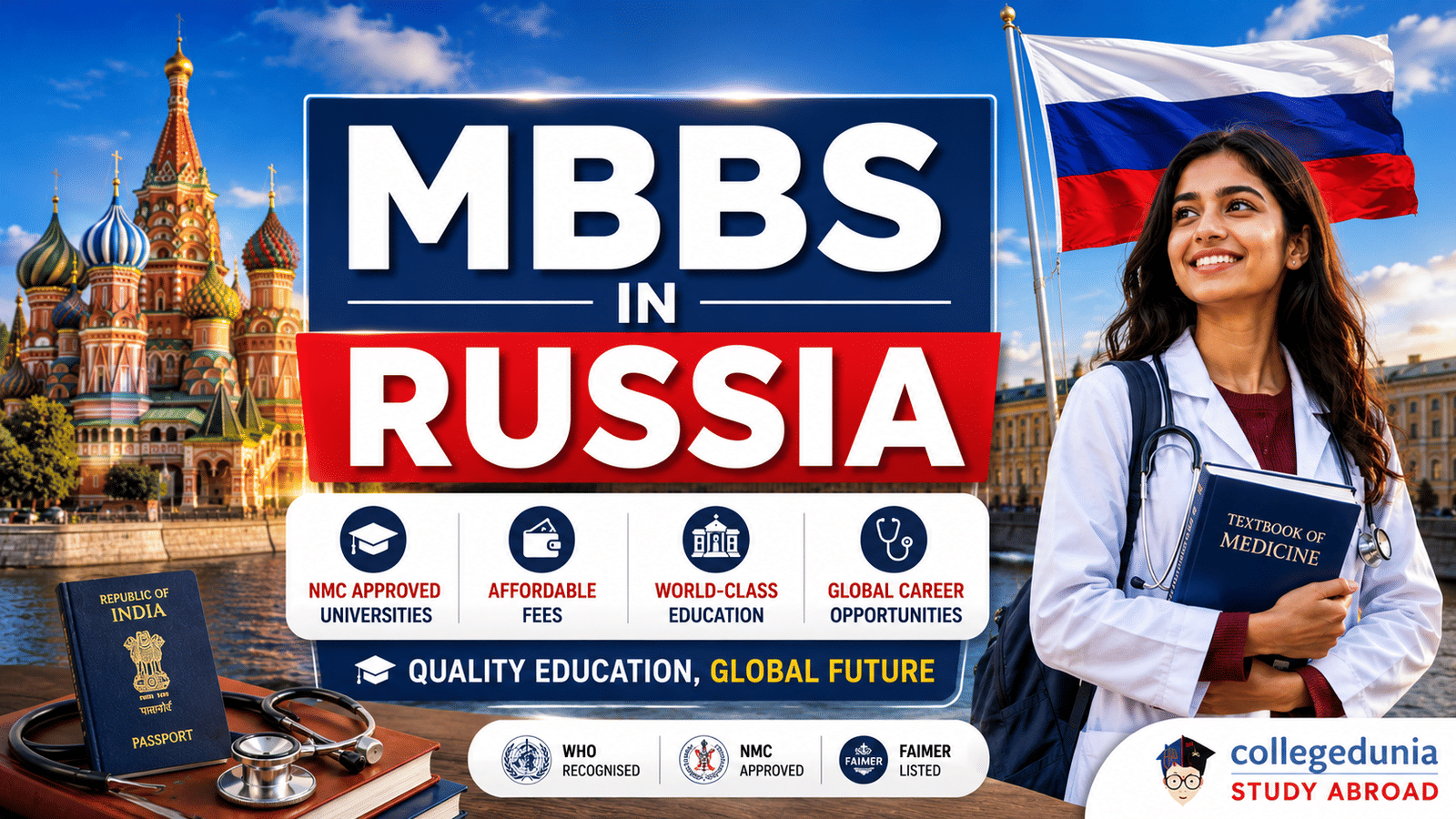
MBBS in Russia is a 6-year NMC-approved medical program that more than 27,000 Indian students currently pursue. Total cost runs Rs 25 to 50 lakh for the full 6-year program including tuition and living, against Rs 50 lakh to Rs 1.5 crore at Indian private medical colleges.
- The MBBS in Russia program is 6 years long, NMC-approved and English-medium for international students at most universities.
- Total cost for Indian students sits at Rs 25 to 50 lakh, inclusive of tuition, hostel and living, compared to Rs 50 lakh or more at Indian private colleges.
- The FMGE 2024 pass rate for Russian graduates was 29.54%, with top universities crossing 60% and bottom universities below 15%.
- NEET qualifying score is mandatory for Indian students, but there is no fixed NEET cutoff for foreign admission.
29.54% is the share of Indian graduates from Russian medical universities who cleared the FMGE in 2024. This translates into 7 in 10 graduates failing the licensing exam needed to practise medicine in India. The good news is that a handful of Russian universities (Crimean Federal, Kazan, Orenburg, Smolensk, Far Eastern, Mordovia, North Ossetian, Immanuel Kant Baltic Federal) routinely cross 40 to 60% pass rates. Picking the right one is what separates a working doctor from a 6-year detour.
Also Check:
- Why Study MBBS in Russia?
- Top 10 Medical Universities for MBBS in Russia
- FMGE Pass Percentage of Russian Medical Universities
- Total Cost of MBBS in Russia for 6 Years
- Eligibility Criteria for MBBS in Russia
- MBBS in Russia Admission Process Step by Step
- Education Loan for MBBS in Russia
- Scholarship Opportunities for MBBS Students in Russia
- NMC-Approved Medical Colleges in Russia
- Is Russia Safe for Indian Students After the Ukraine War?
- English vs Russian Medium for MBBS in Russia
- MBBS in India vs MBBS in Russia
- Career Opportunities After MBBS in Russia
- FAQs on MBBS in Russia
Why Study MBBS in Russia?
MBBS in Russia is the most popular MBBS abroad option for Indian students because of low tuition, NMC-approved universities and English-medium programs. The Ministry of External Affairs reported in the December 2025 Winter Session that more than 27,000 Indian students are currently studying MBBS in Russia, the highest concentration of Indian medical aspirants in any single country abroad.
Russia has hosted Indian medical students continuously since the 1980s, with the cost as the central pull.
- Annual tuition at NMC-approved universities ranges from Rs 2.5 lakh to Rs 8 lakh, against Rs 8 to 25 lakh per year at Indian private medical colleges.
- The trade-off is a longer program (6 years vs 5.5 years in India), a colder climate and a lower FMGE pass rate that puts the burden of university selection squarely on the student.
| Factor | MBBS in Russia | MBBS in India (Private) |
|---|---|---|
| Annual tuition | Rs 2.5 to 8 lakh | Rs 8 to 25 lakh |
| Total 6-year cost | Rs 25 to 50 lakh | Rs 50 lakh to Rs 1.5 crore |
| NEET requirement | Qualifying score only | Cutoff-based admission |
| Medium of instruction | English (with Russian for clinical years) | English |
| Degree recognition | NMC, WHO, WDOMS, ECFMG | NMC |
| FMGE 2024 pass rate | 29.54% (up to 60% at top universities) | Not applicable (FMGE is for foreign graduates) |
The eight most-cited reasons Indian students choose Russia: low fees, no entrance test beyond NEET, no donation, no IELTS or TOEFL requirement, English-medium classroom teaching, NMC and WHO-recognised degrees, a large existing Indian student community and a structured 6-year curriculum that aligns with NMC 2021 Gazette norms.
Check: MBBS in Russia vs Indian Private Colleges
Top 10 Medical Universities for MBBS in Russia
The top 10 medical universities for MBBS in Russia for Indian students includes Sechenov University, Lomonosov Moscow State University, Pirogov RNRMU, RUDN University, Pavlov University, Saint Petersburg State University, Kazan Federal University, Kazan State Medical University, Novosibirsk State University and Mari State University. All are NMC-approved and accept Indian students for the September 2026 intake.
The fee figures below use the live RUB-INR conversion rate of Rs 1.26. Tuition varies sharply across universities: Sechenov sits at the top end, while regional universities like Mari State and Pavlov offer programs at less than half the Sechenov fee.
| University | City | QS World Ranking | Annual Tuition (RUB) | Annual Tuition (INR) |
|---|---|---|---|---|
| Sechenov University | Moscow | Not ranked in top 500 | RUB 6,52,000 | Rs 8.22 lakh |
| Lomonosov Moscow State University | Moscow | #105 | RUB 4,44,000 | Rs 5.60 lakh |
| Pirogov Russian National Research Medical University | Moscow | Not ranked | RUB 3,33,000 | Rs 4.20 lakh |
| RUDN University | Moscow | #361 | RUB 5,22,000 | Rs 6.58 lakh |
| Pavlov University | Saint Petersburg | Not ranked | RUB 1,90,000 | Rs 2.39 lakh |
| Saint Petersburg State University | Saint Petersburg | #375 | RUB 3,34,000 | Rs 4.21 lakh |
| Kazan Federal University | Kazan | #450 | RUB 2,55,000 | Rs 3.21 lakh |
| Kazan State Medical University | Kazan | Not ranked | RUB 4,75,000 | Rs 5.99 lakh |
| Novosibirsk State University | Novosibirsk | #461 | RUB 2,16,000 | Rs 2.72 lakh |
| Mari State University | Yoshkar-Ola | Not ranked | RUB 3,84,000 | Rs 4.84 lakh |
Conversions based on a RUB-INR rate of Rs 1.26. Exchange rates fluctuate; check the current rate before financial planning.
Tuition alone does not decide the outcome. The same Rs 4 lakh per year university can produce 60% FMGE pass rates or 12% pass rates depending on faculty quality, English instruction depth and exam-prep culture. The next section breaks down which universities actually deliver on the licensing exam.
Read More: MBBS in Russia Fees 2026: Complete Cost Breakdown
FMGE Pass Percentage of Russian Medical Universities
The overall FMGE 2024 pass rate for Indian graduates of Russian medical universities was 29.54%, with 3,331 of 11,276 candidates clearing the exam. This is up from the 10 to 18% band of earlier years but still well below the Bangladesh (26.79%), Nepal (30%) and Philippines (24%) averages. The university-level spread inside Russia is wider than the country-level spread.
According to FMGE 2024 data released by the National Board of Examinations in Medical Sciences (NBEMS), 24 of the roughly 59 Russian universities hosting Indian students recorded pass rates below 44.6%, while a smaller cluster of universities consistently delivered 50% or higher. The variation is large enough that university choice is the single biggest predictor of FMGE outcome for a Russian MBBS graduate.
| University | FMGE Pass Percentage (Recent Cycles) | Tier |
|---|---|---|
| North Ossetian State Medical Academy | Above 70% | Top |
| N.P. Ogarev Mordovia State University | Above 70% | Top |
| Crimea Federal University | 60% to 70% | Top |
| Immanuel Kant Baltic Federal University | 42% to 50% | Strong |
| Kazan Federal University | 40% to 50% | Strong |
| Orenburg State Medical University | 40% to 50% | Strong |
| Smolensk State Medical University | 35% to 45% | Strong |
| Far Eastern Federal University | 35% to 45% | Strong |
| Sechenov University | 30% to 40% | Average |
| RUDN University | 25% to 35% | Average |
| Russia overall (FMGE 2024) | 29.54% | National benchmark |
FMGE is a 300-question MCQ paper conducted twice a year (June and December) by NBEMS. The pass mark is 150 of 300 (50%). Despite the relatively low passing threshold, the overall pass rate stays under 30% nationally because the curriculum at many universities does not align with NMC content weightage and Indian-style preparation patterns. Important: begin FMGE preparation from year 1, not in the final 6 months. Students at top-tier universities almost always start exam-focused MCQ practice from year 2 onwards.
Why is the FMGE pass rate so low for Russia overall?
- The Russian medical curriculum is oral-exam driven, not MCQ-driven; FMGE is purely MCQ.
- Many universities switch to Russian language in clinical years 4 to 6, creating a content-recall gap for students who did not learn medical Russian.
- Lower-tier universities admit students with weak NEET scores and weak English; these students struggle through the program and fail FMGE in proportion.
- FMGE-focused coaching during the MBBS in Russia program is patchy outside the top 10 universities.
FMGE to NExT transition for 2026
The National Exit Test (NExT) is set to replace FMGE for foreign medical graduates from the 2026-27 cycle onward, per NMC's 2024 announcement. NExT will combine licensing screening for foreign medical graduates with the postgraduate entrance exam, meaning a single exam will determine both licensure and PG seat eligibility. The exact roll-out date for foreign medical graduates is yet to be confirmed by NMC. Students currently in Russia should prepare on the FMGE syllabus while tracking NMC notifications quarterly.
Total Cost of MBBS in Russia for 6 Years
The total cost of MBBS in Russia for an Indian student over 6 years sits between Rs 25 lakh and Rs 50 lakh, including tuition, hostel, food, transport, insurance and travel. This is a 50 to 70% saving against private Indian medical colleges, where the same 5.5-year MBBS costs Rs 50 lakh to Rs 1.5 crore.
The annual breakdown below is calculated for a mid-tier NMC-approved Russian university (e.g., Kazan Federal or Mari State) at the live RUB-INR rate of Rs 1.26 as of 08 May 2026. Year 1 carries one-time costs (visa, flight, admission fee) while years 2 to 6 follow a stable annual pattern.
| Component | Annual (RUB) | Annual (INR) |
|---|---|---|
| Tuition fee | RUB 2,75,000 | Rs 3,46,500 |
| Hostel and accommodation | RUB 60,000 | Rs 75,600 |
| Food and groceries | RUB 1,20,000 | Rs 1,51,200 |
| Transport, utilities, miscellaneous | RUB 25,000 | Rs 31,500 |
| Medical insurance | RUB 6,000 | Rs 7,560 |
| Total per year | RUB 4,86,000 | Rs 6,12,360 |
Conversions based on a RUB-INR rate of Rs 1.26. Exchange rates fluctuate; check the current rate before financial planning.
Adding one-time year 1 costs (visa Rs 8,360, return flights Rs 50,000 to 70,000, admission fee Rs 25,000 to 50,000, document attestation and HIV report Rs 8,000) and annual costs across 6 years, the cumulative total for a mid-tier university lands at Rs 38 to 42 lakh. Top-tier universities like Sechenov push this to Rs 55 to 60 lakh, while regional universities like Pavlov or Mari can keep the total under Rs 30 lakh.
Eligibility Criteria for MBBS in Russia
Eligibility for MBBS in Russia for Indian students requires a 10+2 with Physics, Chemistry and Biology at 50% aggregate, a qualifying NEET score, age of 17 years or above by 31 December of the admission year and a valid passport with at least 18 months validity. No additional entrance test beyond NEET is required.
| Criterion | Requirement |
|---|---|
| Academic qualification | 10+2 with Physics, Chemistry, Biology and English; minimum 50% in PCB for General category, 40% for SC/ST/OBC |
| NEET requirement | Qualifying score (50th percentile General, 40th percentile reserved); no specific cutoff for foreign admission |
| Age | Minimum 17 years by 31 December of admission year |
| Language test | IELTS or TOEFL not required by most universities; English proficiency confirmed via 12th-grade English marks |
| Health | HIV-negative report (within 3 months of visa application); medical fitness certificate |
| Passport | Valid passport with minimum 18 months remaining validity |
NEET qualification is the non-negotiable rule. Even though Russian universities themselves do not check NEET marks for admission, NMC requires a qualifying NEET score for any Indian student who wants to practise medicine in India after graduation.
Important: students who skip NEET cannot appear for FMGE/NExT, which means the Russian MBBS degree becomes practically unusable in India.
Documents required for MBBS in Russia
The mandatory document set: 10th and 12th mark sheets and certificates (notarised), passport (18+ months validity), NEET scorecard, HIV-negative report, passport-size photographs (3.5 x 4.5 cm, white background), birth certificate, application form filled and signed and bank statement showing proof of funds. Visa documentation adds an official invitation letter from the Russian university and a Rs 8,360 visa application fee.
MBBS in Russia Admission Process Step by Step
The MBBS in Russia admission process for Indian students runs in 7 stages over 4 to 6 months: shortlist universities, submit application, get invitation letter, pay admission fee, apply for student visa, attest documents and travel for enrolment. The September intake timeline starts in May and closes in mid-August.
| Stage | Timeline | Action required |
|---|---|---|
| Stage 1: Shortlist universities | March to April | Pick 3 to 5 NMC-approved Russian universities based on FMGE pass rate, fees and location |
| Stage 2: Submit application | May to June | Send filled application form, 10th and 12th mark sheets, NEET scorecard and passport copy directly to university |
| Stage 3: Receive invitation letter | June to July | Wait for the official Invitation Letter from the Russian Ministry of Internal Affairs (issued via the university) |
| Stage 4: Pay first-year tuition | July | Pay first-year tuition directly to the university bank account; collect receipt |
| Stage 5: Apply for student visa | July to August | Submit visa application at Russian VFS centre with Invitation Letter, HIV report, photos and visa fee |
| Stage 6: Attest documents | August | MEA attestation of 10th, 12th and birth certificate; embassy attestation |
| Stage 7: Travel and enrol | Late August to early September | Fly to Russia, complete enrolment, register at university dormitory and begin classes |
The full process from application to landing in Russia takes 4 to 6 months. Students who start preparation only after NEET results (early June) often miss the September intake and have to either wait for February or take a gap year.
Important: verify that the Russian university appears on the current NMC list of approved foreign medical institutions before paying any admission fee. The NMC list is updated annually; an institution that was approved in 2023 may not be on the 2026 list. Pay tuition only via direct bank transfer to the university's verified account, not to a consultant's account.
Education Loan for MBBS in Russia
Indian students can get an education loan for MBBS in Russia of up to Rs 1 crore from public sector banks, private banks and NBFCs at interest rates of 7% to 14% per annum. Public sector banks (SBI, Bank of Baroda, Canara, PNB) offer the lowest rates but slowest processing; NBFCs (HDFC Credila, Avanse, Auxilo) charge higher rates but disburse faster.
Most Russian MBBS loans require collateral above Rs 7.5 lakh. Since total program cost is Rs 25 to 50 lakh, collateral (property, fixed deposit or life insurance policy) is the standard requirement. Moratorium runs for the full 6-year course duration plus 6 months, after which EMIs begin.
| Lender | Maximum Loan | Interest Rate (p.a.) | Processing Time |
|---|---|---|---|
| State Bank of India (SBI) | Rs 50 lakh (Global Ed-Vantage) | 9% to 11% | 4 to 6 weeks |
| Bank of Baroda | Rs 80 lakh | 9.7% to 11.5% | 3 to 5 weeks |
| Punjab National Bank (PNB) | Rs 30 lakh | 9.5% to 11% | 5 to 8 weeks |
| Canara Bank | Rs 30 lakh | 9.25% to 11.25% | 4 to 6 weeks |
| HDFC Credila (NBFC) | Rs 1 crore | 11% to 13% | 7 to 15 days |
| Avanse Financial (NBFC) | Rs 75 lakh | 12% to 14% | 10 to 15 days |
| ICICI Bank | Rs 1 crore (unsecured for select profiles) | 10.5% to 13% | 2 to 4 weeks |
Public sector banks remain the cheapest option for MBBS abroad loans by a meaningful margin. SBI's Global Ed-Vantage scheme is the most-used loan product among Indian students going to Russia, with a documented 1% interest reduction if the student services interest during the moratorium period instead of letting it accrue.
Scholarship Opportunities for MBBS Students in Russia
Most Russian medical universities do not offer direct scholarships to Indian MBBS students; financial aid is available primarily through the Russian Government Scholarship (Open Doors program), university-specific tuition waivers and select WHO and Open Society Foundation grants. The Russian Government Scholarship is the largest pathway, awarding 100+ scholarships per year to Indian students across all academic levels.
| Scholarship | Provider | Coverage |
|---|---|---|
| Russian Government Scholarship | Government of Russia (Russia Study portal) | Full tuition fee, monthly stipend, free accommodation in some cases |
| Open Doors Russian Scholarship | Russian Council, Ministry of Education | Tuition waiver, partial living support |
| University-specific waivers | Pirogov, RUDN, Kazan Federal and others | 10% to 30% tuition waiver for academic merit |
| WHO Scholarships | World Health Organization in coordination with host government | Tuition and living for select health-priority specialisations |
The Russian Government Scholarship has tight competition; selection is based on a written test and interview conducted via the Russia Study portal. Indian students who clear the selection round typically have a 90%+ academic record in Class 12 PCB. Important: Russian Government Scholarship application opens in November and closes in February each year, well before the September intake; missing this window means waiting a full year.
NMC-Approved Medical Colleges in Russia (2026)
The National Medical Commission (NMC) currently recognises 54 medical colleges in Russia for Indian students seeking eligibility for FMGE/NExT and Indian medical practice. The list is reviewed annually; students should always verify the current status on the NMC website before paying any admission fee.
| NMC-Approved Medical Universities in Russia | ||
|---|---|---|
| Altai State Medical University | Astrakhan State Medical University | Bashkir State Medical University |
| Belgorod State National Research University | Chechen State University | Chuvash State University, named after I.N. Ulyanov |
| Crimean Federal University, named after V.I. Vernadsky | Dagestan State Medical University | Far Eastern Federal University |
| Immanuel Kant Baltic Federal University | Irkutsk State Medical University | Ivanovo State Medical Academy |
| Izhevsk State Medical Academy | Kabardino-Balkarian State University | Kazan Federal (Volga) University |
| Kazan State Medical University | Kemerovo State Medical Academy | Kuban State Medical University |
| Kursk State Medical University | Mari State University | National Research Ogarev Mordovia State University |
| National Research Nuclear University MIFI | North Ossetian State Medical Academy | North-Eastern Federal University |
| Northern State Medical University | Novosibirsk National Research State University | Omsk State Medical University |
| Orel State University | Orenburg State Medical University | Pacific State Medical University |
| Penza State University | Perm State Medical University | Privolzhsky Research Medical University |
| Pskov State University | Rostov State Medical University | Russian National Research Medical University (Pirogov) |
| Russian Peoples Friendship University | Ryazan State Medical University | Saratov State Medical University |
| Siberian State Medical University | Smolensk State Medical University | St. Petersburg State Pediatric Medical Academy |
| Stavropol State Medical University | Tambov State University | The First Moscow State Medical University (Sechenov) |
| The First Saint-Petersburg State Medical University (Pavlov) | Tula State University | Tver State Medical University |
| Tyumen State Medical University | Ulyanovsk State University | Ural State Medical University |
| Volgograd State Medical University | Voronezh State Medical University | Yaroslavl State Medical University |
Inclusion in this list does not guarantee FMGE outcome. Students should cross-reference NMC approval against FMGE pass percentage data before finalising university choice. A university that is NMC-approved but produces 12% FMGE pass rates is a worse choice than one with 50% pass rates.
Is Russia Safe for Indian Students After the Ukraine War?
Russia is currently safe for Indian medical students; Russian cities and universities continue normal operations even as the conflict in Ukraine continues into 2026. Indian student enrolment in Russia has actually increased post-2022, with MEA data showing more than 27,000 Indian students currently in Russian medical programs against approximately 18,000 to 20,000 pre-war.
The war is geographically contained to Ukrainian territory and the eastern border regions of Russia. Major Russian medical university hubs (Moscow, Saint Petersburg, Kazan, Yoshkar-Ola, Vladivostok, Krasnodar, Volgograd) are far from the conflict zone and have not faced direct disruption to academic activities. Universities have continued to issue invitation letters, conduct admissions, run classes and graduate students through 2024 and 2025.
| Concern | 2026 Reality |
|---|---|
| Are Russian universities operating? | Yes, all NMC-approved universities are running normal academic schedules |
| Has Indian student enrolment dropped? | No, enrolment has grown by 35 to 50% since 2022 |
| Are Indian student visas being issued? | Yes, the visa process is operational with no disruption for student visas |
| Are flights to Russia available from India? | Yes, direct and connecting flights to Moscow, Saint Petersburg and other cities run regularly |
| Are western sanctions affecting students? | Indian students in Russia have not faced sanctions impact; tuition payments via Indian banks via SBI Russia and other channels work normally |
The Indian Embassy in Moscow has issued no advisory against Indian students travelling to Russia for academic purposes in 2025 or 2026. Universities, where contacted by current students, have routine evacuation protocols in place if the security situation changes, but no such protocol has been activated to date.
Important: students should still register with the Indian Embassy in Moscow on arrival and keep emergency contacts updated. Avoid eastern border regions during personal travel and check the Russian Ministry of Foreign Affairs advisories quarterly during the program duration.
English vs Russian Medium for MBBS in Russia
Most NMC-approved Russian medical universities offer the first 3 years of MBBS in English, but clinical training in years 4 to 6 requires basic conversational Russian for patient interaction in Russian-speaking hospitals. Students are taught Russian language as a compulsory subject in years 1 to 3 to bridge this transition.
Many study-abroad consultants market Russian universities as fully English-medium without flagging the Russian-language requirement for clinical years. This is the single most common misconception Indian students carry into the program. The English-medium claim is true for theoretical classes but not for the bedside clinical work that begins from year 4 onwards. Students who skip the Russian language modules in early years face genuine difficulty in clinical rotations.
| Year | Medium of Instruction | What it means in practice |
|---|---|---|
| Year 1 to 3 (Pre-clinical) | English (with Russian as a subject) | Anatomy, physiology, biochemistry, pharmacology taught in English; Russian language compulsory module |
| Year 4 to 5 (Clinical) | English theory + Russian for patient interaction | Lectures in English; ward rounds and history-taking require basic Russian |
| Year 6 (Internship) | Predominantly Russian | Hospital postings require working Russian; reports may need to be written in Russian |
Top Russian universities provide structured Russian language support for international students through years 1 to 3, with classroom instruction averaging 4 hours per week. Students who take this seriously reach functional patient-interaction fluency by year 4. Students who treat the language module as optional struggle, transfer to bilingual universities or in extreme cases drop out.
Important: Ask the university directly during application whether clinical rotations require Russian, and whether English-medium ward rounds are available. Universities like Sechenov, Pirogov and Kazan Federal have stronger English-medium clinical infrastructure than smaller regional universities.
MBBS in India vs MBBS in Russia
MBBS in Russia is 2 to 3 times cheaper than private MBBS in India and offers easier admission, but the FMGE requirement and a 6-year duration vs India's 5.5-year MBBS make the comparison less one-sided than it appears. Government MBBS in India remains the best option for students who clear the cutoff; for everyone else, Russia is a serious alternative.
| Aspect | MBBS in Russia | MBBS in India |
|---|---|---|
| Duration | 6 years (5 years study + 1 year internship) | 5.5 years (4.5 years study + 1 year internship) |
| Tuition (total) | Rs 18 to 35 lakh | Government: Rs 50,000 to 5 lakh; Private: Rs 50 lakh to Rs 1 crore |
| Total cost (with living) | Rs 25 to 50 lakh | Government: Rs 5 to 10 lakh; Private: Rs 60 lakh to Rs 1.5 crore |
| Admission criterion | NEET qualifying score; no specific cutoff | NEET cutoff (state and category-wise) |
| Curriculum | Russian medical curriculum aligned with NMC 2021 Gazette | NMC curriculum; Indian-context clinical cases |
| Licensing exam | FMGE/NExT mandatory | Not required (NMC license direct) |
| Clinical exposure | Russian hospitals; international cases | Indian hospitals; Indian-context cases |
| Language | English with Russian for clinical years | English (and regional language for clinical) |
The decision matrix for Indian students simplifies to three scenarios. Students who clear the government MBBS NEET cutoff should take that seat; cost and outcome both win. Students with NEET scores high enough for private MBBS but with a Rs 50 lakh budget ceiling should compare Russia (Rs 35 to 45 lakh total, NMC-approved, 6 years) against private Indian MBBS (Rs 50 lakh+ at lower-tier private colleges, 5.5 years, no FMGE). Students with NEET below private MBBS cutoffs in India find Russia the cheapest viable path to a medical degree.
Read More: MBBS Abroad at Low Cost for Indian Students
Career Opportunities After MBBS in Russia
Indian MBBS graduates from Russia can practise medicine in India after clearing FMGE/NExT, pursue residency in Russia or other countries, attempt USMLE for the United States, attempt PLAB for the United Kingdom or join MD/MS programs after returning to India. Indian doctors with Russian MBBS earn a starting monthly salary of Rs 1.4 lakh to Rs 5.15 lakh depending on specialisation and location.
| Job Role | Monthly Salary in Russia (INR) | Monthly Salary in India (INR) |
|---|---|---|
| General Practitioner | Rs 1.4 to 2.8 lakh | Rs 60,000 to 1.5 lakh |
| Specialist Doctor | Rs 1.4 to 4.3 lakh | Rs 1 to 3 lakh |
| Surgeon | Rs 1.4 to 5.15 lakh | Rs 1.5 to 5 lakh |
| Medical Researcher | Rs 1.4 to 3.5 lakh | Rs 70,000 to 2 lakh |
| Medical Professor | Rs 1.4 to 4 lakh | Rs 1 to 3 lakh |
Conversions based on a RUB-INR rate of Rs 1.26
Is an MBBS degree from Russia recognised in India?
Yes, an MBBS degree from an NMC-approved Russian university is recognised in India, but Indian graduates must clear FMGE (or NExT once notified) to register with the National Medical Commission and practise medicine. The graduate must also complete a one-year internship at an NMC-recognised Indian hospital after passing FMGE/NExT before independent practice. Without FMGE clearance, the Russian MBBS degree is valid academically but cannot be used for medical practice in India.
Also Check
FAQs on MBBS in Russia
Ques. Which Russian medical university has the highest FMGE pass rate for Indian students?
Ans. North Ossetian State Medical Academy and N.P. Ogarev Mordovia State University have consistently produced FMGE pass rates above 70% in recent cycles. Crimean Federal University, Kazan Federal University and Immanuel Kant Baltic Federal University also rank in the top tier with pass rates of 40 to 60%. Universities with smaller batch sizes sometimes show inflated percentages, so check the absolute number of candidates appearing alongside the percentage.
Ques. Is MBBS in Russia worth it for Indian students in 2026?
Ans. Yes, MBBS in Russia is worth it if the student picks a top-tier NMC-approved university with FMGE pass rates above 40% and is committed to FMGE preparation from year 1. The total cost of Rs 25 to 50 lakh is a meaningful saving against private Indian MBBS at Rs 50 lakh to 1.5 crore. The risk lies in choosing a low-tier university with poor FMGE outcomes; the same Rs 30 lakh investment delivers very different career outcomes across Russian universities.
Ques. How much does MBBS in Russia cost in total for 6 years?
Ans. Total cost of MBBS in Russia for 6 years runs Rs 25 to 50 lakh for an Indian student, including tuition, hostel, food, transport, insurance and travel. Mid-tier NMC-approved universities like Kazan Federal or Mari State land at Rs 35 to 42 lakh total, top-tier universities like Sechenov or RUDN push toward Rs 55 to 60 lakh and regional universities like Pavlov or Mordovia stay under Rs 30 lakh.
Ques. Is NEET mandatory for MBBS in Russia?
Ans. Yes, NEET is mandatory for Indian students who plan to study MBBS in Russia and return to practise medicine in India. The NEET requirement is set by NMC, not by the Russian university. A qualifying NEET score (50th percentile General, 40th percentile reserved) is sufficient; there is no specific NEET cutoff for foreign admission. Students who skip NEET cannot appear for FMGE/NExT, which makes the Russian MBBS degree practically unusable in India.
Ques. Can Indian students study MBBS in Russia without IELTS or TOEFL?
Ans. Yes, most NMC-approved Russian medical universities including Sechenov, Kazan Federal and Pirogov accept Indian students without IELTS or TOEFL scores. English proficiency is confirmed through the Class 12 English subject marks. This removes Rs 15,000 to 25,000 of test fees and 2 to 3 months of preparation from the application timeline.
Ques. Is Russia safe for Indian medical students after the Ukraine war?
Ans. Yes, Russia is currently safe for Indian medical students. The conflict is geographically contained to Ukrainian territory and Russian border regions. Major medical university hubs (Moscow, Kazan, Saint Petersburg, Yoshkar-Ola, Vladivostok) are running normal academic schedules, and Indian student enrolment in Russia has actually increased by 35 to 50% since 2022. The Indian Embassy in Moscow has issued no advisory against student travel to Russia in 2025 or 2026.
Ques. What is the FMGE pass percentage for Russia in 2024?
Ans. The overall FMGE 2024 pass rate for Indian graduates of Russian medical universities was 29.54%, with 3,331 of 11,276 candidates clearing the exam. This is up from earlier-cycle pass rates of 10 to 18%. University-level variation is wide: top universities deliver 40 to 70% pass rates while bottom-tier universities stay below 15%.
Ques. How to apply for an education loan for MBBS in Russia?
Ans. Apply through public sector banks (SBI, Bank of Baroda, Canara, PNB) for the lowest interest rates of 9 to 11%, or through NBFCs (HDFC Credila, Avanse) for faster 7 to 15-day processing at 11 to 14%. The Vidya Lakshmi portal (vidyalakshmi.co.in) lets students submit one application to up to 3 banks at once. Loan amounts run up to Rs 1 crore with collateral required above Rs 7.5 lakh; moratorium covers the full 6-year course duration plus 6 months.
Ques. Is MBBS in Russia taught entirely in English?
Ans. Years 1 to 3 (pre-clinical) are taught in English at most NMC-approved Russian universities, with Russian language as a compulsory subject. Years 4 to 6 (clinical) require basic Russian for patient interaction during ward rounds and history-taking. Sechenov, Pirogov and Kazan Federal have stronger English-medium clinical infrastructure than smaller regional universities, but no Russian university is 100% English-medium through all 6 years.
Ques. What is the average salary after MBBS in Russia?
Ans. Indian doctors with a Russian MBBS earn a starting monthly salary of Rs 60,000 to Rs 1.5 lakh as a general practitioner in India after clearing FMGE/NExT and completing the one-year internship. In Russia, the same role pays Rs 1.4 to 2.8 lakh per month. Specialists, surgeons and researchers earn 2 to 3 times these figures depending on location, hospital tier and years of experience.
Ques. Which intake is better for MBBS in Russia: September or February?
Ans. September is the main and recommended intake for MBBS in Russia. It has more available seats, more university choices and the standard 6-year program timeline. February is a smaller secondary intake at select universities, typically used by students who missed the September deadline or had visa or document delays. Indian students should target the September intake by submitting applications between May and August.
Ques. Can Indian students transfer from one Russian medical university to another during MBBS?
Ans. Yes, transfers are possible between Russian universities under specific conditions, but they depend on credit recognition and acceptance by the receiving university. Sechenov, Kazan Federal and Pirogov accept transfer students from other NMC-approved Russian universities subject to academic record review. Transfers typically work between years 2 and 4 and require a no-objection certificate from the original university.


gxYz5c 10 TUltr2
| 02eUQl | aAOIPy | u5TFje | unO4Ie | ||||||||||||||||||||||||||||||||||||||||||||||||||||||||||||||||||||||||||||||||||||||||||||||||
|---|---|---|---|---|---|---|---|---|---|---|---|---|---|---|---|---|---|---|---|---|---|---|---|---|---|---|---|---|---|---|---|---|---|---|---|---|---|---|---|---|---|---|---|---|---|---|---|---|---|---|---|---|---|---|---|---|---|---|---|---|---|---|---|---|---|---|---|---|---|---|---|---|---|---|---|---|---|---|---|---|---|---|---|---|---|---|---|---|---|---|---|---|---|---|---|---|---|---|---|
 #801/2298 THE Ranking 2027(Overall) |  RUDN University, MoscowMoscow, Russia60%q8kmCZ | MBBS Course duration: 6 years | J9uNHw: (₽907,200/Yr)$9.1K/Yr | ||||||||||||||||||||||||||||||||||||||||||||||||||||||||||||||||||||||||||||||||||||||||||||||||
#1001/2298 THE Ranking 2027(Overall) |  Kazan Federal University, KazanRepublic Of Tatarstan, Russia31%q8kmCZ | MBBS Course duration: 6 years | J9uNHw: (₽594,000/Yr)$5.9K/Yr | ||||||||||||||||||||||||||||||||||||||||||||||||||||||||||||||||||||||||||||||||||||||||||||||||
#1201/2298 THE Ranking 2027(Overall) |  Sechenov University, MoscowMoscow, Russia70%q8kmCZ | MBBS Course duration: 6 years | J9uNHw: (₽1,250,000/Yr)$12.5K/Yr | ||||||||||||||||||||||||||||||||||||||||||||||||||||||||||||||||||||||||||||||||||||||||||||||||
#1801/2298 THE Ranking 2027(Overall) |  Kazan State Medical University, KazanRepublic Of Tatarstan, Russia68%q8kmCZ | MBBS Course duration: 6 years | J9uNHw: (₽475,000/Yr)$4.7K/Yr | ||||||||||||||||||||||||||||||||||||||||||||||||||||||||||||||||||||||||||||||||||||||||||||||||
#1801/2298 THE Ranking 2027(Overall) |  Bashkir State Medical University, UfaRepublic Of Bashkortostan, Russia | MBBS Course duration: 6 years | J9uNHw: (₽490,080/Yr)$4.9K/Yr | ||||||||||||||||||||||||||||||||||||||||||||||||||||||||||||||||||||||||||||||||||||||||||||||||
| -- |  Lomonosov Moscow State University, MoscowMoscow, Russia12%q8kmCZ | MBBS Course duration: 6 years | J9uNHw: (₽734,000/Yr)$7.3K/Yr | ||||||||||||||||||||||||||||||||||||||||||||||||||||||||||||||||||||||||||||||||||||||||||||||||
| -- |  Mari State University, Yoshkar-OlaMari El Republic, Russia | MBBS Course duration: 6 years | J9uNHw: (₽483,656/Yr)$4.8K/Yr | ||||||||||||||||||||||||||||||||||||||||||||||||||||||||||||||||||||||||||||||||||||||||||||||||
| -- |  Altai State Medical University, BarnaulAltai Krai, Russia | MBBS Course duration: 6 years | J9uNHw: (₽5,000/Yr)$50/Yr | ||||||||||||||||||||||||||||||||||||||||||||||||||||||||||||||||||||||||||||||||||||||||||||||||
| -- |  Astrakhan State Medical University, AstrakhanAstrakhan Oblast, Russia | MBBS Course duration: 6 years | J9uNHw: (₽250,000/Yr)$2.5K/Yr | ||||||||||||||||||||||||||||||||||||||||||||||||||||||||||||||||||||||||||||||||||||||||||||||||
| -- |  Dagestan State Medical University, MakhachkalaRepublic Of Dagestan, Russia | MBBS Course duration: 6 years | J9uNHw: (₽498,231/Yr)$5K/Yr | ||||||||||||||||||||||||||||||||||||||||||||||||||||||||||||||||||||||||||||||||||||||||||||||||
 | |||||||||||||||||||||||||||||||||||||||||||||||||||||||||||||||||||||||||||||||||||||||||||||||||||
dOGVmW


