



Study Abroad Expert | Updated On - Sep 16, 2026
The New Zealand 6-Month Graduate Work Visa launches for international students on November 16, 2026. The visa gives eligible graduates six months in New Zealand to find skilled work after their course. It is a shorter, focused pathway sitting alongside the standard Post-Study Work Visa (work permit after your course).
- The new rule reshapes how short-course graduates enter the New Zealand job market.
- Indian students must plan their job search from the final semester, not after graduation.
- The visa fits best when a job offer or strong employer interest is lined up early.
- Longer degree holders still keep access to the standard Post-Study Work Visa.
New Zealand hosts nearly 8,000 Indian students each year, most of whom join for a Master’s or PG diploma. A shorter, sharper post-study window changes how you plan your job search timeline. Getting the visa route right decides whether your NZ degree turns into an offer letter or a return flight.
| Parameter | Detail |
|---|---|
| Start date | November 16, 2026 |
| Visa duration | 6 months |
| Application fee (indicative) | NZD 700 (around INR 36,610) |
| Eligibility | Graduates of approved NZ Level 7+ courses |
| English requirement | IELTS 6.5 or accepted equivalent |
| Job offer needed | No at application stage |
| Apply through | Immigration New Zealand (INZ) online portal |
Note: Conversions based on an NZD-INR rate of INR 52.30 as of September 16, 2026.
Also check,
- New Zealand Work Visa: Types, Eligibility and Fees
- New Zealand Set to Give Indian Graduates Up to 4 Years to Work After Degree
- What Is the New 6-Month Graduate Visa
- Who Can Apply for the New Visa
- Key Dates for Indian Students
- Fees and Costs for the Visa
- How the New Visa Compares to PSWV
- Documents Needed for the Application
- Impact on Indian Students in NZ
- Job Search Tips During Six Months
- What Happens After the 6 Months
- FAQs
What Is the New 6-Month Graduate Visa
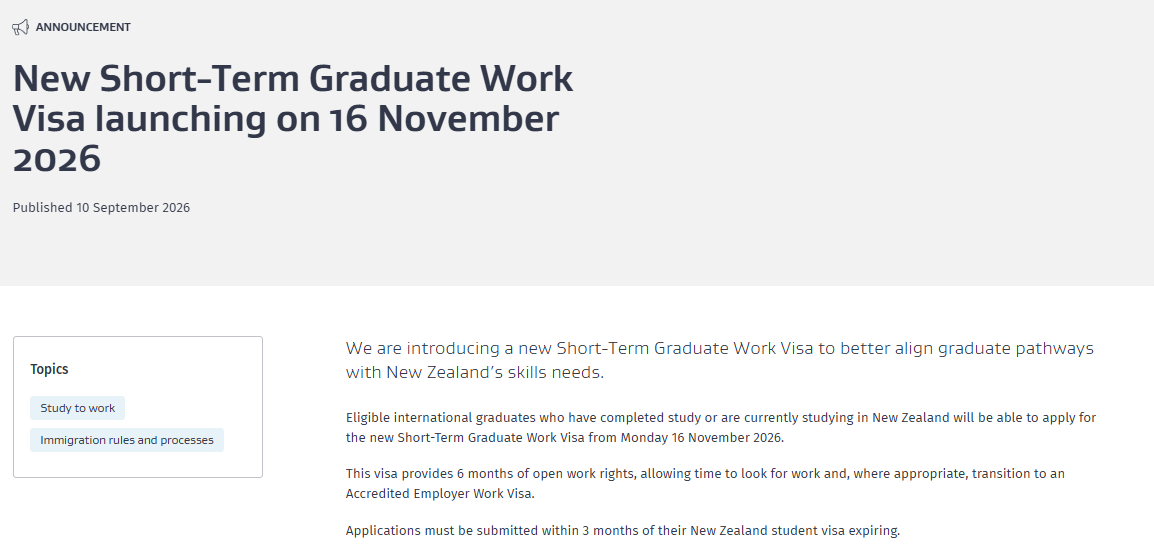
The New Zealand 6-Month Graduate Work Visa is a short-term open work permit for international graduates. It replaces the older three-year post-study option for many shorter qualifications. Holders can work for any employer during the six-month period.
The visa was announced as part of a wider review of New Zealand’s international education settings. The goal is to tie post-study work rights more closely to skill shortages in New Zealand.
The key features are:
- Open work rights, no employer sponsor needed at the start.
- Valid for 6 months from grant date.
- One-time issue, no repeat applications on the same qualification.
- Job offer during the 6 months can lead to a longer skilled visa.
Key Insight: The 6-month cap is a policy shift, not a temporary trial. Students who need longer runway must plan a higher-level qualification or a fast employer offer.
Also check: Complete Study in New Zealand Guide for Indian Students
Who Can Apply for the New Visa
Eligibility is tied to the level and length of your New Zealand qualification. The 6-month visa targets graduates of shorter, non-degree courses at approved providers. Longer degree holders may still access the 2 to 3 year Post-Study Work Visa.
Source: Immigration New Zealand policy update on graduate work rights.
Who fits the 6-month track:
- Graduates of Level 7 diplomas or Graduate Diplomas under 30 weeks.
- Students who studied at a private training establishment on the approved list.
- Applicants who finish study on or after November 16, 2026.
- Holders of a valid student visa at course completion.
Who does not fit:
- Students who completed their course before November 16, 2026.
- Applicants with a study gap of more than 3 months post-completion.
- Graduates without proof of the required English score.
Key Dates for Indian Students
The 6-month visa opens for applications on November 16, 2026. The dates below cover the main planning steps for Indian students starting or finishing courses around that window.
| Milestone | Date |
|---|---|
| Policy announcement | Earlier in 2026 |
| New visa rules take effect | November 16, 2026 |
| Last cohort under old rules | Graduates completing before Nov 16, 2026 |
| First cohort under 6-month rule | Graduates completing Nov 16, 2026 onwards |
| Typical application window | Within 3 months of course completion |
If your course ends before November 16, 2026, you may still qualify under the older rules. Confirm your eligibility with your university’s international office in writing.
Key Insight: The cut-off is based on course completion, not visa application date. A December 2026 graduate cannot argue back into the older longer visa.
Fees and Costs for the Visa
The indicative visa fee sits at NZD 700 (around INR 36,610), based on the current post-study visa charge. Immigration NZ has not published a separate fee for the new 6-month version. Assume a similar range until official confirmation.
| Cost Head | Amount (NZD) | Amount (INR) |
|---|---|---|
| Visa application fee | NZD 700 | INR 36,610 |
| IVL (levy) fee | NZD 100 | INR 5,230 |
| Medical and X-ray | NZD 350 | INR 18,305 |
| Police clearance | NZD 50 | INR 2,615 |
| Total (approx.) | NZD 1,200 | INR 62,760 |
Note: Living costs during the 6-month period also matter. Auckland and Wellington rents run higher than Christchurch or Dunedin. Budget at least NZD 15,000 (around INR 7.85 lakh) for the full six-month runway including rent, food and transport.
How the New Visa Compares to PSWV
The 6-month visa is a shorter, tighter version of the older Post-Study Work Visa. The main difference is duration and the type of qualifications covered. Both allow open work rights and neither requires an employer sponsor to apply.
| Feature | 6-Month Graduate Visa | Post-Study Work Visa |
|---|---|---|
| Duration | 6 months | 2 or 3 years |
| Course level | Level 7 (under 30 weeks) | Level 7 (30+ weeks) or higher |
| Employer sponsor | Not required | Not required |
| Work type | Open | Open |
| Renewal | Not renewable | Not renewable |
| Path to skilled visa | Yes, via job offer | Yes, via job offer |
What the 6-month visa gives you:
- Legal permission to work full-time for any employer.
- A real window to attend interviews and site visits.
- A base to convert to the Skilled Migrant category later.
What the 6-month visa does not cover:
- Extension or repeat application on the same course.
- Automatic pathway to Permanent Residence (PR).
- Family sponsorship rights in most cases.
Documents Needed for the Application
Immigration New Zealand asks for a standard set of documents at application. Missing any one can push your decision by 4 to 6 weeks, which cuts into the 6-month window.
Core documents you should keep ready:
- Valid passport with at least 15 months of validity.
- Completion letter or transcript from your NZ institution.
- Proof of English test score (IELTS 6.5+ or accepted equivalent).
- Recent medical certificate and chest X-ray from a panel doctor.
- Police clearance certificate from India and any other country lived in.
- Proof of funds covering at least NZD 4,200 (around INR 2.20 lakh) for the visa period.
- One passport-size photo meeting INZ specifications.
Source: Immigration New Zealand document checklist for post-study visa applications.
Impact on Indian Students in NZ
The 6-month rule hits shorter course students hardest. Indian students on Level 7 diplomas at private training establishments now have half a year to convert study into a full skilled visa. Master’s and doctorate students continue to hold longer post-study rights.
Real fallout for Indian applicants:
- Course choice matters more. A one-year Master’s beats a 6-month diploma on visa outcome.
- Job hunt starts earlier. Applications from the final semester become standard.
- ROI math changes. Shorter runway lowers the chance of a settled career route.
Named lenders in India, including HDFC Credila, Avanse and SBI Global Ed-Vantage, may re-look at loan appraisals for shorter NZ courses. A tighter post-study period cuts expected earnings and stretches loan repayment timelines. Discuss the loan tenure with your lender before signing.
What Happens After the 6 Months
The 6-month visa does not extend, so plan the next step from Day 1. Three routes open up after the visa ends, and each depends on what you did during the six months.
If you have a full job offer:
- Apply for the Accredited Employer Work Visa (AEWV) through your employer.
- Duration ranges from 2 to 5 years based on role and salary.
- Skilled Migrant residence pathway opens after roughly 24 months on AEWV.
If you do not have an offer:
- You must exit New Zealand within the visa expiry date.
- Re-entry is possible on a fresh visa for a new course or role.
- A visitor visa does not permit job search or work.
If your goal is Permanent Residence (PR):
- PR requires meeting Skilled Migrant points, usually built up over 2 to 3 years of skilled work.
- Roles on the Green List Tier 1 offer a fast-track to residence in some cases.
- Points come from age, work experience, qualification level and job offer salary.
If X applies to you, then Y is the safer play. If you hold a Level 8 or higher qualification, then the standard PSWV is a better base than the 6-month visa. That means you get 2 to 3 years to build the skilled work profile PR requires.
Also Check:
| MS in New Zealand | MBA in New Zealand | Top New Zealand Universities |
| Cost of Studying in New Zealand | IELTS Score for New Zealand | New Zealand PR for Indians |
New Zealand’s 6-Month Graduate Work Visa reshapes the study-to-work pathway for shorter courses from November 16, 2026. Indian students on Level 7 diplomas face a shorter runway, while Master’s and doctorate students retain access to the longer Post-Study Work Visa. Students should now choose their course level with the visa outcome in mind. Start job applications from the final semester and target Green List roles for a potential pathway to residence. Confirm all details with Immigration New Zealand and your university before finalising plans.
FAQs
Ques. What is the New Zealand 6-Month Graduate Work Visa?
Ans. It is a new open work visa launched on November 16, 2026, for international graduates of shorter New Zealand courses. It allows six months of full-time work in any role. The visa targets Level 7 diplomas under 30 weeks and does not extend.
Ques. Who is eligible for the new 6-month graduate visa?
Ans. Eligibility covers graduates of approved Level 7 courses completing on or after November 16, 2026. Applicants need a valid passport, an IELTS 6.5 score and clean police clearance. Longer degree holders may still qualify for the standard Post-Study Work Visa instead.
Ques. When can Indian students apply for the new visa?
Ans. Applications open on November 16, 2026. Students should apply within three months of course completion. Files submitted later may face rejection under the fresh policy timeline.
Ques. How much does the new graduate work visa cost?
Ans. The indicative fee is NZD 700 (around INR 36,610). Total cost with medicals, police clearance and IVL levy runs to about NZD 1,200 (around INR 62,760). Immigration New Zealand may confirm a separate fee closer to the launch date.
Ques. Can students still get the 3-year Post-Study Work Visa?
Ans. Yes. The standard 2 to 3 year PSWV stays open for graduates of Level 7 courses over 30 weeks or Level 8, 9 and 10 qualifications. Only shorter Level 7 diplomas shift to the new 6-month rule.
Ques. Can I extend the 6-month graduate visa?
Ans. No. The visa is not renewable. Students with a skilled job offer can switch to the Accredited Employer Work Visa. Others must leave New Zealand before the visa expires.
Ques. Do I need a job offer to apply for the new visa?
Ans. No. The visa grants open work rights at application. You can look for work during the six months without an employer sponsor. A job offer is only needed for the next visa step.
Ques. What jobs qualify for a skilled visa switch?
Ans. Roles on the Green List or accredited employer register offer the best route. Common qualifying jobs include registered nurses, software engineers, civil engineers and secondary school teachers. Salary must meet the median wage threshold set by Immigration New Zealand.



Comments