





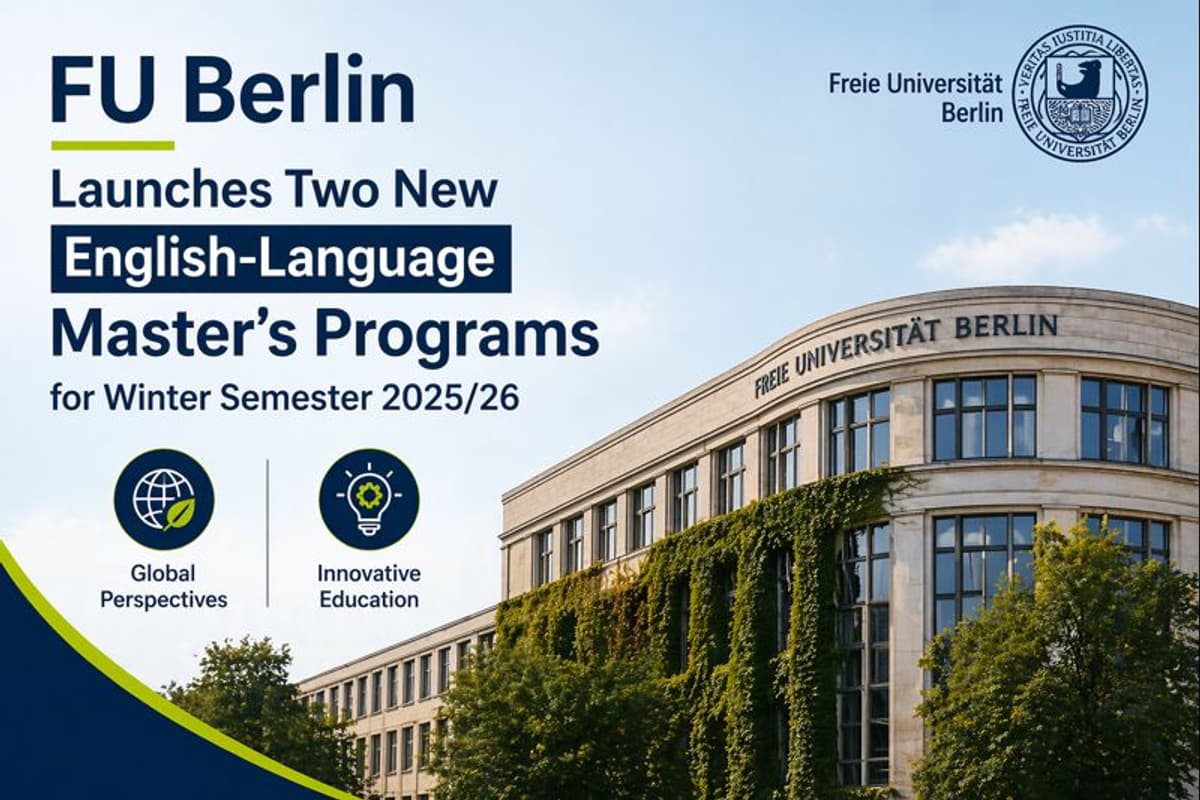
Freie Universität Berlin (FU Berlin), ranked #88 in the QS World University Rankings 2026, has officially launched two brand-new English-language Master's programs starting Winter Semester 2025/26. The two programs are the MA "History and Societies of the Islamic World" and the MA "Semitic Studies". Both are fully taught in English with no German language requirement for admission, making them directly accessible to Indian students without prior German proficiency.
This is a significant development for Indian students interested in Middle Eastern studies, Islamic history, Arabic linguistics, or Semitic languages. Germany's public universities charge zero tuition fees — even for international students — and FU Berlin is no exception. Students pay only a semester contribution of €358.80 (approximately ₹39,600) per semester, which includes a Germany-wide public transport ticket.
As brand-new programs, both cohorts are expected to be smaller and less competitive than established programs at the same university. FU Berlin's Institute of Islamic Studies has confirmed that all applicants who met formal criteria have been accepted so far — a transparency that is rare and valuable for prospective students planning their applications. Indian students applying must obtain an APS Certificate from the German Embassy in India before applying through the uni-assist portal.
Explore the Free University of Berlin — Courses, Fees, Rankings and Admissions 2026 on Collegedunia to plan your application.
FU Berlin at a Glance — Why It Matters for Indian Students
Freie Universität Berlin is one of Germany's top four universities by QS ranking and is ranked #4 in Germany in the QS World University Rankings 2026. It is a public research university founded in 1948 and hosts students from 150+ countries. The university operates primarily from its Dahlem campus in southwest Berlin — a green, quiet, and residential area well-connected to the city centre by U-Bahn and S-Bahn.
For Indian students, FU Berlin offers a rare combination: world-class academic reputation, zero tuition fees, and a growing portfolio of English-taught programs. The university's humanities and regional studies departments are particularly strong, with QS ranking FU Berlin #30 globally for Humanities and Arts in 2026.
| Ranking Body | 2026 Rank | 2025 Rank | 2024 Rank |
|---|---|---|---|
| QS World University Rankings | #88 | #97 | #98 |
| Times Higher Education (THE) | #113 | #104 | #102 |
| Collegedunia Study Abroad Rankings | #56 | — | — |
| QS Europe Rankings (Western Europe) | #14 | #16 | #15 |
| QS Subject: Humanities and Arts | #30 globally | — | — |
FU Berlin's consistent rise from #127 in 2022 to #88 in 2026 on the QS rankings reflects its growing global academic standing. For Indian students in humanities and regional studies, this trajectory matters — a degree from a top-100 global university carries weight in international organisations, cultural institutions, and academic careers.
Check the full ranking history of Free University of Berlin on Collegedunia
MA "History and Societies of the Islamic World" — Full Program Details
This is a research-oriented, 4-semester (2-year) Master's program taught entirely in English at FU Berlin's Department of History and Cultural Studies. It focuses on the social, political, cultural, and religious history of Islamic societies from the origins of Islam to the present day, including a unique regional focus on Islam in Europe — a profile area that does not exist in this form at any other German university.
The program is housed at the Institute of Islamic Studies, which is embedded in a network of world-class institutions. Students gain access to the Museum für Islamische Kunst (Museum for Islamic Art), the Prussian Cultural Heritage Foundation's State Library (home to the largest collection of Arabic manuscripts in Germany), the Leibniz-Zentrum Moderner Orient, and the Berlin Graduate School Muslim Cultures and Societies. This institutional network is a direct academic advantage that no classroom alone can replicate.
Program Structure
The program is divided into three components. The Core Component includes mandatory modules on Islamic History I and II, Culture and Knowledge in Muslim Societies, Theory and Methodology, and Academic Skills. Students then choose an elective track focusing either on West Asia and North Africa or Islam in Europe. The Trans- and Interdisciplinary Component allows students to take courses in Turkish, Hebrew, Persian, or related disciplines. The program concludes with a Master's Thesis.
Students in their second or third semester are encouraged to study abroad at partner universities. Professional internships can also be incorporated into the program as part of the interdisciplinary component.
Admission Requirements
| Requirement | Details |
|---|---|
| Bachelor's Degree | Minimum 180 ECTS; at least 60 ECTS in Islamic world-related subjects |
| Arabic Language | At least 40 ECTS in Arabic up to B2 level (CEFR); or proof of secondary/tertiary education in an Arabic-speaking country |
| English Proficiency | C1 level (CEFR) required if previous degree was not in English |
| German Language | Not required |
| Admission Type | Unrestricted admission (no NC/numerus clausus) |
The Arabic language requirement is the most important eligibility filter for Indian students. Applicants who completed secondary or tertiary education in an Arabic-speaking country are exempt from the ECTS-based Arabic requirement. Indian students with a background in Arabic studies, Islamic studies, or Middle Eastern history from Indian universities are the primary target audience for this program.
Career Outcomes
Graduates are prepared for careers in international organisations, NGOs, media, publishing, museums, specialist libraries, public authorities, political consulting, migration services, and tourism. The program also qualifies graduates for doctoral studies, with the Berlin Graduate School Muslim Cultures and Societies offering further academic pathways for top graduates.
Read the full program details on the FU Berlin Institute of Islamic Studies page
MA "Semitic Studies" — Full Program Details
The MA in Semitic Studies is a two-year, tuition-free, full-time program taught entirely in English at FU Berlin's Institute of Semitic Studies. It offers a deep exploration of Semitic languages including Arabic, Aramaic, and Hebrew, alongside linguistics, cultural history, and the history of the West Asia–North Africa (WANA) region. A defining feature of this program is its special focus on Christian communities and religious minorities in the Middle East — a niche that is academically underrepresented globally.
The program maintains strong connections with Semitic-speaking communities in Berlin itself, giving students direct access to living language communities for research and fieldwork. It also collaborates with the Pergamon Museum (home to the Museum of the Ancient Near East and the Museum of Islamic Art), the Egyptian Museum, and the Prussian Cultural Heritage Foundation's State Library with its renowned Oriental Department.
What You Can Study
The curriculum covers Aramaic across 3,000 years — from Old Aramaic to modern Neo-Aramaic dialects — Syriac Studies, Arabic linguistics and dialectology, Biblical Hebrew, Ugaritic, Comparative Semitics, and Semitic philology. This breadth makes the program one of the most comprehensive Semitic Studies offerings in Europe.
Program Structure
| Component | Modules |
|---|---|
| Basic Area | Northwest Semitic Languages A and B; Comparative Semitics; Christian Orient Past and Present |
| Interdisciplinary Area | Choose two modules from any department at FU Berlin |
| Advanced Area | Choose two from: Arabic Linguistics and Dialectology; Research Perspectives in Semitic Studies; Aramaic Linguistics and Dialectology |
| Master's Thesis | Fourth semester; includes presentation of results |
Admission Requirements
| Requirement | Details |
|---|---|
| Bachelor's Degree | Professionally qualifying degree from a recognised university; minimum 60 CP in Semitic Studies or related fields |
| Language Proficiency (Option A) | At least 40 CP in a modern Semitic language (Arabic MSA, Hebrew, Amharic, Neo-Aramaic) at B2 CEFR or higher |
| Language Proficiency (Option B) | At least 40 CP in a classical Semitic language (Syriac-Aramaic, Biblical Hebrew, Classical Arabic, Geez, Phoenician) |
| English Proficiency | C1 level (CEFR) if previous degree was not in English |
| German Language | Not required |
Indian students from universities offering Arabic, Hebrew, or Semitic language programs — including institutions like Jawaharlal Nehru University (JNU), Aligarh Muslim University (AMU), or Jamia Millia Islamia — are well-positioned to meet these requirements. The Examination Board at FU Berlin evaluates foreign degrees and can assess equivalence before the application process upon request.
Career Outcomes
Graduates can pursue careers in academia and PhD research, museums and cultural heritage institutions, language teaching, international organisations such as UNESCO and UNHCR, media and publishing, and government and diplomatic services focused on the Middle East. The program's interdisciplinary approach and Berlin's extensive WANA-focused institutional network give graduates a competitive edge in niche but high-demand fields.
Read the full MA Semitic Studies program details on the FU Berlin website
Fees and Cost of Studying at FU Berlin — What Indian Students Actually Pay
FU Berlin charges zero tuition fees for all programs — including both new Master's programs — for all students regardless of nationality. This applies equally to Indian students. The only mandatory payment is the semester contribution of €358.80 (approximately ₹39,600) per semester, which covers administrative fees, student union contributions, and a Germany-wide public transport ticket (Deutschlandticket).
For a full 2-year Master's program (4 semesters), the total semester contribution amounts to approximately €1,435 (approximately ₹1.58 lakh) for the entire degree. This is one of the most cost-effective Master's degree options available to Indian students at a globally ranked university.
| Fee Component | Amount (EUR) | Amount (INR approx.) |
|---|---|---|
| Administration Fee (per semester) | €50.00 | ₹5,518 |
| Studierendenwerk Contribution (per semester) | €85.00 | ₹9,380 |
| Student Government Contribution (per semester) | €10.00 | ₹1,103 |
| Deutschlandticket / Transport (per semester) | €213.80 | ₹23,592 |
| Total per Semester | €358.80 | ₹39,593 |
| Total for 2-Year Master's (4 semesters) | €1,435.20 | ~₹1.58 lakh |
Conversion Note: All INR values are calculated at 1 EUR = ₹110.35 (ECB reference rate, April 24, 2026). Actual conversion rates may vary at the time of payment.
Estimated Monthly Living Costs in Berlin
| Expense Category | Monthly Cost (EUR) | Monthly Cost (INR approx.) |
|---|---|---|
| Accommodation (shared flat/WG) | €300 – €650 | ₹33,105 – ₹71,728 |
| Food and Groceries | €200 – €300 | ₹22,070 – ₹33,105 |
| Health Insurance | €110 – €130 | ₹12,139 – ₹14,346 |
| Mobile and Internet | €20 – €40 | ₹2,207 – ₹4,414 |
| Leisure and Miscellaneous | €100 – €150 | ₹11,035 – ₹16,553 |
| Broadcasting Fee (GEZ, per apartment) | €18.36 | ₹2,026 |
| Estimated Monthly Total | €750 – €1,270 | ₹82,763 – ₹1.40 lakh |
Indian students should note that Berlin housing is highly competitive and it is strongly recommended to begin searching for accommodation well before the semester starts. Shared flats (WGs) near the Dahlem campus or along the U3 and S1 lines offer the best balance of cost and commute. The semester transport ticket included in the semester contribution covers all public transport across Germany — a significant saving for students who travel frequently.
For the German student visa, Indian students must show a blocked account (Sperrkonto) of approximately €11,904 per year (approximately ₹13.13 lakh) as proof of financial capacity.
Read the complete guide to Cost of Living in Germany for Indian Students on Collegedunia
How Indian Students Apply to FU Berlin — Step-by-Step Process
Indian students applying to FU Berlin for a Master's program must follow a two-stage process involving the uni-assist portal and the FU Berlin application portal. This process is specific to applicants with non-German degrees, and Indian students have an additional mandatory requirement: the APS Certificate.
The APS (Akademische Prüfstelle) Certificate is issued by the Academic Evaluation Centre at the German Embassy in India. It verifies the authenticity of Indian academic credentials and is mandatory for all Indian students applying to German universities. Without it, neither uni-assist nor FU Berlin will process the application.
Application Steps for Indian Students
| Step | Action | Key Detail |
|---|---|---|
| 1 | Obtain APS Certificate | Apply at the German Embassy in India; mandatory for Indian applicants |
| 2 | Apply for VPD at uni-assist | Submit online at my.uni-assist.de; select "Freie Universität Berlin" and "alle Fächer – Master"; processing takes 4–8 weeks |
| 3 | Create FU Berlin Application Account | Register at identity.fu-berlin.de within the application deadline period |
| 4 | Submit Application via FU Berlin Portal | Upload VPD, transcripts, degree certificate, English proficiency proof, and APS Certificate |
| 5 | Await Admission Decision | Both new programs have unrestricted admission; all applicants meeting formal criteria have been accepted so far |
Application Deadlines
| Semester | Application Period |
|---|---|
| Winter Semester (October start) | 20 April to 15 August |
| Summer Semester (April start) | 1 December to 15 January |
The VPD processing at uni-assist can take up to 8 weeks during peak periods. Indian students must apply for the VPD well in advance of the FU Berlin application deadline. The decisive factor for meeting the deadline is the complete receipt of all documents including the VPD in the FU Berlin portal — not the date the VPD was applied for.
Check the complete FU Berlin Admission Process and Deadlines on Collegedunia
English Proficiency Requirements — No German Needed for These Programs
Both new Master's programs require English proficiency at the C1 level (CEFR) for applicants whose previous degree was not conducted in English. Indian students who completed their Bachelor's degree at an English-medium institution in India are typically exempt from submitting a separate English proficiency test, as the instruction medium of their degree qualifies as proof.
For students who do need to submit a test score, the following are accepted:
| Test | Minimum Score Required (C1 Level) |
|---|---|
| IELTS Academic | 7.0 overall (C1 equivalent) |
| TOEFL iBT | 95+ (C1 equivalent) |
| Duolingo English Test | 120+ (C1 equivalent) |
| PTE Academic | 76+ (C1 equivalent) |
Critically, no German language skills are required for admission to either program. This removes the single biggest barrier that typically prevents Indian students from considering German public universities. Students may write their MA theses in English, and all coursework is conducted in English.
Learn about German Language Proficiency Tests
Scholarships and Funding Options for Indian Students at FU Berlin
FU Berlin does not charge tuition fees, which is itself the most significant financial benefit for Indian students. Beyond this, several scholarship and funding options are available. The primary merit-based scholarship open to all enrolled students — including Indian students — is the Deutschlandstipendium, which provides €300 per month (approximately ₹33,105) funded equally by the German Federal Government and private sponsors.
| Scholarship | Amount | Eligibility | Key Note for Indian Students |
|---|---|---|---|
| Deutschlandstipendium | €300/month (~₹33,105); minimum 2 semesters | All enrolled students including Indian students; merit-based | Apply after receiving admission; strong academic record and extracurricular activities help |
| DAAD Scholarships | ~€934/month (~₹1.03 lakh) plus travel and insurance | Indian students for Master's and PhD programs | Best option to apply before arriving in Germany; multiple fully funded options available |
| STIBET (via University) | ~€250/month (~₹27,588) for ~10 months | Currently enrolled international students only | Not available for new applicants; limited seats |
| PROMOS | Partial funding (varies) | Enrolled students for study abroad periods | Useful for the study abroad semester in second or third year |
Indian students should prioritise applying for DAAD scholarships before arriving in Germany, as these are the most substantial funding source available to Indian Master's students. The DAAD has a dedicated India office and regularly funds students in humanities, social sciences, and regional studies — fields directly aligned with both new FU Berlin programs.
Explore DAAD Scholarships for Indian Students on Collegedunia
Why These Two Programs Are a Strategic Opportunity for Indian Students
Both programs launched in Winter Semester 2025/26, making them brand-new with no established waitlist culture or inflated competition. FU Berlin's Institute of Islamic Studies has publicly stated that all applicants who met formal criteria have been accepted so far — a level of transparency that signals genuine accessibility for qualified applicants. For Indian students with the right academic background, this is a rare window to enter a top-100 global university program at its earliest and most accessible stage.
The no-German-required policy removes the most common barrier for Indian students considering German universities. Most public university programs in Germany require TestDaF or DSH German proficiency, which demands 1–2 years of preparation. These two programs bypass that requirement entirely.
From a career perspective, both programs open doors to international organisations, UNESCO, UNHCR, cultural diplomacy, academic research, and museum work — sectors where a degree from a QS top-100 university in Germany carries significant credibility. Berlin's position as a European capital with a large Muslim population, active Semitic-speaking communities, and a dense network of WANA-focused research institutions makes it uniquely suited for these fields of study.
Indian students from universities with strong Arabic, Islamic studies, or Semitic language departments — such as JNU, AMU, Jamia Millia Islamia, or Hyderabad Central University — are the most directly eligible applicants. Students with a background in history, linguistics, religious studies, or Middle Eastern studies from any recognised Indian university should assess their ECTS equivalence and Arabic or Semitic language credits before applying.
Browse all English-taught programs at Free University of Berlin on Collegedunia
interested in this College ?
Follow & Share this college to get information about admission.



Comments