





ESSEC Business School admissions for Indian students run through structured round-based selection across the Global MBA, Master in Management, MSc, and Global BBA tracks. A 4-year Bachelor’s is the postgraduate eligibility, while the Global BBA reviews Class XII transcripts well above the school average.
- Next live window: Global MBA takes case-by-case applications for September 2026 intake through mid-July 2026.
- SMIB base tuition: €29,900 (₹32.00 Lakhs) plus application fee €120 (₹12,842).
- Eligibility: BBA needs strong Class XII, PG needs Bachelor’s plus IELTS 6.5, MBA needs IELTS 7.
- Selectivity: Estimated 13 to 25% across flagship programs, with no official institutional rate published.
The Master in Management, Global MBA, and Master in Data Sciences carry the strongest Indian interest at ESSEC Business School. Indian alumni rate the Eiffel-eligible MIM track, the four-campus rotation, and the Paris-La Défense placement reach.
Currency note: All INR figures in this article use €1 = ₹107.02 (June 30, 2026). Live rates may vary, so confirm with your bank before remitting.
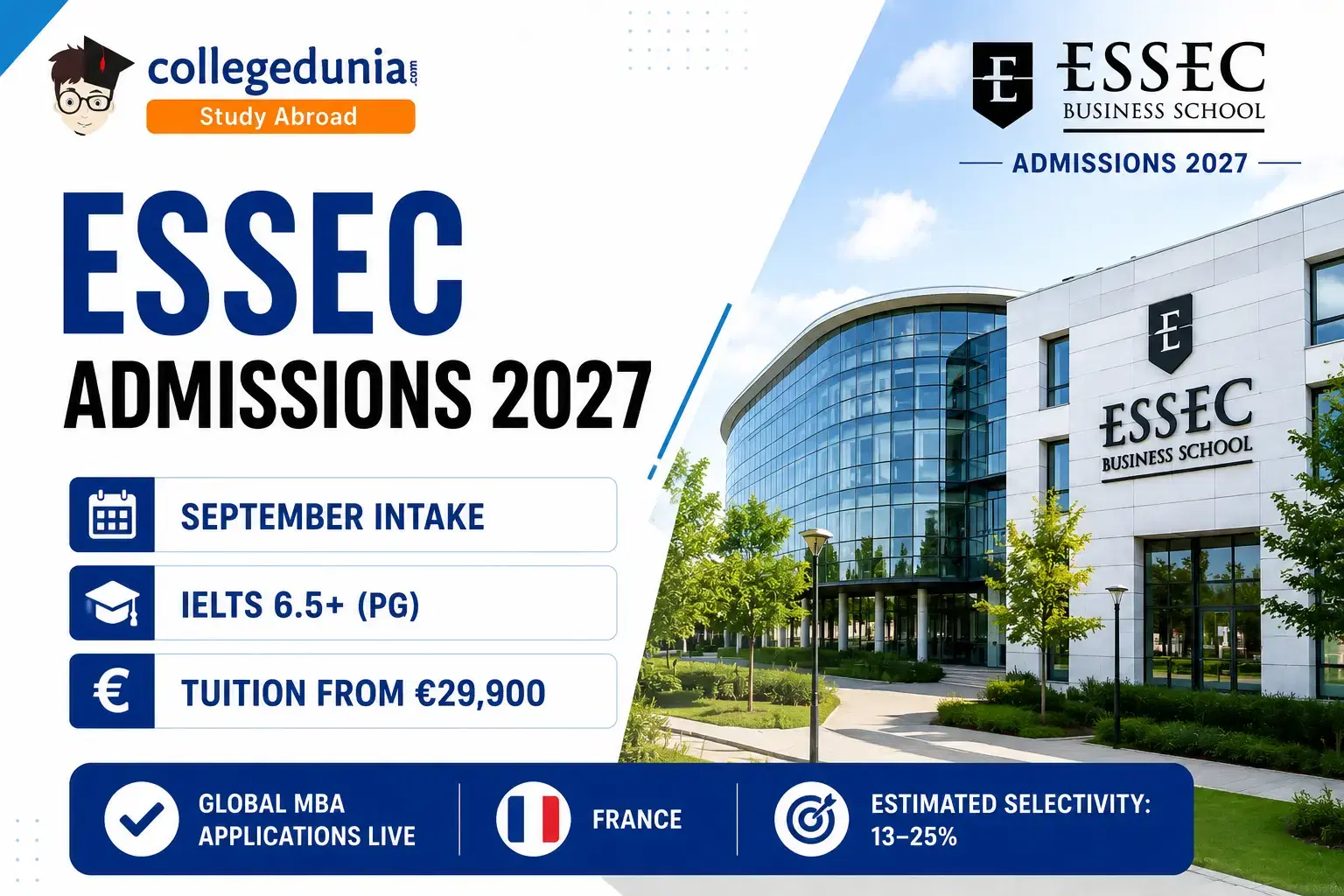
Table of Contents
- ESSEC Business School Application Deadlines
- ESSEC Business School Eligibility Criteria
- ESSEC Business School PG Programs
- ESSEC Business School Global BBA Admissions
- ESSEC Business School Global MBA Admissions
- ESSEC Business School Application Process
- ESSEC Business School Admission Decisions
- ESSEC Business School Documents Required
- ESSEC Business School Acceptance Rate
- France Student Visa for ESSEC Business School
- ESSEC Business School Admission Tips
- ESSEC Business School Admissions Checklist
- ESSEC Business School Admissions: Frequently Asked Questions
ESSEC Business School Application Deadlines for Indian Students
ESSEC runs four annual application rounds for postgraduate and undergraduate programs across its Cergy, La Défense, Singapore, and Rabat campuses. All deadlines close at 12:00 noon Paris time (3:30 pm IST), with results published roughly four to six weeks after each round.
The dates below cover the just-closed September 2026 cycle, sourced from ESSEC’s published Master in Management admissions calendar. The September 2027 cycle Round 1 is expected to open in October 2026.
| Program (Sept 2026 intake) | Round 1 | Round 2 | Round 3 | Round 4 | App Fee | Portal |
|---|---|---|---|---|---|---|
| MIM Grande Ecole (Intensive and Flexible) Primary intake | 2 Oct 2025 (Closed) | 15 Dec 2025 (Closed) | 19 Feb 2026 (Closed) | 9 Apr 2026 (Closed) | €180 (₹19,264) | myapply.online |
| Master in Finance and DSBA | 15 Oct 2025 (Closed) | 7 Jan 2026 (Closed) | 24 Feb 2026 (Closed) | 14 Apr 2026 (Closed) | €120 (₹12,842) | myapply.online |
| SMIB | 15 Oct 2025 (Closed) | 12 Jan 2026 (Closed) | 4 Mar 2026 (Closed) | 27 Apr 2026 (Closed) | €120 (₹12,842) | myapply.online |
| Global BBA (Cergy and Singapore) | 30 Oct 2025 (Closed) | 13 Jan 2026 (Closed) | 11 Mar 2026 (Closed) | 22 Apr 2026 (Closed) | €100 (₹10,702) | myapply.online |
| Global MBA (rolling) | Early Bird 15 Jun 2026 (Closed) | Final case-by-case through mid-July 2026 (Live) | Next intake Sept 2027 | Next intake Sept 2027 | €130 (₹13,913) | candidate.essec.edu |
Note: Round 1 for the September 2027 cycle typically opens in mid-October 2026 across MIM, Master in Finance, DSBA, SMIB, and Global BBA. The Global BBA also runs a Round 5 (Singapore and Rabat campuses only) if seats remain.
ESSEC Business School Eligibility Criteria for Indian Students
Each ESSEC track sets a different academic criteria, but all postgraduate programs share an institutional English minimum and accept an India-friendly aptitude test list. The Global MBA carries the highest experience bar, while the Global BBA reads Class XII transcripts.
- UG (Global BBA): Class XII completed with results well above the school average across the last three years.
- PG (MIM, MSc): A recognised Bachelor’s degree from an accredited Indian university with strong academic profile.
- Global MBA: Four-year Bachelor’s, minimum 3 years (6 years average) of post-graduation work experience.
- Age floor (MBA only): 25 years on application; cohort average sits at 30.
English proficiency is mandatory across all English-taught tracks. ESSEC accepts five tests with the following floors:
| English Test | Global MBA | MIM and MSc | Global BBA |
|---|---|---|---|
| IELTS Academic | 7.0 | 6.5 | 6.5 |
| TOEFL iBT | 100 | 95 | 90 |
| TOEIC L&R | 800 | 850 | 850 |
| Cambridge B2 First | Accepted | 175 | 175 |
| Duolingo English Test | 135 | Not accepted | 120 (Rabat only) |
ESSEC IELTS Waiver for Indian Students:
ESSEC waives English testing for several Indian applicant profiles. The MIM and MSc tracks accept candidates who have completed three years of higher education entirely in English. The Global BBA waives the test if the last two years of pre-university study were taught fully in English. The Global MBA waives the test for graduates whose university degree was English-medium or who have spent three years in an English-speaking environment.
Aptitude Tests Accepted for Indian PG Applicants
ESSEC accepts CAT scores specifically for Indian applicants to the MIM, SMIB, Master in Finance, and DSBA programs, valid for one year. GMAT, GMAT Focus, GRE, and TAGE-MAGE are also accepted. Score validity sits at five years for GMAT and GRE.
Insider note: Indian applicants who have taken CAT for IIM rounds can reuse the same score here. The CAT acceptance is a country-specific carve-out that GMAT-only competitors do not advertise.
ESSEC Business School PG Programs for Indian Students
ESSEC offers two flagship postgraduate routes: the Master in Management Grande Ecole (the standard MIM in two tracks) and a wide MSc catalog spanning finance, data science, luxury, and international strategy. Base tuition starts around €15,900 per year (₹17.02 Lakhs) for the one-year DSBA M2 and rises with program duration. For the full course-wise fees breakdown, see the dedicated ESSEC fees page.
| Programme | Duration | Minimum Eligibility | English Req. Min. |
|---|---|---|---|
| Master in Management (MIM) Intensive Track | 1 year | Bachelor’s with 6+ months full-time experience | IELTS 6.5 / TOEFL 95 |
| Master in Management (MIM) Flexible Track | 2 to 3 years | Bachelor’s, no work experience required | IELTS 6.5 / TOEFL 95 |
| Master in Strategy and Management of International Business (SMIB) | 1 or 2 years | Bachelor’s degree, all backgrounds | IELTS 6.5 / TOEFL 95 |
| Master in Data Sciences and Business Analytics (with CentraleSupélec) | 1 or 2 years | Bachelor’s, quantitative coursework preferred | IELTS 6.5 / TOEFL 95 |
| Master in Luxury Management | 2 years | Bachelor’s degree, motivation for luxury sector | IELTS 6.5 / TOEFL 95 |
| Master in Finance | 1 or 2 years | Bachelor’s, finance or economics preferred | IELTS 6.5 / TOEFL 95 |
| Master in Marketing Management and Digital | 2 years | Bachelor’s degree, all backgrounds | IELTS 6.5 / TOEFL 95 |
| Master in Sustainability Transformation | 2 years | Bachelor’s degree, demonstrated sustainability interest | IELTS 6.5 / TOEFL 95 |
The MIM Intensive Track suits Indian applicants with a four-year Bachelor’s and at least six months of post-degree work. The Flexible Track stretches over two to three years and accepts fresh graduates. Both tracks share the same admissions calendar and the same Cergy and Singapore campus rotation.
Planning note: Indian MIM applicants are automatically nominated for the French government’s Eiffel Excellence Scholarship if eligible. See ESSEC’s funding for Indian students page for the wider list.
Note: Program-specific entry requirements, fees, and intake availability may differ from the institution-wide minimums shown above. Always confirm on the official ESSEC Master in Management page for your chosen program before applying.
ESSEC Business School Global BBA Admissions for Indian Students
The Global BBA is ESSEC’s flagship undergraduate route, running as a four-year program with rotations across the Cergy, Singapore, and Rabat campuses. Indian students apply through the International Track, intended for high-school candidates with strong Class XII academic profiles.
| Programme | Duration | Minimum Eligibility | English Req. Min. |
|---|---|---|---|
| Global BBA International Track (Cergy or Singapore) | 4 years | Class XII with academic record consistently above class average across last 3 years | IELTS 6.5 / TOEFL 90 |
| Global BBA International Track (Rabat) | 4 years | Class XII with strong academic record | IELTS 6.5 / TOEFL 90 / Duolingo 120 |
The Global BBA application fee is €100 (₹10,702) for the Cergy and Singapore campuses, and €50 (₹5,351) for Rabat. Shortlisted candidates face a 30-minute motivational interview conducted via Zoom in front of two examiners. The school does not publish a fixed Class XII%age cutoff but explicitly states the academic record must be "way above the average".
ESSEC Business School Global MBA Admissions for Indian Students
The ESSEC Global MBA is a 12-month full-time program (extendable to 16 months) with start on 7 September 2026. The application fee is €130 (₹13,913), and shortlisted candidates undergo a structured interview before final admission. ESSEC publishes tuition on the program’s Financing section, with a deposit of €6,000 (₹6.42 Lakhs) due within two weeks of admission. See the per-course Global MBA page for the current fee figure.
Global MBA Eligibility for Indian Applicants
ESSEC requires a four-year Bachelor’s degree and a minimum of three years of post-university professional experience, with six years the cohort average. Applicants holding a three-year Indian Bachelor’s enter via the VAPP recognition route, which lifts the work-experience floor to five years. The minimum age at application is 25.
The GMAT Focus, classic GMAT, Executive Assessment, GRE, or TAGE-MAGE are accepted with a preferred minimum GMAT Focus score of 585 (cohort average 615). ESSEC allows conditional admission without the test score, provided the verified score arrives before the next round deadline.
Global MBA Interview and Decision Timeline
Complete applications are reviewed within two weeks, after which shortlisted candidates are invited to a 30 to 40-minute interview conducted in person at Paris or Singapore, or by video conference. Panels mix the Academic Director with alumni, HR professionals, and recruiters. Decisions follow within 2 to 3 weeks of the interview.
Planning note: The September 2026 intake still admits Indian applicants on a case-by-case basis through mid-July 2026. Apply with a complete file (GMAT or test waiver justification, 2 references, transcripts, English proof) to be considered against remaining seats.
ESSEC Business School Application Process for Indian Students
ESSEC routes all postgraduate, MSc, and Global BBA applications through one online portal, while the Global MBA uses a dedicated candidate space. The submission, fee payment, document upload, and interview booking all happen online. The end-to-end cycle from start to decision typically runs six to eight weeks.
- Pick your program and round: Choose MIM, MSc, SMIB, BBA, or Global MBA, and the round whose deadline gives you four to six weeks of prep.
- Create your candidate account: Postgraduate, MSc, and BBA applicants register on the ESSEC myapply portal; Global MBA applicants use the Global MBA candidate space.
- Upload supporting documents: Transcripts, degree certificates, CV (one page), references, English test score, and GMAT or CAT scores.
- Pay the application fee: Pay the program-specific application fee of €100 to €180 (₹10,702 to ₹19,264) online; Global MBA applicants pay €130 (₹13,913).
- Submit before noon Paris time: All files lock at 12:00 noon Paris time (3:30 pm IST) on the round deadline day.
- Attend the videoconference interview: Shortlisted candidates schedule a 30 to 45-minute Zoom interview within two weeks of file review.
ESSEC Business School Admission Decisions and Offer Acceptance
Decisions land in your portal inbox roughly six weeks after the round deadline, broken into a shortlist email, the interview window, and the final admission verdict. Offers carry a clear acceptance deadline and a financial deposit requirement.
- Offer letter timing: Final results published within 6 weeks of round deadline; Global MBA decisions within 3 weeks of interview.
- Deposit on acceptance: Global MBA candidates pay a non-refundable €6,000 (₹6.42 Lakhs) deposit within two weeks of admission.
- Conditional offers: Pending GMAT, IELTS, or final Bachelor’s transcript; final score required before next round close.
- Deferral policy: Limited and handled case-by-case; written request to the Admissions office within 30 days of offer.
- Visa file release: ESSEC issues the Campus France-ready admission letter after the deposit is cleared.
ESSEC Business School Documents Required for Indian Applicants
The document set is uniform across most ESSEC tracks, with three add-ons for the Global MBA. Originals stay in India; the portal accepts certified PDF copies, translated into English or French if the source is in any other language.
- Passport copy: Bio-data page, valid 6 months beyond course end.
- Passport-size ID photograph: Recent, plain background, JPEG or PDF.
- Curriculum Vitae: One page maximum for MIM and BBA; up to two for the Global MBA.
- Class X and XII transcripts: CBSE, ICSE, or State Board mark sheets, all years.
- Bachelor’s degree certificate: Provisional or final, with university convocation letter if available.
- Official university transcripts: Semester-wise mark sheets from all institutions attended.
- Two reference letters: One academic, one professional for MIM; both professional for the Global MBA. ESSEC ships a dedicated PDF template.
- Statement of motivation: Embedded in the application essays within the portal.
- Proof of employment: Joining letter and most recent payslip; Global MBA needs a detailed work history letter.
- Financial proof: Bank statement or loan sanction letter to cover tuition and €615 (₹65,817) monthly living costs.
ESSEC Business School Acceptance Rate for Indian Students
ESSEC does not publish an official institutional acceptance rate. Based on cohort-size disclosures and applicant volume across forums and the school’s published cohort composition, selectivity is estimated at 13 to 25% across the MIM, MSc, and Global MBA tracks.
Estimated selectivity by Program
- Master in Management: Estimated 13 to 15%, drawn from a high-volume international applicant pool.
- Global MBA: Estimated 15 to 25%, with a 100% international cohort and a 6-year experience average.
- MSc programs: Estimated 20 to 30% depending on program demand and quant filtering.
- Global BBA: Estimated 25 to 35%, with academic transcripts the dominant filter.
What Shapes an Indian Applicant’s Odds?
Three filters move the needle: Class XII or Bachelor’s transcript strength, an aptitude score above the cohort average (GMAT Focus 615 for MBA, strong CAT or GMAT%ile for MIM), and a coherent international career narrative for the interview. The school also tracks international work or study exposure as a positive signal for MBA review.
Insider note: ESSEC weights cross-border profiles heavily. Indian applicants with a semester exchange, an MNC role with global remit, or a documented language credential outside English-Hindi tend to convert interviews more often.
France Student Visa for ESSEC Business School Admits
Indian admits to ESSEC apply for the VLS-TS long-stay student visa, the standard France residence-permit visa for stays beyond 90 days. The application runs in two stages: a Campus France pre-validation followed by the consular visa stamp via VFS Global.
The Campus France stage requires registration on india.campusfrance.org, document upload, fee payment, and a pedagogical interview at one of the Campus France offices (Delhi, Mumbai, Bengaluru, Chennai, or Kolkata). The visa stage uses france-visas.gouv.fr for the application and books biometrics at a VFS centre. Indian applicants need an ESSEC admission letter, accommodation proof, financial proof of €615 (₹65,817) per month for 12 months, medical insurance, and the Campus France fee receipt. Start the file 8 to 12 weeks ahead of departure. Once in France, validate the VLS-TS online through ANEF within 3 months of arrival and pay the €50 (₹5,351) e-stamp. International students work up to 964 hours per year, around 20 hours per week.
2026 update: Campus France India processing times remain stable at 6 to 8 weeks. Book VFS biometrics in July or early August for September-intake admits, as Mumbai and Delhi slots fill ahead of the academic year.
Tips for ESSEC Business School Admissions
The following tips are drawn from Indian-applicant patterns at ESSEC across the MIM, MSc, BBA, and Global MBA tracks.
- Take CAT instead of GMAT: ESSEC accepts CAT scores specifically for Indian MIM and MSc applicants, valid for one year.
- Submit by Round 2 (mid-December or January): Eiffel Excellence Scholarship slots fill quickly across MIM and MSc tracks.
- Pick MIM Intensive if you have 6+ months work: The Admissions Committee re-routes underqualified profiles to Flexible without warning.
- Consider the Singapore campus track: SMIB and MIM fees match Cergy, but Singapore living costs are tighter and predictable.
- Use the GMAT waiver for MBA at risk: ESSEC accepts a complete file without the test if you commit to deliver before next round.
- Combine MBA with a 1+1 partner: Yale SOM and MIT Sloan offer dual-degree pathways open to ESSEC Global MBA admits.
- Mention Indian work-related global exposure: Cross-border deals, MNC remit, or overseas internships convert interviews at higher rates.
ESSEC Business School Admissions Checklist
The following steps cover what Indian applicants typically complete in the weeks before each round closes at noon Paris time.
- 12 weeks out: Begin Campus France Études en France registration for September intake.
- 10 weeks out: Book the GMAT or CAT slot to allow a rescore buffer.
- 8 weeks out: Schedule IELTS or TOEFL, no later than this window.
- 6 weeks out: Brief both referees on ESSEC’s PDF reference template.
- 4 weeks out: Request transcripts and degree attestations from your university.
- Round deadline day: Submit by 12:00 noon Paris time (3:30 pm IST) and pay the application fee.
- Post-submission: Reserve a two-week window for the interview videoconference.
ESSEC fits Indian applicants who can submit early, line up a CAT or GMAT score, and prepare for an interview within two weeks of submission. The Eiffel pathway and the Singapore campus option give the MIM and SMIB tracks a strong cost-adjusted return for serious candidates.
Frequently Asked Questions
Ques. Can Indian students apply to ESSEC with a three-year Bachelor’s degree?
Ans. Yes for MIM and most MSc programs. The Global MBA, however, asks for a four-year Bachelor’s; three-year holders apply via the VAPP route with a five-year work-experience floor.
Ques. Does ESSEC accept CAT scores from Indian applicants?
Ans. Yes. ESSEC accepts CAT for the MIM, SMIB, Master in Finance, and DSBA tracks specifically for Indian applicants. CAT scores stay valid for one year from the test date.
Ques. What is the next live application deadline for Indian students?
Ans. The Global MBA still takes case-by-case applications for September 2026 through mid-July 2026. All other programs (MIM, MSc, BBA) reopen with Round 1 in October 2026 for the September 2027 intake.
Ques. How much is the ESSEC application fee for Indian applicants?
Ans. The application fee runs from €100 to €180 (₹10,702 to ₹19,264) by program. MIM is €180, MBA is €130, most MScs are €120, and the Global BBA is €100 (Cergy and Singapore) or €50 for Rabat.
Ques. Is the GMAT mandatory for the Global MBA?
Ans. No. ESSEC permits a conditional admission without the GMAT or GRE if you commit to deliver a valid score before the next round deadline. The preferred minimum GMAT Focus is 585; cohort average is 615.
Ques. Are there IELTS waivers for Indian applicants at ESSEC?
Ans. Yes. MIM and MSc applicants who completed three years of higher education entirely in English are exempt. BBA applicants are exempt if the last two years of Class XI and XII were taught fully in English. Global MBA grants the waiver to English-medium Bachelor’s graduates.
Ques. How long does the ESSEC application decision take?
Ans. Final results land within six weeks of the round deadline for MIM and MSc, and within three weeks of the interview for the Global MBA. Shortlist confirmations arrive two to three weeks ahead of final results.
Ques. What scholarships can Indian applicants apply for at ESSEC?
Ans. Indian MIM applicants are nominated automatically for the French government’s Eiffel Excellence Scholarship if eligible. The Charpak Scholarship, ESSEC-QS Future Leader (up to €20,000 / ₹21.40 Lakhs for MBA), and the Global MBA Summer Offer (€2,500 / ₹2.68 Lakhs) are also open.
Ques. Where do Indian admits attend ESSEC, Cergy or Singapore?
Ans. Most Indian admits begin at Cergy (Paris area) or Singapore. The MIM and SMIB allow campus rotation between Cergy, Singapore, and Rabat. The Global MBA splits between Paris-La Défense and Singapore.
Ques. What financial proof does the France student visa need?
Ans. The VLS-TS long-stay student visa requires proof of at least €615 (₹65,817) per month for 12 months, covering rent, food, and transport. Education loan sanction letters from Indian banks are accepted alongside bank statements and scholarship letters.
Ques. Can Indian students work during ESSEC studies?
Ans. Yes. International students with the VLS-TS visa work up to 964 hours per year, around 20 hours per week, during term and full-time during recognized academic breaks.
Ques. What is the interview format for ESSEC Indian applicants?
Ans. All ESSEC interviews run on Zoom video for international applicants. MIM and SMIB use 45-minute interviews with two examiners; the Global MBA uses 30 to 40 minutes with academics, alumni, and recruiters. The BBA uses 30 minutes.
Essec business school Program Fees & Deadlines
| Program | Important Dates | Fees | Application Fees | Eligibility |
|---|---|---|---|---|
MBA Global 12 months | INR 59.5 L/Yr EUR 55,000 /Yr | 130 | TOEFL iBT: 100 | IELTS: 7 | Duolingo: 135 |
Do you think the Dates are wrong ? Report Here



Comments