





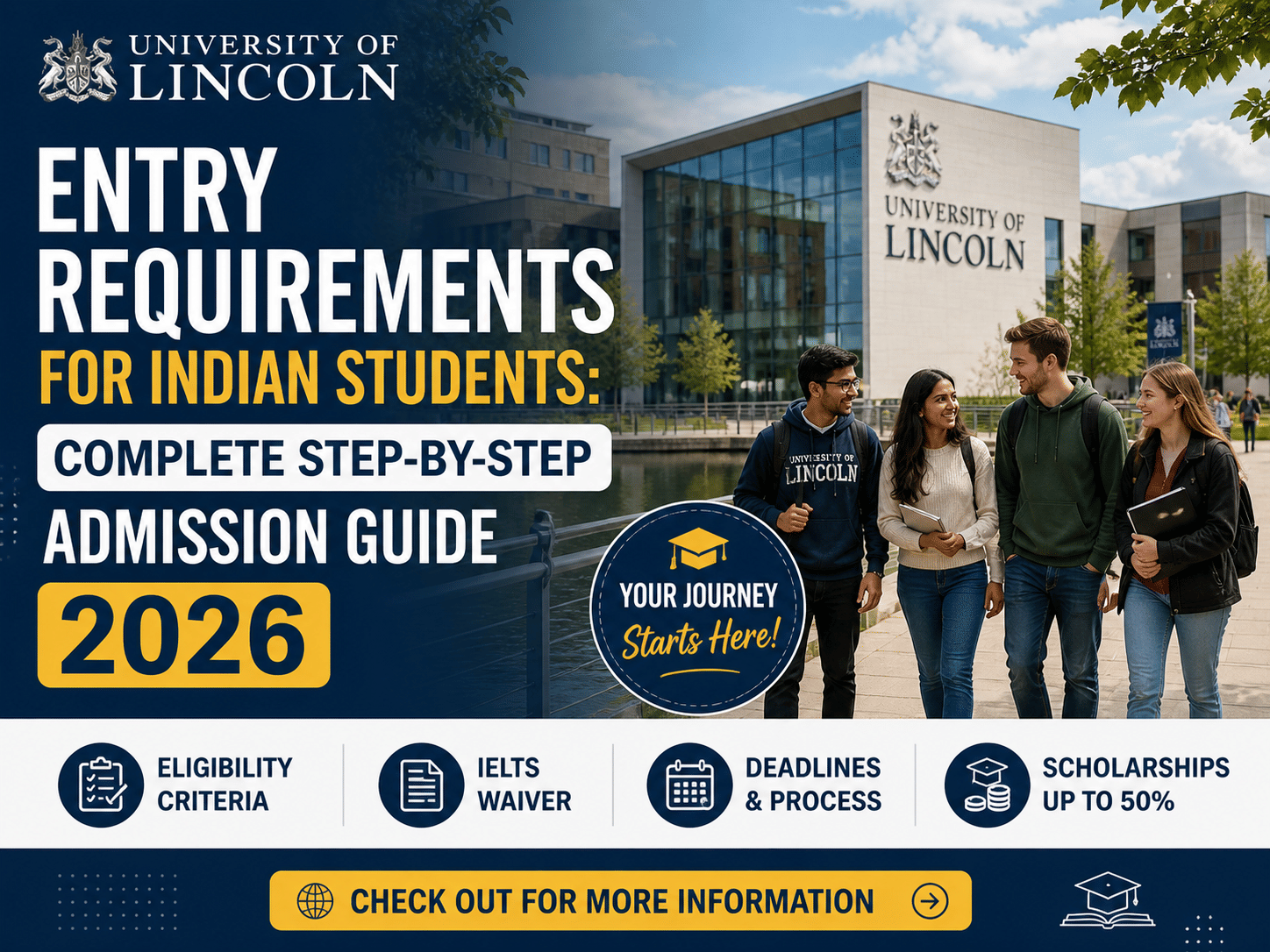
The University of Lincoln accepts CBSE and State Board results and has an acceptance rate of around 91%, making it one of the more accessible UK universities for Indian students. For undergraduate programs, students must complete Class 12, typically with 65–70%, although no official minimum is specified. For postgraduate programs, a bachelor’s degree with around 60% (UK 2:1 equivalent) is required. The university may waive IELTS if a student has scored 70% or above in English in Class 12.
The application deadline for the September 2026 intake is 14 January 2026 (UCAS equal consideration deadline), and the overall admission process generally takes 4 – 6 months from application to enrollment. The process includes key steps such as eligibility check, course selection, document preparation, application submission, offer acceptance, CAS/visa process, and final enrollment. Degree preparation programs are available for students who do not meet direct entry requirements, and scholarships of up to 50% of tuition fees are available for Indian students.
STEP 1: Check Your Eligibility – Do You Meet Requirements?
Before applying, verify that you meet the University of Lincoln's entry requirements.
Undergraduate Eligibility
| Requirement | What You Need |
|---|---|
| Academic Qualification | 12th Standard (CBSE/CISCE/State Board) – Pass |
| Minimum Marks | Typically 65–70% (no official minimum) |
| English Language | IELTS 6.0 OR 70%+ in English in 12th |
| Subject Requirements | Check specific program (some need Math/Science) |
| Age | Minimum 17 years old |
Postgraduate Eligibility
| Requirement | What You Need |
|---|---|
| Bachelor's Degree | Completed from a recognized university |
| Minimum Marks | 60% (UK 2:1) or 55% (UK 2:2) – check program |
| English Language | IELTS 6.5 OR 70%+ in English in 12th |
| Relevant Background | Bachelor's in a related field (check program) |
What If You Don't Meet Requirements?
- Low Marks: Apply for International Foundation Year (UG) or Pre-Masters (PG) – no minimum marks required
- No IELTS: If 70%+ English in 12th, you get IELTS waiver
- Below Minimum: 91% acceptance rate – still worth applying directly
For more information, check out the University of Lincoln's admission
STEP 2: Choose Your Course – Browse 300+ Programs
University of Lincoln offers 300+ undergraduate and postgraduate courses.
How to Choose Your Course
- Visit Course Finder: lincoln.ac.uk/search – search by subject, level, or keyword
- Filter by Level: Undergraduate, Postgraduate Taught, or Postgraduate Research
- Read Course Details: Check content, entry requirements, career prospects, fees
- Check Entry Requirements: Each course page lists specific requirements (some need Math/Science)
- Review Fees: Undergraduate: £15,000–£20,000/year. Postgraduate: £12,000–£18,000/year
- Shortlist 3–5 Courses: Apply to multiple programs to increase chances
Popular Courses for Indian Students
- Business & Management: MBA, MSc Business, BA Business
- Engineering: BEng Mechanical, BEng Civil, MSc Engineering
- Computer Science: BSc Computer Science, MSc Data Science
- Arts & Humanities: BA English, BA History, MA Creative Writing
- Health & Social Care: BSc Nursing, MSc Public Health
For more information, check out the University of Lincoln courses and fees
STEP 3: Prepare Required Documents – Gather Everything Now
Prepare all documents before applying – delays cause missed deadlines.
Documents Required for All Applications
| Document | Details | How to Get | Timeline |
|---|---|---|---|
| Academic Transcripts | 10th, 12th, Bachelor's marks | Request from school/college | 1–2 weeks |
| Certificates | 12th standard certificate, Bachelor's degree | School/college office | 1–2 weeks |
| English Language Proof | IELTS score OR 70%+ English in 12th | IELTS test (if needed) or 12th mark sheet | 4–6 weeks (IELTS) |
| Passport Copy | Photo page (scanned) | Scan your passport | Immediate |
| Personal Statement | 250–500 words (UG) or 500–1000 words (PG) | Write yourself | 1–2 weeks |
| References | 1–2 academic/professional references | Ask teachers/professors/employers | 1–2 weeks |
| Certified Translations | If the documents are not in English | Professional translator | 1–2 weeks |
Personal Statement Tips
- Why This Course: Explain your genuine interest in the program
- Career Goals: How the course helps your career aspirations
- Why Lincoln: Why you chose University of Lincoln specifically
- Your Strengths: Highlight relevant skills and achievements
- Be Authentic: Write in your own words – don't use AI or copy
- Proofread: Check for spelling and grammar errors
Reference Letter Tips
- Ask Early: Give referees 2–3 weeks notice
- Provide Details: Send them course information and your CV
- Academic References: Teachers/professors are best for UG
- Professional References: Employers/supervisors are good for PG
- Direct Submission: Ask them to send directly to University
For more information, check out the UCAS deadlines 2026
STEP 4: Submit Your Application – Online Portal
Application process differs for undergraduate and postgraduate.
UNDERGRADUATE APPLICATION (via UCAS)
- Step 1: Visit www.ucas.com
- Step 2: Create account with email and password
- Step 3: Fill in personal details (name, address, passport number)
- Step 4: Add education history (10th, 12th, any other qualifications)
- Step 5: Search for University of Lincoln courses (code: L72)
- Step 6: Add up to 5 courses to your application
- Step 7: Write personal statement (250–500 words)
- Step 8: Add reference (teacher/professor)
- Step 9: Pay application fee (£22.50 for multiple courses)
- Step 10: Submit application
POSTGRADUATE APPLICATION (Direct to University)
- Step 1: Visit course page on lincoln.ac.uk
- Step 2: Click "Apply Now" button
- Step 3: Create account on University's online system
- Step 4: Fill in personal and education details
- Step 5: Upload documents (transcripts, certificates, passport)
- Step 6: Write personal statement (500–1000 words)
- Step 7: Add reference letter
- Step 8: Submit application (usually FREE)
Application Checklist Before Submitting
- All documents uploaded and clear
- Personal statement proofread and authentic
- Reference letter received
- All personal details correct (name, passport number, email)
- Correct course code selected
- Application fee paid (if applicable)
- Email address is active and monitored
Action: Submit application at least 1 week before deadline to avoid technical issues.
STEP 5: Receive Offer & Accept – Wait for Decision
After submission, University reviews your application.
What Happens After Submission
| Timeline | What Happens | Action Required |
|---|---|---|
| 1–2 weeks | University reviews application | Check email regularly |
| 2–4 weeks | Receive offer (conditional or unconditional) | Read offer letter carefully |
| If Conditional: | Meet conditions (e.g., final exam results) | Provide documents by deadline |
| If Unconditional: | Offer is final – you're accepted | Accept offer immediately |
| After Acceptance: | Receive acceptance confirmation | Proceed to CAS application |
Types of Offers
- Unconditional Offer: You're accepted – no conditions. Accept immediately and proceed to CAS.
- Conditional Offer: Accepted IF you meet conditions (e.g., final exam results, IELTS score). Provide documents by deadline.
- Rejection: Application unsuccessful. You can appeal or apply to other universities.
How to Accept Your Offer
- UCAS (Undergraduate): Log into UCAS Hub → Click "Accept" on offer
- Direct Application (Postgraduate): Reply to offer email or use University portal
- Deadline: Usually 2–4 weeks to accept – don't delay
- Confirmation: You'll receive acceptance confirmation email
For more information, check out the accommodation in the UK
STEP 6: Apply for CAS & Student Visa – Sponsorship Letter
After accepting offer, apply for CAS (Confirmation of Acceptance for Studies) – required for UK student visa.
What is CAS?
- CAS = Confirmation of Acceptance for Studies
- Official letter from University confirming your enrollment
- Required to apply for UK student visa
- Issued after you accept offer and meet conditions
CAS Application Process
| Step | Action | Timeline |
|---|---|---|
| 1 | Accept offer from University | Immediately |
| 2 | University sends CAS request form | 1–2 weeks after acceptance |
| 3 | Complete CAS form with personal details | 1 week |
| 4 | Submit CAS form to University | Immediately |
| 5 | PRE-CAS INTERVIEW (for Indian students) | 1–2 weeks |
| 6 | University issues CAS letter | 1–2 weeks after interview |
| 7 | Receive CAS letter via email | Immediately |
IMPORTANT: Pre-CAS Interview for Indian Students
- Required for: India, Ghana, Iran, Iraq, Nepal, Sri Lanka, Sudan, Syria
- Purpose: Verify your genuine intention to study and financial capacity
- Format: Online video interview (15–20 minutes)
- Questions: Why this course? Career goals? Financial support? English proficiency?
- Preparation: Research course, practice English, prepare answers
- After Interview: CAS issued within 1–2 weeks if approved
Student Visa Application
- After CAS Received: Apply for UK Student Visa (Tier 4/Student Visa)
- Where to Apply: www.gov.uk/student-visa
- Required Documents:
- CAS letter from University
- Passport (valid for 6+ months)
- Proof of funds (bank statements showing fees + living costs)
- IELTS certificate (if applicable)
- Tuberculosis test certificate
- Processing Time: 3–4 weeks for Indian students (fast-track available)
- Visa Fee: £719 (approximately INR 60,000)
- Health Surcharge: £1,035/year (approximately INR 86,000/year)
Also, check Scholarships in the UK
STEP 7: Travel & Enroll – Final Steps
After visa approval, prepare for travel and enrollment.
Pre-Departure Checklist
- ✓ Visa approval received
- ✓ Accommodation booked (on-campus or private)
- ✓ Flight tickets booked
- ✓ Travel insurance purchased
- ✓ Tuberculosis test done
- ✓ Bank account opened (if possible)
- ✓ Luggage packed with essentials
- ✓ Inform University of arrival date
Arrival in UK
- Arrive 1–2 weeks before course starts
- Attend University induction/orientation
- Register with local police (if required)
- Open UK bank account
- Get student ID card
- Attend welcome events and meet other students
For more information, check out the work while studying in the UK
Enrollment Process
- Attend enrollment appointment at University
- Confirm personal details and course
- Pay any remaining fees
- Receive student ID and library card
- Register for classes
- Attend first lectures
Action: Book accommodation early. Arrive 1–2 weeks before course starts. Attend all orientation events.
Application Deadlines 2026 – CRITICAL DATES
| Intake | Program Type | Application Deadline | Course Start | Status |
|---|---|---|---|---|
| September 2026 | Undergraduate (UCAS) | 14 January 2026 (Equal Consideration) | September 2026 | OPEN NOW |
| September 2026 | Postgraduate | Rolling (Apply ASAP) | September 2026 | OPEN NOW |
| January 2027 | Undergraduate (UCAS) | 30 June 2026 | January 2027 | OPEN |
| January 2027 | Postgraduate | Rolling (Apply ASAP) | January 2027 | OPEN |
For more information, check out the work while studying in the UK
FAQs
Ques. What is the complete timeline from application to enrollment?
Ans. Typical timeline: 4–6 months (1) Application submission: January 2026, (2) Offer received: February–March 2026, (3) Accept offer: March 2026, (4) CAS + Pre-CAS interview: April–May 2026, (5) Visa application: May 2026, (6) Visa approval: June 2026, (7) Travel & enrollment: August–September 2026. Start applying NOW to meet September 2026 intake.
Ques. Do I need IELTS if I scored 70%+ in English in 12th?
Ans. NO – you get an IELTS waiver. If you scored 70% or above in English in 12th standard (CBSE, CISCE, or State Board), you don't need IELTS. This saves time and money. Just provide your 12th mark sheet as proof.
Ques. What happens in the Pre-CAS interview for Indian students?
Ans. Pre-CAS interview is a 15–20 minute online video call to verify your genuine intention to study and financial capacity. Questions asked: Why this course? Career goals? How will you fund your studies? English proficiency? Preparation: Research the course, practice English, prepare honest answers. After interview: CAS issued within 1–2 weeks if approved.
Ques. How much money do I need to show for visa?
Ans. You need to show proof of funds for: (1) Full tuition fees for 1 year (e.g., £15,000–£20,000 for UG), (2) Living costs for 1 year (approximately £15,000–£20,000). Total: £30,000–£40,000 (INR 25–33 Lakhs). Funds must be in your bank account for at least 28 days before visa application. Parents' bank statements are acceptable.
interested in this College ?
Follow & Share this college to get information about admission.



Comments