



| Updated On - Jul 8, 2026
A Medium of Instruction (MOI) certificate is an official letter from a school, college, or university confirming that a student's education was taught and examined entirely in English. Universities abroad often accept it in place of IELTS or TOEFL, making it one of the cheapest documents in a study-abroad file. It costs nothing to INR 500, against IELTS fees of INR 18,000 to 19,000.
- An MOI certificate proves where you studied in English, not how well you speak it, so acceptance always depends on each university's own policy.
- The document is only as strong as its presentation: no letterhead, no seal, or no authorised signature means near-certain rejection abroad.
- A university waiving IELTS is not the same as the visa authority waiving it, so both must be checked separately before skipping the test.
- Requesting the certificate early matters more than most students expect, because Indian registrar offices move slowly during exam season.
| Parameter | Detail |
|---|---|
| Full form | Medium of Instruction certificate |
| Issued by | Registrar, Controller of Examinations or Principal |
| Cost in India | Free to INR 500 |
| Processing time | 5 to 15 working days (up to 4 to 6 weeks in exam season) |
| Replaces | IELTS, TOEFL, PTE or Duolingo at accepting universities only |
| Accepting destinations | 70+ UK universities, plus institutions in the USA, Germany, France, Ireland, Canada and Malaysia |
| Typical validity window | Qualification completed within the last 2 to 5 years |
Must Read:
What is an MOI Certificate?
An MOI certificate is a one-line factual declaration, on institutional letterhead, that the language of teaching and examination for a named student's program was English. It is typically a single A4 letter signed by the Registrar, Controller of Examinations or Principal, depending on institution rules. Some Indian institutions title the same letter a bonafide letter or an English language waiver, and the wording inside matters more than the title.
- The student's full name and enrollment or registration number, matching the passport spelling exactly.
- The program name and the start and end dates of study at the institution.
- An explicit statement that the medium of instruction and examination was English.
- Official letterhead, the institution's seal, the signatory's name and designation, and the date of issue.
What an MOI certificate gives you: a documented basis for an English test waiver, faster applications and savings of INR 18,000 or more. What it does not cover: a measured proficiency score, guaranteed acceptance at every university, or automatic clearance of visa-stage English rules.
Who Can Get an MOI Certificate?
Any student whose full program was taught and examined in English can request an MOI certificate from that institution. Partial English teaching usually does not qualify, and overseas universities can reject certificates from programs that mixed languages. The issuing institution must also be recognised by national education authorities for the letter to hold weight abroad.
| Applicant Profile | Who Issues the MOI | Typically Used For |
|---|---|---|
| Class 12 pass (English medium, Class 10 to 12) | School Principal | Bachelor's applications abroad |
| Bachelor's degree holder | College or university Registrar | Master's applications abroad |
| Diploma holder | Diploma institution | UG or PG diploma pathways |
| Master's degree holder | University Registrar | Second master's or PhD applications |
School-issued MOI letters generally need at least 2 years of continuous English-medium study, which is why the Class 10 to 12 window is the standard reference. For master's applications, universities want the MOI from the bachelor's institution, not the school. It works like a chain: the letter must come from the most recent qualification relevant to the program applied for.
Key Insight: When both a school MOI and a college MOI are available, universities abroad tend to prefer the one from the highest and most recent qualification. Sending the college letter for a master's application avoids an avoidable follow-up email from admissions.
Also Read:
MOI Certificate Sample PDF
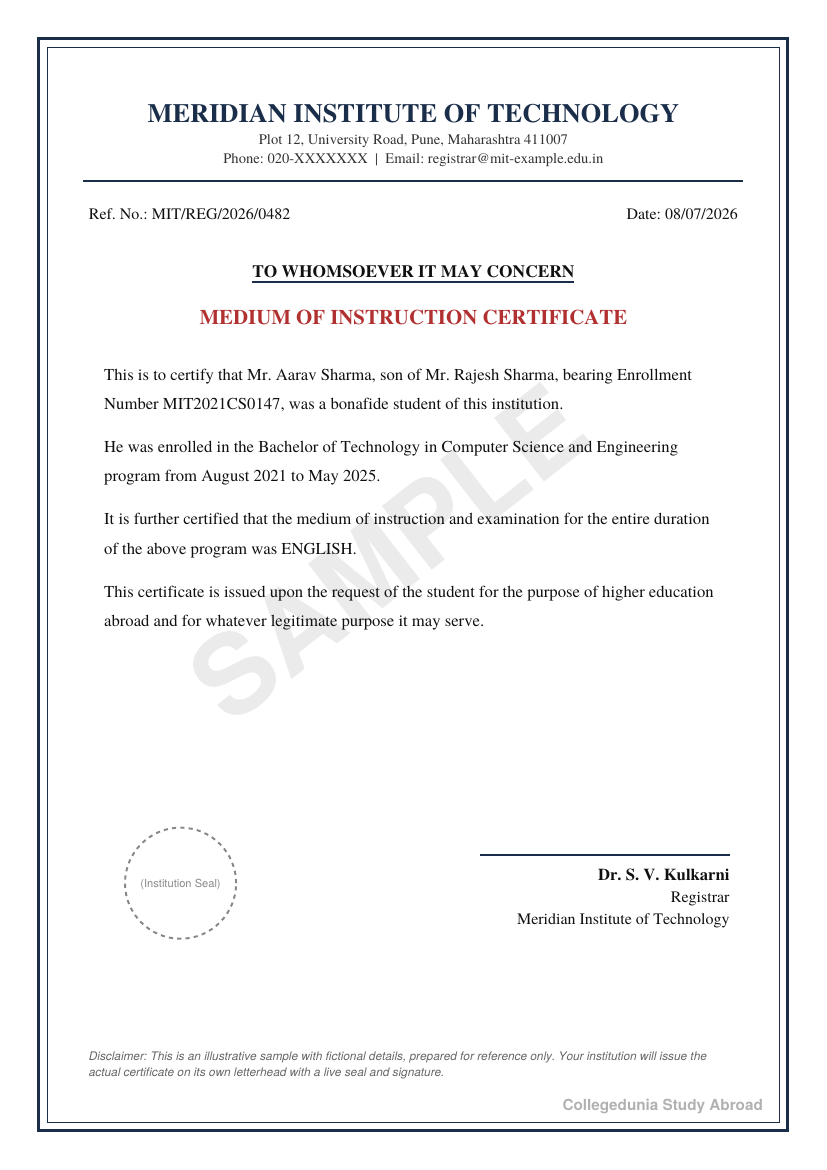
There is no single national format for an MOI certificate, so most Indian institutions issue it as a short letter on their own letterhead, and many ask the student to supply a draft format. If your target university has shared a specific format, hand that exact version to your registrar. Otherwise, the standard structure below is accepted across institutions.
Download the ready-to-use formats and the filled sample below:
- MOI Certificate Format (University/College) PDF: blank template for bachelor's and master's degree holders, to be printed on institutional letterhead.
- MOI Certificate Format (School) PDF: blank template for Class 12 pass students applying for bachelor's programs abroad.
- MOI Certificate Sample PDF: a filled illustrative example showing correct placement of the reference number, body text, seal and signature.
How to Apply for an MOI Certificate?
Students apply for an MOI certificate directly at their institution's registrar office, examination cell or principal's office, in person or through the institution's online certificate portal where one exists. The process is administrative rather than evaluative, so no test or interview is involved. Follow these steps:
- Check your target university's English waiver policy and download any prescribed MOI format it specifies.
- Write a formal request to the Registrar, Controller of Examinations or Principal stating the purpose as higher education abroad.
- Attach supporting documents: marksheets, degree or provisional certificate and a government ID.
- Pay the applicable fee, which ranges from nothing to INR 500 at most institutions.
- Collect the signed and sealed certificate, then scan it at high resolution for online applications.
Standard processing takes 5 to 15 working days. If the deadline is in October, then the request should go in by August. That means the MOI sits ready before applications open rather than becoming the item that delays them.
Students whose institution declines to issue an MOI still have routes into an admit, including alternative tests and the conditions covered under the IELTS fee waiver and cost-saving options available in India.
MOI Certificate vs IELTS: Key Differences
An MOI certificate records the language of past study, while IELTS measures current English proficiency with a band score, and universities treat the two as different classes of evidence. That is why an MOI works at some universities and fails at others that insist on a scored test. Neither document cancels the need to check the other's requirement.
| Parameter | MOI Certificate | IELTS |
|---|---|---|
| What it proves | Education was in English | Measured English ability (band 1 to 9) |
| Cost | Free to INR 500 (around USD 5) | INR 18,000 to 19,000 (around USD 190 to 200) |
| Preparation time | None | Typically 1 to 6 months |
| Issued or conducted by | Your own institution | IDP test centres |
| Acceptance | University-specific and conditional | Near-universal for admission and visas |
| Validity | Tied to a qualification usually within 2 to 5 years | 2 years from the test date |
Conversions based on a USD-INR rate of INR 95.29 as of July 08, 2026. Rates fluctuate; check the current rate before financial planning.
Note: The MOI is a waiver document, not a score substitute. A university that "accepts MOI" is choosing to waive its test requirement for you; it has not received any proof of how well you actually read, write or speak English, which is why interviews sometimes accompany MOI-based admits.
Which Countries Accept the MOI Certificate?
Over 70 UK universities accept the MOI certificate, and institutions across the USA, Germany, France, Ireland, Canada, Australia and Malaysia recognise it under their own conditions. No country operates a blanket national rule, so acceptance is decided university by university against published English requirements. The pattern by destination looks like this:
| Country | How MOI Acceptance Works |
|---|---|
| UK | 70+ universities accept MOI; UKVI lets the sponsoring university self-assess English, so MOI works only when reflected on the CAS |
| USA | Many state and private universities waive tests with 2+ years of English-medium study; the I-20 then usually satisfies the F-1 requirement |
| Germany | Widely accepted for English-taught programs alongside APS verification of transcripts |
| France | Majority of public universities and many business schools accept MOI for a waiver |
| Ireland | Universities such as TU Dublin and MTU consider MOI for select programs |
| Canada | Accepted by several institutions, often needing 3 to 4 years of continuous English-medium study |
| Australia | Some universities accept MOI for the offer, but the Subclass 500 visa still demands a secure English test |
Germany illustrates the strongest use case: public universities charge no tuition for most programs, and an MOI plus APS-verified transcripts can complete the English requirement for admission there. The full pathway is covered in this guide to studying in Germany without IELTS, including visa-stage proof.
When Does an MOI Certificate Get Rejected?
MOI certificates are most often rejected for presentation defects, expired qualification windows, excluded institutions or program categories that mandate a scored test. Knowing the failure points in advance is what separates a smooth waiver from a mid-application scramble. The documented rejection triggers are:
- The letter is not on official letterhead or lacks the institutional seal and an authorised signature.
- The qualification is older than the university's window, usually 2 to 5 years from completion.
- Many UK universities do not accept MOI letters from institutions in Punjab, Haryana and Jammu and Kashmir, so applicants from these states are steered to PTE Academic UKVI or LanguageCert.
- Medicine, nursing, dentistry and law programs almost always require IELTS regardless of the university's general waiver policy.
- The program mixed English with a regional language, so the "entire duration in English" statement cannot be truthfully made.
What a university IELTS waiver covers: the admission requirement of that one university for that one intake. What it does not cover: immigration rules, which run separately. Canada's post-graduation work permit now requires CLB 7 on a designated test, so a student can enter Canada on an MOI-based admit yet still need a scored test before working after graduation. In the UK, the Graduate Route shortens from 2 years to 18 months for applications on or after January 1, 2027, which affects planning either way. Source: IRCC and UK government policy updates, 2026.
If an application falls in a rejection category, then the fallback is an alternative test or a strong Class 12 English score. That means booking PTE or Duolingo early enough to keep the original intake, typically 6 to 8 weeks before the deadline.
The MOI certificate rewards students who treat it as an early-stage document rather than a last-minute fix. It costs almost nothing, takes days to weeks to issue and can remove the single most expensive test from an application budget. Its limits are equally real: acceptance is conditional, presentation defects are fatal and visa rules run on their own track. A student who confirms acceptance in writing, requests the letter one cycle early and keeps a scored-test fallback loses nothing either way. Handled that way, one letter from a registrar's office can quietly do the work of a month of test preparation.
FAQs
Ques. What is an MOI certificate?
Ans. An MOI certificate is an official letter from a school, college or university confirming that a student's coursework and examinations were conducted entirely in English. Many universities abroad accept it in place of IELTS, TOEFL, PTE or Duolingo, subject to their own published English requirements.
Ques. How much does an MOI certificate cost in India?
Ans. Free to INR 500 at most Indian institutions. Compared with an IELTS fee of INR 18,000 to 19,000, plus possible coaching of INR 10,000 to 50,000, the MOI route can save a student up to INR 69,000 in total.
Ques. How long does it take to get an MOI certificate?
Ans. Approximately 5 to 15 working days in normal periods. During exam season, registrar offices can stretch to 4 to 6 weeks, and a format error can add another 2 to 3 weeks, so early requests are strongly advised.
Ques. Who issues the MOI certificate in India?
Ans. The Registrar or Controller of Examinations issues it at colleges and universities, and the Principal issues it at schools. The certificate is valid only on official letterhead with the institution's seal and an authorised signature.
Ques. Can a Class 12 student get an MOI certificate from school?
Ans. Yes. A school can issue an MOI if the student completed at least 2 years of English-medium study, typically Class 10 to 12. School MOI letters are accepted mainly for bachelor's applications, while master's applications need the letter from the bachelor's institution.



Comments